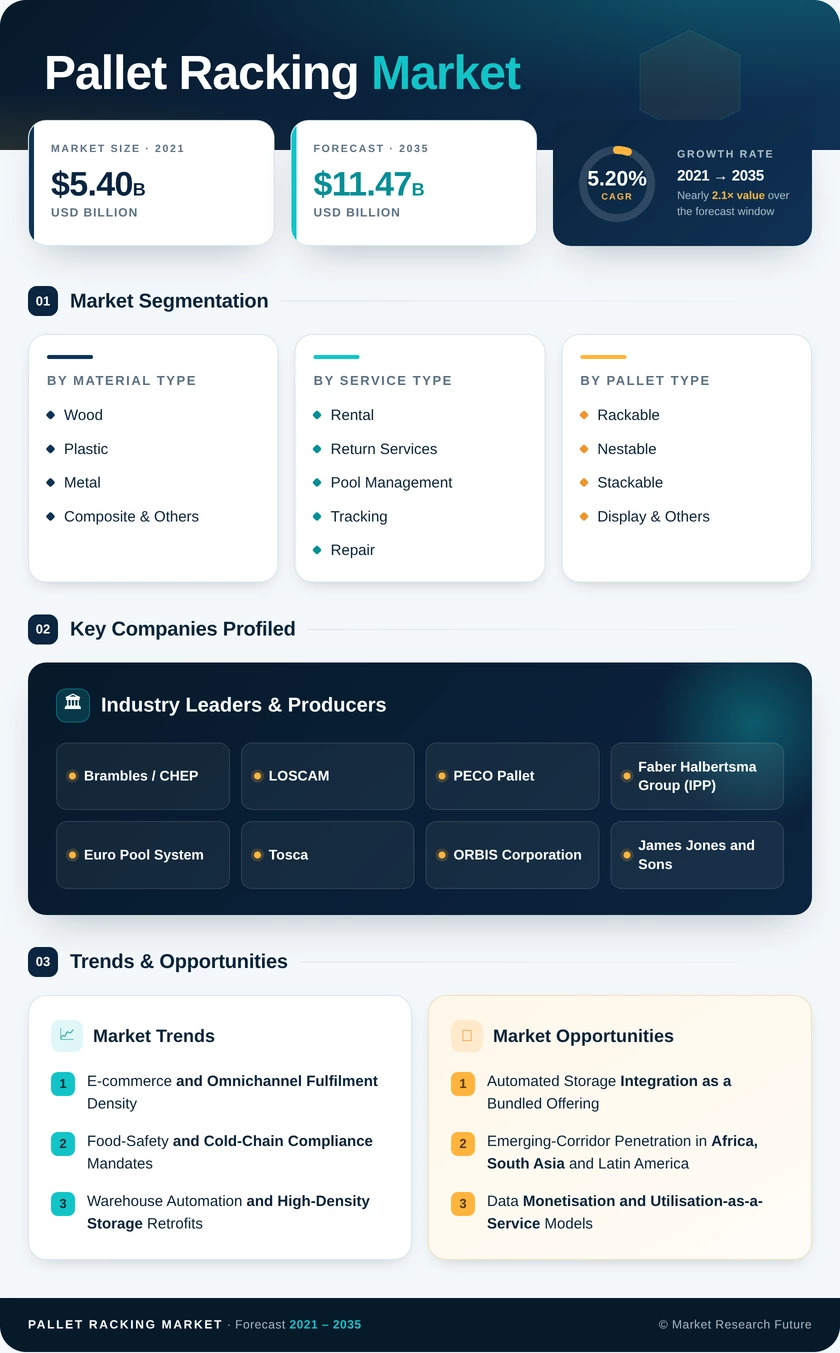
Segmentation Quick Reference
| Dimension | Sub-Segments | Dominant Segment | Fastest Growing Segment |
| By Material Type | Wood; Plastic; Metal; Composite & Others | Wood | Plastic |
| By Service Type | Rental and Return Services; Pool Management and Tracking; Repair and Refurbishment | Rental and Return Services | Pool Management and Tracking |
| By Pallet Type | Rackable; Nestable; Stackable; Display & Others | Rackable | Nestable |
| By End-User Industry | Food and Beverage; Retail and Consumer Goods; Chemicals; Pharmaceuticals; Automotive; Others | Food and Beverage | Pharmaceuticals |
| By Region | North America; Europe; Asia-Pacific; South America; Middle East & Africa | North America | Asia-Pacific |
Market Segmentation Overview
By Material Type
| Sub-Segment | Key Trend |
| Wood | Repair-led cost advantage sustains volume leadership; ISPM-15 treatment capacity concentrates supply |
| Plastic | Wash-validated surfaces expand into chilled food, dairy and pharmaceutical loops |
| Metal | Retained for loads above 1,500 kg where deflection tolerance is critical |
| Composite & Others | Recycled-content formulations gain preference under European reuse accounting |
Material selection is increasingly a compliance decision rather than a cost decision. Hygiene validation and recycled-content verification now influence tender outcomes as much as unit price, which explains why plastic and composite formats grow faster than the market average despite higher acquisition cost.
By Service Type
| Sub-Segment | Key Trend |
| Rental and Return Services | Core revenue base; pricing shifting from per-trip toward availability-guaranteed contracts |
| Pool Management and Tracking | Fastest-growing service line as traceability and utilisation reporting become billable |
| Repair and Refurbishment | Capacity constraint emerging as extended trip counts improve customer disclosure positions |
Service mix is migrating up the value stack. Operators that once sold physical access are now selling audited event data and guaranteed availability, which raises switching costs and improves contract duration relative to commodity rental arrangements.
By Pallet Type
| Sub-Segment | Key Trend |
| Rackable | Required for racked and automated high-bay storage; dimensional tolerance becoming certified |
| Nestable | Collapsed return height cuts empty-leg trailer counts and freight emissions |
| Stackable | Steady demand in floor-stacked general distribution and secondary corridors |
| Display & Others | Retail merchandising units tied to promotional calendars and store-ready formats |
Format demand tracks storage architecture. As automated retrieval and high-bay configurations spread, edge-supported rackable designs become the default specification, while nestable formats capture growth wherever return-leg freight economics dominate the total cost calculation.
By End-User Industry
| Sub-Segment | Key Trend |
| Food and Beverage | Traceability enforcement drives identifier-bearing platform adoption ahead of 2028 |
| Retail and Consumer Goods | Omnichannel replenishment raises handling frequency and reverse-flow volume |
| Chemicals | Load integrity and hazardous handling documentation govern specification |
| Pharmaceuticals | Good distribution practice validation supports premium per-trip pricing |
| Automotive | Captive tier-supplier loops remain structurally stable with long specification cycles |
| Others | Industrial, agricultural and construction distribution growing with regional infrastructure spend |
End-user growth diverges by regulatory exposure rather than by volume. Verticals facing statutory traceability or hygiene validation requirements — food, pharmaceuticals — expand fastest, while captive industrial loops grow steadily but change specification only on multi-year redesign cycles.
By Region
| Sub-Segment | Key Trend |
| North America | Traceability compliance and automation retrofit dominate capital allocation |
| Europe | Reuse mandates and disclosure obligations reshape procurement criteria |
| Asia-Pacific | Cold-chain buildout and warehousing formalisation drive first-time adoption |
| South America | Agricultural export corridors anchor demand; currency volatility constrains fleet capital |
| Middle East & Africa | Trade-hub investment and third-party logistics partnerships open white space |
Regional trajectories reflect two distinct growth engines. Mature markets grow on regulation-driven replacement and density improvement, while developing corridors grow on penetration gains from a low base, which explains the wide spread between North American and Asia-Pacific growth rates.


 Noah Malgeri
Co-Founder

 Peter Groot koerkamp
Account and Business Manager

 Younghwan Choi
Senior Retail Manager

 Mark Irwin
Management Consultant

 Akif Moroglu
Strategy & Business Development Director

 Guilherme Gomes Martins
Product Management Director

 Joseph Aguayo
Sales Operations & Pricing Manager

 La Terria Dodd
Program Support Specialist

 Rob Kooiker
Group Product Manager HVAC & Fire Protection GMA