×
Request Free Sample ×

Kindly complete the form below to receive a free sample of this Report

* Please use a valid business email

Leading companies partner with us for data-driven Insights

clients tt-cursor
Hero Background
English
Chinese
French
Japanese
Korean
German
Spanish

Pain Management Market Trends

ID: MRFR/MED/4517-HCR
200 Pages
Rahul Gotadki
February 2026

Pain Management Market Research Report By Type of Pain (Acute Pain, Chronic Pain, Neuropathic Pain, Nociceptive Pain), By Treatment Type (Medication, Physical Therapy, Interventional Procedures, Alternative Therapies), By End User (Hospitals, Clinics, Homecare Settings, Rehabilitation Centers), By Route of Administration (Oral, Topical, Injectable, Transdermal) and By Regional (North America, Europe, South America, Asia Pacific, Middle East and Africa) - Growth & Industry Forecast 2025 To 2035

Share:
Download PDF ×

We do not share your information with anyone. However, we may send you emails based on your report interest from time to time. You may contact us at any time to opt-out.

Pain Management Market Infographic
Purchase Options

Market Trends

Key Emerging Trends in the Pain Management Market

In the contemporary landscape, consumers are undergoing a paradigm shift towards heightened health consciousness, prompting companies to intensify their focus on research and development. This strategic emphasis aims to usher in advanced technologies and treatments, providing a competitive edge in a dynamic market. The ongoing evolution in the global neuropathic pain market is significantly influenced by key players who wield considerable influence in steering industry trends. These major players are making strategic decisions, particularly in the realms of acquisition and collaboration, aimed at bolstering their product portfolios and fortifying science and technology capabilities on a global scale.

The competitive dynamics in the neuropathic pain market are characterized by major players engaging in business expansion through subsidiaries, deploying a market penetration strategy to mitigate competition effectively. This approach allows companies to establish a more significant footprint, reaching diverse consumer bases and tapping into emerging markets. The relentless pursuit of innovation and the introduction of new chemical entities and refined products underline the commitment of these key players to address the evolving needs of a discerning consumer base.

In the Middle Eastern regions, such as Saudi Arabia and the UAE, the economic outlook of high-income countries is witnessing a positive upswing. This economic growth is poised to support the recovery of the healthcare sector in the region. Entities like the Ministry of Health (MoH) and other governmental bodies are allocating substantial funds and coordinating health promotion programs, reflecting a concerted effort to meet the escalating demand for healthcare facilities driven by population growth.

The global neuropathic pain market is experiencing steady growth, propelled by continuous innovations that prompt brands to prioritize scientific advancements in their products. This conscientious approach is especially relevant in developing and underdeveloped economies, where accessibility to advanced medical solutions is crucial. Consequently, the surge in technological advancements presents lucrative opportunities for industry players operating on a global scale. An illustrative example is the launch of Orpyx SI Sensory Insoles with Remote Patient Monitoring by Orpyx Medical Technologies Inc. in December 2019. This innovation, designed for the prevention of diabetic foot ulcers and neuropathy-related ulcers, exemplifies the transformative potential of digital health therapeutics.

In this era of evolving healthcare landscapes, manufacturers in the neuropathic pain market can explore strategic avenues beyond product launches. The development of independent software or acquisitions from medtech companies represents a viable strategy for broadening revenue streams. An instance of such strategic diversification is evident in the May 2019 launch of Gabaquil by Hetero Healthcare in India. This product is specifically formulated for the management of painful diabetic neuropathy, showcasing the industry's commitment to addressing diverse healthcare challenges through a multifaceted approach.

Looking ahead, the forecast for the global neuropathic pain market is intricately tied to the continued commitment of major players to research and development, strategic collaborations, and innovative solutions. The intersection of technology and healthcare holds the promise of transformative advancements that not only enhance patient outcomes but also redefine industry standards. As the market navigates these dynamic currents, the strategic foresight and concerted efforts of key players will be instrumental in shaping the trajectory of neuropathic pain treatment on a global scale.


Author
Rahul Gotadki
Research Manager

He holds an experience of about 9+ years in Market Research and Business Consulting, working under the spectrum of Life Sciences and Healthcare domains. Rahul conceptualizes and implements a scalable business strategy and provides strategic leadership to the clients. His expertise lies in market estimation, competitive intelligence, pipeline analysis, customer assessment, etc.

Leave a Comment

FAQs

What is the current valuation of the Pain Management Market?

<p>As of 2024, the Pain Management Market was valued at 75.23 USD Billion.</p>

What is the projected market size for the Pain Management Market by 2035?

<p>The Pain Management Market is projected to reach 134.05 USD Billion by 2035.</p>

What is the expected CAGR for the Pain Management Market during the forecast period 2025 - 2035?

<p>The expected CAGR for the Pain Management Market during the forecast period 2025 - 2035 is 5.39%.</p>

Which segment of the Pain Management Market had the highest valuation in 2024?

<p>In 2024, the Chronic Pain segment had the highest valuation at 30.0 USD Billion.</p>

What are the key types of treatment in the Pain Management Market?

<p>Key types of treatment include Pharmacological Treatment, Physical Therapy, and Interventional Procedures.</p>

How does the Pain Management Market segment by patient demographics?

<p>The market segments by patient demographics include Age Group, Gender, Socioeconomic Status, Comorbidities, and Lifestyle Factors.</p>

Which route of administration is most prevalent in the Pain Management Market?

<p>The Oral route of administration is most prevalent, with a valuation of 30.0 USD Billion in 2024.</p>

What is the market valuation for pharmacies in the Pain Management Market?

<p>Pharmacies had a market valuation of 37.23 USD Billion in 2024.</p>

Who are the leading companies in the Pain Management Market?

<p>Leading companies include Johnson & Johnson, Pfizer Inc., and AbbVie Inc.</p>

What is the projected growth for the Acute Pain segment by 2035?

<p>The Acute Pain segment is projected to grow from 15.0 USD Billion in 2024 to 27.0 USD Billion by 2035.</p>

Market Summary

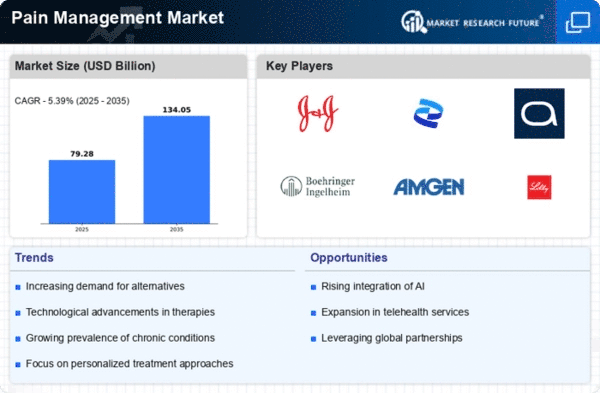
According to MRFR analysis, the Pain Management Market Size was valued at USD 75.23 Billion in 2024. The market is projected to grow from USD 79.29 Billion in 2025 to USD 134.05 Billion by 2035, registering a CAGR of 5.39% during the forecast 2025–2035. North America led the market with over 53.17% share, generating around USD 40 billion in revenue.    
Growth in the pain management market is driven by the increasing prevalence of chronic conditions, rising geriatric population, and growing demand for non-opioid therapies. Key trends include advancements in neuromodulation devices, minimally invasive procedures, and digital pain management solutions, alongside increasing adoption of personalized treatment approaches to improve long-term patient outcomes.

Key Market Trends & Highlights

The Pain Management Market is experiencing a transformative shift towards innovative and personalized treatment solutions.

  • The rise of digital health solutions is reshaping patient engagement and monitoring in pain management. There is a notable focus on non-opioid therapies, driven by increasing concerns over opioid dependency. Personalized pain management approaches are gaining traction, particularly in the chronic pain segment, which remains the largest market. Key market drivers include the increasing prevalence of chronic pain conditions and advancements in pain management technologies, particularly in North America and Asia-Pacific.

Market Size & Forecast

2024 Market Size 75.23 (USD Billion)
2035 Market Size 134.05 (USD Billion)
CAGR (2025 - 2035) 5.39%
Largest Regional Market Share in 2024 North America

Major Players

Johnson &amp; Johnson (US), Pfizer Inc. (US), AbbVie Inc. (US), Boehringer Ingelheim (DE), Amgen Inc. (US), Eli Lilly and Company (US), Novartis AG (CH), Teva Pharmaceutical Industries Ltd. (IL), Mylan N.V. (US)

Market Trends

The Pain Management Market is currently experiencing a transformative phase, characterized by a growing emphasis on innovative therapies and patient-centered approaches. This evolution is driven by an increasing recognition of the multifaceted nature of pain, which necessitates a comprehensive understanding of both physical and psychological factors. As healthcare providers strive to enhance patient outcomes, there is a notable shift towards integrating technology, such as telemedicine and digital health solutions, into pain management strategies.

This integration not only facilitates better access to care but also empowers patients to take an active role in their treatment plans. Moreover, the Pain Management Market is witnessing a surge in the development of non-opioid alternatives, reflecting a broader societal push towards reducing reliance on traditional pain medications. This trend is indicative of a growing awareness regarding the potential risks associated with opioid use, prompting stakeholders to explore safer and more effective options.

As a result, the market landscape is becoming increasingly diverse, with a range of therapies, including physical therapy, cognitive behavioral therapy, and complementary approaches, gaining traction. The ongoing evolution of this market suggests a promising future, where personalized and holistic pain management solutions may become the norm, ultimately improving the quality of life for individuals suffering from chronic pain conditions.

Rise of Digital Health Solutions

The Pain Management Market is increasingly incorporating digital health technologies, such as mobile applications and telehealth services. These innovations facilitate remote monitoring and provide patients with tools to manage their pain effectively. By enhancing communication between patients and healthcare providers, digital solutions may lead to improved adherence to treatment plans and better overall outcomes.

Focus on Non-Opioid Therapies

There is a growing emphasis on non-opioid therapies within the Pain Management Market, driven by concerns over opioid dependency and side effects. This trend encompasses a variety of treatment modalities, including physical therapy, acupuncture, and mindfulness practices. As healthcare professionals seek safer alternatives, the market is likely to expand with innovative non-opioid options.

Personalized Pain Management Approaches

The Pain Management Market is shifting towards personalized treatment strategies that consider individual patient needs and preferences. This trend reflects a broader understanding of pain as a complex experience influenced by various factors. Tailoring interventions to specific patient profiles may enhance efficacy and satisfaction, ultimately leading to better management of chronic pain.

Pain Management Market Market Drivers

Rising Prevalence of Chronic Pain

The increasing prevalence of chronic pain conditions globally is a primary driver of the Global Pain Management Market Industry. According to recent data, approximately 20% of adults experience chronic pain, which significantly impacts their quality of life.
 
This growing patient population necessitates effective pain management solutions, contributing to the market's expansion. In 2024, the market is projected to reach 80.8 USD Billion, reflecting the urgent need for innovative therapies and interventions. As the global population ages, the demand for pain management services is likely to escalate, further propelling market growth.

Increased Focus on Patient-Centric Care

The shift towards patient-centric care models significantly influences the Global Pain Management Market Industry. Healthcare providers are increasingly prioritizing individualized treatment plans that consider patients' unique needs and preferences.
 
This trend is evident in the growing adoption of multidisciplinary approaches that integrate physical therapy, psychological support, and pharmacological treatments. By focusing on holistic care, providers aim to enhance patient satisfaction and treatment adherence. This paradigm shift is likely to contribute to the market's growth, as more patients seek tailored pain management solutions that align with their lifestyles and health goals.

Advancements in Pain Management Technologies

Technological advancements in pain management are reshaping the Global Pain Management Market Industry. Innovations such as neuromodulation devices, telemedicine, and digital health applications are enhancing patient outcomes and accessibility.
 
For instance, the integration of artificial intelligence in pain assessment tools allows for more personalized treatment plans. These advancements not only improve the efficacy of pain management strategies but also attract investment into the sector. As a result, the market is expected to grow steadily, with projections indicating a rise to 100.5 USD Billion by 2035, driven by continuous technological evolution.

Regulatory Support for Pain Management Solutions

Regulatory support for innovative pain management solutions is a crucial driver of the Global Pain Management Market Industry. Governments and health organizations are increasingly recognizing the need for effective pain management strategies, leading to the development of supportive policies and guidelines.
 
This regulatory environment fosters research and development of new therapies, including novel analgesics and interventional techniques. As a result, the market is likely to benefit from increased funding and resources aimed at improving pain management practices. This supportive framework is expected to facilitate market growth, ensuring that patients have access to the latest treatment options.

Rising Awareness and Education on Pain Management

There is a notable increase in awareness and education regarding pain management strategies, which is positively impacting the Global Pain Management Market Industry. Public health campaigns and educational initiatives are informing patients and healthcare professionals about effective pain management options, including non-pharmacological therapies.
 
This heightened awareness encourages individuals to seek treatment for their pain conditions, thereby expanding the patient base. As a result, the market is projected to experience a compound annual growth rate of 2.01% from 2025 to 2035, reflecting the growing recognition of the importance of effective pain management.

Market Segment Insights

By Application: Chronic Pain (Largest) vs. Neuropathic Pain (Fastest-Growing)

In the Pain Management Market, the application segment is dominated by Chronic Pain, which accounts for a significant share and is recognized for its longstanding prevalence among patients. Acute Pain and Cancer Pain also hold considerable shares but are overshadowed by Chronic Pain's extensive reach. Postoperative Pain and <a href="https://www.marketresearchfuture.com/reports/neuropathic-pain-market-1390">Neuropathic Pain</a>, while crucial, take up smaller portions of the market. The distribution underscores the critical need for effective management solutions targeting long-term pain sufferers while balancing acute and specialized pain treatments.

Chronic Pain (Dominant) vs. Neuropathic Pain (Emerging)

Chronic Pain is the dominant force in the Pain Management Market, characterized by its persistent nature and the necessity for ongoing therapeutic interventions. This segment encompasses a wide range of conditions and requires a comprehensive, multimodal treatment approach that includes medications, physical therapy, and psychological support. In contrast, Neuropathic Pain, which is gaining traction as an emerging market segment, is associated with nerve damage and can lead to debilitating discomfort. This segment exhibits faster growth due to increasing recognition of neuropathic pain syndromes and advancements in targeted therapies, making it an exciting area for innovation and investment.

By Type of Treatment: Pharmacological Treatment (Largest) vs. Interventional Procedures (Fastest-Growing)

The Pain Management Market is segmented into several treatment types, with pharmacological treatment holding the largest market share. This segment encompasses various medications such as analgesics, anti-inflammatory drugs, and opioids that are widely utilized across different pain management scenarios. Following pharmacological treatment, physical therapy and interventional procedures are significant, though the latter has been gaining traction due to advancements in minimally invasive techniques and increasing patient awareness of their effectiveness. The growth in the Pain Management Market is driven by a rising prevalence of chronic pain conditions and an aging population seeking effective treatment options. Interventional procedures, including nerve blocks and spinal injections, are emerging as faster-growing alternatives, attracting investments in technology and expertise. Additionally, psychological therapy and complementary medicine are becoming essential components of pain management, emphasizing a patient-centric approach and a holistic understanding of pain treatment.

Pharmacological Treatment (Dominant) vs. Interventional Procedures (Emerging)

Pharmacological treatment remains the dominant force in the Pain Management Market, offering various options to address pain effectively. Its extensive use of medications provides immediate and measurable relief, making it a preferred choice for many healthcare providers. Despite concerns regarding opioids and side effects, innovation in drug formulations and the development of safer alternatives continue to support the segment's position. On the other hand, interventional procedures are becoming increasingly popular due to their minimally invasive nature and prolonged pain relief effects. Techniques such as corticosteroid injections and radiofrequency ablation enhance patient outcomes and satisfaction, thus gaining acceptance as viable options. This dynamic between the established pharmacological treatments and the emerging interventional methods illustrates the diversity of approaches being adopted for effective pain management.

By Patient Demographics: Age Group (Largest) vs. Gender (Fastest-Growing)

<p>In the Pain Management Market, the Age Group segment holds the largest share, reflecting the significant need for pain management solutions among older adults who are more prone to chronic pain conditions. Meanwhile, the Gender segment is witnessing rapid growth, with increasing recognition of gender-specific pain reporting and management needs. The market is notably expanding as awareness of these differences enhances treatment approaches.</p>

<p>Age Group (Dominant) vs. Gender (Emerging)</p>

<p>The Age Group segment in the Pain Management Market plays a dominant role, primarily driven by the aging population experiencing more chronic pain related to degenerative diseases and injuries. This segment notably includes the elderly, who require tailored interventions and medications to manage their conditions effectively. Conversely, the Gender segment is emerging as a significant focus, as recent studies highlight that women report pain differently and often face unique challenges in pain management. The industry is adapting to these insights, leading to innovative gender-sensitive therapies and products.</p>

By Route of Administration: Oral (Largest) vs. Injectable (Fastest-Growing)

In the Pain Management Market, the route of administration plays a crucial role in treatment efficacy and patient preference. Currently, the oral segment holds the largest market share, driven by the convenience and ease of use for patients. This is followed closely by the injectable segment, which has gained momentum due to advancements in delivery systems and the growing acceptance of biologics in pain management therapies.

Administration Method: Oral (Dominant) vs. Injectable (Emerging)

The oral route remains the dominant method of pain management administration, favored for its simplicity and effectiveness in chronic pain scenarios. It encompasses a variety of formulations, including tablets and liquids, making it adaptable to different patient needs. Conversely, the injectable segment is rapidly emerging, driven by innovations in drug formulations that enhance absorption and efficacy. This segment caters to acute pain scenarios or chronic conditions where immediate relief is necessary. With ongoing research and development, injectable methods are expected to become increasingly integrated into pain management protocols, along with growing patient acceptance.

By End User: Hospitals (Largest) vs. Home Care Settings (Fastest-Growing)

<p>In the Pain Management Market, Hospitals account for the largest share, predominantly driven by their comprehensive resources and capability to handle severe cases. Clinics and pharmacies make up additional significant portions of the market, contributing to the diverse access to pain management solutions. Home Care Settings, while currently smaller, represent a growing segment as more patients opt for at-home therapies and management, leading to changing dynamics in patient care and engagement.</p>

<p>Home Care Settings (Emerging) vs. Hospitals (Dominant)</p>

<p>Hospitals serve as the dominant force in the Pain Management Market due to their advanced infrastructure, specialized staff, and ability to provide a wide range of pain management services under one roof. They cater to both acute and chronic pain management effectively, with a focus on procedural interventions and multidisciplinary care. In contrast, Home Care Settings are emerging as a vital segment, driven by the increasing trend of outpatient care and patient preferences for convenience. Home care services enhance patient comfort and compliance, often integrating technology such as telehealth to monitor pain management, making them a favorable choice for many.</p>

Get more detailed insights about Pain Management Market Research Report – Forecast to 2035

Regional Insights

North America : Market Leader in Pain Management

North America leads in the Pain Management Market Size, accounting for over 53.17% of the global revenue in 2024. Key growth drivers include an aging population, increasing prevalence of chronic pain conditions, and advancements in pain management therapies. Regulatory support, such as streamlined approval processes for new medications, further fuels market expansion. 

The region's robust healthcare infrastructure and high healthcare expenditure also contribute to its market dominance. The competitive landscape in North America is characterized by the presence of major players like Johnson & Johnson, Pfizer Inc., and AbbVie Inc. These companies are actively engaged in research and development to innovate pain management solutions. The U.S. remains the largest market, driven by high demand for both pharmaceutical and non-pharmaceutical pain relief options. The focus on personalized medicine and patient-centric approaches is expected to enhance market growth further.

Europe : Emerging Market with Growth Potential

Europe Pain Management Market was valued at USD 15.05 billion in 2024, making it the second-largest regional market with a 30% share. The region is witnessing a rise in chronic pain cases, driven by lifestyle changes and an aging demographic. Regulatory frameworks, such as the European Medicines Agency's guidelines, are evolving to support innovative pain management solutions. Increased awareness and acceptance of pain management therapies are also contributing to market growth, alongside a push for integrated healthcare solutions.

Leading countries in Europe include Germany, France, and the UK, where healthcare systems are increasingly adopting advanced pain management strategies. The competitive landscape features key players like Boehringer Ingelheim and Novartis AG, who are investing in R&D to develop new therapies. The European market is characterized by a mix of established pharmaceutical companies and emerging biotech firms, enhancing innovation and competition.

Asia-Pacific : Rapidly Growing Market Segment

The Asia-Pacific region is emerging as a rapidly growing segment in the Pain Management Market, accounting for 12.0% of the market share in 2024. Factors driving this growth include increasing healthcare access, rising awareness of pain management options, and a growing elderly population. Additionally, government initiatives aimed at improving healthcare infrastructure and regulatory support for new therapies are expected to enhance market dynamics.

The region is also witnessing a shift towards more holistic pain management approaches, integrating traditional and modern practices. Countries like China, India, and Japan are leading the charge in this market, with significant investments in healthcare and pharmaceutical sectors. The competitive landscape is diverse, featuring both multinational corporations and local players. Key companies such as Teva Pharmaceutical Industries and Mylan N.V. are focusing on expanding their product portfolios to cater to the unique needs of the region, driving innovation and competition.

Middle East and Africa : Emerging Market with Challenges

The Middle East and Africa (MEA) region, while currently holding a smaller share of the Pain Management Market at 3.23%, is gradually emerging as a focus area for growth. Factors such as increasing healthcare expenditure, rising awareness of pain management therapies, and a growing prevalence of chronic diseases are driving market interest. However, challenges such as regulatory hurdles and varying healthcare infrastructure across countries may impede rapid growth.

Governments are increasingly recognizing the need for improved pain management solutions, which is expected to catalyze market development. Leading countries in the MEA region include South Africa and the UAE, where healthcare systems are evolving to meet the demands of chronic pain management. The competitive landscape is characterized by a mix of local and international players, with companies exploring partnerships to enhance their market presence. The focus on improving healthcare access and affordability is likely to shape the future of pain management in this region.

Key Players and Competitive Insights

The Pain Management Market is characterized by a dynamic competitive landscape, driven by increasing demand for effective pain relief solutions and advancements in pharmaceutical technologies. Key players such as Johnson & Johnson (US), Pfizer Inc. (US), and AbbVie Inc. (US) are strategically positioned to leverage innovation and expand their market presence. Johnson & Johnson (US) focuses on developing novel analgesics and enhancing its product portfolio through strategic partnerships, while Pfizer Inc. (US) emphasizes research and development to introduce cutting-edge therapies. AbbVie Inc. (US) is actively pursuing mergers and acquisitions to bolster its capabilities in pain management, thereby shaping the competitive environment through a blend of innovation and strategic growth initiatives. The market structure appears moderately fragmented, with a mix of established players and emerging companies vying for market share. Key business tactics such as localizing manufacturing and optimizing supply chains are prevalent among major companies, allowing them to respond swiftly to regional demands and regulatory changes. This collective influence of key players fosters a competitive atmosphere where agility and responsiveness are paramount. In November 2025, Pfizer Inc. (US) announced a collaboration with a leading biotechnology firm to develop a new class of pain management therapies utilizing gene therapy techniques. This strategic move is likely to position Pfizer at the forefront of innovative pain relief solutions, potentially transforming treatment paradigms and enhancing patient outcomes. The collaboration underscores Pfizer's commitment to harnessing advanced technologies to address unmet medical needs in pain management. In October 2025, AbbVie Inc. (US) completed the acquisition of a smaller pharmaceutical company specializing in non-opioid pain relief products. This acquisition is significant as it expands AbbVie's portfolio and reinforces its strategy to diversify pain management options, particularly in light of increasing scrutiny on opioid prescriptions. The integration of these products may enhance AbbVie's competitive edge in a market that is progressively shifting towards safer alternatives. In December 2025, Johnson & Johnson (US) launched a digital health platform aimed at providing personalized pain management solutions through telehealth services. This initiative reflects a growing trend towards digitalization in healthcare, enabling patients to access tailored pain management strategies remotely. By investing in digital health, Johnson & Johnson is likely to enhance patient engagement and adherence, thereby solidifying its market position in an increasingly tech-driven landscape. As of December 2025, current competitive trends indicate a pronounced shift towards digitalization, sustainability, and the integration of artificial intelligence in pain management solutions. Strategic alliances among key players are shaping the landscape, fostering innovation and enhancing product offerings. The competitive differentiation is expected to evolve, moving away from price-based competition towards a focus on technological advancements, innovative therapies, and reliable supply chains. This transition may redefine market dynamics, emphasizing the importance of agility and responsiveness in meeting the evolving needs of patients and healthcare providers.

Key Companies in the Pain Management Market include

Industry Developments

There have been some big changes in the Pain Management Market lately, with a number of companies making big moves. Pfizer said in October 2023 that it was adding to its pain relief portfolio, focusing on new delivery systems to make it easier for patients to follow their treatment plans.

Companies like Novartis and Amgen saw their stock prices go up because investors were more confident in the market. This was because there was still a lot of demand for migraine and chronic pain drugs like Aimovig.

In June 2023, talks in the industry brought up Takeda Pharmaceutical Company's plan to move into non-opioid pain relief solutions, but no specific acquisitions have been confirmed yet. The rise of non-opioid therapies like biologics, neuromodulation, and digital health solutions in recent years has been a major shift.

This is in the way things are done, and this has been supported by global regulatory movements that promote safer pain management options. These trends show that the Pain Management Market is changing and moving in a dynamic way because of new ideas.

Safety concerns, and the fact that pain is becoming more common around the world.

Future Outlook

Pain Management Market Future Outlook

The Pain Management Market size is projected to reach USD 0.36 Billion by 2035, growing at a CAGR of 53.17%

New opportunities lie in:

  • <p>Development of telehealth platforms for pain management consultations. Investment in AI-driven pain assessment tools for personalized treatment. Expansion of non-opioid pain relief product lines targeting diverse demographics.</p>

By 2035, the Pain Management Market is expected to be robust, reflecting significant advancements and strategic growth.

Market Segmentation

Pain Management Market End User Outlook

  • Hospitals
  • Clinics
  • Home Care Settings
  • Rehabilitation Centers
  • Pharmacies

Pain Management Market Application Outlook

  • Chronic Pain
  • Acute Pain
  • Postoperative Pain
  • Cancer Pain
  • Neuropathic Pain

Pain Management Market Type of Treatment Outlook

  • Pharmacological Treatment
  • Physical Therapy
  • Interventional Procedures
  • Psychological Therapy
  • Complementary and Alternative Medicine

Pain Management Market Patient Demographics Outlook

  • Age
  • Gender
  • Socioeconomic Status
  • Comorbidities
  • Lifestyle Factors

Pain Management Market Route of Administration Outlook

  • Oral
  • Topical
  • Injectable
  • Transdermal
  • Inhalation

Report Scope

MARKET SIZE 2024 75.23(USD Billion)
MARKET SIZE 2025 79.29(USD Billion)
MARKET SIZE 2035 134.05(USD Billion)
COMPOUND ANNUAL GROWTH RATE (CAGR) 5.39% (2024 - 2035)
REPORT COVERAGE Revenue Forecast, Competitive Landscape, Growth Factors, and Trends
BASE YEAR 2024
Market Forecast Period 2025 - 2035
Historical Data 2019 - 2024
Market Forecast Units USD Billion
Key Companies Profiled Johnson & Johnson (US), Pfizer Inc. (US), AbbVie Inc. (US), Boehringer Ingelheim (DE), Amgen Inc. (US), Eli Lilly and Company (US), Novartis AG (CH), Teva Pharmaceutical Industries Ltd. (IL), Mylan N.V. (US)
Segments Covered Application, Type of Treatment, Patient Demographics, Route of Administration, End User
Key Market Opportunities Integration of digital therapeutics and telehealth solutions in the Pain Management Market.
Key Market Dynamics Rising demand for non-opioid pain relief options drives innovation and competition in the Pain Management Market.
Countries Covered North America, Europe, APAC, South America, MEA

FAQs

What is the current valuation of the Pain Management Market?

<p>As of 2024, the Pain Management Market was valued at 75.23 USD Billion.</p>

What is the projected market size for the Pain Management Market by 2035?

<p>The Pain Management Market is projected to reach 134.05 USD Billion by 2035.</p>

What is the expected CAGR for the Pain Management Market during the forecast period 2025 - 2035?

<p>The expected CAGR for the Pain Management Market during the forecast period 2025 - 2035 is 5.39%.</p>

Which segment of the Pain Management Market had the highest valuation in 2024?

<p>In 2024, the Chronic Pain segment had the highest valuation at 30.0 USD Billion.</p>

What are the key types of treatment in the Pain Management Market?

<p>Key types of treatment include Pharmacological Treatment, Physical Therapy, and Interventional Procedures.</p>

How does the Pain Management Market segment by patient demographics?

<p>The market segments by patient demographics include Age Group, Gender, Socioeconomic Status, Comorbidities, and Lifestyle Factors.</p>

Which route of administration is most prevalent in the Pain Management Market?

<p>The Oral route of administration is most prevalent, with a valuation of 30.0 USD Billion in 2024.</p>

What is the market valuation for pharmacies in the Pain Management Market?

<p>Pharmacies had a market valuation of 37.23 USD Billion in 2024.</p>

Who are the leading companies in the Pain Management Market?

<p>Leading companies include Johnson & Johnson, Pfizer Inc., and AbbVie Inc.</p>

What is the projected growth for the Acute Pain segment by 2035?

<p>The Acute Pain segment is projected to grow from 15.0 USD Billion in 2024 to 27.0 USD Billion by 2035.</p>

  1. SECTION I: EXECUTIVE SUMMARY AND KEY HIGHLIGHTS
    1. | 1.1 EXECUTIVE SUMMARY
    2. | | 1.1.1 Market Overview
    3. | | 1.1.2 Key Findings
    4. | | 1.1.3 Market Segmentation
    5. | | 1.1.4 Competitive Landscape
    6. | | 1.1.5 Challenges and Opportunities
    7. | | 1.1.6 Future Outlook
  2. SECTION II: SCOPING, METHODOLOGY AND MARKET STRUCTURE
    1. | 2.1 MARKET INTRODUCTION
    2. | | 2.1.1 Definition
    3. | | 2.1.2 Scope of the study
    4. | | | 2.1.2.1 Research Objective
    5. | | | 2.1.2.2 Assumption
    6. | | | 2.1.2.3 Limitations
    7. | 2.2 RESEARCH METHODOLOGY
    8. | | 2.2.1 Overview
    9. | | 2.2.2 Data Mining
    10. | | 2.2.3 Secondary Research
    11. | | 2.2.4 Primary Research
    12. | | | 2.2.4.1 Primary Interviews and Information Gathering Process
    13. | | | 2.2.4.2 Breakdown of Primary Respondents
    14. | | 2.2.5 Forecasting Model
    15. | | 2.2.6 Market Size Estimation
    16. | | | 2.2.6.1 Bottom-Up Approach
    17. | | | 2.2.6.2 Top-Down Approach
    18. | | 2.2.7 Data Triangulation
    19. | | 2.2.8 Validation
  3. SECTION III: QUALITATIVE ANALYSIS
    1. | 3.1 MARKET DYNAMICS
    2. | | 3.1.1 Overview
    3. | | 3.1.2 Drivers
    4. | | 3.1.3 Restraints
    5. | | 3.1.4 Opportunities
    6. | 3.2 MARKET FACTOR ANALYSIS
    7. | | 3.2.1 Value chain Analysis
    8. | | 3.2.2 Porter's Five Forces Analysis
    9. | | | 3.2.2.1 Bargaining Power of Suppliers
    10. | | | 3.2.2.2 Bargaining Power of Buyers
    11. | | | 3.2.2.3 Threat of New Entrants
    12. | | | 3.2.2.4 Threat of Substitutes
    13. | | | 3.2.2.5 Intensity of Rivalry
    14. | | 3.2.3 COVID-19 Impact Analysis
    15. | | | 3.2.3.1 Market Impact Analysis
    16. | | | 3.2.3.2 Regional Impact
    17. | | | 3.2.3.3 Opportunity and Threat Analysis
  4. SECTION IV: QUANTITATIVE ANALYSIS
    1. | 4.1 Healthcare, BY Application (USD Billion)
    2. | | 4.1.1 Chronic Pain
    3. | | 4.1.2 Acute Pain
    4. | | 4.1.3 Postoperative Pain
    5. | | 4.1.4 Cancer Pain
    6. | | 4.1.5 Neuropathic Pain
    7. | 4.2 Healthcare, BY Type of Treatment (USD Billion)
    8. | | 4.2.1 Pharmacological Treatment
    9. | | 4.2.2 Physical Therapy
    10. | | 4.2.3 Interventional Procedures
    11. | | 4.2.4 Psychological Therapy
    12. | | 4.2.5 Complementary and Alternative Medicine
    13. | 4.3 Healthcare, BY Patient Demographics (USD Billion)
    14. | | 4.3.1 Age Group
    15. | | 4.3.2 Gender
    16. | | 4.3.3 Socioeconomic Status
    17. | | 4.3.4 Comorbidities
    18. | | 4.3.5 Lifestyle Factors
    19. | 4.4 Healthcare, BY Route of Administration (USD Billion)
    20. | | 4.4.1 Oral
    21. | | 4.4.2 Topical
    22. | | 4.4.3 Injectable
    23. | | 4.4.4 Transdermal
    24. | | 4.4.5 Inhalation
    25. | 4.5 Healthcare, BY End User (USD Billion)
    26. | | 4.5.1 Hospitals
    27. | | 4.5.2 Clinics
    28. | | 4.5.3 Home Care Settings
    29. | | 4.5.4 Rehabilitation Centers
    30. | | 4.5.5 Pharmacies
    31. | 4.6 Healthcare, BY Region (USD Billion)
    32. | | 4.6.1 North America
    33. | | | 4.6.1.1 US
    34. | | | 4.6.1.2 Canada
    35. | | 4.6.2 Europe
    36. | | | 4.6.2.1 Germany
    37. | | | 4.6.2.2 UK
    38. | | | 4.6.2.3 France
    39. | | | 4.6.2.4 Russia
    40. | | | 4.6.2.5 Italy
    41. | | | 4.6.2.6 Spain
    42. | | | 4.6.2.7 Rest of Europe
    43. | | 4.6.3 APAC
    44. | | | 4.6.3.1 China
    45. | | | 4.6.3.2 India
    46. | | | 4.6.3.3 Japan
    47. | | | 4.6.3.4 South Korea
    48. | | | 4.6.3.5 Malaysia
    49. | | | 4.6.3.6 Thailand
    50. | | | 4.6.3.7 Indonesia
    51. | | | 4.6.3.8 Rest of APAC
    52. | | 4.6.4 South America
    53. | | | 4.6.4.1 Brazil
    54. | | | 4.6.4.2 Mexico
    55. | | | 4.6.4.3 Argentina
    56. | | | 4.6.4.4 Rest of South America
    57. | | 4.6.5 MEA
    58. | | | 4.6.5.1 GCC Countries
    59. | | | 4.6.5.2 South Africa
    60. | | | 4.6.5.3 Rest of MEA
  5. SECTION V: COMPETITIVE ANALYSIS
    1. | 5.1 Competitive Landscape
    2. | | 5.1.1 Overview
    3. | | 5.1.2 Competitive Analysis
    4. | | 5.1.3 Market share Analysis
    5. | | 5.1.4 Major Growth Strategy in the Healthcare
    6. | | 5.1.5 Competitive Benchmarking
    7. | | 5.1.6 Leading Players in Terms of Number of Developments in the Healthcare
    8. | | 5.1.7 Key developments and growth strategies
    9. | | | 5.1.7.1 New Product Launch/Service Deployment
    10. | | | 5.1.7.2 Merger & Acquisitions
    11. | | | 5.1.7.3 Joint Ventures
    12. | | 5.1.8 Major Players Financial Matrix
    13. | | | 5.1.8.1 Sales and Operating Income
    14. | | | 5.1.8.2 Major Players R&D Expenditure. 2023
    15. | 5.2 Company Profiles
    16. | | 5.2.1 Johnson & Johnson (US)
    17. | | | 5.2.1.1 Financial Overview
    18. | | | 5.2.1.2 Products Offered
    19. | | | 5.2.1.3 Key Developments
    20. | | | 5.2.1.4 SWOT Analysis
    21. | | | 5.2.1.5 Key Strategies
    22. | | 5.2.2 Pfizer Inc. (US)
    23. | | | 5.2.2.1 Financial Overview
    24. | | | 5.2.2.2 Products Offered
    25. | | | 5.2.2.3 Key Developments
    26. | | | 5.2.2.4 SWOT Analysis
    27. | | | 5.2.2.5 Key Strategies
    28. | | 5.2.3 AbbVie Inc. (US)
    29. | | | 5.2.3.1 Financial Overview
    30. | | | 5.2.3.2 Products Offered
    31. | | | 5.2.3.3 Key Developments
    32. | | | 5.2.3.4 SWOT Analysis
    33. | | | 5.2.3.5 Key Strategies
    34. | | 5.2.4 Boehringer Ingelheim (DE)
    35. | | | 5.2.4.1 Financial Overview
    36. | | | 5.2.4.2 Products Offered
    37. | | | 5.2.4.3 Key Developments
    38. | | | 5.2.4.4 SWOT Analysis
    39. | | | 5.2.4.5 Key Strategies
    40. | | 5.2.5 Amgen Inc. (US)
    41. | | | 5.2.5.1 Financial Overview
    42. | | | 5.2.5.2 Products Offered
    43. | | | 5.2.5.3 Key Developments
    44. | | | 5.2.5.4 SWOT Analysis
    45. | | | 5.2.5.5 Key Strategies
    46. | | 5.2.6 Eli Lilly and Company (US)
    47. | | | 5.2.6.1 Financial Overview
    48. | | | 5.2.6.2 Products Offered
    49. | | | 5.2.6.3 Key Developments
    50. | | | 5.2.6.4 SWOT Analysis
    51. | | | 5.2.6.5 Key Strategies
    52. | | 5.2.7 Novartis AG (CH)
    53. | | | 5.2.7.1 Financial Overview
    54. | | | 5.2.7.2 Products Offered
    55. | | | 5.2.7.3 Key Developments
    56. | | | 5.2.7.4 SWOT Analysis
    57. | | | 5.2.7.5 Key Strategies
    58. | | 5.2.8 Teva Pharmaceutical Industries Ltd. (IL)
    59. | | | 5.2.8.1 Financial Overview
    60. | | | 5.2.8.2 Products Offered
    61. | | | 5.2.8.3 Key Developments
    62. | | | 5.2.8.4 SWOT Analysis
    63. | | | 5.2.8.5 Key Strategies
    64. | | 5.2.9 Mylan N.V. (US)
    65. | | | 5.2.9.1 Financial Overview
    66. | | | 5.2.9.2 Products Offered
    67. | | | 5.2.9.3 Key Developments
    68. | | | 5.2.9.4 SWOT Analysis
    69. | | | 5.2.9.5 Key Strategies
    70. | 5.3 Appendix
    71. | | 5.3.1 References
    72. | | 5.3.2 Related Reports
  6. LIST OF FIGURES
    1. | 6.1 MARKET SYNOPSIS
    2. | 6.2 NORTH AMERICA MARKET ANALYSIS
    3. | 6.3 US MARKET ANALYSIS BY APPLICATION
    4. | 6.4 US MARKET ANALYSIS BY TYPE OF TREATMENT
    5. | 6.5 US MARKET ANALYSIS BY PATIENT DEMOGRAPHICS
    6. | 6.6 US MARKET ANALYSIS BY ROUTE OF ADMINISTRATION
    7. | 6.7 US MARKET ANALYSIS BY END USER
    8. | 6.8 CANADA MARKET ANALYSIS BY APPLICATION
    9. | 6.9 CANADA MARKET ANALYSIS BY TYPE OF TREATMENT
    10. | 6.10 CANADA MARKET ANALYSIS BY PATIENT DEMOGRAPHICS
    11. | 6.11 CANADA MARKET ANALYSIS BY ROUTE OF ADMINISTRATION
    12. | 6.12 CANADA MARKET ANALYSIS BY END USER
    13. | 6.13 EUROPE MARKET ANALYSIS
    14. | 6.14 GERMANY MARKET ANALYSIS BY APPLICATION
    15. | 6.15 GERMANY MARKET ANALYSIS BY TYPE OF TREATMENT
    16. | 6.16 GERMANY MARKET ANALYSIS BY PATIENT DEMOGRAPHICS
    17. | 6.17 GERMANY MARKET ANALYSIS BY ROUTE OF ADMINISTRATION
    18. | 6.18 GERMANY MARKET ANALYSIS BY END USER
    19. | 6.19 UK MARKET ANALYSIS BY APPLICATION
    20. | 6.20 UK MARKET ANALYSIS BY TYPE OF TREATMENT
    21. | 6.21 UK MARKET ANALYSIS BY PATIENT DEMOGRAPHICS
    22. | 6.22 UK MARKET ANALYSIS BY ROUTE OF ADMINISTRATION
    23. | 6.23 UK MARKET ANALYSIS BY END USER
    24. | 6.24 FRANCE MARKET ANALYSIS BY APPLICATION
    25. | 6.25 FRANCE MARKET ANALYSIS BY TYPE OF TREATMENT
    26. | 6.26 FRANCE MARKET ANALYSIS BY PATIENT DEMOGRAPHICS
    27. | 6.27 FRANCE MARKET ANALYSIS BY ROUTE OF ADMINISTRATION
    28. | 6.28 FRANCE MARKET ANALYSIS BY END USER
    29. | 6.29 RUSSIA MARKET ANALYSIS BY APPLICATION
    30. | 6.30 RUSSIA MARKET ANALYSIS BY TYPE OF TREATMENT
    31. | 6.31 RUSSIA MARKET ANALYSIS BY PATIENT DEMOGRAPHICS
    32. | 6.32 RUSSIA MARKET ANALYSIS BY ROUTE OF ADMINISTRATION
    33. | 6.33 RUSSIA MARKET ANALYSIS BY END USER
    34. | 6.34 ITALY MARKET ANALYSIS BY APPLICATION
    35. | 6.35 ITALY MARKET ANALYSIS BY TYPE OF TREATMENT
    36. | 6.36 ITALY MARKET ANALYSIS BY PATIENT DEMOGRAPHICS
    37. | 6.37 ITALY MARKET ANALYSIS BY ROUTE OF ADMINISTRATION
    38. | 6.38 ITALY MARKET ANALYSIS BY END USER
    39. | 6.39 SPAIN MARKET ANALYSIS BY APPLICATION
    40. | 6.40 SPAIN MARKET ANALYSIS BY TYPE OF TREATMENT
    41. | 6.41 SPAIN MARKET ANALYSIS BY PATIENT DEMOGRAPHICS
    42. | 6.42 SPAIN MARKET ANALYSIS BY ROUTE OF ADMINISTRATION
    43. | 6.43 SPAIN MARKET ANALYSIS BY END USER
    44. | 6.44 REST OF EUROPE MARKET ANALYSIS BY APPLICATION
    45. | 6.45 REST OF EUROPE MARKET ANALYSIS BY TYPE OF TREATMENT
    46. | 6.46 REST OF EUROPE MARKET ANALYSIS BY PATIENT DEMOGRAPHICS
    47. | 6.47 REST OF EUROPE MARKET ANALYSIS BY ROUTE OF ADMINISTRATION
    48. | 6.48 REST OF EUROPE MARKET ANALYSIS BY END USER
    49. | 6.49 APAC MARKET ANALYSIS
    50. | 6.50 CHINA MARKET ANALYSIS BY APPLICATION
    51. | 6.51 CHINA MARKET ANALYSIS BY TYPE OF TREATMENT
    52. | 6.52 CHINA MARKET ANALYSIS BY PATIENT DEMOGRAPHICS
    53. | 6.53 CHINA MARKET ANALYSIS BY ROUTE OF ADMINISTRATION
    54. | 6.54 CHINA MARKET ANALYSIS BY END USER
    55. | 6.55 INDIA MARKET ANALYSIS BY APPLICATION
    56. | 6.56 INDIA MARKET ANALYSIS BY TYPE OF TREATMENT
    57. | 6.57 INDIA MARKET ANALYSIS BY PATIENT DEMOGRAPHICS
    58. | 6.58 INDIA MARKET ANALYSIS BY ROUTE OF ADMINISTRATION
    59. | 6.59 INDIA MARKET ANALYSIS BY END USER
    60. | 6.60 JAPAN MARKET ANALYSIS BY APPLICATION
    61. | 6.61 JAPAN MARKET ANALYSIS BY TYPE OF TREATMENT
    62. | 6.62 JAPAN MARKET ANALYSIS BY PATIENT DEMOGRAPHICS
    63. | 6.63 JAPAN MARKET ANALYSIS BY ROUTE OF ADMINISTRATION
    64. | 6.64 JAPAN MARKET ANALYSIS BY END USER
    65. | 6.65 SOUTH KOREA MARKET ANALYSIS BY APPLICATION
    66. | 6.66 SOUTH KOREA MARKET ANALYSIS BY TYPE OF TREATMENT
    67. | 6.67 SOUTH KOREA MARKET ANALYSIS BY PATIENT DEMOGRAPHICS
    68. | 6.68 SOUTH KOREA MARKET ANALYSIS BY ROUTE OF ADMINISTRATION
    69. | 6.69 SOUTH KOREA MARKET ANALYSIS BY END USER
    70. | 6.70 MALAYSIA MARKET ANALYSIS BY APPLICATION
    71. | 6.71 MALAYSIA MARKET ANALYSIS BY TYPE OF TREATMENT
    72. | 6.72 MALAYSIA MARKET ANALYSIS BY PATIENT DEMOGRAPHICS
    73. | 6.73 MALAYSIA MARKET ANALYSIS BY ROUTE OF ADMINISTRATION
    74. | 6.74 MALAYSIA MARKET ANALYSIS BY END USER
    75. | 6.75 THAILAND MARKET ANALYSIS BY APPLICATION
    76. | 6.76 THAILAND MARKET ANALYSIS BY TYPE OF TREATMENT
    77. | 6.77 THAILAND MARKET ANALYSIS BY PATIENT DEMOGRAPHICS
    78. | 6.78 THAILAND MARKET ANALYSIS BY ROUTE OF ADMINISTRATION
    79. | 6.79 THAILAND MARKET ANALYSIS BY END USER
    80. | 6.80 INDONESIA MARKET ANALYSIS BY APPLICATION
    81. | 6.81 INDONESIA MARKET ANALYSIS BY TYPE OF TREATMENT
    82. | 6.82 INDONESIA MARKET ANALYSIS BY PATIENT DEMOGRAPHICS
    83. | 6.83 INDONESIA MARKET ANALYSIS BY ROUTE OF ADMINISTRATION
    84. | 6.84 INDONESIA MARKET ANALYSIS BY END USER
    85. | 6.85 REST OF APAC MARKET ANALYSIS BY APPLICATION
    86. | 6.86 REST OF APAC MARKET ANALYSIS BY TYPE OF TREATMENT
    87. | 6.87 REST OF APAC MARKET ANALYSIS BY PATIENT DEMOGRAPHICS
    88. | 6.88 REST OF APAC MARKET ANALYSIS BY ROUTE OF ADMINISTRATION
    89. | 6.89 REST OF APAC MARKET ANALYSIS BY END USER
    90. | 6.90 SOUTH AMERICA MARKET ANALYSIS
    91. | 6.91 BRAZIL MARKET ANALYSIS BY APPLICATION
    92. | 6.92 BRAZIL MARKET ANALYSIS BY TYPE OF TREATMENT
    93. | 6.93 BRAZIL MARKET ANALYSIS BY PATIENT DEMOGRAPHICS
    94. | 6.94 BRAZIL MARKET ANALYSIS BY ROUTE OF ADMINISTRATION
    95. | 6.95 BRAZIL MARKET ANALYSIS BY END USER
    96. | 6.96 MEXICO MARKET ANALYSIS BY APPLICATION
    97. | 6.97 MEXICO MARKET ANALYSIS BY TYPE OF TREATMENT
    98. | 6.98 MEXICO MARKET ANALYSIS BY PATIENT DEMOGRAPHICS
    99. | 6.99 MEXICO MARKET ANALYSIS BY ROUTE OF ADMINISTRATION
    100. | 6.100 MEXICO MARKET ANALYSIS BY END USER
    101. | 6.101 ARGENTINA MARKET ANALYSIS BY APPLICATION
    102. | 6.102 ARGENTINA MARKET ANALYSIS BY TYPE OF TREATMENT
    103. | 6.103 ARGENTINA MARKET ANALYSIS BY PATIENT DEMOGRAPHICS
    104. | 6.104 ARGENTINA MARKET ANALYSIS BY ROUTE OF ADMINISTRATION
    105. | 6.105 ARGENTINA MARKET ANALYSIS BY END USER
    106. | 6.106 REST OF SOUTH AMERICA MARKET ANALYSIS BY APPLICATION
    107. | 6.107 REST OF SOUTH AMERICA MARKET ANALYSIS BY TYPE OF TREATMENT
    108. | 6.108 REST OF SOUTH AMERICA MARKET ANALYSIS BY PATIENT DEMOGRAPHICS
    109. | 6.109 REST OF SOUTH AMERICA MARKET ANALYSIS BY ROUTE OF ADMINISTRATION
    110. | 6.110 REST OF SOUTH AMERICA MARKET ANALYSIS BY END USER
    111. | 6.111 MEA MARKET ANALYSIS
    112. | 6.112 GCC COUNTRIES MARKET ANALYSIS BY APPLICATION
    113. | 6.113 GCC COUNTRIES MARKET ANALYSIS BY TYPE OF TREATMENT
    114. | 6.114 GCC COUNTRIES MARKET ANALYSIS BY PATIENT DEMOGRAPHICS
    115. | 6.115 GCC COUNTRIES MARKET ANALYSIS BY ROUTE OF ADMINISTRATION
    116. | 6.116 GCC COUNTRIES MARKET ANALYSIS BY END USER
    117. | 6.117 SOUTH AFRICA MARKET ANALYSIS BY APPLICATION
    118. | 6.118 SOUTH AFRICA MARKET ANALYSIS BY TYPE OF TREATMENT
    119. | 6.119 SOUTH AFRICA MARKET ANALYSIS BY PATIENT DEMOGRAPHICS
    120. | 6.120 SOUTH AFRICA MARKET ANALYSIS BY ROUTE OF ADMINISTRATION
    121. | 6.121 SOUTH AFRICA MARKET ANALYSIS BY END USER
    122. | 6.122 REST OF MEA MARKET ANALYSIS BY APPLICATION
    123. | 6.123 REST OF MEA MARKET ANALYSIS BY TYPE OF TREATMENT
    124. | 6.124 REST OF MEA MARKET ANALYSIS BY PATIENT DEMOGRAPHICS
    125. | 6.125 REST OF MEA MARKET ANALYSIS BY ROUTE OF ADMINISTRATION
    126. | 6.126 REST OF MEA MARKET ANALYSIS BY END USER
    127. | 6.127 KEY BUYING CRITERIA OF HEALTHCARE
    128. | 6.128 RESEARCH PROCESS OF MRFR
    129. | 6.129 DRO ANALYSIS OF HEALTHCARE
    130. | 6.130 DRIVERS IMPACT ANALYSIS: HEALTHCARE
    131. | 6.131 RESTRAINTS IMPACT ANALYSIS: HEALTHCARE
    132. | 6.132 SUPPLY / VALUE CHAIN: HEALTHCARE
    133. | 6.133 HEALTHCARE, BY APPLICATION, 2024 (% SHARE)
    134. | 6.134 HEALTHCARE, BY APPLICATION, 2024 TO 2035 (USD Billion)
    135. | 6.135 HEALTHCARE, BY TYPE OF TREATMENT, 2024 (% SHARE)
    136. | 6.136 HEALTHCARE, BY TYPE OF TREATMENT, 2024 TO 2035 (USD Billion)
    137. | 6.137 HEALTHCARE, BY PATIENT DEMOGRAPHICS, 2024 (% SHARE)
    138. | 6.138 HEALTHCARE, BY PATIENT DEMOGRAPHICS, 2024 TO 2035 (USD Billion)
    139. | 6.139 HEALTHCARE, BY ROUTE OF ADMINISTRATION, 2024 (% SHARE)
    140. | 6.140 HEALTHCARE, BY ROUTE OF ADMINISTRATION, 2024 TO 2035 (USD Billion)
    141. | 6.141 HEALTHCARE, BY END USER, 2024 (% SHARE)
    142. | 6.142 HEALTHCARE, BY END USER, 2024 TO 2035 (USD Billion)
    143. | 6.143 BENCHMARKING OF MAJOR COMPETITORS
  7. LIST OF TABLES
    1. | 7.1 LIST OF ASSUMPTIONS
    2. | | 7.1.1
    3. | 7.2 North America MARKET SIZE ESTIMATES; FORECAST
    4. | | 7.2.1 BY APPLICATION, 2025-2035 (USD Billion)
    5. | | 7.2.2 BY TYPE OF TREATMENT, 2025-2035 (USD Billion)
    6. | | 7.2.3 BY PATIENT DEMOGRAPHICS, 2025-2035 (USD Billion)
    7. | | 7.2.4 BY ROUTE OF ADMINISTRATION, 2025-2035 (USD Billion)
    8. | | 7.2.5 BY END USER, 2025-2035 (USD Billion)
    9. | 7.3 US MARKET SIZE ESTIMATES; FORECAST
    10. | | 7.3.1 BY APPLICATION, 2025-2035 (USD Billion)
    11. | | 7.3.2 BY TYPE OF TREATMENT, 2025-2035 (USD Billion)
    12. | | 7.3.3 BY PATIENT DEMOGRAPHICS, 2025-2035 (USD Billion)
    13. | | 7.3.4 BY ROUTE OF ADMINISTRATION, 2025-2035 (USD Billion)
    14. | | 7.3.5 BY END USER, 2025-2035 (USD Billion)
    15. | 7.4 Canada MARKET SIZE ESTIMATES; FORECAST
    16. | | 7.4.1 BY APPLICATION, 2025-2035 (USD Billion)
    17. | | 7.4.2 BY TYPE OF TREATMENT, 2025-2035 (USD Billion)
    18. | | 7.4.3 BY PATIENT DEMOGRAPHICS, 2025-2035 (USD Billion)
    19. | | 7.4.4 BY ROUTE OF ADMINISTRATION, 2025-2035 (USD Billion)
    20. | | 7.4.5 BY END USER, 2025-2035 (USD Billion)
    21. | 7.5 Europe MARKET SIZE ESTIMATES; FORECAST
    22. | | 7.5.1 BY APPLICATION, 2025-2035 (USD Billion)
    23. | | 7.5.2 BY TYPE OF TREATMENT, 2025-2035 (USD Billion)
    24. | | 7.5.3 BY PATIENT DEMOGRAPHICS, 2025-2035 (USD Billion)
    25. | | 7.5.4 BY ROUTE OF ADMINISTRATION, 2025-2035 (USD Billion)
    26. | | 7.5.5 BY END USER, 2025-2035 (USD Billion)
    27. | 7.6 Germany MARKET SIZE ESTIMATES; FORECAST
    28. | | 7.6.1 BY APPLICATION, 2025-2035 (USD Billion)
    29. | | 7.6.2 BY TYPE OF TREATMENT, 2025-2035 (USD Billion)
    30. | | 7.6.3 BY PATIENT DEMOGRAPHICS, 2025-2035 (USD Billion)
    31. | | 7.6.4 BY ROUTE OF ADMINISTRATION, 2025-2035 (USD Billion)
    32. | | 7.6.5 BY END USER, 2025-2035 (USD Billion)
    33. | 7.7 UK MARKET SIZE ESTIMATES; FORECAST
    34. | | 7.7.1 BY APPLICATION, 2025-2035 (USD Billion)
    35. | | 7.7.2 BY TYPE OF TREATMENT, 2025-2035 (USD Billion)
    36. | | 7.7.3 BY PATIENT DEMOGRAPHICS, 2025-2035 (USD Billion)
    37. | | 7.7.4 BY ROUTE OF ADMINISTRATION, 2025-2035 (USD Billion)
    38. | | 7.7.5 BY END USER, 2025-2035 (USD Billion)
    39. | 7.8 France MARKET SIZE ESTIMATES; FORECAST
    40. | | 7.8.1 BY APPLICATION, 2025-2035 (USD Billion)
    41. | | 7.8.2 BY TYPE OF TREATMENT, 2025-2035 (USD Billion)
    42. | | 7.8.3 BY PATIENT DEMOGRAPHICS, 2025-2035 (USD Billion)
    43. | | 7.8.4 BY ROUTE OF ADMINISTRATION, 2025-2035 (USD Billion)
    44. | | 7.8.5 BY END USER, 2025-2035 (USD Billion)
    45. | 7.9 Russia MARKET SIZE ESTIMATES; FORECAST
    46. | | 7.9.1 BY APPLICATION, 2025-2035 (USD Billion)
    47. | | 7.9.2 BY TYPE OF TREATMENT, 2025-2035 (USD Billion)
    48. | | 7.9.3 BY PATIENT DEMOGRAPHICS, 2025-2035 (USD Billion)
    49. | | 7.9.4 BY ROUTE OF ADMINISTRATION, 2025-2035 (USD Billion)
    50. | | 7.9.5 BY END USER, 2025-2035 (USD Billion)
    51. | 7.10 Italy MARKET SIZE ESTIMATES; FORECAST
    52. | | 7.10.1 BY APPLICATION, 2025-2035 (USD Billion)
    53. | | 7.10.2 BY TYPE OF TREATMENT, 2025-2035 (USD Billion)
    54. | | 7.10.3 BY PATIENT DEMOGRAPHICS, 2025-2035 (USD Billion)
    55. | | 7.10.4 BY ROUTE OF ADMINISTRATION, 2025-2035 (USD Billion)
    56. | | 7.10.5 BY END USER, 2025-2035 (USD Billion)
    57. | 7.11 Spain MARKET SIZE ESTIMATES; FORECAST
    58. | | 7.11.1 BY APPLICATION, 2025-2035 (USD Billion)
    59. | | 7.11.2 BY TYPE OF TREATMENT, 2025-2035 (USD Billion)
    60. | | 7.11.3 BY PATIENT DEMOGRAPHICS, 2025-2035 (USD Billion)
    61. | | 7.11.4 BY ROUTE OF ADMINISTRATION, 2025-2035 (USD Billion)
    62. | | 7.11.5 BY END USER, 2025-2035 (USD Billion)
    63. | 7.12 Rest of Europe MARKET SIZE ESTIMATES; FORECAST
    64. | | 7.12.1 BY APPLICATION, 2025-2035 (USD Billion)
    65. | | 7.12.2 BY TYPE OF TREATMENT, 2025-2035 (USD Billion)
    66. | | 7.12.3 BY PATIENT DEMOGRAPHICS, 2025-2035 (USD Billion)
    67. | | 7.12.4 BY ROUTE OF ADMINISTRATION, 2025-2035 (USD Billion)
    68. | | 7.12.5 BY END USER, 2025-2035 (USD Billion)
    69. | 7.13 APAC MARKET SIZE ESTIMATES; FORECAST
    70. | | 7.13.1 BY APPLICATION, 2025-2035 (USD Billion)
    71. | | 7.13.2 BY TYPE OF TREATMENT, 2025-2035 (USD Billion)
    72. | | 7.13.3 BY PATIENT DEMOGRAPHICS, 2025-2035 (USD Billion)
    73. | | 7.13.4 BY ROUTE OF ADMINISTRATION, 2025-2035 (USD Billion)
    74. | | 7.13.5 BY END USER, 2025-2035 (USD Billion)
    75. | 7.14 China MARKET SIZE ESTIMATES; FORECAST
    76. | | 7.14.1 BY APPLICATION, 2025-2035 (USD Billion)
    77. | | 7.14.2 BY TYPE OF TREATMENT, 2025-2035 (USD Billion)
    78. | | 7.14.3 BY PATIENT DEMOGRAPHICS, 2025-2035 (USD Billion)
    79. | | 7.14.4 BY ROUTE OF ADMINISTRATION, 2025-2035 (USD Billion)
    80. | | 7.14.5 BY END USER, 2025-2035 (USD Billion)
    81. | 7.15 India MARKET SIZE ESTIMATES; FORECAST
    82. | | 7.15.1 BY APPLICATION, 2025-2035 (USD Billion)
    83. | | 7.15.2 BY TYPE OF TREATMENT, 2025-2035 (USD Billion)
    84. | | 7.15.3 BY PATIENT DEMOGRAPHICS, 2025-2035 (USD Billion)
    85. | | 7.15.4 BY ROUTE OF ADMINISTRATION, 2025-2035 (USD Billion)
    86. | | 7.15.5 BY END USER, 2025-2035 (USD Billion)
    87. | 7.16 Japan MARKET SIZE ESTIMATES; FORECAST
    88. | | 7.16.1 BY APPLICATION, 2025-2035 (USD Billion)
    89. | | 7.16.2 BY TYPE OF TREATMENT, 2025-2035 (USD Billion)
    90. | | 7.16.3 BY PATIENT DEMOGRAPHICS, 2025-2035 (USD Billion)
    91. | | 7.16.4 BY ROUTE OF ADMINISTRATION, 2025-2035 (USD Billion)
    92. | | 7.16.5 BY END USER, 2025-2035 (USD Billion)
    93. | 7.17 South Korea MARKET SIZE ESTIMATES; FORECAST
    94. | | 7.17.1 BY APPLICATION, 2025-2035 (USD Billion)
    95. | | 7.17.2 BY TYPE OF TREATMENT, 2025-2035 (USD Billion)
    96. | | 7.17.3 BY PATIENT DEMOGRAPHICS, 2025-2035 (USD Billion)
    97. | | 7.17.4 BY ROUTE OF ADMINISTRATION, 2025-2035 (USD Billion)
    98. | | 7.17.5 BY END USER, 2025-2035 (USD Billion)
    99. | 7.18 Malaysia MARKET SIZE ESTIMATES; FORECAST
    100. | | 7.18.1 BY APPLICATION, 2025-2035 (USD Billion)
    101. | | 7.18.2 BY TYPE OF TREATMENT, 2025-2035 (USD Billion)
    102. | | 7.18.3 BY PATIENT DEMOGRAPHICS, 2025-2035 (USD Billion)
    103. | | 7.18.4 BY ROUTE OF ADMINISTRATION, 2025-2035 (USD Billion)
    104. | | 7.18.5 BY END USER, 2025-2035 (USD Billion)
    105. | 7.19 Thailand MARKET SIZE ESTIMATES; FORECAST
    106. | | 7.19.1 BY APPLICATION, 2025-2035 (USD Billion)
    107. | | 7.19.2 BY TYPE OF TREATMENT, 2025-2035 (USD Billion)
    108. | | 7.19.3 BY PATIENT DEMOGRAPHICS, 2025-2035 (USD Billion)
    109. | | 7.19.4 BY ROUTE OF ADMINISTRATION, 2025-2035 (USD Billion)
    110. | | 7.19.5 BY END USER, 2025-2035 (USD Billion)
    111. | 7.20 Indonesia MARKET SIZE ESTIMATES; FORECAST
    112. | | 7.20.1 BY APPLICATION, 2025-2035 (USD Billion)
    113. | | 7.20.2 BY TYPE OF TREATMENT, 2025-2035 (USD Billion)
    114. | | 7.20.3 BY PATIENT DEMOGRAPHICS, 2025-2035 (USD Billion)
    115. | | 7.20.4 BY ROUTE OF ADMINISTRATION, 2025-2035 (USD Billion)
    116. | | 7.20.5 BY END USER, 2025-2035 (USD Billion)
    117. | 7.21 Rest of APAC MARKET SIZE ESTIMATES; FORECAST
    118. | | 7.21.1 BY APPLICATION, 2025-2035 (USD Billion)
    119. | | 7.21.2 BY TYPE OF TREATMENT, 2025-2035 (USD Billion)
    120. | | 7.21.3 BY PATIENT DEMOGRAPHICS, 2025-2035 (USD Billion)
    121. | | 7.21.4 BY ROUTE OF ADMINISTRATION, 2025-2035 (USD Billion)
    122. | | 7.21.5 BY END USER, 2025-2035 (USD Billion)
    123. | 7.22 South America MARKET SIZE ESTIMATES; FORECAST
    124. | | 7.22.1 BY APPLICATION, 2025-2035 (USD Billion)
    125. | | 7.22.2 BY TYPE OF TREATMENT, 2025-2035 (USD Billion)
    126. | | 7.22.3 BY PATIENT DEMOGRAPHICS, 2025-2035 (USD Billion)
    127. | | 7.22.4 BY ROUTE OF ADMINISTRATION, 2025-2035 (USD Billion)
    128. | | 7.22.5 BY END USER, 2025-2035 (USD Billion)
    129. | 7.23 Brazil MARKET SIZE ESTIMATES; FORECAST
    130. | | 7.23.1 BY APPLICATION, 2025-2035 (USD Billion)
    131. | | 7.23.2 BY TYPE OF TREATMENT, 2025-2035 (USD Billion)
    132. | | 7.23.3 BY PATIENT DEMOGRAPHICS, 2025-2035 (USD Billion)
    133. | | 7.23.4 BY ROUTE OF ADMINISTRATION, 2025-2035 (USD Billion)
    134. | | 7.23.5 BY END USER, 2025-2035 (USD Billion)
    135. | 7.24 Mexico MARKET SIZE ESTIMATES; FORECAST
    136. | | 7.24.1 BY APPLICATION, 2025-2035 (USD Billion)
    137. | | 7.24.2 BY TYPE OF TREATMENT, 2025-2035 (USD Billion)
    138. | | 7.24.3 BY PATIENT DEMOGRAPHICS, 2025-2035 (USD Billion)
    139. | | 7.24.4 BY ROUTE OF ADMINISTRATION, 2025-2035 (USD Billion)
    140. | | 7.24.5 BY END USER, 2025-2035 (USD Billion)
    141. | 7.25 Argentina MARKET SIZE ESTIMATES; FORECAST
    142. | | 7.25.1 BY APPLICATION, 2025-2035 (USD Billion)
    143. | | 7.25.2 BY TYPE OF TREATMENT, 2025-2035 (USD Billion)
    144. | | 7.25.3 BY PATIENT DEMOGRAPHICS, 2025-2035 (USD Billion)
    145. | | 7.25.4 BY ROUTE OF ADMINISTRATION, 2025-2035 (USD Billion)
    146. | | 7.25.5 BY END USER, 2025-2035 (USD Billion)
    147. | 7.26 Rest of South America MARKET SIZE ESTIMATES; FORECAST
    148. | | 7.26.1 BY APPLICATION, 2025-2035 (USD Billion)
    149. | | 7.26.2 BY TYPE OF TREATMENT, 2025-2035 (USD Billion)
    150. | | 7.26.3 BY PATIENT DEMOGRAPHICS, 2025-2035 (USD Billion)
    151. | | 7.26.4 BY ROUTE OF ADMINISTRATION, 2025-2035 (USD Billion)
    152. | | 7.26.5 BY END USER, 2025-2035 (USD Billion)
    153. | 7.27 MEA MARKET SIZE ESTIMATES; FORECAST
    154. | | 7.27.1 BY APPLICATION, 2025-2035 (USD Billion)
    155. | | 7.27.2 BY TYPE OF TREATMENT, 2025-2035 (USD Billion)
    156. | | 7.27.3 BY PATIENT DEMOGRAPHICS, 2025-2035 (USD Billion)
    157. | | 7.27.4 BY ROUTE OF ADMINISTRATION, 2025-2035 (USD Billion)
    158. | | 7.27.5 BY END USER, 2025-2035 (USD Billion)
    159. | 7.28 GCC Countries MARKET SIZE ESTIMATES; FORECAST
    160. | | 7.28.1 BY APPLICATION, 2025-2035 (USD Billion)
    161. | | 7.28.2 BY TYPE OF TREATMENT, 2025-2035 (USD Billion)
    162. | | 7.28.3 BY PATIENT DEMOGRAPHICS, 2025-2035 (USD Billion)
    163. | | 7.28.4 BY ROUTE OF ADMINISTRATION, 2025-2035 (USD Billion)
    164. | | 7.28.5 BY END USER, 2025-2035 (USD Billion)
    165. | 7.29 South Africa MARKET SIZE ESTIMATES; FORECAST
    166. | | 7.29.1 BY APPLICATION, 2025-2035 (USD Billion)
    167. | | 7.29.2 BY TYPE OF TREATMENT, 2025-2035 (USD Billion)
    168. | | 7.29.3 BY PATIENT DEMOGRAPHICS, 2025-2035 (USD Billion)
    169. | | 7.29.4 BY ROUTE OF ADMINISTRATION, 2025-2035 (USD Billion)
    170. | | 7.29.5 BY END USER, 2025-2035 (USD Billion)
    171. | 7.30 Rest of MEA MARKET SIZE ESTIMATES; FORECAST
    172. | | 7.30.1 BY APPLICATION, 2025-2035 (USD Billion)
    173. | | 7.30.2 BY TYPE OF TREATMENT, 2025-2035 (USD Billion)
    174. | | 7.30.3 BY PATIENT DEMOGRAPHICS, 2025-2035 (USD Billion)
    175. | | 7.30.4 BY ROUTE OF ADMINISTRATION, 2025-2035 (USD Billion)
    176. | | 7.30.5 BY END USER, 2025-2035 (USD Billion)
    177. | 7.31 PRODUCT LAUNCH/PRODUCT DEVELOPMENT/APPROVAL
    178. | | 7.31.1
    179. | 7.32 ACQUISITION/PARTNERSHIP
    180. | | 7.32.1

Healthcare Market Segmentation

Healthcare By Application (USD Billion, 2025-2035)

  • Chronic Pain
  • Acute Pain
  • Postoperative Pain
  • Cancer Pain
  • Neuropathic Pain

Healthcare By Type of Treatment (USD Billion, 2025-2035)

  • Pharmacological Treatment
  • Physical Therapy
  • Interventional Procedures
  • Psychological Therapy
  • Complementary and Alternative Medicine

Healthcare By Patient Demographics (USD Billion, 2025-2035)

  • Age Group
  • Gender
  • Socioeconomic Status
  • Comorbidities
  • Lifestyle Factors

Healthcare By Route of Administration (USD Billion, 2025-2035)

  • Oral
  • Topical
  • Injectable
  • Transdermal
  • Inhalation

Healthcare By End User (USD Billion, 2025-2035)

  • Hospitals
  • Clinics
  • Home Care Settings
  • Rehabilitation Centers
  • Pharmacies
Infographic

Free Sample Request

Kindly complete the form below to receive a free sample of this Report

Get Free Sample

Customer Strories

Compare Licence

×
Features License Type
Single User Multiuser License Enterprise User
Price $4,950 $5,950 $7,250
Maximum User Access Limit 1 User Upto 10 Users Unrestricted Access Throughout the Organization
Free Customization
Direct Access to Analyst
Deliverable Format
Platform Access
Discount on Next Purchase 10% 15% 15%
Printable Versions