Request Free Sample ×

Kindly complete the form below to receive a free sample of this Report

* Please use a valid business email

Leading companies partner with us for data-driven Insights

clients tt-cursor
Hero Background
English
Chinese
French
Japanese
Korean
German
Spanish

Organic Matting Agent Market Size

ID: MRFR/CnM/2982-HCR
136 Pages
Anshula Mandaokar
Last Updated: April 06, 2026

Organic Matting Agent Market Research Report Information: by Type (Waxes, Thermoplastic, and Others), by Technology (Solvent Based, Water Based, UV Curing, and Powder), by Application (Automotive, Wood, Industrial, Architectural, Leather, and Others), and by Region- Forecast till 2035

Share:
Download PDF ×

We do not share your information with anyone. However, we may send you emails based on your report interest from time to time. You may contact us at any time to opt-out.

Organic Matting Agent Market Infographic
Purchase Options

Organic Matting Agent Size

Organic Matting Agent Market Growth Projections and Opportunities

The coatings and paints industry's rising demand for these agents is a major reason. Organic matting agents help modify coating gloss, satinify surfaces, and improve aesthetics. Organic matting agents have become more popular as consumers seek matte finishes on furniture, cars, and electronics.

Ecological and regulatory factors affect the Organic Matting Agent market. As sustainable and eco-friendly practices grow, regulatory organizations are enforcing strict chemical composition and use requirements in numerous industries. This has led producers to create organic matting agents that meet these criteria, harmonizing with the global push for sustainability. Such standards promote environmental responsibility and influence customer decisions, especially in green businesses.

Organic Matting Agents market trends depend on global economic conditions. Economic swings, currency exchange rates, and geopolitics affect manufacturer production costs and pricing tactics. Economic health also affects consumer expenditure and organic matting agent demand. Market stakeholders and manufacturers must monitor and adjust to these macroeconomic elements to overcome hurdles and make informed business decisions.

Technological breakthroughs drive the Organic Matting Agent market. Continuous research and development improves formulation techniques and creates high-performance matting agents. These advancements meet end-user needs for durability, scratch resistance, and coating system compatibility.

Consumer tastes and industrial changes also affect Organic Matting Agents markets. The demand for low-VOC and non-toxic matting agents is prompting producers to create these. The Organic Matting Agent market also evolves due to demand for durable, UV-resistant products.

Geographical factors complicate market dynamics. Market dynamics vary globally due to regional rules, climate, and industry demands. Each region has different conditions and tastes, so manufacturers must adapt their methods to match local norms and consumer expectations.

Organic Matting Agents market dynamics are also shaped by industry competition. M&As, strategic partnerships, and product differentiation affect competition. Brand recognition, quality assurance, and creative product offers help companies compete in the Organic Matting Agent market.
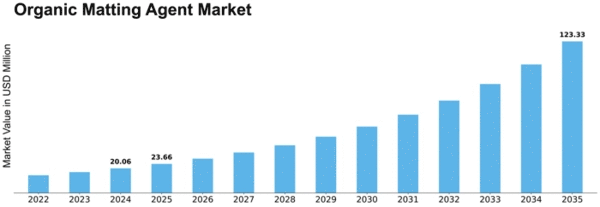
Organic Matting Agent Market Size Graph
Author
Author Profile
Anshula Mandaokar
Team Lead - Research

Anshula Mandaokar holds an academic degree in Chemical Engineering and has been contributing to the field for more than 5 years. She has expertise in Market Research and Business Consulting and serves as a Team Lead for a reputed Market Research firm under the Chemicals and Materials domain spectrum. She has worked on multiple projects, generating explicit results in a quick turnaround time. Her understanding of data interpretation justifies her role as a leader.

Leave a Comment

FAQs

What is the projected market valuation for the Organic Matting Agent Market in 2035?

<p>The projected market valuation for the Organic Matting Agent Market in 2035 is 123.33 USD Million.</p>

What was the market valuation of the Organic Matting Agent Market in 2024?

<p>The market valuation of the Organic Matting Agent Market in 2024 was 20.06 USD Million.</p>

What is the expected CAGR for the Organic Matting Agent Market during the forecast period 2025 - 2035?

<p>The expected CAGR for the Organic Matting Agent Market during the forecast period 2025 - 2035 is 17.95%.</p>

Which companies are considered key players in the Organic Matting Agent Market?

Key players in the Organic Matting Agent Market include Evonik Industries AG, BASF SE, Kraton Corporation, and others.

What are the primary applications of organic matting agents?

The primary applications of organic matting agents include coatings, inks, adhesives, plastics, and cosmetics.

How does the performance of the coatings segment compare to other applications?

The coatings segment, valued at 30.0 USD Million, appears to outperform other applications in the Organic Matting Agent Market.

What is the valuation range for the adhesives segment in the Organic Matting Agent Market?

The valuation range for the adhesives segment in the Organic Matting Agent Market is between 4.0 and 25.0 USD Million.

What end-use sectors are driving demand for organic matting agents?

The end-use sectors driving demand for organic matting agents include automotive, construction, consumer goods, electronics, and textiles.

What formulation types are available in the Organic Matting Agent Market?

Available formulation types in the Organic Matting Agent Market include water-based, solvent-based, powdered, emulsions, and dispersion.

What functionality do organic matting agents serve in various applications?

Organic matting agents serve functionalities such as matting, thickening, stabilizing, texturizing, and binding.

Market Summary

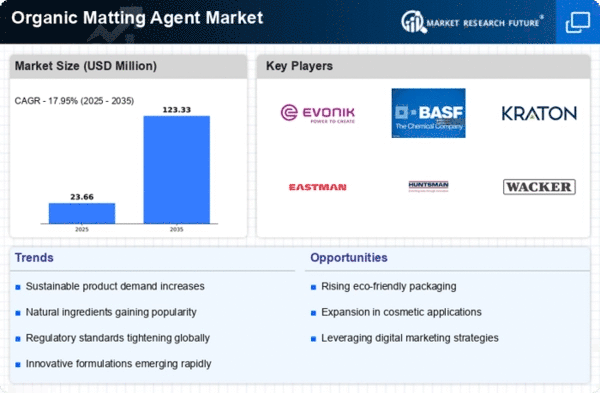
As per MRFR analysis, the Organic Matting Agent Market Size was estimated at 20.06 USD Million in 2024. The Organic Matting Agent industry is projected to grow from 23.66 in 2025 to 123.33 by 2035, exhibiting a compound annual growth rate (CAGR) of 17.95% during the forecast period 2025 - 2035.

Key Market Trends & Highlights

The Organic Matting Agent Market is poised for substantial growth driven by sustainability and innovation.

  • The market is increasingly characterized by a strong focus on sustainability, reflecting a broader consumer trend towards eco-friendly products.
  • Technological advancements are enhancing product formulations, particularly in the coatings segment, which remains the largest market.
  • North America leads the market, while the Asia-Pacific region is emerging as the fastest-growing area, driven by rising industrial demand.
  • Key market drivers include the rising demand for eco-friendly products and regulatory support for sustainable practices, particularly in the automotive and construction sectors.

Market Size & Forecast

2024 Market Size 20.06 (USD Million)
2035 Market Size 123.33 (USD Million)
CAGR (2025 - 2035) 17.95%
Largest Regional Market Share in 2024 North America

Major Players

Evonik Industries AG (DE), BASF SE (DE), Kraton Corporation (US), Eastman Chemical Company (US), Huntsman Corporation (US), Wacker Chemie AG (DE), Solvay SA (BE), Clariant AG (CH), Ashland Global Holdings Inc. (US)

Market Trends

The Organic Matting Agent Market is currently experiencing a notable evolution, driven by increasing consumer awareness regarding sustainable products and environmental concerns. This market encompasses a variety of natural substances that serve to reduce gloss and enhance the aesthetic appeal of coatings, inks, and other formulations. As industries strive to meet the growing demand for eco-friendly solutions, manufacturers are increasingly focusing on developing innovative organic matting agents that align with these sustainability goals. The shift towards natural ingredients is not merely a trend but appears to be a fundamental change in consumer preferences, influencing product formulations across various sectors. Moreover, the Organic Matting Agent Market is likely to witness advancements in technology and production processes, which may enhance the efficiency and effectiveness of these agents. The integration of bio-based materials into formulations is becoming more prevalent, suggesting a potential for improved performance characteristics. Additionally, regulatory frameworks promoting the use of environmentally friendly products could further bolster market growth. As the landscape evolves, stakeholders must remain vigilant to adapt to these changes, ensuring that they meet both regulatory requirements and consumer expectations for sustainability and performance.

Sustainability Focus

The emphasis on sustainability is reshaping the Organic Matting Agent Market. Consumers increasingly prefer products that are environmentally friendly, prompting manufacturers to innovate with natural ingredients. This trend indicates a shift towards eco-conscious formulations that align with broader environmental goals.

Technological Advancements

Technological progress is playing a crucial role in the Organic Matting Agent Market. Innovations in production techniques and material science are enhancing the performance of organic matting agents. This trend suggests that future developments may lead to more efficient and effective products.

Regulatory Influence

Regulatory frameworks are increasingly favoring the use of organic and sustainable materials. This influence is likely to drive growth in the Organic Matting Agent Market, as companies adapt to comply with new standards while meeting consumer demand for greener alternatives.

Organic Matting Agent Market Market Drivers

Market Growth Projections

The Global Organic Matting Agent Market Industry is poised for substantial growth, with projections indicating a market value of 1250 USD Million in 2024 and an anticipated increase to 2750 USD Million by 2035. This growth trajectory reflects a compound annual growth rate (CAGR) of 7.43% from 2025 to 2035, driven by various factors including rising demand for eco-friendly products, technological advancements, and expanding applications across industries. The market's expansion is indicative of a broader trend towards sustainability and the adoption of organic materials in multiple sectors, suggesting a promising future for organic matting agents.

Consumer Awareness and Education

Consumer awareness and education regarding the benefits of organic products significantly impact the Global Organic Matting Agent Market Industry. As consumers become more informed about the environmental and health advantages of organic materials, their purchasing decisions increasingly favor products that align with these values. This heightened awareness is driving demand for organic matting agents, as consumers seek alternatives that are less harmful to both their health and the environment. Manufacturers are capitalizing on this trend by highlighting the benefits of their organic offerings, thereby fostering a more informed consumer base. This driver is likely to contribute to the overall growth of the market in the coming years.

Rising Demand for Eco-Friendly Products

The Global Organic Matting Agent Market Industry experiences a notable surge in demand for eco-friendly products. As consumers become increasingly aware of environmental issues, there is a growing preference for sustainable alternatives in various applications, including coatings and inks. This trend is reflected in the market's projected value of 1250 USD Million in 2024, indicating a robust consumer shift towards organic materials. Manufacturers are responding by developing innovative organic matting agents that align with sustainability goals, thereby enhancing their market presence. This shift not only caters to consumer preferences but also complies with stringent regulations aimed at reducing environmental impact.

Expanding Applications Across Industries

The expanding applications of organic matting agents across diverse industries bolster the Global Organic Matting Agent Market Industry. These agents are increasingly utilized in coatings, adhesives, and inks, among other applications, due to their superior performance and environmental benefits. The versatility of organic matting agents allows them to cater to various market segments, including automotive, construction, and consumer goods. As industries continue to seek sustainable solutions, the demand for organic matting agents is expected to rise, further driving market growth. This trend is indicative of a broader shift towards sustainability across multiple sectors, enhancing the market's overall potential.

Technological Advancements in Production

Technological advancements play a pivotal role in the Global Organic Matting Agent Market Industry, facilitating the development of more efficient and effective production methods. Innovations in extraction and processing technologies enable manufacturers to produce high-quality organic matting agents with improved performance characteristics. These advancements contribute to cost reductions and enhanced product offerings, which are essential for maintaining competitiveness in a growing market. As a result, the industry is likely to witness an increase in production capacity and a broader range of applications, further driving the market's growth trajectory towards an anticipated value of 2750 USD Million by 2035.

Regulatory Support for Sustainable Practices

Regulatory support for sustainable practices significantly influences the Global Organic Matting Agent Market Industry. Governments worldwide are implementing stringent regulations aimed at promoting the use of organic materials in various sectors, including construction and automotive. This regulatory landscape encourages manufacturers to adopt organic matting agents, as compliance with these regulations becomes increasingly critical. The market is expected to benefit from these supportive policies, which not only facilitate market entry for organic products but also enhance consumer trust. Consequently, this driver is likely to contribute to the projected CAGR of 7.43% from 2025 to 2035, reflecting a sustained commitment to sustainability.

Market Segment Insights

By Application: Coatings (Largest) vs. Inks (Fastest-Growing)

The Organic Matting Agent Market showcases diverse applications with coatings leading the way as the largest segment. This application dominates the market due to its extensive use in architectural and automotive finishes. Following coatings, inks emerge as a significant segment, driven by the increasing demand for high-quality printing processes that require eco-friendly solutions. Cosmetically-oriented applications, though smaller, are gaining traction thanks to sustainable practices in cosmetic formulations.

Coatings (Dominant) vs. Inks (Emerging)

The coatings segment is characterized by its widespread applicability in protective and decorative finishes, utilizing organic matting agents to achieve desired aesthetics and performance. It boasts robust demand from various industries, including automotive and construction, establishing it as the dominant force in the market. Conversely, the inks segment is rapidly evolving, with a marked shift towards sustainable practices due to increasing environmental awareness among consumers. This shift presents inks as an emerging opportunity, particularly in high-quality printing where earthy and <a href="https://www.marketresearchfuture.com/reports/organic-pigments-market-1687" target="_blank" title="organic pigments">organic pigments</a> are preferred, framing a path of growth in the overall market.

By End Use: Automotive (Largest) vs. Construction (Fastest-Growing)

The Organic Matting Agent Market is segmented into Automotive, Construction, Consumer Goods, Electronics, and Textiles. Among these, the Automotive sector holds the largest market share, driven by the increasing demand for eco-friendly and sustainable materials in vehicle manufacturing. The Construction segment, while currently smaller, is experiencing a rapid growth trajectory due to rising awareness of environmental impact and regulations favoring organic materials in building applications.

Automotive: Dominant vs. Construction: Emerging

The Automotive segment, as the dominant player in the Organic Matting Agent Market, leverages the growing trend of sustainability among consumers and manufacturers alike. This sector utilizes organic matting agents to improve product durability and appearance while reducing environmental footprints. In contrast, the Construction sector is emerging as a key player, rapidly adapting organic matting agents into various applications such as paints, coatings, and sealants to comply with eco-friendly regulations and consumer preferences for non-toxic building materials. Both segments reflect a shift towards sustainable production, with Automotive being more established, while Construction shows significant potential for future growth.

By Formulation Type: Water-Based (Largest) vs. Powdered (Fastest-Growing)

<p>In the Organic Matting Agent Market, the formulation type segment is primarily dominated by water-based products, which hold a significant share due to their eco-friendliness and versatility. Water-based formulations are favored in various applications including cosmetics, paints, and coatings, where lower VOC emissions and a safer application process are essential. In contrast, powdered organic matting agents are rapidly gaining traction, primarily driven by their easy handling, cost-effectiveness, and performance in a range of end-use applications, such as in agriculture and adhesives.</p>

<p>Water-Based (Dominant) vs. Emulsions (Emerging)</p>

<p>Water-based organic matting agents are recognized for their extensive adoption in environmentally sensitive applications. They offer benefits such as safe usage, easy applicability, and compliance with stringent regulations on VOC emissions. In contrast, emulsions are emerging as a significant alternative, providing excellent stability and texture enhancement in formulations. These two segments represent a critical dynamic within the market; while water-based agents hold the dominant position due to their established reputation and broad acceptance, emulsions are rapidly becoming attractive for applications requiring specialized textures, indicating a shift towards diversified formulations.</p>

By Source: Natural (Largest) vs. Biobased (Fastest-Growing)

<p>In the Organic Matting Agent Market, the source segment is characterized by diverse categories including Natural, Synthetic, Biobased, Mineral, and Plant-Based agents. Among these, Natural sources hold the largest market share due to their eco-friendliness and safety, appealing to a growing consumer base that prioritizes sustainability. Meanwhile, Biobased agents are gaining traction as more industries seek biodegradable and renewable options, reflecting an increasing consumer demand for environmentally responsible products. Growth trends in the organic matting agent market are driven by the rising awareness regarding environmental impact and health preferences. Natural agents remain popular, driven by their safety for both users and the environment. Conversely, the Biobased segment is emerging as the fastest-growing category, spurred by innovations and advancements in organic materials, which capture the attention of manufacturers and consumers looking for sustainable solutions in various applications.</p>

<p>Natural (Dominant) vs. Biobased (Emerging)</p>

<p>Natural organic matting agents dominate the market due to their favorable properties, such as non-toxicity, safety in use, and performance efficiency in a variety of applications. They are derived from sources that are inherently biodegradable, which enhances their appeal among environmentally conscious consumers and regulatory bodies. On the other hand, Biobased agents are rapidly emerging as a competitive alternative, fueled by technological advancements and a growing shift towards renewable materials. These agents are often produced from plant or agricultural resources, aligning with sustainability goals. Both segments are expected to coexist, appealing to different consumer bases; Natural for bulk use and safety, and Biobased for innovation and ecological efficiency.</p>

By Functionality: Thickening (Largest) vs. Stabilizing (Fastest-Growing)

<p>In the Organic Matting Agent Market, the functionality segment is primarily driven by thickening agents, which hold the largest share due to their versatility across various applications such as paints, coatings, and beauty products. Following closely are stabilizing agents, which are gaining traction due to increasing demand for eco-friendly formulations. Other functionalities like matting, texturizing, and binding are also present, but they hold a smaller market share in comparison to these two key segments.</p>

<p>Thickening (Dominant) vs. Stabilizing (Emerging)</p>

<p>Thickening agents in the Organic Matting Agent Market are essential for modifying the viscosity of formulations, thereby enhancing product stability and performance. These agents are prominently used in various industries such as cosmetics and food production, making them a dominant force in the market. In contrast, stabilizing agents are emerging rapidly, catering to the growing consumer preference for natural and organic products. While typically associated with maintaining the consistency and stability of formulations, these agents are also being innovated to meet specific regulatory requirements. Together, they represent a diverse and rapidly evolving functional landscape, serving both established and emerging market needs.</p>

Get more detailed insights about Organic Matting Agent Market Research Report- Forecast to 2035

Regional Insights

North America : Market Leader in Innovation

North America is poised to maintain its leadership in the Organic Matting Agent market, holding a significant market share of 10.03 in 2024. The region's growth is driven by increasing demand for eco-friendly products and stringent regulations promoting sustainable practices. The presence of major players and advanced manufacturing capabilities further bolster market expansion, with a focus on innovation and product development. The United States stands out as the leading country in this sector, hosting key players such as Evonik Industries AG and Eastman Chemical Company. The competitive landscape is characterized by continuous R&D efforts and strategic partnerships aimed at enhancing product offerings. As companies adapt to evolving consumer preferences, North America is expected to sustain its market dominance well into the future.

Europe : Sustainable Growth Focus

Europe's Organic Matting Agent market is projected to grow significantly, with a market size of 6.02 in 2024. The region is witnessing a shift towards sustainable and organic products, driven by consumer awareness and regulatory frameworks that encourage eco-friendly practices. The European Union's Green Deal and various national initiatives are pivotal in shaping market dynamics, fostering innovation and compliance with environmental standards. Germany and France are leading countries in this market, with a robust presence of key players like BASF SE and Wacker Chemie AG. The competitive landscape is marked by collaborations and investments in sustainable technologies. As the demand for organic solutions rises, Europe is set to enhance its market position, aligning with global sustainability goals.

Asia-Pacific : Emerging Market Potential

The Asia-Pacific region is emerging as a significant player in the Organic Matting Agent market, with a market size of 3.01 in 2024. The growth is fueled by increasing industrialization, urbanization, and a rising awareness of environmental issues. Countries are implementing regulations that support the use of organic materials, driving demand for sustainable solutions in various applications, including coatings and plastics. China and India are at the forefront of this growth, with a burgeoning market for organic products. The competitive landscape features both local and international players, including Kraton Corporation and Clariant AG. As the region continues to develop, the focus on innovation and sustainability will be crucial for capturing market share and meeting consumer demands.

Middle East and Africa : Untapped Market Potential

The Middle East and Africa region, with a market size of 1.0 in 2024, presents untapped potential in the Organic Matting Agent market. The growth is driven by increasing industrial activities and a gradual shift towards sustainable practices. Governments are beginning to recognize the importance of environmental regulations, which is expected to catalyze demand for organic solutions across various sectors, including construction and automotive. Countries like South Africa and the UAE are leading the charge, with a growing interest in eco-friendly products. The competitive landscape is still developing, with opportunities for both local and international players to establish a foothold. As awareness of organic materials increases, the region is likely to see significant growth in the coming years.
Key Players and Competitive Insights

The Organic Matting Agent Market is currently characterized by a dynamic competitive landscape, driven by increasing demand for sustainable and eco-friendly products across various industries, including cosmetics, coatings, and plastics. Key players such as Evonik Industries AG (DE), BASF SE (DE), and Huntsman Corporation (US) are strategically positioning themselves through innovation and regional expansion. Evonik Industries AG (DE) has focused on enhancing its product portfolio with bio-based matting agents, which aligns with the growing consumer preference for sustainable solutions. Meanwhile, BASF SE (DE) has been investing in digital transformation initiatives to optimize its supply chain and improve operational efficiency, thereby enhancing its competitive edge in the market. These strategies collectively contribute to a moderately fragmented market structure, where the influence of major players is significant but not overwhelming, allowing for the emergence of niche competitors.In terms of business tactics, companies are increasingly localizing manufacturing to reduce lead times and enhance responsiveness to regional market demands. This approach not only optimizes supply chains but also mitigates risks associated with global logistics disruptions. The competitive structure of the Organic Matting Agent Market appears to be moderately fragmented, with several key players exerting considerable influence while allowing smaller firms to thrive through specialized offerings.

In November Huntsman Corporation (US) announced the launch of a new line of organic matting agents designed specifically for the cosmetics industry. This strategic move is significant as it not only diversifies Huntsman's product offerings but also positions the company to capitalize on the growing trend of clean beauty products. By catering to this niche market, Huntsman is likely to enhance its market share and strengthen its brand reputation among environmentally conscious consumers.

In October BASF SE (DE) unveiled a partnership with a leading technology firm to develop AI-driven solutions for optimizing the formulation of matting agents. This collaboration is indicative of the increasing integration of technology within the industry, suggesting that BASF is keen on leveraging digital tools to enhance product performance and customer satisfaction. Such initiatives may provide the company with a competitive advantage by enabling faster innovation cycles and more tailored solutions for clients.

In September Evonik Industries AG (DE) expanded its production capacity for bio-based matting agents in response to rising demand. This expansion reflects Evonik's commitment to sustainability and its proactive approach to meeting market needs. By increasing its capacity, the company is likely to solidify its position as a leader in the organic matting agent segment, appealing to a broader customer base that prioritizes eco-friendly products.

As of December the Organic Matting Agent Market is witnessing trends that emphasize digitalization, sustainability, and the integration of advanced technologies such as AI. Strategic alliances are becoming increasingly prevalent, as companies recognize the value of collaboration in driving innovation and enhancing market presence. The competitive landscape is shifting from traditional price-based competition towards a focus on technological advancements, product innovation, and supply chain reliability. This evolution suggests that companies that prioritize these aspects will likely achieve greater differentiation and success in the market.

Key Companies in the Organic Matting Agent Market include

Industry Developments

Future Outlook

Organic Matting Agent Market Future Outlook

The Organic Matting Agent Market is projected to grow at 17.95% CAGR from 2025 to 2035, driven by increasing demand for sustainable products and innovations in formulation technologies.

New opportunities lie in:

  • Development of bio-based matting agents for eco-friendly formulations.
  • Expansion into emerging markets with tailored product offerings.
  • Strategic partnerships with cosmetic brands for exclusive product lines.

By 2035, the market is expected to achieve substantial growth, positioning itself as a leader in sustainable solutions.

Market Segmentation

Organic Matting Agent Market Source Outlook

  • Natural
  • Synthetic
  • Biobased
  • Mineral
  • Plant Extracts

Organic Matting Agent Market End Use Outlook

  • Automotive
  • Construction
  • Consumer Goods
  • Electronics
  • Textiles

Organic Matting Agent Market Application Outlook

  • Coatings
  • Inks
  • Adhesives
  • Plastics
  • Cosmetics

Organic Matting Agent Market Functionality Outlook

  • Matting
  • Thickening
  • Stabilizing
  • Texturing
  • Binding

Organic Matting Agent Market Formulation Type Outlook

  • Water-Based
  • Solvent-Based
  • Powdered
  • Emulsions
  • Dispersion

Report Scope

MARKET SIZE 2024 20.06(USD Million)
MARKET SIZE 2025 23.66(USD Million)
MARKET SIZE 2035 123.33(USD Million)
COMPOUND ANNUAL GROWTH RATE (CAGR) 17.95% (2025 - 2035)
REPORT COVERAGE Revenue Forecast, Competitive Landscape, Growth Factors, and Trends
BASE YEAR 2024
Market Forecast Period 2025 - 2035
Historical Data 2019 - 2024
Market Forecast Units USD Million
Key Companies Profiled Evonik Industries AG (DE), BASF SE (DE), Kraton Corporation (US), Eastman Chemical Company (US), Huntsman Corporation (US), Wacker Chemie AG (DE), Solvay SA (BE), Clariant AG (CH), Ashland Global Holdings Inc. (US)
Segments Covered Application, End Use, Formulation Type, Source, Functionality
Key Market Opportunities Growing demand for sustainable products drives innovation in the Organic Matting Agent Market.
Key Market Dynamics Rising consumer preference for sustainable products drives demand for organic matting agents in various industries.
Countries Covered North America, Europe, APAC, South America, MEA

FAQs

What is the projected market valuation for the Organic Matting Agent Market in 2035?

<p>The projected market valuation for the Organic Matting Agent Market in 2035 is 123.33 USD Million.</p>

What was the market valuation of the Organic Matting Agent Market in 2024?

<p>The market valuation of the Organic Matting Agent Market in 2024 was 20.06 USD Million.</p>

What is the expected CAGR for the Organic Matting Agent Market during the forecast period 2025 - 2035?

<p>The expected CAGR for the Organic Matting Agent Market during the forecast period 2025 - 2035 is 17.95%.</p>

Which companies are considered key players in the Organic Matting Agent Market?

Key players in the Organic Matting Agent Market include Evonik Industries AG, BASF SE, Kraton Corporation, and others.

What are the primary applications of organic matting agents?

The primary applications of organic matting agents include coatings, inks, adhesives, plastics, and cosmetics.

How does the performance of the coatings segment compare to other applications?

The coatings segment, valued at 30.0 USD Million, appears to outperform other applications in the Organic Matting Agent Market.

What is the valuation range for the adhesives segment in the Organic Matting Agent Market?

The valuation range for the adhesives segment in the Organic Matting Agent Market is between 4.0 and 25.0 USD Million.

What end-use sectors are driving demand for organic matting agents?

The end-use sectors driving demand for organic matting agents include automotive, construction, consumer goods, electronics, and textiles.

What formulation types are available in the Organic Matting Agent Market?

Available formulation types in the Organic Matting Agent Market include water-based, solvent-based, powdered, emulsions, and dispersion.

What functionality do organic matting agents serve in various applications?

Organic matting agents serve functionalities such as matting, thickening, stabilizing, texturizing, and binding.

  1. SECTION I: EXECUTIVE SUMMARY AND KEY HIGHLIGHTS
    1. | 1.1 EXECUTIVE SUMMARY
    2. | | 1.1.1 Market Overview
    3. | | 1.1.2 Key Findings
    4. | | 1.1.3 Market Segmentation
    5. | | 1.1.4 Competitive Landscape
    6. | | 1.1.5 Challenges and Opportunities
    7. | | 1.1.6 Future Outlook
  2. SECTION II: SCOPING, METHODOLOGY AND MARKET STRUCTURE
    1. | 2.1 MARKET INTRODUCTION
    2. | | 2.1.1 Definition
    3. | | 2.1.2 Scope of the study
    4. | | | 2.1.2.1 Research Objective
    5. | | | 2.1.2.2 Assumption
    6. | | | 2.1.2.3 Limitations
    7. | 2.2 RESEARCH METHODOLOGY
    8. | | 2.2.1 Overview
    9. | | 2.2.2 Data Mining
    10. | | 2.2.3 Secondary Research
    11. | | 2.2.4 Primary Research
    12. | | | 2.2.4.1 Primary Interviews and Information Gathering Process
    13. | | | 2.2.4.2 Breakdown of Primary Respondents
    14. | | 2.2.5 Forecasting Model
    15. | | 2.2.6 Market Size Estimation
    16. | | | 2.2.6.1 Bottom-Up Approach
    17. | | | 2.2.6.2 Top-Down Approach
    18. | | 2.2.7 Data Triangulation
    19. | | 2.2.8 Validation
  3. SECTION III: QUALITATIVE ANALYSIS
    1. | 3.1 MARKET DYNAMICS
    2. | | 3.1.1 Overview
    3. | | 3.1.2 Drivers
    4. | | 3.1.3 Restraints
    5. | | 3.1.4 Opportunities
    6. | 3.2 MARKET FACTOR ANALYSIS
    7. | | 3.2.1 Value chain Analysis
    8. | | 3.2.2 Porter's Five Forces Analysis
    9. | | | 3.2.2.1 Bargaining Power of Suppliers
    10. | | | 3.2.2.2 Bargaining Power of Buyers
    11. | | | 3.2.2.3 Threat of New Entrants
    12. | | | 3.2.2.4 Threat of Substitutes
    13. | | | 3.2.2.5 Intensity of Rivalry
    14. | | 3.2.3 COVID-19 Impact Analysis
    15. | | | 3.2.3.1 Market Impact Analysis
    16. | | | 3.2.3.2 Regional Impact
    17. | | | 3.2.3.3 Opportunity and Threat Analysis
  4. SECTION IV: QUANTITATIVE ANALYSIS
    1. | 4.1 Chemicals and Materials, BY Application (USD Million)
    2. | | 4.1.1 Coatings
    3. | | 4.1.2 Inks
    4. | | 4.1.3 Adhesives
    5. | | 4.1.4 Plastics
    6. | | 4.1.5 Cosmetics
    7. | 4.2 Chemicals and Materials, BY End Use (USD Million)
    8. | | 4.2.1 Automotive
    9. | | 4.2.2 Construction
    10. | | 4.2.3 Consumer Goods
    11. | | 4.2.4 Electronics
    12. | | 4.2.5 Textiles
    13. | 4.3 Chemicals and Materials, BY Formulation Type (USD Million)
    14. | | 4.3.1 Water-Based
    15. | | 4.3.2 Solvent-Based
    16. | | 4.3.3 Powdered
    17. | | 4.3.4 Emulsions
    18. | | 4.3.5 Dispersion
    19. | 4.4 Chemicals and Materials, BY Source (USD Million)
    20. | | 4.4.1 Natural
    21. | | 4.4.2 Synthetic
    22. | | 4.4.3 Biobased
    23. | | 4.4.4 Mineral
    24. | | 4.4.5 Plant-Based
    25. | 4.5 Chemicals and Materials, BY Functionality (USD Million)
    26. | | 4.5.1 Matting
    27. | | 4.5.2 Thickening
    28. | | 4.5.3 Stabilizing
    29. | | 4.5.4 Texturizing
    30. | | 4.5.5 Binding
    31. | 4.6 Chemicals and Materials, BY Region (USD Million)
    32. | | 4.6.1 North America
    33. | | | 4.6.1.1 US
    34. | | | 4.6.1.2 Canada
    35. | | 4.6.2 Europe
    36. | | | 4.6.2.1 Germany
    37. | | | 4.6.2.2 UK
    38. | | | 4.6.2.3 France
    39. | | | 4.6.2.4 Russia
    40. | | | 4.6.2.5 Italy
    41. | | | 4.6.2.6 Spain
    42. | | | 4.6.2.7 Rest of Europe
    43. | | 4.6.3 APAC
    44. | | | 4.6.3.1 China
    45. | | | 4.6.3.2 India
    46. | | | 4.6.3.3 Japan
    47. | | | 4.6.3.4 South Korea
    48. | | | 4.6.3.5 Malaysia
    49. | | | 4.6.3.6 Thailand
    50. | | | 4.6.3.7 Indonesia
    51. | | | 4.6.3.8 Rest of APAC
    52. | | 4.6.4 South America
    53. | | | 4.6.4.1 Brazil
    54. | | | 4.6.4.2 Mexico
    55. | | | 4.6.4.3 Argentina
    56. | | | 4.6.4.4 Rest of South America
    57. | | 4.6.5 MEA
    58. | | | 4.6.5.1 GCC Countries
    59. | | | 4.6.5.2 South Africa
    60. | | | 4.6.5.3 Rest of MEA
  5. SECTION V: COMPETITIVE ANALYSIS
    1. | 5.1 Competitive Landscape
    2. | | 5.1.1 Overview
    3. | | 5.1.2 Competitive Analysis
    4. | | 5.1.3 Market share Analysis
    5. | | 5.1.4 Major Growth Strategy in the Chemicals and Materials
    6. | | 5.1.5 Competitive Benchmarking
    7. | | 5.1.6 Leading Players in Terms of Number of Developments in the Chemicals and Materials
    8. | | 5.1.7 Key developments and growth strategies
    9. | | | 5.1.7.1 New Product Launch/Service Deployment
    10. | | | 5.1.7.2 Merger & Acquisitions
    11. | | | 5.1.7.3 Joint Ventures
    12. | | 5.1.8 Major Players Financial Matrix
    13. | | | 5.1.8.1 Sales and Operating Income
    14. | | | 5.1.8.2 Major Players R&D Expenditure. 2023
    15. | 5.2 Company Profiles
    16. | | 5.2.1 Evonik Industries AG (DE)
    17. | | | 5.2.1.1 Financial Overview
    18. | | | 5.2.1.2 Products Offered
    19. | | | 5.2.1.3 Key Developments
    20. | | | 5.2.1.4 SWOT Analysis
    21. | | | 5.2.1.5 Key Strategies
    22. | | 5.2.2 BASF SE (DE)
    23. | | | 5.2.2.1 Financial Overview
    24. | | | 5.2.2.2 Products Offered
    25. | | | 5.2.2.3 Key Developments
    26. | | | 5.2.2.4 SWOT Analysis
    27. | | | 5.2.2.5 Key Strategies
    28. | | 5.2.3 Kraton Corporation (US)
    29. | | | 5.2.3.1 Financial Overview
    30. | | | 5.2.3.2 Products Offered
    31. | | | 5.2.3.3 Key Developments
    32. | | | 5.2.3.4 SWOT Analysis
    33. | | | 5.2.3.5 Key Strategies
    34. | | 5.2.4 Eastman Chemical Company (US)
    35. | | | 5.2.4.1 Financial Overview
    36. | | | 5.2.4.2 Products Offered
    37. | | | 5.2.4.3 Key Developments
    38. | | | 5.2.4.4 SWOT Analysis
    39. | | | 5.2.4.5 Key Strategies
    40. | | 5.2.5 Huntsman Corporation (US)
    41. | | | 5.2.5.1 Financial Overview
    42. | | | 5.2.5.2 Products Offered
    43. | | | 5.2.5.3 Key Developments
    44. | | | 5.2.5.4 SWOT Analysis
    45. | | | 5.2.5.5 Key Strategies
    46. | | 5.2.6 Wacker Chemie AG (DE)
    47. | | | 5.2.6.1 Financial Overview
    48. | | | 5.2.6.2 Products Offered
    49. | | | 5.2.6.3 Key Developments
    50. | | | 5.2.6.4 SWOT Analysis
    51. | | | 5.2.6.5 Key Strategies
    52. | | 5.2.7 Solvay SA (BE)
    53. | | | 5.2.7.1 Financial Overview
    54. | | | 5.2.7.2 Products Offered
    55. | | | 5.2.7.3 Key Developments
    56. | | | 5.2.7.4 SWOT Analysis
    57. | | | 5.2.7.5 Key Strategies
    58. | | 5.2.8 Clariant AG (CH)
    59. | | | 5.2.8.1 Financial Overview
    60. | | | 5.2.8.2 Products Offered
    61. | | | 5.2.8.3 Key Developments
    62. | | | 5.2.8.4 SWOT Analysis
    63. | | | 5.2.8.5 Key Strategies
    64. | | 5.2.9 DOW Inc. (US)
    65. | | | 5.2.9.1 Financial Overview
    66. | | | 5.2.9.2 Products Offered
    67. | | | 5.2.9.3 Key Developments
    68. | | | 5.2.9.4 SWOT Analysis
    69. | | | 5.2.9.5 Key Strategies
    70. | 5.3 Appendix
    71. | | 5.3.1 References
    72. | | 5.3.2 Related Reports
  6. LIST OF FIGURES
    1. | 6.1 MARKET SYNOPSIS
    2. | 6.2 NORTH AMERICA MARKET ANALYSIS
    3. | 6.3 US MARKET ANALYSIS BY APPLICATION
    4. | 6.4 US MARKET ANALYSIS BY END USE
    5. | 6.5 US MARKET ANALYSIS BY FORMULATION TYPE
    6. | 6.6 US MARKET ANALYSIS BY SOURCE
    7. | 6.7 US MARKET ANALYSIS BY FUNCTIONALITY
    8. | 6.8 CANADA MARKET ANALYSIS BY APPLICATION
    9. | 6.9 CANADA MARKET ANALYSIS BY END USE
    10. | 6.10 CANADA MARKET ANALYSIS BY FORMULATION TYPE
    11. | 6.11 CANADA MARKET ANALYSIS BY SOURCE
    12. | 6.12 CANADA MARKET ANALYSIS BY FUNCTIONALITY
    13. | 6.13 EUROPE MARKET ANALYSIS
    14. | 6.14 GERMANY MARKET ANALYSIS BY APPLICATION
    15. | 6.15 GERMANY MARKET ANALYSIS BY END USE
    16. | 6.16 GERMANY MARKET ANALYSIS BY FORMULATION TYPE
    17. | 6.17 GERMANY MARKET ANALYSIS BY SOURCE
    18. | 6.18 GERMANY MARKET ANALYSIS BY FUNCTIONALITY
    19. | 6.19 UK MARKET ANALYSIS BY APPLICATION
    20. | 6.20 UK MARKET ANALYSIS BY END USE
    21. | 6.21 UK MARKET ANALYSIS BY FORMULATION TYPE
    22. | 6.22 UK MARKET ANALYSIS BY SOURCE
    23. | 6.23 UK MARKET ANALYSIS BY FUNCTIONALITY
    24. | 6.24 FRANCE MARKET ANALYSIS BY APPLICATION
    25. | 6.25 FRANCE MARKET ANALYSIS BY END USE
    26. | 6.26 FRANCE MARKET ANALYSIS BY FORMULATION TYPE
    27. | 6.27 FRANCE MARKET ANALYSIS BY SOURCE
    28. | 6.28 FRANCE MARKET ANALYSIS BY FUNCTIONALITY
    29. | 6.29 RUSSIA MARKET ANALYSIS BY APPLICATION
    30. | 6.30 RUSSIA MARKET ANALYSIS BY END USE
    31. | 6.31 RUSSIA MARKET ANALYSIS BY FORMULATION TYPE
    32. | 6.32 RUSSIA MARKET ANALYSIS BY SOURCE
    33. | 6.33 RUSSIA MARKET ANALYSIS BY FUNCTIONALITY
    34. | 6.34 ITALY MARKET ANALYSIS BY APPLICATION
    35. | 6.35 ITALY MARKET ANALYSIS BY END USE
    36. | 6.36 ITALY MARKET ANALYSIS BY FORMULATION TYPE
    37. | 6.37 ITALY MARKET ANALYSIS BY SOURCE
    38. | 6.38 ITALY MARKET ANALYSIS BY FUNCTIONALITY
    39. | 6.39 SPAIN MARKET ANALYSIS BY APPLICATION
    40. | 6.40 SPAIN MARKET ANALYSIS BY END USE
    41. | 6.41 SPAIN MARKET ANALYSIS BY FORMULATION TYPE
    42. | 6.42 SPAIN MARKET ANALYSIS BY SOURCE
    43. | 6.43 SPAIN MARKET ANALYSIS BY FUNCTIONALITY
    44. | 6.44 REST OF EUROPE MARKET ANALYSIS BY APPLICATION
    45. | 6.45 REST OF EUROPE MARKET ANALYSIS BY END USE
    46. | 6.46 REST OF EUROPE MARKET ANALYSIS BY FORMULATION TYPE
    47. | 6.47 REST OF EUROPE MARKET ANALYSIS BY SOURCE
    48. | 6.48 REST OF EUROPE MARKET ANALYSIS BY FUNCTIONALITY
    49. | 6.49 APAC MARKET ANALYSIS
    50. | 6.50 CHINA MARKET ANALYSIS BY APPLICATION
    51. | 6.51 CHINA MARKET ANALYSIS BY END USE
    52. | 6.52 CHINA MARKET ANALYSIS BY FORMULATION TYPE
    53. | 6.53 CHINA MARKET ANALYSIS BY SOURCE
    54. | 6.54 CHINA MARKET ANALYSIS BY FUNCTIONALITY
    55. | 6.55 INDIA MARKET ANALYSIS BY APPLICATION
    56. | 6.56 INDIA MARKET ANALYSIS BY END USE
    57. | 6.57 INDIA MARKET ANALYSIS BY FORMULATION TYPE
    58. | 6.58 INDIA MARKET ANALYSIS BY SOURCE
    59. | 6.59 INDIA MARKET ANALYSIS BY FUNCTIONALITY
    60. | 6.60 JAPAN MARKET ANALYSIS BY APPLICATION
    61. | 6.61 JAPAN MARKET ANALYSIS BY END USE
    62. | 6.62 JAPAN MARKET ANALYSIS BY FORMULATION TYPE
    63. | 6.63 JAPAN MARKET ANALYSIS BY SOURCE
    64. | 6.64 JAPAN MARKET ANALYSIS BY FUNCTIONALITY
    65. | 6.65 SOUTH KOREA MARKET ANALYSIS BY APPLICATION
    66. | 6.66 SOUTH KOREA MARKET ANALYSIS BY END USE
    67. | 6.67 SOUTH KOREA MARKET ANALYSIS BY FORMULATION TYPE
    68. | 6.68 SOUTH KOREA MARKET ANALYSIS BY SOURCE
    69. | 6.69 SOUTH KOREA MARKET ANALYSIS BY FUNCTIONALITY
    70. | 6.70 MALAYSIA MARKET ANALYSIS BY APPLICATION
    71. | 6.71 MALAYSIA MARKET ANALYSIS BY END USE
    72. | 6.72 MALAYSIA MARKET ANALYSIS BY FORMULATION TYPE
    73. | 6.73 MALAYSIA MARKET ANALYSIS BY SOURCE
    74. | 6.74 MALAYSIA MARKET ANALYSIS BY FUNCTIONALITY
    75. | 6.75 THAILAND MARKET ANALYSIS BY APPLICATION
    76. | 6.76 THAILAND MARKET ANALYSIS BY END USE
    77. | 6.77 THAILAND MARKET ANALYSIS BY FORMULATION TYPE
    78. | 6.78 THAILAND MARKET ANALYSIS BY SOURCE
    79. | 6.79 THAILAND MARKET ANALYSIS BY FUNCTIONALITY
    80. | 6.80 INDONESIA MARKET ANALYSIS BY APPLICATION
    81. | 6.81 INDONESIA MARKET ANALYSIS BY END USE
    82. | 6.82 INDONESIA MARKET ANALYSIS BY FORMULATION TYPE
    83. | 6.83 INDONESIA MARKET ANALYSIS BY SOURCE
    84. | 6.84 INDONESIA MARKET ANALYSIS BY FUNCTIONALITY
    85. | 6.85 REST OF APAC MARKET ANALYSIS BY APPLICATION
    86. | 6.86 REST OF APAC MARKET ANALYSIS BY END USE
    87. | 6.87 REST OF APAC MARKET ANALYSIS BY FORMULATION TYPE
    88. | 6.88 REST OF APAC MARKET ANALYSIS BY SOURCE
    89. | 6.89 REST OF APAC MARKET ANALYSIS BY FUNCTIONALITY
    90. | 6.90 SOUTH AMERICA MARKET ANALYSIS
    91. | 6.91 BRAZIL MARKET ANALYSIS BY APPLICATION
    92. | 6.92 BRAZIL MARKET ANALYSIS BY END USE
    93. | 6.93 BRAZIL MARKET ANALYSIS BY FORMULATION TYPE
    94. | 6.94 BRAZIL MARKET ANALYSIS BY SOURCE
    95. | 6.95 BRAZIL MARKET ANALYSIS BY FUNCTIONALITY
    96. | 6.96 MEXICO MARKET ANALYSIS BY APPLICATION
    97. | 6.97 MEXICO MARKET ANALYSIS BY END USE
    98. | 6.98 MEXICO MARKET ANALYSIS BY FORMULATION TYPE
    99. | 6.99 MEXICO MARKET ANALYSIS BY SOURCE
    100. | 6.100 MEXICO MARKET ANALYSIS BY FUNCTIONALITY
    101. | 6.101 ARGENTINA MARKET ANALYSIS BY APPLICATION
    102. | 6.102 ARGENTINA MARKET ANALYSIS BY END USE
    103. | 6.103 ARGENTINA MARKET ANALYSIS BY FORMULATION TYPE
    104. | 6.104 ARGENTINA MARKET ANALYSIS BY SOURCE
    105. | 6.105 ARGENTINA MARKET ANALYSIS BY FUNCTIONALITY
    106. | 6.106 REST OF SOUTH AMERICA MARKET ANALYSIS BY APPLICATION
    107. | 6.107 REST OF SOUTH AMERICA MARKET ANALYSIS BY END USE
    108. | 6.108 REST OF SOUTH AMERICA MARKET ANALYSIS BY FORMULATION TYPE
    109. | 6.109 REST OF SOUTH AMERICA MARKET ANALYSIS BY SOURCE
    110. | 6.110 REST OF SOUTH AMERICA MARKET ANALYSIS BY FUNCTIONALITY
    111. | 6.111 MEA MARKET ANALYSIS
    112. | 6.112 GCC COUNTRIES MARKET ANALYSIS BY APPLICATION
    113. | 6.113 GCC COUNTRIES MARKET ANALYSIS BY END USE
    114. | 6.114 GCC COUNTRIES MARKET ANALYSIS BY FORMULATION TYPE
    115. | 6.115 GCC COUNTRIES MARKET ANALYSIS BY SOURCE
    116. | 6.116 GCC COUNTRIES MARKET ANALYSIS BY FUNCTIONALITY
    117. | 6.117 SOUTH AFRICA MARKET ANALYSIS BY APPLICATION
    118. | 6.118 SOUTH AFRICA MARKET ANALYSIS BY END USE
    119. | 6.119 SOUTH AFRICA MARKET ANALYSIS BY FORMULATION TYPE
    120. | 6.120 SOUTH AFRICA MARKET ANALYSIS BY SOURCE
    121. | 6.121 SOUTH AFRICA MARKET ANALYSIS BY FUNCTIONALITY
    122. | 6.122 REST OF MEA MARKET ANALYSIS BY APPLICATION
    123. | 6.123 REST OF MEA MARKET ANALYSIS BY END USE
    124. | 6.124 REST OF MEA MARKET ANALYSIS BY FORMULATION TYPE
    125. | 6.125 REST OF MEA MARKET ANALYSIS BY SOURCE
    126. | 6.126 REST OF MEA MARKET ANALYSIS BY FUNCTIONALITY
    127. | 6.127 KEY BUYING CRITERIA OF CHEMICALS AND MATERIALS
    128. | 6.128 RESEARCH PROCESS OF MRFR
    129. | 6.129 DRO ANALYSIS OF CHEMICALS AND MATERIALS
    130. | 6.130 DRIVERS IMPACT ANALYSIS: CHEMICALS AND MATERIALS
    131. | 6.131 RESTRAINTS IMPACT ANALYSIS: CHEMICALS AND MATERIALS
    132. | 6.132 SUPPLY / VALUE CHAIN: CHEMICALS AND MATERIALS
    133. | 6.133 CHEMICALS AND MATERIALS, BY APPLICATION, 2024 (% SHARE)
    134. | 6.134 CHEMICALS AND MATERIALS, BY APPLICATION, 2024 TO 2035 (USD Million)
    135. | 6.135 CHEMICALS AND MATERIALS, BY END USE, 2024 (% SHARE)
    136. | 6.136 CHEMICALS AND MATERIALS, BY END USE, 2024 TO 2035 (USD Million)
    137. | 6.137 CHEMICALS AND MATERIALS, BY FORMULATION TYPE, 2024 (% SHARE)
    138. | 6.138 CHEMICALS AND MATERIALS, BY FORMULATION TYPE, 2024 TO 2035 (USD Million)
    139. | 6.139 CHEMICALS AND MATERIALS, BY SOURCE, 2024 (% SHARE)
    140. | 6.140 CHEMICALS AND MATERIALS, BY SOURCE, 2024 TO 2035 (USD Million)
    141. | 6.141 CHEMICALS AND MATERIALS, BY FUNCTIONALITY, 2024 (% SHARE)
    142. | 6.142 CHEMICALS AND MATERIALS, BY FUNCTIONALITY, 2024 TO 2035 (USD Million)
    143. | 6.143 BENCHMARKING OF MAJOR COMPETITORS
  7. LIST OF TABLES
    1. | 7.1 LIST OF ASSUMPTIONS
    2. | | 7.1.1
    3. | 7.2 North America MARKET SIZE ESTIMATES; FORECAST
    4. | | 7.2.1 BY APPLICATION, 2025-2035 (USD Million)
    5. | | 7.2.2 BY END USE, 2025-2035 (USD Million)
    6. | | 7.2.3 BY FORMULATION TYPE, 2025-2035 (USD Million)
    7. | | 7.2.4 BY SOURCE, 2025-2035 (USD Million)
    8. | | 7.2.5 BY FUNCTIONALITY, 2025-2035 (USD Million)
    9. | 7.3 US MARKET SIZE ESTIMATES; FORECAST
    10. | | 7.3.1 BY APPLICATION, 2025-2035 (USD Million)
    11. | | 7.3.2 BY END USE, 2025-2035 (USD Million)
    12. | | 7.3.3 BY FORMULATION TYPE, 2025-2035 (USD Million)
    13. | | 7.3.4 BY SOURCE, 2025-2035 (USD Million)
    14. | | 7.3.5 BY FUNCTIONALITY, 2025-2035 (USD Million)
    15. | 7.4 Canada MARKET SIZE ESTIMATES; FORECAST
    16. | | 7.4.1 BY APPLICATION, 2025-2035 (USD Million)
    17. | | 7.4.2 BY END USE, 2025-2035 (USD Million)
    18. | | 7.4.3 BY FORMULATION TYPE, 2025-2035 (USD Million)
    19. | | 7.4.4 BY SOURCE, 2025-2035 (USD Million)
    20. | | 7.4.5 BY FUNCTIONALITY, 2025-2035 (USD Million)
    21. | 7.5 Europe MARKET SIZE ESTIMATES; FORECAST
    22. | | 7.5.1 BY APPLICATION, 2025-2035 (USD Million)
    23. | | 7.5.2 BY END USE, 2025-2035 (USD Million)
    24. | | 7.5.3 BY FORMULATION TYPE, 2025-2035 (USD Million)
    25. | | 7.5.4 BY SOURCE, 2025-2035 (USD Million)
    26. | | 7.5.5 BY FUNCTIONALITY, 2025-2035 (USD Million)
    27. | 7.6 Germany MARKET SIZE ESTIMATES; FORECAST
    28. | | 7.6.1 BY APPLICATION, 2025-2035 (USD Million)
    29. | | 7.6.2 BY END USE, 2025-2035 (USD Million)
    30. | | 7.6.3 BY FORMULATION TYPE, 2025-2035 (USD Million)
    31. | | 7.6.4 BY SOURCE, 2025-2035 (USD Million)
    32. | | 7.6.5 BY FUNCTIONALITY, 2025-2035 (USD Million)
    33. | 7.7 UK MARKET SIZE ESTIMATES; FORECAST
    34. | | 7.7.1 BY APPLICATION, 2025-2035 (USD Million)
    35. | | 7.7.2 BY END USE, 2025-2035 (USD Million)
    36. | | 7.7.3 BY FORMULATION TYPE, 2025-2035 (USD Million)
    37. | | 7.7.4 BY SOURCE, 2025-2035 (USD Million)
    38. | | 7.7.5 BY FUNCTIONALITY, 2025-2035 (USD Million)
    39. | 7.8 France MARKET SIZE ESTIMATES; FORECAST
    40. | | 7.8.1 BY APPLICATION, 2025-2035 (USD Million)
    41. | | 7.8.2 BY END USE, 2025-2035 (USD Million)
    42. | | 7.8.3 BY FORMULATION TYPE, 2025-2035 (USD Million)
    43. | | 7.8.4 BY SOURCE, 2025-2035 (USD Million)
    44. | | 7.8.5 BY FUNCTIONALITY, 2025-2035 (USD Million)
    45. | 7.9 Russia MARKET SIZE ESTIMATES; FORECAST
    46. | | 7.9.1 BY APPLICATION, 2025-2035 (USD Million)
    47. | | 7.9.2 BY END USE, 2025-2035 (USD Million)
    48. | | 7.9.3 BY FORMULATION TYPE, 2025-2035 (USD Million)
    49. | | 7.9.4 BY SOURCE, 2025-2035 (USD Million)
    50. | | 7.9.5 BY FUNCTIONALITY, 2025-2035 (USD Million)
    51. | 7.10 Italy MARKET SIZE ESTIMATES; FORECAST
    52. | | 7.10.1 BY APPLICATION, 2025-2035 (USD Million)
    53. | | 7.10.2 BY END USE, 2025-2035 (USD Million)
    54. | | 7.10.3 BY FORMULATION TYPE, 2025-2035 (USD Million)
    55. | | 7.10.4 BY SOURCE, 2025-2035 (USD Million)
    56. | | 7.10.5 BY FUNCTIONALITY, 2025-2035 (USD Million)
    57. | 7.11 Spain MARKET SIZE ESTIMATES; FORECAST
    58. | | 7.11.1 BY APPLICATION, 2025-2035 (USD Million)
    59. | | 7.11.2 BY END USE, 2025-2035 (USD Million)
    60. | | 7.11.3 BY FORMULATION TYPE, 2025-2035 (USD Million)
    61. | | 7.11.4 BY SOURCE, 2025-2035 (USD Million)
    62. | | 7.11.5 BY FUNCTIONALITY, 2025-2035 (USD Million)
    63. | 7.12 Rest of Europe MARKET SIZE ESTIMATES; FORECAST
    64. | | 7.12.1 BY APPLICATION, 2025-2035 (USD Million)
    65. | | 7.12.2 BY END USE, 2025-2035 (USD Million)
    66. | | 7.12.3 BY FORMULATION TYPE, 2025-2035 (USD Million)
    67. | | 7.12.4 BY SOURCE, 2025-2035 (USD Million)
    68. | | 7.12.5 BY FUNCTIONALITY, 2025-2035 (USD Million)
    69. | 7.13 APAC MARKET SIZE ESTIMATES; FORECAST
    70. | | 7.13.1 BY APPLICATION, 2025-2035 (USD Million)
    71. | | 7.13.2 BY END USE, 2025-2035 (USD Million)
    72. | | 7.13.3 BY FORMULATION TYPE, 2025-2035 (USD Million)
    73. | | 7.13.4 BY SOURCE, 2025-2035 (USD Million)
    74. | | 7.13.5 BY FUNCTIONALITY, 2025-2035 (USD Million)
    75. | 7.14 China MARKET SIZE ESTIMATES; FORECAST
    76. | | 7.14.1 BY APPLICATION, 2025-2035 (USD Million)
    77. | | 7.14.2 BY END USE, 2025-2035 (USD Million)
    78. | | 7.14.3 BY FORMULATION TYPE, 2025-2035 (USD Million)
    79. | | 7.14.4 BY SOURCE, 2025-2035 (USD Million)
    80. | | 7.14.5 BY FUNCTIONALITY, 2025-2035 (USD Million)
    81. | 7.15 India MARKET SIZE ESTIMATES; FORECAST
    82. | | 7.15.1 BY APPLICATION, 2025-2035 (USD Million)
    83. | | 7.15.2 BY END USE, 2025-2035 (USD Million)
    84. | | 7.15.3 BY FORMULATION TYPE, 2025-2035 (USD Million)
    85. | | 7.15.4 BY SOURCE, 2025-2035 (USD Million)
    86. | | 7.15.5 BY FUNCTIONALITY, 2025-2035 (USD Million)
    87. | 7.16 Japan MARKET SIZE ESTIMATES; FORECAST
    88. | | 7.16.1 BY APPLICATION, 2025-2035 (USD Million)
    89. | | 7.16.2 BY END USE, 2025-2035 (USD Million)
    90. | | 7.16.3 BY FORMULATION TYPE, 2025-2035 (USD Million)
    91. | | 7.16.4 BY SOURCE, 2025-2035 (USD Million)
    92. | | 7.16.5 BY FUNCTIONALITY, 2025-2035 (USD Million)
    93. | 7.17 South Korea MARKET SIZE ESTIMATES; FORECAST
    94. | | 7.17.1 BY APPLICATION, 2025-2035 (USD Million)
    95. | | 7.17.2 BY END USE, 2025-2035 (USD Million)
    96. | | 7.17.3 BY FORMULATION TYPE, 2025-2035 (USD Million)
    97. | | 7.17.4 BY SOURCE, 2025-2035 (USD Million)
    98. | | 7.17.5 BY FUNCTIONALITY, 2025-2035 (USD Million)
    99. | 7.18 Malaysia MARKET SIZE ESTIMATES; FORECAST
    100. | | 7.18.1 BY APPLICATION, 2025-2035 (USD Million)
    101. | | 7.18.2 BY END USE, 2025-2035 (USD Million)
    102. | | 7.18.3 BY FORMULATION TYPE, 2025-2035 (USD Million)
    103. | | 7.18.4 BY SOURCE, 2025-2035 (USD Million)
    104. | | 7.18.5 BY FUNCTIONALITY, 2025-2035 (USD Million)
    105. | 7.19 Thailand MARKET SIZE ESTIMATES; FORECAST
    106. | | 7.19.1 BY APPLICATION, 2025-2035 (USD Million)
    107. | | 7.19.2 BY END USE, 2025-2035 (USD Million)
    108. | | 7.19.3 BY FORMULATION TYPE, 2025-2035 (USD Million)
    109. | | 7.19.4 BY SOURCE, 2025-2035 (USD Million)
    110. | | 7.19.5 BY FUNCTIONALITY, 2025-2035 (USD Million)
    111. | 7.20 Indonesia MARKET SIZE ESTIMATES; FORECAST
    112. | | 7.20.1 BY APPLICATION, 2025-2035 (USD Million)
    113. | | 7.20.2 BY END USE, 2025-2035 (USD Million)
    114. | | 7.20.3 BY FORMULATION TYPE, 2025-2035 (USD Million)
    115. | | 7.20.4 BY SOURCE, 2025-2035 (USD Million)
    116. | | 7.20.5 BY FUNCTIONALITY, 2025-2035 (USD Million)
    117. | 7.21 Rest of APAC MARKET SIZE ESTIMATES; FORECAST
    118. | | 7.21.1 BY APPLICATION, 2025-2035 (USD Million)
    119. | | 7.21.2 BY END USE, 2025-2035 (USD Million)
    120. | | 7.21.3 BY FORMULATION TYPE, 2025-2035 (USD Million)
    121. | | 7.21.4 BY SOURCE, 2025-2035 (USD Million)
    122. | | 7.21.5 BY FUNCTIONALITY, 2025-2035 (USD Million)
    123. | 7.22 South America MARKET SIZE ESTIMATES; FORECAST
    124. | | 7.22.1 BY APPLICATION, 2025-2035 (USD Million)
    125. | | 7.22.2 BY END USE, 2025-2035 (USD Million)
    126. | | 7.22.3 BY FORMULATION TYPE, 2025-2035 (USD Million)
    127. | | 7.22.4 BY SOURCE, 2025-2035 (USD Million)
    128. | | 7.22.5 BY FUNCTIONALITY, 2025-2035 (USD Million)
    129. | 7.23 Brazil MARKET SIZE ESTIMATES; FORECAST
    130. | | 7.23.1 BY APPLICATION, 2025-2035 (USD Million)
    131. | | 7.23.2 BY END USE, 2025-2035 (USD Million)
    132. | | 7.23.3 BY FORMULATION TYPE, 2025-2035 (USD Million)
    133. | | 7.23.4 BY SOURCE, 2025-2035 (USD Million)
    134. | | 7.23.5 BY FUNCTIONALITY, 2025-2035 (USD Million)
    135. | 7.24 Mexico MARKET SIZE ESTIMATES; FORECAST
    136. | | 7.24.1 BY APPLICATION, 2025-2035 (USD Million)
    137. | | 7.24.2 BY END USE, 2025-2035 (USD Million)
    138. | | 7.24.3 BY FORMULATION TYPE, 2025-2035 (USD Million)
    139. | | 7.24.4 BY SOURCE, 2025-2035 (USD Million)
    140. | | 7.24.5 BY FUNCTIONALITY, 2025-2035 (USD Million)
    141. | 7.25 Argentina MARKET SIZE ESTIMATES; FORECAST
    142. | | 7.25.1 BY APPLICATION, 2025-2035 (USD Million)
    143. | | 7.25.2 BY END USE, 2025-2035 (USD Million)
    144. | | 7.25.3 BY FORMULATION TYPE, 2025-2035 (USD Million)
    145. | | 7.25.4 BY SOURCE, 2025-2035 (USD Million)
    146. | | 7.25.5 BY FUNCTIONALITY, 2025-2035 (USD Million)
    147. | 7.26 Rest of South America MARKET SIZE ESTIMATES; FORECAST
    148. | | 7.26.1 BY APPLICATION, 2025-2035 (USD Million)
    149. | | 7.26.2 BY END USE, 2025-2035 (USD Million)
    150. | | 7.26.3 BY FORMULATION TYPE, 2025-2035 (USD Million)
    151. | | 7.26.4 BY SOURCE, 2025-2035 (USD Million)
    152. | | 7.26.5 BY FUNCTIONALITY, 2025-2035 (USD Million)
    153. | 7.27 MEA MARKET SIZE ESTIMATES; FORECAST
    154. | | 7.27.1 BY APPLICATION, 2025-2035 (USD Million)
    155. | | 7.27.2 BY END USE, 2025-2035 (USD Million)
    156. | | 7.27.3 BY FORMULATION TYPE, 2025-2035 (USD Million)
    157. | | 7.27.4 BY SOURCE, 2025-2035 (USD Million)
    158. | | 7.27.5 BY FUNCTIONALITY, 2025-2035 (USD Million)
    159. | 7.28 GCC Countries MARKET SIZE ESTIMATES; FORECAST
    160. | | 7.28.1 BY APPLICATION, 2025-2035 (USD Million)
    161. | | 7.28.2 BY END USE, 2025-2035 (USD Million)
    162. | | 7.28.3 BY FORMULATION TYPE, 2025-2035 (USD Million)
    163. | | 7.28.4 BY SOURCE, 2025-2035 (USD Million)
    164. | | 7.28.5 BY FUNCTIONALITY, 2025-2035 (USD Million)
    165. | 7.29 South Africa MARKET SIZE ESTIMATES; FORECAST
    166. | | 7.29.1 BY APPLICATION, 2025-2035 (USD Million)
    167. | | 7.29.2 BY END USE, 2025-2035 (USD Million)
    168. | | 7.29.3 BY FORMULATION TYPE, 2025-2035 (USD Million)
    169. | | 7.29.4 BY SOURCE, 2025-2035 (USD Million)
    170. | | 7.29.5 BY FUNCTIONALITY, 2025-2035 (USD Million)
    171. | 7.30 Rest of MEA MARKET SIZE ESTIMATES; FORECAST
    172. | | 7.30.1 BY APPLICATION, 2025-2035 (USD Million)
    173. | | 7.30.2 BY END USE, 2025-2035 (USD Million)
    174. | | 7.30.3 BY FORMULATION TYPE, 2025-2035 (USD Million)
    175. | | 7.30.4 BY SOURCE, 2025-2035 (USD Million)
    176. | | 7.30.5 BY FUNCTIONALITY, 2025-2035 (USD Million)
    177. | 7.31 PRODUCT LAUNCH/PRODUCT DEVELOPMENT/APPROVAL
    178. | | 7.31.1
    179. | 7.32 ACQUISITION/PARTNERSHIP
    180. | | 7.32.1

Chemicals and Materials Market Segmentation

Chemicals and Materials By Application (USD Million, 2025-2035)

  • Coatings
  • Inks
  • Adhesives
  • Plastics
  • Cosmetics

Chemicals and Materials By End Use (USD Million, 2025-2035)

  • Automotive
  • Construction
  • Consumer Goods
  • Electronics
  • Textiles

Chemicals and Materials By Formulation Type (USD Million, 2025-2035)

  • Water-Based
  • Solvent-Based
  • Powdered
  • Emulsions
  • Dispersion

Chemicals and Materials By Source (USD Million, 2025-2035)

  • Natural
  • Synthetic
  • Biobased
  • Mineral
  • Plant-Based

Chemicals and Materials By Functionality (USD Million, 2025-2035)

  • Matting
  • Thickening
  • Stabilizing
  • Texturizing
  • Binding
Infographic

Free Sample Request

Kindly complete the form below to receive a free sample of this Report

Get Free Sample

Customer Strories

Compare Licence

×
Features License Type
Single User Multiuser License Enterprise User
Price $4,950 $5,950 $7,250
Maximum User Access Limit 1 User Upto 10 Users Unrestricted Access Throughout the Organization
Free Customization
Direct Access to Analyst
Deliverable Format
Platform Access
Discount on Next Purchase 10% 15% 15%
Printable Versions