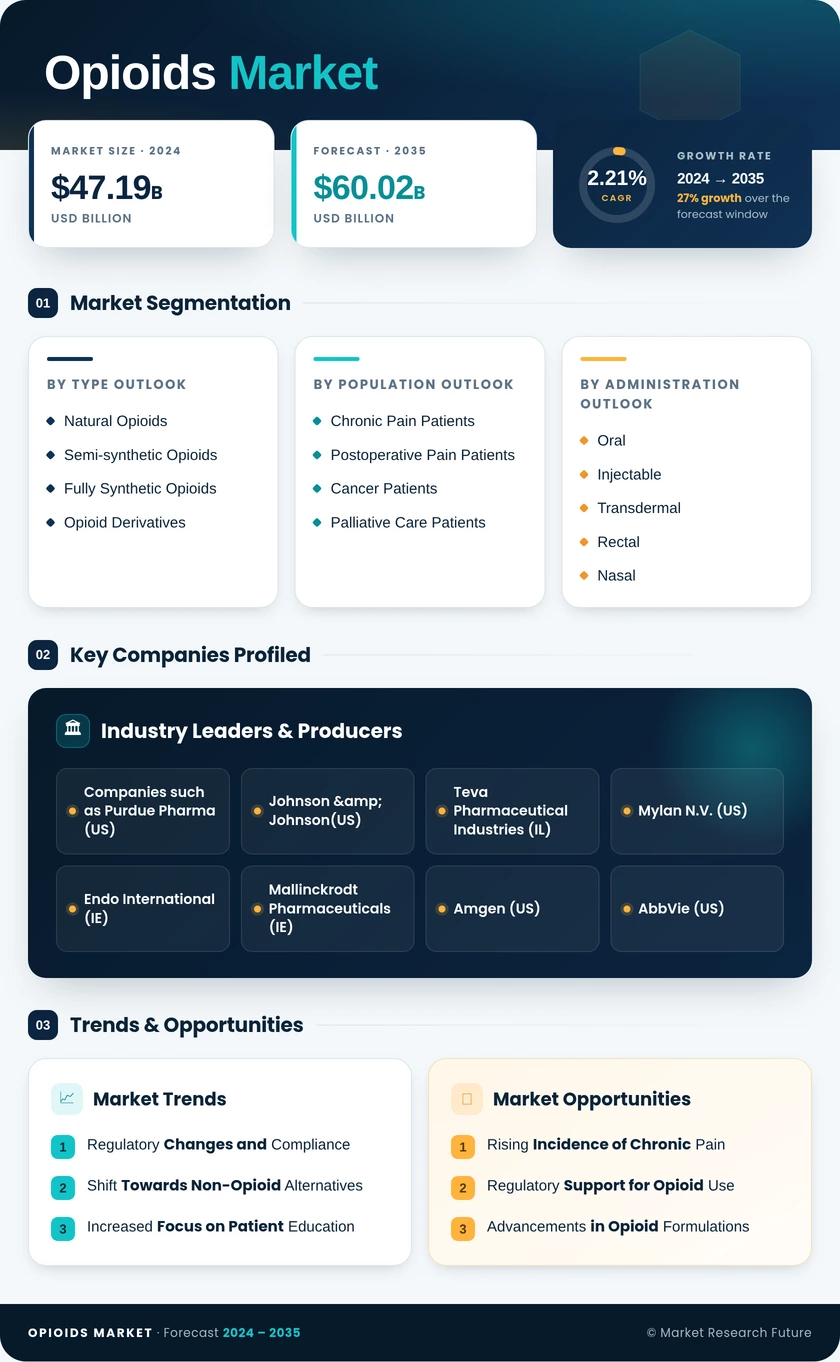
Segmentation Quick Reference
| Dimension | Sub-Segments | Dominant Segment | Fastest Growing Segment |
| By Product Type | Codeine, Fentanyl, Meperidine, Oxycodone, Hydrocodone, Morphine, Methadone, Tramadol, Buprenorphine, Others | Oxycodone | Buprenorphine |
| By Receptor Binding | Strong Agonist, Mild to Moderate Agonist, Partial Agonist, Mixed Agonist-Antagonist, and Others | Strong Agonist | Partial Agonist |
| By Route of Administration | Oral, Parenteral / IV, Transdermal, Others | Parenteral / IV | Transdermal |
| By Application | Pain Management, Cold and Cough, Opioid-Dependence Therapy, Anesthesia Adjunct, Others | Pain Management | Opioid-Dependence Therapy |
| By Distribution Channel | Hospital, Retail Pharmacy, Specialty Clinic, Online Pharmacy | Hospital | Online Pharmacy |
| By Geography | North America, Europe, Asia-Pacific, South America, Middle East & Africa | North America | Asia-Pacific |
Market Segmentation Overview
By Product Type
| Sub-Segment | Key Trend |
| Codeine | Antitussive reformulation and pediatric restrictions reshape volume |
| Fentanyl | Transdermal oncology use offsets injectable quota limits |
| Meperidine | Steady clinical retirement from perioperative protocols |
| Oxycodone | Branded abuse-deterrent versions defend price against volume decline |
| Hydrocodone | Combination-product scheduling continues to compress prescribing |
| Morphine | Remains the WHO essential-medicine reference for severe pain |
| Methadone | Take-home flexibility rules restructure clinic economics |
| Tramadol | Emerging-market step-two analgesia growth with rising scheduling scrutiny |
| Buprenorphine | Depot formulations shift dependence therapy to monthly dosing |
| Others | Specialty breakthrough-pain and combination products |
Molecule-level performance now diverges sharply by regulatory treatment rather than clinical merit. Quota-constrained agonists trade volume for price, while dependence-therapy molecules expand on public funding.
By Receptor Binding
| Sub-Segment | Key Trend |
| Strong Agonist | Anchored in hospital, oncology, and trauma settings |
| Mild to Moderate Agonist | Outpatient prescribing declines under monitoring programs |
| Partial Agonist | Ceiling-effect safety profile drives treatment adoption |
| Mixed Agonist-Antagonist and Others | Niche reversal and specialty analgesia applications |
Pharmacological classification increasingly predicts reimbursement outcomes. Payers reward partial agonists for their reduced respiratory-depression risk, accelerating formulary migration away from full agonists in maintenance settings.
By Route of Administration
| Sub-Segment | Key Trend |
| Oral | Tablet volumes fall as prescription quantities shrink |
| Parenteral / IV | Shortage-driven contracting favors resilient suppliers |
| Transdermal | Continuous release wins in hospice and dysphagia populations |
| Others | Nasal and buccal formats serve breakthrough cancer pain |
Delivery format determines exposure to prescribing surveillance. Hospital-administered routes remain insulated, while outpatient oral products absorb most of the policy-driven contraction.
By Application
| Sub-Segment | Key Trend |
| Pain Management | Multimodal protocols reduce per-case exposure without cutting case counts |
| Cold and Cough | Regulatory restrictions narrow the codeine antitussive base |
| Opioid-Dependence Therapy | Public funding and depot dosing expand treated populations |
| Anesthesia Adjunct | Procedural sedation demand tracks ambulatory surgery growth |
| Others | Dyspnea, diarrhea, and specialty palliative indications |
Application mix is the clearest structural shift underway. Therapy for dependence is converting from a public-health cost centre into a commercially attractive franchise with outcome-linked contracting.
By Distribution Channel
| Sub-Segment | Key Trend |
| Hospital | Group purchasing consolidation raises supplier qualification bars |
| Retail Pharmacy | Dispensing caps and query mandates suppress script volumes |
| Specialty Clinic | Opioid treatment programs expand under accreditation reform |
| Online Pharmacy | E-prescribing rules unlock compliant mail-order growth |
Channel economics now diverge more than product economics. Hospital contracting rewards reliability, retail rewards nothing at all, and online dispensing grows from a small base under newly permissive telehealth rules.


 Noah Malgeri
Co-Founder
Noah Malgeri
Co-Founder

 Peter Groot koerkamp
Account and Business Manager
Peter Groot koerkamp
Account and Business Manager

 Younghwan Choi
Senior Retail Manager
Younghwan Choi
Senior Retail Manager

 Mark Irwin
Management Consultant
Mark Irwin
Management Consultant

 Akif Moroglu
Strategy & Business Development Director
Akif Moroglu
Strategy & Business Development Director

 Guilherme Gomes Martins
Product Management Director
Guilherme Gomes Martins
Product Management Director

 Joseph Aguayo
Sales Operations & Pricing Manager
Joseph Aguayo
Sales Operations & Pricing Manager

 La Terria Dodd
Program Support Specialist
La Terria Dodd
Program Support Specialist

 Rob Kooiker
Group Product Manager HVAC & Fire Protection GMA
Rob Kooiker
Group Product Manager HVAC & Fire Protection GMA