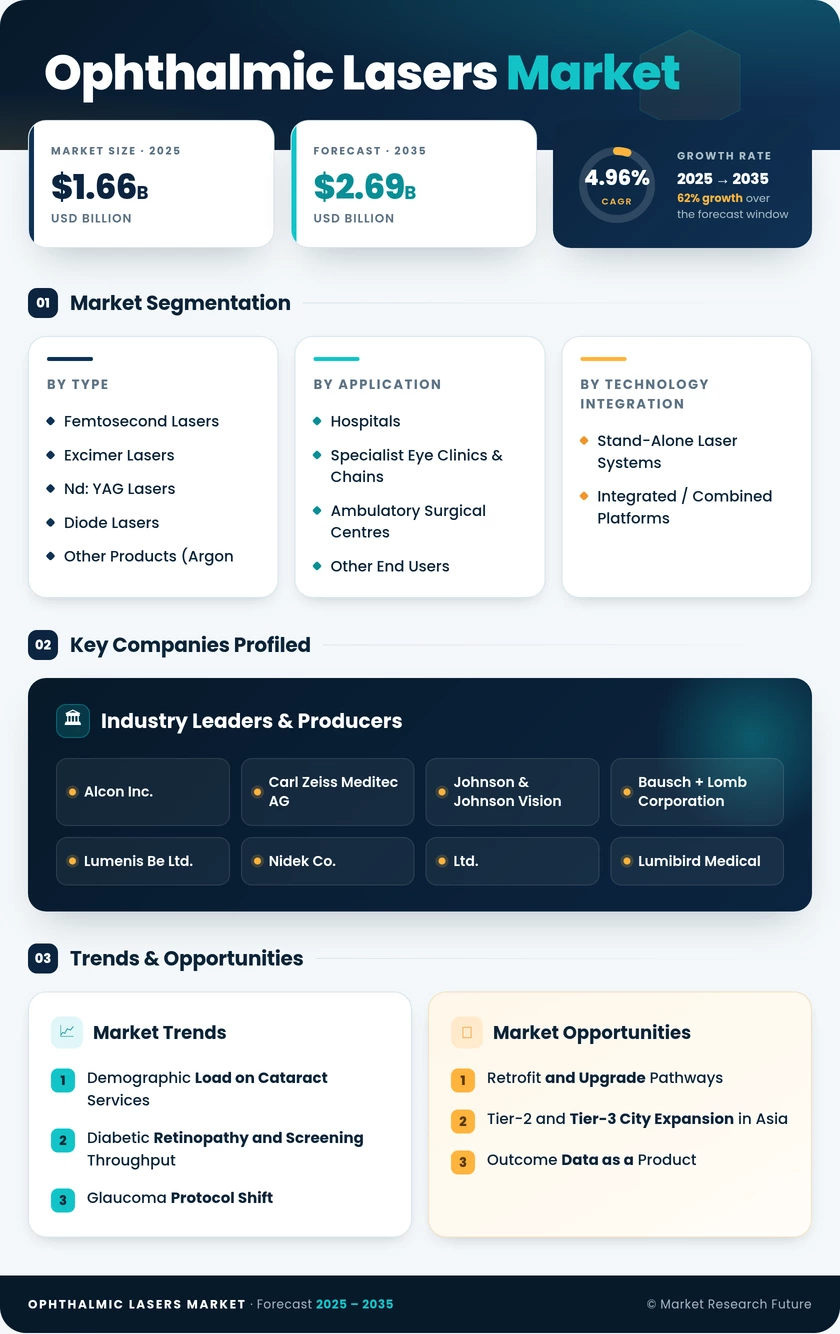
Segmentation Quick Reference
| Dimension | Sub-Segments | Dominant Segment | Fastest Growing Segment |
| By Product | Femtosecond Lasers; Excimer Lasers; Nd:YAG Lasers; Diode Lasers; Other Products | Femtosecond Lasers | Diode Lasers |
| By Application | Cataract Surgery; Refractive Error Correction; Glaucoma Treatment; Retinal Disorders; Other Applications | Cataract Surgery | Glaucoma Treatment |
| By End User | Hospitals; Specialist Eye Clinics & Chains; Ambulatory Surgical Centres; Other End Users | Hospitals | Specialist Eye Clinics & Chains |
| By Technology Integration | Stand-Alone Laser Systems; Integrated / Combined Platforms | Stand-Alone Laser Systems | Integrated / Combined Platforms |
| By Geography | North America; Europe; Asia-Pacific; South America; Middle East & Africa | North America | Asia-Pacific |
Market Segmentation Overview
By Product
| Sub-Segment | Key Trend |
| Femtosecond Lasers | Disposable interface annuity model drives vendor preference over one-time hardware sales. |
| Excimer Lasers | Solid-state alternatives pressure gas-based systems on facility and operating cost. |
| Nd: YAG Lasers | Steady capsulotomy volumes make this the most recession-resistant product line. |
| Diode Lasers | Micropulse and subthreshold protocols expand indications beyond conventional burns. |
| Other Products | Selective laser trabeculoplasty benefits directly from laser-first glaucoma guidelines. |
Product strategy increasingly separates the console from the revenue. Vendors that attach consumables, software licences and service contracts to a placement earn multiples of the initial hardware margin over a seven-to-ten-year lifecycle, which is why the femtosecond and pattern-scanning categories attract the heaviest development spend.
By Application
| Sub-Segment | Key Trend |
| Cataract Surgery | Backlog clearance programmes sustain high baseline procedure volumes globally. |
| Refractive Error Correction | Lenticule extraction gains share against surface ablation, particularly in East Asia. |
| Glaucoma Treatment | Guideline shifts move laser ahead of topical medication for newly diagnosed patients. |
| Retinal Disorders | Diabetes prevalence drives non-discretionary, counter-cyclical treatment demand. |
| Other Applications | Oculoplastic and diagnostic uses remain a small but stable adjacent pool. |
Payer structure explains most of the variance across applications. Publicly funded posterior-segment work grows with disease burden and is insulated from consumer sentiment, while refractive demand tracks disposable income and responds quickly to macroeconomic shifts.
By End User
| Sub-Segment | Key Trend |
| Hospitals | Retain complex, comorbid and posterior-segment caseloads requiring full platform breadth. |
| Specialist Eye Clinics & Chains | Centralised procurement across networks standardises platforms and compresses vendor lists. |
| Ambulatory Surgical Centres | Site-of-service reimbursement differentials continue shifting routine cataract volume outward. |
| Other End Users | Academic centres influence adoption through training pipelines and published outcomes. |
Buying power is consolidating. A regional chain purchasing twenty platforms negotiates very differently from a single practice, and vendors are restructuring commercial teams around network accounts rather than individual surgeons.
By Technology Integration
| Sub-Segment | Key Trend |
| Stand-Alone Laser Systems | Preferred where budgets are constrained or existing diagnostic equipment is already installed |
| Integrated / Combined Platforms | High-volume centres favour unified biometry, planning and delivery to compress chair time. |
Integration wins on throughput and loses on flexibility. Centres running above roughly 100 cases monthly recover the premium through time savings, while smaller sites generally find modular, stand-alone configurations easier to finance and upgrade incrementally.
By Region
| Sub-Segment | Key Trend |
| North America | Ambulatory migration and premium self-pay channel define purchasing behaviour. |
| Europe | Regulatory recertification thins supplier choice while laser-first protocols lift volumes. |
| Asia-Pacific | Public tenders and chain expansion generate the steepest growth trajectory. |
| South America | Currency volatility favours refurbished units and extended service structures |
| Middle East & Africa | Sovereign health programmes and medical tourism support premium specification |
Regional strategy now hinges on service infrastructure as much as product fit. Buyers in emerging markets increasingly score tenders on local parts availability and guaranteed response times, which rewards vendors willing to invest in depot networks ahead of volume.


 Noah Malgeri
Co-Founder
Noah Malgeri
Co-Founder

 Peter Groot koerkamp
Account and Business Manager
Peter Groot koerkamp
Account and Business Manager

 Younghwan Choi
Senior Retail Manager
Younghwan Choi
Senior Retail Manager

 Mark Irwin
Management Consultant
Mark Irwin
Management Consultant

 Akif Moroglu
Strategy & Business Development Director
Akif Moroglu
Strategy & Business Development Director

 Guilherme Gomes Martins
Product Management Director
Guilherme Gomes Martins
Product Management Director

 Joseph Aguayo
Sales Operations & Pricing Manager
Joseph Aguayo
Sales Operations & Pricing Manager

 La Terria Dodd
Program Support Specialist
La Terria Dodd
Program Support Specialist

 Rob Kooiker
Group Product Manager HVAC & Fire Protection GMA
Rob Kooiker
Group Product Manager HVAC & Fire Protection GMA