×
Request Free Sample ×

Kindly complete the form below to receive a free sample of this Report

* Please use a valid business email

Leading companies partner with us for data-driven Insights

clients tt-cursor
Hero Background
English
Chinese
French
Japanese
Korean
German
Spanish

Ophthalmic Knives Market Trends

ID: MRFR/HC/7343-HCR
118 Pages
Rahul Gotadki
October 2025

Ophthalmic Knives Market Research Report: Size, Share, Trend Analysis By Applications (Cataract Surgery, Corneal Surgery, Refractive Surgery, Glaucoma Surgery), By Types (MVR Knives, Blade Knives, Micro Knives, Tissue Knives), By End Use (Hospitals, Ambulatory Surgery Centers, Ophthalmic Clinics), By Material (Stainless Steel, Carbon Steel, Plastic) and By Regional (North America, Europe, South America, Asia Pacific, Middle East and Africa) - Growth Outlook & Industry Forecast 2025 To 2035

Share:
Download PDF ×

We do not share your information with anyone. However, we may send you emails based on your report interest from time to time. You may contact us at any time to opt-out.

Ophthalmic Knives Market Infographic
×
Ophthalmic Knives Market Infographic Full View
Purchase Options

Market Trends

Key Emerging Trends in the Ophthalmic Knives Market

The Ophthalmic Knives Market has undergone a series of groundbreaking transformations of the last few years. The ophthalmic knives are a useful tool for many eye surgeries: cataract, corneal transplantation, and refractive surgeries. The other trend is the escalating demand for less invasive procedures and thus calls for the manufactures to come up with new generations of surgical knives which offer precision with the very small incisions.

Technological advancements have been, and still are, a key factor in molding the competitive landscape of the market. Using robots and automation in the field of ophthalmology is getting more and more popular, which is how the smart knives have been developed and they are going to improve the surgical precision. Modern surgeons operate with help of advanced instrumentation updated with sensor and imaging technologies which enable them to monitor the procedure in real-time and have precise control of what happens at the site.

The next significant trend is the elevating spectre of eye diseases alongside the burgeoning elderly population, altogether bringing forth the rising demand ophthalmic surgeries. With the ongoing global aging, the occurrence of cataract and other related eye accidents is on the increase, and so is the need for efficient and competent ophthalmic knives. Besides, increased consciousness about eye health as well as the rising number of sophisticated surgical solutions are other factors that bring in the market growth.

Presently the production of disposable ophthalmic knives is the emerging market trend. The one time usage of instruments in Eye surgeries decreases the risk of infections and standardizes a higher level of sterility. It shows the industry's concern about the patients' safety as well as control measures for infections. Disposable ophthalmic knives skip the reprocessing process does not require it hence saving time and resources for health services.

Additionally, the Ophthalmic Knives Market shows geographical development characterized by the emerging markets becoming important contributors. Healthcare infrastructure improves in emerging countries giving rise to the adoption of more progressed ophthalmic surgery techniques which increase the demand for perfect knives. Also, they are providing the local manufacturers who serve to the needs of the local market cost-effectively and that in turn increase the market growth

There is a notable trend towards the use of premium, durable materials by the manufacturing of ophthalmic knives from a materials perspective. The importance of titanium and stainless steel is growing because of their extraordinary strength, corrosion resistance, and biocompatibility. These materials extend the life time of the tools and provide excellent performance of the instruments in the time of surgical operations.


Author
Rahul Gotadki
Assistant Manager

He holds an experience of about 7+ years in Market Research and Business Consulting, working under the spectrum of Life Sciences and Healthcare domains. Rahul conceptualizes and implements a scalable business strategy and provides strategic leadership to the clients. His expertise lies in market estimation, competitive intelligence, pipeline analysis, customer assessment, etc. In addition to the above, his other responsibility includes strategic tracking of high growth markets & advising clients on the potential areas of focus they could direct their business initiatives

Leave a Comment

FAQs

What is the expected market size of the Ophthalmic Knives Market in 2035?

The Ophthalmic Knives Market is expected to be valued at 3.47 USD Billion in 2035.

What is the estimated compound annual growth rate (CAGR) for the Ophthalmic Knives Market from 2025 to 2035?

The expected CAGR for the Ophthalmic Knives Market from 2025 to 2034 is 5.18%.

How much is the North America segment valued in the Ophthalmic Knives Market for the year 2023?

The North America segment of the Ophthalmic Knives Market is valued at 0.85 USD Billion in 2023.

What is the market value of the Cataract Surgery application in 2032?

The market value of the Cataract Surgery application is projected to be 1.2 USD Billion in 2032.

Who are the key players in the Ophthalmic Knives Market?

Key players in the Ophthalmic Knives Market include Ziemer Ophthalmic Systems, Iantech, and Bausch Health.

What is the expected market size for the Corneal Surgery application by 2032?

The Corneal Surgery application is expected to reach a market size of 0.75 USD Billion by 2032.

What is the projected market size for the APAC region in 2032?

The APAC region is projected to have a market size of 0.48 USD Billion in 2032.

How much is the Glaucoma Surgery application valued in 2023?

The Glaucoma Surgery application is valued at 0.29 USD Billion in 2023.

What market size can be expected for the South America region in 2032?

The South America region is expected to achieve a market size of 0.15 USD Billion by 2032.

What are the growth drivers impacting the Ophthalmic Knives Market?

Growth drivers for the Ophthalmic Knives Market include advancements in surgical technology and the rising prevalence of eye disorders.

Market Summary

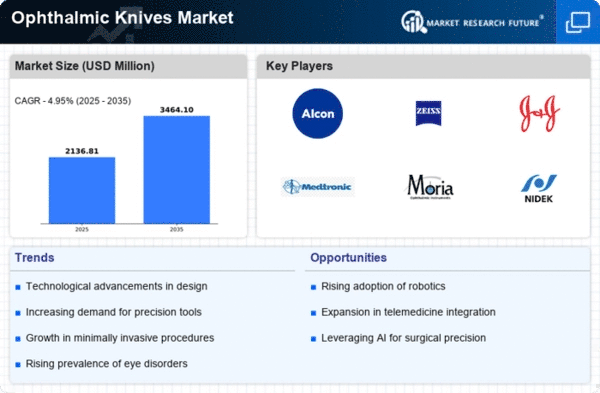
As per MRFR analysis, the Ophthalmic Knives Market Size was estimated at 2036.03 USD Million in 2024. The Ophthalmic Knives industry is projected to grow from 2136.81 USD Million in 2025 to 3464.1 USD Million by 2035, exhibiting a compound annual growth rate (CAGR) of 4.95 during the forecast period 2025 - 2035.

Key Market Trends & Highlights

The Ophthalmic Knives Market is experiencing robust growth driven by technological advancements and increasing demand for eye care.

  • North America remains the largest market for ophthalmic knives, driven by advanced healthcare infrastructure. The Asia-Pacific region is the fastest-growing market, reflecting a surge in eye care awareness and healthcare investments. Cataract surgery represents the largest segment, while refractive surgery is emerging as the fastest-growing segment in the market. Technological advancements and the rising demand for minimally invasive procedures are key drivers propelling market growth.

Market Size & Forecast

2024 Market Size 2036.03 (USD Million)
2035 Market Size 3464.1 (USD Million)
CAGR (2025 - 2035) 4.95%
Largest Regional Market Share in 2024 North America

Major Players

<a href="https://www.alconnordicsurgicalproducts.com/disposables1/clearcut-knive">Alcon </a>(CH), Bausch + Lomb (US), Carl Zeiss (DE), Johnson &amp; Johnson (US), Medtronic (IE), Moria Surgical (FR), Nidek (JP), Surgical Specialties Corporation (US), Topcon Corporation (JP)

Market Trends

The Ophthalmic Knives Market is currently experiencing a notable evolution, driven by advancements in surgical techniques and an increasing demand for precision in ophthalmic procedures. Surgeons are increasingly favoring specialized knives that enhance their ability to perform intricate operations with minimal trauma to surrounding tissues. This shift towards more refined instruments is indicative of a broader trend within the healthcare sector, where the emphasis on patient outcomes and recovery times is paramount.

 Furthermore, the growing prevalence of eye disorders globally is likely to propel the market forward, as healthcare providers seek to equip themselves with the latest tools to address these challenges effectively. In addition, the Ophthalmic Knives Market appears to be influenced by technological innovations, such as the integration of smart technologies and improved materials. These advancements not only enhance the performance of surgical instruments but also contribute to the overall safety and efficacy of procedures. As the market continues to evolve, it is essential for manufacturers to stay attuned to the changing needs of healthcare professionals and patients alike. The future of the Ophthalmic Knives Market seems promising, with ongoing research and development efforts likely to yield even more sophisticated solutions for eye care practitioners.

Technological Advancements

The Ophthalmic Knives Market is witnessing a surge in technological innovations, particularly in the development of precision instruments. Enhanced materials and smart technologies are being integrated into knife designs, improving surgical outcomes and patient safety.

Rising Demand for Minimally Invasive Procedures

There is a growing preference for minimally invasive surgical techniques within the Ophthalmic Knives Market. This trend is driven by the desire for reduced recovery times and lower risks associated with traditional surgical methods.

Increasing Prevalence of Eye Disorders

The rising incidence of eye-related conditions is significantly impacting the Ophthalmic Knives Market. As more individuals seek treatment for various ocular diseases, the demand for specialized surgical instruments is expected to grow.

Ophthalmic Knives Market Market Drivers

Expansion of Eye Care Facilities

The proliferation of eye care facilities worldwide is a crucial driver for the Global Ophthalmic Knives Market Industry. As more specialized clinics and hospitals emerge, the demand for ophthalmic surgical instruments increases correspondingly. These facilities often require a range of surgical tools, including ophthalmic knives, to cater to diverse patient needs. The establishment of new eye care centers is likely to enhance access to surgical procedures, thereby boosting the market. This expansion aligns with the broader trend of increasing healthcare accessibility, which is essential for the growth of the Global Ophthalmic Knives Market Industry.

Increase in Healthcare Expenditure

Rising healthcare expenditure across various regions contributes to the expansion of the Global Ophthalmic Knives Market Industry. Governments and private sectors are investing more in healthcare infrastructure, which includes the procurement of advanced surgical instruments. This increase in funding allows hospitals and clinics to acquire high-quality ophthalmic knives, thereby enhancing surgical capabilities. As healthcare systems evolve, the demand for effective surgical tools is likely to rise, further supporting the growth of the Global Ophthalmic Knives Market Industry. This trend aligns with the overall increase in healthcare spending observed globally.

Rising Prevalence of Eye Disorders

The increasing incidence of eye disorders globally drives the demand for ophthalmic knives. Conditions such as cataracts and glaucoma are becoming more prevalent, necessitating surgical interventions. In 2024, the Global Ophthalmic Knives Market Industry is valued at approximately 1.99 USD Billion, reflecting the urgent need for effective surgical tools. As populations age and lifestyle factors contribute to eye health deterioration, the market is expected to expand. This trend is likely to continue as more individuals seek surgical solutions, thereby propelling the growth of the Global Ophthalmic Knives Market Industry.

Growing Demand for Minimally Invasive Procedures

The trend towards minimally invasive surgical techniques is reshaping the Global Ophthalmic Knives Market Industry. Patients and healthcare providers favor these procedures due to their associated benefits, such as reduced recovery times and lower risk of complications. As a result, ophthalmic knives designed for such applications are in high demand. This shift is expected to drive market growth, as more surgeons adopt these techniques. The Global Ophthalmic Knives Market Industry is projected to grow at a CAGR of 5.18% from 2025 to 2035, indicating a robust future for minimally invasive surgical tools.

Technological Advancements in Surgical Instruments

Innovations in surgical technology significantly influence the Global Ophthalmic Knives Market Industry. The introduction of advanced materials and precision engineering enhances the performance and safety of ophthalmic knives. For instance, the development of blades with improved sharpness and durability allows for minimally invasive procedures, which are increasingly preferred by surgeons. As these technologies evolve, they not only improve surgical outcomes but also attract more healthcare providers to adopt modern techniques. This shift is likely to contribute to the projected market growth, with an anticipated increase to 3.47 USD Billion by 2035.

Market Segment Insights

By Application: Cataract Surgery (Largest) vs. Refractive Surgery (Fastest-Growing)

The Ophthalmic Knives Market exhibits a diverse distribution of applications, with cataract surgery holding the largest share, primarily because of the high prevalence of cataracts among the aging population. On the other hand, refractive surgery, while currently smaller in market share, has been rapidly gaining traction among patients seeking corrective vision solutions. Corneal and glaucoma surgeries also contribute significantly, yet they remain overshadowed by the dominant role of cataract surgery.

Cataract Surgery (Dominant) vs. Refractive Surgery (Emerging)

Cataract surgery is the dominant segment in the Ophthalmic Knives Market, characterized by its widespread adoption and proven surgical techniques. It involves specialized knives that ensure precision and minimal trauma to the surrounding tissues. Conversely, refractive surgery is emerging as a fast-growing segment, fueled by technological advancements such as LASIK and PRK procedures. These methods emphasize patient comfort and desire for improved vision, with increased awareness and accessibility driving market demand. Additionally, evolving patient demographics and lifestyle choices contribute to the heightened interest in refractive solutions.

By Type: Scalpel (Largest) vs. Femtosecond Laser (Fastest-Growing)

The Ophthalmic Knives Market exhibits a diverse distribution across various types, with scalpels holding the largest market share due to their long-standing application in surgeries. Scalpels are preferred for their precision and versatility in various ophthalmic procedures. Following closely, microkeratomes and <a href="https://www.marketresearchfuture.com/reports/surgical-blades-market-8107">surgical blades</a> also play significant roles, but their share is overshadowed by the increasing adoption of advanced technologies like femtosecond lasers, which are gaining traction due to their enhanced capabilities in performing complex surgeries.

Scalpel: Dominant vs. Femtosecond Laser: Emerging

Scalpels dominate the Ophthalmic Knives Market, known for their precision, ease of use, and reliability in various eye surgeries. Their widespread acceptance in traditional surgical practices contributes to their strong market position. Conversely, femtosecond lasers represent an emerging innovation, offering advanced surgical techniques such as improved accuracy, reduced healing time, and minimal tissue damage. The increasing trend towards minimally invasive procedures is driving the adoption of femtosecond lasers, making them the fastest-growing segment. Both scalpel and femtosecond lasers illustrate the contrast between established surgical tools and the innovation-driven future of ophthalmic surgeries.

By End Use: Hospitals (Largest) vs. Ophthalmic Clinics (Fastest-Growing)

In the Ophthalmic Knives Market, hospitals serve as the largest end-use segment, accounting for a significant share due to their comprehensive surgical services and resources. Their extensive requirements for ophthalmic procedures ensure a steady demand for precision instruments such as ophthalmic knives. On the other hand, ophthalmic clinics are rapidly gaining traction, particularly with the rise of specialized eye care services. The expansion of such clinics is reshaping the market landscape, driving innovation and tailored product offerings.

Hospitals (Dominant) vs. Ophthalmic Clinics (Emerging)

Hospitals dominate the Ophthalmic Knives Market due to their capacity for a wide range of surgeries, superior infrastructure, and access to skilled ophthalmologists. They require a consistent supply of high-quality surgical tools to meet patient needs effectively. In contrast, ophthalmic clinics are emerging as vital players by focusing on specialized treatments for eye conditions like cataracts and glaucoma. Their growth can be attributed to an increase in outpatient procedures and a demand for personalized care, positioning them as a crucial segment for ophthalmic knife manufacturers.

Get more detailed insights about Ophthalmic Knives Market Research Report - Global Forecast till 2035

Regional Insights

North America : Market Leader in Innovation

North America continues to lead the Ophthalmic Knives market, holding a significant share of 1018.02M in 2024. The region's growth is driven by advanced healthcare infrastructure, increasing prevalence of eye disorders, and a strong focus on R&D. Regulatory support from agencies like the FDA ensures that innovative products meet safety and efficacy standards, further boosting market demand. The rising adoption of minimally invasive surgical techniques is also a key factor contributing to this growth. The competitive landscape in North America is robust, featuring major players such as Alcon, Bausch + Lomb, and Johnson & Johnson. These companies are at the forefront of technological advancements, offering a range of high-quality ophthalmic knives. The presence of established healthcare systems and a growing number of surgical procedures are expected to sustain the market's upward trajectory. As the region invests in healthcare technology, the demand for specialized surgical instruments will continue to rise.

Europe : Emerging Market with Growth Potential

Europe's Ophthalmic Knives market is valued at 610.0M, reflecting a growing demand driven by an aging population and increasing awareness of eye health. Regulatory frameworks, such as the EU Medical Device Regulation, are enhancing product safety and efficacy, which is crucial for market growth. The region is witnessing a shift towards advanced surgical techniques, which is expected to further propel the demand for specialized ophthalmic instruments. Leading countries in this market include Germany, France, and the UK, where key players like Carl Zeiss and Moria Surgical are making significant contributions. The competitive landscape is characterized by innovation and collaboration among manufacturers, healthcare providers, and regulatory bodies. As Europe continues to invest in healthcare infrastructure, the demand for ophthalmic knives is anticipated to grow, supported by a focus on improving surgical outcomes.

Asia-Pacific : Rapid Growth in Emerging Markets

The Asia-Pacific Ophthalmic Knives market, valued at 350.0M, is experiencing rapid growth due to increasing healthcare expenditure and rising awareness of eye health. Countries like Japan and China are leading this growth, driven by advancements in medical technology and a growing elderly population. Regulatory bodies are also playing a crucial role in ensuring product safety, which is vital for market expansion. The region's focus on improving healthcare access is expected to further boost demand for ophthalmic surgical instruments. The competitive landscape in Asia-Pacific is evolving, with key players such as Nidek and Topcon Corporation leading the charge. These companies are investing in R&D to develop innovative products tailored to local market needs. As the region continues to enhance its healthcare infrastructure, the demand for specialized ophthalmic knives is projected to rise significantly, supported by a growing number of surgical procedures and a focus on quality care.

Middle East and Africa : Emerging Market with Unique Challenges

The Middle East and Africa (MEA) Ophthalmic Knives market is valued at 58.01M, presenting unique growth opportunities amid challenges such as limited healthcare infrastructure. The region is witnessing an increase in eye-related diseases, which is driving demand for surgical instruments. Regulatory bodies are beginning to implement frameworks to ensure product safety and efficacy, which is essential for market growth. The rising number of healthcare initiatives aimed at improving eye care is also contributing to market expansion. Countries like South Africa and the UAE are leading the market, with key players such as Surgical Specialties Corporation making strides in the region. The competitive landscape is characterized by a mix of local and international companies, focusing on providing affordable yet high-quality ophthalmic knives. As healthcare access improves, the demand for specialized surgical instruments is expected to grow, supported by increasing investments in healthcare infrastructure.

Key Players and Competitive Insights

The Ophthalmic Knives Market is characterized by a competitive landscape that is increasingly shaped by innovation, strategic partnerships, and regional expansions. Key players such as Alcon (CH), Bausch + Lomb (US), and Johnson & Johnson (US) are at the forefront, each adopting distinct strategies to enhance their market presence. Alcon (CH) focuses on advancing its product portfolio through continuous innovation, particularly in the development of next-generation surgical instruments. Bausch + Lomb (US), on the other hand, emphasizes strategic acquisitions to bolster its capabilities and expand its market reach. Meanwhile, Johnson & Johnson (US) is leveraging its extensive distribution network to penetrate emerging markets, thereby enhancing its competitive positioning.
The business tactics employed by these companies reflect a concerted effort to optimize supply chains and localize manufacturing processes. The market structure appears moderately fragmented, with a mix of established players and emerging companies vying for market share. This fragmentation is indicative of a dynamic environment where key players exert considerable influence, yet also face challenges from smaller, agile competitors that can quickly adapt to changing market demands.
In November 2025, Alcon (CH) announced the launch of a new line of ophthalmic knives designed to improve surgical precision and reduce recovery times for patients. This strategic move is likely to reinforce Alcon's reputation as a leader in innovation within the ophthalmic sector, potentially attracting new customers and retaining existing ones through enhanced product offerings. The introduction of these advanced surgical tools may also set a new benchmark for quality and performance in the market.
In October 2025, Bausch + Lomb (US) completed the acquisition of a smaller surgical instrument manufacturer, which is expected to enhance its product range and operational capabilities. This acquisition not only strengthens Bausch + Lomb's market position but also allows for greater integration of advanced technologies into its existing product lines. The strategic importance of this move lies in the potential for increased market share and the ability to offer a more comprehensive suite of surgical solutions to healthcare providers.
In September 2025, Johnson & Johnson (US) entered into a strategic partnership with a leading technology firm to integrate AI-driven analytics into its surgical instruments. This collaboration aims to enhance surgical outcomes through data-driven insights, positioning Johnson & Johnson at the cutting edge of technological advancement in the ophthalmic field. The significance of this partnership is underscored by the growing trend towards digitalization in healthcare, which is likely to redefine surgical practices and improve patient care.
As of December 2025, the competitive trends in the Ophthalmic Knives Market are increasingly influenced by digitalization, sustainability, and the integration of AI technologies. Strategic alliances are becoming pivotal in shaping the landscape, as companies seek to leverage complementary strengths to drive innovation. Looking ahead, it is anticipated that competitive differentiation will evolve, with a pronounced shift from price-based competition to a focus on technological innovation, product quality, and supply chain reliability. This evolution suggests that companies that prioritize these aspects will likely emerge as leaders in the market.

Key Companies in the Ophthalmic Knives Market include

Industry Developments

  • Q1 2024: Bausch + Lomb Launches New Stellaris Elite Ophthalmic Surgical System in Europe Bausch + Lomb announced the European launch of its Stellaris Elite system, which includes advanced ophthalmic knives designed for cataract and retinal surgery, expanding its surgical device portfolio.
  • Q2 2024: Alcon Unveils Next-Generation Diamond Ophthalmic Knives Market at ASCRS 2024 Alcon introduced a new line of diamond ophthalmic knives at the American Society of Cataract and Refractive Surgery (ASCRS) meeting, featuring enhanced precision and durability for minimally invasive eye surgeries.
  • Q2 2024: FDA Grants 510(k) Clearance to Beaver-Visitec International’s Single-Use Crescent Ophthalmic Knife Beaver-Visitec International received FDA 510(k) clearance for its new single-use crescent ophthalmic knife, designed to improve sterility and reduce infection risk in cataract procedures.
  • Q3 2024: Johnson & Johnson Vision Expands Jacksonville Facility for Ophthalmic Surgical Instruments Johnson & Johnson Vision announced the opening of a new manufacturing wing at its Jacksonville, Florida facility, dedicated to producing ophthalmic knives and other surgical instruments.
  • Q3 2024: Santen Pharmaceutical Acquires Swiss Ophthalmic Knife Maker Moria Surgical Santen Pharmaceutical completed the acquisition of Moria Surgical, a Swiss manufacturer specializing in ophthalmic knives, strengthening its position in the global ophthalmic surgery market.
  • Q4 2024: Rumex International Secures Major Supply Contract with NHS for Ophthalmic Knives Market Rumex International signed a multi-year contract to supply ophthalmic knives to the UK National Health Service (NHS), supporting cataract and refractive surgery programs nationwide.
  • Q4 2024: Staar Surgical Appoints New VP of Global Operations to Oversee Ophthalmic Knife Production Staar Surgical named Dr. Emily Chen as Vice President of Global Operations, tasking her with scaling up production of ophthalmic knives and related surgical devices.
  • Q1 2025: Alcon Receives CE Mark for Disposable Slit Ophthalmic Knife Alcon announced it has received CE Mark approval for its new disposable slit ophthalmic knife, enabling expanded distribution across the European Union.
  • Q1 2025: Bausch + Lomb Partners with Indian Hospital Chain for Ophthalmic Knife Distribution Bausch + Lomb entered a strategic partnership with Apollo Hospitals in India to distribute its latest ophthalmic knives for cataract and refractive surgeries.
  • Q2 2025: Ophthalmic Device Startup OcuEdge Raises $20M Series A to Develop Smart Surgical Knives OcuEdge, a medical device startup, closed a $20 million Series A funding round to accelerate development of smart ophthalmic knives with integrated sensors for real-time feedback during surgery.
  • Q2 2025: FDA Approves Medline’s Reusable Ophthalmic Knife for U.S. Market Medline Industries received FDA approval for its reusable ophthalmic knife, designed to offer cost-effective and sustainable options for eye surgery centers.
  • Q3 2025: Carl Zeiss Meditec Opens New R&D Center Focused on Ophthalmic Surgical Instruments Carl Zeiss Meditec inaugurated a new research and development center in Germany, dedicated to innovation in ophthalmic knives and other microsurgical tools.

Future Outlook

Ophthalmic Knives Market Future Outlook

The Ophthalmic Knives Market is projected to grow at a 4.95% CAGR from 2025 to 2035, driven by technological advancements, increasing surgical procedures, and rising demand for precision instruments.

New opportunities lie in:

  • Development of advanced blade materials for enhanced durability
  • Expansion into emerging markets with tailored product offerings
  • Integration of smart technology for real-time surgical feedback

By 2035, the market is expected to achieve robust growth, positioning itself as a leader in surgical instrument innovation.

Market Segmentation

Ophthalmic Knives Market Type Outlook

  • Scalpel
  • Microkeratome
  • Femtosecond Laser
  • Surgical Blade

Ophthalmic Knives Market End Use Outlook

  • Hospitals
  • Ophthalmic Clinics
  • Ambulatory Surgical Centers

Ophthalmic Knives Market Application Outlook

  • Cataract Surgery
  • Corneal Surgery
  • Refractive Surgery
  • Glaucoma Surgery

Report Scope

MARKET SIZE 2024 2036.03(USD Million)
MARKET SIZE 2025 2136.81(USD Million)
MARKET SIZE 2035 3464.1(USD Million)
COMPOUND ANNUAL GROWTH RATE (CAGR) 4.95% (2025 - 2035)
REPORT COVERAGE Revenue Forecast, Competitive Landscape, Growth Factors, and Trends
BASE YEAR 2024
Market Forecast Period 2025 - 2035
Historical Data 2019 - 2024
Market Forecast Units USD Million
Key Companies Profiled Alcon (CH), Bausch + Lomb (US), Carl Zeiss (DE), Johnson & Johnson (US), Medtronic (IE), Moria Surgical (FR), Nidek (JP), Surgical Specialties Corporation (US), Topcon Corporation (JP)
Segments Covered Application, Type, End Use
Key Market Opportunities Advancements in minimally invasive surgical techniques drive demand in the Ophthalmic Knives Market.
Key Market Dynamics Technological advancements and regulatory changes drive innovation and competition in the ophthalmic knives market.
Countries Covered North America, Europe, APAC, South America, MEA

FAQs

What is the expected market size of the Ophthalmic Knives Market in 2035?

The Ophthalmic Knives Market is expected to be valued at 3.47 USD Billion in 2035.

What is the estimated compound annual growth rate (CAGR) for the Ophthalmic Knives Market from 2025 to 2035?

The expected CAGR for the Ophthalmic Knives Market from 2025 to 2034 is 5.18%.

How much is the North America segment valued in the Ophthalmic Knives Market for the year 2023?

The North America segment of the Ophthalmic Knives Market is valued at 0.85 USD Billion in 2023.

What is the market value of the Cataract Surgery application in 2032?

The market value of the Cataract Surgery application is projected to be 1.2 USD Billion in 2032.

Who are the key players in the Ophthalmic Knives Market?

Key players in the Ophthalmic Knives Market include Ziemer Ophthalmic Systems, Iantech, and Bausch Health.

What is the expected market size for the Corneal Surgery application by 2032?

The Corneal Surgery application is expected to reach a market size of 0.75 USD Billion by 2032.

What is the projected market size for the APAC region in 2032?

The APAC region is projected to have a market size of 0.48 USD Billion in 2032.

How much is the Glaucoma Surgery application valued in 2023?

The Glaucoma Surgery application is valued at 0.29 USD Billion in 2023.

What market size can be expected for the South America region in 2032?

The South America region is expected to achieve a market size of 0.15 USD Billion by 2032.

What are the growth drivers impacting the Ophthalmic Knives Market?

Growth drivers for the Ophthalmic Knives Market include advancements in surgical technology and the rising prevalence of eye disorders.

  1. SECTION I: EXECUTIVE SUMMARY AND KEY HIGHLIGHTS
    1. | 1.1 EXECUTIVE SUMMARY
    2. | 1.1.1 Market Overview
    3. | 1.1.2 Key Findings
    4. | 1.1.3 Market Segmentation
    5. | 1.1.4 Competitive Landscape
    6. | 1.1.5 Challenges and Opportunities
    7. | 1.1.6 Future Outlook
  2. SECTION II: SCOPING, METHODOLOGY AND MARKET STRUCTURE
    1. | 2.1 MARKET INTRODUCTION
    2. | 2.1.1 Definition
    3. | 2.1.2 Scope of the study
    4. |-- 2.1.2.1 Research Objective
    5. |-- 2.1.2.2 Assumption
    6. |-- 2.1.2.3 Limitations
    7. | 2.2 RESEARCH METHODOLOGY
    8. | 2.2.1 Overview
    9. | 2.2.2 Data Mining
    10. | 2.2.3 Secondary Research
    11. | 2.2.4 Primary Research
    12. |-- 2.2.4.1 Primary Interviews and Information Gathering Process
    13. |-- 2.2.4.2 Breakdown of Primary Respondents
    14. | 2.2.5 Forecasting Model
    15. | 2.2.6 Market Size Estimation
    16. |-- 2.2.6.1 Bottom-Up Approach
    17. |-- 2.2.6.2 Top-Down Approach
    18. | 2.2.7 Data Triangulation
    19. | 2.2.8 Validation
  3. SECTION III: QUALITATIVE ANALYSIS
    1. | 3.1 MARKET DYNAMICS
    2. | 3.1.1 Overview
    3. | 3.1.2 Drivers
    4. | 3.1.3 Restraints
    5. | 3.1.4 Opportunities
    6. | 3.2 MARKET FACTOR ANALYSIS
    7. | 3.2.1 Value chain Analysis
    8. | 3.2.2 Porter's Five Forces Analysis
    9. |-- 3.2.2.1 Bargaining Power of Suppliers
    10. |-- 3.2.2.2 Bargaining Power of Buyers
    11. |-- 3.2.2.3 Threat of New Entrants
    12. |-- 3.2.2.4 Threat of Substitutes
    13. |-- 3.2.2.5 Intensity of Rivalry
    14. | 3.2.3 COVID-19 Impact Analysis
    15. |-- 3.2.3.1 Market Impact Analysis
    16. |-- 3.2.3.2 Regional Impact
    17. |-- 3.2.3.3 Opportunity and Threat Analysis
  4. SECTION IV: QUANTITATIVE ANALYSIS
    1. | 4.1 Healthcare, BY Application (USD Million)
    2. | 4.1.1 Cataract Surgery
    3. | 4.1.2 Corneal Surgery
    4. | 4.1.3 Refractive Surgery
    5. | 4.1.4 Glaucoma Surgery
    6. | 4.2 Healthcare, BY Type (USD Million)
    7. | 4.2.1 Scalpel
    8. | 4.2.2 Microkeratome
    9. | 4.2.3 Femtosecond Laser
    10. | 4.2.4 Surgical Blade
    11. | 4.3 Healthcare, BY End Use (USD Million)
    12. | 4.3.1 Hospitals
    13. | 4.3.2 Ophthalmic Clinics
    14. | 4.3.3 Ambulatory Surgical Centers
    15. | 4.4 Healthcare, BY Region (USD Million)
    16. | 4.4.1 North America
    17. |-- 4.4.1.1 US
    18. |-- 4.4.1.2 Canada
    19. | 4.4.2 Europe
    20. |-- 4.4.2.1 Germany
    21. |-- 4.4.2.2 UK
    22. |-- 4.4.2.3 France
    23. |-- 4.4.2.4 Russia
    24. |-- 4.4.2.5 Italy
    25. |-- 4.4.2.6 Spain
    26. |-- 4.4.2.7 Rest of Europe
    27. | 4.4.3 APAC
    28. |-- 4.4.3.1 China
    29. |-- 4.4.3.2 India
    30. |-- 4.4.3.3 Japan
    31. |-- 4.4.3.4 South Korea
    32. |-- 4.4.3.5 Malaysia
    33. |-- 4.4.3.6 Thailand
    34. |-- 4.4.3.7 Indonesia
    35. |-- 4.4.3.8 Rest of APAC
    36. | 4.4.4 South America
    37. |-- 4.4.4.1 Brazil
    38. |-- 4.4.4.2 Mexico
    39. |-- 4.4.4.3 Argentina
    40. |-- 4.4.4.4 Rest of South America
    41. | 4.4.5 MEA
    42. |-- 4.4.5.1 GCC Countries
    43. |-- 4.4.5.2 South Africa
    44. |-- 4.4.5.3 Rest of MEA
  5. SECTION V: COMPETITIVE ANALYSIS
    1. | 5.1 Competitive Landscape
    2. | 5.1.1 Overview
    3. | 5.1.2 Competitive Analysis
    4. | 5.1.3 Market share Analysis
    5. | 5.1.4 Major Growth Strategy in the Healthcare
    6. | 5.1.5 Competitive Benchmarking
    7. | 5.1.6 Leading Players in Terms of Number of Developments in the Healthcare
    8. | 5.1.7 Key developments and growth strategies
    9. |-- 5.1.7.1 New Product Launch/Service Deployment
    10. |-- 5.1.7.2 Merger & Acquisitions
    11. |-- 5.1.7.3 Joint Ventures
    12. | 5.1.8 Major Players Financial Matrix
    13. |-- 5.1.8.1 Sales and Operating Income
    14. |-- 5.1.8.2 Major Players R&D Expenditure. 2023
    15. | 5.2 Company Profiles
    16. | 5.2.1 Alcon (CH)
    17. |-- 5.2.1.1 Financial Overview
    18. |-- 5.2.1.2 Products Offered
    19. |-- 5.2.1.3 Key Developments
    20. |-- 5.2.1.4 SWOT Analysis
    21. |-- 5.2.1.5 Key Strategies
    22. | 5.2.2 Bausch + Lomb (US)
    23. |-- 5.2.2.1 Financial Overview
    24. |-- 5.2.2.2 Products Offered
    25. |-- 5.2.2.3 Key Developments
    26. |-- 5.2.2.4 SWOT Analysis
    27. |-- 5.2.2.5 Key Strategies
    28. | 5.2.3 Carl Zeiss (DE)
    29. |-- 5.2.3.1 Financial Overview
    30. |-- 5.2.3.2 Products Offered
    31. |-- 5.2.3.3 Key Developments
    32. |-- 5.2.3.4 SWOT Analysis
    33. |-- 5.2.3.5 Key Strategies
    34. | 5.2.4 Johnson & Johnson (US)
    35. |-- 5.2.4.1 Financial Overview
    36. |-- 5.2.4.2 Products Offered
    37. |-- 5.2.4.3 Key Developments
    38. |-- 5.2.4.4 SWOT Analysis
    39. |-- 5.2.4.5 Key Strategies
    40. | 5.2.5 Medtronic (IE)
    41. |-- 5.2.5.1 Financial Overview
    42. |-- 5.2.5.2 Products Offered
    43. |-- 5.2.5.3 Key Developments
    44. |-- 5.2.5.4 SWOT Analysis
    45. |-- 5.2.5.5 Key Strategies
    46. | 5.2.6 Moria Surgical (FR)
    47. |-- 5.2.6.1 Financial Overview
    48. |-- 5.2.6.2 Products Offered
    49. |-- 5.2.6.3 Key Developments
    50. |-- 5.2.6.4 SWOT Analysis
    51. |-- 5.2.6.5 Key Strategies
    52. | 5.2.7 Nidek (JP)
    53. |-- 5.2.7.1 Financial Overview
    54. |-- 5.2.7.2 Products Offered
    55. |-- 5.2.7.3 Key Developments
    56. |-- 5.2.7.4 SWOT Analysis
    57. |-- 5.2.7.5 Key Strategies
    58. | 5.2.8 Surgical Specialties Corporation (US)
    59. |-- 5.2.8.1 Financial Overview
    60. |-- 5.2.8.2 Products Offered
    61. |-- 5.2.8.3 Key Developments
    62. |-- 5.2.8.4 SWOT Analysis
    63. |-- 5.2.8.5 Key Strategies
    64. | 5.2.9 Topcon Corporation (JP)
    65. |-- 5.2.9.1 Financial Overview
    66. |-- 5.2.9.2 Products Offered
    67. |-- 5.2.9.3 Key Developments
    68. |-- 5.2.9.4 SWOT Analysis
    69. |-- 5.2.9.5 Key Strategies
    70. | 5.3 Appendix
    71. | 5.3.1 References
    72. | 5.3.2 Related Reports

Healthcare Market Segmentation

Healthcare By Application (USD Million, 2025-2035)

  • Cataract Surgery
  • Corneal Surgery
  • Refractive Surgery
  • Glaucoma Surgery

Healthcare By Type (USD Million, 2025-2035)

  • Scalpel
  • Microkeratome
  • Femtosecond Laser
  • Surgical Blade

Healthcare By End Use (USD Million, 2025-2035)

  • Hospitals
  • Ophthalmic Clinics
  • Ambulatory Surgical Centers
Infographic

Free Sample Request

Kindly complete the form below to receive a free sample of this Report

Get Free Sample

Customer Strories

Compare Licence

×
Features License Type
Single User Multiuser License Enterprise User
Price $4,950 $5,950 $7,250
Maximum User Access Limit 1 User Upto 10 Users Unrestricted Access Throughout the Organization
Free Customization
Direct Access to Analyst
Deliverable Format
Platform Access
Discount on Next Purchase 10% 15% 15%
Printable Versions