
Request Free Sample ×

Kindly complete the form below to receive a free sample of this Report

* Please use a valid business email

Leading companies partner with us for data-driven Insights

clients tt-cursor
Hero Background
English
Chinese
French
Japanese
Korean
German
Spanish

Office Furniture Market Share

ID: MRFR/CG/10998-HCR
128 Pages
Pradeep Nandi
April 2026

Global Office Furniture Market Size, Share, Industry Trend & Analysis Research Report: By Product Type (Desks, Chairs, Storage Units, Tables, Partition Panels), By Material (Wood, Metal, Plastic, Glass), By End Use (Corporate Offices, Public Sector, Educational Institutions, Home Offices), By Distribution Channel (Online Retail, Physical Retail, Distributors, Direct Sales) andBy Regional (North America, Europe, South America, Asia Pacific, Middle East and Africa)- Forecast to 2035

Share:
Download PDF ×

We do not share your information with anyone. However, we may send you emails based on your report interest from time to time. You may contact us at any time to opt-out.

Office Furniture Market Infographic
Purchase Options

Market Share

Office Furniture Market Share Analysis

Situating methodologies for piece of the pie are basic to progress in the office furniture industry. In a powerful industry, organizations separate themselves through imaginative item contributions that charm clients with their style, ergonomics, and mechanical combination. The administration of evaluating techniques inside the workplace furniture area considerably affects the situating of portion of the overall industry. To draw in economical clients, organizations might embrace premium evaluating techniques or cost authority, which look to find some kind of harmony among cost and saw esteem. By focusing on specialty markets in the office furniture industry, organizations can foster particular items and lay out a standing for fathoming and satisfying buyer preliminaries in regions like medical care, training, and innovation. In the office furniture industry, piece of the pie is essentially influenced by brand situating, which lays out client recognizable proof, uprightness, and trust through a convincing offer, adherence to corporate qualities, and obligation regarding client satisfaction. Dispersion and availability are basic elements in deciding piece of the pie. It is suggested that organizations widen their conveyance channels, ensure item accessibility by means of web-based business stages and physical areas, and deal an assortment of shopper touchpoints. Key coalitions inside the office furniture area effectively support piece of the pie situating by creating possibilities for cooperative advertising endeavours, select product offerings, and the pooling of assets. Manageability joining into business tasks is arising as an undeniably imperative procedure for acquiring piece of the pie. With the developing consciousness of natural issues, organizations that focus on supportable and eco-accommodating cycles in their material obtainment and assembling can possibly draw in a greater scope of clients. Manageability drives can add to the foundation of a great brand picture and delight the inclinations of naturally cognizant purchasers and organizations. In the office furniture industry, piece of the pie situating procedures envelop various methodologies, including the improvement of unmistakable items, valuing techniques, focusing on unambiguous market sections, developing a positive brand picture, overseeing conveyance and access, framing vital partnerships, and advancing maintainability. Unmistakable associations frequently utilize a blend of these systems to foster an interesting and powerful incentive, empowering them to secure and hold a significant portion of the overall industry. By iteratively altering and sharpening these methodologies because of advancing business sector elements, associations can upgrade their cutthroat position and flourish in the expanding office furniture industry.


Author
Author Profile
Pradeep Nandi
Senior Research Analyst

I have a bachelor's degree in mechanical engineering and an MBA. I have more than two years of expertise in the retail, food, and beverage, chemical, and material industries, and hence have developed a sound cross-domain expertise. A firm believer in lifelong learning and sharing of knowledge. Having a proclivity for hatching ideas and trying to absorb as much information as possible in a short amount of time. Introducing corporates to the data and insight, which enables them to move from probability to possibility, has been my key areas of interest. 

Leave a Comment

FAQs

What is the current valuation of the Office Furniture Market in 2025?

<p>The Office Furniture Market is valued at approximately 54.9 USD Billion in 2024.</p>

What is the projected market size for the Office Furniture Market by 2035?

The market is projected to reach approximately 130.67 USD Billion by 2035.

What is the expected CAGR for the Office Furniture Market during the forecast period 2025 - 2035?

The expected CAGR for the Office Furniture Market during the forecast period 2025 - 2035 is 8.2%.

Which companies are considered key players in the Office Furniture Market?

Key players in the market include Steelcase, Herman Miller, Haworth, Knoll, and Humanscale.

What are the main segments of the Office Furniture Market?

The main segments include Type, Material, End Use, and Distribution Channel.

How much revenue do desks generate in the Office Furniture Market?

Desks generated revenue between 10.0 and 25.0 USD Billion in 2024.

What is the revenue range for chairs in the Office Furniture Market?

Chairs generated revenue between 15.0 and 35.0 USD Billion in 2024.

What is the projected revenue for storage units in the Office Furniture Market by 2035?

Storage units are projected to generate revenue between 8.0 and 20.0 USD Billion by 2035.

How does the distribution channel impact the Office Furniture Market?

The distribution channel includes Online Retail, Physical Retail, Distributors, and Direct Sales, with Physical Retail generating 20.0 to 45.0 USD Billion in 2024.

What is the revenue range for corporate offices in the Office Furniture Market?

Corporate offices generated revenue between 20.0 and 48.0 USD Billion in 2024.

Market Summary

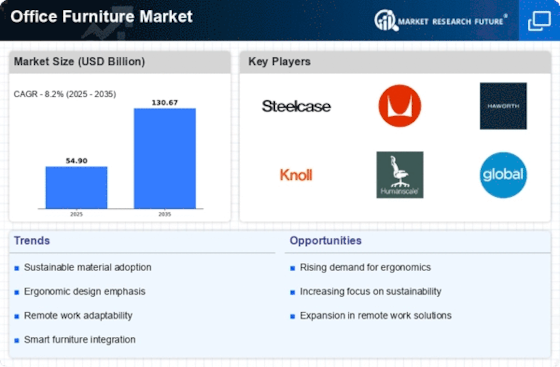
As per Market Research Future analysis, the Office Furniture Market was estimated at 54.9 USD Billion in 2024. The Office Furniture industry is projected to grow from 59.4 USD Billion in 2025 to 130.67 USD Billion by 2035, exhibiting a compound annual growth rate (CAGR) of 8.2% during the forecast period 2025 - 2035

Key Market Trends & Highlights

The Office Furniture Market is experiencing a dynamic shift towards ergonomic and sustainable solutions.

  • The North American region remains the largest market for office furniture, driven by a strong demand for ergonomic designs. In the Asia-Pacific region, the office furniture market is the fastest-growing, reflecting a rising emphasis on adaptable workspaces. Desks continue to dominate the market as the largest segment, while chairs are witnessing the fastest growth due to increased health and wellness awareness. Technological advancements and sustainability initiatives are key drivers propelling the market forward.

Market Size & Forecast

2024 Market Size 54.9 (USD Billion)
2035 Market Size 130.67 (USD Billion)
CAGR (2025 - 2035) 8.2%
Largest Regional Market Share in 2024 North America

Major Players

<p>Steelcase (US), Herman Miller (US), <a href="https://taigaconcept.fi/">Haworth (US)</a>, Knoll (US), Humanscale (US), Global Furniture Group (CA), Teknion (CA), Kimball International (US), Safco Products (US)</p>

Market Trends

The Office Furniture Market is currently experiencing a dynamic evolution, driven by various factors that reflect changing workplace needs and preferences. Key office furniture market trends include the rise of ergonomic designs, sustainability initiatives, and smart furniture integration. As organizations increasingly prioritize employee well-being and productivity, there is a noticeable shift towards ergonomic designs and flexible furniture solutions. This trend appears to be influenced by a growing awareness of the importance of comfort in enhancing work performance. Additionally, sustainability has emerged as a key consideration, with many companies seeking eco-friendly materials and practices in their office environments. This focus on environmental responsibility suggests a potential long-term transformation in how office spaces are designed and furnished. Moreover, the rise of remote and hybrid work models has prompted a reevaluation of traditional office layouts. Businesses are now exploring innovative configurations that accommodate both collaborative and individual work styles. This adaptability may lead to a more diverse range of products in the Office Furniture Market, catering to various settings and preferences. As the market continues to evolve, it is likely that technological integration will also play a crucial role, with smart furniture solutions becoming increasingly prevalent. Overall, the Office Furniture Market is poised for significant changes that reflect broader societal shifts in work culture and environmental consciousness.

Ergonomic Design Focus

The emphasis on ergonomic furniture is becoming more pronounced as organizations recognize the link between comfort and productivity. This trend indicates a shift towards designs that support health and well-being, potentially reducing workplace injuries and enhancing employee satisfaction.

Sustainability Initiatives

Sustainability is gaining traction within the Office Furniture Market, with companies increasingly opting for eco-friendly materials and production methods. This movement suggests a growing commitment to environmental stewardship, influencing purchasing decisions and design choices.

Adaptable Workspaces

The demand for adaptable office environments is rising, driven by the need for flexibility in work arrangements. This trend reflects a shift towards multifunctional furniture that can easily transition between collaborative and individual work settings, catering to diverse employee needs.

Office Furniture Market Market Drivers

Remote Work Trends

The rise of remote work is reshaping the Office Furniture Market. As more companies adopt flexible work arrangements, there is a growing demand for home office furniture that combines comfort and functionality. This shift has led to an increase in sales of ergonomic chairs and adjustable desks designed for home use. Market data suggests that the home office furniture segment is expected to account for nearly 30% of total office furniture sales by 2026. This trend highlights the necessity for manufacturers to adapt their product lines to meet the needs of remote workers, thereby expanding their market reach.

Technological Advancements

The Office Furniture Market is experiencing a notable shift due to rapid technological advancements. Innovations such as smart desks and integrated technology in furniture are becoming increasingly prevalent. These advancements not only enhance functionality but also improve user experience. For instance, the incorporation of wireless charging stations and built-in connectivity options in office furniture is appealing to tech-savvy consumers. According to recent data, the demand for technologically integrated office furniture is projected to grow by approximately 15% annually. This trend indicates a significant opportunity for manufacturers to innovate and cater to the evolving needs of modern workplaces.

Health and Wellness Awareness

Increasing awareness of health and wellness is significantly influencing the Office Furniture Market. Organizations are prioritizing employee well-being, leading to a surge in demand for ergonomic furniture that promotes better posture and reduces the risk of musculoskeletal disorders. Research indicates that companies investing in ergonomic office furniture can see a reduction in employee absenteeism by up to 25%. This growing emphasis on health and wellness is prompting manufacturers to innovate and offer products that align with these values, thereby enhancing their competitive edge in the market.

Customization and Personalization

The demand for customization and personalization is emerging as a key driver in the Office Furniture Market. As businesses strive to create unique work environments that reflect their brand identity, the need for customizable furniture solutions is increasing. This trend allows companies to tailor office layouts and furniture to meet specific functional and aesthetic requirements. Data indicates that nearly 40% of consumers are willing to pay a premium for personalized office furniture. This growing inclination towards bespoke solutions presents a lucrative opportunity for manufacturers to differentiate their offerings and cater to diverse customer preferences.

Sustainability and Eco-Friendly Products

Sustainability is becoming a critical driver in the Office Furniture Market. Consumers are increasingly seeking eco-friendly furniture options made from sustainable materials. This trend is prompting manufacturers to adopt greener practices, such as using recycled materials and reducing waste in production processes. Market analysis reveals that the demand for sustainable office furniture is expected to grow by over 20% in the coming years. This shift not only reflects changing consumer preferences but also encourages companies to enhance their corporate social responsibility initiatives, thereby appealing to environmentally conscious buyers.

Market Segment Insights

By Type: Desks (Largest) vs. Chairs (Fastest-Growing)

<p>In the Office Furniture Market, the composition of the 'By Type' segment reveals significant insights into consumer preferences. Desks lead the segment with the largest market share, reflecting their fundamental role in workplace design. Chairs follow closely behind, showcasing a substantial portion of the overall market. Storage Units, Tables, and Partition Panels contribute to the diverse offerings within this segment but occupy smaller shares. Overall, this distribution highlights the essential nature of desks and the integral role chairs play in office spaces, making them key drivers in market strategy.</p>

<p>Desks (Dominant) vs. Chairs (Emerging)</p>

<p>Desks in the office furniture market are characterized by their pivotal role in creating functional workspaces, making them the dominant segment. With a wide variety of styles, including executive, standing, and collaborative desks, they cater to diverse work environments. In contrast, chairs are emerging as a fast-growing segment, driven by a growing focus on ergonomics and comfort. Modern designs and increasing awareness of employee wellness are pushing the demand for innovative chairs in the market. The emphasis on aesthetics and functionality in both desks and chairs continues to shape their market positions, driving growth and innovation.</p>

By Material: Wood (Largest) vs. Metal (Fastest-Growing)

<p>The Office Furniture Market displays a diverse share distribution among materials, with wood consistently reigning as the most dominant material due to its aesthetic appeal and durability. Following closely are metal and plastic, which capture notable market shares, facilitated by their strength and versatility. Glass, while less common, serves niche segments, appealing to the modern office aesthetic. The preference for wood is driven by traditional values and consumer perception of quality, while metal and plastic provide cost-effective solutions without compromising functionality.</p>

<p>Wood (Dominant) vs. Metal (Emerging)</p>

<p>Wood furniture is characterized by its rich textures, durability, and timeless appeal, making it the most sought-after material among consumers in the office furniture market. Its insulating qualities and ease of customization enhance its desirability in traditional and modern offices alike. Conversely, metal furniture is emerging as a strong contender due to its lightweight nature and industrial aesthetics. It is increasingly favored in contemporary spaces, offering sleek designs that cater to the fast-paced corporate environment. The durability and strength of metal also make it ideal for multi-purpose environments.</p>

By End Use: Corporate Offices (Largest) vs. Home Offices (Fastest-Growing)

<p>The Office Furniture Market displays varied market share distribution among key end-use segments. Corporate offices hold the largest market share, reflecting the extensive investment by enterprises in creating productive and appealing workspaces. This segment encompasses a wide array of furniture solutions, catering to diverse corporate needs, including ergonomic desks, collaborative workspaces, and more. On the other hand, the public sector and educational institutions contribute significantly, though to a lesser extent than corporate offices, providing essential furniture that supports functionality and efficiency. Growth trends in the Office Furniture Market are particularly driven by the emergence of home offices, a segment witnessing rapid expansion. The shift towards remote work models has propelled demand for home office furniture, with consumers seeking ergonomic designs that promote productivity. Furthermore, corporate offices are increasingly investing in modern, flexible solutions that foster collaboration and employee well-being, indicating a broader trend toward adaptable workspace design. As businesses continue to adapt to post-pandemic norms, the focus on creating engaging office environments remains a significant driver of market growth.</p>

<p>Corporate Offices (Dominant) vs. Home Offices (Emerging)</p>

<p>Corporate offices dominate the Office Furniture Market due to their substantial investments in creating conducive work environments. They prioritize functionality, aesthetic appeal, and compliance with health and safety regulations. This segment typically features diverse furniture types, including desks, chairs, and collaborative spaces that enhance productivity. On the other hand, home offices are emerging as a critical segment, fueled by the growing trend of remote work. Consumers are increasingly looking for furniture that blends style with comfort and productivity, resulting in a surge in demand for adjustable desks and ergonomic chairs. This shift not only showcases changing consumer preferences but also indicates a fundamental transformation in workspace dynamics, presenting opportunities for innovative furniture solutions.</p>

By Distribution Channel: Online Retail (Largest) vs. Direct Sales (Fastest-Growing)

<p>In the Office Furniture Market, the distribution of market share among the various segments reveals significant insights. Online Retail stands out as the largest segment, gaining traction due to the convenience it offers consumers seeking office furniture options. Physical Retail follows, providing a tactile shopping experience, while Distributors maintain an essential role in reaching broader market bases. Direct Sales, which also capture a notable share, have begun to shift trajectory as businesses increasingly prefer tailored solutions from manufacturers directly.</p>

<p>Online Retail (Dominant) vs. Direct Sales (Emerging)</p>

<p>Online <a href="https://www.marketresearchfuture.com/reports/retail-industry-in-market-34684">Retail</a> is becoming the dominant distribution channel due to its accessibility and the growing trend towards e-commerce. This segment attracts a diverse demographic, leveraging technological advancements to enhance consumer experience. Meanwhile, Direct Sales are emerging as a key player, particularly among businesses looking for customized furniture solutions. This channel is characterized by strong relationships between manufacturers and clients, allowing for a high level of service and personalization. As companies prioritize hybrid work environments, both Online Retail and Direct Sales are positioned to cater specifically to the evolving needs of modern office setups.</p>

Get more detailed insights about Office Furniture Market Research Report – Forecast till 2035

Regional Insights

North America : Market Leader in Innovation

North America remains the largest market for office furniture, holding approximately 40% of the global share. North America holds the largest office furniture market share at approximately 40% of the global market. Key growth drivers include a surge in remote work, leading to increased demand for ergonomic and flexible office solutions. Regulatory support for workplace safety and health standards further catalyzes market growth. The U.S. is the primary contributor, followed by Canada, which holds around 10% of the market share. The competitive landscape is characterized by major players such as Steelcase, Herman Miller, and Haworth, who dominate the market with innovative designs and sustainable practices. The presence of these key players fosters a dynamic environment, pushing for continuous improvement in product offerings. Additionally, the focus on creating collaborative workspaces is driving demand for modular and adaptable furniture solutions, enhancing the overall market appeal.

Europe : Sustainable Growth and Innovation

Europe is witnessing a robust growth trajectory in the office furniture market, accounting for approximately 30% of the global share. The demand for ergonomic and sustainable office solutions is a significant driver, supported by stringent regulations promoting workplace health and safety. Countries like Germany and the UK lead the market, with Germany holding about 12% of the share, while the UK follows closely with 8%. The competitive landscape is marked by a mix of established brands and innovative startups. Key players such as Steelcase and Herman Miller are expanding their presence, while local manufacturers are focusing on sustainability and customization. The emphasis on creating healthier work environments is reshaping product offerings, with a notable increase in demand for eco-friendly materials and designs. This trend is expected to continue as companies prioritize employee well-being and environmental responsibility.

Asia-Pacific : Emerging Market Potential

The Asia-Pacific region is emerging as a significant player in the office furniture market, holding approximately 25% of the global share. Key growth drivers include rapid urbanization, increasing disposable incomes, and a shift towards modern office designs. China is the largest market in the region, accounting for about 15% of the global share, followed by India, which is experiencing a surge in demand for office furniture solutions. The competitive landscape is evolving, with both international and local players vying for market share. Companies like Steelcase and Herman Miller are expanding their operations, while local manufacturers are gaining traction by offering cost-effective solutions. The focus on creating collaborative and flexible workspaces is driving innovation, leading to a diverse range of products tailored to meet the needs of a growing workforce. This trend is expected to accelerate as businesses adapt to changing work environments.

Middle East and Africa : Untapped Market Opportunities

The Middle East and Africa region is witnessing gradual growth in the office furniture market, holding approximately 5% of the global share. Key drivers include increasing investments in infrastructure and a growing emphasis on modern office environments. The UAE and South Africa are the leading markets, with the UAE accounting for about 3% of the global share, driven by a booming economy and a focus on innovation in workspace design. The competitive landscape is characterized by a mix of international brands and local manufacturers. Key players are beginning to establish a foothold in the region, focusing on customization and quality. The demand for flexible and modular office solutions is rising, as businesses seek to create adaptable workspaces that cater to diverse needs. This trend presents significant opportunities for growth as the region continues to develop its commercial infrastructure.

Key Players and Competitive Insights

The Office Furniture Market Report is currently characterized by a dynamic competitive landscape, driven by evolving workplace needs and a growing emphasis on sustainability and technology integration. This report provides an in-depth office furniture market analysis, covering material types, end-use segments, and regional growth patterns Major players such as Steelcase (US), Herman Miller (US), and Haworth (US) are at the forefront, each adopting distinct strategies to enhance their market positioning. Steelcase (US) focuses on innovation through research and development, aiming to create adaptable workspaces that cater to diverse employee needs. Herman Miller (US), on the other hand, emphasizes sustainability, integrating eco-friendly materials into its product lines, which resonates with environmentally conscious consumers. Haworth (US) is actively pursuing regional expansion, particularly in emerging markets, thereby broadening its global footprint and enhancing its competitive edge. Collectively, these strategies contribute to a moderately fragmented market structure, where innovation and sustainability are pivotal in shaping competitive dynamics.


In terms of business tactics, companies are increasingly localizing manufacturing to reduce lead times and enhance supply chain efficiency. This approach not only mitigates risks associated with global supply chain disruptions but also allows for more responsive customer service. The competitive structure of the Office Furniture Market remains moderately fragmented, with key players exerting considerable influence through their strategic initiatives. The collective actions of these companies indicate a shift towards a more integrated and responsive market environment, where agility and customer-centricity are paramount.


In August 2025, Steelcase (US) announced a partnership with a leading technology firm to develop smart office solutions that leverage AI for workspace optimization. This strategic move underscores Steelcase's commitment to innovation and positions it to meet the growing demand for technology-enhanced work environments. By integrating AI capabilities, Steelcase aims to provide clients with data-driven insights that can enhance productivity and employee satisfaction, thereby reinforcing its competitive advantage.


In September 2025, Herman Miller (US) launched a new line of sustainable office furniture made from recycled materials, further solidifying its reputation as a leader in eco-friendly design. This initiative not only aligns with global sustainability trends but also caters to a growing segment of consumers who prioritize environmental responsibility in their purchasing decisions. The introduction of this product line is likely to attract new customers and strengthen brand loyalty among existing clients, enhancing Herman Miller's market position.


In July 2025, Haworth (US) expanded its operations in Asia by opening a new manufacturing facility in Vietnam. This strategic expansion is indicative of Haworth's focus on regional growth and its intent to capitalize on the burgeoning demand for office furniture in the Asia-Pacific region. By localizing production, Haworth can reduce costs and improve delivery times, thereby enhancing its competitive stance in a rapidly evolving market.


As of October 2025, the Office Furniture Market is witnessing significant trends such as digitalization, sustainability, and the integration of AI technologies. These trends are reshaping competitive strategies, with companies increasingly forming strategic alliances to leverage complementary strengths. The shift from price-based competition to a focus on innovation, technology, and supply chain reliability is becoming evident. Moving forward, competitive differentiation will likely hinge on the ability to adapt to these trends, with companies that prioritize innovation and sustainability poised to lead the market.

Key Companies in the Office Furniture Market include

Industry Developments

The Global Office Furniture Market is experiencing a dynamic shift characterized by increasing demand for ergonomic and sustainable designs. Recent developments indicate a growing interest in flexible workspace solutions, driven by the rise of hybrid work models post-COVID-19. In May 2023, Steelcase announced significant enhancements to its product lines focused on fostering collaboration and employee well-being, aligning with this trend.

Moreover, HNI Corporation expanded its reach by acquiring a regional office furniture manufacturing firm in June 2023, reinforcing its foothold in the global market.Current trends emphasize the importance of incorporating technology into office furniture, with Herman Miller launching smart furniture solutions to address the needs of modern workplaces. Additionally, IKEA has initiated collaborations with tech partners to innovate office setups for enhanced productivity. Over the last couple of years, the market has also been influenced by an upward valuation trajectory, with major companies like Vari reporting a substantial increase in revenue attributed to their adaptive office furniture solutions.

The Global Office Furniture Market continues to evolve, aligning with broader economic shifts and the changing dynamics of traditional office environments.

Future Outlook

Office Furniture Market Future Outlook

<p>The Office Furniture Market is projected to grow at an 8.2% CAGR from 2025 to 2035, driven by remote work trends, ergonomic innovations, and sustainability initiatives.</p>

New opportunities lie in:

  • <p>Expansion of modular office furniture solutions for flexible workspaces. Development of smart office furniture integrated with IoT technology. Investment in sustainable materials for eco-friendly office furniture production.</p>

<p>By 2035, the market is expected to be robust, reflecting evolving workplace dynamics and consumer preferences.</p>

Market Segmentation

Office Furniture Market Type Outlook

  • Desks
  • Chairs
  • Storage Units
  • Tables
  • Partition Panels

Office Furniture Market End Use Outlook

  • Corporate Offices
  • Public Sector
  • Educational Institutions
  • Home Offices

Office Furniture Market Material Outlook

  • Wood
  • Metal
  • Plastic
  • Glass

Office Furniture Market Distribution Channel Outlook

  • Online Retail
  • Physical Retail
  • Distributors
  • Direct Sales

Report Scope

MARKET SIZE 2024 54.9(USD Billion)
MARKET SIZE 2025 59.4(USD Billion)
MARKET SIZE 2035 130.67(USD Billion)
COMPOUND ANNUAL GROWTH RATE (CAGR) 8.2% (2025 - 2035)
REPORT COVERAGE Revenue Forecast, Competitive Landscape, Growth Factors, and Trends
BASE YEAR 2024
Market Forecast Period 2025 - 2035
Historical Data 2019 - 2024
Market Forecast Units USD Billion
Key Companies Profiled Steelcase (US), Herman Miller (US), Haworth (US), Knoll (US), Humanscale (US), Global Furniture Group (CA), Teknion (CA), Kimball International (US), Safco Products (US)
Segments Covered Product Type, Material, End Use, Distribution Channel, Regional
Key Market Opportunities Integration of ergonomic designs and smart technology in the Office Furniture Market.
Key Market Dynamics Rising demand for ergonomic designs drives innovation and competition in the office furniture sector.
Countries Covered North America, Europe, APAC, South America, MEA

FAQs

What is the current valuation of the Office Furniture Market in 2025?

<p>The Office Furniture Market is valued at approximately 54.9 USD Billion in 2024.</p>

What is the projected market size for the Office Furniture Market by 2035?

The market is projected to reach approximately 130.67 USD Billion by 2035.

What is the expected CAGR for the Office Furniture Market during the forecast period 2025 - 2035?

The expected CAGR for the Office Furniture Market during the forecast period 2025 - 2035 is 8.2%.

Which companies are considered key players in the Office Furniture Market?

Key players in the market include Steelcase, Herman Miller, Haworth, Knoll, and Humanscale.

What are the main segments of the Office Furniture Market?

The main segments include Type, Material, End Use, and Distribution Channel.

How much revenue do desks generate in the Office Furniture Market?

Desks generated revenue between 10.0 and 25.0 USD Billion in 2024.

What is the revenue range for chairs in the Office Furniture Market?

Chairs generated revenue between 15.0 and 35.0 USD Billion in 2024.

What is the projected revenue for storage units in the Office Furniture Market by 2035?

Storage units are projected to generate revenue between 8.0 and 20.0 USD Billion by 2035.

How does the distribution channel impact the Office Furniture Market?

The distribution channel includes Online Retail, Physical Retail, Distributors, and Direct Sales, with Physical Retail generating 20.0 to 45.0 USD Billion in 2024.

What is the revenue range for corporate offices in the Office Furniture Market?

Corporate offices generated revenue between 20.0 and 48.0 USD Billion in 2024.

  1. SECTION I: EXECUTIVE SUMMARY AND KEY HIGHLIGHTS
    1. | 1.1 EXECUTIVE SUMMARY
    2. | | 1.1.1 Market Overview
    3. | | 1.1.2 Key Findings
    4. | | 1.1.3 Market Segmentation
    5. | | 1.1.4 Competitive Landscape
    6. | | 1.1.5 Challenges and Opportunities
    7. | | 1.1.6 Future Outlook
  2. SECTION II: SCOPING, METHODOLOGY AND MARKET STRUCTURE
    1. | 2.1 MARKET INTRODUCTION
    2. | | 2.1.1 Definition
    3. | | 2.1.2 Scope of the study
    4. | | | 2.1.2.1 Research Objective
    5. | | | 2.1.2.2 Assumption
    6. | | | 2.1.2.3 Limitations
    7. | 2.2 RESEARCH METHODOLOGY
    8. | | 2.2.1 Overview
    9. | | 2.2.2 Data Mining
    10. | | 2.2.3 Secondary Research
    11. | | 2.2.4 Primary Research
    12. | | | 2.2.4.1 Primary Interviews and Information Gathering Process
    13. | | | 2.2.4.2 Breakdown of Primary Respondents
    14. | | 2.2.5 Forecasting Model
    15. | | 2.2.6 Market Size Estimation
    16. | | | 2.2.6.1 Bottom-Up Approach
    17. | | | 2.2.6.2 Top-Down Approach
    18. | | 2.2.7 Data Triangulation
    19. | | 2.2.8 Validation
  3. SECTION III: QUALITATIVE ANALYSIS
    1. | 3.1 MARKET DYNAMICS
    2. | | 3.1.1 Overview
    3. | | 3.1.2 Drivers
    4. | | 3.1.3 Restraints
    5. | | 3.1.4 Opportunities
    6. | 3.2 MARKET FACTOR ANALYSIS
    7. | | 3.2.1 Value chain Analysis
    8. | | 3.2.2 Porter's Five Forces Analysis
    9. | | | 3.2.2.1 Bargaining Power of Suppliers
    10. | | | 3.2.2.2 Bargaining Power of Buyers
    11. | | | 3.2.2.3 Threat of New Entrants
    12. | | | 3.2.2.4 Threat of Substitutes
    13. | | | 3.2.2.5 Intensity of Rivalry
    14. | | 3.2.3 COVID-19 Impact Analysis
    15. | | | 3.2.3.1 Market Impact Analysis
    16. | | | 3.2.3.2 Regional Impact
    17. | | | 3.2.3.3 Opportunity and Threat Analysis
  4. SECTION IV: QUANTITATIVE ANALYSIS
    1. | 4.1 Consumer and Retail, BY Type (USD Billion)
    2. | | 4.1.1 Desks
    3. | | 4.1.2 Chairs
    4. | | 4.1.3 Storage Units
    5. | | 4.1.4 Tables
    6. | | 4.1.5 Partition Panels
    7. | 4.2 Consumer and Retail, BY Material (USD Billion)
    8. | | 4.2.1 Wood
    9. | | 4.2.2 Metal
    10. | | 4.2.3 Plastic
    11. | | 4.2.4 Glass
    12. | 4.3 Consumer and Retail, BY End Use (USD Billion)
    13. | | 4.3.1 Corporate Offices
    14. | | 4.3.2 Public Sector
    15. | | 4.3.3 Educational Institutions
    16. | | 4.3.4 Home Offices
    17. | 4.4 Consumer and Retail, BY Distribution Channel (USD Billion)
    18. | | 4.4.1 Online Retail
    19. | | 4.4.2 Physical Retail
    20. | | 4.4.3 Distributors
    21. | | 4.4.4 Direct Sales
    22. | 4.5 Consumer and Retail, BY Region (USD Billion)
    23. | | 4.5.1 North America
    24. | | | 4.5.1.1 US
    25. | | | 4.5.1.2 Canada
    26. | | 4.5.2 Europe
    27. | | | 4.5.2.1 Germany
    28. | | | 4.5.2.2 UK
    29. | | | 4.5.2.3 France
    30. | | | 4.5.2.4 Russia
    31. | | | 4.5.2.5 Italy
    32. | | | 4.5.2.6 Spain
    33. | | | 4.5.2.7 Rest of Europe
    34. | | 4.5.3 APAC
    35. | | | 4.5.3.1 China
    36. | | | 4.5.3.2 India
    37. | | | 4.5.3.3 Japan
    38. | | | 4.5.3.4 South Korea
    39. | | | 4.5.3.5 Malaysia
    40. | | | 4.5.3.6 Thailand
    41. | | | 4.5.3.7 Indonesia
    42. | | | 4.5.3.8 Rest of APAC
    43. | | 4.5.4 South America
    44. | | | 4.5.4.1 Brazil
    45. | | | 4.5.4.2 Mexico
    46. | | | 4.5.4.3 Argentina
    47. | | | 4.5.4.4 Rest of South America
    48. | | 4.5.5 MEA
    49. | | | 4.5.5.1 GCC Countries
    50. | | | 4.5.5.2 South Africa
    51. | | | 4.5.5.3 Rest of MEA
  5. SECTION V: COMPETITIVE ANALYSIS
    1. | 5.1 Competitive Landscape
    2. | | 5.1.1 Overview
    3. | | 5.1.2 Competitive Analysis
    4. | | 5.1.3 Market share Analysis
    5. | | 5.1.4 Major Growth Strategy in the Consumer and Retail
    6. | | 5.1.5 Competitive Benchmarking
    7. | | 5.1.6 Leading Players in Terms of Number of Developments in the Consumer and Retail
    8. | | 5.1.7 Key developments and growth strategies
    9. | | | 5.1.7.1 New Product Launch/Service Deployment
    10. | | | 5.1.7.2 Merger & Acquisitions
    11. | | | 5.1.7.3 Joint Ventures
    12. | | 5.1.8 Major Players Financial Matrix
    13. | | | 5.1.8.1 Sales and Operating Income
    14. | | | 5.1.8.2 Major Players R&D Expenditure. 2023
    15. | 5.2 Company Profiles
    16. | | 5.2.1 Steelcase (US)
    17. | | | 5.2.1.1 Financial Overview
    18. | | | 5.2.1.2 Products Offered
    19. | | | 5.2.1.3 Key Developments
    20. | | | 5.2.1.4 SWOT Analysis
    21. | | | 5.2.1.5 Key Strategies
    22. | | 5.2.2 Herman Miller (US)
    23. | | | 5.2.2.1 Financial Overview
    24. | | | 5.2.2.2 Products Offered
    25. | | | 5.2.2.3 Key Developments
    26. | | | 5.2.2.4 SWOT Analysis
    27. | | | 5.2.2.5 Key Strategies
    28. | | 5.2.3 Haworth (US)
    29. | | | 5.2.3.1 Financial Overview
    30. | | | 5.2.3.2 Products Offered
    31. | | | 5.2.3.3 Key Developments
    32. | | | 5.2.3.4 SWOT Analysis
    33. | | | 5.2.3.5 Key Strategies
    34. | | 5.2.4 Knoll (US)
    35. | | | 5.2.4.1 Financial Overview
    36. | | | 5.2.4.2 Products Offered
    37. | | | 5.2.4.3 Key Developments
    38. | | | 5.2.4.4 SWOT Analysis
    39. | | | 5.2.4.5 Key Strategies
    40. | | 5.2.5 Humanscale (US)
    41. | | | 5.2.5.1 Financial Overview
    42. | | | 5.2.5.2 Products Offered
    43. | | | 5.2.5.3 Key Developments
    44. | | | 5.2.5.4 SWOT Analysis
    45. | | | 5.2.5.5 Key Strategies
    46. | | 5.2.6 Global Furniture Group (CA)
    47. | | | 5.2.6.1 Financial Overview
    48. | | | 5.2.6.2 Products Offered
    49. | | | 5.2.6.3 Key Developments
    50. | | | 5.2.6.4 SWOT Analysis
    51. | | | 5.2.6.5 Key Strategies
    52. | | 5.2.7 Teknion (CA)
    53. | | | 5.2.7.1 Financial Overview
    54. | | | 5.2.7.2 Products Offered
    55. | | | 5.2.7.3 Key Developments
    56. | | | 5.2.7.4 SWOT Analysis
    57. | | | 5.2.7.5 Key Strategies
    58. | | 5.2.8 Kimball International (US)
    59. | | | 5.2.8.1 Financial Overview
    60. | | | 5.2.8.2 Products Offered
    61. | | | 5.2.8.3 Key Developments
    62. | | | 5.2.8.4 SWOT Analysis
    63. | | | 5.2.8.5 Key Strategies
    64. | | 5.2.9 Safco Products (US)
    65. | | | 5.2.9.1 Financial Overview
    66. | | | 5.2.9.2 Products Offered
    67. | | | 5.2.9.3 Key Developments
    68. | | | 5.2.9.4 SWOT Analysis
    69. | | | 5.2.9.5 Key Strategies
    70. | 5.3 Appendix
    71. | | 5.3.1 References
    72. | | 5.3.2 Related Reports
  6. LIST OF FIGURES
    1. | 6.1 MARKET SYNOPSIS
    2. | 6.2 NORTH AMERICA MARKET ANALYSIS
    3. | 6.3 US MARKET ANALYSIS BY TYPE
    4. | 6.4 US MARKET ANALYSIS BY MATERIAL
    5. | 6.5 US MARKET ANALYSIS BY END USE
    6. | 6.6 US MARKET ANALYSIS BY DISTRIBUTION CHANNEL
    7. | 6.7 CANADA MARKET ANALYSIS BY TYPE
    8. | 6.8 CANADA MARKET ANALYSIS BY MATERIAL
    9. | 6.9 CANADA MARKET ANALYSIS BY END USE
    10. | 6.10 CANADA MARKET ANALYSIS BY DISTRIBUTION CHANNEL
    11. | 6.11 EUROPE MARKET ANALYSIS
    12. | 6.12 GERMANY MARKET ANALYSIS BY TYPE
    13. | 6.13 GERMANY MARKET ANALYSIS BY MATERIAL
    14. | 6.14 GERMANY MARKET ANALYSIS BY END USE
    15. | 6.15 GERMANY MARKET ANALYSIS BY DISTRIBUTION CHANNEL
    16. | 6.16 UK MARKET ANALYSIS BY TYPE
    17. | 6.17 UK MARKET ANALYSIS BY MATERIAL
    18. | 6.18 UK MARKET ANALYSIS BY END USE
    19. | 6.19 UK MARKET ANALYSIS BY DISTRIBUTION CHANNEL
    20. | 6.20 FRANCE MARKET ANALYSIS BY TYPE
    21. | 6.21 FRANCE MARKET ANALYSIS BY MATERIAL
    22. | 6.22 FRANCE MARKET ANALYSIS BY END USE
    23. | 6.23 FRANCE MARKET ANALYSIS BY DISTRIBUTION CHANNEL
    24. | 6.24 RUSSIA MARKET ANALYSIS BY TYPE
    25. | 6.25 RUSSIA MARKET ANALYSIS BY MATERIAL
    26. | 6.26 RUSSIA MARKET ANALYSIS BY END USE
    27. | 6.27 RUSSIA MARKET ANALYSIS BY DISTRIBUTION CHANNEL
    28. | 6.28 ITALY MARKET ANALYSIS BY TYPE
    29. | 6.29 ITALY MARKET ANALYSIS BY MATERIAL
    30. | 6.30 ITALY MARKET ANALYSIS BY END USE
    31. | 6.31 ITALY MARKET ANALYSIS BY DISTRIBUTION CHANNEL
    32. | 6.32 SPAIN MARKET ANALYSIS BY TYPE
    33. | 6.33 SPAIN MARKET ANALYSIS BY MATERIAL
    34. | 6.34 SPAIN MARKET ANALYSIS BY END USE
    35. | 6.35 SPAIN MARKET ANALYSIS BY DISTRIBUTION CHANNEL
    36. | 6.36 REST OF EUROPE MARKET ANALYSIS BY TYPE
    37. | 6.37 REST OF EUROPE MARKET ANALYSIS BY MATERIAL
    38. | 6.38 REST OF EUROPE MARKET ANALYSIS BY END USE
    39. | 6.39 REST OF EUROPE MARKET ANALYSIS BY DISTRIBUTION CHANNEL
    40. | 6.40 APAC MARKET ANALYSIS
    41. | 6.41 CHINA MARKET ANALYSIS BY TYPE
    42. | 6.42 CHINA MARKET ANALYSIS BY MATERIAL
    43. | 6.43 CHINA MARKET ANALYSIS BY END USE
    44. | 6.44 CHINA MARKET ANALYSIS BY DISTRIBUTION CHANNEL
    45. | 6.45 INDIA MARKET ANALYSIS BY TYPE
    46. | 6.46 INDIA MARKET ANALYSIS BY MATERIAL
    47. | 6.47 INDIA MARKET ANALYSIS BY END USE
    48. | 6.48 INDIA MARKET ANALYSIS BY DISTRIBUTION CHANNEL
    49. | 6.49 JAPAN MARKET ANALYSIS BY TYPE
    50. | 6.50 JAPAN MARKET ANALYSIS BY MATERIAL
    51. | 6.51 JAPAN MARKET ANALYSIS BY END USE
    52. | 6.52 JAPAN MARKET ANALYSIS BY DISTRIBUTION CHANNEL
    53. | 6.53 SOUTH KOREA MARKET ANALYSIS BY TYPE
    54. | 6.54 SOUTH KOREA MARKET ANALYSIS BY MATERIAL
    55. | 6.55 SOUTH KOREA MARKET ANALYSIS BY END USE
    56. | 6.56 SOUTH KOREA MARKET ANALYSIS BY DISTRIBUTION CHANNEL
    57. | 6.57 MALAYSIA MARKET ANALYSIS BY TYPE
    58. | 6.58 MALAYSIA MARKET ANALYSIS BY MATERIAL
    59. | 6.59 MALAYSIA MARKET ANALYSIS BY END USE
    60. | 6.60 MALAYSIA MARKET ANALYSIS BY DISTRIBUTION CHANNEL
    61. | 6.61 THAILAND MARKET ANALYSIS BY TYPE
    62. | 6.62 THAILAND MARKET ANALYSIS BY MATERIAL
    63. | 6.63 THAILAND MARKET ANALYSIS BY END USE
    64. | 6.64 THAILAND MARKET ANALYSIS BY DISTRIBUTION CHANNEL
    65. | 6.65 INDONESIA MARKET ANALYSIS BY TYPE
    66. | 6.66 INDONESIA MARKET ANALYSIS BY MATERIAL
    67. | 6.67 INDONESIA MARKET ANALYSIS BY END USE
    68. | 6.68 INDONESIA MARKET ANALYSIS BY DISTRIBUTION CHANNEL
    69. | 6.69 REST OF APAC MARKET ANALYSIS BY TYPE
    70. | 6.70 REST OF APAC MARKET ANALYSIS BY MATERIAL
    71. | 6.71 REST OF APAC MARKET ANALYSIS BY END USE
    72. | 6.72 REST OF APAC MARKET ANALYSIS BY DISTRIBUTION CHANNEL
    73. | 6.73 SOUTH AMERICA MARKET ANALYSIS
    74. | 6.74 BRAZIL MARKET ANALYSIS BY TYPE
    75. | 6.75 BRAZIL MARKET ANALYSIS BY MATERIAL
    76. | 6.76 BRAZIL MARKET ANALYSIS BY END USE
    77. | 6.77 BRAZIL MARKET ANALYSIS BY DISTRIBUTION CHANNEL
    78. | 6.78 MEXICO MARKET ANALYSIS BY TYPE
    79. | 6.79 MEXICO MARKET ANALYSIS BY MATERIAL
    80. | 6.80 MEXICO MARKET ANALYSIS BY END USE
    81. | 6.81 MEXICO MARKET ANALYSIS BY DISTRIBUTION CHANNEL
    82. | 6.82 ARGENTINA MARKET ANALYSIS BY TYPE
    83. | 6.83 ARGENTINA MARKET ANALYSIS BY MATERIAL
    84. | 6.84 ARGENTINA MARKET ANALYSIS BY END USE
    85. | 6.85 ARGENTINA MARKET ANALYSIS BY DISTRIBUTION CHANNEL
    86. | 6.86 REST OF SOUTH AMERICA MARKET ANALYSIS BY TYPE
    87. | 6.87 REST OF SOUTH AMERICA MARKET ANALYSIS BY MATERIAL
    88. | 6.88 REST OF SOUTH AMERICA MARKET ANALYSIS BY END USE
    89. | 6.89 REST OF SOUTH AMERICA MARKET ANALYSIS BY DISTRIBUTION CHANNEL
    90. | 6.90 MEA MARKET ANALYSIS
    91. | 6.91 GCC COUNTRIES MARKET ANALYSIS BY TYPE
    92. | 6.92 GCC COUNTRIES MARKET ANALYSIS BY MATERIAL
    93. | 6.93 GCC COUNTRIES MARKET ANALYSIS BY END USE
    94. | 6.94 GCC COUNTRIES MARKET ANALYSIS BY DISTRIBUTION CHANNEL
    95. | 6.95 SOUTH AFRICA MARKET ANALYSIS BY TYPE
    96. | 6.96 SOUTH AFRICA MARKET ANALYSIS BY MATERIAL
    97. | 6.97 SOUTH AFRICA MARKET ANALYSIS BY END USE
    98. | 6.98 SOUTH AFRICA MARKET ANALYSIS BY DISTRIBUTION CHANNEL
    99. | 6.99 REST OF MEA MARKET ANALYSIS BY TYPE
    100. | 6.100 REST OF MEA MARKET ANALYSIS BY MATERIAL
    101. | 6.101 REST OF MEA MARKET ANALYSIS BY END USE
    102. | 6.102 REST OF MEA MARKET ANALYSIS BY DISTRIBUTION CHANNEL
    103. | 6.103 KEY BUYING CRITERIA OF CONSUMER AND RETAIL
    104. | 6.104 RESEARCH PROCESS OF MRFR
    105. | 6.105 DRO ANALYSIS OF CONSUMER AND RETAIL
    106. | 6.106 DRIVERS IMPACT ANALYSIS: CONSUMER AND RETAIL
    107. | 6.107 RESTRAINTS IMPACT ANALYSIS: CONSUMER AND RETAIL
    108. | 6.108 SUPPLY / VALUE CHAIN: CONSUMER AND RETAIL
    109. | 6.109 CONSUMER AND RETAIL, BY TYPE, 2024 (% SHARE)
    110. | 6.110 CONSUMER AND RETAIL, BY TYPE, 2024 TO 2035 (USD Billion)
    111. | 6.111 CONSUMER AND RETAIL, BY MATERIAL, 2024 (% SHARE)
    112. | 6.112 CONSUMER AND RETAIL, BY MATERIAL, 2024 TO 2035 (USD Billion)
    113. | 6.113 CONSUMER AND RETAIL, BY END USE, 2024 (% SHARE)
    114. | 6.114 CONSUMER AND RETAIL, BY END USE, 2024 TO 2035 (USD Billion)
    115. | 6.115 CONSUMER AND RETAIL, BY DISTRIBUTION CHANNEL, 2024 (% SHARE)
    116. | 6.116 CONSUMER AND RETAIL, BY DISTRIBUTION CHANNEL, 2024 TO 2035 (USD Billion)
    117. | 6.117 BENCHMARKING OF MAJOR COMPETITORS
  7. LIST OF TABLES
    1. | 7.1 LIST OF ASSUMPTIONS
    2. | | 7.1.1
    3. | 7.2 North America MARKET SIZE ESTIMATES; FORECAST
    4. | | 7.2.1 BY TYPE, 2025-2035 (USD Billion)
    5. | | 7.2.2 BY MATERIAL, 2025-2035 (USD Billion)
    6. | | 7.2.3 BY END USE, 2025-2035 (USD Billion)
    7. | | 7.2.4 BY DISTRIBUTION CHANNEL, 2025-2035 (USD Billion)
    8. | 7.3 US MARKET SIZE ESTIMATES; FORECAST
    9. | | 7.3.1 BY TYPE, 2025-2035 (USD Billion)
    10. | | 7.3.2 BY MATERIAL, 2025-2035 (USD Billion)
    11. | | 7.3.3 BY END USE, 2025-2035 (USD Billion)
    12. | | 7.3.4 BY DISTRIBUTION CHANNEL, 2025-2035 (USD Billion)
    13. | 7.4 Canada MARKET SIZE ESTIMATES; FORECAST
    14. | | 7.4.1 BY TYPE, 2025-2035 (USD Billion)
    15. | | 7.4.2 BY MATERIAL, 2025-2035 (USD Billion)
    16. | | 7.4.3 BY END USE, 2025-2035 (USD Billion)
    17. | | 7.4.4 BY DISTRIBUTION CHANNEL, 2025-2035 (USD Billion)
    18. | 7.5 Europe MARKET SIZE ESTIMATES; FORECAST
    19. | | 7.5.1 BY TYPE, 2025-2035 (USD Billion)
    20. | | 7.5.2 BY MATERIAL, 2025-2035 (USD Billion)
    21. | | 7.5.3 BY END USE, 2025-2035 (USD Billion)
    22. | | 7.5.4 BY DISTRIBUTION CHANNEL, 2025-2035 (USD Billion)
    23. | 7.6 Germany MARKET SIZE ESTIMATES; FORECAST
    24. | | 7.6.1 BY TYPE, 2025-2035 (USD Billion)
    25. | | 7.6.2 BY MATERIAL, 2025-2035 (USD Billion)
    26. | | 7.6.3 BY END USE, 2025-2035 (USD Billion)
    27. | | 7.6.4 BY DISTRIBUTION CHANNEL, 2025-2035 (USD Billion)
    28. | 7.7 UK MARKET SIZE ESTIMATES; FORECAST
    29. | | 7.7.1 BY TYPE, 2025-2035 (USD Billion)
    30. | | 7.7.2 BY MATERIAL, 2025-2035 (USD Billion)
    31. | | 7.7.3 BY END USE, 2025-2035 (USD Billion)
    32. | | 7.7.4 BY DISTRIBUTION CHANNEL, 2025-2035 (USD Billion)
    33. | 7.8 France MARKET SIZE ESTIMATES; FORECAST
    34. | | 7.8.1 BY TYPE, 2025-2035 (USD Billion)
    35. | | 7.8.2 BY MATERIAL, 2025-2035 (USD Billion)
    36. | | 7.8.3 BY END USE, 2025-2035 (USD Billion)
    37. | | 7.8.4 BY DISTRIBUTION CHANNEL, 2025-2035 (USD Billion)
    38. | 7.9 Russia MARKET SIZE ESTIMATES; FORECAST
    39. | | 7.9.1 BY TYPE, 2025-2035 (USD Billion)
    40. | | 7.9.2 BY MATERIAL, 2025-2035 (USD Billion)
    41. | | 7.9.3 BY END USE, 2025-2035 (USD Billion)
    42. | | 7.9.4 BY DISTRIBUTION CHANNEL, 2025-2035 (USD Billion)
    43. | 7.10 Italy MARKET SIZE ESTIMATES; FORECAST
    44. | | 7.10.1 BY TYPE, 2025-2035 (USD Billion)
    45. | | 7.10.2 BY MATERIAL, 2025-2035 (USD Billion)
    46. | | 7.10.3 BY END USE, 2025-2035 (USD Billion)
    47. | | 7.10.4 BY DISTRIBUTION CHANNEL, 2025-2035 (USD Billion)
    48. | 7.11 Spain MARKET SIZE ESTIMATES; FORECAST
    49. | | 7.11.1 BY TYPE, 2025-2035 (USD Billion)
    50. | | 7.11.2 BY MATERIAL, 2025-2035 (USD Billion)
    51. | | 7.11.3 BY END USE, 2025-2035 (USD Billion)
    52. | | 7.11.4 BY DISTRIBUTION CHANNEL, 2025-2035 (USD Billion)
    53. | 7.12 Rest of Europe MARKET SIZE ESTIMATES; FORECAST
    54. | | 7.12.1 BY TYPE, 2025-2035 (USD Billion)
    55. | | 7.12.2 BY MATERIAL, 2025-2035 (USD Billion)
    56. | | 7.12.3 BY END USE, 2025-2035 (USD Billion)
    57. | | 7.12.4 BY DISTRIBUTION CHANNEL, 2025-2035 (USD Billion)
    58. | 7.13 APAC MARKET SIZE ESTIMATES; FORECAST
    59. | | 7.13.1 BY TYPE, 2025-2035 (USD Billion)
    60. | | 7.13.2 BY MATERIAL, 2025-2035 (USD Billion)
    61. | | 7.13.3 BY END USE, 2025-2035 (USD Billion)
    62. | | 7.13.4 BY DISTRIBUTION CHANNEL, 2025-2035 (USD Billion)
    63. | 7.14 China MARKET SIZE ESTIMATES; FORECAST
    64. | | 7.14.1 BY TYPE, 2025-2035 (USD Billion)
    65. | | 7.14.2 BY MATERIAL, 2025-2035 (USD Billion)
    66. | | 7.14.3 BY END USE, 2025-2035 (USD Billion)
    67. | | 7.14.4 BY DISTRIBUTION CHANNEL, 2025-2035 (USD Billion)
    68. | 7.15 India MARKET SIZE ESTIMATES; FORECAST
    69. | | 7.15.1 BY TYPE, 2025-2035 (USD Billion)
    70. | | 7.15.2 BY MATERIAL, 2025-2035 (USD Billion)
    71. | | 7.15.3 BY END USE, 2025-2035 (USD Billion)
    72. | | 7.15.4 BY DISTRIBUTION CHANNEL, 2025-2035 (USD Billion)
    73. | 7.16 Japan MARKET SIZE ESTIMATES; FORECAST
    74. | | 7.16.1 BY TYPE, 2025-2035 (USD Billion)
    75. | | 7.16.2 BY MATERIAL, 2025-2035 (USD Billion)
    76. | | 7.16.3 BY END USE, 2025-2035 (USD Billion)
    77. | | 7.16.4 BY DISTRIBUTION CHANNEL, 2025-2035 (USD Billion)
    78. | 7.17 South Korea MARKET SIZE ESTIMATES; FORECAST
    79. | | 7.17.1 BY TYPE, 2025-2035 (USD Billion)
    80. | | 7.17.2 BY MATERIAL, 2025-2035 (USD Billion)
    81. | | 7.17.3 BY END USE, 2025-2035 (USD Billion)
    82. | | 7.17.4 BY DISTRIBUTION CHANNEL, 2025-2035 (USD Billion)
    83. | 7.18 Malaysia MARKET SIZE ESTIMATES; FORECAST
    84. | | 7.18.1 BY TYPE, 2025-2035 (USD Billion)
    85. | | 7.18.2 BY MATERIAL, 2025-2035 (USD Billion)
    86. | | 7.18.3 BY END USE, 2025-2035 (USD Billion)
    87. | | 7.18.4 BY DISTRIBUTION CHANNEL, 2025-2035 (USD Billion)
    88. | 7.19 Thailand MARKET SIZE ESTIMATES; FORECAST
    89. | | 7.19.1 BY TYPE, 2025-2035 (USD Billion)
    90. | | 7.19.2 BY MATERIAL, 2025-2035 (USD Billion)
    91. | | 7.19.3 BY END USE, 2025-2035 (USD Billion)
    92. | | 7.19.4 BY DISTRIBUTION CHANNEL, 2025-2035 (USD Billion)
    93. | 7.20 Indonesia MARKET SIZE ESTIMATES; FORECAST
    94. | | 7.20.1 BY TYPE, 2025-2035 (USD Billion)
    95. | | 7.20.2 BY MATERIAL, 2025-2035 (USD Billion)
    96. | | 7.20.3 BY END USE, 2025-2035 (USD Billion)
    97. | | 7.20.4 BY DISTRIBUTION CHANNEL, 2025-2035 (USD Billion)
    98. | 7.21 Rest of APAC MARKET SIZE ESTIMATES; FORECAST
    99. | | 7.21.1 BY TYPE, 2025-2035 (USD Billion)
    100. | | 7.21.2 BY MATERIAL, 2025-2035 (USD Billion)
    101. | | 7.21.3 BY END USE, 2025-2035 (USD Billion)
    102. | | 7.21.4 BY DISTRIBUTION CHANNEL, 2025-2035 (USD Billion)
    103. | 7.22 South America MARKET SIZE ESTIMATES; FORECAST
    104. | | 7.22.1 BY TYPE, 2025-2035 (USD Billion)
    105. | | 7.22.2 BY MATERIAL, 2025-2035 (USD Billion)
    106. | | 7.22.3 BY END USE, 2025-2035 (USD Billion)
    107. | | 7.22.4 BY DISTRIBUTION CHANNEL, 2025-2035 (USD Billion)
    108. | 7.23 Brazil MARKET SIZE ESTIMATES; FORECAST
    109. | | 7.23.1 BY TYPE, 2025-2035 (USD Billion)
    110. | | 7.23.2 BY MATERIAL, 2025-2035 (USD Billion)
    111. | | 7.23.3 BY END USE, 2025-2035 (USD Billion)
    112. | | 7.23.4 BY DISTRIBUTION CHANNEL, 2025-2035 (USD Billion)
    113. | 7.24 Mexico MARKET SIZE ESTIMATES; FORECAST
    114. | | 7.24.1 BY TYPE, 2025-2035 (USD Billion)
    115. | | 7.24.2 BY MATERIAL, 2025-2035 (USD Billion)
    116. | | 7.24.3 BY END USE, 2025-2035 (USD Billion)
    117. | | 7.24.4 BY DISTRIBUTION CHANNEL, 2025-2035 (USD Billion)
    118. | 7.25 Argentina MARKET SIZE ESTIMATES; FORECAST
    119. | | 7.25.1 BY TYPE, 2025-2035 (USD Billion)
    120. | | 7.25.2 BY MATERIAL, 2025-2035 (USD Billion)
    121. | | 7.25.3 BY END USE, 2025-2035 (USD Billion)
    122. | | 7.25.4 BY DISTRIBUTION CHANNEL, 2025-2035 (USD Billion)
    123. | 7.26 Rest of South America MARKET SIZE ESTIMATES; FORECAST
    124. | | 7.26.1 BY TYPE, 2025-2035 (USD Billion)
    125. | | 7.26.2 BY MATERIAL, 2025-2035 (USD Billion)
    126. | | 7.26.3 BY END USE, 2025-2035 (USD Billion)
    127. | | 7.26.4 BY DISTRIBUTION CHANNEL, 2025-2035 (USD Billion)
    128. | 7.27 MEA MARKET SIZE ESTIMATES; FORECAST
    129. | | 7.27.1 BY TYPE, 2025-2035 (USD Billion)
    130. | | 7.27.2 BY MATERIAL, 2025-2035 (USD Billion)
    131. | | 7.27.3 BY END USE, 2025-2035 (USD Billion)
    132. | | 7.27.4 BY DISTRIBUTION CHANNEL, 2025-2035 (USD Billion)
    133. | 7.28 GCC Countries MARKET SIZE ESTIMATES; FORECAST
    134. | | 7.28.1 BY TYPE, 2025-2035 (USD Billion)
    135. | | 7.28.2 BY MATERIAL, 2025-2035 (USD Billion)
    136. | | 7.28.3 BY END USE, 2025-2035 (USD Billion)
    137. | | 7.28.4 BY DISTRIBUTION CHANNEL, 2025-2035 (USD Billion)
    138. | 7.29 South Africa MARKET SIZE ESTIMATES; FORECAST
    139. | | 7.29.1 BY TYPE, 2025-2035 (USD Billion)
    140. | | 7.29.2 BY MATERIAL, 2025-2035 (USD Billion)
    141. | | 7.29.3 BY END USE, 2025-2035 (USD Billion)
    142. | | 7.29.4 BY DISTRIBUTION CHANNEL, 2025-2035 (USD Billion)
    143. | 7.30 Rest of MEA MARKET SIZE ESTIMATES; FORECAST
    144. | | 7.30.1 BY TYPE, 2025-2035 (USD Billion)
    145. | | 7.30.2 BY MATERIAL, 2025-2035 (USD Billion)
    146. | | 7.30.3 BY END USE, 2025-2035 (USD Billion)
    147. | | 7.30.4 BY DISTRIBUTION CHANNEL, 2025-2035 (USD Billion)
    148. | 7.31 PRODUCT LAUNCH/PRODUCT DEVELOPMENT/APPROVAL
    149. | | 7.31.1
    150. | 7.32 ACQUISITION/PARTNERSHIP
    151. | | 7.32.1

Consumer and Retail Market Segmentation

Consumer and Retail By Type (USD Billion, 2025-2035)

  • Desks
  • Chairs
  • Storage Units
  • Tables
  • Partition Panels

Consumer and Retail By Material (USD Billion, 2025-2035)

  • Wood
  • Metal
  • Plastic
  • Glass

Consumer and Retail By End Use (USD Billion, 2025-2035)

  • Corporate Offices
  • Public Sector
  • Educational Institutions
  • Home Offices

Consumer and Retail By Distribution Channel (USD Billion, 2025-2035)

  • Online Retail
  • Physical Retail
  • Distributors
  • Direct Sales
Infographic

Free Sample Request

Kindly complete the form below to receive a free sample of this Report

Get Free Sample

Customer Strories

Compare Licence

×
Features License Type
Single User Multiuser License Enterprise User
Price $4,950 $5,950 $7,250
Maximum User Access Limit 1 User Upto 10 Users Unrestricted Access Throughout the Organization
Free Customization
Direct Access to Analyst
Deliverable Format
Platform Access
Discount on Next Purchase 10% 15% 15%
Printable Versions
%>