Request Free Sample ×

Kindly complete the form below to receive a free sample of this Report

* Please use a valid business email

Leading companies partner with us for data-driven Insights

clients tt-cursor
Hero Background
English
Chinese
French
Japanese
Korean
German
Spanish

Nylon market Size

ID: MRFR/CnM/0562-CR
111 Pages
Chitranshi Jaiswal
July 2025

Nylon Market Size, Share & Industry Analysis Research Report: By Type (Nylon 6, Nylon 6,6, Nylon 12, Others), By Application (Automotive, Electrical & Electronics, Packaging, Textile, Sports, Others) and By Regional : Global Opportunity Analysis and Industry Forecast, 2025 - 2035

Share:
Download PDF ×

We do not share your information with anyone. However, we may send you emails based on your report interest from time to time. You may contact us at any time to opt-out.

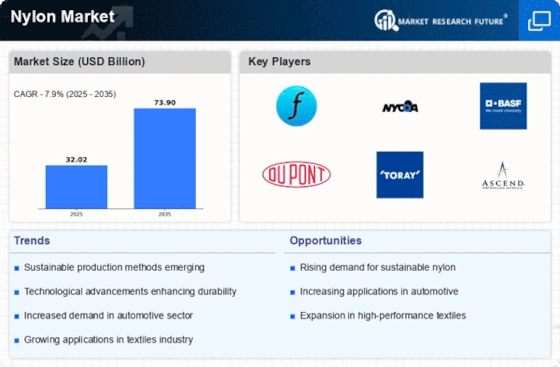
Nylon market Infographic
Purchase Options

Nylon Size

Nylon market Growth Projections and Opportunities

The Nylon market is influenced by various factors that play a crucial role in shaping its dynamics. One of the primary market factors affecting Nylon is the demand-supply scenario. Fluctuations in demand, driven by industries like textiles, automotive, and packaging, directly impact Nylon prices and production levels. For instance, a surge in demand from the automotive sector for lightweight, durable materials can lead to increased production of Nylon. Conversely, a slowdown in the textile industry may result in oversupply and downward pressure on prices.

Nylon has an important role to play as an ingredient in a huge number of engineering products like bearing, oil containers, fuse boxes, bushings, amongst others like cylinder head covers, wire harness connectors, timing belts, and crankcases.

Another significant market factor is raw material availability and prices. Nylon production relies on key raw materials such as adipic acid and hexamethylene diamine. Any disruptions in the supply chain of these materials, such as shortages or price hikes, can ripple through the Nylon market, affecting its cost structure and profitability. Factors like geopolitical tensions, natural disasters, or shifts in global trade policies can all influence raw material prices and availability, thereby impacting the Nylon market.

Technological advancements also play a vital role in shaping the Nylon market. Innovations in manufacturing processes, such as the development of bio-based Nylon or improvements in polymerization techniques, can drive efficiency gains and cost reductions in Nylon production. Additionally, advancements in end-use applications, such as the utilization of Nylon in 3D printing or composite materials, can create new avenues for market growth and expansion.

Market competition is another critical factor affecting the Nylon market. The presence of numerous manufacturers and suppliers competing for market share can lead to price wars and intense rivalry. Factors such as product quality, brand reputation, and customer service become crucial in determining competitive advantage in the Nylon market. Furthermore, the emergence of new players or the consolidation of existing ones through mergers and acquisitions can significantly impact market dynamics.

Regulatory policies and environmental concerns also exert a significant influence on the Nylon market. Environmental regulations regarding emissions, waste disposal, and recycling requirements can affect production processes and operating costs for Nylon manufacturers. Additionally, consumer preferences for sustainable and eco-friendly products are driving the demand for bio-based or recycled Nylon, prompting companies to adapt their strategies to meet these evolving market trends.

Global economic conditions and trade dynamics are external factors that can affect the Nylon market. Economic downturns or recessions can dampen consumer spending and industrial activity, leading to reduced demand for Nylon products. Moreover, fluctuations in currency exchange rates and trade tariffs can impact the cost competitiveness of Nylon manufacturers operating in global markets, influencing their pricing strategies and market positioning.
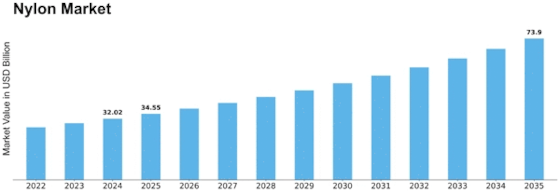
Nylon market Size Graph
Author
Author Profile
Chitranshi Jaiswal
Team Lead - Research

Chitranshi is a Team Leader in the Chemicals & Materials (CnM) and Energy & Power (EnP) domains, with 6+ years of experience in market research. She leads and mentors teams to deliver cross-domain projects that equip clients with actionable insights and growth strategies. She is skilled in market estimation, forecasting, competitive benchmarking, and both primary & secondary research, enabling her to turn complex data into decision-ready insights. An engineer and MBA professional, she combines technical expertise with strategic acumen to solve dynamic market challenges. Chitranshi has successfully managed projects that support market entry, investment planning, and competitive positioning, while building strong client relationships. Certified in Advanced Excel & Power BI she leverages data-driven approaches to ensure accuracy, clarity, and impactful outcomes.

Leave a Comment

FAQs

What is the current valuation of the Nylon Market as of 2024?

<p>The Nylon Market was valued at 32.02 USD Billion in 2024.</p>

What is the projected market valuation for the Nylon Market in 2035?

<p>The Nylon Market is projected to reach 73.9 USD Billion by 2035.</p>

What is the expected CAGR for the Nylon Market during the forecast period 2025 - 2035?

<p>The expected CAGR for the Nylon Market during the forecast period 2025 - 2035 is 7.9%.</p>

Which companies are considered key players in the Nylon Market?

<p>Key players in the Nylon Market include Invista, Nylon Corporation, BASF, DuPont, Toray Industries, Ascend Performance Materials, Nexis Fibers, and Mitsubishi Chemical.</p>

What are the main types of nylon and their market valuations?

<p>In 2024, Nylon 6 was valued at 10.0 USD Billion, Nylon 6,6 at 12.0 USD Billion, Nylon 12 at 5.0 USD Billion, and others at 5.02 USD Billion.</p>

How does the Nylon Market perform in the automotive sector?

<p>The automotive segment of the Nylon Market was valued at 6.5 USD Billion in 2024 and is expected to grow to 15.0 USD Billion by 2035.</p>

What is the market valuation for nylon in the textile application?

<p>The textile application segment was valued at 8.0 USD Billion in 2024 and is projected to reach 18.0 USD Billion by 2035.</p>

What is the expected growth for the electrical and electronics application of nylon?

<p>The electrical and electronics segment was valued at 5.0 USD Billion in 2024 and is anticipated to grow to 12.0 USD Billion by 2035.</p>

What are the projected valuations for nylon in packaging applications?

<p>The packaging segment was valued at 4.0 USD Billion in 2024 and is expected to increase to 9.0 USD Billion by 2035.</p>

How does the nylon market's growth in the sports application compare to other segments?

<p>The sports application segment was valued at 3.0 USD Billion in 2024 and is projected to grow to 7.0 USD Billion by 2035, indicating a steady increase.</p>

Market Summary

As per Market Research Future analysis, the Nylon Market Size was estimated at 38 USD Billion in 2024. The Nylon industry is projected to grow from 40.1 USD Billion in 2025 to 68.5 USD Billion by 2035, exhibiting a compound annual growth rate (CAGR) of 5.50% during the forecast period 2025 - 2035

Key Market Trends & Highlights

The Nylon Market is currently experiencing a dynamic shift driven by sustainability and technological advancements.

  • North America remains the largest market for nylon, driven by robust demand across various industries. Asia-Pacific is emerging as the fastest-growing region, reflecting increasing investments in manufacturing and innovation. Nylon Market 6 continues to dominate the market, while Nylon Market 6,6 is witnessing rapid growth due to its superior properties. Key market drivers include sustainability initiatives and the expansion of the automotive industry, which are shaping future demand.

Market Size & Forecast

2024 Market Size 38(USD Billion)
2035 Market Size 68.5(USD Billion)
CAGR (2025 - 2035) 5.50%
Largest Regional Market Share in 2024 Asia Pacific

Major Players

Invista (US), Nylon Corporation (JP), BASF (DE), DuPont (US), Toray Industries (JP), Ascend Performance Materials (US), Nexis Fibers (US), Mitsubishi Chemical (JP)

Market Trends

The Nylon Market is currently experiencing a dynamic phase characterized by evolving consumer preferences and technological advancements. The expansion of the global nylon market is supported by increasing industrialization and innovation across key end-use sectors. As industries increasingly prioritize sustainability, there is a noticeable shift towards bio-based nylon alternatives. This trend reflects a growing awareness of environmental impacts and a desire for materials that align with eco-friendly practices. Additionally, the demand for high-performance nylon in sectors such as automotive and aerospace is on the rise, driven by the need for lightweight yet durable materials that enhance efficiency and performance. Furthermore, innovations in production processes are likely to improve the quality and reduce the costs associated with nylon manufacturing, potentially expanding its applications across various industries.

In parallel, the Nylon Market is witnessing a surge in demand from the textile sector, where nylon's versatility and strength make it a preferred choice for clothing and accessories. The increasing popularity of activewear and outdoor apparel is further propelling this trend, as consumers seek durable and functional fabrics. The rising demand for reusable and sustainable nylon market bags is also contributing to growth, particularly as governments and consumers shift away from single-use plastics.  Moreover, the integration of smart textiles into nylon products may offer additional opportunities for growth, as technology continues to influence consumer behavior and preferences. Overall, the Nylon Market appears poised for continued expansion, driven by a combination of innovation, sustainability, and changing consumer demands.

Sustainability Initiatives

The Nylon Market is increasingly influenced by sustainability initiatives, with a growing emphasis on eco-friendly materials. Manufacturers are exploring bio-based nylon options to reduce environmental impact, reflecting a shift in consumer preferences towards greener products.

Technological Advancements

Technological advancements in production processes are enhancing the quality and efficiency of nylon manufacturing. Innovations may lead to cost reductions and improved performance characteristics, thereby broadening the material's applications across various sectors.

Rising Demand in Textiles

The textile sector is experiencing heightened demand for nylon, particularly in activewear and outdoor apparel. This trend is driven by consumer preferences for durable, functional fabrics that meet the needs of modern lifestyles.

Nylon market Market Drivers

Rising Demand in Textiles

The Nylon Market is experiencing a surge in demand within the textiles sector, driven by the material's versatility and durability. Nylon Market is favored for its lightweight, strong, and elastic properties, making it an ideal choice for various applications, including apparel, upholstery, and industrial textiles. The Nylon Market is projected to grow at a rate of 5% annually, with nylon playing a crucial role in this expansion. Additionally, the increasing popularity of activewear and athleisure trends is further propelling the demand for nylon fabrics, as consumers seek high-performance materials that offer comfort and functionality. This rising demand is expected to significantly impact the nylon market, potentially leading to a market valuation exceeding 30 billion dollars by 2027.

Automotive Industry Growth

The Nylon Market is significantly influenced by the growth of the automotive sector, where nylon is increasingly utilized in various applications. The material's lightweight nature contributes to fuel efficiency, making it a preferred choice for manufacturers aiming to meet stringent emissions regulations. Nylon Market components are commonly found in interior and exterior parts, such as bumpers, trims, and under-the-hood applications. As the automotive industry shifts towards electric vehicles, the demand for lightweight materials like nylon is expected to rise. Projections indicate that the automotive nylon market could grow at a rate of 7% annually, reflecting the industry's ongoing transformation and the increasing adoption of nylon in vehicle manufacturing.

Sustainability Initiatives

The Nylon Market is increasingly influenced by sustainability initiatives as manufacturers seek to reduce their environmental footprint. The demand for eco-friendly nylon, produced from renewable resources or recycled materials, is on the rise. This shift is driven by consumer preferences for sustainable products, which has led to innovations in production processes. For instance, the introduction of bio-based nylon is gaining traction, appealing to environmentally conscious consumers. As a result, companies are investing in research and development to create sustainable nylon alternatives. This trend is expected to contribute to a compound annual growth rate of approximately 4.5% in the nylon market over the next five years, reflecting a growing commitment to sustainability within the industry.

Technological Advancements

Technological advancements play a pivotal role in shaping the Nylon Market. Innovations in manufacturing processes, such as the development of advanced polymerization techniques, enhance the efficiency and quality of nylon production. These advancements not only reduce production costs but also improve the performance characteristics of nylon products, making them more appealing to various industries. For example, the integration of automation and artificial intelligence in production lines is streamlining operations, leading to increased output and reduced waste. Furthermore, the introduction of smart textiles, which incorporate nylon fibers, is expanding the application scope of nylon in sectors like healthcare and sportswear. This technological evolution is likely to drive market growth, with projections indicating a potential increase in market size by 6% annually.

Consumer Electronics Expansion

The Nylon Market is also benefiting from the expansion of the consumer electronics sector. Nylon Market is utilized in various electronic applications, including cables, connectors, and housings, due to its excellent insulating properties and durability. As the demand for consumer electronics continues to rise, driven by technological advancements and increased connectivity, the need for high-quality nylon components is expected to grow. The consumer electronics market is projected to expand at a rate of 6% annually, which will likely bolster the nylon market as manufacturers seek reliable materials for their products. This trend indicates a promising future for nylon, as it becomes an integral part of the evolving landscape of consumer electronics.

Market Segment Insights

By Type: Nylon 6 (Largest) vs. Nylon 6,6 (Fastest-Growing)

<p>In the Nylon Market, the distribution of share among the segment types shows that Nylon 6 holds the largest share, primarily due to its widespread application in various industries such as automotive, textiles, and consumer goods. Conversely, Nylon 6,6 is gaining traction swiftly and is recognized as the fastest-growing segment. Its superior thermal stability and mechanical properties make it a preferred choice for more specialized applications, driving notable growth in its market presence. The growth trends for these Nylon types indicate an increase in demand, particularly for Nylon 6,6, which is supported by technological advancements and evolving end-user requirements. As industries embrace more sustainable practices, the shift towards high-performance materials showcasing durability and reliability is contributing to Nylon 6,6's rapid expansion. The demand for Nylon 12 and others remains steady but could see an uptick as new applications are explored.</p>

<p>Nylon 6 (Dominant) vs. Nylon 12 (Emerging)</p>

<p>Nylon 6 is a dominant player in the Nylon Market, well-regarded for its versatility and capability to withstand diverse applications ranging from industrial components to consumer textiles. Its established production processes and extensive supply chain contribute to its leadership. On the other hand, Nylon 12 is emerging as a noteworthy alternative, primarily in applications requiring low water absorption and flexibility. Its unique properties appeal to niche markets such as automotive fuel lines and medical devices. While Nylon 6 benefits from being the mainstream choice, innovative strategies and applications could enhance Nylon 12's market position, indicating a potential shift in consumer preferences.</p>

By Application: Automotive (Largest) vs. Electrical & Electronics (Fastest-Growing)

In the Nylon Market, the Application segment is characterized by several key areas, with Automotive leading in market share due to the extensive use of nylon in various automotive components for its strength and durability. Following closely are sectors like Electrical &amp; Electronics, and <a href="https://www.marketresearchfuture.com/reports/packaging-market-10902">Packaging</a>, which leverage nylon's lightweight and insulating properties. Textile and Sports applications also contribute significantly, although they represent a smaller share compared to the automotive domain.

Automotive (Dominant) vs. Electrical &amp; Electronics (Emerging)

The Automotive application represents a dominant segment in the Nylon Market, driven by the material's high performance in producing fuel-efficient and safety-related components such as airbags, belts, and under-the-hood parts. Its mechanical strength, resistance to wear, and ability to withstand harsh environments make it a material of choice in the sector. On the other hand, the Electrical &amp; Electronics application is emerging rapidly, primarily due to the increasing demand for lightweight materials in gadgets and devices. Nylon Market's excellent electrical insulation properties and thermal stability are leading to its soaring use in connector housings, circuit boards, and other electronic components, making it an attractive option in this tech-driven era.

Get more detailed insights about Nylon Market Research Report – Forecast Till 2035

Regional Insights

The Nylon Market exhibits a diverse regional presence, with significant valuations anticipated across key areas in the coming years. In 2024, the North American market is valued at 8.5 USD Billion, demonstrating a robust demand driven by automotive and consumer goods industries, while Europe leads with a valuation of 9.0 USD Billion, bolstered by strong textile and engineering sectors.

The Asia Pacific region shows great potential, being the largest market at 10.0 USD Billion in 2024, attributed to rapid industrialization and urbanization.South America accounts for 2.5 USD Billion, supported by the growth in packaging and construction sectors, while the Middle East and Africa, valued at 1.02 USD Billion, remains a developing market with opportunities in manufacturing and infrastructure projects.

The Nylon Market segmentation clearly highlights these regions' roles, where the Asia Pacific region dominates due to its majority holding, appealing growth rates, and substantial industrial base, positioning it as a crucial area for market growth and investment in the next decade.

India's nylon market is witnessing steady growth due to increasing demand from the automotive and textile industries. With rising urbanization and industrial expansion, the nylon market in India is expected to see significant investments and technological advancements.

Key Players and Competitive Insights

The Nylon Market is characterized by a rapidly evolving competitive landscape driven by technological advancements, shifting consumer demands, and an increasing focus on sustainability. Major players in the market are competing not only on price and quality but also on innovation and environmentally-friendly practices. The industry is witnessing heightened competition as companies strive to develop high-performance nylon products that meet diverse applications across various sectors such as automotive, textiles, electronics, and consumer goods.Additionally, the entry of new players and the expansion efforts of existing players into emerging markets are intensifying competition, leading to strategic collaborations, mergers, acquisitions, and a sustained emphasis on research and development. As the market adapts to these dynamics, understanding the competitive positioning of key players becomes crucial for stakeholders looking to navigate this complex environment effectively.AdvanSix has established itself as a significant entity in the Nylon Market, harnessing its strengths to carve out a niche for itself.The company is recognized for its vertical integration, which allows for control over the supply chain, from raw materials to finished products. This integration not only enhances cost-efficiency but also enables AdvanSix to maintain quality consistency throughout its production processes. The company’s innovations in nylon production techniques have also bolstered its reputation, allowing it to cater to a diverse array of clients across industries. Furthermore, AdvanSix's commitment to sustainability initiatives aligns its operations with trends, making it more competitive in attracting environmentally conscious consumers and partners.The company’s strong presence in North America, coupled with strategic investments in expanding its reach, emphasizes its growth trajectory and the robustness of its market position.DuPont is a globally acknowledged leader in the nylon market, renowned for its pioneering contributions to the development of nylon and its ongoing innovation in advanced polymer solutions. DuPont has consistently produced high-performance nylon products that are utilized in the automotive, electronics, industrial, and consumer goods sectors, leveraging decades of expertise.The company's nylon products, such as Zytel® and Crastin®, are designed to withstand heat, exhibit mechanical strength, and be durable, rendering them suitable for high-stress applications. DuPont's dedication to sustainability is demonstrated by its initiatives to develop polyamide materials that are both bio-based and recycled, which are consistent with environmental objectives. DuPont maintains its position as a leader in nylon innovation by investing continuously in research and development and fostering strong partnerships with OEMs. This has enabled the company to shape the market with high-quality, application-specific engineered materials.

Key Companies in the Nylon market include

Industry Developments

  • Q2 2024: China's nylon-6 resin capacity rises to 600,000 mt/year in H2 2024, resulting in oversupply Chinese producers expanded nylon-6 resin capacity in the second half of 2024, leading to market oversupply and impacting price dynamics as textile and apparel makers ramp up production ahead of Lunar New Year.

Future Outlook

Nylon market Future Outlook

The Nylon Market is projected to grow at a 5.50% CAGR from 2025 to 2035, driven by increasing demand in automotive, textiles, and electronics sectors.

New opportunities lie in:

  • <p>Expansion into bio-based nylon production for sustainability initiatives.</p>
  • <p> </p>
  • <p>Development of high-performance nylon composites for aerospace applications.</p>
  • <p>Investment in advanced recycling technologies to enhance circular economy practices.</p>

By 2035, the Nylon Market is expected to achieve robust growth, driven by innovation and sustainability.

Market Segmentation

Nylon market Type Outlook

  • Nylon 6
  • Nylon 6
  • 6
  • Nylon 12
  • Others

Nylon market Application Outlook

  • Automotive
  • Electrical & Electronics
  • Packaging
  • Textile
  • Sports
  • Others

Report Scope

MARKET SIZE 2024 38(USD Billion)
MARKET SIZE 2025 40.1(USD Billion)
MARKET SIZE 2035 68.5(USD Billion)
COMPOUND ANNUAL GROWTH RATE (CAGR) 5.50% (2025 - 2035)
REPORT COVERAGE Revenue Forecast, Competitive Landscape, Growth Factors, and Trends
BASE YEAR 2024
Market Forecast Period 2025 - 2035
Historical Data 2019 - 2024
Market Forecast Units USD Billion
Key Companies Profiled Invista (US), Nylon Corporation (JP), BASF (DE), DuPont (US), Toray Industries (JP), Ascend Performance Materials (US), Nexis Fibers (US), Mitsubishi Chemical (JP)
Segments Covered Type, Application, Regional : Global Opportunity Analysis and Industry Forecast, 2025 - 2035
Key Market Opportunities Growing demand for sustainable nylon alternatives presents opportunities in the Nylon Market.
Key Market Dynamics Rising demand for sustainable materials drives innovation and competition in the nylon market.
Countries Covered North America, Europe, APAC, South America, MEA

FAQs

What is the current valuation of the Nylon Market as of 2024?

<p>The Nylon Market was valued at 32.02 USD Billion in 2024.</p>

What is the projected market valuation for the Nylon Market in 2035?

<p>The Nylon Market is projected to reach 73.9 USD Billion by 2035.</p>

What is the expected CAGR for the Nylon Market during the forecast period 2025 - 2035?

<p>The expected CAGR for the Nylon Market during the forecast period 2025 - 2035 is 7.9%.</p>

Which companies are considered key players in the Nylon Market?

<p>Key players in the Nylon Market include Invista, Nylon Corporation, BASF, DuPont, Toray Industries, Ascend Performance Materials, Nexis Fibers, and Mitsubishi Chemical.</p>

What are the main types of nylon and their market valuations?

<p>In 2024, Nylon 6 was valued at 10.0 USD Billion, Nylon 6,6 at 12.0 USD Billion, Nylon 12 at 5.0 USD Billion, and others at 5.02 USD Billion.</p>

How does the Nylon Market perform in the automotive sector?

<p>The automotive segment of the Nylon Market was valued at 6.5 USD Billion in 2024 and is expected to grow to 15.0 USD Billion by 2035.</p>

What is the market valuation for nylon in the textile application?

<p>The textile application segment was valued at 8.0 USD Billion in 2024 and is projected to reach 18.0 USD Billion by 2035.</p>

What is the expected growth for the electrical and electronics application of nylon?

<p>The electrical and electronics segment was valued at 5.0 USD Billion in 2024 and is anticipated to grow to 12.0 USD Billion by 2035.</p>

What are the projected valuations for nylon in packaging applications?

<p>The packaging segment was valued at 4.0 USD Billion in 2024 and is expected to increase to 9.0 USD Billion by 2035.</p>

How does the nylon market's growth in the sports application compare to other segments?

<p>The sports application segment was valued at 3.0 USD Billion in 2024 and is projected to grow to 7.0 USD Billion by 2035, indicating a steady increase.</p>

  1. SECTION I: EXECUTIVE SUMMARY AND KEY HIGHLIGHTS
    1. | 1.1 EXECUTIVE SUMMARY
    2. | | 1.1.1 Market Overview
    3. | | 1.1.2 Key Findings
    4. | | 1.1.3 Market Segmentation
    5. | | 1.1.4 Competitive Landscape
    6. | | 1.1.5 Challenges and Opportunities
    7. | | 1.1.6 Future Outlook
  2. SECTION II: SCOPING, METHODOLOGY AND MARKET STRUCTURE
    1. | 2.1 MARKET INTRODUCTION
    2. | | 2.1.1 Definition
    3. | | 2.1.2 Scope of the study
    4. | | | 2.1.2.1 Research Objective
    5. | | | 2.1.2.2 Assumption
    6. | | | 2.1.2.3 Limitations
    7. | 2.2 RESEARCH METHODOLOGY
    8. | | 2.2.1 Overview
    9. | | 2.2.2 Data Mining
    10. | | 2.2.3 Secondary Research
    11. | | 2.2.4 Primary Research
    12. | | | 2.2.4.1 Primary Interviews and Information Gathering Process
    13. | | | 2.2.4.2 Breakdown of Primary Respondents
    14. | | 2.2.5 Forecasting Model
    15. | | 2.2.6 Market Size Estimation
    16. | | | 2.2.6.1 Bottom-Up Approach
    17. | | | 2.2.6.2 Top-Down Approach
    18. | | 2.2.7 Data Triangulation
    19. | | 2.2.8 Validation
  3. SECTION III: QUALITATIVE ANALYSIS
    1. | 3.1 MARKET DYNAMICS
    2. | | 3.1.1 Overview
    3. | | 3.1.2 Drivers
    4. | | 3.1.3 Restraints
    5. | | 3.1.4 Opportunities
    6. | 3.2 MARKET FACTOR ANALYSIS
    7. | | 3.2.1 Value chain Analysis
    8. | | 3.2.2 Porter's Five Forces Analysis
    9. | | | 3.2.2.1 Bargaining Power of Suppliers
    10. | | | 3.2.2.2 Bargaining Power of Buyers
    11. | | | 3.2.2.3 Threat of New Entrants
    12. | | | 3.2.2.4 Threat of Substitutes
    13. | | | 3.2.2.5 Intensity of Rivalry
    14. | | 3.2.3 COVID-19 Impact Analysis
    15. | | | 3.2.3.1 Market Impact Analysis
    16. | | | 3.2.3.2 Regional Impact
    17. | | | 3.2.3.3 Opportunity and Threat Analysis
  4. SECTION IV: QUANTITATIVE ANALYSIS
    1. | 4.1 Chemicals and Materials, BY Type (USD Billion)
    2. | | 4.1.1 Nylon 6
    3. | | 4.1.2 Nylon 6,6
    4. | | 4.1.3 Nylon 12
    5. | | 4.1.4 Others
    6. | 4.2 Chemicals and Materials, BY Application (USD Billion)
    7. | | 4.2.1 Automotive
    8. | | 4.2.2 Electrical & Electronics
    9. | | 4.2.3 Packaging
    10. | | 4.2.4 Textile
    11. | | 4.2.5 Sports
    12. | | 4.2.6 Others
    13. | 4.3 Chemicals and Materials, BY Region (USD Billion)
    14. | | 4.3.1 North America
    15. | | | 4.3.1.1 US
    16. | | | 4.3.1.2 Canada
    17. | | 4.3.2 Europe
    18. | | | 4.3.2.1 Germany
    19. | | | 4.3.2.2 UK
    20. | | | 4.3.2.3 France
    21. | | | 4.3.2.4 Russia
    22. | | | 4.3.2.5 Italy
    23. | | | 4.3.2.6 Spain
    24. | | | 4.3.2.7 Rest of Europe
    25. | | 4.3.3 APAC
    26. | | | 4.3.3.1 China
    27. | | | 4.3.3.2 India
    28. | | | 4.3.3.3 Japan
    29. | | | 4.3.3.4 South Korea
    30. | | | 4.3.3.5 Malaysia
    31. | | | 4.3.3.6 Thailand
    32. | | | 4.3.3.7 Indonesia
    33. | | | 4.3.3.8 Rest of APAC
    34. | | 4.3.4 South America
    35. | | | 4.3.4.1 Brazil
    36. | | | 4.3.4.2 Mexico
    37. | | | 4.3.4.3 Argentina
    38. | | | 4.3.4.4 Rest of South America
    39. | | 4.3.5 MEA
    40. | | | 4.3.5.1 GCC Countries
    41. | | | 4.3.5.2 South Africa
    42. | | | 4.3.5.3 Rest of MEA
  5. SECTION V: COMPETITIVE ANALYSIS
    1. | 5.1 Competitive Landscape
    2. | | 5.1.1 Overview
    3. | | 5.1.2 Competitive Analysis
    4. | | 5.1.3 Market share Analysis
    5. | | 5.1.4 Major Growth Strategy in the Chemicals and Materials
    6. | | 5.1.5 Competitive Benchmarking
    7. | | 5.1.6 Leading Players in Terms of Number of Developments in the Chemicals and Materials
    8. | | 5.1.7 Key developments and growth strategies
    9. | | | 5.1.7.1 New Product Launch/Service Deployment
    10. | | | 5.1.7.2 Merger & Acquisitions
    11. | | | 5.1.7.3 Joint Ventures
    12. | | 5.1.8 Major Players Financial Matrix
    13. | | | 5.1.8.1 Sales and Operating Income
    14. | | | 5.1.8.2 Major Players R&D Expenditure. 2023
    15. | 5.2 Company Profiles
    16. | | 5.2.1 Invista (US)
    17. | | | 5.2.1.1 Financial Overview
    18. | | | 5.2.1.2 Products Offered
    19. | | | 5.2.1.3 Key Developments
    20. | | | 5.2.1.4 SWOT Analysis
    21. | | | 5.2.1.5 Key Strategies
    22. | | 5.2.2 Nylon Corporation (JP)
    23. | | | 5.2.2.1 Financial Overview
    24. | | | 5.2.2.2 Products Offered
    25. | | | 5.2.2.3 Key Developments
    26. | | | 5.2.2.4 SWOT Analysis
    27. | | | 5.2.2.5 Key Strategies
    28. | | 5.2.3 BASF (DE)
    29. | | | 5.2.3.1 Financial Overview
    30. | | | 5.2.3.2 Products Offered
    31. | | | 5.2.3.3 Key Developments
    32. | | | 5.2.3.4 SWOT Analysis
    33. | | | 5.2.3.5 Key Strategies
    34. | | 5.2.4 DuPont (US)
    35. | | | 5.2.4.1 Financial Overview
    36. | | | 5.2.4.2 Products Offered
    37. | | | 5.2.4.3 Key Developments
    38. | | | 5.2.4.4 SWOT Analysis
    39. | | | 5.2.4.5 Key Strategies
    40. | | 5.2.5 Toray Industries (JP)
    41. | | | 5.2.5.1 Financial Overview
    42. | | | 5.2.5.2 Products Offered
    43. | | | 5.2.5.3 Key Developments
    44. | | | 5.2.5.4 SWOT Analysis
    45. | | | 5.2.5.5 Key Strategies
    46. | | 5.2.6 Ascend Performance Materials (US)
    47. | | | 5.2.6.1 Financial Overview
    48. | | | 5.2.6.2 Products Offered
    49. | | | 5.2.6.3 Key Developments
    50. | | | 5.2.6.4 SWOT Analysis
    51. | | | 5.2.6.5 Key Strategies
    52. | | 5.2.7 Nexis Fibers (US)
    53. | | | 5.2.7.1 Financial Overview
    54. | | | 5.2.7.2 Products Offered
    55. | | | 5.2.7.3 Key Developments
    56. | | | 5.2.7.4 SWOT Analysis
    57. | | | 5.2.7.5 Key Strategies
    58. | | 5.2.8 Mitsubishi Chemical (JP)
    59. | | | 5.2.8.1 Financial Overview
    60. | | | 5.2.8.2 Products Offered
    61. | | | 5.2.8.3 Key Developments
    62. | | | 5.2.8.4 SWOT Analysis
    63. | | | 5.2.8.5 Key Strategies
    64. | 5.3 Appendix
    65. | | 5.3.1 References
    66. | | 5.3.2 Related Reports
  6. LIST OF FIGURES
    1. | 6.1 MARKET SYNOPSIS
    2. | 6.2 NORTH AMERICA MARKET ANALYSIS
    3. | 6.3 US MARKET ANALYSIS BY TYPE
    4. | 6.4 US MARKET ANALYSIS BY APPLICATION
    5. | 6.5 CANADA MARKET ANALYSIS BY TYPE
    6. | 6.6 CANADA MARKET ANALYSIS BY APPLICATION
    7. | 6.7 EUROPE MARKET ANALYSIS
    8. | 6.8 GERMANY MARKET ANALYSIS BY TYPE
    9. | 6.9 GERMANY MARKET ANALYSIS BY APPLICATION
    10. | 6.10 UK MARKET ANALYSIS BY TYPE
    11. | 6.11 UK MARKET ANALYSIS BY APPLICATION
    12. | 6.12 FRANCE MARKET ANALYSIS BY TYPE
    13. | 6.13 FRANCE MARKET ANALYSIS BY APPLICATION
    14. | 6.14 RUSSIA MARKET ANALYSIS BY TYPE
    15. | 6.15 RUSSIA MARKET ANALYSIS BY APPLICATION
    16. | 6.16 ITALY MARKET ANALYSIS BY TYPE
    17. | 6.17 ITALY MARKET ANALYSIS BY APPLICATION
    18. | 6.18 SPAIN MARKET ANALYSIS BY TYPE
    19. | 6.19 SPAIN MARKET ANALYSIS BY APPLICATION
    20. | 6.20 REST OF EUROPE MARKET ANALYSIS BY TYPE
    21. | 6.21 REST OF EUROPE MARKET ANALYSIS BY APPLICATION
    22. | 6.22 APAC MARKET ANALYSIS
    23. | 6.23 CHINA MARKET ANALYSIS BY TYPE
    24. | 6.24 CHINA MARKET ANALYSIS BY APPLICATION
    25. | 6.25 INDIA MARKET ANALYSIS BY TYPE
    26. | 6.26 INDIA MARKET ANALYSIS BY APPLICATION
    27. | 6.27 JAPAN MARKET ANALYSIS BY TYPE
    28. | 6.28 JAPAN MARKET ANALYSIS BY APPLICATION
    29. | 6.29 SOUTH KOREA MARKET ANALYSIS BY TYPE
    30. | 6.30 SOUTH KOREA MARKET ANALYSIS BY APPLICATION
    31. | 6.31 MALAYSIA MARKET ANALYSIS BY TYPE
    32. | 6.32 MALAYSIA MARKET ANALYSIS BY APPLICATION
    33. | 6.33 THAILAND MARKET ANALYSIS BY TYPE
    34. | 6.34 THAILAND MARKET ANALYSIS BY APPLICATION
    35. | 6.35 INDONESIA MARKET ANALYSIS BY TYPE
    36. | 6.36 INDONESIA MARKET ANALYSIS BY APPLICATION
    37. | 6.37 REST OF APAC MARKET ANALYSIS BY TYPE
    38. | 6.38 REST OF APAC MARKET ANALYSIS BY APPLICATION
    39. | 6.39 SOUTH AMERICA MARKET ANALYSIS
    40. | 6.40 BRAZIL MARKET ANALYSIS BY TYPE
    41. | 6.41 BRAZIL MARKET ANALYSIS BY APPLICATION
    42. | 6.42 MEXICO MARKET ANALYSIS BY TYPE
    43. | 6.43 MEXICO MARKET ANALYSIS BY APPLICATION
    44. | 6.44 ARGENTINA MARKET ANALYSIS BY TYPE
    45. | 6.45 ARGENTINA MARKET ANALYSIS BY APPLICATION
    46. | 6.46 REST OF SOUTH AMERICA MARKET ANALYSIS BY TYPE
    47. | 6.47 REST OF SOUTH AMERICA MARKET ANALYSIS BY APPLICATION
    48. | 6.48 MEA MARKET ANALYSIS
    49. | 6.49 GCC COUNTRIES MARKET ANALYSIS BY TYPE
    50. | 6.50 GCC COUNTRIES MARKET ANALYSIS BY APPLICATION
    51. | 6.51 SOUTH AFRICA MARKET ANALYSIS BY TYPE
    52. | 6.52 SOUTH AFRICA MARKET ANALYSIS BY APPLICATION
    53. | 6.53 REST OF MEA MARKET ANALYSIS BY TYPE
    54. | 6.54 REST OF MEA MARKET ANALYSIS BY APPLICATION
    55. | 6.55 KEY BUYING CRITERIA OF CHEMICALS AND MATERIALS
    56. | 6.56 RESEARCH PROCESS OF MRFR
    57. | 6.57 DRO ANALYSIS OF CHEMICALS AND MATERIALS
    58. | 6.58 DRIVERS IMPACT ANALYSIS: CHEMICALS AND MATERIALS
    59. | 6.59 RESTRAINTS IMPACT ANALYSIS: CHEMICALS AND MATERIALS
    60. | 6.60 SUPPLY / VALUE CHAIN: CHEMICALS AND MATERIALS
    61. | 6.61 CHEMICALS AND MATERIALS, BY TYPE, 2024 (% SHARE)
    62. | 6.62 CHEMICALS AND MATERIALS, BY TYPE, 2024 TO 2035 (USD Billion)
    63. | 6.63 CHEMICALS AND MATERIALS, BY APPLICATION, 2024 (% SHARE)
    64. | 6.64 CHEMICALS AND MATERIALS, BY APPLICATION, 2024 TO 2035 (USD Billion)
    65. | 6.65 BENCHMARKING OF MAJOR COMPETITORS
  7. LIST OF TABLES
    1. | 7.1 LIST OF ASSUMPTIONS
    2. | | 7.1.1
    3. | 7.2 North America MARKET SIZE ESTIMATES; FORECAST
    4. | | 7.2.1 BY TYPE, 2025-2035 (USD Billion)
    5. | | 7.2.2 BY APPLICATION, 2025-2035 (USD Billion)
    6. | 7.3 US MARKET SIZE ESTIMATES; FORECAST
    7. | | 7.3.1 BY TYPE, 2025-2035 (USD Billion)
    8. | | 7.3.2 BY APPLICATION, 2025-2035 (USD Billion)
    9. | 7.4 Canada MARKET SIZE ESTIMATES; FORECAST
    10. | | 7.4.1 BY TYPE, 2025-2035 (USD Billion)
    11. | | 7.4.2 BY APPLICATION, 2025-2035 (USD Billion)
    12. | 7.5 Europe MARKET SIZE ESTIMATES; FORECAST
    13. | | 7.5.1 BY TYPE, 2025-2035 (USD Billion)
    14. | | 7.5.2 BY APPLICATION, 2025-2035 (USD Billion)
    15. | 7.6 Germany MARKET SIZE ESTIMATES; FORECAST
    16. | | 7.6.1 BY TYPE, 2025-2035 (USD Billion)
    17. | | 7.6.2 BY APPLICATION, 2025-2035 (USD Billion)
    18. | 7.7 UK MARKET SIZE ESTIMATES; FORECAST
    19. | | 7.7.1 BY TYPE, 2025-2035 (USD Billion)
    20. | | 7.7.2 BY APPLICATION, 2025-2035 (USD Billion)
    21. | 7.8 France MARKET SIZE ESTIMATES; FORECAST
    22. | | 7.8.1 BY TYPE, 2025-2035 (USD Billion)
    23. | | 7.8.2 BY APPLICATION, 2025-2035 (USD Billion)
    24. | 7.9 Russia MARKET SIZE ESTIMATES; FORECAST
    25. | | 7.9.1 BY TYPE, 2025-2035 (USD Billion)
    26. | | 7.9.2 BY APPLICATION, 2025-2035 (USD Billion)
    27. | 7.10 Italy MARKET SIZE ESTIMATES; FORECAST
    28. | | 7.10.1 BY TYPE, 2025-2035 (USD Billion)
    29. | | 7.10.2 BY APPLICATION, 2025-2035 (USD Billion)
    30. | 7.11 Spain MARKET SIZE ESTIMATES; FORECAST
    31. | | 7.11.1 BY TYPE, 2025-2035 (USD Billion)
    32. | | 7.11.2 BY APPLICATION, 2025-2035 (USD Billion)
    33. | 7.12 Rest of Europe MARKET SIZE ESTIMATES; FORECAST
    34. | | 7.12.1 BY TYPE, 2025-2035 (USD Billion)
    35. | | 7.12.2 BY APPLICATION, 2025-2035 (USD Billion)
    36. | 7.13 APAC MARKET SIZE ESTIMATES; FORECAST
    37. | | 7.13.1 BY TYPE, 2025-2035 (USD Billion)
    38. | | 7.13.2 BY APPLICATION, 2025-2035 (USD Billion)
    39. | 7.14 China MARKET SIZE ESTIMATES; FORECAST
    40. | | 7.14.1 BY TYPE, 2025-2035 (USD Billion)
    41. | | 7.14.2 BY APPLICATION, 2025-2035 (USD Billion)
    42. | 7.15 India MARKET SIZE ESTIMATES; FORECAST
    43. | | 7.15.1 BY TYPE, 2025-2035 (USD Billion)
    44. | | 7.15.2 BY APPLICATION, 2025-2035 (USD Billion)
    45. | 7.16 Japan MARKET SIZE ESTIMATES; FORECAST
    46. | | 7.16.1 BY TYPE, 2025-2035 (USD Billion)
    47. | | 7.16.2 BY APPLICATION, 2025-2035 (USD Billion)
    48. | 7.17 South Korea MARKET SIZE ESTIMATES; FORECAST
    49. | | 7.17.1 BY TYPE, 2025-2035 (USD Billion)
    50. | | 7.17.2 BY APPLICATION, 2025-2035 (USD Billion)
    51. | 7.18 Malaysia MARKET SIZE ESTIMATES; FORECAST
    52. | | 7.18.1 BY TYPE, 2025-2035 (USD Billion)
    53. | | 7.18.2 BY APPLICATION, 2025-2035 (USD Billion)
    54. | 7.19 Thailand MARKET SIZE ESTIMATES; FORECAST
    55. | | 7.19.1 BY TYPE, 2025-2035 (USD Billion)
    56. | | 7.19.2 BY APPLICATION, 2025-2035 (USD Billion)
    57. | 7.20 Indonesia MARKET SIZE ESTIMATES; FORECAST
    58. | | 7.20.1 BY TYPE, 2025-2035 (USD Billion)
    59. | | 7.20.2 BY APPLICATION, 2025-2035 (USD Billion)
    60. | 7.21 Rest of APAC MARKET SIZE ESTIMATES; FORECAST
    61. | | 7.21.1 BY TYPE, 2025-2035 (USD Billion)
    62. | | 7.21.2 BY APPLICATION, 2025-2035 (USD Billion)
    63. | 7.22 South America MARKET SIZE ESTIMATES; FORECAST
    64. | | 7.22.1 BY TYPE, 2025-2035 (USD Billion)
    65. | | 7.22.2 BY APPLICATION, 2025-2035 (USD Billion)
    66. | 7.23 Brazil MARKET SIZE ESTIMATES; FORECAST
    67. | | 7.23.1 BY TYPE, 2025-2035 (USD Billion)
    68. | | 7.23.2 BY APPLICATION, 2025-2035 (USD Billion)
    69. | 7.24 Mexico MARKET SIZE ESTIMATES; FORECAST
    70. | | 7.24.1 BY TYPE, 2025-2035 (USD Billion)
    71. | | 7.24.2 BY APPLICATION, 2025-2035 (USD Billion)
    72. | 7.25 Argentina MARKET SIZE ESTIMATES; FORECAST
    73. | | 7.25.1 BY TYPE, 2025-2035 (USD Billion)
    74. | | 7.25.2 BY APPLICATION, 2025-2035 (USD Billion)
    75. | 7.26 Rest of South America MARKET SIZE ESTIMATES; FORECAST
    76. | | 7.26.1 BY TYPE, 2025-2035 (USD Billion)
    77. | | 7.26.2 BY APPLICATION, 2025-2035 (USD Billion)
    78. | 7.27 MEA MARKET SIZE ESTIMATES; FORECAST
    79. | | 7.27.1 BY TYPE, 2025-2035 (USD Billion)
    80. | | 7.27.2 BY APPLICATION, 2025-2035 (USD Billion)
    81. | 7.28 GCC Countries MARKET SIZE ESTIMATES; FORECAST
    82. | | 7.28.1 BY TYPE, 2025-2035 (USD Billion)
    83. | | 7.28.2 BY APPLICATION, 2025-2035 (USD Billion)
    84. | 7.29 South Africa MARKET SIZE ESTIMATES; FORECAST
    85. | | 7.29.1 BY TYPE, 2025-2035 (USD Billion)
    86. | | 7.29.2 BY APPLICATION, 2025-2035 (USD Billion)
    87. | 7.30 Rest of MEA MARKET SIZE ESTIMATES; FORECAST
    88. | | 7.30.1 BY TYPE, 2025-2035 (USD Billion)
    89. | | 7.30.2 BY APPLICATION, 2025-2035 (USD Billion)
    90. | 7.31 PRODUCT LAUNCH/PRODUCT DEVELOPMENT/APPROVAL
    91. | | 7.31.1
    92. | 7.32 ACQUISITION/PARTNERSHIP
    93. | | 7.32.1

Chemicals and Materials Market Segmentation

Chemicals and Materials By Type (USD Billion, 2025-2035)

  • Nylon 6
  • Nylon 6,6
  • Nylon 12
  • Others

Chemicals and Materials By Application (USD Billion, 2025-2035)

  • Automotive
  • Electrical & Electronics
  • Packaging
  • Textile
  • Sports
  • Others
Infographic

Free Sample Request

Kindly complete the form below to receive a free sample of this Report

Get Free Sample

Customer Strories

Compare Licence

×
Features License Type
Single User Multiuser License Enterprise User
Price $4,950 $5,950 $7,250
Maximum User Access Limit 1 User Upto 10 Users Unrestricted Access Throughout the Organization
Free Customization
Direct Access to Analyst
Deliverable Format
Platform Access
Discount on Next Purchase 10% 15% 15%
Printable Versions