Request Free Sample ×

Kindly complete the form below to receive a free sample of this Report

* Please use a valid business email

Leading companies partner with us for data-driven Insights

clients tt-cursor
Hero Background
English
Chinese
French
Japanese
Korean
German
Spanish

North America Textile Coatings Market Trends

ID: MRFR/CnM/10922-HCR
111 Pages
Chitranshi Jaiswal
Last Updated: April 06, 2026

North America Textile Coatings Market Research Report Information By Type (Thermosets Cellulosic, Natural Rubber, Polyvinyl Chloride, Thermoplastics, Acrylics, and Polyurethane), By End-User (Building & Construction Industry, Transportation, Agriculture, Automotive, Industrial, and Fabric Filters), By Technology (Traditional, Advanced, Magnetron Sputtering, and Plasma Coating) –and North America Market Forecast Till 2035.

Share:
Download PDF ×

We do not share your information with anyone. However, we may send you emails based on your report interest from time to time. You may contact us at any time to opt-out.

North America Textile Coatings Market Infographic
Purchase Options

Market Trends

Key Emerging Trends in the North America Textile Coatings Market

Technology, sustainability, and customer preferences are driving trends in the North America Textile Coatings Market. This market is trending toward functional and performance textile coatings. Manufacturers are creating coatings that improve textile durability, usefulness, and protection as customers want textiles with water resistance, flame retardancy, and antimicrobial qualities. This trend follows the rise of performance-driven textiles in fashion, home textiles, and industrial applications.

The North America Textile Coatings Market emphasizes sustainability due to environmental awareness and the necessity for eco-friendly solutions. Textile coating manufacturers are using water-based coatings and bio-based polymers to lessen their environmental effect. Coatings that prolong textile life are also becoming more popular, encouraging circular and ethical consumption. Consumers that value sustainability have driven the development of eco-friendly textile coatings.

Digital printing is affecting the North American Textile Coatings Market by allowing elaborate and customizable patterns on coated fabrics. Digital printing helps producers to make visually attractive and individualized textiles by printing high-resolution and multicolor onto coated materials. Consumers want customized and attractive coated materials, therefore this trend matches textile industry need for personalization and distinctive patterns.

Smart textile coatings, which include technology for usefulness, are becoming popular. Conductive coatings with sensors for monitoring and response characteristics for diverse applications are becoming popular. These smart coatings are used in sports and fitness, healthcare, and industrial applications to create intelligent fabrics that adapt to changing environmental circumstances and human demands.

Waterproof and water-repellent coatings are growing in the North America Textile Coatings Market to meet the need for water-resistant, breathable fabrics. Outdoor gear, athletics, and performance fabrics employ these coatings to protect against rain and moisture while providing comfort. Popular waterproof coatings reflect the trend toward utilitarian and adaptable fabrics for active lives.

These coatings protect fabrics against microbial contamination by inhibiting bacteria and virus development. As consumers prioritize cleanliness and infection prevention, medical textiles, PPE, and household textiles have seen increased demand for antimicrobial coatings.

North American textile coating producers and fashion designers are collaborating more to create innovative coated fabrics. Collaborations provide unique textile coatings with usefulness, aesthetics, and sustainability. Manufacturers and fashion companies collaborate to keep ahead of market trends and provide consumers unique coated textile goods.

Author
Author Profile
Chitranshi Jaiswal
Team Lead - Research

Chitranshi is a Team Leader in the Chemicals & Materials (CnM) and Energy & Power (EnP) domains, with 6+ years of experience in market research. She leads and mentors teams to deliver cross-domain projects that equip clients with actionable insights and growth strategies. She is skilled in market estimation, forecasting, competitive benchmarking, and both primary & secondary research, enabling her to turn complex data into decision-ready insights. An engineer and MBA professional, she combines technical expertise with strategic acumen to solve dynamic market challenges. Chitranshi has successfully managed projects that support market entry, investment planning, and competitive positioning, while building strong client relationships. Certified in Advanced Excel & Power BI she leverages data-driven approaches to ensure accuracy, clarity, and impactful outcomes.

Leave a Comment

FAQs

What is the projected market valuation for the North America textile coatings market in 2035?

<p>The projected market valuation for the North America textile coatings market in 2035 is $3333.62 Billion.</p>

What was the overall market valuation for the North America textile coatings market in 2024?

<p>The overall market valuation for the North America textile coatings market in 2024 was $1963.03 Billion.</p>

What is the expected CAGR for the North America textile coatings market during the forecast period 2025 - 2035?

<p>The expected CAGR for the North America textile coatings market during the forecast period 2025 - 2035 is 4.93%.</p>

Which segment had the highest valuation in the North America textile coatings market in 2024?

<p>In 2024, the segment with the highest valuation was Fluoropolymer Coatings, valued at $763.03 Billion.</p>

What are the key players in the North America textile coatings market?

<p>Key players in the North America textile coatings market include BASF SE, The Dow Chemical Company, and Huntsman Corporation.</p>

What is the valuation range for Water-Based Coatings in the North America textile coatings market?

<p>The valuation range for Water-Based Coatings in the North America textile coatings market is $600.0 Billion to $1000.0 Billion.</p>

How does the valuation of Sportswear compare to that of Protective Clothing in 2024?

<p>In 2024, Sportswear was valued between $463.03 Billion and $833.62 Billion, while Protective Clothing was valued between $350.0 Billion and $600.0 Billion.</p>

What is the valuation range for Bio-Based Coatings in the North America textile coatings market?

<p>The valuation range for Bio-Based Coatings in the North America textile coatings market is $563.03 Billion to $1133.62 Billion.</p>

Which end-use segment is projected to have the highest valuation by 2035?

<p>By 2035, the Technical Textiles end-use segment is projected to have the highest valuation, estimated between $863.03 Billion and $1533.62 Billion.</p>

What is the valuation range for Industrial Textiles in the North America textile coatings market?

<p>The valuation range for Industrial Textiles in the North America textile coatings market is $400.0 Billion to $650.0 Billion.</p>

Market Summary

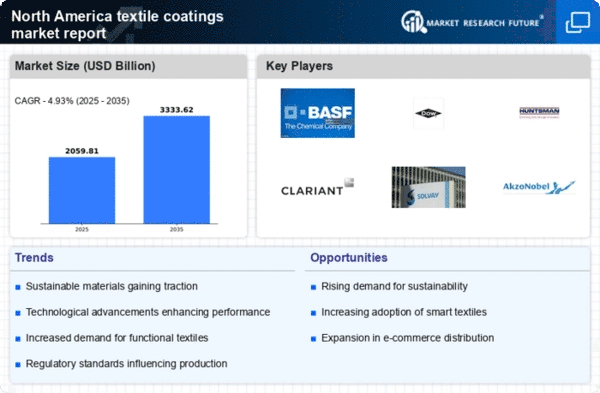
As per Market Research Future analysis, the North America textile coatings market size was estimated at 1963.03 USD Billion in 2024. The North America textile coatings market is projected to grow from 2059.81 USD Billion in 2025 to 3333.62 USD Billion by 2035, exhibiting a compound annual growth rate (CAGR) of 4.9% during the forecast period 2025 - 2035

Key Market Trends & Highlights

The North America textile coatings market is experiencing a dynamic shift towards sustainability and innovation.

  • The US remains the largest market for textile coatings, driven by robust demand across various industries. Canada is emerging as the fastest-growing region, reflecting increasing investments in sustainable textile solutions. Technological advancements are fostering customization and personalization in textile coatings, enhancing consumer appeal. Key market drivers include the growing demand for functional textiles and rising consumer awareness of health and wellness.

Market Size & Forecast

2024 Market Size 1963.03 (USD Billion)
2035 Market Size 3333.62 (USD Billion)
CAGR (2025 - 2035) 4.93%

Major Players

BASF SE (DE), The Dow Chemical Company (US), Huntsman Corporation (US), Clariant AG (CH), Solvay SA (BE), AkzoNobel N.V. (NL), Covestro AG (DE), Wacker Chemie AG (DE), Fabrics &amp; Coatings (IN)

Market Trends

The textile coatings market in North America is currently experiencing a notable transformation, driven by advancements in technology and increasing consumer demand for high-performance materials. Manufacturers are focusing on developing innovative coatings that enhance the durability, water resistance, and aesthetic appeal of textiles. This shift is largely influenced by the growing awareness of sustainability, prompting companies to explore eco-friendly alternatives that minimize environmental impact. As a result, the market is witnessing a surge in the adoption of bio-based and non-toxic coatings, which align with the preferences of environmentally conscious consumers. Moreover, the textile coatings market is benefiting from the expansion of various end-use industries, including automotive, healthcare, and sportswear. These sectors are increasingly utilizing coated textiles for their superior properties, such as stain resistance and breathability. The ongoing trend towards customization and personalization in consumer products further fuels the demand for specialized coatings. Consequently, manufacturers are investing in research and development to create tailored solutions that meet specific industry requirements. This dynamic landscape suggests a promising outlook for the textile coatings market in North America, as it adapts to evolving consumer preferences and technological advancements.

Sustainability Initiatives

The textile coatings market is witnessing a significant shift towards sustainable practices. Manufacturers are increasingly adopting eco-friendly materials and processes to meet the rising demand for environmentally responsible products. This trend is driven by consumer preferences for non-toxic and biodegradable coatings, which are perceived as safer for both users and the environment.

Technological Advancements

Innovations in coating technologies are reshaping the textile coatings market. The introduction of advanced application techniques and smart coatings is enhancing the performance characteristics of textiles. These developments enable textiles to exhibit properties such as self-cleaning, UV resistance, and enhanced durability, catering to diverse consumer needs.

Customization and Personalization

There is a growing trend towards customization in the textile coatings market. Consumers are increasingly seeking personalized solutions that cater to their specific requirements. This demand is prompting manufacturers to offer tailored coatings that provide unique functionalities, thereby enhancing the overall consumer experience.

North America Textile Coatings Market Market Drivers

Growing Demand for Functional Textiles

The textile coatings market in North America experiences a notable surge in demand for functional textiles, driven by the increasing need for performance-oriented fabrics. Industries such as automotive, healthcare, and sports apparel are seeking textiles that offer enhanced properties like water resistance, UV protection, and antimicrobial features. This trend is reflected in the market data, which indicates that the functional textiles segment is projected to grow at a CAGR of approximately 6.5% from 2025 to 2030. As consumers become more aware of the benefits of coated textiles, manufacturers are compelled to innovate and expand their product offerings, thereby propelling the textile coatings market forward.

Expansion of E-commerce and Online Retail

The textile coatings market in North America is witnessing a transformation due to the rapid expansion of e-commerce and online retail platforms. This shift allows consumers to access a wider variety of coated textiles, including specialty and niche products that may not be available in traditional retail settings. Market data indicates that online sales of textiles are expected to grow by over 20% annually, creating new opportunities for manufacturers to reach diverse customer segments. As online shopping becomes more prevalent, the textile coatings market is likely to benefit from increased visibility and accessibility of products.

Regulatory Compliance and Safety Standards

In North America, the textile coatings market is significantly influenced by stringent regulatory compliance and safety standards. Government agencies enforce regulations concerning the use of hazardous chemicals in textile production, prompting manufacturers to adopt safer alternatives. This shift not only ensures consumer safety but also enhances the market's reputation. The market data suggests that companies investing in eco-friendly and compliant coatings are likely to capture a larger share, as consumers increasingly prefer products that align with safety standards. Consequently, adherence to regulations is becoming a critical driver for growth in the textile coatings market.

Technological Innovations in Coating Processes

Technological innovations in coating processes are playing a pivotal role in shaping the textile coatings market in North America. Advancements in application techniques, such as digital printing and nanotechnology, enable manufacturers to create more efficient and effective coatings. These innovations not only improve the performance of textiles but also reduce waste and production costs. Market data suggests that the adoption of advanced coating technologies could lead to a reduction in production costs by up to 15%, thereby enhancing profitability for manufacturers. As technology continues to evolve, it is likely to drive further growth in the textile coatings market.

Rising Consumer Awareness of Health and Wellness

Consumer awareness regarding health and wellness is increasingly impacting the textile coatings market in North America. There is a growing preference for textiles that promote well-being, such as those with antimicrobial and hypoallergenic properties. This trend is particularly evident in sectors like home textiles and activewear, where consumers prioritize health benefits. Market data shows that the demand for health-oriented coated textiles is projected to rise by approximately 7% annually. As manufacturers respond to this trend by developing innovative coatings that enhance health benefits, the textile coatings market is expected to expand significantly.

Market Segment Insights

By Application: Automotive (Largest) vs. Sportswear (Fastest-Growing)

<p>The textile coatings market is witnessing a substantial market share distribution among the application segments. Automotive stands out as the largest application segment, driven by the growing demand for coated fabrics in vehicle interiors and exteriors. Home textiles and industrial textiles follow, both benefiting from enhanced durability and aesthetic appeal provided by innovative coatings. Protective clothing and sportswear are gaining traction as consumer preferences shift towards functional and performance-oriented textiles. Growth trends indicate that the automotive segment is fueled by advancements in material technology, while sportswear is experiencing rapid growth due to increasing health awareness and fitness trends. The protective clothing segment is also seeing an upward trend, driven by stringent safety regulations. Overall, the emphasis on sustainability and eco-friendly formulations is shaping the future dynamics of these application segments.</p>

<p>Automotive (Dominant) vs. Sportswear (Emerging)</p>

<p>Automotive dominates the textile coatings market, characterized by its established supply chains and robust demand for high-performance coated materials. This segment includes a wide array of applications such as upholstery, seat covers, and exterior coatings, ensuring durability and aesthetics. In contrast, sportswear is an emerging segment that showcases innovation with breathable, lightweight, and moisture-wicking textile technologies tailored for athletic performance. This segment is rapidly gaining consumer attention, fueled by the increasing trend of athleisure and a heightened focus on health and fitness. Manufacturers are adapting to these trends by developing specialized coatings that enhance comfort, functionality, and style, thus positioning themselves effectively in this competitive landscape.</p>

By Type: Polyurethane Coatings (Largest) vs. Acrylic Coatings (Fastest-Growing)

<p>The market share distribution in the Type segment reveals that Polyurethane Coatings dominate, accounting for a significant portion of the market. This segment's popularity is driven by its excellent durability and performance in various applications, making it the go-to choice for many manufacturers. Meanwhile, Acrylic Coatings are positioned as the fastest-growing segment, attracting attention for their eco-friendly properties and versatility in application. Growth trends indicate a shift towards environmentally friendly options, with Acrylic Coatings poised for rapid expansion due to increasing regulatory pressures and consumer preferences for sustainable products. Polyurethane Coatings, while still leading, may face challenges from the emerging demand for greener alternatives. Overall, innovation in formulations and performance enhancements will be key in shaping the future of these coating technologies.</p>

<p>Polyurethane Coatings (Dominant) vs. Acrylic Coatings (Emerging)</p>

<p>Polyurethane Coatings are recognized for their superior adhesion, flexibility, and resistance to abrasion, making them the dominant choice in the textile coatings market. They are widely adopted in applications requiring durability and protection against harsh environmental conditions. Conversely, Acrylic Coatings are emerging rapidly due to their low environmental impact and strong performance characteristics. They offer excellent color retention and are increasingly favored in the automotive and apparel industries. The movement towards sustainability is encouraging manufacturers to explore Acrylic options, leading to innovations that enhance their appeal and market competitiveness.</p>

By Technology: Water-Based Coatings (Largest) vs. Solvent-Based Coatings (Fastest-Growing)

<p>In recent years, Water-Based Coatings have emerged as the most widely adopted technology in the textile coatings market, capturing a significant market share due to their environmental benefits and compliance with regulations. This segment has established a strong foothold, thanks to its versatility and easy application in various textile applications, thereby appealing to manufacturers seeking sustainable solutions. On the other hand, Solvent-Based Coatings are currently the fastest-growing segment, driven by their superior performance characteristics such as durability and resistance to various environmental factors. The demand for these coatings is increasing among consumers looking for high-quality finishes in textile products. Additionally, advancements in solvent technologies are helping to mitigate environmental concerns, contributing to their rapid growth in the market.</p>

<p>Coatings: Water-Based (Dominant) vs. Solvent-Based (Emerging)</p>

<p>Water-Based Coatings dominate the North America textile coatings market due to their eco-friendly nature and regulatory compliance, making them a preferred choice among manufacturers. These coatings offer excellent adhesion, flexibility, and wash durability, which are critical for a variety of textile applications including apparel and home furnishings. Meanwhile, Solvent-Based Coatings, while experiencing robust growth, provide unparalleled advantages in terms of performance, particularly in applications that require high resistance to wear and tear. As manufacturers continue to innovate and leverage advancements in chemistry, the performance gap between these two technologies is expected to narrow, enhancing the competitive landscape within the market.</p>

By End Use: Clothing (Largest) vs. Technical Textiles (Fastest-Growing)

In the North America textile coatings market, the 'Clothing' segment holds a significant share, making it the largest end-use area within this market. This segment is primarily driven by the increasing demand for coated fabrics in apparel for enhanced durability and functionality. On the other hand, 'Home Furnishings' also contributes a notable share, but it is the 'Technical Textiles' segment that showcases remarkable potential for growth, catering to specialized applications in various industries. The growth trends indicate a rising inclination towards innovations in textile coatings, particularly in 'Technical Textiles', which are gaining traction due to their application in sectors like automotive and medical. Moreover, advancements in coating technologies that offer better performance and environmental sustainability are influencing growth. As industries prioritize performance and safety, technical textiles are emerging as a pivotal segment offering significant opportunities in the market.

Clothing: Dominant vs. Technical Textiles: Emerging

The 'Clothing' segment is characterized by its widespread application in fashion and everyday apparel, making it a dominant force in the market. It emphasizes aesthetics, comfort, and performance, driving the demand for advanced coatings that enhance fabric qualities, such as moisture resistance and stain repellence. Conversely, the 'Technical Textiles' segment is emerging rapidly due to its innovative applications in complex industries like healthcare, automotive, and construction, which require specialized properties for functionality and safety. This segment is witnessing an increasing focus on high-performance coatings that meet stringent regulatory requirements and operational challenges, thereby positioning it as a crucial area for future growth in the textile coatings landscape.

Get more detailed insights about North America Textile Coatings Market- Forecast till 2035

Regional Insights

US : Leading Market with Robust Growth

The US textile coatings market is valued at $1650.0 million, representing a significant share of the North American market. Key growth drivers include increasing demand for high-performance textiles in automotive and construction sectors, alongside a shift towards sustainable materials. Regulatory policies promoting eco-friendly practices and government initiatives supporting innovation in textile technology further bolster market growth. Additionally, advanced infrastructure and a well-established industrial base facilitate production and distribution.

Canada : Sustainable Focus in Textile Coatings

Canada's textile coatings market, valued at $313.03 million, is characterized by a growing emphasis on sustainability and eco-friendly products. Key growth drivers include increasing consumer awareness and government regulations aimed at reducing environmental impact. Demand trends show a rise in applications for outdoor textiles and protective coatings, driven by the harsh climate. Infrastructure development in urban areas also supports market expansion, particularly in provinces like Ontario and British Columbia.

Key Players and Competitive Insights

The textile coatings market in North America is characterized by a dynamic competitive landscape, driven by innovation, sustainability, and technological advancements. Key players such as BASF SE (DE), The Dow Chemical Company (US), and Huntsman Corporation (US) are actively shaping the market through strategic initiatives. BASF SE (DE) focuses on developing eco-friendly coatings, aligning with the growing demand for sustainable products. Meanwhile, The Dow Chemical Company (US) emphasizes digital transformation and smart manufacturing processes to enhance operational efficiency. Huntsman Corporation (US) is leveraging partnerships to expand its product portfolio, particularly in high-performance coatings, which are increasingly sought after in various applications. Collectively, these strategies contribute to a competitive environment that prioritizes innovation and sustainability.
In terms of business tactics, companies are increasingly localizing manufacturing to reduce lead times and enhance supply chain resilience. This approach is particularly relevant in a moderately fragmented market where agility can provide a competitive edge. The collective influence of major players fosters a competitive structure that encourages collaboration and innovation, as companies seek to differentiate themselves through unique offerings and enhanced customer experiences.
In October 2025, BASF SE (DE) announced the launch of a new line of bio-based textile coatings aimed at reducing environmental impact. This strategic move not only aligns with global sustainability goals but also positions BASF as a leader in eco-friendly solutions, potentially attracting environmentally conscious consumers and businesses. The introduction of these coatings may enhance BASF's market share and reinforce its commitment to sustainable practices.
In September 2025, The Dow Chemical Company (US) unveiled a new digital platform designed to optimize the supply chain for textile coatings. This initiative is significant as it integrates advanced analytics and AI to streamline operations, reduce costs, and improve customer service. By enhancing supply chain efficiency, The Dow aims to strengthen its competitive position and respond more effectively to market demands.
In August 2025, Huntsman Corporation (US) entered into a strategic partnership with a leading textile manufacturer to co-develop innovative coatings for performance fabrics. This collaboration is noteworthy as it allows Huntsman to leverage the expertise of its partner while expanding its product offerings in a growing segment. Such partnerships are likely to enhance Huntsman's competitive edge and foster innovation in textile coatings.
As of November 2025, current trends in the textile coatings market include a strong emphasis on digitalization, sustainability, and the integration of AI technologies. Strategic alliances are increasingly shaping the competitive landscape, enabling companies to pool resources and expertise for enhanced innovation. Looking ahead, competitive differentiation is expected to evolve, with a shift from price-based competition to a focus on technological advancements, sustainability, and supply chain reliability. This transition underscores the importance of innovation as a key driver of success in the textile coatings market.

Key Companies in the North America Textile Coatings Market include

Industry Developments

Future Outlook

North America Textile Coatings Market Future Outlook

The textile coatings market is projected to grow at a 4.93% CAGR from 2025 to 2035, driven by innovations in sustainable materials, increasing demand for performance textiles, and advancements in application technologies.

New opportunities lie in:

  • Development of eco-friendly textile coatings for sustainable fashion brands.
  • Expansion into smart textiles integrating IoT for enhanced functionality.
  • Investment in R&amp;D for high-performance coatings targeting industrial applications.

By 2035, the textile coatings market is expected to achieve robust growth, driven by innovation and sustainability.

Market Segmentation

North America Textile Coatings Market Type Outlook

  • Thermosets Cellulosic
  • Natural Rubber
  • Polyvinyl Chloride
  • Thermoplastics
  • Acrylics
  • Polyurethane

North America Textile Coatings Market End User Outlook

  • Building & Construction Industry
  • Transportation
  • Agriculture
  • Automotive
  • Industrial
  • Fabric Filters

North America Textile Coatings Market Technology Outlook

  • Traditional
  • Advanced
  • Magnetron Sputtering
  • Plasma Coating

Report Scope

MARKET SIZE 2024 1963.03(USD Billion)
MARKET SIZE 2025 2059.81(USD Billion)
MARKET SIZE 2035 3333.62(USD Billion)
COMPOUND ANNUAL GROWTH RATE (CAGR) 4.93% (2025 - 2035)
REPORT COVERAGE Revenue Forecast, Competitive Landscape, Growth Factors, and Trends
BASE YEAR 2024
Market Forecast Period 2025 - 2035
Historical Data 2019 - 2024
Market Forecast Units USD Billion
Key Companies Profiled BASF SE (DE), The Dow Chemical Company (US), Huntsman Corporation (US), Clariant AG (CH), Solvay SA (BE), AkzoNobel N.V. (NL), Covestro AG (DE), Wacker Chemie AG (DE), Fabrics & Coatings (IN)
Segments Covered Application, Type, Technology, End Use
Key Market Opportunities Growing demand for sustainable textile coatings driven by eco-conscious consumer preferences and regulatory initiatives.
Key Market Dynamics Technological advancements and sustainability trends drive innovation in the North American textile coatings market.
Countries Covered US, Canada

FAQs

What is the projected market valuation for the North America textile coatings market in 2035?

<p>The projected market valuation for the North America textile coatings market in 2035 is $3333.62 Billion.</p>

What was the overall market valuation for the North America textile coatings market in 2024?

<p>The overall market valuation for the North America textile coatings market in 2024 was $1963.03 Billion.</p>

What is the expected CAGR for the North America textile coatings market during the forecast period 2025 - 2035?

<p>The expected CAGR for the North America textile coatings market during the forecast period 2025 - 2035 is 4.93%.</p>

Which segment had the highest valuation in the North America textile coatings market in 2024?

<p>In 2024, the segment with the highest valuation was Fluoropolymer Coatings, valued at $763.03 Billion.</p>

What are the key players in the North America textile coatings market?

<p>Key players in the North America textile coatings market include BASF SE, The Dow Chemical Company, and Huntsman Corporation.</p>

What is the valuation range for Water-Based Coatings in the North America textile coatings market?

<p>The valuation range for Water-Based Coatings in the North America textile coatings market is $600.0 Billion to $1000.0 Billion.</p>

How does the valuation of Sportswear compare to that of Protective Clothing in 2024?

<p>In 2024, Sportswear was valued between $463.03 Billion and $833.62 Billion, while Protective Clothing was valued between $350.0 Billion and $600.0 Billion.</p>

What is the valuation range for Bio-Based Coatings in the North America textile coatings market?

<p>The valuation range for Bio-Based Coatings in the North America textile coatings market is $563.03 Billion to $1133.62 Billion.</p>

Which end-use segment is projected to have the highest valuation by 2035?

<p>By 2035, the Technical Textiles end-use segment is projected to have the highest valuation, estimated between $863.03 Billion and $1533.62 Billion.</p>

What is the valuation range for Industrial Textiles in the North America textile coatings market?

<p>The valuation range for Industrial Textiles in the North America textile coatings market is $400.0 Billion to $650.0 Billion.</p>

  1. SECTION I: EXECUTIVE SUMMARY AND KEY HIGHLIGHTS
    1. | 1.1 EXECUTIVE SUMMARY
    2. | | 1.1.1 Market Overview
    3. | | 1.1.2 Key Findings
    4. | | 1.1.3 Market Segmentation
    5. | | 1.1.4 Competitive Landscape
    6. | | 1.1.5 Challenges and Opportunities
    7. | | 1.1.6 Future Outlook
  2. SECTION II: SCOPING, METHODOLOGY AND MARKET STRUCTURE
    1. | 2.1 MARKET INTRODUCTION
    2. | | 2.1.1 Definition
    3. | | 2.1.2 Scope of the study
    4. | | | 2.1.2.1 Research Objective
    5. | | | 2.1.2.2 Assumption
    6. | | | 2.1.2.3 Limitations
    7. | 2.2 RESEARCH METHODOLOGY
    8. | | 2.2.1 Overview
    9. | | 2.2.2 Data Mining
    10. | | 2.2.3 Secondary Research
    11. | | 2.2.4 Primary Research
    12. | | | 2.2.4.1 Primary Interviews and Information Gathering Process
    13. | | | 2.2.4.2 Breakdown of Primary Respondents
    14. | | 2.2.5 Forecasting Model
    15. | | 2.2.6 Market Size Estimation
    16. | | | 2.2.6.1 Bottom-Up Approach
    17. | | | 2.2.6.2 Top-Down Approach
    18. | | 2.2.7 Data Triangulation
    19. | | 2.2.8 Validation
  3. SECTION III: QUALITATIVE ANALYSIS
    1. | 3.1 MARKET DYNAMICS
    2. | | 3.1.1 Overview
    3. | | 3.1.2 Drivers
    4. | | 3.1.3 Restraints
    5. | | 3.1.4 Opportunities
    6. | 3.2 MARKET FACTOR ANALYSIS
    7. | | 3.2.1 Value chain Analysis
    8. | | 3.2.2 Porter's Five Forces Analysis
    9. | | | 3.2.2.1 Bargaining Power of Suppliers
    10. | | | 3.2.2.2 Bargaining Power of Buyers
    11. | | | 3.2.2.3 Threat of New Entrants
    12. | | | 3.2.2.4 Threat of Substitutes
    13. | | | 3.2.2.5 Intensity of Rivalry
    14. | | 3.2.3 COVID-19 Impact Analysis
    15. | | | 3.2.3.1 Market Impact Analysis
    16. | | | 3.2.3.2 Regional Impact
    17. | | | 3.2.3.3 Opportunity and Threat Analysis
  4. SECTION IV: QUANTITATIVE ANALYSIS
    1. | 4.1 Food, Beverages & Nutrition, BY Application (USD Billion)
    2. | | 4.1.1 Automotive
    3. | | 4.1.2 Home Textiles
    4. | | 4.1.3 Industrial Textiles
    5. | | 4.1.4 Protective Clothing
    6. | | 4.1.5 Sportswear
    7. | 4.2 Food, Beverages & Nutrition, BY Type (USD Billion)
    8. | | 4.2.1 Polyurethane Coatings
    9. | | 4.2.2 Acrylic Coatings
    10. | | 4.2.3 Silicone Coatings
    11. | | 4.2.4 Fluoropolymer Coatings
    12. | 4.3 Food, Beverages & Nutrition, BY Technology (USD Billion)
    13. | | 4.3.1 Water-Based Coatings
    14. | | 4.3.2 Solvent-Based Coatings
    15. | | 4.3.3 Bio-Based Coatings
    16. | 4.4 Food, Beverages & Nutrition, BY End Use (USD Billion)
    17. | | 4.4.1 Clothing
    18. | | 4.4.2 Home Furnishings
    19. | | 4.4.3 Technical Textiles
  5. SECTION V: COMPETITIVE ANALYSIS
    1. | 5.1 Competitive Landscape
    2. | | 5.1.1 Overview
    3. | | 5.1.2 Competitive Analysis
    4. | | 5.1.3 Market share Analysis
    5. | | 5.1.4 Major Growth Strategy in the Food, Beverages & Nutrition
    6. | | 5.1.5 Competitive Benchmarking
    7. | | 5.1.6 Leading Players in Terms of Number of Developments in the Food, Beverages & Nutrition
    8. | | 5.1.7 Key developments and growth strategies
    9. | | | 5.1.7.1 New Product Launch/Service Deployment
    10. | | | 5.1.7.2 Merger & Acquisitions
    11. | | | 5.1.7.3 Joint Ventures
    12. | | 5.1.8 Major Players Financial Matrix
    13. | | | 5.1.8.1 Sales and Operating Income
    14. | | | 5.1.8.2 Major Players R&D Expenditure. 2023
    15. | 5.2 Company Profiles
    16. | | 5.2.1 BASF SE (DE)
    17. | | | 5.2.1.1 Financial Overview
    18. | | | 5.2.1.2 Products Offered
    19. | | | 5.2.1.3 Key Developments
    20. | | | 5.2.1.4 SWOT Analysis
    21. | | | 5.2.1.5 Key Strategies
    22. | | 5.2.2 The Dow Chemical Company (US)
    23. | | | 5.2.2.1 Financial Overview
    24. | | | 5.2.2.2 Products Offered
    25. | | | 5.2.2.3 Key Developments
    26. | | | 5.2.2.4 SWOT Analysis
    27. | | | 5.2.2.5 Key Strategies
    28. | | 5.2.3 Huntsman Corporation (US)
    29. | | | 5.2.3.1 Financial Overview
    30. | | | 5.2.3.2 Products Offered
    31. | | | 5.2.3.3 Key Developments
    32. | | | 5.2.3.4 SWOT Analysis
    33. | | | 5.2.3.5 Key Strategies
    34. | | 5.2.4 Clariant AG (CH)
    35. | | | 5.2.4.1 Financial Overview
    36. | | | 5.2.4.2 Products Offered
    37. | | | 5.2.4.3 Key Developments
    38. | | | 5.2.4.4 SWOT Analysis
    39. | | | 5.2.4.5 Key Strategies
    40. | | 5.2.5 Solvay SA (BE)
    41. | | | 5.2.5.1 Financial Overview
    42. | | | 5.2.5.2 Products Offered
    43. | | | 5.2.5.3 Key Developments
    44. | | | 5.2.5.4 SWOT Analysis
    45. | | | 5.2.5.5 Key Strategies
    46. | | 5.2.6 AkzoNobel N.V. (NL)
    47. | | | 5.2.6.1 Financial Overview
    48. | | | 5.2.6.2 Products Offered
    49. | | | 5.2.6.3 Key Developments
    50. | | | 5.2.6.4 SWOT Analysis
    51. | | | 5.2.6.5 Key Strategies
    52. | | 5.2.7 Covestro AG (DE)
    53. | | | 5.2.7.1 Financial Overview
    54. | | | 5.2.7.2 Products Offered
    55. | | | 5.2.7.3 Key Developments
    56. | | | 5.2.7.4 SWOT Analysis
    57. | | | 5.2.7.5 Key Strategies
    58. | | 5.2.8 Wacker Chemie AG (DE)
    59. | | | 5.2.8.1 Financial Overview
    60. | | | 5.2.8.2 Products Offered
    61. | | | 5.2.8.3 Key Developments
    62. | | | 5.2.8.4 SWOT Analysis
    63. | | | 5.2.8.5 Key Strategies
    64. | | 5.2.9 Fabrics & Coatings (IN)
    65. | | | 5.2.9.1 Financial Overview
    66. | | | 5.2.9.2 Products Offered
    67. | | | 5.2.9.3 Key Developments
    68. | | | 5.2.9.4 SWOT Analysis
    69. | | | 5.2.9.5 Key Strategies
    70. | 5.3 Appendix
    71. | | 5.3.1 References
    72. | | 5.3.2 Related Reports
  6. LIST OF FIGURES
    1. | 6.1 MARKET SYNOPSIS
    2. | 6.2 NORTH AMERICA MARKET ANALYSIS BY APPLICATION
    3. | 6.3 NORTH AMERICA MARKET ANALYSIS BY TYPE
    4. | 6.4 NORTH AMERICA MARKET ANALYSIS BY TECHNOLOGY
    5. | 6.5 NORTH AMERICA MARKET ANALYSIS BY END USE
    6. | 6.6 KEY BUYING CRITERIA OF FOOD, BEVERAGES & NUTRITION
    7. | 6.7 RESEARCH PROCESS OF MRFR
    8. | 6.8 DRO ANALYSIS OF FOOD, BEVERAGES & NUTRITION
    9. | 6.9 DRIVERS IMPACT ANALYSIS: FOOD, BEVERAGES & NUTRITION
    10. | 6.10 RESTRAINTS IMPACT ANALYSIS: FOOD, BEVERAGES & NUTRITION
    11. | 6.11 SUPPLY / VALUE CHAIN: FOOD, BEVERAGES & NUTRITION
    12. | 6.12 FOOD, BEVERAGES & NUTRITION, BY APPLICATION, 2024 (% SHARE)
    13. | 6.13 FOOD, BEVERAGES & NUTRITION, BY APPLICATION, 2024 TO 2035 (USD Billion)
    14. | 6.14 FOOD, BEVERAGES & NUTRITION, BY TYPE, 2024 (% SHARE)
    15. | 6.15 FOOD, BEVERAGES & NUTRITION, BY TYPE, 2024 TO 2035 (USD Billion)
    16. | 6.16 FOOD, BEVERAGES & NUTRITION, BY TECHNOLOGY, 2024 (% SHARE)
    17. | 6.17 FOOD, BEVERAGES & NUTRITION, BY TECHNOLOGY, 2024 TO 2035 (USD Billion)
    18. | 6.18 FOOD, BEVERAGES & NUTRITION, BY END USE, 2024 (% SHARE)
    19. | 6.19 FOOD, BEVERAGES & NUTRITION, BY END USE, 2024 TO 2035 (USD Billion)
    20. | 6.20 BENCHMARKING OF MAJOR COMPETITORS
  7. LIST OF TABLES
    1. | 7.1 LIST OF ASSUMPTIONS
    2. | | 7.1.1
    3. | 7.2 North America MARKET SIZE ESTIMATES; FORECAST
    4. | | 7.2.1 BY APPLICATION, 2025-2035 (USD Billion)
    5. | | 7.2.2 BY TYPE, 2025-2035 (USD Billion)
    6. | | 7.2.3 BY TECHNOLOGY, 2025-2035 (USD Billion)
    7. | | 7.2.4 BY END USE, 2025-2035 (USD Billion)
    8. | 7.3 PRODUCT LAUNCH/PRODUCT DEVELOPMENT/APPROVAL
    9. | | 7.3.1
    10. | 7.4 ACQUISITION/PARTNERSHIP
    11. | | 7.4.1

North America Food, Beverages & Nutrition Market Segmentation

Food, Beverages & Nutrition By Application (USD Billion, 2025-2035)

  • Automotive
  • Home Textiles
  • Industrial Textiles
  • Protective Clothing
  • Sportswear

Food, Beverages & Nutrition By Type (USD Billion, 2025-2035)

  • Polyurethane Coatings
  • Acrylic Coatings
  • Silicone Coatings
  • Fluoropolymer Coatings

Food, Beverages & Nutrition By Technology (USD Billion, 2025-2035)

  • Water-Based Coatings
  • Solvent-Based Coatings
  • Bio-Based Coatings

Food, Beverages & Nutrition By End Use (USD Billion, 2025-2035)

  • Clothing
  • Home Furnishings
  • Technical Textiles
Infographic

Free Sample Request

Kindly complete the form below to receive a free sample of this Report

Get Free Sample

Customer Strories

Compare Licence

×
Features License Type
Single User Multiuser License Enterprise User
Price $4,950 $5,950 $7,250
Maximum User Access Limit 1 User Upto 10 Users Unrestricted Access Throughout the Organization
Free Customization
Direct Access to Analyst
Deliverable Format
Platform Access
Discount on Next Purchase 10% 15% 15%
Printable Versions