
Request Free Sample ×

Kindly complete the form below to receive a free sample of this Report

* Please use a valid business email

Leading companies partner with us for data-driven Insights

clients tt-cursor
Hero Background
English
Chinese
French
Japanese
Korean
German
Spanish

Noise Monitoring System Market Trends

ID: MRFR/SEM/2732-HCR
100 Pages
Nirmit Biswas
Last Updated: April 06, 2026

Noise Monitoring System Market Size, Share and Research Report By Monitoring system (Permanent Noise Monitoring System, Semi-Permanent Noise Monitoring System, and Portable Noise Monitoring System), By Monitoring Method (Permanent Monitoring, Short–Term Monitoring, Long–Term Monitoring), By Component (Hardware, Software, and Service), And By Region (North America, Europe, Asia-Pacific, And Rest Of The World) –Industry Forecast Till 2035

Share:
Download PDF ×

We do not share your information with anyone. However, we may send you emails based on your report interest from time to time. You may contact us at any time to opt-out.

Noise Monitoring System Market Infographic
Purchase Options

Market Trends

Key Emerging Trends in the Noise Monitoring System Market

Noise Monitoring System market trends reflect environmental monitoring and regulatory compliance changes. AI and ML are being used in noise monitoring systems. Advanced technologies improve data analysis, predictive modeling, and noise pattern recognition in these systems. This trend boosts noise monitoring efficiency and positions the sector to use AI for proactive noise control.

Demand for wireless and IoT-enabled noise monitoring technologies is another development. Wireless connectivity and IoT integration provide real-time monitoring and data transmission, giving users vital information. This trend follows the industry's push toward smart solutions, which allow users to remotely monitor and modify noise levels for more effective and responsive noise control.

Sensors are being miniaturized and noise monitoring systems are becoming portable. These smaller, more adaptable sensors are used in industrial and community noise monitoring applications. These devices are portable and suited for temporary deployments or scenarios that require flexibility, leading to a market trend toward more flexible noise monitoring solutions.

Integration of different environmental monitoring metrics into a single platform is another industry development. Noise monitoring devices are increasingly measuring air quality and vibration to provide a complete environmental monitoring solution. This trend reflects the increased awareness of environmental interdependencies and the need for holistic monitoring solutions that can handle many elements.

Additionally, the Noise Monitoring System market is moving toward cloud-based solutions and data analytics. Cloud solutions enable efficient data analysis, centralized data storage, and remote access. Data analytics tools help users make informed decisions and analyze long-term trends by providing useful insights from acquired data.

Smart city efforts worldwide are making noise monitoring part of urban planning and development. Noise monitoring devices are being added to smart infrastructure in cities to improve residents' quality of life. As urbanization increases and authorities prioritize sustainable and livable cities, this trend will certainly continue.

Public participation and knowledge in noise monitoring are also rising. Mobile apps and websites that let citizens report noise complaints are becoming more popular. This pattern shows a move toward community-driven noise monitoring, where residents discover and address noise pollution in their surroundings.


Author
Author Profile
Nirmit Biswas
Senior Research Analyst

With 5+ years of expertise in Market Intelligence and Strategic Research, Nirmit Biswas specializes in ICT, Semiconductors, and BFSI. Backed by an MBA in Financial Services and a Computer Science foundation, Nirmit blends technical depth with business acumen. He has successfully led 100+ projects for global enterprises and startups, including Amazon, Cisco, L&T and Huawei, delivering market estimations, competitive benchmarking, and GTM strategies. His focus lies in transforming complex data into clear, actionable insights that drive growth, innovation, and investment decisions. Recognized for bridging engineering innovation with executive strategy, Nirmit helps businesses navigate dynamic markets with confidence.

Leave a Comment

FAQs

What is the current valuation of the Noise Monitoring System Market as of 2024?

<p>The overall market valuation was 0.8659 USD Billion in 2024.</p>

What is the projected market size for the Noise Monitoring System Market in 2035?

<p>The projected valuation for 2035 is 1.309 USD Billion.</p>

What is the expected CAGR for the Noise Monitoring System Market during the forecast period 2025 - 2035?

<p>The expected CAGR for the Noise Monitoring System Market during the forecast period 2025 - 2035 is 3.83%.</p>

Which companies are considered key players in the Noise Monitoring System Market?

<p>Key players in the market include Bruel & Kjaer, 3M, Honeywell, Siemens, Acoem, Cirrus Research, Norsonic, Rion, Extech Instruments, and Kimo Instruments.</p>

What are the main segments of the Noise Monitoring System Market?

<p>The main segments include Monitoring System, Monitoring Method, and Component.</p>

What was the valuation of the Permanent Noise Monitoring System segment in 2024?

<p>The valuation of the Permanent Noise Monitoring System segment was 0.3459 USD Billion in 2024.</p>

How does the valuation of Portable Noise Monitoring Systems compare to Semi-Permanent systems?

In 2024, the Portable Noise Monitoring System was valued at 0.255 USD Billion, while the Semi-Permanent Noise Monitoring System was valued at 0.265 USD Billion.

What is the projected growth for the Permanent Monitoring segment by 2035?

The Permanent Monitoring segment is projected to grow from 0.3459 USD Billion in 2024 to a higher valuation by 2035.

What components are included in the Noise Monitoring System Market?

The components include Hardware, Software, and Service, with respective valuations in 2024 of 0.3459, 0.265, and 0.255 USD Billion.

What is the expected trend for Long-Term Monitoring systems in the coming years?

The Long-Term Monitoring segment is expected to grow from 0.305 USD Billion in 2024, indicating a positive trend towards 2035.

Market Summary

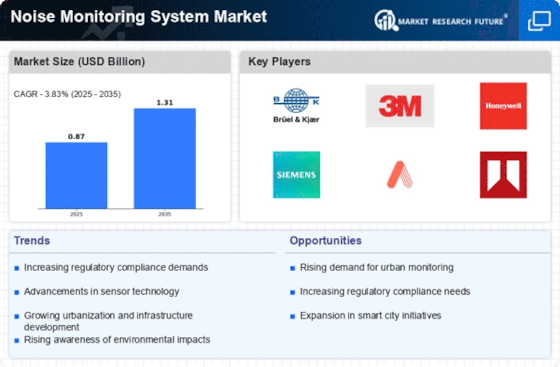
As per Market Research Future analysis, the Noise Monitoring System Market Size was estimated at 0.8659 USD Billion in 2024. The Noise Monitoring System industry is projected to grow from 0.899 USD Billion in 2025 to 1.309 USD Billion by 2035, exhibiting a compound annual growth rate (CAGR) of 3.83% during the forecast period 2025 - 2035

Key Market Trends & Highlights

The Noise Monitoring System Market is experiencing robust growth driven by technological advancements and increasing regulatory compliance.

  • The market is witnessing a significant integration with smart city initiatives, enhancing urban management. Advancements in sensor technology are leading to more accurate and efficient noise monitoring solutions. North America remains the largest market, while Asia-Pacific is emerging as the fastest-growing region in this sector. Rising urbanization and increased awareness of health impacts from noise pollution are key drivers propelling market expansion.

Market Size & Forecast

2024 Market Size 0.8659 (USD Billion)
2035 Market Size 1.309 (USD Billion)
CAGR (2025 - 2035) 3.83%
Largest Regional Market Share in 2024 North America

Major Players

Bruel &amp; Kjaer (DK), 3M (US), Honeywell (US), Siemens (DE), Acoem (FR), Cirrus Research (GB), Norsonic (NO), Rion (JP), Extech Instruments (US), Kimo Instruments (FR)

Market Trends

The Noise Monitoring System Market is currently experiencing a notable evolution, driven by increasing awareness of environmental noise pollution and its adverse effects on health and well-being. Governments and regulatory bodies are implementing stricter noise regulations, which in turn propels the demand for advanced monitoring systems. These systems are being integrated into urban planning and development projects, as cities strive to create quieter, more livable environments. Furthermore, technological advancements in sensor technology and data analytics are enhancing the capabilities of noise monitoring systems, allowing for real-time data collection and analysis. This trend appears to be fostering a more proactive approach to noise management, as stakeholders seek to mitigate noise-related issues before they escalate. In addition, the growing trend of smart cities is likely to further influence the Noise Monitoring System Market. As urban areas increasingly adopt smart technologies, the integration of noise monitoring systems into broader smart city frameworks becomes more prevalent. This integration not only aids in effective noise management but also contributes to overall urban sustainability efforts. The market seems poised for continued growth, as innovations in wireless communication and IoT technologies facilitate seamless connectivity and data sharing among various urban systems. Overall, the Noise Monitoring System Market is on a trajectory of transformation, reflecting a heightened commitment to addressing noise pollution and enhancing quality of life in urban settings.

Integration with Smart City Initiatives

The Noise Monitoring System Market is increasingly aligning with smart city initiatives, where noise monitoring is integrated into broader urban management systems. This integration allows for real-time data sharing and analysis, enhancing the ability to address noise pollution effectively. As cities adopt smart technologies, the demand for sophisticated noise monitoring solutions is likely to rise.

Advancements in Sensor Technology

Recent advancements in sensor technology are significantly impacting the Noise Monitoring System Market. Enhanced sensors provide more accurate and reliable data, enabling better monitoring of noise levels. These innovations may lead to the development of more compact and cost-effective solutions, making noise monitoring accessible to a wider range of users.

Regulatory Compliance and Environmental Awareness

Growing regulatory frameworks aimed at controlling noise pollution are driving the Noise Monitoring System Market. Increased awareness of the health impacts of noise pollution is prompting organizations and governments to invest in monitoring systems to ensure compliance with regulations. This trend suggests a shift towards more responsible urban planning and development.

Noise Monitoring System Market Market Drivers

Technological Advancements in Noise Monitoring

Technological innovations are significantly influencing the Noise Monitoring System Market. The advent of advanced sensor technologies, data analytics, and IoT integration has transformed traditional noise monitoring systems into sophisticated solutions capable of real-time data collection and analysis. For instance, the integration of machine learning algorithms allows for predictive analytics, enabling proactive noise management strategies. The market for noise monitoring systems is expected to grow at a compound annual growth rate (CAGR) of around 8.5% from 2025 to 2030, driven by these technological advancements. Furthermore, the development of portable and cost-effective noise monitoring devices is making it easier for various sectors, including construction, transportation, and environmental agencies, to adopt noise monitoring solutions. This trend indicates a robust future for the Noise Monitoring System Market as technology continues to evolve.

Regulatory Frameworks and Compliance Requirements

The establishment of stringent regulatory frameworks regarding noise pollution is a crucial driver for the Noise Monitoring System Market. Various countries have implemented laws and guidelines aimed at controlling noise emissions from industrial, commercial, and residential sources. Compliance with these regulations is essential for businesses and municipalities, prompting them to invest in noise monitoring systems to ensure adherence. For instance, the European Union has set specific noise limits for various sectors, which necessitates continuous monitoring and reporting. This regulatory landscape creates a favorable environment for the Noise Monitoring System Market, as organizations seek to avoid penalties and enhance their corporate social responsibility profiles. The demand for compliance-driven noise monitoring solutions is expected to grow, further solidifying the market's expansion.

Rising Urbanization and Infrastructure Development

The ongoing trend of urbanization is a pivotal driver for the Noise Monitoring System Market. As cities expand and infrastructure projects proliferate, noise pollution becomes a pressing concern. Urban areas are projected to house approximately 68% of the world's population by 2050, leading to increased vehicular traffic, construction activities, and industrial operations. This surge in urban density necessitates effective noise monitoring solutions to ensure compliance with noise regulations and to enhance the quality of life for residents. Consequently, municipalities and urban planners are increasingly investing in noise monitoring systems to assess and mitigate noise levels, thereby fostering a healthier urban environment. The Noise Monitoring System Market is likely to experience substantial growth as stakeholders prioritize noise management in their urban development strategies.

Increased Awareness of Health Impacts of Noise Pollution

The growing recognition of the adverse health effects associated with noise pollution is a significant driver for the Noise Monitoring System Market. Research indicates that prolonged exposure to high noise levels can lead to various health issues, including stress, sleep disturbances, and cardiovascular diseases. As public awareness of these health implications rises, there is a corresponding demand for effective noise monitoring solutions to identify and mitigate noise pollution sources. Governments and health organizations are increasingly advocating for noise management policies, further propelling the need for noise monitoring systems. The Noise Monitoring System Market is likely to benefit from this heightened awareness, as stakeholders seek to implement measures that protect public health and enhance community well-being.

Growing Demand from Construction and Transportation Sectors

The construction and transportation sectors are significant contributors to the Noise Monitoring System Market. As infrastructure projects and transportation networks expand, noise pollution from construction activities and vehicular traffic intensifies. The construction industry alone is projected to grow at a CAGR of 5.4%, leading to increased noise levels in urban areas. Consequently, construction companies and transportation authorities are increasingly adopting noise monitoring systems to assess and manage noise emissions effectively. These systems not only help in complying with local regulations but also enhance community relations by addressing public concerns regarding noise pollution. The Noise Monitoring System Market is poised for growth as these sectors prioritize noise management in their operational strategies.

Market Segment Insights

By Monitoring System: Permanent Noise Monitoring System (Largest) vs. Portable Noise Monitoring System (Fastest-Growing)

<p>In the Noise Monitoring System Market, the distribution of market share among various segments reveals that Permanent Noise Monitoring Systems hold a substantial portion of the market due to their reliable and continuous monitoring capabilities. This type of system is widely adopted in residential areas, urban developments, and industrial zones. Meanwhile, Portable Noise Monitoring Systems are gaining traction for their flexibility and ease of use, allowing for on-site measurements and temporary monitoring, making them increasingly popular in construction and event management settings. The growth trends in the Noise Monitoring System segment show a marked increase in demand for Portable Noise Monitoring Systems. The need for real-time data collection and compliance with noise regulations is driving this growth, as temporary monitoring becomes essential for construction projects and public events. Additionally, technological advancements and the integration of IoT in monitoring systems enhance functionality, thereby contributing to the faster adoption of these emerging solutions in diverse environments.</p>

<p>Permanent Noise Monitoring System (Dominant) vs. Portable Noise Monitoring System (Emerging)</p>

<p>Permanent Noise Monitoring Systems are recognized for their capacity to provide continuous and accurate noise level readings over an extended period. These systems are typically installed in fixed locations and play a crucial role in monitoring environmental noise and ensuring compliance with local regulations. Their stability and reliability make them the predominant choice among municipalities and industries looking for consistent data. On the other hand, Portable Noise Monitoring Systems are emerging as a versatile alternative, favored for their convenience and adaptability. They allow for quick deployment and can be utilized in various settings, especially where noise monitoring is temporary, such as in construction sites or during events. These systems often incorporate advanced technology, offering features such as remote monitoring and smartphone integration, which enhances their appeal and market presence as a growing segment.</p>

By Monitoring Method: Permanent Monitoring (Largest) vs. Short–Term Monitoring (Fastest-Growing)

<p>In the Noise Monitoring System Market, the Permanent Monitoring segment holds the largest share, reflecting its importance in continuous noise assessment across various environments. Short-Term Monitoring has emerged as the fastest-growing segment, driven by the increasing need for temporary assessments in construction and event management. Long-Term Monitoring, while significant, occupies a smaller share compared to the other two methods, largely used in environments where ongoing data collection is critical. The growth trends indicate a shift towards adaptable and versatile monitoring solutions where Short-Term Monitoring's adoption is fueled by urban development and regulatory compliance. The need for quick assessments and data collection to support temporary projects is propelling this segment forward. Meanwhile, Permanent Monitoring remains essential, as continuous data helps in understanding noise patterns and compliance with environmental standards.</p>

<p>Permanent Monitoring: Dominant vs. Short–Term Monitoring: Emerging</p>

<p>Permanent Monitoring is characterized by its consistent, real-time assessment capability, making it an invaluable tool for industries that require ongoing noise regulation compliance. This approach is widely adopted across sectors such as transportation and urban development, where long-term data helps identify trends and inform policy making. On the other hand, Short-Term Monitoring is increasingly viewed as an emerging solution, particularly in scenarios requiring rapid and temporary noise assessments. It appeals to clients in sectors like construction, where noise impact can vary significantly over time and shorter durations of monitoring can provide necessary insights without substantial long-term investments. The flexibility and adaptability of Short-Term Monitoring solutions make them attractive options in dynamic environments.</p>

By Component: Hardware (Largest) vs. Software (Fastest-Growing)

<p>In the Noise Monitoring System Market, the component segment is primarily divided into hardware, software, and service categories. Among these, hardware remains the largest segment, capturing a significant share of the market. This reflects the essential role of physical equipment in noise monitoring, such as sensors, microphones, and data loggers. Conversely, software is gaining momentum as the fastest-growing segment as the demand for data analytics and real-time monitoring solutions increases, particularly in urban areas and regulatory environments. The growth trends within this segment indicate a paradigm shift towards integrated solutions that combine hardware with advanced software capabilities. Innovations in artificial intelligence and machine learning are driving software advancements, enhancing data processing and analysis. Furthermore, regulatory requirements for noise pollution assessment are increasing the reliance on both hardware and software solutions, thus broadening their market appeal and fostering growth across the segment as a whole.</p>

<p>Hardware (Dominant) vs. Software (Emerging)</p>

<p>The hardware component of the Noise Monitoring System Market is characterized by essential components such as high-quality sensors, microphones, and data acquisition systems. These devices enable accurate measurement and monitoring of noise levels in various environments, including urban and industrial settings. Hardware solutions are typically seen as more reliable due to their physical presence and capacity for direct data collection. In contrast, software solutions, which are emerging as pivotal tools, focus extensively on data analysis, visualization, and integration with other systems. With growing dependence on data-driven decision-making, software is evolving rapidly to incorporate advanced features like predictive analytics and real-time notifications, setting the stage for even wider adoption as businesses and municipalities seek comprehensive noise management solutions.</p>

Get more detailed insights about Noise Monitoring System Market Research Report- Global Forecast 2035

Regional Insights

North America : Regulatory Leader in Noise Control

North America is the largest market for noise monitoring systems, holding approximately 40% of the global market share. The region's growth is driven by stringent environmental regulations and increasing awareness of noise pollution's health impacts. Government initiatives aimed at urban development and infrastructure improvements further catalyze demand for advanced monitoring solutions. The U.S. and Canada are the primary contributors to this market, with a focus on technological advancements and compliance with noise regulations. The competitive landscape in North America is characterized by the presence of key players such as 3M, Honeywell, and Bruel & Kjaer. These companies are investing in innovative technologies to enhance their product offerings. The market is also witnessing collaborations between public and private sectors to develop comprehensive noise management strategies. As urbanization continues, the demand for effective noise monitoring solutions is expected to rise significantly, ensuring a robust market environment.

Europe : Innovative Solutions for Urban Noise

Europe is the second-largest market for noise monitoring systems, accounting for approximately 30% of the global share. The region's growth is propelled by stringent EU regulations on noise pollution and a growing emphasis on sustainable urban development. Countries like Germany and France are leading the charge, implementing advanced noise monitoring technologies to comply with environmental standards. The European market is also influenced by public awareness campaigns highlighting the health effects of noise pollution. Leading countries in Europe include Germany, France, and the UK, where companies like Siemens and Acoem are prominent players. The competitive landscape is marked by innovation, with firms investing in smart technologies and IoT solutions for real-time monitoring. The European market is also characterized by collaborations between governmental bodies and private enterprises to enhance noise management strategies, ensuring compliance with regulations and improving urban living conditions.

Asia-Pacific : Emerging Markets Driving Growth

Asia-Pacific is witnessing rapid growth in the noise monitoring system market, holding approximately 20% of the global share. The region's expansion is driven by urbanization, industrialization, and increasing awareness of noise pollution's adverse effects. Countries like China and India are at the forefront, implementing regulations to manage noise levels in urban areas. Government initiatives aimed at improving public health and environmental quality are further boosting demand for noise monitoring solutions. China, Japan, and India are the leading countries in this market, with significant investments in noise monitoring technologies. The competitive landscape features key players such as Rion and Cirrus Research, who are focusing on developing advanced monitoring systems. The market is also seeing a rise in local manufacturers, enhancing competition and driving innovation. As urban areas continue to expand, the need for effective noise management solutions is expected to grow, creating opportunities for market players.

Middle East and Africa : Regulatory Frameworks Evolving

The Middle East and Africa region is gradually emerging in the noise monitoring system market, holding about 10% of the global share. The growth is driven by increasing urbanization, industrial activities, and a growing awareness of environmental issues. Countries like South Africa and the UAE are implementing regulations to address noise pollution, which is fostering demand for monitoring systems. The region's focus on sustainable development and smart city initiatives is also contributing to market growth. Leading countries in this region include South Africa, the UAE, and Saudi Arabia, where companies are beginning to invest in noise monitoring technologies. The competitive landscape is still developing, with both international and local players vying for market share. As governments enhance their regulatory frameworks and public awareness increases, the demand for effective noise monitoring solutions is expected to rise, paving the way for future growth in the region.

Key Players and Competitive Insights

Leading market players are investing heavily in research and development to expand their product lines, which will help the noise monitoring system market grow even more. There are some strategies for action that market participants are implementing to increase their presence around the world's global footprint, with important market developments including new product launches, contractual agreements and acquisitions, higher investments, and collaboration with other organizations. To expand and survive in a more competitive and rising market climate, the noise monitoring system industry must offer cost-effective items.Manufacturing locally to minimize operational costs is one of the key business tactics manufacturer use in the global noise monitoring system industry to benefit clients and increase the market sector. In recent years, the noise monitoring system industry has offered some of the most significant technological advancements. Major players in the noise monitoring system market, including Extech Instruments (U.S.), Pulsar Instruments (U.K), 3M Company (U.S.), RION Co.Ltd. (Japan), Bruel & Kjaer (Denmark), Cirrus Research Plc (U.K), Castle Group Ltd. (U.K), Casella Inc. (US), SKF Group (Sweden), Kimo Instrument (Japan), B&K Precision Corporation (U.S.), and others are attempting to grow market demand by investing in research and development operations.B&K Precision Corporation has been making reliable, cost-effective test and measurement tools for more than 70 years. During this time, they have built a reputation for being the best at what they do. The company's products are used for many different things, like creation, research and development, testing on the production line, industrial maintenance, and electronic field service. Precision tests and measurement tools from B&K are standard in a lot of universities and technical schools where engineers and workers of the future are trained. The main office of B&K Precision is in Yorba Linda, California.The company was started in 1951. Since 1951, the name B&K Precision has stood for quality, stability, and good value. Our goal is to keep up the high standards that have made us famous, come up with new goods to meet changing needs and keep giving our customers the products and services they have come to trust.

In March B&K announced MIT Creating a 1-MW Motor, and It's for E-Airplanes, The head of the research team said that they had to "push the limits" in materials, manufacturing, thermal management, structures and rotor dynamics, and power electronics to make it happen.SKF is the world's top provider of new solutions that help businesses become more competitive and environmentally friendly. We help our customers improve the performance of their rotating equipment and lessen their effect on the environment by making our products lighter, more efficient, more durable, and easier to fix. We give bearings, seals, lubrication management, condition monitoring, and services for the rotating shaft. Since its founding in 1907, SKF has expanded to about 129 countries and 17,000 distributor spots around the world.

In June SKF and Sinoma Nitride, an industry leader in developing and making silicon nitride materials and ceramic balls, signed a Joint Venture (JV) deal to work together more closely on hybrid ceramic ball bearings. The partnership is important for SKF's plan because ceramic bearings are a high-priority new technology.

Key Companies in the Noise Monitoring System Market include

Industry Developments

March 2023: B&K Precision is a company that designs and makes reliable and affordable test and measurement tools. They have just announced their new 8500B series of programmable DC loads, which are better in every way than their popular 8500 Series.

January 2023: NTi Audio has added to its leading test and measurement tools for acoustics, audio, and vibration applications. The company's NoiseScout noise monitoring system was made better by adding AI analysis and Noise Classification.

Future Outlook

Noise Monitoring System Market Future Outlook

The Noise Monitoring System Market is projected to grow at a 3.83% CAGR from 2025 to 2035, driven by urbanization, regulatory pressures, and technological advancements.

New opportunities lie in:

  • Integration of AI-driven analytics for real-time noise data interpretation.</p><p>Development of portable noise monitoring devices for construction sites.</p><p>Expansion into emerging markets with tailored noise solutions.

By 2035, the market is expected to be robust, driven by innovation and increasing demand for noise management solutions.

Market Segmentation

Noise Monitoring System Market Component Outlook

  • Hardware
  • Software
  • Service

Noise Monitoring System Market Monitoring Method Outlook

  • Permanent Monitoring
  • Short–Term Monitoring
  • Long–Term Monitoring

Noise Monitoring System Market Monitoring System Outlook

  • Permanent Noise Monitoring System
  • Semi-Permanent Noise Monitoring System
  • Portable Noise Monitoring System

Report Scope

MARKET SIZE 2024 0.8659(USD Billion)
MARKET SIZE 2025 0.899(USD Billion)
MARKET SIZE 2035 1.309(USD Billion)
COMPOUND ANNUAL GROWTH RATE (CAGR) 3.83% (2025 - 2035)
REPORT COVERAGE Revenue Forecast, Competitive Landscape, Growth Factors, and Trends
BASE YEAR 2024
Market Forecast Period 2025 - 2035
Historical Data 2019 - 2024
Market Forecast Units USD Billion
Key Companies Profiled Bruel & Kjaer (DK), 3M (US), Honeywell (US), Siemens (DE), Acoem (FR), Cirrus Research (GB), Norsonic (NO), Rion (JP), Extech Instruments (US), Kimo Instruments (FR)
Segments Covered Monitoring system, Monitoring Method, Component, Region
Key Market Opportunities Integration of advanced analytics and IoT in the Noise Monitoring System Market enhances real-time data utilization.
Key Market Dynamics Rising regulatory pressures and technological advancements drive demand for innovative noise monitoring solutions across various sectors.
Countries Covered North America, Europe, APAC, South America, MEA

FAQs

What is the current valuation of the Noise Monitoring System Market as of 2024?

<p>The overall market valuation was 0.8659 USD Billion in 2024.</p>

What is the projected market size for the Noise Monitoring System Market in 2035?

<p>The projected valuation for 2035 is 1.309 USD Billion.</p>

What is the expected CAGR for the Noise Monitoring System Market during the forecast period 2025 - 2035?

<p>The expected CAGR for the Noise Monitoring System Market during the forecast period 2025 - 2035 is 3.83%.</p>

Which companies are considered key players in the Noise Monitoring System Market?

<p>Key players in the market include Bruel & Kjaer, 3M, Honeywell, Siemens, Acoem, Cirrus Research, Norsonic, Rion, Extech Instruments, and Kimo Instruments.</p>

What are the main segments of the Noise Monitoring System Market?

<p>The main segments include Monitoring System, Monitoring Method, and Component.</p>

What was the valuation of the Permanent Noise Monitoring System segment in 2024?

<p>The valuation of the Permanent Noise Monitoring System segment was 0.3459 USD Billion in 2024.</p>

How does the valuation of Portable Noise Monitoring Systems compare to Semi-Permanent systems?

In 2024, the Portable Noise Monitoring System was valued at 0.255 USD Billion, while the Semi-Permanent Noise Monitoring System was valued at 0.265 USD Billion.

What is the projected growth for the Permanent Monitoring segment by 2035?

The Permanent Monitoring segment is projected to grow from 0.3459 USD Billion in 2024 to a higher valuation by 2035.

What components are included in the Noise Monitoring System Market?

The components include Hardware, Software, and Service, with respective valuations in 2024 of 0.3459, 0.265, and 0.255 USD Billion.

What is the expected trend for Long-Term Monitoring systems in the coming years?

The Long-Term Monitoring segment is expected to grow from 0.305 USD Billion in 2024, indicating a positive trend towards 2035.

  1. SECTION I: EXECUTIVE SUMMARY AND KEY HIGHLIGHTS
    1. | 1.1 EXECUTIVE SUMMARY
    2. | | 1.1.1 Market Overview
    3. | | 1.1.2 Key Findings
    4. | | 1.1.3 Market Segmentation
    5. | | 1.1.4 Competitive Landscape
    6. | | 1.1.5 Challenges and Opportunities
    7. | | 1.1.6 Future Outlook
  2. SECTION II: SCOPING, METHODOLOGY AND MARKET STRUCTURE
    1. | 2.1 MARKET INTRODUCTION
    2. | | 2.1.1 Definition
    3. | | 2.1.2 Scope of the study
    4. | | | 2.1.2.1 Research Objective
    5. | | | 2.1.2.2 Assumption
    6. | | | 2.1.2.3 Limitations
    7. | 2.2 RESEARCH METHODOLOGY
    8. | | 2.2.1 Overview
    9. | | 2.2.2 Data Mining
    10. | | 2.2.3 Secondary Research
    11. | | 2.2.4 Primary Research
    12. | | | 2.2.4.1 Primary Interviews and Information Gathering Process
    13. | | | 2.2.4.2 Breakdown of Primary Respondents
    14. | | 2.2.5 Forecasting Model
    15. | | 2.2.6 Market Size Estimation
    16. | | | 2.2.6.1 Bottom-Up Approach
    17. | | | 2.2.6.2 Top-Down Approach
    18. | | 2.2.7 Data Triangulation
    19. | | 2.2.8 Validation
  3. SECTION III: QUALITATIVE ANALYSIS
    1. | 3.1 MARKET DYNAMICS
    2. | | 3.1.1 Overview
    3. | | 3.1.2 Drivers
    4. | | 3.1.3 Restraints
    5. | | 3.1.4 Opportunities
    6. | 3.2 MARKET FACTOR ANALYSIS
    7. | | 3.2.1 Value chain Analysis
    8. | | 3.2.2 Porter's Five Forces Analysis
    9. | | | 3.2.2.1 Bargaining Power of Suppliers
    10. | | | 3.2.2.2 Bargaining Power of Buyers
    11. | | | 3.2.2.3 Threat of New Entrants
    12. | | | 3.2.2.4 Threat of Substitutes
    13. | | | 3.2.2.5 Intensity of Rivalry
    14. | | 3.2.3 COVID-19 Impact Analysis
    15. | | | 3.2.3.1 Market Impact Analysis
    16. | | | 3.2.3.2 Regional Impact
    17. | | | 3.2.3.3 Opportunity and Threat Analysis
  4. SECTION IV: QUANTITATIVE ANALYSIS
    1. | 4.1 Semiconductor & Electronics, BY Monitoring System (USD Billion)
    2. | | 4.1.1 Permanent Noise Monitoring System
    3. | | 4.1.2 Semi-Permanent Noise Monitoring System
    4. | | 4.1.3 Portable Noise Monitoring System
    5. | 4.2 Semiconductor & Electronics, BY Monitoring Method (USD Billion)
    6. | | 4.2.1 Permanent Monitoring
    7. | | 4.2.2 Short–Term Monitoring
    8. | | 4.2.3 Long–Term Monitoring
    9. | 4.3 Semiconductor & Electronics, BY Component (USD Billion)
    10. | | 4.3.1 Hardware
    11. | | 4.3.2 Software
    12. | | 4.3.3 Service
    13. | 4.4 Semiconductor & Electronics, BY Region (USD Billion)
    14. | | 4.4.1 North America
    15. | | | 4.4.1.1 US
    16. | | | 4.4.1.2 Canada
    17. | | 4.4.2 Europe
    18. | | | 4.4.2.1 Germany
    19. | | | 4.4.2.2 UK
    20. | | | 4.4.2.3 France
    21. | | | 4.4.2.4 Russia
    22. | | | 4.4.2.5 Italy
    23. | | | 4.4.2.6 Spain
    24. | | | 4.4.2.7 Rest of Europe
    25. | | 4.4.3 APAC
    26. | | | 4.4.3.1 China
    27. | | | 4.4.3.2 India
    28. | | | 4.4.3.3 Japan
    29. | | | 4.4.3.4 South Korea
    30. | | | 4.4.3.5 Malaysia
    31. | | | 4.4.3.6 Thailand
    32. | | | 4.4.3.7 Indonesia
    33. | | | 4.4.3.8 Rest of APAC
    34. | | 4.4.4 South America
    35. | | | 4.4.4.1 Brazil
    36. | | | 4.4.4.2 Mexico
    37. | | | 4.4.4.3 Argentina
    38. | | | 4.4.4.4 Rest of South America
    39. | | 4.4.5 MEA
    40. | | | 4.4.5.1 GCC Countries
    41. | | | 4.4.5.2 South Africa
    42. | | | 4.4.5.3 Rest of MEA
  5. SECTION V: COMPETITIVE ANALYSIS
    1. | 5.1 Competitive Landscape
    2. | | 5.1.1 Overview
    3. | | 5.1.2 Competitive Analysis
    4. | | 5.1.3 Market share Analysis
    5. | | 5.1.4 Major Growth Strategy in the Semiconductor & Electronics
    6. | | 5.1.5 Competitive Benchmarking
    7. | | 5.1.6 Leading Players in Terms of Number of Developments in the Semiconductor & Electronics
    8. | | 5.1.7 Key developments and growth strategies
    9. | | | 5.1.7.1 New Product Launch/Service Deployment
    10. | | | 5.1.7.2 Merger & Acquisitions
    11. | | | 5.1.7.3 Joint Ventures
    12. | | 5.1.8 Major Players Financial Matrix
    13. | | | 5.1.8.1 Sales and Operating Income
    14. | | | 5.1.8.2 Major Players R&D Expenditure. 2023
    15. | 5.2 Company Profiles
    16. | | 5.2.1 Bruel & Kjaer (DK)
    17. | | | 5.2.1.1 Financial Overview
    18. | | | 5.2.1.2 Products Offered
    19. | | | 5.2.1.3 Key Developments
    20. | | | 5.2.1.4 SWOT Analysis
    21. | | | 5.2.1.5 Key Strategies
    22. | | 5.2.2 3M (US)
    23. | | | 5.2.2.1 Financial Overview
    24. | | | 5.2.2.2 Products Offered
    25. | | | 5.2.2.3 Key Developments
    26. | | | 5.2.2.4 SWOT Analysis
    27. | | | 5.2.2.5 Key Strategies
    28. | | 5.2.3 Honeywell (US)
    29. | | | 5.2.3.1 Financial Overview
    30. | | | 5.2.3.2 Products Offered
    31. | | | 5.2.3.3 Key Developments
    32. | | | 5.2.3.4 SWOT Analysis
    33. | | | 5.2.3.5 Key Strategies
    34. | | 5.2.4 Siemens (DE)
    35. | | | 5.2.4.1 Financial Overview
    36. | | | 5.2.4.2 Products Offered
    37. | | | 5.2.4.3 Key Developments
    38. | | | 5.2.4.4 SWOT Analysis
    39. | | | 5.2.4.5 Key Strategies
    40. | | 5.2.5 Acoem (FR)
    41. | | | 5.2.5.1 Financial Overview
    42. | | | 5.2.5.2 Products Offered
    43. | | | 5.2.5.3 Key Developments
    44. | | | 5.2.5.4 SWOT Analysis
    45. | | | 5.2.5.5 Key Strategies
    46. | | 5.2.6 Cirrus Research (GB)
    47. | | | 5.2.6.1 Financial Overview
    48. | | | 5.2.6.2 Products Offered
    49. | | | 5.2.6.3 Key Developments
    50. | | | 5.2.6.4 SWOT Analysis
    51. | | | 5.2.6.5 Key Strategies
    52. | | 5.2.7 Norsonic (NO)
    53. | | | 5.2.7.1 Financial Overview
    54. | | | 5.2.7.2 Products Offered
    55. | | | 5.2.7.3 Key Developments
    56. | | | 5.2.7.4 SWOT Analysis
    57. | | | 5.2.7.5 Key Strategies
    58. | | 5.2.8 Rion (JP)
    59. | | | 5.2.8.1 Financial Overview
    60. | | | 5.2.8.2 Products Offered
    61. | | | 5.2.8.3 Key Developments
    62. | | | 5.2.8.4 SWOT Analysis
    63. | | | 5.2.8.5 Key Strategies
    64. | | 5.2.9 Extech Instruments (US)
    65. | | | 5.2.9.1 Financial Overview
    66. | | | 5.2.9.2 Products Offered
    67. | | | 5.2.9.3 Key Developments
    68. | | | 5.2.9.4 SWOT Analysis
    69. | | | 5.2.9.5 Key Strategies
    70. | | 5.2.10 Kimo Instruments (FR)
    71. | | | 5.2.10.1 Financial Overview
    72. | | | 5.2.10.2 Products Offered
    73. | | | 5.2.10.3 Key Developments
    74. | | | 5.2.10.4 SWOT Analysis
    75. | | | 5.2.10.5 Key Strategies
    76. | 5.3 Appendix
    77. | | 5.3.1 References
    78. | | 5.3.2 Related Reports
  6. LIST OF FIGURES
    1. | 6.1 MARKET SYNOPSIS
    2. | 6.2 NORTH AMERICA MARKET ANALYSIS
    3. | 6.3 US MARKET ANALYSIS BY MONITORING SYSTEM
    4. | 6.4 US MARKET ANALYSIS BY MONITORING METHOD
    5. | 6.5 US MARKET ANALYSIS BY COMPONENT
    6. | 6.6 CANADA MARKET ANALYSIS BY MONITORING SYSTEM
    7. | 6.7 CANADA MARKET ANALYSIS BY MONITORING METHOD
    8. | 6.8 CANADA MARKET ANALYSIS BY COMPONENT
    9. | 6.9 EUROPE MARKET ANALYSIS
    10. | 6.10 GERMANY MARKET ANALYSIS BY MONITORING SYSTEM
    11. | 6.11 GERMANY MARKET ANALYSIS BY MONITORING METHOD
    12. | 6.12 GERMANY MARKET ANALYSIS BY COMPONENT
    13. | 6.13 UK MARKET ANALYSIS BY MONITORING SYSTEM
    14. | 6.14 UK MARKET ANALYSIS BY MONITORING METHOD
    15. | 6.15 UK MARKET ANALYSIS BY COMPONENT
    16. | 6.16 FRANCE MARKET ANALYSIS BY MONITORING SYSTEM
    17. | 6.17 FRANCE MARKET ANALYSIS BY MONITORING METHOD
    18. | 6.18 FRANCE MARKET ANALYSIS BY COMPONENT
    19. | 6.19 RUSSIA MARKET ANALYSIS BY MONITORING SYSTEM
    20. | 6.20 RUSSIA MARKET ANALYSIS BY MONITORING METHOD
    21. | 6.21 RUSSIA MARKET ANALYSIS BY COMPONENT
    22. | 6.22 ITALY MARKET ANALYSIS BY MONITORING SYSTEM
    23. | 6.23 ITALY MARKET ANALYSIS BY MONITORING METHOD
    24. | 6.24 ITALY MARKET ANALYSIS BY COMPONENT
    25. | 6.25 SPAIN MARKET ANALYSIS BY MONITORING SYSTEM
    26. | 6.26 SPAIN MARKET ANALYSIS BY MONITORING METHOD
    27. | 6.27 SPAIN MARKET ANALYSIS BY COMPONENT
    28. | 6.28 REST OF EUROPE MARKET ANALYSIS BY MONITORING SYSTEM
    29. | 6.29 REST OF EUROPE MARKET ANALYSIS BY MONITORING METHOD
    30. | 6.30 REST OF EUROPE MARKET ANALYSIS BY COMPONENT
    31. | 6.31 APAC MARKET ANALYSIS
    32. | 6.32 CHINA MARKET ANALYSIS BY MONITORING SYSTEM
    33. | 6.33 CHINA MARKET ANALYSIS BY MONITORING METHOD
    34. | 6.34 CHINA MARKET ANALYSIS BY COMPONENT
    35. | 6.35 INDIA MARKET ANALYSIS BY MONITORING SYSTEM
    36. | 6.36 INDIA MARKET ANALYSIS BY MONITORING METHOD
    37. | 6.37 INDIA MARKET ANALYSIS BY COMPONENT
    38. | 6.38 JAPAN MARKET ANALYSIS BY MONITORING SYSTEM
    39. | 6.39 JAPAN MARKET ANALYSIS BY MONITORING METHOD
    40. | 6.40 JAPAN MARKET ANALYSIS BY COMPONENT
    41. | 6.41 SOUTH KOREA MARKET ANALYSIS BY MONITORING SYSTEM
    42. | 6.42 SOUTH KOREA MARKET ANALYSIS BY MONITORING METHOD
    43. | 6.43 SOUTH KOREA MARKET ANALYSIS BY COMPONENT
    44. | 6.44 MALAYSIA MARKET ANALYSIS BY MONITORING SYSTEM
    45. | 6.45 MALAYSIA MARKET ANALYSIS BY MONITORING METHOD
    46. | 6.46 MALAYSIA MARKET ANALYSIS BY COMPONENT
    47. | 6.47 THAILAND MARKET ANALYSIS BY MONITORING SYSTEM
    48. | 6.48 THAILAND MARKET ANALYSIS BY MONITORING METHOD
    49. | 6.49 THAILAND MARKET ANALYSIS BY COMPONENT
    50. | 6.50 INDONESIA MARKET ANALYSIS BY MONITORING SYSTEM
    51. | 6.51 INDONESIA MARKET ANALYSIS BY MONITORING METHOD
    52. | 6.52 INDONESIA MARKET ANALYSIS BY COMPONENT
    53. | 6.53 REST OF APAC MARKET ANALYSIS BY MONITORING SYSTEM
    54. | 6.54 REST OF APAC MARKET ANALYSIS BY MONITORING METHOD
    55. | 6.55 REST OF APAC MARKET ANALYSIS BY COMPONENT
    56. | 6.56 SOUTH AMERICA MARKET ANALYSIS
    57. | 6.57 BRAZIL MARKET ANALYSIS BY MONITORING SYSTEM
    58. | 6.58 BRAZIL MARKET ANALYSIS BY MONITORING METHOD
    59. | 6.59 BRAZIL MARKET ANALYSIS BY COMPONENT
    60. | 6.60 MEXICO MARKET ANALYSIS BY MONITORING SYSTEM
    61. | 6.61 MEXICO MARKET ANALYSIS BY MONITORING METHOD
    62. | 6.62 MEXICO MARKET ANALYSIS BY COMPONENT
    63. | 6.63 ARGENTINA MARKET ANALYSIS BY MONITORING SYSTEM
    64. | 6.64 ARGENTINA MARKET ANALYSIS BY MONITORING METHOD
    65. | 6.65 ARGENTINA MARKET ANALYSIS BY COMPONENT
    66. | 6.66 REST OF SOUTH AMERICA MARKET ANALYSIS BY MONITORING SYSTEM
    67. | 6.67 REST OF SOUTH AMERICA MARKET ANALYSIS BY MONITORING METHOD
    68. | 6.68 REST OF SOUTH AMERICA MARKET ANALYSIS BY COMPONENT
    69. | 6.69 MEA MARKET ANALYSIS
    70. | 6.70 GCC COUNTRIES MARKET ANALYSIS BY MONITORING SYSTEM
    71. | 6.71 GCC COUNTRIES MARKET ANALYSIS BY MONITORING METHOD
    72. | 6.72 GCC COUNTRIES MARKET ANALYSIS BY COMPONENT
    73. | 6.73 SOUTH AFRICA MARKET ANALYSIS BY MONITORING SYSTEM
    74. | 6.74 SOUTH AFRICA MARKET ANALYSIS BY MONITORING METHOD
    75. | 6.75 SOUTH AFRICA MARKET ANALYSIS BY COMPONENT
    76. | 6.76 REST OF MEA MARKET ANALYSIS BY MONITORING SYSTEM
    77. | 6.77 REST OF MEA MARKET ANALYSIS BY MONITORING METHOD
    78. | 6.78 REST OF MEA MARKET ANALYSIS BY COMPONENT
    79. | 6.79 KEY BUYING CRITERIA OF SEMICONDUCTOR & ELECTRONICS
    80. | 6.80 RESEARCH PROCESS OF MRFR
    81. | 6.81 DRO ANALYSIS OF SEMICONDUCTOR & ELECTRONICS
    82. | 6.82 DRIVERS IMPACT ANALYSIS: SEMICONDUCTOR & ELECTRONICS
    83. | 6.83 RESTRAINTS IMPACT ANALYSIS: SEMICONDUCTOR & ELECTRONICS
    84. | 6.84 SUPPLY / VALUE CHAIN: SEMICONDUCTOR & ELECTRONICS
    85. | 6.85 SEMICONDUCTOR & ELECTRONICS, BY MONITORING SYSTEM, 2024 (% SHARE)
    86. | 6.86 SEMICONDUCTOR & ELECTRONICS, BY MONITORING SYSTEM, 2024 TO 2035 (USD Billion)
    87. | 6.87 SEMICONDUCTOR & ELECTRONICS, BY MONITORING METHOD, 2024 (% SHARE)
    88. | 6.88 SEMICONDUCTOR & ELECTRONICS, BY MONITORING METHOD, 2024 TO 2035 (USD Billion)
    89. | 6.89 SEMICONDUCTOR & ELECTRONICS, BY COMPONENT, 2024 (% SHARE)
    90. | 6.90 SEMICONDUCTOR & ELECTRONICS, BY COMPONENT, 2024 TO 2035 (USD Billion)
    91. | 6.91 BENCHMARKING OF MAJOR COMPETITORS
  7. LIST OF TABLES
    1. | 7.1 LIST OF ASSUMPTIONS
    2. | | 7.1.1
    3. | 7.2 North America MARKET SIZE ESTIMATES; FORECAST
    4. | | 7.2.1 BY MONITORING SYSTEM, 2025-2035 (USD Billion)
    5. | | 7.2.2 BY MONITORING METHOD, 2025-2035 (USD Billion)
    6. | | 7.2.3 BY COMPONENT, 2025-2035 (USD Billion)
    7. | 7.3 US MARKET SIZE ESTIMATES; FORECAST
    8. | | 7.3.1 BY MONITORING SYSTEM, 2025-2035 (USD Billion)
    9. | | 7.3.2 BY MONITORING METHOD, 2025-2035 (USD Billion)
    10. | | 7.3.3 BY COMPONENT, 2025-2035 (USD Billion)
    11. | 7.4 Canada MARKET SIZE ESTIMATES; FORECAST
    12. | | 7.4.1 BY MONITORING SYSTEM, 2025-2035 (USD Billion)
    13. | | 7.4.2 BY MONITORING METHOD, 2025-2035 (USD Billion)
    14. | | 7.4.3 BY COMPONENT, 2025-2035 (USD Billion)
    15. | 7.5 Europe MARKET SIZE ESTIMATES; FORECAST
    16. | | 7.5.1 BY MONITORING SYSTEM, 2025-2035 (USD Billion)
    17. | | 7.5.2 BY MONITORING METHOD, 2025-2035 (USD Billion)
    18. | | 7.5.3 BY COMPONENT, 2025-2035 (USD Billion)
    19. | 7.6 Germany MARKET SIZE ESTIMATES; FORECAST
    20. | | 7.6.1 BY MONITORING SYSTEM, 2025-2035 (USD Billion)
    21. | | 7.6.2 BY MONITORING METHOD, 2025-2035 (USD Billion)
    22. | | 7.6.3 BY COMPONENT, 2025-2035 (USD Billion)
    23. | 7.7 UK MARKET SIZE ESTIMATES; FORECAST
    24. | | 7.7.1 BY MONITORING SYSTEM, 2025-2035 (USD Billion)
    25. | | 7.7.2 BY MONITORING METHOD, 2025-2035 (USD Billion)
    26. | | 7.7.3 BY COMPONENT, 2025-2035 (USD Billion)
    27. | 7.8 France MARKET SIZE ESTIMATES; FORECAST
    28. | | 7.8.1 BY MONITORING SYSTEM, 2025-2035 (USD Billion)
    29. | | 7.8.2 BY MONITORING METHOD, 2025-2035 (USD Billion)
    30. | | 7.8.3 BY COMPONENT, 2025-2035 (USD Billion)
    31. | 7.9 Russia MARKET SIZE ESTIMATES; FORECAST
    32. | | 7.9.1 BY MONITORING SYSTEM, 2025-2035 (USD Billion)
    33. | | 7.9.2 BY MONITORING METHOD, 2025-2035 (USD Billion)
    34. | | 7.9.3 BY COMPONENT, 2025-2035 (USD Billion)
    35. | 7.10 Italy MARKET SIZE ESTIMATES; FORECAST
    36. | | 7.10.1 BY MONITORING SYSTEM, 2025-2035 (USD Billion)
    37. | | 7.10.2 BY MONITORING METHOD, 2025-2035 (USD Billion)
    38. | | 7.10.3 BY COMPONENT, 2025-2035 (USD Billion)
    39. | 7.11 Spain MARKET SIZE ESTIMATES; FORECAST
    40. | | 7.11.1 BY MONITORING SYSTEM, 2025-2035 (USD Billion)
    41. | | 7.11.2 BY MONITORING METHOD, 2025-2035 (USD Billion)
    42. | | 7.11.3 BY COMPONENT, 2025-2035 (USD Billion)
    43. | 7.12 Rest of Europe MARKET SIZE ESTIMATES; FORECAST
    44. | | 7.12.1 BY MONITORING SYSTEM, 2025-2035 (USD Billion)
    45. | | 7.12.2 BY MONITORING METHOD, 2025-2035 (USD Billion)
    46. | | 7.12.3 BY COMPONENT, 2025-2035 (USD Billion)
    47. | 7.13 APAC MARKET SIZE ESTIMATES; FORECAST
    48. | | 7.13.1 BY MONITORING SYSTEM, 2025-2035 (USD Billion)
    49. | | 7.13.2 BY MONITORING METHOD, 2025-2035 (USD Billion)
    50. | | 7.13.3 BY COMPONENT, 2025-2035 (USD Billion)
    51. | 7.14 China MARKET SIZE ESTIMATES; FORECAST
    52. | | 7.14.1 BY MONITORING SYSTEM, 2025-2035 (USD Billion)
    53. | | 7.14.2 BY MONITORING METHOD, 2025-2035 (USD Billion)
    54. | | 7.14.3 BY COMPONENT, 2025-2035 (USD Billion)
    55. | 7.15 India MARKET SIZE ESTIMATES; FORECAST
    56. | | 7.15.1 BY MONITORING SYSTEM, 2025-2035 (USD Billion)
    57. | | 7.15.2 BY MONITORING METHOD, 2025-2035 (USD Billion)
    58. | | 7.15.3 BY COMPONENT, 2025-2035 (USD Billion)
    59. | 7.16 Japan MARKET SIZE ESTIMATES; FORECAST
    60. | | 7.16.1 BY MONITORING SYSTEM, 2025-2035 (USD Billion)
    61. | | 7.16.2 BY MONITORING METHOD, 2025-2035 (USD Billion)
    62. | | 7.16.3 BY COMPONENT, 2025-2035 (USD Billion)
    63. | 7.17 South Korea MARKET SIZE ESTIMATES; FORECAST
    64. | | 7.17.1 BY MONITORING SYSTEM, 2025-2035 (USD Billion)
    65. | | 7.17.2 BY MONITORING METHOD, 2025-2035 (USD Billion)
    66. | | 7.17.3 BY COMPONENT, 2025-2035 (USD Billion)
    67. | 7.18 Malaysia MARKET SIZE ESTIMATES; FORECAST
    68. | | 7.18.1 BY MONITORING SYSTEM, 2025-2035 (USD Billion)
    69. | | 7.18.2 BY MONITORING METHOD, 2025-2035 (USD Billion)
    70. | | 7.18.3 BY COMPONENT, 2025-2035 (USD Billion)
    71. | 7.19 Thailand MARKET SIZE ESTIMATES; FORECAST
    72. | | 7.19.1 BY MONITORING SYSTEM, 2025-2035 (USD Billion)
    73. | | 7.19.2 BY MONITORING METHOD, 2025-2035 (USD Billion)
    74. | | 7.19.3 BY COMPONENT, 2025-2035 (USD Billion)
    75. | 7.20 Indonesia MARKET SIZE ESTIMATES; FORECAST
    76. | | 7.20.1 BY MONITORING SYSTEM, 2025-2035 (USD Billion)
    77. | | 7.20.2 BY MONITORING METHOD, 2025-2035 (USD Billion)
    78. | | 7.20.3 BY COMPONENT, 2025-2035 (USD Billion)
    79. | 7.21 Rest of APAC MARKET SIZE ESTIMATES; FORECAST
    80. | | 7.21.1 BY MONITORING SYSTEM, 2025-2035 (USD Billion)
    81. | | 7.21.2 BY MONITORING METHOD, 2025-2035 (USD Billion)
    82. | | 7.21.3 BY COMPONENT, 2025-2035 (USD Billion)
    83. | 7.22 South America MARKET SIZE ESTIMATES; FORECAST
    84. | | 7.22.1 BY MONITORING SYSTEM, 2025-2035 (USD Billion)
    85. | | 7.22.2 BY MONITORING METHOD, 2025-2035 (USD Billion)
    86. | | 7.22.3 BY COMPONENT, 2025-2035 (USD Billion)
    87. | 7.23 Brazil MARKET SIZE ESTIMATES; FORECAST
    88. | | 7.23.1 BY MONITORING SYSTEM, 2025-2035 (USD Billion)
    89. | | 7.23.2 BY MONITORING METHOD, 2025-2035 (USD Billion)
    90. | | 7.23.3 BY COMPONENT, 2025-2035 (USD Billion)
    91. | 7.24 Mexico MARKET SIZE ESTIMATES; FORECAST
    92. | | 7.24.1 BY MONITORING SYSTEM, 2025-2035 (USD Billion)
    93. | | 7.24.2 BY MONITORING METHOD, 2025-2035 (USD Billion)
    94. | | 7.24.3 BY COMPONENT, 2025-2035 (USD Billion)
    95. | 7.25 Argentina MARKET SIZE ESTIMATES; FORECAST
    96. | | 7.25.1 BY MONITORING SYSTEM, 2025-2035 (USD Billion)
    97. | | 7.25.2 BY MONITORING METHOD, 2025-2035 (USD Billion)
    98. | | 7.25.3 BY COMPONENT, 2025-2035 (USD Billion)
    99. | 7.26 Rest of South America MARKET SIZE ESTIMATES; FORECAST
    100. | | 7.26.1 BY MONITORING SYSTEM, 2025-2035 (USD Billion)
    101. | | 7.26.2 BY MONITORING METHOD, 2025-2035 (USD Billion)
    102. | | 7.26.3 BY COMPONENT, 2025-2035 (USD Billion)
    103. | 7.27 MEA MARKET SIZE ESTIMATES; FORECAST
    104. | | 7.27.1 BY MONITORING SYSTEM, 2025-2035 (USD Billion)
    105. | | 7.27.2 BY MONITORING METHOD, 2025-2035 (USD Billion)
    106. | | 7.27.3 BY COMPONENT, 2025-2035 (USD Billion)
    107. | 7.28 GCC Countries MARKET SIZE ESTIMATES; FORECAST
    108. | | 7.28.1 BY MONITORING SYSTEM, 2025-2035 (USD Billion)
    109. | | 7.28.2 BY MONITORING METHOD, 2025-2035 (USD Billion)
    110. | | 7.28.3 BY COMPONENT, 2025-2035 (USD Billion)
    111. | 7.29 South Africa MARKET SIZE ESTIMATES; FORECAST
    112. | | 7.29.1 BY MONITORING SYSTEM, 2025-2035 (USD Billion)
    113. | | 7.29.2 BY MONITORING METHOD, 2025-2035 (USD Billion)
    114. | | 7.29.3 BY COMPONENT, 2025-2035 (USD Billion)
    115. | 7.30 Rest of MEA MARKET SIZE ESTIMATES; FORECAST
    116. | | 7.30.1 BY MONITORING SYSTEM, 2025-2035 (USD Billion)
    117. | | 7.30.2 BY MONITORING METHOD, 2025-2035 (USD Billion)
    118. | | 7.30.3 BY COMPONENT, 2025-2035 (USD Billion)
    119. | 7.31 PRODUCT LAUNCH/PRODUCT DEVELOPMENT/APPROVAL
    120. | | 7.31.1
    121. | 7.32 ACQUISITION/PARTNERSHIP
    122. | | 7.32.1

Semiconductor & Electronics Market Segmentation

Semiconductor & Electronics By Monitoring System (USD Billion, 2025-2035)

  • Permanent Noise Monitoring System
  • Semi-Permanent Noise Monitoring System
  • Portable Noise Monitoring System

Semiconductor & Electronics By Monitoring Method (USD Billion, 2025-2035)

  • Permanent Monitoring
  • Short–Term Monitoring
  • Long–Term Monitoring

Semiconductor & Electronics By Component (USD Billion, 2025-2035)

  • Hardware
  • Software
  • Service
Infographic

Free Sample Request

Kindly complete the form below to receive a free sample of this Report

Get Free Sample

Customer Strories

Compare Licence

×
Features License Type
Single User Multiuser License Enterprise User
Price $4,950 $5,950 $7,250
Maximum User Access Limit 1 User Upto 10 Users Unrestricted Access Throughout the Organization
Free Customization
Direct Access to Analyst
Deliverable Format
Platform Access
Discount on Next Purchase 10% 15% 15%
Printable Versions