×
Request Free Sample ×

Kindly complete the form below to receive a free sample of this Report

* Please use a valid business email

Leading companies partner with us for data-driven Insights

clients tt-cursor
Hero Background
English
Chinese
French
Japanese
Korean
German
Spanish

Niobium Capacitor Market Analysis

ID: MRFR/CnM/11085-HCR
128 Pages
Shubham Munde
February 2026

Niobium Capacitor Market Research Report Information By Product Type (Solid Electrolytic Capacitor and Liquid Electrolytic Capacitor), By Material (Niobium Oxide, Niobium Pentoxide, Niobium Powders and Others), By Capacitance (10-100µF, 100-300µF, 300-470µF and Above 470µF), By End-use Industry (Consumer Electronics, Automotive, Industrial, Aerospace and Defense, Power and Energy and Others), And By Region (North America, Europe, Asia-Pacific, And Rest Of The World) – Industry Forecast Till 2035

Share:
Download PDF ×

We do not share your information with anyone. However, we may send you emails based on your report interest from time to time. You may contact us at any time to opt-out.

Niobium Capacitor Market Infographic
Purchase Options

Market Analysis

In-depth Analysis of Niobium Capacitor Market Industry Landscape

The Niobium Capacitor Market is subject to a dynamic interplay of factors that collectively shape its market dynamics. One of the fundamental drivers is the incessant demand for electronic devices across various industries. As technology advances, the consumer electronics, automotive, and telecommunications sectors continually seek smaller, more efficient components, and niobium capacitors are well-positioned to meet this demand. The market dynamics are intricately tied to the rapid pace of innovation in electronic devices, influencing the design and specifications of niobium capacitors to accommodate the evolving needs of modern technology.

Global economic conditions significantly impact the Niobium Capacitor Market dynamics. Economic growth fosters increased consumer spending on electronic gadgets, fueling demand for capacitors. Conversely, economic downturns may lead to a temporary dip in demand as consumers become more cautious about discretionary spending. The market dynamics are, therefore, sensitive to global economic trends, and manufacturers must adapt their strategies to navigate through periods of economic fluctuations.

Technological advancements play a pivotal role in shaping the dynamics of the niobium capacitor market. The relentless pursuit of innovation results in the development of capacitors with improved performance, smaller form factors, and increased energy efficiency. Manufacturers engage in continuous research and development to stay ahead in this technology-driven market, ensuring that their products remain relevant and competitive amid the evolving landscape of electronic devices.

Regulatory factors are integral to the market dynamics of the Niobium Capacitor Market. Governments and regulatory bodies impose standards and guidelines on the electronics industry to ensure product safety, environmental sustainability, and compliance. Manufacturers must navigate these regulatory frameworks, adapting their processes and materials to meet the required standards. Compliance with regulations not only ensures market acceptance but also positions manufacturers as responsible contributors to the industry.

Global supply chain dynamics and geopolitical factors add an additional layer of complexity to the market dynamics. The availability of raw materials, geopolitical tensions, and trade policies can impact production costs, supply chain efficiency, and overall market stability. Fluctuations in these external factors may pose challenges for manufacturers, influencing procurement strategies and potentially affecting the pricing and availability of niobium capacitors in the market.

Competition and the presence of alternative technologies contribute significantly to the market dynamics of niobium capacitors. Manufacturers must differentiate their products to stand out in a competitive landscape. The emergence of alternative capacitor technologies requires niobium capacitor manufacturers to stay agile and continually enhance their offerings to maintain market relevance. The dynamics of market competition drive product development, pricing strategies, and overall market positioning.

Moreover, the increasing emphasis on sustainability is influencing the dynamics of the Niobium Capacitor Market. Eco-friendly practices in manufacturing, recycling initiatives, and the use of environmentally conscious materials are gaining prominence. Companies incorporating sustainable practices not only contribute to environmental conservation but also appeal to a growing segment of consumers who prioritize green and ethical choices. The market dynamics are evolving to reflect this shift towards sustainability, impacting the strategies and decision-making processes of niobium capacitor manufacturers.

Author
Shubham Munde
Team Lead - Research

Shubham brings over 7 years of expertise in Market Intelligence and Strategic Consulting, with a strong focus on the Automotive, Aerospace, and Defense sectors. Backed by a solid foundation in semiconductors, electronics, and software, he has successfully delivered high-impact syndicated and custom research on a global scale. His core strengths include market sizing, forecasting, competitive intelligence, consumer insights, and supply chain mapping. Widely recognized for developing scalable growth strategies, Shubham empowers clients to navigate complex markets and achieve a lasting competitive edge. Trusted by start-ups and Fortune 500 companies alike, he consistently converts challenges into strategic opportunities that drive sustainable growth.

Leave a Comment

FAQs

What is the projected market valuation of the Niobium Capacitor Market by 2035?

<p>The Niobium Capacitor Market is projected to reach a valuation of 21.16 USD Billion by 2035.</p>

What was the market valuation of the Niobium Capacitor Market in 2024?

<p>In 2024, the Niobium Capacitor Market was valued at 7.341 USD Billion.</p>

What is the expected CAGR for the Niobium Capacitor Market during the forecast period 2025 - 2035?

<p>The expected CAGR for the Niobium Capacitor Market during the forecast period 2025 - 2035 is 10.1%.</p>

Which product type segment had the highest valuation in 2024?

<p>The Solid Electrolytic Capacitor segment had a valuation of 3.5 USD Billion in 2024.</p>

What are the key materials used in Niobium Capacitors?

<p>Key materials include Niobium Oxide, Niobium Pentoxide, and Niobium Powders, with respective valuations in 2024 of 1.5 USD Billion, 2.0 USD Billion, and 1.0 USD Billion.</p>

Which end-use industry is expected to drive growth in the Niobium Capacitor Market?

<p>The Consumer Electronics industry is expected to drive growth, with a valuation of 1.5 USD Billion in 2024.</p>

Who are the leading players in the Niobium Capacitor Market?

Key players include KEMET Corporation, Vishay Intertechnology, Inc., and Panasonic Corporation.

What is the projected growth for the Liquid Electrolytic Capacitor segment by 2035?

The Liquid Electrolytic Capacitor segment is projected to grow from 3.841 USD Billion in 2024 to 10.66 USD Billion by 2035.

How does the capacitance segment of 100-300µF perform in the market?

The 100-300µF capacitance segment had a valuation of 2.0 USD Billion in 2024 and is expected to grow significantly.

What is the potential market size for the Aerospace and Defense sector in 2035?

The Aerospace and Defense sector is projected to reach a market size of 2.4 USD Billion by 2035.

Market Summary

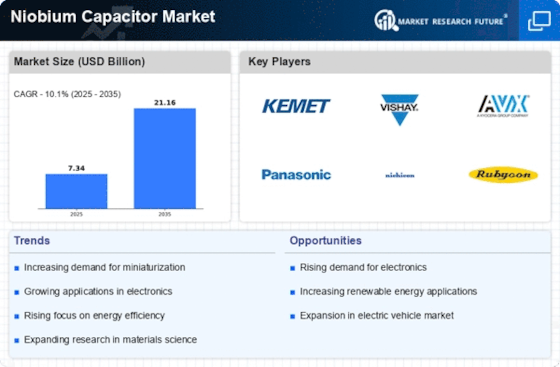
As per Market Research Future analysis, the Niobium Capacitor Market Size was estimated at 7.341 USD Billion in 2024. The Niobium Capacitor industry is projected to grow from 8.082 USD Billion in 2025 to 21.16 USD Billion by 2035, exhibiting a compound annual growth rate (CAGR) of 10.1% during the forecast period 2025 - 2035

Key Market Trends & Highlights

The Niobium Capacitor Market is poised for growth driven by technological advancements and increasing demand across various sectors.

  • Technological advancements are enhancing the performance and efficiency of niobium capacitors, particularly in consumer electronics. The Asia-Pacific region is emerging as the fastest-growing market, driven by rapid industrialization and increasing electronic manufacturing. Solid electrolytic capacitors remain the largest segment, while liquid electrolytic capacitors are experiencing the fastest growth due to their versatility. Rising demand for consumer electronics and advancements in automotive technology are key drivers propelling market expansion.

Market Size & Forecast

2024 Market Size 7.341 (USD Billion)
2035 Market Size 21.16 (USD Billion)
CAGR (2025 - 2035) 10.1%
Largest Regional Market Share in 2024 North America

Major Players

KEMET Corporation (US), Vishay Intertechnology, Inc. (US), AVX Corporation (US), Panasonic Corporation (JP), Nichicon Corporation (JP), Rubycon Corporation (JP), Taiyo Yuden Co., Ltd. (JP), Samsung Electro-Mechanics (KR), WIMA GmbH (DE)

Market Trends

The Niobium Capacitor Market is currently experiencing a notable evolution, driven by advancements in technology and increasing demand for high-performance electronic components. As industries such as automotive, telecommunications, and consumer electronics continue to expand, the need for reliable and efficient capacitors becomes paramount. Niobium capacitors, known for their superior performance in high-temperature and high-voltage applications, are gaining traction. This trend is further supported by the growing emphasis on miniaturization and energy efficiency in electronic devices, which necessitates the use of compact and reliable components. Moreover, the market appears to be influenced by a shift towards sustainable practices, with manufacturers exploring eco-friendly materials and production methods. This inclination towards sustainability may lead to innovations in niobium capacitor design and functionality, potentially enhancing their appeal in various applications. As the global landscape evolves, the Niobium Capacitor Market is poised for growth, reflecting broader trends in technology and environmental responsibility. The interplay of these factors suggests a dynamic future for niobium capacitors, with opportunities for both established players and new entrants in the market.

Technological Advancements

The Niobium Capacitor Market is witnessing rapid technological advancements that enhance performance and reliability. Innovations in materials and manufacturing processes are likely to improve the efficiency of niobium capacitors, making them more attractive for high-demand applications.

Sustainability Focus

There is a growing emphasis on sustainability within the Niobium Capacitor Market. Manufacturers are increasingly adopting eco-friendly practices and materials, which may lead to the development of more environmentally responsible products that appeal to conscious consumers.

Miniaturization Trends

The trend towards miniaturization in electronics is significantly impacting the Niobium Capacitor Market. As devices become smaller and more compact, the demand for high-performance capacitors that can fit into limited spaces is likely to increase, driving innovation in design.

Niobium Capacitor Market Market Drivers

Growth in Renewable Energy Sector

The Niobium Capacitor Market is poised to benefit from the expansion of the renewable energy sector. As nations increasingly invest in solar and wind energy, the demand for efficient energy storage solutions rises. Niobium capacitors, with their superior performance characteristics, are well-suited for applications in energy storage systems. The renewable energy market is expected to witness a significant increase, with estimates suggesting a growth rate of around 8% annually. This trend indicates a promising opportunity for the Niobium Capacitor Market, as manufacturers align their products with the needs of this evolving sector.

Increased Focus on Energy Efficiency

As industries and consumers alike become more conscious of energy consumption, the Niobium Capacitor Market is witnessing a shift towards energy-efficient components. Niobium capacitors offer lower equivalent series resistance (ESR) and higher thermal stability, making them ideal for applications where energy efficiency is paramount. This trend is particularly evident in sectors such as telecommunications and industrial automation, where energy costs are a significant concern. The market for energy-efficient components is projected to expand, potentially increasing the demand for niobium capacitors as companies seek to optimize their energy usage.

Advancements in Automotive Technology

The automotive industry is undergoing a transformation, with a notable shift towards electric vehicles (EVs) and advanced driver-assistance systems (ADAS). This evolution is creating a heightened demand for high-performance capacitors, including niobium capacitors, which are essential for managing power in these sophisticated systems. The Niobium Capacitor Market is likely to see increased adoption as automakers prioritize components that enhance vehicle efficiency and safety. Market projections suggest that the electric vehicle segment alone could grow by over 20% in the coming years, further driving the need for reliable capacitor solutions.

Rising Demand for Consumer Electronics

The Niobium Capacitor Market is experiencing a surge in demand driven by the increasing consumption of consumer electronics. As devices such as smartphones, tablets, and laptops become more prevalent, the need for efficient and reliable capacitors intensifies. Niobium capacitors, known for their high capacitance and stability, are particularly favored in these applications. Market data indicates that the consumer electronics sector is projected to grow at a compound annual growth rate of approximately 5% over the next few years. This growth is likely to bolster the Niobium Capacitor Market, as manufacturers seek components that can enhance performance and energy efficiency in their products.

Emerging Applications in Medical Devices

The medical device sector is increasingly incorporating advanced materials and technologies, leading to new applications for niobium capacitors. These capacitors are valued for their reliability and performance in critical medical equipment, such as imaging devices and implantable devices. The Niobium Capacitor Market is likely to see growth as healthcare providers demand components that ensure safety and efficacy. With the medical device market expected to grow at a rate of approximately 6% annually, the integration of niobium capacitors into these devices presents a significant opportunity for manufacturers to expand their reach and influence.

Market Segment Insights

By Product Type: Solid Electrolytic Capacitor (Largest) vs. Liquid Electrolytic Capacitor (Fastest-Growing)

In the Niobium Capacitor Market, Solid Electrolytic Capacitors hold a significant portion of the market share due to their high efficiency and reliability in various applications. They are favored in sectors that require stable performance and durability over time. In contrast, Liquid Electrolytic Capacitors are gaining traction as they provide high capacitance values suitable for demanding electronic circuits. The increasing adoption of these components across various industries contributes to their growing market share, even though they currently represent a smaller fraction compared to their solid counterparts.

Capacitor Type: Solid Electrolytic (Dominant) vs. Liquid Electrolytic (Emerging)

Solid Electrolytic Capacitors are recognized for their robust construction and minimal leakage current, making them ideal for high-performance applications like power supplies and automotive electronics. This dominance is driven by their low equivalent series resistance (ESR) and long lifespan, which appeals to manufacturers seeking reliability. On the other hand, Liquid Electrolytic Capacitors, while traditionally less preferred due to factors like size and potential leakage, are emerging as a compelling option in high-capacity applications. Their ability to deliver larger capacitance in compact designs positions them favorably in the evolving electronics landscape, attracting innovation and investment.

By Material: Niobium Oxide (Largest) vs. Niobium Powders (Fastest-Growing)

In the Niobium Capacitor Market, the material segment is characterized by a diverse range of applications and performance attributes. <a href="https://www.marketresearchfuture.com/reports/niobium-oxide-market-39605" target="_blank" title="niobium oxide">Niobium Oxide</a> currently dominates the market, capturing a significant share due to its superior capacitance and thermal stability. Niobium Pentoxide and Others hold smaller yet notable portions of the market, appealing to niche applications that prioritize different material properties. The comprehensive abilities of Niobium Oxide in high-frequency applications ensure its continued prominence in this competitive landscape. On the other hand, Niobium Powders are emerging rapidly, driven by increasing demand for lightweight and efficient capacitor solutions. The growing trend towards miniaturization in electronic devices fuels the adoption of these materials, pushing manufacturers to innovate in powder technology. As manufacturers aim for greater efficiency and reduced size, the demand for Niobium Powders is expected to accelerate significantly, creating new market dynamics and opportunities for key players.

Niobium Oxide (Dominant) vs. Niobium Powders (Emerging)

Niobium Oxide remains the dominant material in the Niobium Capacitor Market, attributed to its excellent performance in capacitance, thermal stability, and long operational life. Its unique properties enable superior performance in a variety of electronic applications, making it the preferred choice among manufacturers. In contrast, Niobium Powders represent an emerging segment, appealing to businesses looking for lightweight and compact solutions. These powders facilitate the fabrication of capacitors that can meet the demands of modern, miniaturized <a href="https://www.marketresearchfuture.com/reports/intelligent-electronic-devices-market-7390">electronic devices</a>. With advancements in powder processing technologies and increasing applications in portable electronics, Niobium Powders are well-positioned to capture a growing share of the market.

By Capacitance: 300-470µF (Largest) vs. 100-300µF (Fastest-Growing)

The Niobium Capacitor Market exhibits distinct market share distributions among capacitance segments, with the 300-470&micro;F range currently holding the largest share. This capacitance category appeals to various applications in consumer electronics and automotive sectors, driving its prominence. In contrast, the 100-300&micro;F segment has been gaining traction and represents the fastest-growing area, as manufacturers leverage advancements in technology to optimize performance in compact device applications.

300-470&micro;F (Dominant) vs. 100-300&micro;F (Emerging)

The 300-470&micro;F segment is characterized by its extensive utilization in mid-range capacitance applications, particularly in power management and signal coupling for electronic devices. Its dominance is attributed to the balance it strikes between size and performance, catering well to the needs of both high-performance consumer electronics and robust industrial applications. Conversely, the 100-300&micro;F range is emerging as a popular choice among manufacturers focusing on lightweight and compact solutions, spurred by the demand for energy-efficient designs in a market leaning towards miniaturization. This emerging segment is crucial as it adapts to trends of increased circuit density and the rising expectations for higher performance in smaller footprints.

By End-use Industry: Consumer Electronics (Largest) vs. Automotive (Fastest-Growing)

The Niobium Capacitor Market is witnessing significant distribution among various end-use industries. The consumer electronics sector holds the largest share, driven by the relentless demand for compact, efficient components in everyday devices. This segment benefits from the surging popularity of smartphones, laptops, and wearable electronics which continually necessitate advancements in capacitor technology. In contrast, the automotive industry, while smaller, is rapidly expanding as electric vehicles (EVs) become mainstream. The shift towards electrification and the need for energy-efficient solutions in vehicles are driving increased utilization of niobium capacitors in this sector.

Consumer Electronics (Dominant) vs. Automotive (Emerging)

In the Niobium Capacitor Market, the consumer electronics segment is characterized by its dominant position, thanks to the proliferation of devices requiring high-performance capacitors. These applications demand capacitors with excellent frequency stability and low leakage current, essential for powering digital circuits effectively. Meanwhile, the automotive segment, marked as emerging, is experiencing a transformative phase as manufacturers incorporate advanced electronic systems in vehicles for enhanced performance and efficiency. With the rise in electric and hybrid vehicles, the demand for niobium capacitors is projected to grow, driven by the need for improved energy storage solutions for power management systems, which marks a pivotal shift in automotive electronics.

Get more detailed insights about Niobium Capacitor Market Research Report—Global Forecast till 2035

Regional Insights

North America : Innovation and Demand Surge

North America is the largest market for niobium capacitors, holding approximately 40% of the global market share. The region's growth is driven by increasing demand in consumer electronics, automotive, and renewable energy sectors. Regulatory support for advanced technologies and sustainability initiatives further catalyzes market expansion. The presence of major manufacturers and a robust supply chain enhances the region's competitive edge. The United States is the leading country in this market, with significant contributions from companies like KEMET Corporation and Vishay Intertechnology. Canada also plays a vital role, focusing on innovation and research in capacitor technology. The competitive landscape is characterized by a mix of established players and emerging startups, fostering a dynamic environment for growth.

Europe : Regulatory Support and Growth

Europe is witnessing significant growth in the niobium capacitor market, accounting for approximately 30% of the global share. The region benefits from stringent regulations promoting energy efficiency and sustainability, which drive demand for advanced capacitor technologies. Countries like Germany and France are at the forefront, with increasing investments in electric vehicles and renewable energy solutions, further propelling market growth. Germany is the largest market in Europe, supported by key players such as WIMA GmbH and Panasonic Corporation. France and the UK also contribute significantly, focusing on innovation and technological advancements. The competitive landscape is marked by collaborations between manufacturers and research institutions, enhancing product development and market reach.

Asia-Pacific : Rapid Expansion and Innovation

Asia-Pacific is rapidly emerging as a powerhouse in the niobium capacitor market, holding around 25% of the global share. The region's growth is fueled by increasing demand from the electronics and automotive sectors, particularly in countries like Japan and South Korea. Government initiatives promoting technological advancements and manufacturing capabilities further enhance market dynamics, making it a key player in the global landscape. Japan leads the market, with major companies like Nichicon Corporation and Rubycon Corporation driving innovation. South Korea and China are also significant contributors, focusing on expanding their manufacturing capabilities. The competitive landscape is characterized by a mix of established firms and new entrants, fostering a vibrant ecosystem for growth and development.

Middle East and Africa : Untapped Potential and Growth

The Middle East and Africa region is gradually emerging in the niobium capacitor market, currently holding about 5% of the global share. The growth is primarily driven by increasing investments in infrastructure and technology, particularly in the Gulf Cooperation Council (GCC) countries. Regulatory frameworks are evolving to support technological advancements, which could further stimulate market growth in the coming years. Countries like the UAE and South Africa are leading the charge, focusing on enhancing their technological capabilities. The competitive landscape is still developing, with a few key players beginning to establish a foothold in the market. As the region continues to invest in technology and infrastructure, the potential for growth in the niobium capacitor market is significant.

Key Players and Competitive Insights

Leading market players are investing heavily in advanced technologies in order to expand their solutions and services, which will help the Niobium Capacitor Market, grow even more. Market participants are also undertaking a variety of strategic activities to expand their global footprint, with important market developments including new solution launches, contractual agreements, mergers and acquisitions, higher investments, and collaboration with other organizations. To expand and survive in a more competitive and rising market climate, Niobium Capacitor industry must offer cost-effective solutions.
Growing demand for automation in manufacturing, healthcare, and other tactics used by key players in the global Niobium Capacitor industry to benefit clients and increase the market sector. In recent years, the Niobium Capacitor industry has offered some of the most significant advantages to enterprises. Major players in the Niobium Capacitor Market, including AMG NV, AVX Corporation, Illinois Capacitor, Toshiba Corporation, CBMM, NioCorp Developments, JX Nippon Mining & Metals, MITSUI Mining & Smelting Co. Ltd., Murata Manufacturing Co., Ltd., Kyocera Corporation, are attempting to increase market demand by investing in research and development operations.
AVX Corporation is a globally recognized manufacturer and supplier of advanced electronic components and interconnect solutions. It offers an extensive product portfolio, including ceramic, tantalum, aluminum, and film capacitors. These components are crucial in a variety of applications, from energy storage and power management to signal filtering and electronic protection. It operates a global network of manufacturing facilities, research and development centers, and sales offices. This global presence enables the company to serve customers worldwide, catering to regional needs and ensuring timely delivery. It places a strong emphasis on innovation and research and development.
It continually invests in cutting-edge technologies and new product development, keeping pace with the ever-evolving electronic industry. This dedication to innovation has led to the creation of advanced components with improved performance and reliability. It collaborates with various global partners, including electronic component distributors and manufacturers. These partnerships extend the company's reach and ensure that its components are readily available to customers.
Murata Manufacturing Co., Ltd. is a globally renowned Japanese company that specializes in the design, manufacturing, and distribution of electronic components, modules, and solutions. It offers an extensive range of electronic components, including ceramic capacitors, inductors, resistors, sensors, wireless communication modules, and power supplies. These components play a vital role in various electronic applications, from smartphones and automotive systems to healthcare devices and industrial equipment. It operates a worldwide network of manufacturing facilities, research and development centers, and sales offices.
This global footprint allows the company to serve customers on a global scale, providing tailored solutions to meet regional needs and requirements. It deeply committed to sustainability and environmental responsibility. The company implements eco-friendly manufacturing practices, such as energy-efficient operations, waste reduction, and compliance with environmental regulations. Murata's dedication to sustainability extends to its product development, with a focus on creating energy-efficient components.

Key Companies in the Niobium Capacitor Market include

Industry Developments

May 2021: Auxico Resources Canada Inc. became a member of the Tantalum-Niobium International Study Centre. The organization includes 80 member companies from over 30 countries involved in the entire value chain of tantalum and niobium products. TIC membership provides Auxico Resources with valuable industry insights, market information, and access to research and data related to tantalum and niobium.

February 2020: AVX Corporation launched an updated version of the SpiCAT Online Simulation Tool. The tool is widely used for accurate parametric characterization of the niobium oxide capacitors. The latest update increases reliability and enhances multi-functionality across domains.

Future Outlook

Niobium Capacitor Market Future Outlook

The Niobium Capacitor Market is projected to grow at a 10.1% CAGR from 2025 to 2035, driven by increasing demand for high-performance electronics and renewable energy applications.

New opportunities lie in:

  • Development of specialized niobium capacitor solutions for electric vehicles.
  • Expansion into emerging markets with tailored product offerings.
  • Investment in R&amp;D for advanced materials to enhance capacitor efficiency.

By 2035, the Niobium Capacitor Market is expected to achieve substantial growth and innovation.

Market Segmentation

Niobium Capacitor Market Material Outlook

  • Niobium Oxide
  • Niobium Pentoxide
  • Niobium Powders
  • Others

Niobium Capacitor Market Capacitance Outlook

  • 10-100µF
  • 100-300µF
  • 300-470µF
  • Above 470µF

Niobium Capacitor Market Product Type Outlook

  • Solid Electrolytic Capacitor
  • Liquid Electrolytic Capacitor

Niobium Capacitor Market End-use Industry Outlook

  • Consumer Electronics
  • Automotive
  • Industrial
  • Aerospace and Defense
  • Power and Energy
  • Others

Report Scope

MARKET SIZE 2024 7.341(USD Billion)
MARKET SIZE 2025 8.082(USD Billion)
MARKET SIZE 2035 21.16(USD Billion)
COMPOUND ANNUAL GROWTH RATE (CAGR) 10.1% (2025 - 2035)
REPORT COVERAGE Revenue Forecast, Competitive Landscape, Growth Factors, and Trends
BASE YEAR 2024
Market Forecast Period 2025 - 2035
Historical Data 2019 - 2024
Market Forecast Units USD Billion
Key Companies Profiled KEMET Corporation (US), Vishay Intertechnology, Inc. (US), AVX Corporation (US), Panasonic Corporation (JP), Nichicon Corporation (JP), Rubycon Corporation (JP), Taiyo Yuden Co., Ltd. (JP), Samsung Electro-Mechanics (KR), WIMA GmbH (DE)
Segments Covered Product Type, Material, Capacitance, End-use Industry, Region
Key Market Opportunities Growing demand for high-performance electronics drives innovation in the Niobium Capacitor Market.
Key Market Dynamics Rising demand for compact electronic devices drives innovation and competition in the niobium capacitor market.
Countries Covered North America, Europe, APAC, South America, MEA

FAQs

What is the projected market valuation of the Niobium Capacitor Market by 2035?

<p>The Niobium Capacitor Market is projected to reach a valuation of 21.16 USD Billion by 2035.</p>

What was the market valuation of the Niobium Capacitor Market in 2024?

<p>In 2024, the Niobium Capacitor Market was valued at 7.341 USD Billion.</p>

What is the expected CAGR for the Niobium Capacitor Market during the forecast period 2025 - 2035?

<p>The expected CAGR for the Niobium Capacitor Market during the forecast period 2025 - 2035 is 10.1%.</p>

Which product type segment had the highest valuation in 2024?

<p>The Solid Electrolytic Capacitor segment had a valuation of 3.5 USD Billion in 2024.</p>

What are the key materials used in Niobium Capacitors?

<p>Key materials include Niobium Oxide, Niobium Pentoxide, and Niobium Powders, with respective valuations in 2024 of 1.5 USD Billion, 2.0 USD Billion, and 1.0 USD Billion.</p>

Which end-use industry is expected to drive growth in the Niobium Capacitor Market?

<p>The Consumer Electronics industry is expected to drive growth, with a valuation of 1.5 USD Billion in 2024.</p>

Who are the leading players in the Niobium Capacitor Market?

Key players include KEMET Corporation, Vishay Intertechnology, Inc., and Panasonic Corporation.

What is the projected growth for the Liquid Electrolytic Capacitor segment by 2035?

The Liquid Electrolytic Capacitor segment is projected to grow from 3.841 USD Billion in 2024 to 10.66 USD Billion by 2035.

How does the capacitance segment of 100-300µF perform in the market?

The 100-300µF capacitance segment had a valuation of 2.0 USD Billion in 2024 and is expected to grow significantly.

What is the potential market size for the Aerospace and Defense sector in 2035?

The Aerospace and Defense sector is projected to reach a market size of 2.4 USD Billion by 2035.

  1. SECTION I: EXECUTIVE SUMMARY AND KEY HIGHLIGHTS
    1. | 1.1 EXECUTIVE SUMMARY
    2. | | 1.1.1 Market Overview
    3. | | 1.1.2 Key Findings
    4. | | 1.1.3 Market Segmentation
    5. | | 1.1.4 Competitive Landscape
    6. | | 1.1.5 Challenges and Opportunities
    7. | | 1.1.6 Future Outlook
  2. SECTION II: SCOPING, METHODOLOGY AND MARKET STRUCTURE
    1. | 2.1 MARKET INTRODUCTION
    2. | | 2.1.1 Definition
    3. | | 2.1.2 Scope of the study
    4. | | | 2.1.2.1 Research Objective
    5. | | | 2.1.2.2 Assumption
    6. | | | 2.1.2.3 Limitations
    7. | 2.2 RESEARCH METHODOLOGY
    8. | | 2.2.1 Overview
    9. | | 2.2.2 Data Mining
    10. | | 2.2.3 Secondary Research
    11. | | 2.2.4 Primary Research
    12. | | | 2.2.4.1 Primary Interviews and Information Gathering Process
    13. | | | 2.2.4.2 Breakdown of Primary Respondents
    14. | | 2.2.5 Forecasting Model
    15. | | 2.2.6 Market Size Estimation
    16. | | | 2.2.6.1 Bottom-Up Approach
    17. | | | 2.2.6.2 Top-Down Approach
    18. | | 2.2.7 Data Triangulation
    19. | | 2.2.8 Validation
  3. SECTION III: QUALITATIVE ANALYSIS
    1. | 3.1 MARKET DYNAMICS
    2. | | 3.1.1 Overview
    3. | | 3.1.2 Drivers
    4. | | 3.1.3 Restraints
    5. | | 3.1.4 Opportunities
    6. | 3.2 MARKET FACTOR ANALYSIS
    7. | | 3.2.1 Value chain Analysis
    8. | | 3.2.2 Porter's Five Forces Analysis
    9. | | | 3.2.2.1 Bargaining Power of Suppliers
    10. | | | 3.2.2.2 Bargaining Power of Buyers
    11. | | | 3.2.2.3 Threat of New Entrants
    12. | | | 3.2.2.4 Threat of Substitutes
    13. | | | 3.2.2.5 Intensity of Rivalry
    14. | | 3.2.3 COVID-19 Impact Analysis
    15. | | | 3.2.3.1 Market Impact Analysis
    16. | | | 3.2.3.2 Regional Impact
    17. | | | 3.2.3.3 Opportunity and Threat Analysis
  4. SECTION IV: QUANTITATIVE ANALYSIS
    1. | 4.1 Semiconductor & Electronics, BY Product Type (USD Billion)
    2. | | 4.1.1 Solid Electrolytic Capacitor
    3. | | 4.1.2 Liquid Electrolytic Capacitor
    4. | 4.2 Semiconductor & Electronics, BY Material (USD Billion)
    5. | | 4.2.1 Niobium Oxide
    6. | | 4.2.2 Niobium Pentoxide
    7. | | 4.2.3 Niobium Powders
    8. | | 4.2.4 Others
    9. | 4.3 Semiconductor & Electronics, BY Capacitance (USD Billion)
    10. | | 4.3.1 10-100µF
    11. | | 4.3.2 100-300µF
    12. | | 4.3.3 300-470µF
    13. | | 4.3.4 Above 470µF
    14. | 4.4 Semiconductor & Electronics, BY End-use Industry (USD Billion)
    15. | | 4.4.1 Consumer Electronics
    16. | | 4.4.2 Automotive
    17. | | 4.4.3 Industrial
    18. | | 4.4.4 Aerospace and Defense
    19. | | 4.4.5 Power and Energy
    20. | | 4.4.6 Others
    21. | 4.5 Semiconductor & Electronics, BY Region (USD Billion)
    22. | | 4.5.1 North America
    23. | | | 4.5.1.1 US
    24. | | | 4.5.1.2 Canada
    25. | | 4.5.2 Europe
    26. | | | 4.5.2.1 Germany
    27. | | | 4.5.2.2 UK
    28. | | | 4.5.2.3 France
    29. | | | 4.5.2.4 Russia
    30. | | | 4.5.2.5 Italy
    31. | | | 4.5.2.6 Spain
    32. | | | 4.5.2.7 Rest of Europe
    33. | | 4.5.3 APAC
    34. | | | 4.5.3.1 China
    35. | | | 4.5.3.2 India
    36. | | | 4.5.3.3 Japan
    37. | | | 4.5.3.4 South Korea
    38. | | | 4.5.3.5 Malaysia
    39. | | | 4.5.3.6 Thailand
    40. | | | 4.5.3.7 Indonesia
    41. | | | 4.5.3.8 Rest of APAC
    42. | | 4.5.4 South America
    43. | | | 4.5.4.1 Brazil
    44. | | | 4.5.4.2 Mexico
    45. | | | 4.5.4.3 Argentina
    46. | | | 4.5.4.4 Rest of South America
    47. | | 4.5.5 MEA
    48. | | | 4.5.5.1 GCC Countries
    49. | | | 4.5.5.2 South Africa
    50. | | | 4.5.5.3 Rest of MEA
  5. SECTION V: COMPETITIVE ANALYSIS
    1. | 5.1 Competitive Landscape
    2. | | 5.1.1 Overview
    3. | | 5.1.2 Competitive Analysis
    4. | | 5.1.3 Market share Analysis
    5. | | 5.1.4 Major Growth Strategy in the Semiconductor & Electronics
    6. | | 5.1.5 Competitive Benchmarking
    7. | | 5.1.6 Leading Players in Terms of Number of Developments in the Semiconductor & Electronics
    8. | | 5.1.7 Key developments and growth strategies
    9. | | | 5.1.7.1 New Product Launch/Service Deployment
    10. | | | 5.1.7.2 Merger & Acquisitions
    11. | | | 5.1.7.3 Joint Ventures
    12. | | 5.1.8 Major Players Financial Matrix
    13. | | | 5.1.8.1 Sales and Operating Income
    14. | | | 5.1.8.2 Major Players R&D Expenditure. 2023
    15. | 5.2 Company Profiles
    16. | | 5.2.1 KEMET Corporation (US)
    17. | | | 5.2.1.1 Financial Overview
    18. | | | 5.2.1.2 Products Offered
    19. | | | 5.2.1.3 Key Developments
    20. | | | 5.2.1.4 SWOT Analysis
    21. | | | 5.2.1.5 Key Strategies
    22. | | 5.2.2 Vishay Intertechnology, Inc. (US)
    23. | | | 5.2.2.1 Financial Overview
    24. | | | 5.2.2.2 Products Offered
    25. | | | 5.2.2.3 Key Developments
    26. | | | 5.2.2.4 SWOT Analysis
    27. | | | 5.2.2.5 Key Strategies
    28. | | 5.2.3 AVX Corporation (US)
    29. | | | 5.2.3.1 Financial Overview
    30. | | | 5.2.3.2 Products Offered
    31. | | | 5.2.3.3 Key Developments
    32. | | | 5.2.3.4 SWOT Analysis
    33. | | | 5.2.3.5 Key Strategies
    34. | | 5.2.4 Panasonic Corporation (JP)
    35. | | | 5.2.4.1 Financial Overview
    36. | | | 5.2.4.2 Products Offered
    37. | | | 5.2.4.3 Key Developments
    38. | | | 5.2.4.4 SWOT Analysis
    39. | | | 5.2.4.5 Key Strategies
    40. | | 5.2.5 Nichicon Corporation (JP)
    41. | | | 5.2.5.1 Financial Overview
    42. | | | 5.2.5.2 Products Offered
    43. | | | 5.2.5.3 Key Developments
    44. | | | 5.2.5.4 SWOT Analysis
    45. | | | 5.2.5.5 Key Strategies
    46. | | 5.2.6 Rubycon Corporation (JP)
    47. | | | 5.2.6.1 Financial Overview
    48. | | | 5.2.6.2 Products Offered
    49. | | | 5.2.6.3 Key Developments
    50. | | | 5.2.6.4 SWOT Analysis
    51. | | | 5.2.6.5 Key Strategies
    52. | | 5.2.7 Taiyo Yuden Co., Ltd. (JP)
    53. | | | 5.2.7.1 Financial Overview
    54. | | | 5.2.7.2 Products Offered
    55. | | | 5.2.7.3 Key Developments
    56. | | | 5.2.7.4 SWOT Analysis
    57. | | | 5.2.7.5 Key Strategies
    58. | | 5.2.8 Samsung Electro-Mechanics (KR)
    59. | | | 5.2.8.1 Financial Overview
    60. | | | 5.2.8.2 Products Offered
    61. | | | 5.2.8.3 Key Developments
    62. | | | 5.2.8.4 SWOT Analysis
    63. | | | 5.2.8.5 Key Strategies
    64. | | 5.2.9 WIMA GmbH (DE)
    65. | | | 5.2.9.1 Financial Overview
    66. | | | 5.2.9.2 Products Offered
    67. | | | 5.2.9.3 Key Developments
    68. | | | 5.2.9.4 SWOT Analysis
    69. | | | 5.2.9.5 Key Strategies
    70. | 5.3 Appendix
    71. | | 5.3.1 References
    72. | | 5.3.2 Related Reports
  6. LIST OF FIGURES
    1. | 6.1 MARKET SYNOPSIS
    2. | 6.2 NORTH AMERICA MARKET ANALYSIS
    3. | 6.3 US MARKET ANALYSIS BY PRODUCT TYPE
    4. | 6.4 US MARKET ANALYSIS BY MATERIAL
    5. | 6.5 US MARKET ANALYSIS BY CAPACITANCE
    6. | 6.6 US MARKET ANALYSIS BY END-USE INDUSTRY
    7. | 6.7 CANADA MARKET ANALYSIS BY PRODUCT TYPE
    8. | 6.8 CANADA MARKET ANALYSIS BY MATERIAL
    9. | 6.9 CANADA MARKET ANALYSIS BY CAPACITANCE
    10. | 6.10 CANADA MARKET ANALYSIS BY END-USE INDUSTRY
    11. | 6.11 EUROPE MARKET ANALYSIS
    12. | 6.12 GERMANY MARKET ANALYSIS BY PRODUCT TYPE
    13. | 6.13 GERMANY MARKET ANALYSIS BY MATERIAL
    14. | 6.14 GERMANY MARKET ANALYSIS BY CAPACITANCE
    15. | 6.15 GERMANY MARKET ANALYSIS BY END-USE INDUSTRY
    16. | 6.16 UK MARKET ANALYSIS BY PRODUCT TYPE
    17. | 6.17 UK MARKET ANALYSIS BY MATERIAL
    18. | 6.18 UK MARKET ANALYSIS BY CAPACITANCE
    19. | 6.19 UK MARKET ANALYSIS BY END-USE INDUSTRY
    20. | 6.20 FRANCE MARKET ANALYSIS BY PRODUCT TYPE
    21. | 6.21 FRANCE MARKET ANALYSIS BY MATERIAL
    22. | 6.22 FRANCE MARKET ANALYSIS BY CAPACITANCE
    23. | 6.23 FRANCE MARKET ANALYSIS BY END-USE INDUSTRY
    24. | 6.24 RUSSIA MARKET ANALYSIS BY PRODUCT TYPE
    25. | 6.25 RUSSIA MARKET ANALYSIS BY MATERIAL
    26. | 6.26 RUSSIA MARKET ANALYSIS BY CAPACITANCE
    27. | 6.27 RUSSIA MARKET ANALYSIS BY END-USE INDUSTRY
    28. | 6.28 ITALY MARKET ANALYSIS BY PRODUCT TYPE
    29. | 6.29 ITALY MARKET ANALYSIS BY MATERIAL
    30. | 6.30 ITALY MARKET ANALYSIS BY CAPACITANCE
    31. | 6.31 ITALY MARKET ANALYSIS BY END-USE INDUSTRY
    32. | 6.32 SPAIN MARKET ANALYSIS BY PRODUCT TYPE
    33. | 6.33 SPAIN MARKET ANALYSIS BY MATERIAL
    34. | 6.34 SPAIN MARKET ANALYSIS BY CAPACITANCE
    35. | 6.35 SPAIN MARKET ANALYSIS BY END-USE INDUSTRY
    36. | 6.36 REST OF EUROPE MARKET ANALYSIS BY PRODUCT TYPE
    37. | 6.37 REST OF EUROPE MARKET ANALYSIS BY MATERIAL
    38. | 6.38 REST OF EUROPE MARKET ANALYSIS BY CAPACITANCE
    39. | 6.39 REST OF EUROPE MARKET ANALYSIS BY END-USE INDUSTRY
    40. | 6.40 APAC MARKET ANALYSIS
    41. | 6.41 CHINA MARKET ANALYSIS BY PRODUCT TYPE
    42. | 6.42 CHINA MARKET ANALYSIS BY MATERIAL
    43. | 6.43 CHINA MARKET ANALYSIS BY CAPACITANCE
    44. | 6.44 CHINA MARKET ANALYSIS BY END-USE INDUSTRY
    45. | 6.45 INDIA MARKET ANALYSIS BY PRODUCT TYPE
    46. | 6.46 INDIA MARKET ANALYSIS BY MATERIAL
    47. | 6.47 INDIA MARKET ANALYSIS BY CAPACITANCE
    48. | 6.48 INDIA MARKET ANALYSIS BY END-USE INDUSTRY
    49. | 6.49 JAPAN MARKET ANALYSIS BY PRODUCT TYPE
    50. | 6.50 JAPAN MARKET ANALYSIS BY MATERIAL
    51. | 6.51 JAPAN MARKET ANALYSIS BY CAPACITANCE
    52. | 6.52 JAPAN MARKET ANALYSIS BY END-USE INDUSTRY
    53. | 6.53 SOUTH KOREA MARKET ANALYSIS BY PRODUCT TYPE
    54. | 6.54 SOUTH KOREA MARKET ANALYSIS BY MATERIAL
    55. | 6.55 SOUTH KOREA MARKET ANALYSIS BY CAPACITANCE
    56. | 6.56 SOUTH KOREA MARKET ANALYSIS BY END-USE INDUSTRY
    57. | 6.57 MALAYSIA MARKET ANALYSIS BY PRODUCT TYPE
    58. | 6.58 MALAYSIA MARKET ANALYSIS BY MATERIAL
    59. | 6.59 MALAYSIA MARKET ANALYSIS BY CAPACITANCE
    60. | 6.60 MALAYSIA MARKET ANALYSIS BY END-USE INDUSTRY
    61. | 6.61 THAILAND MARKET ANALYSIS BY PRODUCT TYPE
    62. | 6.62 THAILAND MARKET ANALYSIS BY MATERIAL
    63. | 6.63 THAILAND MARKET ANALYSIS BY CAPACITANCE
    64. | 6.64 THAILAND MARKET ANALYSIS BY END-USE INDUSTRY
    65. | 6.65 INDONESIA MARKET ANALYSIS BY PRODUCT TYPE
    66. | 6.66 INDONESIA MARKET ANALYSIS BY MATERIAL
    67. | 6.67 INDONESIA MARKET ANALYSIS BY CAPACITANCE
    68. | 6.68 INDONESIA MARKET ANALYSIS BY END-USE INDUSTRY
    69. | 6.69 REST OF APAC MARKET ANALYSIS BY PRODUCT TYPE
    70. | 6.70 REST OF APAC MARKET ANALYSIS BY MATERIAL
    71. | 6.71 REST OF APAC MARKET ANALYSIS BY CAPACITANCE
    72. | 6.72 REST OF APAC MARKET ANALYSIS BY END-USE INDUSTRY
    73. | 6.73 SOUTH AMERICA MARKET ANALYSIS
    74. | 6.74 BRAZIL MARKET ANALYSIS BY PRODUCT TYPE
    75. | 6.75 BRAZIL MARKET ANALYSIS BY MATERIAL
    76. | 6.76 BRAZIL MARKET ANALYSIS BY CAPACITANCE
    77. | 6.77 BRAZIL MARKET ANALYSIS BY END-USE INDUSTRY
    78. | 6.78 MEXICO MARKET ANALYSIS BY PRODUCT TYPE
    79. | 6.79 MEXICO MARKET ANALYSIS BY MATERIAL
    80. | 6.80 MEXICO MARKET ANALYSIS BY CAPACITANCE
    81. | 6.81 MEXICO MARKET ANALYSIS BY END-USE INDUSTRY
    82. | 6.82 ARGENTINA MARKET ANALYSIS BY PRODUCT TYPE
    83. | 6.83 ARGENTINA MARKET ANALYSIS BY MATERIAL
    84. | 6.84 ARGENTINA MARKET ANALYSIS BY CAPACITANCE
    85. | 6.85 ARGENTINA MARKET ANALYSIS BY END-USE INDUSTRY
    86. | 6.86 REST OF SOUTH AMERICA MARKET ANALYSIS BY PRODUCT TYPE
    87. | 6.87 REST OF SOUTH AMERICA MARKET ANALYSIS BY MATERIAL
    88. | 6.88 REST OF SOUTH AMERICA MARKET ANALYSIS BY CAPACITANCE
    89. | 6.89 REST OF SOUTH AMERICA MARKET ANALYSIS BY END-USE INDUSTRY
    90. | 6.90 MEA MARKET ANALYSIS
    91. | 6.91 GCC COUNTRIES MARKET ANALYSIS BY PRODUCT TYPE
    92. | 6.92 GCC COUNTRIES MARKET ANALYSIS BY MATERIAL
    93. | 6.93 GCC COUNTRIES MARKET ANALYSIS BY CAPACITANCE
    94. | 6.94 GCC COUNTRIES MARKET ANALYSIS BY END-USE INDUSTRY
    95. | 6.95 SOUTH AFRICA MARKET ANALYSIS BY PRODUCT TYPE
    96. | 6.96 SOUTH AFRICA MARKET ANALYSIS BY MATERIAL
    97. | 6.97 SOUTH AFRICA MARKET ANALYSIS BY CAPACITANCE
    98. | 6.98 SOUTH AFRICA MARKET ANALYSIS BY END-USE INDUSTRY
    99. | 6.99 REST OF MEA MARKET ANALYSIS BY PRODUCT TYPE
    100. | 6.100 REST OF MEA MARKET ANALYSIS BY MATERIAL
    101. | 6.101 REST OF MEA MARKET ANALYSIS BY CAPACITANCE
    102. | 6.102 REST OF MEA MARKET ANALYSIS BY END-USE INDUSTRY
    103. | 6.103 KEY BUYING CRITERIA OF SEMICONDUCTOR & ELECTRONICS
    104. | 6.104 RESEARCH PROCESS OF MRFR
    105. | 6.105 DRO ANALYSIS OF SEMICONDUCTOR & ELECTRONICS
    106. | 6.106 DRIVERS IMPACT ANALYSIS: SEMICONDUCTOR & ELECTRONICS
    107. | 6.107 RESTRAINTS IMPACT ANALYSIS: SEMICONDUCTOR & ELECTRONICS
    108. | 6.108 SUPPLY / VALUE CHAIN: SEMICONDUCTOR & ELECTRONICS
    109. | 6.109 SEMICONDUCTOR & ELECTRONICS, BY PRODUCT TYPE, 2024 (% SHARE)
    110. | 6.110 SEMICONDUCTOR & ELECTRONICS, BY PRODUCT TYPE, 2024 TO 2035 (USD Billion)
    111. | 6.111 SEMICONDUCTOR & ELECTRONICS, BY MATERIAL, 2024 (% SHARE)
    112. | 6.112 SEMICONDUCTOR & ELECTRONICS, BY MATERIAL, 2024 TO 2035 (USD Billion)
    113. | 6.113 SEMICONDUCTOR & ELECTRONICS, BY CAPACITANCE, 2024 (% SHARE)
    114. | 6.114 SEMICONDUCTOR & ELECTRONICS, BY CAPACITANCE, 2024 TO 2035 (USD Billion)
    115. | 6.115 SEMICONDUCTOR & ELECTRONICS, BY END-USE INDUSTRY, 2024 (% SHARE)
    116. | 6.116 SEMICONDUCTOR & ELECTRONICS, BY END-USE INDUSTRY, 2024 TO 2035 (USD Billion)
    117. | 6.117 BENCHMARKING OF MAJOR COMPETITORS
  7. LIST OF TABLES
    1. | 7.1 LIST OF ASSUMPTIONS
    2. | | 7.1.1
    3. | 7.2 North America MARKET SIZE ESTIMATES; FORECAST
    4. | | 7.2.1 BY PRODUCT TYPE, 2025-2035 (USD Billion)
    5. | | 7.2.2 BY MATERIAL, 2025-2035 (USD Billion)
    6. | | 7.2.3 BY CAPACITANCE, 2025-2035 (USD Billion)
    7. | | 7.2.4 BY END-USE INDUSTRY, 2025-2035 (USD Billion)
    8. | 7.3 US MARKET SIZE ESTIMATES; FORECAST
    9. | | 7.3.1 BY PRODUCT TYPE, 2025-2035 (USD Billion)
    10. | | 7.3.2 BY MATERIAL, 2025-2035 (USD Billion)
    11. | | 7.3.3 BY CAPACITANCE, 2025-2035 (USD Billion)
    12. | | 7.3.4 BY END-USE INDUSTRY, 2025-2035 (USD Billion)
    13. | 7.4 Canada MARKET SIZE ESTIMATES; FORECAST
    14. | | 7.4.1 BY PRODUCT TYPE, 2025-2035 (USD Billion)
    15. | | 7.4.2 BY MATERIAL, 2025-2035 (USD Billion)
    16. | | 7.4.3 BY CAPACITANCE, 2025-2035 (USD Billion)
    17. | | 7.4.4 BY END-USE INDUSTRY, 2025-2035 (USD Billion)
    18. | 7.5 Europe MARKET SIZE ESTIMATES; FORECAST
    19. | | 7.5.1 BY PRODUCT TYPE, 2025-2035 (USD Billion)
    20. | | 7.5.2 BY MATERIAL, 2025-2035 (USD Billion)
    21. | | 7.5.3 BY CAPACITANCE, 2025-2035 (USD Billion)
    22. | | 7.5.4 BY END-USE INDUSTRY, 2025-2035 (USD Billion)
    23. | 7.6 Germany MARKET SIZE ESTIMATES; FORECAST
    24. | | 7.6.1 BY PRODUCT TYPE, 2025-2035 (USD Billion)
    25. | | 7.6.2 BY MATERIAL, 2025-2035 (USD Billion)
    26. | | 7.6.3 BY CAPACITANCE, 2025-2035 (USD Billion)
    27. | | 7.6.4 BY END-USE INDUSTRY, 2025-2035 (USD Billion)
    28. | 7.7 UK MARKET SIZE ESTIMATES; FORECAST
    29. | | 7.7.1 BY PRODUCT TYPE, 2025-2035 (USD Billion)
    30. | | 7.7.2 BY MATERIAL, 2025-2035 (USD Billion)
    31. | | 7.7.3 BY CAPACITANCE, 2025-2035 (USD Billion)
    32. | | 7.7.4 BY END-USE INDUSTRY, 2025-2035 (USD Billion)
    33. | 7.8 France MARKET SIZE ESTIMATES; FORECAST
    34. | | 7.8.1 BY PRODUCT TYPE, 2025-2035 (USD Billion)
    35. | | 7.8.2 BY MATERIAL, 2025-2035 (USD Billion)
    36. | | 7.8.3 BY CAPACITANCE, 2025-2035 (USD Billion)
    37. | | 7.8.4 BY END-USE INDUSTRY, 2025-2035 (USD Billion)
    38. | 7.9 Russia MARKET SIZE ESTIMATES; FORECAST
    39. | | 7.9.1 BY PRODUCT TYPE, 2025-2035 (USD Billion)
    40. | | 7.9.2 BY MATERIAL, 2025-2035 (USD Billion)
    41. | | 7.9.3 BY CAPACITANCE, 2025-2035 (USD Billion)
    42. | | 7.9.4 BY END-USE INDUSTRY, 2025-2035 (USD Billion)
    43. | 7.10 Italy MARKET SIZE ESTIMATES; FORECAST
    44. | | 7.10.1 BY PRODUCT TYPE, 2025-2035 (USD Billion)
    45. | | 7.10.2 BY MATERIAL, 2025-2035 (USD Billion)
    46. | | 7.10.3 BY CAPACITANCE, 2025-2035 (USD Billion)
    47. | | 7.10.4 BY END-USE INDUSTRY, 2025-2035 (USD Billion)
    48. | 7.11 Spain MARKET SIZE ESTIMATES; FORECAST
    49. | | 7.11.1 BY PRODUCT TYPE, 2025-2035 (USD Billion)
    50. | | 7.11.2 BY MATERIAL, 2025-2035 (USD Billion)
    51. | | 7.11.3 BY CAPACITANCE, 2025-2035 (USD Billion)
    52. | | 7.11.4 BY END-USE INDUSTRY, 2025-2035 (USD Billion)
    53. | 7.12 Rest of Europe MARKET SIZE ESTIMATES; FORECAST
    54. | | 7.12.1 BY PRODUCT TYPE, 2025-2035 (USD Billion)
    55. | | 7.12.2 BY MATERIAL, 2025-2035 (USD Billion)
    56. | | 7.12.3 BY CAPACITANCE, 2025-2035 (USD Billion)
    57. | | 7.12.4 BY END-USE INDUSTRY, 2025-2035 (USD Billion)
    58. | 7.13 APAC MARKET SIZE ESTIMATES; FORECAST
    59. | | 7.13.1 BY PRODUCT TYPE, 2025-2035 (USD Billion)
    60. | | 7.13.2 BY MATERIAL, 2025-2035 (USD Billion)
    61. | | 7.13.3 BY CAPACITANCE, 2025-2035 (USD Billion)
    62. | | 7.13.4 BY END-USE INDUSTRY, 2025-2035 (USD Billion)
    63. | 7.14 China MARKET SIZE ESTIMATES; FORECAST
    64. | | 7.14.1 BY PRODUCT TYPE, 2025-2035 (USD Billion)
    65. | | 7.14.2 BY MATERIAL, 2025-2035 (USD Billion)
    66. | | 7.14.3 BY CAPACITANCE, 2025-2035 (USD Billion)
    67. | | 7.14.4 BY END-USE INDUSTRY, 2025-2035 (USD Billion)
    68. | 7.15 India MARKET SIZE ESTIMATES; FORECAST
    69. | | 7.15.1 BY PRODUCT TYPE, 2025-2035 (USD Billion)
    70. | | 7.15.2 BY MATERIAL, 2025-2035 (USD Billion)
    71. | | 7.15.3 BY CAPACITANCE, 2025-2035 (USD Billion)
    72. | | 7.15.4 BY END-USE INDUSTRY, 2025-2035 (USD Billion)
    73. | 7.16 Japan MARKET SIZE ESTIMATES; FORECAST
    74. | | 7.16.1 BY PRODUCT TYPE, 2025-2035 (USD Billion)
    75. | | 7.16.2 BY MATERIAL, 2025-2035 (USD Billion)
    76. | | 7.16.3 BY CAPACITANCE, 2025-2035 (USD Billion)
    77. | | 7.16.4 BY END-USE INDUSTRY, 2025-2035 (USD Billion)
    78. | 7.17 South Korea MARKET SIZE ESTIMATES; FORECAST
    79. | | 7.17.1 BY PRODUCT TYPE, 2025-2035 (USD Billion)
    80. | | 7.17.2 BY MATERIAL, 2025-2035 (USD Billion)
    81. | | 7.17.3 BY CAPACITANCE, 2025-2035 (USD Billion)
    82. | | 7.17.4 BY END-USE INDUSTRY, 2025-2035 (USD Billion)
    83. | 7.18 Malaysia MARKET SIZE ESTIMATES; FORECAST
    84. | | 7.18.1 BY PRODUCT TYPE, 2025-2035 (USD Billion)
    85. | | 7.18.2 BY MATERIAL, 2025-2035 (USD Billion)
    86. | | 7.18.3 BY CAPACITANCE, 2025-2035 (USD Billion)
    87. | | 7.18.4 BY END-USE INDUSTRY, 2025-2035 (USD Billion)
    88. | 7.19 Thailand MARKET SIZE ESTIMATES; FORECAST
    89. | | 7.19.1 BY PRODUCT TYPE, 2025-2035 (USD Billion)
    90. | | 7.19.2 BY MATERIAL, 2025-2035 (USD Billion)
    91. | | 7.19.3 BY CAPACITANCE, 2025-2035 (USD Billion)
    92. | | 7.19.4 BY END-USE INDUSTRY, 2025-2035 (USD Billion)
    93. | 7.20 Indonesia MARKET SIZE ESTIMATES; FORECAST
    94. | | 7.20.1 BY PRODUCT TYPE, 2025-2035 (USD Billion)
    95. | | 7.20.2 BY MATERIAL, 2025-2035 (USD Billion)
    96. | | 7.20.3 BY CAPACITANCE, 2025-2035 (USD Billion)
    97. | | 7.20.4 BY END-USE INDUSTRY, 2025-2035 (USD Billion)
    98. | 7.21 Rest of APAC MARKET SIZE ESTIMATES; FORECAST
    99. | | 7.21.1 BY PRODUCT TYPE, 2025-2035 (USD Billion)
    100. | | 7.21.2 BY MATERIAL, 2025-2035 (USD Billion)
    101. | | 7.21.3 BY CAPACITANCE, 2025-2035 (USD Billion)
    102. | | 7.21.4 BY END-USE INDUSTRY, 2025-2035 (USD Billion)
    103. | 7.22 South America MARKET SIZE ESTIMATES; FORECAST
    104. | | 7.22.1 BY PRODUCT TYPE, 2025-2035 (USD Billion)
    105. | | 7.22.2 BY MATERIAL, 2025-2035 (USD Billion)
    106. | | 7.22.3 BY CAPACITANCE, 2025-2035 (USD Billion)
    107. | | 7.22.4 BY END-USE INDUSTRY, 2025-2035 (USD Billion)
    108. | 7.23 Brazil MARKET SIZE ESTIMATES; FORECAST
    109. | | 7.23.1 BY PRODUCT TYPE, 2025-2035 (USD Billion)
    110. | | 7.23.2 BY MATERIAL, 2025-2035 (USD Billion)
    111. | | 7.23.3 BY CAPACITANCE, 2025-2035 (USD Billion)
    112. | | 7.23.4 BY END-USE INDUSTRY, 2025-2035 (USD Billion)
    113. | 7.24 Mexico MARKET SIZE ESTIMATES; FORECAST
    114. | | 7.24.1 BY PRODUCT TYPE, 2025-2035 (USD Billion)
    115. | | 7.24.2 BY MATERIAL, 2025-2035 (USD Billion)
    116. | | 7.24.3 BY CAPACITANCE, 2025-2035 (USD Billion)
    117. | | 7.24.4 BY END-USE INDUSTRY, 2025-2035 (USD Billion)
    118. | 7.25 Argentina MARKET SIZE ESTIMATES; FORECAST
    119. | | 7.25.1 BY PRODUCT TYPE, 2025-2035 (USD Billion)
    120. | | 7.25.2 BY MATERIAL, 2025-2035 (USD Billion)
    121. | | 7.25.3 BY CAPACITANCE, 2025-2035 (USD Billion)
    122. | | 7.25.4 BY END-USE INDUSTRY, 2025-2035 (USD Billion)
    123. | 7.26 Rest of South America MARKET SIZE ESTIMATES; FORECAST
    124. | | 7.26.1 BY PRODUCT TYPE, 2025-2035 (USD Billion)
    125. | | 7.26.2 BY MATERIAL, 2025-2035 (USD Billion)
    126. | | 7.26.3 BY CAPACITANCE, 2025-2035 (USD Billion)
    127. | | 7.26.4 BY END-USE INDUSTRY, 2025-2035 (USD Billion)
    128. | 7.27 MEA MARKET SIZE ESTIMATES; FORECAST
    129. | | 7.27.1 BY PRODUCT TYPE, 2025-2035 (USD Billion)
    130. | | 7.27.2 BY MATERIAL, 2025-2035 (USD Billion)
    131. | | 7.27.3 BY CAPACITANCE, 2025-2035 (USD Billion)
    132. | | 7.27.4 BY END-USE INDUSTRY, 2025-2035 (USD Billion)
    133. | 7.28 GCC Countries MARKET SIZE ESTIMATES; FORECAST
    134. | | 7.28.1 BY PRODUCT TYPE, 2025-2035 (USD Billion)
    135. | | 7.28.2 BY MATERIAL, 2025-2035 (USD Billion)
    136. | | 7.28.3 BY CAPACITANCE, 2025-2035 (USD Billion)
    137. | | 7.28.4 BY END-USE INDUSTRY, 2025-2035 (USD Billion)
    138. | 7.29 South Africa MARKET SIZE ESTIMATES; FORECAST
    139. | | 7.29.1 BY PRODUCT TYPE, 2025-2035 (USD Billion)
    140. | | 7.29.2 BY MATERIAL, 2025-2035 (USD Billion)
    141. | | 7.29.3 BY CAPACITANCE, 2025-2035 (USD Billion)
    142. | | 7.29.4 BY END-USE INDUSTRY, 2025-2035 (USD Billion)
    143. | 7.30 Rest of MEA MARKET SIZE ESTIMATES; FORECAST
    144. | | 7.30.1 BY PRODUCT TYPE, 2025-2035 (USD Billion)
    145. | | 7.30.2 BY MATERIAL, 2025-2035 (USD Billion)
    146. | | 7.30.3 BY CAPACITANCE, 2025-2035 (USD Billion)
    147. | | 7.30.4 BY END-USE INDUSTRY, 2025-2035 (USD Billion)
    148. | 7.31 PRODUCT LAUNCH/PRODUCT DEVELOPMENT/APPROVAL
    149. | | 7.31.1
    150. | 7.32 ACQUISITION/PARTNERSHIP
    151. | | 7.32.1

Semiconductor & Electronics Market Segmentation

Semiconductor & Electronics By Product Type (USD Billion, 2025-2035)

  • Solid Electrolytic Capacitor
  • Liquid Electrolytic Capacitor

Semiconductor & Electronics By Material (USD Billion, 2025-2035)

  • Niobium Oxide
  • Niobium Pentoxide
  • Niobium Powders
  • Others

Semiconductor & Electronics By Capacitance (USD Billion, 2025-2035)

  • 10-100µF
  • 100-300µF
  • 300-470µF
  • Above 470µF

Semiconductor & Electronics By End-use Industry (USD Billion, 2025-2035)

  • Consumer Electronics
  • Automotive
  • Industrial
  • Aerospace and Defense
  • Power and Energy
  • Others
Infographic

Free Sample Request

Kindly complete the form below to receive a free sample of this Report

Get Free Sample

Customer Strories

Compare Licence

×
Features License Type
Single User Multiuser License Enterprise User
Price $4,950 $5,950 $7,250
Maximum User Access Limit 1 User Upto 10 Users Unrestricted Access Throughout the Organization
Free Customization
Direct Access to Analyst
Deliverable Format
Platform Access
Discount on Next Purchase 10% 15% 15%
Printable Versions