Request Free Sample ×

Kindly complete the form below to receive a free sample of this Report

* Please use a valid business email

Leading companies partner with us for data-driven Insights

clients tt-cursor
Hero Background
English
Chinese
French
Japanese
Korean
German
Spanish

Nerve Stimulator Market Size

ID: MRFR/HC/3820-CR
200 Pages
Vikita Thakur
Last Updated: January 13, 2026

Nerve Stimulators Market Research Report By Application (Pain Management, Neurological Disorders, Cardiovascular Disorders, Gastrointestinal Disorders), By Product Type (Transcutaneous Electrical Nerve Stimulation, Implantable Neurostimulators, Peripheral Nerve Stimulation, Spinal Cord Stimulation), By End-user (Hospitals, Ambulatory Surgical Centers, Home Care Settings, Rehabilitation Centers), By Technology (Invasive, Non-Invasive), and By Regional (North America, Europe, South America, Asia Pacific, Middle East and Africa) - Growth & Industry Forecast 2025 To 2035

Share:
Download PDF ×

We do not share your information with anyone. However, we may send you emails based on your report interest from time to time. You may contact us at any time to opt-out.

Nerve Stimulator Market Infographic
Purchase Options

Nerve Stimulator Size

Nerve Stimulator Market Growth Projections and Opportunities

The Nerve Stimulators Market, a dynamic and evolving sector in the healthcare industry, is influenced by a myriad of market factors that collectively shape its growth and trajectory. Among them are technological advancements. For example, continuous innovations in device design have a direct impact on the market's competitiveness. Such changes include the incorporation of wireless connectivity as well as advanced programming capabilities, to name but a few. These continuous improvements in technology not only appeal to medical professionals but also advance patients' preferences, thereby leading to a market increase. Regulatory frameworks and reimbursement policies are important influencers in the Nerve Stimulators Market. The extent to which nerve stimulator surgeries are covered by insurance determines their adoption rates, as patients and healthcare providers are more likely to choose treatments that ease their financial burden. The level of competition within this space also defines its landscape; it is one of the main drivers behind lower prices, with many key players trying hard for their product differentiation using various aspects like features, price competitiveness, or better clinical outcomes, hence benefiting end-users. Mergers and acquisitions also contribute significantly towards consolidation among companies by widening their product portfolios and increasing their presence across markets. Geographical factors play an important role in explaining variations observed in the Nerve Stimulators Market across different regions, including North America, Europe, Asia-Pacific, Latin America, and MEA (Middle East & Africa). Variations include uneven distribution of health care infrastructure gap between economies making Nerve Stimulator use vary from one country or region another with developed nations having strong health infrastructures adopting these technologies faster than others due to resource constraints such limited access advanced medical treatments because there is inadequate funding available at affordable prices while developing countries lag behind due lack thereof leaving majority without proper facilities where they can seek help needed since they do not have enough funds support even basic necessities let alone expensive treatment options which might save somebody life someday if taken earlier during diagnosis stage when still atleast treatable say any condition whatsoever before it becomes too late without any intervention whatsoever eventually making life impossible without any option but to give up everything knowing that tomorrow will never come unless we keep trying regardless of the countless setbacks which we ought to face along our journey towards success.
Nerve Stimulator Market Size Graph
Author
Author Profile
Vikita Thakur
Senior Research Analyst

She holds an experience of about 5+ years in market research and business consulting projects for sectors such as life sciences, medical devices, and healthcare IT. She possesses a robust background in data analysis, market estimation, competitive intelligence, pipeline analysis market trend identification, and consumer behavior insights. Her expertise lies in technical Sales support, client interaction and project management, designing and implementing market research studies, conducting competitive analysis, and synthesizing complex data into actionable recommendations that drive business growth.

Leave a Comment

FAQs

What is the projected market valuation of the Nerve Stimulators Market by 2035?

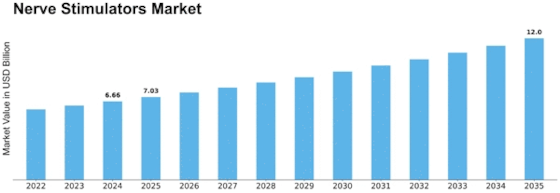
<p>The Nerve Stimulators Market is projected to reach a valuation of 12.0 USD Billion by 2035.</p>

What was the market valuation of the Nerve Stimulators Market in 2024?

<p>In 2024, the Nerve Stimulators Market was valued at 6.66 USD Billion.</p>

What is the expected CAGR for the Nerve Stimulators Market during the forecast period 2025 - 2035?

<p>The expected CAGR for the Nerve Stimulators Market during the forecast period 2025 - 2035 is 5.5%.</p>

Which application segment is projected to have the highest growth in the Nerve Stimulators Market?

<p>The Pain Management application segment is projected to grow from 2.0 USD Billion in 2024 to 3.5 USD Billion by 2035.</p>

What are the key players in the Nerve Stimulators Market?

<p>Key players in the Nerve Stimulators Market include Medtronic, Boston Scientific, Abbott, and NeuroMetrix.</p>

How does the market for Implantable Neurostimulators compare to other product types?

<p>The market for Implantable Neurostimulators is expected to grow from 2.0 USD Billion in 2024 to 4.0 USD Billion by 2035, indicating strong demand.</p>

What end-user segment is anticipated to experience significant growth in the Nerve Stimulators Market?

<p>The Hospitals end-user segment is expected to increase from 2.0 USD Billion in 2024 to 3.5 USD Billion by 2035.</p>

What is the projected growth for Non-Invasive technology in the Nerve Stimulators Market?

<p>The Non-Invasive technology segment is projected to grow from 3.16 USD Billion in 2024 to 5.5 USD Billion by 2035.</p>

Which product type is expected to show the most substantial increase in market size?

<p>Spinal Cord Stimulation is expected to grow from 2.16 USD Billion in 2024 to 3.5 USD Billion by 2035.</p>

What trends are influencing the growth of the Nerve Stimulators Market?

<p>Trends such as advancements in technology and increasing prevalence of neurological disorders are influencing the growth of the Nerve Stimulators Market.</p>

Market Summary

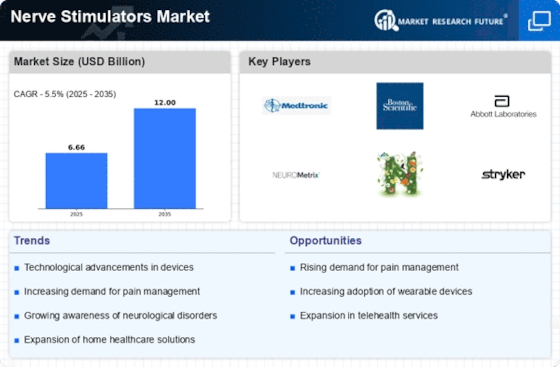
As per Market Research Future analysis, the Nerve Stimulators Market Size was estimated at 6.66 USD Billion in 2024. The Nerve Stimulators industry is projected to grow from 7.026 USD Billion in 2025 to 12.0 USD Billion by 2035, exhibiting a compound annual growth rate (CAGR) of 5.5% during the forecast period 2025 - 2035

Key Market Trends & Highlights

The Nerve Stimulators Market is poised for substantial growth driven by technological advancements and increasing demand for effective treatment options.

  • North America remains the largest market for nerve stimulators, driven by advanced healthcare infrastructure and high adoption rates. The Asia-Pacific region is emerging as the fastest-growing market, fueled by rising healthcare investments and increasing awareness of nerve stimulation therapies. Pain management continues to dominate the market, while the segment of implantable neurostimulators is experiencing rapid growth due to innovative technologies. Technological advancements and the increasing prevalence of neurological disorders are key drivers propelling market expansion.

Market Size & Forecast

2024 Market Size 6.66 (USD Billion)
2035 Market Size 12.0 (USD Billion)
CAGR (2025 - 2035) 5.5%
Largest Regional Market Share in 2024 North America

Major Players

Medtronic (US), Boston Scientific (US), Abbott (US), NeuroMetrix (US), Nuvectra (US), Stryker (US), Cochlear (AU), Stimwave (US), Huntleigh Healthcare (GB)

Market Trends

The Nerve Stimulators Market is currently experiencing a notable evolution, driven by advancements in technology and an increasing understanding of neurological disorders. The integration of innovative materials and sophisticated designs into nerve stimulators has the potential to enhance patient outcomes significantly.

Furthermore, the growing prevalence of chronic pain conditions and neurological disorders appears to be propelling demand for these devices. As healthcare providers seek effective solutions for pain management and rehabilitation, the Nerve Stimulators Market is likely to expand, reflecting a shift towards more personalized and targeted therapies. In addition, the regulatory landscape surrounding medical devices is evolving, which may influence the Nerve Stimulators Market.

Regulatory bodies are increasingly focusing on ensuring safety and efficacy, which could lead to more rigorous approval processes. This, in turn, might encourage manufacturers to invest in research and development to meet these standards. The market seems poised for growth, with emerging technologies such as wireless stimulation and closed-loop systems potentially reshaping treatment paradigms. Overall, the Nerve Stimulators Market is on a trajectory that suggests a promising future, characterized by innovation and a commitment to improving patient care.

Technological Advancements

The Nerve Stimulators Market is witnessing rapid technological advancements that enhance device functionality and patient experience. Innovations such as miniaturization, wireless connectivity, and smart algorithms are likely to improve the precision of nerve stimulation, making treatments more effective and user-friendly.

Increasing Prevalence of Neurological Disorders

The rising incidence of neurological disorders, including epilepsy and multiple sclerosis, appears to be a driving force behind the demand for nerve stimulators. As awareness of these conditions grows, healthcare providers are more inclined to explore nerve stimulation as a viable treatment option.

Regulatory Changes and Compliance

The evolving regulatory environment surrounding medical devices may impact the Nerve Stimulators Market. Stricter compliance requirements could lead to enhanced safety and efficacy standards, prompting manufacturers to innovate and adapt their products to meet these new regulations.

Nerve Stimulator Market Market Drivers

Regulatory Changes and Compliance

Regulatory changes are shaping the landscape of the Nerve Stimulators Market, influencing product development and market entry strategies. Stricter compliance requirements are being implemented to ensure the safety and efficacy of nerve stimulation devices. Regulatory bodies are increasingly focusing on post-market surveillance and real-world evidence to assess device performance. This shift is likely to encourage manufacturers to invest in research and development, leading to the introduction of more advanced and reliable products. As a result, the Nerve Stimulators Market may witness a wave of innovation driven by the need to meet these regulatory standards. Companies that adapt to these changes effectively could gain a competitive edge, potentially increasing their market share in a rapidly evolving environment.

Rising Investment in Healthcare Infrastructure

Investment in healthcare infrastructure is a pivotal driver for the Nerve Stimulators Market. As countries enhance their healthcare systems, there is a growing emphasis on integrating advanced medical technologies, including nerve stimulation devices. This investment is particularly evident in emerging markets, where healthcare facilities are being upgraded to accommodate modern treatment modalities. The expansion of hospitals and clinics equipped with the latest nerve stimulation technologies is likely to increase patient access to these therapies. Furthermore, government initiatives aimed at improving healthcare access are expected to bolster the Nerve Stimulators Market. With an anticipated increase in healthcare spending, the market for nerve stimulators is poised for substantial growth, reflecting the broader trend of prioritizing innovative healthcare solutions.

Increasing Prevalence of Neurological Disorders

The rising incidence of neurological disorders is a critical driver for the Nerve Stimulators Market. Conditions such as epilepsy, chronic pain, and Parkinson's disease are becoming more common, necessitating effective treatment options. According to recent estimates, approximately 1 in 6 individuals worldwide will experience a neurological disorder at some point in their lives. This growing patient population is likely to increase the demand for nerve stimulation therapies, as they offer non-invasive alternatives to traditional surgical interventions. The market for nerve stimulators is expected to expand significantly, with projections indicating a compound annual growth rate of around 10% over the next five years. This trend underscores the urgent need for innovative solutions within the Nerve Stimulators Market to address the challenges posed by these disorders.

Technological Advancements in Nerve Stimulators

The Nerve Stimulators Market is experiencing a surge in technological advancements that enhance the efficacy and safety of nerve stimulation devices. Innovations such as closed-loop systems and miniaturized devices are becoming increasingly prevalent. These advancements allow for more precise targeting of nerve pathways, which can lead to improved patient outcomes. For instance, the introduction of wireless nerve stimulators has made it easier for patients to manage their conditions without the constraints of traditional wired devices. Furthermore, the integration of artificial intelligence in nerve stimulators is anticipated to optimize treatment protocols, potentially increasing the market's value, which is projected to reach USD 7 billion by 2026. This trend indicates a robust growth trajectory for the Nerve Stimulators Market, driven by continuous innovation.

Growing Awareness and Acceptance of Nerve Stimulation Therapies

The Nerve Stimulators Market is benefiting from a growing awareness and acceptance of nerve stimulation therapies among both healthcare professionals and patients. Educational initiatives and outreach programs are helping to inform stakeholders about the benefits and applications of nerve stimulators. As patients become more informed about their treatment options, there is a noticeable shift towards non-invasive therapies, which are perceived as safer alternatives to traditional surgical methods. This trend is likely to drive demand for nerve stimulators, as more patients seek these innovative solutions for pain management and neurological conditions. The increasing acceptance of these therapies is expected to contribute to the overall growth of the Nerve Stimulators Market, fostering a more favorable environment for manufacturers and healthcare providers alike.

Market Segment Insights

By Application: Pain Management (Largest) vs. Neurological Disorders (Fastest-Growing)

In the Nerve Stimulators Market, the application segment is significantly influenced by the demand for pain management solutions, which holds the largest market share. Pain management devices meet the rising need for effective treatments among patients with chronic pain conditions. Neurological disorders closely follow, showcasing a rapid increase in adoption, driven by the growing awareness and prevalence of neurological conditions. The market distribution among these segments indicates a robust preference for pain management solutions over other applications.

Pain Management (Dominant) vs. Neurological Disorders (Emerging)

The pain management application remains dominant within the Nerve Stimulators Market due to its established efficacy in treating various chronic pain conditions, including migraines and back pain. This segment benefits from an increased focus on non-pharmacological treatments amid the <a href="https://www.marketresearchfuture.com/reports/opioids-market-7626">opioid </a>crisis, making nerve stimulators a preferred choice. On the other hand, neurological disorders have emerged as a fast-growing segment, largely attributed to the rising incidence of conditions like epilepsy and Parkinson's disease. The growing research and development in nerve stimulation therapies, along with advancements in technology, are paving the way for more effective treatments, positioning neurological disorders as a key area for future growth in the market.

By Product Type: Spinal Cord Stimulation (Largest) vs. Implantable Neurostimulators (Fastest-Growing)

The Nerve Stimulators Market is characterized by a diverse array of product types, including Transcutaneous Electrical Nerve Stimulation, Implantable Neurostimulators, Peripheral Nerve Stimulation, and Spinal Cord Stimulation. Among these, Spinal Cord Stimulation holds the largest market share, being widely utilized for chronic pain management. In contrast, Implantable Neurostimulators are capturing significant attention due to their rising adoption rates and potential to provide targeted treatments for various neurological disorders. The growth trends within the Nerve Stimulators Market are driven by advancements in stimulation technology, increasing prevalence of chronic pain, and a growing elderly population seeking effective pain management solutions. As healthcare providers become more aware of the benefits of neurostimulation therapies, especially implantable devices, the market is witnessing a shift towards these innovative solutions. This is positioning the Implantable Neurostimulators segment as a leading contender for future growth in the market.

Spinal Cord Stimulation (Dominant) vs. Peripheral Nerve Stimulation (Emerging)

Spinal Cord Stimulation is recognized as the dominant force in the Nerve Stimulators Market, widely regarded for its efficiency in managing chronic pain conditions. It incorporates advanced technology to modulate pain signals before they reach the brain, proving effective for patients who have not responded to conventional therapies. In contrast, Peripheral Nerve Stimulation is emerging as a viable alternative, showing promise in pain relief and the treatment of various conditions. The adaptability and less invasive nature of peripheral devices make them appealing, expanding their presence in the market. As innovation continues and studies on efficacy grow, both segments are likely to play crucial roles in shaping the future landscape of pain management solutions.

By End-user: Hospitals (Largest) vs. Home Care Settings (Fastest-Growing)

In the Nerve Stimulators Market, Hospitals command a significant market share, owing to their advanced infrastructure and expertise in administering complex nerve stimulation therapies. Ambulatory Surgical Centers also hold a noteworthy portion of the market, catering to patients requiring less invasive nerve stimulation procedures. Home Care Settings are becoming increasingly important as they provide greater convenience for patients, allowing nerve stimulation therapies to be administered in familiar surroundings, thereby enhancing patient compliance and satisfaction. Growth trends indicate a shift towards the adoption of nerve stimulators in Home Care Settings, which are experiencing the fastest growth due to rising demand for personalized and decentralized healthcare models. With the increasing prevalence of chronic pain and neurological disorders, more patients prefer receiving care at home. Rehabilitation Centers continue to play a crucial role in recovery post-surgery, driving steady demand for nerve stimulators as part of therapeutic interventions.

Hospitals (Dominant) vs. Rehabilitation Centers (Emerging)

Hospitals remain the dominant force in the Nerve Stimulators Market due to their ability to provide comprehensive healthcare services, advanced medical technologies, and a full range of treatment options for patients with chronic pain or neurological conditions. Their specialized medical staff is trained to handle complex cases, ensuring a high level of care. In contrast, Rehabilitation Centers are emerging as vital players, focusing on recovery and rehabilitation processes, utilizing nerve stimulators as part of therapeutic regimens. These centers are increasingly collaborating with hospitals and specialized clinics to develop tailored rehabilitation plans that incorporate nerve stimulation therapies. This synergy enhances treatment outcomes and fosters a growing recognition of the importance of rehabilitation in the management of nerve-related disorders.

By Technology: Invasive (Largest) vs. Non-Invasive (Fastest-Growing)

The Nerve Stimulators Market has a distinct distribution in its technology segments, with Invasive nerve stimulators holding the largest share. This segment has been widely adopted due to its efficacy in treating chronic pain and neurological disorders. Conversely, Non-Invasive devices are rapidly gaining traction, appealing to patients seeking less invasive treatment options, thereby carving a significant niche within the market.

Technology: Invasive (Dominant) vs. Non-Invasive (Emerging)

Invasive nerve stimulators are characterized by their direct application into the nervous system, often resulting in immediate and substantial symptom relief. They encompass devices like spinal cord stimulators and deep brain stimulators, often employed in more severe cases. In contrast, Non-Invasive nerve stimulators utilize external electrodes and techniques such as transcutaneous electrical nerve stimulation (TENS) or neuromodulation to relieve pain without surgical intervention, making them particularly appealing to a broader audience. As patients increasingly favor Non-Invasive treatments due to ease of use and reduced risks, this segment is projected to experience rapid growth, driven by technological advancements and heightened awareness.

Get more detailed insights about Nerve Stimulators Market Research Report - Forecast till 2035

Regional Insights

In the Nerve Stimulators Market, the Regional segmentation presented a robust landscape with diverse dynamics across various areas. In 2024, North America led the region with a significant valuation of 2.8 USD Billion, expected to grow to 5.0 USD Billion by 2035, showcasing its majority holding due to advanced healthcare infrastructure and robust Research and Development activities.

Europe followed with a market value of 1.8 USD Billion in 2024, projected at 3.0 USD Billion in 2035, driven by increasing geriatric populations and rising incidences of neurological disorders. The Asia Pacific region had a notable valuation of 1.56 USD Billion in 2024, growing to 2.7 USD Billion by 2035, representing significant potential as healthcare access increases and chronic disease prevalence rises.

South America accounted for a smaller share, valued at 0.5 USD Billion in 2024, and is expected to reach 1.0 USD Billion by 2035, indicating gradual market growth. In contrast, the Middle East and Africa held a nascent market value of 0.0 USD Billion in 2024, projected to reach 0.3 USD Billion by 2035, highlighting opportunities for expansion in emerging markets. This segmentation revealed how regional dynamics, healthcare developments, and demographic changes shape the Nerve Stimulators Market revenue and growth trajectory.

Key Players and Competitive Insights

The Nerve Stimulators Market is characterized by a dynamic and competitive landscape where numerous players are vying for market share through innovation and strategic partnerships. Companies in this sector are focused on developing advanced technological solutions that improve patient outcomes in various neurological conditions.
The competitive environment is driven by rising healthcare expenditures, increasing awareness about nerve-related disorders, and a growing population that requires effective treatments. Organizations in this market are engaging in extensive research and development activities to enhance their product offerings and establish a foothold in emerging markets. As a result, the competitive insights reveal a multifaceted approach by leading firms who are leveraging both technological advancements and strategic mergers and acquisitions to strengthen their market position.
Nuvectra operates effectively in the Nerve Stimulators Market by promoting its unique product offerings designed for emerging medical needs. The company has carved out a significant market presence through its innovative solutions that address chronic pain and neurological disorders.
Nuvectra's strengths lie in its commitment to research and development, contributing to a steadily growing pipeline of products that cater to a variety of therapeutic areas. Their focus on patient-centric solutions has allowed them to establish strong brand loyalty and recognition among healthcare professionals and patients alike. Furthermore, Nuvectra’s proactive approach in forming strategic collaborations and partnerships enhances its position, allowing it to tap into new technologies and treatment methodologies, ultimately driving its competitive edge in the global arena.
Hughston Clinic has made a notable impact on the Nerve Stimulators Market by offering comprehensive medical services and advanced treatment options focused on nerve stimulation therapies. The clinic is recognized for its strong emphasis on patient care and innovative solutions that effectively address nerve-related ailments.
Having a regional presence with ambitions for global reach, Hughston Clinic strengthens its portfolio with a variety of key products and services that cater to the needs of different patient demographics. The organization’s strengths include a robust network of healthcare professionals specialized in pain management, extensive clinical experience, and a solid reputation in the medical community. In addition, Hughston Clinic actively pursues collaborations and potential acquisitions to expand its service offerings and market presence, allowing it to adapt to evolving industry trends and maintain a competitive edge within the global marketplace.

Key Companies in the Nerve Stimulator Market include

Industry Developments

A $13 million Series A funding round headed by U.S. Venture Partners was concluded by Nervonik in March 2025 to support the development of their opioid-free peripheral nerve stimulation (PNS) technology for the treatment of chronic pain.

Additionally, the business said that it has successfully finished its first-in-human clinical trial, showcasing the potential of its wirelessly powered, minimally invasive PNS technology, which is intended to provide individualized and efficient pain treatment.

After good proof-of-concept results for patients undergoing lumbar decompression and fusion, SynerFuse and Velentium Medical announced intentions in March 2025 to expand their proprietary SynerFuse e-TLIF method, which integrates direct nerve stimulation with spinal fusion operations.

Medtronic introduced the first SCS system that detects physiological spinal signals and modifies stimulation in almost real-time to correspond with everyday movement in March 2025 with the launch of their InceptivTM closed-loop rechargeable spinal cord stimulator in a few markets.

In March 2025, Medtronic also provided 12-month statistics for its closed-loop SCS, stating that over 80% of patients showed at least 50% reduction in low back pain and 91% of patients did not suffer any painful overstimulation during daily activities.

Medtronic's BrainSenseTM adaptive deep brain stimulation platform and electrode identifier received CE-Mark approval in January 2025, allowing Parkinson's patients in the UK and Europe to receive responsive, real-time DBS therapy.

The FDA approved Medtronic's deployment of its adaptive DBS (aDBS) and brain-sensing electrode identifier in the United States in January 2025, enabling North American patients and doctors to access dynamic, signal-responsive Parkinson's therapy.

Future Outlook

Nerve Stimulator Market Future Outlook

The Nerve Stimulators Market is projected to grow at a 5.5% CAGR from 2025 to 2035, driven by technological advancements, increasing prevalence of neurological disorders, and rising demand for non-invasive treatment options.

New opportunities lie in:

  • Development of portable nerve stimulators for home use
  • Expansion into emerging markets with tailored products
  • Partnerships with healthcare providers for integrated pain management solutions

By 2035, the Nerve Stimulators Market is expected to achieve substantial growth and innovation.

Market Segmentation

Nerve Stimulator Market End-user Outlook

  • Hospitals
  • Ambulatory Surgical Centers
  • Home Care Settings
  • Rehabilitation Centers

Nerve Stimulator Market Technology Outlook

  • Invasive
  • Non-Invasive

Nerve Stimulator Market Application Outlook

  • Pain Management
  • Neurological Disorders
  • Cardiovascular Disorders
  • Gastrointestinal Disorders

Nerve Stimulator Market Product Type Outlook

  • Transcutaneous Electrical Nerve Stimulation
  • Implantable Neurostimulators
  • Peripheral Nerve Stimulation
  • Spinal Cord Stimulation

Report Scope

MARKET SIZE 2024 6.66(USD Billion)
MARKET SIZE 2025 7.026(USD Billion)
MARKET SIZE 2035 12.0(USD Billion)
COMPOUND ANNUAL GROWTH RATE (CAGR) 5.5% (2025 - 2035)
REPORT COVERAGE Revenue Forecast, Competitive Landscape, Growth Factors, and Trends
BASE YEAR 2024
Market Forecast Period 2025 - 2035
Historical Data 2019 - 2024
Market Forecast Units USD Billion
Key Companies Profiled Medtronic (US), Boston Scientific (US), Abbott (US), NeuroMetrix (US), Nuvectra (US), Stryker (US), Cochlear (AU), Stimwave (US), Huntleigh Healthcare (GB)
Segments Covered Application, Product Type, End-user, Technology, Regional
Key Market Opportunities Advancements in neuromodulation technologies enhance therapeutic options in the Nerve Stimulators Market.
Key Market Dynamics Rising demand for non-invasive pain management solutions drives innovation and competition in the nerve stimulators market.
Countries Covered North America, Europe, APAC, South America, MEA

FAQs

What is the projected market valuation of the Nerve Stimulators Market by 2035?

<p>The Nerve Stimulators Market is projected to reach a valuation of 12.0 USD Billion by 2035.</p>

What was the market valuation of the Nerve Stimulators Market in 2024?

<p>In 2024, the Nerve Stimulators Market was valued at 6.66 USD Billion.</p>

What is the expected CAGR for the Nerve Stimulators Market during the forecast period 2025 - 2035?

<p>The expected CAGR for the Nerve Stimulators Market during the forecast period 2025 - 2035 is 5.5%.</p>

Which application segment is projected to have the highest growth in the Nerve Stimulators Market?

<p>The Pain Management application segment is projected to grow from 2.0 USD Billion in 2024 to 3.5 USD Billion by 2035.</p>

What are the key players in the Nerve Stimulators Market?

<p>Key players in the Nerve Stimulators Market include Medtronic, Boston Scientific, Abbott, and NeuroMetrix.</p>

How does the market for Implantable Neurostimulators compare to other product types?

<p>The market for Implantable Neurostimulators is expected to grow from 2.0 USD Billion in 2024 to 4.0 USD Billion by 2035, indicating strong demand.</p>

What end-user segment is anticipated to experience significant growth in the Nerve Stimulators Market?

<p>The Hospitals end-user segment is expected to increase from 2.0 USD Billion in 2024 to 3.5 USD Billion by 2035.</p>

What is the projected growth for Non-Invasive technology in the Nerve Stimulators Market?

<p>The Non-Invasive technology segment is projected to grow from 3.16 USD Billion in 2024 to 5.5 USD Billion by 2035.</p>

Which product type is expected to show the most substantial increase in market size?

<p>Spinal Cord Stimulation is expected to grow from 2.16 USD Billion in 2024 to 3.5 USD Billion by 2035.</p>

What trends are influencing the growth of the Nerve Stimulators Market?

<p>Trends such as advancements in technology and increasing prevalence of neurological disorders are influencing the growth of the Nerve Stimulators Market.</p>

  1. SECTION I: EXECUTIVE SUMMARY AND KEY HIGHLIGHTS
    1. | 1.1 EXECUTIVE SUMMARY
    2. | | 1.1.1 Market Overview
    3. | | 1.1.2 Key Findings
    4. | | 1.1.3 Market Segmentation
    5. | | 1.1.4 Competitive Landscape
    6. | | 1.1.5 Challenges and Opportunities
    7. | | 1.1.6 Future Outlook
  2. SECTION II: SCOPING, METHODOLOGY AND MARKET STRUCTURE
    1. | 2.1 MARKET INTRODUCTION
    2. | | 2.1.1 Definition
    3. | | 2.1.2 Scope of the study
    4. | | | 2.1.2.1 Research Objective
    5. | | | 2.1.2.2 Assumption
    6. | | | 2.1.2.3 Limitations
    7. | 2.2 RESEARCH METHODOLOGY
    8. | | 2.2.1 Overview
    9. | | 2.2.2 Data Mining
    10. | | 2.2.3 Secondary Research
    11. | | 2.2.4 Primary Research
    12. | | | 2.2.4.1 Primary Interviews and Information Gathering Process
    13. | | | 2.2.4.2 Breakdown of Primary Respondents
    14. | | 2.2.5 Forecasting Model
    15. | | 2.2.6 Market Size Estimation
    16. | | | 2.2.6.1 Bottom-Up Approach
    17. | | | 2.2.6.2 Top-Down Approach
    18. | | 2.2.7 Data Triangulation
    19. | | 2.2.8 Validation
  3. SECTION III: QUALITATIVE ANALYSIS
    1. | 3.1 MARKET DYNAMICS
    2. | | 3.1.1 Overview
    3. | | 3.1.2 Drivers
    4. | | 3.1.3 Restraints
    5. | | 3.1.4 Opportunities
    6. | 3.2 MARKET FACTOR ANALYSIS
    7. | | 3.2.1 Value chain Analysis
    8. | | 3.2.2 Porter's Five Forces Analysis
    9. | | | 3.2.2.1 Bargaining Power of Suppliers
    10. | | | 3.2.2.2 Bargaining Power of Buyers
    11. | | | 3.2.2.3 Threat of New Entrants
    12. | | | 3.2.2.4 Threat of Substitutes
    13. | | | 3.2.2.5 Intensity of Rivalry
    14. | | 3.2.3 COVID-19 Impact Analysis
    15. | | | 3.2.3.1 Market Impact Analysis
    16. | | | 3.2.3.2 Regional Impact
    17. | | | 3.2.3.3 Opportunity and Threat Analysis
  4. SECTION IV: QUANTITATIVE ANALYSIS
    1. | 4.1 Healthcare, BY Application (USD Billion)
    2. | | 4.1.1 Pain Management
    3. | | 4.1.2 Neurological Disorders
    4. | | 4.1.3 Cardiovascular Disorders
    5. | | 4.1.4 Gastrointestinal Disorders
    6. | 4.2 Healthcare, BY Product Type (USD Billion)
    7. | | 4.2.1 Transcutaneous Electrical Nerve Stimulation
    8. | | 4.2.2 Implantable Neurostimulators
    9. | | 4.2.3 Peripheral Nerve Stimulation
    10. | | 4.2.4 Spinal Cord Stimulation
    11. | 4.3 Healthcare, BY End-user (USD Billion)
    12. | | 4.3.1 Hospitals
    13. | | 4.3.2 Ambulatory Surgical Centers
    14. | | 4.3.3 Home Care Settings
    15. | | 4.3.4 Rehabilitation Centers
    16. | 4.4 Healthcare, BY Technology (USD Billion)
    17. | | 4.4.1 Invasive
    18. | | 4.4.2 Non-Invasive
    19. | 4.5 Healthcare, BY Region (USD Billion)
    20. | | 4.5.1 North America
    21. | | | 4.5.1.1 US
    22. | | | 4.5.1.2 Canada
    23. | | 4.5.2 Europe
    24. | | | 4.5.2.1 Germany
    25. | | | 4.5.2.2 UK
    26. | | | 4.5.2.3 France
    27. | | | 4.5.2.4 Russia
    28. | | | 4.5.2.5 Italy
    29. | | | 4.5.2.6 Spain
    30. | | | 4.5.2.7 Rest of Europe
    31. | | 4.5.3 APAC
    32. | | | 4.5.3.1 China
    33. | | | 4.5.3.2 India
    34. | | | 4.5.3.3 Japan
    35. | | | 4.5.3.4 South Korea
    36. | | | 4.5.3.5 Malaysia
    37. | | | 4.5.3.6 Thailand
    38. | | | 4.5.3.7 Indonesia
    39. | | | 4.5.3.8 Rest of APAC
    40. | | 4.5.4 South America
    41. | | | 4.5.4.1 Brazil
    42. | | | 4.5.4.2 Mexico
    43. | | | 4.5.4.3 Argentina
    44. | | | 4.5.4.4 Rest of South America
    45. | | 4.5.5 MEA
    46. | | | 4.5.5.1 GCC Countries
    47. | | | 4.5.5.2 South Africa
    48. | | | 4.5.5.3 Rest of MEA
  5. SECTION V: COMPETITIVE ANALYSIS
    1. | 5.1 Competitive Landscape
    2. | | 5.1.1 Overview
    3. | | 5.1.2 Competitive Analysis
    4. | | 5.1.3 Market share Analysis
    5. | | 5.1.4 Major Growth Strategy in the Healthcare
    6. | | 5.1.5 Competitive Benchmarking
    7. | | 5.1.6 Leading Players in Terms of Number of Developments in the Healthcare
    8. | | 5.1.7 Key developments and growth strategies
    9. | | | 5.1.7.1 New Product Launch/Service Deployment
    10. | | | 5.1.7.2 Merger & Acquisitions
    11. | | | 5.1.7.3 Joint Ventures
    12. | | 5.1.8 Major Players Financial Matrix
    13. | | | 5.1.8.1 Sales and Operating Income
    14. | | | 5.1.8.2 Major Players R&D Expenditure. 2023
    15. | 5.2 Company Profiles
    16. | | 5.2.1 Medtronic (US)
    17. | | | 5.2.1.1 Financial Overview
    18. | | | 5.2.1.2 Products Offered
    19. | | | 5.2.1.3 Key Developments
    20. | | | 5.2.1.4 SWOT Analysis
    21. | | | 5.2.1.5 Key Strategies
    22. | | 5.2.2 Boston Scientific (US)
    23. | | | 5.2.2.1 Financial Overview
    24. | | | 5.2.2.2 Products Offered
    25. | | | 5.2.2.3 Key Developments
    26. | | | 5.2.2.4 SWOT Analysis
    27. | | | 5.2.2.5 Key Strategies
    28. | | 5.2.3 Abbott (US)
    29. | | | 5.2.3.1 Financial Overview
    30. | | | 5.2.3.2 Products Offered
    31. | | | 5.2.3.3 Key Developments
    32. | | | 5.2.3.4 SWOT Analysis
    33. | | | 5.2.3.5 Key Strategies
    34. | | 5.2.4 NeuroMetrix (US)
    35. | | | 5.2.4.1 Financial Overview
    36. | | | 5.2.4.2 Products Offered
    37. | | | 5.2.4.3 Key Developments
    38. | | | 5.2.4.4 SWOT Analysis
    39. | | | 5.2.4.5 Key Strategies
    40. | | 5.2.5 Nuvectra (US)
    41. | | | 5.2.5.1 Financial Overview
    42. | | | 5.2.5.2 Products Offered
    43. | | | 5.2.5.3 Key Developments
    44. | | | 5.2.5.4 SWOT Analysis
    45. | | | 5.2.5.5 Key Strategies
    46. | | 5.2.6 Stryker (US)
    47. | | | 5.2.6.1 Financial Overview
    48. | | | 5.2.6.2 Products Offered
    49. | | | 5.2.6.3 Key Developments
    50. | | | 5.2.6.4 SWOT Analysis
    51. | | | 5.2.6.5 Key Strategies
    52. | | 5.2.7 Cochlear (AU)
    53. | | | 5.2.7.1 Financial Overview
    54. | | | 5.2.7.2 Products Offered
    55. | | | 5.2.7.3 Key Developments
    56. | | | 5.2.7.4 SWOT Analysis
    57. | | | 5.2.7.5 Key Strategies
    58. | | 5.2.8 Stimwave (US)
    59. | | | 5.2.8.1 Financial Overview
    60. | | | 5.2.8.2 Products Offered
    61. | | | 5.2.8.3 Key Developments
    62. | | | 5.2.8.4 SWOT Analysis
    63. | | | 5.2.8.5 Key Strategies
    64. | | 5.2.9 Huntleigh Healthcare (GB)
    65. | | | 5.2.9.1 Financial Overview
    66. | | | 5.2.9.2 Products Offered
    67. | | | 5.2.9.3 Key Developments
    68. | | | 5.2.9.4 SWOT Analysis
    69. | | | 5.2.9.5 Key Strategies
    70. | 5.3 Appendix
    71. | | 5.3.1 References
    72. | | 5.3.2 Related Reports
  6. LIST OF FIGURES
    1. | 6.1 MARKET SYNOPSIS
    2. | 6.2 NORTH AMERICA MARKET ANALYSIS
    3. | 6.3 US MARKET ANALYSIS BY APPLICATION
    4. | 6.4 US MARKET ANALYSIS BY PRODUCT TYPE
    5. | 6.5 US MARKET ANALYSIS BY END-USER
    6. | 6.6 US MARKET ANALYSIS BY TECHNOLOGY
    7. | 6.7 CANADA MARKET ANALYSIS BY APPLICATION
    8. | 6.8 CANADA MARKET ANALYSIS BY PRODUCT TYPE
    9. | 6.9 CANADA MARKET ANALYSIS BY END-USER
    10. | 6.10 CANADA MARKET ANALYSIS BY TECHNOLOGY
    11. | 6.11 EUROPE MARKET ANALYSIS
    12. | 6.12 GERMANY MARKET ANALYSIS BY APPLICATION
    13. | 6.13 GERMANY MARKET ANALYSIS BY PRODUCT TYPE
    14. | 6.14 GERMANY MARKET ANALYSIS BY END-USER
    15. | 6.15 GERMANY MARKET ANALYSIS BY TECHNOLOGY
    16. | 6.16 UK MARKET ANALYSIS BY APPLICATION
    17. | 6.17 UK MARKET ANALYSIS BY PRODUCT TYPE
    18. | 6.18 UK MARKET ANALYSIS BY END-USER
    19. | 6.19 UK MARKET ANALYSIS BY TECHNOLOGY
    20. | 6.20 FRANCE MARKET ANALYSIS BY APPLICATION
    21. | 6.21 FRANCE MARKET ANALYSIS BY PRODUCT TYPE
    22. | 6.22 FRANCE MARKET ANALYSIS BY END-USER
    23. | 6.23 FRANCE MARKET ANALYSIS BY TECHNOLOGY
    24. | 6.24 RUSSIA MARKET ANALYSIS BY APPLICATION
    25. | 6.25 RUSSIA MARKET ANALYSIS BY PRODUCT TYPE
    26. | 6.26 RUSSIA MARKET ANALYSIS BY END-USER
    27. | 6.27 RUSSIA MARKET ANALYSIS BY TECHNOLOGY
    28. | 6.28 ITALY MARKET ANALYSIS BY APPLICATION
    29. | 6.29 ITALY MARKET ANALYSIS BY PRODUCT TYPE
    30. | 6.30 ITALY MARKET ANALYSIS BY END-USER
    31. | 6.31 ITALY MARKET ANALYSIS BY TECHNOLOGY
    32. | 6.32 SPAIN MARKET ANALYSIS BY APPLICATION
    33. | 6.33 SPAIN MARKET ANALYSIS BY PRODUCT TYPE
    34. | 6.34 SPAIN MARKET ANALYSIS BY END-USER
    35. | 6.35 SPAIN MARKET ANALYSIS BY TECHNOLOGY
    36. | 6.36 REST OF EUROPE MARKET ANALYSIS BY APPLICATION
    37. | 6.37 REST OF EUROPE MARKET ANALYSIS BY PRODUCT TYPE
    38. | 6.38 REST OF EUROPE MARKET ANALYSIS BY END-USER
    39. | 6.39 REST OF EUROPE MARKET ANALYSIS BY TECHNOLOGY
    40. | 6.40 APAC MARKET ANALYSIS
    41. | 6.41 CHINA MARKET ANALYSIS BY APPLICATION
    42. | 6.42 CHINA MARKET ANALYSIS BY PRODUCT TYPE
    43. | 6.43 CHINA MARKET ANALYSIS BY END-USER
    44. | 6.44 CHINA MARKET ANALYSIS BY TECHNOLOGY
    45. | 6.45 INDIA MARKET ANALYSIS BY APPLICATION
    46. | 6.46 INDIA MARKET ANALYSIS BY PRODUCT TYPE
    47. | 6.47 INDIA MARKET ANALYSIS BY END-USER
    48. | 6.48 INDIA MARKET ANALYSIS BY TECHNOLOGY
    49. | 6.49 JAPAN MARKET ANALYSIS BY APPLICATION
    50. | 6.50 JAPAN MARKET ANALYSIS BY PRODUCT TYPE
    51. | 6.51 JAPAN MARKET ANALYSIS BY END-USER
    52. | 6.52 JAPAN MARKET ANALYSIS BY TECHNOLOGY
    53. | 6.53 SOUTH KOREA MARKET ANALYSIS BY APPLICATION
    54. | 6.54 SOUTH KOREA MARKET ANALYSIS BY PRODUCT TYPE
    55. | 6.55 SOUTH KOREA MARKET ANALYSIS BY END-USER
    56. | 6.56 SOUTH KOREA MARKET ANALYSIS BY TECHNOLOGY
    57. | 6.57 MALAYSIA MARKET ANALYSIS BY APPLICATION
    58. | 6.58 MALAYSIA MARKET ANALYSIS BY PRODUCT TYPE
    59. | 6.59 MALAYSIA MARKET ANALYSIS BY END-USER
    60. | 6.60 MALAYSIA MARKET ANALYSIS BY TECHNOLOGY
    61. | 6.61 THAILAND MARKET ANALYSIS BY APPLICATION
    62. | 6.62 THAILAND MARKET ANALYSIS BY PRODUCT TYPE
    63. | 6.63 THAILAND MARKET ANALYSIS BY END-USER
    64. | 6.64 THAILAND MARKET ANALYSIS BY TECHNOLOGY
    65. | 6.65 INDONESIA MARKET ANALYSIS BY APPLICATION
    66. | 6.66 INDONESIA MARKET ANALYSIS BY PRODUCT TYPE
    67. | 6.67 INDONESIA MARKET ANALYSIS BY END-USER
    68. | 6.68 INDONESIA MARKET ANALYSIS BY TECHNOLOGY
    69. | 6.69 REST OF APAC MARKET ANALYSIS BY APPLICATION
    70. | 6.70 REST OF APAC MARKET ANALYSIS BY PRODUCT TYPE
    71. | 6.71 REST OF APAC MARKET ANALYSIS BY END-USER
    72. | 6.72 REST OF APAC MARKET ANALYSIS BY TECHNOLOGY
    73. | 6.73 SOUTH AMERICA MARKET ANALYSIS
    74. | 6.74 BRAZIL MARKET ANALYSIS BY APPLICATION
    75. | 6.75 BRAZIL MARKET ANALYSIS BY PRODUCT TYPE
    76. | 6.76 BRAZIL MARKET ANALYSIS BY END-USER
    77. | 6.77 BRAZIL MARKET ANALYSIS BY TECHNOLOGY
    78. | 6.78 MEXICO MARKET ANALYSIS BY APPLICATION
    79. | 6.79 MEXICO MARKET ANALYSIS BY PRODUCT TYPE
    80. | 6.80 MEXICO MARKET ANALYSIS BY END-USER
    81. | 6.81 MEXICO MARKET ANALYSIS BY TECHNOLOGY
    82. | 6.82 ARGENTINA MARKET ANALYSIS BY APPLICATION
    83. | 6.83 ARGENTINA MARKET ANALYSIS BY PRODUCT TYPE
    84. | 6.84 ARGENTINA MARKET ANALYSIS BY END-USER
    85. | 6.85 ARGENTINA MARKET ANALYSIS BY TECHNOLOGY
    86. | 6.86 REST OF SOUTH AMERICA MARKET ANALYSIS BY APPLICATION
    87. | 6.87 REST OF SOUTH AMERICA MARKET ANALYSIS BY PRODUCT TYPE
    88. | 6.88 REST OF SOUTH AMERICA MARKET ANALYSIS BY END-USER
    89. | 6.89 REST OF SOUTH AMERICA MARKET ANALYSIS BY TECHNOLOGY
    90. | 6.90 MEA MARKET ANALYSIS
    91. | 6.91 GCC COUNTRIES MARKET ANALYSIS BY APPLICATION
    92. | 6.92 GCC COUNTRIES MARKET ANALYSIS BY PRODUCT TYPE
    93. | 6.93 GCC COUNTRIES MARKET ANALYSIS BY END-USER
    94. | 6.94 GCC COUNTRIES MARKET ANALYSIS BY TECHNOLOGY
    95. | 6.95 SOUTH AFRICA MARKET ANALYSIS BY APPLICATION
    96. | 6.96 SOUTH AFRICA MARKET ANALYSIS BY PRODUCT TYPE
    97. | 6.97 SOUTH AFRICA MARKET ANALYSIS BY END-USER
    98. | 6.98 SOUTH AFRICA MARKET ANALYSIS BY TECHNOLOGY
    99. | 6.99 REST OF MEA MARKET ANALYSIS BY APPLICATION
    100. | 6.100 REST OF MEA MARKET ANALYSIS BY PRODUCT TYPE
    101. | 6.101 REST OF MEA MARKET ANALYSIS BY END-USER
    102. | 6.102 REST OF MEA MARKET ANALYSIS BY TECHNOLOGY
    103. | 6.103 KEY BUYING CRITERIA OF HEALTHCARE
    104. | 6.104 RESEARCH PROCESS OF MRFR
    105. | 6.105 DRO ANALYSIS OF HEALTHCARE
    106. | 6.106 DRIVERS IMPACT ANALYSIS: HEALTHCARE
    107. | 6.107 RESTRAINTS IMPACT ANALYSIS: HEALTHCARE
    108. | 6.108 SUPPLY / VALUE CHAIN: HEALTHCARE
    109. | 6.109 HEALTHCARE, BY APPLICATION, 2024 (% SHARE)
    110. | 6.110 HEALTHCARE, BY APPLICATION, 2024 TO 2035 (USD Billion)
    111. | 6.111 HEALTHCARE, BY PRODUCT TYPE, 2024 (% SHARE)
    112. | 6.112 HEALTHCARE, BY PRODUCT TYPE, 2024 TO 2035 (USD Billion)
    113. | 6.113 HEALTHCARE, BY END-USER, 2024 (% SHARE)
    114. | 6.114 HEALTHCARE, BY END-USER, 2024 TO 2035 (USD Billion)
    115. | 6.115 HEALTHCARE, BY TECHNOLOGY, 2024 (% SHARE)
    116. | 6.116 HEALTHCARE, BY TECHNOLOGY, 2024 TO 2035 (USD Billion)
    117. | 6.117 BENCHMARKING OF MAJOR COMPETITORS
  7. LIST OF TABLES
    1. | 7.1 LIST OF ASSUMPTIONS
    2. | | 7.1.1
    3. | 7.2 North America MARKET SIZE ESTIMATES; FORECAST
    4. | | 7.2.1 BY APPLICATION, 2025-2035 (USD Billion)
    5. | | 7.2.2 BY PRODUCT TYPE, 2025-2035 (USD Billion)
    6. | | 7.2.3 BY END-USER, 2025-2035 (USD Billion)
    7. | | 7.2.4 BY TECHNOLOGY, 2025-2035 (USD Billion)
    8. | 7.3 US MARKET SIZE ESTIMATES; FORECAST
    9. | | 7.3.1 BY APPLICATION, 2025-2035 (USD Billion)
    10. | | 7.3.2 BY PRODUCT TYPE, 2025-2035 (USD Billion)
    11. | | 7.3.3 BY END-USER, 2025-2035 (USD Billion)
    12. | | 7.3.4 BY TECHNOLOGY, 2025-2035 (USD Billion)
    13. | 7.4 Canada MARKET SIZE ESTIMATES; FORECAST
    14. | | 7.4.1 BY APPLICATION, 2025-2035 (USD Billion)
    15. | | 7.4.2 BY PRODUCT TYPE, 2025-2035 (USD Billion)
    16. | | 7.4.3 BY END-USER, 2025-2035 (USD Billion)
    17. | | 7.4.4 BY TECHNOLOGY, 2025-2035 (USD Billion)
    18. | 7.5 Europe MARKET SIZE ESTIMATES; FORECAST
    19. | | 7.5.1 BY APPLICATION, 2025-2035 (USD Billion)
    20. | | 7.5.2 BY PRODUCT TYPE, 2025-2035 (USD Billion)
    21. | | 7.5.3 BY END-USER, 2025-2035 (USD Billion)
    22. | | 7.5.4 BY TECHNOLOGY, 2025-2035 (USD Billion)
    23. | 7.6 Germany MARKET SIZE ESTIMATES; FORECAST
    24. | | 7.6.1 BY APPLICATION, 2025-2035 (USD Billion)
    25. | | 7.6.2 BY PRODUCT TYPE, 2025-2035 (USD Billion)
    26. | | 7.6.3 BY END-USER, 2025-2035 (USD Billion)
    27. | | 7.6.4 BY TECHNOLOGY, 2025-2035 (USD Billion)
    28. | 7.7 UK MARKET SIZE ESTIMATES; FORECAST
    29. | | 7.7.1 BY APPLICATION, 2025-2035 (USD Billion)
    30. | | 7.7.2 BY PRODUCT TYPE, 2025-2035 (USD Billion)
    31. | | 7.7.3 BY END-USER, 2025-2035 (USD Billion)
    32. | | 7.7.4 BY TECHNOLOGY, 2025-2035 (USD Billion)
    33. | 7.8 France MARKET SIZE ESTIMATES; FORECAST
    34. | | 7.8.1 BY APPLICATION, 2025-2035 (USD Billion)
    35. | | 7.8.2 BY PRODUCT TYPE, 2025-2035 (USD Billion)
    36. | | 7.8.3 BY END-USER, 2025-2035 (USD Billion)
    37. | | 7.8.4 BY TECHNOLOGY, 2025-2035 (USD Billion)
    38. | 7.9 Russia MARKET SIZE ESTIMATES; FORECAST
    39. | | 7.9.1 BY APPLICATION, 2025-2035 (USD Billion)
    40. | | 7.9.2 BY PRODUCT TYPE, 2025-2035 (USD Billion)
    41. | | 7.9.3 BY END-USER, 2025-2035 (USD Billion)
    42. | | 7.9.4 BY TECHNOLOGY, 2025-2035 (USD Billion)
    43. | 7.10 Italy MARKET SIZE ESTIMATES; FORECAST
    44. | | 7.10.1 BY APPLICATION, 2025-2035 (USD Billion)
    45. | | 7.10.2 BY PRODUCT TYPE, 2025-2035 (USD Billion)
    46. | | 7.10.3 BY END-USER, 2025-2035 (USD Billion)
    47. | | 7.10.4 BY TECHNOLOGY, 2025-2035 (USD Billion)
    48. | 7.11 Spain MARKET SIZE ESTIMATES; FORECAST
    49. | | 7.11.1 BY APPLICATION, 2025-2035 (USD Billion)
    50. | | 7.11.2 BY PRODUCT TYPE, 2025-2035 (USD Billion)
    51. | | 7.11.3 BY END-USER, 2025-2035 (USD Billion)
    52. | | 7.11.4 BY TECHNOLOGY, 2025-2035 (USD Billion)
    53. | 7.12 Rest of Europe MARKET SIZE ESTIMATES; FORECAST
    54. | | 7.12.1 BY APPLICATION, 2025-2035 (USD Billion)
    55. | | 7.12.2 BY PRODUCT TYPE, 2025-2035 (USD Billion)
    56. | | 7.12.3 BY END-USER, 2025-2035 (USD Billion)
    57. | | 7.12.4 BY TECHNOLOGY, 2025-2035 (USD Billion)
    58. | 7.13 APAC MARKET SIZE ESTIMATES; FORECAST
    59. | | 7.13.1 BY APPLICATION, 2025-2035 (USD Billion)
    60. | | 7.13.2 BY PRODUCT TYPE, 2025-2035 (USD Billion)
    61. | | 7.13.3 BY END-USER, 2025-2035 (USD Billion)
    62. | | 7.13.4 BY TECHNOLOGY, 2025-2035 (USD Billion)
    63. | 7.14 China MARKET SIZE ESTIMATES; FORECAST
    64. | | 7.14.1 BY APPLICATION, 2025-2035 (USD Billion)
    65. | | 7.14.2 BY PRODUCT TYPE, 2025-2035 (USD Billion)
    66. | | 7.14.3 BY END-USER, 2025-2035 (USD Billion)
    67. | | 7.14.4 BY TECHNOLOGY, 2025-2035 (USD Billion)
    68. | 7.15 India MARKET SIZE ESTIMATES; FORECAST
    69. | | 7.15.1 BY APPLICATION, 2025-2035 (USD Billion)
    70. | | 7.15.2 BY PRODUCT TYPE, 2025-2035 (USD Billion)
    71. | | 7.15.3 BY END-USER, 2025-2035 (USD Billion)
    72. | | 7.15.4 BY TECHNOLOGY, 2025-2035 (USD Billion)
    73. | 7.16 Japan MARKET SIZE ESTIMATES; FORECAST
    74. | | 7.16.1 BY APPLICATION, 2025-2035 (USD Billion)
    75. | | 7.16.2 BY PRODUCT TYPE, 2025-2035 (USD Billion)
    76. | | 7.16.3 BY END-USER, 2025-2035 (USD Billion)
    77. | | 7.16.4 BY TECHNOLOGY, 2025-2035 (USD Billion)
    78. | 7.17 South Korea MARKET SIZE ESTIMATES; FORECAST
    79. | | 7.17.1 BY APPLICATION, 2025-2035 (USD Billion)
    80. | | 7.17.2 BY PRODUCT TYPE, 2025-2035 (USD Billion)
    81. | | 7.17.3 BY END-USER, 2025-2035 (USD Billion)
    82. | | 7.17.4 BY TECHNOLOGY, 2025-2035 (USD Billion)
    83. | 7.18 Malaysia MARKET SIZE ESTIMATES; FORECAST
    84. | | 7.18.1 BY APPLICATION, 2025-2035 (USD Billion)
    85. | | 7.18.2 BY PRODUCT TYPE, 2025-2035 (USD Billion)
    86. | | 7.18.3 BY END-USER, 2025-2035 (USD Billion)
    87. | | 7.18.4 BY TECHNOLOGY, 2025-2035 (USD Billion)
    88. | 7.19 Thailand MARKET SIZE ESTIMATES; FORECAST
    89. | | 7.19.1 BY APPLICATION, 2025-2035 (USD Billion)
    90. | | 7.19.2 BY PRODUCT TYPE, 2025-2035 (USD Billion)
    91. | | 7.19.3 BY END-USER, 2025-2035 (USD Billion)
    92. | | 7.19.4 BY TECHNOLOGY, 2025-2035 (USD Billion)
    93. | 7.20 Indonesia MARKET SIZE ESTIMATES; FORECAST
    94. | | 7.20.1 BY APPLICATION, 2025-2035 (USD Billion)
    95. | | 7.20.2 BY PRODUCT TYPE, 2025-2035 (USD Billion)
    96. | | 7.20.3 BY END-USER, 2025-2035 (USD Billion)
    97. | | 7.20.4 BY TECHNOLOGY, 2025-2035 (USD Billion)
    98. | 7.21 Rest of APAC MARKET SIZE ESTIMATES; FORECAST
    99. | | 7.21.1 BY APPLICATION, 2025-2035 (USD Billion)
    100. | | 7.21.2 BY PRODUCT TYPE, 2025-2035 (USD Billion)
    101. | | 7.21.3 BY END-USER, 2025-2035 (USD Billion)
    102. | | 7.21.4 BY TECHNOLOGY, 2025-2035 (USD Billion)
    103. | 7.22 South America MARKET SIZE ESTIMATES; FORECAST
    104. | | 7.22.1 BY APPLICATION, 2025-2035 (USD Billion)
    105. | | 7.22.2 BY PRODUCT TYPE, 2025-2035 (USD Billion)
    106. | | 7.22.3 BY END-USER, 2025-2035 (USD Billion)
    107. | | 7.22.4 BY TECHNOLOGY, 2025-2035 (USD Billion)
    108. | 7.23 Brazil MARKET SIZE ESTIMATES; FORECAST
    109. | | 7.23.1 BY APPLICATION, 2025-2035 (USD Billion)
    110. | | 7.23.2 BY PRODUCT TYPE, 2025-2035 (USD Billion)
    111. | | 7.23.3 BY END-USER, 2025-2035 (USD Billion)
    112. | | 7.23.4 BY TECHNOLOGY, 2025-2035 (USD Billion)
    113. | 7.24 Mexico MARKET SIZE ESTIMATES; FORECAST
    114. | | 7.24.1 BY APPLICATION, 2025-2035 (USD Billion)
    115. | | 7.24.2 BY PRODUCT TYPE, 2025-2035 (USD Billion)
    116. | | 7.24.3 BY END-USER, 2025-2035 (USD Billion)
    117. | | 7.24.4 BY TECHNOLOGY, 2025-2035 (USD Billion)
    118. | 7.25 Argentina MARKET SIZE ESTIMATES; FORECAST
    119. | | 7.25.1 BY APPLICATION, 2025-2035 (USD Billion)
    120. | | 7.25.2 BY PRODUCT TYPE, 2025-2035 (USD Billion)
    121. | | 7.25.3 BY END-USER, 2025-2035 (USD Billion)
    122. | | 7.25.4 BY TECHNOLOGY, 2025-2035 (USD Billion)
    123. | 7.26 Rest of South America MARKET SIZE ESTIMATES; FORECAST
    124. | | 7.26.1 BY APPLICATION, 2025-2035 (USD Billion)
    125. | | 7.26.2 BY PRODUCT TYPE, 2025-2035 (USD Billion)
    126. | | 7.26.3 BY END-USER, 2025-2035 (USD Billion)
    127. | | 7.26.4 BY TECHNOLOGY, 2025-2035 (USD Billion)
    128. | 7.27 MEA MARKET SIZE ESTIMATES; FORECAST
    129. | | 7.27.1 BY APPLICATION, 2025-2035 (USD Billion)
    130. | | 7.27.2 BY PRODUCT TYPE, 2025-2035 (USD Billion)
    131. | | 7.27.3 BY END-USER, 2025-2035 (USD Billion)
    132. | | 7.27.4 BY TECHNOLOGY, 2025-2035 (USD Billion)
    133. | 7.28 GCC Countries MARKET SIZE ESTIMATES; FORECAST
    134. | | 7.28.1 BY APPLICATION, 2025-2035 (USD Billion)
    135. | | 7.28.2 BY PRODUCT TYPE, 2025-2035 (USD Billion)
    136. | | 7.28.3 BY END-USER, 2025-2035 (USD Billion)
    137. | | 7.28.4 BY TECHNOLOGY, 2025-2035 (USD Billion)
    138. | 7.29 South Africa MARKET SIZE ESTIMATES; FORECAST
    139. | | 7.29.1 BY APPLICATION, 2025-2035 (USD Billion)
    140. | | 7.29.2 BY PRODUCT TYPE, 2025-2035 (USD Billion)
    141. | | 7.29.3 BY END-USER, 2025-2035 (USD Billion)
    142. | | 7.29.4 BY TECHNOLOGY, 2025-2035 (USD Billion)
    143. | 7.30 Rest of MEA MARKET SIZE ESTIMATES; FORECAST
    144. | | 7.30.1 BY APPLICATION, 2025-2035 (USD Billion)
    145. | | 7.30.2 BY PRODUCT TYPE, 2025-2035 (USD Billion)
    146. | | 7.30.3 BY END-USER, 2025-2035 (USD Billion)
    147. | | 7.30.4 BY TECHNOLOGY, 2025-2035 (USD Billion)
    148. | 7.31 PRODUCT LAUNCH/PRODUCT DEVELOPMENT/APPROVAL
    149. | | 7.31.1
    150. | 7.32 ACQUISITION/PARTNERSHIP
    151. | | 7.32.1

Healthcare Market Segmentation

Healthcare By Application (USD Billion, 2025-2035)

  • Pain Management
  • Neurological Disorders
  • Cardiovascular Disorders
  • Gastrointestinal Disorders

Healthcare By Product Type (USD Billion, 2025-2035)

  • Transcutaneous Electrical Nerve Stimulation
  • Implantable Neurostimulators
  • Peripheral Nerve Stimulation
  • Spinal Cord Stimulation

Healthcare By End-user (USD Billion, 2025-2035)

  • Hospitals
  • Ambulatory Surgical Centers
  • Home Care Settings
  • Rehabilitation Centers

Healthcare By Technology (USD Billion, 2025-2035)

  • Invasive
  • Non-Invasive
Infographic

Free Sample Request

Kindly complete the form below to receive a free sample of this Report

Get Free Sample

Customer Strories

Compare Licence

×
Features License Type
Single User Multiuser License Enterprise User
Price $4,950 $5,950 $7,250
Maximum User Access Limit 1 User Upto 10 Users Unrestricted Access Throughout the Organization
Free Customization
Direct Access to Analyst
Deliverable Format
Platform Access
Discount on Next Purchase 10% 15% 15%
Printable Versions