×
Hero Background
English
Chinese
French
Japanese
Korean
German
Spanish

Nephroblastoma Treatment Market Analysis

ID: MRFR/HC/3791-HCR
90 Pages
Kinjoll Dey
October 2025

Nephroblastoma Treatment Market Research Report Information By Therapy Type (Favorable Histology, Unfavorable Histology (Anaplastic Wilms Tumor)), By End User (Hospitals, Cancer Centers And Ambulatory Surgical Centers), By Treatment (Surgery, Chemotherapy, Radiation Therapy and Others), By Drugs (Dactinomycin, Doxorubicin, Vincristine, Cyclophosphamide, Etoposide), By Diagnosis (Computerized Tomography (CT), Magnetic Resonance Imaging (MRI), Chest X-Ray, Bone Scan, Lab Tests and Others), By Distribution Channel (Hospital Pharmacies, E-Commer... read more

Share:
Download PDF ×

We do not share your information with anyone. However, we may send you emails based on your report interest from time to time. You may contact us at any time to opt-out.

Nephroblastoma Treatment Market Infographic
Purchase Options

Market Analysis

In-depth Analysis of Nephroblastoma Treatment Market Industry Landscape

One of the critical drivers of the nephroblastoma treatment market is the rising occurrence and frequency of nephroblastoma in kids. As the awareness and symptomatic abilities improve, more cases are being recognized early, requiring the improvement of cutting edge and compelling treatment choices. Ceaseless innovative work endeavors assume a critical part in forming the nephroblastoma treatment market. Drug organizations and exploration establishments are putting resources into novel helpful methodologies, investigating immunotherapies, and leading clinical preliminaries to deliver new and more proficient treatment choices for nephroblastoma patients. Coordinated efforts and organizations between drug organizations, scholastic establishments, and medical care associations are cultivating a cooperative climate helpful for speeding up drug improvement and offering inventive treatments for sale to the public quicker. These coordinated efforts work with the sharing of information, assets, and mastery, driving advancement in nephroblastoma treatment. The administrative climate fundamentally impacts the nephroblastoma treatment market. Severe administrative principles guarantee the health and adequacy of treatments, while facilitated endorsement pathways for intriguing conditions add to quicker market access for inventive treatments. Understanding and exploring the administrative scene is significant for organizations working in this market. Exceptional competition among drug organizations is a sign of the nephroblastoma treatment market. Organizations endeavor to separate themselves by creating exceptional treatment draws near, getting licensed innovation privileges, and marketing their items. This opposition can drive development and lead to a different scope of treatment choices for nephroblastoma patients. Aside from the positive elements, the nephroblastoma treatment market faces difficulties, for example, high improvement costs, restricted patient pool for clinical preliminaries, and repayment issues. Defeating these difficulties requires vital preparation, cooperation, and a focused effort from partners to guarantee proceeded with progress in treating nephroblastoma.


Author
Kinjoll Dey
Research Analyst Level I

He is an extremely curious individual currently working in Healthcare and Medical Devices Domain. Kinjoll is comfortably versed in data centric research backed by healthcare educational background. He leverages extensive data mining and analytics tools such as Primary and Secondary Research, Statistical Analysis, Machine Learning, Data Modelling. His key role also involves Technical Sales Support, Client Interaction and Project management within the Healthcare team. Lastly, he showcases extensive affinity towards learning new skills and remain fascinated in implementing them.

Leave a Comment

FAQs

What is the current valuation of the Nephroblastoma Treatment Market?

The Nephroblastoma Treatment Market was valued at 1.47 USD Billion in 2024.

What is the projected market size for Nephroblastoma Treatment by 2035?

The market is expected to reach 2.242 USD Billion by 2035.

What is the expected CAGR for the Nephroblastoma Treatment Market from 2025 to 2035?

The market is projected to grow at a CAGR of 3.91% during the forecast period.

Which companies are the key players in the Nephroblastoma Treatment Market?

Key players include Bristol Myers Squibb, Roche, Novartis, Pfizer, Eli Lilly and Company, Merck & Co., Amgen, and Bayer.

What are the main treatment types for Nephroblastoma?

The primary treatment types include Surgery, Chemotherapy, Radiation Therapy, and others, with Surgery valued at 0.5 USD Billion in 2024.

How does the market segment for diagnosis perform?

The Diagnosis segment, which includes Ultrasound and CT scans, was valued at 1.1 USD Billion in 2024.

Market Summary

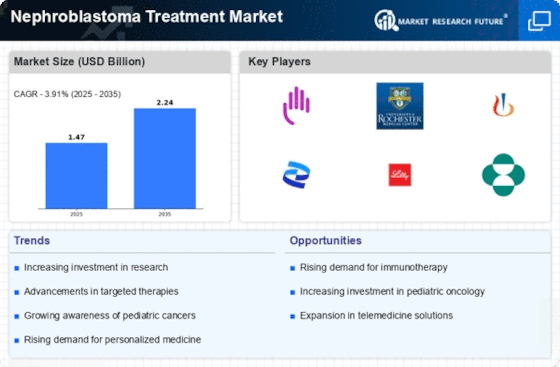
As per MRFR analysis, the Nephroblastoma Treatment Market Size was estimated at 1.47 USD Billion in 2024. The Nephroblastoma Treatment industry is projected to grow from 1.528 in 2025 to 2.242 by 2035, exhibiting a compound annual growth rate (CAGR) of 3.91 during the forecast period 2025 - 2035.

Key Market Trends & Highlights

The Nephroblastoma Treatment Market is poised for growth driven by innovative therapies and increased awareness.

  • The market is witnessing an emergence of targeted therapies that enhance treatment efficacy. There is an increased focus on early detection, which is crucial for improving patient outcomes. Integration of multidisciplinary care is becoming a standard approach in managing nephroblastoma. The rising incidence of nephroblastoma and advancements in treatment modalities are key drivers of market growth.

Market Size & Forecast

2024 Market Size 1.47 (USD Billion)
2035 Market Size 2.242 (USD Billion)
CAGR (2025 - 2035) 3.91%
Largest Regional Market Share in 2024 North America

Major Players

<p>Bristol Myers Squibb (US), Roche (CH), Novartis (CH), <a href="https://healthanswers.pfizer.com/cancer/kidney/complications-of-wilms-tumor?from=/cancer/kidney/wilms-tumor&amp;title=Wilm%27s%20Tumor">Pfizer </a>(US), Eli Lilly and Company (US), Merck &amp; Co. (US), Amgen (US), Bayer (DE)</p>

Market Trends

The Nephroblastoma Treatment Market is currently experiencing a dynamic evolution, driven by advancements in medical research and technology. This pediatric cancer, primarily affecting children, necessitates a multifaceted approach to treatment, which includes surgery, chemotherapy, and radiation therapy. The increasing awareness of early diagnosis and the importance of personalized treatment plans appear to be influencing the market positively. Furthermore, ongoing clinical trials and the development of novel therapeutics suggest a promising future for innovative treatment options. As healthcare systems worldwide strive to enhance patient outcomes, the integration of multidisciplinary care models is likely to gain traction, potentially reshaping the landscape of nephroblastoma management. In addition, the Nephroblastoma Treatment Market seems to be benefiting from collaborative efforts among pharmaceutical companies, research institutions, and healthcare providers. These partnerships may facilitate the rapid translation of research findings into clinical practice, thereby improving treatment efficacy. Moreover, the growing emphasis on patient-centric care indicates a shift towards more holistic approaches, which could enhance the overall quality of life for affected children. As the market continues to evolve, stakeholders must remain vigilant in addressing the challenges posed by this complex disease, ensuring that advancements in treatment are accessible and equitable for all patients.

Emergence of Targeted Therapies

The Nephroblastoma Treatment Market is witnessing a notable shift towards the development of targeted therapies. These treatments aim to specifically attack cancer cells while minimizing damage to healthy tissues. This approach not only enhances treatment efficacy but also reduces side effects, making it a preferred option for many clinicians. As research progresses, the potential for these therapies to become standard practice appears promising.

Increased Focus on Early Detection

There is a growing emphasis on the importance of early detection in the Nephroblastoma Treatment Market. Enhanced screening methods and awareness campaigns are likely to lead to earlier diagnoses, which can significantly improve treatment outcomes. This trend suggests that stakeholders are prioritizing initiatives that educate both healthcare professionals and the public about the signs and symptoms of nephroblastoma.

Integration of Multidisciplinary Care

The integration of multidisciplinary care models is becoming increasingly prevalent within the Nephroblastoma Treatment Market. This approach involves collaboration among various healthcare professionals, including oncologists, surgeons, and supportive care teams. Such collaboration is expected to enhance treatment planning and execution, ultimately leading to improved patient outcomes and satisfaction.

Nephroblastoma Treatment Market Market Drivers

Increased Research Funding

The Nephroblastoma Treatment Market is benefiting from increased research funding aimed at understanding the underlying mechanisms of nephroblastoma. Government and private organizations are allocating substantial resources to support clinical trials and research initiatives. This influx of funding is likely to accelerate the development of novel therapies and improve existing treatment protocols. As a result, the market may witness a surge in innovative treatment options that could enhance patient outcomes. Furthermore, the collaboration between academic institutions and pharmaceutical companies is expected to foster breakthroughs in the Nephroblastoma Treatment Market, ultimately leading to more effective and personalized treatment approaches.

Growing Awareness and Advocacy

The Nephroblastoma Treatment Market is experiencing a shift due to growing awareness and advocacy efforts surrounding childhood cancers. Non-profit organizations and patient advocacy groups are playing a crucial role in educating the public about nephroblastoma, its symptoms, and the importance of early detection. This heightened awareness is likely to lead to earlier diagnoses and increased demand for treatment options. As more families become informed about available therapies, the market may see a rise in patient engagement and participation in clinical trials. This trend could further stimulate growth within the Nephroblastoma Treatment Market, as stakeholders strive to meet the needs of an informed patient population.

Rising Incidence of Nephroblastoma

The Nephroblastoma Treatment Market is experiencing a notable increase in the incidence of nephroblastoma, particularly among children aged 0 to 5 years. This rise is attributed to various factors, including genetic predispositions and environmental influences. According to recent data, nephroblastoma accounts for approximately 5% of all childhood cancers, which underscores the urgent need for effective treatment options. As awareness of this condition grows, healthcare providers are likely to invest more in research and development of innovative therapies. This trend may lead to an expansion of the Nephroblastoma Treatment Market, as more patients seek advanced treatment modalities that can improve survival rates and quality of life.

Advancements in Treatment Modalities

The Nephroblastoma Treatment Market is significantly influenced by advancements in treatment modalities, including chemotherapy, surgery, and radiation therapy. Recent innovations in targeted therapies and immunotherapy have shown promise in improving patient outcomes. For instance, the introduction of agents that specifically target cancer cells has the potential to reduce side effects and enhance efficacy. The market is projected to grow as these new treatment options become more widely available, with estimates suggesting a compound annual growth rate of around 5% over the next several years. This growth reflects the ongoing commitment to improving therapeutic strategies within the Nephroblastoma Treatment Market.

Regulatory Support for Innovative Therapies

The Nephroblastoma Treatment Market is positively impacted by regulatory support for innovative therapies. Regulatory agencies are increasingly recognizing the need for expedited approval processes for new treatments that demonstrate potential benefits for patients. This support is particularly relevant for therapies targeting rare pediatric cancers like nephroblastoma. The implementation of programs such as orphan drug designations and fast-track approvals may encourage pharmaceutical companies to invest in research and development. Consequently, the Nephroblastoma Treatment Market could experience accelerated growth as new therapies enter the market, providing patients with more options and improving overall treatment outcomes.

Market Segment Insights

By Type: Favorable Histology (Largest) vs. Unfavorable Histology (Fastest-Growing)

<p>In the Nephroblastoma Treatment Market, favorable histology currently dominates the landscape, accounting for a significant portion of treatment strategies. This segment benefits from improved treatment outcomes and ongoing research aimed at enhancing therapeutic efficacy. On the other hand, unfavorable histology is emerging as a critical focus area for new therapeutic approaches, with an increasing recognition of its unique challenges and treatment needs.</p>

<p>Histology: Favorable (Dominant) vs. Unfavorable (Emerging)</p>

<p>Favorable histology in Nephroblastoma treatment represents well-differentiated tumors that typically respond better to conventional therapies, making it the preferred approach for clinicians. Its dominance in the market is supported by established protocols and favorable patient outcomes. Conversely, unfavorable histology poses significant treatment challenges due to its aggressive nature and poorer prognosis. This segment is rapidly evolving, attracting more research and development as companies strive to innovate and find viable treatment solutions, thereby gaining attention and potential market share in the forthcoming years.</p>

By End User: Hospitals (Largest) vs. Cancer Centers (Fastest-Growing)

<p>In the Nephroblastoma Treatment Market, hospitals represent the largest segment, capturing a significant share of the overall market. Their established networks, extensive resources, and specialized personnel contribute to their dominance in providing nephroblastoma treatments. Cancer centers are also emerging as crucial players, given their focused approach and comprehensive treatment options that cater specifically to cancer patients. This strategic positioning allows them to capture a slice of the market, particularly among those seeking specialized care.</p>

<p>Hospitals (Dominant) vs. Cancer Centers (Emerging)</p>

<p>Hospitals play a vital role in the Nephroblastoma Treatment Market due to their extensive infrastructure and specialized staff trained to handle complex pediatric cancers. They offer a wide range of services including diagnosis, treatment, and follow-up care, thus becoming the preferred choice for many families. On the other hand, cancer centers are gaining traction as they focus exclusively on oncology, providing cutting-edge treatments and tailored care protocols. Their ability to integrate the latest research findings into clinical practice enhances their appeal, making them an emerging alternative for patients desiring specialized treatment options.</p>

By Treatment: Surgery (Largest) vs. Chemotherapy (Fastest-Growing)

<p>The Nephroblastoma Treatment Market is primarily characterized by its diverse treatment options, with Surgery occupying the largest market share. This intervention serves as the first line of defense against nephroblastoma, providing significant success rates in early-stage cases. Chemotherapy follows as a significant contributor, increasingly recognized for its role in treating advanced stages of the disease. The market also includes Radiation Therapy and other modalities, although they hold comparatively smaller shares in overall treatment strategies.</p>

<p>Surgery (Dominant) vs. Chemotherapy (Emerging)</p>

<p>Surgery remains the dominant treatment modality in the Nephroblastoma Treatment Market due to its effectiveness in tumor removal, particularly in localized cases. This invasive approach ensures substantial tumor reduction and enhances patient prognosis. Conversely, Chemotherapy is recognized as an emerging strategy that complements surgical interventions, particularly in cases with metastatic involvement or high-risk features. The evolving chemotherapy protocols, combined with personalized medicine approaches, are driving rapid adoption in clinics, highlighting its potential in improving overall survival rates. As new chemotherapeutic agents and combinations are being explored, <a href="https://www.marketresearchfuture.com/reports/compounding-chemotherapy-market-10379">Chemotherapy</a> is fast gaining traction, providing a compelling alternative alongside traditional surgery.</p>

By Diagnosis: Ultrasound (Largest) vs. Magnetic Resonance Imaging (Fastest-Growing)

<p>In the Nephroblastoma Treatment Market, the diagnosis segment features a diverse array of imaging techniques. Ultrasound currently holds the largest share of the market, owing to its non-invasive nature and efficiency in detecting abdominal masses, making it a preferred choice among clinicians. In contrast, while less widely used in initial assessments, Magnetic Resonance Imaging (MRI) is rapidly gaining traction for its superior soft tissue contrast and detail, making it invaluable for treatment planning and follow-up assessments. The growth trends within the Diagnosis segment are primarily driven by advancements in imaging technology and increased awareness of nephroblastoma. The rising incidence rates of this kidney cancer, especially in pediatric populations, bolster the demand for effective diagnostic tools. Moreover, the integration of AI and computer-aided detection into imaging modalities is poised to enhance accuracy and efficiency, further stimulating growth in this segment as healthcare providers seek improved outcomes for their patients.</p>

<p>Ultrasound (Dominant) vs. MRI (Emerging)</p>

<p>Ultrasound remains the dominant modality in the diagnosis segment of the Nephroblastoma Treatment Market, primarily because of its accessibility, cost-effectiveness, and safety profile, which is particularly critical in pediatric cases. It allows for real-time imaging and is widely used to guide further diagnostic evaluations. Meanwhile, MRI is emerging as a key player, paralleling advancements in pediatric imaging technology. Its ability to provide detailed anatomical information without ionizing radiation positions it as a critical tool for diagnosis and treatment assessment. The growing shift toward using MRI reflects a broader trend towards personalized medicine, where tailored treatment plans require detailed imaging for precise tumor characterization.</p>

By Distribution Channel: Hospital Pharmacies (Largest) vs. E-Commerce (Fastest-Growing)

<p>The Nephroblastoma Treatment Market displays a diverse set of distribution channels, with hospital pharmacies holding the largest share. These facilities not only serve as critical points for drug dispensation but also offer specialized knowledge that enhances treatment efficiency. Conversely, the e-commerce sector is rapidly emerging, demonstrating significant growth due to increasing digital transformation and patient preference for online access to medicines. This shift is being propelled by the convenience and wider reach that online platforms provide, making them increasingly important in the distribution network.</p>

<p>Hospital Pharmacies (Dominant) vs. E-Commerce (Emerging)</p>

<p>Hospital pharmacies are the dominant distribution channel in the Nephroblastoma Treatment Market, as they provide comprehensive care and personalized services tailored to pediatric patients. They often collaborate closely with physicians and healthcare teams, ensuring timely and effective treatment delivery. On the other hand, e-commerce is capturing attention as an emerging channel, favored for its convenience and accessibility. This channel appeals particularly to tech-savvy patients and caregivers who are seeking alternatives to traditional distribution methods. The growth of e-commerce is further supported by advancements in logistics and an increasing array of online services catering to the healthcare sector.</p>

By Drug: Dactinomycin (Largest) vs. Irinotecan (Fastest-Growing)

<p>In the Nephroblastoma Treatment Market, the drug segment exhibits a diverse distribution of market shares among various treatment options. Dactinomycin remains the largest segment, recognized for its established efficacy in treating Wilms' tumor, a common form of nephroblastoma. Other drugs like Doxorubicin and Vincristine also hold significant shares due to their effectiveness and historical usage in combination chemotherapy regimens, ensuring comprehensive patient care. Meanwhile, medications like Etoposide and Cyclophosphamide are essential for pediatric cancer treatment protocols, contributing to their relevance in this market. The nephroblastoma treatment landscape is witnessing exciting growth trends, driven by advancements in drug formulations and combination therapies that enhance efficacy and reduce toxicity. Newly explored drugs, particularly Irinotecan, are emerging as fast-growing options, appealing particularly for resistant cases of nephroblastoma. Ongoing clinical research and the increasing prevalence of nephroblastoma are expected to further fuel the market's growth, with innovative treatment regimens paving the way for more personalized and effective therapy options.</p>

<p>Dactinomycin (Dominant) vs. Irinotecan (Emerging)</p>

<p>Dactinomycin stands as a dominant player in the Nephroblastoma Treatment Market, primarily due to its historical success and rigorous clinical validation in treating Wilms' tumors. Its durability as a first-line treatment underscores its importance in pediatric oncology. In contrast, Irinotecan emerges as an innovative option in treating nephroblastoma, particularly beneficial for patients who show resistance to standard therapies. Its inclusion in clinical trials and studies has highlighted its potential efficacy, leading to increased interest from oncologists and researchers. The contrasting characteristics of these drugs illustrate the evolving landscape of nephroblastoma treatment, where established drugs remain vital, while new therapies like Irinotecan signal a shift towards more advanced, personalized treatment approaches.</p>

Get more detailed insights about Nephroblastoma Treatment Market Research Report - Forecast till 2035

Regional Insights

North America : Leading Market for Innovation

North America is the largest market for nephroblastoma treatment, accounting for approximately 45% of the global market share. The region benefits from advanced healthcare infrastructure, high R&D investments, and a growing prevalence of pediatric cancers. Regulatory support from agencies like the FDA accelerates the approval of innovative therapies, driving market growth. The increasing focus on personalized medicine and targeted therapies further fuels demand in this region. The United States is the primary contributor to this market, with key players such as Bristol Myers Squibb, Pfizer, and Merck & Co. leading the competitive landscape. Canada also plays a significant role, with a growing emphasis on pediatric oncology. The presence of major pharmaceutical companies and ongoing clinical trials enhances the market's dynamism, ensuring a robust pipeline of treatment options for nephroblastoma patients.

Europe : Emerging Market with Growth Potential

Europe is the second-largest market for nephroblastoma treatment, holding around 30% of the global market share. The region is characterized by increasing investments in healthcare and a rising incidence of childhood cancers. Regulatory frameworks, such as the European Medicines Agency's guidelines, facilitate the introduction of new therapies, enhancing treatment accessibility. Collaborative efforts among countries to improve pediatric cancer care are also significant growth drivers. Leading countries in this market include Germany, France, and the UK, where healthcare systems are increasingly adopting advanced treatment protocols. Major players like Roche and Novartis are actively involved in research and development, contributing to a competitive landscape. The presence of specialized pediatric oncology centers further supports the growth of nephroblastoma treatment options across Europe.

Asia-Pacific : Rapidly Growing Healthcare Sector

Asia-Pacific is witnessing rapid growth in the nephroblastoma treatment market, driven by increasing healthcare investments and rising awareness of pediatric cancers. The region holds approximately 20% of the global market share, with countries like China and India emerging as significant players. Government initiatives aimed at improving healthcare infrastructure and access to treatment are pivotal in driving market demand. The growing prevalence of childhood cancers necessitates innovative treatment solutions, further propelling market growth. China is the largest market in the region, supported by a robust pharmaceutical industry and increasing R&D activities. India follows closely, with a rising number of clinical trials and collaborations with global pharmaceutical companies. The competitive landscape is evolving, with both local and international players striving to enhance treatment options for nephroblastoma, ensuring a diverse range of therapies for patients.

Middle East and Africa : Emerging Market with Challenges

The Middle East and Africa region is gradually developing its nephroblastoma treatment market, currently holding about 5% of the global market share. The growth is driven by increasing healthcare investments and a rising awareness of childhood cancers. However, challenges such as limited access to advanced therapies and healthcare disparities hinder market expansion. Government initiatives aimed at improving healthcare infrastructure are crucial for enhancing treatment accessibility in this region. Countries like South Africa and the UAE are leading the market, with efforts to establish specialized pediatric oncology centers. The presence of international pharmaceutical companies is growing, but local players are also emerging to address specific regional needs. Collaborative efforts between governments and healthcare organizations are essential to improve treatment options and outcomes for nephroblastoma patients in the region.

Key Players and Competitive Insights

The Nephroblastoma Treatment Market is characterized by a dynamic competitive landscape, driven by a confluence of innovation, strategic partnerships, and a focus on patient-centric therapies. Key players such as Bristol Myers Squibb (US), Roche (CH), and Novartis (CH) are at the forefront, each adopting distinct strategies to enhance their market presence. Bristol Myers Squibb (US) emphasizes innovation through its robust pipeline of targeted therapies, while Roche (CH) leverages its extensive research capabilities to develop personalized treatment options. Novartis (CH), on the other hand, is focusing on strategic collaborations to expand its therapeutic offerings, thereby shaping a competitive environment that is increasingly reliant on advanced treatment modalities and collaborative efforts.

In terms of business tactics, companies are increasingly localizing manufacturing and optimizing supply chains to enhance efficiency and responsiveness to market demands. The Nephroblastoma Treatment Market appears moderately fragmented, with several key players exerting influence over various segments. This fragmentation allows for a diverse range of treatment options, yet the collective strategies of major companies are likely to consolidate their positions, creating a more competitive atmosphere.

In August 2025, Roche (CH) announced a strategic partnership with a leading biotechnology firm to co-develop a novel immunotherapy for nephroblastoma. This collaboration is poised to enhance Roche's portfolio and accelerate the development of innovative treatment options, reflecting a broader trend towards personalized medicine. The strategic importance of this partnership lies in its potential to leverage combined expertise, thereby expediting the delivery of cutting-edge therapies to patients.

In September 2025, Novartis (CH) launched a new clinical trial aimed at evaluating the efficacy of a combination therapy for nephroblastoma. This initiative underscores Novartis's commitment to advancing treatment paradigms through rigorous research and development. The trial's outcomes could significantly influence treatment protocols, positioning Novartis as a leader in the evolving landscape of nephroblastoma therapies.

In October 2025, Bristol Myers Squibb (US) unveiled a digital health platform designed to enhance patient engagement and adherence to treatment regimens. This initiative reflects a growing trend towards digitalization in healthcare, aiming to improve patient outcomes through technology. The strategic importance of this platform lies in its potential to foster a more informed patient population, ultimately leading to better treatment adherence and outcomes.

As of October 2025, current competitive trends in the Nephroblastoma Treatment Market are increasingly defined by digitalization, sustainability, and the integration of artificial intelligence. Strategic alliances are shaping the landscape, enabling companies to pool resources and expertise in the pursuit of innovative solutions. Looking ahead, competitive differentiation is likely to evolve from traditional price-based competition towards a focus on innovation, technological advancements, and supply chain reliability, as companies strive to meet the complex needs of patients and healthcare providers.

Key Companies in the Nephroblastoma Treatment Market market include

Industry Developments

  • Q3 2025: Novartis receives FDA approval for new pediatric nephroblastoma therapy Novartis announced that the U.S. Food and Drug Administration has approved its novel targeted therapy for pediatric nephroblastoma, marking a significant advancement in treatment options for children with Wilms tumor.
  • Q2 2025: Pfizer and Children's Oncology Group announce partnership to advance nephroblastoma clinical trials Pfizer has entered into a strategic partnership with the Children's Oncology Group to accelerate clinical development of next-generation therapies for nephroblastoma, aiming to improve survival rates and reduce long-term side effects.
  • Q2 2025: Roche launches Phase III trial for new immunotherapy in pediatric nephroblastoma Roche has initiated a global Phase III clinical trial to evaluate the efficacy of its latest immunotherapy candidate in children diagnosed with nephroblastoma, following promising early-stage results.
  • Q1 2025: AstraZeneca acquires biotech startup focused on rare pediatric kidney cancers AstraZeneca completed the acquisition of a biotech startup specializing in targeted therapies for rare pediatric kidney cancers, including nephroblastoma, to expand its oncology pipeline.
  • Q1 2025: Merck & Co. opens new pediatric oncology research facility in Boston Merck & Co. inaugurated a state-of-the-art research facility dedicated to pediatric oncology, with a focus on developing novel treatments for nephroblastoma and other childhood cancers.
  • Q4 2024: FDA grants Orphan Drug Designation to GSK's investigational nephroblastoma therapy GlaxoSmithKline received Orphan Drug Designation from the FDA for its investigational therapy targeting nephroblastoma, providing incentives for further development and expedited review.
  • Q4 2024: Eli Lilly announces $100M investment in pediatric cancer drug manufacturing Eli Lilly committed $100 million to expand its manufacturing capabilities for pediatric cancer drugs, including those used in nephroblastoma treatment, to meet rising global demand.
  • Q3 2024: Bristol Myers Squibb secures major contract with US government for nephroblastoma drug supply Bristol Myers Squibb signed a multi-year contract with the U.S. government to supply its approved nephroblastoma treatment to federal pediatric cancer centers nationwide.
  • Q3 2024: Sanofi launches new pediatric oncology division with focus on nephroblastoma Sanofi announced the creation of a dedicated pediatric oncology division, prioritizing research and development of new therapies for nephroblastoma and other childhood cancers.
  • Q2 2024: Johnson & Johnson initiates global access program for nephroblastoma treatment in low-income countries Johnson & Johnson launched a global access initiative to provide its nephroblastoma treatment at reduced cost in low- and middle-income countries, aiming to improve outcomes for children worldwide.
  • Q2 2024: Takeda Pharmaceutical receives EMA approval for new nephroblastoma chemotherapy regimen Takeda Pharmaceutical announced that the European Medicines Agency has approved its new chemotherapy regimen for the treatment of nephroblastoma in pediatric patients.
  • Q1 2024: Bayer appoints new head of pediatric oncology to lead nephroblastoma research Bayer named a new global head of pediatric oncology, tasking the executive with accelerating the company's research and development efforts in nephroblastoma therapies.

Future Outlook

Nephroblastoma Treatment Market Future Outlook

<p>The Nephroblastoma Treatment Market is projected to grow at a 3.91% CAGR from 2024 to 2035, driven by advancements in treatment modalities and increasing awareness.</p>

New opportunities lie in:

  • <p>Development of targeted therapies for high-risk patients</p><p>Expansion of telemedicine services for remote patient monitoring</p><p>Investment in personalized medicine approaches for treatment optimization</p>

<p>By 2035, the market is expected to achieve substantial growth, reflecting evolving treatment paradigms.</p>

Market Segmentation

Nephroblastoma Treatment Market Drug Outlook

  • Dactinomycin (Cosmegen)
  • Doxorubicin (Adriamycin)
  • Vincristine (Vincasar Pfs, Oncovin)
  • Cyclophosphamide (Cytoxan, Neosar)
  • Etoposide (Toposar, Vepesid)
  • Irinotecan (Camptosar)
  • Others

Nephroblastoma Treatment Market Type Outlook

  • Favorable Histology
  • Unfavorable Histology

Nephroblastoma Treatment Market End User Outlook

  • Hospitals
  • Cancer Centers
  • Ambulatory Surgical Centers

Nephroblastoma Treatment Market Diagnosis Outlook

  • Ultrasound
  • Computerized Tomography (CT)
  • Magnetic Resonance Imaging (MRI)
  • Chest X-Ray
  • Bone Scan
  • Lab Tests
  • Others

Nephroblastoma Treatment Market Treatment Outlook

  • Surgery
  • Chemotherapy
  • Radiation Therapy
  • Others

Nephroblastoma Treatment Market Distribution Channel Outlook

  • Hospital Pharmacies
  • E-Commerce
  • Drug Stores
  • Retail Pharmacy
  • Others

Report Scope

MARKET SIZE 20241.47(USD Billion)
MARKET SIZE 20251.528(USD Billion)
MARKET SIZE 20352.242(USD Billion)
COMPOUND ANNUAL GROWTH RATE (CAGR)3.91% (2024 - 2035)
REPORT COVERAGERevenue Forecast, Competitive Landscape, Growth Factors, and Trends
BASE YEAR2024
Market Forecast Period2025 - 2035
Historical Data2019 - 2024
Market Forecast UnitsUSD Billion
Key Companies ProfiledMarket analysis in progress
Segments CoveredMarket segmentation analysis in progress
Key Market OpportunitiesAdvancements in targeted therapies and immunotherapy are reshaping the Nephroblastoma Treatment Market landscape.
Key Market DynamicsRising demand for targeted therapies drives innovation and competition in the Nephroblastoma Treatment Market.
Countries CoveredNorth America, Europe, APAC, South America, MEA

FAQs

What is the current valuation of the Nephroblastoma Treatment Market?

The Nephroblastoma Treatment Market was valued at 1.47 USD Billion in 2024.

What is the projected market size for Nephroblastoma Treatment by 2035?

The market is expected to reach 2.242 USD Billion by 2035.

What is the expected CAGR for the Nephroblastoma Treatment Market from 2025 to 2035?

The market is projected to grow at a CAGR of 3.91% during the forecast period.

Which companies are the key players in the Nephroblastoma Treatment Market?

Key players include Bristol Myers Squibb, Roche, Novartis, Pfizer, Eli Lilly and Company, Merck & Co., Amgen, and Bayer.

What are the main treatment types for Nephroblastoma?

The primary treatment types include Surgery, Chemotherapy, Radiation Therapy, and others, with Surgery valued at 0.5 USD Billion in 2024.

How does the market segment for diagnosis perform?

The Diagnosis segment, which includes Ultrasound and CT scans, was valued at 1.1 USD Billion in 2024.

  1. SECTION I: EXECUTIVE SUMMARY AND KEY HIGHLIGHTS
    1. EXECUTIVE SUMMARY
      1. Market Overview
      2. Key Findings
      3. Market Segmentation
      4. Competitive Landscape
      5. Challenges and Opportunities
      6. Future Outlook 2 SECTION II: SCOPING, METHODOLOGY AND MARKET STRUCTURE
    2. MARKET INTRODUCTION
      1. Definition
      2. Scope of the study
    3. RESEARCH METHODOLOGY
      1. Overview
      2. Data Mining
      3. Secondary Research
      4. Primary Research
      5. Forecasting Model
      6. Market Size Estimation
      7. Data Triangulation
      8. Validation 3 SECTION III: QUALITATIVE ANALYSIS
    4. MARKET DYNAMICS
      1. Overview
      2. Drivers
      3. Restraints
      4. Opportunities
    5. MARKET FACTOR ANALYSIS
      1. Value chain Analysis
      2. Porter's Five Forces Analysis
      3. COVID-19 Impact Analysis
    6. Healthcare, BY Type (USD Billion)
      1. Favorable Histology
      2. Unfavorable Histology
    7. Healthcare, BY End User (USD Billion)
      1. Hospitals
      2. Cancer Centers
      3. Ambulatory Surgical Centers
    8. Healthcare, BY Treatment (USD Billion)
      1. Surgery
      2. Chemotherapy
      3. Radiation Therapy
      4. Others
    9. Healthcare, BY Diagnosis (USD Billion)
      1. Ultrasound
      2. Computerized Tomography (CT)
      3. Magnetic Resonance Imaging (MRI)
      4. Chest X-Ray
      5. Bone Scan
      6. Lab Tests
      7. Others
    10. Healthcare, BY Distribution Channel (USD Billion)
      1. Hospital Pharmacies
      2. E-Commerce
      3. Drug Stores
      4. Retail Pharmacy
      5. Others
    11. Healthcare, BY Drug (USD Billion)
      1. Dactinomycin (Cosmegen)
      2. Doxorubicin (Adriamycin)
      3. Vincristine (Vincasar Pfs, Oncovin)
      4. Cyclophosphamide (Cytoxan, Neosar)
      5. Etoposide (Toposar, Vepesid)
      6. Irinotecan (Camptosar)
      7. Others
    12. Healthcare, BY Region (USD Billion)
      1. North America
      2. Europe
      3. APAC
      4. South America
      5. MEA
    13. Competitive Landscape
      1. Overview
      2. Competitive Analysis
      3. Market share Analysis
      4. Major Growth Strategy in the Healthcare
      5. Competitive Benchmarking
      6. Leading Players in Terms of Number of Developments in the Healthcare
      7. Key developments and growth strategies
      8. Major Players Financial Matrix
    14. Company Profiles
      1. Bristol Myers Squibb (US)
      2. Roche (CH)
      3. Novartis (CH)
      4. Pfizer (US)
      5. Eli Lilly and Company (US)
      6. Merck & Co. (US)
      7. Amgen (US)
      8. Bayer (DE)
    15. Appendix
      1. References
      2. Related Reports 6 LIST OF FIGURES
    16. MARKET SYNOPSIS
    17. NORTH AMERICA MARKET ANALYSIS
    18. US MARKET ANALYSIS BY TYPE
    19. US MARKET ANALYSIS BY END USER
    20. US MARKET ANALYSIS BY TREATMENT
    21. US MARKET ANALYSIS BY DIAGNOSIS
    22. US MARKET ANALYSIS BY DISTRIBUTION CHANNEL
    23. US MARKET ANALYSIS BY DRUG
    24. CANADA MARKET ANALYSIS BY TYPE
    25. CANADA MARKET ANALYSIS BY END USER
    26. CANADA MARKET ANALYSIS BY TREATMENT
    27. CANADA MARKET ANALYSIS BY DIAGNOSIS
    28. CANADA MARKET ANALYSIS BY DISTRIBUTION CHANNEL
    29. CANADA MARKET ANALYSIS BY DRUG
    30. EUROPE MARKET ANALYSIS
    31. GERMANY MARKET ANALYSIS BY TYPE
    32. GERMANY MARKET ANALYSIS BY END USER
    33. GERMANY MARKET ANALYSIS BY TREATMENT
    34. GERMANY MARKET ANALYSIS BY DIAGNOSIS
    35. GERMANY MARKET ANALYSIS BY DISTRIBUTION CHANNEL
    36. GERMANY MARKET ANALYSIS BY DRUG
    37. UK MARKET ANALYSIS BY TYPE
    38. UK MARKET ANALYSIS BY END USER
    39. UK MARKET ANALYSIS BY TREATMENT
    40. UK MARKET ANALYSIS BY DIAGNOSIS
    41. UK MARKET ANALYSIS BY DISTRIBUTION CHANNEL
    42. UK MARKET ANALYSIS BY DRUG
    43. FRANCE MARKET ANALYSIS BY TYPE
    44. FRANCE MARKET ANALYSIS BY END USER
    45. FRANCE MARKET ANALYSIS BY TREATMENT
    46. FRANCE MARKET ANALYSIS BY DIAGNOSIS
    47. FRANCE MARKET ANALYSIS BY DISTRIBUTION CHANNEL
    48. FRANCE MARKET ANALYSIS BY DRUG
    49. RUSSIA MARKET ANALYSIS BY TYPE
    50. RUSSIA MARKET ANALYSIS BY END USER
    51. RUSSIA MARKET ANALYSIS BY TREATMENT
    52. RUSSIA MARKET ANALYSIS BY DIAGNOSIS
    53. RUSSIA MARKET ANALYSIS BY DISTRIBUTION CHANNEL
    54. RUSSIA MARKET ANALYSIS BY DRUG
    55. ITALY MARKET ANALYSIS BY TYPE
    56. ITALY MARKET ANALYSIS BY END USER
    57. ITALY MARKET ANALYSIS BY TREATMENT
    58. ITALY MARKET ANALYSIS BY DIAGNOSIS
    59. ITALY MARKET ANALYSIS BY DISTRIBUTION CHANNEL
    60. ITALY MARKET ANALYSIS BY DRUG
    61. SPAIN MARKET ANALYSIS BY TYPE
    62. SPAIN MARKET ANALYSIS BY END USER
    63. SPAIN MARKET ANALYSIS BY TREATMENT
    64. SPAIN MARKET ANALYSIS BY DIAGNOSIS
    65. SPAIN MARKET ANALYSIS BY DISTRIBUTION CHANNEL
    66. SPAIN MARKET ANALYSIS BY DRUG
    67. REST OF EUROPE MARKET ANALYSIS BY TYPE
    68. REST OF EUROPE MARKET ANALYSIS BY END USER
    69. REST OF EUROPE MARKET ANALYSIS BY TREATMENT
    70. REST OF EUROPE MARKET ANALYSIS BY DIAGNOSIS
    71. REST OF EUROPE MARKET ANALYSIS BY DISTRIBUTION CHANNEL
    72. REST OF EUROPE MARKET ANALYSIS BY DRUG
    73. APAC MARKET ANALYSIS
    74. CHINA MARKET ANALYSIS BY TYPE
    75. CHINA MARKET ANALYSIS BY END USER
    76. CHINA MARKET ANALYSIS BY TREATMENT
    77. CHINA MARKET ANALYSIS BY DIAGNOSIS
    78. CHINA MARKET ANALYSIS BY DISTRIBUTION CHANNEL
    79. CHINA MARKET ANALYSIS BY DRUG
    80. INDIA MARKET ANALYSIS BY TYPE
    81. INDIA MARKET ANALYSIS BY END USER
    82. INDIA MARKET ANALYSIS BY TREATMENT
    83. INDIA MARKET ANALYSIS BY DIAGNOSIS
    84. INDIA MARKET ANALYSIS BY DISTRIBUTION CHANNEL
    85. INDIA MARKET ANALYSIS BY DRUG
    86. JAPAN MARKET ANALYSIS BY TYPE
    87. JAPAN MARKET ANALYSIS BY END USER
    88. JAPAN MARKET ANALYSIS BY TREATMENT
    89. JAPAN MARKET ANALYSIS BY DIAGNOSIS
    90. JAPAN MARKET ANALYSIS BY DISTRIBUTION CHANNEL
    91. JAPAN MARKET ANALYSIS BY DRUG
    92. SOUTH KOREA MARKET ANALYSIS BY TYPE
    93. SOUTH KOREA MARKET ANALYSIS BY END USER
    94. SOUTH KOREA MARKET ANALYSIS BY TREATMENT
    95. SOUTH KOREA MARKET ANALYSIS BY DIAGNOSIS
    96. SOUTH KOREA MARKET ANALYSIS BY DISTRIBUTION CHANNEL
    97. SOUTH KOREA MARKET ANALYSIS BY DRUG
    98. MALAYSIA MARKET ANALYSIS BY TYPE
    99. MALAYSIA MARKET ANALYSIS BY END USER
    100. MALAYSIA MARKET ANALYSIS BY TREATMENT
    101. MALAYSIA MARKET ANALYSIS BY DIAGNOSIS
    102. MALAYSIA MARKET ANALYSIS BY DISTRIBUTION CHANNEL
    103. MALAYSIA MARKET ANALYSIS BY DRUG
    104. THAILAND MARKET ANALYSIS BY TYPE
    105. THAILAND MARKET ANALYSIS BY END USER
    106. THAILAND MARKET ANALYSIS BY TREATMENT
    107. THAILAND MARKET ANALYSIS BY DIAGNOSIS
    108. THAILAND MARKET ANALYSIS BY DISTRIBUTION CHANNEL
    109. THAILAND MARKET ANALYSIS BY DRUG
    110. INDONESIA MARKET ANALYSIS BY TYPE
    111. INDONESIA MARKET ANALYSIS BY END USER
    112. INDONESIA MARKET ANALYSIS BY TREATMENT
    113. INDONESIA MARKET ANALYSIS BY DIAGNOSIS
    114. INDONESIA MARKET ANALYSIS BY DISTRIBUTION CHANNEL
    115. INDONESIA MARKET ANALYSIS BY DRUG
    116. REST OF APAC MARKET ANALYSIS BY TYPE
    117. REST OF APAC MARKET ANALYSIS BY END USER
    118. REST OF APAC MARKET ANALYSIS BY TREATMENT
    119. REST OF APAC MARKET ANALYSIS BY DIAGNOSIS
    120. REST OF APAC MARKET ANALYSIS BY DISTRIBUTION CHANNEL
    121. REST OF APAC MARKET ANALYSIS BY DRUG
    122. SOUTH AMERICA MARKET ANALYSIS
    123. BRAZIL MARKET ANALYSIS BY TYPE
    124. BRAZIL MARKET ANALYSIS BY END USER
    125. BRAZIL MARKET ANALYSIS BY TREATMENT
    126. BRAZIL MARKET ANALYSIS BY DIAGNOSIS
    127. BRAZIL MARKET ANALYSIS BY DISTRIBUTION CHANNEL
    128. BRAZIL MARKET ANALYSIS BY DRUG
    129. MEXICO MARKET ANALYSIS BY TYPE
    130. MEXICO MARKET ANALYSIS BY END USER
    131. MEXICO MARKET ANALYSIS BY TREATMENT
    132. MEXICO MARKET ANALYSIS BY DIAGNOSIS
    133. MEXICO MARKET ANALYSIS BY DISTRIBUTION CHANNEL
    134. MEXICO MARKET ANALYSIS BY DRUG
    135. ARGENTINA MARKET ANALYSIS BY TYPE
    136. ARGENTINA MARKET ANALYSIS BY END USER
    137. ARGENTINA MARKET ANALYSIS BY TREATMENT
    138. ARGENTINA MARKET ANALYSIS BY DIAGNOSIS
    139. ARGENTINA MARKET ANALYSIS BY DISTRIBUTION CHANNEL
    140. ARGENTINA MARKET ANALYSIS BY DRUG
    141. REST OF SOUTH AMERICA MARKET ANALYSIS BY TYPE
    142. REST OF SOUTH AMERICA MARKET ANALYSIS BY END USER
    143. REST OF SOUTH AMERICA MARKET ANALYSIS BY TREATMENT
    144. REST OF SOUTH AMERICA MARKET ANALYSIS BY DIAGNOSIS
    145. REST OF SOUTH AMERICA MARKET ANALYSIS BY DISTRIBUTION CHANNEL
    146. REST OF SOUTH AMERICA MARKET ANALYSIS BY DRUG
    147. MEA MARKET ANALYSIS
    148. GCC COUNTRIES MARKET ANALYSIS BY TYPE
    149. GCC COUNTRIES MARKET ANALYSIS BY END USER
    150. GCC COUNTRIES MARKET ANALYSIS BY TREATMENT
    151. GCC COUNTRIES MARKET ANALYSIS BY DIAGNOSIS
    152. GCC COUNTRIES MARKET ANALYSIS BY DISTRIBUTION CHANNEL
    153. GCC COUNTRIES MARKET ANALYSIS BY DRUG
    154. SOUTH AFRICA MARKET ANALYSIS BY TYPE
    155. SOUTH AFRICA MARKET ANALYSIS BY END USER
    156. SOUTH AFRICA MARKET ANALYSIS BY TREATMENT
    157. SOUTH AFRICA MARKET ANALYSIS BY DIAGNOSIS
    158. SOUTH AFRICA MARKET ANALYSIS BY DISTRIBUTION CHANNEL
    159. SOUTH AFRICA MARKET ANALYSIS BY DRUG
    160. REST OF MEA MARKET ANALYSIS BY TYPE
    161. REST OF MEA MARKET ANALYSIS BY END USER
    162. REST OF MEA MARKET ANALYSIS BY TREATMENT
    163. REST OF MEA MARKET ANALYSIS BY DIAGNOSIS
    164. REST OF MEA MARKET ANALYSIS BY DISTRIBUTION CHANNEL
    165. REST OF MEA MARKET ANALYSIS BY DRUG
    166. KEY BUYING CRITERIA OF HEALTHCARE
    167. RESEARCH PROCESS OF MRFR
    168. DRO ANALYSIS OF HEALTHCARE
    169. DRIVERS IMPACT ANALYSIS: HEALTHCARE
    170. RESTRAINTS IMPACT ANALYSIS: HEALTHCARE
    171. SUPPLY / VALUE CHAIN: HEALTHCARE
    172. HEALTHCARE, BY TYPE, 2024 (% SHARE)
    173. HEALTHCARE, BY TYPE, 2024 TO 2035 (USD Billion)
    174. HEALTHCARE, BY END USER, 2024 (% SHARE)
    175. HEALTHCARE, BY END USER, 2024 TO 2035 (USD Billion)
    176. HEALTHCARE, BY TREATMENT, 2024 (% SHARE)
    177. HEALTHCARE, BY TREATMENT, 2024 TO 2035 (USD Billion)
    178. HEALTHCARE, BY DIAGNOSIS, 2024 (% SHARE)
    179. HEALTHCARE, BY DIAGNOSIS, 2024 TO 2035 (USD Billion)
    180. HEALTHCARE, BY DISTRIBUTION CHANNEL, 2024 (% SHARE)
    181. HEALTHCARE, BY DISTRIBUTION CHANNEL, 2024 TO 2035 (USD Billion)
    182. HEALTHCARE, BY DRUG, 2024 (% SHARE)
    183. HEALTHCARE, BY DRUG, 2024 TO 2035 (USD Billion)
    184. BENCHMARKING OF MAJOR COMPETITORS 7 LIST OF TABLES
    185. LIST OF ASSUMPTIONS
    186. North America MARKET SIZE ESTIMATES; FORECAST
      1. BY TYPE, 2025-2035 (USD Billion)
      2. BY END USER, 2025-2035 (USD Billion)
      3. BY TREATMENT, 2025-2035 (USD Billion)
      4. BY DIAGNOSIS, 2025-2035 (USD Billion)
      5. BY DISTRIBUTION CHANNEL, 2025-2035 (USD Billion)
      6. BY DRUG, 2025-2035 (USD Billion)
    187. US MARKET SIZE ESTIMATES; FORECAST
      1. BY TYPE, 2025-2035 (USD Billion)
      2. BY END USER, 2025-2035 (USD Billion)
      3. BY TREATMENT, 2025-2035 (USD Billion)
      4. BY DIAGNOSIS, 2025-2035 (USD Billion)
      5. BY DISTRIBUTION CHANNEL, 2025-2035 (USD Billion)
      6. BY DRUG, 2025-2035 (USD Billion)
    188. Canada MARKET SIZE ESTIMATES; FORECAST
      1. BY TYPE, 2025-2035 (USD Billion)
      2. BY END USER, 2025-2035 (USD Billion)
      3. BY TREATMENT, 2025-2035 (USD Billion)
      4. BY DIAGNOSIS, 2025-2035 (USD Billion)
      5. BY DISTRIBUTION CHANNEL, 2025-2035 (USD Billion)
      6. BY DRUG, 2025-2035 (USD Billion)
    189. Europe MARKET SIZE ESTIMATES; FORECAST
      1. BY TYPE, 2025-2035 (USD Billion)
      2. BY END USER, 2025-2035 (USD Billion)
      3. BY TREATMENT, 2025-2035 (USD Billion)
      4. BY DIAGNOSIS, 2025-2035 (USD Billion)
      5. BY DISTRIBUTION CHANNEL, 2025-2035 (USD Billion)
      6. BY DRUG, 2025-2035 (USD Billion)
    190. Germany MARKET SIZE ESTIMATES; FORECAST
      1. BY TYPE, 2025-2035 (USD Billion)
      2. BY END USER, 2025-2035 (USD Billion)
      3. BY TREATMENT, 2025-2035 (USD Billion)
      4. BY DIAGNOSIS, 2025-2035 (USD Billion)
      5. BY DISTRIBUTION CHANNEL, 2025-2035 (USD Billion)
      6. BY DRUG, 2025-2035 (USD Billion)
    191. UK MARKET SIZE ESTIMATES; FORECAST
      1. BY TYPE, 2025-2035 (USD Billion)
      2. BY END USER, 2025-2035 (USD Billion)
      3. BY TREATMENT, 2025-2035 (USD Billion)
      4. BY DIAGNOSIS, 2025-2035 (USD Billion)
      5. BY DISTRIBUTION CHANNEL, 2025-2035 (USD Billion)
      6. BY DRUG, 2025-2035 (USD Billion)
    192. France MARKET SIZE ESTIMATES; FORECAST
      1. BY TYPE, 2025-2035 (USD Billion)
      2. BY END USER, 2025-2035 (USD Billion)
      3. BY TREATMENT, 2025-2035 (USD Billion)
      4. BY DIAGNOSIS, 2025-2035 (USD Billion)
      5. BY DISTRIBUTION CHANNEL, 2025-2035 (USD Billion)
      6. BY DRUG, 2025-2035 (USD Billion)
    193. Russia MARKET SIZE ESTIMATES; FORECAST
      1. BY TYPE, 2025-2035 (USD Billion)
      2. BY END USER, 2025-2035 (USD Billion)
      3. BY TREATMENT, 2025-2035 (USD Billion)
      4. BY DIAGNOSIS, 2025-2035 (USD Billion)
      5. BY DISTRIBUTION CHANNEL, 2025-2035 (USD Billion)
      6. BY DRUG, 2025-2035 (USD Billion)
    194. Italy MARKET SIZE ESTIMATES; FORECAST
      1. BY TYPE, 2025-2035 (USD Billion)
      2. BY END USER, 2025-2035 (USD Billion)
      3. BY TREATMENT, 2025-2035 (USD Billion)
      4. BY DIAGNOSIS, 2025-2035 (USD Billion)
      5. BY DISTRIBUTION CHANNEL, 2025-2035 (USD Billion)
      6. BY DRUG, 2025-2035 (USD Billion)
    195. Spain MARKET SIZE ESTIMATES; FORECAST
      1. BY TYPE, 2025-2035 (USD Billion)
      2. BY END USER, 2025-2035 (USD Billion)
      3. BY TREATMENT, 2025-2035 (USD Billion)
      4. BY DIAGNOSIS, 2025-2035 (USD Billion)
      5. BY DISTRIBUTION CHANNEL, 2025-2035 (USD Billion)
      6. BY DRUG, 2025-2035 (USD Billion)
    196. Rest of Europe MARKET SIZE ESTIMATES; FORECAST
      1. BY TYPE, 2025-2035 (USD Billion)
      2. BY END USER, 2025-2035 (USD Billion)
      3. BY TREATMENT, 2025-2035 (USD Billion)
      4. BY DIAGNOSIS, 2025-2035 (USD Billion)
      5. BY DISTRIBUTION CHANNEL, 2025-2035 (USD Billion)
      6. BY DRUG, 2025-2035 (USD Billion)
    197. APAC MARKET SIZE ESTIMATES; FORECAST
      1. BY TYPE, 2025-2035 (USD Billion)
      2. BY END USER, 2025-2035 (USD Billion)
      3. BY TREATMENT, 2025-2035 (USD Billion)
      4. BY DIAGNOSIS, 2025-2035 (USD Billion)
      5. BY DISTRIBUTION CHANNEL, 2025-2035 (USD Billion)
      6. BY DRUG, 2025-2035 (USD Billion)
    198. China MARKET SIZE ESTIMATES; FORECAST
      1. BY TYPE, 2025-2035 (USD Billion)
      2. BY END USER, 2025-2035 (USD Billion)
      3. BY TREATMENT, 2025-2035 (USD Billion)
      4. BY DIAGNOSIS, 2025-2035 (USD Billion)
      5. BY DISTRIBUTION CHANNEL, 2025-2035 (USD Billion)
      6. BY DRUG, 2025-2035 (USD Billion)
    199. India MARKET SIZE ESTIMATES; FORECAST
      1. BY TYPE, 2025-2035 (USD Billion)
      2. BY END USER, 2025-2035 (USD Billion)
      3. BY TREATMENT, 2025-2035 (USD Billion)
      4. BY DIAGNOSIS, 2025-2035 (USD Billion)
      5. BY DISTRIBUTION CHANNEL, 2025-2035 (USD Billion)
      6. BY DRUG, 2025-2035 (USD Billion)
    200. Japan MARKET SIZE ESTIMATES; FORECAST
      1. BY TYPE, 2025-2035 (USD Billion)
      2. BY END USER, 2025-2035 (USD Billion)
      3. BY TREATMENT, 2025-2035 (USD Billion)
      4. BY DIAGNOSIS, 2025-2035 (USD Billion)
      5. BY DISTRIBUTION CHANNEL, 2025-2035 (USD Billion)
      6. BY DRUG, 2025-2035 (USD Billion)
    201. South Korea MARKET SIZE ESTIMATES; FORECAST
      1. BY TYPE, 2025-2035 (USD Billion)
      2. BY END USER, 2025-2035 (USD Billion)
      3. BY TREATMENT, 2025-2035 (USD Billion)
      4. BY DIAGNOSIS, 2025-2035 (USD Billion)
      5. BY DISTRIBUTION CHANNEL, 2025-2035 (USD Billion)
      6. BY DRUG, 2025-2035 (USD Billion)
    202. Malaysia MARKET SIZE ESTIMATES; FORECAST
      1. BY TYPE, 2025-2035 (USD Billion)
      2. BY END USER, 2025-2035 (USD Billion)
      3. BY TREATMENT, 2025-2035 (USD Billion)
      4. BY DIAGNOSIS, 2025-2035 (USD Billion)
      5. BY DISTRIBUTION CHANNEL, 2025-2035 (USD Billion)
      6. BY DRUG, 2025-2035 (USD Billion)
    203. Thailand MARKET SIZE ESTIMATES; FORECAST
      1. BY TYPE, 2025-2035 (USD Billion)
      2. BY END USER, 2025-2035 (USD Billion)
      3. BY TREATMENT, 2025-2035 (USD Billion)
      4. BY DIAGNOSIS, 2025-2035 (USD Billion)
      5. BY DISTRIBUTION CHANNEL, 2025-2035 (USD Billion)
      6. BY DRUG, 2025-2035 (USD Billion)
    204. Indonesia MARKET SIZE ESTIMATES; FORECAST
      1. BY TYPE, 2025-2035 (USD Billion)
      2. BY END USER, 2025-2035 (USD Billion)
      3. BY TREATMENT, 2025-2035 (USD Billion)
      4. BY DIAGNOSIS, 2025-2035 (USD Billion)
      5. BY DISTRIBUTION CHANNEL, 2025-2035 (USD Billion)
      6. BY DRUG, 2025-2035 (USD Billion)
    205. Rest of APAC MARKET SIZE ESTIMATES; FORECAST
      1. BY TYPE, 2025-2035 (USD Billion)
      2. BY END USER, 2025-2035 (USD Billion)
      3. BY TREATMENT, 2025-2035 (USD Billion)
      4. BY DIAGNOSIS, 2025-2035 (USD Billion)
      5. BY DISTRIBUTION CHANNEL, 2025-2035 (USD Billion)
      6. BY DRUG, 2025-2035 (USD Billion)
    206. South America MARKET SIZE ESTIMATES; FORECAST
      1. BY TYPE, 2025-2035 (USD Billion)
      2. BY END USER, 2025-2035 (USD Billion)
      3. BY TREATMENT, 2025-2035 (USD Billion)
      4. BY DIAGNOSIS, 2025-2035 (USD Billion)
      5. BY DISTRIBUTION CHANNEL, 2025-2035 (USD Billion)
      6. BY DRUG, 2025-2035 (USD Billion)
    207. Brazil MARKET SIZE ESTIMATES; FORECAST
      1. BY TYPE, 2025-2035 (USD Billion)
      2. BY END USER, 2025-2035 (USD Billion)
      3. BY TREATMENT, 2025-2035 (USD Billion)
      4. BY DIAGNOSIS, 2025-2035 (USD Billion)
      5. BY DISTRIBUTION CHANNEL, 2025-2035 (USD Billion)
      6. BY DRUG, 2025-2035 (USD Billion)
    208. Mexico MARKET SIZE ESTIMATES; FORECAST
      1. BY TYPE, 2025-2035 (USD Billion)
      2. BY END USER, 2025-2035 (USD Billion)
      3. BY TREATMENT, 2025-2035 (USD Billion)
      4. BY DIAGNOSIS, 2025-2035 (USD Billion)
      5. BY DISTRIBUTION CHANNEL, 2025-2035 (USD Billion)
      6. BY DRUG, 2025-2035 (USD Billion)
    209. Argentina MARKET SIZE ESTIMATES; FORECAST
      1. BY TYPE, 2025-2035 (USD Billion)
      2. BY END USER, 2025-2035 (USD Billion)
      3. BY TREATMENT, 2025-2035 (USD Billion)
      4. BY DIAGNOSIS, 2025-2035 (USD Billion)
      5. BY DISTRIBUTION CHANNEL, 2025-2035 (USD Billion)
      6. BY DRUG, 2025-2035 (USD Billion)
    210. Rest of South America MARKET SIZE ESTIMATES; FORECAST
      1. BY TYPE, 2025-2035 (USD Billion)
      2. BY END USER, 2025-2035 (USD Billion)
      3. BY TREATMENT, 2025-2035 (USD Billion)
      4. BY DIAGNOSIS, 2025-2035 (USD Billion)
      5. BY DISTRIBUTION CHANNEL, 2025-2035 (USD Billion)
      6. BY DRUG, 2025-2035 (USD Billion)
    211. MEA MARKET SIZE ESTIMATES; FORECAST
      1. BY TYPE, 2025-2035 (USD Billion)
      2. BY END USER, 2025-2035 (USD Billion)
      3. BY TREATMENT, 2025-2035 (USD Billion)
      4. BY DIAGNOSIS, 2025-2035 (USD Billion)
      5. BY DISTRIBUTION CHANNEL, 2025-2035 (USD Billion)
      6. BY DRUG, 2025-2035 (USD Billion)
    212. GCC Countries MARKET SIZE ESTIMATES; FORECAST
      1. BY TYPE, 2025-2035 (USD Billion)
      2. BY END USER, 2025-2035 (USD Billion)
      3. BY TREATMENT, 2025-2035 (USD Billion)
      4. BY DIAGNOSIS, 2025-2035 (USD Billion)
      5. BY DISTRIBUTION CHANNEL, 2025-2035 (USD Billion)
      6. BY DRUG, 2025-2035 (USD Billion)
    213. South Africa MARKET SIZE ESTIMATES; FORECAST
      1. BY TYPE, 2025-2035 (USD Billion)
      2. BY END USER, 2025-2035 (USD Billion)
      3. BY TREATMENT, 2025-2035 (USD Billion)
      4. BY DIAGNOSIS, 2025-2035 (USD Billion)
      5. BY DISTRIBUTION CHANNEL, 2025-2035 (USD Billion)
      6. BY DRUG, 2025-2035 (USD Billion)
    214. Rest of MEA MARKET SIZE ESTIMATES; FORECAST
      1. BY TYPE, 2025-2035 (USD Billion)
      2. BY END USER, 2025-2035 (USD Billion)
      3. BY TREATMENT, 2025-2035 (USD Billion)
      4. BY DIAGNOSIS, 2025-2035 (USD Billion)
      5. BY DISTRIBUTION CHANNEL, 2025-2035 (USD Billion)
      6. BY DRUG, 2025-2035 (USD Billion)
    215. PRODUCT LAUNCH/PRODUCT DEVELOPMENT/APPROVAL
    216. ACQUISITION/PARTNERSHIP

Market Segmentation

Nephroblastoma Treatment Therapy Type Outlook (USD Billion, 2018-2032)

Favorable Histology

Unfavorable Histology (Anaplastic Wilms Tumor)

Nephroblastoma Treatment Distribution Channel Outlook (USD Billion, 2018-2032)

Hospital Pharmacies

Retail Pharmacy

Drug Stores

E-Commerce

Others

Nephroblastoma Treatment Outlook (USD Billion, 2018-2032)

Chemotherapy

Surgery

Radiation Therapy

Others

Nephroblastoma Treatment Drug Outlook (USD Billion, 2018-2032)

Dactinomycin (Cosmegen)

Doxorubicin (Adriamycin)

Vincristine (Vincasar Pfs, Oncovin)

Cyclophosphamide (Cytoxan, Neosar)

Etoposide (Toposar, Vepesid)

Irinotecan (Camptosar)

Others

Nephroblastoma Treatment Diagnosis Outlook (USD Billion, 2018-2032)

Ultrasound

Computerized Tomography (CT)

Magnetic Resonance Imaging (MRI)

Chest X-Ray

Bone Scan

Lab Tests

Others

Nephroblastoma Treatment End User Outlook (USD Billion, 2018-2032)

Hospitals

Cancer Centers

Ambulatory Surgical Centers

Nephroblastoma Treatment Regional Outlook (USD Billion, 2018-2032)

North America Outlook (USD Billion, 2018-2032)

North America Nephroblastoma Treatment by Type

Favorable Histology

Unfavorable Histology (Anaplastic Wilms Tumor)

North America Nephroblastoma Treatment by Distribution Channel

Hospital Pharmacies

Retail Pharmacy

Drug Stores

E-Commerce

Others

North America Nephroblastoma Treatment by Distribution Channel

Hospital Pharmacies

Retail Pharmacy

Drug Stores

E-Commerce

Others

North America Nephroblastoma Treatment by Treatment

Chemotherapy

Surgery

Radiation Therapy

Others

North America Nephroblastoma Treatment by Drug

Dactinomycin (Cosmegen)

Doxorubicin (Adriamycin)

Vincristine (Vincasar Pfs, Oncovin)

Cyclophosphamide (Cytoxan, Neosar)

Etoposide (Toposar, Vepesid)

Irinotecan (Camptosar)

Others

North America Nephroblastoma Treatment by Diagnosis

Ultrasound

Computerized Tomography (CT)

Magnetic Resonance Imaging (MRI)

Chest X-Ray

Bone Scan

Lab Tests

Others

North America Nephroblastoma Treatment by End User

Hospitals

Cancer Centers

Ambulatory Surgical Centers

US Outlook (USD Billion, 2018-2032)

US Nephroblastoma Treatment by Type

Favorable Histology

Unfavorable Histology (Anaplastic Wilms Tumor)

US Nephroblastoma Treatment by Distribution Channel

Hospital Pharmacies

Retail Pharmacy

Drug Stores

E-Commerce

Others

US Nephroblastoma Treatment by Distribution Channel

Hospital Pharmacies

Retail Pharmacy

Drug Stores

E-Commerce

Others

US Nephroblastoma Treatment by Treatment

Chemotherapy

Surgery

Radiation Therapy

Others

US Nephroblastoma Treatment by Drug

Dactinomycin (Cosmegen)

Doxorubicin (Adriamycin)

Vincristine (Vincasar Pfs, Oncovin)

Cyclophosphamide (Cytoxan, Neosar)

Etoposide (Toposar, Vepesid)

Irinotecan (Camptosar)

Others

US Nephroblastoma Treatment by Diagnosis

Ultrasound

Computerized Tomography (CT)

Magnetic Resonance Imaging (MRI)

Chest X-Ray

Bone Scan

Lab Tests

Others

US Nephroblastoma Treatment by End User

Hospitals

Cancer Centers

Ambulatory Surgical Centers

CANADA Outlook (USD Billion, 2018-2032)

Canada Nephroblastoma Treatment by Type

Favorable Histology

Unfavorable Histology (Anaplastic Wilms Tumor)

Canada Nephroblastoma Treatment by Distribution Channel

Hospital Pharmacies

Retail Pharmacy

Drug Stores

E-Commerce

Others

Canada Nephroblastoma Treatment by Distribution Channel

Hospital Pharmacies

Retail Pharmacy

Drug Stores

E-Commerce

Others

Canada Nephroblastoma Treatment by Treatment

Chemotherapy

Surgery

Radiation Therapy

Others

Canada Nephroblastoma Treatment by Drug

Dactinomycin (Cosmegen)

Doxorubicin (Adriamycin)

Vincristine (Vincasar Pfs, Oncovin)

Cyclophosphamide (Cytoxan, Neosar)

Etoposide (Toposar, Vepesid)

Irinotecan (Camptosar)

Others

Canada Nephroblastoma Treatment by Diagnosis

Ultrasound

Computerized Tomography (CT)

Magnetic Resonance Imaging (MRI)

Chest X-Ray

Bone Scan

Lab Tests

Others

Canada Nephroblastoma Treatment by End User

Hospitals

Cancer Centers

Ambulatory Surgical Centers

Europe Outlook (USD Billion, 2018-2032)

Europe Nephroblastoma Treatment by Type

Favorable Histology

Unfavorable Histology (Anaplastic Wilms Tumor)

Europe Nephroblastoma Treatment by Distribution Channel

Hospital Pharmacies

Retail Pharmacy

Drug Stores

E-Commerce

Others

Europe Nephroblastoma Treatment by Distribution Channel

Hospital Pharmacies

Retail Pharmacy

Drug Stores

E-Commerce

Others

Europe Nephroblastoma Treatment by Treatment

Chemotherapy

Surgery

Radiation Therapy

Others

Europe Nephroblastoma Treatment by Drug

Dactinomycin (Cosmegen)

Doxorubicin (Adriamycin)

Vincristine (Vincasar Pfs, Oncovin)

Cyclophosphamide (Cytoxan, Neosar)

Etoposide (Toposar, Vepesid)

Irinotecan (Camptosar)

Others

Europe Nephroblastoma Treatment by Diagnosis

Ultrasound

Computerized Tomography (CT)

Magnetic Resonance Imaging (MRI)

Chest X-Ray

Bone Scan

Lab Tests

Others

Europe Nephroblastoma Treatment by End User

Hospitals

Cancer Centers

Ambulatory Surgical Centers

Germany Outlook (USD Billion, 2018-2032)

Germany Nephroblastoma Treatment by Type

Favorable Histology

Unfavorable Histology (Anaplastic Wilms Tumor)

Germany Nephroblastoma Treatment by Distribution Channel

Hospital Pharmacies

Retail Pharmacy

Drug Stores

E-Commerce

Others

Germany Nephroblastoma Treatment by Distribution Channel

Hospital Pharmacies

Retail Pharmacy

Drug Stores

E-Commerce

Others

Germany Nephroblastoma Treatment by Treatment

Chemotherapy

Surgery

Radiation Therapy

Others

Germany Nephroblastoma Treatment by Drug

Dactinomycin (Cosmegen)

Doxorubicin (Adriamycin)

Vincristine (Vincasar Pfs, Oncovin)

Cyclophosphamide (Cytoxan, Neosar)

Etoposide (Toposar, Vepesid)

Irinotecan (Camptosar)

Others

Germany Nephroblastoma Treatment by Diagnosis

Ultrasound

Computerized Tomography (CT)

Magnetic Resonance Imaging (MRI)

Chest X-Ray

Bone Scan

Lab Tests

Others

Germany Nephroblastoma Treatment by End User

Hospitals

Cancer Centers

Ambulatory Surgical Centers

France Outlook (USD Billion, 2018-2032)

France Nephroblastoma Treatment by Type

Favorable Histology

Unfavorable Histology (Anaplastic Wilms Tumor)

France Nephroblastoma Treatment by Distribution Channel

Hospital Pharmacies

Retail Pharmacy

Drug Stores

E-Commerce

Others

France Nephroblastoma Treatment by Distribution Channel

Hospital Pharmacies

Retail Pharmacy

Drug Stores

E-Commerce

Others

France Nephroblastoma Treatment by Treatment

Chemotherapy

Surgery

Radiation Therapy

Others

France Nephroblastoma Treatment by Drug

Dactinomycin (Cosmegen)

Doxorubicin (Adriamycin)

Vincristine (Vincasar Pfs, Oncovin)

Cyclophosphamide (Cytoxan, Neosar)

Etoposide (Toposar, Vepesid)

Irinotecan (Camptosar)

Others

France Nephroblastoma Treatment by Diagnosis

Ultrasound

Computerized Tomography (CT)

Magnetic Resonance Imaging (MRI)

Chest X-Ray

Bone Scan

Lab Tests

Others

France Nephroblastoma Treatment by End User

Hospitals

Cancer Centers

Ambulatory Surgical Centers

UK Outlook (USD Billion, 2018-2032)

UK Nephroblastoma Treatment by Type

Favorable Histology

Unfavorable Histology (Anaplastic Wilms Tumor)

UK Nephroblastoma Treatment by Distribution Channel

Hospital Pharmacies

Retail Pharmacy

Drug Stores

E-Commerce

Others

UK Nephroblastoma Treatment by Distribution Channel

Hospital Pharmacies

Retail Pharmacy

Drug Stores

E-Commerce

Others

UK Nephroblastoma Treatment by Treatment

Chemotherapy

Surgery

Radiation Therapy

Others

UK Nephroblastoma Treatment by Drug

Dactinomycin (Cosmegen)

Doxorubicin (Adriamycin)

Vincristine (Vincasar Pfs, Oncovin)

Cyclophosphamide (Cytoxan, Neosar)

Etoposide (Toposar, Vepesid)

Irinotecan (Camptosar)

Others

UK Nephroblastoma Treatment by Diagnosis

Ultrasound

Computerized Tomography (CT)

Magnetic Resonance Imaging (MRI)

Chest X-Ray

Bone Scan

Lab Tests

Others

UK Nephroblastoma Treatment by End User

Hospitals

Cancer Centers

Ambulatory Surgical Centers

ITALY Outlook (USD Billion, 2018-2032)

Italy Nephroblastoma Treatment by Type

Favorable Histology

Unfavorable Histology (Anaplastic Wilms Tumor)

Italy Nephroblastoma Treatment by Distribution Channel

Hospital Pharmacies

Retail Pharmacy

Drug Stores

E-Commerce

Others

Italy Nephroblastoma Treatment by Distribution Channel

Hospital Pharmacies

Retail Pharmacy

Drug Stores

E-Commerce

Others

Italy Nephroblastoma Treatment by Treatment

Chemotherapy

Surgery

Radiation Therapy

Others

Italy Nephroblastoma Treatment by Drug

Dactinomycin (Cosmegen)

Doxorubicin (Adriamycin)

Vincristine (Vincasar Pfs, Oncovin)

Cyclophosphamide (Cytoxan, Neosar)

Etoposide (Toposar, Vepesid)

Irinotecan (Camptosar)

Others

Italy Nephroblastoma Treatment by Diagnosis

Ultrasound

Computerized Tomography (CT)

Magnetic Resonance Imaging (MRI)

Chest X-Ray

Bone Scan

Lab Tests

Others

Italy Nephroblastoma Treatment by End User

Hospitals

Cancer Centers

Ambulatory Surgical Centers

SPAIN Outlook (USD Billion, 2018-2032)

Spain Nephroblastoma Treatment by Type

Favorable Histology

Unfavorable Histology (Anaplastic Wilms Tumor)

Spain Nephroblastoma Treatment by Distribution Channel

Hospital Pharmacies

Retail Pharmacy

Drug Stores

E-Commerce

Others

Spain Nephroblastoma Treatment by Distribution Channel

Hospital Pharmacies

Retail Pharmacy

Drug Stores

E-Commerce

Others

Spain Nephroblastoma Treatment by Treatment

Chemotherapy

Surgery

Radiation Therapy

Others

Spain Nephroblastoma Treatment by Drug

Dactinomycin (Cosmegen)

Doxorubicin (Adriamycin)

Vincristine (Vincasar Pfs, Oncovin)

Cyclophosphamide (Cytoxan, Neosar)

Etoposide (Toposar, Vepesid)

Irinotecan (Camptosar)

Others

Spain Nephroblastoma Treatment by Diagnosis

Ultrasound

Computerized Tomography (CT)

Magnetic Resonance Imaging (MRI)

Chest X-Ray

Bone Scan

Lab Tests

Others

Spain Nephroblastoma Treatment by End User

Hospitals

Cancer Centers

Ambulatory Surgical Centers

Rest Of Europe Outlook (USD Billion, 2018-2032)

Rest of Europe Nephroblastoma Treatment by Type

Favorable Histology

Unfavorable Histology (Anaplastic Wilms Tumor)

Rest of Europe Nephroblastoma Treatment by Distribution Channel

Hospital Pharmacies

Retail Pharmacy

Drug Stores

E-Commerce

Others

Rest of Europe Nephroblastoma Treatment by Distribution Channel

Hospital Pharmacies

Retail Pharmacy

Drug Stores

E-Commerce

Others

Rest of Europe Nephroblastoma Treatment by Treatment

Chemotherapy

Surgery

Radiation Therapy

Others

Rest of Europe Nephroblastoma Treatment by Drug

Dactinomycin (Cosmegen)

Doxorubicin (Adriamycin)

Vincristine (Vincasar Pfs, Oncovin)

Cyclophosphamide (Cytoxan, Neosar)

Etoposide (Toposar, Vepesid)

Irinotecan (Camptosar)

Others

Rest of Europe Nephroblastoma Treatment by Diagnosis

Ultrasound

Computerized Tomography (CT)

Magnetic Resonance Imaging (MRI)

Chest X-Ray

Bone Scan

Lab Tests

Others

Rest of Europe Nephroblastoma Treatment by End User

Hospitals

Cancer Centers

Ambulatory Surgical Centers

Asia-Pacific Outlook (USD Billion, 2018-2032)

Asia Pacific Nephroblastoma Treatment by Type

Favorable Histology

Unfavorable Histology (Anaplastic Wilms Tumor)

Asia Pacific Nephroblastoma Treatment by Distribution Channel

Hospital Pharmacies

Retail Pharmacy

Drug Stores

E-Commerce

Others

Asia Pacific Nephroblastoma Treatment by Distribution Channel

Hospital Pharmacies

Retail Pharmacy

Drug Stores

E-Commerce

Others

Asia Pacific Nephroblastoma Treatment by Treatment

Chemotherapy

Surgery

Radiation Therapy

Others

Asia Pacific Nephroblastoma Treatment by Drug

Dactinomycin (Cosmegen)

Doxorubicin (Adriamycin)

Vincristine (Vincasar Pfs, Oncovin)

Cyclophosphamide (Cytoxan, Neosar)

Etoposide (Toposar, Vepesid)

Irinotecan (Camptosar)

Others

Asia Pacific Nephroblastoma Treatment by Diagnosis

Ultrasound

Computerized Tomography (CT)

Magnetic Resonance Imaging (MRI)

Chest X-Ray

Bone Scan

Lab Tests

Others

Asia Pacific Nephroblastoma Treatment by End User

Hospitals

Cancer Centers

Ambulatory Surgical Centers

China Outlook (USD Billion, 2018-2032)

China Nephroblastoma Treatment by Type

Favorable Histology

Unfavorable Histology (Anaplastic Wilms Tumor)

China Nephroblastoma Treatment by Distribution Channel

Hospital Pharmacies

Retail Pharmacy

Drug Stores

E-Commerce

Others

China Nephroblastoma Treatment by Distribution Channel

Hospital Pharmacies

Retail Pharmacy

Drug Stores

E-Commerce

Others

China Nephroblastoma Treatment by Treatment

Chemotherapy

Surgery

Radiation Therapy

Others

China Nephroblastoma Treatment by Drug

Dactinomycin (Cosmegen)

Doxorubicin (Adriamycin)

Vincristine (Vincasar Pfs, Oncovin)

Cyclophosphamide (Cytoxan, Neosar)

Etoposide (Toposar, Vepesid)

Irinotecan (Camptosar)

Others

China Nephroblastoma Treatment by Diagnosis

Ultrasound

Computerized Tomography (CT)

Magnetic Resonance Imaging (MRI)

Chest X-Ray

Bone Scan

Lab Tests

Others

China Nephroblastoma Treatment by End User

Hospitals

Cancer Centers

Ambulatory Surgical Centers

Japan Outlook (USD Billion, 2018-2032)

Japan Nephroblastoma Treatment by Type

Favorable Histology

Unfavorable Histology (Anaplastic Wilms Tumor)

Japan Nephroblastoma Treatment by Distribution Channel

Hospital Pharmacies

Retail Pharmacy

Drug Stores

E-Commerce

Others

Japan Nephroblastoma Treatment by Distribution Channel

Hospital Pharmacies

Retail Pharmacy

Drug Stores

E-Commerce

Others

Japan Nephroblastoma Treatment by Treatment

Chemotherapy

Surgery

Radiation Therapy

Others

Japan Nephroblastoma Treatment by Drug

Dactinomycin (Cosmegen)

Doxorubicin (Adriamycin)

Vincristine (Vincasar Pfs, Oncovin)

Cyclophosphamide (Cytoxan, Neosar)

Etoposide (Toposar, Vepesid)

Irinotecan (Camptosar)

Others

Japan Nephroblastoma Treatment by Diagnosis

Ultrasound

Computerized Tomography (CT)

Magnetic Resonance Imaging (MRI)

Chest X-Ray

Bone Scan

Lab Tests

Others

Japan Nephroblastoma Treatment by End User

Hospitals

Cancer Centers

Ambulatory Surgical Centers

India Outlook (USD Billion, 2018-2032)

India Nephroblastoma Treatment by Type

Favorable Histology

Unfavorable Histology (Anaplastic Wilms Tumor)

India Nephroblastoma Treatment by Distribution Channel

Hospital Pharmacies

Retail Pharmacy

Drug Stores

E-Commerce

Others

India Nephroblastoma Treatment by Distribution Channel

Hospital Pharmacies

Retail Pharmacy

Drug Stores

E-Commerce

Others

India Nephroblastoma Treatment by Treatment

Chemotherapy

Surgery

Radiation Therapy

Others

India Nephroblastoma Treatment by Drug

Dactinomycin (Cosmegen)

Doxorubicin (Adriamycin)

Vincristine (Vincasar Pfs, Oncovin)

Cyclophosphamide (Cytoxan, Neosar)

Etoposide (Toposar, Vepesid)

Irinotecan (Camptosar)

Others

India Nephroblastoma Treatment by Diagnosis

Ultrasound

Computerized Tomography (CT)

Magnetic Resonance Imaging (MRI)

Chest X-Ray

Bone Scan

Lab Tests

Others

India Nephroblastoma Treatment by End User

Hospitals

Cancer Centers

Ambulatory Surgical Centers

Australia Outlook (USD Billion, 2018-2032)

Australia Nephroblastoma Treatment by Type

Favorable Histology

Unfavorable Histology (Anaplastic Wilms Tumor)

Australia Nephroblastoma Treatment by Distribution Channel

Hospital Pharmacies

Retail Pharmacy

Drug Stores

E-Commerce

Others

Australia Nephroblastoma Treatment by Distribution Channel

Hospital Pharmacies

Retail Pharmacy

Drug Stores

E-Commerce

Others

Australia Nephroblastoma Treatment by Treatment

Chemotherapy

Surgery

Radiation Therapy

Others

Australia Nephroblastoma Treatment by Drug

Dactinomycin (Cosmegen)

Doxorubicin (Adriamycin)

Vincristine (Vincasar Pfs, Oncovin)

Cyclophosphamide (Cytoxan, Neosar)

Etoposide (Toposar, Vepesid)

Irinotecan (Camptosar)

Others

Australia Nephroblastoma Treatment by Diagnosis

Ultrasound

Computerized Tomography (CT)

Magnetic Resonance Imaging (MRI)

Chest X-Ray

Bone Scan

Lab Tests

Others

Australia Nephroblastoma Treatment by End User

Hospitals

Cancer Centers

Ambulatory Surgical Centers

Rest of Asia-Pacific Outlook (USD Billion, 2018-2032)

Rest of Asia-Pacific Nephroblastoma Treatment by Type

Favorable Histology

Unfavorable Histology (Anaplastic Wilms Tumor)

Rest of Asia-Pacific Nephroblastoma Treatment by Distribution Channel

Hospital Pharmacies

Retail Pharmacy

Drug Stores

E-Commerce

Others

Rest of Asia-Pacific Nephroblastoma Treatment by Distribution Channel

Hospital Pharmacies

Retail Pharmacy

Drug Stores

E-Commerce

Others

Rest of Asia-Pacific Nephroblastoma Treatment by Treatment

Chemotherapy

Surgery

Radiation Therapy

Others

Rest of Asia-Pacific Nephroblastoma Treatment by Drug

Dactinomycin (Cosmegen)

Doxorubicin (Adriamycin)

Vincristine (Vincasar Pfs, Oncovin)

Cyclophosphamide (Cytoxan, Neosar)

Etoposide (Toposar, Vepesid)

Irinotecan (Camptosar)

Others

Rest of Asia-Pacific Nephroblastoma Treatment by Diagnosis

Ultrasound

Computerized Tomography (CT)

Magnetic Resonance Imaging (MRI)

Chest X-Ray

Bone Scan

Lab Tests

Others

Rest of Asia-Pacific Nephroblastoma Treatment by End User

Hospitals

Cancer Centers

Ambulatory Surgical Centers

Rest of the World Outlook (USD Billion, 2018-2032)

Rest of the World Nephroblastoma Treatment by Type

Favorable Histology

Unfavorable Histology (Anaplastic Wilms Tumor)

Rest of the World Nephroblastoma Treatment by Distribution Channel

Hospital Pharmacies

Retail Pharmacy

Drug Stores

E-Commerce

Others

Rest of the World Nephroblastoma Treatment by Distribution Channel

Hospital Pharmacies

Retail Pharmacy

Drug Stores

E-Commerce

Others

Rest of the World Nephroblastoma Treatment by Treatment

Chemotherapy

Surgery

Radiation Therapy

Others

Rest of the World Nephroblastoma Treatment by Drug

Dactinomycin (Cosmegen)

Doxorubicin (Adriamycin)

Vincristine (Vincasar Pfs, Oncovin)

Cyclophosphamide (Cytoxan, Neosar)

Etoposide (Toposar, Vepesid)

Irinotecan (Camptosar)

Others

Rest of the World Nephroblastoma Treatment by Diagnosis

Ultrasound

Computerized Tomography (CT)

Magnetic Resonance Imaging (MRI)

Chest X-Ray

Bone Scan

Lab Tests

Others

Rest of the World Nephroblastoma Treatment by End User

Hospitals

Cancer Centers

Ambulatory Surgical Centers

Middle East Outlook (USD Billion, 2018-2032)

Middle East Nephroblastoma Treatment by Type

Favorable Histology

Unfavorable Histology (Anaplastic Wilms Tumor)

Middle East Nephroblastoma Treatment by Distribution Channel

Hospital Pharmacies

Retail Pharmacy

Drug Stores

E-Commerce

Others

Middle East Nephroblastoma Treatment by Distribution Channel

Hospital Pharmacies

Retail Pharmacy

Drug Stores

E-Commerce

Others

Middle East Nephroblastoma Treatment by Treatment

Chemotherapy

Surgery

Radiation Therapy

Others

Middle East Nephroblastoma Treatment by Drug

Dactinomycin (Cosmegen)

Doxorubicin (Adriamycin)

Vincristine (Vincasar Pfs, Oncovin)

Cyclophosphamide (Cytoxan, Neosar)

Etoposide (Toposar, Vepesid)

Irinotecan (Camptosar)

Others

Middle East Nephroblastoma Treatment by Diagnosis

Ultrasound

Computerized Tomography (CT)

Magnetic Resonance Imaging (MRI)

Chest X-Ray

Bone Scan

Lab Tests

Others

Middle East Nephroblastoma Treatment by End User

Hospitals

Cancer Centers

Ambulatory Surgical Centers

Africa Outlook (USD Billion, 2018-2032)

Africa Nephroblastoma Treatment by Type

Favorable Histology

Unfavorable Histology (Anaplastic Wilms Tumor)

Africa Nephroblastoma Treatment by Distribution Channel

Hospital Pharmacies

Retail Pharmacy

Drug Stores

E-Commerce

Others

Africa Nephroblastoma Treatment by Distribution Channel

Hospital Pharmacies

Retail Pharmacy

Drug Stores

E-Commerce

Others

Africa Nephroblastoma Treatment by Treatment

Chemotherapy

Surgery

Radiation Therapy

Others

Africa Nephroblastoma Treatment by Drug

Dactinomycin (Cosmegen)

Doxorubicin (Adriamycin)

Vincristine (Vincasar Pfs, Oncovin)

Cyclophosphamide (Cytoxan, Neosar)

Etoposide (Toposar, Vepesid)

Irinotecan (Camptosar)

Others

Africa Nephroblastoma Treatment by Diagnosis

Ultrasound

Computerized Tomography (CT)

Magnetic Resonance Imaging (MRI)

Chest X-Ray

Bone Scan

Lab Tests

Others

Africa Nephroblastoma Treatment by End User

Hospitals

Cancer Centers

Ambulatory Surgical Centers

Latin America Outlook (USD Billion, 2018-2032)

Latin America Nephroblastoma Treatment by Type

Favorable Histology

Unfavorable Histology (Anaplastic Wilms Tumor)

Latin America Nephroblastoma Treatment by Distribution Channel

Hospital Pharmacies

Retail Pharmacy

Drug Stores

E-Commerce

Others

Latin America Nephroblastoma Treatment by Distribution Channel

Hospital Pharmacies

Retail Pharmacy

Drug Stores

E-Commerce

Others

Latin America Nephroblastoma Treatment by Treatment

Chemotherapy

Surgery

Radiation Therapy

Others

Latin America Nephroblastoma Treatment by Drug

Dactinomycin (Cosmegen)

Doxorubicin (Adriamycin)

Vincristine (Vincasar Pfs, Oncovin)

Cyclophosphamide (Cytoxan, Neosar)

Etoposide (Toposar, Vepesid)

Irinotecan (Camptosar)

Others

Latin America Nephroblastoma Treatment by Diagnosis

Ultrasound

Computerized Tomography (CT)

Magnetic Resonance Imaging (MRI)

Chest X-Ray

Bone Scan

Lab Tests

Others

Latin America Nephroblastoma Treatment by End User

Hospitals

Cancer Centers

Ambulatory Surgical Centers

Infographic

Free Sample Request

Kindly complete the form below to receive a free sample of this Report

Get Free Sample

Customer Strories

Compare Licence

×
Features License Type
Single User Multiuser License Enterprise User
Price $4,950 $5,950 $7,250
Maximum User Access Limit 1 User Upto 10 Users Unrestricted Access Throughout the Organization
Free Customization
Direct Access to Analyst
Deliverable Format
Platform Access
Discount on Next Purchase 10% 15% 15%
Printable Versions