Request Free Sample ×

Kindly complete the form below to receive a free sample of this Report

* Please use a valid business email

Leading companies partner with us for data-driven Insights

clients tt-cursor
Hero Background
English
Chinese
French
Japanese
Korean
German
Spanish

Necrotizing Fasciitis Market Analysis

ID: MRFR/Pharma/4004-HCR
203 Pages
Vikita Thakur
March 2026

Necrotizing Fasciitis Market Trends And Share Analysis By Type (Type I, Type Ii, Type Iii), Treatment (Intravenous Antibiotics, Surgery, And Hyperbaric Oxygen Treatment), And End Users (Hospitals & Clinics, And Surgical Centers) - Forecast Till 2035

Share:
Download PDF ×

We do not share your information with anyone. However, we may send you emails based on your report interest from time to time. You may contact us at any time to opt-out.

Necrotizing Fasciitis Market Infographic
Purchase Options

Market Analysis

In-depth Analysis of Necrotizing Fasciitis Market Industry Landscape

The market dynamics of Necrotizing Fasciitis (NF) replicate a complex interplay of various factors influencing the prognosis, remedy, and universal management of this lifestyles-threatening smooth tissue contamination. NF, usually referred to as flesh-consuming disorder, has garnered expanded interest inside the scientific network due to its fast development and high mortality costs. Understanding the market dynamics starts with assessing the prevalence and occurrence of NF. Despite being a rather rare circumstance, the rising quantity of reported instances globally has contributed to an expanded recognition of research, improvement, and investment in addressing this critical clinical difficulty. Advances in diagnostic technology play a crucial function within the market dynamics of NF. Early and accurate diagnosis is pivotal for powerful intervention. The market witnesses a non-stop influx of progressive diagnostic gear, along with imaging strategies, molecular diagnostics, and factor-of-care testing, aiming to beautify early detection and enhance affected person results. The emergence of promising cures marks the market dynamics. Research into new antibiotics with stronger efficacy in opposition to NF-causing organisms, together with Streptococcus pyogenes, and the exploration of immunomodulatory sellers are shaping the future of NF remedy. Biotechnology groups are at the forefront, riding innovation in this area. Regulatory approvals and guidelines substantially affect market dynamics. Stringent regulatory processes ensure the safety and efficacy of new cures even as selling opposition. Understanding and navigating the regulatory landscape is crucial for market gamers to deliver novel NF remedies to the market and meet unmet scientific wishes. The market for NF remedies is competitive, with pharmaceutical and biotechnology companies vying to set up their products as requirements of care. This competition fosters innovation, with organizations investing in studies and improvement to gain an aggressive aspect. Collaboration and partnerships are not unusual strategies to leverage complementary strengths. The worldwide nature of the NF market increases questions about the accessibility of treatments. Disparities in healthcare infrastructure and resources throughout areas affect the availability of superior diagnostic gear and cures. The monetary components of healthcare make contributions notably to market dynamics. The value of NF treatment, which includes hospitalization, surgical procedures, and medicines, poses demanding situations for both patients and healthcare systems. Market gamers need to consider fee-effectiveness and reimbursement strategies to ensure the vast adoption of their products. The function of patient advocacy organizations and attention campaigns can't be overstated in shaping the market dynamics. These initiatives no longer only contribute to early detection with the aid of teaching the public and healthcare specialists but also affect research priorities and funding allocations.


Author
Author Profile
Vikita Thakur
Senior Research Analyst

She holds an experience of about 5+ years in market research and business consulting projects for sectors such as life sciences, medical devices, and healthcare IT. She possesses a robust background in data analysis, market estimation, competitive intelligence, pipeline analysis market trend identification, and consumer behavior insights. Her expertise lies in technical Sales support, client interaction and project management, designing and implementing market research studies, conducting competitive analysis, and synthesizing complex data into actionable recommendations that drive business growth.

Leave a Comment

FAQs

What is the projected market valuation of The Global Necrotizing Fasciitis by 2035?

<p>The projected market valuation for The Global Necrotizing Fasciitis is expected to reach 0.5732 USD Billion by 2035.</p>

What was the market valuation of The Global Necrotizing Fasciitis in 2024?

<p>The overall market valuation was 0.2777 USD Billion in 2024.</p>

What is the expected CAGR for The Global Necrotizing Fasciitis during the forecast period 2025 - 2035?

<p>The expected CAGR for The Global Necrotizing Fasciitis during the forecast period 2025 - 2035 is 6.81%.</p>

Which companies are considered key players in The Global Necrotizing Fasciitis?

Key players in the market include Johnson &amp; Johnson, Merck &amp; Co., Pfizer Inc., Baxter International Inc., GSK, AstraZeneca, Novartis AG, Sanofi, and Boehringer Ingelheim.

What are the main treatment segments in The Global Necrotizing Fasciitis?

<p>The main treatment segments include intravenous antibiotics, surgery, hyperbaric oxygen treatment, and others.</p>

How did the Type I segment perform in The Global Necrotizing Fasciitis in 2024?

The Type I segment was valued at 0.1115 USD Billion in 2024 and is projected to reach 0.227 USD Billion by 2035.

What is the market size for hospitals and clinics as end users in The Global Necrotizing Fasciitis?

The market size for hospitals and clinics as end users was 0.1661 USD Billion in 2024 and is expected to grow to 0.3531 USD Billion by 2035.

What is the projected growth for the surgery treatment segment in The Global Necrotizing Fasciitis?

The surgery treatment segment was valued at 0.1115 USD Billion in 2024 and is anticipated to increase to 0.2335 USD Billion by 2035.

What is the expected performance of the Type II segment in The Global Necrotizing Fasciitis?

The Type II segment was valued at 0.0838 USD Billion in 2024 and is projected to reach 0.168 USD Billion by 2035.

How does the market for hyperbaric oxygen treatment compare to other treatment segments?

The hyperbaric oxygen treatment segment was valued at 0.0558 USD Billion in 2024 and is expected to grow to 0.1165 USD Billion by 2035, indicating a steady increase.

Market Summary

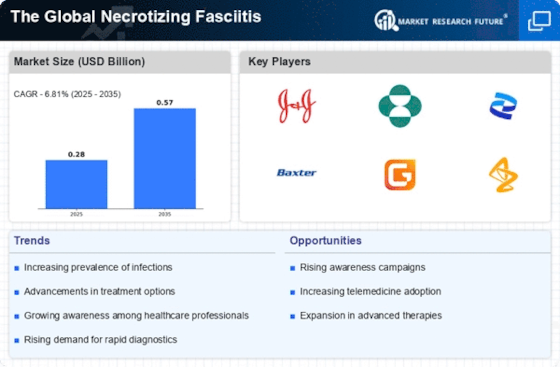
According to MRFR analysis, the Global Necrotizing Fasciitis Market Size was valued at USD 0.2777 Billion in 2024. The market is projected to grow from USD 0.2966 Billion in 2025 to USD 0.5732 Billion by 2035, registering a CAGR of 6.81% during the forecast 2025–2035. North America led the market with over 36.01% share, generating around USD 0.1 Billion in revenue.

Key Market Trends & Highlights

The Global Necrotizing Fasciitis Market is poised for growth driven by advancements in treatment and rising awareness.

  • Technological advancements in treatment are reshaping the landscape of necrotizing fasciitis management. North America remains the largest market, while Asia-Pacific is emerging as the fastest-growing region. Type I necrotizing fasciitis is currently the largest segment, whereas Type II is witnessing the most rapid growth. Increased awareness and education, along with rising incidence of risk factors, are key drivers propelling market expansion.

Market Size & Forecast

2024 Market Size 0.2777 (USD Billion)
2035 Market Size 0.5732 (USD Billion)
CAGR (2025 - 2035) 6.81%
Largest Regional Market Share in 2024 America

Major Players

Johnson &amp; Johnson (US), Merck &amp; Co. (US), <a href="https://www.pfizer.com/products/product-list">Pfizer </a>Inc. (US), Baxter International Inc. (US), GSK (GB), AstraZeneca (GB), Novartis AG (CH), Sanofi (FR), Boehringer Ingelheim (DE)

Market Trends

The Global Necrotizing Fasciitis Market is currently experiencing a notable evolution, driven by a combination of factors including advancements in medical technology and increased awareness of this severe condition. As healthcare systems worldwide enhance their diagnostic and treatment capabilities, the incidence of necrotizing fasciitis is being addressed more effectively. This condition, characterized by rapid tissue destruction, necessitates prompt medical intervention, which has led to a growing demand for specialized surgical procedures and antibiotic therapies. Furthermore, the rising prevalence of diabetes and obesity, which are known risk factors, appears to contribute to the market's expansion.

In addition, The Global Necrotizing Fasciitis Market is likely to benefit from ongoing research initiatives aimed at understanding the underlying mechanisms of this disease. Innovative treatment modalities, including the use of advanced wound care products and regenerative medicine, may emerge as key components in managing this complex condition. The collaboration between healthcare providers and researchers is essential in developing effective strategies to combat necrotizing fasciitis, ultimately improving patient outcomes. As awareness continues to grow, it seems plausible that the market will see further investment in education and prevention efforts, which could enhance early detection and treatment options for affected individuals.

Technological Advancements in Treatment

The Global Necrotizing Fasciitis Market is witnessing a surge in innovative treatment options, largely due to technological advancements. Enhanced surgical techniques, such as minimally invasive procedures, are becoming more prevalent, allowing for quicker recovery times and reduced complications. Additionally, the development of novel antibiotics and antimicrobial agents is likely to improve treatment efficacy, addressing the challenges posed by resistant bacterial strains.

Increased Awareness and Education

There is a growing emphasis on raising awareness about necrotizing fasciitis among healthcare professionals and the general public. Educational campaigns are being implemented to inform individuals about the symptoms and risks associated with this condition. This heightened awareness may lead to earlier diagnosis and treatment, potentially reducing morbidity and mortality rates associated with necrotizing fasciitis.

Rising Incidence of Risk Factors

The Global Necrotizing Fasciitis Market is influenced by the increasing prevalence of risk factors such as diabetes and obesity. As these conditions become more common, the likelihood of developing necrotizing fasciitis may rise correspondingly. This trend underscores the need for targeted prevention strategies and effective management protocols to address the growing burden of this severe infection.

Necrotizing Fasciitis Market Market Drivers

Rising Incidence of Risk Factors

The Global Necrotizing Fasciitis Industry is witnessing growth driven by the rising incidence of risk factors associated with the condition. Factors such as diabetes, obesity, and immunocompromised states are becoming more prevalent in various populations. For example, the World Health Organization has reported an increase in diabetes prevalence, which is a significant risk factor for necrotizing fasciitis.
 
As more individuals present with these underlying conditions, the likelihood of developing necrotizing fasciitis increases, thereby driving demand for treatment options. This trend suggests a potential increase in healthcare expenditures related to managing this severe infection, further propelling the market.

Increased Awareness and Education

In recent years, there has been a marked increase in awareness and education regarding necrotizing fasciitis, significantly impacting The Global Necrotizing Fasciitis Industry. Public health campaigns and educational initiatives by healthcare organizations are informing both the general public and healthcare professionals about the symptoms and urgency of treatment for this condition.
 
This heightened awareness is leading to earlier diagnosis and intervention, which is critical for improving patient outcomes. As a result, the demand for effective treatment options is likely to rise, contributing to market growth. Additionally, healthcare providers are increasingly prioritizing training on recognizing and managing necrotizing fasciitis, further bolstering the industry.

Technological Advancements in Treatment

The Global Necrotizing Fasciitis Industry is experiencing a notable transformation due to rapid technological advancements in treatment methodologies. Innovations such as advanced imaging techniques, minimally invasive surgical procedures, and novel antibiotic therapies are enhancing patient outcomes. For instance, the introduction of real-time imaging allows for more precise surgical interventions, which is crucial in managing this life-threatening condition.
 
Furthermore, the development of new antimicrobial agents is addressing the challenge of antibiotic resistance, which has been a significant concern in treating necrotizing fasciitis. As these technologies continue to evolve, they are likely to improve survival rates and reduce recovery times, thereby driving growth in the market.

Emerging Research and Development Initiatives

The Global Necrotizing Fasciitis Industry is benefiting from emerging research and development initiatives aimed at understanding and combating this severe infection. Ongoing studies are exploring novel therapeutic approaches, including immunotherapy and regenerative medicine, which may offer new hope for patients. Research institutions and pharmaceutical companies are increasingly collaborating to develop targeted therapies that address the unique challenges posed by necrotizing fasciitis.
 
As these initiatives progress, they are likely to yield innovative treatment options that could significantly alter the landscape of care for affected individuals. This focus on R&D is expected to drive market growth as new therapies become available.

Growing Investment in Healthcare Infrastructure

Investment in healthcare infrastructure is a crucial driver for The Global Necrotizing Fasciitis Industry. Governments and private entities are increasingly allocating resources to enhance healthcare facilities, particularly in regions with high incidences of infectious diseases. Improved infrastructure facilitates better access to advanced medical technologies and specialized care, which is essential for the effective management of necrotizing fasciitis.
 
Enhanced surgical facilities and intensive care units are vital for treating severe cases, and as these investments continue, they are likely to lead to improved patient outcomes. Consequently, this growth in healthcare infrastructure is expected to stimulate demand for necrotizing fasciitis treatments.

Market Segment Insights

By Type: Type I (Largest) vs. Type II (Fastest-Growing)

In The Global Necrotizing Fasciitis, the Type segment is primarily dominated by Type I, which encompasses a mixed infection involving both aerobic and anaerobic bacteria, accounting for a significant portion of the market. Type II follows, driven by its association with streptococcal infections, reflecting a growing concern among healthcare professionals due to its aggressive nature and rapid progression. Other types, including Type III and the Others category, while present in the market, capture a smaller share comparatively, indicating a focus on the more prevalent and severe types of necrotizing fasciitis. Growth trends in this segment are heavily influenced by increasing awareness of necrotizing fasciitis, advances in diagnostic techniques, and the development of targeted therapies. Type II is emerging as the fastest-growing segment, attributed to heightened attention on its clinical implications and management strategies. Moreover, factors such as an aging population and rising incidence rates of diabetes and obesity, which predispose individuals to aggressive bacterial infections, are contributing to the overall market expansion for both Type I and Type II necrotizing fasciitis cases.

Type I (Dominant) vs. Type II (Emerging)

Type I necrotizing fasciitis is characterized by a polymicrobial infection, making it the dominant type in The Global Necrotizing Fasciitis due to its widespread occurrence and complex nature. It typically involves a combination of various bacteria, including Gram-positive cocci, Gram-negative rods, and anaerobes, leading to a higher severity of clinical presentation. This dominance is reflected in its significant recognition among healthcare providers and researchers alike. On the other hand, Type II, primarily caused by Group A Streptococcus, is considered an emerging type due to its rapidly progressive nature and high mortality rate if not treated promptly. Its increasing incidence and aggressive treatment requirements have led to a surge in research and development focused on effective management strategies, positioning Type II as a critical area of interest in the evolving landscape of necrotizing fasciitis.

By Treatment: Surgery (Largest) vs. Hyperbaric Oxygen Treatment (Fastest-Growing)

In The Global Necrotizing Fasciitis, the treatment segment distribution reveals that surgery holds the largest share, being the primary intervention for this severe infection. Intravenous antibiotics are also critical, serving as frontline therapy, while hyperbaric oxygen treatment is emerging rapidly due to its innovative approach to enhancing healing. Other treatment modalities are utilized less frequently but play supportive roles based on specific patient needs. Growth trends in this segment are strongly influenced by the rising incidence of necrotizing fasciitis linked to diabetes and intravenous drug use. Advances in surgical techniques and increased awareness of hyperbaric oxygen therapy's benefits have catalyzed market expansion. Additionally, the growing prevalence of risk factors emphasizes the need for effective treatments, further propelling the demand for innovative solutions in this space.

Surgery (Dominant) vs. Hyperbaric Oxygen Treatment (Emerging)

Surgery remains the dominant treatment option in The Global Necrotizing Fasciitis due to its critical role in removing necrotic tissue and preventing further infection. Surgeons typically perform debridement, which is essential for patient recovery, solidifying surgery's necessity as a primary intervention. Conversely, hyperbaric oxygen treatment is regarded as an emerging modality. This treatment helps mitigate tissue hypoxia, thereby enhancing healing and reducing the risk of amputation. As awareness of its efficacy grows, more medical professionals are advocating for its integration into treatment protocols. Both methods, while different in application, highlight the vital need for timely and effective interventions in managing necrotizing fasciitis.

By End Users: Hospitals & Clinics (Largest) vs. Surgical Centers (Fastest-Growing)

In The Global Necrotizing Fasciitis, the end users are primarily segmented into Hospitals &amp; Clinics, Surgical Centers, and Others. Hospitals &amp; Clinics dominate the market, holding a significant share due to their comprehensive healthcare services and the availability of specialized facilities required for treating necrotizing fasciitis. They cater to a large patient base, ensuring prompt diagnosis and multi-disciplinary management of the condition. Surgical Centers, while smaller in share, are growing rapidly as they offer specialized surgical expertise and quicker treatment options which are increasingly preferred by patients and healthcare providers alike.

Hospitals &amp; Clinics (Dominant) vs. Surgical Centers (Emerging)

Hospitals &amp; Clinics play a dominant role in the treatment of necrotizing fasciitis, being equipped with advanced medical technologies and a variety of surgical, pharmaceutical, and rehabilitative services. Their established reputation, comprehensive care protocols, and ability to handle complex cases make them the preferred choice for many patients. In contrast, Surgical Centers are emerging as a significant avenue for treatment, offering specialized services focused on quicker interventions with enhanced patient experiences. They cater to patients seeking minimally invasive techniques and often boast shorter wait times for surgeries, making them increasingly appealing to health systems aiming to improve patient flow and satisfaction.

Get more detailed insights about Necrotizing Fasciitis Market Research Report - Forecast till 2035

Regional Insights

North America : Healthcare Innovation Leader

North America leads in the Necrotizing Fasciitis Market Size, accounting for over 36.01% of the global revenue in 2024. The region's growth is driven by advanced healthcare infrastructure, increasing awareness of the disease, and a rise in surgical procedures. Regulatory support from agencies like the FDA facilitates the introduction of new therapies, enhancing treatment options for patients. The United States is the leading country in this market, with significant contributions from key players such as Johnson & Johnson and Merck & Co.

The competitive landscape is characterized by ongoing research and development, with companies focusing on innovative treatment solutions. Canada also plays a vital role, contributing to the overall market dynamics with its robust healthcare system and increasing incidence of necrotizing fasciitis cases.

Europe : Emerging Market with Potential

Europe Necrotizing Fasciitis Market was valued at USD 0.08 Billion in 2024, making it the second-largest regional market with a 30% share. The region benefits from a strong regulatory framework that encourages the development of new therapies. Increased healthcare spending and a growing elderly population are key drivers of market growth, alongside rising awareness of necrotizing fasciitis. Leading countries in Europe include Germany, France, and the UK, where healthcare systems are well-established.

The competitive landscape features major players like GSK and AstraZeneca, who are actively involved in research and development. The European Medicines Agency plays a crucial role in ensuring the safety and efficacy of new treatments, fostering innovation in the market.

Asia-Pacific : Rapidly Growing Healthcare Sector

Asia-Pacific is witnessing rapid growth in the necrotizing fasciitis market, holding about 15% of the global market share. The region's growth is fueled by increasing healthcare investments, rising awareness of infectious diseases, and a growing population. Countries like India and China are experiencing a surge in cases, prompting healthcare authorities to focus on improving treatment protocols and access to care.

Key players in this region include local pharmaceutical companies and international firms expanding their presence. The competitive landscape is evolving, with an emphasis on affordable treatment options. Governments are also implementing initiatives to enhance healthcare infrastructure, which is expected to further drive market growth in the coming years.

Middle East and Africa : Untapped Market Potential

The Middle East and Africa region represents a smaller share of the necrotizing fasciitis market, estimated at around 10%. However, the region presents significant growth opportunities due to increasing healthcare investments and rising awareness of infectious diseases. Challenges such as limited access to healthcare facilities and varying regulatory environments can hinder market growth, but ongoing initiatives aim to address these issues.

Countries like South Africa and the UAE are leading the way in healthcare advancements, with a focus on improving treatment options for necrotizing fasciitis. The competitive landscape is characterized by a mix of local and international players, with efforts to enhance healthcare delivery systems. As awareness grows, the market is expected to expand, driven by both public and private sector initiatives.

Key Players and Competitive Insights

The Global Necrotizing Fasciitis is characterized by a complex interplay of competitive dynamics, driven by the urgent need for effective treatment options and the rising incidence of this severe condition. Key players such as Johnson & Johnson (US), Merck & Co. (US), and Pfizer Inc. (US) are at the forefront, each adopting distinct strategies to enhance their market presence. Johnson & Johnson (US) focuses on innovation through advanced wound care products, while Merck & Co. (US) emphasizes research and development to expand its therapeutic portfolio. Pfizer Inc. (US) is leveraging partnerships to enhance its distribution capabilities, thereby strengthening its operational focus in this niche market. Collectively, these strategies contribute to a competitive environment that is increasingly oriented towards innovation and collaboration.
In terms of business tactics, companies are localizing manufacturing and optimizing supply chains to respond swiftly to market demands. The competitive structure of The Global Necrotizing Fasciitis appears moderately fragmented, with several players vying for market share. This fragmentation is indicative of the diverse approaches adopted by key players, which collectively influence market dynamics and consumer choices.
In August 2025, Merck & Co. (US) announced a strategic partnership with a leading biotechnology firm to co-develop a novel antibiotic specifically targeting necrotizing fasciitis. This collaboration is significant as it not only enhances Merck's research capabilities but also positions the company to address a critical gap in treatment options, potentially leading to improved patient outcomes and market share.
In September 2025, Pfizer Inc. (US) launched a new digital platform aimed at healthcare providers, designed to streamline the prescription process for its necrotizing fasciitis treatment. This initiative reflects Pfizer's commitment to digital transformation, enhancing accessibility and efficiency in treatment delivery. By integrating technology into its operations, Pfizer is likely to improve patient engagement and adherence to treatment protocols.
In October 2025, Johnson & Johnson (US) unveiled a new line of advanced wound care products specifically formulated for necrotizing fasciitis patients. This product launch underscores the company's focus on innovation and its proactive approach to addressing the unique needs of this patient population. By expanding its product offerings, Johnson & Johnson is poised to capture a larger share of the market and reinforce its leadership position.
As of October 2025, current competitive trends in The Global Necrotizing Fasciitis are increasingly defined by digitalization, sustainability, and the integration of artificial intelligence in treatment protocols. Strategic alliances among key players are shaping the landscape, fostering innovation and enhancing operational efficiencies. Looking ahead, competitive differentiation is expected to evolve, with a pronounced shift from price-based competition to a focus on technological advancements, innovative treatment solutions, and reliable supply chains. This transition may ultimately redefine how companies position themselves in the market, emphasizing the importance of adaptability and forward-thinking strategies.

Key Companies in the Necrotizing Fasciitis Market include

Industry Developments

Future Outlook

Necrotizing Fasciitis Market Future Outlook

The Necrotizing Fasciitis Market size is projected to reach USD 0.2777 Billion by 2035, growing at a CAGR of 6.81%, driven by advancements in treatment protocols, increased awareness, and improved diagnostic technologies.

New opportunities lie in:

  • <p>Development of telemedicine platforms for remote consultations and follow-ups. Investment in advanced wound care technologies to enhance patient outcomes. Partnerships with hospitals for integrated care pathways and rapid response teams.</p>

By 2035, the market is expected to achieve substantial growth, reflecting enhanced treatment capabilities and increased healthcare investments.

Market Segmentation

Necrotizing Fasciitis Market Type Outlook

  • Type I
  • Type II
  • Type III
  • Others

Necrotizing Fasciitis Market End Users Outlook

  • Hospitals & Clinics
  • Surgical Centers
  • Others

Necrotizing Fasciitis Market Treatment Outlook

  • Intravenous antibiotics
  • Surgery
  • Hyperbaric oxygen treatment
  • Others

Report Scope

MARKET SIZE 2024 0.2777(USD Billion)
MARKET SIZE 2025 0.2966(USD Billion)
MARKET SIZE 2035 0.5732(USD Billion)
COMPOUND ANNUAL GROWTH RATE (CAGR) 6.81% (2025 - 2035)
REPORT COVERAGE Revenue Forecast, Competitive Landscape, Growth Factors, and Trends
BASE YEAR 2024
Market Forecast Period 2025 - 2035
Historical Data 2019 - 2024
Market Forecast Units USD Billion
Key Companies Profiled Johnson & Johnson (US), Merck & Co. (US), Pfizer Inc. (US), Baxter International Inc. (US), GSK (GB), AstraZeneca (GB), Novartis AG (CH), Sanofi (FR), Boehringer Ingelheim (DE)
Segments Covered Type
Key Market Opportunities Advancements in rapid diagnostic technologies enhance early detection in The Global Necrotizing Fasciitis.
Key Market Dynamics Rising awareness and advancements in treatment options drive competitive dynamics in the necrotizing fasciitis market.
Countries Covered North America, Europe, APAC, South America, MEA

FAQs

What is the projected market valuation of The Global Necrotizing Fasciitis by 2035?

<p>The projected market valuation for The Global Necrotizing Fasciitis is expected to reach 0.5732 USD Billion by 2035.</p>

What was the market valuation of The Global Necrotizing Fasciitis in 2024?

<p>The overall market valuation was 0.2777 USD Billion in 2024.</p>

What is the expected CAGR for The Global Necrotizing Fasciitis during the forecast period 2025 - 2035?

<p>The expected CAGR for The Global Necrotizing Fasciitis during the forecast period 2025 - 2035 is 6.81%.</p>

Which companies are considered key players in The Global Necrotizing Fasciitis?

Key players in the market include Johnson &amp; Johnson, Merck &amp; Co., Pfizer Inc., Baxter International Inc., GSK, AstraZeneca, Novartis AG, Sanofi, and Boehringer Ingelheim.

What are the main treatment segments in The Global Necrotizing Fasciitis?

<p>The main treatment segments include intravenous antibiotics, surgery, hyperbaric oxygen treatment, and others.</p>

How did the Type I segment perform in The Global Necrotizing Fasciitis in 2024?

The Type I segment was valued at 0.1115 USD Billion in 2024 and is projected to reach 0.227 USD Billion by 2035.

What is the market size for hospitals and clinics as end users in The Global Necrotizing Fasciitis?

The market size for hospitals and clinics as end users was 0.1661 USD Billion in 2024 and is expected to grow to 0.3531 USD Billion by 2035.

What is the projected growth for the surgery treatment segment in The Global Necrotizing Fasciitis?

The surgery treatment segment was valued at 0.1115 USD Billion in 2024 and is anticipated to increase to 0.2335 USD Billion by 2035.

What is the expected performance of the Type II segment in The Global Necrotizing Fasciitis?

The Type II segment was valued at 0.0838 USD Billion in 2024 and is projected to reach 0.168 USD Billion by 2035.

How does the market for hyperbaric oxygen treatment compare to other treatment segments?

The hyperbaric oxygen treatment segment was valued at 0.0558 USD Billion in 2024 and is expected to grow to 0.1165 USD Billion by 2035, indicating a steady increase.

  1. SECTION I: EXECUTIVE SUMMARY AND KEY HIGHLIGHTS |
    1. EXECUTIVE SUMMARY | |
      1. Market Overview | |
      2. Key Findings | |
      3. Market Segmentation | |
      4. Competitive Landscape | |
      5. Challenges and Opportunities | |
      6. Future Outlook 2
  2. SECTION II: SCOPING, METHODOLOGY AND MARKET STRUCTURE |
    1. MARKET INTRODUCTION | |
      1. Definition | |
      2. Scope of the study | | |
    2. RESEARCH METHODOLOGY | |
      1. Overview | |
      2. Data Mining | |
      3. Secondary Research | |
      4. Primary Research | | |
      5. Forecasting Model | |
      6. Market Size Estimation | | |
      7. Data Triangulation | |
      8. Validation 3
  3. SECTION III: QUALITATIVE ANALYSIS |
    1. MARKET DYNAMICS | |
      1. Overview | |
      2. Drivers | |
      3. Restraints | |
      4. Opportunities |
    2. MARKET FACTOR ANALYSIS | |
      1. Value chain Analysis | |
      2. Porter's Five Forces Analysis | | |
      3. COVID-19 Impact Analysis | | |
  4. SECTION IV: QUANTITATIVE ANALYSIS |
    1. Healthcare, BY Type (USD Billion) | |
      1. Type I | |
      2. Type II | |
      3. Type III | |
      4. Others |
    2. Healthcare, BY Treatment (USD Billion) | |
      1. Intravenous antibiotics | |
      2. Surgery | |
      3. Hyperbaric oxygen treatment | |
      4. Others |
    3. Healthcare, BY End Users (USD Billion) | |
      1. Hospitals & Clinics | |
      2. Surgical Centers | |
      3. Others |
    4. Healthcare, BY Region (USD Billion) | |
      1. North America | | |
      2. Europe | | |
      3. APAC | | |
      4. South America | | |
      5. MEA | | |
  5. SECTION V: COMPETITIVE ANALYSIS |
    1. Competitive Landscape | |
      1. Overview | |
      2. Competitive Analysis | |
      3. Market share Analysis | |
      4. Major Growth Strategy in the Healthcare | |
      5. Competitive Benchmarking | |
      6. Leading Players in Terms of Number of Developments in the Healthcare | |
      7. Key developments and growth strategies | | |
      8. Major Players Financial Matrix | | |
    2. Company Profiles | |
      1. Johnson & Johnson (US) | | |
      2. Merck & Co. (US) | | |
      3. Pfizer Inc. (US) | | |
      4. Baxter International Inc. (US) | | |
      5. GSK (GB) | | |
      6. AstraZeneca (GB) | | |
      7. Novartis AG (CH) | | |
      8. Sanofi (FR) | | |
      9. Boehringer Ingelheim (DE) | | |
    3. Appendix | |
      1. References | |
      2. Related Reports 6 LIST OF FIGURES |
    4. MARKET SYNOPSIS |
    5. NORTH AMERICA MARKET ANALYSIS |
    6. US MARKET ANALYSIS BY TYPE |
    7. US MARKET ANALYSIS BY TREATMENT |
    8. US MARKET ANALYSIS BY END USERS |
    9. CANADA MARKET ANALYSIS BY TYPE |
    10. CANADA MARKET ANALYSIS BY TREATMENT |
    11. CANADA MARKET ANALYSIS BY END USERS |
    12. EUROPE MARKET ANALYSIS |
    13. GERMANY MARKET ANALYSIS BY TYPE |
    14. GERMANY MARKET ANALYSIS BY TREATMENT |
    15. GERMANY MARKET ANALYSIS BY END USERS |
    16. UK MARKET ANALYSIS BY TYPE |
    17. UK MARKET ANALYSIS BY TREATMENT |
    18. UK MARKET ANALYSIS BY END USERS |
    19. FRANCE MARKET ANALYSIS BY TYPE |
    20. FRANCE MARKET ANALYSIS BY TREATMENT |
    21. FRANCE MARKET ANALYSIS BY END USERS |
    22. RUSSIA MARKET ANALYSIS BY TYPE |
    23. RUSSIA MARKET ANALYSIS BY TREATMENT |
    24. RUSSIA MARKET ANALYSIS BY END USERS |
    25. ITALY MARKET ANALYSIS BY TYPE |
    26. ITALY MARKET ANALYSIS BY TREATMENT |
    27. ITALY MARKET ANALYSIS BY END USERS |
    28. SPAIN MARKET ANALYSIS BY TYPE |
    29. SPAIN MARKET ANALYSIS BY TREATMENT |
    30. SPAIN MARKET ANALYSIS BY END USERS |
    31. REST OF EUROPE MARKET ANALYSIS BY TYPE |
    32. REST OF EUROPE MARKET ANALYSIS BY TREATMENT |
    33. REST OF EUROPE MARKET ANALYSIS BY END USERS |
    34. APAC MARKET ANALYSIS |
    35. CHINA MARKET ANALYSIS BY TYPE |
    36. CHINA MARKET ANALYSIS BY TREATMENT |
    37. CHINA MARKET ANALYSIS BY END USERS |
    38. INDIA MARKET ANALYSIS BY TYPE |
    39. INDIA MARKET ANALYSIS BY TREATMENT |
    40. INDIA MARKET ANALYSIS BY END USERS |
    41. JAPAN MARKET ANALYSIS BY TYPE |
    42. JAPAN MARKET ANALYSIS BY TREATMENT |
    43. JAPAN MARKET ANALYSIS BY END USERS |
    44. SOUTH KOREA MARKET ANALYSIS BY TYPE |
    45. SOUTH KOREA MARKET ANALYSIS BY TREATMENT |
    46. SOUTH KOREA MARKET ANALYSIS BY END USERS |
    47. MALAYSIA MARKET ANALYSIS BY TYPE |
    48. MALAYSIA MARKET ANALYSIS BY TREATMENT |
    49. MALAYSIA MARKET ANALYSIS BY END USERS |
    50. THAILAND MARKET ANALYSIS BY TYPE |
    51. THAILAND MARKET ANALYSIS BY TREATMENT |
    52. THAILAND MARKET ANALYSIS BY END USERS |
    53. INDONESIA MARKET ANALYSIS BY TYPE |
    54. INDONESIA MARKET ANALYSIS BY TREATMENT |
    55. INDONESIA MARKET ANALYSIS BY END USERS |
    56. REST OF APAC MARKET ANALYSIS BY TYPE |
    57. REST OF APAC MARKET ANALYSIS BY TREATMENT |
    58. REST OF APAC MARKET ANALYSIS BY END USERS |
    59. SOUTH AMERICA MARKET ANALYSIS |
    60. BRAZIL MARKET ANALYSIS BY TYPE |
    61. BRAZIL MARKET ANALYSIS BY TREATMENT |
    62. BRAZIL MARKET ANALYSIS BY END USERS |
    63. MEXICO MARKET ANALYSIS BY TYPE |
    64. MEXICO MARKET ANALYSIS BY TREATMENT |
    65. MEXICO MARKET ANALYSIS BY END USERS |
    66. ARGENTINA MARKET ANALYSIS BY TYPE |
    67. ARGENTINA MARKET ANALYSIS BY TREATMENT |
    68. ARGENTINA MARKET ANALYSIS BY END USERS |
    69. REST OF SOUTH AMERICA MARKET ANALYSIS BY TYPE |
    70. REST OF SOUTH AMERICA MARKET ANALYSIS BY TREATMENT |
    71. REST OF SOUTH AMERICA MARKET ANALYSIS BY END USERS |
    72. MEA MARKET ANALYSIS |
    73. GCC COUNTRIES MARKET ANALYSIS BY TYPE |
    74. GCC COUNTRIES MARKET ANALYSIS BY TREATMENT |
    75. GCC COUNTRIES MARKET ANALYSIS BY END USERS |
    76. SOUTH AFRICA MARKET ANALYSIS BY TYPE |
    77. SOUTH AFRICA MARKET ANALYSIS BY TREATMENT |
    78. SOUTH AFRICA MARKET ANALYSIS BY END USERS |
    79. REST OF MEA MARKET ANALYSIS BY TYPE |
    80. REST OF MEA MARKET ANALYSIS BY TREATMENT |
    81. REST OF MEA MARKET ANALYSIS BY END USERS |
    82. KEY BUYING CRITERIA OF HEALTHCARE |
    83. RESEARCH PROCESS OF MRFR |
    84. DRO ANALYSIS OF HEALTHCARE |
    85. DRIVERS IMPACT ANALYSIS: HEALTHCARE |
    86. RESTRAINTS IMPACT ANALYSIS: HEALTHCARE |
    87. SUPPLY / VALUE CHAIN: HEALTHCARE |
    88. HEALTHCARE, BY TYPE, 2024 (% SHARE) |
    89. HEALTHCARE, BY TYPE, 2024 TO 2035 (USD Billion) |
    90. HEALTHCARE, BY TREATMENT, 2024 (% SHARE) |
    91. HEALTHCARE, BY TREATMENT, 2024 TO 2035 (USD Billion) |
    92. HEALTHCARE, BY END USERS, 2024 (% SHARE) |
    93. HEALTHCARE, BY END USERS, 2024 TO 2035 (USD Billion) |
    94. BENCHMARKING OF MAJOR COMPETITORS 7 LIST OF TABLES |
    95. LIST OF ASSUMPTIONS | |
      1. |
    96. North America MARKET SIZE ESTIMATES; FORECAST | |
      1. BY TYPE, 2025-2035 (USD Billion) | |
      2. BY TREATMENT, 2025-2035 (USD Billion) | |
      3. BY END USERS, 2025-2035 (USD Billion) |
    97. US MARKET SIZE ESTIMATES; FORECAST | |
      1. BY TYPE, 2025-2035 (USD Billion) | |
      2. BY TREATMENT, 2025-2035 (USD Billion) | |
      3. BY END USERS, 2025-2035 (USD Billion) |
    98. Canada MARKET SIZE ESTIMATES; FORECAST | |
      1. BY TYPE, 2025-2035 (USD Billion) | |
      2. BY TREATMENT, 2025-2035 (USD Billion) | |
      3. BY END USERS, 2025-2035 (USD Billion) |
    99. Europe MARKET SIZE ESTIMATES; FORECAST | |
      1. BY TYPE, 2025-2035 (USD Billion) | |
      2. BY TREATMENT, 2025-2035 (USD Billion) | |
      3. BY END USERS, 2025-2035 (USD Billion) |
    100. Germany MARKET SIZE ESTIMATES; FORECAST | |
      1. BY TYPE, 2025-2035 (USD Billion) | |
      2. BY TREATMENT, 2025-2035 (USD Billion) | |
      3. BY END USERS, 2025-2035 (USD Billion) |
    101. UK MARKET SIZE ESTIMATES; FORECAST | |
      1. BY TYPE, 2025-2035 (USD Billion) | |
      2. BY TREATMENT, 2025-2035 (USD Billion) | |
      3. BY END USERS, 2025-2035 (USD Billion) |
    102. France MARKET SIZE ESTIMATES; FORECAST | |
      1. BY TYPE, 2025-2035 (USD Billion) | |
      2. BY TREATMENT, 2025-2035 (USD Billion) | |
      3. BY END USERS, 2025-2035 (USD Billion) |
    103. Russia MARKET SIZE ESTIMATES; FORECAST | |
      1. BY TYPE, 2025-2035 (USD Billion) | |
      2. BY TREATMENT, 2025-2035 (USD Billion) | |
      3. BY END USERS, 2025-2035 (USD Billion) |
    104. Italy MARKET SIZE ESTIMATES; FORECAST | |
      1. BY TYPE, 2025-2035 (USD Billion) | |
      2. BY TREATMENT, 2025-2035 (USD Billion) | |
      3. BY END USERS, 2025-2035 (USD Billion) |
    105. Spain MARKET SIZE ESTIMATES; FORECAST | |
      1. BY TYPE, 2025-2035 (USD Billion) | |
      2. BY TREATMENT, 2025-2035 (USD Billion) | |
      3. BY END USERS, 2025-2035 (USD Billion) |
    106. Rest of Europe MARKET SIZE ESTIMATES; FORECAST | |
      1. BY TYPE, 2025-2035 (USD Billion) | |
      2. BY TREATMENT, 2025-2035 (USD Billion) | |
      3. BY END USERS, 2025-2035 (USD Billion) |
    107. APAC MARKET SIZE ESTIMATES; FORECAST | |
      1. BY TYPE, 2025-2035 (USD Billion) | |
      2. BY TREATMENT, 2025-2035 (USD Billion) | |
      3. BY END USERS, 2025-2035 (USD Billion) |
    108. China MARKET SIZE ESTIMATES; FORECAST | |
      1. BY TYPE, 2025-2035 (USD Billion) | |
      2. BY TREATMENT, 2025-2035 (USD Billion) | |
      3. BY END USERS, 2025-2035 (USD Billion) |
    109. India MARKET SIZE ESTIMATES; FORECAST | |
      1. BY TYPE, 2025-2035 (USD Billion) | |
      2. BY TREATMENT, 2025-2035 (USD Billion) | |
      3. BY END USERS, 2025-2035 (USD Billion) |
    110. Japan MARKET SIZE ESTIMATES; FORECAST | |
      1. BY TYPE, 2025-2035 (USD Billion) | |
      2. BY TREATMENT, 2025-2035 (USD Billion) | |
      3. BY END USERS, 2025-2035 (USD Billion) |
    111. South Korea MARKET SIZE ESTIMATES; FORECAST | |
      1. BY TYPE, 2025-2035 (USD Billion) | |
      2. BY TREATMENT, 2025-2035 (USD Billion) | |
      3. BY END USERS, 2025-2035 (USD Billion) |
    112. Malaysia MARKET SIZE ESTIMATES; FORECAST | |
      1. BY TYPE, 2025-2035 (USD Billion) | |
      2. BY TREATMENT, 2025-2035 (USD Billion) | |
      3. BY END USERS, 2025-2035 (USD Billion) |
    113. Thailand MARKET SIZE ESTIMATES; FORECAST | |
      1. BY TYPE, 2025-2035 (USD Billion) | |
      2. BY TREATMENT, 2025-2035 (USD Billion) | |
      3. BY END USERS, 2025-2035 (USD Billion) |
    114. Indonesia MARKET SIZE ESTIMATES; FORECAST | |
      1. BY TYPE, 2025-2035 (USD Billion) | |
      2. BY TREATMENT, 2025-2035 (USD Billion) | |
      3. BY END USERS, 2025-2035 (USD Billion) |
    115. Rest of APAC MARKET SIZE ESTIMATES; FORECAST | |
      1. BY TYPE, 2025-2035 (USD Billion) | |
      2. BY TREATMENT, 2025-2035 (USD Billion) | |
      3. BY END USERS, 2025-2035 (USD Billion) |
    116. South America MARKET SIZE ESTIMATES; FORECAST | |
      1. BY TYPE, 2025-2035 (USD Billion) | |
      2. BY TREATMENT, 2025-2035 (USD Billion) | |
      3. BY END USERS, 2025-2035 (USD Billion) |
    117. Brazil MARKET SIZE ESTIMATES; FORECAST | |
      1. BY TYPE, 2025-2035 (USD Billion) | |
      2. BY TREATMENT, 2025-2035 (USD Billion) | |
      3. BY END USERS, 2025-2035 (USD Billion) |
    118. Mexico MARKET SIZE ESTIMATES; FORECAST | |
      1. BY TYPE, 2025-2035 (USD Billion) | |
      2. BY TREATMENT, 2025-2035 (USD Billion) | |
      3. BY END USERS, 2025-2035 (USD Billion) |
    119. Argentina MARKET SIZE ESTIMATES; FORECAST | |
      1. BY TYPE, 2025-2035 (USD Billion) | |
      2. BY TREATMENT, 2025-2035 (USD Billion) | |
      3. BY END USERS, 2025-2035 (USD Billion) |
    120. Rest of South America MARKET SIZE ESTIMATES; FORECAST | |
      1. BY TYPE, 2025-2035 (USD Billion) | |
      2. BY TREATMENT, 2025-2035 (USD Billion) | |
      3. BY END USERS, 2025-2035 (USD Billion) |
    121. MEA MARKET SIZE ESTIMATES; FORECAST | |
      1. BY TYPE, 2025-2035 (USD Billion) | |
      2. BY TREATMENT, 2025-2035 (USD Billion) | |
      3. BY END USERS, 2025-2035 (USD Billion) |
    122. GCC Countries MARKET SIZE ESTIMATES; FORECAST | |
      1. BY TYPE, 2025-2035 (USD Billion) | |
      2. BY TREATMENT, 2025-2035 (USD Billion) | |
      3. BY END USERS, 2025-2035 (USD Billion) |
    123. South Africa MARKET SIZE ESTIMATES; FORECAST | |
      1. BY TYPE, 2025-2035 (USD Billion) | |
      2. BY TREATMENT, 2025-2035 (USD Billion) | |
      3. BY END USERS, 2025-2035 (USD Billion) |
    124. Rest of MEA MARKET SIZE ESTIMATES; FORECAST | |
      1. BY TYPE, 2025-2035 (USD Billion) | |
      2. BY TREATMENT, 2025-2035 (USD Billion) | |
      3. BY END USERS, 2025-2035 (USD Billion) |
    125. PRODUCT LAUNCH/PRODUCT DEVELOPMENT/APPROVAL | |
      1. |
    126. ACQUISITION/PARTNERSHIP | |

Healthcare Market Segmentation

Healthcare By Type (USD Billion, 2025-2035)

  • Type I
  • Type II
  • Type III
  • Others

Healthcare By Treatment (USD Billion, 2025-2035)

  • Intravenous antibiotics
  • Surgery
  • Hyperbaric oxygen treatment
  • Others

Healthcare By End Users (USD Billion, 2025-2035)

  • Hospitals & Clinics
  • Surgical Centers
  • Others
Infographic

Free Sample Request

Kindly complete the form below to receive a free sample of this Report

Get Free Sample

Customer Strories

Compare Licence

×
Features License Type
Single User Multiuser License Enterprise User
Price $4,950 $5,950 $7,250
Maximum User Access Limit 1 User Upto 10 Users Unrestricted Access Throughout the Organization
Free Customization
Direct Access to Analyst
Deliverable Format
Platform Access
Discount on Next Purchase 10% 15% 15%
Printable Versions