×
Hero Background
English
Chinese
French
Japanese
Korean
German
Spanish

Nanobiosensors in Healthcare Market Analysis

ID: MRFR/HC/6521-HCR
85 Pages
Rahul Gotadki
October 2025

Nanobiosensors in Healthcare Market Research Report Information by type (Optical Nanobiosensor, Electrochemical Nanobiosensor, Acoustic Nanobiosensor), Application (Diabetes, Immunoassay, Cancer, Pathogenic Bacteria), End User (Hospitals and Clinics, Point of Care, Diagnostic Centers ) - Forecast till 2035

Share:
Download PDF ×

We do not share your information with anyone. However, we may send you emails based on your report interest from time to time. You may contact us at any time to opt-out.

Nanobiosensors in Healthcare Market Infographic
Purchase Options

Market Analysis

In-depth Analysis of Nanobiosensors in Healthcare Market Industry Landscape

Nanobiosensors represent a groundbreaking technological development in healthcare, imparting the potential for quite touchy and speedy detection of organic molecules. In the healthcare marketplace, these nanoscale gadgets have garnered substantial attention because of their capability to beautify diagnostic abilities and improve the results of affected persons. One of the key market dynamics is the increasing demand for point-of-care diagnostics. Nanobiosensors enable healthcare professionals to behavior real-time, on-website checking out, getting rid of the need for time-consuming laboratory approaches. The emphasis on early ailment detection and the need for prompt decision-making in affected person care drives this demand. The market is propelled by means of non-stop technological improvements in nanotechnology and biosensor improvement. Miniaturization of devices progressed sensitivity, and integration with records analytics contribute to the evolution of nano biosensors, making them more green and dependable for healthcare packages. The market isn't without its challenges, and regulatory compliance is a crucial aspect. As nano biosensors benefit prominence in healthcare, making sure adherence to regulatory standards becomes paramount. Navigating the complicated regulatory panorama poses demanding situations for market gamers, but it is critical for gaining consideration and acceptance inside the healthcare industry. Affordability and accessibility remain key considerations within the marketplace dynamics of nano biosensors. Striking a balance between superior technology and price effectiveness is essential for considerable adoption. Market players are actively running on strategies to make nano biosensors even lower priced and more reachable, especially in resource-limited settings. The versatility of nano biosensors allows for disease-unique programs, ranging from cancer diagnostics to infectious sickness monitoring. Tailoring nano biosensors to cope with unique healthcare demanding situations enhances their relevance and widens their scope of packages, using marketplace increase in numerous scientific fields. Competition amongst industry gamers is intensifying as organizations try to capture a larger percentage of the worldwide nano biosensor marketplace. Market dynamics suggest a focus on global growth, with agencies in search of opportunities in emerging markets and forming strategic alliances to strengthen their market presence. Looking in advance, the future of nano biosensors in healthcare seems promising. Continued innovation, research breakthroughs, and advancements in manufacturing strategies are expected to form the marketplace. The ongoing quest for improving diagnostic accuracy, affected person results, and overall healthcare performance will possibly power sustained growth in this dynamic region.


Author
Rahul Gotadki
Assistant Manager

He holds an experience of about 7+ years in Market Research and Business Consulting, working under the spectrum of Life Sciences and Healthcare domains. Rahul conceptualizes and implements a scalable business strategy and provides strategic leadership to the clients. His expertise lies in market estimation, competitive intelligence, pipeline analysis, customer assessment, etc. In addition to the above, his other responsibility includes strategic tracking of high growth markets & advising clients on the potential areas of focus they could direct their business initiatives

Leave a Comment

FAQs

What is the projected market valuation for Nanobiosensors in Healthcare by 2035?

The projected market valuation for Nanobiosensors in Healthcare is expected to reach 1.37 USD Billion by 2035.

What was the market valuation for Nanobiosensors in Healthcare in 2024?

The overall market valuation for Nanobiosensors in Healthcare was 0.43 USD Billion in 2024.

What is the expected CAGR for the Nanobiosensors in Healthcare Market during the forecast period 2025 - 2035?

The expected CAGR for the Nanobiosensors in Healthcare Market during the forecast period 2025 - 2035 is 11.11%.

Which companies are considered key players in the Nanobiosensors in Healthcare Market?

Key players in the Nanobiosensors in Healthcare Market include Abbott Laboratories, Siemens Healthineers, and Thermo Fisher Scientific.

What are the main types of Nanobiosensors in the healthcare market?

The main types of Nanobiosensors in the healthcare market include Optical, Electrochemical, and Acoustic Nanobiosensors.

Market Summary

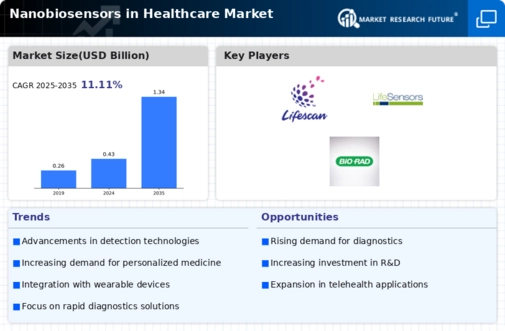
As per MRFR analysis, the Nanobiosensors in Healthcare Market was estimated at 0.43 USD Billion in 2024. The Nanobiosensors industry is projected to grow from 0.4778 in 2025 to 1.37 by 2035, exhibiting a compound annual growth rate (CAGR) of 11.11 during the forecast period 2025 - 2035.

Key Market Trends & Highlights

The Nanobiosensors in Healthcare Market is poised for substantial growth driven by technological advancements and increasing demand for point-of-care testing.

  • North America remains the largest market for nanobiosensors, driven by robust healthcare infrastructure and innovation.
  • The Asia-Pacific region is emerging as the fastest-growing market, fueled by increasing investments in healthcare technologies.
  • Optical nanobiosensors dominate the market, while electrochemical nanobiosensors are experiencing rapid growth due to their versatility.
  • Key market drivers include technological advancements in nanobiosensors and rising demand for point-of-care testing, particularly in diabetes and cancer segments.

Market Size & Forecast

2024 Market Size 0.43 (USD Billion)
2035 Market Size 1.37 (USD Billion)
CAGR (2025 - 2035) 11.11%
Largest Regional Market Share in 2024 Americas

Major Players

<p>Abbott Laboratories (US), Siemens Healthineers (DE), Thermo Fisher Scientific (US), Roche Diagnostics (CH), Medtronic (US), Biosensors International Group (SG), Acon Laboratories (US), NantHealth (US), Bio-Rad Laboratories (US)</p>

Market Trends

The Nanobiosensors in Healthcare Market is currently experiencing a transformative phase, characterized by rapid advancements in technology and increasing demand for precise diagnostic tools. These devices, which integrate biological components with nanotechnology, offer enhanced sensitivity and specificity in detecting various health conditions. As healthcare systems worldwide strive for improved patient outcomes, the adoption of nanobiosensors is likely to rise, driven by their potential to facilitate early disease detection and personalized medicine. Furthermore, the growing emphasis on point-of-care testing is propelling innovation in this sector, as healthcare providers seek efficient solutions that can be deployed in diverse settings. In addition to technological advancements, regulatory frameworks are evolving to accommodate the unique challenges posed by nanobiosensors. This shift may foster a more conducive environment for research and development, encouraging collaborations between academic institutions and industry players. Moreover, the increasing prevalence of chronic diseases and the aging population are expected to further stimulate the Nanobiosensors in Healthcare Market. As stakeholders navigate these dynamics, the focus on sustainability and cost-effectiveness will likely shape future product offerings, ensuring that nanobiosensors remain at the forefront of healthcare innovation.

Technological Advancements

Recent innovations in nanotechnology are enhancing the capabilities of biosensors, leading to more accurate and rapid diagnostic tools. These advancements are likely to improve the performance of nanobiosensors, making them indispensable in clinical settings.

Regulatory Developments

The evolving regulatory landscape is adapting to the unique characteristics of nanobiosensors, potentially streamlining approval processes. This may encourage more research and development initiatives, fostering growth in the market.

Rising Demand for Point-of-Care Testing

The increasing need for point-of-care testing solutions is driving the adoption of nanobiosensors. Their ability to provide quick and reliable results in various environments aligns with the healthcare industry's shift towards decentralized care.

Nanobiosensors in Healthcare Market Market Drivers

Rising Demand for Point-of-Care Testing

The increasing demand for point-of-care testing (POCT) is significantly influencing the Nanobiosensors in Healthcare Market. Patients and healthcare providers are seeking rapid and accurate diagnostic solutions that can be administered outside traditional laboratory settings. Nanobiosensors offer the advantage of providing immediate results, which is particularly beneficial in emergency situations. The market for POCT is projected to grow substantially, with estimates indicating a value of USD 30 billion by 2027. This trend is driven by the need for timely decision-making in patient management, especially in chronic disease monitoring and infectious disease detection. Consequently, the integration of nanobiosensors into POCT devices is likely to enhance their functionality and reliability, thereby propelling market growth.

Growing Awareness of Preventive Healthcare

The growing awareness of preventive healthcare is driving the Nanobiosensors in Healthcare Market. As individuals become more proactive about their health, there is an increasing demand for tools that facilitate early detection of diseases. Nanobiosensors, with their ability to provide rapid and accurate diagnostics, align well with this trend. Public health campaigns and educational initiatives are promoting the importance of regular health monitoring, thereby increasing the adoption of these technologies. The market for preventive healthcare solutions is anticipated to reach USD 50 billion by 2028, with nanobiosensors playing a pivotal role in this transformation. This shift towards preventive measures not only enhances patient outcomes but also reduces healthcare costs, making it a compelling driver for market growth.

Technological Advancements in Nanobiosensors

The Nanobiosensors in Healthcare Market is experiencing rapid growth due to continuous technological advancements. Innovations in nanotechnology have led to the development of highly sensitive and specific biosensors capable of detecting biomarkers at extremely low concentrations. For instance, the integration of nanomaterials such as graphene and gold nanoparticles enhances the performance of these sensors, allowing for real-time monitoring of various health conditions. The market is projected to reach USD 5 billion by 2026, driven by the increasing adoption of these advanced technologies in diagnostics and therapeutic applications. Furthermore, the miniaturization of devices and the incorporation of wireless technology facilitate seamless integration into healthcare systems, thereby improving patient outcomes.

Increased Investment in Healthcare Innovations

Investment in healthcare innovations is a key driver for the Nanobiosensors in Healthcare Market. Venture capital and government funding are increasingly directed towards research and development of nanotechnology-based solutions. This influx of capital supports the exploration of novel applications for nanobiosensors, including personalized medicine and targeted drug delivery systems. As healthcare systems worldwide strive to improve efficiency and patient outcomes, the demand for innovative diagnostic tools is expected to rise. Reports indicate that investment in healthcare technology could exceed USD 200 billion by 2025, with a significant portion allocated to nanobiosensor research. This trend not only fosters technological advancements but also encourages collaboration between academia and industry, further enhancing market potential.

Regulatory Developments Supporting Nanobiosensors

Regulatory developments play a crucial role in shaping the Nanobiosensors in Healthcare Market. Governments and health authorities are increasingly recognizing the potential of nanobiosensors for improving diagnostic accuracy and patient care. Recent initiatives aim to streamline the approval processes for these innovative devices, thereby encouraging research and development. For example, the introduction of guidelines for the evaluation of nanotechnology-based medical devices has fostered a more conducive environment for market entry. This regulatory support is expected to enhance the market's growth trajectory, with estimates suggesting a compound annual growth rate (CAGR) of 15% over the next five years. As a result, manufacturers are more inclined to invest in the development of novel nanobiosensors, further expanding the market.

Market Segment Insights

By Type: Optical Nanobiosensors (Largest) vs. Electrochemical Nanobiosensors (Fastest-Growing)

<p>The Nanobiosensors in Healthcare Market has a diverse distribution among various types, with Optical Nanobiosensors leading in market share due to their established applications in diagnostics and real-time monitoring. This segment has garnered significant attention from healthcare providers due to its high sensitivity and accuracy in detecting biomarkers. Meanwhile, Electrochemical Nanobiosensors are quickly gaining traction, fueled by their ability to provide rapid and reliable results in point-of-care settings, thus attracting investments and innovations in the field. In terms of growth trends, the rise of chronic diseases and the demand for personalized medicine are driving the adoption of Nanobiosensors. Optical Nanobiosensors are benefitting from advancements in nanotechnology and integration with digital healthcare solutions, while Electrochemical Nanobiosensors are characterized by their increasing use in wearable devices and home healthcare settings. This combination of factors is expected to expand their market presence significantly over the coming years.</p>

<p>Optical Nanobiosensors (Dominant) vs. Acoustic Nanobiosensors (Emerging)</p>

<p>Optical Nanobiosensors have established a dominant position in the Nanobiosensors in Healthcare Market, primarily due to their remarkable sensitivity, specificity, and versatility in detecting a wide range of biomarkers, including proteins and nucleic acids. This segment has been widely used in laboratory diagnostics and point-of-care applications. In contrast, Acoustic Nanobiosensors, though still emerging, are gaining recognition for their potential in non-invasive testing and real-time monitoring of biological interactions. With advancements in acoustic wave technologies and their integration capabilities with microfluidics, Acoustic Nanobiosensors are poised for growth, particularly in areas where sensitive detection and analysis are paramount.</p>

By Application: Diabetes (Largest) vs. Cancer (Fastest-Growing)

<p>The application segment of nanobiosensors in healthcare is diverse, with diabetes management emerging as the largest segment, showcasing a substantial share of the market. Following closely are cancer diagnostics and immunoassays, which also represent significant portions of this sector. Pathogenic bacteria detection and other applications account for the remaining market share, indicating a growing interest and investment in these areas as well.</p>

<p>Application: Diabetes (Dominant) vs. Cancer (Emerging)</p>

<p>Diabetes management is a dominant application of nanobiosensors in healthcare, primarily due to the rising prevalence of diabetes globally and the increasing need for effective glucose monitoring solutions. These biosensors enable real-time monitoring and management, greatly enhancing patient care. On the other hand, cancer detection using nanobiosensors is an emerging application, rapidly gaining traction owing to advancements in early diagnostic techniques. This segment's growth is fueled by the increasing incidence of cancer and a heightened focus on personalized medicine. As technology advances, nanobiosensors for cancer show promising development in specificity and sensitivity, positioning them as a critical tool for future diagnostics.</p>

By End User: Hospitals & Clinics (Largest) vs. Point of Care Testing (Fastest-Growing)

<p>In the Nanobiosensors in Healthcare Market, the distribution of market share among end users reveals that Hospitals and Clinics hold the largest share, reflecting their integral role in patient care and diagnostics. The growing demand for rapid and accurate diagnostic tools has led to an increasing adoption of nanobiosensing technologies in these facilities. On the other hand, Point of Care Testing is emerging as a fast-growing segment, driven by the need for immediate results and decentralized testing settings, allowing healthcare practitioners to make timely decisions at the point of care.</p>

<p>Hospitals & Clinics (Dominant) vs. Point of Care Testing (Emerging)</p>

<p>Hospitals and Clinics remain the dominant end users in the Nanobiosensors in Healthcare Market due to their extensive infrastructure and high patient volumes, which drive the demand for advanced diagnostic equipment. These settings require precise and rapid tests that can improve patient outcomes and streamline operations. Conversely, Point of Care Testing is categorized as an emerging segment, gaining traction thanks to advancements in mobile health technologies and increasing patient demand for home testing solutions. This segment's growth is supported by innovations in nanobiosensors, which provide reliable results on-site, enhancing the efficiency of clinical decisions and patient management.</p>

Get more detailed insights about Nanobiosensors in Healthcare Market Research Report - Forecast till 2035

Regional Insights

North America : Innovation and Investment Hub

North America is the largest market for nanobiosensors in healthcare, holding approximately 45% of the global market share. The region's growth is driven by significant investments in healthcare technology, increasing prevalence of chronic diseases, and supportive regulatory frameworks. The demand for rapid diagnostic tools and personalized medicine is also on the rise, further propelling market expansion. The United States is the dominant player, with key companies like Abbott Laboratories, Thermo Fisher Scientific, and Medtronic leading the charge. Canada is also emerging as a significant market, focusing on research and development in nanotechnology. The competitive landscape is characterized by innovation and strategic partnerships among leading firms, enhancing their market presence.

Europe : Regulatory Framework and Growth

Europe is the second-largest market for nanobiosensors, accounting for about 30% of the global share. The region benefits from stringent regulatory standards that ensure product safety and efficacy, fostering consumer trust. The increasing focus on preventive healthcare and the integration of nanotechnology in diagnostics are key growth drivers. Countries like Germany and the UK are at the forefront, with supportive government initiatives promoting research and development. Germany leads the market, supported by major players like Siemens Healthineers and Roche Diagnostics. The competitive landscape is marked by collaborations between academia and industry, enhancing innovation. The European market is also witnessing a rise in startups focusing on nanobiosensor technology, contributing to a dynamic ecosystem.

Asia-Pacific : Rapid Growth and Adoption

Asia-Pacific is witnessing rapid growth in the nanobiosensors market, holding approximately 20% of the global share. The region's expansion is fueled by increasing healthcare expenditures, a growing population, and rising awareness of advanced diagnostic tools. Countries like China and India are leading the charge, supported by government initiatives aimed at enhancing healthcare infrastructure and technology adoption. China is the largest market in the region, with significant investments in nanotechnology research. The competitive landscape features both established companies and emerging startups, creating a vibrant ecosystem. Key players like Biosensors International Group and Acon Laboratories are making strides in the market, contributing to its overall growth.

Middle East and Africa : Emerging Market Potential

The Middle East and Africa (MEA) region is gradually emerging in the nanobiosensors market, holding about 5% of the global share. The growth is driven by increasing healthcare investments, rising disease prevalence, and a focus on improving diagnostic capabilities. Countries like South Africa and the UAE are leading the market, with government initiatives aimed at enhancing healthcare technology adoption. The competitive landscape is still developing, with a mix of local and international players. Companies are increasingly focusing on partnerships and collaborations to enhance their market presence. The region's potential for growth is significant, as healthcare systems continue to evolve and adapt to new technologies.

Key Companies in the Nanobiosensors in Healthcare Market market include

Industry Developments

Future Outlook

Nanobiosensors in Healthcare Market Future Outlook

<p>The Nanobiosensors in Healthcare Market is projected to grow at 11.11% CAGR from 2024 to 2035, driven by technological advancements, increasing demand for point-of-care diagnostics, and rising healthcare expenditures.</p>

New opportunities lie in:

  • <p>Development of portable nanobiosensor devices for remote patient monitoring.</p>
  • <p>Integration of AI algorithms for enhanced data analysis in diagnostics.</p>
  • <p>Partnerships with pharmaceutical companies for drug delivery systems using nanobiosensors.</p>

<p>By 2035, the market is expected to be robust, driven by innovation and strategic partnerships.</p>

Market Segmentation

Nanobiosensors in Healthcare Market Type Outlook

  • Optical Nanobiosensors
  • Electrochemical Nanobiosensors
  • Acoustic Nanobiosensors
  • Others

Nanobiosensors in Healthcare Market End User Outlook

  • Hospitals & Clinics
  • Diagnostic Centre
  • Point of Care Testing
  • Others

Nanobiosensors in Healthcare Market Application Outlook

  • Diabetes
  • Immunoassay
  • Cancer
  • Pathogenic Bacteria
  • Others

Report Scope

MARKET SIZE 20240.43(USD Billion)
MARKET SIZE 20250.4778(USD Billion)
MARKET SIZE 20351.37(USD Billion)
COMPOUND ANNUAL GROWTH RATE (CAGR)11.11% (2024 - 2035)
REPORT COVERAGERevenue Forecast, Competitive Landscape, Growth Factors, and Trends
BASE YEAR2024
Market Forecast Period2025 - 2035
Historical Data2019 - 2024
Market Forecast UnitsUSD Billion
Key Companies ProfiledMarket analysis in progress
Segments CoveredMarket segmentation analysis in progress
Key Market OpportunitiesIntegration of advanced nanobiosensors enhances real-time patient monitoring and personalized healthcare solutions.
Key Market DynamicsTechnological advancements in nanobiosensors drive innovation, enhancing diagnostics and patient monitoring in healthcare.
Countries CoveredNorth America, Europe, APAC, South America, MEA

FAQs

What is the projected market valuation for Nanobiosensors in Healthcare by 2035?

The projected market valuation for Nanobiosensors in Healthcare is expected to reach 1.37 USD Billion by 2035.

What was the market valuation for Nanobiosensors in Healthcare in 2024?

The overall market valuation for Nanobiosensors in Healthcare was 0.43 USD Billion in 2024.

What is the expected CAGR for the Nanobiosensors in Healthcare Market during the forecast period 2025 - 2035?

The expected CAGR for the Nanobiosensors in Healthcare Market during the forecast period 2025 - 2035 is 11.11%.

Which companies are considered key players in the Nanobiosensors in Healthcare Market?

Key players in the Nanobiosensors in Healthcare Market include Abbott Laboratories, Siemens Healthineers, and Thermo Fisher Scientific.

What are the main types of Nanobiosensors in the healthcare market?

The main types of Nanobiosensors in the healthcare market include Optical, Electrochemical, and Acoustic Nanobiosensors.

  1. SECTION I: EXECUTIVE SUMMARY AND KEY HIGHLIGHTS
    1. EXECUTIVE SUMMARY
      1. Market Overview
      2. Key Findings
      3. Market Segmentation
      4. Competitive Landscape
      5. Challenges and Opportunities
      6. Future Outlook
  2. SECTION II: SCOPING, METHODOLOGY AND MARKET STRUCTURE
    1. MARKET INTRODUCTION
      1. Definition
      2. Scope of the study
    2. RESEARCH METHODOLOGY
      1. Overview
      2. Data Mining
      3. Secondary Research
      4. Primary Research
      5. Forecasting Model
      6. Market Size Estimation
      7. Data Triangulation
      8. Validation
  3. SECTION III: QUALITATIVE ANALYSIS
    1. MARKET DYNAMICS
      1. Overview
      2. Drivers
      3. Restraints
      4. Opportunities
    2. MARKET FACTOR ANALYSIS
      1. Value chain Analysis
      2. Porter's Five Forces Analysis
      3. COVID-19 Impact Analysis
  4. SECTION IV: QUANTITATIVE ANALYSIS
    1. Healthcare, BY Type (USD Billion)
      1. Optical Nanobiosensors
      2. Electrochemical Nanobiosensors
      3. Acoustic Nanobiosensors
      4. Others
    2. Healthcare, BY Application (USD Billion)
      1. Diabetes
      2. Immunoassay
      3. Cancer
      4. Pathogenic Bacteria
      5. Others
    3. Healthcare, BY End User (USD Billion)
      1. Hospitals & Clinics
      2. Diagnostic Centre
      3. Point of Care Testing
      4. Others
    4. Healthcare, BY Region (USD Billion)
      1. North America
      2. Europe
      3. APAC
      4. South America
      5. MEA
  5. SECTION V: COMPETITIVE ANALYSIS
    1. Competitive Landscape
      1. Overview
      2. Competitive Analysis
      3. Market share Analysis
      4. Major Growth Strategy in the Healthcare
      5. Competitive Benchmarking
      6. Leading Players in Terms of Number of Developments in the Healthcare
      7. Key developments and growth strategies
      8. Major Players Financial Matrix
    2. Company Profiles
      1. Abbott Laboratories (US)
      2. Siemens Healthineers (DE)
      3. Thermo Fisher Scientific (US)
      4. Roche Diagnostics (CH)
      5. Medtronic (US)
      6. Biosensors International Group (SG)
      7. Acon Laboratories (US)
      8. NantHealth (US)
      9. Bio-Rad Laboratories (US)
    3. Appendix
      1. References
      2. Related Reports
  6. LIST OF FIGURES
    1. MARKET SYNOPSIS
    2. NORTH AMERICA MARKET ANALYSIS
    3. US MARKET ANALYSIS BY TYPE
    4. US MARKET ANALYSIS BY APPLICATION
    5. US MARKET ANALYSIS BY END USER
    6. CANADA MARKET ANALYSIS BY TYPE
    7. CANADA MARKET ANALYSIS BY APPLICATION
    8. CANADA MARKET ANALYSIS BY END USER
    9. EUROPE MARKET ANALYSIS
    10. GERMANY MARKET ANALYSIS BY TYPE
    11. GERMANY MARKET ANALYSIS BY APPLICATION
    12. GERMANY MARKET ANALYSIS BY END USER
    13. UK MARKET ANALYSIS BY TYPE
    14. UK MARKET ANALYSIS BY APPLICATION
    15. UK MARKET ANALYSIS BY END USER
    16. FRANCE MARKET ANALYSIS BY TYPE
    17. FRANCE MARKET ANALYSIS BY APPLICATION
    18. FRANCE MARKET ANALYSIS BY END USER
    19. RUSSIA MARKET ANALYSIS BY TYPE
    20. RUSSIA MARKET ANALYSIS BY APPLICATION
    21. RUSSIA MARKET ANALYSIS BY END USER
    22. ITALY MARKET ANALYSIS BY TYPE
    23. ITALY MARKET ANALYSIS BY APPLICATION
    24. ITALY MARKET ANALYSIS BY END USER
    25. SPAIN MARKET ANALYSIS BY TYPE
    26. SPAIN MARKET ANALYSIS BY APPLICATION
    27. SPAIN MARKET ANALYSIS BY END USER
    28. REST OF EUROPE MARKET ANALYSIS BY TYPE
    29. REST OF EUROPE MARKET ANALYSIS BY APPLICATION
    30. REST OF EUROPE MARKET ANALYSIS BY END USER
    31. APAC MARKET ANALYSIS
    32. CHINA MARKET ANALYSIS BY TYPE
    33. CHINA MARKET ANALYSIS BY APPLICATION
    34. CHINA MARKET ANALYSIS BY END USER
    35. INDIA MARKET ANALYSIS BY TYPE
    36. INDIA MARKET ANALYSIS BY APPLICATION
    37. INDIA MARKET ANALYSIS BY END USER
    38. JAPAN MARKET ANALYSIS BY TYPE
    39. JAPAN MARKET ANALYSIS BY APPLICATION
    40. JAPAN MARKET ANALYSIS BY END USER
    41. SOUTH KOREA MARKET ANALYSIS BY TYPE
    42. SOUTH KOREA MARKET ANALYSIS BY APPLICATION
    43. SOUTH KOREA MARKET ANALYSIS BY END USER
    44. MALAYSIA MARKET ANALYSIS BY TYPE
    45. MALAYSIA MARKET ANALYSIS BY APPLICATION
    46. MALAYSIA MARKET ANALYSIS BY END USER
    47. THAILAND MARKET ANALYSIS BY TYPE
    48. THAILAND MARKET ANALYSIS BY APPLICATION
    49. THAILAND MARKET ANALYSIS BY END USER
    50. INDONESIA MARKET ANALYSIS BY TYPE
    51. INDONESIA MARKET ANALYSIS BY APPLICATION
    52. INDONESIA MARKET ANALYSIS BY END USER
    53. REST OF APAC MARKET ANALYSIS BY TYPE
    54. REST OF APAC MARKET ANALYSIS BY APPLICATION
    55. REST OF APAC MARKET ANALYSIS BY END USER
    56. SOUTH AMERICA MARKET ANALYSIS
    57. BRAZIL MARKET ANALYSIS BY TYPE
    58. BRAZIL MARKET ANALYSIS BY APPLICATION
    59. BRAZIL MARKET ANALYSIS BY END USER
    60. MEXICO MARKET ANALYSIS BY TYPE
    61. MEXICO MARKET ANALYSIS BY APPLICATION
    62. MEXICO MARKET ANALYSIS BY END USER
    63. ARGENTINA MARKET ANALYSIS BY TYPE
    64. ARGENTINA MARKET ANALYSIS BY APPLICATION
    65. ARGENTINA MARKET ANALYSIS BY END USER
    66. REST OF SOUTH AMERICA MARKET ANALYSIS BY TYPE
    67. REST OF SOUTH AMERICA MARKET ANALYSIS BY APPLICATION
    68. REST OF SOUTH AMERICA MARKET ANALYSIS BY END USER
    69. MEA MARKET ANALYSIS
    70. GCC COUNTRIES MARKET ANALYSIS BY TYPE
    71. GCC COUNTRIES MARKET ANALYSIS BY APPLICATION
    72. GCC COUNTRIES MARKET ANALYSIS BY END USER
    73. SOUTH AFRICA MARKET ANALYSIS BY TYPE
    74. SOUTH AFRICA MARKET ANALYSIS BY APPLICATION
    75. SOUTH AFRICA MARKET ANALYSIS BY END USER
    76. REST OF MEA MARKET ANALYSIS BY TYPE
    77. REST OF MEA MARKET ANALYSIS BY APPLICATION
    78. REST OF MEA MARKET ANALYSIS BY END USER
    79. KEY BUYING CRITERIA OF HEALTHCARE
    80. RESEARCH PROCESS OF MRFR
    81. DRO ANALYSIS OF HEALTHCARE
    82. DRIVERS IMPACT ANALYSIS: HEALTHCARE
    83. RESTRAINTS IMPACT ANALYSIS: HEALTHCARE
    84. SUPPLY / VALUE CHAIN: HEALTHCARE
    85. HEALTHCARE, BY TYPE, 2024 (% SHARE)
    86. HEALTHCARE, BY TYPE, 2024 TO 2035 (USD Billion)
    87. HEALTHCARE, BY APPLICATION, 2024 (% SHARE)
    88. HEALTHCARE, BY APPLICATION, 2024 TO 2035 (USD Billion)
    89. HEALTHCARE, BY END USER, 2024 (% SHARE)
    90. HEALTHCARE, BY END USER, 2024 TO 2035 (USD Billion)
    91. BENCHMARKING OF MAJOR COMPETITORS
  7. LIST OF TABLES
    1. LIST OF ASSUMPTIONS
    2. North America MARKET SIZE ESTIMATES; FORECAST
      1. BY TYPE, 2025-2035 (USD Billion)
      2. BY APPLICATION, 2025-2035 (USD Billion)
      3. BY END USER, 2025-2035 (USD Billion)
    3. US MARKET SIZE ESTIMATES; FORECAST
      1. BY TYPE, 2025-2035 (USD Billion)
      2. BY APPLICATION, 2025-2035 (USD Billion)
      3. BY END USER, 2025-2035 (USD Billion)
    4. Canada MARKET SIZE ESTIMATES; FORECAST
      1. BY TYPE, 2025-2035 (USD Billion)
      2. BY APPLICATION, 2025-2035 (USD Billion)
      3. BY END USER, 2025-2035 (USD Billion)
    5. Europe MARKET SIZE ESTIMATES; FORECAST
      1. BY TYPE, 2025-2035 (USD Billion)
      2. BY APPLICATION, 2025-2035 (USD Billion)
      3. BY END USER, 2025-2035 (USD Billion)
    6. Germany MARKET SIZE ESTIMATES; FORECAST
      1. BY TYPE, 2025-2035 (USD Billion)
      2. BY APPLICATION, 2025-2035 (USD Billion)
      3. BY END USER, 2025-2035 (USD Billion)
    7. UK MARKET SIZE ESTIMATES; FORECAST
      1. BY TYPE, 2025-2035 (USD Billion)
      2. BY APPLICATION, 2025-2035 (USD Billion)
      3. BY END USER, 2025-2035 (USD Billion)
    8. France MARKET SIZE ESTIMATES; FORECAST
      1. BY TYPE, 2025-2035 (USD Billion)
      2. BY APPLICATION, 2025-2035 (USD Billion)
      3. BY END USER, 2025-2035 (USD Billion)
    9. Russia MARKET SIZE ESTIMATES; FORECAST
      1. BY TYPE, 2025-2035 (USD Billion)
      2. BY APPLICATION, 2025-2035 (USD Billion)
      3. BY END USER, 2025-2035 (USD Billion)
    10. Italy MARKET SIZE ESTIMATES; FORECAST
      1. BY TYPE, 2025-2035 (USD Billion)
      2. BY APPLICATION, 2025-2035 (USD Billion)
      3. BY END USER, 2025-2035 (USD Billion)
    11. Spain MARKET SIZE ESTIMATES; FORECAST
      1. BY TYPE, 2025-2035 (USD Billion)
      2. BY APPLICATION, 2025-2035 (USD Billion)
      3. BY END USER, 2025-2035 (USD Billion)
    12. Rest of Europe MARKET SIZE ESTIMATES; FORECAST
      1. BY TYPE, 2025-2035 (USD Billion)
      2. BY APPLICATION, 2025-2035 (USD Billion)
      3. BY END USER, 2025-2035 (USD Billion)
    13. APAC MARKET SIZE ESTIMATES; FORECAST
      1. BY TYPE, 2025-2035 (USD Billion)
      2. BY APPLICATION, 2025-2035 (USD Billion)
      3. BY END USER, 2025-2035 (USD Billion)
    14. China MARKET SIZE ESTIMATES; FORECAST
      1. BY TYPE, 2025-2035 (USD Billion)
      2. BY APPLICATION, 2025-2035 (USD Billion)
      3. BY END USER, 2025-2035 (USD Billion)
    15. India MARKET SIZE ESTIMATES; FORECAST
      1. BY TYPE, 2025-2035 (USD Billion)
      2. BY APPLICATION, 2025-2035 (USD Billion)
      3. BY END USER, 2025-2035 (USD Billion)
    16. Japan MARKET SIZE ESTIMATES; FORECAST
      1. BY TYPE, 2025-2035 (USD Billion)
      2. BY APPLICATION, 2025-2035 (USD Billion)
      3. BY END USER, 2025-2035 (USD Billion)
    17. South Korea MARKET SIZE ESTIMATES; FORECAST
      1. BY TYPE, 2025-2035 (USD Billion)
      2. BY APPLICATION, 2025-2035 (USD Billion)
      3. BY END USER, 2025-2035 (USD Billion)
    18. Malaysia MARKET SIZE ESTIMATES; FORECAST
      1. BY TYPE, 2025-2035 (USD Billion)
      2. BY APPLICATION, 2025-2035 (USD Billion)
      3. BY END USER, 2025-2035 (USD Billion)
    19. Thailand MARKET SIZE ESTIMATES; FORECAST
      1. BY TYPE, 2025-2035 (USD Billion)
      2. BY APPLICATION, 2025-2035 (USD Billion)
      3. BY END USER, 2025-2035 (USD Billion)
    20. Indonesia MARKET SIZE ESTIMATES; FORECAST
      1. BY TYPE, 2025-2035 (USD Billion)
      2. BY APPLICATION, 2025-2035 (USD Billion)
      3. BY END USER, 2025-2035 (USD Billion)
    21. Rest of APAC MARKET SIZE ESTIMATES; FORECAST
      1. BY TYPE, 2025-2035 (USD Billion)
      2. BY APPLICATION, 2025-2035 (USD Billion)
      3. BY END USER, 2025-2035 (USD Billion)
    22. South America MARKET SIZE ESTIMATES; FORECAST
      1. BY TYPE, 2025-2035 (USD Billion)
      2. BY APPLICATION, 2025-2035 (USD Billion)
      3. BY END USER, 2025-2035 (USD Billion)
    23. Brazil MARKET SIZE ESTIMATES; FORECAST
      1. BY TYPE, 2025-2035 (USD Billion)
      2. BY APPLICATION, 2025-2035 (USD Billion)
      3. BY END USER, 2025-2035 (USD Billion)
    24. Mexico MARKET SIZE ESTIMATES; FORECAST
      1. BY TYPE, 2025-2035 (USD Billion)
      2. BY APPLICATION, 2025-2035 (USD Billion)
      3. BY END USER, 2025-2035 (USD Billion)
    25. Argentina MARKET SIZE ESTIMATES; FORECAST
      1. BY TYPE, 2025-2035 (USD Billion)
      2. BY APPLICATION, 2025-2035 (USD Billion)
      3. BY END USER, 2025-2035 (USD Billion)
    26. Rest of South America MARKET SIZE ESTIMATES; FORECAST
      1. BY TYPE, 2025-2035 (USD Billion)
      2. BY APPLICATION, 2025-2035 (USD Billion)
      3. BY END USER, 2025-2035 (USD Billion)
    27. MEA MARKET SIZE ESTIMATES; FORECAST
      1. BY TYPE, 2025-2035 (USD Billion)
      2. BY APPLICATION, 2025-2035 (USD Billion)
      3. BY END USER, 2025-2035 (USD Billion)
    28. GCC Countries MARKET SIZE ESTIMATES; FORECAST
      1. BY TYPE, 2025-2035 (USD Billion)
      2. BY APPLICATION, 2025-2035 (USD Billion)
      3. BY END USER, 2025-2035 (USD Billion)
    29. South Africa MARKET SIZE ESTIMATES; FORECAST
      1. BY TYPE, 2025-2035 (USD Billion)
      2. BY APPLICATION, 2025-2035 (USD Billion)
      3. BY END USER, 2025-2035 (USD Billion)
    30. Rest of MEA MARKET SIZE ESTIMATES; FORECAST
      1. BY TYPE, 2025-2035 (USD Billion)
      2. BY APPLICATION, 2025-2035 (USD Billion)
      3. BY END USER, 2025-2035 (USD Billion)
    31. PRODUCT LAUNCH/PRODUCT DEVELOPMENT/APPROVAL
    32. ACQUISITION/PARTNERSHIP

Nanobiosensors in Healthcare Market Segmentation

Market Segmentation Overview

  • Detailed segmentation data will be available in the full report
  • Comprehensive analysis by multiple parameters
  • Regional and country-level breakdowns
  • Market size forecasts by segment
Infographic

Free Sample Request

Kindly complete the form below to receive a free sample of this Report

Get Free Sample

Customer Strories

Compare Licence

×
Features License Type
Single User Multiuser License Enterprise User
Price $4,950 $5,950 $7,250
Maximum User Access Limit 1 User Upto 10 Users Unrestricted Access Throughout the Organization
Free Customization
Direct Access to Analyst
Deliverable Format
Platform Access
Discount on Next Purchase 10% 15% 15%
Printable Versions