Request Free Sample ×

Kindly complete the form below to receive a free sample of this Report

* Please use a valid business email

Leading companies partner with us for data-driven Insights

clients tt-cursor
Hero Background
English
Chinese
French
Japanese
Korean
German
Spanish

Monoclonal Antibody Custom Service Market Size

ID: MRFR/HC/3098-CR
166 Pages
Vikita Thakur
Last Updated: April 06, 2026

Monoclonal Antibody Custom Service Market Research Report: Information By Type (Rat Custom Monoclonal Antibody, Rabbit Custom Monoclonal Antibody), By Application (Diagnostic Application (Biochemical Analysis (Pregnancy Cancer, Hormonal Disorder and Infectious Diseases), Diagnostic Imaging (Cardiovascular Diseases, Cancer and Bacterial Infections, Therapeutic Application (MAb as Therapeutic Agents and MAb as Targeting Agents), Protein Purification), By End User (Hospitals,Research) And By Region (North America, Europe, Asia-Pacific, And Rest Of The World) –Market Forecast Till 2035

Share:
Download PDF ×

We do not share your information with anyone. However, we may send you emails based on your report interest from time to time. You may contact us at any time to opt-out.

Monoclonal Antibody Custom Service Market Infographic
Purchase Options

Monoclonal Antibody Custom Service Size

Monoclonal Antibody Custom Service Market Growth Projections and Opportunities

The monoclonal antibody custom service market is witnessing a surge in demand due to the increasing focus on personalized medicine. As healthcare transitions towards more targeted and individualized treatments, monoclonal antibodies play a pivotal role in addressing specific diseases and conditions tailored to a patient's unique genetic makeup. Globally, chronic illnesses like cancer, and autoimmune disorders are increasing at an impressive rate. Monoclonal antibodies provide extremely specific therapeutic options for these conditions hence market growth is attributed to this. The specificity of such antibodies increases their efficacy and hence, reduces the incidence of adverse events; this is a preferred preference in the treatment arena. The market is macroscopic in its growth which is due to innovation of the new techniques in the area of antibody technology. Novelty in the area of antibody design and modification methods improves the potencies of Mab in terms of specificity, binding affinity, and therapeutics. Such technical advancement makes it possible to create tailor -made options fulfilling individual requirements of researchers and clinicians. Research and development activities toward monoclonal antibodies are extensively supported by the pharmaceutical and biotechnology industries. As a result of this, new targets are found and also specific antibodies are created and produced into functional antibodies for specialized markets of custom antibody services markets. This trend is further perpetuated due to the collaboration between research institutions and industrial players. The constant evolution of the biopharmaceutical industry is one of the drivers boosting innovation in the monoclonal antibody custom service market. Active waiting to invest a lot of money in these companies that develop biotherapeutics because of these advantages has other means that biopharmaceutical companies have opted to use custom antibodies to hasten their drug development processes. This partnership provides them with the highly specialized knowledge and resources which enable them to produce excellent monoclonal antibodies efficiently. The regulatory environment fostering of development and commercialization of monoclonal antibodies is an essential component of market dynamics. Tight quality standards and regulatory parameters guarantee product safety and functionality. All these standards that are being observed increase confidence in custom antibody services, thus pushing its growth. The past year and a half reveal the urgent need to be prepared for infectious disease prevention. Investment and demand have increased in the field of viral infections; monoclonal antibodies have proved effective in treating these infections. Custom antibody services also are bound to find an unwavered demand as the governments and organizations in the healthcare sector will emphasize on building resilience against future pandemics. Custom service providers and pharmaceutical collaborations and partnerships are increasingly common. Such collaborations take advantage of the knowledge from both sides and allow the preparation of genetically personalized monoclonal antibodies. Such partnerships serve not only to improve the productivity of antibodies but also develop the larger market. Now, a patient-centered philosophy requires great efforts to start personalization and goal orientation in healthcare. The approach of going for fantasy developments is perfectly suited to monoclonal antibodies which have the ability to target specific molecules accurately.

The growing recognition of precision medicine as a transformative approach in healthcare is driving investments in technologies that enable the customization of therapeutic interventions. Monoclonal antibody custom services align with the principles of precision medicine, offering tailored solutions that address the unique characteristics of each patient's disease.
Monoclonal Antibody Custom Service Market Size Graph
Author
Author Profile
Vikita Thakur
Senior Research Analyst

She holds an experience of about 5+ years in market research and business consulting projects for sectors such as life sciences, medical devices, and healthcare IT. She possesses a robust background in data analysis, market estimation, competitive intelligence, pipeline analysis market trend identification, and consumer behavior insights. Her expertise lies in technical Sales support, client interaction and project management, designing and implementing market research studies, conducting competitive analysis, and synthesizing complex data into actionable recommendations that drive business growth.

Leave a Comment

FAQs

What is the projected market valuation of the Monoclonal Antibody Custom Service Market by 2035?

<p>The market is projected to reach a valuation of 1.423 USD Billion by 2035.</p>

What was the market valuation of the Monoclonal Antibody Custom Service Market in 2024?

<p>In 2024, the market valuation was 0.8201 USD Billion.</p>

What is the expected CAGR for the Monoclonal Antibody Custom Service Market during the forecast period 2025 - 2035?

<p>The expected CAGR for the market during this period is 5.14%.</p>

Which companies are considered key players in the Monoclonal Antibody Custom Service Market?

<p>Key players include Thermo Fisher Scientific, Roche, AbbVie, Merck KGaA, Amgen, SAB Biotherapeutics, Genmab, Lonza, and Bristol-Myers Squibb.</p>

What are the main application segments of the Monoclonal Antibody Custom Service Market?

<p>Main application segments include Diagnostic Application, Diagnostic Imaging, Therapeutic Application, and Protein Purification.</p>

How did the valuation of Rat Custom Monoclonal Antibodies change from 2024 to 2025?

<p>The valuation for Rat Custom Monoclonal Antibodies increased from 0.4101 USD Billion in 2024 to 0.7435 USD Billion in 2025.</p>

What is the projected growth for Rabbit Custom Monoclonal Antibodies from 2024 to 2035?

<p>The valuation for Rabbit Custom Monoclonal Antibodies is expected to grow from 0.41 USD Billion in 2024 to 0.6795 USD Billion by 2035.</p>

Which end-user segments are driving the Monoclonal Antibody Custom Service Market?

<p>The end-user segments driving the market include Hospitals and Research institutions.</p>

What was the market size for Therapeutic Applications in 2024?

<p>In 2024, the market size for Therapeutic Applications was 0.3 USD Billion.</p>

How does the market for Diagnostic Imaging compare to other application segments?

<p>The market for Diagnostic Imaging was valued at 0.15 USD Billion in 2024, indicating a smaller share compared to other application segments.</p>

Market Summary

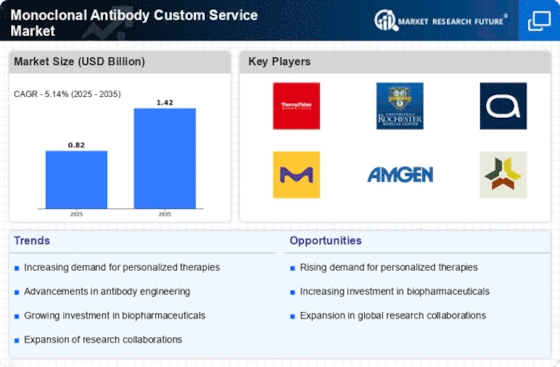
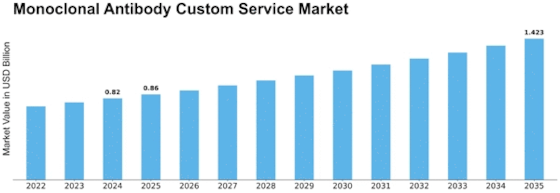
As per Market Research Future analysis, the Monoclonal Antibody Custom Service Market was estimated at 0.8201 USD Billion in 2024. The Monoclonal Antibody Custom Service industry is projected to grow from USD 0.8622 Billion in 2025 to USD 1.423 Billion by 2035, exhibiting a compound annual growth rate (CAGR) of 5.14% during the forecast period 2025 - 2035

Key Market Trends & Highlights

The Monoclonal Antibody Custom Service Market is experiencing robust growth driven by advancements in biotechnology and increasing demand for personalized medicine.

  • The market is witnessing a rising demand for personalized medicine, particularly in North America, which remains the largest market.
  • Collaborative research initiatives are becoming more prevalent, especially in the Asia-Pacific region, which is the fastest-growing market.
  • The Rat Custom Monoclonal Antibody segment leads in market share, while the Rabbit Custom Monoclonal Antibody segment is emerging rapidly.
  • Key market drivers include the increasing prevalence of chronic diseases and a growing focus on precision medicine, fueling investment in biopharmaceutical research.

Market Size & Forecast

2024 Market Size 0.8201 (USD Billion)
2035 Market Size 1.423 (USD Billion)
CAGR (2025 - 2035) 5.14%
Largest Regional Market Share in 2024 North America

Major Players

Thermo Fisher Scientific (US), Roche (CH), AbbVie (US), Merck KGaA (DE), Amgen (US), SAB Biotherapeutics (US), Genmab (DK), Lonza (CH), Bristol-Myers Squibb (US)

Market Trends

The Monoclonal Antibody Custom Service Market is currently experiencing a notable evolution, driven by advancements in biotechnology and increasing demand for personalized medicine. This market appears to be expanding as researchers and pharmaceutical companies seek tailored solutions for their therapeutic needs. The growing prevalence of chronic diseases and the need for targeted therapies seem to be propelling the demand for custom monoclonal antibodies. Furthermore, collaborations between academic institutions and industry players indicate a trend towards innovation and enhanced service offerings, which may further stimulate market growth. In addition, the regulatory landscape surrounding monoclonal antibodies is evolving, potentially impacting the Monoclonal Antibody Custom Service Market. Regulatory agencies are increasingly focusing on the safety and efficacy of these products, which could lead to more stringent guidelines. This shift may encourage service providers to enhance their quality control measures and invest in advanced technologies. Overall, the market appears poised for growth, with a focus on customization, regulatory compliance, and collaborative efforts driving its trajectory.

Rising Demand for Personalized Medicine

The Monoclonal Antibody Custom Service Market is witnessing a surge in demand for personalized medicine. This trend is largely influenced by the growing recognition of the need for tailored therapeutic solutions that cater to individual patient profiles. As healthcare providers increasingly adopt precision medicine approaches, the requirement for custom monoclonal antibodies is likely to rise, fostering innovation in service offerings.

Collaborative Research Initiatives

There is a noticeable increase in collaborative research initiatives between academic institutions and biotechnology firms within the Monoclonal Antibody Custom Service Market. These partnerships appear to enhance the development of novel therapeutic antibodies, as they combine academic expertise with industry resources. Such collaborations may lead to accelerated advancements in antibody design and production, ultimately benefiting the market.

Evolving Regulatory Frameworks

The regulatory environment surrounding monoclonal antibodies is evolving, which could have implications for the Monoclonal Antibody Custom Service Market. Regulatory agencies are placing greater emphasis on the safety and efficacy of these products, potentially leading to more rigorous compliance requirements. This shift may compel service providers to adopt enhanced quality assurance practices and invest in cutting-edge technologies to meet new standards.

Monoclonal Antibody Custom Service Market Market Drivers

Advancements in Biotechnology

Technological advancements in biotechnology are propelling the Monoclonal Antibody Custom Service Market forward. Innovations in genetic engineering, hybridoma technology, and antibody humanization techniques have enhanced the efficiency and specificity of monoclonal antibody production. These advancements enable researchers to create highly targeted therapies with fewer side effects, which is increasingly appealing to both healthcare providers and patients. The market for monoclonal antibodies is projected to reach significant figures, with a notable portion attributed to custom services that cater to specific research and therapeutic needs. As biotechnology continues to evolve, the Monoclonal Antibody Custom Service Market is poised for further expansion, driven by the demand for cutting-edge therapeutic solutions.

Rising Focus on Precision Medicine

The shift towards precision medicine is significantly impacting the Monoclonal Antibody Custom Service Market. As healthcare systems increasingly prioritize personalized treatment approaches, the demand for monoclonal antibodies tailored to individual patient profiles is on the rise. This trend is supported by a growing body of evidence suggesting that precision medicine can lead to improved patient outcomes and reduced healthcare costs. The market for monoclonal antibodies is projected to expand as healthcare providers seek custom solutions that align with the principles of precision medicine. Consequently, the Monoclonal Antibody Custom Service Market is expected to benefit from this paradigm shift, as more stakeholders recognize the value of tailored therapeutic options.

Increasing Prevalence of Chronic Diseases

The rising incidence of chronic diseases such as cancer, diabetes, and autoimmune disorders is a primary driver for the Monoclonal Antibody Custom Service Market. As these conditions become more prevalent, the demand for targeted therapies, including monoclonal antibodies, escalates. According to recent estimates, the global burden of chronic diseases is expected to increase significantly, necessitating innovative treatment options. This trend compels pharmaceutical companies to invest in custom monoclonal antibody services to develop tailored therapies that address specific patient needs. Consequently, the Monoclonal Antibody Custom Service Market is likely to experience substantial growth as healthcare providers seek effective solutions to manage these complex diseases.

Growing Investment in Biopharmaceutical Research

The surge in investment directed towards biopharmaceutical research is a crucial factor influencing the Monoclonal Antibody Custom Service Market. With an increasing number of biopharmaceutical companies focusing on monoclonal antibodies as a cornerstone of their therapeutic pipelines, the need for custom services has become more pronounced. Reports indicate that funding for biopharmaceutical research has seen a steady increase, with many companies allocating substantial budgets for the development of monoclonal antibody therapies. This trend not only fosters innovation but also enhances the demand for specialized services that can support the unique requirements of these research initiatives. As a result, the Monoclonal Antibody Custom Service Market is likely to thrive in this investment-driven environment.

Emerging Markets and Expanding Access to Healthcare

Emerging markets are playing a pivotal role in the growth of the Monoclonal Antibody Custom Service Market. As these regions experience economic development, there is a corresponding increase in healthcare access and investment in advanced medical technologies. The demand for monoclonal antibodies is rising in these markets, driven by a growing awareness of innovative treatment options and the need for effective therapies for various diseases. This trend is likely to lead to an increase in the utilization of custom monoclonal antibody services, as local pharmaceutical companies seek to develop products that cater to the specific health challenges faced by their populations. Thus, the Monoclonal Antibody Custom Service Market is positioned to capitalize on the opportunities presented by these emerging markets.

Market Segment Insights

By Type: Rat Custom Monoclonal Antibody (Largest) vs. Rabbit Custom Monoclonal Antibody (Fastest-Growing)

<p>In the Monoclonal Antibody Custom Service Market, the Rat Custom Monoclonal Antibody dominates as the largest segment, holding a significant share due to its widespread application in research and diagnostics. Its robust presence is attributed to the extensive use of rat models in various studies, making it a preferred choice for many laboratories. On the other hand, the Rabbit Custom Monoclonal Antibody segment is experiencing rapid growth, fueled by increased demand for high specificity and affinity in antibody-based assays. The versatility of rabbit antibodies in recognizing various antigens enhances their appeal in diverse applications, contributing to their rising market share.</p>

<p>Type: Rat Custom Monoclonal Antibody (Dominant) vs. Rabbit Custom Monoclonal Antibody (Emerging)</p>

<p>The Rat Custom Monoclonal Antibody segment is characterized by its long-standing presence in the market, leveraging established research practices and protocols. Rat antibodies are recognized for their robustness in various assays, making them the go-to choice for academic and commercial laboratories. In contrast, the Rabbit Custom Monoclonal Antibody is emerging rapidly, driven by innovations in antibody engineering and an increasing preference for rabbit antibodies in therapeutic development and diagnostic applications. As research methodologies evolve, the rabbit segment is expected to witness heightened investment and adoption, positioning it as a crucial player in future market developments.</p>

By Application: Therapeutic Application (Largest) vs. Diagnostic Imaging (Fastest-Growing)

<p>In the Monoclonal Antibody Custom Service Market, the application segment is notably diverse, encompassing four primary areas: Diagnostic Application, <a href="https://www.marketresearchfuture.com/reports/diagnostic-imaging-market-6765" target="_blank" title="diagnostic imaging">Diagnostic Imaging</a>, Therapeutic Application, and Protein Purification. Among these, Therapeutic Application holds the largest share, showcasing significant utilization in treatment protocols across various diseases, thus dominating the market landscape. Conversely, Diagnostic Imaging is emerging as the fastest-growing segment due to its increasing adoption in early disease detection and advancements in imaging technologies, reflecting shifting market dynamics.</p>

<p>Diagnostic Application (Dominant) vs. Protein Purification (Emerging)</p>

<p>The Diagnostic Application segment stands as a dominant force in the Monoclonal Antibody Custom Service Market, primarily driven by its widespread usage in clinical diagnostics and laboratory settings. It effectively addresses the need for accurate and efficient diagnostics, ensuring high reliability and efficacy in various tests. In contrast, Protein Purification is an emerging segment, gaining traction due to rising demand for high-quality protein samples in research and development. This segment is characterized by innovative purification techniques that enhance the purity and yield of proteins vital for drug formulation and development, marking its rising importance in biopharmaceutical applications.</p>

By End User: Hospitals (Largest) vs. Research (Fastest-Growing)

<p>In the Monoclonal Antibody Custom Service Market, hospitals account for a significant portion of the market share due to their extensive usage of monoclonal antibodies for diagnostic and therapeutic purposes. With a robust infrastructure and high patient turnover, hospitals are able to leverage these custom services to enhance treatment outcomes. On the other hand, the research segment is rapidly gaining traction, driven by an increase in research activities focused on drug development and personalized medicine, allowing it to capture an expanding niche of the market.</p>

<p>End Users: Hospitals (Dominant) vs. Research (Emerging)</p>

<p>Hospitals are currently the dominant end-user in the Monoclonal Antibody Custom Service Market, characterized by their constant demand for tailored therapeutic solutions to address diverse patient needs. Their established networks and significant budgets allow them to integrate monoclonal antibodies into routine clinical practice, facilitating faster and more effective treatment protocols. Conversely, the research segment is emerging rapidly as academic institutions and biotech companies invest in innovative studies aimed at advancing monoclonal antibody applications. This segment is particularly driven by increased funding for biotechnology research and an ongoing demand for novel therapies, positioning it as a vital component of future market growth.</p>

Monoclonal Antibody Custom Service Market End UserInsights

Based on end-user, the Monoclonal Antibody Custom Service Market segmentation includes hospitals and research. The hospital segment dominated the market;hospitals are a significant end-user of diagnostic customized antibody products. Government and private hospitals are included in the hospital sector. Hospitals use monoclonal antibodies to treat and diagnose COVID-19, cancer, and other diseases.

Source: Secondary Research, Primary Research, Market Research Future Database, and Analyst Review

Get more detailed insights about Monoclonal Antibody Custom Service Market Research Report—Global Forecast till 2035

Regional Insights

North America : Leading Innovation and Demand

North America is the largest market for monoclonal antibody custom services, holding approximately 45% of the global market share. The region benefits from robust healthcare infrastructure, significant R&D investments, and a high prevalence of chronic diseases. Regulatory support from agencies like the FDA further catalyzes market growth, ensuring rapid approval processes for new therapies. The increasing demand for personalized medicine and targeted therapies is driving innovation in this sector. The United States is the primary contributor to this market, with key players such as Thermo Fisher Scientific, AbbVie, and Amgen leading the charge. Canada also plays a significant role, albeit smaller, with a growing focus on biopharmaceuticals. The competitive landscape is characterized by collaborations and partnerships among major firms, enhancing service offerings and technological advancements. The presence of established companies ensures a dynamic market environment.

Europe : Emerging Market with Growth Potential

Europe is the second-largest market for monoclonal antibody custom services, accounting for approximately 30% of the global market share. The region is witnessing growth driven by increasing investments in biopharmaceuticals and a strong emphasis on research and development. Regulatory bodies like the European Medicines Agency (EMA) are pivotal in streamlining approval processes, which encourages innovation and market entry for new therapies. The rising prevalence of autoimmune diseases and cancers is further propelling demand for monoclonal antibodies. Leading countries in this region include Germany, France, and the United Kingdom, which host several key players such as Roche and Merck KGaA. The competitive landscape is marked by a mix of established firms and emerging biotech companies, fostering a vibrant ecosystem for monoclonal antibody development. Collaborations between academia and industry are also prevalent, enhancing research capabilities and accelerating product development.

Asia-Pacific : Rapidly Growing Biotech Sector

Asia-Pacific is rapidly emerging as a significant player in the monoclonal antibody custom service market, holding about 20% of the global market share. The region's growth is fueled by increasing healthcare expenditures, a rising patient population, and a growing focus on biotechnology. Countries like China and India are investing heavily in biopharmaceutical research, supported by favorable government policies and initiatives aimed at enhancing healthcare infrastructure. The demand for innovative therapies is driving the expansion of this market. China is the largest market in the region, with a burgeoning biotech sector and numerous local companies entering the monoclonal antibody space. India follows closely, with a strong emphasis on affordable healthcare solutions. The competitive landscape is characterized by both local and international players, including Genmab and Lonza, who are actively collaborating to enhance their service offerings and technological capabilities. This dynamic environment is expected to foster significant growth in the coming years.

Middle East and Africa : Untapped Market Potential

The Middle East and Africa region is gradually emerging in the monoclonal antibody custom service market, currently holding about 5% of the global market share. The growth is primarily driven by increasing investments in healthcare infrastructure and a rising awareness of biopharmaceuticals. Countries like South Africa and the UAE are making strides in developing their biotech sectors, supported by government initiatives aimed at enhancing research and development capabilities. The demand for advanced therapies is expected to rise as healthcare systems evolve. South Africa is the leading market in this region, with a growing number of biotech firms and research institutions focusing on monoclonal antibodies. The competitive landscape is still developing, with opportunities for both local and international players to establish a presence. Collaborations between governments and private sectors are crucial for fostering innovation and expanding the market, paving the way for future growth in this untapped region.

Key Players and Competitive Insights

Prominent industry players are making substantial investments in research and development to enhance their product portfolios, thereby driving the growth of the monoclonal antibodies market. These market participants also engage in strategic activities to expand their presence, such as launching new products, entering into contractual agreements, pursuing mergers and acquisitions, increasing investments, and fostering collaborations with other organizations. In the increasingly competitive and growing market environment, Monoclonal Antibody Custom Service industry companies must offer cost-effective solutions to expand and thrive.
TheThe Monoclonal Antibody Custom Service industry has offered some of the most significant medical advantages. Major players in the Monoclonal Antibody market, includingThermo Fisher Scientific Inc. (US), GenScript (US), Abnova Corporation (Taiwan), and ProteoGenix (France). Several companies in the industry, are making efforts to boost market demand by allocating significant investments towards research and development activities. These companies recognize innovation's importance and are actively developing new products, technologies, and solutions.
Merck Group, a renowned German multinational science and technology company based in Darmstadt, operates in 66 countries and employs approximately 60,000 individuals. The group comprises around 250 companies, with its primary entity being Merck KGaA in Germany.Merck KGaA has collaborated with Kelun-Biotech to jointly develop seven investigational preclinical antibody-drug conjugates (ADC) for cancer treatment.
Thermo Fisher Scientific Inc. is a scientific solutions provider globally, generating approximately $40 billion in annual revenue. Their mission is to empower customers to create a healthier, cleaner, and safer world. They achieve this by supporting various endeavors such as accelerating life sciences research, addressing complex analytical challenges, enhancing laboratory productivity, advancing patient health through diagnostics, and contributing to developing and producing life-changing therapies. Thermo Fisher Scientific acquired The Binding Site Group, a prominent player in specialty diagnostics with a presence.

Key Companies in the Monoclonal Antibody Custom Service Market include

Industry Developments

December 2022:Merck KGaA collaborated with Kelun-Biotech to develop seven investigational preclinical antibody-drug conjugates (ADC) for cancer treatment.

October 2022: Thermo Fisher Scientific Inc. is a leader in scientific solutions. Thermo Fisher Scientific provides a huge range of products and services that cater to various scientific needs, including advancing life sciences research, addressing complex analytical challenges, enhancing laboratory productivity, improving patient healthcare through diagnostics, and developing transformative therapies. In line with its growth strategy, Thermo Fisher Scientific has successfully acquired The Binding Site Group, a renowned company specializing in specialty diagnostics on a scale.

Future Outlook

Monoclonal Antibody Custom Service Market Future Outlook

The Monoclonal Antibody Custom Service Market is projected to grow at a 5.14% CAGR from 2025 to 2035, driven by increasing demand for personalized medicine and advancements in biopharmaceutical technologies.

New opportunities lie in:

  • Expansion into emerging markets with tailored services
  • Development of high-throughput screening technologies
  • Strategic partnerships with biotech firms for co-development projects

By 2035, the market is expected to solidify its position as a leader in biopharmaceutical innovation.

Market Segmentation

Monoclonal Antibody Custom Service Market Type Outlook

  • Rat Custom Monoclonal Antibody
  • Rabbit Custom Monoclonal Antibody

Monoclonal Antibody Custom Service Market End User Outlook

  • Hospitals
  • Research

Monoclonal Antibody Custom Service Market Application Outlook

  • Diagnostic Application
  • Diagnostic Imaging
  • Therapeutic Application
  • Protein Purification

Report Scope

MARKET SIZE 2024 0.8201(USD Billion)
MARKET SIZE 2025 0.8622(USD Billion)
MARKET SIZE 2035 1.423(USD Billion)
COMPOUND ANNUAL GROWTH RATE (CAGR) 5.14% (2025 - 2035)
REPORT COVERAGE Revenue Forecast, Competitive Landscape, Growth Factors, and Trends
BASE YEAR 2024
Market Forecast Period 2025 - 2035
Historical Data 2019 - 2024
Market Forecast Units USD Billion
Key Companies Profiled Thermo Fisher Scientific (US), Roche (CH), AbbVie (US), Merck KGaA (DE), Amgen (US), SAB Biotherapeutics (US), Genmab (DK), Lonza (CH), Bristol-Myers Squibb (US)
Segments Covered Type, Application, End User, Region
Key Market Opportunities Growing demand for personalized medicine drives innovation in the Monoclonal Antibody Custom Service Market.
Key Market Dynamics Rising demand for personalized medicine drives innovation and competition in the Monoclonal Antibody Custom Service Market.
Countries Covered North America, Europe, APAC, South America, MEA

FAQs

What is the projected market valuation of the Monoclonal Antibody Custom Service Market by 2035?

<p>The market is projected to reach a valuation of 1.423 USD Billion by 2035.</p>

What was the market valuation of the Monoclonal Antibody Custom Service Market in 2024?

<p>In 2024, the market valuation was 0.8201 USD Billion.</p>

What is the expected CAGR for the Monoclonal Antibody Custom Service Market during the forecast period 2025 - 2035?

<p>The expected CAGR for the market during this period is 5.14%.</p>

Which companies are considered key players in the Monoclonal Antibody Custom Service Market?

<p>Key players include Thermo Fisher Scientific, Roche, AbbVie, Merck KGaA, Amgen, SAB Biotherapeutics, Genmab, Lonza, and Bristol-Myers Squibb.</p>

What are the main application segments of the Monoclonal Antibody Custom Service Market?

<p>Main application segments include Diagnostic Application, Diagnostic Imaging, Therapeutic Application, and Protein Purification.</p>

How did the valuation of Rat Custom Monoclonal Antibodies change from 2024 to 2025?

<p>The valuation for Rat Custom Monoclonal Antibodies increased from 0.4101 USD Billion in 2024 to 0.7435 USD Billion in 2025.</p>

What is the projected growth for Rabbit Custom Monoclonal Antibodies from 2024 to 2035?

<p>The valuation for Rabbit Custom Monoclonal Antibodies is expected to grow from 0.41 USD Billion in 2024 to 0.6795 USD Billion by 2035.</p>

Which end-user segments are driving the Monoclonal Antibody Custom Service Market?

<p>The end-user segments driving the market include Hospitals and Research institutions.</p>

What was the market size for Therapeutic Applications in 2024?

<p>In 2024, the market size for Therapeutic Applications was 0.3 USD Billion.</p>

How does the market for Diagnostic Imaging compare to other application segments?

<p>The market for Diagnostic Imaging was valued at 0.15 USD Billion in 2024, indicating a smaller share compared to other application segments.</p>

  1. SECTION I: EXECUTIVE SUMMARY AND KEY HIGHLIGHTS
    1. | 1.1 EXECUTIVE SUMMARY
    2. | | 1.1.1 Market Overview
    3. | | 1.1.2 Key Findings
    4. | | 1.1.3 Market Segmentation
    5. | | 1.1.4 Competitive Landscape
    6. | | 1.1.5 Challenges and Opportunities
    7. | | 1.1.6 Future Outlook
  2. SECTION II: SCOPING, METHODOLOGY AND MARKET STRUCTURE
    1. | 2.1 MARKET INTRODUCTION
    2. | | 2.1.1 Definition
    3. | | 2.1.2 Scope of the study
    4. | | | 2.1.2.1 Research Objective
    5. | | | 2.1.2.2 Assumption
    6. | | | 2.1.2.3 Limitations
    7. | 2.2 RESEARCH METHODOLOGY
    8. | | 2.2.1 Overview
    9. | | 2.2.2 Data Mining
    10. | | 2.2.3 Secondary Research
    11. | | 2.2.4 Primary Research
    12. | | | 2.2.4.1 Primary Interviews and Information Gathering Process
    13. | | | 2.2.4.2 Breakdown of Primary Respondents
    14. | | 2.2.5 Forecasting Model
    15. | | 2.2.6 Market Size Estimation
    16. | | | 2.2.6.1 Bottom-Up Approach
    17. | | | 2.2.6.2 Top-Down Approach
    18. | | 2.2.7 Data Triangulation
    19. | | 2.2.8 Validation
  3. SECTION III: QUALITATIVE ANALYSIS
    1. | 3.1 MARKET DYNAMICS
    2. | | 3.1.1 Overview
    3. | | 3.1.2 Drivers
    4. | | 3.1.3 Restraints
    5. | | 3.1.4 Opportunities
    6. | 3.2 MARKET FACTOR ANALYSIS
    7. | | 3.2.1 Value chain Analysis
    8. | | 3.2.2 Porter's Five Forces Analysis
    9. | | | 3.2.2.1 Bargaining Power of Suppliers
    10. | | | 3.2.2.2 Bargaining Power of Buyers
    11. | | | 3.2.2.3 Threat of New Entrants
    12. | | | 3.2.2.4 Threat of Substitutes
    13. | | | 3.2.2.5 Intensity of Rivalry
    14. | | 3.2.3 COVID-19 Impact Analysis
    15. | | | 3.2.3.1 Market Impact Analysis
    16. | | | 3.2.3.2 Regional Impact
    17. | | | 3.2.3.3 Opportunity and Threat Analysis
  4. SECTION IV: QUANTITATIVE ANALYSIS
    1. | 4.1 Healthcare, BY Type (USD Billion)
    2. | | 4.1.1 Rat Custom Monoclonal Antibody
    3. | | 4.1.2 Rabbit Custom Monoclonal Antibody
    4. | 4.2 Healthcare, BY Application (USD Billion)
    5. | | 4.2.1 Diagnostic Application
    6. | | 4.2.2 Diagnostic Imaging
    7. | | 4.2.3 Therapeutic Application
    8. | | 4.2.4 Protein Purification
    9. | 4.3 Healthcare, BY End User (USD Billion)
    10. | | 4.3.1 Hospitals
    11. | | 4.3.2 Research
    12. | 4.4 Healthcare, BY Region (USD Billion)
    13. | | 4.4.1 North America
    14. | | | 4.4.1.1 US
    15. | | | 4.4.1.2 Canada
    16. | | 4.4.2 Europe
    17. | | | 4.4.2.1 Germany
    18. | | | 4.4.2.2 UK
    19. | | | 4.4.2.3 France
    20. | | | 4.4.2.4 Russia
    21. | | | 4.4.2.5 Italy
    22. | | | 4.4.2.6 Spain
    23. | | | 4.4.2.7 Rest of Europe
    24. | | 4.4.3 APAC
    25. | | | 4.4.3.1 China
    26. | | | 4.4.3.2 India
    27. | | | 4.4.3.3 Japan
    28. | | | 4.4.3.4 South Korea
    29. | | | 4.4.3.5 Malaysia
    30. | | | 4.4.3.6 Thailand
    31. | | | 4.4.3.7 Indonesia
    32. | | | 4.4.3.8 Rest of APAC
    33. | | 4.4.4 South America
    34. | | | 4.4.4.1 Brazil
    35. | | | 4.4.4.2 Mexico
    36. | | | 4.4.4.3 Argentina
    37. | | | 4.4.4.4 Rest of South America
    38. | | 4.4.5 MEA
    39. | | | 4.4.5.1 GCC Countries
    40. | | | 4.4.5.2 South Africa
    41. | | | 4.4.5.3 Rest of MEA
  5. SECTION V: COMPETITIVE ANALYSIS
    1. | 5.1 Competitive Landscape
    2. | | 5.1.1 Overview
    3. | | 5.1.2 Competitive Analysis
    4. | | 5.1.3 Market share Analysis
    5. | | 5.1.4 Major Growth Strategy in the Healthcare
    6. | | 5.1.5 Competitive Benchmarking
    7. | | 5.1.6 Leading Players in Terms of Number of Developments in the Healthcare
    8. | | 5.1.7 Key developments and growth strategies
    9. | | | 5.1.7.1 New Product Launch/Service Deployment
    10. | | | 5.1.7.2 Merger & Acquisitions
    11. | | | 5.1.7.3 Joint Ventures
    12. | | 5.1.8 Major Players Financial Matrix
    13. | | | 5.1.8.1 Sales and Operating Income
    14. | | | 5.1.8.2 Major Players R&D Expenditure. 2023
    15. | 5.2 Company Profiles
    16. | | 5.2.1 Thermo Fisher Scientific (US)
    17. | | | 5.2.1.1 Financial Overview
    18. | | | 5.2.1.2 Products Offered
    19. | | | 5.2.1.3 Key Developments
    20. | | | 5.2.1.4 SWOT Analysis
    21. | | | 5.2.1.5 Key Strategies
    22. | | 5.2.2 Roche (CH)
    23. | | | 5.2.2.1 Financial Overview
    24. | | | 5.2.2.2 Products Offered
    25. | | | 5.2.2.3 Key Developments
    26. | | | 5.2.2.4 SWOT Analysis
    27. | | | 5.2.2.5 Key Strategies
    28. | | 5.2.3 AbbVie (US)
    29. | | | 5.2.3.1 Financial Overview
    30. | | | 5.2.3.2 Products Offered
    31. | | | 5.2.3.3 Key Developments
    32. | | | 5.2.3.4 SWOT Analysis
    33. | | | 5.2.3.5 Key Strategies
    34. | | 5.2.4 Merck KGaA (DE)
    35. | | | 5.2.4.1 Financial Overview
    36. | | | 5.2.4.2 Products Offered
    37. | | | 5.2.4.3 Key Developments
    38. | | | 5.2.4.4 SWOT Analysis
    39. | | | 5.2.4.5 Key Strategies
    40. | | 5.2.5 Amgen (US)
    41. | | | 5.2.5.1 Financial Overview
    42. | | | 5.2.5.2 Products Offered
    43. | | | 5.2.5.3 Key Developments
    44. | | | 5.2.5.4 SWOT Analysis
    45. | | | 5.2.5.5 Key Strategies
    46. | | 5.2.6 SAB Biotherapeutics (US)
    47. | | | 5.2.6.1 Financial Overview
    48. | | | 5.2.6.2 Products Offered
    49. | | | 5.2.6.3 Key Developments
    50. | | | 5.2.6.4 SWOT Analysis
    51. | | | 5.2.6.5 Key Strategies
    52. | | 5.2.7 Genmab (DK)
    53. | | | 5.2.7.1 Financial Overview
    54. | | | 5.2.7.2 Products Offered
    55. | | | 5.2.7.3 Key Developments
    56. | | | 5.2.7.4 SWOT Analysis
    57. | | | 5.2.7.5 Key Strategies
    58. | | 5.2.8 Lonza (CH)
    59. | | | 5.2.8.1 Financial Overview
    60. | | | 5.2.8.2 Products Offered
    61. | | | 5.2.8.3 Key Developments
    62. | | | 5.2.8.4 SWOT Analysis
    63. | | | 5.2.8.5 Key Strategies
    64. | | 5.2.9 Bristol-Myers Squibb (US)
    65. | | | 5.2.9.1 Financial Overview
    66. | | | 5.2.9.2 Products Offered
    67. | | | 5.2.9.3 Key Developments
    68. | | | 5.2.9.4 SWOT Analysis
    69. | | | 5.2.9.5 Key Strategies
    70. | 5.3 Appendix
    71. | | 5.3.1 References
    72. | | 5.3.2 Related Reports
  6. LIST OF FIGURES
    1. | 6.1 MARKET SYNOPSIS
    2. | 6.2 NORTH AMERICA MARKET ANALYSIS
    3. | 6.3 US MARKET ANALYSIS BY TYPE
    4. | 6.4 US MARKET ANALYSIS BY APPLICATION
    5. | 6.5 US MARKET ANALYSIS BY END USER
    6. | 6.6 CANADA MARKET ANALYSIS BY TYPE
    7. | 6.7 CANADA MARKET ANALYSIS BY APPLICATION
    8. | 6.8 CANADA MARKET ANALYSIS BY END USER
    9. | 6.9 EUROPE MARKET ANALYSIS
    10. | 6.10 GERMANY MARKET ANALYSIS BY TYPE
    11. | 6.11 GERMANY MARKET ANALYSIS BY APPLICATION
    12. | 6.12 GERMANY MARKET ANALYSIS BY END USER
    13. | 6.13 UK MARKET ANALYSIS BY TYPE
    14. | 6.14 UK MARKET ANALYSIS BY APPLICATION
    15. | 6.15 UK MARKET ANALYSIS BY END USER
    16. | 6.16 FRANCE MARKET ANALYSIS BY TYPE
    17. | 6.17 FRANCE MARKET ANALYSIS BY APPLICATION
    18. | 6.18 FRANCE MARKET ANALYSIS BY END USER
    19. | 6.19 RUSSIA MARKET ANALYSIS BY TYPE
    20. | 6.20 RUSSIA MARKET ANALYSIS BY APPLICATION
    21. | 6.21 RUSSIA MARKET ANALYSIS BY END USER
    22. | 6.22 ITALY MARKET ANALYSIS BY TYPE
    23. | 6.23 ITALY MARKET ANALYSIS BY APPLICATION
    24. | 6.24 ITALY MARKET ANALYSIS BY END USER
    25. | 6.25 SPAIN MARKET ANALYSIS BY TYPE
    26. | 6.26 SPAIN MARKET ANALYSIS BY APPLICATION
    27. | 6.27 SPAIN MARKET ANALYSIS BY END USER
    28. | 6.28 REST OF EUROPE MARKET ANALYSIS BY TYPE
    29. | 6.29 REST OF EUROPE MARKET ANALYSIS BY APPLICATION
    30. | 6.30 REST OF EUROPE MARKET ANALYSIS BY END USER
    31. | 6.31 APAC MARKET ANALYSIS
    32. | 6.32 CHINA MARKET ANALYSIS BY TYPE
    33. | 6.33 CHINA MARKET ANALYSIS BY APPLICATION
    34. | 6.34 CHINA MARKET ANALYSIS BY END USER
    35. | 6.35 INDIA MARKET ANALYSIS BY TYPE
    36. | 6.36 INDIA MARKET ANALYSIS BY APPLICATION
    37. | 6.37 INDIA MARKET ANALYSIS BY END USER
    38. | 6.38 JAPAN MARKET ANALYSIS BY TYPE
    39. | 6.39 JAPAN MARKET ANALYSIS BY APPLICATION
    40. | 6.40 JAPAN MARKET ANALYSIS BY END USER
    41. | 6.41 SOUTH KOREA MARKET ANALYSIS BY TYPE
    42. | 6.42 SOUTH KOREA MARKET ANALYSIS BY APPLICATION
    43. | 6.43 SOUTH KOREA MARKET ANALYSIS BY END USER
    44. | 6.44 MALAYSIA MARKET ANALYSIS BY TYPE
    45. | 6.45 MALAYSIA MARKET ANALYSIS BY APPLICATION
    46. | 6.46 MALAYSIA MARKET ANALYSIS BY END USER
    47. | 6.47 THAILAND MARKET ANALYSIS BY TYPE
    48. | 6.48 THAILAND MARKET ANALYSIS BY APPLICATION
    49. | 6.49 THAILAND MARKET ANALYSIS BY END USER
    50. | 6.50 INDONESIA MARKET ANALYSIS BY TYPE
    51. | 6.51 INDONESIA MARKET ANALYSIS BY APPLICATION
    52. | 6.52 INDONESIA MARKET ANALYSIS BY END USER
    53. | 6.53 REST OF APAC MARKET ANALYSIS BY TYPE
    54. | 6.54 REST OF APAC MARKET ANALYSIS BY APPLICATION
    55. | 6.55 REST OF APAC MARKET ANALYSIS BY END USER
    56. | 6.56 SOUTH AMERICA MARKET ANALYSIS
    57. | 6.57 BRAZIL MARKET ANALYSIS BY TYPE
    58. | 6.58 BRAZIL MARKET ANALYSIS BY APPLICATION
    59. | 6.59 BRAZIL MARKET ANALYSIS BY END USER
    60. | 6.60 MEXICO MARKET ANALYSIS BY TYPE
    61. | 6.61 MEXICO MARKET ANALYSIS BY APPLICATION
    62. | 6.62 MEXICO MARKET ANALYSIS BY END USER
    63. | 6.63 ARGENTINA MARKET ANALYSIS BY TYPE
    64. | 6.64 ARGENTINA MARKET ANALYSIS BY APPLICATION
    65. | 6.65 ARGENTINA MARKET ANALYSIS BY END USER
    66. | 6.66 REST OF SOUTH AMERICA MARKET ANALYSIS BY TYPE
    67. | 6.67 REST OF SOUTH AMERICA MARKET ANALYSIS BY APPLICATION
    68. | 6.68 REST OF SOUTH AMERICA MARKET ANALYSIS BY END USER
    69. | 6.69 MEA MARKET ANALYSIS
    70. | 6.70 GCC COUNTRIES MARKET ANALYSIS BY TYPE
    71. | 6.71 GCC COUNTRIES MARKET ANALYSIS BY APPLICATION
    72. | 6.72 GCC COUNTRIES MARKET ANALYSIS BY END USER
    73. | 6.73 SOUTH AFRICA MARKET ANALYSIS BY TYPE
    74. | 6.74 SOUTH AFRICA MARKET ANALYSIS BY APPLICATION
    75. | 6.75 SOUTH AFRICA MARKET ANALYSIS BY END USER
    76. | 6.76 REST OF MEA MARKET ANALYSIS BY TYPE
    77. | 6.77 REST OF MEA MARKET ANALYSIS BY APPLICATION
    78. | 6.78 REST OF MEA MARKET ANALYSIS BY END USER
    79. | 6.79 KEY BUYING CRITERIA OF HEALTHCARE
    80. | 6.80 RESEARCH PROCESS OF MRFR
    81. | 6.81 DRO ANALYSIS OF HEALTHCARE
    82. | 6.82 DRIVERS IMPACT ANALYSIS: HEALTHCARE
    83. | 6.83 RESTRAINTS IMPACT ANALYSIS: HEALTHCARE
    84. | 6.84 SUPPLY / VALUE CHAIN: HEALTHCARE
    85. | 6.85 HEALTHCARE, BY TYPE, 2024 (% SHARE)
    86. | 6.86 HEALTHCARE, BY TYPE, 2024 TO 2035 (USD Billion)
    87. | 6.87 HEALTHCARE, BY APPLICATION, 2024 (% SHARE)
    88. | 6.88 HEALTHCARE, BY APPLICATION, 2024 TO 2035 (USD Billion)
    89. | 6.89 HEALTHCARE, BY END USER, 2024 (% SHARE)
    90. | 6.90 HEALTHCARE, BY END USER, 2024 TO 2035 (USD Billion)
    91. | 6.91 BENCHMARKING OF MAJOR COMPETITORS
  7. LIST OF TABLES
    1. | 7.1 LIST OF ASSUMPTIONS
    2. | | 7.1.1
    3. | 7.2 North America MARKET SIZE ESTIMATES; FORECAST
    4. | | 7.2.1 BY TYPE, 2025-2035 (USD Billion)
    5. | | 7.2.2 BY APPLICATION, 2025-2035 (USD Billion)
    6. | | 7.2.3 BY END USER, 2025-2035 (USD Billion)
    7. | 7.3 US MARKET SIZE ESTIMATES; FORECAST
    8. | | 7.3.1 BY TYPE, 2025-2035 (USD Billion)
    9. | | 7.3.2 BY APPLICATION, 2025-2035 (USD Billion)
    10. | | 7.3.3 BY END USER, 2025-2035 (USD Billion)
    11. | 7.4 Canada MARKET SIZE ESTIMATES; FORECAST
    12. | | 7.4.1 BY TYPE, 2025-2035 (USD Billion)
    13. | | 7.4.2 BY APPLICATION, 2025-2035 (USD Billion)
    14. | | 7.4.3 BY END USER, 2025-2035 (USD Billion)
    15. | 7.5 Europe MARKET SIZE ESTIMATES; FORECAST
    16. | | 7.5.1 BY TYPE, 2025-2035 (USD Billion)
    17. | | 7.5.2 BY APPLICATION, 2025-2035 (USD Billion)
    18. | | 7.5.3 BY END USER, 2025-2035 (USD Billion)
    19. | 7.6 Germany MARKET SIZE ESTIMATES; FORECAST
    20. | | 7.6.1 BY TYPE, 2025-2035 (USD Billion)
    21. | | 7.6.2 BY APPLICATION, 2025-2035 (USD Billion)
    22. | | 7.6.3 BY END USER, 2025-2035 (USD Billion)
    23. | 7.7 UK MARKET SIZE ESTIMATES; FORECAST
    24. | | 7.7.1 BY TYPE, 2025-2035 (USD Billion)
    25. | | 7.7.2 BY APPLICATION, 2025-2035 (USD Billion)
    26. | | 7.7.3 BY END USER, 2025-2035 (USD Billion)
    27. | 7.8 France MARKET SIZE ESTIMATES; FORECAST
    28. | | 7.8.1 BY TYPE, 2025-2035 (USD Billion)
    29. | | 7.8.2 BY APPLICATION, 2025-2035 (USD Billion)
    30. | | 7.8.3 BY END USER, 2025-2035 (USD Billion)
    31. | 7.9 Russia MARKET SIZE ESTIMATES; FORECAST
    32. | | 7.9.1 BY TYPE, 2025-2035 (USD Billion)
    33. | | 7.9.2 BY APPLICATION, 2025-2035 (USD Billion)
    34. | | 7.9.3 BY END USER, 2025-2035 (USD Billion)
    35. | 7.10 Italy MARKET SIZE ESTIMATES; FORECAST
    36. | | 7.10.1 BY TYPE, 2025-2035 (USD Billion)
    37. | | 7.10.2 BY APPLICATION, 2025-2035 (USD Billion)
    38. | | 7.10.3 BY END USER, 2025-2035 (USD Billion)
    39. | 7.11 Spain MARKET SIZE ESTIMATES; FORECAST
    40. | | 7.11.1 BY TYPE, 2025-2035 (USD Billion)
    41. | | 7.11.2 BY APPLICATION, 2025-2035 (USD Billion)
    42. | | 7.11.3 BY END USER, 2025-2035 (USD Billion)
    43. | 7.12 Rest of Europe MARKET SIZE ESTIMATES; FORECAST
    44. | | 7.12.1 BY TYPE, 2025-2035 (USD Billion)
    45. | | 7.12.2 BY APPLICATION, 2025-2035 (USD Billion)
    46. | | 7.12.3 BY END USER, 2025-2035 (USD Billion)
    47. | 7.13 APAC MARKET SIZE ESTIMATES; FORECAST
    48. | | 7.13.1 BY TYPE, 2025-2035 (USD Billion)
    49. | | 7.13.2 BY APPLICATION, 2025-2035 (USD Billion)
    50. | | 7.13.3 BY END USER, 2025-2035 (USD Billion)
    51. | 7.14 China MARKET SIZE ESTIMATES; FORECAST
    52. | | 7.14.1 BY TYPE, 2025-2035 (USD Billion)
    53. | | 7.14.2 BY APPLICATION, 2025-2035 (USD Billion)
    54. | | 7.14.3 BY END USER, 2025-2035 (USD Billion)
    55. | 7.15 India MARKET SIZE ESTIMATES; FORECAST
    56. | | 7.15.1 BY TYPE, 2025-2035 (USD Billion)
    57. | | 7.15.2 BY APPLICATION, 2025-2035 (USD Billion)
    58. | | 7.15.3 BY END USER, 2025-2035 (USD Billion)
    59. | 7.16 Japan MARKET SIZE ESTIMATES; FORECAST
    60. | | 7.16.1 BY TYPE, 2025-2035 (USD Billion)
    61. | | 7.16.2 BY APPLICATION, 2025-2035 (USD Billion)
    62. | | 7.16.3 BY END USER, 2025-2035 (USD Billion)
    63. | 7.17 South Korea MARKET SIZE ESTIMATES; FORECAST
    64. | | 7.17.1 BY TYPE, 2025-2035 (USD Billion)
    65. | | 7.17.2 BY APPLICATION, 2025-2035 (USD Billion)
    66. | | 7.17.3 BY END USER, 2025-2035 (USD Billion)
    67. | 7.18 Malaysia MARKET SIZE ESTIMATES; FORECAST
    68. | | 7.18.1 BY TYPE, 2025-2035 (USD Billion)
    69. | | 7.18.2 BY APPLICATION, 2025-2035 (USD Billion)
    70. | | 7.18.3 BY END USER, 2025-2035 (USD Billion)
    71. | 7.19 Thailand MARKET SIZE ESTIMATES; FORECAST
    72. | | 7.19.1 BY TYPE, 2025-2035 (USD Billion)
    73. | | 7.19.2 BY APPLICATION, 2025-2035 (USD Billion)
    74. | | 7.19.3 BY END USER, 2025-2035 (USD Billion)
    75. | 7.20 Indonesia MARKET SIZE ESTIMATES; FORECAST
    76. | | 7.20.1 BY TYPE, 2025-2035 (USD Billion)
    77. | | 7.20.2 BY APPLICATION, 2025-2035 (USD Billion)
    78. | | 7.20.3 BY END USER, 2025-2035 (USD Billion)
    79. | 7.21 Rest of APAC MARKET SIZE ESTIMATES; FORECAST
    80. | | 7.21.1 BY TYPE, 2025-2035 (USD Billion)
    81. | | 7.21.2 BY APPLICATION, 2025-2035 (USD Billion)
    82. | | 7.21.3 BY END USER, 2025-2035 (USD Billion)
    83. | 7.22 South America MARKET SIZE ESTIMATES; FORECAST
    84. | | 7.22.1 BY TYPE, 2025-2035 (USD Billion)
    85. | | 7.22.2 BY APPLICATION, 2025-2035 (USD Billion)
    86. | | 7.22.3 BY END USER, 2025-2035 (USD Billion)
    87. | 7.23 Brazil MARKET SIZE ESTIMATES; FORECAST
    88. | | 7.23.1 BY TYPE, 2025-2035 (USD Billion)
    89. | | 7.23.2 BY APPLICATION, 2025-2035 (USD Billion)
    90. | | 7.23.3 BY END USER, 2025-2035 (USD Billion)
    91. | 7.24 Mexico MARKET SIZE ESTIMATES; FORECAST
    92. | | 7.24.1 BY TYPE, 2025-2035 (USD Billion)
    93. | | 7.24.2 BY APPLICATION, 2025-2035 (USD Billion)
    94. | | 7.24.3 BY END USER, 2025-2035 (USD Billion)
    95. | 7.25 Argentina MARKET SIZE ESTIMATES; FORECAST
    96. | | 7.25.1 BY TYPE, 2025-2035 (USD Billion)
    97. | | 7.25.2 BY APPLICATION, 2025-2035 (USD Billion)
    98. | | 7.25.3 BY END USER, 2025-2035 (USD Billion)
    99. | 7.26 Rest of South America MARKET SIZE ESTIMATES; FORECAST
    100. | | 7.26.1 BY TYPE, 2025-2035 (USD Billion)
    101. | | 7.26.2 BY APPLICATION, 2025-2035 (USD Billion)
    102. | | 7.26.3 BY END USER, 2025-2035 (USD Billion)
    103. | 7.27 MEA MARKET SIZE ESTIMATES; FORECAST
    104. | | 7.27.1 BY TYPE, 2025-2035 (USD Billion)
    105. | | 7.27.2 BY APPLICATION, 2025-2035 (USD Billion)
    106. | | 7.27.3 BY END USER, 2025-2035 (USD Billion)
    107. | 7.28 GCC Countries MARKET SIZE ESTIMATES; FORECAST
    108. | | 7.28.1 BY TYPE, 2025-2035 (USD Billion)
    109. | | 7.28.2 BY APPLICATION, 2025-2035 (USD Billion)
    110. | | 7.28.3 BY END USER, 2025-2035 (USD Billion)
    111. | 7.29 South Africa MARKET SIZE ESTIMATES; FORECAST
    112. | | 7.29.1 BY TYPE, 2025-2035 (USD Billion)
    113. | | 7.29.2 BY APPLICATION, 2025-2035 (USD Billion)
    114. | | 7.29.3 BY END USER, 2025-2035 (USD Billion)
    115. | 7.30 Rest of MEA MARKET SIZE ESTIMATES; FORECAST
    116. | | 7.30.1 BY TYPE, 2025-2035 (USD Billion)
    117. | | 7.30.2 BY APPLICATION, 2025-2035 (USD Billion)
    118. | | 7.30.3 BY END USER, 2025-2035 (USD Billion)
    119. | 7.31 PRODUCT LAUNCH/PRODUCT DEVELOPMENT/APPROVAL
    120. | | 7.31.1
    121. | 7.32 ACQUISITION/PARTNERSHIP
    122. | | 7.32.1

Healthcare Market Segmentation

Healthcare By Type (USD Billion, 2025-2035)

  • Rat Custom Monoclonal Antibody
  • Rabbit Custom Monoclonal Antibody

Healthcare By Application (USD Billion, 2025-2035)

  • Diagnostic Application
  • Diagnostic Imaging
  • Therapeutic Application
  • Protein Purification

Healthcare By End User (USD Billion, 2025-2035)

  • Hospitals
  • Research
Infographic

Free Sample Request

Kindly complete the form below to receive a free sample of this Report

Get Free Sample

Customer Strories

Compare Licence

×
Features License Type
Single User Multiuser License Enterprise User
Price $4,950 $5,950 $7,250
Maximum User Access Limit 1 User Upto 10 Users Unrestricted Access Throughout the Organization
Free Customization
Direct Access to Analyst
Deliverable Format
Platform Access
Discount on Next Purchase 10% 15% 15%
Printable Versions