Request Free Sample ×

Kindly complete the form below to receive a free sample of this Report

* Please use a valid business email

Leading companies partner with us for data-driven Insights

clients tt-cursor
Hero Background
English
Chinese
French
Japanese
Korean
German
Spanish

mHealth (Mobile Health) Market Trends

ID: MRFR/HS/1284-HCR
200 Pages
Nidhi Mandole
March 2026

mHealth Market Research Report: Size, Share, Trend Analysis By Applications (Chronic Disease Management, Health and Fitness Tracking, Telehealth Services, Medication Management), By Technology (Wearable Devices, Apps, Remote Patient Monitoring, Telemedicine Platforms), By End-use (Healthcare Providers, Patients, Insurance Companies, Pharmaceutical Companies), By Component (Hardware, Software, Services), and By Regional (North America, Europe, South America, Asia Pacific, Middle East and Africa) - Growth Outlook & Industry Forecast 2025 To 2035

Share:
Download PDF ×

We do not share your information with anyone. However, we may send you emails based on your report interest from time to time. You may contact us at any time to opt-out.

Mobile Health Market Infographic
Purchase Options

Market Trends

Key Emerging Trends in the Mobile Health Market

In the mHealth market, telehealth and watching patients from afar are becoming more common. People can get better medical care, especially in places that are hard to get to or don't get enough of it, by keeping an eye on their vital signs, talking to medical professionals, and having video chats. A big part of mHealth trends is tech that you can wear. Many personal electronics, like smartphones and exercise bands, have health monitors built in. People can see their heart rate, how much they move, how much sleep they get, and more. This gives them more power over their health. An intriguing trend in mHealth is the use of AI and ML tools. They make health apps better by giving users more personalized info, more accurate readings of their health risks, and better tools for making predictions. The number of people who use health apps on their phones has raised worries about privacy and data safety. Many people in the market are interested in how to keep users' health information safe by following the rules and putting in place strong security measures. To make it easy for patients and healthcare workers to share information and talk to each other, merging with electronic health records (EHRs) and connection with current healthcare systems are goals. Patients can take care of their health and get active with mHealth. Users are more likely to stick to their health plans if they can see their own personal health information, keep track of their progress toward their goals, and use features that change over time. Standardization and rules are still a problem in the mHealth business. People are working to make rules and guidelines that make sure mHealth technologies are used in a safe, efficient, and moral way. This is in response to concerns about the quality and accuracy of apps.

Author
Author Profile
Nidhi Mandole
Senior Research Analyst

She is an extremely curious individual currently working in Healthcare and Medical Devices Domain. Nidhi is comfortably versed in data centric research backed by healthcare educational background. She leverages extensive data mining and analytics tools such as Primary and Secondary Research, Statistical Analysis, Machine Learning, Data Modelling. Her key role also involves Technical Sales Support, Client Interaction and Project management within the Healthcare team. Lastly, she showcases extensive affinity towards learning new skills and remain fascinated in implementing them.

Leave a Comment

FAQs

What is the current valuation of the mHealth Market as of 2024?

<p>The mHealth Market was valued at 73.24 USD Billion in 2024.</p>

What is the projected market size for the mHealth Market in 2035?

<p>The mHealth Market is projected to reach 238.54 USD Billion by 2035.</p>

What is the expected CAGR for the mHealth Market during the forecast period 2025 - 2035?

<p>The expected CAGR for the mHealth Market during the forecast period 2025 - 2035 is 11.33%.</p>

Which companies are considered key players in the mHealth Market?

<p>Key players in the mHealth Market include Apple, Samsung, Google, Philips, Fitbit, IBM, Cerner, Medtronic, and Omron.</p>

What are the main application segments within the mHealth Market?

<p>The main application segments include Chronic Disease Management, Health and Fitness Tracking, Telehealth Services, and Medication Management.</p>

How much is the Chronic Disease Management segment valued at in 2025?

<p>The Chronic Disease Management segment is valued at 50.0 USD Billion in 2025.</p>

What is the valuation of the Telehealth Services segment in 2025?

<p>The Telehealth Services segment is valued at 80.0 USD Billion in 2025.</p>

What technologies are driving the mHealth Market?

<p>Driving technologies in the mHealth Market include Wearable Devices, Apps, Remote Patient Monitoring, and Telemedicine Platforms.</p>

What is the projected valuation for the Software component in 2035?

<p>The Software component is projected to be valued at 85.0 USD Billion in 2035.</p>

Who are the primary end-users of mHealth technologies?

<p>Primary end-users of mHealth technologies include Healthcare Providers, Patients, Insurance Companies, and Pharmaceutical Companies.</p>

Market Summary

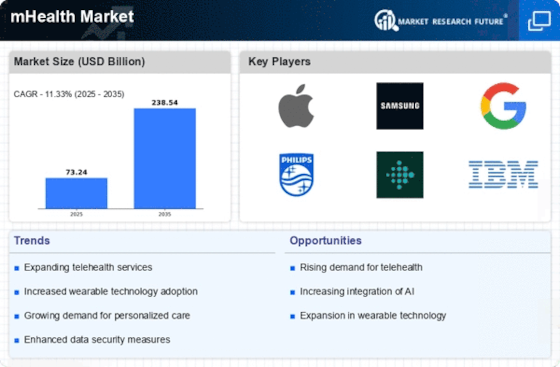
As per Market Research Future analysis, the mHealth Market was estimated at 73.24 USD Billion in 2024. The mHealth (Mobile Health) industry is projected to grow from 81.54 USD Billion in 2025 to 238.54 USD Billion by 2035, exhibiting a compound annual growth rate (CAGR) of 11.3% during the forecast period 2025 - 2035

Key Market Trends & Highlights

The mHealth (Mobile Health) Market is experiencing robust growth driven by technological advancements and changing consumer preferences.

  • The rise of wearable devices continues to dominate the mHealth landscape, particularly in North America. Integration of AI in health applications is gaining traction, enhancing user engagement and personalized care. There is an increasing focus on mental health solutions, reflecting a broader societal awareness of mental well-being. Market drivers such as increased smartphone penetration and rising demand for telehealth services are propelling growth, especially in the Asia-Pacific region.

Market Size & Forecast

2024 Market Size 73.24 (USD Billion)
2035 Market Size 238.54 (USD Billion)
CAGR (2025 - 2035) 11.33%
Largest Regional Market Share in 2024 North America

Major Players

Apple (US), Samsung (KR), Google (US), <a href="https://www.philips.ae/healthcare/articles/patient-monitoring-and-mobile-healthcare">Philips</a> (NL), Fitbit (US), IBM (US), Cerner (US), Medtronic (US), Omron (JP)

Market Trends

The mHealth Market is currently experiencing a transformative phase, driven by advancements in technology and an increasing demand for accessible healthcare solutions. Mobile health applications and devices are becoming integral to patient care, enabling individuals to monitor their health, manage chronic conditions, and communicate with healthcare providers seamlessly. This shift towards digital health solutions appears to be reshaping the landscape of healthcare delivery, as more consumers embrace the convenience and efficiency offered by mobile platforms. Furthermore, the integration of artificial intelligence and data analytics into mHealth applications suggests a potential for enhanced personalized care, allowing for tailored health interventions based on individual needs. In addition to technological advancements, regulatory support and growing awareness of health issues are likely to propel the mHealth Market forward. Governments and health organizations are increasingly recognizing the value of mobile health solutions in promoting public health and improving health outcomes. This recognition may lead to more favorable policies and funding opportunities, further stimulating innovation within the sector. As the mHealth Market continues to evolve, it is essential to monitor these trends closely, as they may significantly influence the future of healthcare delivery and patient engagement.

Rise of Wearable Devices

The proliferation of wearable health devices is reshaping the mHealth Market. These gadgets, which monitor various health metrics, empower users to take charge of their well-being. As technology advances, the accuracy and functionality of these devices are likely to improve, enhancing user experience and engagement.

Integration of AI in Health Apps

The incorporation of artificial intelligence into mobile health applications is becoming increasingly prevalent. AI-driven features can analyze user data to provide personalized health recommendations, potentially improving patient outcomes. This trend indicates a shift towards more tailored healthcare solutions.

Focus on Mental Health Solutions

There is a growing emphasis on mental health within the mHealth Market. Mobile applications designed to support mental well-being are gaining traction, reflecting a broader societal recognition of mental health's importance. This trend suggests a potential expansion of services aimed at addressing psychological health.

Mobile Health Market Market Drivers

Increased Smartphone Penetration

The proliferation of smartphones has catalyzed the mHealth Market, enabling users to access health-related applications and services with unprecedented ease. As of 2025, it is estimated that over 80% of the population in developed regions owns a smartphone, which serves as a primary device for health management. This accessibility allows individuals to monitor their health metrics, schedule appointments, and receive telehealth services directly from their devices. The convenience of having health resources at one's fingertips appears to drive the adoption of mHealth solutions, as users increasingly seek to manage their health proactively. Furthermore, the integration of mobile technology into everyday life suggests that the mHealth Market will continue to expand, as more individuals recognize the benefits of utilizing mobile applications for health management.

Integration of Health Data Analytics

The mHealth Market is witnessing a transformative shift with the integration of health data analytics into mobile health applications. This integration allows for the collection and analysis of vast amounts of health data, enabling personalized health insights and recommendations. As healthcare providers and patients alike recognize the value of data-driven decision-making, the demand for analytics-enabled mHealth solutions is expected to rise. Recent studies indicate that health data analytics can improve patient outcomes by facilitating timely interventions and enhancing treatment plans. This trend suggests that the mHealth Market will continue to evolve, as stakeholders seek to leverage data to optimize health management and improve overall healthcare delivery.

Rising Demand for Telehealth Services

The mHealth Market is experiencing a notable surge in demand for telehealth services, driven by the need for accessible healthcare solutions. As healthcare systems evolve, patients are increasingly seeking remote consultations and follow-up care, which telehealth provides. Recent data indicates that telehealth usage has increased by over 30% in various regions, reflecting a shift in patient preferences towards virtual healthcare. This trend is likely to persist, as patients appreciate the convenience and efficiency of receiving care from home. Moreover, the mHealth Market is poised to benefit from this shift, as healthcare providers invest in telehealth technologies to meet patient needs. The ongoing development of secure and user-friendly platforms may further enhance the appeal of telehealth, potentially leading to a more integrated approach to healthcare delivery.

Growing Focus on Preventive Healthcare

The mHealth Market is increasingly aligned with the global shift towards preventive healthcare, as individuals become more health-conscious and proactive about their well-being. This trend is evidenced by the rising popularity of health tracking applications that monitor vital signs, physical activity, and dietary habits. Data suggests that the preventive healthcare market is projected to grow significantly, with mHealth solutions playing a crucial role in this transformation. By empowering users to take charge of their health, these applications foster a culture of prevention rather than reaction. Consequently, the mHealth Market is likely to see a surge in demand for innovative solutions that facilitate early detection and management of health issues, thereby reducing the burden on healthcare systems.

Expansion of Health Insurance Coverage for mHealth

The mHealth Market is likely to benefit from the expansion of health insurance coverage for mobile health services. As insurers increasingly recognize the value of mHealth solutions in improving patient engagement and reducing costs, more policies are being developed to include telehealth and mobile health applications. This shift is expected to enhance the accessibility of mHealth services, making them more affordable for a broader population. Data indicates that insurance coverage for telehealth services has increased by over 25% in recent years, reflecting a growing acceptance of mHealth solutions within the healthcare ecosystem. Consequently, the mHealth Market may experience accelerated growth as more individuals gain access to these innovative health management tools.


Market Segment Insights

By Application: Chronic Disease Management (Largest) vs. Telehealth Services (Fastest-Growing)

The mHealth market exhibits a diverse distribution of application segments, with Chronic Disease Management holding the largest share due to the increasing prevalence of chronic illnesses globally. This segment has experienced significant adoption as patients leverage mobile health applications to monitor their conditions effectively. Health and Fitness Tracking follows closely, appealing to health-conscious consumers who seek personalization in their fitness journeys. In contrast, Telehealth Services are burgeoning, fostering access to healthcare remotely and accommodating a growing patient base looking for convenient healthcare solutions. The growth trends in the mHealth market are driven by technological advancements, and the unprecedented shift towards remote care solutions post-pandemic has significantly bolstered Telehealth Services. Chronic Disease Management continues to flourish, encouraged by a rising aging population and enhanced patient engagement through digital tools. Furthermore, the increasing capabilities of wearable technologies contribute to Health and Fitness Tracking, promoting preventative health measures and tailored wellness programs. Overall, the mHealth market is on an upward trend, with segments showing diverse dynamics in consumer preferences.

Chronic Disease Management (Dominant) vs. Telehealth Services (Emerging)

Chronic Disease Management serves as a dominant application in the mHealth market as it addresses critical health issues that affect a significant portion of the population. It utilizes mobile applications and devices to monitor various conditions such as diabetes, hypertension, and heart disease, helping users manage their health effectively. This area benefits from established user bases and robust partnerships with healthcare providers, thus ensuring trust and reliability. In contrast, Telehealth Services represent an emerging segment that has gained momentum especially during the COVID-19 pandemic. This application allows patients to access healthcare providers remotely, fostering continuity of care while overcoming geographical barriers. With innovations in real-time communication and video conferencing technology, Telehealth Services are set for rapid growth, appealing to younger demographics who prioritize convenience and accessibility in their healthcare experiences.

By Technology: Wearable Devices (Largest) vs. Apps (Fastest-Growing)

The mHealth market is witnessing a dynamic shift in technology utilization, with wearable devices dominating the segment landscape. This sector accounts for a substantial share, attributed to the increasing consumer emphasis on fitness and health monitoring. Conversely, mobile apps are rapidly gaining traction, appealing to a broader audience due to their accessibility and ease of use, positioning them as one of the fastest-growing segments in the market.

Technology: Wearable Devices (Dominant) vs. Apps (Emerging)

Wearable devices have established themselves as a dominant force in the mHealth market, offering innovative solutions that integrate with everyday health management. These devices range from fitness trackers to advanced biometric monitors significantly enhancing users' engagement with their health. On the other hand, apps represent an emerging trend, driven by advancements in technology and an increasing demand for mobile health solutions. While wearables provide comprehensive data collection, apps ensure wider accessibility, making health management easier for individuals seeking to monitor their wellness. This dichotomy shapes the current landscape, with wearables offering robustness and apps enhancing user experiences.

By End-use: Healthcare Providers (Largest) vs. Patients (Fastest-Growing)

In the mHealth market, the end-use segment exhibits diverse dynamics, with Healthcare Providers holding the largest share. This segment benefits from an increasing emphasis on digital health solutions, facilitating better patient management and operational efficiency. On the other hand, the Patients segment is witnessing significant growth, fueled by a rising adoption of mobile health applications that empower individuals to take charge of their health and wellness, thereby enhancing patient engagement and satisfaction. Growth trends within the mHealth end-use segment are driven by technological advancements and regulatory support that encourages healthcare innovation. As hospitals and clinics increasingly integrate mobile health solutions, the demand from Healthcare Providers is expected to remain robust. Concurrently, Patients are embracing mHealth tools for their convenience and accessibility, making it a rapidly expanding area, particularly in preventive care and <a href="https://www.marketresearchfuture.com/reports/chronic-disease-management-market-981">chronic disease management</a>.

Healthcare Providers (Dominant) vs. Patients (Emerging)

Healthcare Providers are the dominant force within the mHealth market due to their pivotal role in patient care and operational processes. They utilize mobile health solutions to streamline workflows, improve patient outcomes, and ensure compliance with regulatory standards. This segment includes hospitals, clinics, and telehealth services, all leveraging technology to offer comprehensive care. Conversely, the Patients segment is emerging as a vital player, characterized by a growing cohort of health-conscious individuals utilizing mobile applications for self-monitoring, medication adherence, and health education. This shift towards personalized healthcare experiences is reshaping market dynamics, as patients seek tools that enhance their agency in health management and foster a proactive approach to wellness.

By Component: Software (Largest) vs. Hardware (Fastest-Growing)

In the mHealth market, the component segment is primarily dominated by software solutions, which have secured the largest share. These software solutions include mobile applications, web platforms, and cloud-based systems that facilitate remote monitoring, health tracking, and patient engagement. Meanwhile, hardware solutions, including wearable devices, diagnostic instruments, and connected sensors, are swiftly gaining traction, characterized by increasing consumer demands and advancements in technology. The growth trajectory in the mHealth component segment is driven by rising healthcare costs, a growing preference for remote patient monitoring, and an emphasis on preventive healthcare. The integration of AI and machine learning in software applications is enhancing their functionality, leading to higher adoption rates. Simultaneously, the hardware segment is witnessing rapid growth due to advancements in wearable technology and an expanding demographic that prioritizes health and wellness tracking in their daily lives.

Software: Application Solutions (Dominant) vs. Hardware: Wearable Devices (Emerging)

Software solutions, particularly application-based platforms, dominate the mHealth market by offering comprehensive functionalities that improve patient engagement, enable <a href="https://www.marketresearchfuture.com/reports/telemedicine-market-2216">telemedicine</a>, and enhance clinical workflows. These solutions often provide personalized health insights and integrate seamlessly with various health devices, creating a holistic healthcare experience. In contrast, hardware solutions, specifically wearable devices, are emerging as a significant growth area, catering to a tech-savvy demographic that emphasizes health monitoring. These devices not only track physical activities and vital signs but are also becoming increasingly sophisticated, featuring built-in sensors for real-time data collection and connectivity with other health management systems. Together, these components are reshaping how healthcare is delivered and managed.

Get more detailed insights about mHealth (Mobile Health) Market Research Report - Forecast To 2035

Regional Insights

The MHealth Market was characterized by distinct regional segments, reflecting varying levels of adoption and investment across different areas. In 2024, North America led the market with a substantial valuation of 20.0 USD Billion, expected to grow to 60.0 USD Billion by 2035, showcasing its majority holding due to advanced technological infrastructure and strong regulatory support.

Europe followed closely, valued at 15.0 USD Billion in 2024 and projected to reach 45.0 USD Billion in 2035, driven by rising health initiatives and government support for digital health solutions. South America, while smaller at 5.0 USD Billion in 2024, is anticipated to grow to 15.0 USD Billion in 2035, indicating increasing mobile penetration and health engagement among the population.

The Asia Pacific region, valued at 8.0 USD Billion in 2024, is expected to attain 25.0 USD Billion by 2035, representing significant growth potential due to a large population base and increasing smartphone adoption.Lastly, the Middle East and Africa represented the smallest segment with a value of 2.75 USD Billion in 2024, rising to 5.0 USD Billion by 2035.

This region’s growth was contingent on overcoming infrastructure challenges but offered long-term opportunities for mHealth implementation. Each region reflected unique elements shaping the MHealth Market revenue and segmentation, pointing to diverse opportunities and challenges.

Key Players and Competitive Insights

The MHealth Market has witnessed significant growth and increasing competition in recent years, driven by the rising prevalence of chronic diseases, advances in mobile technology, and a growing emphasis on health management and patient engagement.With the escalation of smartphone usage and enhancement of healthcare technologies, numerous players are entering the market to capitalize on this dynamic landscape. The competitive environment is characterized by both established technology companies and emerging startups developing innovative solutions and applications tailored to improve health outcomes.
As healthcare systems worldwide shift toward digital transformation, the ability to effectively leverage mobile health solutions is becoming a critical differentiator, encouraging companies to enhance their offerings and improve user experience.Cerner has robustly positioned itself within the MHealth Market by providing comprehensive health information technology solutions that enhance the efficiency and quality of care. The company is known for its strong suite of electronic health record systems, interoperability solutions, and patient engagement tools.

Cerner has successfully established partnerships with various healthcare organizations to promote the integration of its technologies within clinical workflows, enabling providers to utilize valuable data to inform decision-making and care management.The emphasis on data analytics and population health management solutions further strengthens Cerner's value proposition, allowing it to offer actionable insights that improve patient outcomes and streamline healthcare operations on a global scale.
Samsung has made considerable strides in the MHealth Market by leveraging its core competencies in consumer electronics and smart technology. The company has launched a variety of health-focused products and services, including mobile applications, wearables, and health monitoring devices that aim to promote wellness and fitness.Samsung's key product offerings, such as smartwatches with health tracking capabilities and mobile applications that facilitate personal health management, reflect its commitment to integrating technology in enhancing healthcare outcomes.
The company's strong market presence is amplified by strategic partnerships and collaborations aimed at expanding its ecosystem of health services. Additionally, Samsung's ability to innovate through mergers and acquisitions provides it with a competitive advantage, driving the development of cutting-edge solutions that enhance its position in the global market for mobile health.

Key Companies in the Mobile Health Market include

Industry Developments

Samsung Electronics announced on January 13, 2025, that its Galaxy Ring wearable would be expanding into 15 more countries, becoming available in sizes 14 and 15, and receiving improved sleep-tracking features like Sleep-environment Reports, Sleep-time Guidance, and a Mindfulness Tracker through the Samsung Health app.

Its dedication to innovation in sleep health and enhanced usability was reaffirmed with this release. In order to enable developers and researchers to access BioActive sensor data (heart rate, skin temperature, ECG, BIA, and continuous PPG IR/Red LED inputs) from Galaxy Watch devices, Samsung also unveiled a new Samsung Health SDK Suite on September 26, 2024.

This suite includes Sensor SDK, Data SDK, and Research Stack. Samsung released the One UI 6 Watch update to Galaxy Watch devices globally on November 19, 2024. This update included new watch faces, AI-suggested responses, improved sleep insights, Race and Workout Routine features, and pinch gestures and AI-powered Energy Score to boost health tracking.

Samsung unveiled Health AI advancements at the Galaxy Tech Forum on January 23, 2025, including the Energy Score system and non-invasive blood glucose monitoring innovations targeted at early illness identification and individualized nutrition coaching.Additionally, Samsung unveiled AI-driven sleep environment insights at MWC on March 3, 2025. These insights include room brightness, temperature, and humidity, and they are incorporated into the Galaxy S25 and Samsung Health ecosystem to improve individualized sleep recommendations.

Future Outlook

Mobile Health Market Future Outlook

The mHealth Market is projected to grow at an 11.33% CAGR from 2025 to 2035, driven by technological advancements, increasing smartphone penetration, and rising health awareness.

New opportunities lie in:

  • Development of AI-driven personalized health coaching apps.
  • Expansion of remote patient monitoring solutions for chronic diseases.
  • Integration of mHealth platforms with wearable health technology.

By 2035, the mHealth Market is expected to be a pivotal component of global healthcare delivery.

Market Segmentation

Mobile Health Market End-use Outlook

  • Healthcare Providers
  • Patients
  • Insurance Companies
  • Pharmaceutical Companies

Mobile Health Market Component Outlook

  • Hardware
  • Software
  • Services

Mobile Health Market Technology Outlook

  • Wearable Devices
  • Apps
  • Remote Patient Monitoring
  • Telemedicine Platforms

Mobile Health Market Application Outlook

  • Chronic Disease Management
  • Health and Fitness Tracking
  • Telehealth Services
  • Medication Management

Report Scope

MARKET SIZE 2024 73.24(USD Billion)
MARKET SIZE 2025 81.54(USD Billion)
MARKET SIZE 2035 238.54(USD Billion)
COMPOUND ANNUAL GROWTH RATE (CAGR) 11.33% (2025 - 2035)
REPORT COVERAGE Revenue Forecast, Competitive Landscape, Growth Factors, and Trends
BASE YEAR 2024
Market Forecast Period 2025 - 2035
Historical Data 2019 - 2024
Market Forecast Units USD Billion
Key Companies Profiled Apple (US), Samsung (KR), Google (US), Philips (NL), Fitbit (US), IBM (US), Cerner (US), Medtronic (US), Omron (JP)
Segments Covered Applications, Technology, End-use, Component, Regional
Key Market Opportunities Integration of artificial intelligence in mobile health applications enhances personalized patient care and engagement.
Key Market Dynamics Rising consumer demand for personalized health solutions drives innovation and competition in the mHealth market.
Countries Covered North America, Europe, APAC, South America, MEA

FAQs

What is the current valuation of the mHealth Market as of 2024?

<p>The mHealth Market was valued at 73.24 USD Billion in 2024.</p>

What is the projected market size for the mHealth Market in 2035?

<p>The mHealth Market is projected to reach 238.54 USD Billion by 2035.</p>

What is the expected CAGR for the mHealth Market during the forecast period 2025 - 2035?

<p>The expected CAGR for the mHealth Market during the forecast period 2025 - 2035 is 11.33%.</p>

Which companies are considered key players in the mHealth Market?

<p>Key players in the mHealth Market include Apple, Samsung, Google, Philips, Fitbit, IBM, Cerner, Medtronic, and Omron.</p>

What are the main application segments within the mHealth Market?

<p>The main application segments include Chronic Disease Management, Health and Fitness Tracking, Telehealth Services, and Medication Management.</p>

How much is the Chronic Disease Management segment valued at in 2025?

<p>The Chronic Disease Management segment is valued at 50.0 USD Billion in 2025.</p>

What is the valuation of the Telehealth Services segment in 2025?

<p>The Telehealth Services segment is valued at 80.0 USD Billion in 2025.</p>

What technologies are driving the mHealth Market?

<p>Driving technologies in the mHealth Market include Wearable Devices, Apps, Remote Patient Monitoring, and Telemedicine Platforms.</p>

What is the projected valuation for the Software component in 2035?

<p>The Software component is projected to be valued at 85.0 USD Billion in 2035.</p>

Who are the primary end-users of mHealth technologies?

<p>Primary end-users of mHealth technologies include Healthcare Providers, Patients, Insurance Companies, and Pharmaceutical Companies.</p>

  1. SECTION I: EXECUTIVE SUMMARY AND KEY HIGHLIGHTS
    1. | 1.1 EXECUTIVE SUMMARY
    2. | | 1.1.1 Market Overview
    3. | | 1.1.2 Key Findings
    4. | | 1.1.3 Market Segmentation
    5. | | 1.1.4 Competitive Landscape
    6. | | 1.1.5 Challenges and Opportunities
    7. | | 1.1.6 Future Outlook
  2. SECTION II: SCOPING, METHODOLOGY AND MARKET STRUCTURE
    1. | 2.1 MARKET INTRODUCTION
    2. | | 2.1.1 Definition
    3. | | 2.1.2 Scope of the study
    4. | | | 2.1.2.1 Research Objective
    5. | | | 2.1.2.2 Assumption
    6. | | | 2.1.2.3 Limitations
    7. | 2.2 RESEARCH METHODOLOGY
    8. | | 2.2.1 Overview
    9. | | 2.2.2 Data Mining
    10. | | 2.2.3 Secondary Research
    11. | | 2.2.4 Primary Research
    12. | | | 2.2.4.1 Primary Interviews and Information Gathering Process
    13. | | | 2.2.4.2 Breakdown of Primary Respondents
    14. | | 2.2.5 Forecasting Model
    15. | | 2.2.6 Market Size Estimation
    16. | | | 2.2.6.1 Bottom-Up Approach
    17. | | | 2.2.6.2 Top-Down Approach
    18. | | 2.2.7 Data Triangulation
    19. | | 2.2.8 Validation
  3. SECTION III: QUALITATIVE ANALYSIS
    1. | 3.1 MARKET DYNAMICS
    2. | | 3.1.1 Overview
    3. | | 3.1.2 Drivers
    4. | | 3.1.3 Restraints
    5. | | 3.1.4 Opportunities
    6. | 3.2 MARKET FACTOR ANALYSIS
    7. | | 3.2.1 Value chain Analysis
    8. | | 3.2.2 Porter's Five Forces Analysis
    9. | | | 3.2.2.1 Bargaining Power of Suppliers
    10. | | | 3.2.2.2 Bargaining Power of Buyers
    11. | | | 3.2.2.3 Threat of New Entrants
    12. | | | 3.2.2.4 Threat of Substitutes
    13. | | | 3.2.2.5 Intensity of Rivalry
    14. | | 3.2.3 COVID-19 Impact Analysis
    15. | | | 3.2.3.1 Market Impact Analysis
    16. | | | 3.2.3.2 Regional Impact
    17. | | | 3.2.3.3 Opportunity and Threat Analysis
  4. SECTION IV: QUANTITATIVE ANALYSIS
    1. | 4.1 Healthcare, BY Application (USD Billion)
    2. | | 4.1.1 Chronic Disease Management
    3. | | 4.1.2 Health and Fitness Tracking
    4. | | 4.1.3 Telehealth Services
    5. | | 4.1.4 Medication Management
    6. | 4.2 Healthcare, BY Technology (USD Billion)
    7. | | 4.2.1 Wearable Devices
    8. | | 4.2.2 Apps
    9. | | 4.2.3 Remote Patient Monitoring
    10. | | 4.2.4 Telemedicine Platforms
    11. | 4.3 Healthcare, BY End-use (USD Billion)
    12. | | 4.3.1 Healthcare Providers
    13. | | 4.3.2 Patients
    14. | | 4.3.3 Insurance Companies
    15. | | 4.3.4 Pharmaceutical Companies
    16. | 4.4 Healthcare, BY Component (USD Billion)
    17. | | 4.4.1 Hardware
    18. | | 4.4.2 Software
    19. | | 4.4.3 Services
    20. | 4.5 Healthcare, BY Region (USD Billion)
    21. | | 4.5.1 North America
    22. | | | 4.5.1.1 US
    23. | | | 4.5.1.2 Canada
    24. | | 4.5.2 Europe
    25. | | | 4.5.2.1 Germany
    26. | | | 4.5.2.2 UK
    27. | | | 4.5.2.3 France
    28. | | | 4.5.2.4 Russia
    29. | | | 4.5.2.5 Italy
    30. | | | 4.5.2.6 Spain
    31. | | | 4.5.2.7 Rest of Europe
    32. | | 4.5.3 APAC
    33. | | | 4.5.3.1 China
    34. | | | 4.5.3.2 India
    35. | | | 4.5.3.3 Japan
    36. | | | 4.5.3.4 South Korea
    37. | | | 4.5.3.5 Malaysia
    38. | | | 4.5.3.6 Thailand
    39. | | | 4.5.3.7 Indonesia
    40. | | | 4.5.3.8 Rest of APAC
    41. | | 4.5.4 South America
    42. | | | 4.5.4.1 Brazil
    43. | | | 4.5.4.2 Mexico
    44. | | | 4.5.4.3 Argentina
    45. | | | 4.5.4.4 Rest of South America
    46. | | 4.5.5 MEA
    47. | | | 4.5.5.1 GCC Countries
    48. | | | 4.5.5.2 South Africa
    49. | | | 4.5.5.3 Rest of MEA
  5. SECTION V: COMPETITIVE ANALYSIS
    1. | 5.1 Competitive Landscape
    2. | | 5.1.1 Overview
    3. | | 5.1.2 Competitive Analysis
    4. | | 5.1.3 Market share Analysis
    5. | | 5.1.4 Major Growth Strategy in the Healthcare
    6. | | 5.1.5 Competitive Benchmarking
    7. | | 5.1.6 Leading Players in Terms of Number of Developments in the Healthcare
    8. | | 5.1.7 Key developments and growth strategies
    9. | | | 5.1.7.1 New Product Launch/Service Deployment
    10. | | | 5.1.7.2 Merger & Acquisitions
    11. | | | 5.1.7.3 Joint Ventures
    12. | | 5.1.8 Major Players Financial Matrix
    13. | | | 5.1.8.1 Sales and Operating Income
    14. | | | 5.1.8.2 Major Players R&D Expenditure. 2023
    15. | 5.2 Company Profiles
    16. | | 5.2.1 Apple (US)
    17. | | | 5.2.1.1 Financial Overview
    18. | | | 5.2.1.2 Products Offered
    19. | | | 5.2.1.3 Key Developments
    20. | | | 5.2.1.4 SWOT Analysis
    21. | | | 5.2.1.5 Key Strategies
    22. | | 5.2.2 Samsung (KR)
    23. | | | 5.2.2.1 Financial Overview
    24. | | | 5.2.2.2 Products Offered
    25. | | | 5.2.2.3 Key Developments
    26. | | | 5.2.2.4 SWOT Analysis
    27. | | | 5.2.2.5 Key Strategies
    28. | | 5.2.3 Google (US)
    29. | | | 5.2.3.1 Financial Overview
    30. | | | 5.2.3.2 Products Offered
    31. | | | 5.2.3.3 Key Developments
    32. | | | 5.2.3.4 SWOT Analysis
    33. | | | 5.2.3.5 Key Strategies
    34. | | 5.2.4 Philips (NL)
    35. | | | 5.2.4.1 Financial Overview
    36. | | | 5.2.4.2 Products Offered
    37. | | | 5.2.4.3 Key Developments
    38. | | | 5.2.4.4 SWOT Analysis
    39. | | | 5.2.4.5 Key Strategies
    40. | | 5.2.5 Fitbit (US)
    41. | | | 5.2.5.1 Financial Overview
    42. | | | 5.2.5.2 Products Offered
    43. | | | 5.2.5.3 Key Developments
    44. | | | 5.2.5.4 SWOT Analysis
    45. | | | 5.2.5.5 Key Strategies
    46. | | 5.2.6 IBM (US)
    47. | | | 5.2.6.1 Financial Overview
    48. | | | 5.2.6.2 Products Offered
    49. | | | 5.2.6.3 Key Developments
    50. | | | 5.2.6.4 SWOT Analysis
    51. | | | 5.2.6.5 Key Strategies
    52. | | 5.2.7 Cerner (US)
    53. | | | 5.2.7.1 Financial Overview
    54. | | | 5.2.7.2 Products Offered
    55. | | | 5.2.7.3 Key Developments
    56. | | | 5.2.7.4 SWOT Analysis
    57. | | | 5.2.7.5 Key Strategies
    58. | | 5.2.8 Medtronic (US)
    59. | | | 5.2.8.1 Financial Overview
    60. | | | 5.2.8.2 Products Offered
    61. | | | 5.2.8.3 Key Developments
    62. | | | 5.2.8.4 SWOT Analysis
    63. | | | 5.2.8.5 Key Strategies
    64. | | 5.2.9 Omron (JP)
    65. | | | 5.2.9.1 Financial Overview
    66. | | | 5.2.9.2 Products Offered
    67. | | | 5.2.9.3 Key Developments
    68. | | | 5.2.9.4 SWOT Analysis
    69. | | | 5.2.9.5 Key Strategies
    70. | 5.3 Appendix
    71. | | 5.3.1 References
    72. | | 5.3.2 Related Reports
  6. LIST OF FIGURES
    1. | 6.1 MARKET SYNOPSIS
    2. | 6.2 NORTH AMERICA MARKET ANALYSIS
    3. | 6.3 US MARKET ANALYSIS BY APPLICATION
    4. | 6.4 US MARKET ANALYSIS BY TECHNOLOGY
    5. | 6.5 US MARKET ANALYSIS BY END-USE
    6. | 6.6 US MARKET ANALYSIS BY COMPONENT
    7. | 6.7 CANADA MARKET ANALYSIS BY APPLICATION
    8. | 6.8 CANADA MARKET ANALYSIS BY TECHNOLOGY
    9. | 6.9 CANADA MARKET ANALYSIS BY END-USE
    10. | 6.10 CANADA MARKET ANALYSIS BY COMPONENT
    11. | 6.11 EUROPE MARKET ANALYSIS
    12. | 6.12 GERMANY MARKET ANALYSIS BY APPLICATION
    13. | 6.13 GERMANY MARKET ANALYSIS BY TECHNOLOGY
    14. | 6.14 GERMANY MARKET ANALYSIS BY END-USE
    15. | 6.15 GERMANY MARKET ANALYSIS BY COMPONENT
    16. | 6.16 UK MARKET ANALYSIS BY APPLICATION
    17. | 6.17 UK MARKET ANALYSIS BY TECHNOLOGY
    18. | 6.18 UK MARKET ANALYSIS BY END-USE
    19. | 6.19 UK MARKET ANALYSIS BY COMPONENT
    20. | 6.20 FRANCE MARKET ANALYSIS BY APPLICATION
    21. | 6.21 FRANCE MARKET ANALYSIS BY TECHNOLOGY
    22. | 6.22 FRANCE MARKET ANALYSIS BY END-USE
    23. | 6.23 FRANCE MARKET ANALYSIS BY COMPONENT
    24. | 6.24 RUSSIA MARKET ANALYSIS BY APPLICATION
    25. | 6.25 RUSSIA MARKET ANALYSIS BY TECHNOLOGY
    26. | 6.26 RUSSIA MARKET ANALYSIS BY END-USE
    27. | 6.27 RUSSIA MARKET ANALYSIS BY COMPONENT
    28. | 6.28 ITALY MARKET ANALYSIS BY APPLICATION
    29. | 6.29 ITALY MARKET ANALYSIS BY TECHNOLOGY
    30. | 6.30 ITALY MARKET ANALYSIS BY END-USE
    31. | 6.31 ITALY MARKET ANALYSIS BY COMPONENT
    32. | 6.32 SPAIN MARKET ANALYSIS BY APPLICATION
    33. | 6.33 SPAIN MARKET ANALYSIS BY TECHNOLOGY
    34. | 6.34 SPAIN MARKET ANALYSIS BY END-USE
    35. | 6.35 SPAIN MARKET ANALYSIS BY COMPONENT
    36. | 6.36 REST OF EUROPE MARKET ANALYSIS BY APPLICATION
    37. | 6.37 REST OF EUROPE MARKET ANALYSIS BY TECHNOLOGY
    38. | 6.38 REST OF EUROPE MARKET ANALYSIS BY END-USE
    39. | 6.39 REST OF EUROPE MARKET ANALYSIS BY COMPONENT
    40. | 6.40 APAC MARKET ANALYSIS
    41. | 6.41 CHINA MARKET ANALYSIS BY APPLICATION
    42. | 6.42 CHINA MARKET ANALYSIS BY TECHNOLOGY
    43. | 6.43 CHINA MARKET ANALYSIS BY END-USE
    44. | 6.44 CHINA MARKET ANALYSIS BY COMPONENT
    45. | 6.45 INDIA MARKET ANALYSIS BY APPLICATION
    46. | 6.46 INDIA MARKET ANALYSIS BY TECHNOLOGY
    47. | 6.47 INDIA MARKET ANALYSIS BY END-USE
    48. | 6.48 INDIA MARKET ANALYSIS BY COMPONENT
    49. | 6.49 JAPAN MARKET ANALYSIS BY APPLICATION
    50. | 6.50 JAPAN MARKET ANALYSIS BY TECHNOLOGY
    51. | 6.51 JAPAN MARKET ANALYSIS BY END-USE
    52. | 6.52 JAPAN MARKET ANALYSIS BY COMPONENT
    53. | 6.53 SOUTH KOREA MARKET ANALYSIS BY APPLICATION
    54. | 6.54 SOUTH KOREA MARKET ANALYSIS BY TECHNOLOGY
    55. | 6.55 SOUTH KOREA MARKET ANALYSIS BY END-USE
    56. | 6.56 SOUTH KOREA MARKET ANALYSIS BY COMPONENT
    57. | 6.57 MALAYSIA MARKET ANALYSIS BY APPLICATION
    58. | 6.58 MALAYSIA MARKET ANALYSIS BY TECHNOLOGY
    59. | 6.59 MALAYSIA MARKET ANALYSIS BY END-USE
    60. | 6.60 MALAYSIA MARKET ANALYSIS BY COMPONENT
    61. | 6.61 THAILAND MARKET ANALYSIS BY APPLICATION
    62. | 6.62 THAILAND MARKET ANALYSIS BY TECHNOLOGY
    63. | 6.63 THAILAND MARKET ANALYSIS BY END-USE
    64. | 6.64 THAILAND MARKET ANALYSIS BY COMPONENT
    65. | 6.65 INDONESIA MARKET ANALYSIS BY APPLICATION
    66. | 6.66 INDONESIA MARKET ANALYSIS BY TECHNOLOGY
    67. | 6.67 INDONESIA MARKET ANALYSIS BY END-USE
    68. | 6.68 INDONESIA MARKET ANALYSIS BY COMPONENT
    69. | 6.69 REST OF APAC MARKET ANALYSIS BY APPLICATION
    70. | 6.70 REST OF APAC MARKET ANALYSIS BY TECHNOLOGY
    71. | 6.71 REST OF APAC MARKET ANALYSIS BY END-USE
    72. | 6.72 REST OF APAC MARKET ANALYSIS BY COMPONENT
    73. | 6.73 SOUTH AMERICA MARKET ANALYSIS
    74. | 6.74 BRAZIL MARKET ANALYSIS BY APPLICATION
    75. | 6.75 BRAZIL MARKET ANALYSIS BY TECHNOLOGY
    76. | 6.76 BRAZIL MARKET ANALYSIS BY END-USE
    77. | 6.77 BRAZIL MARKET ANALYSIS BY COMPONENT
    78. | 6.78 MEXICO MARKET ANALYSIS BY APPLICATION
    79. | 6.79 MEXICO MARKET ANALYSIS BY TECHNOLOGY
    80. | 6.80 MEXICO MARKET ANALYSIS BY END-USE
    81. | 6.81 MEXICO MARKET ANALYSIS BY COMPONENT
    82. | 6.82 ARGENTINA MARKET ANALYSIS BY APPLICATION
    83. | 6.83 ARGENTINA MARKET ANALYSIS BY TECHNOLOGY
    84. | 6.84 ARGENTINA MARKET ANALYSIS BY END-USE
    85. | 6.85 ARGENTINA MARKET ANALYSIS BY COMPONENT
    86. | 6.86 REST OF SOUTH AMERICA MARKET ANALYSIS BY APPLICATION
    87. | 6.87 REST OF SOUTH AMERICA MARKET ANALYSIS BY TECHNOLOGY
    88. | 6.88 REST OF SOUTH AMERICA MARKET ANALYSIS BY END-USE
    89. | 6.89 REST OF SOUTH AMERICA MARKET ANALYSIS BY COMPONENT
    90. | 6.90 MEA MARKET ANALYSIS
    91. | 6.91 GCC COUNTRIES MARKET ANALYSIS BY APPLICATION
    92. | 6.92 GCC COUNTRIES MARKET ANALYSIS BY TECHNOLOGY
    93. | 6.93 GCC COUNTRIES MARKET ANALYSIS BY END-USE
    94. | 6.94 GCC COUNTRIES MARKET ANALYSIS BY COMPONENT
    95. | 6.95 SOUTH AFRICA MARKET ANALYSIS BY APPLICATION
    96. | 6.96 SOUTH AFRICA MARKET ANALYSIS BY TECHNOLOGY
    97. | 6.97 SOUTH AFRICA MARKET ANALYSIS BY END-USE
    98. | 6.98 SOUTH AFRICA MARKET ANALYSIS BY COMPONENT
    99. | 6.99 REST OF MEA MARKET ANALYSIS BY APPLICATION
    100. | 6.100 REST OF MEA MARKET ANALYSIS BY TECHNOLOGY
    101. | 6.101 REST OF MEA MARKET ANALYSIS BY END-USE
    102. | 6.102 REST OF MEA MARKET ANALYSIS BY COMPONENT
    103. | 6.103 KEY BUYING CRITERIA OF HEALTHCARE
    104. | 6.104 RESEARCH PROCESS OF MRFR
    105. | 6.105 DRO ANALYSIS OF HEALTHCARE
    106. | 6.106 DRIVERS IMPACT ANALYSIS: HEALTHCARE
    107. | 6.107 RESTRAINTS IMPACT ANALYSIS: HEALTHCARE
    108. | 6.108 SUPPLY / VALUE CHAIN: HEALTHCARE
    109. | 6.109 HEALTHCARE, BY APPLICATION, 2024 (% SHARE)
    110. | 6.110 HEALTHCARE, BY APPLICATION, 2024 TO 2035 (USD Billion)
    111. | 6.111 HEALTHCARE, BY TECHNOLOGY, 2024 (% SHARE)
    112. | 6.112 HEALTHCARE, BY TECHNOLOGY, 2024 TO 2035 (USD Billion)
    113. | 6.113 HEALTHCARE, BY END-USE, 2024 (% SHARE)
    114. | 6.114 HEALTHCARE, BY END-USE, 2024 TO 2035 (USD Billion)
    115. | 6.115 HEALTHCARE, BY COMPONENT, 2024 (% SHARE)
    116. | 6.116 HEALTHCARE, BY COMPONENT, 2024 TO 2035 (USD Billion)
    117. | 6.117 BENCHMARKING OF MAJOR COMPETITORS
  7. LIST OF TABLES
    1. | 7.1 LIST OF ASSUMPTIONS
    2. | | 7.1.1
    3. | 7.2 North America MARKET SIZE ESTIMATES; FORECAST
    4. | | 7.2.1 BY APPLICATION, 2025-2035 (USD Billion)
    5. | | 7.2.2 BY TECHNOLOGY, 2025-2035 (USD Billion)
    6. | | 7.2.3 BY END-USE, 2025-2035 (USD Billion)
    7. | | 7.2.4 BY COMPONENT, 2025-2035 (USD Billion)
    8. | 7.3 US MARKET SIZE ESTIMATES; FORECAST
    9. | | 7.3.1 BY APPLICATION, 2025-2035 (USD Billion)
    10. | | 7.3.2 BY TECHNOLOGY, 2025-2035 (USD Billion)
    11. | | 7.3.3 BY END-USE, 2025-2035 (USD Billion)
    12. | | 7.3.4 BY COMPONENT, 2025-2035 (USD Billion)
    13. | 7.4 Canada MARKET SIZE ESTIMATES; FORECAST
    14. | | 7.4.1 BY APPLICATION, 2025-2035 (USD Billion)
    15. | | 7.4.2 BY TECHNOLOGY, 2025-2035 (USD Billion)
    16. | | 7.4.3 BY END-USE, 2025-2035 (USD Billion)
    17. | | 7.4.4 BY COMPONENT, 2025-2035 (USD Billion)
    18. | 7.5 Europe MARKET SIZE ESTIMATES; FORECAST
    19. | | 7.5.1 BY APPLICATION, 2025-2035 (USD Billion)
    20. | | 7.5.2 BY TECHNOLOGY, 2025-2035 (USD Billion)
    21. | | 7.5.3 BY END-USE, 2025-2035 (USD Billion)
    22. | | 7.5.4 BY COMPONENT, 2025-2035 (USD Billion)
    23. | 7.6 Germany MARKET SIZE ESTIMATES; FORECAST
    24. | | 7.6.1 BY APPLICATION, 2025-2035 (USD Billion)
    25. | | 7.6.2 BY TECHNOLOGY, 2025-2035 (USD Billion)
    26. | | 7.6.3 BY END-USE, 2025-2035 (USD Billion)
    27. | | 7.6.4 BY COMPONENT, 2025-2035 (USD Billion)
    28. | 7.7 UK MARKET SIZE ESTIMATES; FORECAST
    29. | | 7.7.1 BY APPLICATION, 2025-2035 (USD Billion)
    30. | | 7.7.2 BY TECHNOLOGY, 2025-2035 (USD Billion)
    31. | | 7.7.3 BY END-USE, 2025-2035 (USD Billion)
    32. | | 7.7.4 BY COMPONENT, 2025-2035 (USD Billion)
    33. | 7.8 France MARKET SIZE ESTIMATES; FORECAST
    34. | | 7.8.1 BY APPLICATION, 2025-2035 (USD Billion)
    35. | | 7.8.2 BY TECHNOLOGY, 2025-2035 (USD Billion)
    36. | | 7.8.3 BY END-USE, 2025-2035 (USD Billion)
    37. | | 7.8.4 BY COMPONENT, 2025-2035 (USD Billion)
    38. | 7.9 Russia MARKET SIZE ESTIMATES; FORECAST
    39. | | 7.9.1 BY APPLICATION, 2025-2035 (USD Billion)
    40. | | 7.9.2 BY TECHNOLOGY, 2025-2035 (USD Billion)
    41. | | 7.9.3 BY END-USE, 2025-2035 (USD Billion)
    42. | | 7.9.4 BY COMPONENT, 2025-2035 (USD Billion)
    43. | 7.10 Italy MARKET SIZE ESTIMATES; FORECAST
    44. | | 7.10.1 BY APPLICATION, 2025-2035 (USD Billion)
    45. | | 7.10.2 BY TECHNOLOGY, 2025-2035 (USD Billion)
    46. | | 7.10.3 BY END-USE, 2025-2035 (USD Billion)
    47. | | 7.10.4 BY COMPONENT, 2025-2035 (USD Billion)
    48. | 7.11 Spain MARKET SIZE ESTIMATES; FORECAST
    49. | | 7.11.1 BY APPLICATION, 2025-2035 (USD Billion)
    50. | | 7.11.2 BY TECHNOLOGY, 2025-2035 (USD Billion)
    51. | | 7.11.3 BY END-USE, 2025-2035 (USD Billion)
    52. | | 7.11.4 BY COMPONENT, 2025-2035 (USD Billion)
    53. | 7.12 Rest of Europe MARKET SIZE ESTIMATES; FORECAST
    54. | | 7.12.1 BY APPLICATION, 2025-2035 (USD Billion)
    55. | | 7.12.2 BY TECHNOLOGY, 2025-2035 (USD Billion)
    56. | | 7.12.3 BY END-USE, 2025-2035 (USD Billion)
    57. | | 7.12.4 BY COMPONENT, 2025-2035 (USD Billion)
    58. | 7.13 APAC MARKET SIZE ESTIMATES; FORECAST
    59. | | 7.13.1 BY APPLICATION, 2025-2035 (USD Billion)
    60. | | 7.13.2 BY TECHNOLOGY, 2025-2035 (USD Billion)
    61. | | 7.13.3 BY END-USE, 2025-2035 (USD Billion)
    62. | | 7.13.4 BY COMPONENT, 2025-2035 (USD Billion)
    63. | 7.14 China MARKET SIZE ESTIMATES; FORECAST
    64. | | 7.14.1 BY APPLICATION, 2025-2035 (USD Billion)
    65. | | 7.14.2 BY TECHNOLOGY, 2025-2035 (USD Billion)
    66. | | 7.14.3 BY END-USE, 2025-2035 (USD Billion)
    67. | | 7.14.4 BY COMPONENT, 2025-2035 (USD Billion)
    68. | 7.15 India MARKET SIZE ESTIMATES; FORECAST
    69. | | 7.15.1 BY APPLICATION, 2025-2035 (USD Billion)
    70. | | 7.15.2 BY TECHNOLOGY, 2025-2035 (USD Billion)
    71. | | 7.15.3 BY END-USE, 2025-2035 (USD Billion)
    72. | | 7.15.4 BY COMPONENT, 2025-2035 (USD Billion)
    73. | 7.16 Japan MARKET SIZE ESTIMATES; FORECAST
    74. | | 7.16.1 BY APPLICATION, 2025-2035 (USD Billion)
    75. | | 7.16.2 BY TECHNOLOGY, 2025-2035 (USD Billion)
    76. | | 7.16.3 BY END-USE, 2025-2035 (USD Billion)
    77. | | 7.16.4 BY COMPONENT, 2025-2035 (USD Billion)
    78. | 7.17 South Korea MARKET SIZE ESTIMATES; FORECAST
    79. | | 7.17.1 BY APPLICATION, 2025-2035 (USD Billion)
    80. | | 7.17.2 BY TECHNOLOGY, 2025-2035 (USD Billion)
    81. | | 7.17.3 BY END-USE, 2025-2035 (USD Billion)
    82. | | 7.17.4 BY COMPONENT, 2025-2035 (USD Billion)
    83. | 7.18 Malaysia MARKET SIZE ESTIMATES; FORECAST
    84. | | 7.18.1 BY APPLICATION, 2025-2035 (USD Billion)
    85. | | 7.18.2 BY TECHNOLOGY, 2025-2035 (USD Billion)
    86. | | 7.18.3 BY END-USE, 2025-2035 (USD Billion)
    87. | | 7.18.4 BY COMPONENT, 2025-2035 (USD Billion)
    88. | 7.19 Thailand MARKET SIZE ESTIMATES; FORECAST
    89. | | 7.19.1 BY APPLICATION, 2025-2035 (USD Billion)
    90. | | 7.19.2 BY TECHNOLOGY, 2025-2035 (USD Billion)
    91. | | 7.19.3 BY END-USE, 2025-2035 (USD Billion)
    92. | | 7.19.4 BY COMPONENT, 2025-2035 (USD Billion)
    93. | 7.20 Indonesia MARKET SIZE ESTIMATES; FORECAST
    94. | | 7.20.1 BY APPLICATION, 2025-2035 (USD Billion)
    95. | | 7.20.2 BY TECHNOLOGY, 2025-2035 (USD Billion)
    96. | | 7.20.3 BY END-USE, 2025-2035 (USD Billion)
    97. | | 7.20.4 BY COMPONENT, 2025-2035 (USD Billion)
    98. | 7.21 Rest of APAC MARKET SIZE ESTIMATES; FORECAST
    99. | | 7.21.1 BY APPLICATION, 2025-2035 (USD Billion)
    100. | | 7.21.2 BY TECHNOLOGY, 2025-2035 (USD Billion)
    101. | | 7.21.3 BY END-USE, 2025-2035 (USD Billion)
    102. | | 7.21.4 BY COMPONENT, 2025-2035 (USD Billion)
    103. | 7.22 South America MARKET SIZE ESTIMATES; FORECAST
    104. | | 7.22.1 BY APPLICATION, 2025-2035 (USD Billion)
    105. | | 7.22.2 BY TECHNOLOGY, 2025-2035 (USD Billion)
    106. | | 7.22.3 BY END-USE, 2025-2035 (USD Billion)
    107. | | 7.22.4 BY COMPONENT, 2025-2035 (USD Billion)
    108. | 7.23 Brazil MARKET SIZE ESTIMATES; FORECAST
    109. | | 7.23.1 BY APPLICATION, 2025-2035 (USD Billion)
    110. | | 7.23.2 BY TECHNOLOGY, 2025-2035 (USD Billion)
    111. | | 7.23.3 BY END-USE, 2025-2035 (USD Billion)
    112. | | 7.23.4 BY COMPONENT, 2025-2035 (USD Billion)
    113. | 7.24 Mexico MARKET SIZE ESTIMATES; FORECAST
    114. | | 7.24.1 BY APPLICATION, 2025-2035 (USD Billion)
    115. | | 7.24.2 BY TECHNOLOGY, 2025-2035 (USD Billion)
    116. | | 7.24.3 BY END-USE, 2025-2035 (USD Billion)
    117. | | 7.24.4 BY COMPONENT, 2025-2035 (USD Billion)
    118. | 7.25 Argentina MARKET SIZE ESTIMATES; FORECAST
    119. | | 7.25.1 BY APPLICATION, 2025-2035 (USD Billion)
    120. | | 7.25.2 BY TECHNOLOGY, 2025-2035 (USD Billion)
    121. | | 7.25.3 BY END-USE, 2025-2035 (USD Billion)
    122. | | 7.25.4 BY COMPONENT, 2025-2035 (USD Billion)
    123. | 7.26 Rest of South America MARKET SIZE ESTIMATES; FORECAST
    124. | | 7.26.1 BY APPLICATION, 2025-2035 (USD Billion)
    125. | | 7.26.2 BY TECHNOLOGY, 2025-2035 (USD Billion)
    126. | | 7.26.3 BY END-USE, 2025-2035 (USD Billion)
    127. | | 7.26.4 BY COMPONENT, 2025-2035 (USD Billion)
    128. | 7.27 MEA MARKET SIZE ESTIMATES; FORECAST
    129. | | 7.27.1 BY APPLICATION, 2025-2035 (USD Billion)
    130. | | 7.27.2 BY TECHNOLOGY, 2025-2035 (USD Billion)
    131. | | 7.27.3 BY END-USE, 2025-2035 (USD Billion)
    132. | | 7.27.4 BY COMPONENT, 2025-2035 (USD Billion)
    133. | 7.28 GCC Countries MARKET SIZE ESTIMATES; FORECAST
    134. | | 7.28.1 BY APPLICATION, 2025-2035 (USD Billion)
    135. | | 7.28.2 BY TECHNOLOGY, 2025-2035 (USD Billion)
    136. | | 7.28.3 BY END-USE, 2025-2035 (USD Billion)
    137. | | 7.28.4 BY COMPONENT, 2025-2035 (USD Billion)
    138. | 7.29 South Africa MARKET SIZE ESTIMATES; FORECAST
    139. | | 7.29.1 BY APPLICATION, 2025-2035 (USD Billion)
    140. | | 7.29.2 BY TECHNOLOGY, 2025-2035 (USD Billion)
    141. | | 7.29.3 BY END-USE, 2025-2035 (USD Billion)
    142. | | 7.29.4 BY COMPONENT, 2025-2035 (USD Billion)
    143. | 7.30 Rest of MEA MARKET SIZE ESTIMATES; FORECAST
    144. | | 7.30.1 BY APPLICATION, 2025-2035 (USD Billion)
    145. | | 7.30.2 BY TECHNOLOGY, 2025-2035 (USD Billion)
    146. | | 7.30.3 BY END-USE, 2025-2035 (USD Billion)
    147. | | 7.30.4 BY COMPONENT, 2025-2035 (USD Billion)
    148. | 7.31 PRODUCT LAUNCH/PRODUCT DEVELOPMENT/APPROVAL
    149. | | 7.31.1
    150. | 7.32 ACQUISITION/PARTNERSHIP
    151. | | 7.32.1

Healthcare Market Segmentation

Healthcare By Application (USD Billion, 2025-2035)

  • Chronic Disease Management
  • Health and Fitness Tracking
  • Telehealth Services
  • Medication Management

Healthcare By Technology (USD Billion, 2025-2035)

  • Wearable Devices
  • Apps
  • Remote Patient Monitoring
  • Telemedicine Platforms

Healthcare By End-use (USD Billion, 2025-2035)

  • Healthcare Providers
  • Patients
  • Insurance Companies
  • Pharmaceutical Companies

Healthcare By Component (USD Billion, 2025-2035)

  • Hardware
  • Software
  • Services
Infographic

Free Sample Request

Kindly complete the form below to receive a free sample of this Report

Get Free Sample

Customer Strories

Compare Licence

×
Features License Type
Single User Multiuser License Enterprise User
Price $4,950 $5,950 $7,250
Maximum User Access Limit 1 User Upto 10 Users Unrestricted Access Throughout the Organization
Free Customization
Direct Access to Analyst
Deliverable Format
Platform Access
Discount on Next Purchase 10% 15% 15%
Printable Versions