×
Request Free Sample ×

Kindly complete the form below to receive a free sample of this Report

* Please use a valid business email

Leading companies partner with us for data-driven Insights

clients tt-cursor
Hero Background
English
Chinese
French
Japanese
Korean
German
Spanish

Mobile Food Truck Market Share

ID: MRFR/AT/14550-HCR
128 Pages
Sejal Akre
February 2026

Mobile Food Truck Market Research Report Information By Product Type (Unpowered Food Truck, Electric Food Truck, and Gasoline Food Truck), By Applications (Scenic Spot, Street, and Others), And By Region (North America, Europe, Asia-Pacific, And Rest Of The World) –Market Forecast Till 2035

Share:
Download PDF ×

We do not share your information with anyone. However, we may send you emails based on your report interest from time to time. You may contact us at any time to opt-out.

Mobile Food Truck Market Infographic
Purchase Options

Market Share

Mobile Food Truck Market Share Analysis

The positioning of market share in the Mobile Food Truck industry is a strategic combination, to include innovation and location target; brand recognition, as well as customer engagement. Innovation is regarded as a pivotal strategy, and food truck operators find new culinary opportunities that are unique menu concepts and different variety of cuisines in order to make themselves stand out. Market share is another parameter that the operators can take advantage of by keeping themselves updated with market trends and serving some unique gastronomical experiences. The location targeting is considered to be a crucial market share position attributable t the Mobile Food Truck industry. High-traffic regions, popular events and strategic positions are identified so as to create maximum visibility and accessibility of the base customers. Part of the success in increasing a market share lies with strategically placing mobile food trucks at pedestrian areas, or during events so that they target wider audiences. Another important market share positioning mechanism in the Mobile Food Truck industry is the development of a powerful and recognizable brand. Brand recognition and recall come about when a distinct brand identity is created that includes naming, designing attractive logos with coordinated colors through all visual elements. Developing such positive and unique brand image leads to customer loyalty and word of mouth, helped with boosting the market share over time for a food truck. The usage of Social media and online presence forms fundamental elements in the sector-specific mobile food truck market share positioning plan. By using such platforms as Instagram, Twitter and Facebook, operators can reach a broader audience; share timely up-to date information about locations, and menu offers available from their outlets to create an online network of loyal customers. A properly leveraged social media ensures better brand presence, higher consumer attention and adds to the market share of a food truck by creating a platform that is outside places. Collaborations and partnerships symbolize a tactical corridor for market share placement on the Mobile Food Truck industry. By collaborating with local businesses, event organizers or festivals the food truck operators have a chance to harness from already existing customers and access new target groups. Sustained collaborative efforts lead to a mutual uplift and can help influence the market share of a food truck given their wide spread into peoples diverse setting. The market share positioning mechanism in the Mobile Food Truck industry is very much influenced through customer engagement and subsequent feedback mechanisms. Good reputation is created by operators who are active in requesting customer feedback, responding to reviews, and prioritizing the satisfaction of customers regardless of setting.

Author
Sejal Akre
Senior Research Analyst

She has over 5 years of rich experience, in market research and consulting providing valuable market insights to client. Hands on expertise in management consulting, and extensive knowledge in domain including ICT, Automotive & Transportation and Aerospace & Defense. She is skilled in Go-to market strategy, industry analysis, market sizing, in depth company profiling, competitive intelligence & benchmarking and value chain amongst others.

Leave a Comment

FAQs

What is the current valuation of the Mobile Food Truck Market?

<p>The Mobile Food Truck Market was valued at 3.1 USD Billion in 2024.</p>

What is the projected market size for the Mobile Food Truck Market by 2035?

<p>The market is projected to reach 6.275 USD Billion by 2035.</p>

What is the expected CAGR for the Mobile Food Truck Market during the forecast period?

<p>The expected CAGR for the Mobile Food Truck Market from 2025 to 2035 is 6.62%.</p>

Which product type segment shows the highest growth potential in the Mobile Food Truck Market?

<p>The Unpowered Food Truck segment is projected to grow from 1.24 USD Billion in 2024 to 2.5 USD Billion by 2035.</p>

How does the Electric Food Truck segment compare to others in terms of valuation?

<p>The Electric Food Truck segment is expected to increase from 0.93 USD Billion in 2024 to 1.8 USD Billion by 2035.</p>

What are the primary applications of mobile food trucks in the market?

<p>The Street application segment is anticipated to grow from 1.55 USD Billion in 2024 to 3.15 USD Billion by 2035.</p>

Which key players are leading the Mobile Food Truck Market?

Key players include Gourmet Food Trucks, The Grilled Cheese Truck, Kogi BBQ, and others.

What is the growth outlook for the Scenic Spot application segment?

The Scenic Spot application segment is projected to grow from 0.93 USD Billion in 2024 to 1.85 USD Billion by 2035.

How does the Gasoline Food Truck segment perform compared to Electric Food Trucks?

The Gasoline Food Truck segment is expected to grow from 0.93 USD Billion in 2024 to 2.0 USD Billion by 2035, indicating strong performance.

What trends are influencing the growth of the Mobile Food Truck Market?

Trends such as increasing consumer demand for diverse food options and the rise of food truck culture are likely influencing market growth.

Market Summary

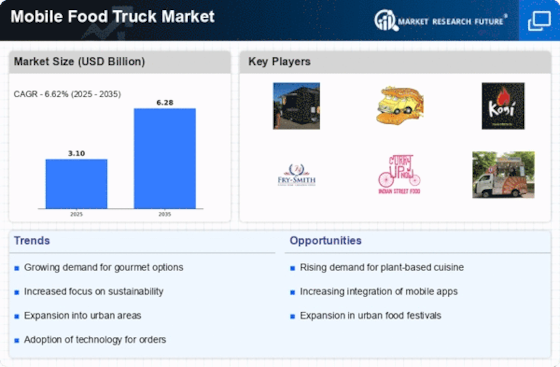
As per Market Research Future analysis, the Mobile Food Truck Market Valuation was estimated at 3.1 USD Billion in 2024. The Mobile Food Truck industry is projected to grow from 3.305 USD Billion in 2025 to 6.275 USD Billion by 2035, exhibiting a compound annual growth rate (CAGR) of 6.62% during the forecast period 2025 - 2035

Key Market Trends & Highlights

The Mobile Food Truck Market is experiencing dynamic growth driven by culinary diversity and technological advancements.

  • Culinary diversity continues to shape menu offerings, appealing to a broad range of consumer tastes in North America. Sustainability practices are increasingly prioritized, with food trucks adopting eco-friendly materials and waste reduction strategies. Technological integration, including mobile ordering and payment systems, enhances customer convenience and operational efficiency. Urbanization and consumer preference for convenience are major drivers, particularly benefiting the electric food truck segment in North America and the unpowered food truck segment in scenic spots across Asia-Pacific.

Market Size & Forecast

2024 Market Size 3.1 (USD Billion)
2035 Market Size 6.275 (USD Billion)
CAGR (2025 - 2035) 6.62%
Largest Regional Market Share in 2024 North America

Major Players

Gourmet Food Trucks (US), The Grilled Cheese Truck (US), <a href="https://kogibbq.com/">Kogi BBQ</a> (US), Frysmith (US), Curry Up Now (US), Dosa Truck (US), Sweetery NYC (US), <a href="https://www.thelobostruck.com/">The Lobos Truck</a> (US)

Market Trends

The Mobile Food Truck Market is currently experiencing a dynamic evolution, characterized by a growing consumer preference for diverse culinary experiences. This trend appears to be driven by an increasing demand for convenience and accessibility, as food trucks offer a unique alternative to traditional dining establishments. The flexibility of mobile food vendors allows them to cater to various events and locations, thereby enhancing their appeal. Additionally, the rise of social media platforms has facilitated the promotion of food trucks, enabling them to reach wider audiences and engage with customers in innovative ways. Moreover, sustainability is becoming a focal point within the Mobile Food Truck Market. Many operators are adopting eco-friendly practices, such as sourcing local ingredients and utilizing biodegradable packaging. This shift not only aligns with consumer values but also positions food trucks as responsible contributors to the food ecosystem. As the market continues to evolve, it is likely that these trends will shape the future landscape of mobile dining, fostering a vibrant and diverse culinary scene.

Culinary Diversity

The Mobile Food Truck Market is witnessing an expansion in culinary offerings, with vendors increasingly exploring global cuisines. This trend reflects a consumer desire for unique and varied dining experiences, encouraging food trucks to innovate and diversify their menus.

Sustainability Practices

Sustainability is gaining traction within the Mobile Food Truck Market, as operators implement eco-friendly practices. This includes sourcing local ingredients and utilizing sustainable packaging, appealing to environmentally conscious consumers.

Technological Integration

The integration of technology is transforming the Mobile Food Truck Market. Operators are leveraging mobile apps and social media for marketing, order management, and customer engagement, enhancing operational efficiency and customer experience.

Mobile Food Truck Market Market Drivers

Urbanization and Mobility

The increasing trend of urbanization appears to be a significant driver for the Mobile Food Truck Market. As more individuals migrate to urban areas, the demand for convenient and accessible food options rises. Food trucks, with their ability to operate in various locations, cater to this need effectively. According to recent data, urban populations are projected to reach 68% by 2050, which could lead to a heightened demand for mobile food services. This shift in demographics suggests that food trucks may become a staple in urban landscapes, providing diverse culinary options to busy city dwellers. The flexibility of food trucks allows them to adapt to changing consumer preferences, making them a viable option for entrepreneurs looking to enter the food service industry.

Cost-Effective Business Model

The Mobile Food Truck Market benefits from a cost-effective business model that appeals to aspiring entrepreneurs. Compared to traditional brick-and-mortar restaurants, food trucks require lower initial investments and operational costs. This affordability allows individuals to enter the food service industry with reduced financial risk. Market data indicates that the average startup cost for a food truck can range from $50,000 to $200,000, significantly less than the costs associated with establishing a full-scale restaurant. This financial accessibility encourages innovation and diversity within the market, as more entrepreneurs can explore unique culinary concepts. Additionally, the flexibility of food trucks allows operators to test different locations and menus, further enhancing their potential for success. This cost-effective model suggests that the food truck industry may continue to attract new entrants, fostering a dynamic and competitive market.

Culinary Innovation and Trends

The Mobile Food Truck Market is significantly influenced by culinary innovation and emerging food trends. As consumers become more adventurous in their dining choices, food trucks have the unique ability to experiment with new flavors and concepts. This adaptability allows food truck operators to introduce innovative dishes that reflect current culinary trends, such as plant-based options and fusion cuisines. Market analysis indicates that the food truck segment has seen a rise in popularity for gourmet offerings, with many trucks focusing on high-quality ingredients and unique recipes. This trend not only attracts food enthusiasts but also positions food trucks as key players in the broader culinary landscape. The ability to quickly pivot and respond to changing tastes suggests that food trucks will continue to thrive in an ever-evolving market.

Consumer Preference for Convenience

Consumer behavior trends indicate a growing preference for convenience, which significantly influences the Mobile Food Truck Market. As lifestyles become increasingly fast-paced, individuals seek quick and accessible dining options. Food trucks, often strategically located in high-traffic areas, provide an efficient solution for on-the-go meals. Market data suggests that the food truck sector has experienced a compound annual growth rate of approximately 7.5% in recent years, reflecting this shift in consumer preferences. The ability of food trucks to offer diverse menus and cater to various dietary needs further enhances their appeal. This trend suggests that food trucks are likely to continue thriving as they align with the evolving demands of modern consumers who prioritize convenience without compromising on quality.

Regulatory Support and Food Safety Standards

Regulatory support and adherence to food safety standards play a crucial role in shaping the Mobile Food Truck Market. Governments are increasingly recognizing the economic potential of food trucks and are implementing policies that facilitate their operation. This support may include streamlined permitting processes and reduced fees, which can encourage more entrepreneurs to enter the market. Furthermore, compliance with food safety regulations is paramount for maintaining consumer trust and ensuring public health. Data indicates that food trucks that prioritize safety and quality are more likely to succeed in a competitive landscape. As regulatory frameworks evolve to support mobile food vendors, the industry may experience growth, driven by a combination of increased accessibility and consumer confidence in food safety practices. This regulatory environment suggests a promising future for the mobile food truck sector.

Market Segment Insights

By Product Type: Electric Food Truck (Largest) vs. Unpowered Food Truck (Fastest-Growing)

The Mobile Food Truck Market exhibits a diverse distribution of product types, with the Electric Food Truck emerging as the dominant player. This segment has captured a substantial share due to its eco-friendly appeal and operational cost savings. Following closely, the Gasoline Food Truck represents a significant portion of the market, primarily driven by traditional consumer preferences and established supply chains. The Unpowered Food Truck is gaining attention, yet it currently holds a smaller share due to rising demands for modern efficiency and sustainability in food service operations.

Electric Food Truck (Dominant) vs. Unpowered Food Truck (Emerging)

The Electric Food Truck segment is characterized by its commitment to sustainability and innovation, attracting a growing base of environmentally conscious consumers. This category benefits from advancements in battery technology, enabling food trucks to operate longer distances with reduced emissions. In contrast, the Unpowered Food Truck represents an emerging segment that appeals to budget-conscious operators and those seeking mobility without the need for energy sources. While it currently trails in market presence, the Unpowered Food Truck is witnessing increased interest from new entrants looking to capitalize on low operational costs and the rising trend of local food sourcing.

By Application: Street (Largest) vs. Scenic Spot (Fastest-Growing)

The Mobile Food Truck Market showcases diverse applications, with the Street segment holding a dominant position. This segment benefits from high foot traffic and urbanization, making it the preferred choice for many food truck operators. In contrast, Scenic Spot applications are gaining traction, driven by a growing interest in unique dining experiences in picturesque locations. This shift reflects changing consumer preferences that favor quality over quantity, particularly for outdoor dining opportunities.

Street (Dominant) vs. Scenic Spot (Emerging)

The Street segment is characterized by its vibrant appeal, capturing a wide array of customers seeking quick and accessible meals in urban areas. This segment thrives on the convenience and fast service that food trucks provide in bustling city streets. On the other hand, the Scenic Spot segment is emerging as a noteworthy player, offering experiential dining in visually captivating environments. This trend is attracting a niche market that values ambiance and unique culinary experiences. The growth of this segment is fueled by the rise of food festivals and outdoor events, where consumers are eager to enjoy meals in scenic settings.

Get more detailed insights about Mobile Food Truck Market Research Report — Global Forecast till 2035

Regional Insights

North America : Culinary Innovation Hub

North America leads the mobile food truck market, driven by a growing demand for diverse culinary experiences and the rise of food truck festivals. The U.S. holds approximately 70% of the market share, with Canada following at around 15%. Regulatory support for food trucks, including streamlined licensing processes and health regulations, has further fueled this growth. The trend towards gourmet and specialty food offerings continues to attract consumers seeking unique dining experiences. The competitive landscape is vibrant, with key players like Gourmet Food Trucks, The Grilled Cheese Truck, and Kogi BBQ dominating the scene. These companies have established strong brand identities and loyal customer bases. The presence of food truck parks and events enhances visibility and accessibility, allowing new entrants to thrive. As the market evolves, innovation in menu offerings and service models will be crucial for maintaining competitive advantage.

Europe : Emerging Culinary Scene

Europe's mobile food truck market is rapidly expanding, driven by urbanization and a shift towards street food culture. The UK and Germany are the largest markets, collectively holding about 60% of the market share. Regulatory frameworks are becoming more supportive, with cities implementing policies to promote food trucks as part of urban revitalization efforts. This trend is expected to continue as consumers seek convenient and diverse dining options. Leading countries like France and Italy are also witnessing a surge in food truck operations, with a focus on local and organic ingredients. The competitive landscape features a mix of established brands and new entrants, fostering innovation in menu offerings. Key players are adapting to consumer preferences by incorporating sustainability practices and unique culinary concepts, enhancing their appeal in a crowded market.

Asia-Pacific : Rapidly Growing Market

The Asia-Pacific region is experiencing significant growth in the mobile food truck market, driven by increasing urbanization and changing consumer lifestyles. Countries like Australia and Japan are leading the market, holding approximately 50% and 20% of the share, respectively. Regulatory changes are facilitating the establishment of food trucks, with local governments promoting street food as a cultural attraction. This trend is expected to continue as consumers seek convenient dining options that reflect local flavors. Australia's competitive landscape is characterized by a mix of gourmet and traditional food trucks, with key players like Dosa Truck and Curry Up Now gaining popularity. In Japan, food trucks are increasingly offering fusion cuisine, appealing to diverse consumer tastes. The presence of food festivals and events further enhances market visibility, allowing food trucks to reach a broader audience and establish brand loyalty.

Middle East and Africa : Cultural Culinary Fusion

The Middle East and Africa are witnessing a burgeoning mobile food truck market, driven by a youthful population and a growing appetite for diverse culinary experiences. Countries like South Africa and the UAE are at the forefront, collectively holding around 45% of the market share. Regulatory frameworks are evolving, with governments recognizing the potential of food trucks to enhance tourism and local economies. This shift is expected to drive further growth as more entrepreneurs enter the market. In South Africa, the competitive landscape is vibrant, with a mix of local and international food trucks offering a variety of cuisines. The UAE is seeing a rise in gourmet food trucks, catering to both locals and tourists. Key players are leveraging social media for marketing and customer engagement, creating a dynamic environment that fosters innovation and culinary creativity.

Key Players and Competitive Insights

The Mobile Food Truck Market is currently characterized by a dynamic competitive landscape, driven by evolving consumer preferences and a growing demand for diverse culinary experiences. Key players such as Gourmet Food Trucks (US), The Grilled Cheese Truck (US), and Kogi BBQ (US) are strategically positioning themselves through innovation and regional expansion. Gourmet Food Trucks (US) has focused on enhancing its menu offerings to include plant-based options, appealing to health-conscious consumers. Meanwhile, The Grilled Cheese Truck (US) has been expanding its footprint in urban areas, leveraging partnerships with local events to increase visibility. Kogi BBQ (US) continues to innovate by integrating technology into its operations, utilizing mobile apps for customer engagement and order efficiency. Collectively, these strategies contribute to a moderately fragmented market, where differentiation is increasingly based on culinary innovation and customer experience. In terms of business tactics, companies are localizing their supply chains to enhance responsiveness and reduce costs. This approach is particularly evident in the Mobile Food Truck Market, where operational efficiency is paramount. The competitive structure remains moderately fragmented, with numerous players vying for market share. However, the influence of key players is substantial, as they set trends that smaller operators often follow. The collective actions of these companies shape a landscape where agility and adaptability are crucial for success. In September 2025, Gourmet Food Trucks (US) launched a new line of gourmet vegan dishes, responding to the increasing demand for plant-based options. This strategic move not only diversifies their menu but also positions them as a leader in the health-conscious segment of the market. The introduction of these offerings is likely to attract a broader customer base, enhancing their competitive edge. In August 2025, The Grilled Cheese Truck (US) announced a partnership with a popular local brewery to create a unique food and drink pairing experience. This collaboration is significant as it allows the company to tap into the growing trend of experiential dining, thereby enhancing customer engagement and loyalty. Such partnerships may serve to elevate their brand presence in a crowded market. In July 2025, Kogi BBQ (US) implemented a new mobile ordering system that utilizes AI to predict customer preferences based on past orders. This technological advancement not only streamlines operations but also enhances the customer experience by providing personalized recommendations. The integration of AI into their service model indicates a forward-thinking approach that could set a new standard in the industry. As of October 2025, the Mobile Food Truck Market is witnessing trends such as digitalization and sustainability becoming increasingly central to competitive strategies. Companies are forming strategic alliances to enhance their operational capabilities and market reach. The shift from price-based competition to a focus on innovation, technology, and supply chain reliability is evident. Moving forward, competitive differentiation will likely hinge on the ability to adapt to these trends, with companies that prioritize innovation and customer experience poised to thrive.

Key Companies in the Mobile Food Truck Market include

Industry Developments

June 2022: Gorkovsky Avtomobilny Zavod (GAZ) unveiled new car types. An example of a vehicle using the GAZelle NN chassis is the food truck. There is flexibility in the layout of this unique and contemporary food truck built on a GAZelle NN chassis.

April 2023: Toyota Australia showcased a range of possible uses for its hydrogen fuel cell technology at a national hydrogen showcase in Melbourne with the FCV Express Diner, an inventive fuel cell food truck design.

June 2023: Hyzon Motors Inc. and Performance Food Group, Inc. (PFG), a major food and food service distribution company in North America, have entered into a five-fuel-cell electric vehicle (FCEV) sales agreement.

In December 2024, Dearborn, Michigan, under Mayor Abdullah Hammoud's guidance, inaugurated three new community "Peace Parks" featuring food carts. This project was part of a broader $29.2 million effort to 'green' empty lots and create new businesses to drive growth in the city's economy. This is part of the city's efforts to bring economic renewal.

In October 2024, New Jersey restaurateurs Fabio Antonio Arbelaez and Ryan McDermott converted two Tesla Cybertrucks into mobile pizza ovens. The trucks had electricity-powered pizza ovens, LED umbrellas, and refrigeration units, all hooked up to the Cybertrucks' batteries. These upgrades made it possible to cook pizza in remote locations.

In August 2024, Kevin Ford, a Burger King cook from Nevada who recently made headlines after having perfect attendance for almost 27 years, launched a food truck business called "K27Y." Together with his daughter, a Le Cordon Bleu trained chef, they plan to have a set of hamburgers and hotdogs, then move on to serve Filipino cuisine.

In October 2023, New Jersey restaurateurs Fabio Antonio Arbelaez and Ryan McDermott converted two Tesla Cybertrucks into mobile pizza ovens. The modified trucks feature electric pizza ovens, LED umbrellas, and refrigeration units, all powered by the Cybertrucks' batteries, enabling pizza cooking even in remote areas.

In August 2023, Kevin Ford, a Burger King cook from Nevada who gained attention for his 27 years of perfect attendance, launched a food truck venture named "K27Y." Partnering with his daughter, a Le Cordon Bleu-trained chef, they plan to serve a menu including hamburgers, hot dogs, and eventually Filipino dishes.

Future Outlook

Mobile Food Truck Market Future Outlook

The Mobile Food Truck Market is projected to grow at a 6.62% CAGR from 2025 to 2035, driven by urbanization, consumer demand for convenience, and innovative culinary experiences.

New opportunities lie in:

  • <p>Expansion into untapped urban areas with high foot traffic Integration of mobile payment systems for enhanced customer experience Collaboration with local farms for fresh, sustainable ingredients</p>

By 2035, the market is expected to be robust, reflecting diverse offerings and increased consumer engagement.

Market Segmentation

Mobile Food Truck Market Application Outlook

  • Scenic Spot
  • Street
  • Others

Mobile Food Truck Market Product Type Outlook

  • Unpowered Food Truck
  • Electric Food Truck
  • Gasoline Food Truck

Report Scope

MARKET SIZE 2024 3.1(USD Billion)
MARKET SIZE 2025 3.305(USD Billion)
MARKET SIZE 2035 6.275(USD Billion)
COMPOUND ANNUAL GROWTH RATE (CAGR) 6.62% (2025 - 2035)
REPORT COVERAGE Revenue Forecast, Competitive Landscape, Growth Factors, and Trends
BASE YEAR 2024
Market Forecast Period 2025 - 2035
Historical Data 2019 - 2024
Market Forecast Units USD Billion
Key Companies Profiled Gourmet Food Trucks (US), The Grilled Cheese Truck (US), Kogi BBQ (US), Frysmith (US), Curry Up Now (US), Dosa Truck (US), Sweetery NYC (US), The Lobos Truck (US)
Segments Covered Product Type, Applications, Region
Key Market Opportunities Integration of advanced technology enhances operational efficiency in the Mobile Food Truck Market.
Key Market Dynamics Rising consumer demand for diverse culinary experiences drives innovation and competition in the mobile food truck sector.
Countries Covered North America, Europe, APAC, South America, MEA

FAQs

What is the current valuation of the Mobile Food Truck Market?

<p>The Mobile Food Truck Market was valued at 3.1 USD Billion in 2024.</p>

What is the projected market size for the Mobile Food Truck Market by 2035?

<p>The market is projected to reach 6.275 USD Billion by 2035.</p>

What is the expected CAGR for the Mobile Food Truck Market during the forecast period?

<p>The expected CAGR for the Mobile Food Truck Market from 2025 to 2035 is 6.62%.</p>

Which product type segment shows the highest growth potential in the Mobile Food Truck Market?

<p>The Unpowered Food Truck segment is projected to grow from 1.24 USD Billion in 2024 to 2.5 USD Billion by 2035.</p>

How does the Electric Food Truck segment compare to others in terms of valuation?

<p>The Electric Food Truck segment is expected to increase from 0.93 USD Billion in 2024 to 1.8 USD Billion by 2035.</p>

What are the primary applications of mobile food trucks in the market?

<p>The Street application segment is anticipated to grow from 1.55 USD Billion in 2024 to 3.15 USD Billion by 2035.</p>

Which key players are leading the Mobile Food Truck Market?

Key players include Gourmet Food Trucks, The Grilled Cheese Truck, Kogi BBQ, and others.

What is the growth outlook for the Scenic Spot application segment?

The Scenic Spot application segment is projected to grow from 0.93 USD Billion in 2024 to 1.85 USD Billion by 2035.

How does the Gasoline Food Truck segment perform compared to Electric Food Trucks?

The Gasoline Food Truck segment is expected to grow from 0.93 USD Billion in 2024 to 2.0 USD Billion by 2035, indicating strong performance.

What trends are influencing the growth of the Mobile Food Truck Market?

Trends such as increasing consumer demand for diverse food options and the rise of food truck culture are likely influencing market growth.

  1. SECTION I: EXECUTIVE SUMMARY AND KEY HIGHLIGHTS
    1. | 1.1 EXECUTIVE SUMMARY
    2. | | 1.1.1 Market Overview
    3. | | 1.1.2 Key Findings
    4. | | 1.1.3 Market Segmentation
    5. | | 1.1.4 Competitive Landscape
    6. | | 1.1.5 Challenges and Opportunities
    7. | | 1.1.6 Future Outlook
  2. SECTION II: SCOPING, METHODOLOGY AND MARKET STRUCTURE
    1. | 2.1 MARKET INTRODUCTION
    2. | | 2.1.1 Definition
    3. | | 2.1.2 Scope of the study
    4. | | | 2.1.2.1 Research Objective
    5. | | | 2.1.2.2 Assumption
    6. | | | 2.1.2.3 Limitations
    7. | 2.2 RESEARCH METHODOLOGY
    8. | | 2.2.1 Overview
    9. | | 2.2.2 Data Mining
    10. | | 2.2.3 Secondary Research
    11. | | 2.2.4 Primary Research
    12. | | | 2.2.4.1 Primary Interviews and Information Gathering Process
    13. | | | 2.2.4.2 Breakdown of Primary Respondents
    14. | | 2.2.5 Forecasting Model
    15. | | 2.2.6 Market Size Estimation
    16. | | | 2.2.6.1 Bottom-Up Approach
    17. | | | 2.2.6.2 Top-Down Approach
    18. | | 2.2.7 Data Triangulation
    19. | | 2.2.8 Validation
  3. SECTION III: QUALITATIVE ANALYSIS
    1. | 3.1 MARKET DYNAMICS
    2. | | 3.1.1 Overview
    3. | | 3.1.2 Drivers
    4. | | 3.1.3 Restraints
    5. | | 3.1.4 Opportunities
    6. | 3.2 MARKET FACTOR ANALYSIS
    7. | | 3.2.1 Value chain Analysis
    8. | | 3.2.2 Porter's Five Forces Analysis
    9. | | | 3.2.2.1 Bargaining Power of Suppliers
    10. | | | 3.2.2.2 Bargaining Power of Buyers
    11. | | | 3.2.2.3 Threat of New Entrants
    12. | | | 3.2.2.4 Threat of Substitutes
    13. | | | 3.2.2.5 Intensity of Rivalry
    14. | | 3.2.3 COVID-19 Impact Analysis
    15. | | | 3.2.3.1 Market Impact Analysis
    16. | | | 3.2.3.2 Regional Impact
    17. | | | 3.2.3.3 Opportunity and Threat Analysis
  4. SECTION IV: QUANTITATIVE ANALYSIS
    1. | 4.1 Automobile, BY Product Type (USD Billion)
    2. | | 4.1.1 Unpowered Food Truck
    3. | | 4.1.2 Electric Food Truck
    4. | | 4.1.3 Gasoline Food Truck
    5. | 4.2 Automobile, BY Application (USD Billion)
    6. | | 4.2.1 Scenic Spot
    7. | | 4.2.2 Street
    8. | | 4.2.3 Others
    9. | 4.3 Automobile, BY Region (USD Billion)
    10. | | 4.3.1 North America
    11. | | | 4.3.1.1 US
    12. | | | 4.3.1.2 Canada
    13. | | 4.3.2 Europe
    14. | | | 4.3.2.1 Germany
    15. | | | 4.3.2.2 UK
    16. | | | 4.3.2.3 France
    17. | | | 4.3.2.4 Russia
    18. | | | 4.3.2.5 Italy
    19. | | | 4.3.2.6 Spain
    20. | | | 4.3.2.7 Rest of Europe
    21. | | 4.3.3 APAC
    22. | | | 4.3.3.1 China
    23. | | | 4.3.3.2 India
    24. | | | 4.3.3.3 Japan
    25. | | | 4.3.3.4 South Korea
    26. | | | 4.3.3.5 Malaysia
    27. | | | 4.3.3.6 Thailand
    28. | | | 4.3.3.7 Indonesia
    29. | | | 4.3.3.8 Rest of APAC
    30. | | 4.3.4 South America
    31. | | | 4.3.4.1 Brazil
    32. | | | 4.3.4.2 Mexico
    33. | | | 4.3.4.3 Argentina
    34. | | | 4.3.4.4 Rest of South America
    35. | | 4.3.5 MEA
    36. | | | 4.3.5.1 GCC Countries
    37. | | | 4.3.5.2 South Africa
    38. | | | 4.3.5.3 Rest of MEA
  5. SECTION V: COMPETITIVE ANALYSIS
    1. | 5.1 Competitive Landscape
    2. | | 5.1.1 Overview
    3. | | 5.1.2 Competitive Analysis
    4. | | 5.1.3 Market share Analysis
    5. | | 5.1.4 Major Growth Strategy in the Automobile
    6. | | 5.1.5 Competitive Benchmarking
    7. | | 5.1.6 Leading Players in Terms of Number of Developments in the Automobile
    8. | | 5.1.7 Key developments and growth strategies
    9. | | | 5.1.7.1 New Product Launch/Service Deployment
    10. | | | 5.1.7.2 Merger & Acquisitions
    11. | | | 5.1.7.3 Joint Ventures
    12. | | 5.1.8 Major Players Financial Matrix
    13. | | | 5.1.8.1 Sales and Operating Income
    14. | | | 5.1.8.2 Major Players R&D Expenditure. 2023
    15. | 5.2 Company Profiles
    16. | | 5.2.1 Gourmet Food Trucks (US)
    17. | | | 5.2.1.1 Financial Overview
    18. | | | 5.2.1.2 Products Offered
    19. | | | 5.2.1.3 Key Developments
    20. | | | 5.2.1.4 SWOT Analysis
    21. | | | 5.2.1.5 Key Strategies
    22. | | 5.2.2 The Grilled Cheese Truck (US)
    23. | | | 5.2.2.1 Financial Overview
    24. | | | 5.2.2.2 Products Offered
    25. | | | 5.2.2.3 Key Developments
    26. | | | 5.2.2.4 SWOT Analysis
    27. | | | 5.2.2.5 Key Strategies
    28. | | 5.2.3 Kogi BBQ (US)
    29. | | | 5.2.3.1 Financial Overview
    30. | | | 5.2.3.2 Products Offered
    31. | | | 5.2.3.3 Key Developments
    32. | | | 5.2.3.4 SWOT Analysis
    33. | | | 5.2.3.5 Key Strategies
    34. | | 5.2.4 Frysmith (US)
    35. | | | 5.2.4.1 Financial Overview
    36. | | | 5.2.4.2 Products Offered
    37. | | | 5.2.4.3 Key Developments
    38. | | | 5.2.4.4 SWOT Analysis
    39. | | | 5.2.4.5 Key Strategies
    40. | | 5.2.5 Curry Up Now (US)
    41. | | | 5.2.5.1 Financial Overview
    42. | | | 5.2.5.2 Products Offered
    43. | | | 5.2.5.3 Key Developments
    44. | | | 5.2.5.4 SWOT Analysis
    45. | | | 5.2.5.5 Key Strategies
    46. | | 5.2.6 Dosa Truck (US)
    47. | | | 5.2.6.1 Financial Overview
    48. | | | 5.2.6.2 Products Offered
    49. | | | 5.2.6.3 Key Developments
    50. | | | 5.2.6.4 SWOT Analysis
    51. | | | 5.2.6.5 Key Strategies
    52. | | 5.2.7 Sweetery NYC (US)
    53. | | | 5.2.7.1 Financial Overview
    54. | | | 5.2.7.2 Products Offered
    55. | | | 5.2.7.3 Key Developments
    56. | | | 5.2.7.4 SWOT Analysis
    57. | | | 5.2.7.5 Key Strategies
    58. | | 5.2.8 The Lobos Truck (US)
    59. | | | 5.2.8.1 Financial Overview
    60. | | | 5.2.8.2 Products Offered
    61. | | | 5.2.8.3 Key Developments
    62. | | | 5.2.8.4 SWOT Analysis
    63. | | | 5.2.8.5 Key Strategies
    64. | 5.3 Appendix
    65. | | 5.3.1 References
    66. | | 5.3.2 Related Reports
  6. LIST OF FIGURES
    1. | 6.1 MARKET SYNOPSIS
    2. | 6.2 NORTH AMERICA MARKET ANALYSIS
    3. | 6.3 US MARKET ANALYSIS BY PRODUCT TYPE
    4. | 6.4 US MARKET ANALYSIS BY APPLICATION
    5. | 6.5 CANADA MARKET ANALYSIS BY PRODUCT TYPE
    6. | 6.6 CANADA MARKET ANALYSIS BY APPLICATION
    7. | 6.7 EUROPE MARKET ANALYSIS
    8. | 6.8 GERMANY MARKET ANALYSIS BY PRODUCT TYPE
    9. | 6.9 GERMANY MARKET ANALYSIS BY APPLICATION
    10. | 6.10 UK MARKET ANALYSIS BY PRODUCT TYPE
    11. | 6.11 UK MARKET ANALYSIS BY APPLICATION
    12. | 6.12 FRANCE MARKET ANALYSIS BY PRODUCT TYPE
    13. | 6.13 FRANCE MARKET ANALYSIS BY APPLICATION
    14. | 6.14 RUSSIA MARKET ANALYSIS BY PRODUCT TYPE
    15. | 6.15 RUSSIA MARKET ANALYSIS BY APPLICATION
    16. | 6.16 ITALY MARKET ANALYSIS BY PRODUCT TYPE
    17. | 6.17 ITALY MARKET ANALYSIS BY APPLICATION
    18. | 6.18 SPAIN MARKET ANALYSIS BY PRODUCT TYPE
    19. | 6.19 SPAIN MARKET ANALYSIS BY APPLICATION
    20. | 6.20 REST OF EUROPE MARKET ANALYSIS BY PRODUCT TYPE
    21. | 6.21 REST OF EUROPE MARKET ANALYSIS BY APPLICATION
    22. | 6.22 APAC MARKET ANALYSIS
    23. | 6.23 CHINA MARKET ANALYSIS BY PRODUCT TYPE
    24. | 6.24 CHINA MARKET ANALYSIS BY APPLICATION
    25. | 6.25 INDIA MARKET ANALYSIS BY PRODUCT TYPE
    26. | 6.26 INDIA MARKET ANALYSIS BY APPLICATION
    27. | 6.27 JAPAN MARKET ANALYSIS BY PRODUCT TYPE
    28. | 6.28 JAPAN MARKET ANALYSIS BY APPLICATION
    29. | 6.29 SOUTH KOREA MARKET ANALYSIS BY PRODUCT TYPE
    30. | 6.30 SOUTH KOREA MARKET ANALYSIS BY APPLICATION
    31. | 6.31 MALAYSIA MARKET ANALYSIS BY PRODUCT TYPE
    32. | 6.32 MALAYSIA MARKET ANALYSIS BY APPLICATION
    33. | 6.33 THAILAND MARKET ANALYSIS BY PRODUCT TYPE
    34. | 6.34 THAILAND MARKET ANALYSIS BY APPLICATION
    35. | 6.35 INDONESIA MARKET ANALYSIS BY PRODUCT TYPE
    36. | 6.36 INDONESIA MARKET ANALYSIS BY APPLICATION
    37. | 6.37 REST OF APAC MARKET ANALYSIS BY PRODUCT TYPE
    38. | 6.38 REST OF APAC MARKET ANALYSIS BY APPLICATION
    39. | 6.39 SOUTH AMERICA MARKET ANALYSIS
    40. | 6.40 BRAZIL MARKET ANALYSIS BY PRODUCT TYPE
    41. | 6.41 BRAZIL MARKET ANALYSIS BY APPLICATION
    42. | 6.42 MEXICO MARKET ANALYSIS BY PRODUCT TYPE
    43. | 6.43 MEXICO MARKET ANALYSIS BY APPLICATION
    44. | 6.44 ARGENTINA MARKET ANALYSIS BY PRODUCT TYPE
    45. | 6.45 ARGENTINA MARKET ANALYSIS BY APPLICATION
    46. | 6.46 REST OF SOUTH AMERICA MARKET ANALYSIS BY PRODUCT TYPE
    47. | 6.47 REST OF SOUTH AMERICA MARKET ANALYSIS BY APPLICATION
    48. | 6.48 MEA MARKET ANALYSIS
    49. | 6.49 GCC COUNTRIES MARKET ANALYSIS BY PRODUCT TYPE
    50. | 6.50 GCC COUNTRIES MARKET ANALYSIS BY APPLICATION
    51. | 6.51 SOUTH AFRICA MARKET ANALYSIS BY PRODUCT TYPE
    52. | 6.52 SOUTH AFRICA MARKET ANALYSIS BY APPLICATION
    53. | 6.53 REST OF MEA MARKET ANALYSIS BY PRODUCT TYPE
    54. | 6.54 REST OF MEA MARKET ANALYSIS BY APPLICATION
    55. | 6.55 KEY BUYING CRITERIA OF AUTOMOBILE
    56. | 6.56 RESEARCH PROCESS OF MRFR
    57. | 6.57 DRO ANALYSIS OF AUTOMOBILE
    58. | 6.58 DRIVERS IMPACT ANALYSIS: AUTOMOBILE
    59. | 6.59 RESTRAINTS IMPACT ANALYSIS: AUTOMOBILE
    60. | 6.60 SUPPLY / VALUE CHAIN: AUTOMOBILE
    61. | 6.61 AUTOMOBILE, BY PRODUCT TYPE, 2024 (% SHARE)
    62. | 6.62 AUTOMOBILE, BY PRODUCT TYPE, 2024 TO 2035 (USD Billion)
    63. | 6.63 AUTOMOBILE, BY APPLICATION, 2024 (% SHARE)
    64. | 6.64 AUTOMOBILE, BY APPLICATION, 2024 TO 2035 (USD Billion)
    65. | 6.65 BENCHMARKING OF MAJOR COMPETITORS
  7. LIST OF TABLES
    1. | 7.1 LIST OF ASSUMPTIONS
    2. | | 7.1.1
    3. | 7.2 North America MARKET SIZE ESTIMATES; FORECAST
    4. | | 7.2.1 BY PRODUCT TYPE, 2025-2035 (USD Billion)
    5. | | 7.2.2 BY APPLICATION, 2025-2035 (USD Billion)
    6. | 7.3 US MARKET SIZE ESTIMATES; FORECAST
    7. | | 7.3.1 BY PRODUCT TYPE, 2025-2035 (USD Billion)
    8. | | 7.3.2 BY APPLICATION, 2025-2035 (USD Billion)
    9. | 7.4 Canada MARKET SIZE ESTIMATES; FORECAST
    10. | | 7.4.1 BY PRODUCT TYPE, 2025-2035 (USD Billion)
    11. | | 7.4.2 BY APPLICATION, 2025-2035 (USD Billion)
    12. | 7.5 Europe MARKET SIZE ESTIMATES; FORECAST
    13. | | 7.5.1 BY PRODUCT TYPE, 2025-2035 (USD Billion)
    14. | | 7.5.2 BY APPLICATION, 2025-2035 (USD Billion)
    15. | 7.6 Germany MARKET SIZE ESTIMATES; FORECAST
    16. | | 7.6.1 BY PRODUCT TYPE, 2025-2035 (USD Billion)
    17. | | 7.6.2 BY APPLICATION, 2025-2035 (USD Billion)
    18. | 7.7 UK MARKET SIZE ESTIMATES; FORECAST
    19. | | 7.7.1 BY PRODUCT TYPE, 2025-2035 (USD Billion)
    20. | | 7.7.2 BY APPLICATION, 2025-2035 (USD Billion)
    21. | 7.8 France MARKET SIZE ESTIMATES; FORECAST
    22. | | 7.8.1 BY PRODUCT TYPE, 2025-2035 (USD Billion)
    23. | | 7.8.2 BY APPLICATION, 2025-2035 (USD Billion)
    24. | 7.9 Russia MARKET SIZE ESTIMATES; FORECAST
    25. | | 7.9.1 BY PRODUCT TYPE, 2025-2035 (USD Billion)
    26. | | 7.9.2 BY APPLICATION, 2025-2035 (USD Billion)
    27. | 7.10 Italy MARKET SIZE ESTIMATES; FORECAST
    28. | | 7.10.1 BY PRODUCT TYPE, 2025-2035 (USD Billion)
    29. | | 7.10.2 BY APPLICATION, 2025-2035 (USD Billion)
    30. | 7.11 Spain MARKET SIZE ESTIMATES; FORECAST
    31. | | 7.11.1 BY PRODUCT TYPE, 2025-2035 (USD Billion)
    32. | | 7.11.2 BY APPLICATION, 2025-2035 (USD Billion)
    33. | 7.12 Rest of Europe MARKET SIZE ESTIMATES; FORECAST
    34. | | 7.12.1 BY PRODUCT TYPE, 2025-2035 (USD Billion)
    35. | | 7.12.2 BY APPLICATION, 2025-2035 (USD Billion)
    36. | 7.13 APAC MARKET SIZE ESTIMATES; FORECAST
    37. | | 7.13.1 BY PRODUCT TYPE, 2025-2035 (USD Billion)
    38. | | 7.13.2 BY APPLICATION, 2025-2035 (USD Billion)
    39. | 7.14 China MARKET SIZE ESTIMATES; FORECAST
    40. | | 7.14.1 BY PRODUCT TYPE, 2025-2035 (USD Billion)
    41. | | 7.14.2 BY APPLICATION, 2025-2035 (USD Billion)
    42. | 7.15 India MARKET SIZE ESTIMATES; FORECAST
    43. | | 7.15.1 BY PRODUCT TYPE, 2025-2035 (USD Billion)
    44. | | 7.15.2 BY APPLICATION, 2025-2035 (USD Billion)
    45. | 7.16 Japan MARKET SIZE ESTIMATES; FORECAST
    46. | | 7.16.1 BY PRODUCT TYPE, 2025-2035 (USD Billion)
    47. | | 7.16.2 BY APPLICATION, 2025-2035 (USD Billion)
    48. | 7.17 South Korea MARKET SIZE ESTIMATES; FORECAST
    49. | | 7.17.1 BY PRODUCT TYPE, 2025-2035 (USD Billion)
    50. | | 7.17.2 BY APPLICATION, 2025-2035 (USD Billion)
    51. | 7.18 Malaysia MARKET SIZE ESTIMATES; FORECAST
    52. | | 7.18.1 BY PRODUCT TYPE, 2025-2035 (USD Billion)
    53. | | 7.18.2 BY APPLICATION, 2025-2035 (USD Billion)
    54. | 7.19 Thailand MARKET SIZE ESTIMATES; FORECAST
    55. | | 7.19.1 BY PRODUCT TYPE, 2025-2035 (USD Billion)
    56. | | 7.19.2 BY APPLICATION, 2025-2035 (USD Billion)
    57. | 7.20 Indonesia MARKET SIZE ESTIMATES; FORECAST
    58. | | 7.20.1 BY PRODUCT TYPE, 2025-2035 (USD Billion)
    59. | | 7.20.2 BY APPLICATION, 2025-2035 (USD Billion)
    60. | 7.21 Rest of APAC MARKET SIZE ESTIMATES; FORECAST
    61. | | 7.21.1 BY PRODUCT TYPE, 2025-2035 (USD Billion)
    62. | | 7.21.2 BY APPLICATION, 2025-2035 (USD Billion)
    63. | 7.22 South America MARKET SIZE ESTIMATES; FORECAST
    64. | | 7.22.1 BY PRODUCT TYPE, 2025-2035 (USD Billion)
    65. | | 7.22.2 BY APPLICATION, 2025-2035 (USD Billion)
    66. | 7.23 Brazil MARKET SIZE ESTIMATES; FORECAST
    67. | | 7.23.1 BY PRODUCT TYPE, 2025-2035 (USD Billion)
    68. | | 7.23.2 BY APPLICATION, 2025-2035 (USD Billion)
    69. | 7.24 Mexico MARKET SIZE ESTIMATES; FORECAST
    70. | | 7.24.1 BY PRODUCT TYPE, 2025-2035 (USD Billion)
    71. | | 7.24.2 BY APPLICATION, 2025-2035 (USD Billion)
    72. | 7.25 Argentina MARKET SIZE ESTIMATES; FORECAST
    73. | | 7.25.1 BY PRODUCT TYPE, 2025-2035 (USD Billion)
    74. | | 7.25.2 BY APPLICATION, 2025-2035 (USD Billion)
    75. | 7.26 Rest of South America MARKET SIZE ESTIMATES; FORECAST
    76. | | 7.26.1 BY PRODUCT TYPE, 2025-2035 (USD Billion)
    77. | | 7.26.2 BY APPLICATION, 2025-2035 (USD Billion)
    78. | 7.27 MEA MARKET SIZE ESTIMATES; FORECAST
    79. | | 7.27.1 BY PRODUCT TYPE, 2025-2035 (USD Billion)
    80. | | 7.27.2 BY APPLICATION, 2025-2035 (USD Billion)
    81. | 7.28 GCC Countries MARKET SIZE ESTIMATES; FORECAST
    82. | | 7.28.1 BY PRODUCT TYPE, 2025-2035 (USD Billion)
    83. | | 7.28.2 BY APPLICATION, 2025-2035 (USD Billion)
    84. | 7.29 South Africa MARKET SIZE ESTIMATES; FORECAST
    85. | | 7.29.1 BY PRODUCT TYPE, 2025-2035 (USD Billion)
    86. | | 7.29.2 BY APPLICATION, 2025-2035 (USD Billion)
    87. | 7.30 Rest of MEA MARKET SIZE ESTIMATES; FORECAST
    88. | | 7.30.1 BY PRODUCT TYPE, 2025-2035 (USD Billion)
    89. | | 7.30.2 BY APPLICATION, 2025-2035 (USD Billion)
    90. | 7.31 PRODUCT LAUNCH/PRODUCT DEVELOPMENT/APPROVAL
    91. | | 7.31.1
    92. | 7.32 ACQUISITION/PARTNERSHIP
    93. | | 7.32.1

Automobile Market Segmentation

Automobile By Product Type (USD Billion, 2025-2035)

  • Unpowered Food Truck
  • Electric Food Truck
  • Gasoline Food Truck

Automobile By Application (USD Billion, 2025-2035)

  • Scenic Spot
  • Street
  • Others
Infographic

Free Sample Request

Kindly complete the form below to receive a free sample of this Report

Get Free Sample

Customer Strories

Compare Licence

×
Features License Type
Single User Multiuser License Enterprise User
Price $4,950 $5,950 $7,250
Maximum User Access Limit 1 User Upto 10 Users Unrestricted Access Throughout the Organization
Free Customization
Direct Access to Analyst
Deliverable Format
Platform Access
Discount on Next Purchase 10% 15% 15%
Printable Versions