
Request Free Sample ×

Kindly complete the form below to receive a free sample of this Report

* Please use a valid business email

Leading companies partner with us for data-driven Insights

clients tt-cursor
Hero Background
English
Chinese
French
Japanese
Korean
German
Spanish

Microgreens Market Analysis

ID: MRFR/FnB/9320-HCR
200 Pages
Snehal Singh
April 2026

Microgreens Market Size, Share, Industry Trend & Analysis Research Report By Type (Leafy Microgreens, Cruciferous Microgreens, Herb Microgreens, Fruit Microgreens), By Distribution Channel (Online Stores, Supermarkets, Farmers Markets, Specialty Health Stores), By End Use (Household, Food Service, Food Processing), By Growing Method (Soil-Based, Hydroponics, Aeroponics) and By Regional (North America, Europe, South America, Asia Pacific, Middle East and Africa)-Forecast to 2035

Share:
Download PDF ×

We do not share your information with anyone. However, we may send you emails based on your report interest from time to time. You may contact us at any time to opt-out.

Microgreens Market Infographic
Purchase Options

Market Analysis

In-depth Analysis of Microgreens Market Industry Landscape

The global microgreens market is projected to grow to USD 2.48 BN by 2030, with a 13.50% CAGR from 2022 to 2030. The rise in expenditure for premium food products and the growing consumer awareness of the health benefits of microgreens are key growth drivers. Changing culinary trends and a growing interest in gourmet and exotic foods are also contributing to the market dynamics of microgreens. Whether used by chefs in restaurants or home cooks in their own kitchen, microgreens are added to enhance both the aesthetic and levels of flavors in dishes. The microgreens 'delicate texture, lustrous pigment and one-of-a-kind often make them a fine condiment in the cookbook. The microgreens market is undergoing another dramatic change. Also with the emphasis on freshly grown and close-at-hand produce, microgreens prove very attractive. Both production and growth are greatly supported by the advantage of microgreens. This concurs with the trend of sustainable and environmentally friendly foods. Microgreens fulfills both the practical need of the eating public as well as meeting the needs of environmental consciousness. Such consumer education and awareness campaigns do play a role in the changing dynamics of the microgreens market. People now know that micros are not only not only healthy, but also easy to grow, and that they can be used in almost any dish, and so more or less everyone wants some. Many educational projects focus on the unique health benefits of different microgreens. As functional foods, which provide nutrition and health benefits, are increasingly becoming a mainstream dietary supplement, the high nutrient density of microgreens, and the superiority of microgreens over produce in most nutrients, is a selling point that does not easily slip past the health-conscious consumer. Interestingly, with many labor-saving technology applications taking hold in the agricultural sector, microgreens have begun impacting the market structure. Microgreens are grown year-round in many countries thanks to the application of control environment agriculture, hydroponics, and vertical farming technologies, so as to overcome the seasonal limitations and prevent chaos from being unable to provide a guaranteed supply. Therefore, modern innovations find their way into all the processes involved in microgreens cultivation, including enhancing their efficiency, reducing resources used, and the quality of the crops, too. This ensures a prosperous and technology-intensive microgreens industry. New microgreen varieties are being introduced, and the market is diversifying, all of which are changing up current market trends. Traditional microgreens such as arugula, kale, and radish please the tongue, and now that the market share of suppliers has widened, producers are offering different varieties according to the varying preferences of consumers. More exotic seedlings like shiso, amaranths, and mustard greens are slowly becoming popular. A wider range of plants will no doubt give consumers more things to play with when cooking. Retails industry relations are important to the market dynamics of microgreens. Microgreens are more readily available, having begun to appear in supermarkets, specialty produce stores and farmer's markets to increase consumer access.


Author
Author Profile
Snehal Singh
Manager - Research

High acumen in analyzing complex macro & micro markets with more than 6 years of work experience in the field of market research. By implementing her analytical skills in forecasting and estimation into market research reports, she has expertise in Packaging, Construction, and Equipment domains. She handles a team size of 20-25 resources and ensures smooth running of the projects, associated marketing activities, and client servicing.

Leave a Comment

FAQs

What is the current valuation of the Microgreens Market as of 2024?

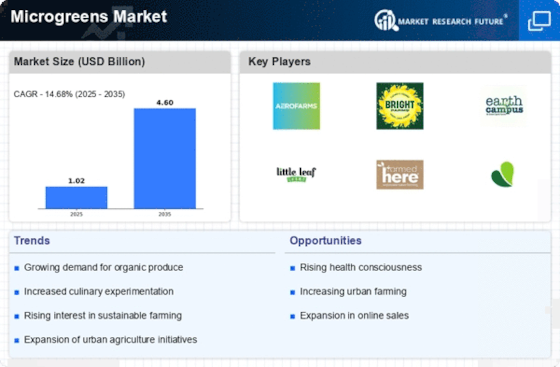
<p>The Microgreens Market was valued at 1.02 USD Billion in 2024.</p>

What is the projected market size for the Microgreens Market in 2035?

<p>The market is projected to reach 4.603 USD Billion by 2035.</p>

What is the expected CAGR for the Microgreens Market during the forecast period 2025 - 2035?

<p>The expected CAGR for the Microgreens Market during 2025 - 2035 is 14.68%.</p>

Which segment of microgreens is expected to have the highest valuation by 2035?

<p>Leafy Microgreens are anticipated to reach a valuation of 1.845 USD Billion by 2035.</p>

How do online stores compare to supermarkets in terms of microgreens distribution channels?

<p>By 2035, supermarkets are projected to reach 1.85 USD Billion, while online stores are expected to reach 0.925 USD Billion.</p>

What are the anticipated valuations for the food service segment in 2035?

<p>The food service segment is expected to reach a valuation of 1.78 USD Billion by 2035.</p>

Which growing method is projected to have the highest market value by 2035?

<p>Hydroponics is projected to reach a market value of 2.2 USD Billion by 2035.</p>

Who are the key players in the Microgreens Market?

<p>Key players include AeroFarms, BrightFarms, Green Spirit Farms, and Little Leaf Farms, among others.</p>

What is the expected valuation for the herb microgreens segment by 2035?

<p>The herb microgreens segment is projected to reach a valuation of 0.918 USD Billion by 2035.</p>

How does the food processing segment's valuation compare to the household segment by 2035?

<p>By 2035, the food processing segment is expected to reach 1.46 USD Billion, while the household segment is projected at 1.36 USD Billion.</p>

Market Summary

As per Market Research Future analysis, the Microgreens Market Size was estimated at 2.663333333 USD Billion in 2024. The Microgreens industry is projected to grow from 3.0 USD Billion in 2025 to 8.6 USD Billion by 2035, exhibiting a compound annual growth rate (CAGR) of 11.2% during the forecast period 2025 - 2035

Key Market Trends & Highlights

The Microgreens Market is experiencing robust growth driven by health consciousness and sustainable practices.

  • Health consciousness is significantly driving demand for microgreens, particularly in North America. Sustainable urban agriculture practices are gaining traction, especially in the Asia-Pacific region. Leafy microgreens remain the largest segment, while herb microgreens are emerging as the fastest-growing category. Key market drivers include the health benefits of microgreens and the rising popularity of plant-based diets.

Market Size & Forecast

2024 Market Size 2.663333333 (USD Billion)
2035 Market Size 8.6 (USD Billion)
CAGR (2025 - 2035) 11.2%
Largest Regional Market Share in 2024 North America

Major Players

AeroFarms (US), BrightFarms (US), Green Spirit Farms (US), Little Leaf Farms (US), FarmedHere (US), Pure Green (US), Urban Cultivator (CA), Fresh Origins (US), The Chef's Garden (US), <a href="https://www.mightygreens.co.nz/">Mighty Greens</a> (US)

Market Trends

The Microgreens Market is currently experiencing a notable transformation, driven by increasing consumer awareness regarding health and nutrition. These young, edible plants are recognized for their rich nutrient profiles, which appeal to health-conscious individuals and culinary enthusiasts alike. As urbanization continues to rise, the demand for locally sourced, fresh produce is becoming more pronounced. This trend is further supported by the growing interest in sustainable agriculture practices, which align with the cultivation of microgreens. The convenience of growing these plants in small spaces, such as urban gardens and indoor setups, enhances their attractiveness to consumers seeking fresh ingredients year-round. Moreover, the Microgreens Market is witnessing a surge in innovative culinary applications. Chefs and home cooks are increasingly incorporating these vibrant greens into various dishes, elevating flavors and aesthetics. This culinary trend is complemented by the rise of social media platforms, where visually appealing food presentations gain traction. As a result, microgreens are not only viewed as a health supplement but also as a gourmet ingredient that enhances the dining experience. The combination of health benefits, sustainability, and culinary creativity positions the Microgreens Market for continued growth and diversification in the coming years.

Health Consciousness Driving Demand

The rising awareness of health and nutrition among consumers is significantly influencing the Microgreens Market. Individuals are increasingly seeking nutrient-dense food options, and microgreens are recognized for their high vitamin and mineral content. This trend is likely to continue as more people prioritize their well-being.

Sustainable Urban Agriculture

The Microgreens Market is benefiting from the growing interest in sustainable agricultural practices. Urban dwellers are turning to microgreens as a viable option for local food production, which aligns with the broader movement towards environmentally friendly farming methods. This shift may lead to increased cultivation in urban settings.

Culinary Innovation and Aesthetics

Chefs and home cooks are embracing microgreens for their unique flavors and visual appeal. The integration of these greens into various culinary creations is becoming more prevalent, driven by social media trends that highlight attractive food presentations. This trend suggests a potential for microgreens to become a staple in modern cuisine.

Microgreens Market Market Drivers

Sustainable Farming Practices

Sustainability is becoming a cornerstone of modern agriculture, and the Microgreens Market is no exception. The cultivation of microgreens often requires less water and space compared to traditional farming methods, making it an attractive option for urban farmers and those looking to minimize their environmental footprint. The ability to grow microgreens indoors or in small spaces allows for year-round production, which aligns with the increasing consumer preference for locally sourced and sustainably produced food. As urban populations grow, the demand for sustainable farming practices is expected to rise, further propelling the Microgreens Market. This shift towards eco-friendly agriculture not only meets consumer expectations but also contributes to the overall health of the planet.

Culinary Trends and Innovation

The Microgreens Market is significantly influenced by culinary trends that emphasize innovation and aesthetics in food presentation. Chefs and home cooks alike are increasingly incorporating microgreens into their dishes, not only for their flavor but also for their visual appeal. The vibrant colors and delicate textures of microgreens enhance the overall dining experience, making them a popular choice in gourmet restaurants and upscale catering services. Market data suggests that the use of microgreens in culinary applications is expected to grow, with an increasing number of food establishments recognizing their potential. This trend is likely to continue, as the demand for unique and visually appealing dishes drives the Microgreens Market forward.

Health Benefits of Microgreens

The Microgreens Market is experiencing a surge in demand due to the increasing awareness of health benefits associated with microgreens. These nutrient-dense plants are known to contain higher concentrations of vitamins, minerals, and antioxidants compared to their mature counterparts. Research indicates that microgreens can provide up to 40 times more nutrients than fully grown vegetables. As consumers become more health-conscious, they are actively seeking out foods that contribute to their overall well-being. This trend is reflected in the rising sales of microgreens in supermarkets and specialty stores, with the market projected to grow at a compound annual growth rate of approximately 20% over the next five years. The emphasis on health and nutrition is likely to continue driving the Microgreens Market forward.

Rising Popularity of Plant-Based Diets

The shift towards plant-based diets is a notable driver of the Microgreens Market. As more individuals adopt vegetarian and vegan lifestyles, the demand for plant-based foods, including microgreens, is on the rise. Microgreens Market serve as an excellent source of essential nutrients and can easily be incorporated into various dishes, making them a favored choice among health-conscious consumers. The market for plant-based foods is projected to grow significantly, with microgreens playing a crucial role in this trend. This increasing popularity of plant-based diets is likely to bolster the Microgreens Market, as consumers seek out nutritious and versatile ingredients to enhance their meals.

Increased Availability and Accessibility

The Microgreens Market is benefiting from improved availability and accessibility of microgreens to consumers. With the rise of online grocery shopping and local farmers markets, consumers now have greater access to fresh microgreens than ever before. Retailers are expanding their offerings to include a variety of microgreens, catering to the growing consumer interest in these products. Additionally, advancements in agricultural technology have made it easier for growers to cultivate and distribute microgreens efficiently. This increased accessibility is likely to drive sales and consumption, as more consumers become aware of the benefits and culinary uses of microgreens. As a result, the Microgreens Market is poised for continued growth.

Market Segment Insights

By Type: Leafy Microgreens (Largest) vs. Herb Microgreens (Fastest-Growing)

<p>The microgreens market showcases a diverse range of types, with leafy microgreens holding the largest market share due to their high demand and versatile applications. Popular varieties such as arugula and spinach contribute to this segment’s dominance in culinary uses and nutritional benefits. In contrast, herb microgreens are rapidly gaining traction for their intense flavors and aromatic qualities, appealing to chefs and health-conscious consumers alike. This emerging segment is seeing substantial growth as awareness of microgreens’ health advantages spreads. As the market evolves, the growth of herb microgreens is driven by the increasing popularity of healthy eating and culinary experimentation. Consumers are becoming more aware of the nutritional benefits that microgreens offer, leading to their rising inclusion in dietary habits. Farms specializing in herb microgreens are likely to see accelerated growth as restaurants and retailers seek fresh, flavorful ingredients to meet consumer demands. Additionally, urban farming ventures focusing on sustainability have further propelled the growth of this segment, indicating a promising trend for the future.</p>

<p>Leafy Microgreens (Dominant) vs. Cruciferous Microgreens (Emerging)</p>

<p>Within the microgreens market, leafy microgreens, such as kale and lettuce, represent the dominant segment due to their established popularity and versatility across various culinary applications. Chefs often prefer them for their vibrant colors and flavors. In comparison, cruciferous microgreens, which include varieties like broccoli and cabbage, are emerging strong contenders in the market. They are recognized for their rich nutrient profiles, including high levels of vitamins and antioxidants, appealing to health-conscious consumers. As the demand for functional foods surges, these cruciferous varieties are gaining popularity, thanks to their perceived health benefits and easy cultivation. Their potential for inclusion in health-oriented diets positions them well for increased market penetration.</p>

By Distribution Channel: Online Stores (Largest) vs. Farmers Markets (Fastest-Growing)

<p>In the microgreens market, the distribution channels have seen varying degrees of market share, with online stores emerging as the largest segment. This trend is attributed to the increasing consumer preference for e-commerce and the convenience of home delivery. Supermarkets and specialty health stores also capture significant market shares, providing consumers easy access to fresh microgreens, while farmers markets, though smaller in comparison, are rapidly gaining traction among health-conscious buyers seeking local and organic options.</p>

<p>Supermarkets (Dominant) vs. Specialty Health Stores (Emerging)</p>

<p>Supermarkets play a dominant role in the distribution of microgreens, leveraging their extensive reach and established supply chains to offer a variety of green produce that includes microgreens. They attract a broad customer base thanks to their one-stop shopping convenience. On the other hand, specialty health stores are emerging as a vital distribution channel, catering to a niche market focused on organic and health-conscious products. These stores often emphasize quality and local sourcing, appealing to consumers willing to pay a premium for sustainably sourced microgreens. The blend of broad accessibility from supermarkets and the personalized experience at specialty health stores creates a diverse landscape within the microgreens sector.</p>

By End Use: Household (Largest) vs. Food Service (Fastest-Growing)

<p>In the Microgreens Market, the Household segment holds the largest market share, driven by increasing consumer awareness of the health benefits associated with microgreens. Households are increasingly adopting microgreens for home cooking, leading to a strong demand for fresh and organic produce. On the other hand, the Food Service segment, which includes restaurants and catering services, is rapidly gaining traction and is characterized as the fastest-growing segment, with more culinary establishments incorporating microgreens into their menus for their visual appeal and nutrition. Growth trends in the Microgreens Market indicate a significant shift towards health-conscious consumption patterns, especially in households. As families look for ways to enhance their diets with nutrient-rich foods, microgreens have emerged as a popular choice. Concurrently, the Food Service segment is being propelled by the rising trend of farm-to-table dining experiences, where customers seek dishes that highlight fresh, local ingredients. This dual momentum is set to shape the microgreens market landscape in the coming years.</p>

<p>Household (Dominant) vs. Food Service (Emerging)</p>

<p>Within the Microgreens Market, the Household segment is characterized by a strong preference for organic and locally sourced products, reflecting the growing health consciousness among consumers. Households prioritize convenience and quality, turning to microgreens as easy-to-use garnishes or nutritious additions to meals, enhancing both flavor and presentation. In contrast, the Food Service segment is emerging rapidly as a key player, with restaurants recognizing the appeal of microgreens in complementing dishes aesthetically and nutritionally. This segment is increasingly seen as innovative, with establishments experimenting with various microgreen types to create unique culinary experiences.</p>

By Growing Method: Soil-Based (Largest) vs. Hydroponics (Fastest-Growing)

<p>In the Microgreens Market, the distribution of market share among the different growing methods highlights the dominance of soil-based cultivation. This traditional approach appeals to many consumers due to its perceived organic nature and ease of use. Conversely, hydroponics is rapidly gaining attention, particularly among urban growers seeking efficient and space-saving solutions. As more consumers embrace sustainable practices, hydroponics is expected to capture a significant portion of the market share in the coming years. The growth trends within the Microgreens Market underscore the increasing popularity of hydroponic systems, driven by advancements in technology and the demand for fresh produce in urban settings. Moreover, as awareness of health benefits associated with microgreens rises, both hydroponics and soil-based methods are likely to see boosts in adoption. Aeroponics, while currently a smaller player, is recognized for its innovative approach to resource efficiency and may emerge as a competitive option in the near future.</p>

<p>Soil-Based (Dominant) vs. Hydroponics (Emerging)</p>

<p>Soil-based growing methods remain dominant in the Microgreens Market, appealing to consumers who value traditional agricultural practices and familiar flavors. This method offers an ease of cultivation, especially for beginners. On the other hand, hydroponics represents an emerging trend, attributing its rise to its efficient use of space and resources. Hydroponically grown microgreens can yield higher quantities in smaller areas, making them particularly attractive to urban farmers and commercial producers. As urbanization increases, the hydroponics segment is poised for significant growth potential, while soil-based methods will continue to cater to the preferences of organic and traditional market segments.</p>

Microgreens Market Growing Method Insights

Microgreens Market Growing Method Insights

The Microgreens Market, particularly within the Growing Method segment, showcases notable diversity with methods such as Soil-Based, Hydroponics, and Aeroponics.

By 2024, the market is projected to reach a valuation of 0.99 USD billion, reflecting a growing interest in innovative farming techniques that enhance crop yields and nutritional value.

Get more detailed insights about Microgreens Market Research Report—Global Forecast till 2035

Regional Insights

North America : Market Leader in Microgreens Market

North America is the largest market for microgreens, accounting for approximately 45% of the global share. The region's growth is driven by increasing consumer demand for healthy, fresh produce and the rise of urban farming initiatives. Regulatory support for sustainable agriculture practices further catalyzes market expansion. The U.S. leads this market, followed closely by Canada, which holds about 15% of the market share, reflecting a growing trend towards local sourcing and organic farming. The competitive landscape in North America is robust, featuring key players such as AeroFarms, BrightFarms, and Little Leaf Farms. These companies are leveraging innovative farming techniques and technology to enhance production efficiency and product quality. The presence of established distribution networks and a strong consumer base for organic products further solidifies the region's market position. As urban areas expand, the demand for locally grown microgreens is expected to rise significantly, fostering further growth in this sector.

Europe : Emerging Market with Potential

Europe is witnessing a significant rise in the microgreens market, currently holding about 30% of the global share. The growth is fueled by increasing health consciousness among consumers and a shift towards plant-based diets. Countries like Germany and the Netherlands are leading this trend, supported by favorable regulations promoting sustainable agriculture and local food production. The European Union's Green Deal aims to enhance food sustainability, which is a key driver for microgreens adoption. Germany stands out as a leading country in this market, with a growing number of urban farms and innovative startups focusing on microgreens. The competitive landscape includes players like Urban Cultivator and Fresh Origins, who are pioneering new cultivation methods. The presence of strong agricultural policies and consumer interest in organic products positions Europe as a promising market for microgreens, with potential for further expansion in the coming years.

Asia-Pacific : Rapid Growth in Emerging Markets

The Asia-Pacific region is rapidly emerging in the microgreens market, currently holding about 15% of the global share. The growth is driven by increasing urbanization, rising disposable incomes, and a growing trend towards health and wellness. Countries like China and Japan are at the forefront, with a rising demand for fresh produce and innovative farming techniques. Regulatory support for urban agriculture is also enhancing market growth, making it a key area for investment and development. China is leading the charge in microgreens production, with numerous startups and established companies entering the market. The competitive landscape is becoming increasingly dynamic, with local players focusing on organic and sustainable practices. As consumer preferences shift towards healthier food options, the demand for microgreens is expected to grow significantly, positioning the Asia-Pacific region as a vital player in the global market.

Middle East and Africa : Emerging Market with Unique Challenges

The Middle East and Africa region is gradually emerging in the microgreens market, currently holding about 10% of the global share. The growth is primarily driven by increasing health awareness and the demand for fresh produce in urban areas. Countries like South Africa and the UAE are leading this trend, supported by initiatives promoting local food production and sustainable agriculture practices. However, challenges such as water scarcity and limited arable land remain significant hurdles to overcome. South Africa is a key player in this market, with a growing number of urban farms and initiatives aimed at promoting microgreens. The competitive landscape is characterized by a mix of local startups and established agricultural firms. As the region continues to develop its agricultural policies and infrastructure, the potential for microgreens is expected to expand, driven by increasing consumer interest in healthy eating and sustainable practices.

Key Players and Competitive Insights

The Microgreens Market has witnessed significant growth due to an increasing demand for healthy and organic food options among consumers. This market is characterized by a diverse array of players ranging from small-scale growers to larger agricultural firms, specializing in the production and distribution of various types of microgreens. Competitive insights reveal that companies in this space are focused on sustainability, innovation, and meeting the demand for fresh produce year-round. As interest in gardening and home cultivation grows, many firms are capitalizing on these trends by developing user-friendly growing systems and offering educational resources. The competitive landscape is shaped by factors such as product quality, brand recognition, geographical presence, and the ability to respond quickly to changing consumer preferences.

BrightFarms has established a significant presence in the Microgreens Market by focusing on sustainable practices and local sourcing. The company is known for its innovative greenhouse farms, which are strategically located near major urban areas, allowing for fresh microgreens to be delivered directly to consumers with minimal transportation. This not only ensures product freshness but also helps in reducing the carbon footprint associated with food transport.  BrightFarms excels in providing a variety of microgreens that cater to the health-conscious consumer, alongside a commitment to organic farming methods. The company’s strength lies in its ability to leverage technology for efficient production and distribution, coupled with strong partnerships with retailers and food service providers that enhance its market reach and visibility.

Urban Cultivator specializes in providing indoor growing systems that empower consumers and businesses to grow their own microgreens and herbs.  With a focus on sustainability and convenience, Urban Cultivator has positioned itself as a leader in the urban farming niche of the Microgreens Market. The company offers a unique product range that includes countertop growing appliances, which are designed for both residential and commercial use. Urban Cultivator's commitment to education and customer support enhances its appeal to a growing base of urban gardeners and food enthusiasts. Moreover, Urban Cultivator has been active in forming partnerships to expand its distribution capabilities and engage in strategic mergers to enhance its product offerings and market reach. This proactive approach positions Urban Cultivator favorably within the competitive landscape, as it continues to innovate and meet the needs of an increasingly health-focused consumer market on a global scale.

Key Companies in the Microgreens Market include

Industry Developments

The Microgreens Market has changed a lot in the last few years because more people want fresh, nutrient-rich fruits and vegetables.

 In August 2023, BrightFarms added more greenhouses in the U.S. so they could make more microgreens and salad greens to send to other parts of the country. In June 2023, Gotham Greens also announced the opening of a new hydroponic facility in Texas.

This is part of their goal to provide locally grown greens all year round. In July 2023, Urban Cultivator came out with a new line of growing appliances for homes and businesses. These appliances are aimed at health-conscious city dwellers who want to grow microgreens at home.

 Farmbox Greens worked with local grocery stores in September 2023 to get more of its microgreens to people in the Pacific Northwest. At the same time, AeroFarms kept expanding its patented vertical farming technology throughout 2023, focusing on water efficiency and sustainable production.

At the same time, companies like Little Leaf Farms and Pure Green saw strong sales growth in 2022 and 2023. This was because people were more interested in functional, locally sourced food options because of health concerns after the pandemic.

Investments in research and development have also gone up. The best growers are now focusing on improving cultivation methods, shelf life, and nutrient content to make their products more valuable and meet the needs of a growing market.

Future Outlook

Microgreens Market Future Outlook

The Microgreens Market is projected to grow at a 11.2% CAGR from 2025 to 2035, driven by increasing health consciousness, urban farming trends, and demand for sustainable food sources.

New opportunities lie in:

  • <p>Expansion of vertical farming technologies in urban areas. Development of subscription-based microgreens delivery services. Partnerships with restaurants for exclusive microgreens sourcing.</p>

By 2035, the Microgreens Market is expected to be a robust sector, reflecting substantial growth and innovation.

Market Segmentation

Microgreens Market Type Outlook

  • Leafy Microgreens
  • Cruciferous Microgreens
  • Herb Microgreens
  • Fruit Microgreens

Microgreens Market End Use Outlook

  • Household
  • Food Service
  • Food Processing

Microgreens Market Growing Method Outlook

  • Soil-Based
  • Hydroponics
  • Aeroponics

Microgreens Market Distribution Channel Outlook

  • Online Stores
  • Supermarkets
  • Farmers Markets
  • Specialty Health Stores

Report Scope

MARKET SIZE 2024 2.663333333(USD Billion)
MARKET SIZE 2025 3.0(USD Billion)
MARKET SIZE 2035 8.6(USD Billion)
COMPOUND ANNUAL GROWTH RATE (CAGR) 11.2% (2025 - 2035)
REPORT COVERAGE Revenue Forecast, Competitive Landscape, Growth Factors, and Trends
BASE YEAR 2024
Market Forecast Period 2025 - 2035
Historical Data 2019 - 2024
Market Forecast Units USD Billion
Key Companies Profiled AeroFarms (US), BrightFarms (US), Green Spirit Farms (US), Little Leaf Farms (US), FarmedHere (US), Pure Green (US), Urban Cultivator (CA), Fresh Origins (US), The Chef's Garden (US), Mighty Greens (US)
Segments Covered Type, Distribution Channel, End Use, Growing Method, Regional
Key Market Opportunities Growing consumer demand for nutritious, locally-sourced food drives innovation in the Microgreens Market.
Key Market Dynamics Rising consumer demand for healthy foods drives innovation and competition in the microgreens market.
Countries Covered North America, Europe, APAC, South America, MEA

FAQs

What is the current valuation of the Microgreens Market as of 2024?

<p>The Microgreens Market was valued at 1.02 USD Billion in 2024.</p>

What is the projected market size for the Microgreens Market in 2035?

<p>The market is projected to reach 4.603 USD Billion by 2035.</p>

What is the expected CAGR for the Microgreens Market during the forecast period 2025 - 2035?

<p>The expected CAGR for the Microgreens Market during 2025 - 2035 is 14.68%.</p>

Which segment of microgreens is expected to have the highest valuation by 2035?

<p>Leafy Microgreens are anticipated to reach a valuation of 1.845 USD Billion by 2035.</p>

How do online stores compare to supermarkets in terms of microgreens distribution channels?

<p>By 2035, supermarkets are projected to reach 1.85 USD Billion, while online stores are expected to reach 0.925 USD Billion.</p>

What are the anticipated valuations for the food service segment in 2035?

<p>The food service segment is expected to reach a valuation of 1.78 USD Billion by 2035.</p>

Which growing method is projected to have the highest market value by 2035?

<p>Hydroponics is projected to reach a market value of 2.2 USD Billion by 2035.</p>

Who are the key players in the Microgreens Market?

<p>Key players include AeroFarms, BrightFarms, Green Spirit Farms, and Little Leaf Farms, among others.</p>

What is the expected valuation for the herb microgreens segment by 2035?

<p>The herb microgreens segment is projected to reach a valuation of 0.918 USD Billion by 2035.</p>

How does the food processing segment's valuation compare to the household segment by 2035?

<p>By 2035, the food processing segment is expected to reach 1.46 USD Billion, while the household segment is projected at 1.36 USD Billion.</p>

  1. SECTION I: EXECUTIVE SUMMARY AND KEY HIGHLIGHTS
    1. | 1.1 EXECUTIVE SUMMARY
    2. | | 1.1.1 Market Overview
    3. | | 1.1.2 Key Findings
    4. | | 1.1.3 Market Segmentation
    5. | | 1.1.4 Competitive Landscape
    6. | | 1.1.5 Challenges and Opportunities
    7. | | 1.1.6 Future Outlook
  2. SECTION II: SCOPING, METHODOLOGY AND MARKET STRUCTURE
    1. | 2.1 MARKET INTRODUCTION
    2. | | 2.1.1 Definition
    3. | | 2.1.2 Scope of the study
    4. | | | 2.1.2.1 Research Objective
    5. | | | 2.1.2.2 Assumption
    6. | | | 2.1.2.3 Limitations
    7. | 2.2 RESEARCH METHODOLOGY
    8. | | 2.2.1 Overview
    9. | | 2.2.2 Data Mining
    10. | | 2.2.3 Secondary Research
    11. | | 2.2.4 Primary Research
    12. | | | 2.2.4.1 Primary Interviews and Information Gathering Process
    13. | | | 2.2.4.2 Breakdown of Primary Respondents
    14. | | 2.2.5 Forecasting Model
    15. | | 2.2.6 Market Size Estimation
    16. | | | 2.2.6.1 Bottom-Up Approach
    17. | | | 2.2.6.2 Top-Down Approach
    18. | | 2.2.7 Data Triangulation
    19. | | 2.2.8 Validation
  3. SECTION III: QUALITATIVE ANALYSIS
    1. | 3.1 MARKET DYNAMICS
    2. | | 3.1.1 Overview
    3. | | 3.1.2 Drivers
    4. | | 3.1.3 Restraints
    5. | | 3.1.4 Opportunities
    6. | 3.2 MARKET FACTOR ANALYSIS
    7. | | 3.2.1 Value chain Analysis
    8. | | 3.2.2 Porter's Five Forces Analysis
    9. | | | 3.2.2.1 Bargaining Power of Suppliers
    10. | | | 3.2.2.2 Bargaining Power of Buyers
    11. | | | 3.2.2.3 Threat of New Entrants
    12. | | | 3.2.2.4 Threat of Substitutes
    13. | | | 3.2.2.5 Intensity of Rivalry
    14. | | 3.2.3 COVID-19 Impact Analysis
    15. | | | 3.2.3.1 Market Impact Analysis
    16. | | | 3.2.3.2 Regional Impact
    17. | | | 3.2.3.3 Opportunity and Threat Analysis
  4. SECTION IV: QUANTITATIVE ANALYSIS
    1. | 4.1 Food, Beverages & Nutrition, BY Type (USD Billion)
    2. | | 4.1.1 Leafy Microgreens
    3. | | 4.1.2 Cruciferous Microgreens
    4. | | 4.1.3 Herb Microgreens
    5. | | 4.1.4 Fruit Microgreens
    6. | 4.2 Food, Beverages & Nutrition, BY Distribution Channel (USD Billion)
    7. | | 4.2.1 Online Stores
    8. | | 4.2.2 Supermarkets
    9. | | 4.2.3 Farmers Markets
    10. | | 4.2.4 Specialty Health Stores
    11. | 4.3 Food, Beverages & Nutrition, BY End Use (USD Billion)
    12. | | 4.3.1 Household
    13. | | 4.3.2 Food Service
    14. | | 4.3.3 Food Processing
    15. | 4.4 Food, Beverages & Nutrition, BY Growing Method (USD Billion)
    16. | | 4.4.1 Soil-Based
    17. | | 4.4.2 Hydroponics
    18. | | 4.4.3 Aeroponics
    19. | 4.5 Food, Beverages & Nutrition, BY Region (USD Billion)
    20. | | 4.5.1 North America
    21. | | | 4.5.1.1 US
    22. | | | 4.5.1.2 Canada
    23. | | 4.5.2 Europe
    24. | | | 4.5.2.1 Germany
    25. | | | 4.5.2.2 UK
    26. | | | 4.5.2.3 France
    27. | | | 4.5.2.4 Russia
    28. | | | 4.5.2.5 Italy
    29. | | | 4.5.2.6 Spain
    30. | | | 4.5.2.7 Rest of Europe
    31. | | 4.5.3 APAC
    32. | | | 4.5.3.1 China
    33. | | | 4.5.3.2 India
    34. | | | 4.5.3.3 Japan
    35. | | | 4.5.3.4 South Korea
    36. | | | 4.5.3.5 Malaysia
    37. | | | 4.5.3.6 Thailand
    38. | | | 4.5.3.7 Indonesia
    39. | | | 4.5.3.8 Rest of APAC
    40. | | 4.5.4 South America
    41. | | | 4.5.4.1 Brazil
    42. | | | 4.5.4.2 Mexico
    43. | | | 4.5.4.3 Argentina
    44. | | | 4.5.4.4 Rest of South America
    45. | | 4.5.5 MEA
    46. | | | 4.5.5.1 GCC Countries
    47. | | | 4.5.5.2 South Africa
    48. | | | 4.5.5.3 Rest of MEA
  5. SECTION V: COMPETITIVE ANALYSIS
    1. | 5.1 Competitive Landscape
    2. | | 5.1.1 Overview
    3. | | 5.1.2 Competitive Analysis
    4. | | 5.1.3 Market share Analysis
    5. | | 5.1.4 Major Growth Strategy in the Food, Beverages & Nutrition
    6. | | 5.1.5 Competitive Benchmarking
    7. | | 5.1.6 Leading Players in Terms of Number of Developments in the Food, Beverages & Nutrition
    8. | | 5.1.7 Key developments and growth strategies
    9. | | | 5.1.7.1 New Product Launch/Service Deployment
    10. | | | 5.1.7.2 Merger & Acquisitions
    11. | | | 5.1.7.3 Joint Ventures
    12. | | 5.1.8 Major Players Financial Matrix
    13. | | | 5.1.8.1 Sales and Operating Income
    14. | | | 5.1.8.2 Major Players R&D Expenditure. 2023
    15. | 5.2 Company Profiles
    16. | | 5.2.1 AeroFarms (US)
    17. | | | 5.2.1.1 Financial Overview
    18. | | | 5.2.1.2 Products Offered
    19. | | | 5.2.1.3 Key Developments
    20. | | | 5.2.1.4 SWOT Analysis
    21. | | | 5.2.1.5 Key Strategies
    22. | | 5.2.2 BrightFarms (US)
    23. | | | 5.2.2.1 Financial Overview
    24. | | | 5.2.2.2 Products Offered
    25. | | | 5.2.2.3 Key Developments
    26. | | | 5.2.2.4 SWOT Analysis
    27. | | | 5.2.2.5 Key Strategies
    28. | | 5.2.3 Green Spirit Farms (US)
    29. | | | 5.2.3.1 Financial Overview
    30. | | | 5.2.3.2 Products Offered
    31. | | | 5.2.3.3 Key Developments
    32. | | | 5.2.3.4 SWOT Analysis
    33. | | | 5.2.3.5 Key Strategies
    34. | | 5.2.4 Little Leaf Farms (US)
    35. | | | 5.2.4.1 Financial Overview
    36. | | | 5.2.4.2 Products Offered
    37. | | | 5.2.4.3 Key Developments
    38. | | | 5.2.4.4 SWOT Analysis
    39. | | | 5.2.4.5 Key Strategies
    40. | | 5.2.5 FarmedHere (US)
    41. | | | 5.2.5.1 Financial Overview
    42. | | | 5.2.5.2 Products Offered
    43. | | | 5.2.5.3 Key Developments
    44. | | | 5.2.5.4 SWOT Analysis
    45. | | | 5.2.5.5 Key Strategies
    46. | | 5.2.6 Pure Green (US)
    47. | | | 5.2.6.1 Financial Overview
    48. | | | 5.2.6.2 Products Offered
    49. | | | 5.2.6.3 Key Developments
    50. | | | 5.2.6.4 SWOT Analysis
    51. | | | 5.2.6.5 Key Strategies
    52. | | 5.2.7 Urban Cultivator (CA)
    53. | | | 5.2.7.1 Financial Overview
    54. | | | 5.2.7.2 Products Offered
    55. | | | 5.2.7.3 Key Developments
    56. | | | 5.2.7.4 SWOT Analysis
    57. | | | 5.2.7.5 Key Strategies
    58. | | 5.2.8 Fresh Origins (US)
    59. | | | 5.2.8.1 Financial Overview
    60. | | | 5.2.8.2 Products Offered
    61. | | | 5.2.8.3 Key Developments
    62. | | | 5.2.8.4 SWOT Analysis
    63. | | | 5.2.8.5 Key Strategies
    64. | | 5.2.9 The Chef's Garden (US)
    65. | | | 5.2.9.1 Financial Overview
    66. | | | 5.2.9.2 Products Offered
    67. | | | 5.2.9.3 Key Developments
    68. | | | 5.2.9.4 SWOT Analysis
    69. | | | 5.2.9.5 Key Strategies
    70. | | 5.2.10 Mighty Greens (US)
    71. | | | 5.2.10.1 Financial Overview
    72. | | | 5.2.10.2 Products Offered
    73. | | | 5.2.10.3 Key Developments
    74. | | | 5.2.10.4 SWOT Analysis
    75. | | | 5.2.10.5 Key Strategies
    76. | 5.3 Appendix
    77. | | 5.3.1 References
    78. | | 5.3.2 Related Reports
  6. LIST OF FIGURES
    1. | 6.1 MARKET SYNOPSIS
    2. | 6.2 NORTH AMERICA MARKET ANALYSIS
    3. | 6.3 US MARKET ANALYSIS BY TYPE
    4. | 6.4 US MARKET ANALYSIS BY DISTRIBUTION CHANNEL
    5. | 6.5 US MARKET ANALYSIS BY END USE
    6. | 6.6 US MARKET ANALYSIS BY GROWING METHOD
    7. | 6.7 CANADA MARKET ANALYSIS BY TYPE
    8. | 6.8 CANADA MARKET ANALYSIS BY DISTRIBUTION CHANNEL
    9. | 6.9 CANADA MARKET ANALYSIS BY END USE
    10. | 6.10 CANADA MARKET ANALYSIS BY GROWING METHOD
    11. | 6.11 EUROPE MARKET ANALYSIS
    12. | 6.12 GERMANY MARKET ANALYSIS BY TYPE
    13. | 6.13 GERMANY MARKET ANALYSIS BY DISTRIBUTION CHANNEL
    14. | 6.14 GERMANY MARKET ANALYSIS BY END USE
    15. | 6.15 GERMANY MARKET ANALYSIS BY GROWING METHOD
    16. | 6.16 UK MARKET ANALYSIS BY TYPE
    17. | 6.17 UK MARKET ANALYSIS BY DISTRIBUTION CHANNEL
    18. | 6.18 UK MARKET ANALYSIS BY END USE
    19. | 6.19 UK MARKET ANALYSIS BY GROWING METHOD
    20. | 6.20 FRANCE MARKET ANALYSIS BY TYPE
    21. | 6.21 FRANCE MARKET ANALYSIS BY DISTRIBUTION CHANNEL
    22. | 6.22 FRANCE MARKET ANALYSIS BY END USE
    23. | 6.23 FRANCE MARKET ANALYSIS BY GROWING METHOD
    24. | 6.24 RUSSIA MARKET ANALYSIS BY TYPE
    25. | 6.25 RUSSIA MARKET ANALYSIS BY DISTRIBUTION CHANNEL
    26. | 6.26 RUSSIA MARKET ANALYSIS BY END USE
    27. | 6.27 RUSSIA MARKET ANALYSIS BY GROWING METHOD
    28. | 6.28 ITALY MARKET ANALYSIS BY TYPE
    29. | 6.29 ITALY MARKET ANALYSIS BY DISTRIBUTION CHANNEL
    30. | 6.30 ITALY MARKET ANALYSIS BY END USE
    31. | 6.31 ITALY MARKET ANALYSIS BY GROWING METHOD
    32. | 6.32 SPAIN MARKET ANALYSIS BY TYPE
    33. | 6.33 SPAIN MARKET ANALYSIS BY DISTRIBUTION CHANNEL
    34. | 6.34 SPAIN MARKET ANALYSIS BY END USE
    35. | 6.35 SPAIN MARKET ANALYSIS BY GROWING METHOD
    36. | 6.36 REST OF EUROPE MARKET ANALYSIS BY TYPE
    37. | 6.37 REST OF EUROPE MARKET ANALYSIS BY DISTRIBUTION CHANNEL
    38. | 6.38 REST OF EUROPE MARKET ANALYSIS BY END USE
    39. | 6.39 REST OF EUROPE MARKET ANALYSIS BY GROWING METHOD
    40. | 6.40 APAC MARKET ANALYSIS
    41. | 6.41 CHINA MARKET ANALYSIS BY TYPE
    42. | 6.42 CHINA MARKET ANALYSIS BY DISTRIBUTION CHANNEL
    43. | 6.43 CHINA MARKET ANALYSIS BY END USE
    44. | 6.44 CHINA MARKET ANALYSIS BY GROWING METHOD
    45. | 6.45 INDIA MARKET ANALYSIS BY TYPE
    46. | 6.46 INDIA MARKET ANALYSIS BY DISTRIBUTION CHANNEL
    47. | 6.47 INDIA MARKET ANALYSIS BY END USE
    48. | 6.48 INDIA MARKET ANALYSIS BY GROWING METHOD
    49. | 6.49 JAPAN MARKET ANALYSIS BY TYPE
    50. | 6.50 JAPAN MARKET ANALYSIS BY DISTRIBUTION CHANNEL
    51. | 6.51 JAPAN MARKET ANALYSIS BY END USE
    52. | 6.52 JAPAN MARKET ANALYSIS BY GROWING METHOD
    53. | 6.53 SOUTH KOREA MARKET ANALYSIS BY TYPE
    54. | 6.54 SOUTH KOREA MARKET ANALYSIS BY DISTRIBUTION CHANNEL
    55. | 6.55 SOUTH KOREA MARKET ANALYSIS BY END USE
    56. | 6.56 SOUTH KOREA MARKET ANALYSIS BY GROWING METHOD
    57. | 6.57 MALAYSIA MARKET ANALYSIS BY TYPE
    58. | 6.58 MALAYSIA MARKET ANALYSIS BY DISTRIBUTION CHANNEL
    59. | 6.59 MALAYSIA MARKET ANALYSIS BY END USE
    60. | 6.60 MALAYSIA MARKET ANALYSIS BY GROWING METHOD
    61. | 6.61 THAILAND MARKET ANALYSIS BY TYPE
    62. | 6.62 THAILAND MARKET ANALYSIS BY DISTRIBUTION CHANNEL
    63. | 6.63 THAILAND MARKET ANALYSIS BY END USE
    64. | 6.64 THAILAND MARKET ANALYSIS BY GROWING METHOD
    65. | 6.65 INDONESIA MARKET ANALYSIS BY TYPE
    66. | 6.66 INDONESIA MARKET ANALYSIS BY DISTRIBUTION CHANNEL
    67. | 6.67 INDONESIA MARKET ANALYSIS BY END USE
    68. | 6.68 INDONESIA MARKET ANALYSIS BY GROWING METHOD
    69. | 6.69 REST OF APAC MARKET ANALYSIS BY TYPE
    70. | 6.70 REST OF APAC MARKET ANALYSIS BY DISTRIBUTION CHANNEL
    71. | 6.71 REST OF APAC MARKET ANALYSIS BY END USE
    72. | 6.72 REST OF APAC MARKET ANALYSIS BY GROWING METHOD
    73. | 6.73 SOUTH AMERICA MARKET ANALYSIS
    74. | 6.74 BRAZIL MARKET ANALYSIS BY TYPE
    75. | 6.75 BRAZIL MARKET ANALYSIS BY DISTRIBUTION CHANNEL
    76. | 6.76 BRAZIL MARKET ANALYSIS BY END USE
    77. | 6.77 BRAZIL MARKET ANALYSIS BY GROWING METHOD
    78. | 6.78 MEXICO MARKET ANALYSIS BY TYPE
    79. | 6.79 MEXICO MARKET ANALYSIS BY DISTRIBUTION CHANNEL
    80. | 6.80 MEXICO MARKET ANALYSIS BY END USE
    81. | 6.81 MEXICO MARKET ANALYSIS BY GROWING METHOD
    82. | 6.82 ARGENTINA MARKET ANALYSIS BY TYPE
    83. | 6.83 ARGENTINA MARKET ANALYSIS BY DISTRIBUTION CHANNEL
    84. | 6.84 ARGENTINA MARKET ANALYSIS BY END USE
    85. | 6.85 ARGENTINA MARKET ANALYSIS BY GROWING METHOD
    86. | 6.86 REST OF SOUTH AMERICA MARKET ANALYSIS BY TYPE
    87. | 6.87 REST OF SOUTH AMERICA MARKET ANALYSIS BY DISTRIBUTION CHANNEL
    88. | 6.88 REST OF SOUTH AMERICA MARKET ANALYSIS BY END USE
    89. | 6.89 REST OF SOUTH AMERICA MARKET ANALYSIS BY GROWING METHOD
    90. | 6.90 MEA MARKET ANALYSIS
    91. | 6.91 GCC COUNTRIES MARKET ANALYSIS BY TYPE
    92. | 6.92 GCC COUNTRIES MARKET ANALYSIS BY DISTRIBUTION CHANNEL
    93. | 6.93 GCC COUNTRIES MARKET ANALYSIS BY END USE
    94. | 6.94 GCC COUNTRIES MARKET ANALYSIS BY GROWING METHOD
    95. | 6.95 SOUTH AFRICA MARKET ANALYSIS BY TYPE
    96. | 6.96 SOUTH AFRICA MARKET ANALYSIS BY DISTRIBUTION CHANNEL
    97. | 6.97 SOUTH AFRICA MARKET ANALYSIS BY END USE
    98. | 6.98 SOUTH AFRICA MARKET ANALYSIS BY GROWING METHOD
    99. | 6.99 REST OF MEA MARKET ANALYSIS BY TYPE
    100. | 6.100 REST OF MEA MARKET ANALYSIS BY DISTRIBUTION CHANNEL
    101. | 6.101 REST OF MEA MARKET ANALYSIS BY END USE
    102. | 6.102 REST OF MEA MARKET ANALYSIS BY GROWING METHOD
    103. | 6.103 KEY BUYING CRITERIA OF FOOD, BEVERAGES & NUTRITION
    104. | 6.104 RESEARCH PROCESS OF MRFR
    105. | 6.105 DRO ANALYSIS OF FOOD, BEVERAGES & NUTRITION
    106. | 6.106 DRIVERS IMPACT ANALYSIS: FOOD, BEVERAGES & NUTRITION
    107. | 6.107 RESTRAINTS IMPACT ANALYSIS: FOOD, BEVERAGES & NUTRITION
    108. | 6.108 SUPPLY / VALUE CHAIN: FOOD, BEVERAGES & NUTRITION
    109. | 6.109 FOOD, BEVERAGES & NUTRITION, BY TYPE, 2024 (% SHARE)
    110. | 6.110 FOOD, BEVERAGES & NUTRITION, BY TYPE, 2024 TO 2035 (USD Billion)
    111. | 6.111 FOOD, BEVERAGES & NUTRITION, BY DISTRIBUTION CHANNEL, 2024 (% SHARE)
    112. | 6.112 FOOD, BEVERAGES & NUTRITION, BY DISTRIBUTION CHANNEL, 2024 TO 2035 (USD Billion)
    113. | 6.113 FOOD, BEVERAGES & NUTRITION, BY END USE, 2024 (% SHARE)
    114. | 6.114 FOOD, BEVERAGES & NUTRITION, BY END USE, 2024 TO 2035 (USD Billion)
    115. | 6.115 FOOD, BEVERAGES & NUTRITION, BY GROWING METHOD, 2024 (% SHARE)
    116. | 6.116 FOOD, BEVERAGES & NUTRITION, BY GROWING METHOD, 2024 TO 2035 (USD Billion)
    117. | 6.117 BENCHMARKING OF MAJOR COMPETITORS
  7. LIST OF TABLES
    1. | 7.1 LIST OF ASSUMPTIONS
    2. | | 7.1.1
    3. | 7.2 North America MARKET SIZE ESTIMATES; FORECAST
    4. | | 7.2.1 BY TYPE, 2025-2035 (USD Billion)
    5. | | 7.2.2 BY DISTRIBUTION CHANNEL, 2025-2035 (USD Billion)
    6. | | 7.2.3 BY END USE, 2025-2035 (USD Billion)
    7. | | 7.2.4 BY GROWING METHOD, 2025-2035 (USD Billion)
    8. | 7.3 US MARKET SIZE ESTIMATES; FORECAST
    9. | | 7.3.1 BY TYPE, 2025-2035 (USD Billion)
    10. | | 7.3.2 BY DISTRIBUTION CHANNEL, 2025-2035 (USD Billion)
    11. | | 7.3.3 BY END USE, 2025-2035 (USD Billion)
    12. | | 7.3.4 BY GROWING METHOD, 2025-2035 (USD Billion)
    13. | 7.4 Canada MARKET SIZE ESTIMATES; FORECAST
    14. | | 7.4.1 BY TYPE, 2025-2035 (USD Billion)
    15. | | 7.4.2 BY DISTRIBUTION CHANNEL, 2025-2035 (USD Billion)
    16. | | 7.4.3 BY END USE, 2025-2035 (USD Billion)
    17. | | 7.4.4 BY GROWING METHOD, 2025-2035 (USD Billion)
    18. | 7.5 Europe MARKET SIZE ESTIMATES; FORECAST
    19. | | 7.5.1 BY TYPE, 2025-2035 (USD Billion)
    20. | | 7.5.2 BY DISTRIBUTION CHANNEL, 2025-2035 (USD Billion)
    21. | | 7.5.3 BY END USE, 2025-2035 (USD Billion)
    22. | | 7.5.4 BY GROWING METHOD, 2025-2035 (USD Billion)
    23. | 7.6 Germany MARKET SIZE ESTIMATES; FORECAST
    24. | | 7.6.1 BY TYPE, 2025-2035 (USD Billion)
    25. | | 7.6.2 BY DISTRIBUTION CHANNEL, 2025-2035 (USD Billion)
    26. | | 7.6.3 BY END USE, 2025-2035 (USD Billion)
    27. | | 7.6.4 BY GROWING METHOD, 2025-2035 (USD Billion)
    28. | 7.7 UK MARKET SIZE ESTIMATES; FORECAST
    29. | | 7.7.1 BY TYPE, 2025-2035 (USD Billion)
    30. | | 7.7.2 BY DISTRIBUTION CHANNEL, 2025-2035 (USD Billion)
    31. | | 7.7.3 BY END USE, 2025-2035 (USD Billion)
    32. | | 7.7.4 BY GROWING METHOD, 2025-2035 (USD Billion)
    33. | 7.8 France MARKET SIZE ESTIMATES; FORECAST
    34. | | 7.8.1 BY TYPE, 2025-2035 (USD Billion)
    35. | | 7.8.2 BY DISTRIBUTION CHANNEL, 2025-2035 (USD Billion)
    36. | | 7.8.3 BY END USE, 2025-2035 (USD Billion)
    37. | | 7.8.4 BY GROWING METHOD, 2025-2035 (USD Billion)
    38. | 7.9 Russia MARKET SIZE ESTIMATES; FORECAST
    39. | | 7.9.1 BY TYPE, 2025-2035 (USD Billion)
    40. | | 7.9.2 BY DISTRIBUTION CHANNEL, 2025-2035 (USD Billion)
    41. | | 7.9.3 BY END USE, 2025-2035 (USD Billion)
    42. | | 7.9.4 BY GROWING METHOD, 2025-2035 (USD Billion)
    43. | 7.10 Italy MARKET SIZE ESTIMATES; FORECAST
    44. | | 7.10.1 BY TYPE, 2025-2035 (USD Billion)
    45. | | 7.10.2 BY DISTRIBUTION CHANNEL, 2025-2035 (USD Billion)
    46. | | 7.10.3 BY END USE, 2025-2035 (USD Billion)
    47. | | 7.10.4 BY GROWING METHOD, 2025-2035 (USD Billion)
    48. | 7.11 Spain MARKET SIZE ESTIMATES; FORECAST
    49. | | 7.11.1 BY TYPE, 2025-2035 (USD Billion)
    50. | | 7.11.2 BY DISTRIBUTION CHANNEL, 2025-2035 (USD Billion)
    51. | | 7.11.3 BY END USE, 2025-2035 (USD Billion)
    52. | | 7.11.4 BY GROWING METHOD, 2025-2035 (USD Billion)
    53. | 7.12 Rest of Europe MARKET SIZE ESTIMATES; FORECAST
    54. | | 7.12.1 BY TYPE, 2025-2035 (USD Billion)
    55. | | 7.12.2 BY DISTRIBUTION CHANNEL, 2025-2035 (USD Billion)
    56. | | 7.12.3 BY END USE, 2025-2035 (USD Billion)
    57. | | 7.12.4 BY GROWING METHOD, 2025-2035 (USD Billion)
    58. | 7.13 APAC MARKET SIZE ESTIMATES; FORECAST
    59. | | 7.13.1 BY TYPE, 2025-2035 (USD Billion)
    60. | | 7.13.2 BY DISTRIBUTION CHANNEL, 2025-2035 (USD Billion)
    61. | | 7.13.3 BY END USE, 2025-2035 (USD Billion)
    62. | | 7.13.4 BY GROWING METHOD, 2025-2035 (USD Billion)
    63. | 7.14 China MARKET SIZE ESTIMATES; FORECAST
    64. | | 7.14.1 BY TYPE, 2025-2035 (USD Billion)
    65. | | 7.14.2 BY DISTRIBUTION CHANNEL, 2025-2035 (USD Billion)
    66. | | 7.14.3 BY END USE, 2025-2035 (USD Billion)
    67. | | 7.14.4 BY GROWING METHOD, 2025-2035 (USD Billion)
    68. | 7.15 India MARKET SIZE ESTIMATES; FORECAST
    69. | | 7.15.1 BY TYPE, 2025-2035 (USD Billion)
    70. | | 7.15.2 BY DISTRIBUTION CHANNEL, 2025-2035 (USD Billion)
    71. | | 7.15.3 BY END USE, 2025-2035 (USD Billion)
    72. | | 7.15.4 BY GROWING METHOD, 2025-2035 (USD Billion)
    73. | 7.16 Japan MARKET SIZE ESTIMATES; FORECAST
    74. | | 7.16.1 BY TYPE, 2025-2035 (USD Billion)
    75. | | 7.16.2 BY DISTRIBUTION CHANNEL, 2025-2035 (USD Billion)
    76. | | 7.16.3 BY END USE, 2025-2035 (USD Billion)
    77. | | 7.16.4 BY GROWING METHOD, 2025-2035 (USD Billion)
    78. | 7.17 South Korea MARKET SIZE ESTIMATES; FORECAST
    79. | | 7.17.1 BY TYPE, 2025-2035 (USD Billion)
    80. | | 7.17.2 BY DISTRIBUTION CHANNEL, 2025-2035 (USD Billion)
    81. | | 7.17.3 BY END USE, 2025-2035 (USD Billion)
    82. | | 7.17.4 BY GROWING METHOD, 2025-2035 (USD Billion)
    83. | 7.18 Malaysia MARKET SIZE ESTIMATES; FORECAST
    84. | | 7.18.1 BY TYPE, 2025-2035 (USD Billion)
    85. | | 7.18.2 BY DISTRIBUTION CHANNEL, 2025-2035 (USD Billion)
    86. | | 7.18.3 BY END USE, 2025-2035 (USD Billion)
    87. | | 7.18.4 BY GROWING METHOD, 2025-2035 (USD Billion)
    88. | 7.19 Thailand MARKET SIZE ESTIMATES; FORECAST
    89. | | 7.19.1 BY TYPE, 2025-2035 (USD Billion)
    90. | | 7.19.2 BY DISTRIBUTION CHANNEL, 2025-2035 (USD Billion)
    91. | | 7.19.3 BY END USE, 2025-2035 (USD Billion)
    92. | | 7.19.4 BY GROWING METHOD, 2025-2035 (USD Billion)
    93. | 7.20 Indonesia MARKET SIZE ESTIMATES; FORECAST
    94. | | 7.20.1 BY TYPE, 2025-2035 (USD Billion)
    95. | | 7.20.2 BY DISTRIBUTION CHANNEL, 2025-2035 (USD Billion)
    96. | | 7.20.3 BY END USE, 2025-2035 (USD Billion)
    97. | | 7.20.4 BY GROWING METHOD, 2025-2035 (USD Billion)
    98. | 7.21 Rest of APAC MARKET SIZE ESTIMATES; FORECAST
    99. | | 7.21.1 BY TYPE, 2025-2035 (USD Billion)
    100. | | 7.21.2 BY DISTRIBUTION CHANNEL, 2025-2035 (USD Billion)
    101. | | 7.21.3 BY END USE, 2025-2035 (USD Billion)
    102. | | 7.21.4 BY GROWING METHOD, 2025-2035 (USD Billion)
    103. | 7.22 South America MARKET SIZE ESTIMATES; FORECAST
    104. | | 7.22.1 BY TYPE, 2025-2035 (USD Billion)
    105. | | 7.22.2 BY DISTRIBUTION CHANNEL, 2025-2035 (USD Billion)
    106. | | 7.22.3 BY END USE, 2025-2035 (USD Billion)
    107. | | 7.22.4 BY GROWING METHOD, 2025-2035 (USD Billion)
    108. | 7.23 Brazil MARKET SIZE ESTIMATES; FORECAST
    109. | | 7.23.1 BY TYPE, 2025-2035 (USD Billion)
    110. | | 7.23.2 BY DISTRIBUTION CHANNEL, 2025-2035 (USD Billion)
    111. | | 7.23.3 BY END USE, 2025-2035 (USD Billion)
    112. | | 7.23.4 BY GROWING METHOD, 2025-2035 (USD Billion)
    113. | 7.24 Mexico MARKET SIZE ESTIMATES; FORECAST
    114. | | 7.24.1 BY TYPE, 2025-2035 (USD Billion)
    115. | | 7.24.2 BY DISTRIBUTION CHANNEL, 2025-2035 (USD Billion)
    116. | | 7.24.3 BY END USE, 2025-2035 (USD Billion)
    117. | | 7.24.4 BY GROWING METHOD, 2025-2035 (USD Billion)
    118. | 7.25 Argentina MARKET SIZE ESTIMATES; FORECAST
    119. | | 7.25.1 BY TYPE, 2025-2035 (USD Billion)
    120. | | 7.25.2 BY DISTRIBUTION CHANNEL, 2025-2035 (USD Billion)
    121. | | 7.25.3 BY END USE, 2025-2035 (USD Billion)
    122. | | 7.25.4 BY GROWING METHOD, 2025-2035 (USD Billion)
    123. | 7.26 Rest of South America MARKET SIZE ESTIMATES; FORECAST
    124. | | 7.26.1 BY TYPE, 2025-2035 (USD Billion)
    125. | | 7.26.2 BY DISTRIBUTION CHANNEL, 2025-2035 (USD Billion)
    126. | | 7.26.3 BY END USE, 2025-2035 (USD Billion)
    127. | | 7.26.4 BY GROWING METHOD, 2025-2035 (USD Billion)
    128. | 7.27 MEA MARKET SIZE ESTIMATES; FORECAST
    129. | | 7.27.1 BY TYPE, 2025-2035 (USD Billion)
    130. | | 7.27.2 BY DISTRIBUTION CHANNEL, 2025-2035 (USD Billion)
    131. | | 7.27.3 BY END USE, 2025-2035 (USD Billion)
    132. | | 7.27.4 BY GROWING METHOD, 2025-2035 (USD Billion)
    133. | 7.28 GCC Countries MARKET SIZE ESTIMATES; FORECAST
    134. | | 7.28.1 BY TYPE, 2025-2035 (USD Billion)
    135. | | 7.28.2 BY DISTRIBUTION CHANNEL, 2025-2035 (USD Billion)
    136. | | 7.28.3 BY END USE, 2025-2035 (USD Billion)
    137. | | 7.28.4 BY GROWING METHOD, 2025-2035 (USD Billion)
    138. | 7.29 South Africa MARKET SIZE ESTIMATES; FORECAST
    139. | | 7.29.1 BY TYPE, 2025-2035 (USD Billion)
    140. | | 7.29.2 BY DISTRIBUTION CHANNEL, 2025-2035 (USD Billion)
    141. | | 7.29.3 BY END USE, 2025-2035 (USD Billion)
    142. | | 7.29.4 BY GROWING METHOD, 2025-2035 (USD Billion)
    143. | 7.30 Rest of MEA MARKET SIZE ESTIMATES; FORECAST
    144. | | 7.30.1 BY TYPE, 2025-2035 (USD Billion)
    145. | | 7.30.2 BY DISTRIBUTION CHANNEL, 2025-2035 (USD Billion)
    146. | | 7.30.3 BY END USE, 2025-2035 (USD Billion)
    147. | | 7.30.4 BY GROWING METHOD, 2025-2035 (USD Billion)
    148. | 7.31 PRODUCT LAUNCH/PRODUCT DEVELOPMENT/APPROVAL
    149. | | 7.31.1
    150. | 7.32 ACQUISITION/PARTNERSHIP
    151. | | 7.32.1

Food, Beverages & Nutrition Market Segmentation

Food, Beverages & Nutrition By Type (USD Billion, 2025-2035)

  • Leafy Microgreens
  • Cruciferous Microgreens
  • Herb Microgreens
  • Fruit Microgreens

Food, Beverages & Nutrition By Distribution Channel (USD Billion, 2025-2035)

  • Online Stores
  • Supermarkets
  • Farmers Markets
  • Specialty Health Stores

Food, Beverages & Nutrition By End Use (USD Billion, 2025-2035)

  • Household
  • Food Service
  • Food Processing

Food, Beverages & Nutrition By Growing Method (USD Billion, 2025-2035)

  • Soil-Based
  • Hydroponics
  • Aeroponics
Infographic

Free Sample Request

Kindly complete the form below to receive a free sample of this Report

Get Free Sample

Customer Strories

Compare Licence

×
Features License Type
Single User Multiuser License Enterprise User
Price $4,950 $5,950 $7,250
Maximum User Access Limit 1 User Upto 10 Users Unrestricted Access Throughout the Organization
Free Customization
Direct Access to Analyst
Deliverable Format
Platform Access
Discount on Next Purchase 10% 15% 15%
Printable Versions
%>