Request Free Sample ×

Kindly complete the form below to receive a free sample of this Report

* Please use a valid business email

Leading companies partner with us for data-driven Insights

clients tt-cursor
Hero Background
English
Chinese
French
Japanese
Korean
German
Spanish

Microdermabrasion Market Analysis

ID: MRFR/MED/4021-CR
149 Pages
Rahul Gotadki
Last Updated: January 13, 2026

Microdermabrasion Market Research Report Information By Type (Diamond Microdermabrasion and Crystal Microdermabrasion), By Component (Microdermabrasion Machine, Microdermabrasion Crystals, Microdermabrasion Tips, and Microdermabrasion Creams & Scrubs), By Indication (Acne & Trauma Scars, Hyperpigmentation, Stretch Marks, and Photo-Damage), By End-User (Hospitals, Dermatology Clinics, and Home Care) And By Region (North America, Europe, Asia-Pacific, And Rest Of The World) –Market Forecast Till 2035

Share:
Download PDF ×

We do not share your information with anyone. However, we may send you emails based on your report interest from time to time. You may contact us at any time to opt-out.

Microdermabrasion Market Infographic
Purchase Options

Market Analysis

In-depth Analysis of Microdermabrasion Market Industry Landscape

The demand for non invasive cosmetic procedures and knowledge about skin care has led to changing trends in microdermabrasion. Microdermabrasion is a minimally invasive, abrasive technique that helps in exfoliating the superficial layer of the epidermis, which is known to be effective in rejuvenating and treating dermatological disorders. The market dynamics are affected by consumer’s focus on personal grooming and aesthetics as manifested by those who want non surgical solutions for wrinkles, fine lines and uneven skin tone have opted to use microdermabrasion treatments.

Microdermabrasion industry is shaped by technology advancements. Technology and method improvements such as these have increased popularity of microdermabrasions operations due to their improved accuracy, efficiency, and safety. Because of diamond-tip or crystal microdermabrasion equipment, therapists can apply the treatment according to various skin types or conditions. There has also been an influx of portable at-home types of microdermabration equipment into the market increasing accessibility for individuals wishing to include this procedure into their daily schedules."

Market dynamics are influenced by aging population coupled with rising skin concerns. This has therefore made microdermabrasion become a popular preventive and corrective skincare alternative hence driving market growth. Due to minimal downtime after treatment and low risk associated with surgical methods, it is an attractive procedure across a wide variety of demographics. Drive for youthful clear complexion as well as availability of microdermabrasion treatments are increasingly making it popular among all generations.

Market dynamics are influenced by regional preferences, healthcare infrastructure and economic variables. North America and Europe have experienced considerable micro-derm abrasion market growth due to higher disposable incomes along with beauty & wellness culture respectively.Awareness campaign middleclass with some pocket money, urbanization as well as emergence in Asia-Pacific(Asia-Pacific)and Latin America regions will drive demand from these markets.

Competition characterizes the existing players and new entrants in the microdermabrasion market as they innovate to expand their product portfolio. These companies are continually coming up with new technology, formulations and methods of treatment. They also enter into strategic alliances, make partnerships, buy other firms or extend product lines. In addition to that cosmetic industry regulations and standards affect product development and marketing.

In Microdermabrasions market the efficiency of the procedure depends on qualified personnel. Trust in a service is likely to decrease when customers are concerned about side effects and complications. Proper practitioner training as well as awareness campaigns need to be maintained for expanding this market."


Author
Author Profile
Rahul Gotadki
Research Manager

He holds an experience of about 9+ years in Market Research and Business Consulting, working under the spectrum of Life Sciences and Healthcare domains. Rahul conceptualizes and implements a scalable business strategy and provides strategic leadership to the clients. His expertise lies in market estimation, competitive intelligence, pipeline analysis, customer assessment, etc.

Leave a Comment

FAQs

What is the current valuation of the Microdermabrasion Market as of 2024?

<p>The Microdermabrasion Market was valued at 0.58 USD Billion in 2024.</p>

What is the projected market size for the Microdermabrasion Market in 2035?

<p>The market is projected to reach 1.277 USD Billion by 2035.</p>

What is the expected CAGR for the Microdermabrasion Market during the forecast period 2025 - 2035?

<p>The expected CAGR for the Microdermabrasion Market during 2025 - 2035 is 7.44%.</p>

Which companies are considered key players in the Microdermabrasion Market?

<p>Key players include DermaSweep, DiamondTome, Microderm GLO, Neutrogena, SkinMedica, Aestheticare, Lumenis, Allergan, and Galderma.</p>

What are the main types of microdermabrasion techniques available in the market?

<p>The main types are Diamond Microdermabrasion and Crystal Microdermabrasion, valued at 0.348 and 0.232 USD Billion respectively in 2024.</p>

What components contribute to the Microdermabrasion Market's valuation?

<p>Components include Microdermabrasion Machines, Crystals, Tips, and Creams & Scrubs, with total values ranging from 0.1 to 0.45 USD Billion.</p>

What indications are driving the demand for microdermabrasion treatments?

<p>Demand is driven by indications such as Acne & Trauma Scars, Hyperpigmentation, Stretch Marks, and Photo-Damage, with values from 0.08 to 0.42 USD Billion.</p>

Which end-users are primarily utilizing microdermabrasion services?

<p>End-users include Hospitals, Dermatology Clinics, and Home Care, with market values ranging from 0.13 to 0.6 USD Billion.</p>

How does the market for microdermabrasion machines compare to other components?

Microdermabrasion Machines are valued at 0.2 to 0.45 USD Billion, indicating a strong demand compared to other components.

What trends are expected to shape the Microdermabrasion Market in the coming years?

Trends may include increased consumer awareness and technological advancements, potentially driving growth through 2035.

Market Summary

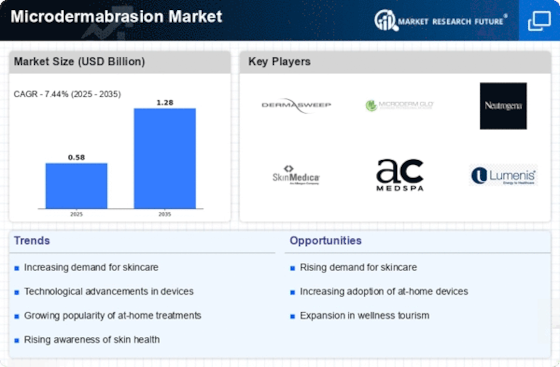
As per Market Research Future analysis, the Microdermabrasion Market Size was estimated at 0.58 USD Billion in 2024. The Microdermabrasion industry is projected to grow from USD 0.6232 Billion in 2025 to USD 1.277 Billion by 2035, exhibiting a compound annual growth rate (CAGR) of 7.44% during the forecast period 2025 - 2035

Key Market Trends & Highlights

The Microdermabrasion Market is experiencing robust growth driven by technological advancements and increasing consumer awareness.

  • The demand for non-invasive treatments is rising, particularly in North America, which remains the largest market. Technological advancements in microdermabrasion devices are enhancing treatment efficacy and user experience. The Asia-Pacific region is emerging as the fastest-growing market, fueled by a burgeoning interest in wellness and self-care. Key market drivers include the increasing awareness of skin health and the expansion of aesthetic clinics, particularly influencing the diamond microdermabrasion segment.

Market Size & Forecast

2024 Market Size 0.58 (USD Billion)
2035 Market Size 1.277 (USD Billion)
CAGR (2025 - 2035) 7.44%
Largest Regional Market Share in 2024 North America

Major Players

DermaSweep (US), DiamondTome (US), <a href="https://microdermglo.com/?srsltid=AfmBOorJZYqlJ0LRkn-PLH7FrHtd4MJ8lG_06EO7P6fRnsH07XPonMo7">Microderm GLO</a> (US), Neutrogena (US), SkinMedica (US), Aestheticare (US), Lumenis (IL), Allergan (US), Galderma (CH)

Market Trends

The Microdermabrasion Market is currently experiencing a notable evolution, driven by increasing consumer awareness regarding skin health and aesthetics. This market appears to be expanding as individuals seek non-invasive solutions for skin rejuvenation. The rise in demand for effective skincare treatments, coupled with advancements in technology, suggests a promising future for microdermabrasion devices and services. Furthermore, the growing trend of self-care and wellness among consumers indicates a shift towards prioritizing personal grooming and skincare routines. As a result, various stakeholders, including manufacturers and service providers, are likely to adapt their offerings to meet the changing preferences of consumers. In addition, the Microdermabrasion Market seems to be influenced by the rising popularity of beauty clinics and spas that offer specialized treatments. This trend indicates a potential increase in the availability of microdermabrasion services, making them more accessible to a broader audience. Moreover, the integration of innovative technologies, such as at-home microdermabrasion devices, may further enhance consumer engagement and satisfaction. Overall, the market appears poised for growth, driven by evolving consumer behaviors and technological advancements that cater to the desire for effective skincare solutions.

Rising Demand for Non-Invasive Treatments

The Microdermabrasion Market is witnessing a surge in interest for non-invasive skincare solutions. Consumers increasingly prefer treatments that offer visible results without the need for surgical procedures. This trend reflects a broader shift towards safer, less invasive options in the beauty industry.

Technological Advancements in Devices

Innovations in microdermabrasion technology are shaping the market landscape. Newer devices are being developed with enhanced features, such as adjustable suction levels and improved exfoliation techniques. These advancements are likely to attract a wider consumer base, including those seeking at-home solutions.

Growth of Wellness and Self-Care Trends

The Microdermabrasion Market is benefiting from the growing emphasis on wellness and self-care. As individuals prioritize their skincare routines, the demand for effective treatments is expected to rise. This trend may lead to increased investment in both professional services and home-use devices.

Microdermabrasion Market Market Drivers

Growing Aging Population

The aging population is a critical factor influencing the Microdermabrasion Market. As individuals age, they often seek solutions to combat signs of aging, such as fine lines and uneven skin texture. Microdermabrasion Market offers a non-invasive option that appeals to this demographic, providing visible results without the need for surgical intervention. Data indicates that the population aged 65 and older is expected to double by 2050, creating a substantial market for anti-aging treatments. This demographic shift is likely to drive demand for microdermabrasion services and products, thereby enhancing the overall growth of the Microdermabrasion Market.

Expansion of Aesthetic Clinics

The proliferation of aesthetic clinics and dermatology practices is a notable driver in the Microdermabrasion Market. As more clinics offer specialized skincare services, the accessibility of microdermabrasion treatments increases. This expansion is supported by a growing number of trained professionals who can perform these procedures safely and effectively. According to recent data, the number of aesthetic clinics has increased by over 20% in the past five years, indicating a robust market environment. This growth not only enhances consumer access but also fosters competition, leading to improved service offerings and pricing strategies within the Microdermabrasion Market.

Increasing Awareness of Skin Health

The Microdermabrasion Market is experiencing a surge in consumer awareness regarding skin health and aesthetics. As individuals become more informed about skincare, there is a growing inclination towards non-invasive procedures that enhance skin appearance. This trend is reflected in the rising sales of microdermabrasion devices and services, with the market projected to reach approximately USD 1.5 billion by 2026. Consumers are increasingly seeking treatments that offer immediate results with minimal downtime, which microdermabrasion effectively provides. This heightened awareness is likely to drive demand for both at-home devices and professional treatments, thereby expanding the Microdermabrasion Market significantly.

Rising Popularity of At-Home Devices

The Microdermabrasion Market is witnessing a notable shift towards at-home skincare solutions. With advancements in technology, manufacturers are developing user-friendly microdermabrasion devices that allow consumers to perform treatments in the comfort of their homes. This trend is particularly appealing to younger demographics who prioritize convenience and cost-effectiveness. Market analysis suggests that the at-home segment could account for nearly 40% of the total market share by 2027. As consumers increasingly seek effective yet affordable skincare options, the demand for at-home microdermabrasion devices is likely to propel the Microdermabrasion Market forward.

Influence of Social Media and Beauty Trends

The impact of social media on beauty standards and trends is a significant driver for the Microdermabrasion Market. Platforms such as Instagram and TikTok have popularized skincare routines that include microdermabrasion, leading to increased consumer interest. Influencers and beauty experts often showcase the benefits of these treatments, which can lead to a rapid increase in demand. This phenomenon is further supported by the rise of beauty-related content, which has been shown to influence purchasing decisions. As social media continues to shape consumer behavior, the Microdermabrasion Market is likely to benefit from heightened visibility and engagement.

Market Segment Insights

By Type: Diamond Microdermabrasion (Largest) vs. Crystal Microdermabrasion (Fastest-Growing)

<p>In the Microdermabrasion Market, the distribution of market share reveals that Diamond Microdermabrasion holds the largest share, primarily due to its high effectiveness and growing popularity among professionals and consumers alike. This type is often preferred for its precision and the ability to offer a more controlled treatment. Conversely, Crystal Microdermabrasion, while currently smaller in market share, is witnessing a significant rise in consumer interest and adoption, driven by its accessibility and lower cost.</p>

<p>Microdermabrasion Type: Diamond (Dominant) vs. Crystal (Emerging)</p>

<p>Diamond Microdermabrasion stands out as the dominant type in the market, celebrated for its ability to provide a thorough and safe exfoliation, making it suitable for various skin types. Professionals favor this method for its effectiveness in treating skin imperfections, including scars and fine lines. On the other hand, Crystal Microdermabrasion is considered an emerging alternative, gaining traction thanks to its simpler technology and cost-effectiveness. It employs aluminum oxide crystals to exfoliate the skin, which appeals to budget-conscious consumers and professionals looking for economical solutions. The rising awareness of skincare has fueled the growth of both types, positioning them strategically in a competitive landscape.</p>

By Component: Microdermabrasion Machines (Largest) vs. Microdermabrasion Crystals (Fastest-Growing)

<p>In the Microdermabrasion Market, the segment is predominantly driven by Microdermabrasion Machines, which hold the largest share. These machines offer professional-grade skincare solutions and are favored by both dermatologists and consumers for their effectiveness in skin rejuvenation. Following closely are Microdermabrasion Crystals, which are rapidly gaining traction among users for at-home treatments and are recognized for their affordability and ease of use. Moreover, Microdermabrasion Tips and Creams & Scrubs also play essential roles, though they contribute comparatively less to the overall market share.</p>

<p>Microdermabrasion Machines (Dominant) vs. Microdermabrasion Crystals (Emerging)</p>

<p>Microdermabrasion Machines are renowned for their efficiency and professional results, making them the dominant choice in clinics and beauty centers, where skincare professionals prefer their reliability. In contrast, Microdermabrasion Crystals are becoming an emerging favorite for consumers seeking at-home options, thanks to their user-friendly nature and low-cost appeal. This segment's growth is driven by increasing consumer awareness of skin health, a shift towards self-care practices, and the rising popularity of DIY skincare. While Machines cater to the high-end market, Crystals are democratizing access to microdermabrasion treatments, appealing to a broader audience.</p>

By Indication: Acne & Trauma Scars (Largest) vs. Hyperpigmentation (Fastest-Growing)

<p>In the Microdermabrasion Market, the segment for Acne & Trauma Scars holds a substantial share, driven by increasing awareness and demand for effective skin treatments. On the other hand, the Hyperpigmentation segment, benefitting from a surge in skincare consciousness, especially among the younger demographics, has been gaining considerable traction. While Acne & Trauma Scars have remained a staple in microdermabrasion applications owing to their established efficacy, the growing trend of personalized skincare is pushing Hyperpigmentation solutions to the forefront.</p>

<p>Acne & Trauma Scars (Dominant) vs. Hyperpigmentation (Emerging)</p>

<p>The Acne & Trauma Scars segment is characterized by its longstanding presence in the microdermabrasion market, focusing on the effective removal of dead skin layers to promote new cell growth and diminish the appearance of scars. Its dominance is underscored by robust consumer demand and a broad treatment range. Conversely, the Hyperpigmentation segment is emerging rapidly, fueled by rising concerns over skin discoloration and a proactive approach to skincare. This segment attracts younger consumers seeking aesthetic treatments for even skin tone, highlighting a shift in focus towards prevention and treatment of age spots and sun damage.</p>

By End-User: Dermatology Clinics (Largest) vs. Home Care (Fastest-Growing)

<p>In the Microdermabrasion Market, the end-user segment is primarily divided among hospitals, dermatology clinics, and home care applications. Dermatology clinics dominate this space, largely due to their specialized services and ability to offer advanced microdermabrasion treatments. Hospitals also represent a significant portion of the market but tend to focus more on extensive dermatological issues rather than cosmetic procedures. Home care products are still emerging but are gaining traction as consumers seek effective solutions for skin rejuvenation at home. The growth trends in the Microdermabrasion Market are driven by rising consumer awareness about skin care and the increasing demand for non-invasive cosmetic procedures. Dermatology clinics are expanding their offerings to include microdermabrasion, catering to clients seeking effective skin treatments. Meanwhile, the home care segment benefits from advancements in technology that allow consumers to achieve professional-like results from the comfort of their homes, positioning it as the fastest-growing segment within the market.</p>

<p>Dermatology Clinics (Dominant) vs. Home Care (Emerging)</p>

<p>Dermatology clinics play a dominant role in the Microdermabrasion Market by providing professional-grade treatments that are safe and effective. These clinics often employ trained dermatologists who can tailor procedures to individual skin types, maximizing the treatment's efficacy and ensuring patient satisfaction. This segment prioritizes clinical expertise and advanced equipment, making it attractive to clients seeking significant skin improvements. Conversely, the home care segment is emerging rapidly, catering to a growing demographic looking for accessible and convenient skin care solutions. Products designed for home use are typically less invasive and user-friendly, allowing consumers to maintain their skin health between professional treatments. As technology continues to evolve, home care is expected to become increasingly sophisticated, bridging the gap between professional services and home-based skincare routines.</p>

Get more detailed insights about Microdermabrasion Market Research Report - Global Forecast till 2035

Regional Insights

North America : Market Leader in Innovation

North America is the largest market for microdermabrasion, holding approximately 45% of the global share. The region's growth is driven by increasing consumer awareness about skincare, rising disposable incomes, and a growing trend towards non-invasive cosmetic procedures. Regulatory support for aesthetic treatments further fuels demand, with the FDA actively approving new devices and technologies. The United States is the primary contributor, with key players like DermaSweep, DiamondTome, and Neutrogena leading the market. The competitive landscape is characterized by innovation and a focus on advanced technologies. The presence of established brands and a robust distribution network enhances market penetration, making North America a hub for microdermabrasion advancements.

Europe : Emerging Market with Growth Potential

Europe is witnessing significant growth in the microdermabrasion market, accounting for approximately 30% of the global share. Factors such as increasing demand for skincare treatments, a rise in aesthetic procedures, and a growing aging population are driving this expansion. Regulatory bodies in Europe are also promoting safe practices in cosmetic procedures, which enhances consumer confidence and market growth. Leading countries include Germany, France, and the UK, where the presence of key players like Lumenis and Galderma is notable. The competitive landscape is marked by a mix of established brands and emerging companies, focusing on innovative products and services. The region's regulatory framework supports the introduction of new technologies, further boosting market dynamics.

Asia-Pacific : Rapid Growth in Aesthetic Treatments

Asia-Pacific is rapidly emerging as a significant player in the microdermabrasion market, holding about 20% of the global share. The region's growth is driven by increasing disposable incomes, a growing middle class, and heightened awareness of skincare. Additionally, the rise in aesthetic procedures and the influence of social media are propelling demand for microdermabrasion treatments across various demographics. Countries like China, Japan, and Australia are leading the market, with a competitive landscape featuring both local and international brands. Key players such as Allergan and SkinMedica are expanding their presence, focusing on innovative solutions tailored to regional preferences. The market is characterized by a blend of traditional and modern skincare practices, enhancing its appeal to consumers.

Middle East and Africa : Untapped Potential in Skincare

The Middle East and Africa region is gradually emerging in the microdermabrasion market, currently holding about 5% of the global share. The growth is driven by increasing urbanization, rising disposable incomes, and a growing interest in cosmetic procedures. Regulatory frameworks are evolving to support the aesthetic industry, which is crucial for market expansion in this region. Countries like South Africa and the UAE are at the forefront, with a competitive landscape that includes both local and international players. The presence of brands like Microderm GLO and Aestheticare is notable, as they cater to the growing demand for skincare solutions. The market is characterized by a blend of traditional beauty practices and modern treatments, appealing to a diverse consumer base.

Key Players and Competitive Insights

Leading market participants are investing heavily in research and development to develop their product lines, which will allow the microdermabrasion market to grow even more. Market players are also embarking on various strategic activities to develop their footprint ly, with important market developments including new higher investments, product launches, contractual agreements, mergers and acquisitions, and collaboration with other organizations. To develop and survive in a more competitive and advancing market climate, the microdermabrasion industry must deliver cost-effective items.

Manufacturing locally to underestimate operational costs is one of the essential business tactics utilized by manufacturers in the microdermabrasion industry to help clients and improve the market sector. Major players in the microdermabrasion market, including Johnson & Johnson Services Incorporated, Advanced Microderm Incorporated, Procter & Gamble, Koninklijke Philips N.V., Pretika Corporation, and others, are attempting to grow market demand by funding in research and development operations.

Allergan Ltd, a subsidiary of AbbVie Inc, is a specialty pharmaceutical enterprise that develops and markets branded pharmaceuticals and biosimilar and over-the-counter pharmaceutical developments. It delivers products in eye care, dermatology, medical aesthetics, gastroenterology, central nervous system, urology, women's health, and anti-infective therapeutic categories. The enterprise sells its products to retailers, drug wholesalers, and distributors, including national retail drug and food store chains, mail-order retailers, clinics, government agencies, hospitals, and managed healthcare providers such as health maintenance organizations and other institutions.

In March Allergan Plc acquired Envy Medical, Inc., a privately held firm with proprietary skin resurfacing technology.

Allergan's best-in-class Medical Aesthetics portfolio was strengthened due to the acquisition.

Lumenis Ltd is an energy-based medical device company for aesthetic and ophthalmic applications in the domain of minimally invasive clinical explanations. It manufactures and broadcasts medical and aesthetic lasers and light-based procedures. Its primary products contain holmium lasers, reusable fibers, CO2 lasers, laser photocoagulators, multi-wavelength lasers, and other aesthetic devices. The enterprise offers solutions to various medical environments, including aesthetic and ophthalmic procedures. Lumenis has an operational presence and markets its products through subsidiaries through distributors worldwide.

In May 2021, Lumenis announced a partnership with the Harrods wellness clinic in London, United Kingdom, to extend its product portfolio and adopt advanced technologies.

Key Companies in the Microdermabrasion Market include

Industry Developments

January 2022 Galderma, the largest independent dermatology company, announced that it had obtained antitrust approval from the U.S. management and has achieved the acquisition of ALASTIN Skincare, Inc., a specialty aesthetics organization dedicated to creating creative and clinically-tested physician-dispensed skincare products.

November 2021 BioPhotas Inc., a leading manufacturer of medical devices, joined hands with Ulta Beauty, a chain of beauty stores. This partnership would enable Ulta Beauty to expand its skin service offering in salons by including the former's Celluma Series of Light Therapy devices.

July 2021 PMD Beauty launched its personal Microderm at Chippendale Fashion Institute. The device utilizes patented spinning disc technology embedded with aluminum oxide crystals, gently removing the top layer of dull, dead skin.

Future Outlook

Microdermabrasion Market Future Outlook

The Microdermabrasion Market is projected to grow at a 7.44% CAGR from 2025 to 2035, driven by increasing consumer demand for skin rejuvenation and technological advancements.

New opportunities lie in:

  • Expansion of mobile microdermabrasion services in urban areas
  • Development of eco-friendly microdermabrasion products
  • Integration of AI technology for personalized skincare solutions

By 2035, the Microdermabrasion Market is expected to achieve substantial growth and innovation.

Market Segmentation

Microdermabrasion Market Type Outlook

  • Diamond Microdermabrasion
  • Crystal Microdermabrasion

Microdermabrasion Market End-User Outlook

  • Hospitals
  • Dermatology Clinics
  • Home Care

Microdermabrasion Market Component Outlook

  • Microdermabrasion Machines
  • Microdermabrasion Crystals
  • Microdermabrasion Tips
  • Microdermabrasion Creams & Scrubs

Microdermabrasion Market Indication Outlook

  • Acne & Trauma Scars
  • Hyperpigmentation
  • Stretch Marks
  • Photo-Damage

Report Scope

MARKET SIZE 2024 0.58(USD Billion)
MARKET SIZE 2025 0.6232(USD Billion)
MARKET SIZE 2035 1.277(USD Billion)
COMPOUND ANNUAL GROWTH RATE (CAGR) 7.44% (2025 - 2035)
REPORT COVERAGE Revenue Forecast, Competitive Landscape, Growth Factors, and Trends
BASE YEAR 2024
Market Forecast Period 2025 - 2035
Historical Data 2019 - 2024
Market Forecast Units USD Billion
Key Companies Profiled DermaSweep (US), DiamondTome (US), Microderm GLO (US), Neutrogena (US), SkinMedica (US), Aestheticare (US), Lumenis (IL), Allergan (US), Galderma (CH)
Segments Covered Type, Component, Indication, End-User, Region
Key Market Opportunities Integration of advanced technologies enhances efficacy and consumer appeal in the Microdermabrasion Market.
Key Market Dynamics Rising consumer demand for non-invasive skin treatments drives innovation and competition in the microdermabrasion market.
Countries Covered North America, Europe, APAC, South America, MEA

FAQs

What is the current valuation of the Microdermabrasion Market as of 2024?

<p>The Microdermabrasion Market was valued at 0.58 USD Billion in 2024.</p>

What is the projected market size for the Microdermabrasion Market in 2035?

<p>The market is projected to reach 1.277 USD Billion by 2035.</p>

What is the expected CAGR for the Microdermabrasion Market during the forecast period 2025 - 2035?

<p>The expected CAGR for the Microdermabrasion Market during 2025 - 2035 is 7.44%.</p>

Which companies are considered key players in the Microdermabrasion Market?

<p>Key players include DermaSweep, DiamondTome, Microderm GLO, Neutrogena, SkinMedica, Aestheticare, Lumenis, Allergan, and Galderma.</p>

What are the main types of microdermabrasion techniques available in the market?

<p>The main types are Diamond Microdermabrasion and Crystal Microdermabrasion, valued at 0.348 and 0.232 USD Billion respectively in 2024.</p>

What components contribute to the Microdermabrasion Market's valuation?

<p>Components include Microdermabrasion Machines, Crystals, Tips, and Creams & Scrubs, with total values ranging from 0.1 to 0.45 USD Billion.</p>

What indications are driving the demand for microdermabrasion treatments?

<p>Demand is driven by indications such as Acne & Trauma Scars, Hyperpigmentation, Stretch Marks, and Photo-Damage, with values from 0.08 to 0.42 USD Billion.</p>

Which end-users are primarily utilizing microdermabrasion services?

<p>End-users include Hospitals, Dermatology Clinics, and Home Care, with market values ranging from 0.13 to 0.6 USD Billion.</p>

How does the market for microdermabrasion machines compare to other components?

Microdermabrasion Machines are valued at 0.2 to 0.45 USD Billion, indicating a strong demand compared to other components.

What trends are expected to shape the Microdermabrasion Market in the coming years?

Trends may include increased consumer awareness and technological advancements, potentially driving growth through 2035.

  1. SECTION I: EXECUTIVE SUMMARY AND KEY HIGHLIGHTS
    1. | 1.1 EXECUTIVE SUMMARY
    2. | | 1.1.1 Market Overview
    3. | | 1.1.2 Key Findings
    4. | | 1.1.3 Market Segmentation
    5. | | 1.1.4 Competitive Landscape
    6. | | 1.1.5 Challenges and Opportunities
    7. | | 1.1.6 Future Outlook
  2. SECTION II: SCOPING, METHODOLOGY AND MARKET STRUCTURE
    1. | 2.1 MARKET INTRODUCTION
    2. | | 2.1.1 Definition
    3. | | 2.1.2 Scope of the study
    4. | | | 2.1.2.1 Research Objective
    5. | | | 2.1.2.2 Assumption
    6. | | | 2.1.2.3 Limitations
    7. | 2.2 RESEARCH METHODOLOGY
    8. | | 2.2.1 Overview
    9. | | 2.2.2 Data Mining
    10. | | 2.2.3 Secondary Research
    11. | | 2.2.4 Primary Research
    12. | | | 2.2.4.1 Primary Interviews and Information Gathering Process
    13. | | | 2.2.4.2 Breakdown of Primary Respondents
    14. | | 2.2.5 Forecasting Model
    15. | | 2.2.6 Market Size Estimation
    16. | | | 2.2.6.1 Bottom-Up Approach
    17. | | | 2.2.6.2 Top-Down Approach
    18. | | 2.2.7 Data Triangulation
    19. | | 2.2.8 Validation
  3. SECTION III: QUALITATIVE ANALYSIS
    1. | 3.1 MARKET DYNAMICS
    2. | | 3.1.1 Overview
    3. | | 3.1.2 Drivers
    4. | | 3.1.3 Restraints
    5. | | 3.1.4 Opportunities
    6. | 3.2 MARKET FACTOR ANALYSIS
    7. | | 3.2.1 Value chain Analysis
    8. | | 3.2.2 Porter's Five Forces Analysis
    9. | | | 3.2.2.1 Bargaining Power of Suppliers
    10. | | | 3.2.2.2 Bargaining Power of Buyers
    11. | | | 3.2.2.3 Threat of New Entrants
    12. | | | 3.2.2.4 Threat of Substitutes
    13. | | | 3.2.2.5 Intensity of Rivalry
    14. | | 3.2.3 COVID-19 Impact Analysis
    15. | | | 3.2.3.1 Market Impact Analysis
    16. | | | 3.2.3.2 Regional Impact
    17. | | | 3.2.3.3 Opportunity and Threat Analysis
  4. SECTION IV: QUANTITATIVE ANALYSIS
    1. | 4.1 Healthcare, BY Type (USD Billion)
    2. | | 4.1.1 Diamond Microdermabrasion
    3. | | 4.1.2 Crystal Microdermabrasion
    4. | 4.2 Healthcare, BY Component (USD Billion)
    5. | | 4.2.1 Microdermabrasion Machines
    6. | | 4.2.2 Microdermabrasion Crystals
    7. | | 4.2.3 Microdermabrasion Tips
    8. | | 4.2.4 Microdermabrasion Creams & Scrubs
    9. | 4.3 Healthcare, BY Indication (USD Billion)
    10. | | 4.3.1 Acne & Trauma Scars
    11. | | 4.3.2 Hyperpigmentation
    12. | | 4.3.3 Stretch Marks
    13. | | 4.3.4 Photo-Damage
    14. | 4.4 Healthcare, BY End-User (USD Billion)
    15. | | 4.4.1 Hospitals
    16. | | 4.4.2 Dermatology Clinics
    17. | | 4.4.3 Home Care
    18. | 4.5 Healthcare, BY Region (USD Billion)
    19. | | 4.5.1 North America
    20. | | | 4.5.1.1 US
    21. | | | 4.5.1.2 Canada
    22. | | 4.5.2 Europe
    23. | | | 4.5.2.1 Germany
    24. | | | 4.5.2.2 UK
    25. | | | 4.5.2.3 France
    26. | | | 4.5.2.4 Russia
    27. | | | 4.5.2.5 Italy
    28. | | | 4.5.2.6 Spain
    29. | | | 4.5.2.7 Rest of Europe
    30. | | 4.5.3 APAC
    31. | | | 4.5.3.1 China
    32. | | | 4.5.3.2 India
    33. | | | 4.5.3.3 Japan
    34. | | | 4.5.3.4 South Korea
    35. | | | 4.5.3.5 Malaysia
    36. | | | 4.5.3.6 Thailand
    37. | | | 4.5.3.7 Indonesia
    38. | | | 4.5.3.8 Rest of APAC
    39. | | 4.5.4 South America
    40. | | | 4.5.4.1 Brazil
    41. | | | 4.5.4.2 Mexico
    42. | | | 4.5.4.3 Argentina
    43. | | | 4.5.4.4 Rest of South America
    44. | | 4.5.5 MEA
    45. | | | 4.5.5.1 GCC Countries
    46. | | | 4.5.5.2 South Africa
    47. | | | 4.5.5.3 Rest of MEA
  5. SECTION V: COMPETITIVE ANALYSIS
    1. | 5.1 Competitive Landscape
    2. | | 5.1.1 Overview
    3. | | 5.1.2 Competitive Analysis
    4. | | 5.1.3 Market share Analysis
    5. | | 5.1.4 Major Growth Strategy in the Healthcare
    6. | | 5.1.5 Competitive Benchmarking
    7. | | 5.1.6 Leading Players in Terms of Number of Developments in the Healthcare
    8. | | 5.1.7 Key developments and growth strategies
    9. | | | 5.1.7.1 New Product Launch/Service Deployment
    10. | | | 5.1.7.2 Merger & Acquisitions
    11. | | | 5.1.7.3 Joint Ventures
    12. | | 5.1.8 Major Players Financial Matrix
    13. | | | 5.1.8.1 Sales and Operating Income
    14. | | | 5.1.8.2 Major Players R&D Expenditure. 2023
    15. | 5.2 Company Profiles
    16. | | 5.2.1 DermaSweep (US)
    17. | | | 5.2.1.1 Financial Overview
    18. | | | 5.2.1.2 Products Offered
    19. | | | 5.2.1.3 Key Developments
    20. | | | 5.2.1.4 SWOT Analysis
    21. | | | 5.2.1.5 Key Strategies
    22. | | 5.2.2 DiamondTome (US)
    23. | | | 5.2.2.1 Financial Overview
    24. | | | 5.2.2.2 Products Offered
    25. | | | 5.2.2.3 Key Developments
    26. | | | 5.2.2.4 SWOT Analysis
    27. | | | 5.2.2.5 Key Strategies
    28. | | 5.2.3 Microderm GLO (US)
    29. | | | 5.2.3.1 Financial Overview
    30. | | | 5.2.3.2 Products Offered
    31. | | | 5.2.3.3 Key Developments
    32. | | | 5.2.3.4 SWOT Analysis
    33. | | | 5.2.3.5 Key Strategies
    34. | | 5.2.4 Neutrogena (US)
    35. | | | 5.2.4.1 Financial Overview
    36. | | | 5.2.4.2 Products Offered
    37. | | | 5.2.4.3 Key Developments
    38. | | | 5.2.4.4 SWOT Analysis
    39. | | | 5.2.4.5 Key Strategies
    40. | | 5.2.5 SkinMedica (US)
    41. | | | 5.2.5.1 Financial Overview
    42. | | | 5.2.5.2 Products Offered
    43. | | | 5.2.5.3 Key Developments
    44. | | | 5.2.5.4 SWOT Analysis
    45. | | | 5.2.5.5 Key Strategies
    46. | | 5.2.6 Aestheticare (US)
    47. | | | 5.2.6.1 Financial Overview
    48. | | | 5.2.6.2 Products Offered
    49. | | | 5.2.6.3 Key Developments
    50. | | | 5.2.6.4 SWOT Analysis
    51. | | | 5.2.6.5 Key Strategies
    52. | | 5.2.7 Lumenis (IL)
    53. | | | 5.2.7.1 Financial Overview
    54. | | | 5.2.7.2 Products Offered
    55. | | | 5.2.7.3 Key Developments
    56. | | | 5.2.7.4 SWOT Analysis
    57. | | | 5.2.7.5 Key Strategies
    58. | | 5.2.8 Allergan (US)
    59. | | | 5.2.8.1 Financial Overview
    60. | | | 5.2.8.2 Products Offered
    61. | | | 5.2.8.3 Key Developments
    62. | | | 5.2.8.4 SWOT Analysis
    63. | | | 5.2.8.5 Key Strategies
    64. | | 5.2.9 Galderma (CH)
    65. | | | 5.2.9.1 Financial Overview
    66. | | | 5.2.9.2 Products Offered
    67. | | | 5.2.9.3 Key Developments
    68. | | | 5.2.9.4 SWOT Analysis
    69. | | | 5.2.9.5 Key Strategies
    70. | 5.3 Appendix
    71. | | 5.3.1 References
    72. | | 5.3.2 Related Reports
  6. LIST OF FIGURES
    1. | 6.1 MARKET SYNOPSIS
    2. | 6.2 NORTH AMERICA MARKET ANALYSIS
    3. | 6.3 US MARKET ANALYSIS BY TYPE
    4. | 6.4 US MARKET ANALYSIS BY COMPONENT
    5. | 6.5 US MARKET ANALYSIS BY INDICATION
    6. | 6.6 US MARKET ANALYSIS BY END-USER
    7. | 6.7 CANADA MARKET ANALYSIS BY TYPE
    8. | 6.8 CANADA MARKET ANALYSIS BY COMPONENT
    9. | 6.9 CANADA MARKET ANALYSIS BY INDICATION
    10. | 6.10 CANADA MARKET ANALYSIS BY END-USER
    11. | 6.11 EUROPE MARKET ANALYSIS
    12. | 6.12 GERMANY MARKET ANALYSIS BY TYPE
    13. | 6.13 GERMANY MARKET ANALYSIS BY COMPONENT
    14. | 6.14 GERMANY MARKET ANALYSIS BY INDICATION
    15. | 6.15 GERMANY MARKET ANALYSIS BY END-USER
    16. | 6.16 UK MARKET ANALYSIS BY TYPE
    17. | 6.17 UK MARKET ANALYSIS BY COMPONENT
    18. | 6.18 UK MARKET ANALYSIS BY INDICATION
    19. | 6.19 UK MARKET ANALYSIS BY END-USER
    20. | 6.20 FRANCE MARKET ANALYSIS BY TYPE
    21. | 6.21 FRANCE MARKET ANALYSIS BY COMPONENT
    22. | 6.22 FRANCE MARKET ANALYSIS BY INDICATION
    23. | 6.23 FRANCE MARKET ANALYSIS BY END-USER
    24. | 6.24 RUSSIA MARKET ANALYSIS BY TYPE
    25. | 6.25 RUSSIA MARKET ANALYSIS BY COMPONENT
    26. | 6.26 RUSSIA MARKET ANALYSIS BY INDICATION
    27. | 6.27 RUSSIA MARKET ANALYSIS BY END-USER
    28. | 6.28 ITALY MARKET ANALYSIS BY TYPE
    29. | 6.29 ITALY MARKET ANALYSIS BY COMPONENT
    30. | 6.30 ITALY MARKET ANALYSIS BY INDICATION
    31. | 6.31 ITALY MARKET ANALYSIS BY END-USER
    32. | 6.32 SPAIN MARKET ANALYSIS BY TYPE
    33. | 6.33 SPAIN MARKET ANALYSIS BY COMPONENT
    34. | 6.34 SPAIN MARKET ANALYSIS BY INDICATION
    35. | 6.35 SPAIN MARKET ANALYSIS BY END-USER
    36. | 6.36 REST OF EUROPE MARKET ANALYSIS BY TYPE
    37. | 6.37 REST OF EUROPE MARKET ANALYSIS BY COMPONENT
    38. | 6.38 REST OF EUROPE MARKET ANALYSIS BY INDICATION
    39. | 6.39 REST OF EUROPE MARKET ANALYSIS BY END-USER
    40. | 6.40 APAC MARKET ANALYSIS
    41. | 6.41 CHINA MARKET ANALYSIS BY TYPE
    42. | 6.42 CHINA MARKET ANALYSIS BY COMPONENT
    43. | 6.43 CHINA MARKET ANALYSIS BY INDICATION
    44. | 6.44 CHINA MARKET ANALYSIS BY END-USER
    45. | 6.45 INDIA MARKET ANALYSIS BY TYPE
    46. | 6.46 INDIA MARKET ANALYSIS BY COMPONENT
    47. | 6.47 INDIA MARKET ANALYSIS BY INDICATION
    48. | 6.48 INDIA MARKET ANALYSIS BY END-USER
    49. | 6.49 JAPAN MARKET ANALYSIS BY TYPE
    50. | 6.50 JAPAN MARKET ANALYSIS BY COMPONENT
    51. | 6.51 JAPAN MARKET ANALYSIS BY INDICATION
    52. | 6.52 JAPAN MARKET ANALYSIS BY END-USER
    53. | 6.53 SOUTH KOREA MARKET ANALYSIS BY TYPE
    54. | 6.54 SOUTH KOREA MARKET ANALYSIS BY COMPONENT
    55. | 6.55 SOUTH KOREA MARKET ANALYSIS BY INDICATION
    56. | 6.56 SOUTH KOREA MARKET ANALYSIS BY END-USER
    57. | 6.57 MALAYSIA MARKET ANALYSIS BY TYPE
    58. | 6.58 MALAYSIA MARKET ANALYSIS BY COMPONENT
    59. | 6.59 MALAYSIA MARKET ANALYSIS BY INDICATION
    60. | 6.60 MALAYSIA MARKET ANALYSIS BY END-USER
    61. | 6.61 THAILAND MARKET ANALYSIS BY TYPE
    62. | 6.62 THAILAND MARKET ANALYSIS BY COMPONENT
    63. | 6.63 THAILAND MARKET ANALYSIS BY INDICATION
    64. | 6.64 THAILAND MARKET ANALYSIS BY END-USER
    65. | 6.65 INDONESIA MARKET ANALYSIS BY TYPE
    66. | 6.66 INDONESIA MARKET ANALYSIS BY COMPONENT
    67. | 6.67 INDONESIA MARKET ANALYSIS BY INDICATION
    68. | 6.68 INDONESIA MARKET ANALYSIS BY END-USER
    69. | 6.69 REST OF APAC MARKET ANALYSIS BY TYPE
    70. | 6.70 REST OF APAC MARKET ANALYSIS BY COMPONENT
    71. | 6.71 REST OF APAC MARKET ANALYSIS BY INDICATION
    72. | 6.72 REST OF APAC MARKET ANALYSIS BY END-USER
    73. | 6.73 SOUTH AMERICA MARKET ANALYSIS
    74. | 6.74 BRAZIL MARKET ANALYSIS BY TYPE
    75. | 6.75 BRAZIL MARKET ANALYSIS BY COMPONENT
    76. | 6.76 BRAZIL MARKET ANALYSIS BY INDICATION
    77. | 6.77 BRAZIL MARKET ANALYSIS BY END-USER
    78. | 6.78 MEXICO MARKET ANALYSIS BY TYPE
    79. | 6.79 MEXICO MARKET ANALYSIS BY COMPONENT
    80. | 6.80 MEXICO MARKET ANALYSIS BY INDICATION
    81. | 6.81 MEXICO MARKET ANALYSIS BY END-USER
    82. | 6.82 ARGENTINA MARKET ANALYSIS BY TYPE
    83. | 6.83 ARGENTINA MARKET ANALYSIS BY COMPONENT
    84. | 6.84 ARGENTINA MARKET ANALYSIS BY INDICATION
    85. | 6.85 ARGENTINA MARKET ANALYSIS BY END-USER
    86. | 6.86 REST OF SOUTH AMERICA MARKET ANALYSIS BY TYPE
    87. | 6.87 REST OF SOUTH AMERICA MARKET ANALYSIS BY COMPONENT
    88. | 6.88 REST OF SOUTH AMERICA MARKET ANALYSIS BY INDICATION
    89. | 6.89 REST OF SOUTH AMERICA MARKET ANALYSIS BY END-USER
    90. | 6.90 MEA MARKET ANALYSIS
    91. | 6.91 GCC COUNTRIES MARKET ANALYSIS BY TYPE
    92. | 6.92 GCC COUNTRIES MARKET ANALYSIS BY COMPONENT
    93. | 6.93 GCC COUNTRIES MARKET ANALYSIS BY INDICATION
    94. | 6.94 GCC COUNTRIES MARKET ANALYSIS BY END-USER
    95. | 6.95 SOUTH AFRICA MARKET ANALYSIS BY TYPE
    96. | 6.96 SOUTH AFRICA MARKET ANALYSIS BY COMPONENT
    97. | 6.97 SOUTH AFRICA MARKET ANALYSIS BY INDICATION
    98. | 6.98 SOUTH AFRICA MARKET ANALYSIS BY END-USER
    99. | 6.99 REST OF MEA MARKET ANALYSIS BY TYPE
    100. | 6.100 REST OF MEA MARKET ANALYSIS BY COMPONENT
    101. | 6.101 REST OF MEA MARKET ANALYSIS BY INDICATION
    102. | 6.102 REST OF MEA MARKET ANALYSIS BY END-USER
    103. | 6.103 KEY BUYING CRITERIA OF HEALTHCARE
    104. | 6.104 RESEARCH PROCESS OF MRFR
    105. | 6.105 DRO ANALYSIS OF HEALTHCARE
    106. | 6.106 DRIVERS IMPACT ANALYSIS: HEALTHCARE
    107. | 6.107 RESTRAINTS IMPACT ANALYSIS: HEALTHCARE
    108. | 6.108 SUPPLY / VALUE CHAIN: HEALTHCARE
    109. | 6.109 HEALTHCARE, BY TYPE, 2024 (% SHARE)
    110. | 6.110 HEALTHCARE, BY TYPE, 2024 TO 2035 (USD Billion)
    111. | 6.111 HEALTHCARE, BY COMPONENT, 2024 (% SHARE)
    112. | 6.112 HEALTHCARE, BY COMPONENT, 2024 TO 2035 (USD Billion)
    113. | 6.113 HEALTHCARE, BY INDICATION, 2024 (% SHARE)
    114. | 6.114 HEALTHCARE, BY INDICATION, 2024 TO 2035 (USD Billion)
    115. | 6.115 HEALTHCARE, BY END-USER, 2024 (% SHARE)
    116. | 6.116 HEALTHCARE, BY END-USER, 2024 TO 2035 (USD Billion)
    117. | 6.117 BENCHMARKING OF MAJOR COMPETITORS
  7. LIST OF TABLES
    1. | 7.1 LIST OF ASSUMPTIONS
    2. | | 7.1.1
    3. | 7.2 North America MARKET SIZE ESTIMATES; FORECAST
    4. | | 7.2.1 BY TYPE, 2025-2035 (USD Billion)
    5. | | 7.2.2 BY COMPONENT, 2025-2035 (USD Billion)
    6. | | 7.2.3 BY INDICATION, 2025-2035 (USD Billion)
    7. | | 7.2.4 BY END-USER, 2025-2035 (USD Billion)
    8. | 7.3 US MARKET SIZE ESTIMATES; FORECAST
    9. | | 7.3.1 BY TYPE, 2025-2035 (USD Billion)
    10. | | 7.3.2 BY COMPONENT, 2025-2035 (USD Billion)
    11. | | 7.3.3 BY INDICATION, 2025-2035 (USD Billion)
    12. | | 7.3.4 BY END-USER, 2025-2035 (USD Billion)
    13. | 7.4 Canada MARKET SIZE ESTIMATES; FORECAST
    14. | | 7.4.1 BY TYPE, 2025-2035 (USD Billion)
    15. | | 7.4.2 BY COMPONENT, 2025-2035 (USD Billion)
    16. | | 7.4.3 BY INDICATION, 2025-2035 (USD Billion)
    17. | | 7.4.4 BY END-USER, 2025-2035 (USD Billion)
    18. | 7.5 Europe MARKET SIZE ESTIMATES; FORECAST
    19. | | 7.5.1 BY TYPE, 2025-2035 (USD Billion)
    20. | | 7.5.2 BY COMPONENT, 2025-2035 (USD Billion)
    21. | | 7.5.3 BY INDICATION, 2025-2035 (USD Billion)
    22. | | 7.5.4 BY END-USER, 2025-2035 (USD Billion)
    23. | 7.6 Germany MARKET SIZE ESTIMATES; FORECAST
    24. | | 7.6.1 BY TYPE, 2025-2035 (USD Billion)
    25. | | 7.6.2 BY COMPONENT, 2025-2035 (USD Billion)
    26. | | 7.6.3 BY INDICATION, 2025-2035 (USD Billion)
    27. | | 7.6.4 BY END-USER, 2025-2035 (USD Billion)
    28. | 7.7 UK MARKET SIZE ESTIMATES; FORECAST
    29. | | 7.7.1 BY TYPE, 2025-2035 (USD Billion)
    30. | | 7.7.2 BY COMPONENT, 2025-2035 (USD Billion)
    31. | | 7.7.3 BY INDICATION, 2025-2035 (USD Billion)
    32. | | 7.7.4 BY END-USER, 2025-2035 (USD Billion)
    33. | 7.8 France MARKET SIZE ESTIMATES; FORECAST
    34. | | 7.8.1 BY TYPE, 2025-2035 (USD Billion)
    35. | | 7.8.2 BY COMPONENT, 2025-2035 (USD Billion)
    36. | | 7.8.3 BY INDICATION, 2025-2035 (USD Billion)
    37. | | 7.8.4 BY END-USER, 2025-2035 (USD Billion)
    38. | 7.9 Russia MARKET SIZE ESTIMATES; FORECAST
    39. | | 7.9.1 BY TYPE, 2025-2035 (USD Billion)
    40. | | 7.9.2 BY COMPONENT, 2025-2035 (USD Billion)
    41. | | 7.9.3 BY INDICATION, 2025-2035 (USD Billion)
    42. | | 7.9.4 BY END-USER, 2025-2035 (USD Billion)
    43. | 7.10 Italy MARKET SIZE ESTIMATES; FORECAST
    44. | | 7.10.1 BY TYPE, 2025-2035 (USD Billion)
    45. | | 7.10.2 BY COMPONENT, 2025-2035 (USD Billion)
    46. | | 7.10.3 BY INDICATION, 2025-2035 (USD Billion)
    47. | | 7.10.4 BY END-USER, 2025-2035 (USD Billion)
    48. | 7.11 Spain MARKET SIZE ESTIMATES; FORECAST
    49. | | 7.11.1 BY TYPE, 2025-2035 (USD Billion)
    50. | | 7.11.2 BY COMPONENT, 2025-2035 (USD Billion)
    51. | | 7.11.3 BY INDICATION, 2025-2035 (USD Billion)
    52. | | 7.11.4 BY END-USER, 2025-2035 (USD Billion)
    53. | 7.12 Rest of Europe MARKET SIZE ESTIMATES; FORECAST
    54. | | 7.12.1 BY TYPE, 2025-2035 (USD Billion)
    55. | | 7.12.2 BY COMPONENT, 2025-2035 (USD Billion)
    56. | | 7.12.3 BY INDICATION, 2025-2035 (USD Billion)
    57. | | 7.12.4 BY END-USER, 2025-2035 (USD Billion)
    58. | 7.13 APAC MARKET SIZE ESTIMATES; FORECAST
    59. | | 7.13.1 BY TYPE, 2025-2035 (USD Billion)
    60. | | 7.13.2 BY COMPONENT, 2025-2035 (USD Billion)
    61. | | 7.13.3 BY INDICATION, 2025-2035 (USD Billion)
    62. | | 7.13.4 BY END-USER, 2025-2035 (USD Billion)
    63. | 7.14 China MARKET SIZE ESTIMATES; FORECAST
    64. | | 7.14.1 BY TYPE, 2025-2035 (USD Billion)
    65. | | 7.14.2 BY COMPONENT, 2025-2035 (USD Billion)
    66. | | 7.14.3 BY INDICATION, 2025-2035 (USD Billion)
    67. | | 7.14.4 BY END-USER, 2025-2035 (USD Billion)
    68. | 7.15 India MARKET SIZE ESTIMATES; FORECAST
    69. | | 7.15.1 BY TYPE, 2025-2035 (USD Billion)
    70. | | 7.15.2 BY COMPONENT, 2025-2035 (USD Billion)
    71. | | 7.15.3 BY INDICATION, 2025-2035 (USD Billion)
    72. | | 7.15.4 BY END-USER, 2025-2035 (USD Billion)
    73. | 7.16 Japan MARKET SIZE ESTIMATES; FORECAST
    74. | | 7.16.1 BY TYPE, 2025-2035 (USD Billion)
    75. | | 7.16.2 BY COMPONENT, 2025-2035 (USD Billion)
    76. | | 7.16.3 BY INDICATION, 2025-2035 (USD Billion)
    77. | | 7.16.4 BY END-USER, 2025-2035 (USD Billion)
    78. | 7.17 South Korea MARKET SIZE ESTIMATES; FORECAST
    79. | | 7.17.1 BY TYPE, 2025-2035 (USD Billion)
    80. | | 7.17.2 BY COMPONENT, 2025-2035 (USD Billion)
    81. | | 7.17.3 BY INDICATION, 2025-2035 (USD Billion)
    82. | | 7.17.4 BY END-USER, 2025-2035 (USD Billion)
    83. | 7.18 Malaysia MARKET SIZE ESTIMATES; FORECAST
    84. | | 7.18.1 BY TYPE, 2025-2035 (USD Billion)
    85. | | 7.18.2 BY COMPONENT, 2025-2035 (USD Billion)
    86. | | 7.18.3 BY INDICATION, 2025-2035 (USD Billion)
    87. | | 7.18.4 BY END-USER, 2025-2035 (USD Billion)
    88. | 7.19 Thailand MARKET SIZE ESTIMATES; FORECAST
    89. | | 7.19.1 BY TYPE, 2025-2035 (USD Billion)
    90. | | 7.19.2 BY COMPONENT, 2025-2035 (USD Billion)
    91. | | 7.19.3 BY INDICATION, 2025-2035 (USD Billion)
    92. | | 7.19.4 BY END-USER, 2025-2035 (USD Billion)
    93. | 7.20 Indonesia MARKET SIZE ESTIMATES; FORECAST
    94. | | 7.20.1 BY TYPE, 2025-2035 (USD Billion)
    95. | | 7.20.2 BY COMPONENT, 2025-2035 (USD Billion)
    96. | | 7.20.3 BY INDICATION, 2025-2035 (USD Billion)
    97. | | 7.20.4 BY END-USER, 2025-2035 (USD Billion)
    98. | 7.21 Rest of APAC MARKET SIZE ESTIMATES; FORECAST
    99. | | 7.21.1 BY TYPE, 2025-2035 (USD Billion)
    100. | | 7.21.2 BY COMPONENT, 2025-2035 (USD Billion)
    101. | | 7.21.3 BY INDICATION, 2025-2035 (USD Billion)
    102. | | 7.21.4 BY END-USER, 2025-2035 (USD Billion)
    103. | 7.22 South America MARKET SIZE ESTIMATES; FORECAST
    104. | | 7.22.1 BY TYPE, 2025-2035 (USD Billion)
    105. | | 7.22.2 BY COMPONENT, 2025-2035 (USD Billion)
    106. | | 7.22.3 BY INDICATION, 2025-2035 (USD Billion)
    107. | | 7.22.4 BY END-USER, 2025-2035 (USD Billion)
    108. | 7.23 Brazil MARKET SIZE ESTIMATES; FORECAST
    109. | | 7.23.1 BY TYPE, 2025-2035 (USD Billion)
    110. | | 7.23.2 BY COMPONENT, 2025-2035 (USD Billion)
    111. | | 7.23.3 BY INDICATION, 2025-2035 (USD Billion)
    112. | | 7.23.4 BY END-USER, 2025-2035 (USD Billion)
    113. | 7.24 Mexico MARKET SIZE ESTIMATES; FORECAST
    114. | | 7.24.1 BY TYPE, 2025-2035 (USD Billion)
    115. | | 7.24.2 BY COMPONENT, 2025-2035 (USD Billion)
    116. | | 7.24.3 BY INDICATION, 2025-2035 (USD Billion)
    117. | | 7.24.4 BY END-USER, 2025-2035 (USD Billion)
    118. | 7.25 Argentina MARKET SIZE ESTIMATES; FORECAST
    119. | | 7.25.1 BY TYPE, 2025-2035 (USD Billion)
    120. | | 7.25.2 BY COMPONENT, 2025-2035 (USD Billion)
    121. | | 7.25.3 BY INDICATION, 2025-2035 (USD Billion)
    122. | | 7.25.4 BY END-USER, 2025-2035 (USD Billion)
    123. | 7.26 Rest of South America MARKET SIZE ESTIMATES; FORECAST
    124. | | 7.26.1 BY TYPE, 2025-2035 (USD Billion)
    125. | | 7.26.2 BY COMPONENT, 2025-2035 (USD Billion)
    126. | | 7.26.3 BY INDICATION, 2025-2035 (USD Billion)
    127. | | 7.26.4 BY END-USER, 2025-2035 (USD Billion)
    128. | 7.27 MEA MARKET SIZE ESTIMATES; FORECAST
    129. | | 7.27.1 BY TYPE, 2025-2035 (USD Billion)
    130. | | 7.27.2 BY COMPONENT, 2025-2035 (USD Billion)
    131. | | 7.27.3 BY INDICATION, 2025-2035 (USD Billion)
    132. | | 7.27.4 BY END-USER, 2025-2035 (USD Billion)
    133. | 7.28 GCC Countries MARKET SIZE ESTIMATES; FORECAST
    134. | | 7.28.1 BY TYPE, 2025-2035 (USD Billion)
    135. | | 7.28.2 BY COMPONENT, 2025-2035 (USD Billion)
    136. | | 7.28.3 BY INDICATION, 2025-2035 (USD Billion)
    137. | | 7.28.4 BY END-USER, 2025-2035 (USD Billion)
    138. | 7.29 South Africa MARKET SIZE ESTIMATES; FORECAST
    139. | | 7.29.1 BY TYPE, 2025-2035 (USD Billion)
    140. | | 7.29.2 BY COMPONENT, 2025-2035 (USD Billion)
    141. | | 7.29.3 BY INDICATION, 2025-2035 (USD Billion)
    142. | | 7.29.4 BY END-USER, 2025-2035 (USD Billion)
    143. | 7.30 Rest of MEA MARKET SIZE ESTIMATES; FORECAST
    144. | | 7.30.1 BY TYPE, 2025-2035 (USD Billion)
    145. | | 7.30.2 BY COMPONENT, 2025-2035 (USD Billion)
    146. | | 7.30.3 BY INDICATION, 2025-2035 (USD Billion)
    147. | | 7.30.4 BY END-USER, 2025-2035 (USD Billion)
    148. | 7.31 PRODUCT LAUNCH/PRODUCT DEVELOPMENT/APPROVAL
    149. | | 7.31.1
    150. | 7.32 ACQUISITION/PARTNERSHIP
    151. | | 7.32.1

Healthcare Market Segmentation

Healthcare By Type (USD Billion, 2025-2035)

  • Diamond Microdermabrasion
  • Crystal Microdermabrasion

Healthcare By Component (USD Billion, 2025-2035)

  • Microdermabrasion Machines
  • Microdermabrasion Crystals
  • Microdermabrasion Tips
  • Microdermabrasion Creams & Scrubs

Healthcare By Indication (USD Billion, 2025-2035)

  • Acne & Trauma Scars
  • Hyperpigmentation
  • Stretch Marks
  • Photo-Damage

Healthcare By End-User (USD Billion, 2025-2035)

  • Hospitals
  • Dermatology Clinics
  • Home Care
Infographic

Free Sample Request

Kindly complete the form below to receive a free sample of this Report

Get Free Sample

Customer Strories

Compare Licence

×
Features License Type
Single User Multiuser License Enterprise User
Price $4,950 $5,950 $7,250
Maximum User Access Limit 1 User Upto 10 Users Unrestricted Access Throughout the Organization
Free Customization
Direct Access to Analyst
Deliverable Format
Platform Access
Discount on Next Purchase 10% 15% 15%
Printable Versions