×
Request Free Sample ×

Kindly complete the form below to receive a free sample of this Report

* Please use a valid business email

Leading companies partner with us for data-driven Insights

clients tt-cursor
Hero Background
English
Chinese
French
Japanese
Korean
German
Spanish

Methanol Market Size

ID: MRFR/CnM/1232-HCR
111 Pages
Chitranshi Jaiswal
February 2026

Methanol Market Size, Share & Industry Analysis Research Report By Application (Fuel, Chemical Feedstock, Solvent, Reducing Agent, Antifreeze), By End Use Industry (Automotive, Construction, Agriculture, Electronics, Pharmaceuticals), By Production Method (Natural Gas Reforming, Coal Gasification, Biomass Gasification, Recycling, Others), By Form (Liquid, Gas, Solid) and By Regional (North America, Europe, South America, Asia Pacific, Middle East and Africa)- Forecast to 2035

Share:
Download PDF ×

We do not share your information with anyone. However, we may send you emails based on your report interest from time to time. You may contact us at any time to opt-out.

Methanol Market Infographic
Purchase Options

Methanol Size

Methanol Market Growth Projections and Opportunities

What are the factors influencing supply, consumption and prices in Global Methanol market? The Methanol market is greatly affected by the supply and price of feedstocks, chiefly natural gas and coal. Natural gas prices, geopolitics and changes in coal market dynamics all affect overall production costs for methanol. The application of methanol is closely related to its demand. Formaldehyde, acetic acid and other chemicals are made from methanol. Furthermore, it is a raw material for the production of olefins and biodiesel. Methanol is regarded as a clean fuel, and its usage in the mixing of fuels has attracted attention. Policies aiming at a low-emission society and sustainable growth also have an impact on the market, with methanol as one eco-friendly alternative. The Methanol market is influenced by international trade dynamics and market integration. Methanol is traded internationally and the trends in one market influence prices elsewhere. Methanol flow across borders is affected by these trade agreements, tariffs and geopolitical events which make the market quite volatile. Capacity expansions and plants for Methanol production influence the market. To increase production capacities or improve efficiency, industry players often make strategic investment. These expansions affect market supply, which influences the pricing and availability of methanol across the globe. An emerging trend is the potential for methanol to serve as a fuel in transportation. Methanol can be used as fuel in both internal combustion engines and fuel cells, making it a cleaner substitute for conventional fuels. Moreover, these developments related to adopting methanol as a fuel for transportation have an impact on market dynamics. In particular, regions pressing hard in the direction of sustainable mobility solutions are highly relevant here. Methanol the market may be affected by geopolitical factors and supply chain disruptions. Political events, trade disputes and natural disasters impacting major Methanol-producing regions can all cause hiccups in the global supply chain; prices fluctuate sharply as a result, while supply shortages are not uncommon.
Methanol Market Size Graph
Author
Chitranshi Jaiswal
Team Lead - Research

Chitranshi is a Team Leader in the Chemicals & Materials (CnM) and Energy & Power (EnP) domains, with 6+ years of experience in market research. She leads and mentors teams to deliver cross-domain projects that equip clients with actionable insights and growth strategies. She is skilled in market estimation, forecasting, competitive benchmarking, and both primary & secondary research, enabling her to turn complex data into decision-ready insights. An engineer and MBA professional, she combines technical expertise with strategic acumen to solve dynamic market challenges. Chitranshi has successfully managed projects that support market entry, investment planning, and competitive positioning, while building strong client relationships. Certified in Advanced Excel & Power BI she leverages data-driven approaches to ensure accuracy, clarity, and impactful outcomes.

Leave a Comment

FAQs

What is the current valuation of The Global Methanol?

<p>The Global Methanol was valued at 20.37 USD Billion in 2024.</p>

What is the projected market valuation for The Global Methanol in 2035?

<p>The market is projected to reach 36.72 USD Billion by 2035.</p>

What is the expected CAGR for The Global Methanol during the forecast period 2025 - 2035?

<p>The expected CAGR for The Global Methanol during 2025 - 2035 is 5.5%.</p>

Which companies are considered key players in The Global Methanol?

<p>Key players include Methanex Corporation, China National Petroleum Corporation, SABIC, and LyondellBasell Industries.</p>

What are the main applications of methanol in the market?

<p>Methanol is primarily used in applications such as Chemical Feedstock, Fuel, and Solvent, with valuations ranging from 2.0 to 14.0 USD Billion.</p>

How does the automotive industry contribute to The Global Methanol?

<p>The automotive sector is projected to contribute between 3.5 and 6.5 USD Billion to the market.</p>

What production methods are utilized in The Global Methanol?

<p>Production methods include Natural Gas Reforming, Coal Gasification, and Biomass Gasification, with valuations from 1.0 to 18.0 USD Billion.</p>

What forms of methanol are available in the market?

<p>Methanol is available in Liquid, Gas, and Solid forms, with market valuations ranging from 5.37 to 14.5 USD Billion.</p>

What role does the construction industry play in The Global Methanol?

<p>The construction industry is expected to account for a market share between 4.0 and 7.0 USD Billion.</p>

How does the pharmaceutical industry impact The Global Methanol?

The pharmaceutical sector is projected to contribute between 2.37 and 3.72 USD Billion to the overall market.

Market Summary

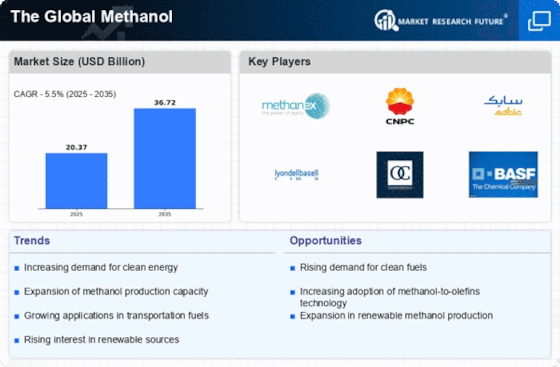
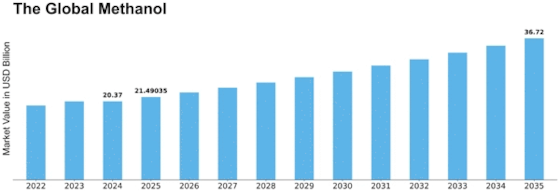
As per Market Research Future analysis, The Global Methanol Market Size was estimated at 20.37 USD Billion in 2024. The methanol industry is projected to grow from 21.49 USD Billion in 2025 to 36.72 USD Billion by 2035, exhibiting a compound annual growth rate (CAGR) of 5% during the forecast period 2025 - 2035

Key Market Trends & Highlights

The Global Methanol Market is poised for substantial growth driven by sustainability and technological advancements.

  • North America remains the largest market for methanol, primarily due to its extensive production capabilities. Asia-Pacific is recognized as the fastest-growing region, fueled by increasing industrialization and urbanization. The fuel segment continues to dominate the market, while the chemical feedstock segment is experiencing rapid growth. Key market drivers include the rising demand for clean energy and the expansion of methanol production facilities.

Market Size & Forecast

2024 Market Size 20.37 (USD Billion)
2035 Market Size 36.72 (USD Billion)
CAGR (2025 - 2035) 5.5%
Largest Regional Market Share in 2024 Asia Pacific

Major Players

Methanex Corporation (CA), China National Petroleum Corporation (CN), SABIC (SA), LyondellBasell Industries (US), OCI N.V. (NL), BASF SE (DE), Yara International (NO), Petrobras (BR), Mitsubishi Gas Chemical Company (JP)

Market Trends

The Methanol Market is currently experiencing a dynamic phase characterized by evolving demand patterns and technological advancements. The increasing focus on sustainable energy solutions appears to be driving interest in methanol as a cleaner alternative to traditional fossil fuels. This shift is likely influenced by global initiatives aimed at reducing carbon emissions and promoting renewable energy sources. Furthermore, the versatility of methanol in various applications, including transportation, chemicals, and energy storage, suggests a broadening scope for its utilization. As industries seek to innovate and adapt to changing regulations, the role of methanol may become increasingly pivotal in achieving environmental goals. In addition, The Global Methanol Market seems to be witnessing a rise in production capacities, particularly in regions with abundant natural gas resources. This trend may enhance the competitive landscape, as producers strive to meet the growing demand. Moreover, the potential for methanol to serve as a hydrogen carrier in fuel cell technologies indicates a promising avenue for future development. Overall, the market appears poised for growth, driven by both regulatory frameworks and technological innovations that could redefine its trajectory in the coming years.

Sustainability Initiatives

The emphasis on sustainability is reshaping The Global Methanol Market. As governments and organizations prioritize reducing carbon footprints, methanol is increasingly recognized for its potential as a low-emission fuel. This trend may lead to greater investments in methanol production and infrastructure, aligning with global environmental goals.

Technological Advancements

Innovations in production technologies are likely enhancing the efficiency and cost-effectiveness of methanol manufacturing. These advancements could facilitate the integration of renewable feedstocks, thereby expanding the market's appeal. As technology evolves, the potential for methanol applications in various sectors may also increase.

Rising Production Capacities

The expansion of production capacities in regions rich in natural gas resources appears to be a significant trend within The Global Methanol Market. This increase may foster competition among producers and ensure a steady supply to meet the growing demand across diverse applications.

Methanol Market Market Drivers

Increasing Demand for Clean Energy

The rising The Global Methanol Industry. As nations strive to reduce carbon emissions, methanol is increasingly recognized as a cleaner alternative to traditional fossil fuels. The International Energy Agency indicates that methanol can be utilized in fuel cells and as a transportation fuel, which may lead to a surge in demand. Furthermore, the transition towards renewable energy sources, such as wind and solar, often necessitates energy storage solutions where methanol can play a crucial role. This growing inclination towards sustainable energy sources is likely to bolster the market, as methanol's versatility positions it favorably in the evolving energy landscape.

Government Policies and Regulations

Government policies and regulations aimed at promoting cleaner fuels and reducing greenhouse gas emissions are likely to influence The Global Methanol Industry positively. Many countries are implementing stricter environmental regulations, which may encourage the adoption of methanol as a cleaner alternative to conventional fuels. Incentives for renewable energy and cleaner technologies could further stimulate methanol production and consumption. For example, some governments are providing subsidies for methanol fuel use in transportation, which may enhance its market penetration. As regulatory frameworks evolve, the methanol industry could benefit from increased support, potentially leading to a more robust market presence.

Diverse Applications Across Industries

The diverse applications of methanol across multiple industries serve as a substantial driver for The Global Methanol Industry. Methanol Market is utilized in the production of formaldehyde, acetic acid, and various chemicals, which are essential in manufacturing plastics, paints, and textiles. The chemical industry, in particular, has shown a consistent demand for methanol, with estimates suggesting that around 60% of methanol produced is converted into other chemicals. Additionally, the automotive sector is increasingly adopting methanol as a fuel alternative, which could further expand its market reach. This versatility in applications not only sustains demand but also positions methanol as a critical component in various industrial processes.

Expansion of Methanol Production Facilities

The expansion of methanol production facilities is a notable driver for The Global Methanol Industry. Recent investments in new production plants and the upgrading of existing facilities have been observed across various regions. For instance, the establishment of large-scale methanol plants in regions rich in natural gas, such as North America and the Middle East, has significantly increased production capacities. According to industry study, the global methanol report production capacity is projected to reach approximately 150 million metric tons by 2025. This increase in production capabilities not only meets the rising demand but also enhances the competitive landscape, potentially leading to lower prices and increased accessibility of methanol in various applications.

Technological Innovations in Production Processes

Technological innovations in methanol production processes are emerging as a significant driver for The Global Methanol Industry. Advances in catalytic processes and the development of more efficient production methods are likely to enhance yield and reduce costs. For instance, the adoption of new catalysts can improve the conversion rates of natural gas to methanol, making production more economically viable. Furthermore, innovations in carbon capture and utilization technologies may allow for the integration of renewable feedstocks, thereby reducing the carbon footprint of methanol production. These technological advancements not only promise to increase production efficiency but also align with the global shift towards sustainable manufacturing practices.

Market Segment Insights

By Application: Fuel (Largest) vs. Chemical Feedstock (Fastest-Growing)

<p>In The Global Methanol, the application segment is quite diverse, consisting of fuel, chemical feedstock, solvent, reducing agent, and antifreeze. Among these, fuel holds the largest market share, predominantly utilized in energy generation and transportation. The increasing demand for cleaner fuels bolsters its position as a leading application, while chemical feedstock is rapidly gaining traction as the fastest-growing segment, driven by its extensive use in producing formaldehyde and other chemicals.</p>

<p>Fuel (Dominant) vs. Chemical Feedstock (Emerging)</p>

<p>The fuel segment is recognized for its significant consumption in various applications, particularly in the automotive and energy sectors. It is favored for its efficiency and lower emissions compared to traditional fossil fuels. On the other hand, chemical feedstock, though currently smaller in market share, is on a growth trajectory due to its vital role in manufacturing essential chemicals like methanol derivatives. Emerging trends in sustainability are escalating its adoption, positioning it as a crucial player in the transition towards greener chemical production.</p>

By End Use Industry: Automotive (Largest) vs. Construction (Fastest-Growing)

<p>In The Global Methanol, the end use industry segment demonstrates a diverse distribution of applications. The automotive sector stands out with a significant share, leveraging methanol as a clean alternative fuel and fuel additive to improve efficiency and reduce emissions. In contrast, the construction industry is rapidly adopting methanol for its potential in sustainable building materials and construction chemicals, reflecting a growing market interest. The growth trends within this segment highlight the increasing shift towards renewable energy sources and sustainability. The automotive industry is driven by regulatory pressures to reduce carbon footprints, pushing manufacturers to innovate with methanol as a greener option. Meanwhile, the construction sector's growth is fueled by initiatives for eco-friendly building practices and the increasing use of methanol-derived products in construction, indicating an evolving landscape with promising opportunities for market participants.</p>

<p>Automotive: Dominant vs. Agriculture: Emerging</p>

<p>The automotive industry remains the dominant end use for methanol, utilizing it primarily as a clean energy source in fuel cells and as a blending component for gasoline to lower emissions and enhance performance. This sector benefits from a robust infrastructure supporting methanol usage, including methanol refueling stations and partnerships among automotive manufacturers. In contrast, the agriculture sector is emerging as a significant player by utilizing methanol in a variety of applications such as fertilizer production and as a key ingredient in herbicides. Methanol's versatility in agricultural chemicals positions it as a crucial component in enhancing crop yields while promoting sustainable farming practices. This shift reveals the industry's potential for growth as environmental concerns continue to shape agricultural methodologies.</p>

By Production Method: Natural Gas Reforming (Largest) vs. Coal Gasification (Fastest-Growing)

<p>In The Global Methanol, Natural Gas Reforming stands out as the dominant production method, accounting for a significant portion of the total market share. This production technique utilizes natural gas as a primary feedstock, which allows for efficient conversion into methanol. Coal Gasification follows closely but is quickly gaining traction due to its potential to utilize abundant coal resources, providing a strong alternative to natural gas.</p>

<p>Natural Gas Reforming (Dominant) vs. Coal Gasification (Emerging)</p>

<p>Natural Gas Reforming is characterized by its established technology and cost-effectiveness, making it the preferred method in regions where gas supply is readily available. In contrast, Coal Gasification is emerging as a competitive alternative, especially in countries rich in coal reserves. This method has seen increased investment as it aligns with governmental policies on energy independence and lower emissions. Moreover, innovations in coal gasification technologies are paving the way for cleaner production processes, enhancing its market potential in the coming years.</p>

By Form: Liquid (Largest) vs. Gas (Fastest-Growing)

<p>In The Global Methanol, the distribution of market share among forms reveals that liquid methanol holds the largest share. It remains the preferred choice for various industrial applications and as a key ingredient in the production of chemicals and fuels. Gas methanol, although currently smaller in terms of market share, is emerging rapidly as innovations in methanol-based energy solutions gain traction.</p>

<p>Methanol Forms: Liquid (Dominant) vs. Gas (Emerging)</p>

<p>Liquid methanol is established as the dominant form in the market, utilized widely due to its ease of transport and storage. It serves a critical role in producing formaldehyde, acetic acid, and other derivatives, signifying its indispensable nature in various industries. On the other hand, gas methanol is considered an emerging segment, fueled by increasing interest in sustainable energy solutions, including methanol as a clean fuel option. As technological advancements occur, gas methanol is anticipated to present new opportunities, attracting investment and driving further innovation.</p>

Get more detailed insights about Methanol Market Research Report - Global Forecast to 2035

Regional Insights

North America : Innovation and Sustainability Focus

North America is a significant player in The Global Methanol Market, driven by increasing demand for cleaner fuels and sustainable chemical production. The region holds approximately 30% of the global market share, with the United States being the largest market, followed by Canada. Regulatory support for renewable energy and emissions reduction initiatives further catalyzes growth in this sector. The competitive landscape is characterized by major players such as Methanex Corporation and LyondellBasell Industries, which are investing in advanced technologies to enhance production efficiency. The presence of robust infrastructure and a strong focus on innovation positions North America as a leader in methanol production and consumption, catering to both domestic and international markets.

Europe : Sustainable Growth and Innovation

Europe is emerging as a key region in The Global Methanol Market, driven by stringent environmental regulations and a strong push towards sustainable energy solutions. The region accounts for approximately 25% of the global market share, with Germany and the Netherlands leading in production and consumption. The European Union's Green Deal and various national policies are significant catalysts for growth, promoting the use of methanol as a cleaner alternative to fossil fuels. Leading countries like Germany and the Netherlands are home to major players such as BASF SE and OCI N.V., which are investing heavily in green methanol technologies. The competitive landscape is evolving, with a focus on innovation and sustainability, positioning Europe as a hub for methanol production and research, aiming to reduce carbon emissions and enhance energy security.

Asia-Pacific : Rapid Growth and Industrial Demand

APAC methanol market is the largest market, accounting for approximately 40% of the global market share, with China being the dominant player. The region's rapid industrialization and urbanization are driving demand for methanol in various applications, including chemicals and fuels. Government initiatives to promote cleaner energy sources and reduce pollution are also significant growth drivers. China National Petroleum Corporation and Mitsubishi Gas Chemical Company are among the key players in this region, focusing on expanding production capacities and enhancing technological advancements. The competitive landscape is marked by a mix of state-owned and private enterprises, all vying for market share in a rapidly growing sector, making Asia-Pacific a focal point for methanol production and consumption.

Middle East and Africa : Resource-Rich and Emerging Markets

The Middle East and Africa region is witnessing a gradual increase in methanol production, driven by abundant natural gas resources and growing industrial demand. This region holds approximately 5% of the global market share, with countries like Saudi Arabia and South Africa leading the way. The focus on diversifying economies and reducing reliance on oil is prompting investments in methanol production facilities. Saudi Arabia's SABIC is a key player in the region, leveraging its vast resources to enhance methanol production capabilities. The competitive landscape is evolving, with emerging markets in Africa beginning to explore methanol as a viable energy source. As infrastructure develops, the region is poised for growth in the methanol sector, attracting both local and international investments.

Key Players and Competitive Insights

The Global Methanol Market has experienced significant growth and transformation in recent years, driven by an escalating demand for methanol in various applications, including fuel, global chemicals industry, and plastics. This market is characterized by a diverse mix of players varying from multinational corporations to regional manufacturers. Competitive insights into this sector reveal a landscape shaped by factors such as technology advancements, strategic partnerships, and geographic expansion strategies. Companies are increasingly focusing on innovation and the development of sustainable processes to lower emissions in methanol production while tapping into new markets.
By implementing strategies like vertical integration and regional diversification, key players are positioning themselves to leverage emerging opportunities across the globe.China National Chemical Corporation serves as a formidable entity within the Global Methanol Market, boasting a robust production capacity and a significant influence on the pricing dynamics of methanol internationally. Its strengths include a well-established presence in China, the world's largest methanol producer, combined with extensive resources for research and development to enhance operational efficiency and product quality. The commitment to integrating advanced technologies in their production processes further distinguishes China National Chemical Corporation from competitors.
Moreover, the company's strong governmental ties enable favorable regulations and policies that bolster its overall market position, making it a significant player that shapes the global methanol supply chain.Qatar Petroleum is another influential player in the Global Methanol Market, renowned for its strategic approach to product offerings and market positioning. The company specializes in producing high-purity methanol that serves diverse industrial applications, reinforcing its presence in the global arena. Qatar Petroleum's strengths lie in its state-of-the-art production facilities and its ability to efficiently manage resources, resulting in a cost-effective operation.
The company has engaged in strategic partnerships and joint ventures to enhance its market reach and capabilities, thus ensuring continued growth in various regions. Recent mergers and acquisitions align with its vision to expand its operational footprint and diversify its product portfolio, subsequently facilitating access to new markets and strengthening its competitive edge within the methanol sector on a global scale.

Key Companies in the Methanol Market include

Industry Developments

  • Q2 2024: OCI Global and Linde to Build World’s Largest Green Methanol Market Plant in Texas OCI Global and Linde announced a partnership to construct what they claim will be the world’s largest green methanol facility in Beaumont, Texas, with production expected to begin in 2025. The plant will supply green methanol for shipping and other industries seeking to decarbonize.
  • Q2 2024: Maersk Receives First Delivery of Green Methanol Market for New Fleet A.P. Moller-Maersk took delivery of its first batch of green methanol to fuel its new methanol-powered container ships, marking a milestone in the shipping industry’s transition to alternative fuels.
  • Q3 2024: China’s Shandong Yuhuang Chemical Launches New Methanol Market Plant Shandong Yuhuang Chemical announced the opening of a new 1 million tonne-per-year methanol production facility in Shandong province, expanding its capacity to meet rising domestic and export demand.
  • Q3 2024: Methanex Appoints New CEO, John Smith, to Lead Global Expansion Methanex Corporation announced the appointment of John Smith as Chief Executive Officer, effective August 2024, as the company pursues new investments in low-carbon methanol production.
  • Q4 2024: Proman and Stena Line Sign Long-Term Green Methanol Market Supply Agreement Proman and Stena Line entered a multi-year contract for the supply of green methanol to power Stena’s expanding fleet of methanol-fueled ferries operating in Northern Europe.
  • Q4 2024: Celanese Announces Commercial Operation of New Methanol Market Plant in Texas Celanese Corporation declared the start of commercial operations at its new methanol production facility in Clear Lake, Texas, increasing its North American methanol output.
  • Q1 2025: Saudi Aramco and SABIC Launch Joint Methanol Market Venture in Jubail Saudi Aramco and SABIC announced the launch of a joint venture to build and operate a large-scale methanol plant in Jubail Industrial City, aiming to serve both domestic and export markets.
  • Q1 2025: OCI Global Secures $500 Million Green Financing for Methanol Market Expansion OCI Global secured $500 million in green financing to expand its methanol production capacity, with a focus on low-carbon and renewable methanol projects.
  • Q2 2025: BASF and Mitsui Announce Partnership for Green Methanol Market Production in Europe BASF and Mitsui signed a strategic partnership to develop and operate green methanol production facilities in Europe, targeting the chemical and shipping sectors.
  • Q2 2025: Proman Opens New Methanol Market Terminal in Rotterdam Proman inaugurated a new methanol import and distribution terminal in the Port of Rotterdam, enhancing supply chain flexibility for European customers.
  • Q3 2025: China’s Sinopec Completes Acquisition of Minority Stake in Methanol Market Plant Sinopec completed the acquisition of a 30% stake in a major methanol production facility in Inner Mongolia, strengthening its position in the Chinese methanol market.
  • Q3 2025: Methanex Signs Long-Term Methanol Market Supply Contract with Dow Methanex Corporation entered into a long-term supply agreement with Dow to provide methanol for Dow’s North American chemical manufacturing operations.

Future Outlook

Methanol Market Future Outlook

The Global Methanol Market is projected to grow at a 5.5% CAGR from 2025 to 2035, driven by increasing demand for clean energy and sustainable chemicals.

New opportunities lie in:

  • Expansion into renewable methanol production facilities
  • Development of methanol-based fuel cell technologies
  • Strategic partnerships for methanol as a hydrogen carrier

By 2035, the market is expected to solidify its position as a key player in sustainable energy solutions.

Market Segmentation

Methanol Market Form Outlook

  • Liquid
  • Gas
  • Solid

Methanol Market Application Outlook

  • Fuel
  • Chemical Feedstock
  • Solvent
  • Reducing Agent
  • Antifreeze

Methanol Market End Use Industry Outlook

  • Automotive
  • Construction
  • Agriculture
  • Electronics
  • Pharmaceuticals

Methanol Market Production Method Outlook

  • Natural Gas Reforming
  • Coal Gasification
  • Biomass Gasification
  • Recycling
  • Others

Report Scope

MARKET SIZE 2024 20.37(USD Billion)
MARKET SIZE 2025 21.49(USD Billion)
MARKET SIZE 2035 36.72(USD Billion)
COMPOUND ANNUAL GROWTH RATE (CAGR) 5.5% (2025 - 2035)
REPORT COVERAGE Revenue Forecast, Competitive Landscape, Growth Factors, and Trends
BASE YEAR 2024
Market Forecast Period 2025 - 2035
Historical Data 2019 - 2024
Market Forecast Units USD Billion
Key Companies Profiled Methanex Corporation (CA), China National Petroleum Corporation (CN), SABIC (SA), LyondellBasell Industries (US), OCI N.V. (NL), BASF SE (DE), Yara International (NO), Petrobras (BR), Mitsubishi Gas Chemical Company (JP)
Segments Covered Application, End Use Industry, Production Method, Form, Regional
Key Market Opportunities Growing demand for sustainable fuels and chemicals drives innovation in The Global Methanol.
Key Market Dynamics Rising demand for cleaner fuels drives innovation and investment in methanol production technologies and applications.
Countries Covered North America, Europe, APAC, South America, MEA

FAQs

What is the current valuation of The Global Methanol?

<p>The Global Methanol was valued at 20.37 USD Billion in 2024.</p>

What is the projected market valuation for The Global Methanol in 2035?

<p>The market is projected to reach 36.72 USD Billion by 2035.</p>

What is the expected CAGR for The Global Methanol during the forecast period 2025 - 2035?

<p>The expected CAGR for The Global Methanol during 2025 - 2035 is 5.5%.</p>

Which companies are considered key players in The Global Methanol?

<p>Key players include Methanex Corporation, China National Petroleum Corporation, SABIC, and LyondellBasell Industries.</p>

What are the main applications of methanol in the market?

<p>Methanol is primarily used in applications such as Chemical Feedstock, Fuel, and Solvent, with valuations ranging from 2.0 to 14.0 USD Billion.</p>

How does the automotive industry contribute to The Global Methanol?

<p>The automotive sector is projected to contribute between 3.5 and 6.5 USD Billion to the market.</p>

What production methods are utilized in The Global Methanol?

<p>Production methods include Natural Gas Reforming, Coal Gasification, and Biomass Gasification, with valuations from 1.0 to 18.0 USD Billion.</p>

What forms of methanol are available in the market?

<p>Methanol is available in Liquid, Gas, and Solid forms, with market valuations ranging from 5.37 to 14.5 USD Billion.</p>

What role does the construction industry play in The Global Methanol?

<p>The construction industry is expected to account for a market share between 4.0 and 7.0 USD Billion.</p>

How does the pharmaceutical industry impact The Global Methanol?

The pharmaceutical sector is projected to contribute between 2.37 and 3.72 USD Billion to the overall market.

  1. SECTION I: EXECUTIVE SUMMARY AND KEY HIGHLIGHTS
    1. | 1.1 EXECUTIVE SUMMARY
    2. | | 1.1.1 Market Overview
    3. | | 1.1.2 Key Findings
    4. | | 1.1.3 Market Segmentation
    5. | | 1.1.4 Competitive Landscape
    6. | | 1.1.5 Challenges and Opportunities
    7. | | 1.1.6 Future Outlook
  2. SECTION II: SCOPING, METHODOLOGY AND MARKET STRUCTURE
    1. | 2.1 MARKET INTRODUCTION
    2. | | 2.1.1 Definition
    3. | | 2.1.2 Scope of the study
    4. | | | 2.1.2.1 Research Objective
    5. | | | 2.1.2.2 Assumption
    6. | | | 2.1.2.3 Limitations
    7. | 2.2 RESEARCH METHODOLOGY
    8. | | 2.2.1 Overview
    9. | | 2.2.2 Data Mining
    10. | | 2.2.3 Secondary Research
    11. | | 2.2.4 Primary Research
    12. | | | 2.2.4.1 Primary Interviews and Information Gathering Process
    13. | | | 2.2.4.2 Breakdown of Primary Respondents
    14. | | 2.2.5 Forecasting Model
    15. | | 2.2.6 Market Size Estimation
    16. | | | 2.2.6.1 Bottom-Up Approach
    17. | | | 2.2.6.2 Top-Down Approach
    18. | | 2.2.7 Data Triangulation
    19. | | 2.2.8 Validation
  3. SECTION III: QUALITATIVE ANALYSIS
    1. | 3.1 MARKET DYNAMICS
    2. | | 3.1.1 Overview
    3. | | 3.1.2 Drivers
    4. | | 3.1.3 Restraints
    5. | | 3.1.4 Opportunities
    6. | 3.2 MARKET FACTOR ANALYSIS
    7. | | 3.2.1 Value chain Analysis
    8. | | 3.2.2 Porter's Five Forces Analysis
    9. | | | 3.2.2.1 Bargaining Power of Suppliers
    10. | | | 3.2.2.2 Bargaining Power of Buyers
    11. | | | 3.2.2.3 Threat of New Entrants
    12. | | | 3.2.2.4 Threat of Substitutes
    13. | | | 3.2.2.5 Intensity of Rivalry
    14. | | 3.2.3 COVID-19 Impact Analysis
    15. | | | 3.2.3.1 Market Impact Analysis
    16. | | | 3.2.3.2 Regional Impact
    17. | | | 3.2.3.3 Opportunity and Threat Analysis
  4. SECTION IV: QUANTITATIVE ANALYSIS
    1. | 4.1 Chemicals and Materials, BY Application (USD Billion)
    2. | | 4.1.1 Fuel
    3. | | 4.1.2 Chemical Feedstock
    4. | | 4.1.3 Solvent
    5. | | 4.1.4 Reducing Agent
    6. | | 4.1.5 Antifreeze
    7. | 4.2 Chemicals and Materials, BY End Use Industry (USD Billion)
    8. | | 4.2.1 Automotive
    9. | | 4.2.2 Construction
    10. | | 4.2.3 Agriculture
    11. | | 4.2.4 Electronics
    12. | | 4.2.5 Pharmaceuticals
    13. | 4.3 Chemicals and Materials, BY Production Method (USD Billion)
    14. | | 4.3.1 Natural Gas Reforming
    15. | | 4.3.2 Coal Gasification
    16. | | 4.3.3 Biomass Gasification
    17. | | 4.3.4 Recycling
    18. | | 4.3.5 Others
    19. | 4.4 Chemicals and Materials, BY Form (USD Billion)
    20. | | 4.4.1 Liquid
    21. | | 4.4.2 Gas
    22. | | 4.4.3 Solid
    23. | 4.5 Chemicals and Materials, BY Region (USD Billion)
    24. | | 4.5.1 North America
    25. | | | 4.5.1.1 US
    26. | | | 4.5.1.2 Canada
    27. | | 4.5.2 Europe
    28. | | | 4.5.2.1 Germany
    29. | | | 4.5.2.2 UK
    30. | | | 4.5.2.3 France
    31. | | | 4.5.2.4 Russia
    32. | | | 4.5.2.5 Italy
    33. | | | 4.5.2.6 Spain
    34. | | | 4.5.2.7 Rest of Europe
    35. | | 4.5.3 APAC
    36. | | | 4.5.3.1 China
    37. | | | 4.5.3.2 India
    38. | | | 4.5.3.3 Japan
    39. | | | 4.5.3.4 South Korea
    40. | | | 4.5.3.5 Malaysia
    41. | | | 4.5.3.6 Thailand
    42. | | | 4.5.3.7 Indonesia
    43. | | | 4.5.3.8 Rest of APAC
    44. | | 4.5.4 South America
    45. | | | 4.5.4.1 Brazil
    46. | | | 4.5.4.2 Mexico
    47. | | | 4.5.4.3 Argentina
    48. | | | 4.5.4.4 Rest of South America
    49. | | 4.5.5 MEA
    50. | | | 4.5.5.1 GCC Countries
    51. | | | 4.5.5.2 South Africa
    52. | | | 4.5.5.3 Rest of MEA
  5. SECTION V: COMPETITIVE ANALYSIS
    1. | 5.1 Competitive Landscape
    2. | | 5.1.1 Overview
    3. | | 5.1.2 Competitive Analysis
    4. | | 5.1.3 Market share Analysis
    5. | | 5.1.4 Major Growth Strategy in the Chemicals and Materials
    6. | | 5.1.5 Competitive Benchmarking
    7. | | 5.1.6 Leading Players in Terms of Number of Developments in the Chemicals and Materials
    8. | | 5.1.7 Key developments and growth strategies
    9. | | | 5.1.7.1 New Product Launch/Service Deployment
    10. | | | 5.1.7.2 Merger & Acquisitions
    11. | | | 5.1.7.3 Joint Ventures
    12. | | 5.1.8 Major Players Financial Matrix
    13. | | | 5.1.8.1 Sales and Operating Income
    14. | | | 5.1.8.2 Major Players R&D Expenditure. 2023
    15. | 5.2 Company Profiles
    16. | | 5.2.1 Methanex Corporation (CA)
    17. | | | 5.2.1.1 Financial Overview
    18. | | | 5.2.1.2 Products Offered
    19. | | | 5.2.1.3 Key Developments
    20. | | | 5.2.1.4 SWOT Analysis
    21. | | | 5.2.1.5 Key Strategies
    22. | | 5.2.2 China National Petroleum Corporation (CN)
    23. | | | 5.2.2.1 Financial Overview
    24. | | | 5.2.2.2 Products Offered
    25. | | | 5.2.2.3 Key Developments
    26. | | | 5.2.2.4 SWOT Analysis
    27. | | | 5.2.2.5 Key Strategies
    28. | | 5.2.3 SABIC (SA)
    29. | | | 5.2.3.1 Financial Overview
    30. | | | 5.2.3.2 Products Offered
    31. | | | 5.2.3.3 Key Developments
    32. | | | 5.2.3.4 SWOT Analysis
    33. | | | 5.2.3.5 Key Strategies
    34. | | 5.2.4 LyondellBasell Industries (US)
    35. | | | 5.2.4.1 Financial Overview
    36. | | | 5.2.4.2 Products Offered
    37. | | | 5.2.4.3 Key Developments
    38. | | | 5.2.4.4 SWOT Analysis
    39. | | | 5.2.4.5 Key Strategies
    40. | | 5.2.5 OCI N.V. (NL)
    41. | | | 5.2.5.1 Financial Overview
    42. | | | 5.2.5.2 Products Offered
    43. | | | 5.2.5.3 Key Developments
    44. | | | 5.2.5.4 SWOT Analysis
    45. | | | 5.2.5.5 Key Strategies
    46. | | 5.2.6 BASF SE (DE)
    47. | | | 5.2.6.1 Financial Overview
    48. | | | 5.2.6.2 Products Offered
    49. | | | 5.2.6.3 Key Developments
    50. | | | 5.2.6.4 SWOT Analysis
    51. | | | 5.2.6.5 Key Strategies
    52. | | 5.2.7 Yara International (NO)
    53. | | | 5.2.7.1 Financial Overview
    54. | | | 5.2.7.2 Products Offered
    55. | | | 5.2.7.3 Key Developments
    56. | | | 5.2.7.4 SWOT Analysis
    57. | | | 5.2.7.5 Key Strategies
    58. | | 5.2.8 Petrobras (BR)
    59. | | | 5.2.8.1 Financial Overview
    60. | | | 5.2.8.2 Products Offered
    61. | | | 5.2.8.3 Key Developments
    62. | | | 5.2.8.4 SWOT Analysis
    63. | | | 5.2.8.5 Key Strategies
    64. | | 5.2.9 Mitsubishi Gas Chemical Company (JP)
    65. | | | 5.2.9.1 Financial Overview
    66. | | | 5.2.9.2 Products Offered
    67. | | | 5.2.9.3 Key Developments
    68. | | | 5.2.9.4 SWOT Analysis
    69. | | | 5.2.9.5 Key Strategies
    70. | 5.3 Appendix
    71. | | 5.3.1 References
    72. | | 5.3.2 Related Reports
  6. LIST OF FIGURES
    1. | 6.1 MARKET SYNOPSIS
    2. | 6.2 NORTH AMERICA MARKET ANALYSIS
    3. | 6.3 US MARKET ANALYSIS BY APPLICATION
    4. | 6.4 US MARKET ANALYSIS BY END USE INDUSTRY
    5. | 6.5 US MARKET ANALYSIS BY PRODUCTION METHOD
    6. | 6.6 US MARKET ANALYSIS BY FORM
    7. | 6.7 CANADA MARKET ANALYSIS BY APPLICATION
    8. | 6.8 CANADA MARKET ANALYSIS BY END USE INDUSTRY
    9. | 6.9 CANADA MARKET ANALYSIS BY PRODUCTION METHOD
    10. | 6.10 CANADA MARKET ANALYSIS BY FORM
    11. | 6.11 EUROPE MARKET ANALYSIS
    12. | 6.12 GERMANY MARKET ANALYSIS BY APPLICATION
    13. | 6.13 GERMANY MARKET ANALYSIS BY END USE INDUSTRY
    14. | 6.14 GERMANY MARKET ANALYSIS BY PRODUCTION METHOD
    15. | 6.15 GERMANY MARKET ANALYSIS BY FORM
    16. | 6.16 UK MARKET ANALYSIS BY APPLICATION
    17. | 6.17 UK MARKET ANALYSIS BY END USE INDUSTRY
    18. | 6.18 UK MARKET ANALYSIS BY PRODUCTION METHOD
    19. | 6.19 UK MARKET ANALYSIS BY FORM
    20. | 6.20 FRANCE MARKET ANALYSIS BY APPLICATION
    21. | 6.21 FRANCE MARKET ANALYSIS BY END USE INDUSTRY
    22. | 6.22 FRANCE MARKET ANALYSIS BY PRODUCTION METHOD
    23. | 6.23 FRANCE MARKET ANALYSIS BY FORM
    24. | 6.24 RUSSIA MARKET ANALYSIS BY APPLICATION
    25. | 6.25 RUSSIA MARKET ANALYSIS BY END USE INDUSTRY
    26. | 6.26 RUSSIA MARKET ANALYSIS BY PRODUCTION METHOD
    27. | 6.27 RUSSIA MARKET ANALYSIS BY FORM
    28. | 6.28 ITALY MARKET ANALYSIS BY APPLICATION
    29. | 6.29 ITALY MARKET ANALYSIS BY END USE INDUSTRY
    30. | 6.30 ITALY MARKET ANALYSIS BY PRODUCTION METHOD
    31. | 6.31 ITALY MARKET ANALYSIS BY FORM
    32. | 6.32 SPAIN MARKET ANALYSIS BY APPLICATION
    33. | 6.33 SPAIN MARKET ANALYSIS BY END USE INDUSTRY
    34. | 6.34 SPAIN MARKET ANALYSIS BY PRODUCTION METHOD
    35. | 6.35 SPAIN MARKET ANALYSIS BY FORM
    36. | 6.36 REST OF EUROPE MARKET ANALYSIS BY APPLICATION
    37. | 6.37 REST OF EUROPE MARKET ANALYSIS BY END USE INDUSTRY
    38. | 6.38 REST OF EUROPE MARKET ANALYSIS BY PRODUCTION METHOD
    39. | 6.39 REST OF EUROPE MARKET ANALYSIS BY FORM
    40. | 6.40 APAC MARKET ANALYSIS
    41. | 6.41 CHINA MARKET ANALYSIS BY APPLICATION
    42. | 6.42 CHINA MARKET ANALYSIS BY END USE INDUSTRY
    43. | 6.43 CHINA MARKET ANALYSIS BY PRODUCTION METHOD
    44. | 6.44 CHINA MARKET ANALYSIS BY FORM
    45. | 6.45 INDIA MARKET ANALYSIS BY APPLICATION
    46. | 6.46 INDIA MARKET ANALYSIS BY END USE INDUSTRY
    47. | 6.47 INDIA MARKET ANALYSIS BY PRODUCTION METHOD
    48. | 6.48 INDIA MARKET ANALYSIS BY FORM
    49. | 6.49 JAPAN MARKET ANALYSIS BY APPLICATION
    50. | 6.50 JAPAN MARKET ANALYSIS BY END USE INDUSTRY
    51. | 6.51 JAPAN MARKET ANALYSIS BY PRODUCTION METHOD
    52. | 6.52 JAPAN MARKET ANALYSIS BY FORM
    53. | 6.53 SOUTH KOREA MARKET ANALYSIS BY APPLICATION
    54. | 6.54 SOUTH KOREA MARKET ANALYSIS BY END USE INDUSTRY
    55. | 6.55 SOUTH KOREA MARKET ANALYSIS BY PRODUCTION METHOD
    56. | 6.56 SOUTH KOREA MARKET ANALYSIS BY FORM
    57. | 6.57 MALAYSIA MARKET ANALYSIS BY APPLICATION
    58. | 6.58 MALAYSIA MARKET ANALYSIS BY END USE INDUSTRY
    59. | 6.59 MALAYSIA MARKET ANALYSIS BY PRODUCTION METHOD
    60. | 6.60 MALAYSIA MARKET ANALYSIS BY FORM
    61. | 6.61 THAILAND MARKET ANALYSIS BY APPLICATION
    62. | 6.62 THAILAND MARKET ANALYSIS BY END USE INDUSTRY
    63. | 6.63 THAILAND MARKET ANALYSIS BY PRODUCTION METHOD
    64. | 6.64 THAILAND MARKET ANALYSIS BY FORM
    65. | 6.65 INDONESIA MARKET ANALYSIS BY APPLICATION
    66. | 6.66 INDONESIA MARKET ANALYSIS BY END USE INDUSTRY
    67. | 6.67 INDONESIA MARKET ANALYSIS BY PRODUCTION METHOD
    68. | 6.68 INDONESIA MARKET ANALYSIS BY FORM
    69. | 6.69 REST OF APAC MARKET ANALYSIS BY APPLICATION
    70. | 6.70 REST OF APAC MARKET ANALYSIS BY END USE INDUSTRY
    71. | 6.71 REST OF APAC MARKET ANALYSIS BY PRODUCTION METHOD
    72. | 6.72 REST OF APAC MARKET ANALYSIS BY FORM
    73. | 6.73 SOUTH AMERICA MARKET ANALYSIS
    74. | 6.74 BRAZIL MARKET ANALYSIS BY APPLICATION
    75. | 6.75 BRAZIL MARKET ANALYSIS BY END USE INDUSTRY
    76. | 6.76 BRAZIL MARKET ANALYSIS BY PRODUCTION METHOD
    77. | 6.77 BRAZIL MARKET ANALYSIS BY FORM
    78. | 6.78 MEXICO MARKET ANALYSIS BY APPLICATION
    79. | 6.79 MEXICO MARKET ANALYSIS BY END USE INDUSTRY
    80. | 6.80 MEXICO MARKET ANALYSIS BY PRODUCTION METHOD
    81. | 6.81 MEXICO MARKET ANALYSIS BY FORM
    82. | 6.82 ARGENTINA MARKET ANALYSIS BY APPLICATION
    83. | 6.83 ARGENTINA MARKET ANALYSIS BY END USE INDUSTRY
    84. | 6.84 ARGENTINA MARKET ANALYSIS BY PRODUCTION METHOD
    85. | 6.85 ARGENTINA MARKET ANALYSIS BY FORM
    86. | 6.86 REST OF SOUTH AMERICA MARKET ANALYSIS BY APPLICATION
    87. | 6.87 REST OF SOUTH AMERICA MARKET ANALYSIS BY END USE INDUSTRY
    88. | 6.88 REST OF SOUTH AMERICA MARKET ANALYSIS BY PRODUCTION METHOD
    89. | 6.89 REST OF SOUTH AMERICA MARKET ANALYSIS BY FORM
    90. | 6.90 MEA MARKET ANALYSIS
    91. | 6.91 GCC COUNTRIES MARKET ANALYSIS BY APPLICATION
    92. | 6.92 GCC COUNTRIES MARKET ANALYSIS BY END USE INDUSTRY
    93. | 6.93 GCC COUNTRIES MARKET ANALYSIS BY PRODUCTION METHOD
    94. | 6.94 GCC COUNTRIES MARKET ANALYSIS BY FORM
    95. | 6.95 SOUTH AFRICA MARKET ANALYSIS BY APPLICATION
    96. | 6.96 SOUTH AFRICA MARKET ANALYSIS BY END USE INDUSTRY
    97. | 6.97 SOUTH AFRICA MARKET ANALYSIS BY PRODUCTION METHOD
    98. | 6.98 SOUTH AFRICA MARKET ANALYSIS BY FORM
    99. | 6.99 REST OF MEA MARKET ANALYSIS BY APPLICATION
    100. | 6.100 REST OF MEA MARKET ANALYSIS BY END USE INDUSTRY
    101. | 6.101 REST OF MEA MARKET ANALYSIS BY PRODUCTION METHOD
    102. | 6.102 REST OF MEA MARKET ANALYSIS BY FORM
    103. | 6.103 KEY BUYING CRITERIA OF CHEMICALS AND MATERIALS
    104. | 6.104 RESEARCH PROCESS OF MRFR
    105. | 6.105 DRO ANALYSIS OF CHEMICALS AND MATERIALS
    106. | 6.106 DRIVERS IMPACT ANALYSIS: CHEMICALS AND MATERIALS
    107. | 6.107 RESTRAINTS IMPACT ANALYSIS: CHEMICALS AND MATERIALS
    108. | 6.108 SUPPLY / VALUE CHAIN: CHEMICALS AND MATERIALS
    109. | 6.109 CHEMICALS AND MATERIALS, BY APPLICATION, 2024 (% SHARE)
    110. | 6.110 CHEMICALS AND MATERIALS, BY APPLICATION, 2024 TO 2035 (USD Billion)
    111. | 6.111 CHEMICALS AND MATERIALS, BY END USE INDUSTRY, 2024 (% SHARE)
    112. | 6.112 CHEMICALS AND MATERIALS, BY END USE INDUSTRY, 2024 TO 2035 (USD Billion)
    113. | 6.113 CHEMICALS AND MATERIALS, BY PRODUCTION METHOD, 2024 (% SHARE)
    114. | 6.114 CHEMICALS AND MATERIALS, BY PRODUCTION METHOD, 2024 TO 2035 (USD Billion)
    115. | 6.115 CHEMICALS AND MATERIALS, BY FORM, 2024 (% SHARE)
    116. | 6.116 CHEMICALS AND MATERIALS, BY FORM, 2024 TO 2035 (USD Billion)
    117. | 6.117 BENCHMARKING OF MAJOR COMPETITORS
  7. LIST OF TABLES
    1. | 7.1 LIST OF ASSUMPTIONS
    2. | | 7.1.1
    3. | 7.2 North America MARKET SIZE ESTIMATES; FORECAST
    4. | | 7.2.1 BY APPLICATION, 2025-2035 (USD Billion)
    5. | | 7.2.2 BY END USE INDUSTRY, 2025-2035 (USD Billion)
    6. | | 7.2.3 BY PRODUCTION METHOD, 2025-2035 (USD Billion)
    7. | | 7.2.4 BY FORM, 2025-2035 (USD Billion)
    8. | 7.3 US MARKET SIZE ESTIMATES; FORECAST
    9. | | 7.3.1 BY APPLICATION, 2025-2035 (USD Billion)
    10. | | 7.3.2 BY END USE INDUSTRY, 2025-2035 (USD Billion)
    11. | | 7.3.3 BY PRODUCTION METHOD, 2025-2035 (USD Billion)
    12. | | 7.3.4 BY FORM, 2025-2035 (USD Billion)
    13. | 7.4 Canada MARKET SIZE ESTIMATES; FORECAST
    14. | | 7.4.1 BY APPLICATION, 2025-2035 (USD Billion)
    15. | | 7.4.2 BY END USE INDUSTRY, 2025-2035 (USD Billion)
    16. | | 7.4.3 BY PRODUCTION METHOD, 2025-2035 (USD Billion)
    17. | | 7.4.4 BY FORM, 2025-2035 (USD Billion)
    18. | 7.5 Europe MARKET SIZE ESTIMATES; FORECAST
    19. | | 7.5.1 BY APPLICATION, 2025-2035 (USD Billion)
    20. | | 7.5.2 BY END USE INDUSTRY, 2025-2035 (USD Billion)
    21. | | 7.5.3 BY PRODUCTION METHOD, 2025-2035 (USD Billion)
    22. | | 7.5.4 BY FORM, 2025-2035 (USD Billion)
    23. | 7.6 Germany MARKET SIZE ESTIMATES; FORECAST
    24. | | 7.6.1 BY APPLICATION, 2025-2035 (USD Billion)
    25. | | 7.6.2 BY END USE INDUSTRY, 2025-2035 (USD Billion)
    26. | | 7.6.3 BY PRODUCTION METHOD, 2025-2035 (USD Billion)
    27. | | 7.6.4 BY FORM, 2025-2035 (USD Billion)
    28. | 7.7 UK MARKET SIZE ESTIMATES; FORECAST
    29. | | 7.7.1 BY APPLICATION, 2025-2035 (USD Billion)
    30. | | 7.7.2 BY END USE INDUSTRY, 2025-2035 (USD Billion)
    31. | | 7.7.3 BY PRODUCTION METHOD, 2025-2035 (USD Billion)
    32. | | 7.7.4 BY FORM, 2025-2035 (USD Billion)
    33. | 7.8 France MARKET SIZE ESTIMATES; FORECAST
    34. | | 7.8.1 BY APPLICATION, 2025-2035 (USD Billion)
    35. | | 7.8.2 BY END USE INDUSTRY, 2025-2035 (USD Billion)
    36. | | 7.8.3 BY PRODUCTION METHOD, 2025-2035 (USD Billion)
    37. | | 7.8.4 BY FORM, 2025-2035 (USD Billion)
    38. | 7.9 Russia MARKET SIZE ESTIMATES; FORECAST
    39. | | 7.9.1 BY APPLICATION, 2025-2035 (USD Billion)
    40. | | 7.9.2 BY END USE INDUSTRY, 2025-2035 (USD Billion)
    41. | | 7.9.3 BY PRODUCTION METHOD, 2025-2035 (USD Billion)
    42. | | 7.9.4 BY FORM, 2025-2035 (USD Billion)
    43. | 7.10 Italy MARKET SIZE ESTIMATES; FORECAST
    44. | | 7.10.1 BY APPLICATION, 2025-2035 (USD Billion)
    45. | | 7.10.2 BY END USE INDUSTRY, 2025-2035 (USD Billion)
    46. | | 7.10.3 BY PRODUCTION METHOD, 2025-2035 (USD Billion)
    47. | | 7.10.4 BY FORM, 2025-2035 (USD Billion)
    48. | 7.11 Spain MARKET SIZE ESTIMATES; FORECAST
    49. | | 7.11.1 BY APPLICATION, 2025-2035 (USD Billion)
    50. | | 7.11.2 BY END USE INDUSTRY, 2025-2035 (USD Billion)
    51. | | 7.11.3 BY PRODUCTION METHOD, 2025-2035 (USD Billion)
    52. | | 7.11.4 BY FORM, 2025-2035 (USD Billion)
    53. | 7.12 Rest of Europe MARKET SIZE ESTIMATES; FORECAST
    54. | | 7.12.1 BY APPLICATION, 2025-2035 (USD Billion)
    55. | | 7.12.2 BY END USE INDUSTRY, 2025-2035 (USD Billion)
    56. | | 7.12.3 BY PRODUCTION METHOD, 2025-2035 (USD Billion)
    57. | | 7.12.4 BY FORM, 2025-2035 (USD Billion)
    58. | 7.13 APAC MARKET SIZE ESTIMATES; FORECAST
    59. | | 7.13.1 BY APPLICATION, 2025-2035 (USD Billion)
    60. | | 7.13.2 BY END USE INDUSTRY, 2025-2035 (USD Billion)
    61. | | 7.13.3 BY PRODUCTION METHOD, 2025-2035 (USD Billion)
    62. | | 7.13.4 BY FORM, 2025-2035 (USD Billion)
    63. | 7.14 China MARKET SIZE ESTIMATES; FORECAST
    64. | | 7.14.1 BY APPLICATION, 2025-2035 (USD Billion)
    65. | | 7.14.2 BY END USE INDUSTRY, 2025-2035 (USD Billion)
    66. | | 7.14.3 BY PRODUCTION METHOD, 2025-2035 (USD Billion)
    67. | | 7.14.4 BY FORM, 2025-2035 (USD Billion)
    68. | 7.15 India MARKET SIZE ESTIMATES; FORECAST
    69. | | 7.15.1 BY APPLICATION, 2025-2035 (USD Billion)
    70. | | 7.15.2 BY END USE INDUSTRY, 2025-2035 (USD Billion)
    71. | | 7.15.3 BY PRODUCTION METHOD, 2025-2035 (USD Billion)
    72. | | 7.15.4 BY FORM, 2025-2035 (USD Billion)
    73. | 7.16 Japan MARKET SIZE ESTIMATES; FORECAST
    74. | | 7.16.1 BY APPLICATION, 2025-2035 (USD Billion)
    75. | | 7.16.2 BY END USE INDUSTRY, 2025-2035 (USD Billion)
    76. | | 7.16.3 BY PRODUCTION METHOD, 2025-2035 (USD Billion)
    77. | | 7.16.4 BY FORM, 2025-2035 (USD Billion)
    78. | 7.17 South Korea MARKET SIZE ESTIMATES; FORECAST
    79. | | 7.17.1 BY APPLICATION, 2025-2035 (USD Billion)
    80. | | 7.17.2 BY END USE INDUSTRY, 2025-2035 (USD Billion)
    81. | | 7.17.3 BY PRODUCTION METHOD, 2025-2035 (USD Billion)
    82. | | 7.17.4 BY FORM, 2025-2035 (USD Billion)
    83. | 7.18 Malaysia MARKET SIZE ESTIMATES; FORECAST
    84. | | 7.18.1 BY APPLICATION, 2025-2035 (USD Billion)
    85. | | 7.18.2 BY END USE INDUSTRY, 2025-2035 (USD Billion)
    86. | | 7.18.3 BY PRODUCTION METHOD, 2025-2035 (USD Billion)
    87. | | 7.18.4 BY FORM, 2025-2035 (USD Billion)
    88. | 7.19 Thailand MARKET SIZE ESTIMATES; FORECAST
    89. | | 7.19.1 BY APPLICATION, 2025-2035 (USD Billion)
    90. | | 7.19.2 BY END USE INDUSTRY, 2025-2035 (USD Billion)
    91. | | 7.19.3 BY PRODUCTION METHOD, 2025-2035 (USD Billion)
    92. | | 7.19.4 BY FORM, 2025-2035 (USD Billion)
    93. | 7.20 Indonesia MARKET SIZE ESTIMATES; FORECAST
    94. | | 7.20.1 BY APPLICATION, 2025-2035 (USD Billion)
    95. | | 7.20.2 BY END USE INDUSTRY, 2025-2035 (USD Billion)
    96. | | 7.20.3 BY PRODUCTION METHOD, 2025-2035 (USD Billion)
    97. | | 7.20.4 BY FORM, 2025-2035 (USD Billion)
    98. | 7.21 Rest of APAC MARKET SIZE ESTIMATES; FORECAST
    99. | | 7.21.1 BY APPLICATION, 2025-2035 (USD Billion)
    100. | | 7.21.2 BY END USE INDUSTRY, 2025-2035 (USD Billion)
    101. | | 7.21.3 BY PRODUCTION METHOD, 2025-2035 (USD Billion)
    102. | | 7.21.4 BY FORM, 2025-2035 (USD Billion)
    103. | 7.22 South America MARKET SIZE ESTIMATES; FORECAST
    104. | | 7.22.1 BY APPLICATION, 2025-2035 (USD Billion)
    105. | | 7.22.2 BY END USE INDUSTRY, 2025-2035 (USD Billion)
    106. | | 7.22.3 BY PRODUCTION METHOD, 2025-2035 (USD Billion)
    107. | | 7.22.4 BY FORM, 2025-2035 (USD Billion)
    108. | 7.23 Brazil MARKET SIZE ESTIMATES; FORECAST
    109. | | 7.23.1 BY APPLICATION, 2025-2035 (USD Billion)
    110. | | 7.23.2 BY END USE INDUSTRY, 2025-2035 (USD Billion)
    111. | | 7.23.3 BY PRODUCTION METHOD, 2025-2035 (USD Billion)
    112. | | 7.23.4 BY FORM, 2025-2035 (USD Billion)
    113. | 7.24 Mexico MARKET SIZE ESTIMATES; FORECAST
    114. | | 7.24.1 BY APPLICATION, 2025-2035 (USD Billion)
    115. | | 7.24.2 BY END USE INDUSTRY, 2025-2035 (USD Billion)
    116. | | 7.24.3 BY PRODUCTION METHOD, 2025-2035 (USD Billion)
    117. | | 7.24.4 BY FORM, 2025-2035 (USD Billion)
    118. | 7.25 Argentina MARKET SIZE ESTIMATES; FORECAST
    119. | | 7.25.1 BY APPLICATION, 2025-2035 (USD Billion)
    120. | | 7.25.2 BY END USE INDUSTRY, 2025-2035 (USD Billion)
    121. | | 7.25.3 BY PRODUCTION METHOD, 2025-2035 (USD Billion)
    122. | | 7.25.4 BY FORM, 2025-2035 (USD Billion)
    123. | 7.26 Rest of South America MARKET SIZE ESTIMATES; FORECAST
    124. | | 7.26.1 BY APPLICATION, 2025-2035 (USD Billion)
    125. | | 7.26.2 BY END USE INDUSTRY, 2025-2035 (USD Billion)
    126. | | 7.26.3 BY PRODUCTION METHOD, 2025-2035 (USD Billion)
    127. | | 7.26.4 BY FORM, 2025-2035 (USD Billion)
    128. | 7.27 MEA MARKET SIZE ESTIMATES; FORECAST
    129. | | 7.27.1 BY APPLICATION, 2025-2035 (USD Billion)
    130. | | 7.27.2 BY END USE INDUSTRY, 2025-2035 (USD Billion)
    131. | | 7.27.3 BY PRODUCTION METHOD, 2025-2035 (USD Billion)
    132. | | 7.27.4 BY FORM, 2025-2035 (USD Billion)
    133. | 7.28 GCC Countries MARKET SIZE ESTIMATES; FORECAST
    134. | | 7.28.1 BY APPLICATION, 2025-2035 (USD Billion)
    135. | | 7.28.2 BY END USE INDUSTRY, 2025-2035 (USD Billion)
    136. | | 7.28.3 BY PRODUCTION METHOD, 2025-2035 (USD Billion)
    137. | | 7.28.4 BY FORM, 2025-2035 (USD Billion)
    138. | 7.29 South Africa MARKET SIZE ESTIMATES; FORECAST
    139. | | 7.29.1 BY APPLICATION, 2025-2035 (USD Billion)
    140. | | 7.29.2 BY END USE INDUSTRY, 2025-2035 (USD Billion)
    141. | | 7.29.3 BY PRODUCTION METHOD, 2025-2035 (USD Billion)
    142. | | 7.29.4 BY FORM, 2025-2035 (USD Billion)
    143. | 7.30 Rest of MEA MARKET SIZE ESTIMATES; FORECAST
    144. | | 7.30.1 BY APPLICATION, 2025-2035 (USD Billion)
    145. | | 7.30.2 BY END USE INDUSTRY, 2025-2035 (USD Billion)
    146. | | 7.30.3 BY PRODUCTION METHOD, 2025-2035 (USD Billion)
    147. | | 7.30.4 BY FORM, 2025-2035 (USD Billion)
    148. | 7.31 PRODUCT LAUNCH/PRODUCT DEVELOPMENT/APPROVAL
    149. | | 7.31.1
    150. | 7.32 ACQUISITION/PARTNERSHIP
    151. | | 7.32.1

Chemicals and Materials Market Segmentation

Chemicals and Materials By Application (USD Billion, 2025-2035)

  • Fuel
  • Chemical Feedstock
  • Solvent
  • Reducing Agent
  • Antifreeze

Chemicals and Materials By End Use Industry (USD Billion, 2025-2035)

  • Automotive
  • Construction
  • Agriculture
  • Electronics
  • Pharmaceuticals

Chemicals and Materials By Production Method (USD Billion, 2025-2035)

  • Natural Gas Reforming
  • Coal Gasification
  • Biomass Gasification
  • Recycling
  • Others

Chemicals and Materials By Form (USD Billion, 2025-2035)

  • Liquid
  • Gas
  • Solid
Infographic

Free Sample Request

Kindly complete the form below to receive a free sample of this Report

Get Free Sample

Customer Strories

Compare Licence

×
Features License Type
Single User Multiuser License Enterprise User
Price $4,950 $5,950 $7,250
Maximum User Access Limit 1 User Upto 10 Users Unrestricted Access Throughout the Organization
Free Customization
Direct Access to Analyst
Deliverable Format
Platform Access
Discount on Next Purchase 10% 15% 15%
Printable Versions