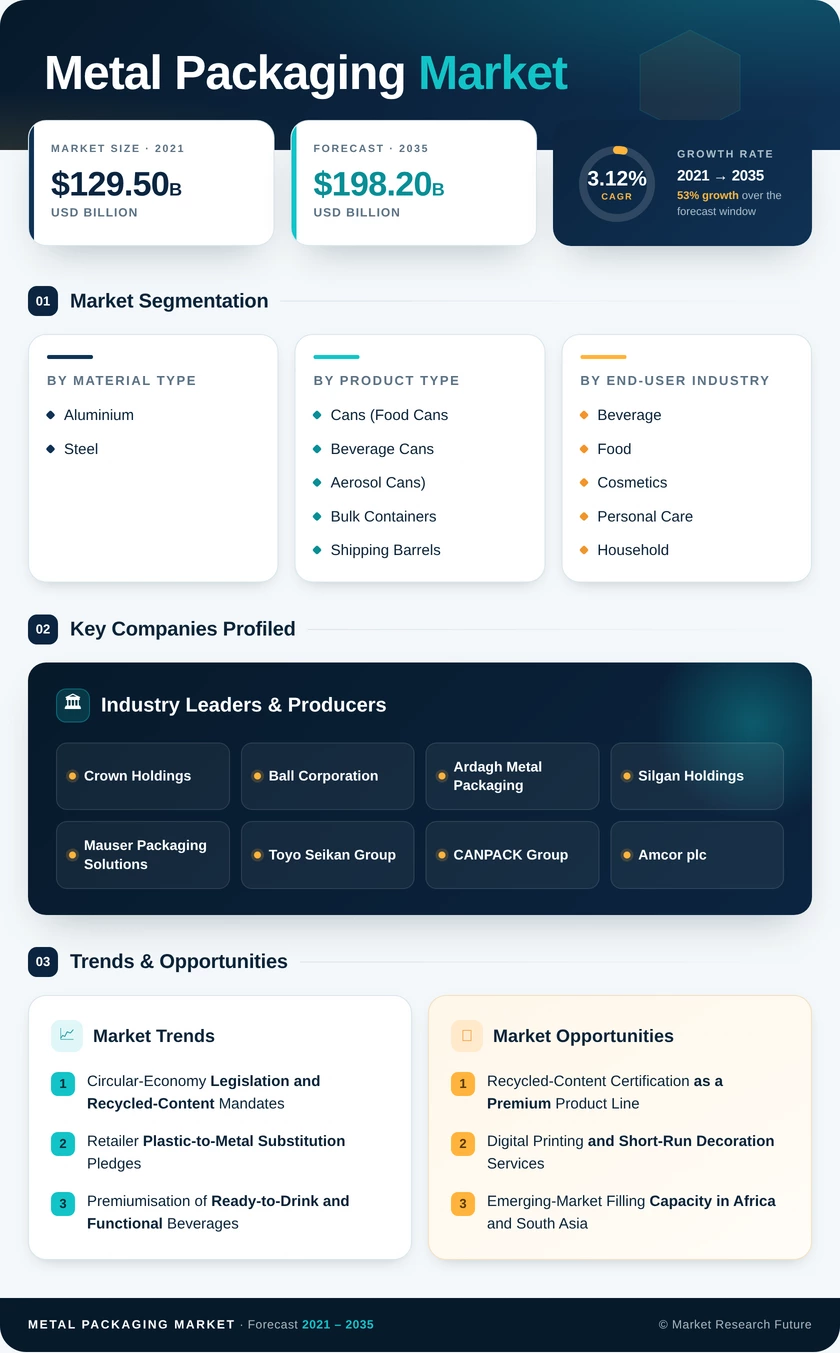
Segmentation Quick Reference
| Dimension | Sub-Segments | Dominant Segment | Fastest Growing Segment |
| By Material Type | Aluminium; Steel | Aluminium (45.80% share, 2025) | Aluminium (3.82% CAGR, 2026–2035) |
| By Product Type | Cans (Food Cans, Beverage Cans, Aerosol Cans); Bulk Containers; Shipping Barrels and Drums; Caps and Closures | Cans (44.00% share, 2025) | Cans (5.65% CAGR, 2026–2035) |
| By End-user Industry | Beverage; Food; Cosmetics and Personal Care; Household; Other End-user Industry | Beverage (37.30% share, 2025) | Food (6.57% CAGR, 2026–2035) |
| By Coating / Lining Type | BPA-Based Epoxy; BPA-NI Epoxy; Polyester / PET; Other Coating / Lining Type | BPA-Based Epoxy (51.41% share, 2025) | BPA-NI Epoxy (5.47% CAGR, 2026–2035) |
| By Container Capacity | Less than 250 ml; 251 – 500 ml; 501 – 1000 ml; More than 1000 ml | 251 – 500 ml (62.19% share, 2025) | 251 – 500 ml (5.71% CAGR, 2026–2035) |
Market Segmentation Overview
By Material Type
| Sub-Segment | Key Trend |
| Aluminium | Closed-loop remelt capacity expansion aligned to recycled-content mandates |
| Steel | Advanced-high-strength tinplate narrowing the weight gap in food formats |
Aluminium leads this dimension and also grows fastest, because remelting recovered stock consumes roughly a twentieth of primary-smelting energy and satisfies PPWR recycled-content thresholds without reformulating the container. Steel expands more slowly at 2.66%, yet it remains irreplaceable in shipping drums and large-format food cans where puncture resistance and magnetic recoverability from mixed waste streams govern specification. Carbon border pricing sharpens the divide, since heavier steel containers carry freight-emission penalties that buyers now quantify in tender scoring.
By Product Type
| Sub-Segment | Key Trend |
| Cans | Beverage premiumisation and short-run digital decoration lifting value per unit |
| Bulk Containers | Reusability certification supporting edible-oil and chemical intermediate handling |
| Shipping Barrels and Drums | UN transport certification sustaining agrochemical demand |
| Caps and Closures | Tamper-evident lug lids gaining specification in retort food lines |
Cans both dominate and grow fastest here, driven by Beverage Cans serving carbonated and functional drinks that need pressure-bearing walls, Food Cans supplying high-barrier retort protection, and Aerosol Cans tracking personal-care recovery. Shipping Barrels and Drums hold the second-largest revenue block through certified reusability rather than growth, while Caps and Closures advance at 3.41% as retort food lines specify tamper-evident lug systems. Format economics rather than substrate choice determine which converters can serve each sub-segment profitably.
By End-user Industry
| Sub-Segment | Key Trend |
| Beverage | Thin-gauge aluminium contracts anchored to carbonation performance |
| Food | Bisphenol-free retort coatings opening organic and infant-nutrition accounts |
| Cosmetics and Personal Care | Decorative tins and aerosols supporting luxury positioning |
| Household | Aerosol cleaners and insecticides tracking hygiene awareness |
| Other End-user Industry | Paints, lubricants and specialty chemicals in general-line containers |
Beverage remains the largest end-user at 37.30% because high-volume beer and soft-drink fillers sign multi-year contracts that lock in thin-gauge specifications. Food grows fastest at 6.57%, since BPA-non-intent retort linings finally satisfy organic and infant-nutrition brands that previously rejected metal on additive grounds. Cosmetics and Personal Care contributes outsized value per unit through decorative tins, and Household volume follows hygiene spending in emerging economies rather than premium positioning.
By Coating / Lining Type
| Sub-Segment | Key Trend |
| BPA-Based Epoxy | Installed base retained where shelf-life data is already validated |
| BPA-NI Epoxy | Regulatory migration limits accelerating conversion capex |
| Polyester / PET | Flavour-neutral systems preferred for sensitive beverage formulations |
| Other Coating / Lining Type | Oleoresin and acrylic variants broadening supplier resilience |
BPA-Based Epoxy still covers 51.41% of internal linings on the strength of four decades of validated shelf-life data, not superior performance. BPA-NI Epoxy grows fastest at 5.47% as regulators narrow bisphenol migration thresholds and formulations remove PFAS and formaldehyde alongside bisphenols. Polyester / PET wins specification where flavour neutrality governs, particularly in low-pH and lightly hopped products, while oleoresin and acrylic variants give converters supply-chain redundancy across resin families.
By Container Capacity
| Sub-Segment | Key Trend |
| Less than 250 ml | Slim energy-shot and ready-to-drink espresso formats gaining shelf space |
| 251 – 500 ml | Global single-serve convention across beer, carbonates and energy drinks |
| 501 – 1000 ml | Family-size food cans and larger beer formats in off-trade channels |
| More than 1000 ml | Foodservice, bulk oil and industrial pack demand |
The 251 – 500 ml band leads at 62.19% and grows fastest at 5.71%, because 330 ml and 500 ml are the entrenched single-serve conventions that filling lines worldwide are tooled to run. Less than 250 ml formats take share from that band in premium niches, where portion control and higher price per millilitre justify slim-can tooling. Larger 501 – 1000 ml and More than 1000 ml formats track foodservice and industrial demand, growing near or below the market average as retail channels favour single-serve convenience.


 Noah Malgeri
Co-Founder

 Peter Groot koerkamp
Account and Business Manager

 Younghwan Choi
Senior Retail Manager

 Mark Irwin
Management Consultant

 Akif Moroglu
Strategy & Business Development Director

 Guilherme Gomes Martins
Product Management Director

 Joseph Aguayo
Sales Operations & Pricing Manager

 La Terria Dodd
Program Support Specialist

 Rob Kooiker
Group Product Manager HVAC & Fire Protection GMA