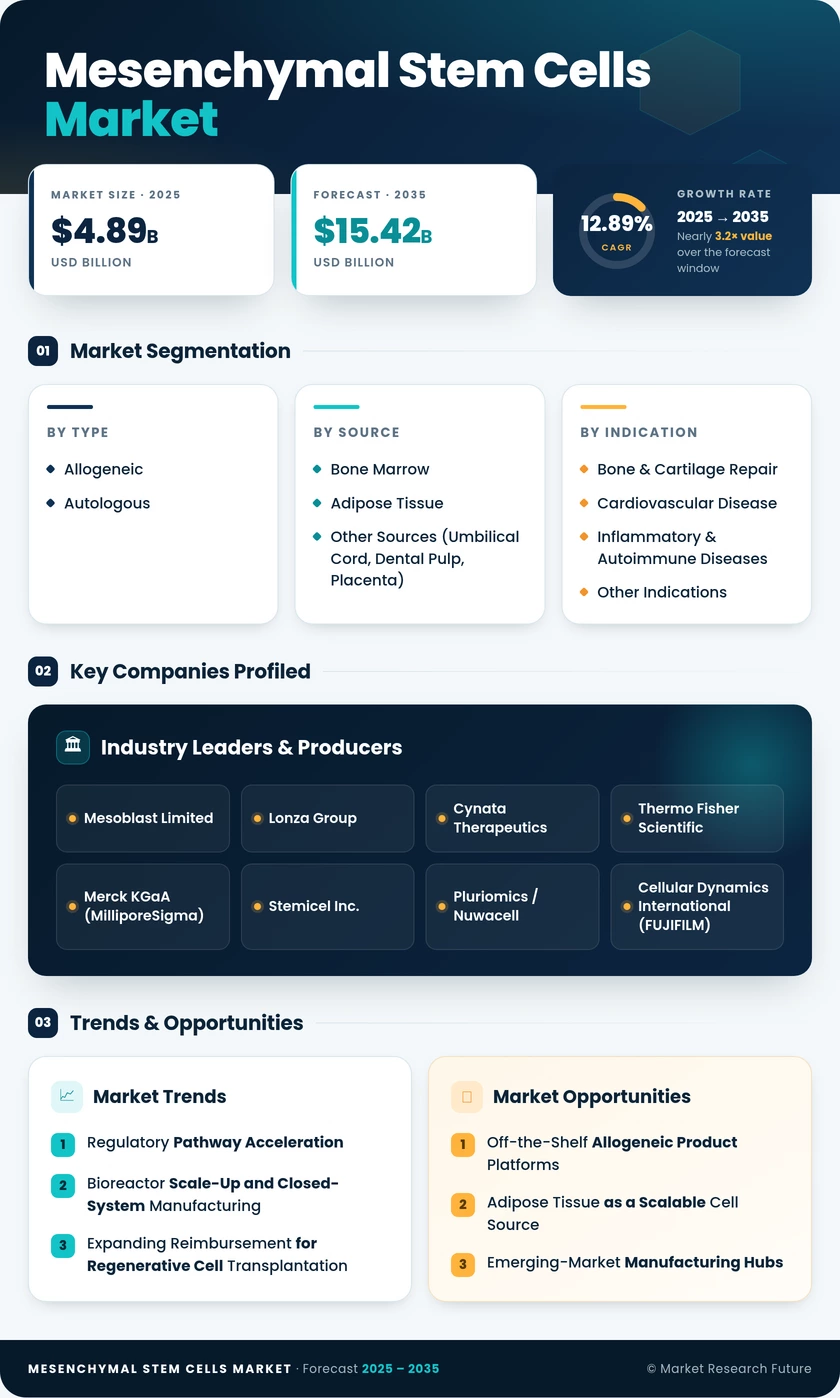
Segmentation Quick Reference
| Dimension | Sub-Segments | Dominant Segment | Fastest Growing Segment |
| Products & Mesenchymal Stem Cells Markets | Kits, Media & Reagents; Cells & Cell Lines; Mesenchymal Stem Cells Markets | Kits, Media & Reagents | Cells & Cell Lines |
| Type | Allogeneic; Autologous | Allogeneic | Autologous |
| Source | Bone Marrow; Adipose Tissue; Umbilical Cord; Dental Pulp; Placenta; Other | Bone Marrow | Adipose Tissue |
| Indication | Bone & Cartilage Repair; Cardiovascular Disease; Inflammatory & Autoimmune Diseases; Neurological Disorders; Hepatic Diseases; Other | Bone & Cartilage Repair | Cardiovascular Disease |
| Application | Drug Development & Discovery; Disease Modelling; Stem Cell Banking; Tissue Engineering; Other | Drug Development & Discovery | Disease Modelling |
| Geography | North America; Europe; Asia-Pacific; South America; Middle East & Africa | North America | Asia-Pacific |
Market Segmentation Overview
By Products & Mesenchymal Stem Cells Markets
| Sub-Segment | Key Trend |
| Kits, Media & Reagents | Shift toward xeno-free, GMP-grade culture media for clinical manufacturing |
| Cells & Cell Lines | Growth in cryopreserved allogeneic master cell banks for off-the-shelf therapies |
| Mesenchymal Stem Cells Markets | CDMO consolidation is driving end-to-end contract manufacturing and analytics |
The products & services dimension reflects the consumables-heavy economics of the mesenchymal stem cells industry, where every clinical and research workflow generates recurring demand for standardized reagents alongside one-time cell purchases.
By Type
| Sub-Segment | Key Trend |
| Allogeneic | Dominance expanding via scalable donor-derived product platforms |
| Autologous | Growth driven by point-of-care processing devices for personalized orthopedic applications |
Allogeneic approaches benefit from off-the-shelf convenience, while autologous therapies retain their edge in immune-sensitive indications requiring patient-specific cell processing.
By Source
| Sub-Segment | Key Trend |
| Bone Marrow | Gold-standard source with the longest clinical validation history |
| Adipose Tissue | Rapidly gaining share due to 500x higher cell yields per gram versus bone marrow |
| Umbilical Cord | Growing neonatal tissue banking infrastructure supports non-invasive collection |
| Dental Pulp | Emerging research source for craniofacial and neurological applications |
| Placenta | Post-partum collection offers ethical sourcing advantages |
| Other Sources | Includes synovial membrane, periosteum, and peripheral blood-derived MSCs |
Source selection is increasingly indication-driven, with bone marrow preferred for immunomodulation and adipose tissue favored for high-volume orthopedic and dermatological workflows.
By Indication
| Sub-Segment | Key Trend |
| Bone & Cartilage Repair | Largest Indication driven by aging demographics and joint replacement alternatives |
| Cardiovascular Disease | Fastest CAGR fueled by unmet need in chronic heart failure |
| Inflammatory & Autoimmune Diseases | GvHD and Crohn's disease represent anchor indications post-Ryoncil approval |
| Neurological Disorders | Stroke and spinal cord injury programs entering late-stage trials |
| Hepatic Diseases | Liver fibrosis and cirrhosis MSC programs in Phase II |
| Other Indications | Dermatological, pulmonary, and renal applications in early development |
Cardiovascular and neurological indications are expected to gain share over the decade as Phase III data matures and reimbursement pathways crystallize.
By Application
| Sub-Segment | Key Trend |
| Drug Development & Discovery | MSCs as in-vitro screening platforms and co-culture models |
| Disease Modelling | Patient-derived organoid systems incorporating MSCs for preclinical testing |
| Stem Cell Banking | Allogeneic master cell bank infrastructure expansion |
| Tissue Engineering | Scaffold-based and bioprinting applications using MSC-seeded constructs |
| Other Applications | Cosmeceuticals and veterinary regenerative medicine |
Drug development applications dominate current revenue, but clinical-use applications (stem cell banking, tissue engineering) are projected to converge in share by the early 2030s as commercial therapies proliferate.