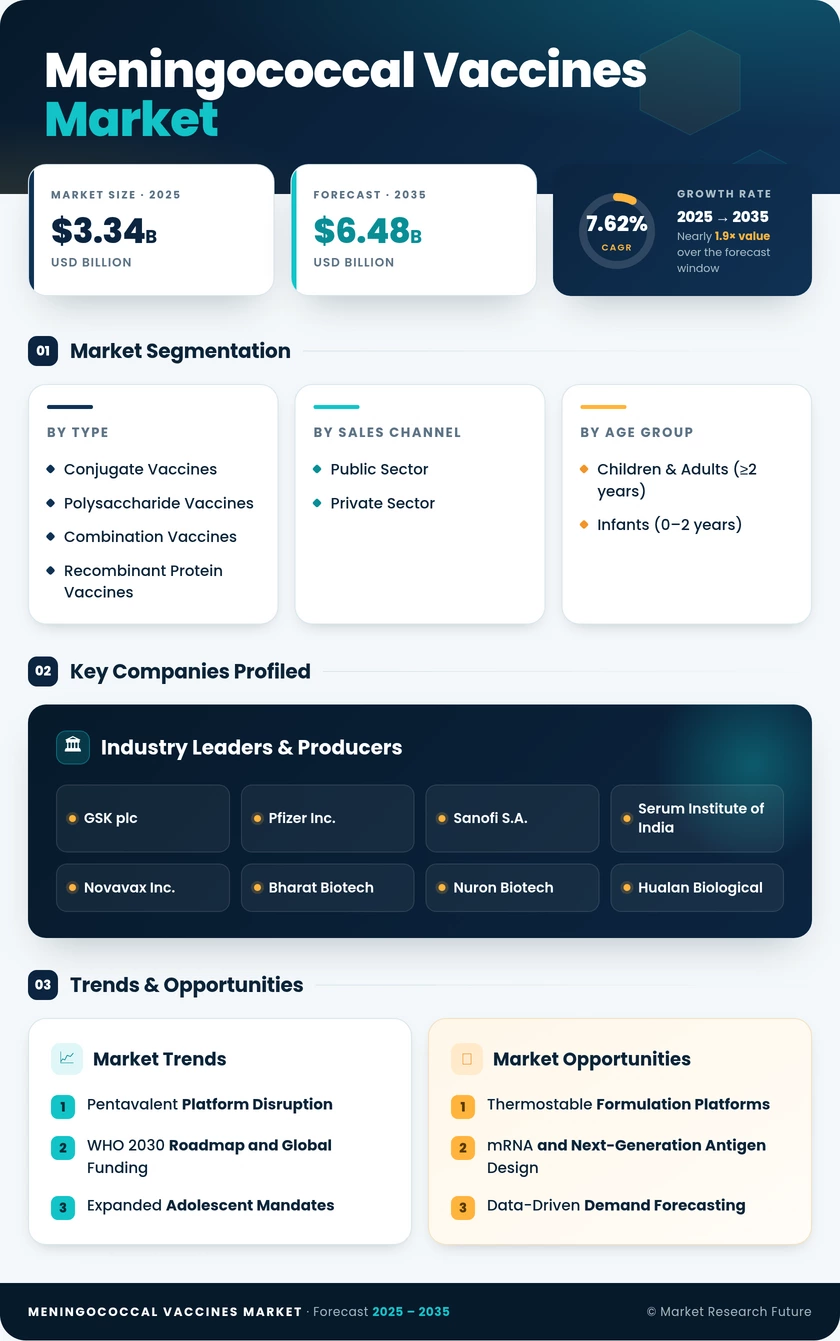
Meningococcal Vaccines Market

ID: MRFR/Pharma/7150-CR
120 Pages
Satyendra Maurya
Last Updated: June 10, 2026
Meningococcal Vaccines Market Size, Growth Research Report By Vaccine Type (Monovalent Vaccines, Multivalent Vaccines, Conjugate Vaccines), By Age Group (Infants, Children, Adolescents, Adults), By Administration Route (Intramuscular, Subcutaneous, Oral), By Distribution Channel (Hospitals, Clinics, Pharmacies) and By Regional (North America, Europe, South America, Asia Pacific, Middle East and Africa) - Competitor Industry Analysis and Trends Forecast Till 2035
Download PDF ×

We do not share your information with anyone. However, we may send you emails based on your report interest from time to time. You may contact us at any time to opt-out.

  1. 1 Market Overview |
    1. 1.1 Study Assumptions & Market Definition |
    2. 1.2 Scope of the Study |
    3. 1.3 Research Methodology
  2. 2 Market Summary & Key Takeaways
  3. 3 Market Dynamics |
    1. 3.1 Market Drivers Analysis | |
      1. 3.1.1 Pentavalent Vaccine Approvals | |
      2. 3.1.2 WHO 2030 Meningitis Elimination Roadmap | |
      3. 3.1.3 Expanded Adolescent Meningitis Vaccination Mandates | |
      4. 3.1.4 Gavi & Public-Private Partnership Funding | |
      5. 3.1.5 Thermostable Conjugate Meningococcal Vaccine Development | |
      6. 3.1.6 mRNA Platform Extension to Meningococcal Antigens | |
      7. 3.1.7 Rising Serogroup W & Y Outbreak Frequency |
    2. 3.2 Market Restraints Analysis | |
      1. 3.2.1 High Per-Dose Cost of Pentavalent Vaccines | |
      2. 3.2.2 Cold-Chain Infrastructure Gaps | |
      3. 3.2.3 Cannibalization of Legacy Quadrivalent Revenues | |
      4. 3.2.4 Vaccine Hesitancy and Misinformation | |
      5. 3.2.5 Regulatory Approval Timelines for Novel Platforms |
    3. 3.3 Market Opportunity Analysis | |
      1. 3.3.1 Thermostable Formulation Platforms | |
      2. 3.3.2 mRNA and Next-Generation Antigen Design | |
      3. 3.3.3 Data-Driven Demand Forecasting | |
      4. 3.3.4 Emerging-Market National Immunization Expansion | |
      5. 3.3.5 Combination Vaccine Bundling Strategies |
    4. 3.4 Industry Value Chain Analysis |
    5. 3.5 Porter's Five Forces Analysis
  4. 4 Global Meningococcal Vaccines Market Size & Forecast (2021–2035) |
    1. 4.1 Historical Market Size (2021–2025) |
    2. 4.2 Current & Forecast Market Size (2026–2035) |
    3. 4.3 Market Size by Revenue (USD Billion) |
    4. 4.4 Year-over-Year Growth Analysis
  5. 5 Segmentation Analysis |
    1. 5.1 By Product Type | |
      1. 5.1.1 Quadrivalent | |
      2. 5.1.2 Bivalent | |
      3. 5.1.3 Monovalent | |
      4. 5.1.4 Pentavalent |
    2. 5.2 By Vaccine Type | |
      1. 5.2.1 Conjugate Vaccines | |
      2. 5.2.2 Polysaccharide Vaccines | |
      3. 5.2.3 Combination Vaccines | |
      4. 5.2.4 Recombinant Protein Vaccines |
    3. 5.3 By Sales Channel | |
      1. 5.3.1 Public Sector | |
      2. 5.3.2 Private Sector |
    4. 5.4 By Age Group | |
      1. 5.4.1 Children & Adults (Aged 2 Years and Above) | |
      2. 5.4.2 Infants (Aged 0–2 Years)
  6. 6 Regional Analysis |
    1. 6.1 North America | |
      1. 6.1.1 United States | |
      2. 6.1.2 Canada | |
      3. 6.1.3 Mexico |
    2. 6.2 Europe | |
      1. 6.2.1 Germany | |
      2. 6.2.2 United Kingdom | |
      3. 6.2.3 France | |
      4. 6.2.4 Italy | |
      5. 6.2.5 Spain | |
      6. 6.2.6 Nordic Countries | |
      7. 6.2.7 Russia | |
      8. 6.2.8 Rest of Europe |
    3. 6.3 Asia-Pacific | |
      1. 6.3.1 China | |
      2. 6.3.2 India | |
      3. 6.3.3 Japan | |
      4. 6.3.4 South Korea | |
      5. 6.3.5 ASEAN | |
      6. 6.3.6 Rest of Asia-Pacific |
    4. 6.4 South America | |
      1. 6.4.1 Brazil | |
      2. 6.4.2 Argentina | |
      3. 6.4.3 Rest of South America |
    5. 6.5 Middle East & Africa | |
      1. 6.5.1 Saudi Arabia | |
      2. 6.5.2 UAE | |
      3. 6.5.3 South Africa | |
      4. 6.5.4 Egypt | |
      5. 6.5.5 Rest of MEA
  7. 7 Competitive Landscape |
    1. 7.1 Market Share Analysis (2025) |
    2. 7.2 Competitive Benchmarking Matrix |
    3. 7.3 Company Profiles | |
      1. 7.3.1 GSK plc | |
      2. 7.3.2 Pfizer Inc. | |
      3. 7.3.3 Sanofi S.A. | |
      4. 7.3.4 Serum Institute of India | |
      5. 7.3.5 Novavax Inc. | |
      6. 7.3.6 Bharat Biotech | |
      7. 7.3.7 Nuron Biotech | |
      8. 7.3.8 Hualan Biological | |
      9. 7.3.9 Bio-Manguinhos / Fiocruz | |
      10. 7.3.10 Walvax Biotechnology
  8. 8 Future Outlook & Strategic Recommendations (2026–2035) |
    1. 8.1 Pentavalent Dominance and Portfolio Rationalization |
    2. 8.2 mRNA and Platform Vaccine Innovation |
    3. 8.3 AI-Enabled Surveillance and Demand Planning |
    4. 8.4 Equity-Driven Access and Tiered Pricing
  9. 9 Recent Developments & News
  10. 10 Frequently Asked Questions (FAQs)
  11. 11 Report Scope & Methodology |
    1. 11.1 Study Period & Base Year |
    2. 11.2 Data Sources & Citations |
    3. 11.3 Abbreviations
  12. 12 LIST OF TABLES |
  13. TABLE 1 Global Meningococcal Vaccines Market Size & Forecast, by Revenue (USD Billion), 2021–2035 |
  14. TABLE 2 Global Meningococcal Vaccines Market – Year-over-Year Growth Analysis, 2021–2035 |
  15. TABLE 3 Global Meningococcal Vaccines Market – Driver Impact Analysis, 2026–2035 |
  16. TABLE 4 Global Meningococcal Vaccines Market – Restraint Impact Analysis, 2026–2035 |
  17. TABLE 5 Global Meningococcal Vaccines Market Size, by Product Type, 2021–2035 (USD Billion) |
  18. TABLE 6 Global Meningococcal Vaccines Market Size, by Vaccine Type, 2021–2035 (USD Billion) |
  19. TABLE 7 Global Meningococcal Vaccines Market Size, by Sales Channel, 2021–2035 (USD Billion) |
  20. TABLE 8 Global Meningococcal Vaccines Market Size, by Age Group, 2021–2035 (USD Billion) |
  21. TABLE 9 Global Meningococcal Vaccines Market Size, by Region, 2021–2035 (USD Billion) |
  22. TABLE 10 North America Meningococcal Vaccines Market Size, by Country, 2021–2035 (USD Billion) |
  23. TABLE 11 Europe Meningococcal Vaccines Market Size, by Country, 2021–2035 (USD Billion) |
  24. TABLE 12 Asia-Pacific Meningococcal Vaccines Market Size, by Country, 2021–2035 (USD Billion) |
  25. TABLE 13 South America Meningococcal Vaccines Market Size, by Country, 2021–2035 (USD Billion) |
  26. TABLE 14 Middle East & Africa Meningococcal Vaccines Market Size, by Country, 2021–2035 (USD Billion) |
  27. TABLE 15 Competitive Benchmarking Matrix – Global Meningococcal Vaccines Market, 2025 |
  28. TABLE 16 Company Profiles – Key Players, Global Meningococcal Vaccines Market |
  29. TABLE 17 Recent Developments & Strategic Announcements, 2023–2025 |
  30. TABLE 18 North America Meningococcal Vaccines Market Size, by Product Type, 2021–2035 (USD Billion) |
  31. TABLE 19 North America Meningococcal Vaccines Market Size, by Vaccine Type, 2021–2035 (USD Billion) |
  32. TABLE 20 North America Meningococcal Vaccines Market Size, by Sales Channel, 2021–2035 (USD Billion) |
  33. TABLE 21 North America Meningococcal Vaccines Market Size, by Age Group, 2021–2035 (USD Billion) |
  34. TABLE 22 Europe Meningococcal Vaccines Market Size, by Product Type, 2021–2035 (USD Billion) |
  35. TABLE 23 Europe Meningococcal Vaccines Market Size, by Vaccine Type, 2021–2035 (USD Billion) |
  36. TABLE 24 Europe Meningococcal Vaccines Market Size, by Sales Channel, 2021–2035 (USD Billion) |
  37. TABLE 25 Europe Meningococcal Vaccines Market Size, by Age Group, 2021–2035 (USD Billion) |
  38. TABLE 26 Asia-Pacific Meningococcal Vaccines Market Size, by Product Type, 2021–2035 (USD Billion) |
  39. TABLE 27 Asia-Pacific Meningococcal Vaccines Market Size, by Vaccine Type, 2021–2035 (USD Billion) |
  40. TABLE 28 Asia-Pacific Meningococcal Vaccines Market Size, by Sales Channel, 2021–2035 (USD Billion) |
  41. TABLE 29 Asia-Pacific Meningococcal Vaccines Market Size, by Age Group, 2021–2035 (USD Billion) |
  42. TABLE 30 South America Meningococcal Vaccines Market Size, by Product Type, 2021–2035 (USD Billion) |
  43. TABLE 31 South America Meningococcal Vaccines Market Size, by Vaccine Type, 2021–2035 (USD Billion) |
  44. TABLE 32 South America Meningococcal Vaccines Market Size, by Sales Channel, 2021–2035 (USD Billion) |
  45. TABLE 33 South America Meningococcal Vaccines Market Size, by Age Group, 2021–2035 (USD Billion) |
  46. TABLE 34 Middle East & Africa Meningococcal Vaccines Market Size, by Product Type, 2021–2035 (USD Billion) |
  47. TABLE 35 Middle East & Africa Meningococcal Vaccines Market Size, by Vaccine Type, 2021–2035 (USD Billion) |
  48. TABLE 36 Middle East & Africa Meningococcal Vaccines Market Size, by Sales Channel, 2021–2035 (USD Billion) |
  49. TABLE 37 Middle East & Africa Meningococcal Vaccines Market Size, by Age Group, 2021–2035 (USD Billion) |
  50. TABLE 38 Report Scope & Methodology Summary |
  51. TABLE 39 Detailed Sources and Citations
  52. 13 LIST OF FIGURES |
  53. FIGURE 1 Global Meningococcal Vaccines Market Dynamics Overview (Drivers, Restraints, Opportunities) |
  54. FIGURE 2 Industry Value Chain Analysis – Meningococcal Vaccines Market |
  55. FIGURE 3 Porter's Five Forces Analysis – Meningococcal Vaccines Market |
  56. FIGURE 4 Global Meningococcal Vaccines Market Size Trend (USD Billion), 2021–2035 |
  57. FIGURE 5 Global Meningococcal Vaccines Market Share, by Product Type (%), 2025 |
  58. FIGURE 6 Global Meningococcal Vaccines Market Share, by Vaccine Type (%), 2025 |
  59. FIGURE 7 Global Meningococcal Vaccines Market Share, by Sales Channel (%), 2025 |
  60. FIGURE 8 Global Meningococcal Vaccines Market Share, by Age Group (%), 2025 |
  61. FIGURE 9 Global Meningococcal Vaccines Market Share, by Region (%), 2025 |
  62. FIGURE 10 North America Meningococcal Vaccines Market Share, by Country (%), 2025 |
  63. FIGURE 11 Europe Meningococcal Vaccines Market Share, by Country (%), 2025 |
  64. FIGURE 12 Asia-Pacific Meningococcal Vaccines Market Share, by Country (%), 2025 |
  65. FIGURE 13 South America Meningococcal Vaccines Market Share, by Country (%), 2025 |
  66. FIGURE 14 Middle East & Africa Meningococcal Vaccines Market Share, by Country (%), 2025 |
  67. FIGURE 15 Competitive Landscape – Market Share Analysis, 2025 |
  68. FIGURE 16 Competitive Benchmarking Radar Chart – Top 10 Players

Segmentation Quick Reference

DimensionSub-SegmentsDominant SegmentFastest Growing Segment
Product TypeQuadrivalent, Bivalent, Monovalent, PentavalentQuadrivalent (57% share, 2025)Pentavalent (9.10% CAGR)
Vaccine TypeConjugate, Polysaccharide, Combination, Recombinant ProteinConjugate (49% share, 2025)Combination (8.72% CAGR)
Sales ChannelPublic Sector, Private SectorPublic Sector (72% share, 2025)Private Sector (8.78% CAGR)
Age GroupChildren & Adults (≥2 years), Infants (0–2 years)Children & Adults (80% share, 2025)Infants (8.82% CAGR)
GeographyNorth America, Europe, Asia-Pacific, South America, Middle East & AfricaNorth America (43% share, 2025)Asia-Pacific (8.92% CAGR)


Market Segmentation Overview

By Product Type

Sub-SegmentKey Trend
QuadrivalentMature category is facing gradual share erosion as pentavalent alternatives gain reimbursement approval
BivalentStrong growth driven by serogroup B-specific recommendations for university-age populations
MonovalentDeclining share in developed markets; sustained demand in the African meningitis belt MenA campaigns
PentavalentNewest category with the highest growth trajectory, consolidating multi-dose schedules into single injections


Quadrivalent vaccines remain the largest product category in the Meningococcal Vaccines Market, but their share is expected to decline from 57% in 2025 to roughly 42% by 2035 as pentavalent and bivalent products gain traction. The pentavalent segment, led by GSK's Penmenvy and Pfizer's Penbraya, represents the most disruptive product innovation since the introduction of conjugate meningococcal vaccine technology in the early 2000s.

By Vaccine Type

Sub-SegmentKey Trend
Conjugate VaccinesGold standard for routine immunization due to T-cell-dependent memory and infant suitability
Polysaccharide VaccinesDeclining but still relevant for mass outbreak-response campaigns in cost-sensitive settings
Combination VaccinesFastest growth as pentavalent platforms merge conjugate and recombinant protein components
Recombinant Protein VaccinesSpecialized serogroup B focus; pipeline candidates exploring broader serogroup coverage


Conjugate vaccines anchor routine Neisseria meningitidis immunization programs globally, while combination vaccine platforms are converging conjugate and recombinant technologies into unified products. Polysaccharide vaccines will retain a niche in emergency outbreak response where cost per dose is the primary procurement criterion.

By Sales Channel

Sub-SegmentKey Trend
Public SectorDominant channel driven by national immunization programs and multilateral procurement mechanisms
Private SectorFastest growing, fueled by parental demand for out-of-schedule serogroup B meningococcal protection


Public procurement through government tenders and Gavi-backed mechanisms accounts for the majority of global meningococcal vaccine volume. Private-sector growth is concentrated in high-income countries where awareness of bacterial meningitis prevention beyond routine schedules drives discretionary purchasing.

By Age Group

Sub-SegmentKey Trend
Children & Adults (≥2 years)Largest segment, anchored by adolescent meningitis vaccination school-entry mandates
Infants (0–2 years)Fastest growing as countries expand NIP schedules to include infant conjugate meningococcal vaccine doses


The children and adults segment dominates due to well-established adolescent meningitis vaccination requirements. Infant programs, however, are expanding as additional countries adopt conjugate meningococcal vaccine schedules for children under 2, reflecting WHO guidance on early-life Neisseria meningitidis immunization.