Request Free Sample ×

Kindly complete the form below to receive a free sample of this Report

* Please use a valid business email

Leading companies partner with us for data-driven Insights

clients tt-cursor
Hero Background
English
Chinese
French
Japanese
Korean
German
Spanish

Medium Duty Truck Market Trends

ID: MRFR/AT/12392-HCR
128 Pages
Shubham Munde
April 2026

Medium-Duty Truck Market Research Report Information By Fuel (Diesel, Natural Gas, Hybrid, Electric, and Gasoline), By Horsepower (Below 150 HP, 150 HP-250 HP, and Above 250 HP), By Application (Construction & Mining and Freight & Logistics), By Region (North America, Europe, Asia-Pacific, And Rest Of The World) - Growth & Industry Forecast to 2035

Share:
Download PDF ×

We do not share your information with anyone. However, we may send you emails based on your report interest from time to time. You may contact us at any time to opt-out.

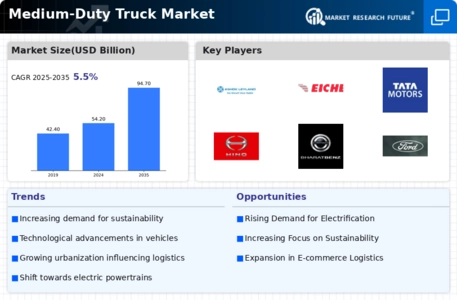
Medium Duty Truck Market Infographic
Purchase Options

Market Trends

Key Emerging Trends in the Medium Duty Truck Market

The market trends for medium-duty trucks have undergone significant transformations in recent years, reflecting a combination of technological advancements, shifting consumer demands, and industry-wide efforts to enhance efficiency and sustainability. One notable trend in the medium-duty truck market is the increasing integration of advanced technologies. Manufacturers are incorporating features such as telematics, advanced driver assistance systems (ADAS), and connectivity solutions to improve fleet management, optimize fuel efficiency, and enhance overall safety. These technological advancements contribute to the modernization of medium-duty truck fleets, making them more intelligent and adaptable to the evolving needs of businesses.

Efforts to improve fuel efficiency and reduce emissions are driving innovations in the medium-duty truck market. With a growing emphasis on environmental sustainability and stricter emission regulations, manufacturers are investing in the development of more fuel-efficient engines, lightweight materials, and aerodynamic designs for medium-duty trucks. This trend aligns with the broader industry goal of minimizing the environmental impact of transportation and ensuring compliance with stringent emission standards.

The electrification of medium-duty trucks is emerging as a key trend in response to the global push towards sustainable transportation. Electric medium-duty trucks offer the advantage of zero-emission operations, making them particularly appealing for urban delivery and short-haul applications. Manufacturers are investing in electric drivetrain technology, battery advancements, and charging infrastructure to meet the increasing demand for electric medium-duty trucks, especially in regions where environmental regulations and incentives support the adoption of electric vehicles.

The rise of e-commerce and the consequent growth in last-mile delivery services have significantly impacted the medium-duty truck market. As online shopping becomes more prevalent, there is an increased demand for medium-duty trucks that are well-suited for urban and suburban deliveries. Manufacturers are adapting to this trend by designing medium-duty trucks with compact dimensions, improved maneuverability, and features tailored to the specific needs of last-mile delivery operations, such as efficient cargo handling systems and driver-friendly cabins.

The market for medium-duty trucks is experiencing a shift towards customization and versatility. Businesses across various industries require medium-duty trucks that can be adapted to specific applications and operational requirements. Manufacturers are responding to this demand by offering a diverse range of configurations, allowing customers to choose from various body styles, cargo capacities, and specialized features. This trend caters to the diverse needs of industries such as construction, utilities, and logistics, where medium-duty trucks play a crucial role in daily operations.

Digitalization and connectivity are playing an increasingly significant role in the medium-duty truck market. Manufacturers are incorporating telematics and connectivity solutions to provide real-time data on vehicle performance, maintenance needs, and driver behavior. Fleet managers can leverage this information to optimize route planning, monitor fuel efficiency, and implement preventive maintenance strategies. The integration of digital technologies enhances the overall efficiency of medium-duty truck fleets and contributes to cost savings for businesses.

Safety features and driver assistance systems are becoming standard in modern medium-duty trucks. With a focus on improving road safety and reducing accidents, manufacturers are equipping medium-duty trucks with technologies such as lane departure warning systems, collision mitigation, and adaptive cruise control. These safety advancements not only protect drivers and other road users but also contribute to operational efficiency by minimizing downtime and repair costs associated with accidents.

The market trends for medium-duty trucks reflect a dynamic landscape shaped by technological innovations, environmental considerations, changing consumer preferences, and the evolving needs of various industries. From the integration of advanced technologies and electrification to the customization of trucks for specific applications and the emphasis on safety and connectivity, the medium-duty truck market is undergoing a transformation to meet the demands of a rapidly evolving transportation landscape. As manufacturers continue to adapt to these trends, medium-duty trucks are likely to play a crucial role in facilitating efficient, sustainable, and safe transportation across diverse industries.


Author
Author Profile
Shubham Munde
Team Lead - Research

Shubham brings over 7 years of expertise in Market Intelligence and Strategic Consulting, with a strong focus on the Automotive, Aerospace, and Defense sectors. Backed by a solid foundation in semiconductors, electronics, and software, he has successfully delivered high-impact syndicated and custom research on a global scale. His core strengths include market sizing, forecasting, competitive intelligence, consumer insights, and supply chain mapping. Widely recognized for developing scalable growth strategies, Shubham empowers clients to navigate complex markets and achieve a lasting competitive edge. Trusted by start-ups and Fortune 500 companies alike, he consistently converts challenges into strategic opportunities that drive sustainable growth.

Leave a Comment

FAQs

What is the projected market valuation of the Medium-Duty Truck Market by 2035?

<p>The Medium-Duty Truck Market is projected to reach a valuation of 99.89 USD Billion by 2035.</p>

What was the market valuation of the Medium-Duty Truck Market in 2024?

<p>In 2024, the Medium-Duty Truck Market was valued at 55.42 USD Billion.</p>

What is the expected CAGR for the Medium-Duty Truck Market during the forecast period 2025 - 2035?

<p>The expected CAGR for the Medium-Duty Truck Market during the forecast period 2025 - 2035 is 5.5%.</p>

Which fuel segment is projected to have the highest valuation in the Medium-Duty Truck Market?

<p>The Diesel fuel segment is projected to have the highest valuation, ranging from 30.0 to 50.0 USD Billion.</p>

What are the projected valuations for the Electric fuel segment by 2035?

<p>The Electric fuel segment is projected to reach valuations between 5.0 and 15.0 USD Billion by 2035.</p>

Which horsepower segment is expected to dominate the Medium-Duty Truck Market?

<p>The 150 HP-250 HP segment is expected to dominate, with projected valuations between 25.0 and 45.0 USD Billion.</p>

What applications are driving growth in the Medium-Duty Truck Market?

The Freight &amp; Logistics application is driving growth, with projected valuations between 33.26 and 60.89 USD Billion.

Who are the key players in the Medium-Duty Truck Market?

Key players in the Medium-Duty Truck Market include Freightliner, International, Hino, Isuzu, and Kenworth.

What is the projected valuation for the Construction & Mining application segment by 2035?

The Construction &amp; Mining application segment is projected to reach valuations between 22.16 and 39.0 USD Billion by 2035.

How does the Medium-Duty Truck Market's growth compare across different fuel types?

The market shows varied growth across fuel types, with Diesel leading, followed by Natural Gas and Electric segments.

Market Summary

As per Market Research Future analysis, the Medium-Duty Truck Market Size was estimated at 55.42 USD Billion in 2024. The Medium-Duty Truck industry is projected to grow from 58.47 USD Billion in 2025 to 99.89 USD Billion by 2035, exhibiting a compound annual growth rate (CAGR) of 5.5% during the forecast period 2025 - 2035

Key Market Trends & Highlights

The Medium-Duty Truck Market is experiencing a transformative shift driven by technological advancements and evolving consumer preferences.

  • Technological advancements are reshaping the medium-duty truck market, enhancing efficiency and performance. In North America, the market remains the largest, while the Asia-Pacific region is emerging as the fastest-growing area. The diesel segment continues to dominate, whereas the electric segment is rapidly gaining traction among consumers. Increasing demand for e-commerce delivery and stringent regulatory compliance are key drivers propelling market growth.

Market Size & Forecast

2024 Market Size 55.42 (USD Billion)
2035 Market Size 99.89 (USD Billion)
CAGR (2025 - 2035) 5.5%
Largest Regional Market Share in 2024 North America

Major Players

<a href="https://www.freightliner.com/blog-and-newsletters/what-is-a-medium-duty-truck/">Freightliner</a> (US), International (US), Hino (JP), <a href="https://www.isuzucv.com/en/isuzutrucks">Isuzu</a> (JP), Mitsubishi Fuso (JP), Kenworth (US), Peterbilt (US), Volvo (SE), Mack (US)

Market Trends

The Medium-Duty Truck Market is currently experiencing a dynamic evolution, driven by various factors that influence both demand and supply. The increasing need for efficient transportation solutions, particularly in urban areas, has led to a surge in the adoption of medium-duty trucks. These vehicles are favored for their versatility, capable of handling a range of applications from delivery services to construction. Furthermore, advancements in technology, such as improved fuel efficiency and enhanced safety features, are reshaping consumer preferences. As environmental concerns gain prominence, the market is also witnessing a gradual shift towards electric and hybrid models, which may redefine traditional operational paradigms. In addition to technological advancements, regulatory frameworks are playing a crucial role in shaping the Medium-Duty Truck Market. Governments worldwide are implementing stricter emissions standards, prompting manufacturers to innovate and adapt their offerings. This regulatory pressure could potentially accelerate the transition towards greener alternatives. Moreover, the ongoing development of infrastructure, particularly in emerging economies, is likely to bolster the demand for medium-duty trucks. Overall, the Medium-Duty Truck Market appears poised for growth, with a blend of innovation, regulatory influence, and evolving consumer needs driving its trajectory.

Technological Advancements

The Medium-Duty Truck Market is witnessing a wave of technological innovations that enhance vehicle performance and efficiency. Features such as advanced telematics, automated driving systems, and improved fuel management are becoming increasingly prevalent. These advancements not only optimize operational efficiency but also contribute to safety and driver comfort.

Shift Towards Sustainability

There is a noticeable trend towards sustainability within the Medium-Duty Truck Market. As environmental regulations tighten, manufacturers are exploring alternative fuel options, including electric and hybrid vehicles. This shift reflects a broader commitment to reducing carbon footprints and meeting consumer demand for greener transportation solutions.

Evolving Consumer Preferences

Consumer preferences in the Medium-Duty Truck Market are evolving, with a growing emphasis on customization and flexibility. Businesses are seeking vehicles that can be tailored to specific operational needs, leading to increased demand for specialized configurations. This trend indicates a shift towards more personalized solutions in the medium-duty segment.

Medium Duty Truck Market Market Drivers

Rising Urbanization and Logistics Needs

The trend of rising urbanization is significantly impacting the medium-duty truck market. As more people move to urban areas, the demand for efficient logistics solutions increases. Medium-duty trucks are particularly well-suited for urban environments, where their size and maneuverability allow for effective delivery in congested areas. In 2025, it is expected that urban logistics will drive a substantial portion of the medium-duty truck market, as businesses adapt to the changing landscape. The need for timely deliveries and efficient supply chains in urban settings is prompting companies to invest in medium-duty trucks. Additionally, the growth of urban populations is likely to lead to increased consumer spending, further fueling the demand for logistics services and, consequently, medium-duty trucks.

Increasing Demand for E-commerce Delivery

The rise of e-commerce has led to a notable increase in demand for medium-duty trucks, which are essential for last-mile delivery services. As online shopping continues to expand, businesses require efficient logistics solutions to meet consumer expectations. In 2025, the medium-duty truck market is projected to experience a growth rate of approximately 5% annually, driven by the need for timely deliveries. This trend is further supported by the increasing number of distribution centers and warehouses, which necessitate a robust fleet of medium-duty trucks. Companies are investing in these vehicles to enhance their delivery capabilities, thereby contributing to the overall growth of the medium-duty truck market. The shift towards urbanization also plays a role, as cities require smaller, more maneuverable trucks for navigating congested areas.

Infrastructure Development and Investment

Investment in infrastructure development is a critical driver for the medium-duty truck market. Governments and private entities are allocating substantial resources to enhance transportation networks, including roads, bridges, and logistics hubs. This investment facilitates smoother and more efficient transportation of goods, thereby increasing the demand for medium-duty trucks. In 2025, the medium-duty truck market is expected to benefit from these developments, as improved infrastructure allows for better access to markets and reduces transit times. Additionally, the expansion of trade routes and logistics facilities is likely to create new opportunities for medium-duty truck operators. As infrastructure continues to evolve, the market for these vehicles is poised for growth, reflecting the interconnected nature of transportation and economic development.

Regulatory Compliance and Emission Standards

Stringent regulatory frameworks regarding emissions and fuel efficiency are shaping the medium-duty truck market. Governments are implementing stricter emission standards to combat climate change and improve air quality. As a result, manufacturers are compelled to innovate and produce cleaner, more efficient medium-duty trucks. The introduction of electric and hybrid models is becoming increasingly prevalent, as companies seek to comply with these regulations while also reducing operational costs. In 2025, it is anticipated that the market for electric medium-duty trucks will grow significantly, reflecting a shift towards sustainable transportation solutions. This regulatory landscape not only drives technological advancements but also influences consumer purchasing decisions, as businesses prioritize compliance and sustainability in their logistics operations.

Technological Integration and Fleet Management Solutions

The integration of advanced technologies into fleet management is transforming the medium-duty truck market. Companies are increasingly adopting telematics, GPS tracking, and data analytics to optimize their operations. These technologies enable businesses to monitor vehicle performance, reduce fuel consumption, and enhance route planning. In 2025, it is projected that the adoption of such technologies will lead to a more efficient medium-duty truck market, as operators seek to maximize productivity and minimize costs. Furthermore, the rise of autonomous driving technology may also influence the market, as companies explore the potential for driverless medium-duty trucks. This technological evolution not only improves operational efficiency but also enhances safety and compliance within the industry.

Market Segment Insights

By Fuel: Diesel (Largest) vs. Electric (Fastest-Growing)

The Medium-Duty Truck Market exhibits a diverse fuel segment landscape, with Diesel fuel holding the largest market share. Diesel engines are favored for their efficiency and torque, making them the go-to choice for commercial transport. Natural Gas follows as a noteworthy contender, valued for its environmental benefits, while Hybrid and Electric options are gaining momentum. Gasoline, though less prevalent in this segment, still holds a niche market. The competition among these fuels is shaping the market dynamics significantly.

Diesel (Dominant) vs. Electric (Emerging)

Diesel fuel dominates the Medium-Duty Truck Market due to its well-established technology and performance reliability. It provides excellent fuel efficiency and power output, crucial for heavy-load applications. Conversely, <a href="https://www.marketresearchfuture.com/reports/electric-truck-market-6261">Electric trucks</a> are emerging as a viable market force, driven by advancements in battery technology and increasing demand for sustainable solutions. As infrastructure for electric charging improves, more fleets are considering electric options for urban routes. This shift is indicative of a broader trend towards decarbonization in the transportation sector, where electric vehicles are viewed as essential to meeting future environmental standards.

By Horsepower: 150 HP-250 HP (Largest) vs. Above 250 HP (Fastest-Growing)

In the Medium-Duty Truck market, the segment distribution by horsepower reveals that trucks with 150 HP-250 HP take the lead, commanding the largest market share. This segment is favored for its balance of power and efficiency, appealing to a broad range of applications, from delivery services to regional hauling. In contrast, trucks with horsepower above 250 HP represent a growing niche, increasingly sought after for heavy-duty applications and those requiring higher performance levels, thus carving out a significant albeit smaller market presence.

150 HP-250 HP (Dominant) vs. Above 250 HP (Emerging)

The 150 HP-250 HP segment remains dominant in the Medium-Duty Truck market, offering versatile options for various commercial uses, including distribution and construction. These trucks provide a robust performance-to-efficiency ratio, making them popular among fleet operators who prioritize reliability and fuel efficiency. In contrast, the Above 250 HP segment is emerging, primarily driven by demands for increased towing capacities and enhanced power for challenging terrains. Although smaller in size, this segment is gaining traction due to advancements in technology and evolving customer preferences, fostering a growing market for high-performance trucks.

By Application: Construction & Mining (Largest) vs. Freight & Logistics (Fastest-Growing)

In the Medium-Duty Truck Market, the application segment showcases distinct dynamics with Construction &amp; Mining holding the largest share. This segment benefits from the ongoing infrastructure development and mining activities, which drive demand for reliable and robust medium-duty trucks. Conversely, the Freight &amp; Logistics segment is carving its niche, rapidly expanding as e-commerce and global trade continue to accelerate, presenting new opportunities for medium-duty truck manufacturers.

Construction &amp; Mining (Dominant) vs. Freight &amp; Logistics (Emerging)

The Construction &amp; Mining sector is characterized by its need for heavy-duty vehicles capable of withstanding tough terrains and operational demands. Medium-duty trucks in this segment are engineered for enhanced durability, focusing on heavy lifting and towing capabilities. On the other hand, the Freight &amp; Logistics segment is emerging rapidly, influenced by the surge in online shopping and the need for effective <a href="https://www.marketresearchfuture.com/reports/last-mile-delivery-market-22138">last-mile delivery</a> solutions. This segment prioritizes efficiency, productivity, and technology integration, making medium-duty trucks versatile for various logistical tasks and adaptable to changing market needs.

Get more detailed insights about Medium-Duty Truck Market Research Report — Global Forecast till 2035

Regional Insights

By region, the study gives market insights into the North America, Europe, Asia-Pacific, and the Rest of the World. The North American Medium-Duty Truck market area dominates this market due to a robust economy that drives substantial demand for goods transported within the continent. The region's well-developed infrastructure, extensive road networks, and a thriving e-commerce sector contribute to the sustained growth of the medium-duty truck market.

Further, the prime countries studied in the market report are The US, Canada, Germany, France, the UK, Italy, Spain, Japan, China, India, Australia, South Korea, and Brazil.

Figure 2: Medium-Duty Truck Market Share By Region 2022 (Usd Billion)

Europe's Medium-Duty Truck market accounts for the second-largest market share owing to stringent environmental regulations, urbanization, and a growing emphasis on sustainable logistics, leading to increased demand for efficient and eco-friendly transportation solutions. Further, the German Medium-Duty Truck market held the largest market share, and the UK Medium-Duty Truck market was the fastest-growing market in European region.

The Asia-Pacific Medium-Duty Truck Market is expected to rise at the rapid CAGR from 2023 to 2032. This is due to the rapid urbanization, burgeoning e-commerce sector, and increasing emphasis on sustainable transportation solutions. Moreover, China’s Medium-Duty Truck market held the largest market share, and the Indian Medium-Duty Truck market was the fastest-growing market in Asia-Pacific region.

Key Players and Competitive Insights

Leading market players are investing heavily in the research and development in order to expand their product lines, which will help the Medium-Duty Truck market grow even more. Market players are also undertaking a variety of strategic activities to spread their global footprint, with important market developments including mergers and acquisitions, new product launches, contractual agreements, higher investments, and collaboration with other organizations. To spread and survive in a more competitive and rising market climate, the Medium-Duty Truck industry must offer cost-effective items.
Manufacturing locally to minimize the operational costs is one of the key business tactics used by the manufacturers in the global Medium-Duty Truck industry to benefit the clients and increase the market sector. In recent years, the Medium-Duty Truck industry has offered some of the most significant advantages to automotive industry. Major players in the Medium-Duty Truck market, including Ashok Leyland, Eicher Motors Limited, Tata Motors Limited, Daimler Trucks, Hino Motors, BharatBenz, Ford, Isuzu Motors, Navistar, Freightliner, and others, are trying to increase market demand by investing in the research and development operations.
Navistar International Corporation is a prominent American company specializing in the manufacturing of commercial vehicles, primarily medium and heavy-duty trucks, buses, and military vehicles. The company is recognized for its innovative technologies, including advanced diesel engines and electric vehicle solutions. Navistar has a strong presence in North America and beyond, catering to various sectors such as transportation, construction, defense, and more. 
Over the years, the company has been known for its commitment to sustainability and has played a significant role for shaping the landscape of commercial vehicle manufacturing. With a focus on providing the reliable and efficient transportation solutions, Navistar continues to be a major contributor to the evolving automotive industry.
In March Navistar announced that it had formed a partnership with GEICO to offer insurance for autonomous medium-duty trucks. The partnership is expected to help Navistar commercialize its autonomous trucking technology.
PACCAR is a prominent American company that stands as one of the world's largest manufacturers of heavy-duty and medium-duty trucks under the brand names Peterbilt, Kenworth, and DAF. Founded in 1905 and headquartered in Washington, PACCAR has established itself as a leader in the global trucking industry. The company is renowned for its commitment to innovation, producing trucks that integrate advanced technologies for enhanced fuel efficiency, safety, and environmental sustainability. PACCAR's trucks are widely used in various applications, including long-haul trucking, construction, and distribution. 
The company's success is attributed not only to its high-quality vehicles but also to its customer-focused approach and dedication to delivering reliable and efficient transportation solutions.
In June PACCAR announced that it had acquired a minority stake in REE Automotive, a startup that develops electric vehicle platforms. The investment is expected to help PACCAR develop electric medium-duty trucks.

Key Companies in the Medium Duty Truck Market include

Industry Developments

July 2023: Daimler Truck and Torc Robotics announced a partnership to develop autonomous medium-duty trucks. Daimler Truck will provide the truck platform, while Torc will provide the autonomous driving system. The partnership is expected to result in the first commercial deployment of autonomous medium-duty trucks in North America.

May 2023: Hino announced that it had formed a joint venture with Isuzu to develop electric medium-duty trucks. The joint venture is expected to lead to the development of new electric truck models that are sold by both companies.

April 2023: Mitsubishi Fuso Truck and Bus Corporation acquired the 10% stake in Nikola Corporation, a startup that develops electric vehicles. The investment is expected to help Mitsubishi Fuso develop electric medium-duty trucks.

Volvo Group has launched the new line of its electric trucks, with more sophisticated battery technology to achieve longer distances and better performance.

Ford Motor Company has recently announced an all-new medium-duty truck and improved driver assistance technology aimed at enhancing fleet management connectivity.

Isuzu Motors announced last week that it had bought UD Trucks from Volvo Group, as part of its alliance with Isuzu Motors.

Future Outlook

Medium Duty Truck Market Future Outlook

The Medium-Duty Truck Market is projected to grow at a 5.5% CAGR from 2025 to 2035, driven by urbanization, e-commerce demand, and technological advancements.

New opportunities lie in:

  • <p>Integration of telematics for fleet optimization Development of electric medium-duty trucks Expansion of last-mile delivery solutions</p>

By 2035, the market is expected to be robust, driven by innovation and evolving customer needs.

Market Segmentation

Medium Duty Truck Market Fuel Outlook

  • Diesel
  • Natural Gas
  • Hybrid
  • Electric
  • Gasoline

Medium Duty Truck Market Horsepower Outlook

  • Below 150 HP
  • 150 HP-250 HP
  • Above 250 HP

Medium Duty Truck Market Application Outlook

  • Construction & Mining
  • Freight & Logistics

Report Scope

MARKET SIZE 2024 55.42(USD Billion)
MARKET SIZE 2025 58.47(USD Billion)
MARKET SIZE 2035 99.89(USD Billion)
COMPOUND ANNUAL GROWTH RATE (CAGR) 5.5% (2025 - 2035)
REPORT COVERAGE Revenue Forecast, Competitive Landscape, Growth Factors, and Trends
BASE YEAR 2024
Market Forecast Period 2025 - 2035
Historical Data 2019 - 2024
Market Forecast Units USD Billion
Key Companies Profiled Freightliner (US), International (US), Hino (JP), Isuzu (JP), Mitsubishi Fuso (JP), Kenworth (US), Peterbilt (US), Volvo (SE), Mack (US)
Segments Covered Fuel, Horsepower, Application, Region
Key Market Opportunities Integration of advanced telematics and automation technologies in the Medium-Duty Truck Market.
Key Market Dynamics Rising demand for fuel-efficient medium-duty trucks drives innovation in engine technology and regulatory compliance.
Countries Covered North America, Europe, APAC, South America, MEA

FAQs

What is the projected market valuation of the Medium-Duty Truck Market by 2035?

<p>The Medium-Duty Truck Market is projected to reach a valuation of 99.89 USD Billion by 2035.</p>

What was the market valuation of the Medium-Duty Truck Market in 2024?

<p>In 2024, the Medium-Duty Truck Market was valued at 55.42 USD Billion.</p>

What is the expected CAGR for the Medium-Duty Truck Market during the forecast period 2025 - 2035?

<p>The expected CAGR for the Medium-Duty Truck Market during the forecast period 2025 - 2035 is 5.5%.</p>

Which fuel segment is projected to have the highest valuation in the Medium-Duty Truck Market?

<p>The Diesel fuel segment is projected to have the highest valuation, ranging from 30.0 to 50.0 USD Billion.</p>

What are the projected valuations for the Electric fuel segment by 2035?

<p>The Electric fuel segment is projected to reach valuations between 5.0 and 15.0 USD Billion by 2035.</p>

Which horsepower segment is expected to dominate the Medium-Duty Truck Market?

<p>The 150 HP-250 HP segment is expected to dominate, with projected valuations between 25.0 and 45.0 USD Billion.</p>

What applications are driving growth in the Medium-Duty Truck Market?

The Freight &amp; Logistics application is driving growth, with projected valuations between 33.26 and 60.89 USD Billion.

Who are the key players in the Medium-Duty Truck Market?

Key players in the Medium-Duty Truck Market include Freightliner, International, Hino, Isuzu, and Kenworth.

What is the projected valuation for the Construction & Mining application segment by 2035?

The Construction &amp; Mining application segment is projected to reach valuations between 22.16 and 39.0 USD Billion by 2035.

How does the Medium-Duty Truck Market's growth compare across different fuel types?

The market shows varied growth across fuel types, with Diesel leading, followed by Natural Gas and Electric segments.

  1. SECTION I: EXECUTIVE SUMMARY AND KEY HIGHLIGHTS
    1. | 1.1 EXECUTIVE SUMMARY
    2. | | 1.1.1 Market Overview
    3. | | 1.1.2 Key Findings
    4. | | 1.1.3 Market Segmentation
    5. | | 1.1.4 Competitive Landscape
    6. | | 1.1.5 Challenges and Opportunities
    7. | | 1.1.6 Future Outlook
  2. SECTION II: SCOPING, METHODOLOGY AND MARKET STRUCTURE
    1. | 2.1 MARKET INTRODUCTION
    2. | | 2.1.1 Definition
    3. | | 2.1.2 Scope of the study
    4. | | | 2.1.2.1 Research Objective
    5. | | | 2.1.2.2 Assumption
    6. | | | 2.1.2.3 Limitations
    7. | 2.2 RESEARCH METHODOLOGY
    8. | | 2.2.1 Overview
    9. | | 2.2.2 Data Mining
    10. | | 2.2.3 Secondary Research
    11. | | 2.2.4 Primary Research
    12. | | | 2.2.4.1 Primary Interviews and Information Gathering Process
    13. | | | 2.2.4.2 Breakdown of Primary Respondents
    14. | | 2.2.5 Forecasting Model
    15. | | 2.2.6 Market Size Estimation
    16. | | | 2.2.6.1 Bottom-Up Approach
    17. | | | 2.2.6.2 Top-Down Approach
    18. | | 2.2.7 Data Triangulation
    19. | | 2.2.8 Validation
  3. SECTION III: QUALITATIVE ANALYSIS
    1. | 3.1 MARKET DYNAMICS
    2. | | 3.1.1 Overview
    3. | | 3.1.2 Drivers
    4. | | 3.1.3 Restraints
    5. | | 3.1.4 Opportunities
    6. | 3.2 MARKET FACTOR ANALYSIS
    7. | | 3.2.1 Value chain Analysis
    8. | | 3.2.2 Porter's Five Forces Analysis
    9. | | | 3.2.2.1 Bargaining Power of Suppliers
    10. | | | 3.2.2.2 Bargaining Power of Buyers
    11. | | | 3.2.2.3 Threat of New Entrants
    12. | | | 3.2.2.4 Threat of Substitutes
    13. | | | 3.2.2.5 Intensity of Rivalry
    14. | | 3.2.3 COVID-19 Impact Analysis
    15. | | | 3.2.3.1 Market Impact Analysis
    16. | | | 3.2.3.2 Regional Impact
    17. | | | 3.2.3.3 Opportunity and Threat Analysis
  4. SECTION IV: QUANTITATIVE ANALYSIS
    1. | 4.1 Automobile, BY Fuel (USD Billion)
    2. | | 4.1.1 Diesel
    3. | | 4.1.2 Natural Gas
    4. | | 4.1.3 Hybrid
    5. | | 4.1.4 Electric
    6. | | 4.1.5 Gasoline
    7. | 4.2 Automobile, BY Horsepower (USD Billion)
    8. | | 4.2.1 Below 150 HP
    9. | | 4.2.2 150 HP-250 HP
    10. | | 4.2.3 Above 250 HP
    11. | 4.3 Automobile, BY Application (USD Billion)
    12. | | 4.3.1 Construction & Mining
    13. | | 4.3.2 Freight & Logistics
    14. | 4.4 Automobile, BY Region (USD Billion)
    15. | | 4.4.1 North America
    16. | | | 4.4.1.1 US
    17. | | | 4.4.1.2 Canada
    18. | | 4.4.2 Europe
    19. | | | 4.4.2.1 Germany
    20. | | | 4.4.2.2 UK
    21. | | | 4.4.2.3 France
    22. | | | 4.4.2.4 Russia
    23. | | | 4.4.2.5 Italy
    24. | | | 4.4.2.6 Spain
    25. | | | 4.4.2.7 Rest of Europe
    26. | | 4.4.3 APAC
    27. | | | 4.4.3.1 China
    28. | | | 4.4.3.2 India
    29. | | | 4.4.3.3 Japan
    30. | | | 4.4.3.4 South Korea
    31. | | | 4.4.3.5 Malaysia
    32. | | | 4.4.3.6 Thailand
    33. | | | 4.4.3.7 Indonesia
    34. | | | 4.4.3.8 Rest of APAC
    35. | | 4.4.4 South America
    36. | | | 4.4.4.1 Brazil
    37. | | | 4.4.4.2 Mexico
    38. | | | 4.4.4.3 Argentina
    39. | | | 4.4.4.4 Rest of South America
    40. | | 4.4.5 MEA
    41. | | | 4.4.5.1 GCC Countries
    42. | | | 4.4.5.2 South Africa
    43. | | | 4.4.5.3 Rest of MEA
  5. SECTION V: COMPETITIVE ANALYSIS
    1. | 5.1 Competitive Landscape
    2. | | 5.1.1 Overview
    3. | | 5.1.2 Competitive Analysis
    4. | | 5.1.3 Market share Analysis
    5. | | 5.1.4 Major Growth Strategy in the Automobile
    6. | | 5.1.5 Competitive Benchmarking
    7. | | 5.1.6 Leading Players in Terms of Number of Developments in the Automobile
    8. | | 5.1.7 Key developments and growth strategies
    9. | | | 5.1.7.1 New Product Launch/Service Deployment
    10. | | | 5.1.7.2 Merger & Acquisitions
    11. | | | 5.1.7.3 Joint Ventures
    12. | | 5.1.8 Major Players Financial Matrix
    13. | | | 5.1.8.1 Sales and Operating Income
    14. | | | 5.1.8.2 Major Players R&D Expenditure. 2023
    15. | 5.2 Company Profiles
    16. | | 5.2.1 Freightliner (US)
    17. | | | 5.2.1.1 Financial Overview
    18. | | | 5.2.1.2 Products Offered
    19. | | | 5.2.1.3 Key Developments
    20. | | | 5.2.1.4 SWOT Analysis
    21. | | | 5.2.1.5 Key Strategies
    22. | | 5.2.2 International (US)
    23. | | | 5.2.2.1 Financial Overview
    24. | | | 5.2.2.2 Products Offered
    25. | | | 5.2.2.3 Key Developments
    26. | | | 5.2.2.4 SWOT Analysis
    27. | | | 5.2.2.5 Key Strategies
    28. | | 5.2.3 Hino (JP)
    29. | | | 5.2.3.1 Financial Overview
    30. | | | 5.2.3.2 Products Offered
    31. | | | 5.2.3.3 Key Developments
    32. | | | 5.2.3.4 SWOT Analysis
    33. | | | 5.2.3.5 Key Strategies
    34. | | 5.2.4 Isuzu (JP)
    35. | | | 5.2.4.1 Financial Overview
    36. | | | 5.2.4.2 Products Offered
    37. | | | 5.2.4.3 Key Developments
    38. | | | 5.2.4.4 SWOT Analysis
    39. | | | 5.2.4.5 Key Strategies
    40. | | 5.2.5 Mitsubishi Fuso (JP)
    41. | | | 5.2.5.1 Financial Overview
    42. | | | 5.2.5.2 Products Offered
    43. | | | 5.2.5.3 Key Developments
    44. | | | 5.2.5.4 SWOT Analysis
    45. | | | 5.2.5.5 Key Strategies
    46. | | 5.2.6 Kenworth (US)
    47. | | | 5.2.6.1 Financial Overview
    48. | | | 5.2.6.2 Products Offered
    49. | | | 5.2.6.3 Key Developments
    50. | | | 5.2.6.4 SWOT Analysis
    51. | | | 5.2.6.5 Key Strategies
    52. | | 5.2.7 Peterbilt (US)
    53. | | | 5.2.7.1 Financial Overview
    54. | | | 5.2.7.2 Products Offered
    55. | | | 5.2.7.3 Key Developments
    56. | | | 5.2.7.4 SWOT Analysis
    57. | | | 5.2.7.5 Key Strategies
    58. | | 5.2.8 Volvo (SE)
    59. | | | 5.2.8.1 Financial Overview
    60. | | | 5.2.8.2 Products Offered
    61. | | | 5.2.8.3 Key Developments
    62. | | | 5.2.8.4 SWOT Analysis
    63. | | | 5.2.8.5 Key Strategies
    64. | | 5.2.9 Mack (US)
    65. | | | 5.2.9.1 Financial Overview
    66. | | | 5.2.9.2 Products Offered
    67. | | | 5.2.9.3 Key Developments
    68. | | | 5.2.9.4 SWOT Analysis
    69. | | | 5.2.9.5 Key Strategies
    70. | 5.3 Appendix
    71. | | 5.3.1 References
    72. | | 5.3.2 Related Reports
  6. LIST OF FIGURES
    1. | 6.1 MARKET SYNOPSIS
    2. | 6.2 NORTH AMERICA MARKET ANALYSIS
    3. | 6.3 US MARKET ANALYSIS BY FUEL
    4. | 6.4 US MARKET ANALYSIS BY HORSEPOWER
    5. | 6.5 US MARKET ANALYSIS BY APPLICATION
    6. | 6.6 CANADA MARKET ANALYSIS BY FUEL
    7. | 6.7 CANADA MARKET ANALYSIS BY HORSEPOWER
    8. | 6.8 CANADA MARKET ANALYSIS BY APPLICATION
    9. | 6.9 EUROPE MARKET ANALYSIS
    10. | 6.10 GERMANY MARKET ANALYSIS BY FUEL
    11. | 6.11 GERMANY MARKET ANALYSIS BY HORSEPOWER
    12. | 6.12 GERMANY MARKET ANALYSIS BY APPLICATION
    13. | 6.13 UK MARKET ANALYSIS BY FUEL
    14. | 6.14 UK MARKET ANALYSIS BY HORSEPOWER
    15. | 6.15 UK MARKET ANALYSIS BY APPLICATION
    16. | 6.16 FRANCE MARKET ANALYSIS BY FUEL
    17. | 6.17 FRANCE MARKET ANALYSIS BY HORSEPOWER
    18. | 6.18 FRANCE MARKET ANALYSIS BY APPLICATION
    19. | 6.19 RUSSIA MARKET ANALYSIS BY FUEL
    20. | 6.20 RUSSIA MARKET ANALYSIS BY HORSEPOWER
    21. | 6.21 RUSSIA MARKET ANALYSIS BY APPLICATION
    22. | 6.22 ITALY MARKET ANALYSIS BY FUEL
    23. | 6.23 ITALY MARKET ANALYSIS BY HORSEPOWER
    24. | 6.24 ITALY MARKET ANALYSIS BY APPLICATION
    25. | 6.25 SPAIN MARKET ANALYSIS BY FUEL
    26. | 6.26 SPAIN MARKET ANALYSIS BY HORSEPOWER
    27. | 6.27 SPAIN MARKET ANALYSIS BY APPLICATION
    28. | 6.28 REST OF EUROPE MARKET ANALYSIS BY FUEL
    29. | 6.29 REST OF EUROPE MARKET ANALYSIS BY HORSEPOWER
    30. | 6.30 REST OF EUROPE MARKET ANALYSIS BY APPLICATION
    31. | 6.31 APAC MARKET ANALYSIS
    32. | 6.32 CHINA MARKET ANALYSIS BY FUEL
    33. | 6.33 CHINA MARKET ANALYSIS BY HORSEPOWER
    34. | 6.34 CHINA MARKET ANALYSIS BY APPLICATION
    35. | 6.35 INDIA MARKET ANALYSIS BY FUEL
    36. | 6.36 INDIA MARKET ANALYSIS BY HORSEPOWER
    37. | 6.37 INDIA MARKET ANALYSIS BY APPLICATION
    38. | 6.38 JAPAN MARKET ANALYSIS BY FUEL
    39. | 6.39 JAPAN MARKET ANALYSIS BY HORSEPOWER
    40. | 6.40 JAPAN MARKET ANALYSIS BY APPLICATION
    41. | 6.41 SOUTH KOREA MARKET ANALYSIS BY FUEL
    42. | 6.42 SOUTH KOREA MARKET ANALYSIS BY HORSEPOWER
    43. | 6.43 SOUTH KOREA MARKET ANALYSIS BY APPLICATION
    44. | 6.44 MALAYSIA MARKET ANALYSIS BY FUEL
    45. | 6.45 MALAYSIA MARKET ANALYSIS BY HORSEPOWER
    46. | 6.46 MALAYSIA MARKET ANALYSIS BY APPLICATION
    47. | 6.47 THAILAND MARKET ANALYSIS BY FUEL
    48. | 6.48 THAILAND MARKET ANALYSIS BY HORSEPOWER
    49. | 6.49 THAILAND MARKET ANALYSIS BY APPLICATION
    50. | 6.50 INDONESIA MARKET ANALYSIS BY FUEL
    51. | 6.51 INDONESIA MARKET ANALYSIS BY HORSEPOWER
    52. | 6.52 INDONESIA MARKET ANALYSIS BY APPLICATION
    53. | 6.53 REST OF APAC MARKET ANALYSIS BY FUEL
    54. | 6.54 REST OF APAC MARKET ANALYSIS BY HORSEPOWER
    55. | 6.55 REST OF APAC MARKET ANALYSIS BY APPLICATION
    56. | 6.56 SOUTH AMERICA MARKET ANALYSIS
    57. | 6.57 BRAZIL MARKET ANALYSIS BY FUEL
    58. | 6.58 BRAZIL MARKET ANALYSIS BY HORSEPOWER
    59. | 6.59 BRAZIL MARKET ANALYSIS BY APPLICATION
    60. | 6.60 MEXICO MARKET ANALYSIS BY FUEL
    61. | 6.61 MEXICO MARKET ANALYSIS BY HORSEPOWER
    62. | 6.62 MEXICO MARKET ANALYSIS BY APPLICATION
    63. | 6.63 ARGENTINA MARKET ANALYSIS BY FUEL
    64. | 6.64 ARGENTINA MARKET ANALYSIS BY HORSEPOWER
    65. | 6.65 ARGENTINA MARKET ANALYSIS BY APPLICATION
    66. | 6.66 REST OF SOUTH AMERICA MARKET ANALYSIS BY FUEL
    67. | 6.67 REST OF SOUTH AMERICA MARKET ANALYSIS BY HORSEPOWER
    68. | 6.68 REST OF SOUTH AMERICA MARKET ANALYSIS BY APPLICATION
    69. | 6.69 MEA MARKET ANALYSIS
    70. | 6.70 GCC COUNTRIES MARKET ANALYSIS BY FUEL
    71. | 6.71 GCC COUNTRIES MARKET ANALYSIS BY HORSEPOWER
    72. | 6.72 GCC COUNTRIES MARKET ANALYSIS BY APPLICATION
    73. | 6.73 SOUTH AFRICA MARKET ANALYSIS BY FUEL
    74. | 6.74 SOUTH AFRICA MARKET ANALYSIS BY HORSEPOWER
    75. | 6.75 SOUTH AFRICA MARKET ANALYSIS BY APPLICATION
    76. | 6.76 REST OF MEA MARKET ANALYSIS BY FUEL
    77. | 6.77 REST OF MEA MARKET ANALYSIS BY HORSEPOWER
    78. | 6.78 REST OF MEA MARKET ANALYSIS BY APPLICATION
    79. | 6.79 KEY BUYING CRITERIA OF AUTOMOBILE
    80. | 6.80 RESEARCH PROCESS OF MRFR
    81. | 6.81 DRO ANALYSIS OF AUTOMOBILE
    82. | 6.82 DRIVERS IMPACT ANALYSIS: AUTOMOBILE
    83. | 6.83 RESTRAINTS IMPACT ANALYSIS: AUTOMOBILE
    84. | 6.84 SUPPLY / VALUE CHAIN: AUTOMOBILE
    85. | 6.85 AUTOMOBILE, BY FUEL, 2024 (% SHARE)
    86. | 6.86 AUTOMOBILE, BY FUEL, 2024 TO 2035 (USD Billion)
    87. | 6.87 AUTOMOBILE, BY HORSEPOWER, 2024 (% SHARE)
    88. | 6.88 AUTOMOBILE, BY HORSEPOWER, 2024 TO 2035 (USD Billion)
    89. | 6.89 AUTOMOBILE, BY APPLICATION, 2024 (% SHARE)
    90. | 6.90 AUTOMOBILE, BY APPLICATION, 2024 TO 2035 (USD Billion)
    91. | 6.91 BENCHMARKING OF MAJOR COMPETITORS
  7. LIST OF TABLES
    1. | 7.1 LIST OF ASSUMPTIONS
    2. | | 7.1.1
    3. | 7.2 North America MARKET SIZE ESTIMATES; FORECAST
    4. | | 7.2.1 BY FUEL, 2025-2035 (USD Billion)
    5. | | 7.2.2 BY HORSEPOWER, 2025-2035 (USD Billion)
    6. | | 7.2.3 BY APPLICATION, 2025-2035 (USD Billion)
    7. | 7.3 US MARKET SIZE ESTIMATES; FORECAST
    8. | | 7.3.1 BY FUEL, 2025-2035 (USD Billion)
    9. | | 7.3.2 BY HORSEPOWER, 2025-2035 (USD Billion)
    10. | | 7.3.3 BY APPLICATION, 2025-2035 (USD Billion)
    11. | 7.4 Canada MARKET SIZE ESTIMATES; FORECAST
    12. | | 7.4.1 BY FUEL, 2025-2035 (USD Billion)
    13. | | 7.4.2 BY HORSEPOWER, 2025-2035 (USD Billion)
    14. | | 7.4.3 BY APPLICATION, 2025-2035 (USD Billion)
    15. | 7.5 Europe MARKET SIZE ESTIMATES; FORECAST
    16. | | 7.5.1 BY FUEL, 2025-2035 (USD Billion)
    17. | | 7.5.2 BY HORSEPOWER, 2025-2035 (USD Billion)
    18. | | 7.5.3 BY APPLICATION, 2025-2035 (USD Billion)
    19. | 7.6 Germany MARKET SIZE ESTIMATES; FORECAST
    20. | | 7.6.1 BY FUEL, 2025-2035 (USD Billion)
    21. | | 7.6.2 BY HORSEPOWER, 2025-2035 (USD Billion)
    22. | | 7.6.3 BY APPLICATION, 2025-2035 (USD Billion)
    23. | 7.7 UK MARKET SIZE ESTIMATES; FORECAST
    24. | | 7.7.1 BY FUEL, 2025-2035 (USD Billion)
    25. | | 7.7.2 BY HORSEPOWER, 2025-2035 (USD Billion)
    26. | | 7.7.3 BY APPLICATION, 2025-2035 (USD Billion)
    27. | 7.8 France MARKET SIZE ESTIMATES; FORECAST
    28. | | 7.8.1 BY FUEL, 2025-2035 (USD Billion)
    29. | | 7.8.2 BY HORSEPOWER, 2025-2035 (USD Billion)
    30. | | 7.8.3 BY APPLICATION, 2025-2035 (USD Billion)
    31. | 7.9 Russia MARKET SIZE ESTIMATES; FORECAST
    32. | | 7.9.1 BY FUEL, 2025-2035 (USD Billion)
    33. | | 7.9.2 BY HORSEPOWER, 2025-2035 (USD Billion)
    34. | | 7.9.3 BY APPLICATION, 2025-2035 (USD Billion)
    35. | 7.10 Italy MARKET SIZE ESTIMATES; FORECAST
    36. | | 7.10.1 BY FUEL, 2025-2035 (USD Billion)
    37. | | 7.10.2 BY HORSEPOWER, 2025-2035 (USD Billion)
    38. | | 7.10.3 BY APPLICATION, 2025-2035 (USD Billion)
    39. | 7.11 Spain MARKET SIZE ESTIMATES; FORECAST
    40. | | 7.11.1 BY FUEL, 2025-2035 (USD Billion)
    41. | | 7.11.2 BY HORSEPOWER, 2025-2035 (USD Billion)
    42. | | 7.11.3 BY APPLICATION, 2025-2035 (USD Billion)
    43. | 7.12 Rest of Europe MARKET SIZE ESTIMATES; FORECAST
    44. | | 7.12.1 BY FUEL, 2025-2035 (USD Billion)
    45. | | 7.12.2 BY HORSEPOWER, 2025-2035 (USD Billion)
    46. | | 7.12.3 BY APPLICATION, 2025-2035 (USD Billion)
    47. | 7.13 APAC MARKET SIZE ESTIMATES; FORECAST
    48. | | 7.13.1 BY FUEL, 2025-2035 (USD Billion)
    49. | | 7.13.2 BY HORSEPOWER, 2025-2035 (USD Billion)
    50. | | 7.13.3 BY APPLICATION, 2025-2035 (USD Billion)
    51. | 7.14 China MARKET SIZE ESTIMATES; FORECAST
    52. | | 7.14.1 BY FUEL, 2025-2035 (USD Billion)
    53. | | 7.14.2 BY HORSEPOWER, 2025-2035 (USD Billion)
    54. | | 7.14.3 BY APPLICATION, 2025-2035 (USD Billion)
    55. | 7.15 India MARKET SIZE ESTIMATES; FORECAST
    56. | | 7.15.1 BY FUEL, 2025-2035 (USD Billion)
    57. | | 7.15.2 BY HORSEPOWER, 2025-2035 (USD Billion)
    58. | | 7.15.3 BY APPLICATION, 2025-2035 (USD Billion)
    59. | 7.16 Japan MARKET SIZE ESTIMATES; FORECAST
    60. | | 7.16.1 BY FUEL, 2025-2035 (USD Billion)
    61. | | 7.16.2 BY HORSEPOWER, 2025-2035 (USD Billion)
    62. | | 7.16.3 BY APPLICATION, 2025-2035 (USD Billion)
    63. | 7.17 South Korea MARKET SIZE ESTIMATES; FORECAST
    64. | | 7.17.1 BY FUEL, 2025-2035 (USD Billion)
    65. | | 7.17.2 BY HORSEPOWER, 2025-2035 (USD Billion)
    66. | | 7.17.3 BY APPLICATION, 2025-2035 (USD Billion)
    67. | 7.18 Malaysia MARKET SIZE ESTIMATES; FORECAST
    68. | | 7.18.1 BY FUEL, 2025-2035 (USD Billion)
    69. | | 7.18.2 BY HORSEPOWER, 2025-2035 (USD Billion)
    70. | | 7.18.3 BY APPLICATION, 2025-2035 (USD Billion)
    71. | 7.19 Thailand MARKET SIZE ESTIMATES; FORECAST
    72. | | 7.19.1 BY FUEL, 2025-2035 (USD Billion)
    73. | | 7.19.2 BY HORSEPOWER, 2025-2035 (USD Billion)
    74. | | 7.19.3 BY APPLICATION, 2025-2035 (USD Billion)
    75. | 7.20 Indonesia MARKET SIZE ESTIMATES; FORECAST
    76. | | 7.20.1 BY FUEL, 2025-2035 (USD Billion)
    77. | | 7.20.2 BY HORSEPOWER, 2025-2035 (USD Billion)
    78. | | 7.20.3 BY APPLICATION, 2025-2035 (USD Billion)
    79. | 7.21 Rest of APAC MARKET SIZE ESTIMATES; FORECAST
    80. | | 7.21.1 BY FUEL, 2025-2035 (USD Billion)
    81. | | 7.21.2 BY HORSEPOWER, 2025-2035 (USD Billion)
    82. | | 7.21.3 BY APPLICATION, 2025-2035 (USD Billion)
    83. | 7.22 South America MARKET SIZE ESTIMATES; FORECAST
    84. | | 7.22.1 BY FUEL, 2025-2035 (USD Billion)
    85. | | 7.22.2 BY HORSEPOWER, 2025-2035 (USD Billion)
    86. | | 7.22.3 BY APPLICATION, 2025-2035 (USD Billion)
    87. | 7.23 Brazil MARKET SIZE ESTIMATES; FORECAST
    88. | | 7.23.1 BY FUEL, 2025-2035 (USD Billion)
    89. | | 7.23.2 BY HORSEPOWER, 2025-2035 (USD Billion)
    90. | | 7.23.3 BY APPLICATION, 2025-2035 (USD Billion)
    91. | 7.24 Mexico MARKET SIZE ESTIMATES; FORECAST
    92. | | 7.24.1 BY FUEL, 2025-2035 (USD Billion)
    93. | | 7.24.2 BY HORSEPOWER, 2025-2035 (USD Billion)
    94. | | 7.24.3 BY APPLICATION, 2025-2035 (USD Billion)
    95. | 7.25 Argentina MARKET SIZE ESTIMATES; FORECAST
    96. | | 7.25.1 BY FUEL, 2025-2035 (USD Billion)
    97. | | 7.25.2 BY HORSEPOWER, 2025-2035 (USD Billion)
    98. | | 7.25.3 BY APPLICATION, 2025-2035 (USD Billion)
    99. | 7.26 Rest of South America MARKET SIZE ESTIMATES; FORECAST
    100. | | 7.26.1 BY FUEL, 2025-2035 (USD Billion)
    101. | | 7.26.2 BY HORSEPOWER, 2025-2035 (USD Billion)
    102. | | 7.26.3 BY APPLICATION, 2025-2035 (USD Billion)
    103. | 7.27 MEA MARKET SIZE ESTIMATES; FORECAST
    104. | | 7.27.1 BY FUEL, 2025-2035 (USD Billion)
    105. | | 7.27.2 BY HORSEPOWER, 2025-2035 (USD Billion)
    106. | | 7.27.3 BY APPLICATION, 2025-2035 (USD Billion)
    107. | 7.28 GCC Countries MARKET SIZE ESTIMATES; FORECAST
    108. | | 7.28.1 BY FUEL, 2025-2035 (USD Billion)
    109. | | 7.28.2 BY HORSEPOWER, 2025-2035 (USD Billion)
    110. | | 7.28.3 BY APPLICATION, 2025-2035 (USD Billion)
    111. | 7.29 South Africa MARKET SIZE ESTIMATES; FORECAST
    112. | | 7.29.1 BY FUEL, 2025-2035 (USD Billion)
    113. | | 7.29.2 BY HORSEPOWER, 2025-2035 (USD Billion)
    114. | | 7.29.3 BY APPLICATION, 2025-2035 (USD Billion)
    115. | 7.30 Rest of MEA MARKET SIZE ESTIMATES; FORECAST
    116. | | 7.30.1 BY FUEL, 2025-2035 (USD Billion)
    117. | | 7.30.2 BY HORSEPOWER, 2025-2035 (USD Billion)
    118. | | 7.30.3 BY APPLICATION, 2025-2035 (USD Billion)
    119. | 7.31 PRODUCT LAUNCH/PRODUCT DEVELOPMENT/APPROVAL
    120. | | 7.31.1
    121. | 7.32 ACQUISITION/PARTNERSHIP
    122. | | 7.32.1

Automobile Market Segmentation

Automobile By Fuel (USD Billion, 2025-2035)

  • Diesel
  • Natural Gas
  • Hybrid
  • Electric
  • Gasoline

Automobile By Horsepower (USD Billion, 2025-2035)

  • Below 150 HP
  • 150 HP-250 HP
  • Above 250 HP

Automobile By Application (USD Billion, 2025-2035)

  • Construction & Mining
  • Freight & Logistics
Infographic

Free Sample Request

Kindly complete the form below to receive a free sample of this Report

Get Free Sample

Customer Strories

Compare Licence

×
Features License Type
Single User Multiuser License Enterprise User
Price $4,950 $5,950 $7,250
Maximum User Access Limit 1 User Upto 10 Users Unrestricted Access Throughout the Organization
Free Customization
Direct Access to Analyst
Deliverable Format
Platform Access
Discount on Next Purchase 10% 15% 15%
Printable Versions
%>