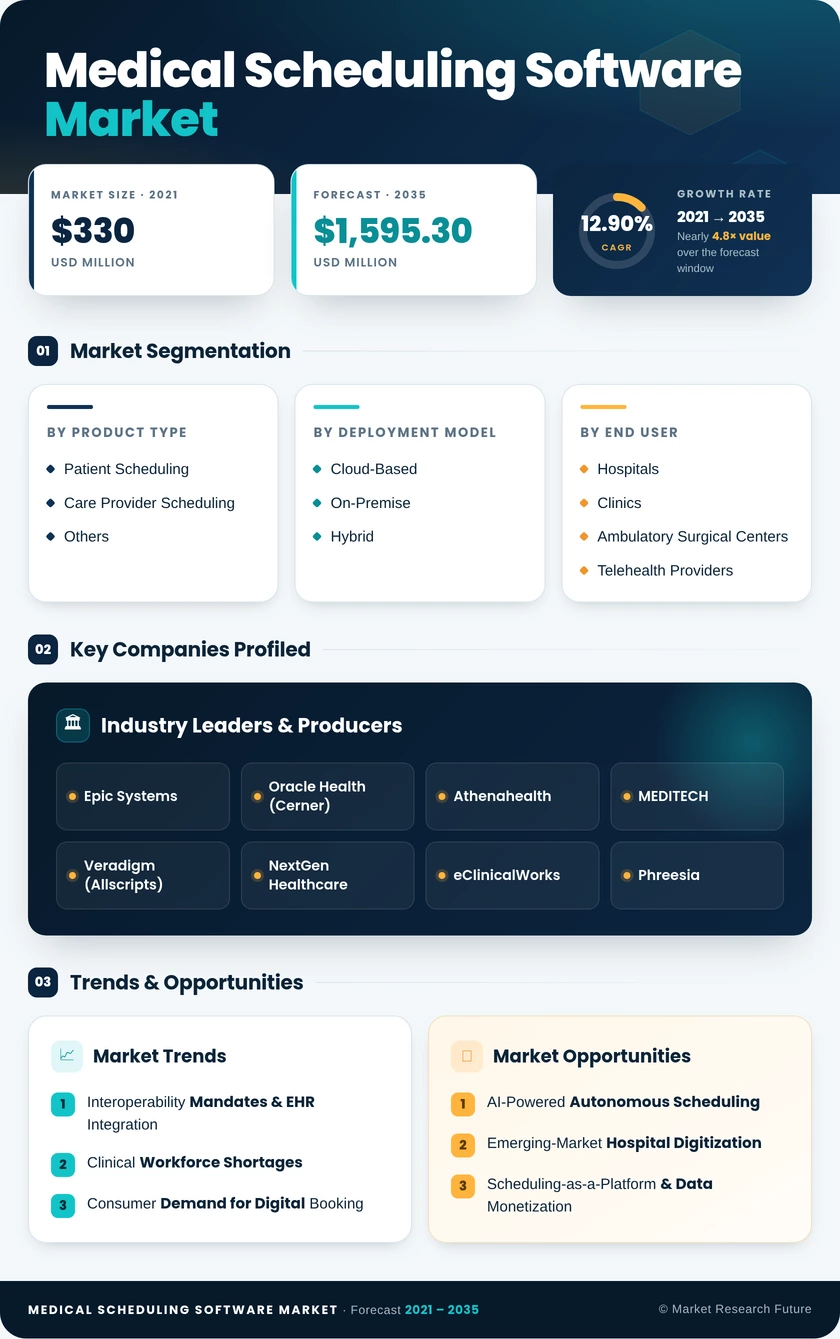
Medical Scheduling Software Market

ID: MRFR/MED/31298-HCR
111 Pages
Rahul Gotadki
Last Updated: June 18, 2026
Medical Scheduling Software Market Research Report By Application (Appointment Scheduling, Patient Management, Resource Allocation, Billing and Invoicing), By Deployment Model (On-Premise, Cloud-Based, Hybrid), By End User (Hospitals, Clinics, Diagnostic Centers, Healthcare Providers), By Features (Automated Reminders, Patient Portal, Reporting and Analytics, Mobile Accessibility) and By Regional (North America, Europe, South America, Asia Pacific, Middle East and Africa) - Growth & Industry Forecast 2025 To 2035
Download PDF ×

We do not share your information with anyone. However, we may send you emails based on your report interest from time to time. You may contact us at any time to opt-out.

  1. 1 Market Overview |
    1. 1.1 Study Assumptions & Market Definition |
    2. 1.2 Scope of the Study |
    3. 1.3 Research Methodology
  2. 2 Market Summary & Key Takeaways
  3. 3 Market Dynamics |
    1. 3.1 Market Drivers Analysis | |
      1. 3.1.1 Interoperability Mandates & EHR Integration | |
      2. 3.1.2 Clinical Workforce Shortages | |
      3. 3.1.3 Consumer Demand for Digital Booking | |
      4. 3.1.4 AI & Predictive Analytics Integration | |
      5. 3.1.5 Telehealth Expansion | |
      6. 3.1.6 Government Digital-Health Funding Programs | |
      7. 3.1.7 Revenue-Cycle Optimization Pressure |
    2. 3.2 Market Restraints Analysis | |
      1. 3.2.1 Legacy-System Integration Complexity | |
      2. 3.2.2 Data Privacy & Security Concerns | |
      3. 3.2.3 Budget Constraints in Small Practices | |
      4. 3.2.4 Interoperability Fragmentation Across Vendors | |
      5. 3.2.5 Change Management & Clinician Resistance |
    3. 3.3 Market Opportunity Analysis | |
      1. 3.3.1 AI-Powered Autonomous Scheduling | |
      2. 3.3.2 Emerging-Market Hospital Digitization | |
      3. 3.3.3 Scheduling-as-a-Platform & Data Monetization | |
      4. 3.3.4 Telehealth-Physical Hybrid Coordination | |
      5. 3.3.5 Behavioral Health & Multi-Site Group Practices |
    4. 3.4 Industry Value Chain Analysis |
    5. 3.5 Porter's Five Forces Analysis
  4. 4 Global Medical Scheduling Software Market Size & Forecast (2021–2035) |
    1. 4.1 Historical Market Size (2021–2025) |
    2. 4.2 Current & Forecast Market Size (2026–2035) |
    3. 4.3 Market Size by Revenue (USD Million) |
    4. 4.4 Year-over-Year Growth Analysis
  5. 5 Segmentation Analysis |
    1. 5.1 By Product Type | |
      1. 5.1.1 Patient Scheduling | |
      2. 5.1.2 Care Provider Scheduling | |
      3. 5.1.3 Others |
    2. 5.2 By Deployment Model | |
      1. 5.2.1 Cloud-Based | |
      2. 5.2.2 On-Premise | |
      3. 5.2.3 Hybrid |
    3. 5.3 By End User | |
      1. 5.3.1 Hospitals | |
      2. 5.3.2 Clinics | |
      3. 5.3.3 Ambulatory Surgical Centers | |
      4. 5.3.4 Telehealth Providers |
    4. 5.4 By Specialty | |
      1. 5.4.1 Primary Care | |
      2. 5.4.2 Dentistry | |
      3. 5.4.3 Behavioral & Mental Health | |
      4. 5.4.4 Others
  6. 6 Regional Analysis |
    1. 6.1 North America | |
      1. 6.1.1 United States | |
      2. 6.1.2 Canada | |
      3. 6.1.3 Mexico |
    2. 6.2 Europe | |
      1. 6.2.1 Germany | |
      2. 6.2.2 United Kingdom | |
      3. 6.2.3 France | |
      4. 6.2.4 Italy | |
      5. 6.2.5 Spain | |
      6. 6.2.6 Nordic Countries | |
      7. 6.2.7 Russia | |
      8. 6.2.8 Rest of Europe |
    3. 6.3 Asia-Pacific | |
      1. 6.3.1 China | |
      2. 6.3.2 India | |
      3. 6.3.3 Japan | |
      4. 6.3.4 South Korea | |
      5. 6.3.5 ASEAN | |
      6. 6.3.6 Rest of Asia-Pacific |
    4. 6.4 South America | |
      1. 6.4.1 Brazil | |
      2. 6.4.2 Argentina | |
      3. 6.4.3 Rest of South America |
    5. 6.5 Middle East & Africa | |
      1. 6.5.1 Saudi Arabia | |
      2. 6.5.2 UAE | |
      3. 6.5.3 South Africa | |
      4. 6.5.4 Egypt | |
      5. 6.5.5 Rest of MEA
  7. 7 Competitive Landscape |
    1. 7.1 Market Share Analysis (2026) |
    2. 7.2 Competitive Benchmarking Matrix |
    3. 7.3 Company Profiles | |
      1. 7.3.1 Epic Systems | |
      2. 7.3.2 Oracle Health (Cerner) | |
      3. 7.3.3 Athenahealth | |
      4. 7.3.4 MEDITECH | |
      5. 7.3.5 Veradigm (Allscripts) | |
      6. 7.3.6 NextGen Healthcare | |
      7. 7.3.7 eClinicalWorks | |
      8. 7.3.8 Phreesia | |
      9. 7.3.9 Zocdoc | |
      10. 7.3.10 Tebra (Kareo)
  8. 8 Future Outlook & Strategic Recommendations (2026–2035) |
    1. 8.1 AI-Autonomous Operations (2026–2029) |
    2. 8.2 Platform Economics & Ecosystem Lock-In (2027–2031) |
    3. 8.3 Behavioral Health & Specialty Expansion (2028–2032) |
    4. 8.4 Sustainability & Operational Efficiency Reporting (2030–2035)
  9. 9 Recent Developments & News
  10. 10 Frequently Asked Questions (FAQs)
  11. 11 Report Scope & Methodology |
    1. 11.1 Study Period & Base Year |
    2. 11.2 Data Sources & Citations |
    3. 11.3 Abbreviations
  12. 12 LIST OF TABLES |
  13. TABLE 1 Global Medical Scheduling Software Market Size & Forecast, by Revenue (USD Million), 2021–2035 |
  14. TABLE 2 Global Medical Scheduling Software Market — Year-over-Year Growth Analysis, 2021–2035 |
  15. TABLE 3 Driver Impact Analysis — Medical Scheduling Software Market, 2026–2035 |
  16. TABLE 4 Restraints Impact Analysis — Medical Scheduling Software Market, 2026–2035 |
  17. TABLE 5 Regional Market Share Summary — Medical Scheduling Software Market, 2025 |
  18. TABLE 6 North America Medical Scheduling Software Market, by Country, 2025 |
  19. TABLE 7 Europe Medical Scheduling Software Market, by Country, 2025 |
  20. TABLE 8 Asia-Pacific Medical Scheduling Software Market, by Country, 2025 |
  21. TABLE 9 South America Medical Scheduling Software Market, by Country, 2025 |
  22. TABLE 10 Middle East & Africa Medical Scheduling Software Market, by Country, 2025 |
  23. TABLE 11 Medical Scheduling Software Market Size, by Product Type, 2025 |
  24. TABLE 12 Medical Scheduling Software Market Size, by Deployment Model, 2025 |
  25. TABLE 13 Medical Scheduling Software Market Size, by End User, 2025 |
  26. TABLE 14 Medical Scheduling Software Market Size, by Specialty, 2025 |
  27. TABLE 15 Competitive Benchmarking Matrix — Medical Scheduling Software Market, 2026 |
  28. TABLE 16 Company Profiles — Key Players, Medical Scheduling Software Market |
  29. TABLE 17 Recent Developments & Strategic Announcements, 2023–2025 |
  30. TABLE 18 Report Scope & Methodology Summary |
  31. TABLE 19 Detailed Sources and Citations
  32. 13 LIST OF FIGURES |
  33. FIGURE 1 Medical Scheduling Software Market Dynamics — Drivers, Restraints & Opportunities |
  34. FIGURE 2 Industry Value Chain Analysis — Medical Scheduling Software Market |
  35. FIGURE 3 Porter's Five Forces Analysis — Medical Scheduling Software Market |
  36. FIGURE 4 Global Medical Scheduling Software Market Size Trend (USD Million), 2021–2035 |
  37. FIGURE 5 Medical Scheduling Software Market Share, by Product Type, 2025 |
  38. FIGURE 6 Medical Scheduling Software Market Share, by Deployment Model, 2025 |
  39. FIGURE 7 Medical Scheduling Software Market Share, by End User, 2025 |
  40. FIGURE 8 Medical Scheduling Software Market Share, by Specialty, 2025 |
  41. FIGURE 9 Medical Scheduling Software Market Revenue Share, by Region, 2025 |
  42. FIGURE 10 North America Medical Scheduling Software Market — Country Revenue Split, 2025 |
  43. FIGURE 11 Europe Medical Scheduling Software Market — Country Revenue Split, 2025 |
  44. FIGURE 12 Asia-Pacific Medical Scheduling Software Market — Country Revenue Split, 2025 |
  45. FIGURE 13 Competitive Landscape — Top-10 Vendor Revenue Share Ranges, 2026

Segmentation Quick Reference

DimensionSub-SegmentsDominant SegmentFastest Growing Segment
Product TypePatient Scheduling, Care Provider Scheduling, OthersPatient SchedulingCare Provider Scheduling
Deployment ModelCloud-Based, On-Premise, HybridCloud-BasedHybrid
End UserHospitals, Clinics, Ambulatory Surgical Centers, Telehealth ProvidersHospitalsTelehealth Providers
SpecialtyPrimary Care, Dentistry, Behavioral & Mental Health, OthersPrimary CareBehavioral & Mental Health
RegionNorth America, Europe, Asia-Pacific, South America, Middle East & AfricaNorth AmericaAsia-Pacific


Market Segmentation Overview

By Product Type

Sub-SegmentKey Trend
Patient SchedulingSelf-service portals with AI-powered no-show prediction driving adoption
Care Provider SchedulingNurse and physician rostering automation addressing workforce shortages
OthersFacility and equipment scheduling gaining traction in asset-heavy environments


Patient scheduling remains the core revenue driver, benefiting from consumer expectations for real-time digital access. Care-provider scheduling is accelerating fastest as staffing constraints force hospitals to automate shift allocation and on-call management.

By Deployment Model

Sub-SegmentKey Trend
Cloud-BasedSaaS pricing models converting CapEx to OpEx for budget-constrained buyers
On-PremisePersistent demand among data-sovereignty-sensitive institutions
HybridBlends cloud-based patient access with on-premise credential storage for compliance


Cloud deployment dominates due to rapid provisioning and lower upfront cost. Hybrid models are emerging as the preferred choice for organizations navigating strict data-residency requirements while seeking modern user experiences.

By End User

Sub-SegmentKey Trend
HospitalsMulti-department complexity drives demand for enterprise-grade platforms
ClinicsAmbulatory volume growth pushing mid-market SaaS adoption
Ambulatory Surgical CentersProcedure migration from inpatient settings increasing throughput optimization needs
Telehealth ProvidersVirtual-physical hybrid scheduling becoming the standard workflow


Hospitals command the largest share, but telehealth providers and ambulatory surgical centers are the fastest-expanding end-user segments as care delivery migrates to outpatient and virtual settings.

By Specialty

Sub-SegmentKey Trend
Primary CareHighest appointment throughput sustains dominant share
DentistryChair-time and operatory optimization driving specialty-specific features
Behavioral & Mental HealthRapid visit-volume growth and PE rollup activity creating urgent demand
OthersOrthopedics, ophthalmology, and dermatology adopting niche scheduling logic


Primary care generates the bulk of scheduling volume across the market. Behavioral and mental health is the fastest-growing specialty vertical, propelled by expanded access mandates and the rapid consolidation of multi-site group practices under private-equity ownership.

By Region

Sub-SegmentKey Trend
North AmericaRegulatory mandates and payer incentives sustain the largest revenue share
EuropeEHDS interoperability regulation standardizes cross-border scheduling data exchange
Asia-PacificGovernment digital-health programs and hospital construction fueling the highest growth
South AmericaPublic-health system modernization driving gradual adoption
Middle East & AfricaSmart-hospital mega-projects anchoring premium demand in Gulf states


North America leads globally, underpinned by ONC mandates and mature EHR ecosystems. Asia-Pacific is poised for the fastest expansion through 2035, with India, China, and ASEAN markets collectively representing the largest untapped opportunity for scheduling-platform providers.