

Request Free Sample ×

Kindly complete the form below to receive a free sample of this Report

* Please use a valid business email

Leading companies partner with us for data-driven Insights

clients tt-cursor
Hero Background
English
Chinese
French
Japanese
Korean
German
Spanish

Medical Marijuana Market Share

ID: MRFR/MED/5008-CR
200 Pages
Rahul Gotadki
April 2025

Medical Marijuana Market Research Report: Size, Share, Trend Analysis By Applications (Chronic Pain, Neurological Disorders, Cancer, Mental Health Disorders, Appetite Loss), By Formulation (Cannabinoid Oils, Dried Flowers, Edibles, Tinctures, Topicals), By Distribution Channel (Pharmacies, Online Stores, Dispensaries, Hospitals), By End Use (Medical Institutions, Homecare Settings, Research Institutions) and By Regional (North America, Europe, South America, Asia Pacific, Middle East and Africa)- Industry Forecast to 2035

Share:
Download PDF ×

We do not share your information with anyone. However, we may send you emails based on your report interest from time to time. You may contact us at any time to opt-out.

Medical Marijuana Market Infographic
Purchase Options

Market Share

Medical Marijuana Market Share Analysis

The Medical Marijuana Market is experiencing significant growth and constant direction changes as a result of the evolving attitudes about cannabis, the increasing legalization, and the growing recognition of the curative potential of the substance. Medical marijuana coming from the cannabis plant has become a very important participant of the healthcare industry. One notable tendency in the medical marijuana market is the growing number of medical applications for this product. In the beginning, medical marijuana has been used for pain treatment, and now it is also studied as a therapy for epilepsy, multiple sclerosis, and emesis, which is the consequence of chemotherapy administration. Such a broader perception and development of multiple uses give birth to new marketing dynamics which provide variety of treatment options for patients.

Furthermore, the segment of Medical Marijuana is also witnessing a trend of product differentiation. With the advancing research, more concern is shown to developing specific strains and blends targeted according to various disease conditions. The emergence of this trend indicates the development and availability of more specific and effective cannabis products that can be administered in various forms such as oils, tinctures, edibles and topical applications. The widening of product line allows patients to have selective options which work perfectly for their taste and conditions.

The market is also noticing a shift towards wider uses and legalization. There is an increasing number of countries and states that acknowledge the medical benefits of cannabis and make legal the use of the plant for therapeutic purposes. Such modifications of the regulatory system are not only increasing the market reach but are also helping in reducing the stigma about medical cannabis which urges more patients to evaluate its potential.

The relationship between cannabis producers, pharmaceutical entities and healthcare practitioners is involved greatly in driving the medical marijuana market. Through these partnerships, research initiatives, clinical trials, and standardized medical marijuana products are attainable. These partnerships are driving now the integration of medical marijuana into mainstream healthcare processes. Partnerships are creating an environment of collaboration with the main purpose―evidence-based medical cannabis solutions.

With the evolution of technology in the healthcare sector, the Medical Marijuana Market is changing into a field that uses digital platforms for education, patient consultations, and product information. Through digital platforms and mobile apps, patients can gain information on strains, dosage recommendations and possible interactions. Telemedicine is becoming a common method for medical marijuana evaluations in which patients can easily and confidentially discuss their treatments with health professionals.

Author
Author Profile
Rahul Gotadki
Research Manager

He holds an experience of about 9+ years in Market Research and Business Consulting, working under the spectrum of Life Sciences and Healthcare domains. Rahul conceptualizes and implements a scalable business strategy and provides strategic leadership to the clients. His expertise lies in market estimation, competitive intelligence, pipeline analysis, customer assessment, etc.

Leave a Comment

FAQs

What is the current valuation of the Medical Marijuana Market?

<p>The Medical Marijuana Market was valued at 18.34 USD Billion in 2024.</p>

What is the projected market size for the Medical Marijuana Market by 2035?

<p>The market is projected to reach 44.99 USD Billion by 2035.</p>

What is the expected CAGR for the Medical Marijuana Market during the forecast period?

<p>The expected CAGR for the Medical Marijuana Market from 2025 to 2035 is 8.5%.</p>

Which companies are considered key players in the Medical Marijuana Market?

<p>Key players include Curaleaf, Trulieve, Green Thumb Industries, Cresco Labs, Aphria, Canopy Growth, Aurora Cannabis, MedMen, and Harvest Health & Recreation.</p>

What are the primary applications driving the Medical Marijuana Market?

<p>Chronic pain, neurological disorders, cancer, mental health disorders, and appetite loss are the primary applications.</p>

How much revenue is generated from the Chronic Pain segment in the Medical Marijuana Market?

<p>The Chronic Pain segment generated 6.0 USD Billion in 2024 and is projected to reach 14.5 USD Billion by 2035.</p>

What formulation types are prevalent in the Medical Marijuana Market?

<p>Cannabinoid oils, dried flowers, edibles, tinctures, and topicals are prevalent formulation types.</p>

What is the revenue projection for the Dried Flowers segment by 2035?

<p>The Dried Flowers segment is projected to generate 12.0 USD Billion by 2035.</p>

Which distribution channels are most significant in the Medical Marijuana Market?

<p>Dispensaries, pharmacies, online stores, and hospitals are significant distribution channels.</p>

What is the expected revenue from Medical Institutions by 2035?

<p>Revenue from Medical Institutions is expected to reach 15.0 USD Billion by 2035.</p>

Market Summary

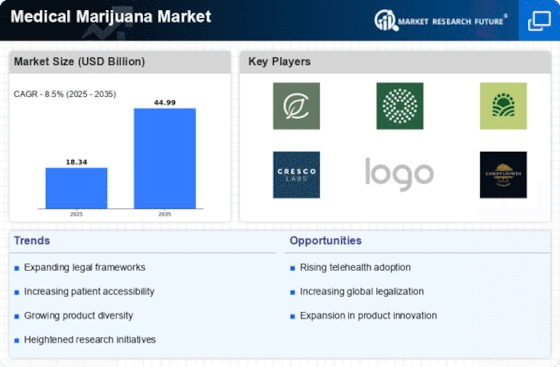
As per Market Research Future analysis, the Medical Marijuana Market was estimated at 18.34 USD Billion in 2024. The Medical Marijuana industry is projected to grow from 19.9 USD Billion in 2025 to 44.99 USD Billion by 2035, exhibiting a compound annual growth rate (CAGR) of 8% during the forecast period 2025 - 2035

Key Market Trends & Highlights

The Medical Marijuana Market is experiencing robust growth driven by evolving regulations and increasing consumer acceptance.

  • North America remains the largest market for medical marijuana, characterized by a progressive regulatory landscape. The Asia-Pacific region is emerging as the fastest-growing market, fueled by rising demand for alternative therapies. Chronic pain management continues to dominate the market, while neurological disorders represent the fastest-growing segment. Key drivers include increasing acceptance of medical marijuana and advancements in research and development, enhancing product availability.

Market Size & Forecast

2024 Market Size 18.34 (USD Billion)
2035 Market Size 44.99 (USD Billion)
CAGR (2025 - 2035) 8.5%
Largest Regional Market Share in 2024 North America

Major Players

Curaleaf (US), Trulieve (US), <a href="https://gtigrows.com/our-story/">Green Thumb Industries</a> (US), Cresco Labs (US), Aphria (CA), Canopy Growth (CA), <a href="https://www.auroramedical.com/collections/aurora-cannabis-best-sellers?filter.v.availability=1">Aurora Cannabis</a> (CA), MedMen (US), Harvest Health &amp; Recreation (US)

Market Trends

The Medical Marijuana Market is currently experiencing a transformative phase characterized by evolving regulations and increasing acceptance among healthcare professionals and patients alike. This shift appears to be driven by a growing body of research supporting the therapeutic benefits of cannabis, which may lead to broader applications in pain management, mental health, and chronic illness treatment. As more jurisdictions legalize medical marijuana, the market is likely to expand, attracting a diverse range of stakeholders, including pharmaceutical companies, healthcare providers, and investors.

Furthermore, the integration of technology in cultivation and distribution processes seems to enhance efficiency and product quality, potentially reshaping consumer experiences and expectations. In addition, the Medical Marijuana Market is witnessing a surge in product innovation, with companies developing various formulations and delivery methods to cater to specific patient needs. This trend indicates a shift towards personalized medicine, where treatments are tailored to individual conditions and preferences, driving the cannabis industry growth. As public awareness increases and stigma diminishes, the market may continue to grow, fostering a more informed consumer base that seeks reliable and effective medical solutions. Overall, the Medical Marijuana Market appears poised for significant growth, driven by regulatory changes, technological advancements, and evolving consumer attitudes.

Regulatory Evolution

The landscape of the Medical Marijuana Market is undergoing substantial changes as governments worldwide reassess their policies regarding cannabis. This evolution suggests a trend towards more favorable regulations, which may facilitate easier access for patients and healthcare providers. As legal frameworks become more accommodating, the market could see an influx of new entrants and innovations.

Technological Integration

Advancements in technology are playing a crucial role in the Medical Marijuana Market, particularly in cultivation and distribution. Innovations such as precision agriculture and blockchain for supply chain transparency may enhance product quality and safety. This integration indicates a potential shift towards more efficient operations and improved consumer trust, thereby upholding cannabis industry growth rate.

Product Diversification

The Medical Marijuana Market is experiencing a notable trend in product diversification, with companies developing a wide array of formulations and delivery methods. This trend reflects a growing understanding of patient needs and preferences, suggesting that personalized approaches to treatment may become increasingly prevalent.

Medical Marijuana Market Market Drivers

Expansion of Distribution Channels

The expansion of distribution channels is a critical factor influencing the Medical Marijuana Market. As regulations evolve, more dispensaries and online platforms are emerging, providing patients with easier access to medical marijuana products. This proliferation of distribution options not only enhances convenience but also fosters competition among suppliers, potentially leading to better pricing and product variety. Recent data suggests that the number of licensed dispensaries has increased by over 30% in the last two years, indicating a robust growth trajectory. This trend is likely to continue, further solidifying the Medical Marijuana Market's position in the healthcare landscape.

Advancements in Research and Development

Ongoing advancements in research and development within the Medical Marijuana Market are driving innovation and product efficacy. Scientific exploration into the pharmacological properties of cannabinoids has led to the development of more targeted therapies, enhancing the appeal of medical marijuana as a viable treatment option. For instance, research indicates that specific strains can effectively manage conditions such as epilepsy and multiple sclerosis. The investment in R&D is expected to increase, with projections suggesting that the market could reach a valuation of over 50 billion dollars by 2028. This focus on scientific validation is likely to bolster consumer confidence and expand the Medical Marijuana Market.

Growing Demand for Alternative Therapies

The increasing demand for alternative therapies is significantly impacting the Medical Marijuana Market. Patients are increasingly seeking non-pharmaceutical options for managing chronic pain, anxiety, and other health conditions, often turning to medical marijuana as a natural alternative. This shift is particularly evident among populations wary of traditional medications and their side effects. Market analysis indicates that the demand for medical marijuana products has surged, with sales projected to grow at a compound annual growth rate of over 20% in the coming years. This trend underscores the potential for the Medical Marijuana Market to cater to a diverse range of patient needs.

Increasing Acceptance of Medical Marijuana

The growing acceptance of medical marijuana among healthcare professionals and patients appears to be a pivotal driver in the Medical Marijuana Market. As more studies emerge highlighting the therapeutic benefits of cannabis, including pain relief and anti-inflammatory properties, healthcare providers are increasingly recommending it as a treatment option. This shift in perception is reflected in the rising number of states and countries legalizing medical marijuana, with over 40 jurisdictions having enacted laws to allow its use for various medical conditions. Consequently, the Medical Marijuana Market is likely to experience substantial growth as acceptance continues to expand, fostering a more favorable environment for both patients and producers.

Regulatory Support and Legalization Trends

Regulatory support and ongoing legalization trends are fundamental drivers of the Medical Marijuana Market. As governments recognize the potential health benefits and economic opportunities associated with medical marijuana, many are enacting supportive legislation. This includes not only the legalization of medical use but also the establishment of regulatory frameworks that ensure product safety and quality. Recent legislative changes in several regions have led to a marked increase in the number of licensed producers and dispensaries, contributing to market growth. The Medical Marijuana Market is likely to benefit from this regulatory momentum, paving the way for further expansion and innovation.

Market Segment Insights

By Application: Chronic Pain (Largest) vs. Neurological Disorders (Fastest-Growing)

In the medical marijuana market, chronic pain applications command the largest share, accounting for a significant portion of the total market. Patients suffering from chronic conditions often turn to marijuana as a therapeutic option, leading to substantial demand in this area. In contrast, neurological disorders represent the fastest-growing segment, as awareness of the therapeutic benefits for conditions like epilepsy and multiple sclerosis rises, drawing both patients and healthcare providers toward cannabis-based treatments.

Chronic Pain (Dominant) vs. Neurological Disorders (Emerging)

Chronic pain remains the dominant application for medical marijuana, catering to a wide demographic with varying <a href="https://www.marketresearchfuture.com/reports/pain-management-market-5975" target="_blank" title="pain management">pain management</a> needs. As healthcare systems increasingly acknowledge the limitations of traditional pain medications, patients are turning towards cannabis as a viable alternative, enhancing its market presence. On the other hand, neurological disorders are emerging with rapid growth potential. The expanding body of clinical research and anecdotal evidence supporting cannabis's efficacy in treating conditions like seizures and migraines is fueling this segment’s popularity, positioning it as a key area for innovation and investment in the medical marijuana market.

By Formulation: Cannabinoid Oils (Largest) vs. Edibles (Fastest-Growing)

In the medical marijuana market, Cannabinoid Oils continue to command the largest share, primarily due to their versatility and efficacy in treating various conditions. As patients seek alternative therapies for pain management, anxiety, and more, these oils have become a preferred choice among consumers. Dried Flowers follow closely but lack the concentrated benefits that oils offer, leading to a gradual shift in patient preferences toward more refined products.

Cannabinoid Oils (Dominant) vs. Edibles (Emerging)

Cannabinoid Oils have solidified their position as the dominant formulation segment due to their concentrated nature and ease of use. They offer precise dosing and fast-acting relief, which are critical for patients with <a href="https://www.marketresearchfuture.com/reports/chronic-granulomatous-disease-market-6447">chronic</a> conditions. On the other hand, Edibles are emerging rapidly, appealing particularly to those who prefer a more palatable option. The growth of this segment is fueled by innovation in flavor and product variety, making cannabis more accessible to non-traditional users. As regulations ease, both segments are likely to continue evolving, appealing to a broader market.

By Distribution Channel: Dispensaries (Largest) vs. Online Stores (Fastest-Growing)

In the Medical Marijuana Market, Dispensaries hold the largest market share among the distribution channels, serving as the primary source for consumers seeking medical cannabis products. Dispensaries provide a personalized shopping experience, allowing patients to obtain tailored advice from knowledgeable staff, thus enhancing customer satisfaction and fostering loyalty. Online Stores, while currently having a smaller share compared to Dispensaries, are rapidly gaining traction due to their convenience and accessibility, making it easier for patients to access medical marijuana from the comfort of their homes. Growth in the Medical Marijuana Market is increasingly driven by the shift towards online purchasing, particularly as consumers seek greater ease and efficiency in accessing their medical needs. Factors such as improved logistics, regulatory advances supporting online sales, and the rising acceptance of medical marijuana are providing significant tailwinds for Online Stores. This segment’s growth is expected to accelerate as more patients become familiar with the benefits of online consultations and deliveries, contributing to an evolving market landscape alongside traditional Dispensaries.

Dispensaries (Dominant) vs. Online Stores (Emerging)

Dispensaries play a dominant role in the Medical Marijuana Market, providing an essential touchpoint for consumers looking for medicinal cannabis. They typically offer a wide range of products, including various strains and forms, and are often staffed by licensed professionals who can guide patients in selecting the right options for their needs. Their physical presence allows for immediate access, which is a significant advantage for users who require immediate relief. In contrast, Online Stores are an emerging segment that is quickly adapting to changing consumer preferences. They appeal to tech-savvy patients who prefer the convenience of browsing and purchasing from home. This evolution in consumer behavior has prompted many traditional dispensaries to expand or enhance their online presence, indicating a trend towards an integrated model that combines both physical and digital retailing.

By End Use: Medical Institutions (Largest) vs. Homecare Settings (Fastest-Growing)

In the Medical Marijuana Market, the distribution of market share among the end-use segments reveals that Medical Institutions hold the largest share. This segment encompasses various healthcare facilities where cannabis is utilized for therapeutic purposes, significantly contributing to the overall market growth. On the other hand, Homecare Settings are rapidly gaining traction, indicating a shift in consumer preferences for at-home medical treatment options. As the demand for alternative therapies continues to rise, Homecare Settings are poised for substantial growth, driven by an increase in patient awareness and positive attitudes towards medical marijuana. Moreover, the COVID-19 pandemic has accelerated the trend of remote treatment solutions, enabling patients to access medical marijuana from the comfort of their homes. This emerging trend presents significant opportunities for market players to cater to the evolving needs of patients seeking safe and effective at-home solutions.

Medical Institutions: Dominant vs. Homecare Settings: Emerging

Medical Institutions represent the dominant segment in the Medical Marijuana Market, characterized by their long-standing history of utilizing cannabis for treatment and research. These institutions include hospitals, clinics, and specialized healthcare centers where medical professionals prescribe marijuana for a variety of conditions. Their established infrastructure, coupled with regulatory support, enables them to maintain a significant market presence. Conversely, Homecare Settings are emerging as a vital segment fueled by increasing consumer demand for home-based therapies. Patients are more inclined to manage their health conditions at home, using medical marijuana as an accessible alternative to traditional pharmaceuticals. The growth in this segment highlights changing healthcare dynamics and a shift towards personalized patient care, inviting new market entrants and innovation.

Get more detailed insights about Medical Marijuana Market Global Research Report - Forecast till 2035

Regional Insights

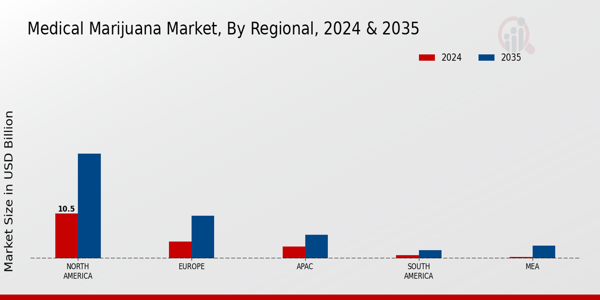
The Global Medical Marijuana Market is projected to showcase significant growth across various regions, with North America holding a majority share of the market. Valued at 10.5 USD Billion in 2024 and expected to rise to 24.5 USD Billion by 2035, North America benefits from progressive legislation and increasing acceptance of medical marijuana for therapeutic uses. The US cannabis market size is the highest in the region. Europe follows, with a market valuation of 4.0 USD Billion in 2024, anticipated to grow to 10.0 USD Billion by 2035, driven by rising healthcare costs and demand for alternative medicine.

The APAC region, valued at 2.75 USD Billion in 2024 and projected to reach 5.5 USD Billion in 2035, reflects a growing recognition of the medical benefits of cannabis, albeit with varying legal landscapes. South America, while currently valued at 0.75 USD Billion in 2024, is expected to grow to 2.0 USD Billion by 2035, as more countries consider legalization for medical purposes.

Lastly, the Middle East and Africa (MEA) region starts with a market value of 0.34 USD Billion in 2024, likely increasing to 3.0 USD Billion by 2035 due to evolving policies and awareness.Each region plays a vital role in the overall market dynamics, contributing to the Global Medical Marijuana Market revenue and providing diverse growth opportunities.

Source: Primary Research, Secondary Research, Market Research Future Database and Analyst Review

Medical Marijuana Market Region   Source: Primary Research, Secondary Research, Market Research Future Database and Analyst Review

Key Players and Competitive Insights

The Global Medical Marijuana Market has been experiencing significant growth and transformation over the past few years due to changing regulations, increased acceptance of cannabis for medical use, and expanding therapeutic applications. As more countries legalize medical marijuana, the competitive landscape becomes increasingly dynamic, with numerous players vying for market share. Companies in this sector are focusing on innovative cultivation techniques, product development, and strategic partnerships to enhance their offerings and meet the growing demand from patients and healthcare providers. Additionally, competition extends beyond product availability, encompassing branding, distribution channels, and consumer education, which ultimately plays a crucial role in shaping the market's trajectory. Given the multifaceted challenges and opportunities within this market, organizations must continuously adapt their strategies to maintain a competitive edge while ensuring compliance with evolving regulations. Trulieve has established itself as a formidable player in the Global Medical Marijuana Market through a robust operational model and a strong geographic presence. The company leverages its extensive cultivation and production facilities to deliver a diverse range of high-quality cannabis products, including oils, concentrates, and flower. Trulieve's commitment to customer-centric service is evident in its patient education initiatives, which aim to enhance understanding and access to medical marijuana therapies. Furthermore, the company's strategic focus on expanding its footprint in key regions has augmented its presence in traditional and emerging markets. Trulieve's competitive strengths lie in its established brand loyalty, sophisticated supply chain management, and a reputation for producing reliable, lab-tested products, which further bolster its standing in an increasingly crowded marketplace. Aphria, operating on a global scale, is also a significant competitor in the Medical Marijuana Market, known for its extensive portfolio of products designed to meet diverse patient needs. The company specializes in a range of high-quality cannabis offerings, including oils, capsules, and other delivery methods, ensuring accessibility for various therapeutic applications. Aphria has strategically positioned itself within the market, not only through organic growth but also via mergers and acquisitions that have bolstered its market presence and expanded its product lineup. This proactive approach enables the company to scale operations efficiently while remaining agile in responding to market trends. With strengths in research and development, customer service, and a strong ethos surrounding quality assurance, Aphria continues to innovate within the global landscape, ensuring it remains a key player in the evolving Medical Marijuana Market.

Key Companies in the Medical Marijuana Market include

Industry Developments

The Global Medical Marijuana Market has seen significant developments recently, with various companies expanding their operations and product offerings. Trulieve announced the opening of additional retail locations to enhance patient access, while Aphria is focusing on boosting production capacity to meet increasing demand. HEXO Corp and Tilray announced their strategic collaboration to create innovative cannabinoid products, aimed at achieving a stronger market presence. Notably, in May 2023, Canopy Growth and Aurora Cannabis finalized a merger, reshaping the competitive landscape by creating a powerful entity capable of producing a wide range of medical marijuana products.

Meanwhile, Green Thumb Industries and Curaleaf have shown impressive growth in market valuation, positively influencing the overall investor sentiment in the market.

This growth is propelled by an increasing acceptance of medical marijuana globally, with regulations becoming more favorable in several jurisdictions. Furthermore, the Global Medical Marijuana Market is expected to expand significantly over the next few years, driven by a rising number of patients seeking alternative treatment options and ongoing advancements in product formulations. Recent regulatory changes in countries like Germany and Canada continue to facilitate the industry's expansion, creating a more robust global marketplace for medical cannabis.

Future Outlook

Medical Marijuana Market Future Outlook

The Medical Marijuana Market is projected to grow at an 8.5% CAGR from 2025 to 2035, driven by increasing legalization, expanding patient demographics, and advancements in product formulations.

New opportunities lie in:

  • <p>Development of telehealth platforms for remote consultations and prescriptions. Investment in automated cultivation technologies to enhance yield efficiency. Expansion of educational programs for healthcare professionals on medical marijuana benefits.</p>

By 2035, the Medical Marijuana Market is expected to be robust, driven by innovation and increased acceptance.

Market Segmentation

Medical Marijuana Market End Use Outlook

  • Medical Institutions
  • Homecare Settings
  • Research Institutions

Medical Marijuana Market Application Outlook

  • Chronic Pain
  • Neurological Disorders
  • Cancer
  • Mental Health Disorders
  • Appetite Loss

Medical Marijuana Market Formulation Outlook

  • Cannabinoid Oils
  • Dried Flowers
  • Edibles
  • Tinctures
  • Topicals

Medical Marijuana Market Distribution Channel Outlook

  • Pharmacies
  • Online Stores
  • Dispensaries
  • Hospitals

Report Scope

MARKET SIZE 2024 18.34(USD Billion)
MARKET SIZE 2025 19.9(USD Billion)
MARKET SIZE 2035 44.99(USD Billion)
COMPOUND ANNUAL GROWTH RATE (CAGR) 8.5% (2025 - 2035)
REPORT COVERAGE Revenue Forecast, Competitive Landscape, Growth Factors, and Trends
BASE YEAR 2024
Market Forecast Period 2025 - 2035
Historical Data 2019 - 2024
Market Forecast Units USD Billion
Key Companies Profiled Curaleaf (US), Trulieve (US), Green Thumb Industries (US), Cresco Labs (US), Aphria (CA), Canopy Growth (CA), Aurora Cannabis (CA), MedMen (US), Harvest Health & Recreation (US)
Segments Covered Applications, Formulation, Distribution Channel, End Use, Regional
Key Market Opportunities Expansion of telehealth services enhances patient access to Medical Marijuana prescriptions.
Key Market Dynamics Evolving regulatory frameworks and consumer preferences drive innovation and competition in the Medical Marijuana Market.
Countries Covered North America, Europe, APAC, South America, MEA

FAQs

What is the current valuation of the Medical Marijuana Market?

<p>The Medical Marijuana Market was valued at 18.34 USD Billion in 2024.</p>

What is the projected market size for the Medical Marijuana Market by 2035?

<p>The market is projected to reach 44.99 USD Billion by 2035.</p>

What is the expected CAGR for the Medical Marijuana Market during the forecast period?

<p>The expected CAGR for the Medical Marijuana Market from 2025 to 2035 is 8.5%.</p>

Which companies are considered key players in the Medical Marijuana Market?

<p>Key players include Curaleaf, Trulieve, Green Thumb Industries, Cresco Labs, Aphria, Canopy Growth, Aurora Cannabis, MedMen, and Harvest Health & Recreation.</p>

What are the primary applications driving the Medical Marijuana Market?

<p>Chronic pain, neurological disorders, cancer, mental health disorders, and appetite loss are the primary applications.</p>

How much revenue is generated from the Chronic Pain segment in the Medical Marijuana Market?

<p>The Chronic Pain segment generated 6.0 USD Billion in 2024 and is projected to reach 14.5 USD Billion by 2035.</p>

What formulation types are prevalent in the Medical Marijuana Market?

<p>Cannabinoid oils, dried flowers, edibles, tinctures, and topicals are prevalent formulation types.</p>

What is the revenue projection for the Dried Flowers segment by 2035?

<p>The Dried Flowers segment is projected to generate 12.0 USD Billion by 2035.</p>

Which distribution channels are most significant in the Medical Marijuana Market?

<p>Dispensaries, pharmacies, online stores, and hospitals are significant distribution channels.</p>

What is the expected revenue from Medical Institutions by 2035?

<p>Revenue from Medical Institutions is expected to reach 15.0 USD Billion by 2035.</p>

  1. SECTION I: EXECUTIVE SUMMARY AND KEY HIGHLIGHTS
    1. | 1.1 EXECUTIVE SUMMARY
    2. | | 1.1.1 Market Overview
    3. | | 1.1.2 Key Findings
    4. | | 1.1.3 Market Segmentation
    5. | | 1.1.4 Competitive Landscape
    6. | | 1.1.5 Challenges and Opportunities
    7. | | 1.1.6 Future Outlook
  2. SECTION II: SCOPING, METHODOLOGY AND MARKET STRUCTURE
    1. | 2.1 MARKET INTRODUCTION
    2. | | 2.1.1 Definition
    3. | | 2.1.2 Scope of the study
    4. | | | 2.1.2.1 Research Objective
    5. | | | 2.1.2.2 Assumption
    6. | | | 2.1.2.3 Limitations
    7. | 2.2 RESEARCH METHODOLOGY
    8. | | 2.2.1 Overview
    9. | | 2.2.2 Data Mining
    10. | | 2.2.3 Secondary Research
    11. | | 2.2.4 Primary Research
    12. | | | 2.2.4.1 Primary Interviews and Information Gathering Process
    13. | | | 2.2.4.2 Breakdown of Primary Respondents
    14. | | 2.2.5 Forecasting Model
    15. | | 2.2.6 Market Size Estimation
    16. | | | 2.2.6.1 Bottom-Up Approach
    17. | | | 2.2.6.2 Top-Down Approach
    18. | | 2.2.7 Data Triangulation
    19. | | 2.2.8 Validation
  3. SECTION III: QUALITATIVE ANALYSIS
    1. | 3.1 MARKET DYNAMICS
    2. | | 3.1.1 Overview
    3. | | 3.1.2 Drivers
    4. | | 3.1.3 Restraints
    5. | | 3.1.4 Opportunities
    6. | 3.2 MARKET FACTOR ANALYSIS
    7. | | 3.2.1 Value chain Analysis
    8. | | 3.2.2 Porter's Five Forces Analysis
    9. | | | 3.2.2.1 Bargaining Power of Suppliers
    10. | | | 3.2.2.2 Bargaining Power of Buyers
    11. | | | 3.2.2.3 Threat of New Entrants
    12. | | | 3.2.2.4 Threat of Substitutes
    13. | | | 3.2.2.5 Intensity of Rivalry
    14. | | 3.2.3 COVID-19 Impact Analysis
    15. | | | 3.2.3.1 Market Impact Analysis
    16. | | | 3.2.3.2 Regional Impact
    17. | | | 3.2.3.3 Opportunity and Threat Analysis
  4. SECTION IV: QUANTITATIVE ANALYSIS
    1. | 4.1 Healthcare, BY Application (USD Billion)
    2. | | 4.1.1 Chronic Pain
    3. | | 4.1.2 Neurological Disorders
    4. | | 4.1.3 Cancer
    5. | | 4.1.4 Mental Health Disorders
    6. | | 4.1.5 Appetite Loss
    7. | 4.2 Healthcare, BY Formulation (USD Billion)
    8. | | 4.2.1 Cannabinoid Oils
    9. | | 4.2.2 Dried Flowers
    10. | | 4.2.3 Edibles
    11. | | 4.2.4 Tinctures
    12. | | 4.2.5 Topicals
    13. | 4.3 Healthcare, BY Distribution Channel (USD Billion)
    14. | | 4.3.1 Pharmacies
    15. | | 4.3.2 Online Stores
    16. | | 4.3.3 Dispensaries
    17. | | 4.3.4 Hospitals
    18. | 4.4 Healthcare, BY End Use (USD Billion)
    19. | | 4.4.1 Medical Institutions
    20. | | 4.4.2 Homecare Settings
    21. | | 4.4.3 Research Institutions
    22. | 4.5 Healthcare, BY Region (USD Billion)
    23. | | 4.5.1 North America
    24. | | | 4.5.1.1 US
    25. | | | 4.5.1.2 Canada
    26. | | 4.5.2 Europe
    27. | | | 4.5.2.1 Germany
    28. | | | 4.5.2.2 UK
    29. | | | 4.5.2.3 France
    30. | | | 4.5.2.4 Russia
    31. | | | 4.5.2.5 Italy
    32. | | | 4.5.2.6 Spain
    33. | | | 4.5.2.7 Rest of Europe
    34. | | 4.5.3 APAC
    35. | | | 4.5.3.1 China
    36. | | | 4.5.3.2 India
    37. | | | 4.5.3.3 Japan
    38. | | | 4.5.3.4 South Korea
    39. | | | 4.5.3.5 Malaysia
    40. | | | 4.5.3.6 Thailand
    41. | | | 4.5.3.7 Indonesia
    42. | | | 4.5.3.8 Rest of APAC
    43. | | 4.5.4 South America
    44. | | | 4.5.4.1 Brazil
    45. | | | 4.5.4.2 Mexico
    46. | | | 4.5.4.3 Argentina
    47. | | | 4.5.4.4 Rest of South America
    48. | | 4.5.5 MEA
    49. | | | 4.5.5.1 GCC Countries
    50. | | | 4.5.5.2 South Africa
    51. | | | 4.5.5.3 Rest of MEA
  5. SECTION V: COMPETITIVE ANALYSIS
    1. | 5.1 Competitive Landscape
    2. | | 5.1.1 Overview
    3. | | 5.1.2 Competitive Analysis
    4. | | 5.1.3 Market share Analysis
    5. | | 5.1.4 Major Growth Strategy in the Healthcare
    6. | | 5.1.5 Competitive Benchmarking
    7. | | 5.1.6 Leading Players in Terms of Number of Developments in the Healthcare
    8. | | 5.1.7 Key developments and growth strategies
    9. | | | 5.1.7.1 New Product Launch/Service Deployment
    10. | | | 5.1.7.2 Merger & Acquisitions
    11. | | | 5.1.7.3 Joint Ventures
    12. | | 5.1.8 Major Players Financial Matrix
    13. | | | 5.1.8.1 Sales and Operating Income
    14. | | | 5.1.8.2 Major Players R&D Expenditure. 2023
    15. | 5.2 Company Profiles
    16. | | 5.2.1 Curaleaf (US)
    17. | | | 5.2.1.1 Financial Overview
    18. | | | 5.2.1.2 Products Offered
    19. | | | 5.2.1.3 Key Developments
    20. | | | 5.2.1.4 SWOT Analysis
    21. | | | 5.2.1.5 Key Strategies
    22. | | 5.2.2 Trulieve (US)
    23. | | | 5.2.2.1 Financial Overview
    24. | | | 5.2.2.2 Products Offered
    25. | | | 5.2.2.3 Key Developments
    26. | | | 5.2.2.4 SWOT Analysis
    27. | | | 5.2.2.5 Key Strategies
    28. | | 5.2.3 Green Thumb Industries (US)
    29. | | | 5.2.3.1 Financial Overview
    30. | | | 5.2.3.2 Products Offered
    31. | | | 5.2.3.3 Key Developments
    32. | | | 5.2.3.4 SWOT Analysis
    33. | | | 5.2.3.5 Key Strategies
    34. | | 5.2.4 Cresco Labs (US)
    35. | | | 5.2.4.1 Financial Overview
    36. | | | 5.2.4.2 Products Offered
    37. | | | 5.2.4.3 Key Developments
    38. | | | 5.2.4.4 SWOT Analysis
    39. | | | 5.2.4.5 Key Strategies
    40. | | 5.2.5 Aphria (CA)
    41. | | | 5.2.5.1 Financial Overview
    42. | | | 5.2.5.2 Products Offered
    43. | | | 5.2.5.3 Key Developments
    44. | | | 5.2.5.4 SWOT Analysis
    45. | | | 5.2.5.5 Key Strategies
    46. | | 5.2.6 Canopy Growth (CA)
    47. | | | 5.2.6.1 Financial Overview
    48. | | | 5.2.6.2 Products Offered
    49. | | | 5.2.6.3 Key Developments
    50. | | | 5.2.6.4 SWOT Analysis
    51. | | | 5.2.6.5 Key Strategies
    52. | | 5.2.7 Aurora Cannabis (CA)
    53. | | | 5.2.7.1 Financial Overview
    54. | | | 5.2.7.2 Products Offered
    55. | | | 5.2.7.3 Key Developments
    56. | | | 5.2.7.4 SWOT Analysis
    57. | | | 5.2.7.5 Key Strategies
    58. | | 5.2.8 MedMen (US)
    59. | | | 5.2.8.1 Financial Overview
    60. | | | 5.2.8.2 Products Offered
    61. | | | 5.2.8.3 Key Developments
    62. | | | 5.2.8.4 SWOT Analysis
    63. | | | 5.2.8.5 Key Strategies
    64. | | 5.2.9 Harvest Health & Recreation (US)
    65. | | | 5.2.9.1 Financial Overview
    66. | | | 5.2.9.2 Products Offered
    67. | | | 5.2.9.3 Key Developments
    68. | | | 5.2.9.4 SWOT Analysis
    69. | | | 5.2.9.5 Key Strategies
    70. | 5.3 Appendix
    71. | | 5.3.1 References
    72. | | 5.3.2 Related Reports
  6. LIST OF FIGURES
    1. | 6.1 MARKET SYNOPSIS
    2. | 6.2 NORTH AMERICA MARKET ANALYSIS
    3. | 6.3 US MARKET ANALYSIS BY APPLICATION
    4. | 6.4 US MARKET ANALYSIS BY FORMULATION
    5. | 6.5 US MARKET ANALYSIS BY DISTRIBUTION CHANNEL
    6. | 6.6 US MARKET ANALYSIS BY END USE
    7. | 6.7 CANADA MARKET ANALYSIS BY APPLICATION
    8. | 6.8 CANADA MARKET ANALYSIS BY FORMULATION
    9. | 6.9 CANADA MARKET ANALYSIS BY DISTRIBUTION CHANNEL
    10. | 6.10 CANADA MARKET ANALYSIS BY END USE
    11. | 6.11 EUROPE MARKET ANALYSIS
    12. | 6.12 GERMANY MARKET ANALYSIS BY APPLICATION
    13. | 6.13 GERMANY MARKET ANALYSIS BY FORMULATION
    14. | 6.14 GERMANY MARKET ANALYSIS BY DISTRIBUTION CHANNEL
    15. | 6.15 GERMANY MARKET ANALYSIS BY END USE
    16. | 6.16 UK MARKET ANALYSIS BY APPLICATION
    17. | 6.17 UK MARKET ANALYSIS BY FORMULATION
    18. | 6.18 UK MARKET ANALYSIS BY DISTRIBUTION CHANNEL
    19. | 6.19 UK MARKET ANALYSIS BY END USE
    20. | 6.20 FRANCE MARKET ANALYSIS BY APPLICATION
    21. | 6.21 FRANCE MARKET ANALYSIS BY FORMULATION
    22. | 6.22 FRANCE MARKET ANALYSIS BY DISTRIBUTION CHANNEL
    23. | 6.23 FRANCE MARKET ANALYSIS BY END USE
    24. | 6.24 RUSSIA MARKET ANALYSIS BY APPLICATION
    25. | 6.25 RUSSIA MARKET ANALYSIS BY FORMULATION
    26. | 6.26 RUSSIA MARKET ANALYSIS BY DISTRIBUTION CHANNEL
    27. | 6.27 RUSSIA MARKET ANALYSIS BY END USE
    28. | 6.28 ITALY MARKET ANALYSIS BY APPLICATION
    29. | 6.29 ITALY MARKET ANALYSIS BY FORMULATION
    30. | 6.30 ITALY MARKET ANALYSIS BY DISTRIBUTION CHANNEL
    31. | 6.31 ITALY MARKET ANALYSIS BY END USE
    32. | 6.32 SPAIN MARKET ANALYSIS BY APPLICATION
    33. | 6.33 SPAIN MARKET ANALYSIS BY FORMULATION
    34. | 6.34 SPAIN MARKET ANALYSIS BY DISTRIBUTION CHANNEL
    35. | 6.35 SPAIN MARKET ANALYSIS BY END USE
    36. | 6.36 REST OF EUROPE MARKET ANALYSIS BY APPLICATION
    37. | 6.37 REST OF EUROPE MARKET ANALYSIS BY FORMULATION
    38. | 6.38 REST OF EUROPE MARKET ANALYSIS BY DISTRIBUTION CHANNEL
    39. | 6.39 REST OF EUROPE MARKET ANALYSIS BY END USE
    40. | 6.40 APAC MARKET ANALYSIS
    41. | 6.41 CHINA MARKET ANALYSIS BY APPLICATION
    42. | 6.42 CHINA MARKET ANALYSIS BY FORMULATION
    43. | 6.43 CHINA MARKET ANALYSIS BY DISTRIBUTION CHANNEL
    44. | 6.44 CHINA MARKET ANALYSIS BY END USE
    45. | 6.45 INDIA MARKET ANALYSIS BY APPLICATION
    46. | 6.46 INDIA MARKET ANALYSIS BY FORMULATION
    47. | 6.47 INDIA MARKET ANALYSIS BY DISTRIBUTION CHANNEL
    48. | 6.48 INDIA MARKET ANALYSIS BY END USE
    49. | 6.49 JAPAN MARKET ANALYSIS BY APPLICATION
    50. | 6.50 JAPAN MARKET ANALYSIS BY FORMULATION
    51. | 6.51 JAPAN MARKET ANALYSIS BY DISTRIBUTION CHANNEL
    52. | 6.52 JAPAN MARKET ANALYSIS BY END USE
    53. | 6.53 SOUTH KOREA MARKET ANALYSIS BY APPLICATION
    54. | 6.54 SOUTH KOREA MARKET ANALYSIS BY FORMULATION
    55. | 6.55 SOUTH KOREA MARKET ANALYSIS BY DISTRIBUTION CHANNEL
    56. | 6.56 SOUTH KOREA MARKET ANALYSIS BY END USE
    57. | 6.57 MALAYSIA MARKET ANALYSIS BY APPLICATION
    58. | 6.58 MALAYSIA MARKET ANALYSIS BY FORMULATION
    59. | 6.59 MALAYSIA MARKET ANALYSIS BY DISTRIBUTION CHANNEL
    60. | 6.60 MALAYSIA MARKET ANALYSIS BY END USE
    61. | 6.61 THAILAND MARKET ANALYSIS BY APPLICATION
    62. | 6.62 THAILAND MARKET ANALYSIS BY FORMULATION
    63. | 6.63 THAILAND MARKET ANALYSIS BY DISTRIBUTION CHANNEL
    64. | 6.64 THAILAND MARKET ANALYSIS BY END USE
    65. | 6.65 INDONESIA MARKET ANALYSIS BY APPLICATION
    66. | 6.66 INDONESIA MARKET ANALYSIS BY FORMULATION
    67. | 6.67 INDONESIA MARKET ANALYSIS BY DISTRIBUTION CHANNEL
    68. | 6.68 INDONESIA MARKET ANALYSIS BY END USE
    69. | 6.69 REST OF APAC MARKET ANALYSIS BY APPLICATION
    70. | 6.70 REST OF APAC MARKET ANALYSIS BY FORMULATION
    71. | 6.71 REST OF APAC MARKET ANALYSIS BY DISTRIBUTION CHANNEL
    72. | 6.72 REST OF APAC MARKET ANALYSIS BY END USE
    73. | 6.73 SOUTH AMERICA MARKET ANALYSIS
    74. | 6.74 BRAZIL MARKET ANALYSIS BY APPLICATION
    75. | 6.75 BRAZIL MARKET ANALYSIS BY FORMULATION
    76. | 6.76 BRAZIL MARKET ANALYSIS BY DISTRIBUTION CHANNEL
    77. | 6.77 BRAZIL MARKET ANALYSIS BY END USE
    78. | 6.78 MEXICO MARKET ANALYSIS BY APPLICATION
    79. | 6.79 MEXICO MARKET ANALYSIS BY FORMULATION
    80. | 6.80 MEXICO MARKET ANALYSIS BY DISTRIBUTION CHANNEL
    81. | 6.81 MEXICO MARKET ANALYSIS BY END USE
    82. | 6.82 ARGENTINA MARKET ANALYSIS BY APPLICATION
    83. | 6.83 ARGENTINA MARKET ANALYSIS BY FORMULATION
    84. | 6.84 ARGENTINA MARKET ANALYSIS BY DISTRIBUTION CHANNEL
    85. | 6.85 ARGENTINA MARKET ANALYSIS BY END USE
    86. | 6.86 REST OF SOUTH AMERICA MARKET ANALYSIS BY APPLICATION
    87. | 6.87 REST OF SOUTH AMERICA MARKET ANALYSIS BY FORMULATION
    88. | 6.88 REST OF SOUTH AMERICA MARKET ANALYSIS BY DISTRIBUTION CHANNEL
    89. | 6.89 REST OF SOUTH AMERICA MARKET ANALYSIS BY END USE
    90. | 6.90 MEA MARKET ANALYSIS
    91. | 6.91 GCC COUNTRIES MARKET ANALYSIS BY APPLICATION
    92. | 6.92 GCC COUNTRIES MARKET ANALYSIS BY FORMULATION
    93. | 6.93 GCC COUNTRIES MARKET ANALYSIS BY DISTRIBUTION CHANNEL
    94. | 6.94 GCC COUNTRIES MARKET ANALYSIS BY END USE
    95. | 6.95 SOUTH AFRICA MARKET ANALYSIS BY APPLICATION
    96. | 6.96 SOUTH AFRICA MARKET ANALYSIS BY FORMULATION
    97. | 6.97 SOUTH AFRICA MARKET ANALYSIS BY DISTRIBUTION CHANNEL
    98. | 6.98 SOUTH AFRICA MARKET ANALYSIS BY END USE
    99. | 6.99 REST OF MEA MARKET ANALYSIS BY APPLICATION
    100. | 6.100 REST OF MEA MARKET ANALYSIS BY FORMULATION
    101. | 6.101 REST OF MEA MARKET ANALYSIS BY DISTRIBUTION CHANNEL
    102. | 6.102 REST OF MEA MARKET ANALYSIS BY END USE
    103. | 6.103 KEY BUYING CRITERIA OF HEALTHCARE
    104. | 6.104 RESEARCH PROCESS OF MRFR
    105. | 6.105 DRO ANALYSIS OF HEALTHCARE
    106. | 6.106 DRIVERS IMPACT ANALYSIS: HEALTHCARE
    107. | 6.107 RESTRAINTS IMPACT ANALYSIS: HEALTHCARE
    108. | 6.108 SUPPLY / VALUE CHAIN: HEALTHCARE
    109. | 6.109 HEALTHCARE, BY APPLICATION, 2024 (% SHARE)
    110. | 6.110 HEALTHCARE, BY APPLICATION, 2024 TO 2035 (USD Billion)
    111. | 6.111 HEALTHCARE, BY FORMULATION, 2024 (% SHARE)
    112. | 6.112 HEALTHCARE, BY FORMULATION, 2024 TO 2035 (USD Billion)
    113. | 6.113 HEALTHCARE, BY DISTRIBUTION CHANNEL, 2024 (% SHARE)
    114. | 6.114 HEALTHCARE, BY DISTRIBUTION CHANNEL, 2024 TO 2035 (USD Billion)
    115. | 6.115 HEALTHCARE, BY END USE, 2024 (% SHARE)
    116. | 6.116 HEALTHCARE, BY END USE, 2024 TO 2035 (USD Billion)
    117. | 6.117 BENCHMARKING OF MAJOR COMPETITORS
  7. LIST OF TABLES
    1. | 7.1 LIST OF ASSUMPTIONS
    2. | | 7.1.1
    3. | 7.2 North America MARKET SIZE ESTIMATES; FORECAST
    4. | | 7.2.1 BY APPLICATION, 2025-2035 (USD Billion)
    5. | | 7.2.2 BY FORMULATION, 2025-2035 (USD Billion)
    6. | | 7.2.3 BY DISTRIBUTION CHANNEL, 2025-2035 (USD Billion)
    7. | | 7.2.4 BY END USE, 2025-2035 (USD Billion)
    8. | 7.3 US MARKET SIZE ESTIMATES; FORECAST
    9. | | 7.3.1 BY APPLICATION, 2025-2035 (USD Billion)
    10. | | 7.3.2 BY FORMULATION, 2025-2035 (USD Billion)
    11. | | 7.3.3 BY DISTRIBUTION CHANNEL, 2025-2035 (USD Billion)
    12. | | 7.3.4 BY END USE, 2025-2035 (USD Billion)
    13. | 7.4 Canada MARKET SIZE ESTIMATES; FORECAST
    14. | | 7.4.1 BY APPLICATION, 2025-2035 (USD Billion)
    15. | | 7.4.2 BY FORMULATION, 2025-2035 (USD Billion)
    16. | | 7.4.3 BY DISTRIBUTION CHANNEL, 2025-2035 (USD Billion)
    17. | | 7.4.4 BY END USE, 2025-2035 (USD Billion)
    18. | 7.5 Europe MARKET SIZE ESTIMATES; FORECAST
    19. | | 7.5.1 BY APPLICATION, 2025-2035 (USD Billion)
    20. | | 7.5.2 BY FORMULATION, 2025-2035 (USD Billion)
    21. | | 7.5.3 BY DISTRIBUTION CHANNEL, 2025-2035 (USD Billion)
    22. | | 7.5.4 BY END USE, 2025-2035 (USD Billion)
    23. | 7.6 Germany MARKET SIZE ESTIMATES; FORECAST
    24. | | 7.6.1 BY APPLICATION, 2025-2035 (USD Billion)
    25. | | 7.6.2 BY FORMULATION, 2025-2035 (USD Billion)
    26. | | 7.6.3 BY DISTRIBUTION CHANNEL, 2025-2035 (USD Billion)
    27. | | 7.6.4 BY END USE, 2025-2035 (USD Billion)
    28. | 7.7 UK MARKET SIZE ESTIMATES; FORECAST
    29. | | 7.7.1 BY APPLICATION, 2025-2035 (USD Billion)
    30. | | 7.7.2 BY FORMULATION, 2025-2035 (USD Billion)
    31. | | 7.7.3 BY DISTRIBUTION CHANNEL, 2025-2035 (USD Billion)
    32. | | 7.7.4 BY END USE, 2025-2035 (USD Billion)
    33. | 7.8 France MARKET SIZE ESTIMATES; FORECAST
    34. | | 7.8.1 BY APPLICATION, 2025-2035 (USD Billion)
    35. | | 7.8.2 BY FORMULATION, 2025-2035 (USD Billion)
    36. | | 7.8.3 BY DISTRIBUTION CHANNEL, 2025-2035 (USD Billion)
    37. | | 7.8.4 BY END USE, 2025-2035 (USD Billion)
    38. | 7.9 Russia MARKET SIZE ESTIMATES; FORECAST
    39. | | 7.9.1 BY APPLICATION, 2025-2035 (USD Billion)
    40. | | 7.9.2 BY FORMULATION, 2025-2035 (USD Billion)
    41. | | 7.9.3 BY DISTRIBUTION CHANNEL, 2025-2035 (USD Billion)
    42. | | 7.9.4 BY END USE, 2025-2035 (USD Billion)
    43. | 7.10 Italy MARKET SIZE ESTIMATES; FORECAST
    44. | | 7.10.1 BY APPLICATION, 2025-2035 (USD Billion)
    45. | | 7.10.2 BY FORMULATION, 2025-2035 (USD Billion)
    46. | | 7.10.3 BY DISTRIBUTION CHANNEL, 2025-2035 (USD Billion)
    47. | | 7.10.4 BY END USE, 2025-2035 (USD Billion)
    48. | 7.11 Spain MARKET SIZE ESTIMATES; FORECAST
    49. | | 7.11.1 BY APPLICATION, 2025-2035 (USD Billion)
    50. | | 7.11.2 BY FORMULATION, 2025-2035 (USD Billion)
    51. | | 7.11.3 BY DISTRIBUTION CHANNEL, 2025-2035 (USD Billion)
    52. | | 7.11.4 BY END USE, 2025-2035 (USD Billion)
    53. | 7.12 Rest of Europe MARKET SIZE ESTIMATES; FORECAST
    54. | | 7.12.1 BY APPLICATION, 2025-2035 (USD Billion)
    55. | | 7.12.2 BY FORMULATION, 2025-2035 (USD Billion)
    56. | | 7.12.3 BY DISTRIBUTION CHANNEL, 2025-2035 (USD Billion)
    57. | | 7.12.4 BY END USE, 2025-2035 (USD Billion)
    58. | 7.13 APAC MARKET SIZE ESTIMATES; FORECAST
    59. | | 7.13.1 BY APPLICATION, 2025-2035 (USD Billion)
    60. | | 7.13.2 BY FORMULATION, 2025-2035 (USD Billion)
    61. | | 7.13.3 BY DISTRIBUTION CHANNEL, 2025-2035 (USD Billion)
    62. | | 7.13.4 BY END USE, 2025-2035 (USD Billion)
    63. | 7.14 China MARKET SIZE ESTIMATES; FORECAST
    64. | | 7.14.1 BY APPLICATION, 2025-2035 (USD Billion)
    65. | | 7.14.2 BY FORMULATION, 2025-2035 (USD Billion)
    66. | | 7.14.3 BY DISTRIBUTION CHANNEL, 2025-2035 (USD Billion)
    67. | | 7.14.4 BY END USE, 2025-2035 (USD Billion)
    68. | 7.15 India MARKET SIZE ESTIMATES; FORECAST
    69. | | 7.15.1 BY APPLICATION, 2025-2035 (USD Billion)
    70. | | 7.15.2 BY FORMULATION, 2025-2035 (USD Billion)
    71. | | 7.15.3 BY DISTRIBUTION CHANNEL, 2025-2035 (USD Billion)
    72. | | 7.15.4 BY END USE, 2025-2035 (USD Billion)
    73. | 7.16 Japan MARKET SIZE ESTIMATES; FORECAST
    74. | | 7.16.1 BY APPLICATION, 2025-2035 (USD Billion)
    75. | | 7.16.2 BY FORMULATION, 2025-2035 (USD Billion)
    76. | | 7.16.3 BY DISTRIBUTION CHANNEL, 2025-2035 (USD Billion)
    77. | | 7.16.4 BY END USE, 2025-2035 (USD Billion)
    78. | 7.17 South Korea MARKET SIZE ESTIMATES; FORECAST
    79. | | 7.17.1 BY APPLICATION, 2025-2035 (USD Billion)
    80. | | 7.17.2 BY FORMULATION, 2025-2035 (USD Billion)
    81. | | 7.17.3 BY DISTRIBUTION CHANNEL, 2025-2035 (USD Billion)
    82. | | 7.17.4 BY END USE, 2025-2035 (USD Billion)
    83. | 7.18 Malaysia MARKET SIZE ESTIMATES; FORECAST
    84. | | 7.18.1 BY APPLICATION, 2025-2035 (USD Billion)
    85. | | 7.18.2 BY FORMULATION, 2025-2035 (USD Billion)
    86. | | 7.18.3 BY DISTRIBUTION CHANNEL, 2025-2035 (USD Billion)
    87. | | 7.18.4 BY END USE, 2025-2035 (USD Billion)
    88. | 7.19 Thailand MARKET SIZE ESTIMATES; FORECAST
    89. | | 7.19.1 BY APPLICATION, 2025-2035 (USD Billion)
    90. | | 7.19.2 BY FORMULATION, 2025-2035 (USD Billion)
    91. | | 7.19.3 BY DISTRIBUTION CHANNEL, 2025-2035 (USD Billion)
    92. | | 7.19.4 BY END USE, 2025-2035 (USD Billion)
    93. | 7.20 Indonesia MARKET SIZE ESTIMATES; FORECAST
    94. | | 7.20.1 BY APPLICATION, 2025-2035 (USD Billion)
    95. | | 7.20.2 BY FORMULATION, 2025-2035 (USD Billion)
    96. | | 7.20.3 BY DISTRIBUTION CHANNEL, 2025-2035 (USD Billion)
    97. | | 7.20.4 BY END USE, 2025-2035 (USD Billion)
    98. | 7.21 Rest of APAC MARKET SIZE ESTIMATES; FORECAST
    99. | | 7.21.1 BY APPLICATION, 2025-2035 (USD Billion)
    100. | | 7.21.2 BY FORMULATION, 2025-2035 (USD Billion)
    101. | | 7.21.3 BY DISTRIBUTION CHANNEL, 2025-2035 (USD Billion)
    102. | | 7.21.4 BY END USE, 2025-2035 (USD Billion)
    103. | 7.22 South America MARKET SIZE ESTIMATES; FORECAST
    104. | | 7.22.1 BY APPLICATION, 2025-2035 (USD Billion)
    105. | | 7.22.2 BY FORMULATION, 2025-2035 (USD Billion)
    106. | | 7.22.3 BY DISTRIBUTION CHANNEL, 2025-2035 (USD Billion)
    107. | | 7.22.4 BY END USE, 2025-2035 (USD Billion)
    108. | 7.23 Brazil MARKET SIZE ESTIMATES; FORECAST
    109. | | 7.23.1 BY APPLICATION, 2025-2035 (USD Billion)
    110. | | 7.23.2 BY FORMULATION, 2025-2035 (USD Billion)
    111. | | 7.23.3 BY DISTRIBUTION CHANNEL, 2025-2035 (USD Billion)
    112. | | 7.23.4 BY END USE, 2025-2035 (USD Billion)
    113. | 7.24 Mexico MARKET SIZE ESTIMATES; FORECAST
    114. | | 7.24.1 BY APPLICATION, 2025-2035 (USD Billion)
    115. | | 7.24.2 BY FORMULATION, 2025-2035 (USD Billion)
    116. | | 7.24.3 BY DISTRIBUTION CHANNEL, 2025-2035 (USD Billion)
    117. | | 7.24.4 BY END USE, 2025-2035 (USD Billion)
    118. | 7.25 Argentina MARKET SIZE ESTIMATES; FORECAST
    119. | | 7.25.1 BY APPLICATION, 2025-2035 (USD Billion)
    120. | | 7.25.2 BY FORMULATION, 2025-2035 (USD Billion)
    121. | | 7.25.3 BY DISTRIBUTION CHANNEL, 2025-2035 (USD Billion)
    122. | | 7.25.4 BY END USE, 2025-2035 (USD Billion)
    123. | 7.26 Rest of South America MARKET SIZE ESTIMATES; FORECAST
    124. | | 7.26.1 BY APPLICATION, 2025-2035 (USD Billion)
    125. | | 7.26.2 BY FORMULATION, 2025-2035 (USD Billion)
    126. | | 7.26.3 BY DISTRIBUTION CHANNEL, 2025-2035 (USD Billion)
    127. | | 7.26.4 BY END USE, 2025-2035 (USD Billion)
    128. | 7.27 MEA MARKET SIZE ESTIMATES; FORECAST
    129. | | 7.27.1 BY APPLICATION, 2025-2035 (USD Billion)
    130. | | 7.27.2 BY FORMULATION, 2025-2035 (USD Billion)
    131. | | 7.27.3 BY DISTRIBUTION CHANNEL, 2025-2035 (USD Billion)
    132. | | 7.27.4 BY END USE, 2025-2035 (USD Billion)
    133. | 7.28 GCC Countries MARKET SIZE ESTIMATES; FORECAST
    134. | | 7.28.1 BY APPLICATION, 2025-2035 (USD Billion)
    135. | | 7.28.2 BY FORMULATION, 2025-2035 (USD Billion)
    136. | | 7.28.3 BY DISTRIBUTION CHANNEL, 2025-2035 (USD Billion)
    137. | | 7.28.4 BY END USE, 2025-2035 (USD Billion)
    138. | 7.29 South Africa MARKET SIZE ESTIMATES; FORECAST
    139. | | 7.29.1 BY APPLICATION, 2025-2035 (USD Billion)
    140. | | 7.29.2 BY FORMULATION, 2025-2035 (USD Billion)
    141. | | 7.29.3 BY DISTRIBUTION CHANNEL, 2025-2035 (USD Billion)
    142. | | 7.29.4 BY END USE, 2025-2035 (USD Billion)
    143. | 7.30 Rest of MEA MARKET SIZE ESTIMATES; FORECAST
    144. | | 7.30.1 BY APPLICATION, 2025-2035 (USD Billion)
    145. | | 7.30.2 BY FORMULATION, 2025-2035 (USD Billion)
    146. | | 7.30.3 BY DISTRIBUTION CHANNEL, 2025-2035 (USD Billion)
    147. | | 7.30.4 BY END USE, 2025-2035 (USD Billion)
    148. | 7.31 PRODUCT LAUNCH/PRODUCT DEVELOPMENT/APPROVAL
    149. | | 7.31.1
    150. | 7.32 ACQUISITION/PARTNERSHIP
    151. | | 7.32.1

Healthcare Market Segmentation

Healthcare By Application (USD Billion, 2025-2035)

  • Chronic Pain
  • Neurological Disorders
  • Cancer
  • Mental Health Disorders
  • Appetite Loss

Healthcare By Formulation (USD Billion, 2025-2035)

  • Cannabinoid Oils
  • Dried Flowers
  • Edibles
  • Tinctures
  • Topicals

Healthcare By Distribution Channel (USD Billion, 2025-2035)

  • Pharmacies
  • Online Stores
  • Dispensaries
  • Hospitals

Healthcare By End Use (USD Billion, 2025-2035)

  • Medical Institutions
  • Homecare Settings
  • Research Institutions
Infographic

Free Sample Request

Kindly complete the form below to receive a free sample of this Report

Get Free Sample

Customer Strories

Compare Licence

×
Features License Type
Single User Multiuser License Enterprise User
Price $4,950 $5,950 $7,250
Maximum User Access Limit 1 User Upto 10 Users Unrestricted Access Throughout the Organization
Free Customization
Direct Access to Analyst
Deliverable Format
Platform Access
Discount on Next Purchase 10% 15% 15%
Printable Versions















