Medical Grade Silicone Market (2026 - 2035)

ID: MRFR/CnM/4312-HCR 200 Pages Chitranshi Jaiswal Last Updated: November 18, 2026
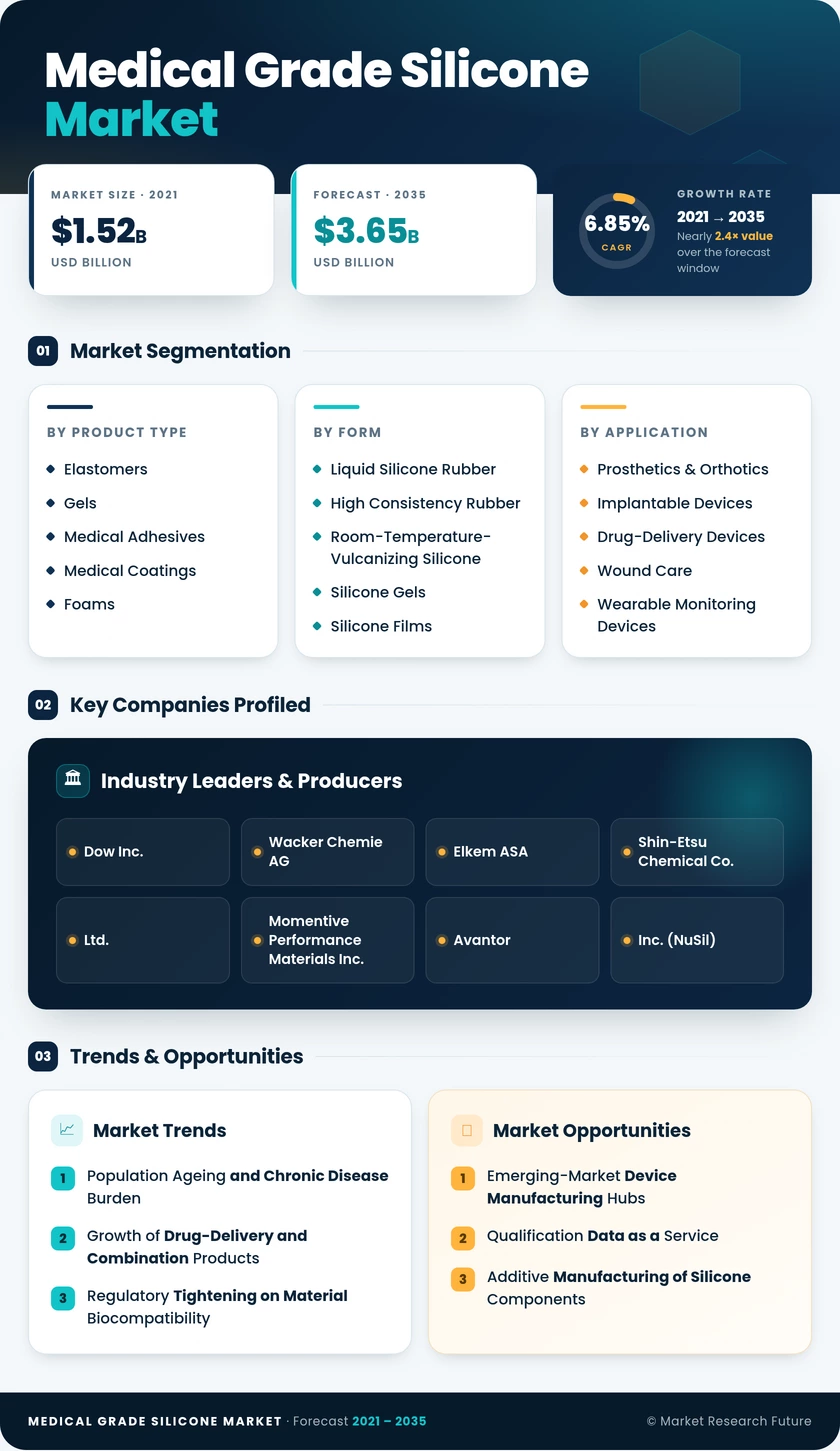
Medical Grade Silicone Market Research Report Information By Product Type (Elastomers, Gels, Medical Adhesives, Medical Coatings, Foams, and Fluids & Oils), By Form (Liquid Silicone Rubber, High Consistency Rubber, Room-Temperature-Vulcanizing Silicone, Silicone Gels, and Silicone Films), By Application (Prosthetics & Orthotics, Implantable Devices, Drug-Delivery Devices, Wound Care, Wearable Monitoring Devices, and Other Applications), By End-User (Medical Device Manufacturers, OEM Contract Manufacturers, Hospitals & Clinics, Pharmaceutical Companies, and Other End-Users), And By Region (North America, Europe, Asia-Pacific, and Rest of the World) – Market Forecast Till 2035.
Medical Grade Silicone Market
Market Size
Forecast Period2026-2035
CAGR (2026-2035)6.85%
2025 Market SizeUSD 1.88 Billion
2035 Market SizeUSD 3.65 Billion
Key Players
Dow Inc.
Wacker Chemie AG
Elkem ASA
Shin-Etsu Chemical Co., Ltd.
Momentive Performance Materials Inc.
Avantor
Opportunities
  • Emerging-Market Device Manufacturing Hubs
  • Qualification Data as a Service
  • Additive Manufacturing of Silicone Components
  1. 1 Market Summary | |
  2. 2 Key Report Takeaways | |
    1. 2.1 By Product Type | |
    2. 2.2 By Form | |
    3. 2.3 By Application | |
    4. 2.4 By End-User | |
    5. 2.5 By Region | |
  3. 3 Market Size and Forecast (2021–2035) | |
  4. 4 Driver Impact Analysis | |
    1. 4.1 Population Ageing and Chronic Disease Burden | |
    2. 4.2 Growth of Drug-Delivery and Combination Products | |
    3. 4.3 Regulatory Tightening on Material Biocompatibility | |
    4. 4.4 Wearable and Skin-Contact Device Adoption | |
    5. 4.5 Asia-Pacific Manufacturing Localization | |
    6. 4.6 Rising Prosthetic and Orthotic Access Programs | |
  5. 5 Restraints Impact Analysis | |
    1. 5.1 Siloxane and Silicon Metal Price Volatility | |
    2. 5.2 High Qualification and Requalification Costs | |
    3. 5.3 Cyclic Siloxane Restrictions | |
    4. 5.4 Implant Safety Scrutiny and Litigation | |
    5. 5.5 Substitution by Thermoplastic Elastomers | |
  6. 6 Opportunities | |
    1. 6.1 Emerging-Market Device Manufacturing Hubs | |
    2. 6.2 Qualification Data as a Service | |
    3. 6.3 Additive Manufacturing of Silicone Components | |
    4. 6.4 Conductive and Sensor-Integrated Silicones | |
    5. 6.5 Low-Cyclic and Circular Formulations | |
  7. 7 Regional Market Share and Country-Level Analysis | |
    1. 7.1 North America | | |
      1. 7.1.1 US | | |
      2. 7.1.2 Canada | | |
      3. 7.1.3 Mexico | |
    2. 7.2 Europe | | |
      1. 7.2.1 Germany | | |
      2. 7.2.2 UK | | |
      3. 7.2.3 France | | |
      4. 7.2.4 Italy | | |
      5. 7.2.5 Spain | | |
      6. 7.2.6 Nordic Countries | | |
      7. 7.2.7 Russia | | |
      8. 7.2.8 Rest of Europe | |
    3. 7.3 Asia-Pacific | | |
      1. 7.3.1 China | | |
      2. 7.3.2 India | | |
      3. 7.3.3 Japan | | |
      4. 7.3.4 South Korea | | |
      5. 7.3.5 ASEAN | | |
      6. 7.3.6 Rest of Asia-Pacific | |
    4. 7.4 South America | | |
      1. 7.4.1 Brazil | | |
      2. 7.4.2 Argentina | | |
      3. 7.4.3 Rest of South America | |
    5. 7.5 Middle East & Africa | | |
      1. 7.5.1 Saudi Arabia | | |
      2. 7.5.2 UAE | | |
      3. 7.5.3 South Africa | | |
      4. 7.5.4 Egypt | | |
      5. 7.5.5 Rest of MEA | |
  8. 8 Future Outlook (2026–2035) | |
    1. 8.1 Data-Driven Molding and Process Control | |
    2. 8.2 Connected Drug Delivery | |
    3. 8.3 Digital and Additive Production | |
    4. 8.4 Sustainability and Chemical Compliance | |
  9. 9 Segmentation Analysis | |
    1. 9.1 By Product Type | | |
      1. 9.1.1 Elastomers | | |
      2. 9.1.2 Gels | | |
      3. 9.1.3 Medical Adhesives | | |
      4. 9.1.4 Medical Coatings | | |
      5. 9.1.5 Foams | | |
      6. 9.1.6 Fluids & Oils | |
    2. 9.2 By Form | | |
      1. 9.2.1 Liquid Silicone Rubber | | |
      2. 9.2.2 High Consistency Rubber | | |
      3. 9.2.3 Room-Temperature-Vulcanizing Silicone | | |
      4. 9.2.4 Silicone Gels | | |
      5. 9.2.5 Silicone Films | |
    3. 9.3 By Application | | |
      1. 9.3.1 Prosthetics & Orthotics | | |
      2. 9.3.2 Implantable Devices | | |
      3. 9.3.3 Drug-Delivery Devices | | |
      4. 9.3.4 Wound Care | | |
      5. 9.3.5 Wearable Monitoring Devices | | |
      6. 9.3.6 Other Applications | |
    4. 9.4 By End-User | | |
      1. 9.4.1 Medical Device Manufacturers | | |
      2. 9.4.2 OEM Contract Manufacturers | | |
      3. 9.4.3 Hospitals & Clinics | | |
      4. 9.4.4 Pharmaceutical Companies | | |
      5. 9.4.5 Other End-Users | |
  10. 10 Competitive Landscape | |
  11. 11 Recent News & Developments | |
  12. 12 Report Scope and Methodology | |
  13. 13 Detailed Sources and Citations | |
  14. 14 Frequently Asked Questions (FAQs) | | LIST OF TABLES | |
  15. TABLE 1 Global Market Size and Forecast, 2021–2035 (USD Billion) | |
  16. TABLE 2 Driver Impact Analysis | |
  17. TABLE 3 Restraints Impact Analysis | |
  18. TABLE 4 Regional Summary, 2025 | |
  19. TABLE 5 North America Country-Level Analysis, 2025 | |
  20. TABLE 6 Europe Country-Level Analysis, 2025 | |
  21. TABLE 7 Asia-Pacific Country-Level Analysis, 2025 | |
  22. TABLE 8 South America Country-Level Analysis, 2025 | |
  23. TABLE 9 Middle East & Africa Country-Level Analysis, 2025 | |
  24. TABLE 10 Segmentation by Product Type, 2025 | |
  25. TABLE 11 Segmentation by Form, 2025 | |
  26. TABLE 12 Segmentation by Application, 2025 | |
  27. TABLE 13 Segmentation by End-User, 2025 | |
  28. TABLE 14 Competitive Benchmarking Matrix | |
  29. TABLE 15 Report Scope and Methodology | |
  30. TABLE 16 Detailed Sources and Citations | | LIST OF FIGURES | |
  31. FIGURE 1 Market Dynamics Overview — Drivers, Restraints and Opportunities | |
  32. FIGURE 2 Value Chain Analysis — Siloxane Monomer to Finished Device | |
  33. FIGURE 3 Porter's Five Forces Analysis | |
  34. FIGURE 4 Global Market Size Trend, 2021–2035 (USD Billion) | |
  35. FIGURE 5 Market Share by Product Type, 2025 | |
  36. FIGURE 6 Market Share by Form, 2025 | |
  37. FIGURE 7 Market Share by Application, 2025 | |
  38. FIGURE 8 Market Share by End-User, 2025 | |
  39. FIGURE 9 Regional Market Share, 2025 | |
  40. FIGURE 10 Competitive Landscape — Estimated Revenue Share Ranges

Segmentation Quick Reference

DimensionSub-SegmentsDominant SegmentFastest Growing Segment
By Product TypeElastomers, Gels, Medical Adhesives, Medical Coatings, Foams, Fluids & OilsElastomers (42.1% share)Medical Adhesives (10.1% CAGR)
By FormLiquid Silicone Rubber, High Consistency Rubber, Room-Temperature-Vulcanizing Silicone, Silicone Gels, Silicone FilmsLiquid Silicone Rubber (48.0% share)Silicone Films (9.3% CAGR)
By ApplicationProsthetics & Orthotics, Implantable Devices, Drug-Delivery Devices, Wound Care, Wearable Monitoring Devices, Other ApplicationsProsthetics & Orthotics (29.4% share)Drug-Delivery Devices (11.1% CAGR)
By End-UserMedical Device Manufacturers, OEM Contract Manufacturers, Hospitals & Clinics, Pharmaceutical Companies, Other End-UsersMedical Device Manufacturers (42.3% share)OEM Contract Manufacturers (9.9% CAGR)
By RegionNorth America, Europe, Asia-Pacific, South America, Middle East & AfricaAsia-Pacific (38.5% share)Asia-Pacific (38.5% share)

Market Segmentation Overview

By Product Type

Sub-SegmentKey Trend
ElastomersLong-term implant and prosthetic socket use
GelsScar therapy and cushioning inserts
Medical AdhesivesHybrid silicone-acrylate systems for multi-day wear
Medical CoatingsLubricious catheter and needle coatings
FoamsNegative-pressure wound therapy interfaces
Fluids & OilsSiliconization of syringes and stoppers

Elastomers lead on value because their tear strength and implant track record suit housings, sockets and lead insulation. Medical Adhesives grow fastest as patch pumps and biosensors require skin bonding that lasts days yet removes without trauma. Gels and Foams follow wound-care volumes rather than implant cycles.

By Form

Sub-SegmentKey Trend
Liquid Silicone RubberAutomated high-cavitation molding
High Consistency RubberExtrusion and high-load components
Room-Temperature-Vulcanizing SiliconeHeat-free sealing of electronics
Silicone GelsSoft prosthetic and orthotic inserts
Silicone FilmsThin, stretchable substrates for sensors

Liquid Silicone Rubber leads because injection molding delivers tight tolerances at short cycle times for plungers and valves. Silicone Films grow fastest as continuous casting below 100 microns supplies stretchable circuits for wearables. High Consistency Rubber holds its place in extruded tubing, where LSR offers less advantage.

By Application

Sub-SegmentKey Trend
Prosthetics & OrthoticsAgeing and diabetes-related limb loss
Implantable DevicesHermetic insulation for cardiac and neuro leads
Drug-Delivery DevicesControlled-release matrices and on-body pumps
Wound CareSoft-tack, atraumatic dressings
Wearable Monitoring DevicesDisinfection-resistant housings
Other ApplicationsDental impression and ophthalmic components

Prosthetics & Orthotics lead because liner and cushioning volumes scale with limb-loss prevalence. Drug-Delivery Devices grow fastest, since silicone's permeability control keeps release rates steady in depots, rings and microneedle arrays. Wearable Monitoring Devices are emerging as the next demand pool behind drug delivery.

By End-User

Sub-SegmentKey Trend
Medical Device ManufacturersIn-house molding of proprietary parts
OEM Contract ManufacturersOutsourced clean-room molding and sterilization
Hospitals & ClinicsIndirect demand via consumables
Pharmaceutical CompaniesCombination products and drug-eluting matrices
Other End-UsersResearch and academic programs

Medical Device Manufacturers remain the largest buyers of raw silicone for proprietary components. OEM Contract Manufacturers grow fastest because brand owners are outsourcing ISO 13485-certified molding and sterilization to specialists. Pharmaceutical Companies are gaining weight as long-acting combination products move toward commercialization.


Download PDF ×

We do not share your information with anyone. However, we may send you emails based on your report interest from time to time. You may contact us at any time to opt-out.