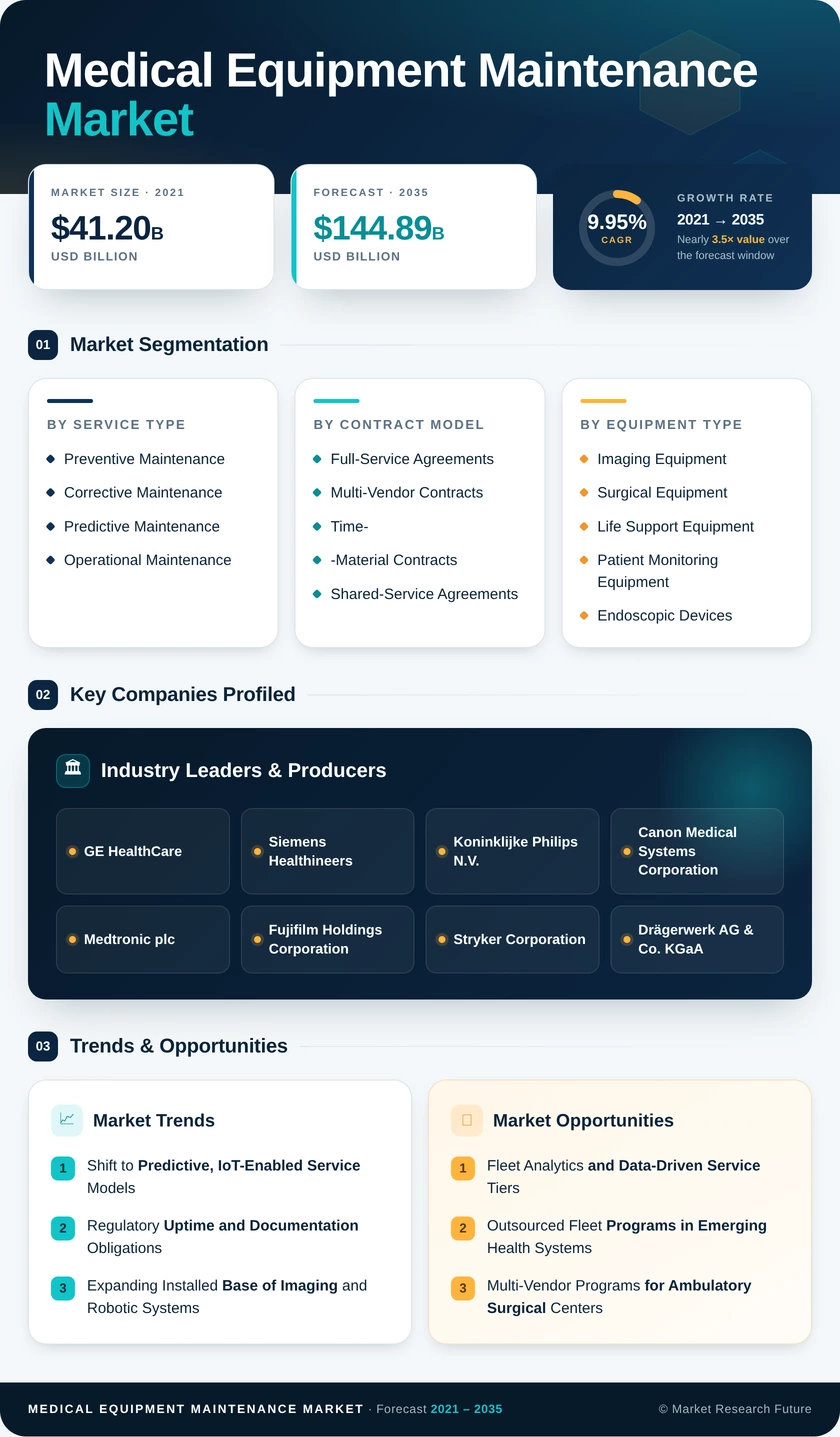
Segmentation Quick Reference
| Dimension | Sub-Segments | Dominant Segment | Fastest Growing Segment |
|---|---|---|---|
| By Service Type | Preventive Maintenance, Corrective Maintenance, Predictive Maintenance, Operational Maintenance | Preventive Maintenance | Corrective Maintenance |
| By Contract Model | Full-Service Agreements, Multi-Vendor Contracts, Time-and-Material Contracts, Shared-Service Agreements | Full-Service Agreements | Multi-Vendor Contracts |
| By Equipment Type | Imaging Equipment, Surgical Equipment, Life Support Equipment, Patient Monitoring Equipment, Endoscopic Devices, Dialysis Equipment, Other Equipment | Imaging Equipment | Surgical Equipment |
| By Service Provider | Original Equipment Manufacturers (OEMs), Independent Service Organizations (ISOs), In-house Maintenance | Original Equipment Manufacturers (OEMs) | Independent Service Organizations (ISOs) |
| By End User | Hospitals, Ambulatory Surgical Centers, Diagnostic Imaging Centers, Specialty Clinics, Other End Users | Hospitals | Ambulatory Surgical Centers |
| By Region | North America, Europe, Asia-Pacific, South America, Middle East & Africa | North America | Asia-Pacific |
Market Segmentation Overview
By Service Type
| Sub-Segment | Key Trend |
|---|---|
| Preventive Maintenance | Accreditation-mandated inspection and safety-testing schedules |
| Corrective Maintenance | Unplanned failures in aging fleets |
| Predictive Maintenance | Sensor telemetry and remote monitoring |
| Operational Maintenance | User training and daily calibration on complex platforms |
Within the Medical Equipment Maintenance Market, Preventive Maintenance remains the largest service type because accreditation bodies and manufacturers prescribe fixed inspection and electrical safety testing intervals. Corrective Maintenance still absorbs a large budget as older fleets fail unpredictably, though value-based contracts penalize the downtime it implies. Predictive Maintenance grows fastest as telemetry lets providers act before failures occur, while Operational Maintenance expands alongside robotic surgery and other platforms needing daily checks and user training.
By Contract Model
| Sub-Segment | Key Trend |
|---|---|
| Full-Service Agreements | Fixed annual cost covering parts, labor, and software updates |
| Multi-Vendor Contracts | Network-wide consolidation across equipment brands |
| Time-and-Material Contracts | Cost flexibility for smaller clinics |
| Shared-Service Agreements | Risk split between hospital teams and vendors |
Contract choice in the Medical Equipment Maintenance Market reflects how much budget certainty buyers want. Full-Service Agreements lead because hospitals value fixed fees that cover parts, labor, and software updates. Multi-Vendor Contracts grow fastest as integrated delivery networks seek one partner, one response standard, and fleet-wide data across brands. Time-and-Material Contracts persist in smaller facilities, while Shared-Service Agreements offer a middle path where in-house teams handle first-line work.
By Equipment Type
| Sub-Segment | Key Trend |
|---|---|
| Imaging Equipment | MRI Systems cryogen and coil service; CT Scanners tube replacement; X-ray and Ultrasound Systems upkeep |
| Surgical Equipment | Robotic platforms and electrosurgical units requiring scheduled checks |
| Life Support Equipment | Ventilator and anesthesia readiness |
| Patient Monitoring Equipment | Networked monitors in acute and step-down care |
| Endoscopic Devices | Reprocessing damage and scope repairs |
| Dialysis Equipment | Rising chronic kidney disease caseloads |
| Other Equipment | Laboratory, infusion, and rehabilitation devices |
Imaging Equipment generates the largest share of Medical Equipment Maintenance Market spending because MRI Systems need cryogen management and gradient-coil calibration, while CT Scanners consume costly tube replacements. Surgical Equipment grows fastest as robotic platforms demand scheduled preventive checks and frequent software updates, and electrosurgical units add recurring handpiece refurbishment. Patient monitoring, dialysis, and endoscopic fleets provide steady volume, with IEC 60601 electrical safety testing shaping scope and pricing for patient-connected devices.
By Service Provider
| Sub-Segment | Key Trend |
|---|---|
| Original Equipment Manufacturers (OEMs) | Proprietary diagnostics and installed-base relationships |
| Independent Service Organizations (ISOs) | Lower pricing and right-to-repair access |
| In-house Maintenance | Large academic centers building internal biomedical teams |
Original Equipment Manufacturers (OEMs) hold the largest position in the Medical Equipment Maintenance Market, especially in MRI and robotic surgery where proprietary software and components remain tightly controlled. Independent Service Organizations (ISOs) grow fastest, typically pricing below OEMs while matching response-time guarantees in patient monitoring and dialysis fleets. In-house Maintenance teams at large academic centers treat equipment management as a strategic capability and increasingly blend internal staff with ISO support.
By End User
| Sub-Segment | Key Trend |
|---|---|
| Hospitals | Large, mixed fleets and accreditation requirements |
| Ambulatory Surgical Centers | Procedure migration from inpatient settings |
| Diagnostic Imaging Centers | High-utilization MRI and CT fleets |
| Specialty Clinics | Dialysis, oncology, and cardiology equipment |
| Other End Users | Laboratories, home care, and long-term care |
Hospitals are the anchor buyers in the Medical Equipment Maintenance Market, running the largest and most varied fleets under strict accreditation oversight. Ambulatory Surgical Centers grow fastest as procedures shift out of inpatient settings, and their lean staffing favors multi-vendor coverage with guaranteed response times. Diagnostic Imaging Centers concentrate spending on high-utilization MRI and CT scanners, while Specialty Clinics depend on dialysis and oncology equipment uptime.


 Noah Malgeri
Co-Founder

 Peter Groot koerkamp
Account and Business Manager

 Younghwan Choi
Senior Retail Manager

 Mark Irwin
Management Consultant

 Akif Moroglu
Strategy & Business Development Director

 Guilherme Gomes Martins
Product Management Director

 Joseph Aguayo
Sales Operations & Pricing Manager

 La Terria Dodd
Program Support Specialist

 Rob Kooiker
Group Product Manager HVAC & Fire Protection GMA