Request Free Sample ×

Kindly complete the form below to receive a free sample of this Report

* Please use a valid business email

Leading companies partner with us for data-driven Insights

clients tt-cursor
Hero Background
English
Chinese
French
Japanese
Korean
German
Spanish

Medical Device Cleaning Market Analysis

ID: MRFR/MED/9101-HCR
200 Pages
Rahul Gotadki
March 2026

Medical Device Cleaning Market Research Report: Size, Share, Trend Analysis By Applications (Surgical Instruments, Endoscopes, Dental Instruments, Implants, General Equipment), By Types (Detergents, Disinfectants, Ultrasonic Cleaners, Steam Sterilizers), By End Use (Hospitals, Ambulatory Surgical Centers, Dental Clinics, Research Laboratories), By Cleaning Method (Manual Cleaning, Automated Cleaning, Ultrasonic Cleaning) and By Regional (North America, Europe, South America, Asia Pacific, Middle East and Africa) - Growth Outlook & Industry Forecast 2025 To 2035

Share:
Download PDF ×

We do not share your information with anyone. However, we may send you emails based on your report interest from time to time. You may contact us at any time to opt-out.

Medical Device Cleaning Market Infographic
Purchase Options

Market Analysis

In-depth Analysis of Medical Device Cleaning Market Industry Landscape

The medical device cleaning marketplace is fashioned through stringent regulatory requirements and guidelines governing the cleaning and sterilization of medical devices. Compliance with these regulations is paramount to ensuring patient safety and preventing healthcare-related infections, riding the demand for powerful and validated cleaning answers. The marketplace dynamics are closely tied to the growing quantity of surgical methods globally. With an increase in surgical interventions, there's a better demand for properly cleaned and sterilized scientific devices. Reusable clinical gadgets are prevalent in healthcare settings because of their price effectiveness. The market is driven by the need for powerful cleansing answers for those devices to ensure their secure reuse. This consists of endoscopes, surgical gadgets, and different devices that undergo multiple makes use of after thorough cleaning and sterilization. Healthcare centers are increasingly adopting automatic cleansing structures for scientific gadgets because of their performance and consistency. Automated systems lessen the threat of human errors, offer standardized cleansing approaches, and enhance average workflow in healthcare settings, contributing to the growth of this market section. Environmental concerns play a role in the market dynamics, with a developing focus on environmentally sustainable cleaning answers. Healthcare facilities are in search of cleaning merchandise and techniques that can be effective but environmentally friendly, aligning with broader sustainability dreams within the healthcare industry. The marketplace is witnessing a trend of outsourcing cleansing services, specifically in larger healthcare centers. Outsourcing allows healthcare companies to leverage specialized information and ultra-modern cleaning technologies, promoting thorough and regular cleansing practices throughout diverse medical gadgets. Healthcare companies are under steady pressure to incorporate prices while maintaining high requirements of patient care. The marketplace dynamics are inspired by the desire for cost-effective cleansing answers that deliver green results, as healthcare centers are seeking to optimize their operational budgets without compromising on affected persons' safety. Proper education and schooling on medical device cleaning protocols are vital in shaping marketplace dynamics. Training applications and projects to educate healthcare specialists on the importance of accurate cleansing practices, inclusive of the choice of suitable cleaning agents and strategies, make contributions to the general efficacy of medical device cleaning processes.

Author
Author Profile
Rahul Gotadki
Research Manager

He holds an experience of about 9+ years in Market Research and Business Consulting, working under the spectrum of Life Sciences and Healthcare domains. Rahul conceptualizes and implements a scalable business strategy and provides strategic leadership to the clients. His expertise lies in market estimation, competitive intelligence, pipeline analysis, customer assessment, etc.

Leave a Comment

FAQs

What is the projected market valuation of the Medical Device Cleaning Market by 2035?

<p>The Medical Device Cleaning Market is projected to reach approximately 5.498 USD Billion by 2035.</p>

What was the market valuation of the Medical Device Cleaning Market in 2024?

<p>In 2024, the market valuation of the Medical Device Cleaning Market was 3.37 USD Billion.</p>

What is the expected CAGR for the Medical Device Cleaning Market during the forecast period 2025 - 2035?

<p>The expected CAGR for the Medical Device Cleaning Market during the forecast period 2025 - 2035 is 4.55%.</p>

Which segment of the Medical Device Cleaning Market had the highest valuation in 2024?

<p>In 2024, the segment for General Equipment had the highest valuation at 1.32 USD Billion.</p>

What are the key players in the Medical Device Cleaning Market?

<p>Key players in the Medical Device Cleaning Market include Ecolab, Diversey Holdings, Getinge AB, Steris plc, and 3M Company.</p>

How much is the Surgical Instruments segment projected to grow by 2035?

<p>The Surgical Instruments segment is projected to grow from 0.85 USD Billion in 2024 to 1.35 USD Billion by 2035.</p>

What is the projected valuation for the Disinfectants segment by 2035?

<p>The Disinfectants segment is projected to reach approximately 2.1 USD Billion by 2035.</p>

Which end-use segment is expected to have the highest valuation in 2035?

<p>By 2035, the Hospitals end-use segment is expected to have the highest valuation at around 2.4 USD Billion.</p>

What cleaning method is anticipated to see the most growth in the Medical Device Cleaning Market?

<p>The Automated Cleaning method is anticipated to see the most growth, projected to reach 2.12 USD Billion by 2035.</p>

How does the market for Dental Instruments compare between 2024 and 2035?

<p>The market for Dental Instruments is expected to grow from 0.65 USD Billion in 2024 to 1.05 USD Billion by 2035.</p>

Market Summary

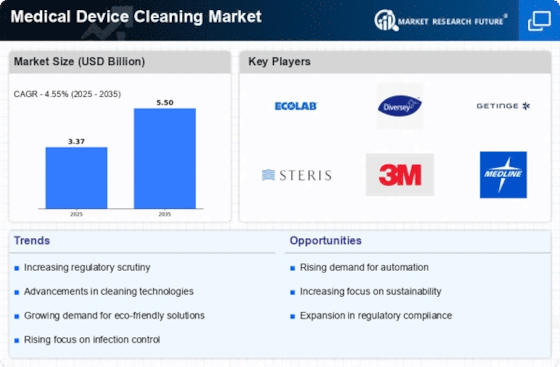
As per Market Research Future analysis, the Medical Device Cleaning Market was estimated at 3.37 USD Billion in 2024. The Medical Device Cleaning industry is projected to grow from 3.523 USD Billion in 2025 to 5.498 USD Billion by 2035, exhibiting a compound annual growth rate (CAGR) of 4.55% during the forecast period 2025 - 2035

Key Market Trends & Highlights

The Medical Device Cleaning Market is poised for substantial growth driven by regulatory demands and technological advancements.

  • North America remains the largest market for medical device cleaning, driven by stringent regulatory compliance and high surgical procedure volumes. The Asia-Pacific region is emerging as the fastest-growing market, fueled by expanding healthcare facilities and increasing awareness of infection control. Surgical instruments dominate the market, while endoscopes are experiencing the fastest growth due to rising procedural demands. Technological innovations in cleaning equipment and the growing focus on infection control are key drivers propelling market expansion.

Market Size & Forecast

2024 Market Size 3.37 (USD Billion)
2035 Market Size 5.498 (USD Billion)
CAGR (2025 - 2035) 4.55%
Largest Regional Market Share in 2024 North America

Major Players

Ecolab (US), Diversey Holdings, Ltd. (US), Getinge AB (SE), Steris plc (IE), <a href="https://www.3m.com/3M/en_US/p/c/i/consumer/">3M </a>Company (US), Medline Industries, Inc. (US), Cantel Medical Corp. (US), Hygiena, LLC (US), B. Braun Melsungen AG (DE)

Market Trends

The Medical Device Cleaning Market is currently experiencing a notable evolution, driven by the increasing emphasis on patient safety and the necessity for stringent hygiene standards in healthcare settings. As medical devices become more complex and integral to patient care, the demand for effective cleaning solutions appears to be rising. This trend is likely influenced by regulatory bodies advocating for enhanced cleaning protocols, which may lead to the adoption of advanced cleaning technologies. Furthermore, the growing awareness of infection control among healthcare professionals suggests a shift towards more comprehensive cleaning practices, potentially reshaping the landscape of the market. In addition, the Medical Device Cleaning Market seems to be adapting to the challenges posed by the diverse range of materials used in medical devices. Manufacturers are likely focusing on developing cleaning agents that are compatible with various surfaces, ensuring that devices are not only cleaned effectively but also preserved in their functionality. The integration of automation and digital solutions in cleaning processes may also emerge as a significant trend, as healthcare facilities seek to optimize efficiency and reduce human error. Overall, the market appears poised for growth, driven by innovation and a commitment to maintaining high standards of cleanliness in medical environments.

Increased Regulatory Scrutiny

The Medical Device Cleaning Market is witnessing heightened regulatory scrutiny, as authorities emphasize the importance of stringent cleaning protocols. This trend may lead to the development of more robust cleaning solutions that comply with evolving standards.

Technological Advancements in Cleaning Solutions

Innovations in cleaning technologies are becoming increasingly prevalent within the Medical Device Cleaning Market. Manufacturers are likely investing in research and development to create more effective and efficient cleaning agents that cater to the diverse needs of medical devices.

Focus on Infection Control

There is a growing focus on infection control within healthcare settings, which is influencing practices in the Medical Device Cleaning Market. This trend suggests that healthcare facilities are prioritizing comprehensive cleaning strategies to mitigate the risk of healthcare-associated infections.

Medical Device Cleaning Market Market Drivers

Stringent Regulatory Compliance

The Medical Device Cleaning Market is significantly influenced by the stringent regulatory frameworks established by health authorities. These regulations mandate rigorous cleaning and sterilization processes to prevent healthcare-associated infections. Compliance with these regulations is not merely a legal obligation but also a critical factor in maintaining patient safety and trust. As regulatory bodies continue to enhance their guidelines, healthcare providers are increasingly required to adopt advanced cleaning solutions and practices. This trend is reflected in the market, where the demand for compliant cleaning products is expected to rise, potentially leading to a market growth rate of around 6% over the next few years. Thus, adherence to regulatory standards is a key driver for innovation and investment in the Medical Device Cleaning Market.

Expansion of Healthcare Facilities

The expansion of healthcare facilities is a significant factor influencing the Medical Device Cleaning Market. As new hospitals, clinics, and surgical centers are established, the demand for medical devices and, consequently, their cleaning becomes paramount. This expansion is driven by various factors, including population growth and increased healthcare access. With more facilities comes the necessity for robust cleaning protocols to ensure patient safety and device functionality. Market projections suggest that the establishment of new healthcare facilities could lead to a 4% increase in the demand for cleaning services and products. Thus, the growth of healthcare infrastructure is a vital driver for the Medical Device Cleaning Market.

Rising Demand for Surgical Procedures

The Medical Device Cleaning Market experiences a notable surge in demand due to the increasing number of surgical procedures performed annually. As healthcare systems expand and populations age, the frequency of surgeries rises, necessitating the use of various medical devices. This trend drives the need for effective cleaning solutions to ensure the safety and efficacy of these devices. According to recent data, the number of surgical procedures is projected to grow by approximately 5% annually, which directly correlates with the demand for cleaning services and products. Consequently, manufacturers and healthcare facilities are compelled to invest in advanced cleaning technologies and protocols to maintain compliance with stringent safety standards, thereby propelling the Medical Device Cleaning Market forward.

Growing Awareness of Infection Control

The heightened awareness surrounding infection control is a critical driver for the Medical Device Cleaning Market. As healthcare providers and patients alike become more cognizant of the risks associated with infections, there is a growing emphasis on maintaining high standards of cleanliness in medical environments. This awareness translates into increased investments in cleaning protocols and products designed to mitigate infection risks. Market data indicates that the infection control market is expected to grow at a rate of 5% annually, which directly impacts the demand for effective cleaning solutions. Consequently, healthcare facilities are prioritizing the implementation of comprehensive cleaning strategies, thereby fostering growth within the Medical Device Cleaning Market.

Technological Innovations in Cleaning Equipment

Technological advancements play a pivotal role in shaping the Medical Device Cleaning Market. Innovations in cleaning equipment, such as automated cleaning systems and advanced disinfection technologies, enhance the efficiency and effectiveness of cleaning processes. These technologies not only reduce the time required for cleaning but also improve the overall quality of cleaning, thereby minimizing the risk of contamination. The integration of smart technologies, such as IoT-enabled devices, allows for real-time monitoring and data collection, which can optimize cleaning protocols. As healthcare facilities increasingly adopt these innovations, the market for advanced cleaning solutions is projected to expand significantly, with estimates suggesting a growth rate of approximately 7% in the coming years. This technological evolution is crucial for meeting the demands of the Medical Device Cleaning Market.

Market Segment Insights

By Application: Surgical Instruments (Largest) vs. Endoscopes (Fastest-Growing)

The Medical Device Cleaning Market is significantly influenced by different application segments. Surgical instruments remain the largest segment, commanding the highest market share due to their essential role in surgical procedures and the stringent cleaning standards required. Endoscopes, however, are the fastest-growing segment, reflecting an increased prevalence of minimally invasive surgeries and a rising demand for advanced cleaning solutions that ensure patient safety and instrument longevity. Growth in the Medical Device Cleaning Market is propelled by rising healthcare expenditures and an emphasis on infection control in medical facilities. Technological advancements in cleaning solutions, alongside the growing adaptability of devices for varied applications, further facilitate market expansion. Endoscopes are particularly thriving thanks to innovative cleaning technologies that enhance efficiency and reduce turnaround times in medical settings, complemented by heightened awareness of the importance of proper hygiene practices in patient care.

Surgical Instruments (Dominant) vs. Dental Instruments (Emerging)

Surgical instruments dominate the Medical Device Cleaning Market due to their critical necessity in surgical procedures, requiring meticulous cleaning protocols to prevent cross-contamination and infections. The broad category encompasses a wide range of tools, from scalpels to clamps, and these instruments must meet rigorous sanitation standards. On the other hand, dental instruments are an emerging segment, experiencing increased attention as dental procedures expand globally. The growth in the dental industry, combined with heightened awareness of hygiene and infection control, drives the demand for effective cleaning solutions for dental tools. Furthermore, advancements in cleaning technology are increasingly being integrated into both surgical and dental cleaning practices, emphasizing the importance of maintaining high standards to ensure patient safety across the medical landscape.

By Type: Detergents (Largest) vs. Disinfectants (Fastest-Growing)

In the Medical Device Cleaning Market, Detergents emerge as the largest segment, dominating the market share due to their essential role in the pre-cleaning process of medical devices. This segment benefits from a broad application base, encompassing numerous types of medical equipment that require thorough cleaning to meet safety regulations. Disinfectants, while currently smaller in market share compared to detergents, are rapidly gaining traction, driven by increasing awareness surrounding infection control and the elevated need for disinfection in healthcare settings. The growth trends in this segment are influenced by various factors, including advancements in cleaning technology, the rise in healthcare-associated infections, and regulatory changes emphasizing stringent cleaning protocols. The demand for effective and efficient cleaning agents is propelled by the continuous evolution of medical devices, requiring specialized or enhanced cleaning solutions to maintain their integrity and performance. As hospitals and clinics prioritize infection prevention, the disinfectants segment is poised for significant expansion in the coming years.

Detergents: Dominant vs. Disinfectants: Emerging

Detergents play a pivotal role in the Medical Device Cleaning Market, characterized by their diverse formulations designed for pre-cleaning procedures that effectively remove organic residues before sterilization. This segment's dominance is rooted in its indispensable nature for a wide array of medical instruments, including surgical tools and diagnostic equipment, ensuring compliance with hygiene standards. On the other hand, disinfectants represent an emerging force in this market, focusing on the eradication of pathogens on surfaces and instruments. Their rapid adoption is fueled by heightened infection prevention awareness and evolving <a href="https://www.marketresearchfuture.com/reports/enzymatic-cleaning-market-38765">cleaning</a> protocols. Disinfectants are formulated to target specific microorganisms, making them crucial in high-risk environments, thus driving their rapid growth as healthcare facilities increasingly embrace advanced disinfectant solutions.

By End Use: Hospitals (Largest) vs. Ambulatory Surgical Centers (Fastest-Growing)

In the Medical Device Cleaning Market, hospitals represent the largest end-use segment, significantly driving the demand for effective cleaning solutions. Their comprehensive procedures and diverse <a href="https://www.marketresearchfuture.com/reports/medical-industry-market-21470">medical </a>instruments necessitate rigorous cleaning processes, contributing to a substantial market share. Following closely are ambulatory surgical centers, which are seeing rapid growth due to the increasing preference for outpatient procedures and the rising number of surgeries performed in such environments.

Hospitals (Dominant) vs. Ambulatory Surgical Centers (Emerging)

Hospitals, as the dominant segment, feature extensive facilities equipped with a variety of complex medical devices requiring meticulous cleaning protocols to ensure patient safety and compliance with health regulations. They emphasize the use of advanced cleaning agents and equipment to maintain hygiene standards. On the other hand, ambulatory surgical centers represent an emerging segment fueled by the trend towards outpatient surgeries. These facilities require efficient cleaning practices to manage patient turnover and maintain operational readiness without compromising safety, making them a critical focus for growth in the market.

By Cleaning Method: Automated Cleaning (Largest) vs. Ultrasonic Cleaning (Fastest-Growing)

In the Medical Device Cleaning Market, the cleaning methods are largely categorized into manual, automated, and ultrasonic cleaning. The automated cleaning segment currently holds the largest market share, primarily due to its efficiency and the increasing need for standardized cleaning protocols in healthcare settings. Manual cleaning is still prevalent, especially in smaller facilities, but is gradually being overshadowed by more advanced methods. Ultrasonic cleaning, on the other hand, is gaining traction as an innovative technology, particularly in the cleaning of intricately designed medical devices that require meticulous attention.

Cleaning Method: Automated (Dominant) vs. Ultrasonic (Emerging)

The automated cleaning segment is characterized by its ability to deliver consistent results, minimize human error, and enhance compliance with regulatory standards, making it the dominant choice among larger healthcare providers. Automated systems help in streamlining operations and ensuring thorough cleaning of medical devices without extensive labor costs. Conversely, ultrasonic cleaning presents itself as an emerging method with high efficacy for thoroughly cleaning complex shapes and surfaces. This technique utilizes high-frequency sound waves to create cavitation bubbles that implode and remove contaminants. Its growing popularity stems from its ability to tackle challenging cleaning tasks, thus appealing to hospitals and clinics that prioritize hygiene and equipment longevity.

Get more detailed insights about Medical Device Cleaning Market Research Report - Global Forecast till 2035

Regional Insights

The Global Medical Device Cleaning Market exhibits a diverse landscape across its Regional segmentation, showcasing varying market valuations. North America holds a substantial share, valued at 1.5 USD Billion in 2024 and projected to reach 2.45 USD Billion by 2035, demonstrating its majority holding in the market due to the region's advanced healthcare infrastructure and stringent regulatory frameworks.

Europe follows with a valuation of 0.9 USD Billion in 2024, expected to rise to 1.45 USD Billion in 2035, reflecting a significant focus on medical device safety and maintenance.The APAC region is emerging as a competitive player, starting at 0.8 USD Billion in 2024 and advancing to 1.3 USD Billion by 2035, driven by rapid healthcare developments and increasing awareness about device hygiene.

South America and MEA, although smaller markets, show growth potential with valuations of 0.1 USD Billion and 0.07 USD Billion respectively in 2024, emphasizing the growing need for medical device cleaning solutions in these regions as healthcare standards improve. Overall, the Global Medical Device Cleaning Market is influenced by advancements in technology, rising healthcare expenditures, and a greater emphasis on patient safety across diverse global regions.

Key Players and Competitive Insights

The Global Medical Device Cleaning Market is experiencing significant growth due to the rising demand for advanced healthcare services coupled with the increasing awareness regarding the importance of cleanliness and infection control in medical settings. The market landscape is characterized by various players who specialize in developing innovative cleaning solutions, including detergents, disinfectants, and cleaning equipment tailored specifically for medical devices. These solutions are vital for maintaining the functionality and longevity of medical instruments while ensuring they meet safety standards. The rise in surgical procedures and the subsequent need for cleanliness have propelled numerous companies to enhance their offerings and expand their market presence to cater to the diverse needs of healthcare facilities across the globe. Aspen Surgical Products holds a considerable position within the Global Medical Device Cleaning Market by leveraging its expertise in providing a comprehensive range of cleaning and sterilization products. The company is recognized for its high-quality offerings that ensure effective cleaning of surgical instruments and devices, thus contributing significantly to infection prevention in medical environments. Its strengths lie in its robust manufacturing processes and a keen focus on innovation, which enable the company to remain competitive. Aspen Surgical Products emphasizes research and development to improve its product line continuously, thereby reinforcing its market presence. The company engages actively with healthcare providers to understand their specific cleaning needs, ensuring that its product innovations align with market demands. Getinge AB is another prominent entity in the Global Medical Device Cleaning Market, known for its broad portfolio of cleaning and sterilization solutions that cater to healthcare institutions. The company’s key products include automated washers, disinfectors, and cleaning agents designed to maintain hygiene standards in surgical settings. Getinge AB benefits from a strong global footprint, which supports its ability to reach diverse markets effectively. The company's strengths include a solid commitment to quality, reliability, and customer-centric innovation. In recent years, Getinge AB has engaged in strategic mergers and acquisitions to enhance its capabilities and expand its service offerings, ensuring it remains a key player in this competitive market. Through these efforts, Getinge AB seeks to meet the evolving demands of healthcare facilities worldwide, thereby solidifying its position in the Global Medical Device Cleaning Market.

Key Companies in the Medical Device Cleaning Market include

Industry Developments

Recent developments in the Global Medical Device Cleaning Market have been shaped by heightened demand for hygienic solutions amidst the ongoing emphasis on infection control practices in healthcare settings. Notable growth has been seen in market valuations for key players like Ecolab and Steris Public Limited Company, indicative of increased investments in cleaning technologies and sterile processing solutions. Additionally, Thermo Fisher Scientific's acquisition of Patheon in April 2017 enhanced its cleaning product portfolio, strengthening its position in the market.

Moreover, advancements in cleaning methodologies, including the rise of automated cleaning systems implemented by companies like Getinge AB and Stryker, reflect a broader trend towards efficiency and effectiveness in device decontamination processes. B. Braun Melsungen AG has also recently introduced innovative cleaning agents aimed at optimizing surgical instrument cleaning. In the past two to three years, companies like Johnson and Johnson have made significant strides towards sustainable practices, garnering attention for their eco-friendly cleaning solutions. As regulatory compliance becomes increasingly stringent, major players are actively developing new cleaning technologies, thereby impacting market dynamics and ensuring safe healthcare environments globally.

Future Outlook

Medical Device Cleaning Market Future Outlook

The Medical Device Cleaning Market is projected to grow at a 4.55% CAGR from 2025 to 2035, driven by technological advancements, regulatory compliance, and increasing healthcare demands.

New opportunities lie in:

  • <p>Development of eco-friendly cleaning agents for medical devices. Integration of IoT for real-time monitoring of cleaning processes. Expansion of automated cleaning systems in surgical environments.</p>

By 2035, the market is expected to be robust, driven by innovation and increased healthcare investments.

Market Segmentation

Medical Device Cleaning Market Type Outlook

  • Detergents
  • Disinfectants
  • Ultrasonic Cleaners
  • Steam Sterilizers

Medical Device Cleaning Market End Use Outlook

  • Hospitals
  • Ambulatory Surgical Centers
  • Dental Clinics
  • Research Laboratories

Medical Device Cleaning Market Application Outlook

  • Surgical Instruments
  • Endoscopes
  • Dental Instruments
  • Implants
  • General Equipment

Medical Device Cleaning Market Cleaning Method Outlook

  • Manual Cleaning
  • Automated Cleaning
  • Ultrasonic Cleaning

Report Scope

MARKET SIZE 2024 3.37(USD Billion)
MARKET SIZE 2025 3.523(USD Billion)
MARKET SIZE 2035 5.498(USD Billion)
COMPOUND ANNUAL GROWTH RATE (CAGR) 4.55% (2025 - 2035)
REPORT COVERAGE Revenue Forecast, Competitive Landscape, Growth Factors, and Trends
BASE YEAR 2024
Market Forecast Period 2025 - 2035
Historical Data 2019 - 2024
Market Forecast Units USD Billion
Key Companies Profiled Ecolab (US), Diversey Holdings, Ltd. (US), Getinge AB (SE), Steris plc (IE), 3M Company (US), Medline Industries, Inc. (US), Cantel Medical Corp. (US), Hygiena, LLC (US), B. Braun Melsungen AG (DE)
Segments Covered Applications, Types, End Use, Cleaning Method, Regional
Key Market Opportunities Integration of advanced sterilization technologies enhances efficiency in the Medical Device Cleaning Market.
Key Market Dynamics Rising regulatory scrutiny and technological advancements drive innovation in the Medical Device Cleaning Market.
Countries Covered North America, Europe, APAC, South America, MEA

FAQs

What is the projected market valuation of the Medical Device Cleaning Market by 2035?

<p>The Medical Device Cleaning Market is projected to reach approximately 5.498 USD Billion by 2035.</p>

What was the market valuation of the Medical Device Cleaning Market in 2024?

<p>In 2024, the market valuation of the Medical Device Cleaning Market was 3.37 USD Billion.</p>

What is the expected CAGR for the Medical Device Cleaning Market during the forecast period 2025 - 2035?

<p>The expected CAGR for the Medical Device Cleaning Market during the forecast period 2025 - 2035 is 4.55%.</p>

Which segment of the Medical Device Cleaning Market had the highest valuation in 2024?

<p>In 2024, the segment for General Equipment had the highest valuation at 1.32 USD Billion.</p>

What are the key players in the Medical Device Cleaning Market?

<p>Key players in the Medical Device Cleaning Market include Ecolab, Diversey Holdings, Getinge AB, Steris plc, and 3M Company.</p>

How much is the Surgical Instruments segment projected to grow by 2035?

<p>The Surgical Instruments segment is projected to grow from 0.85 USD Billion in 2024 to 1.35 USD Billion by 2035.</p>

What is the projected valuation for the Disinfectants segment by 2035?

<p>The Disinfectants segment is projected to reach approximately 2.1 USD Billion by 2035.</p>

Which end-use segment is expected to have the highest valuation in 2035?

<p>By 2035, the Hospitals end-use segment is expected to have the highest valuation at around 2.4 USD Billion.</p>

What cleaning method is anticipated to see the most growth in the Medical Device Cleaning Market?

<p>The Automated Cleaning method is anticipated to see the most growth, projected to reach 2.12 USD Billion by 2035.</p>

How does the market for Dental Instruments compare between 2024 and 2035?

<p>The market for Dental Instruments is expected to grow from 0.65 USD Billion in 2024 to 1.05 USD Billion by 2035.</p>

  1. SECTION I: EXECUTIVE SUMMARY AND KEY HIGHLIGHTS
    1. | 1.1 EXECUTIVE SUMMARY
    2. | | 1.1.1 Market Overview
    3. | | 1.1.2 Key Findings
    4. | | 1.1.3 Market Segmentation
    5. | | 1.1.4 Competitive Landscape
    6. | | 1.1.5 Challenges and Opportunities
    7. | | 1.1.6 Future Outlook
  2. SECTION II: SCOPING, METHODOLOGY AND MARKET STRUCTURE
    1. | 2.1 MARKET INTRODUCTION
    2. | | 2.1.1 Definition
    3. | | 2.1.2 Scope of the study
    4. | | | 2.1.2.1 Research Objective
    5. | | | 2.1.2.2 Assumption
    6. | | | 2.1.2.3 Limitations
    7. | 2.2 RESEARCH METHODOLOGY
    8. | | 2.2.1 Overview
    9. | | 2.2.2 Data Mining
    10. | | 2.2.3 Secondary Research
    11. | | 2.2.4 Primary Research
    12. | | | 2.2.4.1 Primary Interviews and Information Gathering Process
    13. | | | 2.2.4.2 Breakdown of Primary Respondents
    14. | | 2.2.5 Forecasting Model
    15. | | 2.2.6 Market Size Estimation
    16. | | | 2.2.6.1 Bottom-Up Approach
    17. | | | 2.2.6.2 Top-Down Approach
    18. | | 2.2.7 Data Triangulation
    19. | | 2.2.8 Validation
  3. SECTION III: QUALITATIVE ANALYSIS
    1. | 3.1 MARKET DYNAMICS
    2. | | 3.1.1 Overview
    3. | | 3.1.2 Drivers
    4. | | 3.1.3 Restraints
    5. | | 3.1.4 Opportunities
    6. | 3.2 MARKET FACTOR ANALYSIS
    7. | | 3.2.1 Value chain Analysis
    8. | | 3.2.2 Porter's Five Forces Analysis
    9. | | | 3.2.2.1 Bargaining Power of Suppliers
    10. | | | 3.2.2.2 Bargaining Power of Buyers
    11. | | | 3.2.2.3 Threat of New Entrants
    12. | | | 3.2.2.4 Threat of Substitutes
    13. | | | 3.2.2.5 Intensity of Rivalry
    14. | | 3.2.3 COVID-19 Impact Analysis
    15. | | | 3.2.3.1 Market Impact Analysis
    16. | | | 3.2.3.2 Regional Impact
    17. | | | 3.2.3.3 Opportunity and Threat Analysis
  4. SECTION IV: QUANTITATIVE ANALYSIS
    1. | 4.1 Healthcare, BY Application (USD Billion)
    2. | | 4.1.1 Surgical Instruments
    3. | | 4.1.2 Endoscopes
    4. | | 4.1.3 Dental Instruments
    5. | | 4.1.4 Implants
    6. | | 4.1.5 General Equipment
    7. | 4.2 Healthcare, BY Type (USD Billion)
    8. | | 4.2.1 Detergents
    9. | | 4.2.2 Disinfectants
    10. | | 4.2.3 Ultrasonic Cleaners
    11. | | 4.2.4 Steam Sterilizers
    12. | 4.3 Healthcare, BY End Use (USD Billion)
    13. | | 4.3.1 Hospitals
    14. | | 4.3.2 Ambulatory Surgical Centers
    15. | | 4.3.3 Dental Clinics
    16. | | 4.3.4 Research Laboratories
    17. | 4.4 Healthcare, BY Cleaning Method (USD Billion)
    18. | | 4.4.1 Manual Cleaning
    19. | | 4.4.2 Automated Cleaning
    20. | | 4.4.3 Ultrasonic Cleaning
    21. | 4.5 Healthcare, BY Region (USD Billion)
    22. | | 4.5.1 North America
    23. | | | 4.5.1.1 US
    24. | | | 4.5.1.2 Canada
    25. | | 4.5.2 Europe
    26. | | | 4.5.2.1 Germany
    27. | | | 4.5.2.2 UK
    28. | | | 4.5.2.3 France
    29. | | | 4.5.2.4 Russia
    30. | | | 4.5.2.5 Italy
    31. | | | 4.5.2.6 Spain
    32. | | | 4.5.2.7 Rest of Europe
    33. | | 4.5.3 APAC
    34. | | | 4.5.3.1 China
    35. | | | 4.5.3.2 India
    36. | | | 4.5.3.3 Japan
    37. | | | 4.5.3.4 South Korea
    38. | | | 4.5.3.5 Malaysia
    39. | | | 4.5.3.6 Thailand
    40. | | | 4.5.3.7 Indonesia
    41. | | | 4.5.3.8 Rest of APAC
    42. | | 4.5.4 South America
    43. | | | 4.5.4.1 Brazil
    44. | | | 4.5.4.2 Mexico
    45. | | | 4.5.4.3 Argentina
    46. | | | 4.5.4.4 Rest of South America
    47. | | 4.5.5 MEA
    48. | | | 4.5.5.1 GCC Countries
    49. | | | 4.5.5.2 South Africa
    50. | | | 4.5.5.3 Rest of MEA
  5. SECTION V: COMPETITIVE ANALYSIS
    1. | 5.1 Competitive Landscape
    2. | | 5.1.1 Overview
    3. | | 5.1.2 Competitive Analysis
    4. | | 5.1.3 Market share Analysis
    5. | | 5.1.4 Major Growth Strategy in the Healthcare
    6. | | 5.1.5 Competitive Benchmarking
    7. | | 5.1.6 Leading Players in Terms of Number of Developments in the Healthcare
    8. | | 5.1.7 Key developments and growth strategies
    9. | | | 5.1.7.1 New Product Launch/Service Deployment
    10. | | | 5.1.7.2 Merger & Acquisitions
    11. | | | 5.1.7.3 Joint Ventures
    12. | | 5.1.8 Major Players Financial Matrix
    13. | | | 5.1.8.1 Sales and Operating Income
    14. | | | 5.1.8.2 Major Players R&D Expenditure. 2023
    15. | 5.2 Company Profiles
    16. | | 5.2.1 Ecolab (US)
    17. | | | 5.2.1.1 Financial Overview
    18. | | | 5.2.1.2 Products Offered
    19. | | | 5.2.1.3 Key Developments
    20. | | | 5.2.1.4 SWOT Analysis
    21. | | | 5.2.1.5 Key Strategies
    22. | | 5.2.2 Diversey Holdings, Ltd. (US)
    23. | | | 5.2.2.1 Financial Overview
    24. | | | 5.2.2.2 Products Offered
    25. | | | 5.2.2.3 Key Developments
    26. | | | 5.2.2.4 SWOT Analysis
    27. | | | 5.2.2.5 Key Strategies
    28. | | 5.2.3 Getinge AB (SE)
    29. | | | 5.2.3.1 Financial Overview
    30. | | | 5.2.3.2 Products Offered
    31. | | | 5.2.3.3 Key Developments
    32. | | | 5.2.3.4 SWOT Analysis
    33. | | | 5.2.3.5 Key Strategies
    34. | | 5.2.4 Steris plc (IE)
    35. | | | 5.2.4.1 Financial Overview
    36. | | | 5.2.4.2 Products Offered
    37. | | | 5.2.4.3 Key Developments
    38. | | | 5.2.4.4 SWOT Analysis
    39. | | | 5.2.4.5 Key Strategies
    40. | | 5.2.5 3M Company (US)
    41. | | | 5.2.5.1 Financial Overview
    42. | | | 5.2.5.2 Products Offered
    43. | | | 5.2.5.3 Key Developments
    44. | | | 5.2.5.4 SWOT Analysis
    45. | | | 5.2.5.5 Key Strategies
    46. | | 5.2.6 Medline Industries, Inc. (US)
    47. | | | 5.2.6.1 Financial Overview
    48. | | | 5.2.6.2 Products Offered
    49. | | | 5.2.6.3 Key Developments
    50. | | | 5.2.6.4 SWOT Analysis
    51. | | | 5.2.6.5 Key Strategies
    52. | | 5.2.7 Cantel Medical Corp. (US)
    53. | | | 5.2.7.1 Financial Overview
    54. | | | 5.2.7.2 Products Offered
    55. | | | 5.2.7.3 Key Developments
    56. | | | 5.2.7.4 SWOT Analysis
    57. | | | 5.2.7.5 Key Strategies
    58. | | 5.2.8 Hygiena, LLC (US)
    59. | | | 5.2.8.1 Financial Overview
    60. | | | 5.2.8.2 Products Offered
    61. | | | 5.2.8.3 Key Developments
    62. | | | 5.2.8.4 SWOT Analysis
    63. | | | 5.2.8.5 Key Strategies
    64. | | 5.2.9 B. Braun Melsungen AG (DE)
    65. | | | 5.2.9.1 Financial Overview
    66. | | | 5.2.9.2 Products Offered
    67. | | | 5.2.9.3 Key Developments
    68. | | | 5.2.9.4 SWOT Analysis
    69. | | | 5.2.9.5 Key Strategies
    70. | 5.3 Appendix
    71. | | 5.3.1 References
    72. | | 5.3.2 Related Reports
  6. LIST OF FIGURES
    1. | 6.1 MARKET SYNOPSIS
    2. | 6.2 NORTH AMERICA MARKET ANALYSIS
    3. | 6.3 US MARKET ANALYSIS BY APPLICATION
    4. | 6.4 US MARKET ANALYSIS BY TYPE
    5. | 6.5 US MARKET ANALYSIS BY END USE
    6. | 6.6 US MARKET ANALYSIS BY CLEANING METHOD
    7. | 6.7 CANADA MARKET ANALYSIS BY APPLICATION
    8. | 6.8 CANADA MARKET ANALYSIS BY TYPE
    9. | 6.9 CANADA MARKET ANALYSIS BY END USE
    10. | 6.10 CANADA MARKET ANALYSIS BY CLEANING METHOD
    11. | 6.11 EUROPE MARKET ANALYSIS
    12. | 6.12 GERMANY MARKET ANALYSIS BY APPLICATION
    13. | 6.13 GERMANY MARKET ANALYSIS BY TYPE
    14. | 6.14 GERMANY MARKET ANALYSIS BY END USE
    15. | 6.15 GERMANY MARKET ANALYSIS BY CLEANING METHOD
    16. | 6.16 UK MARKET ANALYSIS BY APPLICATION
    17. | 6.17 UK MARKET ANALYSIS BY TYPE
    18. | 6.18 UK MARKET ANALYSIS BY END USE
    19. | 6.19 UK MARKET ANALYSIS BY CLEANING METHOD
    20. | 6.20 FRANCE MARKET ANALYSIS BY APPLICATION
    21. | 6.21 FRANCE MARKET ANALYSIS BY TYPE
    22. | 6.22 FRANCE MARKET ANALYSIS BY END USE
    23. | 6.23 FRANCE MARKET ANALYSIS BY CLEANING METHOD
    24. | 6.24 RUSSIA MARKET ANALYSIS BY APPLICATION
    25. | 6.25 RUSSIA MARKET ANALYSIS BY TYPE
    26. | 6.26 RUSSIA MARKET ANALYSIS BY END USE
    27. | 6.27 RUSSIA MARKET ANALYSIS BY CLEANING METHOD
    28. | 6.28 ITALY MARKET ANALYSIS BY APPLICATION
    29. | 6.29 ITALY MARKET ANALYSIS BY TYPE
    30. | 6.30 ITALY MARKET ANALYSIS BY END USE
    31. | 6.31 ITALY MARKET ANALYSIS BY CLEANING METHOD
    32. | 6.32 SPAIN MARKET ANALYSIS BY APPLICATION
    33. | 6.33 SPAIN MARKET ANALYSIS BY TYPE
    34. | 6.34 SPAIN MARKET ANALYSIS BY END USE
    35. | 6.35 SPAIN MARKET ANALYSIS BY CLEANING METHOD
    36. | 6.36 REST OF EUROPE MARKET ANALYSIS BY APPLICATION
    37. | 6.37 REST OF EUROPE MARKET ANALYSIS BY TYPE
    38. | 6.38 REST OF EUROPE MARKET ANALYSIS BY END USE
    39. | 6.39 REST OF EUROPE MARKET ANALYSIS BY CLEANING METHOD
    40. | 6.40 APAC MARKET ANALYSIS
    41. | 6.41 CHINA MARKET ANALYSIS BY APPLICATION
    42. | 6.42 CHINA MARKET ANALYSIS BY TYPE
    43. | 6.43 CHINA MARKET ANALYSIS BY END USE
    44. | 6.44 CHINA MARKET ANALYSIS BY CLEANING METHOD
    45. | 6.45 INDIA MARKET ANALYSIS BY APPLICATION
    46. | 6.46 INDIA MARKET ANALYSIS BY TYPE
    47. | 6.47 INDIA MARKET ANALYSIS BY END USE
    48. | 6.48 INDIA MARKET ANALYSIS BY CLEANING METHOD
    49. | 6.49 JAPAN MARKET ANALYSIS BY APPLICATION
    50. | 6.50 JAPAN MARKET ANALYSIS BY TYPE
    51. | 6.51 JAPAN MARKET ANALYSIS BY END USE
    52. | 6.52 JAPAN MARKET ANALYSIS BY CLEANING METHOD
    53. | 6.53 SOUTH KOREA MARKET ANALYSIS BY APPLICATION
    54. | 6.54 SOUTH KOREA MARKET ANALYSIS BY TYPE
    55. | 6.55 SOUTH KOREA MARKET ANALYSIS BY END USE
    56. | 6.56 SOUTH KOREA MARKET ANALYSIS BY CLEANING METHOD
    57. | 6.57 MALAYSIA MARKET ANALYSIS BY APPLICATION
    58. | 6.58 MALAYSIA MARKET ANALYSIS BY TYPE
    59. | 6.59 MALAYSIA MARKET ANALYSIS BY END USE
    60. | 6.60 MALAYSIA MARKET ANALYSIS BY CLEANING METHOD
    61. | 6.61 THAILAND MARKET ANALYSIS BY APPLICATION
    62. | 6.62 THAILAND MARKET ANALYSIS BY TYPE
    63. | 6.63 THAILAND MARKET ANALYSIS BY END USE
    64. | 6.64 THAILAND MARKET ANALYSIS BY CLEANING METHOD
    65. | 6.65 INDONESIA MARKET ANALYSIS BY APPLICATION
    66. | 6.66 INDONESIA MARKET ANALYSIS BY TYPE
    67. | 6.67 INDONESIA MARKET ANALYSIS BY END USE
    68. | 6.68 INDONESIA MARKET ANALYSIS BY CLEANING METHOD
    69. | 6.69 REST OF APAC MARKET ANALYSIS BY APPLICATION
    70. | 6.70 REST OF APAC MARKET ANALYSIS BY TYPE
    71. | 6.71 REST OF APAC MARKET ANALYSIS BY END USE
    72. | 6.72 REST OF APAC MARKET ANALYSIS BY CLEANING METHOD
    73. | 6.73 SOUTH AMERICA MARKET ANALYSIS
    74. | 6.74 BRAZIL MARKET ANALYSIS BY APPLICATION
    75. | 6.75 BRAZIL MARKET ANALYSIS BY TYPE
    76. | 6.76 BRAZIL MARKET ANALYSIS BY END USE
    77. | 6.77 BRAZIL MARKET ANALYSIS BY CLEANING METHOD
    78. | 6.78 MEXICO MARKET ANALYSIS BY APPLICATION
    79. | 6.79 MEXICO MARKET ANALYSIS BY TYPE
    80. | 6.80 MEXICO MARKET ANALYSIS BY END USE
    81. | 6.81 MEXICO MARKET ANALYSIS BY CLEANING METHOD
    82. | 6.82 ARGENTINA MARKET ANALYSIS BY APPLICATION
    83. | 6.83 ARGENTINA MARKET ANALYSIS BY TYPE
    84. | 6.84 ARGENTINA MARKET ANALYSIS BY END USE
    85. | 6.85 ARGENTINA MARKET ANALYSIS BY CLEANING METHOD
    86. | 6.86 REST OF SOUTH AMERICA MARKET ANALYSIS BY APPLICATION
    87. | 6.87 REST OF SOUTH AMERICA MARKET ANALYSIS BY TYPE
    88. | 6.88 REST OF SOUTH AMERICA MARKET ANALYSIS BY END USE
    89. | 6.89 REST OF SOUTH AMERICA MARKET ANALYSIS BY CLEANING METHOD
    90. | 6.90 MEA MARKET ANALYSIS
    91. | 6.91 GCC COUNTRIES MARKET ANALYSIS BY APPLICATION
    92. | 6.92 GCC COUNTRIES MARKET ANALYSIS BY TYPE
    93. | 6.93 GCC COUNTRIES MARKET ANALYSIS BY END USE
    94. | 6.94 GCC COUNTRIES MARKET ANALYSIS BY CLEANING METHOD
    95. | 6.95 SOUTH AFRICA MARKET ANALYSIS BY APPLICATION
    96. | 6.96 SOUTH AFRICA MARKET ANALYSIS BY TYPE
    97. | 6.97 SOUTH AFRICA MARKET ANALYSIS BY END USE
    98. | 6.98 SOUTH AFRICA MARKET ANALYSIS BY CLEANING METHOD
    99. | 6.99 REST OF MEA MARKET ANALYSIS BY APPLICATION
    100. | 6.100 REST OF MEA MARKET ANALYSIS BY TYPE
    101. | 6.101 REST OF MEA MARKET ANALYSIS BY END USE
    102. | 6.102 REST OF MEA MARKET ANALYSIS BY CLEANING METHOD
    103. | 6.103 KEY BUYING CRITERIA OF HEALTHCARE
    104. | 6.104 RESEARCH PROCESS OF MRFR
    105. | 6.105 DRO ANALYSIS OF HEALTHCARE
    106. | 6.106 DRIVERS IMPACT ANALYSIS: HEALTHCARE
    107. | 6.107 RESTRAINTS IMPACT ANALYSIS: HEALTHCARE
    108. | 6.108 SUPPLY / VALUE CHAIN: HEALTHCARE
    109. | 6.109 HEALTHCARE, BY APPLICATION, 2024 (% SHARE)
    110. | 6.110 HEALTHCARE, BY APPLICATION, 2024 TO 2035 (USD Billion)
    111. | 6.111 HEALTHCARE, BY TYPE, 2024 (% SHARE)
    112. | 6.112 HEALTHCARE, BY TYPE, 2024 TO 2035 (USD Billion)
    113. | 6.113 HEALTHCARE, BY END USE, 2024 (% SHARE)
    114. | 6.114 HEALTHCARE, BY END USE, 2024 TO 2035 (USD Billion)
    115. | 6.115 HEALTHCARE, BY CLEANING METHOD, 2024 (% SHARE)
    116. | 6.116 HEALTHCARE, BY CLEANING METHOD, 2024 TO 2035 (USD Billion)
    117. | 6.117 BENCHMARKING OF MAJOR COMPETITORS
  7. LIST OF TABLES
    1. | 7.1 LIST OF ASSUMPTIONS
    2. | | 7.1.1
    3. | 7.2 North America MARKET SIZE ESTIMATES; FORECAST
    4. | | 7.2.1 BY APPLICATION, 2025-2035 (USD Billion)
    5. | | 7.2.2 BY TYPE, 2025-2035 (USD Billion)
    6. | | 7.2.3 BY END USE, 2025-2035 (USD Billion)
    7. | | 7.2.4 BY CLEANING METHOD, 2025-2035 (USD Billion)
    8. | 7.3 US MARKET SIZE ESTIMATES; FORECAST
    9. | | 7.3.1 BY APPLICATION, 2025-2035 (USD Billion)
    10. | | 7.3.2 BY TYPE, 2025-2035 (USD Billion)
    11. | | 7.3.3 BY END USE, 2025-2035 (USD Billion)
    12. | | 7.3.4 BY CLEANING METHOD, 2025-2035 (USD Billion)
    13. | 7.4 Canada MARKET SIZE ESTIMATES; FORECAST
    14. | | 7.4.1 BY APPLICATION, 2025-2035 (USD Billion)
    15. | | 7.4.2 BY TYPE, 2025-2035 (USD Billion)
    16. | | 7.4.3 BY END USE, 2025-2035 (USD Billion)
    17. | | 7.4.4 BY CLEANING METHOD, 2025-2035 (USD Billion)
    18. | 7.5 Europe MARKET SIZE ESTIMATES; FORECAST
    19. | | 7.5.1 BY APPLICATION, 2025-2035 (USD Billion)
    20. | | 7.5.2 BY TYPE, 2025-2035 (USD Billion)
    21. | | 7.5.3 BY END USE, 2025-2035 (USD Billion)
    22. | | 7.5.4 BY CLEANING METHOD, 2025-2035 (USD Billion)
    23. | 7.6 Germany MARKET SIZE ESTIMATES; FORECAST
    24. | | 7.6.1 BY APPLICATION, 2025-2035 (USD Billion)
    25. | | 7.6.2 BY TYPE, 2025-2035 (USD Billion)
    26. | | 7.6.3 BY END USE, 2025-2035 (USD Billion)
    27. | | 7.6.4 BY CLEANING METHOD, 2025-2035 (USD Billion)
    28. | 7.7 UK MARKET SIZE ESTIMATES; FORECAST
    29. | | 7.7.1 BY APPLICATION, 2025-2035 (USD Billion)
    30. | | 7.7.2 BY TYPE, 2025-2035 (USD Billion)
    31. | | 7.7.3 BY END USE, 2025-2035 (USD Billion)
    32. | | 7.7.4 BY CLEANING METHOD, 2025-2035 (USD Billion)
    33. | 7.8 France MARKET SIZE ESTIMATES; FORECAST
    34. | | 7.8.1 BY APPLICATION, 2025-2035 (USD Billion)
    35. | | 7.8.2 BY TYPE, 2025-2035 (USD Billion)
    36. | | 7.8.3 BY END USE, 2025-2035 (USD Billion)
    37. | | 7.8.4 BY CLEANING METHOD, 2025-2035 (USD Billion)
    38. | 7.9 Russia MARKET SIZE ESTIMATES; FORECAST
    39. | | 7.9.1 BY APPLICATION, 2025-2035 (USD Billion)
    40. | | 7.9.2 BY TYPE, 2025-2035 (USD Billion)
    41. | | 7.9.3 BY END USE, 2025-2035 (USD Billion)
    42. | | 7.9.4 BY CLEANING METHOD, 2025-2035 (USD Billion)
    43. | 7.10 Italy MARKET SIZE ESTIMATES; FORECAST
    44. | | 7.10.1 BY APPLICATION, 2025-2035 (USD Billion)
    45. | | 7.10.2 BY TYPE, 2025-2035 (USD Billion)
    46. | | 7.10.3 BY END USE, 2025-2035 (USD Billion)
    47. | | 7.10.4 BY CLEANING METHOD, 2025-2035 (USD Billion)
    48. | 7.11 Spain MARKET SIZE ESTIMATES; FORECAST
    49. | | 7.11.1 BY APPLICATION, 2025-2035 (USD Billion)
    50. | | 7.11.2 BY TYPE, 2025-2035 (USD Billion)
    51. | | 7.11.3 BY END USE, 2025-2035 (USD Billion)
    52. | | 7.11.4 BY CLEANING METHOD, 2025-2035 (USD Billion)
    53. | 7.12 Rest of Europe MARKET SIZE ESTIMATES; FORECAST
    54. | | 7.12.1 BY APPLICATION, 2025-2035 (USD Billion)
    55. | | 7.12.2 BY TYPE, 2025-2035 (USD Billion)
    56. | | 7.12.3 BY END USE, 2025-2035 (USD Billion)
    57. | | 7.12.4 BY CLEANING METHOD, 2025-2035 (USD Billion)
    58. | 7.13 APAC MARKET SIZE ESTIMATES; FORECAST
    59. | | 7.13.1 BY APPLICATION, 2025-2035 (USD Billion)
    60. | | 7.13.2 BY TYPE, 2025-2035 (USD Billion)
    61. | | 7.13.3 BY END USE, 2025-2035 (USD Billion)
    62. | | 7.13.4 BY CLEANING METHOD, 2025-2035 (USD Billion)
    63. | 7.14 China MARKET SIZE ESTIMATES; FORECAST
    64. | | 7.14.1 BY APPLICATION, 2025-2035 (USD Billion)
    65. | | 7.14.2 BY TYPE, 2025-2035 (USD Billion)
    66. | | 7.14.3 BY END USE, 2025-2035 (USD Billion)
    67. | | 7.14.4 BY CLEANING METHOD, 2025-2035 (USD Billion)
    68. | 7.15 India MARKET SIZE ESTIMATES; FORECAST
    69. | | 7.15.1 BY APPLICATION, 2025-2035 (USD Billion)
    70. | | 7.15.2 BY TYPE, 2025-2035 (USD Billion)
    71. | | 7.15.3 BY END USE, 2025-2035 (USD Billion)
    72. | | 7.15.4 BY CLEANING METHOD, 2025-2035 (USD Billion)
    73. | 7.16 Japan MARKET SIZE ESTIMATES; FORECAST
    74. | | 7.16.1 BY APPLICATION, 2025-2035 (USD Billion)
    75. | | 7.16.2 BY TYPE, 2025-2035 (USD Billion)
    76. | | 7.16.3 BY END USE, 2025-2035 (USD Billion)
    77. | | 7.16.4 BY CLEANING METHOD, 2025-2035 (USD Billion)
    78. | 7.17 South Korea MARKET SIZE ESTIMATES; FORECAST
    79. | | 7.17.1 BY APPLICATION, 2025-2035 (USD Billion)
    80. | | 7.17.2 BY TYPE, 2025-2035 (USD Billion)
    81. | | 7.17.3 BY END USE, 2025-2035 (USD Billion)
    82. | | 7.17.4 BY CLEANING METHOD, 2025-2035 (USD Billion)
    83. | 7.18 Malaysia MARKET SIZE ESTIMATES; FORECAST
    84. | | 7.18.1 BY APPLICATION, 2025-2035 (USD Billion)
    85. | | 7.18.2 BY TYPE, 2025-2035 (USD Billion)
    86. | | 7.18.3 BY END USE, 2025-2035 (USD Billion)
    87. | | 7.18.4 BY CLEANING METHOD, 2025-2035 (USD Billion)
    88. | 7.19 Thailand MARKET SIZE ESTIMATES; FORECAST
    89. | | 7.19.1 BY APPLICATION, 2025-2035 (USD Billion)
    90. | | 7.19.2 BY TYPE, 2025-2035 (USD Billion)
    91. | | 7.19.3 BY END USE, 2025-2035 (USD Billion)
    92. | | 7.19.4 BY CLEANING METHOD, 2025-2035 (USD Billion)
    93. | 7.20 Indonesia MARKET SIZE ESTIMATES; FORECAST
    94. | | 7.20.1 BY APPLICATION, 2025-2035 (USD Billion)
    95. | | 7.20.2 BY TYPE, 2025-2035 (USD Billion)
    96. | | 7.20.3 BY END USE, 2025-2035 (USD Billion)
    97. | | 7.20.4 BY CLEANING METHOD, 2025-2035 (USD Billion)
    98. | 7.21 Rest of APAC MARKET SIZE ESTIMATES; FORECAST
    99. | | 7.21.1 BY APPLICATION, 2025-2035 (USD Billion)
    100. | | 7.21.2 BY TYPE, 2025-2035 (USD Billion)
    101. | | 7.21.3 BY END USE, 2025-2035 (USD Billion)
    102. | | 7.21.4 BY CLEANING METHOD, 2025-2035 (USD Billion)
    103. | 7.22 South America MARKET SIZE ESTIMATES; FORECAST
    104. | | 7.22.1 BY APPLICATION, 2025-2035 (USD Billion)
    105. | | 7.22.2 BY TYPE, 2025-2035 (USD Billion)
    106. | | 7.22.3 BY END USE, 2025-2035 (USD Billion)
    107. | | 7.22.4 BY CLEANING METHOD, 2025-2035 (USD Billion)
    108. | 7.23 Brazil MARKET SIZE ESTIMATES; FORECAST
    109. | | 7.23.1 BY APPLICATION, 2025-2035 (USD Billion)
    110. | | 7.23.2 BY TYPE, 2025-2035 (USD Billion)
    111. | | 7.23.3 BY END USE, 2025-2035 (USD Billion)
    112. | | 7.23.4 BY CLEANING METHOD, 2025-2035 (USD Billion)
    113. | 7.24 Mexico MARKET SIZE ESTIMATES; FORECAST
    114. | | 7.24.1 BY APPLICATION, 2025-2035 (USD Billion)
    115. | | 7.24.2 BY TYPE, 2025-2035 (USD Billion)
    116. | | 7.24.3 BY END USE, 2025-2035 (USD Billion)
    117. | | 7.24.4 BY CLEANING METHOD, 2025-2035 (USD Billion)
    118. | 7.25 Argentina MARKET SIZE ESTIMATES; FORECAST
    119. | | 7.25.1 BY APPLICATION, 2025-2035 (USD Billion)
    120. | | 7.25.2 BY TYPE, 2025-2035 (USD Billion)
    121. | | 7.25.3 BY END USE, 2025-2035 (USD Billion)
    122. | | 7.25.4 BY CLEANING METHOD, 2025-2035 (USD Billion)
    123. | 7.26 Rest of South America MARKET SIZE ESTIMATES; FORECAST
    124. | | 7.26.1 BY APPLICATION, 2025-2035 (USD Billion)
    125. | | 7.26.2 BY TYPE, 2025-2035 (USD Billion)
    126. | | 7.26.3 BY END USE, 2025-2035 (USD Billion)
    127. | | 7.26.4 BY CLEANING METHOD, 2025-2035 (USD Billion)
    128. | 7.27 MEA MARKET SIZE ESTIMATES; FORECAST
    129. | | 7.27.1 BY APPLICATION, 2025-2035 (USD Billion)
    130. | | 7.27.2 BY TYPE, 2025-2035 (USD Billion)
    131. | | 7.27.3 BY END USE, 2025-2035 (USD Billion)
    132. | | 7.27.4 BY CLEANING METHOD, 2025-2035 (USD Billion)
    133. | 7.28 GCC Countries MARKET SIZE ESTIMATES; FORECAST
    134. | | 7.28.1 BY APPLICATION, 2025-2035 (USD Billion)
    135. | | 7.28.2 BY TYPE, 2025-2035 (USD Billion)
    136. | | 7.28.3 BY END USE, 2025-2035 (USD Billion)
    137. | | 7.28.4 BY CLEANING METHOD, 2025-2035 (USD Billion)
    138. | 7.29 South Africa MARKET SIZE ESTIMATES; FORECAST
    139. | | 7.29.1 BY APPLICATION, 2025-2035 (USD Billion)
    140. | | 7.29.2 BY TYPE, 2025-2035 (USD Billion)
    141. | | 7.29.3 BY END USE, 2025-2035 (USD Billion)
    142. | | 7.29.4 BY CLEANING METHOD, 2025-2035 (USD Billion)
    143. | 7.30 Rest of MEA MARKET SIZE ESTIMATES; FORECAST
    144. | | 7.30.1 BY APPLICATION, 2025-2035 (USD Billion)
    145. | | 7.30.2 BY TYPE, 2025-2035 (USD Billion)
    146. | | 7.30.3 BY END USE, 2025-2035 (USD Billion)
    147. | | 7.30.4 BY CLEANING METHOD, 2025-2035 (USD Billion)
    148. | 7.31 PRODUCT LAUNCH/PRODUCT DEVELOPMENT/APPROVAL
    149. | | 7.31.1
    150. | 7.32 ACQUISITION/PARTNERSHIP
    151. | | 7.32.1

Healthcare Market Segmentation

Healthcare By Application (USD Billion, 2025-2035)

  • Surgical Instruments
  • Endoscopes
  • Dental Instruments
  • Implants
  • General Equipment

Healthcare By Type (USD Billion, 2025-2035)

  • Detergents
  • Disinfectants
  • Ultrasonic Cleaners
  • Steam Sterilizers

Healthcare By End Use (USD Billion, 2025-2035)

  • Hospitals
  • Ambulatory Surgical Centers
  • Dental Clinics
  • Research Laboratories

Healthcare By Cleaning Method (USD Billion, 2025-2035)

  • Manual Cleaning
  • Automated Cleaning
  • Ultrasonic Cleaning
Infographic

Free Sample Request

Kindly complete the form below to receive a free sample of this Report

Get Free Sample

Customer Strories

Compare Licence

×
Features License Type
Single User Multiuser License Enterprise User
Price $4,950 $5,950 $7,250
Maximum User Access Limit 1 User Upto 10 Users Unrestricted Access Throughout the Organization
Free Customization
Direct Access to Analyst
Deliverable Format
Platform Access
Discount on Next Purchase 10% 15% 15%
Printable Versions