×
Request Free Sample ×

Kindly complete the form below to receive a free sample of this Report

* Please use a valid business email

Leading companies partner with us for data-driven Insights

clients tt-cursor
Hero Background
English
Chinese
French
Japanese
Korean
German
Spanish

Medical Case Management Market Trends

ID: MRFR/MED/5698-HCR
90 Pages
Kinjoll Dey
October 2025

Medical Case Management Market Research Report Information By Mode Type (Web-based Case Management, Telephonic Case Management, Field Case Management, and Bilingual Field Case Management), By Case Type (Chronic Pain Case Management, Catastrophic Case Management, Independent Medical Examinations, Short-Term Disability, Long-Term Disability, and Others), By End Users (Hospitals, Home Care Settings, and Others), and By Region (North America, Europe, Asia-Pacific, And Rest Of The World) - Growth & Industry Forecast 2025 To 2035

Share:
Download PDF ×

We do not share your information with anyone. However, we may send you emails based on your report interest from time to time. You may contact us at any time to opt-out.

Medical Case Management Market Infographic
×
Medical Case Management Market Infographic Full View
Purchase Options

Market Trends

Key Emerging Trends in the Medical Case Management Market

The electric truck market in Europe is experiencing notable trends that reflect the broader global shift towards sustainable transportation solutions. One significant trend is the increasing adoption of electric trucks as part of efforts to reduce carbon emissions and combat climate change. The increased adoption of electric vehicles by individuals and companies has resulted in an explosive growth in the need for efficient, scalable charging solutions. This need has grown a massive market for the EV charging management software platforms, which are central to streamlining efficiency of charge installations.

Secondly, the changing regulatory environment is shaping market dynamics. Governments across the world are promoting policies that promote development of EV charging installations, providing incentives and subsidies to consumers as well as businesses. This has also resulted in increased investments into the EV charging market, which has contributed to a significant rise of charging stations. Therefore, the importance of an integrated and advanced management platform software has become indispensable in order to provide a smooth running and monitoring these charging networks.

The EV charging management software platform market also grows due to technological advancements. With the introduction of intelligent technologies, these platforms provide functionality including real-time monitoring and control as well as predictive maintenance. Artificial intelligence and machine learning algorithms also help to make these platforms even more efficient, by optimizing charging schedules; predicting demand patterns; managing energy distribution. The market is expected to be growing as the technology evolves, and innovations keep coming.

Another important factor impacting the market is interoperability. With the development of more charging stations, there is an increasing requirement for compatibility between different charging networks and hardware. Such EV charging management software platforms, which provide unobtrusive integration with multiple stations, manufacturers and utility providers stand apart from the competition. This interoperability harmonizes for EV owners so that they can seamlessly access charging facilities from different platforms and locations.

The increasing consciousness of sustainability and the drive to minimizes carbon footprint are affecting consumer behaviour. Businesses are using eco- friendly practices as a strategy, and the use of electric means is one of them. Therefore, corporate fleets are increasingly going electric and the need for robust charging solution that specifically address needs of fleet management such as monitoring usage , timings optimization & cost minimization is fast increasing.

Renewable energy sources are also shaping the global EV charging management software platform market. Several countries are spending huge sums on renewable energy infrastructures such as solar and wind power. Manufacturers are forming strategic alliances with technology companies, energy providers, and logistics partners to create holistic solutions for electric truck adoption. Collaborative efforts aim to address challenges related to charging infrastructure, battery technology, and fleet management, fostering a comprehensive ecosystem that supports the transition to electric trucks.

Author
Kinjoll Dey
Research Analyst Level I

He is an extremely curious individual currently working in Healthcare and Medical Devices Domain. Kinjoll is comfortably versed in data centric research backed by healthcare educational background. He leverages extensive data mining and analytics tools such as Primary and Secondary Research, Statistical Analysis, Machine Learning, Data Modelling. His key role also involves Technical Sales Support, Client Interaction and Project management within the Healthcare team. Lastly, he showcases extensive affinity towards learning new skills and remain fascinated in implementing them.

Leave a Comment

FAQs

What is the projected growth of the Medical Case Management market?

The Medical Case Management market is the expected increase in total market value of 9.23 USD billion over a defined forecast period 2025–2035. It is driven by factors such as demand trends, technological advances, regulatory changes, and geographic expansion.

What is the size of the Medical Case Management market?

Medical Case Management market size was valued at approximately 5.68 billion USD in 2024. This figure will reach 9.23 billion USD covering all regions (America, Europe, Asia, MEA and ROW), focusing its segments / services / distribution channels till 2035.

What is the CAGR of the Medical Case Management market?

Medical Case Management market is expected to grow at a CAGR of 4.52% between 2025 and 2035.

How much will the Medical Case Management market be worth by 2035?

Medical Case Management market is expected to be worth of 9.23 billion USD, reflecting growth driven by usage, technology and global demands by the end of 2035.

How will the Medical Case Management market perform over the next 10 years?

Over the next 10 years the Medical Case Management market is expected to shift from usd billion 5.68 to 9.23 billion USD, led by adoption of advanced tech, demographic trends, regulatory approvals, with potential headwinds from 2025 to 2035.

Which region held the largest market share in the Medical Case Management market?

North America had the largest share of the global market for medical case management.

Market Summary

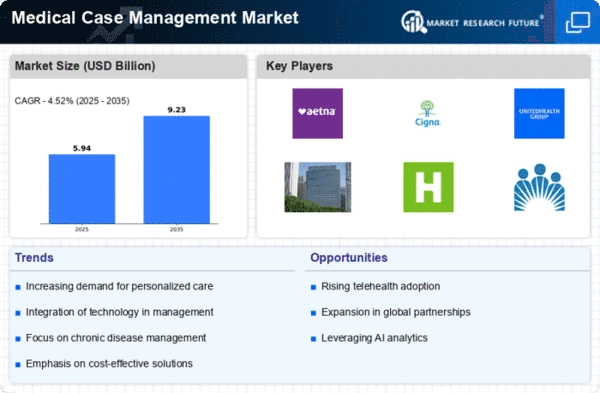
As per MRFR analysis, the Medical Case Management Market Size was estimated at 5.68 USD Billion in 2024. The Medical Case Management industry is projected to grow from 5.93 USD Billion in 2025 to 9.23 USD Billion by 2035, exhibiting a compound annual growth rate (CAGR) of 4.52 during the forecast period 2025 - 2035.

Key Market Trends & Highlights

The Medical Case Management Market is experiencing a transformative shift towards technology integration and value-based care.

  • The integration of technology is reshaping service delivery in the Medical Case Management Market, particularly in North America.
  • Data-driven decision making is becoming increasingly prevalent, enhancing outcomes in Chronic Disease Management, the largest segment.
  • The focus on value-based care is driving growth in Mental Health Services, which is currently the fastest-growing segment.
  • Rising demand for personalized care and an aging population are key drivers propelling the market forward.

Market Size & Forecast

2024 Market Size 5.68 (USD Billion)
2035 Market Size 9.23 (USD Billion)
CAGR (2025 - 2035) 4.52%
Largest Regional Market Share in 2024 North America

Major Players

Aetna (US), Cigna (US), UnitedHealth Group (US), Anthem (US), Humana (US), Kaiser Permanente (US), Magellan Health (US), WellCare Health Plans (US), Molina Healthcare (US)

Market Trends

The Medical Case Management Market is currently experiencing a transformative phase, characterized by an increasing emphasis on patient-centered care and the integration of technology into case management practices. This shift appears to be driven by a growing recognition of the importance of personalized treatment plans that cater to individual patient needs. As healthcare systems evolve, the role of case managers is becoming more pivotal, facilitating communication between patients and providers, and ensuring that care is coordinated effectively. Furthermore, the rise of telehealth services seems to be reshaping traditional case management approaches, allowing for more flexible and accessible patient interactions. In addition, the Medical Case Management Market is witnessing a trend towards the utilization of data analytics and artificial intelligence to enhance decision-making processes. These technologies may provide case managers with valuable insights into patient histories and treatment outcomes, potentially leading to improved care strategies. Moreover, regulatory changes and an increasing focus on value-based care are likely to influence market dynamics, pushing organizations to adopt more efficient case management solutions. Overall, the landscape of the Medical Case Management Market appears to be evolving rapidly, with various factors converging to shape its future direction.

Integration of Technology

The Medical Case Management Market is increasingly incorporating advanced technologies such as telehealth and digital health records. This integration facilitates better communication and coordination among healthcare providers, enhancing patient engagement and satisfaction.

Data-Driven Decision Making

There is a growing trend towards utilizing data analytics and artificial intelligence in case management. These tools may assist case managers in making informed decisions, optimizing treatment plans, and improving patient outcomes.

Focus on Value-Based Care

The shift towards value-based care models is influencing the Medical Case Management Market. Organizations are likely to prioritize efficient case management solutions that demonstrate measurable outcomes and cost-effectiveness.

Medical Case Management Market Market Drivers

Market Growth Projections

The Global Medical Case Management Market Industry is projected to experience substantial growth over the coming years. With a market value of 5.68 USD Billion in 2024, it is expected to expand to 9.23 USD Billion by 2035, reflecting a robust CAGR of 4.51% from 2025 to 2035. This growth trajectory indicates a rising recognition of the importance of case management in healthcare delivery, as stakeholders increasingly prioritize effective care coordination and patient engagement strategies.

Rising Chronic Disease Prevalence

The increasing prevalence of chronic diseases globally is a critical driver of the Global Medical Case Management Market Industry. Chronic conditions such as diabetes, heart disease, and obesity require ongoing management and coordination of care, which case management services provide. As the population ages and lifestyle-related health issues become more common, the demand for effective case management solutions is likely to escalate. This trend is underscored by the market's anticipated growth, with a valuation of 5.68 USD Billion in 2024 and a potential increase to 9.23 USD Billion by 2035.

Regulatory Support for Case Management

Government initiatives and regulatory frameworks are playing a pivotal role in shaping the Global Medical Case Management Market Industry. Many countries are implementing policies that promote integrated care models, emphasizing the importance of case management in improving health outcomes. For example, regulatory bodies are encouraging healthcare providers to adopt case management practices that enhance patient engagement and satisfaction. This supportive environment is likely to foster market growth, as organizations align their services with regulatory expectations, thereby enhancing their operational efficiency and patient care capabilities.

Increasing Demand for Personalized Care

The Global Medical Case Management Market Industry is experiencing a notable shift towards personalized care, driven by the growing recognition of individual patient needs. This trend is reflected in the increasing adoption of tailored treatment plans that consider patients' unique medical histories and preferences. As healthcare providers strive to enhance patient outcomes, the demand for case management services that facilitate personalized approaches is expected to rise. This shift is likely to contribute to the market's growth, with projections indicating a market value of 5.68 USD Billion in 2024, potentially reaching 9.23 USD Billion by 2035.

Technological Advancements in Healthcare

Technological innovations are significantly influencing the Global Medical Case Management Market Industry. The integration of advanced technologies such as telemedicine, artificial intelligence, and data analytics is streamlining case management processes. These technologies enhance communication between healthcare providers and patients, improving the efficiency of care delivery. For instance, AI-driven tools can analyze patient data to identify potential health risks, enabling proactive interventions. As these technologies become more prevalent, they are expected to drive the market's growth, with a projected CAGR of 4.51% from 2025 to 2035.

Focus on Cost-Effective Healthcare Solutions

The Global Medical Case Management Market Industry is increasingly driven by the need for cost-effective healthcare solutions. As healthcare costs continue to rise, stakeholders are seeking ways to optimize resource utilization while maintaining quality care. Case management services are recognized for their potential to reduce unnecessary hospitalizations and streamline care coordination, ultimately leading to cost savings. This focus on efficiency is likely to propel market growth, as organizations adopt case management strategies to enhance their financial sustainability while improving patient outcomes.

Market Segment Insights

By Application: Chronic Disease Management (Largest) vs. Mental Health Services (Fastest-Growing)

In the Medical Case Management Market, Chronic Disease Management takes the lead as the largest segment, capturing a significant portion of market share. This is largely attributed to the high prevalence of chronic conditions such as diabetes and cardiovascular diseases, necessitating a structured approach to case management. Rehabilitation Services and Disability Management follow, catering to the needs of patients recovering from surgeries and managing work-related disabilities respectively. Mental Health Services, although smaller in market share, are emerging rapidly due to a growing awareness of mental health issues and the increasing demand for mental health support services among various demographics.

Chronic Disease Management (Dominant) vs. Mental Health Services (Emerging)

Chronic Disease Management stands out as the dominant application in the Medical Case Management Market, driven by ongoing advancements in technology and care models that focus on long-term health management strategies. Its substantial demand reflects the necessity for comprehensive management plans tailored for patients with chronic illnesses. On the other hand, Mental Health Services are positioned as an emerging force within this sector, fueled by societal shifts that prioritize mental well-being. The growing integration of telehealth solutions has made these services more accessible, supporting their rapid growth and positioning them as vital components of holistic patient care practices.

By End User: Healthcare Providers (Largest) vs. Insurance Companies (Fastest-Growing)

In the Medical Case Management Market, the Healthcare Providers segment holds the largest share, driven by the increasing demand for streamlined patient care and efficient resource allocation. This segment includes hospitals, clinics, and other medical institutions focusing on enhancing patient outcomes through effective case management. Following closely, Insurance Companies represent a rapidly growing sector as they adapt to new healthcare regulations and seek innovative case management solutions to reduce costs and improve service delivery.

Healthcare Providers (Dominant) vs. Insurance Companies (Emerging)

Healthcare Providers are the cornerstone of the Medical Case Management Market, offering comprehensive services to manage patient care efficiently. This segment focuses on integrating case management practices into daily healthcare operations, enabling better patient tracking and improved clinical outcomes. Meanwhile, Insurance Companies are emerging as key players by investing in technology and partnerships that enhance their case management capabilities. They are increasingly adopting data-driven strategies to optimize patient care, reduce claims costs, and provide tailored solutions, positioning themselves as vital partners in the healthcare ecosystem.

By Service Type: Telephonic Case Management (Largest) vs. Integrated Case Management (Fastest-Growing)

In the Medical Case Management Market, the distribution of service types reveals that Telephonic Case Management holds a significant market share due to its widespread adoption and cost-effectiveness. This approach allows for prompt and efficient communication between case managers and patients, facilitating faster resolutions and better resource allocation. In comparison, Integrated Case Management is emerging rapidly, catering to a diverse range of healthcare needs by combining various services such as rehabilitation, social work, and nursing, thereby enhancing overall service delivery.

Telephonic Case Management (Dominant) vs. Integrated Case Management (Emerging)

Telephonic Case Management is recognized as the dominant service type, providing extensive reach and convenience in managing patient cases. Its ability to deliver immediate consultations without geographical constraints gives it an edge in the market, making it preferred by many healthcare providers. On the other hand, Integrated Case Management is considered an emerging approach that combines multiple healthcare services to create a cohesive patient experience. This segment is gaining traction as healthcare systems strive for holistic management of patient care, promoting collaboration among various providers to ensure improved outcomes.

By Patient Demographics: Pediatric Patients (Largest) vs. Geriatric Patients (Fastest-Growing)

In the Medical Case Management Market, the distribution of patient demographics reveals that Pediatric Patients hold the largest share, as healthcare systems increasingly focus on specialized care for younger populations. This segment benefits from tailored solutions that address their unique health needs, driving significant interest and investment. Geriatric Patients, on the other hand, are emerging rapidly in importance due to the aging population, showcasing a notable shift in case management strategies aimed at enhancing quality of life for older adults. The growth trends indicate an increasing prioritization of specialized care in managing chronic conditions among both Pediatric and Geriatric Patients. The demand for case management services tailored to complex medical conditions prevalent in these demographics is driven by technological advancements and the need for personalized healthcare solutions. As the patient population diversifies, medical case management services must evolve to meet varying healthcare demands across all age groups.

Pediatric Patients (Dominant) vs. Geriatric Patients (Emerging)

Pediatric Patients represent a dominant segment in the Medical Case Management Market, characterized by the need for coordinated approaches that address unique health challenges faced by children. This demographic necessitates a focus on preventative care, chronic disease management, and family-centered strategies to ensure optimal health outcomes. On the other hand, Geriatric Patients are rapidly emerging as a crucial segment, driven by demographic shifts toward an older population. This group requires case management that encompasses comprehensive health assessments, a focus on functional independence, and the management of multiple comorbidities. The service demand is increasing for both segments, underscoring the need for specialized resources and innovative care models.

By Technology Utilization: Telehealth Solutions (Largest) vs. Mobile Health Applications (Fastest-Growing)

The Medical Case Management Market is witnessing significant contributions from key technology utilization segments. Telehealth Solutions currently hold the largest market share due to their widespread acceptance and the ability to deliver care remotely. In contrast, Mobile Health Applications are making rapid gains, capitalizing on increasing smartphone usage and patient demand for accessible health management tools. As healthcare continues to embrace technology, these segments are playing pivotal roles in shaping patient care dynamics. Recent growth trends reveal a dramatic shift towards digital health technologies, driven by the need for higher efficiency and better patient engagement. Telehealth Solutions are expanding as healthcare providers recognize the importance of remote monitoring and consultation, especially post-pandemic. Meanwhile, Mobile Health Applications are being rapidly adopted by younger, tech-savvy populations, indicating a strong demand for personalized health solutions that can fit seamlessly into daily life.

Telehealth Solutions (Dominant) vs. Data Analytics Tools (Emerging)

Telehealth Solutions are currently the dominant force within the Medical Case Management Market, providing comprehensive online healthcare services that improve accessibility and patient outcomes. These solutions provide a seamless way for patients to interact with healthcare providers, leading to a more efficient case management process. On the other hand, Data Analytics Tools are emerging as critical assets in this market, enabling healthcare providers to analyze vast amounts of patient data for better decision-making and personalized care. The integration of data analytics enhances the efficiency of case management by allowing providers to identify trends and predict patient needs, thus driving further innovation in patient care.

Get more detailed insights about Medical Case Management Market Research Report – Global Forecast till 2035

Regional Insights

North America : Market Leader in Case Management

North America is poised to maintain its leadership in the Medical Case Management Market, holding a significant market share of 3.0 in 2024. The region's growth is driven by increasing healthcare costs, a rising aging population, and a shift towards value-based care. Regulatory support, including the Affordable Care Act, has catalyzed demand for comprehensive case management services, enhancing patient outcomes and reducing costs. The competitive landscape is robust, with key players such as Aetna, Cigna, and UnitedHealth Group leading the charge. These organizations are leveraging technology to improve service delivery and patient engagement. The presence of established healthcare systems and a focus on integrated care models further solidify North America's position as a hub for medical case management innovation.

Europe : Emerging Market with Growth Potential

Europe's Medical Case Management Market is on the rise, with a market size of 1.5 in 2024. The growth is fueled by increasing healthcare expenditures, a focus on patient-centered care, and regulatory frameworks promoting integrated health services. Countries are investing in digital health solutions, which are expected to enhance case management efficiency and accessibility, driving demand across the region. Leading countries like Germany, France, and the UK are at the forefront of this expansion, with a competitive landscape featuring both established players and new entrants. The presence of organizations such as Cigna and local providers is fostering innovation and collaboration. As the region adapts to changing healthcare needs, the emphasis on quality and efficiency in case management will continue to shape its market dynamics.

Asia-Pacific : Rapidly Growing Healthcare Sector

The Asia-Pacific region is witnessing significant growth in the Medical Case Management Market, with a market size of 0.9 in 2024. Factors such as rising disposable incomes, increasing healthcare awareness, and government initiatives to improve healthcare access are driving this growth. The region is also experiencing a shift towards preventive care, which is enhancing the demand for effective case management solutions. Countries like China, India, and Japan are leading the charge, with a mix of local and international players entering the market. The competitive landscape is evolving, with companies focusing on technology-driven solutions to streamline case management processes. As healthcare systems in the region continue to develop, the emphasis on quality care and patient engagement will be crucial for market expansion.

Middle East and Africa : Developing Market with Challenges

The Middle East and Africa region is gradually emerging in the Medical Case Management Market, with a market size of 0.28 in 2024. The growth is driven by increasing healthcare investments, a rising prevalence of chronic diseases, and a focus on improving healthcare infrastructure. Governments are implementing policies to enhance healthcare delivery, which is expected to boost demand for case management services in the coming years. Leading countries such as South Africa and the UAE are making strides in healthcare reform, attracting both local and international players. The competitive landscape is characterized by a mix of established healthcare providers and new entrants. As the region continues to develop its healthcare systems, the focus on quality and efficiency in case management will be essential for sustainable growth.

Key Players and Competitive Insights

The Medical Case Management Market is currently characterized by a dynamic competitive landscape, driven by the increasing demand for efficient healthcare delivery and the integration of technology in patient management. Key players such as Aetna (US), Cigna (US), and UnitedHealth Group (US) are strategically positioning themselves through innovation and partnerships. Aetna (US) has focused on enhancing its digital capabilities, which appears to be a response to the growing need for telehealth services. Cigna (US) emphasizes a holistic approach to care management, integrating behavioral health with physical health services, thereby addressing the comprehensive needs of patients. UnitedHealth Group (US) continues to leverage its vast data analytics capabilities to improve patient outcomes, suggesting a trend towards data-driven decision-making in the market.The business tactics employed by these companies reflect a moderately fragmented market structure, where local adaptation and supply chain optimization are crucial. Companies are increasingly localizing their services to meet regional healthcare demands, which may enhance their competitive edge. The collective influence of these key players shapes the market, as they engage in strategic collaborations and technology investments to streamline operations and improve service delivery.

In November Aetna (US) announced a partnership with a leading telehealth provider to expand its virtual care offerings. This strategic move is likely to enhance Aetna's service portfolio, allowing it to cater to a broader patient base while addressing the rising demand for remote healthcare solutions. Such partnerships may also position Aetna favorably against competitors who are yet to fully embrace telehealth integration.

In October Cigna (US) launched a new initiative aimed at integrating mental health services into its case management programs. This initiative underscores Cigna's commitment to addressing the growing mental health crisis, which is increasingly recognized as a critical component of overall health. By prioritizing mental health, Cigna may differentiate itself in a crowded market, appealing to consumers seeking comprehensive care solutions.

In September UnitedHealth Group (US) expanded its data analytics platform to include predictive modeling for chronic disease management. This enhancement is indicative of UnitedHealth's strategy to utilize advanced analytics to preemptively address patient needs, potentially reducing healthcare costs and improving outcomes. Such innovations may set a new standard in the industry, compelling other players to adopt similar technologies to remain competitive.

As of December the Medical Case Management Market is witnessing trends such as digitalization, sustainability, and the integration of artificial intelligence (AI) into service delivery. Strategic alliances are increasingly shaping the competitive landscape, as companies recognize the value of collaboration in enhancing service offerings. The shift from price-based competition to a focus on innovation and technology is evident, with companies striving to differentiate themselves through advanced solutions and reliable supply chains. This evolution suggests that future competitive differentiation will hinge on the ability to leverage technology and foster strategic partnerships, ultimately enhancing patient care and operational efficiency.

Key Companies in the Medical Case Management Market include

Industry Developments

Janurary 2022: Ardent Health Services and Cadence have partnered to launch a remote care management programme that will enhance patient care and outcomes outside of clinics.

December 2022: Override a Virtual Chronic Pain a startup raised USD 3.5 million along with 7wireVentures and Martin Ventures, among other investors. The nation's top pain management coaching company was also acquired by Override.

August 2022: The IMA Group acquires Mollie Kallen Case Management to increase its national footprint making it their fourth acquisition of 2022.

Future Outlook

Medical Case Management Market Future Outlook

The Medical Case Management Market is projected to grow at a 4.52% CAGR from 2024 to 2035, driven by technological advancements, increasing healthcare costs, and a growing aging population.

New opportunities lie in:

  • Integration of AI-driven analytics for personalized care management solutions.
  • Expansion of telehealth services to enhance patient engagement and accessibility.
  • Development of mobile case management applications for real-time data tracking.

By 2035, the Medical Case Management Market is expected to be robust, driven by innovation and increased demand for efficient healthcare solutions.

Market Segmentation

Medical Case Management Market End User Outlook

  • Healthcare Providers
  • Insurance Companies
  • Government Agencies
  • Employers

Medical Case Management Market Application Outlook

  • Chronic Disease Management
  • Rehabilitation Services
  • Disability Management
  • Mental Health Services

Medical Case Management Market Service Type Outlook

  • Telephonic Case Management
  • In-Person Case Management
  • Integrated Case Management
  • Specialized Case Management

Medical Case Management Market Patient Demographics Outlook

  • Pediatric Patients
  • Adult Patients
  • Geriatric Patients
  • Patients with Disabilities

Medical Case Management Market Technology Utilization Outlook

  • Telehealth Solutions
  • Mobile Health Applications
  • Data Analytics Tools
  • Electronic Health Records

Report Scope

MARKET SIZE 20245.68(USD Billion)
MARKET SIZE 20255.93(USD Billion)
MARKET SIZE 20359.23(USD Billion)
COMPOUND ANNUAL GROWTH RATE (CAGR)4.52% (2025 - 2035)
REPORT COVERAGERevenue Forecast, Competitive Landscape, Growth Factors, and Trends
BASE YEAR2024
Market Forecast Period2025 - 2035
Historical Data2019 - 2024
Market Forecast UnitsUSD Billion
Key Companies ProfiledAetna (US), Cigna (US), UnitedHealth Group (US), Anthem (US), Humana (US), Kaiser Permanente (US), Magellan Health (US), WellCare Health Plans (US), Molina Healthcare (US)
Segments CoveredApplication, End User, Service Type, Patient Demographics, Technology Utilization
Key Market OpportunitiesIntegration of artificial intelligence in Medical Case Management Market enhances efficiency and patient outcomes.
Key Market DynamicsRising demand for personalized care drives innovation and competition in the Medical Case Management Market.
Countries CoveredNorth America, Europe, APAC, South America, MEA

FAQs

What is the projected growth of the Medical Case Management market?

The Medical Case Management market is the expected increase in total market value of 9.23 USD billion over a defined forecast period 2025–2035. It is driven by factors such as demand trends, technological advances, regulatory changes, and geographic expansion.

What is the size of the Medical Case Management market?

Medical Case Management market size was valued at approximately 5.68 billion USD in 2024. This figure will reach 9.23 billion USD covering all regions (America, Europe, Asia, MEA and ROW), focusing its segments / services / distribution channels till 2035.

What is the CAGR of the Medical Case Management market?

Medical Case Management market is expected to grow at a CAGR of 4.52% between 2025 and 2035.

How much will the Medical Case Management market be worth by 2035?

Medical Case Management market is expected to be worth of 9.23 billion USD, reflecting growth driven by usage, technology and global demands by the end of 2035.

How will the Medical Case Management market perform over the next 10 years?

Over the next 10 years the Medical Case Management market is expected to shift from usd billion 5.68 to 9.23 billion USD, led by adoption of advanced tech, demographic trends, regulatory approvals, with potential headwinds from 2025 to 2035.

Which region held the largest market share in the Medical Case Management market?

North America had the largest share of the global market for medical case management.

  1. SECTION I: EXECUTIVE SUMMARY AND KEY HIGHLIGHTS
    1. | 1.1 EXECUTIVE SUMMARY
  2. SECTION II: SCOPING, METHODOLOGY AND MARKET STRUCTURE
    1. | 2.1 MARKET INTRODUCTION
    2. | 2.2 RESEARCH METHODOLOGY
  3. SECTION III: QUALITATIVE ANALYSIS
    1. | 3.1 MARKET DYNAMICS
    2. | 3.2 MARKET FACTOR ANALYSIS
  4. SECTION IV: QUANTITATIVE ANALYSIS
    1. | 4.1 Healthcare, BY Application (USD Billion)
    2. | 4.2 Healthcare, BY End User (USD Billion)
    3. | 4.3 Healthcare, BY Service Type (USD Billion)
    4. | 4.4 Healthcare, BY Patient Demographics (USD Billion)
    5. | 4.5 Healthcare, BY Technology Utilization (USD Billion)
    6. | 4.6 Healthcare, BY Region (USD Billion)
  5. SECTION V: COMPETITIVE ANALYSIS
    1. | 5.1 Competitive Landscape
    2. | 5.2 Company Profiles
    3. | 5.3 Appendix

Medical Case Management Market Segmentation

Market Segmentation Overview

  • Detailed segmentation data will be available in the full report
  • Comprehensive analysis by multiple parameters
  • Regional and country-level breakdowns
  • Market size forecasts by segment
Infographic

Free Sample Request

Kindly complete the form below to receive a free sample of this Report

Get Free Sample

Customer Strories

Compare Licence

×
Features License Type
Single User Multiuser License Enterprise User
Price $4,950 $5,950 $7,250
Maximum User Access Limit 1 User Upto 10 Users Unrestricted Access Throughout the Organization
Free Customization
Direct Access to Analyst
Deliverable Format
Platform Access
Discount on Next Purchase 10% 15% 15%
Printable Versions