Request Free Sample ×

Kindly complete the form below to receive a free sample of this Report

* Please use a valid business email

Leading companies partner with us for data-driven Insights

clients tt-cursor
Hero Background
English
Chinese
French
Japanese
Korean
German
Spanish

Marine Navigation Systems Market Size

ID: MRFR/AD/3461-CR
140 Pages
Shubham Munde
October 2019

Marine Navigation System Market Size, Share, Industry Trend & Analysis Research Report Information By Type (Chart Plotter, Electronic Navigation Chart and Others), Application (Ship, Remotely Operated Underwater Vehicle, Autonomous Underwater Vehicle and Boat), End-Use (Defense and Commercial) And By Region (North America, Europe, Asia-Pacific, And Rest Of The World) – Forecast Till 2035

Share:
Download PDF ×

We do not share your information with anyone. However, we may send you emails based on your report interest from time to time. You may contact us at any time to opt-out.

Marine Navigation Systems Market Infographic
Purchase Options

Marine Navigation Systems Size

Marine Navigation Systems Market Growth Projections and Opportunities

The marine navigation system market is influenced by a multitude of market factors that shape its growth, development, and competitive landscape. One of the key factors is technological advancements. Constant innovation in navigation technology, including GPS, radar, AIS, ECDIS, and other sensor-based systems, drives the market. The quest for more accurate, efficient, and reliable navigation solutions fuels research and development efforts, leading to the introduction of cutting-edge technologies that cater to the evolving needs of the maritime industry. Companies strive to stay ahead by offering state-of-the-art systems that enhance safety, efficiency, and operational capabilities.

Regulatory mandates and compliance standards also play a pivotal role in shaping the marine navigation system market. Organizations like the International Maritime Organization (IMO) set stringent regulations to ensure maritime safety, security, and environmental protection. Compliance with these regulations necessitates the adoption of advanced navigation systems to mitigate risks, prevent accidents, and adhere to international standards. These mandates drive market growth by compelling shipowners and operators to invest in upgraded navigation technology to meet regulatory requirements.

Furthermore, global trade dynamics significantly impact the demand for marine navigation systems. The expanding global economy leads to increased maritime trade activities, necessitating efficient and reliable navigation solutions. Ports, shipping companies, and vessel operators seek advanced navigation tools to manage the growing traffic, optimize routes, and ensure timely and safe transportation of goods across international waters. Economic fluctuations, such as changes in oil prices or geopolitical tensions, can also influence shipping activities and investments in navigation technology, impacting market dynamics.

The competitive landscape and industry collaborations are crucial market factors influencing the marine navigation system sector. The presence of numerous global and regional players fosters competition, driving continuous innovation and product development. Companies engage in strategic partnerships, mergers, and acquisitions to enhance their product portfolios, expand their market reach, and gain a competitive edge. Collaborations between navigation system providers and shipbuilders or maritime technology integrators also shape market dynamics, leading to the integration of navigation solutions into vessel design and construction.

Moreover, the increasing focus on environmental sustainability has become a significant market factor. The maritime industry is under pressure to reduce its carbon footprint and minimize environmental impact. This drive towards sustainability influences the development of eco-friendly navigation systems that optimize routes, reduce fuel consumption, and limit emissions. Navigation technology that aids in eco-conscious navigation practices becomes a competitive advantage, appealing to environmentally conscious stakeholders and regulatory bodies.

Additionally, financing and investment trends contribute to the market dynamics of marine navigation systems. The availability of funding, government incentives, and investments in maritime infrastructure impact the adoption of advanced navigation technologies. Economic support for fleet modernization or technological upgrades can drive market growth by encouraging vessel owners to invest in newer, more efficient navigation systems.

Marine Navigation Systems Market Size Graph
Author
Author Profile
Shubham Munde
Team Lead - Research

Shubham brings over 7 years of expertise in Market Intelligence and Strategic Consulting, with a strong focus on the Automotive, Aerospace, and Defense sectors. Backed by a solid foundation in semiconductors, electronics, and software, he has successfully delivered high-impact syndicated and custom research on a global scale. His core strengths include market sizing, forecasting, competitive intelligence, consumer insights, and supply chain mapping. Widely recognized for developing scalable growth strategies, Shubham empowers clients to navigate complex markets and achieve a lasting competitive edge. Trusted by start-ups and Fortune 500 companies alike, he consistently converts challenges into strategic opportunities that drive sustainable growth.

Leave a Comment

FAQs

What is the projected market valuation of the Marine Navigation System Market by 2035?

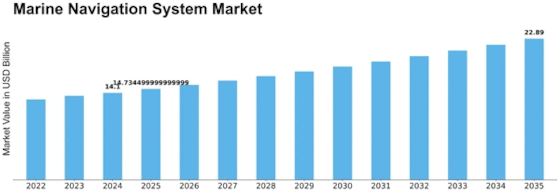
<p>The Marine Navigation System Market is projected to reach a valuation of 22.89 USD Billion by 2035.</p>

What was the market valuation of the Marine Navigation System Market in 2024?

<p>In 2024, the Marine Navigation System Market was valued at 14.1 USD Billion.</p>

What is the expected CAGR for the Marine Navigation System Market during the forecast period 2025 - 2035?

<p>The expected CAGR for the Marine Navigation System Market during the forecast period 2025 - 2035 is 4.5%.</p>

Which companies are considered key players in the Marine Navigation System Market?

<p>Key players in the Marine Navigation System Market include Raymarine, Garmin, Furuno, Navico, Kongsberg Gruppen, Northrop Grumman, Thales Group, Siemens, and Bae Systems.</p>

What are the main types of products in the Marine Navigation System Market?

<p>The main types of products in the Marine Navigation System Market include Chart Plotters, Electronic Navigation Charts, and other navigation systems.</p>

How much was the market size for Chart Plotters in 2024?

<p>The market size for Chart Plotters was 5.0 USD Billion in 2024 and is expected to grow to 8.0 USD Billion by 2035.</p>

What is the projected market size for Electronic Navigation Charts by 2035?

The projected market size for Electronic Navigation Charts is expected to increase from 6.0 USD Billion in 2024 to 10.0 USD Billion by 2035.

Which application segment is expected to have the highest market size in 2035?

The Boat application segment is expected to have the highest market size, growing from 5.6 USD Billion in 2024 to 8.89 USD Billion by 2035.

What is the expected market size for the Defense end-use segment by 2035?

The Defense end-use segment is projected to grow from 5.0 USD Billion in 2024 to 8.0 USD Billion by 2035.

How does the Commercial end-use segment compare to the Defense segment in terms of market size?

The Commercial end-use segment is expected to significantly outpace the Defense segment, growing from 9.1 USD Billion in 2024 to 14.89 USD Billion by 2035.

Market Summary

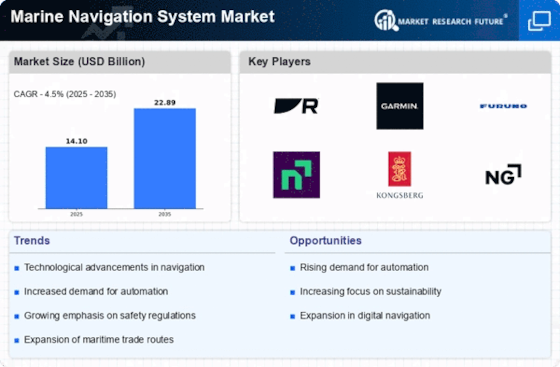
As per Market Research Future analysis, the Marine Navigation System Market was estimated at 14.1 USD Billion in 2024. The Marine Navigation System industry is projected to grow from 14.73 USD Billion in 2025 to 22.89 USD Billion by 2035, exhibiting a compound annual growth rate (CAGR) of 4.5% during the forecast period 2025 - 2035

Key Market Trends & Highlights

The Marine Navigation System Market is poised for substantial growth driven by technological advancements and increasing safety demands.

  • Technological advancements are reshaping the Marine Navigation System Market, enhancing accuracy and efficiency. North America remains the largest market, while Asia-Pacific is emerging as the fastest-growing region in this sector. Chart Plotters dominate the market, whereas Electronic Navigation Charts are witnessing rapid growth. The increasing demand for safety and security, along with regulatory compliance, drives the market forward.

Market Size & Forecast

2024 Market Size 14.1 (USD Billion)
2035 Market Size 22.89 (USD Billion)
CAGR (2025 - 2035) 4.5%
Largest Regional Market Share in 2024 North America

Major Players

Raymarine (GB), Garmin (US), Furuno (JP), Navico (NO), Kongsberg Gruppen (NO), <a href="https://news.northropgrumman.com/News-Stream">Northrop Grumman</a> (US), Thales Group (FR), Siemens (DE), Bae Systems (GB)

Market Trends

The Marine Navigation System Market is currently experiencing a transformative phase, driven by advancements in technology and increasing demand for efficient maritime operations. The integration of sophisticated navigation systems, such as GPS and AIS, enhances safety and operational efficiency for vessels across various sectors, including commercial shipping, fishing, and recreational boating. Furthermore, the growing emphasis on environmental sustainability is prompting the adoption of eco-friendly navigation solutions, which may lead to a shift in market dynamics. As stakeholders prioritize safety and regulatory compliance, the market appears poised for substantial growth, with innovations likely to play a pivotal role in shaping future developments. In addition, the Marine Navigation System Market is witnessing a surge in demand for integrated systems that combine navigation, communication, and monitoring functionalities. This trend reflects a broader industry movement towards holistic solutions that streamline operations and improve situational awareness. The increasing complexity of maritime operations necessitates advanced systems that can provide real-time data and analytics, thereby enhancing decision-making processes. As the market evolves, it seems that collaboration among technology providers, regulatory bodies, and end-users will be crucial in addressing emerging challenges and capitalizing on new opportunities.

Technological Advancements

The Marine Navigation System Market is significantly influenced by rapid technological advancements. Innovations in satellite navigation, sensor technologies, and data analytics are enhancing the accuracy and reliability of navigation systems. These developments not only improve safety but also optimize route planning and fuel efficiency, which are critical for modern maritime operations.

Integration of Systems

There is a noticeable trend towards the integration of various navigation and communication systems within the Marine Navigation System Market. This integration allows for seamless data sharing and improved situational awareness, enabling operators to make informed decisions. As vessels become more interconnected, the demand for comprehensive solutions that combine navigation, monitoring, and communication functionalities is likely to increase.

Focus on Sustainability

The Marine Navigation System Market is increasingly aligning with sustainability goals. Stakeholders are prioritizing eco-friendly navigation solutions that minimize environmental impact. This focus on sustainability may drive the development of technologies that enhance energy efficiency and reduce emissions, reflecting a broader commitment to responsible maritime practices.

Marine Navigation Systems Market Market Drivers

Regulatory Compliance and Standards

The Marine Navigation System Market is significantly influenced by stringent regulatory compliance and standards imposed by maritime authorities. These regulations aim to enhance safety, security, and environmental protection in maritime operations. As countries adopt more rigorous standards, the demand for advanced navigation systems that meet these requirements is likely to increase. For instance, the International Maritime Organization has established guidelines that necessitate the use of sophisticated navigation systems on commercial vessels. This regulatory landscape compels shipowners and operators to invest in modern navigation technologies, thereby driving market growth. The need for compliance not only ensures safer navigation but also promotes the adoption of innovative solutions within the industry.

Growth of E-commerce and Trade Activities

The Marine Navigation System Market is experiencing growth driven by the expansion of e-commerce and trade activities. As global trade continues to flourish, the demand for efficient and reliable maritime transportation increases. This trend necessitates the implementation of advanced navigation systems to ensure timely and safe delivery of goods. Recent statistics indicate that the volume of container shipping is projected to rise significantly, further emphasizing the need for effective navigation solutions. The integration of navigation systems with logistics and supply chain management enhances operational efficiency, thereby supporting the growth of the marine navigation market. This interconnectedness between trade and navigation systems highlights the critical role of technology in facilitating global commerce.

Increasing Demand for Safety and Security

The Marine Navigation System Market experiences a notable surge in demand for enhanced safety and security measures. As maritime activities expand, the need for reliable navigation systems becomes paramount. According to recent data, the market for marine navigation systems is projected to grow at a compound annual growth rate of approximately 7.5% over the next five years. This growth is driven by the increasing number of vessels and the rising concerns regarding maritime accidents. Enhanced navigation systems not only improve safety but also ensure compliance with international regulations, thereby fostering a safer maritime environment. The integration of advanced technologies such as GPS and AIS into navigation systems further bolsters their effectiveness, making them indispensable for modern maritime operations.

Technological Innovations and Advancements

Technological innovations play a crucial role in shaping the Marine Navigation System Market. The advent of cutting-edge technologies such as artificial intelligence, machine learning, and big data analytics is revolutionizing navigation systems. These advancements enable real-time data processing and predictive analytics, enhancing decision-making capabilities for maritime operators. The integration of autonomous navigation systems is also gaining traction, potentially reducing human error and improving operational efficiency. As per industry forecasts, the market for advanced navigation technologies is expected to witness substantial growth, driven by the increasing adoption of smart shipping solutions. This trend indicates a shift towards more sophisticated navigation systems that can adapt to dynamic maritime environments.

Rising Environmental Concerns and Sustainability Initiatives

The Marine Navigation System Market is increasingly influenced by rising environmental concerns and sustainability initiatives. As the maritime sector faces pressure to reduce its carbon footprint, there is a growing emphasis on adopting eco-friendly navigation solutions. Advanced navigation systems that optimize routes and reduce fuel consumption are becoming essential for shipping companies aiming to comply with environmental regulations. The implementation of such systems not only contributes to sustainability goals but also enhances operational efficiency. Market analysis suggests that the demand for green technologies in marine navigation is likely to increase, driven by both regulatory requirements and consumer preferences for environmentally responsible practices. This shift towards sustainability is reshaping the landscape of the marine navigation market.

Market Segment Insights

By Type: Chart Plotter (Largest) vs. Electronic Navigation Chart (Fastest-Growing)

In the Marine Navigation System Market, the distribution among the various types is notably varied. Chart Plotters hold the largest share, recognized for their user-friendly interface and accuracy in navigation, making them a preferred choice among both recreational and commercial users. In contrast, the Electronic Navigation Chart (ENC) segment is experiencing rapid growth, attributed to its advanced features and integration capabilities, appealing to tech-savvy navigators and shipping companies alike. The growth trends in this segment are fueled by the increasing demand for precision navigation, particularly in complex maritime environments. The rise in recreational boating and fishing activities is also propelling Chart Plotters, while regulatory pushes for enhanced navigation safety are bolstering the ENC's growth. Additionally, advancements in technology, such as integration with other marine systems and mobile applications, are driving innovation and adoption in both segments.

Technology: Chart Plotter (Dominant) vs. Electronic Navigation Chart (Emerging)

Chart Plotters, as the dominant segment in the Marine Navigation System Market, offer integrated solutions combining GPS and mapping capabilities, making navigation straightforward for users. Their intuitive interfaces are beneficial for both seasoned sailors and newcomers. On the other hand, Electronic Navigation Charts represent an emerging trend, gaining traction due to their ability to provide updated maritime information and enhance situational awareness. While Chart Plotters dominate in traditional navigation, the ENC segment appeals to modern users wanting real-time data integration and scalability. This interplay between the established technology of Chart Plotters and the innovative features of ENCs illustrates the dynamic nature of the marine navigation landscape.

By Application: Ship (Largest) vs. Autonomous Underwater Vehicle (Fastest-Growing)

The Marine Navigation System Market showcases a diverse array of application segments, with 'Ship' leading the market by a significant margin. This segment is followed by the 'Boat', 'Remotely Operated Underwater Vehicle', and '<a href="https://www.marketresearchfuture.com/reports/autonomous-underwater-vehicle-market-7384">Autonomous Underwater Vehicle</a>' segments, which have been gaining traction due to advancements in marine technology. Boats, typically used for leisure and fishing, are increasingly incorporating advanced navigation systems to enhance safety and user experience. In contrast, the segments related to underwater vehicles are capturing interest due to the rise in underwater exploration and research operations, particularly by academic and government entities.

Ship (Dominant) vs. Autonomous Underwater Vehicle (Emerging)

The 'Ship' segment remains the dominant player in the Marine Navigation System Market, driven by global shipping activities and the need for advanced navigation technologies. This segment leverages sophisticated systems for both safety and operational efficiency, incorporating high-precision GPS, radar, and electronic charting systems. Conversely, the 'Autonomous Underwater Vehicle' (AUV) represents an emerging market segment, characterized by rapidly evolving applications in environmental monitoring, underwater mapping, and military reconnaissance. The growing interest in marine research and the need for less human intervention in potentially hazardous underwater activities are propelling AUVs into mainstream use, making it one of the fastest-growing segments in the industry.

By End-Use: Defense (Largest) vs. Commercial (Fastest-Growing)

The Marine Navigation System Market is primarily segmented into Defense and Commercial end-uses. The Defense segment holds the largest share, driven by the increasing investments in naval fleets and military modernization initiatives across the globe. Commercial applications, however, are gaining traction, reflecting a growing reliance on marine navigation technology for commercial shipping and fishing operations, which requires precision and reliability to enhance operational efficiency. In terms of growth trends, the Commercial segment is currently recognized as the fastest-growing area within this market. Factors such as the expansion of global trade, rising demand for maritime safety, and advancements in navigation technology are propelling this segment forward. The Defense sector, although dominant, is also evolving with new technological integrations to maintain its strategic advantage in global maritime operations. Both segments are expected to see innovations that cater to their unique operational needs.

End-Use: Defense (Dominant) vs. Commercial (Emerging)

The Defense segment of the Marine Navigation System Market is characterized by its substantial governmental and military investments, focusing on robust and secure navigation solutions suitable for various naval platforms. With a strong emphasis on operational capabilities and mission success, defense systems are increasingly integrated with advanced technologies like real-time data analytics and automated navigation systems. This segment maintains dominance due to its critical nature and consistent funding from national defense budgets. On the other hand, the Commercial segment is classified as emerging and is marked by rapid advancements in navigation technology aimed at optimizing logistical operations in shipping and fishing industries. This segment is driven by the need for improved safety and efficiency, as companies seek to harness technology to stay competitive. Innovations like autonomous vessels and enhanced GPS services are reshaping commercial navigation, appealing to a broader market that increasingly prioritizes technological upgrades.

Get more detailed insights about Marine Navigation System Market Research Report - Global Forecast to 2035

Regional Insights

By region, the study provides market insights into North America, Europe, Asia-Pacific and the Rest of the World. The North American Marine Navigation System market will dominate, with the region's early embrace of technology and massive investment in superior navigation systems. Increased spending on various automation technologies and the construction of smart infrastructure across the area is also likely to promote market growth.

Further, the major countries studied in the market report are The US, Canada, German, France, the UK, Italy, Spain, China, Japan, India, Australia, South Korea, and Brazil.

Figure 2: MARINE NAVIGATION SYSTEM MARKET SHARE BY REGION 2022 (USD Billion)

Europe's Marine Navigation System market accounts for the second-largest market share. The demand for the Marine Navigation Systems Market is increasing due to its extensive application. These are used to navigate fishing boats, shipping vessels, and merchant and cruise ships. This system provides benefits to fleet owners. The increasing rate of maritime trade is driving the market. Further, the German Marine Navigation System market held the largest market share, and the UK Marine Navigation System market was the fastest-growing market in the European region.

The Asia-Pacific Marine Navigation System Market is expected to grow at the fastest CAGR from 2023 to 2032. The broad implementation of maritime information systems for real-time access to vessel positions, navigational hazards, weather conditions, security concerns, and proactive risk reduction is considerably supporting demand. Moreover, China's Marine Navigation System market held the largest market share, and the Indian Marine Navigation System market was the fastest-growing market in the Asia-Pacific region.

Key Players and Competitive Insights

Leading market companies are extensively spending R&D on increasing their product lines, which will help the Marine Navigation System market grow even more. Important market developments include new product releases, contractual agreements, acquisitions and mergers, greater investments, and collaboration with other organizations. The Marine Navigation System industry must produce cost-effective merchandise to flourish and thrive in a more competitive and increasing market climate.

Manufacturing locally to reduce operating costs is an effective business strategy manufacturers use in the worldwide Marine Navigation System industry to serve clients and expand the market sector. The Marine Navigation System industry has provided some of the most important benefits recently. Major players in the Marine Navigation System market, including Advanced Navigation, Garmin International, Inc and others, are attempting to increase market demand by investing in research and development operations.

Advanced Navigation is the world's most tenacious innovator in artificial intelligence robotics and navigation technologies. Their solutions provide unprecedented capabilities and remarkable performance across land, air, sea, and space applications by using our skills in AI neural networks and deep learning algorithms. They produce breakthrough technologies ranging from inertial and sonar Navigation to photonic and quantum sensing, thanks to rigorous research, testing, and automated manufacturing. Customers like innovative Navigation because of its high accuracy, dependability, and design. Advanced Navigation aims to spark the autonomy revolution based on a culture of study and discovery.

Eventually, they increase human capabilities to construct a more resilient and sustainable future with safer results. They are driven by a great passion for employing cutting-edge technology to unearth and explore new frontiers.

In October The Boreas D70, a fiber-optic gyroscope (FOG) inertial navigation system (INS), is unveiled by Advanced Navigation. According to the maker, the technology is highly adapted to surveying, mapping, and Navigation in subsea, marine, terrestrial, and air applications.

Garmin International, Inc. is a Garmin Ltd. subsidiary. Garmin Ltd. is headquartered in Switzerland, with primary subsidiaries in the United States, Taiwan, and the United Kingdom. Garmin Ltd. or its subsidiaries owns Garmin, Fusion, and Navionics registered trademarks. All other trademarks, service marks, and brand names are the property of their respective owners.

In June Garmin International, Inc., a division of Garmin Ltd., is pleased to collaborate with Sea Tow Services, International, Inc. to provide members and franchise operators with exclusive incentives and product training to increase boater safety.

Key Companies in the Marine Navigation Systems Market include

Industry Developments

May 2023: A quantum sensor for a future navigation system was tested on a Royal Navy ship. Many modern navigation systems rely on navigation satellite systems (GNSS), such as GPS, which utilize signals from Earth-orbiting satellites.

January 2023: ChartWorld International, a renowned producer of digital navigation charts and services, was recently bought by Teledyne. Mariners, ship owners, and ship management worldwide rely on ChartWorld's products and services to increase safety, efficiency, and compliance.ChartWorld's technology and experienced team will be integrated into Teledyne's maritime Systems sector, which supplies customers in the commercial and defense markets with a wide range of maritime instrumentation, imaging, and communications products and services.

Future Outlook

Marine Navigation Systems Market Future Outlook

The Marine Navigation System Market is projected to grow at a 4.5% CAGR from 2025 to 2035, driven by technological advancements, increased maritime trade, and regulatory compliance.

New opportunities lie in:

  • Integration of AI-driven predictive analytics for route optimization.
  • Development of advanced autonomous navigation systems for commercial vessels.
  • Expansion of cloud-based navigation solutions for real-time data sharing.

By 2035, the market is expected to be robust, reflecting substantial growth and innovation.

Market Segmentation

Marine Navigation Systems Market Type Outlook

  • Chart Plotter
  • Electronic Navigation Chart
  • Others

Marine Navigation Systems Market End-Use Outlook

  • Defense
  • Commercial

Marine Navigation Systems Market Application Outlook

  • Ship
  • Remotely Operated Underwater Vehicle
  • Autonomous Underwater Vehicle
  • Boat

Report Scope

MARKET SIZE 2024 14.1(USD Billion)
MARKET SIZE 2025 14.73(USD Billion)
MARKET SIZE 2035 22.89(USD Billion)
COMPOUND ANNUAL GROWTH RATE (CAGR) 4.5% (2025 - 2035)
REPORT COVERAGE Revenue Forecast, Competitive Landscape, Growth Factors, and Trends
BASE YEAR 2024
Market Forecast Period 2025 - 2035
Historical Data 2019 - 2024
Market Forecast Units USD Billion
Key Companies Profiled Raymarine (GB), Garmin (US), Furuno (JP), Navico (NO), Kongsberg Gruppen (NO), Northrop Grumman (US), Thales Group (FR), Siemens (DE), Bae Systems (GB)
Segments Covered Type, Region
Key Market Opportunities Integration of advanced artificial intelligence in Marine Navigation System Market enhances decision-making and operational efficiency.
Key Market Dynamics Technological advancements and regulatory changes drive innovation and competition in the Marine Navigation System market.
Countries Covered North America, Europe, APAC, South America, MEA

FAQs

What is the projected market valuation of the Marine Navigation System Market by 2035?

<p>The Marine Navigation System Market is projected to reach a valuation of 22.89 USD Billion by 2035.</p>

What was the market valuation of the Marine Navigation System Market in 2024?

<p>In 2024, the Marine Navigation System Market was valued at 14.1 USD Billion.</p>

What is the expected CAGR for the Marine Navigation System Market during the forecast period 2025 - 2035?

<p>The expected CAGR for the Marine Navigation System Market during the forecast period 2025 - 2035 is 4.5%.</p>

Which companies are considered key players in the Marine Navigation System Market?

<p>Key players in the Marine Navigation System Market include Raymarine, Garmin, Furuno, Navico, Kongsberg Gruppen, Northrop Grumman, Thales Group, Siemens, and Bae Systems.</p>

What are the main types of products in the Marine Navigation System Market?

<p>The main types of products in the Marine Navigation System Market include Chart Plotters, Electronic Navigation Charts, and other navigation systems.</p>

How much was the market size for Chart Plotters in 2024?

<p>The market size for Chart Plotters was 5.0 USD Billion in 2024 and is expected to grow to 8.0 USD Billion by 2035.</p>

What is the projected market size for Electronic Navigation Charts by 2035?

The projected market size for Electronic Navigation Charts is expected to increase from 6.0 USD Billion in 2024 to 10.0 USD Billion by 2035.

Which application segment is expected to have the highest market size in 2035?

The Boat application segment is expected to have the highest market size, growing from 5.6 USD Billion in 2024 to 8.89 USD Billion by 2035.

What is the expected market size for the Defense end-use segment by 2035?

The Defense end-use segment is projected to grow from 5.0 USD Billion in 2024 to 8.0 USD Billion by 2035.

How does the Commercial end-use segment compare to the Defense segment in terms of market size?

The Commercial end-use segment is expected to significantly outpace the Defense segment, growing from 9.1 USD Billion in 2024 to 14.89 USD Billion by 2035.

  1. SECTION I: EXECUTIVE SUMMARY AND KEY HIGHLIGHTS
    1. | 1.1 EXECUTIVE SUMMARY
    2. | | 1.1.1 Market Overview
    3. | | 1.1.2 Key Findings
    4. | | 1.1.3 Market Segmentation
    5. | | 1.1.4 Competitive Landscape
    6. | | 1.1.5 Challenges and Opportunities
    7. | | 1.1.6 Future Outlook
  2. SECTION II: SCOPING, METHODOLOGY AND MARKET STRUCTURE
    1. | 2.1 MARKET INTRODUCTION
    2. | | 2.1.1 Definition
    3. | | 2.1.2 Scope of the study
    4. | | | 2.1.2.1 Research Objective
    5. | | | 2.1.2.2 Assumption
    6. | | | 2.1.2.3 Limitations
    7. | 2.2 RESEARCH METHODOLOGY
    8. | | 2.2.1 Overview
    9. | | 2.2.2 Data Mining
    10. | | 2.2.3 Secondary Research
    11. | | 2.2.4 Primary Research
    12. | | | 2.2.4.1 Primary Interviews and Information Gathering Process
    13. | | | 2.2.4.2 Breakdown of Primary Respondents
    14. | | 2.2.5 Forecasting Model
    15. | | 2.2.6 Market Size Estimation
    16. | | | 2.2.6.1 Bottom-Up Approach
    17. | | | 2.2.6.2 Top-Down Approach
    18. | | 2.2.7 Data Triangulation
    19. | | 2.2.8 Validation
  3. SECTION III: QUALITATIVE ANALYSIS
    1. | 3.1 MARKET DYNAMICS
    2. | | 3.1.1 Overview
    3. | | 3.1.2 Drivers
    4. | | 3.1.3 Restraints
    5. | | 3.1.4 Opportunities
    6. | 3.2 MARKET FACTOR ANALYSIS
    7. | | 3.2.1 Value chain Analysis
    8. | | 3.2.2 Porter's Five Forces Analysis
    9. | | | 3.2.2.1 Bargaining Power of Suppliers
    10. | | | 3.2.2.2 Bargaining Power of Buyers
    11. | | | 3.2.2.3 Threat of New Entrants
    12. | | | 3.2.2.4 Threat of Substitutes
    13. | | | 3.2.2.5 Intensity of Rivalry
    14. | | 3.2.3 COVID-19 Impact Analysis
    15. | | | 3.2.3.1 Market Impact Analysis
    16. | | | 3.2.3.2 Regional Impact
    17. | | | 3.2.3.3 Opportunity and Threat Analysis
  4. SECTION IV: QUANTITATIVE ANALYSIS
    1. | 4.1 Aerospace & Defense, BY Type (USD Billion)
    2. | | 4.1.1 Chart Plotter
    3. | | 4.1.2 Electronic Navigation Chart
    4. | | 4.1.3 Others
    5. | 4.2 Aerospace & Defense, BY Application (USD Billion)
    6. | | 4.2.1 Ship
    7. | | 4.2.2 Remotely Operated Underwater Vehicle
    8. | | 4.2.3 Autonomous Underwater Vehicle
    9. | | 4.2.4 Boat
    10. | 4.3 Aerospace & Defense, BY End-Use (USD Billion)
    11. | | 4.3.1 Defense
    12. | | 4.3.2 Commercial
    13. | 4.4 Aerospace & Defense, BY Region (USD Billion)
    14. | | 4.4.1 North America
    15. | | | 4.4.1.1 US
    16. | | | 4.4.1.2 Canada
    17. | | 4.4.2 Europe
    18. | | | 4.4.2.1 Germany
    19. | | | 4.4.2.2 UK
    20. | | | 4.4.2.3 France
    21. | | | 4.4.2.4 Russia
    22. | | | 4.4.2.5 Italy
    23. | | | 4.4.2.6 Spain
    24. | | | 4.4.2.7 Rest of Europe
    25. | | 4.4.3 APAC
    26. | | | 4.4.3.1 China
    27. | | | 4.4.3.2 India
    28. | | | 4.4.3.3 Japan
    29. | | | 4.4.3.4 South Korea
    30. | | | 4.4.3.5 Malaysia
    31. | | | 4.4.3.6 Thailand
    32. | | | 4.4.3.7 Indonesia
    33. | | | 4.4.3.8 Rest of APAC
    34. | | 4.4.4 South America
    35. | | | 4.4.4.1 Brazil
    36. | | | 4.4.4.2 Mexico
    37. | | | 4.4.4.3 Argentina
    38. | | | 4.4.4.4 Rest of South America
    39. | | 4.4.5 MEA
    40. | | | 4.4.5.1 GCC Countries
    41. | | | 4.4.5.2 South Africa
    42. | | | 4.4.5.3 Rest of MEA
  5. SECTION V: COMPETITIVE ANALYSIS
    1. | 5.1 Competitive Landscape
    2. | | 5.1.1 Overview
    3. | | 5.1.2 Competitive Analysis
    4. | | 5.1.3 Market share Analysis
    5. | | 5.1.4 Major Growth Strategy in the Aerospace & Defense
    6. | | 5.1.5 Competitive Benchmarking
    7. | | 5.1.6 Leading Players in Terms of Number of Developments in the Aerospace & Defense
    8. | | 5.1.7 Key developments and growth strategies
    9. | | | 5.1.7.1 New Product Launch/Service Deployment
    10. | | | 5.1.7.2 Merger & Acquisitions
    11. | | | 5.1.7.3 Joint Ventures
    12. | | 5.1.8 Major Players Financial Matrix
    13. | | | 5.1.8.1 Sales and Operating Income
    14. | | | 5.1.8.2 Major Players R&D Expenditure. 2023
    15. | 5.2 Company Profiles
    16. | | 5.2.1 Raymarine (GB)
    17. | | | 5.2.1.1 Financial Overview
    18. | | | 5.2.1.2 Products Offered
    19. | | | 5.2.1.3 Key Developments
    20. | | | 5.2.1.4 SWOT Analysis
    21. | | | 5.2.1.5 Key Strategies
    22. | | 5.2.2 Garmin (US)
    23. | | | 5.2.2.1 Financial Overview
    24. | | | 5.2.2.2 Products Offered
    25. | | | 5.2.2.3 Key Developments
    26. | | | 5.2.2.4 SWOT Analysis
    27. | | | 5.2.2.5 Key Strategies
    28. | | 5.2.3 Furuno (JP)
    29. | | | 5.2.3.1 Financial Overview
    30. | | | 5.2.3.2 Products Offered
    31. | | | 5.2.3.3 Key Developments
    32. | | | 5.2.3.4 SWOT Analysis
    33. | | | 5.2.3.5 Key Strategies
    34. | | 5.2.4 Navico (NO)
    35. | | | 5.2.4.1 Financial Overview
    36. | | | 5.2.4.2 Products Offered
    37. | | | 5.2.4.3 Key Developments
    38. | | | 5.2.4.4 SWOT Analysis
    39. | | | 5.2.4.5 Key Strategies
    40. | | 5.2.5 Kongsberg Gruppen (NO)
    41. | | | 5.2.5.1 Financial Overview
    42. | | | 5.2.5.2 Products Offered
    43. | | | 5.2.5.3 Key Developments
    44. | | | 5.2.5.4 SWOT Analysis
    45. | | | 5.2.5.5 Key Strategies
    46. | | 5.2.6 Northrop Grumman (US)
    47. | | | 5.2.6.1 Financial Overview
    48. | | | 5.2.6.2 Products Offered
    49. | | | 5.2.6.3 Key Developments
    50. | | | 5.2.6.4 SWOT Analysis
    51. | | | 5.2.6.5 Key Strategies
    52. | | 5.2.7 Thales Group (FR)
    53. | | | 5.2.7.1 Financial Overview
    54. | | | 5.2.7.2 Products Offered
    55. | | | 5.2.7.3 Key Developments
    56. | | | 5.2.7.4 SWOT Analysis
    57. | | | 5.2.7.5 Key Strategies
    58. | | 5.2.8 Siemens (DE)
    59. | | | 5.2.8.1 Financial Overview
    60. | | | 5.2.8.2 Products Offered
    61. | | | 5.2.8.3 Key Developments
    62. | | | 5.2.8.4 SWOT Analysis
    63. | | | 5.2.8.5 Key Strategies
    64. | | 5.2.9 Bae Systems (GB)
    65. | | | 5.2.9.1 Financial Overview
    66. | | | 5.2.9.2 Products Offered
    67. | | | 5.2.9.3 Key Developments
    68. | | | 5.2.9.4 SWOT Analysis
    69. | | | 5.2.9.5 Key Strategies
    70. | 5.3 Appendix
    71. | | 5.3.1 References
    72. | | 5.3.2 Related Reports
  6. LIST OF FIGURES
    1. | 6.1 MARKET SYNOPSIS
    2. | 6.2 NORTH AMERICA MARKET ANALYSIS
    3. | 6.3 US MARKET ANALYSIS BY TYPE
    4. | 6.4 US MARKET ANALYSIS BY APPLICATION
    5. | 6.5 US MARKET ANALYSIS BY END-USE
    6. | 6.6 CANADA MARKET ANALYSIS BY TYPE
    7. | 6.7 CANADA MARKET ANALYSIS BY APPLICATION
    8. | 6.8 CANADA MARKET ANALYSIS BY END-USE
    9. | 6.9 EUROPE MARKET ANALYSIS
    10. | 6.10 GERMANY MARKET ANALYSIS BY TYPE
    11. | 6.11 GERMANY MARKET ANALYSIS BY APPLICATION
    12. | 6.12 GERMANY MARKET ANALYSIS BY END-USE
    13. | 6.13 UK MARKET ANALYSIS BY TYPE
    14. | 6.14 UK MARKET ANALYSIS BY APPLICATION
    15. | 6.15 UK MARKET ANALYSIS BY END-USE
    16. | 6.16 FRANCE MARKET ANALYSIS BY TYPE
    17. | 6.17 FRANCE MARKET ANALYSIS BY APPLICATION
    18. | 6.18 FRANCE MARKET ANALYSIS BY END-USE
    19. | 6.19 RUSSIA MARKET ANALYSIS BY TYPE
    20. | 6.20 RUSSIA MARKET ANALYSIS BY APPLICATION
    21. | 6.21 RUSSIA MARKET ANALYSIS BY END-USE
    22. | 6.22 ITALY MARKET ANALYSIS BY TYPE
    23. | 6.23 ITALY MARKET ANALYSIS BY APPLICATION
    24. | 6.24 ITALY MARKET ANALYSIS BY END-USE
    25. | 6.25 SPAIN MARKET ANALYSIS BY TYPE
    26. | 6.26 SPAIN MARKET ANALYSIS BY APPLICATION
    27. | 6.27 SPAIN MARKET ANALYSIS BY END-USE
    28. | 6.28 REST OF EUROPE MARKET ANALYSIS BY TYPE
    29. | 6.29 REST OF EUROPE MARKET ANALYSIS BY APPLICATION
    30. | 6.30 REST OF EUROPE MARKET ANALYSIS BY END-USE
    31. | 6.31 APAC MARKET ANALYSIS
    32. | 6.32 CHINA MARKET ANALYSIS BY TYPE
    33. | 6.33 CHINA MARKET ANALYSIS BY APPLICATION
    34. | 6.34 CHINA MARKET ANALYSIS BY END-USE
    35. | 6.35 INDIA MARKET ANALYSIS BY TYPE
    36. | 6.36 INDIA MARKET ANALYSIS BY APPLICATION
    37. | 6.37 INDIA MARKET ANALYSIS BY END-USE
    38. | 6.38 JAPAN MARKET ANALYSIS BY TYPE
    39. | 6.39 JAPAN MARKET ANALYSIS BY APPLICATION
    40. | 6.40 JAPAN MARKET ANALYSIS BY END-USE
    41. | 6.41 SOUTH KOREA MARKET ANALYSIS BY TYPE
    42. | 6.42 SOUTH KOREA MARKET ANALYSIS BY APPLICATION
    43. | 6.43 SOUTH KOREA MARKET ANALYSIS BY END-USE
    44. | 6.44 MALAYSIA MARKET ANALYSIS BY TYPE
    45. | 6.45 MALAYSIA MARKET ANALYSIS BY APPLICATION
    46. | 6.46 MALAYSIA MARKET ANALYSIS BY END-USE
    47. | 6.47 THAILAND MARKET ANALYSIS BY TYPE
    48. | 6.48 THAILAND MARKET ANALYSIS BY APPLICATION
    49. | 6.49 THAILAND MARKET ANALYSIS BY END-USE
    50. | 6.50 INDONESIA MARKET ANALYSIS BY TYPE
    51. | 6.51 INDONESIA MARKET ANALYSIS BY APPLICATION
    52. | 6.52 INDONESIA MARKET ANALYSIS BY END-USE
    53. | 6.53 REST OF APAC MARKET ANALYSIS BY TYPE
    54. | 6.54 REST OF APAC MARKET ANALYSIS BY APPLICATION
    55. | 6.55 REST OF APAC MARKET ANALYSIS BY END-USE
    56. | 6.56 SOUTH AMERICA MARKET ANALYSIS
    57. | 6.57 BRAZIL MARKET ANALYSIS BY TYPE
    58. | 6.58 BRAZIL MARKET ANALYSIS BY APPLICATION
    59. | 6.59 BRAZIL MARKET ANALYSIS BY END-USE
    60. | 6.60 MEXICO MARKET ANALYSIS BY TYPE
    61. | 6.61 MEXICO MARKET ANALYSIS BY APPLICATION
    62. | 6.62 MEXICO MARKET ANALYSIS BY END-USE
    63. | 6.63 ARGENTINA MARKET ANALYSIS BY TYPE
    64. | 6.64 ARGENTINA MARKET ANALYSIS BY APPLICATION
    65. | 6.65 ARGENTINA MARKET ANALYSIS BY END-USE
    66. | 6.66 REST OF SOUTH AMERICA MARKET ANALYSIS BY TYPE
    67. | 6.67 REST OF SOUTH AMERICA MARKET ANALYSIS BY APPLICATION
    68. | 6.68 REST OF SOUTH AMERICA MARKET ANALYSIS BY END-USE
    69. | 6.69 MEA MARKET ANALYSIS
    70. | 6.70 GCC COUNTRIES MARKET ANALYSIS BY TYPE
    71. | 6.71 GCC COUNTRIES MARKET ANALYSIS BY APPLICATION
    72. | 6.72 GCC COUNTRIES MARKET ANALYSIS BY END-USE
    73. | 6.73 SOUTH AFRICA MARKET ANALYSIS BY TYPE
    74. | 6.74 SOUTH AFRICA MARKET ANALYSIS BY APPLICATION
    75. | 6.75 SOUTH AFRICA MARKET ANALYSIS BY END-USE
    76. | 6.76 REST OF MEA MARKET ANALYSIS BY TYPE
    77. | 6.77 REST OF MEA MARKET ANALYSIS BY APPLICATION
    78. | 6.78 REST OF MEA MARKET ANALYSIS BY END-USE
    79. | 6.79 KEY BUYING CRITERIA OF AEROSPACE & DEFENSE
    80. | 6.80 RESEARCH PROCESS OF MRFR
    81. | 6.81 DRO ANALYSIS OF AEROSPACE & DEFENSE
    82. | 6.82 DRIVERS IMPACT ANALYSIS: AEROSPACE & DEFENSE
    83. | 6.83 RESTRAINTS IMPACT ANALYSIS: AEROSPACE & DEFENSE
    84. | 6.84 SUPPLY / VALUE CHAIN: AEROSPACE & DEFENSE
    85. | 6.85 AEROSPACE & DEFENSE, BY TYPE, 2024 (% SHARE)
    86. | 6.86 AEROSPACE & DEFENSE, BY TYPE, 2024 TO 2035 (USD Billion)
    87. | 6.87 AEROSPACE & DEFENSE, BY APPLICATION, 2024 (% SHARE)
    88. | 6.88 AEROSPACE & DEFENSE, BY APPLICATION, 2024 TO 2035 (USD Billion)
    89. | 6.89 AEROSPACE & DEFENSE, BY END-USE, 2024 (% SHARE)
    90. | 6.90 AEROSPACE & DEFENSE, BY END-USE, 2024 TO 2035 (USD Billion)
    91. | 6.91 BENCHMARKING OF MAJOR COMPETITORS
  7. LIST OF TABLES
    1. | 7.1 LIST OF ASSUMPTIONS
    2. | | 7.1.1
    3. | 7.2 North America MARKET SIZE ESTIMATES; FORECAST
    4. | | 7.2.1 BY TYPE, 2025-2035 (USD Billion)
    5. | | 7.2.2 BY APPLICATION, 2025-2035 (USD Billion)
    6. | | 7.2.3 BY END-USE, 2025-2035 (USD Billion)
    7. | 7.3 US MARKET SIZE ESTIMATES; FORECAST
    8. | | 7.3.1 BY TYPE, 2025-2035 (USD Billion)
    9. | | 7.3.2 BY APPLICATION, 2025-2035 (USD Billion)
    10. | | 7.3.3 BY END-USE, 2025-2035 (USD Billion)
    11. | 7.4 Canada MARKET SIZE ESTIMATES; FORECAST
    12. | | 7.4.1 BY TYPE, 2025-2035 (USD Billion)
    13. | | 7.4.2 BY APPLICATION, 2025-2035 (USD Billion)
    14. | | 7.4.3 BY END-USE, 2025-2035 (USD Billion)
    15. | 7.5 Europe MARKET SIZE ESTIMATES; FORECAST
    16. | | 7.5.1 BY TYPE, 2025-2035 (USD Billion)
    17. | | 7.5.2 BY APPLICATION, 2025-2035 (USD Billion)
    18. | | 7.5.3 BY END-USE, 2025-2035 (USD Billion)
    19. | 7.6 Germany MARKET SIZE ESTIMATES; FORECAST
    20. | | 7.6.1 BY TYPE, 2025-2035 (USD Billion)
    21. | | 7.6.2 BY APPLICATION, 2025-2035 (USD Billion)
    22. | | 7.6.3 BY END-USE, 2025-2035 (USD Billion)
    23. | 7.7 UK MARKET SIZE ESTIMATES; FORECAST
    24. | | 7.7.1 BY TYPE, 2025-2035 (USD Billion)
    25. | | 7.7.2 BY APPLICATION, 2025-2035 (USD Billion)
    26. | | 7.7.3 BY END-USE, 2025-2035 (USD Billion)
    27. | 7.8 France MARKET SIZE ESTIMATES; FORECAST
    28. | | 7.8.1 BY TYPE, 2025-2035 (USD Billion)
    29. | | 7.8.2 BY APPLICATION, 2025-2035 (USD Billion)
    30. | | 7.8.3 BY END-USE, 2025-2035 (USD Billion)
    31. | 7.9 Russia MARKET SIZE ESTIMATES; FORECAST
    32. | | 7.9.1 BY TYPE, 2025-2035 (USD Billion)
    33. | | 7.9.2 BY APPLICATION, 2025-2035 (USD Billion)
    34. | | 7.9.3 BY END-USE, 2025-2035 (USD Billion)
    35. | 7.10 Italy MARKET SIZE ESTIMATES; FORECAST
    36. | | 7.10.1 BY TYPE, 2025-2035 (USD Billion)
    37. | | 7.10.2 BY APPLICATION, 2025-2035 (USD Billion)
    38. | | 7.10.3 BY END-USE, 2025-2035 (USD Billion)
    39. | 7.11 Spain MARKET SIZE ESTIMATES; FORECAST
    40. | | 7.11.1 BY TYPE, 2025-2035 (USD Billion)
    41. | | 7.11.2 BY APPLICATION, 2025-2035 (USD Billion)
    42. | | 7.11.3 BY END-USE, 2025-2035 (USD Billion)
    43. | 7.12 Rest of Europe MARKET SIZE ESTIMATES; FORECAST
    44. | | 7.12.1 BY TYPE, 2025-2035 (USD Billion)
    45. | | 7.12.2 BY APPLICATION, 2025-2035 (USD Billion)
    46. | | 7.12.3 BY END-USE, 2025-2035 (USD Billion)
    47. | 7.13 APAC MARKET SIZE ESTIMATES; FORECAST
    48. | | 7.13.1 BY TYPE, 2025-2035 (USD Billion)
    49. | | 7.13.2 BY APPLICATION, 2025-2035 (USD Billion)
    50. | | 7.13.3 BY END-USE, 2025-2035 (USD Billion)
    51. | 7.14 China MARKET SIZE ESTIMATES; FORECAST
    52. | | 7.14.1 BY TYPE, 2025-2035 (USD Billion)
    53. | | 7.14.2 BY APPLICATION, 2025-2035 (USD Billion)
    54. | | 7.14.3 BY END-USE, 2025-2035 (USD Billion)
    55. | 7.15 India MARKET SIZE ESTIMATES; FORECAST
    56. | | 7.15.1 BY TYPE, 2025-2035 (USD Billion)
    57. | | 7.15.2 BY APPLICATION, 2025-2035 (USD Billion)
    58. | | 7.15.3 BY END-USE, 2025-2035 (USD Billion)
    59. | 7.16 Japan MARKET SIZE ESTIMATES; FORECAST
    60. | | 7.16.1 BY TYPE, 2025-2035 (USD Billion)
    61. | | 7.16.2 BY APPLICATION, 2025-2035 (USD Billion)
    62. | | 7.16.3 BY END-USE, 2025-2035 (USD Billion)
    63. | 7.17 South Korea MARKET SIZE ESTIMATES; FORECAST
    64. | | 7.17.1 BY TYPE, 2025-2035 (USD Billion)
    65. | | 7.17.2 BY APPLICATION, 2025-2035 (USD Billion)
    66. | | 7.17.3 BY END-USE, 2025-2035 (USD Billion)
    67. | 7.18 Malaysia MARKET SIZE ESTIMATES; FORECAST
    68. | | 7.18.1 BY TYPE, 2025-2035 (USD Billion)
    69. | | 7.18.2 BY APPLICATION, 2025-2035 (USD Billion)
    70. | | 7.18.3 BY END-USE, 2025-2035 (USD Billion)
    71. | 7.19 Thailand MARKET SIZE ESTIMATES; FORECAST
    72. | | 7.19.1 BY TYPE, 2025-2035 (USD Billion)
    73. | | 7.19.2 BY APPLICATION, 2025-2035 (USD Billion)
    74. | | 7.19.3 BY END-USE, 2025-2035 (USD Billion)
    75. | 7.20 Indonesia MARKET SIZE ESTIMATES; FORECAST
    76. | | 7.20.1 BY TYPE, 2025-2035 (USD Billion)
    77. | | 7.20.2 BY APPLICATION, 2025-2035 (USD Billion)
    78. | | 7.20.3 BY END-USE, 2025-2035 (USD Billion)
    79. | 7.21 Rest of APAC MARKET SIZE ESTIMATES; FORECAST
    80. | | 7.21.1 BY TYPE, 2025-2035 (USD Billion)
    81. | | 7.21.2 BY APPLICATION, 2025-2035 (USD Billion)
    82. | | 7.21.3 BY END-USE, 2025-2035 (USD Billion)
    83. | 7.22 South America MARKET SIZE ESTIMATES; FORECAST
    84. | | 7.22.1 BY TYPE, 2025-2035 (USD Billion)
    85. | | 7.22.2 BY APPLICATION, 2025-2035 (USD Billion)
    86. | | 7.22.3 BY END-USE, 2025-2035 (USD Billion)
    87. | 7.23 Brazil MARKET SIZE ESTIMATES; FORECAST
    88. | | 7.23.1 BY TYPE, 2025-2035 (USD Billion)
    89. | | 7.23.2 BY APPLICATION, 2025-2035 (USD Billion)
    90. | | 7.23.3 BY END-USE, 2025-2035 (USD Billion)
    91. | 7.24 Mexico MARKET SIZE ESTIMATES; FORECAST
    92. | | 7.24.1 BY TYPE, 2025-2035 (USD Billion)
    93. | | 7.24.2 BY APPLICATION, 2025-2035 (USD Billion)
    94. | | 7.24.3 BY END-USE, 2025-2035 (USD Billion)
    95. | 7.25 Argentina MARKET SIZE ESTIMATES; FORECAST
    96. | | 7.25.1 BY TYPE, 2025-2035 (USD Billion)
    97. | | 7.25.2 BY APPLICATION, 2025-2035 (USD Billion)
    98. | | 7.25.3 BY END-USE, 2025-2035 (USD Billion)
    99. | 7.26 Rest of South America MARKET SIZE ESTIMATES; FORECAST
    100. | | 7.26.1 BY TYPE, 2025-2035 (USD Billion)
    101. | | 7.26.2 BY APPLICATION, 2025-2035 (USD Billion)
    102. | | 7.26.3 BY END-USE, 2025-2035 (USD Billion)
    103. | 7.27 MEA MARKET SIZE ESTIMATES; FORECAST
    104. | | 7.27.1 BY TYPE, 2025-2035 (USD Billion)
    105. | | 7.27.2 BY APPLICATION, 2025-2035 (USD Billion)
    106. | | 7.27.3 BY END-USE, 2025-2035 (USD Billion)
    107. | 7.28 GCC Countries MARKET SIZE ESTIMATES; FORECAST
    108. | | 7.28.1 BY TYPE, 2025-2035 (USD Billion)
    109. | | 7.28.2 BY APPLICATION, 2025-2035 (USD Billion)
    110. | | 7.28.3 BY END-USE, 2025-2035 (USD Billion)
    111. | 7.29 South Africa MARKET SIZE ESTIMATES; FORECAST
    112. | | 7.29.1 BY TYPE, 2025-2035 (USD Billion)
    113. | | 7.29.2 BY APPLICATION, 2025-2035 (USD Billion)
    114. | | 7.29.3 BY END-USE, 2025-2035 (USD Billion)
    115. | 7.30 Rest of MEA MARKET SIZE ESTIMATES; FORECAST
    116. | | 7.30.1 BY TYPE, 2025-2035 (USD Billion)
    117. | | 7.30.2 BY APPLICATION, 2025-2035 (USD Billion)
    118. | | 7.30.3 BY END-USE, 2025-2035 (USD Billion)
    119. | 7.31 PRODUCT LAUNCH/PRODUCT DEVELOPMENT/APPROVAL
    120. | | 7.31.1
    121. | 7.32 ACQUISITION/PARTNERSHIP
    122. | | 7.32.1

Aerospace & Defense Market Segmentation

Aerospace & Defense By Type (USD Billion, 2025-2035)

  • Chart Plotter
  • Electronic Navigation Chart
  • Others

Aerospace & Defense By Application (USD Billion, 2025-2035)

  • Ship
  • Remotely Operated Underwater Vehicle
  • Autonomous Underwater Vehicle
  • Boat

Aerospace & Defense By End-Use (USD Billion, 2025-2035)

  • Defense
  • Commercial
Infographic

Free Sample Request

Kindly complete the form below to receive a free sample of this Report

Get Free Sample

Customer Strories

Compare Licence

×
Features License Type
Single User Multiuser License Enterprise User
Price $4,950 $5,950 $7,250
Maximum User Access Limit 1 User Upto 10 Users Unrestricted Access Throughout the Organization
Free Customization
Direct Access to Analyst
Deliverable Format
Platform Access
Discount on Next Purchase 10% 15% 15%
Printable Versions