Managed Hosting Market (2026 - 2035)

ID: MRFR/ICT/31648-CR 100 Pages Aarti Dhapte Last Updated: October 21, 2026
Managed Hosting Market Research Report: Information by Service Type (web hosting, Industry Vertical hosting, database hosting, network hosting, email hosting, & others), By Deployment Mode (On-premise, cloud, & hybrid), By Organization size (large enterprise, & small and medium enterprise (SMEs)), By Industry Vertical (into IT and telecom, BFSI, retail, manufacturing, healthcare, government, & others)By Region (North America, Europe, Asia Pacific, South America, Middle East & Africa) -Global Forecast to 2035.
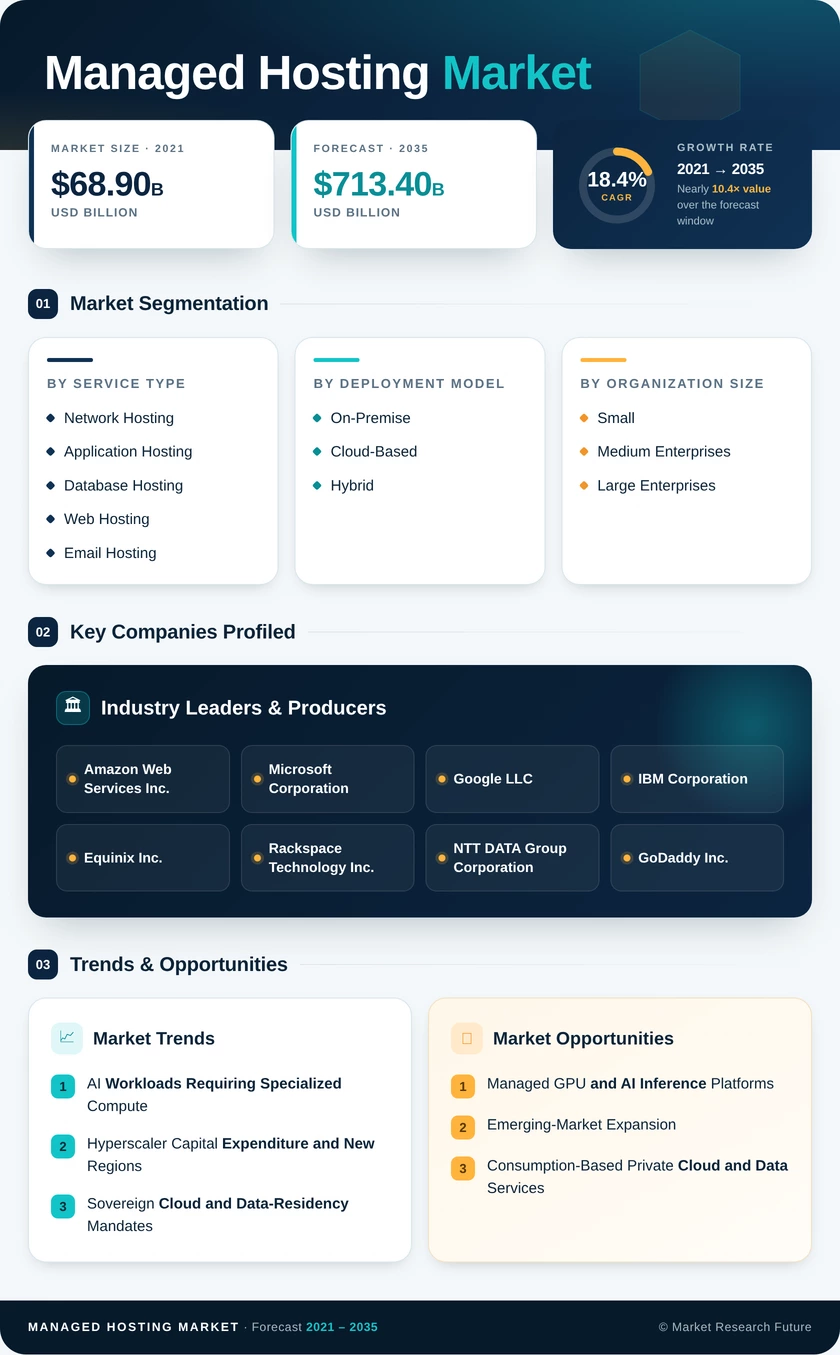
Managed Hosting Market
Market Size
Forecast Period2026-2035
CAGR (2026-2035)18.4%
2025 Market SizeUSD 130.3 Billion
2035 Market SizeUSD 713.4 Billion
Key Players
Amazon Web Services Inc.
Microsoft Corporation
Google LLC
IBM Corporation
Equinix Inc.
Rackspace Technology Inc.
Opportunities
  • Managed GPU and AI Inference Platforms
  • Emerging-Market Expansion
  • Consumption-Based Private Cloud and Data Services
  1. 1 Market Summary | |
  2. 2 Key Report Takeaways | |
    1. 2.1 By Service Type | |
    2. 2.2 By Deployment Model | |
    3. 2.3 By Organization Size | |
    4. 2.4 By Industry Vertical | |
    5. 2.5 By Region | |
  3. 3 Market Size and Forecast (2021–2035) | |
  4. 4 Driver Impact Analysis | |
    1. 4.1 AI Workloads Requiring Specialized Compute | |
    2. 4.2 Hyperscaler Capital Expenditure and New Regions | |
    3. 4.3 Sovereign Cloud and Data-Residency Mandates | |
    4. 4.4 Operational-Resilience and Cybersecurity Regulation | |
    5. 4.5 Infrastructure Talent Shortages | |
    6. 4.6 VMware Licensing Disruption | |
    7. 4.7 AI-Driven Cost Optimization | |
  5. 5 Restraints Impact Analysis | |
    1. 5.1 Power Constraints and Grid-Connection Delays | |
    2. 5.2 Vendor Lock-In and Egress Costs | |
    3. 5.3 Security Liability and Shared-Responsibility Gaps | |
    4. 5.4 Pricing Pressure from Self-Service Cloud | |
    5. 5.5 Capital Intensity of Liquid-Cooling Retrofits | |
  6. 6 Opportunities | |
    1. 6.1 Managed GPU and AI Inference Platforms | |
    2. 6.2 Emerging-Market Expansion | |
    3. 6.3 Consumption-Based Private Cloud and Data Services | |
    4. 6.4 Compliance-Ready Hosting for Healthcare | |
    5. 6.5 Managed Edge Infrastructure | |
  7. 7 Regional Market Share and Country-Level Analysis | |
    1. 7.1 North America | | |
      1. 7.1.1 US | | |
      2. 7.1.2 Canada | | |
      3. 7.1.3 Mexico | |
    2. 7.2 Europe | | |
      1. 7.2.1 Germany | | |
      2. 7.2.2 UK | | |
      3. 7.2.3 France | | |
      4. 7.2.4 Italy | | |
      5. 7.2.5 Spain | | |
      6. 7.2.6 Nordic Countries | | |
      7. 7.2.7 Russia | | |
      8. 7.2.8 Rest of Europe | |
    3. 7.3 Asia-Pacific | | |
      1. 7.3.1 China | | |
      2. 7.3.2 India | | |
      3. 7.3.3 Japan | | |
      4. 7.3.4 South Korea | | |
      5. 7.3.5 ASEAN | | |
      6. 7.3.6 Rest of Asia-Pacific | |
    4. 7.4 South America | | |
      1. 7.4.1 Brazil | | |
      2. 7.4.2 Argentina | | |
      3. 7.4.3 Rest of South America | |
    5. 7.5 Middle East & Africa | | |
      1. 7.5.1 Saudi Arabia | | |
      2. 7.5.2 UAE | | |
      3. 7.5.3 South Africa | | |
      4. 7.5.4 Egypt | | |
      5. 7.5.5 Rest of MEA | |
  8. 8 Future Outlook (2026–2035) | |
    1. 8.1 Autonomous Operations and AIOps | |
    2. 8.2 Power as a Competitive Asset | |
    3. 8.3 Distributed and Sovereign Architectures | |
    4. 8.4 Sustainability Reporting and Efficiency | |
  9. 9 Segmentation Analysis | |
    1. 9.1 By Service Type | | |
      1. 9.1.1 Network Hosting | | |
      2. 9.1.2 Application Hosting | | |
      3. 9.1.3 Database Hosting | | |
      4. 9.1.4 Web Hosting | | |
      5. 9.1.5 Email Hosting | | |
      6. 9.1.6 Other Service Types | |
    2. 9.2 By Deployment Model | | |
      1. 9.2.1 On-Premise | | |
      2. 9.2.2 Cloud-Based | | |
      3. 9.2.3 Hybrid | |
    3. 9.3 By Organization Size | | |
      1. 9.3.1 Small and Medium Enterprises | | |
      2. 9.3.2 Large Enterprises | |
    4. 9.4 By Industry Vertical | | |
      1. 9.4.1 IT and Telecom | | |
      2. 9.4.2 BFSI | | |
      3. 9.4.3 Healthcare | | |
      4. 9.4.4 Retail and eCommerce | | |
      5. 9.4.5 Manufacturing | | |
      6. 9.4.6 Government | | |
      7. 9.4.7 Education | | |
      8. 9.4.8 Other Industry Verticals | |
  10. 10 Competitive Landscape | |
  11. 11 Recent News & Developments | |
  12. 12 Report Scope and Methodology | |
  13. 13 Detailed Sources and Citations | |
  14. 14 Frequently Asked Questions (FAQs) | | LIST OF TABLES | |
  15. TABLE 1 Market Snapshot, 2025–2035 | |
  16. TABLE 2 Global Market Size and Forecast, by Revenue (USD Billion), 2021–2035 | |
  17. TABLE 3 Driver Impact Analysis, 2026–2035 | |
  18. TABLE 4 Restraints Impact Analysis, 2026–2035 | |
  19. TABLE 5 Regional Summary, 2025 | |
  20. TABLE 6 North America Country-Level Analysis | |
  21. TABLE 7 Europe Country-Level Analysis | |
  22. TABLE 8 Asia-Pacific Country-Level Analysis | |
  23. TABLE 9 South America Country-Level Analysis | |
  24. TABLE 10 Middle East & Africa Country-Level Analysis | |
  25. TABLE 11 Global Market, by Service Type | |
  26. TABLE 12 Global Market, by Deployment Model | |
  27. TABLE 13 Global Market, by Organization Size | |
  28. TABLE 14 Global Market, by Industry Vertical | |
  29. TABLE 15 Competitive Benchmarking Matrix | |
  30. TABLE 16 Report Scope and Methodology | |
  31. TABLE 17 Detailed Sources and Citations | |
  32. TABLE 18 Segmentation Quick Reference | | LIST OF FIGURES | |
  33. FIGURE 1 Market Dynamics Overview (Drivers, Restraints, Opportunities) | |
  34. FIGURE 2 Industry Value Chain Analysis | |
  35. FIGURE 3 Porter's Five Forces Analysis | |
  36. FIGURE 4 Global Market Size Trend, 2021–2035 (USD Billion) | |
  37. FIGURE 5 Market Share by Service Type, 2025 | |
  38. FIGURE 6 Market Share by Deployment Model, 2025 | |
  39. FIGURE 7 Market Share by Organization Size, 2025 | |
  40. FIGURE 8 Market Share by Industry Vertical, 2025 | |
  41. FIGURE 9 Regional Market Share, 2025 | |
  42. FIGURE 10 Competitive Landscape — Estimated Revenue Share Ranges, 2025 | |
  43. FIGURE 11 Competitive Positioning Matrix

Segmentation Quick Reference

Dimension Sub-Segments Dominant Segment Fastest Growing Segment
By Service Type Network Hosting, Application Hosting, Database Hosting, Web Hosting, Email Hosting, Other Service Types Web Hosting (29.2% share) Database Hosting (19.0% CAGR)
By Deployment Model On-Premise, Cloud-Based, Hybrid On-Premise (41.8% share) Hybrid (18.9% CAGR)
By Organization Size Small and Medium Enterprises, Large Enterprises Large Enterprises (59.7% share) Small and Medium Enterprises (18.8% CAGR)
By Industry Vertical IT and Telecom, BFSI, Healthcare, Retail and eCommerce, Manufacturing, Government, Education, Other Industry Verticals BFSI (21.5% share) Healthcare (18.9% CAGR)
By Region North America, Europe, Asia-Pacific, South America, Middle East & Africa North America (37.9% share) Asia-Pacific (19.1% CAGR)


Market Segmentation Overview

By Service Type

Sub-Segment Key Trend
Network Hosting Secure interconnects and VPNs linking hybrid estates
Application Hosting Containerized microservices on managed Kubernetes
Database Hosting Vector engines and tuned relational databases for AI retrieval
Web Hosting Bundled SME site packages with security and backups
Email Hosting Migration from on-premises servers to collaboration suites
Other Service Types Backup, disaster recovery and gaming server workloads


Web Hosting leads on volume because millions of SME and content sites depend on bundled, low-touch packages. Database Hosting grows fastest as AI retrieval and analytics require tuned vector and relational engines that internal teams struggle to optimize. Application Hosting follows closely as development teams standardize on containers, while Email Hosting steadily loses on-premises share to subscription suites.

By Deployment Model

Sub-Segment Key Trend
On-Premise Provider-operated infrastructure inside customer or colocation facilities
Cloud-Based Elastic capacity for digitally native firms
Hybrid Unified control planes spanning local and public environments


On-Premise models keep the largest share because compliance rules and sunk hardware investment keep sensitive systems inside controlled facilities. Hybrid grows fastest as enterprises retain regulated data locally while bursting AI training and seasonal peaks to Cloud-Based regions. The competitive edge goes to providers whose orchestration, identity and monitoring work identically across all three models.

By Organization Size

Sub-Segment Key Trend
Small and Medium Enterprises Fixed-fee tiers with enterprise-grade SLAs
Large Enterprises Multi-region contracts bundled with security operations


Large Enterprises dominate revenue through complex, multi-year contracts that combine hosting with compliance reporting and security monitoring. Small and Medium Enterprises grow faster because tiered, predictable pricing now gives them backup, latency guarantees and security they could not staff internally. This narrowing capability gap is widening the provider customer base well beyond traditional corporate buyers.

By Industry Vertical

Sub-Segment Key Trend
IT and Telecom OSS/BSS modernization ahead of 5G monetization
BFSI DORA-driven resilience and real-time trading platforms
Healthcare Compliant hosting for records and AI diagnostics
Retail and eCommerce Auto-scaling storefronts for seasonal peaks
Manufacturing Edge nodes for predictive maintenance
Government Sovereign cloud adoption under residency statutes
Education Virtual desktops for hybrid learning
Other Industry Verticals Media streaming, energy and logistics workloads


BFSI holds the top position because trading, payments and operational-resilience rules such as DORA demand audited uptime and security. Healthcare grows fastest as hospitals move electronic records and AI diagnostics onto compliant hosted platforms ahead of tighter HIPAA security requirements. Government adoption also accelerates under sovereignty statutes, while Education remains constrained by budget limits despite steady virtual-desktop demand.


Download PDF ×

We do not share your information with anyone. However, we may send you emails based on your report interest from time to time. You may contact us at any time to opt-out.