Malaysia Freight Logistics Market (2026 - 2035)

ID: MRFR/PCM/19768-HCR
128 Pages
Snehal Singh
Last Updated: July 15, 2026
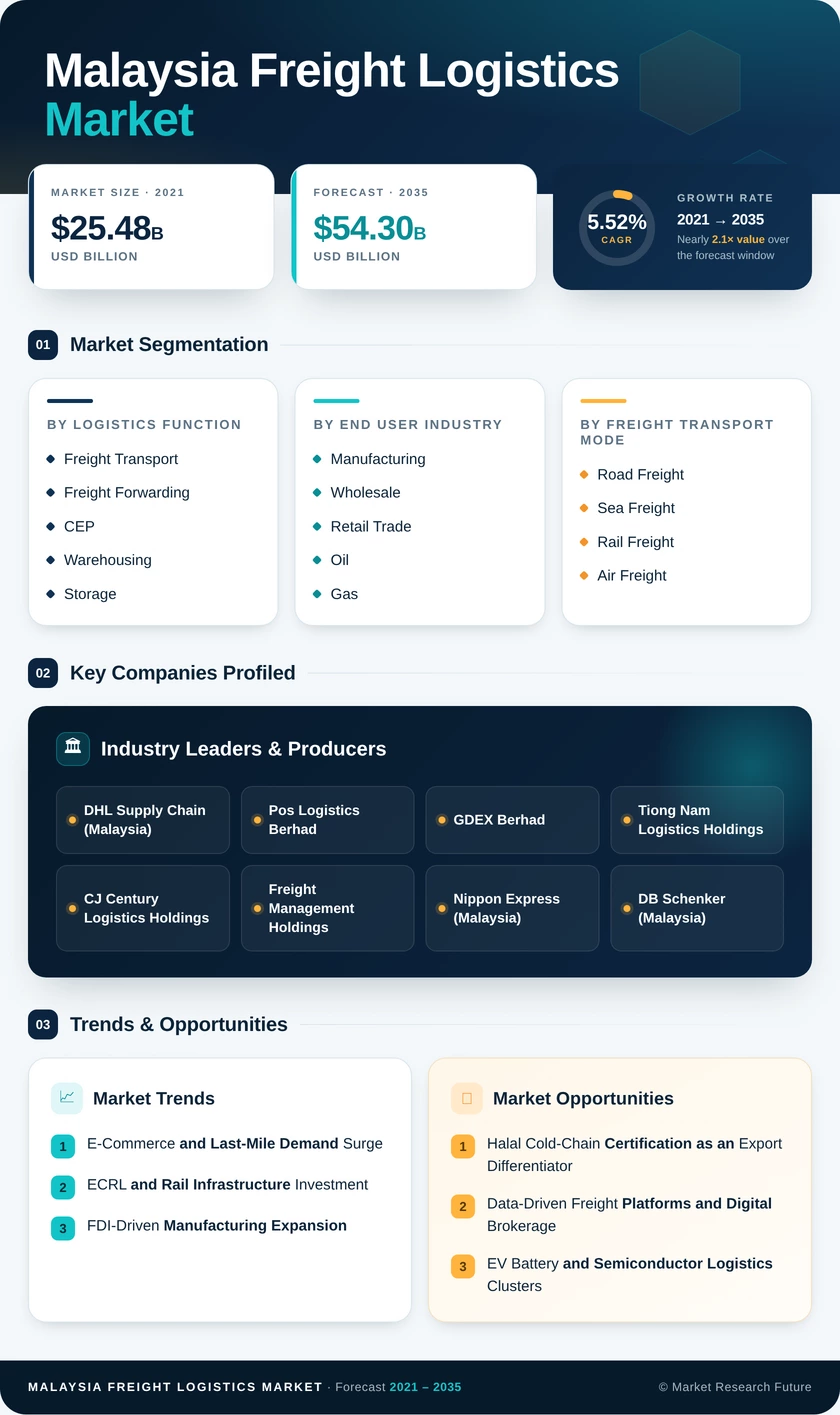
Malaysia Freight Logistics Market Research Report Information By Logistics Function (Freight Transport, Freight Forwarding, Courier, Express, and Parcel (CEP), Warehousing and Storage, and Other Services), By End User Industry (Manufacturing, Wholesale and Retail Trade, Oil and Gas, Mining and Quarrying, Construction, Agriculture, Fishing, and Forestry, and Others), By Freight Transport Mode (Road Freight, Sea Freight, Rail Freight, and Air Freight) – Forecast Till 2035
Malaysia Freight Logistics Market
Market Size
Forecast Period2026-2035
CAGR (2026-2035)5.52%
2025 Market SizeUSD 31.74 Billion
2035 Market SizeUSD 54.30 Billion
Key Players
DHL Supply Chain
Pos Logistics Berhad
GDEX Berhad
Tiong Nam Logistics Holdings
CJ Century Logistics Holdings
Freight Management Holdings
Opportunities
  • Halal Cold-Chain Certification as an Export Differentiator
  • Data-Driven Freight Platforms and Digital Brokerage
  • EV Battery and Semiconductor Logistics Clusters
  1. 1 Market Overview |
    1. 1.1 Study Assumptions & Market Definition |
    2. 1.2 Scope of the Study |
    3. 1.3 Research Methodology
  2. 2 Market Summary & Key Takeaways
  3. 3 Market Dynamics |
    1. 3.1 Market Drivers Analysis | |
      1. 3.1.1 E-Commerce and Last-Mile Demand Surge | |
      2. 3.1.2 ECRL and Rail Infrastructure Investment | |
      3. 3.1.3 FDI-Driven Manufacturing Expansion | |
      4. 3.1.4 RCEP and CPTPP Tariff Liberalization | |
      5. 3.1.5 Cold-Chain and Temperature-Controlled Expansion | |
      6. 3.1.6 Digital Customs and NSW Platform Rollout | |
      7. 3.1.7 Johor–Singapore Special Economic Zone |
    2. 3.2 Market Restraints Analysis | |
      1. 3.2.1 Chronic Driver Shortages and Labor Gaps | |
      2. 3.2.2 Highway Infrastructure Bottlenecks | |
      3. 3.2.3 Fuel Price Volatility and Subsidy Uncertainty | |
      4. 3.2.4 Regulatory Fragmentation Across States | |
      5. 3.2.5 Cybersecurity Risks in Digital Freight Platforms |
    3. 3.3 Market Opportunity Analysis | |
      1. 3.3.1 Halal Cold-Chain Certification as an Export Differentiator | |
      2. 3.3.2 Data-Driven Freight Platforms and Digital Brokerage | |
      3. 3.3.3 EV Battery and Semiconductor Logistics Clusters | |
      4. 3.3.4 East Malaysia Cross-Border Trade | |
      5. 3.3.5 Sustainability-Linked Logistics Contracts |
    4. 3.4 Industry Value Chain Analysis |
    5. 3.5 Porter's Five Forces Analysis
  4. 4 Malaysia Freight Logistics Market Size & Forecast (2021–2035) |
    1. 4.1 Historical Market Size (2021–2025) |
    2. 4.2 Current & Forecast Market Size (2026–2035) |
    3. 4.3 Market Size by Revenue (USD Billion) |
    4. 4.4 Year-over-Year Growth Analysis
  5. 5 Segmentation Analysis |
    1. 5.1 By Logistics Function | |
      1. 5.1.1 Freight Transport | |
      2. 5.1.2 Freight Forwarding | |
      3. 5.1.3 Courier, Express, and Parcel (CEP) | |
      4. 5.1.4 Warehousing and Storage | |
      5. 5.1.5 Other Services |
    2. 5.2 By End User Industry | |
      1. 5.2.1 Manufacturing | |
      2. 5.2.2 Wholesale and Retail Trade | |
      3. 5.2.3 Oil and Gas, Mining and Quarrying | |
      4. 5.2.4 Construction | |
      5. 5.2.5 Agriculture, Fishing, and Forestry | |
      6. 5.2.6 Others |
    3. 5.3 By Freight Transport Mode | |
      1. 5.3.1 Road Freight | |
      2. 5.3.2 Sea Freight | |
      3. 5.3.3 Rail Freight | |
      4. 5.3.4 Air Freight |
    4. 5.4 By Freight Forwarding Type | |
      1. 5.4.1 Sea and Inland Waterways Freight Forwarding | |
      2. 5.4.2 Air Freight Forwarding |
    5. 5.5 By CEP Type | |
      1. 5.5.1 Domestic Deliveries | |
      2. 5.5.2 International CEP |
    6. 5.6 By Warehousing and Storage Type | |
      1. 5.6.1 Non-Temperature Controlled | |
      2. 5.6.2 Temperature Controlled
  6. 6 Regional / Economic Corridor Analysis |
    1. 6.1 Central Region (Selangor, Kuala Lumpur, Putrajaya) |
    2. 6.2 Southern Region (Johor, Melaka, Negeri Sembilan) |
    3. 6.3 Northern Region (Penang, Perak, Kedah, Perlis) |
    4. 6.4 East Coast Region (Pahang, Terengganu, Kelantan) |
    5. 6.5 East Malaysia (Sabah, Sarawak, Labuan)
  7. 7 Competitive Landscape |
    1. 7.1 Market Share Analysis (2025) |
    2. 7.2 Competitive Benchmarking Matrix |
    3. 7.3 Company Profiles | |
      1. 7.3.1 DHL Supply Chain (Malaysia) | |
      2. 7.3.2 Pos Logistics Berhad | |
      3. 7.3.3 GDEX Berhad | |
      4. 7.3.4 Tiong Nam Logistics Holdings | |
      5. 7.3.5 CJ Century Logistics Holdings | |
      6. 7.3.6 Freight Management Holdings | |
      7. 7.3.7 Nippon Express (Malaysia) | |
      8. 7.3.8 DB Schenker (Malaysia) | |
      9. 7.3.9 Kuehne + Nagel (Malaysia) | |
      10. 7.3.10 Kerry Logistics (Malaysia)
  8. 8 Future Outlook & Strategic Recommendations (2026–2035) |
    1. 8.1 Autonomous and AI-Enabled Fleet Operations |
    2. 8.2 Electrification of Last-Mile and Port Drayage Fleets |
    3. 8.3 Platform Economics and Logistics-as-a-Service |
    4. 8.4 ESG Reporting and Green Freight Certification
  9. 9 Recent Developments & News
  10. 10 Frequently Asked Questions (FAQs)
  11. 11 Report Scope & Methodology |
    1. 11.1 Study Period & Base Year |
    2. 11.2 Data Sources & Citations |
    3. 11.3 Abbreviations
  12. 12 LIST OF TABLES |
  13. TABLE 1 Malaysia Freight Logistics Market Size & Forecast, by Revenue (USD Billion), 2021–2035 |
  14. TABLE 2 Malaysia Freight Logistics Market – Year-over-Year Growth Analysis, 2021–2035 |
  15. TABLE 3 Malaysia Freight Logistics Market – Driver Impact Analysis |
  16. TABLE 4 Malaysia Freight Logistics Market – Restraint Impact Analysis |
  17. TABLE 5 Malaysia Freight Logistics Market Size, by Logistics Function, 2021–2035 |
  18. TABLE 6 Malaysia Freight Logistics Market Size, by End User Industry, 2021–2035 |
  19. TABLE 7 Malaysia Freight Logistics Market Size, by Freight Transport Mode, 2021–2035 |
  20. TABLE 8 Malaysia Freight Logistics Market Size, by Freight Forwarding Type, 2021–2035 |
  21. TABLE 9 Malaysia Freight Logistics Market Size, by CEP Type, 2021–2035 |
  22. TABLE 10 Malaysia Freight Logistics Market Size, by Warehousing and Storage Type, 2021–2035 |
  23. TABLE 11 Malaysia Freight Logistics Market Size, by Economic Region, 2021–2035 (USD Billion) |
  24. TABLE 12 Central Region Market Size, by Sub-Region, 2021–2035 (USD Billion) |
  25. TABLE 13 Southern Region Market Size, by Sub-Region, 2021–2035 (USD Billion) |
  26. TABLE 14 Northern Region Market Size, by Sub-Region, 2021–2035 (USD Billion) |
  27. TABLE 15 East Coast Region Market Size, by Sub-Region, 2021–2035 (USD Billion) |
  28. TABLE 16 East Malaysia Market Size, by Sub-Region, 2021–2035 (USD Billion) |
  29. TABLE 17 Competitive Benchmarking Matrix – Malaysia Freight Logistics Market, 2025 |
  30. TABLE 18 Company Profiles – Key Players, Malaysia Freight Logistics Market |
  31. TABLE 19 Recent Developments & Strategic Announcements, 2023–2025 |
  32. TABLE 20 Report Scope and Methodology Summary |
  33. TABLE 21 Detailed Sources and Citations
  34. 13 LIST OF FIGURES |
  35. FIGURE 1 Malaysia Freight Logistics Market Dynamics — Drivers, Restraints, and Opportunities |
  36. FIGURE 2 Industry Value Chain Analysis — Malaysia Freight Logistics Market |
  37. FIGURE 3 Porter's Five Forces Analysis — Malaysia Freight Logistics Market |
  38. FIGURE 4 Malaysia Freight Logistics Market Size Trend (USD Billion), 2021–2035 |
  39. FIGURE 5 Malaysia Freight Logistics Market Share, by Logistics Function, 2025 |
  40. FIGURE 6 Malaysia Freight Logistics Market Share, by End User Industry, 2025 |
  41. FIGURE 7 Malaysia Freight Logistics Market Share, by Freight Transport Mode, 2025 |
  42. FIGURE 8 Malaysia Freight Logistics Market Share, by CEP Type, 2025 |
  43. FIGURE 9 Malaysia Freight Logistics Market Share, by Economic Region, 2025 |
  44. FIGURE 10 Competitive Landscape — Market Share Analysis, 2025

Segmentation Quick Reference

DimensionSub-SegmentsDominant SegmentFastest Growing Segment
By Logistics FunctionFreight Transport; Freight Forwarding; CEP; Warehousing and Storage; Other ServicesFreight TransportCEP
By End User IndustryManufacturing; Wholesale and Retail Trade; Oil and Gas, Mining and Quarrying; Construction; Agriculture, Fishing, and Forestry; OthersManufacturingWholesale and Retail Trade
By Freight Transport ModeRoad Freight; Sea Freight; Rail Freight; Air FreightRoad FreightAir Freight
By Freight Forwarding TypeSea and Inland Waterways; Air Freight ForwardingSea and Inland WaterwaysAir Freight Forwarding
By CEP TypeDomestic Deliveries; International CEPDomestic DeliveriesInternational CEP
By Warehousing and Storage TypeNon-Temperature Controlled; Temperature ControlledNon-Temperature ControlledTemperature Controlled


Market Segmentation Overview

By Logistics Function

Sub-SegmentKey Trend
Freight TransportRoad and sea mode expansion driven by Port Klang volumes and expressway network
Freight ForwardingRCEP-driven cross-border facilitation and digital documentation adoption
Courier, Express, and Parcel (CEP)E-commerce-fueled parcel explosion with automated sortation scaling
Warehousing and StorageCold-chain investments and bonded zone development near port gateways
Other ServicesCustoms brokerage digitization and cargo insurance bundling


Freight transport continues to dominate the Malaysia Freight Logistics Market by function, while CEP services are closing the gap rapidly as parcel volumes outpace traditional cargo growth rates.

By End User Industry

Sub-SegmentKey Trend
ManufacturingSemiconductor and automotive JIT supply chains driving premium freight demand
Wholesale and Retail TradeModern trade and quick-commerce reshaping distribution networks
Oil and Gas, Mining and QuarryingUpstream extraction volumes and LNG terminal logistics
ConstructionMega-infrastructure projects generating heavy-haul demand
Agriculture, Fishing, and ForestryPalm oil and rubber export logistics with emerging traceability mandates
OthersGovernment procurement and defense materiel movement


Manufacturing's role as the largest end user reflects Malaysia's mature industrial base, while wholesale and retail trade is accelerating as consumer delivery expectations compress fulfillment timelines.

By Freight Transport Mode

Sub-SegmentKey Trend
Road FreightExpressway-linked haulage across Peninsular Malaysia
Sea FreightContainer and bulk volumes through Port Klang and Tanjung Pelepas
Rail FreightECRL completion expected to transform east–west cargo routing
Air FreightHigh-value electronics and pharmaceutical airfreight growth


Road freight's entrenched share reflects the flexibility and cost-effectiveness of trucking across Malaysia's well-developed highway system, while air freight is accelerating at the fastest rate driven by time-sensitive semiconductor shipments.

By Freight Forwarding Type

Sub-SegmentKey Trend
Sea and Inland Waterways Freight ForwardingDominant mode leveraging Malaysia's extensive coastal port network
Air Freight ForwardingGrowing demand for expedited shipments in electronics and pharma sectors


Sea and inland waterways forwarding commands the majority of revenue given Malaysia's strategic position on the Strait of Malacca, one of the world's busiest shipping lanes.

By CEP Type

Sub-SegmentKey Trend
Domestic DeliveriesE-commerce volume surge and smart locker network densification
International CEPSME cross-border export growth under RCEP preferential access


Domestic deliveries dominate by volume, though international CEP is growing faster as small and medium enterprises increasingly leverage digital platforms for direct cross-border sales.

By Warehousing and Storage Type

Sub-SegmentKey Trend
Non-Temperature ControlledGeneral merchandise and industrial goods storage
Temperature ControlledHalal food, pharmaceutical, and fresh produce cold-chain expansion


Non-temperature controlled space leads by capacity, while temperature-controlled facilities are the fastest-growing sub-segment as halal export certification and pharmaceutical distribution expand.


 

Download PDF ×

We do not share your information with anyone. However, we may send you emails based on your report interest from time to time. You may contact us at any time to opt-out.