×
Request Free Sample ×

Kindly complete the form below to receive a free sample of this Report

* Please use a valid business email

Leading companies partner with us for data-driven Insights

clients tt-cursor
Hero Background
English
Chinese
French
Japanese
Korean
German
Spanish

Magnetic Resonance Imaging Systems Market Share

ID: MRFR/MED/4735-HCR
110 Pages
Rahul Gotadki
October 2025

Magnetic Resonance Imaging (MRI) Systems Market Research Report: Size, Share, Trend Analysis By Technology (Closed MRI Systems, Open MRI Systems, Functional MRI Systems, High-Field MRI Systems), By Applications (Oncology, Neurology, Cardiology, Musculoskeletal Imaging, Gastrointestinal Imaging), By End Use (Hospitals, Diagnostic Imaging Centers, Research Institutes, Ambulatory Surgical Centers), By Field Strength (Low-Field MRI Systems, Mid-Field MRI Systems, High-Field MRI Systems) and By Regional (North America, Europe, South America, Asia Pacific, Middle East and Africa) - Growth Outlook & Industry Forecast 2025 To 2035

Share:
Download PDF ×

We do not share your information with anyone. However, we may send you emails based on your report interest from time to time. You may contact us at any time to opt-out.

Magnetic Resonance Imaging Systems Market Infographic
Purchase Options

Market Share

Magnetic Resonance Imaging Systems Market Share Analysis

The market for magnetic resonance imaging systems frameworks is a fundamental part of clinical diagnostics and is portrayed by its imperativeness and intensity. In quest for supported market predominance, organizations working in this industry reliably endeavor to execute strong systems because of mechanical progressions. Fathoming Piece of the pie Situating: The idea of piece of the pie situating relates to the assessment of a company's deals income comparable to the total deals income of all organizations working in the magnetic resonance imaging systems market. It shows the strength and intensity of a business compared with its opponents. Item Separation: Item separation is a basic procedure for laying out a piece of the pie position. Creating and presenting novel qualities and innovations that recognize their magnetic resonance imaging systems from those of contenders is a main concern for organizations. This might envelop upgraded imaging abilities, further develop programming functionalities, and expand patient comfort. Cost authority is an extra basic methodology that should be sought after. By endeavoring to produce magnetic resonance imaging systems of predominant quality while decreasing costs, organizations can offer cutthroat evaluating. Subsequently, cost-cognizant medical services establishments and suppliers are drawn in, prompting an extension of piece of the pie. Worldwide Development and Market Entrance: to achieve a bigger portion of the overall industry, organizations much of the time focus on extending their market reach. This involves entering neglected market sections or infiltrating new geographic areas. By understanding the fluctuating requests of various business sectors, associations can tweak their attractive magnetic resonance imaging systems frameworks to satisfy explicit measures, consequently interesting to a greater customer base. Shaping key collusions and coordinated efforts addresses a determined move pointed toward increasing one's market presence. The advancement of cutting-edge magnetic resonance imaging systems frameworks might be achieved through associations with research foundations, medical services suppliers, or innovation organizations. Also, joint endeavors work with the sharing of assets and the extension of market section. Client Relationship The board: For a business to keep up with and grow its piece of the pie, creating strong associations with its customers is fundamental. To ensure shopper fulfillment, organizations put resources into client assistance, preparing projects, and administration arrangements. Consumer loyalty has a positive relationship with magnetic resonance imaging systems dependability and informal, the two of which decidedly affect piece of the pie. Guaranteeing Administrative Consistence and Quality Confirmation: Keeping up with a portion of the overall industry situating is dependent upon the adherence to rigid administrative guidelines and the affirmation of predominant item quality. By putting resources into accreditations and rigid quality affirmation systems, organizations console clients and medical care administrative bodies. This advances validity and trust, which are basic for supporting the development of portion of the overall industry. The advanced methodology includes the incorporation of modern information investigation and man-made brainpower (computer-based intelligence) innovations into magnetic resonance imaging systems frameworks. Associations that distribute assets towards the advancement of man-made intelligence fueled imaging and analytic functionalities lay down a good foundation for themselves as leaders in conveying creative arrangements, subsequently interesting to customer base looking for cutting edge innovation.


Author
Rahul Gotadki
Assistant Manager

He holds an experience of about 7+ years in Market Research and Business Consulting, working under the spectrum of Life Sciences and Healthcare domains. Rahul conceptualizes and implements a scalable business strategy and provides strategic leadership to the clients. His expertise lies in market estimation, competitive intelligence, pipeline analysis, customer assessment, etc. In addition to the above, his other responsibility includes strategic tracking of high growth markets & advising clients on the potential areas of focus they could direct their business initiatives

Leave a Comment

FAQs

What is the expected market size of the Global Magnetic Resonance Imaging (MRI) Systems Market in 2024?

The market size is expected to be valued at 7.45 billion USD in 2024.

What will be the market size of the Global Magnetic Resonance Imaging (MRI) Systems Market by 2035?

By 2035, the market size is anticipated to reach 12.0 billion USD.

What is the expected CAGR for the Global Magnetic Resonance Imaging (MRI) Systems Market from 2025 to 2035?

The market is expected to grow at a CAGR of 4.43% from 2025 to 2035.

Which region holds the largest market share in the Global Magnetic Resonance Imaging (MRI) Systems Market in 2024?

North America is projected to hold the largest market share with a valuation of 3.0 billion USD in 2024.

What is the market value for Closed MRI Systems in 2024?

The market value for Closed MRI Systems is anticipated to be 3.0 billion USD in 2024.

What are the expected growth values for Open MRI Systems by 2035?

The market for Open MRI Systems is expected to grow to 2.5 billion USD by 2035.

What are the anticipated market numbers for Functional MRI Systems in 2024 and 2035?

Functional MRI Systems are valued at 1.25 billion USD in 2024, expected to reach 2.0 billion USD by 2035.

Who are the key players in the Global Magnetic Resonance Imaging (MRI) Systems Market?

Major players include GE Healthcare, Siemens Healthineers, Philips Healthcare, and Fujifilm Holdings Corporation among others.

What is the expected market size for MRI Systems in the APAC region in 2024?

The APAC region is expected to have a market size of 1.8 billion USD in 2024.

What is the market outlook for the MEA region's MRI Systems by 2035?

The MEA region is expected to see a market value of 0.5 billion USD by 2035.

Market Summary

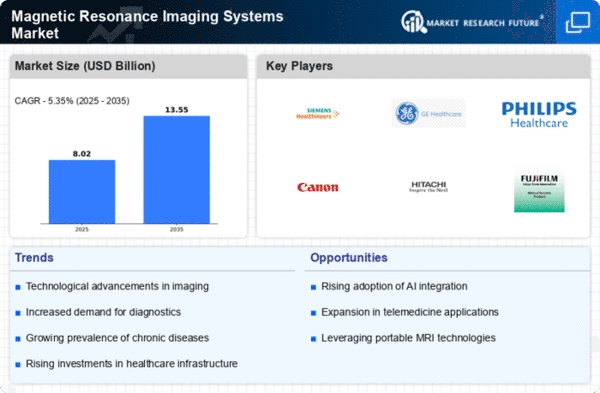
As per MRFR analysis, the Magnetic Resonance Imaging Systems Market Size was estimated at 7.61 USD Billion in 2024. The Magnetic Resonance Imaging Systems industry is projected to grow from 8.1 in 2025 to 13.55 by 2035, exhibiting a compound annual growth rate (CAGR) of 5.35 during the forecast period 2025 - 2035.

Key Market Trends & Highlights

The Magnetic Resonance Imaging Systems Market is poised for substantial growth driven by technological advancements and increasing healthcare demands.

  • Technological advancements in MRI systems are enhancing imaging quality and diagnostic capabilities.
  • The market is witnessing a shift towards portable MRI solutions, catering to diverse healthcare settings.
  • Cost-effectiveness is becoming a focal point as healthcare providers seek to optimize expenditures while maintaining quality care.
  • The increasing prevalence of chronic diseases and the rising demand for early diagnosis are key drivers propelling market expansion, particularly in North America and the Asia-Pacific region.

Market Size & Forecast

2024 Market Size 7.61 (USD Billion)
2035 Market Size 13.55 (USD Billion)
CAGR (2025 - 2035) 5.35%
Largest Regional Market Share in 2024 North America

Major Players

Siemens Healthineers (DE), GE Healthcare (US), Philips Healthcare (NL), Canon Medical Systems (JP), Hitachi Medical Systems (JP), Fujifilm Medical Systems (JP), Bruker Corporation (US), Esaote S.p.A. (IT), Mindray Medical International Limited (CN)

Market Trends

The Magnetic Resonance Imaging Systems Market is currently experiencing a transformative phase, characterized by advancements in technology and increasing demand for non-invasive diagnostic tools. The integration of artificial intelligence and machine learning into imaging systems is enhancing the accuracy and efficiency of diagnoses, thereby improving patient outcomes. Furthermore, the growing prevalence of chronic diseases necessitates the adoption of advanced imaging modalities, as healthcare providers seek to offer precise and timely interventions. This trend is further supported by an expanding geriatric population, which is more susceptible to conditions requiring detailed imaging assessments. In addition to technological innovations, the Magnetic Resonance Imaging Systems Market is witnessing a shift towards portable and compact imaging solutions. These systems are designed to facilitate accessibility in various healthcare settings, including remote and underserved areas. The emphasis on cost-effective solutions is also driving the development of budget-friendly MRI systems, which could potentially democratize access to high-quality imaging services. As the market evolves, stakeholders must remain vigilant to emerging trends and adapt their strategies accordingly to maintain competitiveness in this dynamic landscape.

Technological Advancements

The integration of cutting-edge technologies, such as artificial intelligence and machine learning, is revolutionizing the Magnetic Resonance Imaging Systems Market. These innovations enhance diagnostic accuracy and operational efficiency, leading to improved patient care.

Shift Towards Portable Solutions

There is a noticeable trend towards the development of portable Magnetic Resonance Imaging Systems. These compact devices aim to increase accessibility in diverse healthcare environments, particularly in remote or underserved regions.

Focus on Cost-Effectiveness

The market is increasingly prioritizing cost-effective MRI solutions. This focus on affordability may facilitate broader access to advanced imaging technologies, enabling more healthcare facilities to offer high-quality diagnostic services.

Magnetic Resonance Imaging Systems Market Market Drivers

Market Growth Projections

The Global Magnetic Resonance Imaging (MRI) Systems Market Industry is projected to experience substantial growth over the coming years. The market is expected to reach a valuation of 12 USD Billion by 2035, driven by various factors including technological advancements, rising healthcare expenditure, and an increasing geriatric population. The compound annual growth rate (CAGR) is anticipated to be 4.43% from 2025 to 2035, indicating a robust demand for MRI systems. This growth trajectory suggests a favorable environment for manufacturers and healthcare providers alike, as they adapt to evolving market dynamics and consumer needs.

Growing Geriatric Population

The Global Magnetic Resonance Imaging (MRI) Systems Market Industry is also driven by the growing geriatric population, which is more susceptible to various health conditions requiring advanced imaging techniques. As the global population ages, the demand for MRI systems is likely to rise, as older adults often require more frequent diagnostic imaging. This demographic shift is expected to propel the market forward, with a projected compound annual growth rate (CAGR) of 4.43% from 2025 to 2035. Healthcare facilities are adapting to this trend by upgrading their imaging equipment to meet the needs of an aging population.

Increased Healthcare Expenditure

The Global Magnetic Resonance Imaging (MRI) Systems Market Industry is benefiting from increased healthcare expenditure across various regions. Governments and private sectors are investing more in healthcare infrastructure, which includes the acquisition of advanced imaging technologies. This trend is particularly evident in emerging economies, where healthcare reforms are leading to enhanced access to diagnostic services. As a result, the demand for MRI systems is expected to grow, contributing to a market valuation of 12 USD Billion by 2035. Enhanced funding for healthcare initiatives is likely to facilitate the adoption of MRI technology in hospitals and clinics.

Rising Awareness of Early Diagnosis

The Global Magnetic Resonance Imaging (MRI) Systems Market Industry is witnessing growth due to rising awareness of the importance of early diagnosis in improving health outcomes. Patients and healthcare providers are increasingly recognizing the value of MRI in detecting diseases at earlier stages, which can lead to more effective treatment options. This heightened awareness is driving demand for MRI systems, as healthcare facilities strive to offer comprehensive diagnostic services. With the market projected to reach 7.45 USD Billion in 2024, the emphasis on early diagnosis is likely to play a crucial role in shaping the future of MRI technology.

Rising Prevalence of Chronic Diseases

The Global Magnetic Resonance Imaging (MRI) Systems Market Industry is significantly influenced by the rising prevalence of chronic diseases such as cancer, neurological disorders, and cardiovascular diseases. As these conditions become more common, the demand for advanced diagnostic imaging solutions increases. MRI is particularly valued for its non-invasive nature and ability to provide detailed images of soft tissues. This trend is expected to contribute to the market's growth, with projections indicating a market value of 12 USD Billion by 2035. Healthcare providers are increasingly investing in MRI technology to enhance diagnostic capabilities and improve patient care.

Technological Advancements in MRI Systems

The Global Magnetic Resonance Imaging (MRI) Systems Market Industry is experiencing rapid technological advancements, which are enhancing imaging capabilities and patient outcomes. Innovations such as functional MRI and high-field MRI systems are becoming increasingly prevalent. These advancements allow for improved diagnostic accuracy and faster imaging times, which are critical in clinical settings. As of 2024, the market is valued at approximately 7.45 USD Billion, reflecting the growing demand for advanced imaging technologies. The integration of artificial intelligence in MRI systems is also anticipated to streamline workflows and reduce operational costs, further driving market growth.

Market Segment Insights

By Application: Diagnostic Imaging (Largest) vs. Functional Imaging (Fastest-Growing)

The Magnetic Resonance Imaging Systems Market is predominantly driven by the diagnostic imaging segment, which leads with the largest market share due to its widespread application in clinical practice. Diagnostic imaging is fundamental for disease detection and monitoring, positioning itself as the backbone of MRI usage in hospitals and diagnostic centers. Functional imaging, on the other hand, is emerging as the fastest-growing segment, leveraging advancements in technology to offer more detailed insights into physiological functions, further expanding its adoption in research and clinical settings.

Functional Imaging (Dominant) vs. Cardiac Imaging (Emerging)

Functional imaging holds a significant position in the Magnetic Resonance Imaging Systems Market as it enables the visualization of dynamic processes in the body, such as blood flow and neural activity. This segment leverages cutting-edge technologies to provide critical insights for conditions such as epilepsy and brain tumors, making it a vital tool in neurology. In contrast, cardiac imaging is recognized as an emerging segment, focusing on the assessment of heart conditions and aiding in the diagnosis of cardiovascular diseases. While it is not as established as functional imaging, ongoing innovations in imaging technology and increasing prevalence of heart-related ailments are driving its growth, suggesting a promising future.

By End Use: Hospitals (Largest) vs. Diagnostic Imaging Centers (Fastest-Growing)

In the Magnetic Resonance Imaging Systems Market, hospitals dominate the landscape, accounting for a substantial share of the end-use segment. This is primarily due to their comprehensive array of services, combining both diagnostics and treatment options. As centers offering significant patient volumes, hospitals continue to invest in advanced MRI systems to enhance their capabilities and patient care. In contrast, diagnostic imaging centers are emerging strongly in the market, capitalizing on the trend towards specialized diagnostics and outpatient services. As healthcare systems focus on efficiency and patient-centered care, these centers are positioned for significant growth, driven by technology advancements and increased demand for imaging services. The growth trends in this segment are largely influenced by technological innovations, the increasing prevalence of chronic diseases, and an aging population requiring additional diagnostic services. Diagnostic imaging centers are benefiting from the shift towards outpatient care, making them agile and more attractive to patients seeking faster and more specialized services. Moreover, advancements in MRI technology are creating new opportunities for rapid diagnosis, significantly enhancing operational efficiency. In addition, the growing collaboration between hospitals and imaging centers is facilitating a broader reach for MRIs, contributing to the market's expansion overall.

Hospitals (Dominant) vs. Research Institutions (Emerging)

Hospitals are by far the dominant players in the Magnetic Resonance Imaging Systems Market due to their extensive investments in healthcare infrastructure and technology. They provide comprehensive medical services and are equipped to handle complex diagnostic needs. With established protocols and a broad patient base, hospitals are leveraging state-of-the-art MRI systems to deliver accurate diagnoses and improve patient outcomes. On the other hand, research institutions are seen as emerging players in this landscape. They contribute significantly to the advancement of MRI technology and its applications in clinical research. While they may not operate at the same scale as hospitals, research institutions are crucial for pioneering new imaging methodologies and protocols, often collaborating with hospitals to translate innovations into practical applications that benefit patient care.

By Field Strength: High Field (Largest) vs. Ultra High Field (Fastest-Growing)

The Magnetic Resonance Imaging (MRI) Systems Market exhibits a diverse range of field strengths, with High Field MRIs commanding the largest market share. This segment is favored in clinical settings due to its superior image quality and resolution, making it the go-to choice for diagnostic accuracy. Meanwhile, Low Field and Mid Field segments serve niche applications, often in regions with budget constraints or specific operational requirements. These segments represent a smaller portion of the overall market, together accounting for a notable but limited share of the MRI landscape.

High Field: Dominant vs. Ultra High Field: Emerging

High Field MRI systems, typically defined as those operating in the 1.5T to 3.0T range, are characterized by their high signal-to-noise ratio, enabling detailed imaging that is crucial for accurate diagnostics. The dominant position of this segment is attributed to its widespread adoption in hospitals and imaging centers, where demand for high-resolution imaging is paramount. Conversely, Ultra High Field MRI systems, operating above 3.0T, are emerging rapidly due to advancements in technology. These systems promise enhanced imaging capabilities and offer researchers new opportunities in various medical fields, generating increasing interest from both medical professionals and institutions as they seek to improve diagnostic effectiveness and patient care.

By Technology: Closed MRI Systems (Largest) vs. Open MRI Systems (Fastest-Growing)

The Magnetic Resonance Imaging Systems Market is significantly segmented into Closed MRI Systems, Open MRI Systems, and Extremity MRI Systems, each with distinct share distributions. Closed MRI Systems dominate the market due to their superior image resolution and widespread acceptance in clinical settings. Open MRI Systems, while holding a smaller portion of the market share, are rapidly gaining traction among patients who prefer a more comfortable, less claustrophobic experience, making them a considerable competitor. Extremity MRI Systems are also present in the market, offering alternative imaging solutions but remain less adopted compared to their counterparts.

Technology: Closed MRI Systems (Dominant) vs. Open MRI Systems (Emerging)

Closed MRI Systems offer unparalleled imaging quality and are the preferred choice for diagnostic accuracy in complex medical cases, thus establishing their dominant position in the market. Their robust design allows for high field strength, providing detailed images that facilitate precise diagnoses. Conversely, Open MRI Systems have emerged as a favorable alternative, especially for patients who experience anxiety in traditional closed systems. These systems enhance patient comfort and accessibility, catering to a segment seeking less intimidating imaging experiences. The growing preference for patient-centric solutions underscores the potential of Open MRI Systems to capture a larger market share moving forward.

By Type: Conventional MRI Systems (Largest) vs. Functional MRI Systems (Fastest-Growing)

In the Magnetic Resonance Imaging Systems Market, Conventional MRI Systems hold the largest market share, preferred for their reliability and widespread availability. Functional MRI Systems, on the other hand, are gaining traction due to their innovative capabilities in assessing brain activity and mapping neural function, representing a significant portion of the market's evolving dynamics. Cardiac MRI Systems, while important, typically hold a smaller share compared to the other two segments, as they cater to specific diagnostic needs concerning cardiovascular conditions.

Technology: Conventional MRI Systems (Dominant) vs. Functional MRI Systems (Emerging)

Conventional MRI Systems have established themselves as the dominant force within the Magnetic Resonance Imaging Systems Market, known for their comprehensive imaging capabilities and versatility in diagnosing a wide range of conditions. These systems are characterized by their reliability and cost-effectiveness, making them a staple in various healthcare settings. In contrast, Functional MRI Systems are emerging as a crucial advancement, focusing on real-time brain activity assessment, thus catering to researchers and clinicians interested in neurological studies and cognitive function evaluation. Their increasing adoption reflects a shift towards more specialized imaging technologies that not only enhance diagnostic accuracy but also improve patient outcomes.

Get more detailed insights about Magnetic Resonance Imaging (MRI) Market Research Report – Forecast to 2035

Regional Insights

North America : Market Leader in MRI Systems

North America continues to lead the Magnetic Resonance Imaging (MRI) Systems market, holding a significant share of 3.8 billion in 2024. The growth is driven by advanced healthcare infrastructure, increasing prevalence of chronic diseases, and rising demand for non-invasive diagnostic techniques. Regulatory support and technological advancements further catalyze market expansion, ensuring that North America remains at the forefront of MRI innovation. The competitive landscape is characterized by major players such as GE Healthcare and Siemens Healthineers, which dominate the market with their cutting-edge technologies and extensive product portfolios. The U.S. is the primary contributor, supported by a robust healthcare system and significant investments in medical imaging technologies. This region's focus on research and development ensures continuous improvement and adaptation to emerging healthcare needs.

Europe : Emerging Market with Growth Potential

Europe's Magnetic Resonance Imaging Systems market is valued at 2.2 billion, reflecting a growing demand for advanced imaging solutions. Key growth drivers include an aging population, increasing healthcare expenditure, and a shift towards preventive healthcare. Regulatory frameworks in the EU promote innovation and ensure high standards in medical imaging, further enhancing market growth prospects. Leading countries such as Germany, France, and the UK are pivotal in this market, hosting major players like Philips Healthcare and Siemens Healthineers. The competitive landscape is marked by collaborations and partnerships aimed at enhancing technological capabilities. The European market is poised for growth as healthcare providers increasingly adopt MRI systems for accurate diagnostics and treatment planning.

Asia-Pacific : Rapidly Growing Healthcare Sector

The Asia-Pacific region, with a market size of 1.4 billion, is witnessing rapid growth in the Magnetic Resonance Imaging Systems sector. Factors such as rising disposable incomes, increasing healthcare access, and a growing emphasis on early disease detection are driving demand. Government initiatives aimed at improving healthcare infrastructure and technology adoption are also significant catalysts for market growth in this region. Countries like China, Japan, and India are leading the charge, with substantial investments in healthcare technology. Key players such as Canon Medical Systems and Hitachi Medical Systems are expanding their presence to meet the rising demand. The competitive landscape is evolving, with local manufacturers also entering the market, enhancing competition and innovation in MRI technologies.

Middle East and Africa : Emerging Market with Challenges

The Middle East and Africa region, valued at 0.21 billion, is in the early stages of developing its Magnetic Resonance Imaging Systems market. Key growth drivers include increasing healthcare investments, a rising prevalence of chronic diseases, and a growing focus on improving diagnostic capabilities. However, challenges such as limited healthcare infrastructure and high costs of MRI systems hinder rapid market expansion. Countries like South Africa and the UAE are making strides in enhancing their healthcare systems, with investments in medical imaging technologies. The presence of key players is gradually increasing, as companies recognize the potential for growth in this region. Collaborative efforts between governments and private sectors are essential to overcome existing challenges and foster market development.

Key Players and Competitive Insights

The Magnetic Resonance Imaging Systems Market is characterized by a dynamic competitive landscape, driven by technological advancements and increasing demand for non-invasive diagnostic tools. Key players such as Siemens Healthineers (Germany), GE Healthcare (US), and Philips Healthcare (Netherlands) are at the forefront, each adopting distinct strategies to enhance their market presence. Siemens Healthineers (Germany) emphasizes innovation through the development of advanced imaging technologies, while GE Healthcare (US) focuses on strategic partnerships to expand its product offerings. Philips Healthcare (Netherlands) is actively pursuing digital transformation initiatives, integrating AI capabilities into its imaging systems, which collectively shapes a competitive environment that prioritizes technological superiority and customer-centric solutions.In terms of business tactics, companies are increasingly localizing manufacturing to reduce costs and enhance supply chain efficiency. The market structure appears moderately fragmented, with several players vying for market share. However, the collective influence of major companies like Canon Medical Systems (Japan) and Hitachi Medical Systems (Japan) contributes to a competitive atmosphere where innovation and operational excellence are paramount.

In November Siemens Healthineers (Germany) announced the launch of its latest MRI system, which incorporates AI-driven analytics to improve diagnostic accuracy. This strategic move not only reinforces Siemens' commitment to innovation but also positions the company to capture a larger share of the growing demand for advanced imaging solutions. The integration of AI into MRI technology is likely to enhance workflow efficiency and patient outcomes, thereby solidifying Siemens' competitive edge.

In October GE Healthcare (US) entered a strategic partnership with a leading telehealth provider to enhance remote diagnostic capabilities. This collaboration is significant as it aligns with the increasing trend towards telemedicine, allowing GE Healthcare to expand its reach and offer integrated solutions that cater to the evolving needs of healthcare providers. Such partnerships are indicative of a broader shift towards holistic healthcare solutions, where imaging plays a crucial role in patient management.

In September Philips Healthcare (Netherlands) unveiled a new sustainability initiative aimed at reducing the environmental impact of its MRI systems. This initiative includes the development of energy-efficient machines and a commitment to sustainable manufacturing practices. As environmental concerns gain prominence, Philips' proactive approach may enhance its brand reputation and appeal to environmentally conscious healthcare institutions, thereby influencing purchasing decisions.

As of December the competitive trends in the Magnetic Resonance Imaging Systems Market are increasingly defined by digitalization, sustainability, and the integration of AI technologies. Strategic alliances are becoming more prevalent, enabling companies to leverage complementary strengths and enhance their market offerings. Looking ahead, competitive differentiation is likely to evolve from traditional price-based competition to a focus on innovation, technological advancements, and supply chain reliability. This shift underscores the importance of adaptability and forward-thinking strategies in maintaining a competitive advantage in a rapidly changing market.

Key Companies in the Magnetic Resonance Imaging Systems Market include

Industry Developments

Recent developments in the Global Magnetic Resonance Imaging (MRI) Systems Market have shown a notable increase in technological advancements and consolidation activities among key players. AgfaGevaert, Fujifilm Holdings Corporation, and Siemens Healthineers have all been focusing on enhancing imaging techniques and investing in Artificial Intelligence capabilities to improve diagnostic precision.

In terms of mergers and acquisitions, notable activity includes Samsung Medison's acquisition of a smaller imaging company in July 2022 to expand their technology portfolio, and GE Healthcare's partnership with local entities in markets like Asia to enhance their distribution channels as of August 2023.

As a result of these strategic moves, the market has witnessed significant growth; the valuation of the Global MRI Systems Market is projected to reach approximately USD 9.5 billion by 2024, driven largely by increasing demand for non-invasive diagnostic tools.

Additionally, the last couple of years have seen significant regulatory push towards streamlining MRI technology approval processes, aimed at accelerating the entry of innovative solutions into the market. Investments in R&D remain critical, as major players like Philips Healthcare and Mindray are committed to advancing MRI capabilities to address rising healthcare needs globally.

Future Outlook

Magnetic Resonance Imaging Systems Market Future Outlook

The Magnetic Resonance Imaging Systems Market is projected to grow at a 5.35% CAGR from 2025 to 2035, driven by technological advancements, increasing healthcare expenditure, and rising demand for diagnostic imaging.

New opportunities lie in:

  • Development of portable MRI systems for remote diagnostics.
  • Integration of AI for enhanced imaging analysis and workflow efficiency.
  • Expansion into emerging markets with tailored financing solutions.

By 2035, the market is expected to achieve substantial growth, reflecting evolving healthcare needs and technological innovations.

Market Segmentation

Magnetic Resonance Imaging Systems Market Type Outlook

  • Conventional MRI Systems
  • Functional MRI Systems
  • Cardiac MRI Systems

Magnetic Resonance Imaging Systems Market End Use Outlook

  • Hospitals
  • Diagnostic Imaging Centers
  • Research Institutions
  • Outpatient Facilities

Magnetic Resonance Imaging Systems Market Technology Outlook

  • Closed MRI Systems
  • Open MRI Systems
  • Extremity MRI Systems

Magnetic Resonance Imaging Systems Market Application Outlook

  • Diagnostic Imaging
  • Functional Imaging
  • Spectroscopy
  • Cardiac Imaging

Magnetic Resonance Imaging Systems Market Field Strength Outlook

  • Low Field
  • Mid Field
  • High Field
  • Ultra High Field

Report Scope

MARKET SIZE 20247.61(USD Billion)
MARKET SIZE 20258.1(USD Billion)
MARKET SIZE 203513.55(USD Billion)
COMPOUND ANNUAL GROWTH RATE (CAGR)5.35% (2025 - 2035)
REPORT COVERAGERevenue Forecast, Competitive Landscape, Growth Factors, and Trends
BASE YEAR2024
Market Forecast Period2025 - 2035
Historical Data2019 - 2024
Market Forecast UnitsUSD Billion
Key Companies ProfiledSiemens Healthineers (DE), GE Healthcare (US), Philips Healthcare (NL), Canon Medical Systems (JP), Hitachi Medical Systems (JP), Fujifilm Medical Systems (JP), Bruker Corporation (US), Esaote S.p.A. (IT), Mindray Medical International Limited (CN)
Segments CoveredApplication, End Use, Field Strength, Technology, Type
Key Market OpportunitiesIntegration of artificial intelligence in Magnetic Resonance Imaging Systems enhances diagnostic accuracy and operational efficiency.
Key Market DynamicsTechnological advancements and regulatory changes drive competitive dynamics in the Magnetic Resonance Imaging Systems market.
Countries CoveredNorth America, Europe, APAC, South America, MEA

FAQs

What is the expected market size of the Global Magnetic Resonance Imaging (MRI) Systems Market in 2024?

The market size is expected to be valued at 7.45 billion USD in 2024.

What will be the market size of the Global Magnetic Resonance Imaging (MRI) Systems Market by 2035?

By 2035, the market size is anticipated to reach 12.0 billion USD.

What is the expected CAGR for the Global Magnetic Resonance Imaging (MRI) Systems Market from 2025 to 2035?

The market is expected to grow at a CAGR of 4.43% from 2025 to 2035.

Which region holds the largest market share in the Global Magnetic Resonance Imaging (MRI) Systems Market in 2024?

North America is projected to hold the largest market share with a valuation of 3.0 billion USD in 2024.

What is the market value for Closed MRI Systems in 2024?

The market value for Closed MRI Systems is anticipated to be 3.0 billion USD in 2024.

What are the expected growth values for Open MRI Systems by 2035?

The market for Open MRI Systems is expected to grow to 2.5 billion USD by 2035.

What are the anticipated market numbers for Functional MRI Systems in 2024 and 2035?

Functional MRI Systems are valued at 1.25 billion USD in 2024, expected to reach 2.0 billion USD by 2035.

Who are the key players in the Global Magnetic Resonance Imaging (MRI) Systems Market?

Major players include GE Healthcare, Siemens Healthineers, Philips Healthcare, and Fujifilm Holdings Corporation among others.

What is the expected market size for MRI Systems in the APAC region in 2024?

The APAC region is expected to have a market size of 1.8 billion USD in 2024.

What is the market outlook for the MEA region's MRI Systems by 2035?

The MEA region is expected to see a market value of 0.5 billion USD by 2035.

  1. SECTION I: EXECUTIVE SUMMARY AND KEY HIGHLIGHTS
    1. EXECUTIVE SUMMARY
      1. Market Overview
      2. Key Findings
      3. Market Segmentation
      4. Competitive Landscape
      5. Challenges and Opportunities
      6. Future Outlook
  2. SECTION II: SCOPING, METHODOLOGY AND MARKET STRUCTURE
    1. MARKET INTRODUCTION
      1. Definition
      2. Scope of the study
    2. RESEARCH METHODOLOGY
      1. Overview
      2. Data Mining
      3. Secondary Research
      4. Primary Research
      5. Forecasting Model
      6. Market Size Estimation
      7. Data Triangulation
      8. Validation
  3. SECTION III: QUALITATIVE ANALYSIS
    1. MARKET DYNAMICS
      1. Overview
      2. Drivers
      3. Restraints
      4. Opportunities
    2. MARKET FACTOR ANALYSIS
      1. Value chain Analysis
      2. Porter's Five Forces Analysis
      3. COVID-19 Impact Analysis
  4. SECTION IV: QUANTITATIVE ANALYSIS
    1. Healthcare, BY Application (USD Billion)
      1. Diagnostic Imaging
      2. Functional Imaging
      3. Spectroscopy
      4. Cardiac Imaging
    2. Healthcare, BY End Use (USD Billion)
      1. Hospitals
      2. Diagnostic Imaging Centers
      3. Research Institutions
      4. Outpatient Facilities
    3. Healthcare, BY Field Strength (USD Billion)
      1. Low Field
      2. Mid Field
      3. High Field
      4. Ultra High Field
    4. Healthcare, BY Technology (USD Billion)
      1. Closed MRI Systems
      2. Open MRI Systems
      3. Extremity MRI Systems
    5. Healthcare, BY Type (USD Billion)
      1. Conventional MRI Systems
      2. Functional MRI Systems
      3. Cardiac MRI Systems
    6. Healthcare, BY Region (USD Billion)
      1. North America
      2. Europe
      3. APAC
      4. South America
      5. MEA
  5. SECTION V: COMPETITIVE ANALYSIS
    1. Competitive Landscape
      1. Overview
      2. Competitive Analysis
      3. Market share Analysis
      4. Major Growth Strategy in the Healthcare
      5. Competitive Benchmarking
      6. Leading Players in Terms of Number of Developments in the Healthcare
      7. Key developments and growth strategies
      8. Major Players Financial Matrix
    2. Company Profiles
      1. Siemens Healthineers (DE)
      2. GE Healthcare (US)
      3. Philips Healthcare (NL)
      4. Canon Medical Systems (JP)
      5. Hitachi Medical Systems (JP)
      6. Fujifilm Medical Systems (JP)
      7. Bruker Corporation (US)
      8. Esaote S.p.A. (IT)
      9. Mindray Medical International Limited (CN)
    3. Appendix
      1. References
      2. Related Reports

Healthcare Market Segmentation

Healthcare By Application (USD Billion, 2025-2035)

  • Diagnostic Imaging
  • Functional Imaging
  • Spectroscopy
  • Cardiac Imaging

Healthcare By End Use (USD Billion, 2025-2035)

  • Hospitals
  • Diagnostic Imaging Centers
  • Research Institutions
  • Outpatient Facilities

Healthcare By Field Strength (USD Billion, 2025-2035)

  • Low Field
  • Mid Field
  • High Field
  • Ultra High Field

Healthcare By Technology (USD Billion, 2025-2035)

  • Closed MRI Systems
  • Open MRI Systems
  • Extremity MRI Systems

Healthcare By Type (USD Billion, 2025-2035)

  • Conventional MRI Systems
  • Functional MRI Systems
  • Cardiac MRI Systems
Infographic

Free Sample Request

Kindly complete the form below to receive a free sample of this Report

Get Free Sample

Customer Strories

Compare Licence

×
Features License Type
Single User Multiuser License Enterprise User
Price $4,950 $5,950 $7,250
Maximum User Access Limit 1 User Upto 10 Users Unrestricted Access Throughout the Organization
Free Customization
Direct Access to Analyst
Deliverable Format
Platform Access
Discount on Next Purchase 10% 15% 15%
Printable Versions