
Request Free Sample ×

Kindly complete the form below to receive a free sample of this Report

* Please use a valid business email

Leading companies partner with us for data-driven Insights

clients tt-cursor
Hero Background
English
Chinese
French
Japanese
Korean
German
Spanish

Luxury Car Rental Market Share

ID: MRFR/AT/12520-HCR
128 Pages
Shubham Munde
March 2026

Luxury Car Rental Market Research Report Information By Rental Type (Business, and Leisure), By Booking Mode (Online, and Offline) And By Region (North America, Europe, Asia-Pacific, And Rest Of The World) –Market Forecast Till 2035

Share:
Download PDF ×

We do not share your information with anyone. However, we may send you emails based on your report interest from time to time. You may contact us at any time to opt-out.

Luxury Car Rental Market Infographic
Purchase Options

Market Share

Luxury Car Rental Market Share Analysis

Given the dynamic nature of luxury car rental market, companies implement different market share positioning strategies in their effort to attain a competitive edge and meet high-end consumers’ varying needs. Differentiation appears to be one popular strategy that rental agencies are employing as they focus on providing an exclusive and unique fleet of high-end vehicles. Through establishing collaborations with some of the world’s leading automotive brands and launching exclusive limited editions, these firms establish a unique market position that targets demanding customers who desire extraordinary experiences. Geographical expansion is another critical strategy as firms seek to gain market share by being well placed in a strategic locations. This entails the extension of branches in high tourist sites, well-known cities, and privileged areas. By being made available in different locations, these luxury car rental agencies seek to broaden their reach and accessibility so that potential clients can easily obtain such premium services wherever they are travelling. This is a strategic market positioning that involves working with high end hotels and luxury resorts. Through partnerships with renowned facilities, the high-end car rental firms not only raise their status but also gain access to an elite market. T he offer of package deals with a combination of accommodation and premium transport services for the clients is an added value, which strengthens branding as one top elite agency. Innovations in technology are crucial for market positioning of luxury car rentals. Companies focus on advanced reservation systems, mobile apps and in-vehicle technologies that improve customers’ overall satisfaction. This not only brings tech-savvy clients but also guarantees that the rental process is simplified and effective. Advanced features such as GPS navigation, in-car entertainment systems and personalized concierge services set luxury car rental providers apart from the competitors. Another great tool for winning market shares in luxury car rental business is the use of customer loyalty programs. One way to do this is by providing special privileges, discounts, and personal attention to return customers. These programs do not only retain the current customers but also become an effective marketing tool as happy clients would like to share their positive experiences with friends and relatives. Due to the increasing focus on sustainability, most luxury car rental firms have adopted green initiatives in order improve their market presence. Fitting hybrid or electric vehicles into fleets supports an environment and satisfies rising numbers of eco-conscious people.


Author
Author Profile
Shubham Munde
Team Lead - Research

Shubham brings over 7 years of expertise in Market Intelligence and Strategic Consulting, with a strong focus on the Automotive, Aerospace, and Defense sectors. Backed by a solid foundation in semiconductors, electronics, and software, he has successfully delivered high-impact syndicated and custom research on a global scale. His core strengths include market sizing, forecasting, competitive intelligence, consumer insights, and supply chain mapping. Widely recognized for developing scalable growth strategies, Shubham empowers clients to navigate complex markets and achieve a lasting competitive edge. Trusted by start-ups and Fortune 500 companies alike, he consistently converts challenges into strategic opportunities that drive sustainable growth.

Leave a Comment

FAQs

What is the current valuation of the Luxury Car Rental Market?

<p>The Luxury Car Rental Market was valued at 35.23 USD Billion in 2024.</p>

What is the projected market size for the Luxury Car Rental Market by 2035?

<p>The market is projected to reach 82.14 USD Billion by 2035.</p>

What is the expected CAGR for the Luxury Car Rental Market from 2025 to 2035?

<p>The expected CAGR during the forecast period 2025 - 2035 is 8.0%.</p>

Which segments are driving growth in the Luxury Car Rental Market?

<p>The Business and Leisure segments are key drivers, with valuations of 15.0 to 35.0 USD Billion and 20.23 to 47.14 USD Billion, respectively.</p>

How does the booking mode impact the Luxury Car Rental Market?

<p>The Online booking mode is anticipated to grow from 20.0 to 45.0 USD Billion, while Offline bookings range from 15.23 to 37.14 USD Billion.</p>

Who are the leading players in the Luxury Car Rental Market?

<p>Key players include Sixt, Hertz, Enterprise, Avis, Europcar, Luxury Carriage, Beverly Hills Rent-A-Car, Luxury Cars, and Sixt Luxury Cars.</p>

What trends are influencing the Luxury Car Rental Market in 2025?

<p>Trends include a shift towards online bookings and increasing demand in both Business and Leisure segments.</p>

What is the significance of the Luxury Car Rental Market's growth?

<p>The growth indicates a rising consumer preference for luxury experiences, with a substantial increase in market valuation expected.</p>

How does the Luxury Car Rental Market compare to other segments?

<p>The Luxury Car Rental Market shows robust growth potential, particularly in comparison to traditional car rental segments.</p>

What factors contribute to the projected growth of the Luxury Car Rental Market?

<p>Factors include increasing disposable income, a growing travel industry, and a heightened interest in luxury experiences.</p>

Market Summary

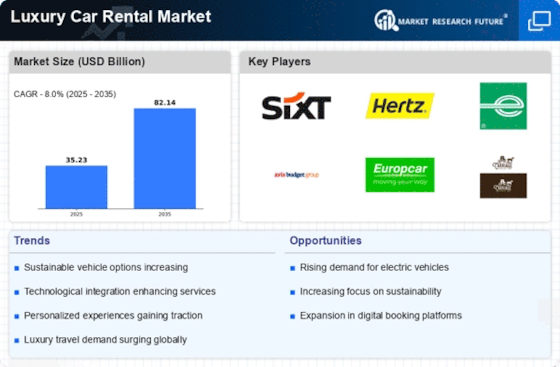
As per Market Research Future analysis, the Luxury Car Rental Market Size was estimated at 35.23 USD Billion in 2024. The Luxury Car Rental industry is projected to grow from 38.05 USD Billion in 2025 to 82.14 USD Billion by 2035, exhibiting a compound annual growth rate (CAGR) of 8.0% during the forecast period 2025 - 2035

Key Market Trends & Highlights

The Luxury Car Rental Market is experiencing a dynamic shift towards digitalization and sustainability, driven by evolving consumer preferences.

  • North America remains the largest market for luxury car rentals, characterized by a strong demand for premium vehicles. The Asia-Pacific region is emerging as the fastest-growing market, fueled by increasing disposable incomes and a burgeoning middle class. The business segment continues to dominate the market, while the leisure segment is witnessing rapid growth as consumers prioritize unique experiences. Rising disposable incomes and a shift towards the experience economy are key drivers propelling the luxury car rental market forward.

Market Size & Forecast

2024 Market Size 35.23 (USD Billion)
2035 Market Size 82.14 (USD Billion)
CAGR (2025 - 2035) 8.0%
Largest Regional Market Share in 2024 North America

Major Players

Sixt (DE), <a href="https://www.hertz.com/us/en/vehicles/luxury-cars">Hertz</a> (US), Enterprise (US), Avis (US), <a href="https://www.europcar.com/en-us/p/car-rental/fleet/type/premium">Europcar</a> (FR), LUXURY CARRIAGE (GB), Beverly Hills Rent-A-Car (US), LUXURY CARS (IT), Sixt Luxury Cars (DE)

Market Trends

The Luxury Car Rental Market is currently experiencing a notable transformation, driven by evolving consumer preferences and technological advancements. As individuals increasingly seek unique experiences, the demand for high-end vehicles has surged contributing to steady growth in the luxury car rental market size.. This shift is not merely about transportation; it reflects a lifestyle choice that emphasizes status and exclusivity. Furthermore, the integration of digital platforms has streamlined the rental process, making it more accessible and user-friendly. a key aspect shaping luxury car rental market trends. Customers now expect seamless online booking systems, personalized services, and flexible rental options, which are becoming standard in the industry. In addition, sustainability is emerging as a crucial factor influencing consumer decisions within the Luxury Car Rental Market. As awareness of environmental issues grows, many rental companies are exploring eco-friendly vehicle options, such as hybrids and electric cars. This trend indicates a potential shift in the market landscape, where luxury does not compromise environmental responsibility. Overall, the Luxury Car Rental Market appears poised for continued growth, with a focus on innovation, customer experience, and sustainability shaping its future.

Digital Transformation

The Luxury Car Rental Market is witnessing a significant shift towards digitalization. Companies are increasingly adopting advanced technologies to enhance customer experiences. Online booking platforms, mobile applications, and contactless services are becoming essential. This trend not only streamlines the rental process but also caters to the tech-savvy clientele who prioritize convenience and efficiency.

Sustainability Initiatives

Sustainability is gaining traction within the Luxury Car Rental Market. As consumers become more environmentally conscious, rental companies are responding by incorporating eco-friendly vehicles into their fleets. This includes electric and hybrid models, which appeal to a demographic that values both luxury and environmental responsibility. Such initiatives may redefine luxury standards in the coming years.

Personalized Customer Experiences

The demand for personalized services is on the rise in the Luxury Car Rental Market. Customers increasingly expect tailored experiences that cater to their individual preferences. This trend encourages rental companies to offer bespoke services, such as customized vehicle options and exclusive packages, enhancing customer satisfaction and loyalty.

Luxury Car Rental Market Market Drivers

Growing Tourism Sector

The Luxury Car Rental Market is significantly bolstered by the expanding tourism sector. As travel becomes more accessible, affluent tourists seek luxury experiences, including high-end vehicle rentals. Recent statistics reveal that luxury car rentals account for a substantial portion of the overall car rental market, with a notable increase in demand during peak travel seasons. Destinations known for luxury tourism, such as major cities and resort areas, are particularly lucrative for rental companies. This trend suggests that the Luxury Car Rental Market is poised for growth, as it aligns with the preferences of travelers who prioritize comfort and style during their journeys.

Rising Disposable Incomes

The Luxury Car Rental Market appears to be positively influenced by the increasing disposable incomes of consumers. As individuals experience higher earnings, they are more inclined to indulge in luxury experiences, including renting high-end vehicles. This trend is particularly evident in emerging economies, where a burgeoning middle class is eager to access luxury services. According to recent data, the luxury car rental segment has seen a growth rate of approximately 10% annually, driven by this demographic shift. The willingness to spend on premium services indicates a robust market potential, suggesting that the Luxury Car Rental Market is well-positioned to capitalize on this economic trend.

Technological Advancements

Technological advancements are reshaping the Luxury Car Rental Market, enhancing customer experiences and operational efficiencies. Innovations such as mobile applications for booking and vehicle tracking have streamlined the rental process, making it more user-friendly. Additionally, the integration of artificial intelligence in customer service has improved personalization, allowing companies to tailor offerings to individual preferences. Data indicates that companies leveraging technology in their operations have reported a 15% increase in customer satisfaction. This technological evolution not only attracts tech-savvy consumers but also positions the Luxury Car Rental Market as a forward-thinking sector, likely to thrive in an increasingly digital landscape.

Shift Towards Experience Economy

The Luxury Car Rental Market is experiencing a shift towards the experience economy, where consumers prioritize experiences over material possessions. This trend is particularly pronounced among younger generations, who are more inclined to rent luxury vehicles for special occasions or unique experiences rather than purchasing them outright. Data suggests that this demographic is driving a significant portion of the luxury rental market, with a preference for short-term rentals that offer flexibility and exclusivity. As the experience economy continues to gain traction, the Luxury Car Rental Market is likely to benefit from this cultural shift, appealing to consumers seeking memorable experiences.

Environmental Awareness and Sustainability

Environmental awareness is increasingly influencing consumer choices within the Luxury Car Rental Market. As sustainability becomes a priority for many consumers, rental companies are adapting by incorporating eco-friendly vehicles into their fleets. This shift not only meets the demand for greener options but also enhances brand reputation among environmentally conscious consumers. Recent surveys indicate that a significant percentage of luxury car renters are willing to pay a premium for sustainable options. Consequently, the Luxury Car Rental Market is likely to see growth as companies align their offerings with the values of modern consumers, emphasizing sustainability as a key differentiator.

Market Segment Insights

By Rental Type: Business (Largest) vs. Leisure (Fastest-Growing)

In the Luxury Car Rental Market, the rental type segment is clearly divided between business and leisure customers, with business rentals holding the largest share. Business travelers tend to book luxury vehicles for corporate events, client meetings, and functions. The demand from companies often leads to substantial bookings, allowing this segment to capitalize on the need for high-end luxury and comfort during travel. Meanwhile, leisure rentals are rapidly gaining ground, appealing to individuals and families seeking a premium experience while on vacation, particularly in key tourist destinations.

Business: Dominant vs. Leisure: Emerging

The business segment in the luxury car rental market is characterized by demand from corporate clients and travel agencies seeking reliable and high-end vehicles for professional use. These customers prioritize comfort, prestige, and service, often opting for luxury sedans and SUVs that convey status and sophistication. On the other hand, the leisure segment, while currently smaller, is emerging due to an increasing number of affluent travelers willing to rent luxury cars for personal enjoyment and special occasions. This segment is likely to benefit from trends like experiential travel and an inclination towards luxury lifestyle choices, which are enhancing its appeal in the rental market.

By Booking Mode: Online (Largest) vs. Offline (Fastest-Growing)

In the Luxury Car Rental Market, the booking mode is crucial for customer experience and operational efficiency. Currently, the online booking segment dominates, accounting for a significant portion of the market share, as consumers increasingly prefer the convenience of digital interfaces for reserving luxury vehicles. This trend has propelled online platforms to the forefront, offering a wide selection of vehicles, competitive pricing, and user-friendly navigation that significantly enhance customer satisfaction. On the other hand, the offline booking segment is emerging as the fastest-growing area, particularly among customers who value personalized service and direct interaction. Many luxury car rental companies are implementing hybrid models that blend the convenience of online reservations with face-to-face consultations, thus catering to diverse consumer preferences and driving growth in this segment. Trends indicate a growing appreciation for bespoke services while retaining the efficiency of digital solutions.

Online (Dominant) vs. Offline (Emerging)

The online booking method in the Luxury Car Rental Market is characterized by an extensive range of options, allowing customers to browse and select vehicles effortlessly. It caters to tech-savvy consumers looking for convenience and time-saving procedures. The dominance of this segment is evidenced by its seamless integration of user-friendly platforms, mobile applications, and advanced payment solutions that enhance user experience. In contrast, offline bookings, while currently smaller in market share, offer a personalized touch that many customers in the luxury segment seek. This emerging segment is growing rapidly as brands focus on building relationships with clients, providing tailored experiences, and ensuring customer loyalty through personal service. The blend of online efficiency with offline engagement is shaping the future of luxury car rentals.

Get more detailed insights about Luxury Car Rental Market Research Report — Global Forecast till 2035

Regional Insights

By region, the study provides the market insights into North America, Europe, Asia-Pacific and Rest of the World. The North American Luxury Car Rental Market area will dominate this market. The demand for car rentals surged above pre-pandemic levels as the countries resumed travel and the markets opened up again.

Further, the major countries studied in the market report are The US, German, France, the UK, Canada, Italy, Spain, India, Australia, South Korea, China, Japan, and Brazil.

Figure2: LUXURY CAR RENTAL MARKET SHARE BY REGION 2022 (USD Billion)

Europe Luxury Car Rental Market has the second-largest portion of the market. This is because the area is well-known for its tourism attractions and jobs. Further, the German Luxury Car Rental Market had the biggest market share, and the UK Luxury Car Rental Market was the European market with the quickest rate of growth.

The Asia-Pacific Luxury Car Rental Market is anticipated to expand between 2023 and 2032 at the quickest CAGR. Another factor contributing to the growth is the rising number of billionaires in Asia Pacific. Moreover, China’s Luxury Car Rental Market had the biggest market share, and the Indian Luxury Rental Cars market was the Asia-Pacific region's fastest-growing market.

Key Players and Competitive Insights

Leading market players are making significant investments in R&D to broaden their product ranges, which will contribute to the growth of the luxury car rental sector. Additionally, market players are engaging in a range of calculated initiatives to increase their worldwide presence, with important market developments involving the introduction of new products, contracts, M&A transactions, increased investment, and cooperation with other enterprises. To grow and endure in an increasingly cutthroat and dynamic market, Luxury Car Rental industry must provide reasonably priced goods. One of the main business strategies employed by manufacturers is to manufacture locally in order to reduce operating expenses in the global Luxury Car Rental industry to help customers and expand the market segment. In recent years, the Luxury Car Rental industry has provided some of the biggest benefits to medicine. Major players in the Luxury Car Rental Market, including Sixt (Germany), Enterprise Holdings (U.S.), Movida (Brazil), Hertz (U.S.), Avis Budget Group (U.S.), Localiza (Brazil), Car Inc. (China)., Europcar Mobility Group (France), and others, are engaging in research and development activities in an effort to boost market demand. Avis Budget Group is based in Parsippany, New Jersey, and operates rental cars. Avis Car Rental, Budget Rent a Car, Budget Truck Rental, Payless Car Rental, and Zipcar are just a few of the brands that it is the parent business of.  The business also manages a number of smaller, regional brands, such as TurisCar, TurisPrime, Maggiore Group, AmicoBlue, France Cars, ACL Hire, and Apex Car Rentals. It is one of the three major holding companies for rental cars in the US. It was trailing both Hertz Global Holdings and Enterprise Holdings in 2021 with a 26% market share. Founded in Paris in 1949, Europcar Mobility Group is a French automobile rental firm. The headquarters of the holding company, Europcar Group S.A., are located in Voisins-le-Bretonneux (Saint Quentin en Yvelines), France, in the Val Saint-Quentin industrial park. Currently, Europcar is present in 140 nations in Western Asia, Africa, North America, and Europe. Green Mobility Holding, S.A., a group headed by the Volkswagen Group, Attestor, and Pon Holdings, has been the owner of Europcar since July 2022. The Europcar recreational rental sub-brand is called Keddy.

Key Companies in the Luxury Car Rental Market include

Industry Developments

  • Q2 2024: SIXT Expands U.S. Footprint with Opening of New Branch at Charlotte Douglas International Airport SIXT, a leading global mobility provider, announced the opening of a new branch at Charlotte Douglas International Airport, further expanding its presence in the U.S. luxury car rental market.
  • Q2 2024: Hertz Announces Partnership with Polestar to Offer Electric Luxury Vehicles in Rental Fleet Hertz entered into a partnership with Polestar to add thousands of Polestar electric luxury vehicles to its rental fleet, aiming to expand its premium and sustainable offerings.
  • Q3 2024: Avis Budget Group Names Joe Ferraro as New CEO Avis Budget Group appointed Joe Ferraro as its new Chief Executive Officer, signaling a leadership change as the company continues to focus on premium and luxury rental segments.
  • Q3 2024: Enterprise Holdings Launches Exotic Car Collection in Dubai Enterprise Holdings announced the launch of its Exotic Car Collection in Dubai, offering high-end vehicles to cater to the growing demand for luxury rentals in the Middle East.
  • Q4 2024: Sixt Launches Premium Subscription Service for Luxury Car Rentals in Europe Sixt introduced a new premium subscription service in select European markets, allowing customers flexible access to luxury vehicles on a monthly basis.
  • Q4 2024: Europcar Mobility Group Acquires Italian Luxury Car Rental Market Firm Primerent Europcar Mobility Group completed the acquisition of Primerent, an Italian luxury car rental company, to strengthen its premium offerings in Southern Europe.
  • Q1 2025: Hertz Raises $500 Million in Private Placement to Expand Luxury and Electric Fleet Hertz secured $500 million in a private placement, with proceeds earmarked for expanding its luxury and electric vehicle rental fleet globally.
  • Q1 2025: Sixt and Mercedes-Benz Sign Strategic Partnership to Offer Exclusive AMG Models in Rental Fleet Sixt and Mercedes-Benz entered a strategic partnership to provide exclusive AMG performance models in Sixt’s luxury rental fleet across key European cities.
  • Q2 2025: Avis Budget Group Opens New Luxury Car Rental Market Facility at Los Angeles International Airport Avis Budget Group opened a dedicated luxury car rental facility at LAX, featuring an expanded fleet of high-end vehicles and premium customer services.
  • Q2 2025: Enterprise Holdings Acquires Dubai-based Luxury Car Rental Market Startup XCar Enterprise Holdings acquired XCar, a Dubai-based luxury car rental startup, to bolster its premium offerings and expand its footprint in the Middle East.
  • Q3 2025: Sixt Launches All-Electric Luxury Rental Fleet in London Sixt launched an all-electric luxury rental fleet in London, featuring high-end EVs from leading manufacturers, as part of its sustainability and premium service strategy.
  • Q3 2025: Hertz Appoints New Chief Sustainability Officer to Lead Luxury EV Expansion Hertz appointed a new Chief Sustainability Officer to oversee the expansion of its luxury electric vehicle rental offerings and drive the company’s ESG initiatives.

Future Outlook

Luxury Car Rental Market Future Outlook

The Luxury Car Rental Market is projected to grow at an 8.0% CAGR from 2025 to 2035, driven by increasing disposable incomes, urbanization, and a growing preference for premium experiences.

New opportunities lie in:

  • <p>Integration of AI-driven customer service platforms Expansion of electric luxury vehicle offerings Development of subscription-based rental models</p>

By 2035, the Luxury Car Rental Market is expected to achieve substantial growth and diversification.

Market Segmentation

Luxury Car Rental Market Rental Type Outlook

  • Business
  • Leisure

Luxury Car Rental Market Booking Mode Outlook

  • Online
  • Offline

Report Scope

MARKET SIZE 2024 35.23(USD Billion)
MARKET SIZE 2025 38.05(USD Billion)
MARKET SIZE 2035 82.14(USD Billion)
COMPOUND ANNUAL GROWTH RATE (CAGR) 8.0% (2025 - 2035)
REPORT COVERAGE Revenue Forecast, Competitive Landscape, Growth Factors, and Trends
BASE YEAR 2024
Market Forecast Period 2025 - 2035
Historical Data 2019 - 2024
Market Forecast Units USD Billion
Key Companies Profiled Sixt (DE), Hertz (US), Enterprise (US), Avis (US), Europcar (FR), LUXURY CARRIAGE (GB), Beverly Hills Rent-A-Car (US), LUXURY CARS (IT), Sixt Luxury Cars (DE)
Segments Covered Rental Type, Booking Mode, Region
Key Market Opportunities Integration of electric vehicles and advanced technology enhances customer experience in the Luxury Car Rental Market.
Key Market Dynamics Rising consumer demand for personalized experiences drives innovation and competition in the luxury car rental sector.
Countries Covered North America, Europe, APAC, South America, MEA

FAQs

What is the current valuation of the Luxury Car Rental Market?

<p>The Luxury Car Rental Market was valued at 35.23 USD Billion in 2024.</p>

What is the projected market size for the Luxury Car Rental Market by 2035?

<p>The market is projected to reach 82.14 USD Billion by 2035.</p>

What is the expected CAGR for the Luxury Car Rental Market from 2025 to 2035?

<p>The expected CAGR during the forecast period 2025 - 2035 is 8.0%.</p>

Which segments are driving growth in the Luxury Car Rental Market?

<p>The Business and Leisure segments are key drivers, with valuations of 15.0 to 35.0 USD Billion and 20.23 to 47.14 USD Billion, respectively.</p>

How does the booking mode impact the Luxury Car Rental Market?

<p>The Online booking mode is anticipated to grow from 20.0 to 45.0 USD Billion, while Offline bookings range from 15.23 to 37.14 USD Billion.</p>

Who are the leading players in the Luxury Car Rental Market?

<p>Key players include Sixt, Hertz, Enterprise, Avis, Europcar, Luxury Carriage, Beverly Hills Rent-A-Car, Luxury Cars, and Sixt Luxury Cars.</p>

What trends are influencing the Luxury Car Rental Market in 2025?

<p>Trends include a shift towards online bookings and increasing demand in both Business and Leisure segments.</p>

What is the significance of the Luxury Car Rental Market's growth?

<p>The growth indicates a rising consumer preference for luxury experiences, with a substantial increase in market valuation expected.</p>

How does the Luxury Car Rental Market compare to other segments?

<p>The Luxury Car Rental Market shows robust growth potential, particularly in comparison to traditional car rental segments.</p>

What factors contribute to the projected growth of the Luxury Car Rental Market?

<p>Factors include increasing disposable income, a growing travel industry, and a heightened interest in luxury experiences.</p>

  1. SECTION I: EXECUTIVE SUMMARY AND KEY HIGHLIGHTS
    1. | 1.1 EXECUTIVE SUMMARY
    2. | | 1.1.1 Market Overview
    3. | | 1.1.2 Key Findings
    4. | | 1.1.3 Market Segmentation
    5. | | 1.1.4 Competitive Landscape
    6. | | 1.1.5 Challenges and Opportunities
    7. | | 1.1.6 Future Outlook
  2. SECTION II: SCOPING, METHODOLOGY AND MARKET STRUCTURE
    1. | 2.1 MARKET INTRODUCTION
    2. | | 2.1.1 Definition
    3. | | 2.1.2 Scope of the study
    4. | | | 2.1.2.1 Research Objective
    5. | | | 2.1.2.2 Assumption
    6. | | | 2.1.2.3 Limitations
    7. | 2.2 RESEARCH METHODOLOGY
    8. | | 2.2.1 Overview
    9. | | 2.2.2 Data Mining
    10. | | 2.2.3 Secondary Research
    11. | | 2.2.4 Primary Research
    12. | | | 2.2.4.1 Primary Interviews and Information Gathering Process
    13. | | | 2.2.4.2 Breakdown of Primary Respondents
    14. | | 2.2.5 Forecasting Model
    15. | | 2.2.6 Market Size Estimation
    16. | | | 2.2.6.1 Bottom-Up Approach
    17. | | | 2.2.6.2 Top-Down Approach
    18. | | 2.2.7 Data Triangulation
    19. | | 2.2.8 Validation
  3. SECTION III: QUALITATIVE ANALYSIS
    1. | 3.1 MARKET DYNAMICS
    2. | | 3.1.1 Overview
    3. | | 3.1.2 Drivers
    4. | | 3.1.3 Restraints
    5. | | 3.1.4 Opportunities
    6. | 3.2 MARKET FACTOR ANALYSIS
    7. | | 3.2.1 Value chain Analysis
    8. | | 3.2.2 Porter's Five Forces Analysis
    9. | | | 3.2.2.1 Bargaining Power of Suppliers
    10. | | | 3.2.2.2 Bargaining Power of Buyers
    11. | | | 3.2.2.3 Threat of New Entrants
    12. | | | 3.2.2.4 Threat of Substitutes
    13. | | | 3.2.2.5 Intensity of Rivalry
    14. | | 3.2.3 COVID-19 Impact Analysis
    15. | | | 3.2.3.1 Market Impact Analysis
    16. | | | 3.2.3.2 Regional Impact
    17. | | | 3.2.3.3 Opportunity and Threat Analysis
  4. SECTION IV: QUANTITATIVE ANALYSIS
    1. | 4.1 Automobile, BY Rental Type (USD Billion)
    2. | | 4.1.1 Business
    3. | | 4.1.2 Leisure
    4. | 4.2 Automobile, BY Booking Mode (USD Billion)
    5. | | 4.2.1 Online
    6. | | 4.2.2 Offline
    7. | 4.3 Automobile, BY Region (USD Billion)
    8. | | 4.3.1 North America
    9. | | | 4.3.1.1 US
    10. | | | 4.3.1.2 Canada
    11. | | 4.3.2 Europe
    12. | | | 4.3.2.1 Germany
    13. | | | 4.3.2.2 UK
    14. | | | 4.3.2.3 France
    15. | | | 4.3.2.4 Russia
    16. | | | 4.3.2.5 Italy
    17. | | | 4.3.2.6 Spain
    18. | | | 4.3.2.7 Rest of Europe
    19. | | 4.3.3 APAC
    20. | | | 4.3.3.1 China
    21. | | | 4.3.3.2 India
    22. | | | 4.3.3.3 Japan
    23. | | | 4.3.3.4 South Korea
    24. | | | 4.3.3.5 Malaysia
    25. | | | 4.3.3.6 Thailand
    26. | | | 4.3.3.7 Indonesia
    27. | | | 4.3.3.8 Rest of APAC
    28. | | 4.3.4 South America
    29. | | | 4.3.4.1 Brazil
    30. | | | 4.3.4.2 Mexico
    31. | | | 4.3.4.3 Argentina
    32. | | | 4.3.4.4 Rest of South America
    33. | | 4.3.5 MEA
    34. | | | 4.3.5.1 GCC Countries
    35. | | | 4.3.5.2 South Africa
    36. | | | 4.3.5.3 Rest of MEA
  5. SECTION V: COMPETITIVE ANALYSIS
    1. | 5.1 Competitive Landscape
    2. | | 5.1.1 Overview
    3. | | 5.1.2 Competitive Analysis
    4. | | 5.1.3 Market share Analysis
    5. | | 5.1.4 Major Growth Strategy in the Automobile
    6. | | 5.1.5 Competitive Benchmarking
    7. | | 5.1.6 Leading Players in Terms of Number of Developments in the Automobile
    8. | | 5.1.7 Key developments and growth strategies
    9. | | | 5.1.7.1 New Product Launch/Service Deployment
    10. | | | 5.1.7.2 Merger & Acquisitions
    11. | | | 5.1.7.3 Joint Ventures
    12. | | 5.1.8 Major Players Financial Matrix
    13. | | | 5.1.8.1 Sales and Operating Income
    14. | | | 5.1.8.2 Major Players R&D Expenditure. 2023
    15. | 5.2 Company Profiles
    16. | | 5.2.1 Sixt (DE)
    17. | | | 5.2.1.1 Financial Overview
    18. | | | 5.2.1.2 Products Offered
    19. | | | 5.2.1.3 Key Developments
    20. | | | 5.2.1.4 SWOT Analysis
    21. | | | 5.2.1.5 Key Strategies
    22. | | 5.2.2 Hertz (US)
    23. | | | 5.2.2.1 Financial Overview
    24. | | | 5.2.2.2 Products Offered
    25. | | | 5.2.2.3 Key Developments
    26. | | | 5.2.2.4 SWOT Analysis
    27. | | | 5.2.2.5 Key Strategies
    28. | | 5.2.3 Enterprise (US)
    29. | | | 5.2.3.1 Financial Overview
    30. | | | 5.2.3.2 Products Offered
    31. | | | 5.2.3.3 Key Developments
    32. | | | 5.2.3.4 SWOT Analysis
    33. | | | 5.2.3.5 Key Strategies
    34. | | 5.2.4 Avis (US)
    35. | | | 5.2.4.1 Financial Overview
    36. | | | 5.2.4.2 Products Offered
    37. | | | 5.2.4.3 Key Developments
    38. | | | 5.2.4.4 SWOT Analysis
    39. | | | 5.2.4.5 Key Strategies
    40. | | 5.2.5 Europcar (FR)
    41. | | | 5.2.5.1 Financial Overview
    42. | | | 5.2.5.2 Products Offered
    43. | | | 5.2.5.3 Key Developments
    44. | | | 5.2.5.4 SWOT Analysis
    45. | | | 5.2.5.5 Key Strategies
    46. | | 5.2.6 LUXURY CARRIAGE (GB)
    47. | | | 5.2.6.1 Financial Overview
    48. | | | 5.2.6.2 Products Offered
    49. | | | 5.2.6.3 Key Developments
    50. | | | 5.2.6.4 SWOT Analysis
    51. | | | 5.2.6.5 Key Strategies
    52. | | 5.2.7 Beverly Hills Rent-A-Car (US)
    53. | | | 5.2.7.1 Financial Overview
    54. | | | 5.2.7.2 Products Offered
    55. | | | 5.2.7.3 Key Developments
    56. | | | 5.2.7.4 SWOT Analysis
    57. | | | 5.2.7.5 Key Strategies
    58. | | 5.2.8 LUXURY CARS (IT)
    59. | | | 5.2.8.1 Financial Overview
    60. | | | 5.2.8.2 Products Offered
    61. | | | 5.2.8.3 Key Developments
    62. | | | 5.2.8.4 SWOT Analysis
    63. | | | 5.2.8.5 Key Strategies
    64. | | 5.2.9 Sixt Luxury Cars (DE)
    65. | | | 5.2.9.1 Financial Overview
    66. | | | 5.2.9.2 Products Offered
    67. | | | 5.2.9.3 Key Developments
    68. | | | 5.2.9.4 SWOT Analysis
    69. | | | 5.2.9.5 Key Strategies
    70. | 5.3 Appendix
    71. | | 5.3.1 References
    72. | | 5.3.2 Related Reports
  6. LIST OF FIGURES
    1. | 6.1 MARKET SYNOPSIS
    2. | 6.2 NORTH AMERICA MARKET ANALYSIS
    3. | 6.3 US MARKET ANALYSIS BY RENTAL TYPE
    4. | 6.4 US MARKET ANALYSIS BY BOOKING MODE
    5. | 6.5 CANADA MARKET ANALYSIS BY RENTAL TYPE
    6. | 6.6 CANADA MARKET ANALYSIS BY BOOKING MODE
    7. | 6.7 EUROPE MARKET ANALYSIS
    8. | 6.8 GERMANY MARKET ANALYSIS BY RENTAL TYPE
    9. | 6.9 GERMANY MARKET ANALYSIS BY BOOKING MODE
    10. | 6.10 UK MARKET ANALYSIS BY RENTAL TYPE
    11. | 6.11 UK MARKET ANALYSIS BY BOOKING MODE
    12. | 6.12 FRANCE MARKET ANALYSIS BY RENTAL TYPE
    13. | 6.13 FRANCE MARKET ANALYSIS BY BOOKING MODE
    14. | 6.14 RUSSIA MARKET ANALYSIS BY RENTAL TYPE
    15. | 6.15 RUSSIA MARKET ANALYSIS BY BOOKING MODE
    16. | 6.16 ITALY MARKET ANALYSIS BY RENTAL TYPE
    17. | 6.17 ITALY MARKET ANALYSIS BY BOOKING MODE
    18. | 6.18 SPAIN MARKET ANALYSIS BY RENTAL TYPE
    19. | 6.19 SPAIN MARKET ANALYSIS BY BOOKING MODE
    20. | 6.20 REST OF EUROPE MARKET ANALYSIS BY RENTAL TYPE
    21. | 6.21 REST OF EUROPE MARKET ANALYSIS BY BOOKING MODE
    22. | 6.22 APAC MARKET ANALYSIS
    23. | 6.23 CHINA MARKET ANALYSIS BY RENTAL TYPE
    24. | 6.24 CHINA MARKET ANALYSIS BY BOOKING MODE
    25. | 6.25 INDIA MARKET ANALYSIS BY RENTAL TYPE
    26. | 6.26 INDIA MARKET ANALYSIS BY BOOKING MODE
    27. | 6.27 JAPAN MARKET ANALYSIS BY RENTAL TYPE
    28. | 6.28 JAPAN MARKET ANALYSIS BY BOOKING MODE
    29. | 6.29 SOUTH KOREA MARKET ANALYSIS BY RENTAL TYPE
    30. | 6.30 SOUTH KOREA MARKET ANALYSIS BY BOOKING MODE
    31. | 6.31 MALAYSIA MARKET ANALYSIS BY RENTAL TYPE
    32. | 6.32 MALAYSIA MARKET ANALYSIS BY BOOKING MODE
    33. | 6.33 THAILAND MARKET ANALYSIS BY RENTAL TYPE
    34. | 6.34 THAILAND MARKET ANALYSIS BY BOOKING MODE
    35. | 6.35 INDONESIA MARKET ANALYSIS BY RENTAL TYPE
    36. | 6.36 INDONESIA MARKET ANALYSIS BY BOOKING MODE
    37. | 6.37 REST OF APAC MARKET ANALYSIS BY RENTAL TYPE
    38. | 6.38 REST OF APAC MARKET ANALYSIS BY BOOKING MODE
    39. | 6.39 SOUTH AMERICA MARKET ANALYSIS
    40. | 6.40 BRAZIL MARKET ANALYSIS BY RENTAL TYPE
    41. | 6.41 BRAZIL MARKET ANALYSIS BY BOOKING MODE
    42. | 6.42 MEXICO MARKET ANALYSIS BY RENTAL TYPE
    43. | 6.43 MEXICO MARKET ANALYSIS BY BOOKING MODE
    44. | 6.44 ARGENTINA MARKET ANALYSIS BY RENTAL TYPE
    45. | 6.45 ARGENTINA MARKET ANALYSIS BY BOOKING MODE
    46. | 6.46 REST OF SOUTH AMERICA MARKET ANALYSIS BY RENTAL TYPE
    47. | 6.47 REST OF SOUTH AMERICA MARKET ANALYSIS BY BOOKING MODE
    48. | 6.48 MEA MARKET ANALYSIS
    49. | 6.49 GCC COUNTRIES MARKET ANALYSIS BY RENTAL TYPE
    50. | 6.50 GCC COUNTRIES MARKET ANALYSIS BY BOOKING MODE
    51. | 6.51 SOUTH AFRICA MARKET ANALYSIS BY RENTAL TYPE
    52. | 6.52 SOUTH AFRICA MARKET ANALYSIS BY BOOKING MODE
    53. | 6.53 REST OF MEA MARKET ANALYSIS BY RENTAL TYPE
    54. | 6.54 REST OF MEA MARKET ANALYSIS BY BOOKING MODE
    55. | 6.55 KEY BUYING CRITERIA OF AUTOMOBILE
    56. | 6.56 RESEARCH PROCESS OF MRFR
    57. | 6.57 DRO ANALYSIS OF AUTOMOBILE
    58. | 6.58 DRIVERS IMPACT ANALYSIS: AUTOMOBILE
    59. | 6.59 RESTRAINTS IMPACT ANALYSIS: AUTOMOBILE
    60. | 6.60 SUPPLY / VALUE CHAIN: AUTOMOBILE
    61. | 6.61 AUTOMOBILE, BY RENTAL TYPE, 2024 (% SHARE)
    62. | 6.62 AUTOMOBILE, BY RENTAL TYPE, 2024 TO 2035 (USD Billion)
    63. | 6.63 AUTOMOBILE, BY BOOKING MODE, 2024 (% SHARE)
    64. | 6.64 AUTOMOBILE, BY BOOKING MODE, 2024 TO 2035 (USD Billion)
    65. | 6.65 BENCHMARKING OF MAJOR COMPETITORS
  7. LIST OF TABLES
    1. | 7.1 LIST OF ASSUMPTIONS
    2. | | 7.1.1
    3. | 7.2 North America MARKET SIZE ESTIMATES; FORECAST
    4. | | 7.2.1 BY RENTAL TYPE, 2025-2035 (USD Billion)
    5. | | 7.2.2 BY BOOKING MODE, 2025-2035 (USD Billion)
    6. | 7.3 US MARKET SIZE ESTIMATES; FORECAST
    7. | | 7.3.1 BY RENTAL TYPE, 2025-2035 (USD Billion)
    8. | | 7.3.2 BY BOOKING MODE, 2025-2035 (USD Billion)
    9. | 7.4 Canada MARKET SIZE ESTIMATES; FORECAST
    10. | | 7.4.1 BY RENTAL TYPE, 2025-2035 (USD Billion)
    11. | | 7.4.2 BY BOOKING MODE, 2025-2035 (USD Billion)
    12. | 7.5 Europe MARKET SIZE ESTIMATES; FORECAST
    13. | | 7.5.1 BY RENTAL TYPE, 2025-2035 (USD Billion)
    14. | | 7.5.2 BY BOOKING MODE, 2025-2035 (USD Billion)
    15. | 7.6 Germany MARKET SIZE ESTIMATES; FORECAST
    16. | | 7.6.1 BY RENTAL TYPE, 2025-2035 (USD Billion)
    17. | | 7.6.2 BY BOOKING MODE, 2025-2035 (USD Billion)
    18. | 7.7 UK MARKET SIZE ESTIMATES; FORECAST
    19. | | 7.7.1 BY RENTAL TYPE, 2025-2035 (USD Billion)
    20. | | 7.7.2 BY BOOKING MODE, 2025-2035 (USD Billion)
    21. | 7.8 France MARKET SIZE ESTIMATES; FORECAST
    22. | | 7.8.1 BY RENTAL TYPE, 2025-2035 (USD Billion)
    23. | | 7.8.2 BY BOOKING MODE, 2025-2035 (USD Billion)
    24. | 7.9 Russia MARKET SIZE ESTIMATES; FORECAST
    25. | | 7.9.1 BY RENTAL TYPE, 2025-2035 (USD Billion)
    26. | | 7.9.2 BY BOOKING MODE, 2025-2035 (USD Billion)
    27. | 7.10 Italy MARKET SIZE ESTIMATES; FORECAST
    28. | | 7.10.1 BY RENTAL TYPE, 2025-2035 (USD Billion)
    29. | | 7.10.2 BY BOOKING MODE, 2025-2035 (USD Billion)
    30. | 7.11 Spain MARKET SIZE ESTIMATES; FORECAST
    31. | | 7.11.1 BY RENTAL TYPE, 2025-2035 (USD Billion)
    32. | | 7.11.2 BY BOOKING MODE, 2025-2035 (USD Billion)
    33. | 7.12 Rest of Europe MARKET SIZE ESTIMATES; FORECAST
    34. | | 7.12.1 BY RENTAL TYPE, 2025-2035 (USD Billion)
    35. | | 7.12.2 BY BOOKING MODE, 2025-2035 (USD Billion)
    36. | 7.13 APAC MARKET SIZE ESTIMATES; FORECAST
    37. | | 7.13.1 BY RENTAL TYPE, 2025-2035 (USD Billion)
    38. | | 7.13.2 BY BOOKING MODE, 2025-2035 (USD Billion)
    39. | 7.14 China MARKET SIZE ESTIMATES; FORECAST
    40. | | 7.14.1 BY RENTAL TYPE, 2025-2035 (USD Billion)
    41. | | 7.14.2 BY BOOKING MODE, 2025-2035 (USD Billion)
    42. | 7.15 India MARKET SIZE ESTIMATES; FORECAST
    43. | | 7.15.1 BY RENTAL TYPE, 2025-2035 (USD Billion)
    44. | | 7.15.2 BY BOOKING MODE, 2025-2035 (USD Billion)
    45. | 7.16 Japan MARKET SIZE ESTIMATES; FORECAST
    46. | | 7.16.1 BY RENTAL TYPE, 2025-2035 (USD Billion)
    47. | | 7.16.2 BY BOOKING MODE, 2025-2035 (USD Billion)
    48. | 7.17 South Korea MARKET SIZE ESTIMATES; FORECAST
    49. | | 7.17.1 BY RENTAL TYPE, 2025-2035 (USD Billion)
    50. | | 7.17.2 BY BOOKING MODE, 2025-2035 (USD Billion)
    51. | 7.18 Malaysia MARKET SIZE ESTIMATES; FORECAST
    52. | | 7.18.1 BY RENTAL TYPE, 2025-2035 (USD Billion)
    53. | | 7.18.2 BY BOOKING MODE, 2025-2035 (USD Billion)
    54. | 7.19 Thailand MARKET SIZE ESTIMATES; FORECAST
    55. | | 7.19.1 BY RENTAL TYPE, 2025-2035 (USD Billion)
    56. | | 7.19.2 BY BOOKING MODE, 2025-2035 (USD Billion)
    57. | 7.20 Indonesia MARKET SIZE ESTIMATES; FORECAST
    58. | | 7.20.1 BY RENTAL TYPE, 2025-2035 (USD Billion)
    59. | | 7.20.2 BY BOOKING MODE, 2025-2035 (USD Billion)
    60. | 7.21 Rest of APAC MARKET SIZE ESTIMATES; FORECAST
    61. | | 7.21.1 BY RENTAL TYPE, 2025-2035 (USD Billion)
    62. | | 7.21.2 BY BOOKING MODE, 2025-2035 (USD Billion)
    63. | 7.22 South America MARKET SIZE ESTIMATES; FORECAST
    64. | | 7.22.1 BY RENTAL TYPE, 2025-2035 (USD Billion)
    65. | | 7.22.2 BY BOOKING MODE, 2025-2035 (USD Billion)
    66. | 7.23 Brazil MARKET SIZE ESTIMATES; FORECAST
    67. | | 7.23.1 BY RENTAL TYPE, 2025-2035 (USD Billion)
    68. | | 7.23.2 BY BOOKING MODE, 2025-2035 (USD Billion)
    69. | 7.24 Mexico MARKET SIZE ESTIMATES; FORECAST
    70. | | 7.24.1 BY RENTAL TYPE, 2025-2035 (USD Billion)
    71. | | 7.24.2 BY BOOKING MODE, 2025-2035 (USD Billion)
    72. | 7.25 Argentina MARKET SIZE ESTIMATES; FORECAST
    73. | | 7.25.1 BY RENTAL TYPE, 2025-2035 (USD Billion)
    74. | | 7.25.2 BY BOOKING MODE, 2025-2035 (USD Billion)
    75. | 7.26 Rest of South America MARKET SIZE ESTIMATES; FORECAST
    76. | | 7.26.1 BY RENTAL TYPE, 2025-2035 (USD Billion)
    77. | | 7.26.2 BY BOOKING MODE, 2025-2035 (USD Billion)
    78. | 7.27 MEA MARKET SIZE ESTIMATES; FORECAST
    79. | | 7.27.1 BY RENTAL TYPE, 2025-2035 (USD Billion)
    80. | | 7.27.2 BY BOOKING MODE, 2025-2035 (USD Billion)
    81. | 7.28 GCC Countries MARKET SIZE ESTIMATES; FORECAST
    82. | | 7.28.1 BY RENTAL TYPE, 2025-2035 (USD Billion)
    83. | | 7.28.2 BY BOOKING MODE, 2025-2035 (USD Billion)
    84. | 7.29 South Africa MARKET SIZE ESTIMATES; FORECAST
    85. | | 7.29.1 BY RENTAL TYPE, 2025-2035 (USD Billion)
    86. | | 7.29.2 BY BOOKING MODE, 2025-2035 (USD Billion)
    87. | 7.30 Rest of MEA MARKET SIZE ESTIMATES; FORECAST
    88. | | 7.30.1 BY RENTAL TYPE, 2025-2035 (USD Billion)
    89. | | 7.30.2 BY BOOKING MODE, 2025-2035 (USD Billion)
    90. | 7.31 PRODUCT LAUNCH/PRODUCT DEVELOPMENT/APPROVAL
    91. | | 7.31.1
    92. | 7.32 ACQUISITION/PARTNERSHIP
    93. | | 7.32.1

Automobile Market Segmentation

Automobile By Rental Type (USD Billion, 2025-2035)

  • Business
  • Leisure

Automobile By Booking Mode (USD Billion, 2025-2035)

  • Online
  • Offline
Infographic

Free Sample Request

Kindly complete the form below to receive a free sample of this Report

Get Free Sample

Customer Strories

Compare Licence

×
Features License Type
Single User Multiuser License Enterprise User
Price $4,950 $5,950 $7,250
Maximum User Access Limit 1 User Upto 10 Users Unrestricted Access Throughout the Organization
Free Customization
Direct Access to Analyst
Deliverable Format
Platform Access
Discount on Next Purchase 10% 15% 15%
Printable Versions