Luggage Market (2026 - 2035)

ID: MRFR/CG/20159-CR 189 Pages Sakshi Gupta Last Updated: October 27, 2026
Luggage Market Size, Share, Industry Trend & Analysis Research Report By Product Type (Travel Luggage, Business Luggage, Backpacks, Duffel Bags & Others), By Material (Hard Case, Soft Case), By End User (Adult, Kids/Children), By Distribution Channel (Supermarkets/Hypermarkets, Specialty Stores, Online Retail Stores, Other Distribution Channels), By Geography (North America, Europe, Asia-Pacific, South America, Middle East & Africa) - Forecast to 2035
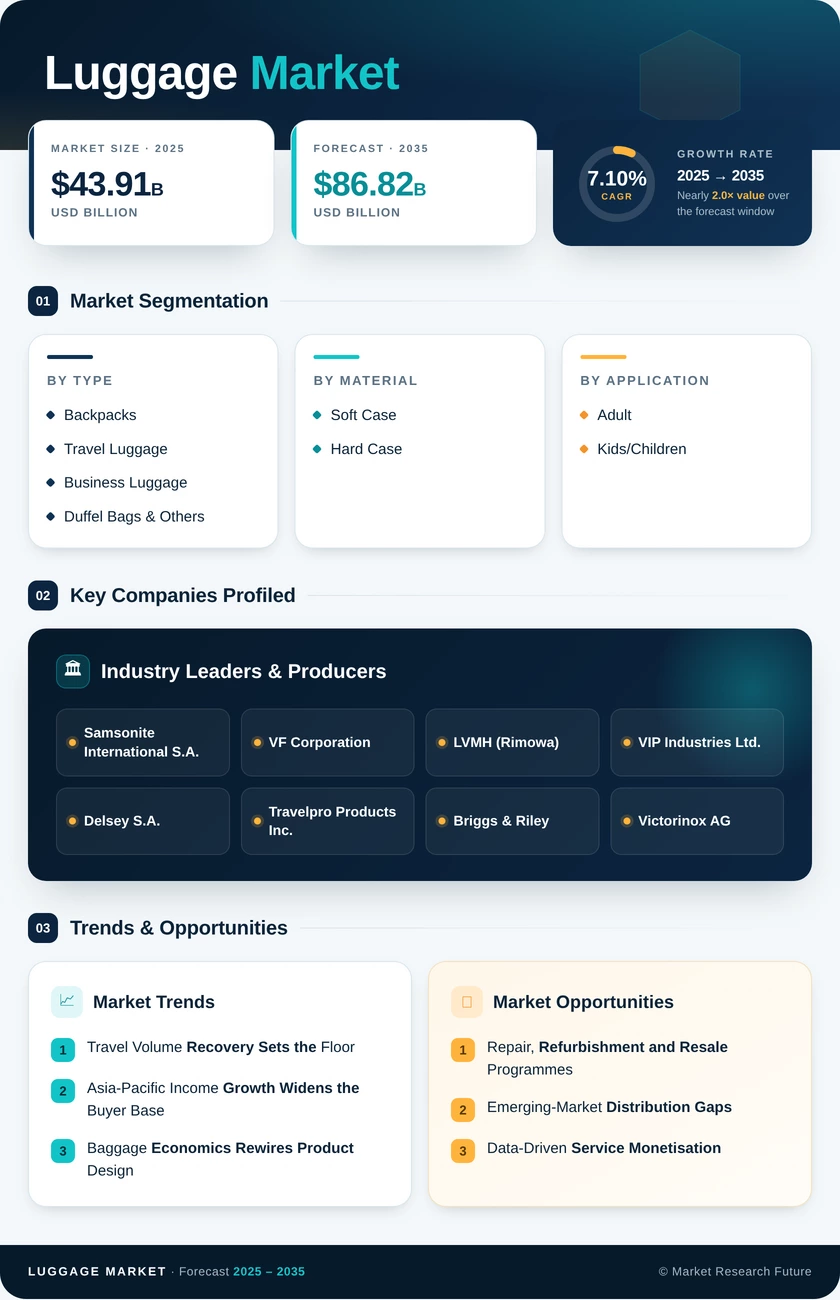
Luggage Market
Market Size
Forecast Period2026-2035
CAGR (2026-2035)7.10%
2025 Market SizeUSD 43.91 Billion
2035 Market SizeUSD 86.82 Billion
Key Players
Samsonite International S.A.
VF Corporation
LVMH
VIP Industries Ltd.
Delsey S.A.
Travelpro Products Inc.
Opportunities
  • Repair, Refurbishment and Resale Programmes
  • Emerging-Market Distribution Gaps
  • Data-Driven Service Monetisation
  1. 1 Market Overview |
    1. 1.1 Study Assumptions & Market Definition |
    2. 1.2 Scope of the Study |
    3. 1.3 Research Methodology
  2. 2 Market Summary & Key Report Takeaways |
    1. 2.1 By Product Type & Material |
    2. 2.2 By End User & Distribution Channel |
    3. 2.3 By Geography
  3. 3 Global Market Size & Forecast (2021–2035) |
    1. 3.1 Historical Market Size (2021–2025) |
    2. 3.2 Current & Forecast Market Size (2026–2035) |
    3. 3.3 Market Size by Revenue (USD Billion) |
    4. 3.4 Year-over-Year Growth Analysis
  4. 4 Market Drivers Analysis |
    1. 4.1 Travel Volume Recovery Sets the Floor |
    2. 4.2 Asia-Pacific Income Growth Widens the Buyer Base |
    3. 4.3 Baggage Economics Rewires Product Design |
    4. 4.4 Digital Retail Compresses the Path to Purchase
  5. 5 Market Restraints Analysis |
    1. 5.1 Input Costs Squeeze the Middle Tier |
    2. 5.2 Battery Rules Cap Connected Product Ambition |
    3. 5.3 Replacement Cycles Blunt Mature-Market Growth
  6. 6 Market Opportunity Analysis |
    1. 6.1 Repair, Refurbishment and Resale Programmes |
    2. 6.2 Emerging-Market Distribution Gaps |
    3. 6.3 Data-Driven Service Monetisation |
    4. 6.4 Kids and Family Formats |
    5. 6.5 Sustainable Materials as a Procurement Requirement |
    6. 6.6 Industry Value Chain Analysis |
    7. 6.7 Porter's Five Forces Analysis
  7. 7 Regional Analysis |
    1. 7.1 North America | |
      1. 7.1.1 US | |
      2. 7.1.2 Canada | |
      3. 7.1.3 Mexico |
    2. 7.2 Europe | |
      1. 7.2.1 Germany | |
      2. 7.2.2 UK | |
      3. 7.2.3 France | |
      4. 7.2.4 Italy | |
      5. 7.2.5 Spain | |
      6. 7.2.6 Nordic Countries | |
      7. 7.2.7 Russia | |
      8. 7.2.8 Rest of Europe |
    3. 7.3 Asia-Pacific | |
      1. 7.3.1 China | |
      2. 7.3.2 India | |
      3. 7.3.3 Japan | |
      4. 7.3.4 South Korea | |
      5. 7.3.5 ASEAN | |
      6. 7.3.6 Rest of Asia-Pacific |
    4. 7.4 South America | |
      1. 7.4.1 Brazil | |
      2. 7.4.2 Argentina | |
      3. 7.4.3 Rest of South America |
    5. 7.5 Middle East & Africa | |
      1. 7.5.1 Saudi Arabia | |
      2. 7.5.2 UAE | |
      3. 7.5.3 South Africa | |
      4. 7.5.4 Egypt | |
      5. 7.5.5 Rest of Middle East & Africa
  8. 8 Future Outlook (2026–2035) |
    1. 8.1 Tracking Becomes Table Stakes |
    2. 8.2 Material Circularity Moves From Marketing to Mandate |
    3. 8.3 Channel Economics Favour Owned Retail |
    4. 8.4 Capacity Diversification Away From Single-Country Sourcing
  9. 9 Market Segmentation Analysis |
    1. 9.1 By Product Type | |
      1. 9.1.1 Travel Luggage | |
      2. 9.1.2 Business Luggage | |
      3. 9.1.3 Backpacks | |
      4. 9.1.4 Duffel Bags & Others |
    2. 9.2 By Material | |
      1. 9.2.1 Hard Case | |
      2. 9.2.2 Soft Case |
    3. 9.3 By End User | |
      1. 9.3.1 Adult | |
      2. 9.3.2 Kids/Children |
    4. 9.4 By Distribution Channel | |
      1. 9.4.1 Supermarkets/Hypermarkets | |
      2. 9.4.2 Specialty Stores | |
      3. 9.4.3 Online Retail Stores | |
      4. 9.4.4 Other Distribution Channels
  10. 10 Competitive Landscape |
    1. 10.1 Market Share Analysis (2026) |
    2. 10.2 Competitive Benchmarking Matrix |
    3. 10.3 Company Profiles | |
      1. 10.3.1 Samsonite International S.A. | |
      2. 10.3.2 VF Corporation | |
      3. 10.3.3 LVMH (Rimowa) | |
      4. 10.3.4 VIP Industries Ltd. | |
      5. 10.3.5 Delsey S.A. | |
      6. 10.3.6 Travelpro Products Inc. | |
      7. 10.3.7 Briggs & Riley | |
      8. 10.3.8 Victorinox AG | |
      9. 10.3.9 Safari Industries (India) Ltd. | |
      10. 10.3.10 ACE Co., Ltd. | |
      11. 10.3.11 Away (JRSK, Inc.) | |
      12. 10.3.12 Antler Ltd.
  11. 11 Recent Developments & News
  12. 12 Report Scope & Methodology |
    1. 12.1 Study Period & Base Year |
    2. 12.2 Data Sources & Citations |
    3. 12.3 Abbreviations
  13. 13 Detailed Sources and Citations
  14. 14 Frequently Asked Questions (FAQs)
  15. 15 LIST OF TABLES |
  16. TABLE 1 Global Luggage Market Size & Forecast, by Revenue (USD Billion), 2021–2035 |
  17. TABLE 2 Global Luggage Market – Year-over-Year Growth Analysis, 2021–2035 |
  18. TABLE 3 Driver Impact Analysis – Global Luggage Market, 2026–2035 |
  19. TABLE 4 Restraint Impact Analysis – Global Luggage Market, 2026–2035 |
  20. TABLE 5 Global Luggage Market Size, by Region, 2021–2035 (USD Billion) |
  21. TABLE 6 North America Luggage Market Size, by Country, 2021–2035 (USD Billion) |
  22. TABLE 7 Europe Luggage Market Size, by Country, 2021–2035 (USD Billion) |
  23. TABLE 8 Asia-Pacific Luggage Market Size, by Country, 2021–2035 (USD Billion) |
  24. TABLE 9 South America Luggage Market Size, by Country, 2021–2035 (USD Billion) |
  25. TABLE 10 Middle East & Africa Luggage Market Size, by Country, 2021–2035 (USD Billion) |
  26. TABLE 11 Global Luggage Market Size, by Product Type, 2021–2035 (USD Billion) |
  27. TABLE 12 Global Luggage Market Size, by Material, 2021–2035 (USD Billion) |
  28. TABLE 13 Global Luggage Market Size, by End User, 2021–2035 (USD Billion) |
  29. TABLE 14 Global Luggage Market Size, by Distribution Channel, 2021–2035 (USD Billion) |
  30. TABLE 15 North America Luggage Market Size, by Product Type, 2021–2035 (USD Billion) |
  31. TABLE 16 North America Luggage Market Size, by Material, 2021–2035 (USD Billion) |
  32. TABLE 17 North America Luggage Market Size, by Distribution Channel, 2021–2035 (USD Billion) |
  33. TABLE 18 Europe Luggage Market Size, by Product Type, 2021–2035 (USD Billion) |
  34. TABLE 19 Europe Luggage Market Size, by Material, 2021–2035 (USD Billion) |
  35. TABLE 20 Europe Luggage Market Size, by Distribution Channel, 2021–2035 (USD Billion) |
  36. TABLE 21 Asia-Pacific Luggage Market Size, by Product Type, 2021–2035 (USD Billion) |
  37. TABLE 22 Asia-Pacific Luggage Market Size, by Material, 2021–2035 (USD Billion) |
  38. TABLE 23 Asia-Pacific Luggage Market Size, by End User, 2021–2035 (USD Billion) |
  39. TABLE 24 South America Luggage Market Size, by Product Type, 2021–2035 (USD Billion) |
  40. TABLE 25 Middle East & Africa Luggage Market Size, by Product Type, 2021–2035 (USD Billion) |
  41. TABLE 26 Competitive Benchmarking Matrix – Global Luggage Market, 2026 |
  42. TABLE 27 Company Profiles – Key Players, Global Luggage Market |
  43. TABLE 28 Recent Developments & Strategic Announcements, 2023–2025 |
  44. TABLE 29 Report Scope & Methodology – Global Luggage Market |
  45. TABLE 30 Detailed Sources and Citations – Global Luggage Market
  46. 16 LIST OF FIGURES |
  47. FIGURE 1 Global Luggage Market Dynamics – Drivers, Restraints and Opportunities |
  48. FIGURE 2 Industry Value Chain Analysis – Global Luggage Market |
  49. FIGURE 3 Porter's Five Forces Analysis – Global Luggage Market |
  50. FIGURE 4 Global Luggage Market Size Trend, 2021–2035 (USD Billion) |
  51. FIGURE 5 Year-over-Year Growth Rate, 2022–2035 (%) |
  52. FIGURE 6 Market Share by Product Type, 2025 vs 2035 (%) |
  53. FIGURE 7 Market Share by Material, 2025 vs 2035 (%) |
  54. FIGURE 8 Market Share by End User, 2025 vs 2035 (%) |
  55. FIGURE 9 Market Share by Distribution Channel, 2025 vs 2035 (%) |
  56. FIGURE 10 Regional Revenue Share, 2025 (%) |
  57. FIGURE 11 Regional CAGR Comparison, 2026–2035 (%) |
  58. FIGURE 12 North America Country-Level Revenue Split, 2025 (%) |
  59. FIGURE 13 Europe Country-Level Revenue Split, 2025 (%) |
  60. FIGURE 14 Asia-Pacific Country-Level Revenue Split, 2025 (%) |
  61. FIGURE 15 Competitive Landscape – Estimated Revenue Share Positioning, 2026 |
  62. FIGURE 16 Strategic Positioning Matrix – Leading Manufacturers

Segmentation Quick Reference

DimensionSub-SegmentsDominant SegmentFastest Growing Segment
By Product TypeTravel Luggage; Business Luggage; Backpacks; Duffel Bags & OthersBackpacksTravel Luggage
By MaterialHard Case; Soft CaseSoft CaseHard Case
By End UserAdult; Kids/ChildrenAdultKids/Children
By Distribution ChannelSupermarkets/Hypermarkets; Specialty Stores; Online Retail Stores; Other Distribution ChannelsSpecialty StoresOnline Retail Stores
By GeographyNorth America; Europe; Asia-Pacific; South America; Middle East & AfricaAsia-PacificSouth America


Market Segmentation Overview

By Product Type

Sub-SegmentKey Trend
Travel LuggageTrade-up toward reinforced shells and sealed bearing wheel systems at the USD 150–300 price band
Business LuggageRecovery in corporate travel policies restoring demand for laptop-compatible rolling briefcases
BackpacksDual-occasion usage compressing replacement cycles to roughly two years
Duffel Bags & OthersSports, gifting and weekend occasions sustaining steady volume at accessible price points


Product breadth is now a competitive requirement rather than an option. Brands that cover backpacks and rolling cases within one identity capture repeat purchases across the customer's life stage, while single-format specialists depend on winning shelf space against portfolio competitors every season.

By Material

Sub-SegmentKey Trend
Hard CasePolycarbonate and polypropylene moulding enabling colour, texture and mono-material recyclability
Soft CaseExpandable construction and external pockets sustaining volume leadership in value tiers


Material selection determines factory economics. Hard-case production demands moulding capital and long tooling lead times, which favours incumbents; soft-case manufacture remains labour-weighted and therefore migrates fastest toward lower-cost sourcing bases across South and Southeast Asia.

By End User

Sub-SegmentKey Trend
AdultPromotion-sensitive replacement demand clustering around holiday and peak-travel windows
Kids/ChildrenLicensed character ranges and scaled ergonomics delivering above-average growth and lower discounting


Household purchasing rarely stays in one lane. Families buying children's ranges frequently upgrade adult cases in the same transaction, which makes bundled family sets one of the more effective basket-building mechanics available to specialty retailers.

By Distribution Channel

Sub-SegmentKey Trend
Supermarkets/HypermarketsValue-tier and impulse purchasing concentrated in pre-holiday seasonal displays
Specialty StoresFitting, trial and warranty registration sustaining the highest average selling prices
Online Retail StoresPublished verified dimensions and improved returns policies accelerating digital conversion
Other Distribution ChannelsAirport and duty-free concessions converting high-dwell-time transit traffic


Channel strategy increasingly determines margin more than product cost does. Owned digital storefronts retain the pricing and data advantage, but physical trial still closes the premium sale, so hybrid structures that treat stores as fitting rooms and fulfilment nodes are outperforming pure-play models on both revenue per customer and return rates.


 

Download PDF ×

We do not share your information with anyone. However, we may send you emails based on your report interest from time to time. You may contact us at any time to opt-out.