Request Free Sample ×

Kindly complete the form below to receive a free sample of this Report

* Please use a valid business email

Leading companies partner with us for data-driven Insights

clients tt-cursor
Hero Background
English
Chinese
French
Japanese
Korean
German
Spanish

Low Migration Inks Market Size

ID: MRFR/CnM/4655-HCR
111 Pages
Chitranshi Jaiswal
March 2026

Low Migration Inks Market Research Report Information By Printing Process (Flexography, Gravure), By Substrate Type (Corrugated Boxes, Flexible Films), By End-Use Industry (Food & Beverage, Pharmaceuticals, Cosmetics & Personal Care), And By Region (North America, Europe, Asia-Pacific, And Rest Of The World) –Market Forecast Till 2035

Share:
Download PDF ×

We do not share your information with anyone. However, we may send you emails based on your report interest from time to time. You may contact us at any time to opt-out.

Low Migration Inks Market Infographic
Purchase Options

Low Migration Inks Size

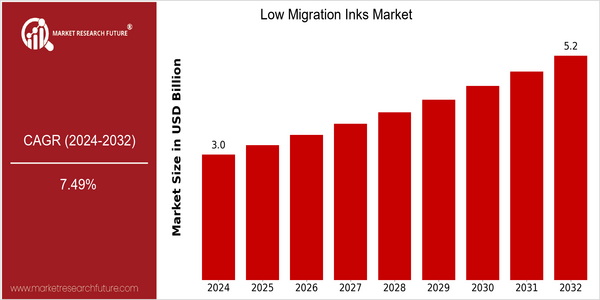
Market Size Snapshot

Year Value
2024 USD 2.95 Billion
2032 USD 5.25 Billion
CAGR (2024-2032) 7.49 %

Note – Market size depicts the revenue generated over the financial year

Low-migration inks market is set to grow at a CAGR of 5.2% between 2024 and 2032. During the forecast period, the market is expected to reach a value of $1.1 billion. The rising demand for low-migration inks is primarily driven by the growing concern for food safety and regulatory compliance in packaging applications, especially in the food and beverage industry. Since the migration of ink into consumables is a matter of concern for manufacturers, the use of low-migration inks is becoming an important part of packaging strategies. The advancements in ink formulation and printing processes are also boosting the market growth. The development of bio-based inks and the improvement in printing technology are enabling companies to achieve high-quality prints while meeting the strictest of safety standards. In addition, the rising R&D spending by market players such as Sun Chem, Siegwerk, and DIC, is resulting in the development of new low-migration ink formulations. These players are also enhancing their market positions through strategic collaborations and acquisitions.
home-ubuntu-www-mrf_ne_design-batch-5-cp-low-migration-inks-market size

Regional Market Size

Regional Deep Dive

The low migration inks market is growing at a significant rate in different regions. The growing consumer awareness of food safety and the stringent regulations on packaging materials are the major factors driving the growth of this market. In North America and Europe, the demand for low migration inks is very high due to the increasing demand for sustainable packaging solutions and the need to comply with the food safety standards. Meanwhile, the rapid industrialization and development of the packaging industry in the Asia-Pacific region will drive the market growth. Each region has its own characteristics influenced by local regulations, cultural preferences, and economic conditions, which will affect the future development of low migration inks.

Europe

  • The European Union's Green Deal and the Circular Economy Action Plan are pushing for sustainable packaging solutions, leading to increased demand for low migration inks that align with these initiatives.
  • Companies such as Flint Group and Siegwerk are actively collaborating with packaging manufacturers to create inks that not only meet regulatory standards but also reduce environmental impact.

Asia Pacific

  • Rapid urbanization and a growing middle class in countries like China and India are driving demand for packaged goods, thereby increasing the need for low migration inks in food and beverage packaging.
  • Local companies are beginning to adopt advanced printing technologies, such as digital printing, which often utilize low migration inks to enhance print quality and safety.

Latin America

  • In Brazil, the National Health Surveillance Agency (ANVISA) is tightening regulations on food packaging, which is driving the adoption of low migration inks among local manufacturers.
  • Emerging companies in the region are beginning to recognize the importance of sustainable packaging, leading to increased investments in low migration ink technologies.

North America

  • The FDA has implemented stricter regulations regarding food packaging, prompting manufacturers to adopt low migration inks to ensure compliance and enhance consumer safety.
  • Key players like Sun Chemical and INX International are investing in R&D to develop innovative low migration ink solutions, which are expected to drive market growth and meet the evolving needs of the packaging industry.

Middle East And Africa

  • The region is witnessing a rise in food safety regulations, particularly in the Gulf Cooperation Council (GCC) countries, which is leading to a greater emphasis on low migration inks in food packaging.
  • Companies like DIC Corporation are expanding their operations in the MEA region, focusing on developing low migration ink solutions tailored to local market needs.

Did You Know?

“Low migration inks are formulated to minimize the transfer of ink components to food products, making them essential for safe food packaging.” — European Printing Ink Association (EuPIA)

Segmental Market Size

The Low-Migration Inks Market is a vital part of the label and packaging industries, especially in the food and pharmaceuticals sectors where safety and compliance are of the utmost importance. This market is currently experiencing growth, as a result of an increased consumer awareness of food safety and stringent regulations aimed at reducing chemical migration from packaging materials. Sun Chem and Flint Group are at the forefront of this market, developing and supplying low-migration ink solutions that meet these demands. Adoption of low-migration inks is already widespread, especially in Europe and North America where regulations such as the European Union’s (EU) Framework Regulation on Food Contact Materials are already in place. The main applications include flexible packaging, labels and cartons, especially in the food and beverage industry, where companies such as Coca-Cola and Nestlé place a high priority on food safety. Moreover, the growing trend for sustainable and eco-friendly packaging solutions is driving the market as companies seek to comply with safety regulations and meet their green goals. Lastly, newer printing methods such as digital and UV-curing are also enhancing efficiency and reducing waste.

Future Outlook

The Low Migration Inks Market is set for substantial growth from 2024 to 2032, with a projected CAGR of 7.49% from $2.95 billion to $5.25 billion. This growth is primarily driven by the rising demand for food safety and regulatory compliance in packaging applications, with consumers and manufacturers putting greater emphasis on safety standards. Industry-wide adoption of low migration inks is expected to increase in the near future, especially in the food and beverage sector. By 2030, it is projected that over 60% of food and beverage packaging will use low migration inks. Meanwhile, technological advancements will also play a crucial role in shaping the future of the low migration inks market. In particular, innovations in ink formulations and printing processes will further enhance the performance and versatility of low migration inks, opening up new applications in the pharmaceutical and cosmetics industries. Moreover, new regulations and policies aimed at reducing the toxic exposure in consumer products will drive the adoption of low migration inks. The growing emphasis on sustainability will also spur the development of inks that use sustainable and eco-friendly materials, in line with the increasing efforts to reduce the impact on the environment. The low migration inks market is set to grow substantially, with a combination of regulatory, technological, and consumer trends putting safety and the environment at the forefront.
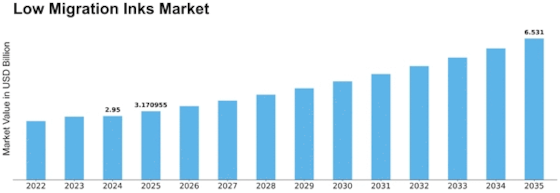

Low Migration Inks Market Size Graph
Author
Chitranshi Jaiswal
Team Lead - Research

Chitranshi is a Team Leader in the Chemicals & Materials (CnM) and Energy & Power (EnP) domains, with 6+ years of experience in market research. She leads and mentors teams to deliver cross-domain projects that equip clients with actionable insights and growth strategies. She is skilled in market estimation, forecasting, competitive benchmarking, and both primary & secondary research, enabling her to turn complex data into decision-ready insights. An engineer and MBA professional, she combines technical expertise with strategic acumen to solve dynamic market challenges. Chitranshi has successfully managed projects that support market entry, investment planning, and competitive positioning, while building strong client relationships. Certified in Advanced Excel & Power BI she leverages data-driven approaches to ensure accuracy, clarity, and impactful outcomes.

Leave a Comment

FAQs

What is the projected market valuation of the Low Migration Inks Market by 2035?

<p>The projected market valuation of the Low Migration Inks Market is expected to reach 6.531 USD Billion by 2035.</p>

What was the market valuation of Low Migration Inks in 2024?

<p>The market valuation of Low Migration Inks was 2.95 USD Billion in 2024.</p>

What is the expected CAGR for the Low Migration Inks Market during the forecast period 2025 - 2035?

<p>The expected CAGR for the Low Migration Inks Market during the forecast period 2025 - 2035 is 7.49%.</p>

Which printing processes are significant in the Low Migration Inks Market?

<p>Flexography and Gravure are significant printing processes, with valuations of 3.95 USD Billion and 2.59 USD Billion projected, respectively.</p>

What are the key end-use industries for Low Migration Inks?

<p>The key end-use industries for Low Migration Inks include Food & Beverage, Pharmaceuticals, and Cosmetics & Personal Care.</p>

How do the valuations for flexible films and corrugated boxes compare in the Low Migration Inks Market?

<p>The projected valuation for flexible films is 2.6 USD Billion, while corrugated boxes are expected to reach 3.93 USD Billion.</p>

Who are the leading players in the Low Migration Inks Market?

Key players in the Low Migration Inks Market include Sun Chemical, Flint Group, and Siegwerk Druckfarben.

What is the projected growth for the Food & Beverage segment in the Low Migration Inks Market?

The Food &amp; Beverage segment is projected to grow to 3.5 USD Billion by 2035.

What is the expected market trend for the Pharmaceuticals segment in the Low Migration Inks Market?

The Pharmaceuticals segment is expected to grow to 1.8 USD Billion by 2035.

How does the growth of the Low Migration Inks Market reflect on consumer safety?

The growth of the Low Migration Inks Market suggests an increasing emphasis on consumer safety, particularly in food packaging and personal care products.

Market Summary

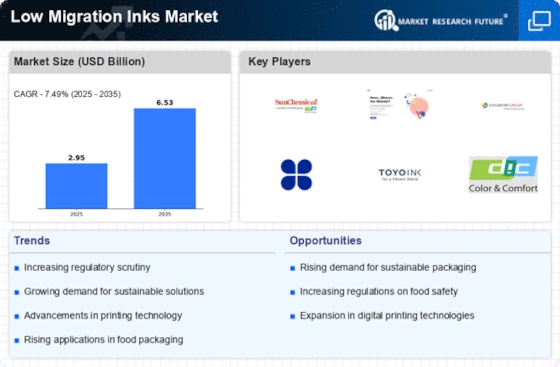
As per Market Research Future analysis, the Low Migration Inks Market Size was estimated at 2.95 USD Billion in 2024. The Low Migration Inks industry is projected to grow from 3.171 USD Billion in 2025 to 6.531 USD Billion by 2035, exhibiting a compound annual growth rate (CAGR) of 7.49% during the forecast period 2025 - 2035

Key Market Trends & Highlights

The Low Migration Inks Market is poised for growth driven by regulatory compliance and sustainability initiatives.

  • North America remains the largest market for low migration inks, reflecting a strong demand in the packaging sector. Asia-Pacific is identified as the fastest-growing region, indicating a shift towards innovative printing solutions. Flexography continues to dominate as the largest segment, while gravure is emerging as the fastest-growing segment in the market. Consumer health awareness and regulatory pressures are key drivers propelling the adoption of low migration inks.

Market Size & Forecast

2024 Market Size 2.95 (USD Billion)
2035 Market Size 6.531 (USD Billion)
CAGR (2025 - 2035) 7.49%
Largest Regional Market Share in 2024 North America

Major Players

Sun Chemical (US), Flint Group (LU), Siegwerk Druckfarben (DE), Huber Group (DE), Toyo Ink (JP), DIC Corporation (JP), INX International Ink Co. (US), Wikoff Color Corporation (US), Zeller+Gmelin (DE)

Market Trends

The Low Migration Inks Market is currently experiencing a notable transformation, driven by increasing consumer awareness regarding food safety and packaging integrity. As industries strive to meet stringent regulations, the demand for inks that minimize the risk of migration into food products appears to be on the rise. This trend is particularly evident in sectors such as food and beverage, where packaging materials must adhere to safety standards. Furthermore, advancements in ink formulation technology suggest that manufacturers are focusing on developing inks that not only comply with regulations but also enhance print quality and durability. In addition, the Low Migration Inks Market is likely to benefit from the growing trend of sustainable packaging solutions. As companies seek to reduce their environmental footprint, the integration of eco-friendly inks into packaging processes may become increasingly prevalent. This shift could lead to a broader acceptance of low migration inks across various applications, including flexible packaging and labels. Overall, the market appears poised for growth, driven by regulatory pressures and a shift towards sustainability in packaging practices.

Regulatory Compliance

The Low Migration Inks Market is influenced by stringent regulations aimed at ensuring consumer safety. As governments implement more rigorous standards, manufacturers are compelled to adopt inks that minimize migration risks. This compliance not only protects consumers but also enhances brand reputation.

Sustainability Initiatives

There is a growing emphasis on sustainable practices within the Low Migration Inks Market trends. Companies are increasingly seeking eco-friendly ink solutions that align with their environmental goals. This trend reflects a broader movement towards reducing waste and promoting responsible sourcing.

Technological Advancements

Innovations in ink formulation are shaping the Low Migration Inks Market. Manufacturers are investing in research and development to create inks that offer superior performance while adhering to safety standards. These advancements may lead to improved print quality and application versatility.

Low Migration Inks Market Market Drivers

Regulatory Pressures

Regulatory pressures play a crucial role in shaping the Low Migration Inks Market. Governments and regulatory bodies are increasingly implementing stringent guidelines to ensure that inks used in food packaging do not pose health risks. For instance, regulations such as the European Union's Framework Regulation on Food Contact Materials mandate that substances used in inks must not migrate into food at harmful levels. This has led to a surge in demand for low migration inks, as companies strive to comply with these regulations. The market is projected to grow significantly, with estimates suggesting a compound annual growth rate of around 12% over the next five years. As compliance becomes non-negotiable, manufacturers are investing in research and development to create inks that meet these evolving standards.

Sustainability Trends

Sustainability trends are increasingly influencing the Low Migration Inks Market. As environmental concerns gain prominence, companies are seeking eco-friendly alternatives to traditional inks. Low migration inks, often derived from renewable resources and designed to minimize waste, align with the sustainability goals of many businesses. The market for sustainable packaging is expected to reach USD 500 billion by 2026, with low migration inks playing a significant role in this transformation. This shift not only addresses environmental issues but also appeals to a growing segment of consumers who prioritize sustainable products. Consequently, manufacturers are likely to enhance their product offerings to include low migration inks that meet both safety and sustainability criteria.

Consumer Health Awareness

The increasing awareness among consumers regarding health and safety is a pivotal driver for the Low Migration Inks Market. As consumers become more informed about the potential risks associated with food packaging and printing materials, there is a growing demand for inks that do not migrate harmful substances into food products. This trend is particularly pronounced in sectors such as food and beverage, where safety standards are stringent. Reports indicate that the demand for low migration inks is expected to rise by approximately 15% annually, reflecting a shift towards safer packaging solutions. Consequently, manufacturers are compelled to innovate and adopt low migration inks to meet consumer expectations and regulatory requirements, thereby enhancing their market position.

Technological Innovations

Technological innovations are driving advancements in the Low Migration Inks Market. The development of new formulations and printing technologies has enabled manufacturers to produce inks that exhibit lower migration properties without compromising on quality. Innovations such as digital printing and advanced curing techniques are enhancing the performance of low migration inks, making them more appealing to various industries, including packaging and labeling. The market is witnessing a shift towards high-performance inks that not only meet safety standards but also offer superior print quality. As a result, the adoption of low migration inks is expected to increase, with market analysts projecting a growth rate of approximately 10% annually as companies embrace these technological advancements.

Rising Demand in Packaging Sector

The rising demand in the packaging sector is a significant driver for the Low Migration Inks Market. With the expansion of e-commerce and retail, the need for safe and effective packaging solutions has surged. Low migration inks are particularly sought after in food packaging, where the risk of chemical migration can compromise product safety. The packaging industry is projected to grow at a rate of 5% annually, with low migration inks becoming a preferred choice for manufacturers aiming to ensure consumer safety. This trend is further supported by the increasing focus on brand integrity and consumer trust, prompting companies to invest in inks that guarantee safety and compliance. As a result, the low migration inks market is likely to experience robust growth in the coming years.

Market Segment Insights

By Printing Process: Flexography (Largest) vs. Gravure (Fastest-Growing)

In the Low Migration Inks Market, Flexography holds a significant market share, positioning itself as the dominant printing process utilized across various applications. This method is preferred for its versatility and applicability in high-speed printing environments, particularly in <a href="https://www.marketresearchfuture.com/reports/packaging-market-10902">packaging</a> and label production. Meanwhile, Gravure is emerging as the fastest-growing segment in this market. Its characteristic of producing high-quality prints with excellent ink transfer efficiency is winning over manufacturers looking for precision in print quality while adhering to low migration standards.

Printing Process: Flexography (Dominant) vs. Gravure (Emerging)

Flexography is currently the dominant printing process in the Low Migration Inks Market, known for its adaptability to various substrates and inks. This method is particularly effective in creating designs on <a href="https://www.marketresearchfuture.com/reports/flexible-packaging-market-1151">flexible packaging</a>, labels, and corrugated containers. It uses a flexible relief plate, ensuring rapid drying times which are essential for maintaining low migration levels. On the other hand, Gravure printing is an emerging technology that is gaining traction due to its ability to produce high-quality images with fine detail, making it ideal for large-scale printing tasks. As food safety regulations tighten, the demand for Gravure inks that meet low migration criteria is increasing, driving its adoption among manufacturers.

By Substrate Type: Corrugated Boxes (Largest) vs. Flexible Films (Fastest-Growing)

In the Low Migration Inks Market, the substrate type segment is prominently divided between corrugated boxes and <a href="https://www.marketresearchfuture.com/reports/flexible-film-market-25540">flexible films</a>. Corrugated boxes hold a significant portion of the market share due to their extensive use in packaging for various sectors like food and consumer goods. This traditional substrate type remains essential for ensuring product safety and brand visibility. On the other hand, flexible films are rapidly gaining traction in the market, driven by the rise of e-commerce and demand for lightweight packaging solutions. As consumer preferences shift towards convenience and sustainability, flexible films are emerging as a viable alternative, contributing to their accelerated growth in the Low Migration Inks Market.

Substrate Type: Corrugated Boxes (Dominant) vs. Flexible Films (Emerging)

Corrugated boxes represent a dominant substrate type in the Low Migration Inks Market, widely appreciated for their robustness and ability to protect products during transit. They are extensively used across various industries, including food and beverages, pharmaceuticals, and consumer products, as they align well with regulatory requirements for low migration inks. Meanwhile, flexible films are emerging rapidly, appealing to environmentally conscious consumers and brands due to their lightweight nature and minimal material use. This segment is witnessing innovation in sustainable materials and printing techniques, capturing interest from sectors focused on reducing their ecological footprint. Together, these two substrate types highlight the evolving dynamics of packaging solutions.

By End-Use Industry: Food & Beverage (Largest) vs. Pharmaceuticals (Fastest-Growing)

The Low Migration Inks Market is predominantly driven by the Food &amp; Beverage industry, which accounts for a significant portion of market share due to its strict packaging regulations and consumer safety concerns. This segment's demand is bolstered by the trend towards sustainable and safe packaging solutions that ensure minimal chemical migration, thus protecting food integrity and consumer health. Conversely, the Pharmaceuticals segment is emerging rapidly as regulatory demands heighten for product labeling and packaging, which influences demand for low migration inks. This growing concern for quality assurance in pharmaceutical packaging is leading to an increased uptake of specialized inks geared towards meeting higher safety standards.

Food &amp; Beverage (Dominant) vs. Pharmaceuticals (Emerging)

In the Low Migration Inks Market, the Food &amp; Beverage sector stands out as the dominant player, primarily driven by stringent health regulations and a growing preference for packaging that guarantees safe consumption. These inks are formulated to minimize chemical transfer, thus preserving food quality and safety standards. On the other hand, the Pharmaceutical industry represents the emerging sector that is gaining momentum due to the rising regulatory framework that demands high-quality and low-risk packaging solutions. The growth in this sector is propelled by an increased focus on patient safety and compliance, pushing manufacturers to adopt inks that adhere to stringent purity specifications.

Get more detailed insights about Low Migration Inks Market Research Report – Forecast to 2035

Regional Insights

North America : Innovation and Sustainability Focus

North America is the largest market for low migration inks, holding approximately 40% of the global market share. The region's growth is driven by stringent regulations on food safety and packaging, alongside increasing consumer demand for sustainable products. The adoption of eco-friendly inks is further propelled by initiatives from regulatory bodies aimed at reducing harmful substances in packaging materials. The United States and Canada are the leading countries in this market, with major players like Sun Chemical and INX International Ink Co. establishing a strong presence. The competitive landscape is characterized by innovation in ink formulations and a focus on compliance with environmental regulations. Companies are investing in R&D to develop inks that meet both performance and safety standards, ensuring a robust market environment.

Europe : Regulatory-Driven Market Growth

Europe is the second-largest market for low migration inks, accounting for approximately 30% of the global market share. The region's growth is significantly influenced by stringent regulations such as the EU's REACH and food contact materials legislation, which mandate the use of safe inks in packaging. This regulatory framework drives demand for low migration inks, as manufacturers seek compliance and consumer safety. Germany, France, and the UK are the leading countries in this market, with key players like Siegwerk Druckfarben and Huber Group actively participating. The competitive landscape is marked by a focus on innovation and sustainability, with companies investing in new technologies to enhance ink performance while adhering to regulatory standards. The presence of established manufacturers and a growing emphasis on eco-friendly solutions further bolster market growth.

Asia-Pacific : Emerging Market with Growth Potential

Asia-Pacific is witnessing rapid growth in the low migration inks market, holding approximately 20% of the global market share. The region's expansion is driven by increasing industrialization, rising disposable incomes, and a growing awareness of food safety standards. Countries like China and India are leading this growth, with a rising demand for safe packaging solutions in the food and beverage sector. Regulatory support for safer packaging materials is also a key driver. China and Japan are the primary markets within this region, with companies like Toyo Ink and DIC Corporation playing significant roles. The competitive landscape is evolving, with local manufacturers emerging alongside established global players. Investments in technology and innovation are crucial as companies strive to meet the growing demand for low migration inks while ensuring compliance with regional regulations.

Middle East and Africa : Developing Market with Opportunities

The Middle East and Africa region is gradually developing its low migration inks market, currently holding about 10% of the global market share. The growth is primarily driven by increasing urbanization, a rise in food packaging needs, and a growing focus on health and safety regulations. Countries like South Africa and the UAE are at the forefront, with a rising demand for compliant packaging solutions. Regulatory frameworks are beginning to evolve, promoting safer ink usage. South Africa and the UAE are the leading markets, with local and international players like Zeller+Gmelin establishing a presence. The competitive landscape is characterized by a mix of established companies and new entrants, focusing on innovation and compliance with emerging regulations. As the market matures, there is significant potential for growth driven by increased consumer awareness and regulatory support.

Key Players and Competitive Insights

The Low Migration Inks Market is characterized by a dynamic competitive landscape, driven by increasing regulatory scrutiny and consumer demand for safer packaging solutions. Key players such as Sun Chemical (US), Flint Group (LU), and Siegwerk Druckfarben (DE) are at the forefront, each adopting distinct strategies to enhance their market positioning. Sun Chemical (US) focuses on innovation, particularly in developing sustainable ink solutions that comply with stringent food safety regulations. Meanwhile, Flint Group (LU) emphasizes regional expansion, targeting emerging markets to capitalize on the growing demand for low migration inks. Siegwerk Druckfarben (DE) is also notable for its commitment to digital transformation, integrating advanced technologies into its production processes to improve efficiency and product quality. Collectively, these strategies contribute to a competitive environment that is increasingly shaped by innovation and regulatory compliance. In terms of business tactics, companies are localizing manufacturing to reduce lead times and optimize supply chains, which is particularly crucial in the context of low migration inks. The market structure appears moderately fragmented, with several key players exerting influence while also facing competition from smaller, specialized firms. This fragmentation allows for a diverse range of products and innovations, although the presence of major players like Sun Chemical and Siegwerk Druckfarben tends to dominate market dynamics. In August 2025, Sun Chemical (US) announced the launch of a new line of low migration inks specifically designed for flexible packaging applications. This strategic move is significant as it not only reinforces Sun Chemical's commitment to sustainability but also addresses the growing demand for safer packaging solutions in the food and beverage sector. By expanding its product portfolio, the company positions itself to capture a larger share of the market, particularly in regions with stringent regulatory requirements. In September 2025, Flint Group (LU) revealed its plans to invest in a new manufacturing facility in Southeast Asia, aimed at enhancing its production capabilities for low migration inks. This investment is indicative of Flint Group's strategy to strengthen its presence in high-growth markets, thereby ensuring a more robust supply chain and improved service delivery. The facility is expected to leverage advanced manufacturing technologies, which could further enhance the company's competitive edge in the region. In July 2025, Siegwerk Druckfarben (DE) entered into a strategic partnership with a leading digital printing technology provider to develop innovative low migration ink solutions. This collaboration is poised to accelerate the integration of digital technologies into Siegwerk's product offerings, allowing for greater customization and efficiency in production. The partnership underscores the importance of technological advancement in maintaining competitiveness within the market. As of October 2025, the Low Migration Inks Market is witnessing trends that emphasize digitalization, sustainability, and the integration of artificial intelligence in production processes. Strategic alliances are increasingly shaping the competitive landscape, enabling companies to leverage complementary strengths and enhance their innovation capabilities. Looking ahead, it appears that competitive differentiation will evolve, shifting from traditional price-based competition to a focus on innovation, technological advancement, and supply chain reliability. This transition may redefine how companies position themselves in the market, ultimately fostering a more sustainable and efficient industry.

Key Companies in the Low Migration Inks Market include

Industry Developments

  • Q2 2024: INX International Launches New Low Migration UV Flexo Inks for Food Packaging INX International announced the commercial launch of a new series of low migration UV flexographic inks designed specifically for food packaging applications, meeting the latest EU and FDA regulatory requirements.
  • Q2 2024: Sun Chemical Expands Low Migration Ink Production Capacity in Europe Sun Chemical revealed the opening of a new production line dedicated to low migration inks at its plant in Germany, aiming to meet growing demand from the European food and pharmaceutical packaging sectors.
  • Q3 2024: Flint Group Introduces Next-Generation Low Migration Offset Inks Flint Group launched a new generation of low migration offset inks, formulated to comply with the latest food safety regulations and to improve print performance for sensitive packaging.
  • Q3 2024: Siegwerk Partners with Packaging Converter for Sustainable Low Migration Ink Solutions Siegwerk announced a strategic partnership with a major European packaging converter to co-develop sustainable low migration ink solutions for food and beverage packaging.
  • Q4 2024: Hubergroup Opens New R&D Center Focused on Low Migration Inks Market Hubergroup inaugurated a new research and development center in Germany dedicated to advancing low migration ink technologies for food and pharmaceutical packaging.
  • Q1 2025: Sakata INX Receives Regulatory Approval for Low Migration Inks Market in Japan Sakata INX announced it has received regulatory approval from Japanese authorities for its latest range of low migration inks, enabling expanded use in domestic food packaging.
  • Q1 2025: DIC Corporation Launches Water-Based Low Migration Inks Market for Flexible Packaging DIC Corporation introduced a new line of water-based low migration inks targeting flexible packaging applications, emphasizing compliance with global food safety standards.
  • Q2 2025: Siegwerk Acquires Stake in Start-Up Specializing in Digital Low Migration Inks Market Siegwerk announced the acquisition of a minority stake in a European start-up focused on digital printing technologies for low migration inks, aiming to accelerate innovation in the sector.

Future Outlook

Low Migration Inks Market Future Outlook

The Low Migration Inks Market size is projected to grow at a 7.49% CAGR from 2024 to 2035, driven by increasing demand for food safety and sustainable packaging solutions.<br>The future outlook for the Low Migration Inks Market is strong, driven by rigorous food safety regulations and the shift toward clean-label packaging. Growth focuses on UV-LED curing formulations, bio-based resins, and advanced digital inkjet integration.

New opportunities lie in:

  • <p>Development of bio-based low migration inks for eco-friendly packaging Investment in advanced printing technologies to enhance ink performance Expansion into emerging markets with tailored product offerings</p>

By 2035, the Low Migration Inks Market share is expected to solidify its position as a leader in sustainable printing solutions.

Market Segmentation

Low Migration Inks Market Substrate Type Outlook

  • Corrugated Boxes
  • Flexible Films

Low Migration Inks Market End-Use Industry Outlook

  • Food & Beverage
  • Pharmaceuticals
  • Cosmetics & Personal Care

Low Migration Inks Market Printing Process Outlook

  • Flexography
  • Gravure

Report Scope

MARKET SIZE 2024 2.95(USD Billion)
MARKET SIZE 2025 3.171(USD Billion)
MARKET SIZE 2035 6.531(USD Billion)
COMPOUND ANNUAL GROWTH RATE (CAGR) 7.49% (2025 - 2035)
REPORT COVERAGE Revenue Forecast, Competitive Landscape, Growth Factors, and Trends
BASE YEAR 2024
Market Forecast Period 2025 - 2035
Historical Data 2019 - 2024
Market Forecast Units USD Billion
Key Companies Profiled Sun Chemical (US), Flint Group (LU), Siegwerk Druckfarben (DE), Huber Group (DE), Toyo Ink (JP), DIC Corporation (JP), INX International Ink Co. (US), Wikoff Color Corporation (US), Zeller+Gmelin (DE)
Segments Covered Printing Process, Substrate Type, End-Use Industry, Region
Key Market Opportunities Growing demand for food-safe packaging drives innovation in Low Migration Inks Market.
Key Market Dynamics Rising regulatory standards drive demand for low migration inks in food packaging and sensitive applications.
Countries Covered North America, Europe, APAC, South America, MEA

FAQs

What is the projected market valuation of the Low Migration Inks Market by 2035?

<p>The projected market valuation of the Low Migration Inks Market is expected to reach 6.531 USD Billion by 2035.</p>

What was the market valuation of Low Migration Inks in 2024?

<p>The market valuation of Low Migration Inks was 2.95 USD Billion in 2024.</p>

What is the expected CAGR for the Low Migration Inks Market during the forecast period 2025 - 2035?

<p>The expected CAGR for the Low Migration Inks Market during the forecast period 2025 - 2035 is 7.49%.</p>

Which printing processes are significant in the Low Migration Inks Market?

<p>Flexography and Gravure are significant printing processes, with valuations of 3.95 USD Billion and 2.59 USD Billion projected, respectively.</p>

What are the key end-use industries for Low Migration Inks?

<p>The key end-use industries for Low Migration Inks include Food & Beverage, Pharmaceuticals, and Cosmetics & Personal Care.</p>

How do the valuations for flexible films and corrugated boxes compare in the Low Migration Inks Market?

<p>The projected valuation for flexible films is 2.6 USD Billion, while corrugated boxes are expected to reach 3.93 USD Billion.</p>

Who are the leading players in the Low Migration Inks Market?

Key players in the Low Migration Inks Market include Sun Chemical, Flint Group, and Siegwerk Druckfarben.

What is the projected growth for the Food & Beverage segment in the Low Migration Inks Market?

The Food &amp; Beverage segment is projected to grow to 3.5 USD Billion by 2035.

What is the expected market trend for the Pharmaceuticals segment in the Low Migration Inks Market?

The Pharmaceuticals segment is expected to grow to 1.8 USD Billion by 2035.

How does the growth of the Low Migration Inks Market reflect on consumer safety?

The growth of the Low Migration Inks Market suggests an increasing emphasis on consumer safety, particularly in food packaging and personal care products.

  1. SECTION I: EXECUTIVE SUMMARY AND KEY HIGHLIGHTS
    1. | 1.1 EXECUTIVE SUMMARY
    2. | | 1.1.1 Market Overview
    3. | | 1.1.2 Key Findings
    4. | | 1.1.3 Market Segmentation
    5. | | 1.1.4 Competitive Landscape
    6. | | 1.1.5 Challenges and Opportunities
    7. | | 1.1.6 Future Outlook
  2. SECTION II: SCOPING, METHODOLOGY AND MARKET STRUCTURE
    1. | 2.1 MARKET INTRODUCTION
    2. | | 2.1.1 Definition
    3. | | 2.1.2 Scope of the study
    4. | | | 2.1.2.1 Research Objective
    5. | | | 2.1.2.2 Assumption
    6. | | | 2.1.2.3 Limitations
    7. | 2.2 RESEARCH METHODOLOGY
    8. | | 2.2.1 Overview
    9. | | 2.2.2 Data Mining
    10. | | 2.2.3 Secondary Research
    11. | | 2.2.4 Primary Research
    12. | | | 2.2.4.1 Primary Interviews and Information Gathering Process
    13. | | | 2.2.4.2 Breakdown of Primary Respondents
    14. | | 2.2.5 Forecasting Model
    15. | | 2.2.6 Market Size Estimation
    16. | | | 2.2.6.1 Bottom-Up Approach
    17. | | | 2.2.6.2 Top-Down Approach
    18. | | 2.2.7 Data Triangulation
    19. | | 2.2.8 Validation
  3. SECTION III: QUALITATIVE ANALYSIS
    1. | 3.1 MARKET DYNAMICS
    2. | | 3.1.1 Overview
    3. | | 3.1.2 Drivers
    4. | | 3.1.3 Restraints
    5. | | 3.1.4 Opportunities
    6. | 3.2 MARKET FACTOR ANALYSIS
    7. | | 3.2.1 Value chain Analysis
    8. | | 3.2.2 Porter's Five Forces Analysis
    9. | | | 3.2.2.1 Bargaining Power of Suppliers
    10. | | | 3.2.2.2 Bargaining Power of Buyers
    11. | | | 3.2.2.3 Threat of New Entrants
    12. | | | 3.2.2.4 Threat of Substitutes
    13. | | | 3.2.2.5 Intensity of Rivalry
    14. | | 3.2.3 COVID-19 Impact Analysis
    15. | | | 3.2.3.1 Market Impact Analysis
    16. | | | 3.2.3.2 Regional Impact
    17. | | | 3.2.3.3 Opportunity and Threat Analysis
  4. SECTION IV: QUANTITATIVE ANALYSIS
    1. | 4.1 Chemicals and Materials, BY Printing Process (USD Billion)
    2. | | 4.1.1 Flexography
    3. | | 4.1.2 Gravure
    4. | 4.2 Chemicals and Materials, BY Substrate Type (USD Billion)
    5. | | 4.2.1 Corrugated Boxes
    6. | | 4.2.2 Flexible Films
    7. | 4.3 Chemicals and Materials, BY End-Use Industry (USD Billion)
    8. | | 4.3.1 Food & Beverage
    9. | | 4.3.2 Pharmaceuticals
    10. | | 4.3.3 Cosmetics & Personal Care
    11. | 4.4 Chemicals and Materials, BY Region (USD Billion)
    12. | | 4.4.1 North America
    13. | | | 4.4.1.1 US
    14. | | | 4.4.1.2 Canada
    15. | | 4.4.2 Europe
    16. | | | 4.4.2.1 Germany
    17. | | | 4.4.2.2 UK
    18. | | | 4.4.2.3 France
    19. | | | 4.4.2.4 Russia
    20. | | | 4.4.2.5 Italy
    21. | | | 4.4.2.6 Spain
    22. | | | 4.4.2.7 Rest of Europe
    23. | | 4.4.3 APAC
    24. | | | 4.4.3.1 China
    25. | | | 4.4.3.2 India
    26. | | | 4.4.3.3 Japan
    27. | | | 4.4.3.4 South Korea
    28. | | | 4.4.3.5 Malaysia
    29. | | | 4.4.3.6 Thailand
    30. | | | 4.4.3.7 Indonesia
    31. | | | 4.4.3.8 Rest of APAC
    32. | | 4.4.4 South America
    33. | | | 4.4.4.1 Brazil
    34. | | | 4.4.4.2 Mexico
    35. | | | 4.4.4.3 Argentina
    36. | | | 4.4.4.4 Rest of South America
    37. | | 4.4.5 MEA
    38. | | | 4.4.5.1 GCC Countries
    39. | | | 4.4.5.2 South Africa
    40. | | | 4.4.5.3 Rest of MEA
  5. SECTION V: COMPETITIVE ANALYSIS
    1. | 5.1 Competitive Landscape
    2. | | 5.1.1 Overview
    3. | | 5.1.2 Competitive Analysis
    4. | | 5.1.3 Market share Analysis
    5. | | 5.1.4 Major Growth Strategy in the Chemicals and Materials
    6. | | 5.1.5 Competitive Benchmarking
    7. | | 5.1.6 Leading Players in Terms of Number of Developments in the Chemicals and Materials
    8. | | 5.1.7 Key developments and growth strategies
    9. | | | 5.1.7.1 New Product Launch/Service Deployment
    10. | | | 5.1.7.2 Merger & Acquisitions
    11. | | | 5.1.7.3 Joint Ventures
    12. | | 5.1.8 Major Players Financial Matrix
    13. | | | 5.1.8.1 Sales and Operating Income
    14. | | | 5.1.8.2 Major Players R&D Expenditure. 2023
    15. | 5.2 Company Profiles
    16. | | 5.2.1 Sun Chemical (US)
    17. | | | 5.2.1.1 Financial Overview
    18. | | | 5.2.1.2 Products Offered
    19. | | | 5.2.1.3 Key Developments
    20. | | | 5.2.1.4 SWOT Analysis
    21. | | | 5.2.1.5 Key Strategies
    22. | | 5.2.2 Flint Group (LU)
    23. | | | 5.2.2.1 Financial Overview
    24. | | | 5.2.2.2 Products Offered
    25. | | | 5.2.2.3 Key Developments
    26. | | | 5.2.2.4 SWOT Analysis
    27. | | | 5.2.2.5 Key Strategies
    28. | | 5.2.3 Siegwerk Druckfarben (DE)
    29. | | | 5.2.3.1 Financial Overview
    30. | | | 5.2.3.2 Products Offered
    31. | | | 5.2.3.3 Key Developments
    32. | | | 5.2.3.4 SWOT Analysis
    33. | | | 5.2.3.5 Key Strategies
    34. | | 5.2.4 Huber Group (DE)
    35. | | | 5.2.4.1 Financial Overview
    36. | | | 5.2.4.2 Products Offered
    37. | | | 5.2.4.3 Key Developments
    38. | | | 5.2.4.4 SWOT Analysis
    39. | | | 5.2.4.5 Key Strategies
    40. | | 5.2.5 Toyo Ink (JP)
    41. | | | 5.2.5.1 Financial Overview
    42. | | | 5.2.5.2 Products Offered
    43. | | | 5.2.5.3 Key Developments
    44. | | | 5.2.5.4 SWOT Analysis
    45. | | | 5.2.5.5 Key Strategies
    46. | | 5.2.6 DIC Corporation (JP)
    47. | | | 5.2.6.1 Financial Overview
    48. | | | 5.2.6.2 Products Offered
    49. | | | 5.2.6.3 Key Developments
    50. | | | 5.2.6.4 SWOT Analysis
    51. | | | 5.2.6.5 Key Strategies
    52. | | 5.2.7 INX International Ink Co. (US)
    53. | | | 5.2.7.1 Financial Overview
    54. | | | 5.2.7.2 Products Offered
    55. | | | 5.2.7.3 Key Developments
    56. | | | 5.2.7.4 SWOT Analysis
    57. | | | 5.2.7.5 Key Strategies
    58. | | 5.2.8 Wikoff Color Corporation (US)
    59. | | | 5.2.8.1 Financial Overview
    60. | | | 5.2.8.2 Products Offered
    61. | | | 5.2.8.3 Key Developments
    62. | | | 5.2.8.4 SWOT Analysis
    63. | | | 5.2.8.5 Key Strategies
    64. | | 5.2.9 Zeller+Gmelin (DE)
    65. | | | 5.2.9.1 Financial Overview
    66. | | | 5.2.9.2 Products Offered
    67. | | | 5.2.9.3 Key Developments
    68. | | | 5.2.9.4 SWOT Analysis
    69. | | | 5.2.9.5 Key Strategies
    70. | 5.3 Appendix
    71. | | 5.3.1 References
    72. | | 5.3.2 Related Reports
  6. LIST OF FIGURES
    1. | 6.1 MARKET SYNOPSIS
    2. | 6.2 NORTH AMERICA MARKET ANALYSIS
    3. | 6.3 US MARKET ANALYSIS BY PRINTING PROCESS
    4. | 6.4 US MARKET ANALYSIS BY SUBSTRATE TYPE
    5. | 6.5 US MARKET ANALYSIS BY END-USE INDUSTRY
    6. | 6.6 CANADA MARKET ANALYSIS BY PRINTING PROCESS
    7. | 6.7 CANADA MARKET ANALYSIS BY SUBSTRATE TYPE
    8. | 6.8 CANADA MARKET ANALYSIS BY END-USE INDUSTRY
    9. | 6.9 EUROPE MARKET ANALYSIS
    10. | 6.10 GERMANY MARKET ANALYSIS BY PRINTING PROCESS
    11. | 6.11 GERMANY MARKET ANALYSIS BY SUBSTRATE TYPE
    12. | 6.12 GERMANY MARKET ANALYSIS BY END-USE INDUSTRY
    13. | 6.13 UK MARKET ANALYSIS BY PRINTING PROCESS
    14. | 6.14 UK MARKET ANALYSIS BY SUBSTRATE TYPE
    15. | 6.15 UK MARKET ANALYSIS BY END-USE INDUSTRY
    16. | 6.16 FRANCE MARKET ANALYSIS BY PRINTING PROCESS
    17. | 6.17 FRANCE MARKET ANALYSIS BY SUBSTRATE TYPE
    18. | 6.18 FRANCE MARKET ANALYSIS BY END-USE INDUSTRY
    19. | 6.19 RUSSIA MARKET ANALYSIS BY PRINTING PROCESS
    20. | 6.20 RUSSIA MARKET ANALYSIS BY SUBSTRATE TYPE
    21. | 6.21 RUSSIA MARKET ANALYSIS BY END-USE INDUSTRY
    22. | 6.22 ITALY MARKET ANALYSIS BY PRINTING PROCESS
    23. | 6.23 ITALY MARKET ANALYSIS BY SUBSTRATE TYPE
    24. | 6.24 ITALY MARKET ANALYSIS BY END-USE INDUSTRY
    25. | 6.25 SPAIN MARKET ANALYSIS BY PRINTING PROCESS
    26. | 6.26 SPAIN MARKET ANALYSIS BY SUBSTRATE TYPE
    27. | 6.27 SPAIN MARKET ANALYSIS BY END-USE INDUSTRY
    28. | 6.28 REST OF EUROPE MARKET ANALYSIS BY PRINTING PROCESS
    29. | 6.29 REST OF EUROPE MARKET ANALYSIS BY SUBSTRATE TYPE
    30. | 6.30 REST OF EUROPE MARKET ANALYSIS BY END-USE INDUSTRY
    31. | 6.31 APAC MARKET ANALYSIS
    32. | 6.32 CHINA MARKET ANALYSIS BY PRINTING PROCESS
    33. | 6.33 CHINA MARKET ANALYSIS BY SUBSTRATE TYPE
    34. | 6.34 CHINA MARKET ANALYSIS BY END-USE INDUSTRY
    35. | 6.35 INDIA MARKET ANALYSIS BY PRINTING PROCESS
    36. | 6.36 INDIA MARKET ANALYSIS BY SUBSTRATE TYPE
    37. | 6.37 INDIA MARKET ANALYSIS BY END-USE INDUSTRY
    38. | 6.38 JAPAN MARKET ANALYSIS BY PRINTING PROCESS
    39. | 6.39 JAPAN MARKET ANALYSIS BY SUBSTRATE TYPE
    40. | 6.40 JAPAN MARKET ANALYSIS BY END-USE INDUSTRY
    41. | 6.41 SOUTH KOREA MARKET ANALYSIS BY PRINTING PROCESS
    42. | 6.42 SOUTH KOREA MARKET ANALYSIS BY SUBSTRATE TYPE
    43. | 6.43 SOUTH KOREA MARKET ANALYSIS BY END-USE INDUSTRY
    44. | 6.44 MALAYSIA MARKET ANALYSIS BY PRINTING PROCESS
    45. | 6.45 MALAYSIA MARKET ANALYSIS BY SUBSTRATE TYPE
    46. | 6.46 MALAYSIA MARKET ANALYSIS BY END-USE INDUSTRY
    47. | 6.47 THAILAND MARKET ANALYSIS BY PRINTING PROCESS
    48. | 6.48 THAILAND MARKET ANALYSIS BY SUBSTRATE TYPE
    49. | 6.49 THAILAND MARKET ANALYSIS BY END-USE INDUSTRY
    50. | 6.50 INDONESIA MARKET ANALYSIS BY PRINTING PROCESS
    51. | 6.51 INDONESIA MARKET ANALYSIS BY SUBSTRATE TYPE
    52. | 6.52 INDONESIA MARKET ANALYSIS BY END-USE INDUSTRY
    53. | 6.53 REST OF APAC MARKET ANALYSIS BY PRINTING PROCESS
    54. | 6.54 REST OF APAC MARKET ANALYSIS BY SUBSTRATE TYPE
    55. | 6.55 REST OF APAC MARKET ANALYSIS BY END-USE INDUSTRY
    56. | 6.56 SOUTH AMERICA MARKET ANALYSIS
    57. | 6.57 BRAZIL MARKET ANALYSIS BY PRINTING PROCESS
    58. | 6.58 BRAZIL MARKET ANALYSIS BY SUBSTRATE TYPE
    59. | 6.59 BRAZIL MARKET ANALYSIS BY END-USE INDUSTRY
    60. | 6.60 MEXICO MARKET ANALYSIS BY PRINTING PROCESS
    61. | 6.61 MEXICO MARKET ANALYSIS BY SUBSTRATE TYPE
    62. | 6.62 MEXICO MARKET ANALYSIS BY END-USE INDUSTRY
    63. | 6.63 ARGENTINA MARKET ANALYSIS BY PRINTING PROCESS
    64. | 6.64 ARGENTINA MARKET ANALYSIS BY SUBSTRATE TYPE
    65. | 6.65 ARGENTINA MARKET ANALYSIS BY END-USE INDUSTRY
    66. | 6.66 REST OF SOUTH AMERICA MARKET ANALYSIS BY PRINTING PROCESS
    67. | 6.67 REST OF SOUTH AMERICA MARKET ANALYSIS BY SUBSTRATE TYPE
    68. | 6.68 REST OF SOUTH AMERICA MARKET ANALYSIS BY END-USE INDUSTRY
    69. | 6.69 MEA MARKET ANALYSIS
    70. | 6.70 GCC COUNTRIES MARKET ANALYSIS BY PRINTING PROCESS
    71. | 6.71 GCC COUNTRIES MARKET ANALYSIS BY SUBSTRATE TYPE
    72. | 6.72 GCC COUNTRIES MARKET ANALYSIS BY END-USE INDUSTRY
    73. | 6.73 SOUTH AFRICA MARKET ANALYSIS BY PRINTING PROCESS
    74. | 6.74 SOUTH AFRICA MARKET ANALYSIS BY SUBSTRATE TYPE
    75. | 6.75 SOUTH AFRICA MARKET ANALYSIS BY END-USE INDUSTRY
    76. | 6.76 REST OF MEA MARKET ANALYSIS BY PRINTING PROCESS
    77. | 6.77 REST OF MEA MARKET ANALYSIS BY SUBSTRATE TYPE
    78. | 6.78 REST OF MEA MARKET ANALYSIS BY END-USE INDUSTRY
    79. | 6.79 KEY BUYING CRITERIA OF CHEMICALS AND MATERIALS
    80. | 6.80 RESEARCH PROCESS OF MRFR
    81. | 6.81 DRO ANALYSIS OF CHEMICALS AND MATERIALS
    82. | 6.82 DRIVERS IMPACT ANALYSIS: CHEMICALS AND MATERIALS
    83. | 6.83 RESTRAINTS IMPACT ANALYSIS: CHEMICALS AND MATERIALS
    84. | 6.84 SUPPLY / VALUE CHAIN: CHEMICALS AND MATERIALS
    85. | 6.85 CHEMICALS AND MATERIALS, BY PRINTING PROCESS, 2024 (% SHARE)
    86. | 6.86 CHEMICALS AND MATERIALS, BY PRINTING PROCESS, 2024 TO 2035 (USD Billion)
    87. | 6.87 CHEMICALS AND MATERIALS, BY SUBSTRATE TYPE, 2024 (% SHARE)
    88. | 6.88 CHEMICALS AND MATERIALS, BY SUBSTRATE TYPE, 2024 TO 2035 (USD Billion)
    89. | 6.89 CHEMICALS AND MATERIALS, BY END-USE INDUSTRY, 2024 (% SHARE)
    90. | 6.90 CHEMICALS AND MATERIALS, BY END-USE INDUSTRY, 2024 TO 2035 (USD Billion)
    91. | 6.91 BENCHMARKING OF MAJOR COMPETITORS
  7. LIST OF TABLES
    1. | 7.1 LIST OF ASSUMPTIONS
    2. | | 7.1.1
    3. | 7.2 North America MARKET SIZE ESTIMATES; FORECAST
    4. | | 7.2.1 BY PRINTING PROCESS, 2025-2035 (USD Billion)
    5. | | 7.2.2 BY SUBSTRATE TYPE, 2025-2035 (USD Billion)
    6. | | 7.2.3 BY END-USE INDUSTRY, 2025-2035 (USD Billion)
    7. | 7.3 US MARKET SIZE ESTIMATES; FORECAST
    8. | | 7.3.1 BY PRINTING PROCESS, 2025-2035 (USD Billion)
    9. | | 7.3.2 BY SUBSTRATE TYPE, 2025-2035 (USD Billion)
    10. | | 7.3.3 BY END-USE INDUSTRY, 2025-2035 (USD Billion)
    11. | 7.4 Canada MARKET SIZE ESTIMATES; FORECAST
    12. | | 7.4.1 BY PRINTING PROCESS, 2025-2035 (USD Billion)
    13. | | 7.4.2 BY SUBSTRATE TYPE, 2025-2035 (USD Billion)
    14. | | 7.4.3 BY END-USE INDUSTRY, 2025-2035 (USD Billion)
    15. | 7.5 Europe MARKET SIZE ESTIMATES; FORECAST
    16. | | 7.5.1 BY PRINTING PROCESS, 2025-2035 (USD Billion)
    17. | | 7.5.2 BY SUBSTRATE TYPE, 2025-2035 (USD Billion)
    18. | | 7.5.3 BY END-USE INDUSTRY, 2025-2035 (USD Billion)
    19. | 7.6 Germany MARKET SIZE ESTIMATES; FORECAST
    20. | | 7.6.1 BY PRINTING PROCESS, 2025-2035 (USD Billion)
    21. | | 7.6.2 BY SUBSTRATE TYPE, 2025-2035 (USD Billion)
    22. | | 7.6.3 BY END-USE INDUSTRY, 2025-2035 (USD Billion)
    23. | 7.7 UK MARKET SIZE ESTIMATES; FORECAST
    24. | | 7.7.1 BY PRINTING PROCESS, 2025-2035 (USD Billion)
    25. | | 7.7.2 BY SUBSTRATE TYPE, 2025-2035 (USD Billion)
    26. | | 7.7.3 BY END-USE INDUSTRY, 2025-2035 (USD Billion)
    27. | 7.8 France MARKET SIZE ESTIMATES; FORECAST
    28. | | 7.8.1 BY PRINTING PROCESS, 2025-2035 (USD Billion)
    29. | | 7.8.2 BY SUBSTRATE TYPE, 2025-2035 (USD Billion)
    30. | | 7.8.3 BY END-USE INDUSTRY, 2025-2035 (USD Billion)
    31. | 7.9 Russia MARKET SIZE ESTIMATES; FORECAST
    32. | | 7.9.1 BY PRINTING PROCESS, 2025-2035 (USD Billion)
    33. | | 7.9.2 BY SUBSTRATE TYPE, 2025-2035 (USD Billion)
    34. | | 7.9.3 BY END-USE INDUSTRY, 2025-2035 (USD Billion)
    35. | 7.10 Italy MARKET SIZE ESTIMATES; FORECAST
    36. | | 7.10.1 BY PRINTING PROCESS, 2025-2035 (USD Billion)
    37. | | 7.10.2 BY SUBSTRATE TYPE, 2025-2035 (USD Billion)
    38. | | 7.10.3 BY END-USE INDUSTRY, 2025-2035 (USD Billion)
    39. | 7.11 Spain MARKET SIZE ESTIMATES; FORECAST
    40. | | 7.11.1 BY PRINTING PROCESS, 2025-2035 (USD Billion)
    41. | | 7.11.2 BY SUBSTRATE TYPE, 2025-2035 (USD Billion)
    42. | | 7.11.3 BY END-USE INDUSTRY, 2025-2035 (USD Billion)
    43. | 7.12 Rest of Europe MARKET SIZE ESTIMATES; FORECAST
    44. | | 7.12.1 BY PRINTING PROCESS, 2025-2035 (USD Billion)
    45. | | 7.12.2 BY SUBSTRATE TYPE, 2025-2035 (USD Billion)
    46. | | 7.12.3 BY END-USE INDUSTRY, 2025-2035 (USD Billion)
    47. | 7.13 APAC MARKET SIZE ESTIMATES; FORECAST
    48. | | 7.13.1 BY PRINTING PROCESS, 2025-2035 (USD Billion)
    49. | | 7.13.2 BY SUBSTRATE TYPE, 2025-2035 (USD Billion)
    50. | | 7.13.3 BY END-USE INDUSTRY, 2025-2035 (USD Billion)
    51. | 7.14 China MARKET SIZE ESTIMATES; FORECAST
    52. | | 7.14.1 BY PRINTING PROCESS, 2025-2035 (USD Billion)
    53. | | 7.14.2 BY SUBSTRATE TYPE, 2025-2035 (USD Billion)
    54. | | 7.14.3 BY END-USE INDUSTRY, 2025-2035 (USD Billion)
    55. | 7.15 India MARKET SIZE ESTIMATES; FORECAST
    56. | | 7.15.1 BY PRINTING PROCESS, 2025-2035 (USD Billion)
    57. | | 7.15.2 BY SUBSTRATE TYPE, 2025-2035 (USD Billion)
    58. | | 7.15.3 BY END-USE INDUSTRY, 2025-2035 (USD Billion)
    59. | 7.16 Japan MARKET SIZE ESTIMATES; FORECAST
    60. | | 7.16.1 BY PRINTING PROCESS, 2025-2035 (USD Billion)
    61. | | 7.16.2 BY SUBSTRATE TYPE, 2025-2035 (USD Billion)
    62. | | 7.16.3 BY END-USE INDUSTRY, 2025-2035 (USD Billion)
    63. | 7.17 South Korea MARKET SIZE ESTIMATES; FORECAST
    64. | | 7.17.1 BY PRINTING PROCESS, 2025-2035 (USD Billion)
    65. | | 7.17.2 BY SUBSTRATE TYPE, 2025-2035 (USD Billion)
    66. | | 7.17.3 BY END-USE INDUSTRY, 2025-2035 (USD Billion)
    67. | 7.18 Malaysia MARKET SIZE ESTIMATES; FORECAST
    68. | | 7.18.1 BY PRINTING PROCESS, 2025-2035 (USD Billion)
    69. | | 7.18.2 BY SUBSTRATE TYPE, 2025-2035 (USD Billion)
    70. | | 7.18.3 BY END-USE INDUSTRY, 2025-2035 (USD Billion)
    71. | 7.19 Thailand MARKET SIZE ESTIMATES; FORECAST
    72. | | 7.19.1 BY PRINTING PROCESS, 2025-2035 (USD Billion)
    73. | | 7.19.2 BY SUBSTRATE TYPE, 2025-2035 (USD Billion)
    74. | | 7.19.3 BY END-USE INDUSTRY, 2025-2035 (USD Billion)
    75. | 7.20 Indonesia MARKET SIZE ESTIMATES; FORECAST
    76. | | 7.20.1 BY PRINTING PROCESS, 2025-2035 (USD Billion)
    77. | | 7.20.2 BY SUBSTRATE TYPE, 2025-2035 (USD Billion)
    78. | | 7.20.3 BY END-USE INDUSTRY, 2025-2035 (USD Billion)
    79. | 7.21 Rest of APAC MARKET SIZE ESTIMATES; FORECAST
    80. | | 7.21.1 BY PRINTING PROCESS, 2025-2035 (USD Billion)
    81. | | 7.21.2 BY SUBSTRATE TYPE, 2025-2035 (USD Billion)
    82. | | 7.21.3 BY END-USE INDUSTRY, 2025-2035 (USD Billion)
    83. | 7.22 South America MARKET SIZE ESTIMATES; FORECAST
    84. | | 7.22.1 BY PRINTING PROCESS, 2025-2035 (USD Billion)
    85. | | 7.22.2 BY SUBSTRATE TYPE, 2025-2035 (USD Billion)
    86. | | 7.22.3 BY END-USE INDUSTRY, 2025-2035 (USD Billion)
    87. | 7.23 Brazil MARKET SIZE ESTIMATES; FORECAST
    88. | | 7.23.1 BY PRINTING PROCESS, 2025-2035 (USD Billion)
    89. | | 7.23.2 BY SUBSTRATE TYPE, 2025-2035 (USD Billion)
    90. | | 7.23.3 BY END-USE INDUSTRY, 2025-2035 (USD Billion)
    91. | 7.24 Mexico MARKET SIZE ESTIMATES; FORECAST
    92. | | 7.24.1 BY PRINTING PROCESS, 2025-2035 (USD Billion)
    93. | | 7.24.2 BY SUBSTRATE TYPE, 2025-2035 (USD Billion)
    94. | | 7.24.3 BY END-USE INDUSTRY, 2025-2035 (USD Billion)
    95. | 7.25 Argentina MARKET SIZE ESTIMATES; FORECAST
    96. | | 7.25.1 BY PRINTING PROCESS, 2025-2035 (USD Billion)
    97. | | 7.25.2 BY SUBSTRATE TYPE, 2025-2035 (USD Billion)
    98. | | 7.25.3 BY END-USE INDUSTRY, 2025-2035 (USD Billion)
    99. | 7.26 Rest of South America MARKET SIZE ESTIMATES; FORECAST
    100. | | 7.26.1 BY PRINTING PROCESS, 2025-2035 (USD Billion)
    101. | | 7.26.2 BY SUBSTRATE TYPE, 2025-2035 (USD Billion)
    102. | | 7.26.3 BY END-USE INDUSTRY, 2025-2035 (USD Billion)
    103. | 7.27 MEA MARKET SIZE ESTIMATES; FORECAST
    104. | | 7.27.1 BY PRINTING PROCESS, 2025-2035 (USD Billion)
    105. | | 7.27.2 BY SUBSTRATE TYPE, 2025-2035 (USD Billion)
    106. | | 7.27.3 BY END-USE INDUSTRY, 2025-2035 (USD Billion)
    107. | 7.28 GCC Countries MARKET SIZE ESTIMATES; FORECAST
    108. | | 7.28.1 BY PRINTING PROCESS, 2025-2035 (USD Billion)
    109. | | 7.28.2 BY SUBSTRATE TYPE, 2025-2035 (USD Billion)
    110. | | 7.28.3 BY END-USE INDUSTRY, 2025-2035 (USD Billion)
    111. | 7.29 South Africa MARKET SIZE ESTIMATES; FORECAST
    112. | | 7.29.1 BY PRINTING PROCESS, 2025-2035 (USD Billion)
    113. | | 7.29.2 BY SUBSTRATE TYPE, 2025-2035 (USD Billion)
    114. | | 7.29.3 BY END-USE INDUSTRY, 2025-2035 (USD Billion)
    115. | 7.30 Rest of MEA MARKET SIZE ESTIMATES; FORECAST
    116. | | 7.30.1 BY PRINTING PROCESS, 2025-2035 (USD Billion)
    117. | | 7.30.2 BY SUBSTRATE TYPE, 2025-2035 (USD Billion)
    118. | | 7.30.3 BY END-USE INDUSTRY, 2025-2035 (USD Billion)
    119. | 7.31 PRODUCT LAUNCH/PRODUCT DEVELOPMENT/APPROVAL
    120. | | 7.31.1
    121. | 7.32 ACQUISITION/PARTNERSHIP
    122. | | 7.32.1

Chemicals and Materials Market Segmentation

Chemicals and Materials By Printing Process (USD Billion, 2025-2035)

  • Flexography
  • Gravure

Chemicals and Materials By Substrate Type (USD Billion, 2025-2035)

  • Corrugated Boxes
  • Flexible Films

Chemicals and Materials By End-Use Industry (USD Billion, 2025-2035)

  • Food & Beverage
  • Pharmaceuticals
  • Cosmetics & Personal Care
Infographic

Free Sample Request

Kindly complete the form below to receive a free sample of this Report

Get Free Sample

Customer Strories

Compare Licence

×
Features License Type
Single User Multiuser License Enterprise User
Price $4,950 $5,950 $7,250
Maximum User Access Limit 1 User Upto 10 Users Unrestricted Access Throughout the Organization
Free Customization
Direct Access to Analyst
Deliverable Format
Platform Access
Discount on Next Purchase 10% 15% 15%
Printable Versions