Request Free Sample ×

Kindly complete the form below to receive a free sample of this Report

* Please use a valid business email

Leading companies partner with us for data-driven Insights

clients tt-cursor
Hero Background
English
Chinese
French
Japanese
Korean
German
Spanish

Life Science Analytics Market Analysis

ID: MRFR/HC/7098-HCR
200 Pages
Satyendra Maurya
March 2026

Life Science Analytics Market Research Report: Size, Share, Trend Analysis By Applications (Drug Discovery, Clinical Trials, Genomic Data Analysis, Sales and Marketing Analytics, Regulatory Compliance), By Types (Descriptive Analytics, Predictive Analytics, Prescriptive Analytics, Cognitive Analytics), By Deployment Mode (On-premise, Cloud-based, Hybrid), By End Users (Pharmaceutical Companies, Biotechnology Companies, Contract Research Organizations, Academic Institutions) and By Regional (North America, Europe, South America, Asia Pacific, Middle East and Africa) - Growth Outlook & Industry Forecast 2025 To 2035

Share:
Download PDF ×

We do not share your information with anyone. However, we may send you emails based on your report interest from time to time. You may contact us at any time to opt-out.

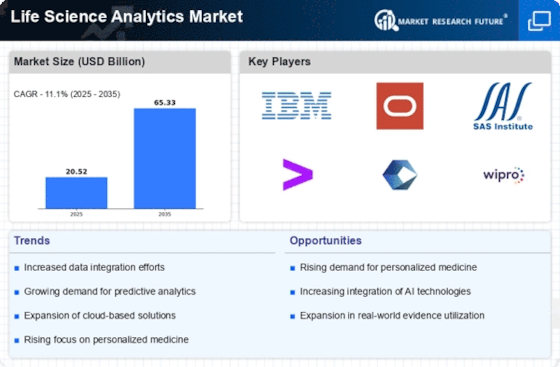
Life Science Analytics Market Infographic
Purchase Options

Market Analysis

In-depth Analysis of Life Science Analytics Market Industry Landscape

Data in the life sciences is growing exponentially, boosting need for life science analytics. Advanced analytics are needed to understand the flood of scientific, clinical, and biological data affecting market dynamics. Big data analytics has transformed life sciences research and market dynamics. Analytics technologies that examine large datasets may help researchers and healthcare professionals identify patterns, correlations, and forecasts. The life science analytics industry is affected by genetics and molecular biology discoveries driving demand in personalized healthcare. Analytics solutions are needed to analyze patient data and adapt therapies, which affects market growth. Life science analytics are essential for medication development and discovery efficiency. Advanced analytics techniques in the pharmaceutical industry help identify drug candidates, anticipate clinical trial outcomes, and improve decision-making, influencing market dynamics. The necessity for real-time healthcare analytics has changed the life science analytics sector. Researchers and doctors are using analytics technologies to acquire instant insights and make faster decisions to enhance patient care. Life science analytics using AI and ML algorithms is groundbreaking. In automating repetitive operations, spotting data trends, and improving predictive modeling, AI and ML really shine. Life sciences are heavily regulated, which impacts market dynamics. Life science analytics solutions influence product invention, validation, and market entry strategies due to regulatory regulations. Consortiums between universities and pharmaceutical companies are revolutionizing life science analytics. Collaborations between domain experts and cutting-edge analytics technologies can lead to customized analytics solutions. Evidence-based healthcare choices are driving life science analytics' popularity. By merging electronic health records with patient-reported outcomes, treatment effectiveness and outcomes may be better understood. Life sciences are quickly embracing cloud-based analytics. Cloud computing's scalability, accessibility, and flexibility let organizations manage and analyze huge datasets, which impacts market dynamics. The life science analytics business prioritizes data privacy and security. Analytics solutions must meet strict security standards since healthcare data is sensitive and influences user trust and market acceptance. Life science analytics has great promise in developing economies, despite adoption challenges. Because infrastructure, data standards, and awareness affect market dynamics, customized methods are needed for market penetration.


Author
Author Profile
Satyendra Maurya
Research Analyst

An accomplished research analyst with high proficiency in market forecasting, data visualization, competitive benchmarking, and others. He holds a pronounced track record in research and consulting projects for sectors such as life sciences, medical devices, and healthcare IT. His capabilities in qualitative and quantitative analysis have resulted in positive client outcomes. Working on niche market trends, opportunities, sales, and forecasted value is part of his skill set.

Leave a Comment

FAQs

What is the projected market valuation of the Life Science Analytics Market by 2035?

<p>The Life Science Analytics Market is projected to reach a valuation of 65.33 USD Billion by 2035.</p>

What was the market valuation of the market in 2024?

In 2024, the market was valued at 20.52 USD Billion.

What is the expected CAGR for the Life Science Analytics Market during the forecast period 2025 - 2035?

<p>The expected CAGR for the Life Science Analytics Market during the forecast period 2025 - 2035 is 11.1%.</p>

Which companies are considered key players in the market?

Key players in the market include IBM, Oracle, SAS Institute, Accenture, Cognizant, Wipro, TIBCO Software, Qlik, and Tableau.

What are the main application segments of the Life Science Analytics Market?

<p>The main application segments include Drug Discovery, Clinical Trials, Genomic Data Analysis, Sales and Marketing Analytics, and Regulatory Compliance.</p>

How much is the Drug Discovery segment projected to grow by 2035?

<p>The Drug Discovery segment is projected to grow from 4.5 USD Billion in 2024 to 15.0 USD Billion by 2035.</p>

What is the projected growth for Cloud-based deployment in the market?

The Cloud-based deployment mode is expected to grow from 10.0 USD Billion in 2024 to 30.0 USD Billion by 2035.

Which end-user segment is expected to have the highest valuation by 2035?

<p>Pharmaceutical Companies are expected to have the highest valuation, growing from 8.21 USD Billion in 2024 to 26.45 USD Billion by 2035.</p>

What are the types of analytics utilized in the market?

The types of analytics utilized include Descriptive Analytics, Predictive Analytics, Prescriptive Analytics, and Cognitive Analytics.

What is the projected growth for Predictive Analytics by 2035?

<p>Predictive Analytics is projected to grow from 5.0 USD Billion in 2024 to 17.0 USD Billion by 2035.</p>

Market Summary

According to Market Research Future analysis, the Life Science Analytics Market Size was valued at USD 20.52 Billion in 2024 and the market is projected to grow from USD 22.8 Billion in 2025 to USD 65.33 Billion by 2035, registering a CAGR of 11% during the forecast 2025–2035. North America led the market with over 44.83% share, generating around USD 9.2 billion in revenue.
 
The Life Science Analytics Market is primarily driven by the increasing adoption of data-driven decision-making across pharmaceutical and biotechnology sectors. Growing demand for efficient drug development, real-time insights, and cost optimization is accelerating the integration of advanced analytics solutions, enhancing operational efficiency and innovation.
 
According to WHO, over 41 million deaths annually are linked to chronic diseases, increasing demand for advanced analytics. IHME estimates global healthcare spending surpassed USD 9 trillion, highlighting strong investment capacity, while CDC reports rising data utilization improving treatment outcomes and healthcare efficiency worldwide.

Key Market Trends & Highlights

The Life Science Analytics Market is poised for substantial growth driven by technological advancements and evolving healthcare needs.

  • North America captured 45% market share, with the United States contributing nearly 78% driven by advanced healthcare digitization. Drug Discovery dominated with 42% share, generating approximately USD 8.62 Billion due to increasing data-driven research demand. Cloud-based deployment led with 48% share, reflecting strong preference for scalable and cost-efficient analytics infrastructure globally. Pharmaceutical companies accounted for 50% share, leveraging analytics solutions worth over USD 10.26 Billion for drug development optimization.

Market Size & Forecast

2024 Market Size 20.52 (USD Billion)
2035 Market Size 65.33 (USD Billion)
CAGR (2025 - 2035) 11.1%
Largest Regional Market Share in 2024 North America

Major Players

Companies such as IBM (US), <a href="https://docs.oracle.com/en/industries/health/lifesciences-ai-data-platform/" target="_blank" rel="noopener">Oracle</a> (US), SAS Institute (US), <a href="https://www.accenture.com/us-en/industries/life-sciences">Accenture</a> (IE), Cognizant (US), Wipro (IN), TIBCO Software (US), Qlik (US), Tableau (US) are some of the major participants in the global market.

Market Trends

The Life Science Analytics Market is currently experiencing a transformative phase, driven by advancements in technology and an increasing emphasis on data-driven decision-making. Organizations within the life sciences sector are increasingly leveraging analytics to enhance research and development processes, optimize clinical trials, and improve patient outcomes.

This shift towards data-centric methodologies appears to be reshaping the landscape, as stakeholders recognize the potential of analytics to provide deeper insights into complex biological systems and patient behaviors. Furthermore, the integration of artificial intelligence and machine learning into analytics platforms is likely to enhance predictive capabilities, thereby facilitating more informed strategic planning and operational efficiency.

In addition, regulatory compliance and the need for real-time data access are becoming paramount in the global life sciences analytics market. Companies are focusing on developing robust analytics solutions that not only meet regulatory standards but also provide actionable insights. This trend suggests a growing recognition of the importance of data integrity and security in fostering trust among stakeholders. As the market evolves, it seems poised for continued growth, with innovations in technology and methodologies paving the way for enhanced analytics capabilities across various life science domains.

Integration of Artificial Intelligence

The incorporation of artificial intelligence into analytics platforms is revolutionizing the Life Science Analytics Market. AI technologies are enhancing data processing capabilities, enabling organizations to derive insights more efficiently. This trend suggests a shift towards more sophisticated analytical tools that can handle vast datasets, ultimately improving decision-making processes.

WHO highlights that AI-driven healthcare solutions could improve outcomes for over 50% of clinical decision processes, while IHME reports increasing adoption of machine learning in disease modeling. This supports analytics demand, as AI enhances predictive accuracy, operational efficiency, and large-scale data interpretation in life sciences.

Focus on Real-Time Data Access

There is a growing emphasis on real-time data access within the market. Organizations are increasingly seeking analytics solutions that provide immediate insights, allowing for timely interventions and adjustments in research and clinical practices. This trend indicates a shift towards agility and responsiveness in data management.

CDC indicates that real-time health data systems improved response times by nearly 30% during public health emergencies, while PAHO emphasizes digital health adoption across 60% of healthcare systems in the Americas, reinforcing demand for instant analytics insights and agile decision-making capabilities.

Regulatory Compliance and Data Integrity

As regulatory requirements become more stringent, the market is witnessing a heightened focus on compliance and data integrity. Companies are prioritizing the development of analytics solutions that not only adhere to regulations but also ensure the accuracy and security of data. This trend highlights the importance of trust and reliability in analytics.

ECDC reports that over 70% of European healthcare institutions strengthened data governance frameworks, while Global Fund investments exceeding USD 5 billion in health systems emphasize compliance and transparency, driving adoption of secure, high-integrity analytics platforms across life sciences organizations.

Life Science Analytics Market Market Drivers

Rising Demand for Personalized Medicine

The increasing emphasis on personalized medicine is a pivotal driver for the Life Science Analytics Market. As healthcare shifts towards tailored treatments, the need for analytics that can interpret vast datasets becomes paramount. This trend is evidenced by the projected growth of the personalized medicine market, which is expected to reach USD 2.4 trillion by 2025.
 
Life science analytics plays a crucial role in identifying patient-specific therapies, thereby enhancing treatment efficacy. The integration of genomic data and patient health records necessitates sophisticated analytical tools, which further propels the demand for analytics solutions. Consequently, organizations are investing in advanced analytics capabilities to harness this data, ensuring they remain competitive in the evolving landscape of personalized healthcare.

Growing Focus on Patient-Centric Approaches

The shift towards patient-centric approaches in healthcare is a significant driver for the Life Science Analytics Market. This paradigm shift emphasizes the importance of understanding patient needs and preferences, which in turn necessitates robust analytics capabilities. Organizations are increasingly utilizing analytics to gather insights into patient behavior, treatment outcomes, and satisfaction levels.
 
This trend is reflected in the rising investments in patient engagement technologies, which are expected to reach USD 20 billion by 2025. By leveraging analytics, healthcare providers can enhance patient experiences and outcomes, ultimately leading to improved healthcare delivery. The focus on patient-centricity is likely to drive demand for analytics solutions that can provide actionable insights into patient journeys and treatment pathways.

Advancements in Data Management Technologies

Technological advancements in data management are significantly influencing the Life Science Analytics Market. The proliferation of big data technologies and cloud computing solutions has transformed how life sciences organizations manage and analyze data.
 
According to recent estimates, The market is projected to reach USD 68.75 billion by 2025. These technologies enable organizations to process and analyze large volumes of data efficiently, leading to improved decision-making and operational efficiency.
 
Furthermore, the ability to integrate disparate data sources enhances the quality of insights derived from analytics, thereby driving the adoption of these technologies in the life sciences sector. As organizations seek to leverage data for competitive advantage, investments in data management technologies are likely to continue to rise.

Increased Investment in Research and Development

The surge in investment in research and development (R&D) within the life sciences sector is a critical driver for the Life Science Analytics Market. Organizations are allocating substantial resources to R&D to foster innovation and develop new therapies. This trend is underscored by the fact that global spending on pharmaceutical R&D is projected to exceed USD 200 billion by 2025.
 
Life science analytics plays a vital role in this context by enabling researchers to analyze complex datasets, streamline clinical trials, and enhance drug development processes. The ability to derive insights from R&D data not only accelerates the innovation cycle but also improves the likelihood of successful outcomes. As R&D investments continue to rise, the demand for analytics solutions that support these initiatives is expected to grow correspondingly.

Regulatory Pressures and Compliance Requirements

Regulatory pressures and compliance requirements are increasingly shaping the landscape of the Life Science Analytics Market. Organizations are faced with stringent regulations that govern data management, reporting, and patient safety. The need to comply with these regulations necessitates the implementation of robust analytics solutions that can ensure data integrity and facilitate compliance.
 
According to industry reports, the cost of non-compliance can reach up to USD 14 million per incident, underscoring the financial implications of regulatory failures. As a result, organizations are investing in analytics tools that not only streamline compliance processes but also enhance overall operational efficiency. The ongoing evolution of regulatory frameworks is likely to drive sustained demand for analytics solutions that can adapt to changing compliance landscapes.

Market Segment Insights

By Application: Drug Discovery (Largest) vs. Clinical Trials (Fastest-Growing)

The application segment showcases a diverse array of value contributions, with Drug Discovery holding the largest Life Science Analytics Market share at 42% among the various segments. This reflects the critical nature of drug development processes in the industry, significantly impacting revenue generation. On the other hand, Clinical Trials is emerging as the fastest-growing segment, driven by increasing investments in this area and the need for innovative solutions to enhance trial efficiency and patient recruitment.

Drug Discovery (Dominant) vs. Clinical Trials (Emerging)

The Drug Discovery segment is integral to the market, characterized by robust methodologies and technologies that optimize the drug development lifecycle. It provides significant insights that aid pharmaceutical companies in their quest to develop effective therapies. In contrast, Clinical Trials, while currently a smaller segment in terms of market share, is rapidly gaining traction. This growth is spurred by advancements in analytics technologies that enhance trial management and patient engagement, making it an essential focus for companies aiming to streamline development processes.

By Type: Descriptive Analytics (Largest) vs. Predictive Analytics (Fastest-Growing)

The Descriptive Analytics segment holds a significant Life Science Analytics Market share at 48%, primarily due to its widespread use in data summarization and visualization across various life science applications. Its ability to interpret historical data to provide insights about trends and patterns has established it as a foundational tool for many organizations looking to enhance decision-making processes. In contrast, Predictive Analytics is rapidly gaining traction, positioning itself as the fastest-growing segment owing to advancements in machine learning and artificial intelligence, which allow for better forecasting and risk assessment in life science environments. The growth trends in these segments are largely driven by the increasing adoption of data-driven decision-making processes in the global life sciences analytics market. As organizations strive to enhance operational efficiency and optimize drug development workflows, the demand for predictive models that can anticipate outcomes has surged. Moreover, evolving regulatory landscapes and the need for compliance have fueled investments in solutions for analytics for life sciences that not only describe past events but also predict future scenarios, making Predictive Analytics an essential tool for navigating complexities in the life science sector.

Analytics: Descriptive (Dominant) vs. Cognitive (Emerging)

Descriptive Analytics remains the dominant force in the market due to its critical role in summarizing complex datasets and facilitating effective communication of findings. It supports stakeholders in visualizing data trends and making informed decisions based on historical performance. On the other hand, Cognitive Analytics is emerging as a key player, leveraging artificial intelligence to mimic human thought processes and enhance understanding of extensive data resources.<br> <br>Descriptive Analytics remains the dominant force in the Life Science Analytics Market due to its critical role in summarizing complex datasets and facilitating effective communication of findings. It supports stakeholders in visualizing data trends and making informed decisions based on historical performance. On the other hand, Cognitive Analytics is emerging as a key player, leveraging artificial intelligence to mimic human thought processes and enhance understanding of extensive data resources. This segment is gaining momentum as organizations seek to harness the power of unstructured data and develop insights that are not readily available through traditional methods for analytics for life sciences. The integration of natural language processing and machine learning capabilities positions Cognitive Analytics as a revolutionary tool for predictive insights, ultimately driving innovation in life sciences.

By Deployment Mode: Cloud-based (Largest) vs. On-premise (Fastest-Growing)

In the Life Science Analytics Market, the deployment mode segment showcases a diverse distribution among three primary categories: on-premise, cloud-based, and hybrid solutions. Cloud-based analytics emerges as the largest segment, with a 48% share, favored for its scalability and convenience, allowing organizations to harness data with minimal infrastructure investment. On-premise solutions, although traditional, are still vital for companies with stringent data security requirements, thus continuing to hold a significant market presence. Hybrid models, combining both on-premise and cloud functionalities, also contribute to this space, catering to businesses seeking flexibility in data management.

On-premise (Dominant) vs. Cloud-based (Emerging)

On-premise deployment solutions remain a dominant force in the market, favored by organizations prioritizing data privacy and security. These systems offer complete control over data and compliance with strict regulations, making them particularly appealing for pharmaceutical firms and research institutions. Conversely, cloud-based analytics, while emerging, rapidly gains traction due to the increasing demand for flexibility and remote accessibility.<br> <br>As life sciences organizations become more data-driven, cloud solutions are integrating advanced analytics and machine learning capabilities, attracting companies looking to innovate without heavy upfront costs. Both deployment modes cater to distinct business needs, with on-premise providing robust security and cloud promoting agility and growth.

By End User: Pharmaceutical Companies (Largest) vs. Biotechnology Companies (Fastest-Growing)

In the Life Science Analytics Market, the distribution of market share among the end user segments reveals significant insights. Pharmaceutical companies constitute the largest segment with 50%, leveraging advanced analytics to optimize drug development and regulatory compliance. Following closely are biotechnology firms, according to the life science market research, which are rapidly gaining traction due to their innovative approaches and focus on tailored therapies. The increasing adoption of analytics solutions among these entities underscores the growing importance of data-driven decisions in the life sciences sector. Growth trends show that biotechnology companies are the fastest-growing segment within the market. This surge can be attributed to an upsurge in research and development activities, the rising prevalence of chronic diseases, and an increased emphasis on personalized medicine. These factors are driving demand for advanced analytics to gain insights into complex biological data and improve patient outcomes, making this segment pivotal for future dynamics of the life science market.

Pharmaceutical Companies (Dominant) vs. Academic Institutions (Emerging)

Pharmaceutical companies dominate the Life Science Analytics Market due to their substantial investments in research and development and their need for efficient data management throughout the drug lifecycle. They utilize comprehensive data analytics in life sciences to enhance clinical trial efficiency, ensure compliance with regulatory standards, and optimize market strategies. In contrast, academic institutions represent an emerging segment, increasingly tapping into analytics to support research initiatives and collaboration with industry players. While pharmaceutical companies are often focused on revenue generation, academic institutions concentrate on advancing scientific knowledge and education. This dichotomy underlines each segment's unique characteristics and priorities, with pharmaceuticals focusing on commercialization and academics driving innovation through research.

Get more detailed insights about Life Science Analytics Market Research Report - Forecast till 2035

Regional Insights

North America : Innovation and Leadership Hub

North America leads in the Life Science Analytics Market Size, accounting for over 44.83% of the global revenue in 2024. The region's growth is driven by advanced healthcare infrastructure, increasing investments in R&D, and a strong focus on personalized medicine. Regulatory support from agencies like the FDA further catalyzes market expansion, ensuring compliance and innovation in analytics solutions.

The United States accounts for 78% share valued at approximately USD 7.20 Billion, driven by strong digital health infrastructure and high analytics adoption, while Canada holds 22% share valued at approximately USD 2.03 Billion, supported by growing healthcare data integration initiatives.

The United States leads the market, followed by Canada, with significant contributions from key players such as IBM, Oracle, and SAS Institute. The competitive landscape is characterized by a mix of established firms and emerging startups, all vying for market share. The presence of major technology companies enhances the region's capabilities in data analytics in life sciences, fostering a robust ecosystem for life sciences.

Europe : Growing Demand and Regulation

Europe Life Science Analytics Market size was valued at USD 6.16 billion in 2024, making it the second-largest regional market with a 30% share. The region's expansion is fueled by increasing healthcare expenditures, a rising focus on patient-centric care, and stringent regulatory frameworks that promote data transparency and security. The European Medicines Agency (EMA) plays a crucial role in shaping the market landscape through its guidelines and support for innovative analytics solutions.

Germany contributing 27% share valued at approximately USD 1.66 Billion, driven by advanced pharmaceutical research, while the UK holds 24% share valued at approximately USD 1.48 Billion, supported by increasing investments in healthcare analytics and regulatory compliance.

Leading countries in this region include Germany, the UK, and France, which are home to numerous pharmaceutical and biotech companies. The competitive environment is marked by collaborations between technology firms and healthcare providers, enhancing the development of analytics tools. Key players like Accenture and Cognizant are actively involved in driving innovation and improving healthcare outcomes through advanced analytics.

Asia-Pacific : Rapid Growth and Adoption

Asia-Pacific is rapidly emerging as a significant player in the life science analytics market, holding around 20% of the global share. The region's growth is driven by increasing healthcare investments, a rising prevalence of chronic diseases, and a growing emphasis on data-driven decision-making in healthcare.

China holds 35% share valued at approximately USD 1.44 Billion, driven by expanding healthcare digitization, while Japan accounts for 28% share valued at approximately USD 1.15 Billion, supported by technological advancements and aging population needs.

Countries like China and India are at the forefront, supported by government initiatives aimed at enhancing healthcare infrastructure and analytics capabilities. China is the largest market in the region, followed by India, with a competitive landscape that includes both local and international players. Companies like Wipro and TIBCO Software are expanding their presence, focusing on tailored analytics solutions for the healthcare sector. The region's diverse market dynamics and increasing adoption of technology are paving the way for innovative analytics applications in life sciences.

Middle East and Africa : Emerging Market with Potential

The Middle East and Africa region is gradually developing its life science analytics market, currently holding about 5% of the global share. The growth is primarily driven by increasing healthcare investments, a rising demand for improved patient outcomes, and government initiatives aimed at enhancing healthcare systems.

UAE holding 32% share valued at approximately USD 0.33 Billion, driven by digital health investments, while South Africa accounts for 26% share valued at approximately USD 0.27 Billion, supported by improving healthcare infrastructure and analytics adoption.

Countries like South Africa and the UAE are leading the way, focusing on integrating advanced analytics into their healthcare frameworks. The competitive landscape is still evolving, with a mix of local and international players entering the market. Key players are beginning to recognize the potential of this region, leading to increased investments in analytics solutions. The presence of global firms is expected to drive innovation and improve healthcare delivery, making this region a promising area for future growth.

Key Players and Competitive Insights

The Life Science Analytics Market is currently characterized by a dynamic competitive landscape, driven by the increasing demand for data-driven decision-making in healthcare and pharmaceutical sectors. Key players are focusing on innovation, strategic partnerships, and digital transformation to enhance their market positioning. Companies such as IBM (US), Oracle (US), and SAS Institute (US) are at the forefront, leveraging advanced analytics and artificial intelligence to provide comprehensive solutions.
 
Their collective strategies not only foster competition but also push the boundaries of technological advancements in life sciences, thereby shaping a robust ecosystem that prioritizes efficiency and patient outcomes. In terms of business tactics, companies are increasingly localizing their operations and optimizing supply chains to better serve regional markets. The competitive structure of the Life Science Analytics Market appears moderately fragmented, with several players vying for market share.
 
However, the influence of major companies like Accenture (IE) and Cognizant (US) is substantial, as they implement strategies that enhance their operational capabilities and market reach. This collective effort among key players indicates a trend towards consolidation and collaboration, which may redefine competitive dynamics in the near future. 
 
In August 2025, IBM (US) announced a strategic partnership with a leading healthcare provider to develop an AI-driven analytics platform aimed at improving patient care outcomes. This initiative underscores IBM's commitment to integrating cutting-edge technology into healthcare analytics, potentially setting a new standard for data utilization in clinical settings. The partnership not only enhances IBM's service offerings but also positions it as a leader in the application of AI in life sciences, which could attract further collaborations.
 
In September 2025, Oracle (US) launched a new suite of cloud-based analytics tools specifically designed for life sciences organizations. This move reflects Oracle's strategy to capitalize on the growing trend of digital transformation within the industry. By providing scalable and flexible solutions, Oracle aims to empower organizations to harness their data more effectively, thereby improving operational efficiencies and decision-making processes. This development may significantly bolster Oracle's competitive edge in the market.
 
In July 2025, SAS Institute (US) expanded its analytics capabilities through the acquisition of a data visualization firm. This acquisition is indicative of SAS's focus on enhancing its product offerings and integrating advanced visualization tools into its analytics solutions. By doing so, SAS not only strengthens its market position but also addresses the increasing demand for user-friendly analytics tools that facilitate better data interpretation and insights.
 
As of October 2025, the Life Science Analytics Market is witnessing trends that emphasize digitalization, sustainability, and the integration of artificial intelligence. Strategic alliances among key players are becoming increasingly prevalent, fostering innovation and enhancing competitive differentiation. The shift from price-based competition to a focus on technology, innovation, and supply chain reliability is likely to define the future landscape of this market. Companies that can effectively leverage these trends will likely emerge as leaders, driving advancements that improve patient outcomes and operational efficiencies.

Key Companies in the Life Science Analytics Market include

Industry Developments

The Life Science Analytics Market has witnessed significant developments recently. In March 2025, Thermo Fisher Scientific collaborated with Mainz Biomed and Quest Diagnostics to accelerate the development of next-generation colorectal cancer screening analytics. The partnership provided assay development and scaling solutions for global markets.Veeva Systems announced Veeva AI in April 2025, a significant initiative that will integrate application-specific AI Agents and Shortcuts into its Vault Platform and Commercial Cloud to enhance clinical, regulatory, safety, quality, medical, and commercial workflows. The deployment is scheduled for December 2025.

In May 2025, Veeva unveiled new AI-driven tools at its Commercial Summit, including the Vault CRM Bot, MLR Bot, voice-controlled workflows, CRM Pulse segmentation, and omnichannel engagement features. The company collaborated with AstraZeneca, Bayer, Boehringer Ingelheim, Eli Lilly, and other organizations to facilitate unified data and analytics.In June 2025, Veeva Systems established a strategic partnership with Sarah Cannon Research Institute to expedite oncology clinical research through the utilization of cloud solutions and integrated AI.

Future Outlook

Life Science Analytics Market Future Outlook

The Life Science Analytics Market size is projected to reach USD 65.33 Billion by 2035, growing at a CAGR of 11%, driven by technological advancements, increasing data generation, and demand for personalized medicine.

New opportunities lie in:

  • <p>Integration of AI-driven predictive analytics tools for drug development. Expansion of cloud-based analytics platforms for real-time data access. Development of customized analytics solutions for clinical trial optimization.</p>

By 2035, the market is expected to achieve substantial growth, driven by innovation and strategic investments.

Market Segmentation

Life Science Analytics Market Type Outlook

  • Descriptive Analytics
  • Predictive Analytics
  • Prescriptive Analytics
  • Cognitive Analytics

Life Science Analytics Market End User Outlook

  • Pharmaceutical Companies
  • Biotechnology Companies
  • Contract Research Organizations
  • Academic Institutions

Life Science Analytics Market Application Outlook

  • Drug Discovery
  • Clinical Trials
  • Genomic Data Analysis
  • Sales and Marketing Analytics
  • Regulatory Compliance

Life Science Analytics Market Deployment Mode Outlook

  • On-premise
  • Cloud-based
  • Hybrid

Report Scope

MARKET SIZE 2024 20.52(USD Billion)
MARKET SIZE 2025 22.8(USD Billion)
MARKET SIZE 2035 65.33(USD Billion)
COMPOUND ANNUAL GROWTH RATE (CAGR) 11.1% (2025 - 2035)
REPORT COVERAGE Revenue Forecast, Competitive Landscape, Growth Factors, and Trends
BASE YEAR 2024
Market Forecast Period 2025 - 2035
Historical Data 2019 - 2024
Market Forecast Units USD Billion
Key Companies Profiled IBM (US), Oracle (US), SAS Institute (US), Accenture (IE), Cognizant (US), Wipro (IN), TIBCO Software (US), Qlik (US), Tableau (US)
Segments Covered Applications, Types, Deployment Mode, End Users, Regional
Key Market Opportunities Integration of artificial intelligence in Life Science Analytics enhances data-driven decision-making and operational efficiency.
Key Market Dynamics Rising demand for data-driven insights drives innovation and competition in the market.
Countries Covered North America, Europe, APAC, South America, MEA

FAQs

What is the projected market valuation of the Life Science Analytics Market by 2035?

<p>The Life Science Analytics Market is projected to reach a valuation of 65.33 USD Billion by 2035.</p>

What was the market valuation of the market in 2024?

In 2024, the market was valued at 20.52 USD Billion.

What is the expected CAGR for the Life Science Analytics Market during the forecast period 2025 - 2035?

<p>The expected CAGR for the Life Science Analytics Market during the forecast period 2025 - 2035 is 11.1%.</p>

Which companies are considered key players in the market?

Key players in the market include IBM, Oracle, SAS Institute, Accenture, Cognizant, Wipro, TIBCO Software, Qlik, and Tableau.

What are the main application segments of the Life Science Analytics Market?

<p>The main application segments include Drug Discovery, Clinical Trials, Genomic Data Analysis, Sales and Marketing Analytics, and Regulatory Compliance.</p>

How much is the Drug Discovery segment projected to grow by 2035?

<p>The Drug Discovery segment is projected to grow from 4.5 USD Billion in 2024 to 15.0 USD Billion by 2035.</p>

What is the projected growth for Cloud-based deployment in the market?

The Cloud-based deployment mode is expected to grow from 10.0 USD Billion in 2024 to 30.0 USD Billion by 2035.

Which end-user segment is expected to have the highest valuation by 2035?

<p>Pharmaceutical Companies are expected to have the highest valuation, growing from 8.21 USD Billion in 2024 to 26.45 USD Billion by 2035.</p>

What are the types of analytics utilized in the market?

The types of analytics utilized include Descriptive Analytics, Predictive Analytics, Prescriptive Analytics, and Cognitive Analytics.

What is the projected growth for Predictive Analytics by 2035?

<p>Predictive Analytics is projected to grow from 5.0 USD Billion in 2024 to 17.0 USD Billion by 2035.</p>

  1. SECTION I: EXECUTIVE SUMMARY AND KEY HIGHLIGHTS |
    1. EXECUTIVE SUMMARY | |
      1. Market Overview | |
      2. Key Findings | |
      3. Market Segmentation | |
      4. Competitive Landscape | |
      5. Challenges and Opportunities | |
      6. Future Outlook 2
  2. SECTION II: SCOPING, METHODOLOGY AND MARKET STRUCTURE |
    1. MARKET INTRODUCTION | |
      1. Definition | |
      2. Scope of the study | | |
    2. RESEARCH METHODOLOGY | |
      1. Overview | |
      2. Data Mining | |
      3. Secondary Research | |
      4. Primary Research | | |
      5. Forecasting Model | |
      6. Market Size Estimation | | |
      7. Data Triangulation | |
      8. Validation 3
  3. SECTION III: QUALITATIVE ANALYSIS |
    1. MARKET DYNAMICS | |
      1. Overview | |
      2. Drivers | |
      3. Restraints | |
      4. Opportunities |
    2. MARKET FACTOR ANALYSIS | |
      1. Value chain Analysis | |
      2. Porter's Five Forces Analysis | | |
      3. COVID-19 Impact Analysis | | |
  4. SECTION IV: QUANTITATIVE ANALYSIS |
    1. Healthcare, BY Application (USD Billion) | |
      1. Drug Discovery | |
      2. Clinical Trials | |
      3. Genomic Data Analysis | |
      4. Sales and Marketing Analytics | |
      5. Regulatory Compliance |
    2. Healthcare, BY Type (USD Billion) | |
      1. Descriptive Analytics | |
      2. Predictive Analytics | |
      3. Prescriptive Analytics | |
      4. Cognitive Analytics |
    3. Healthcare, BY Deployment Mode (USD Billion) | |
      1. On-premise | |
      2. Cloud-based | |
      3. Hybrid |
    4. Healthcare, BY End User (USD Billion) | |
      1. Pharmaceutical Companies | |
      2. Biotechnology Companies | |
      3. Contract Research Organizations | |
      4. Academic Institutions |
    5. Healthcare, BY Region (USD Billion) | |
      1. North America | | |
      2. Europe | | |
      3. APAC | | |
      4. South America | | |
      5. MEA | | |
  5. SECTION V: COMPETITIVE ANALYSIS |
    1. Competitive Landscape | |
      1. Overview | |
      2. Competitive Analysis | |
      3. Market share Analysis | |
      4. Major Growth Strategy in the Healthcare | |
      5. Competitive Benchmarking | |
      6. Leading Players in Terms of Number of Developments in the Healthcare | |
      7. Key developments and growth strategies | | |
      8. Major Players Financial Matrix | | |
    2. Company Profiles | |
      1. IBM (US) | | |
      2. Oracle (US) | | |
      3. SAS Institute (US) | | |
      4. Accenture (IE) | | |
      5. Cognizant (US) | | |
      6. Wipro (IN) | | |
      7. TIBCO Software (US) | | |
      8. Qlik (US) | | |
      9. Tableau (US) | | |
    3. Appendix | |
      1. References | |
      2. Related Reports 6 LIST OF FIGURES |
    4. MARKET SYNOPSIS |
    5. NORTH AMERICA MARKET ANALYSIS |
    6. US MARKET ANALYSIS BY APPLICATION |
    7. US MARKET ANALYSIS BY TYPE |
    8. US MARKET ANALYSIS BY DEPLOYMENT MODE |
    9. US MARKET ANALYSIS BY END USER |
    10. CANADA MARKET ANALYSIS BY APPLICATION |
    11. CANADA MARKET ANALYSIS BY TYPE |
    12. CANADA MARKET ANALYSIS BY DEPLOYMENT MODE |
    13. CANADA MARKET ANALYSIS BY END USER |
    14. EUROPE MARKET ANALYSIS |
    15. GERMANY MARKET ANALYSIS BY APPLICATION |
    16. GERMANY MARKET ANALYSIS BY TYPE |
    17. GERMANY MARKET ANALYSIS BY DEPLOYMENT MODE |
    18. GERMANY MARKET ANALYSIS BY END USER |
    19. UK MARKET ANALYSIS BY APPLICATION |
    20. UK MARKET ANALYSIS BY TYPE |
    21. UK MARKET ANALYSIS BY DEPLOYMENT MODE |
    22. UK MARKET ANALYSIS BY END USER |
    23. FRANCE MARKET ANALYSIS BY APPLICATION |
    24. FRANCE MARKET ANALYSIS BY TYPE |
    25. FRANCE MARKET ANALYSIS BY DEPLOYMENT MODE |
    26. FRANCE MARKET ANALYSIS BY END USER |
    27. RUSSIA MARKET ANALYSIS BY APPLICATION |
    28. RUSSIA MARKET ANALYSIS BY TYPE |
    29. RUSSIA MARKET ANALYSIS BY DEPLOYMENT MODE |
    30. RUSSIA MARKET ANALYSIS BY END USER |
    31. ITALY MARKET ANALYSIS BY APPLICATION |
    32. ITALY MARKET ANALYSIS BY TYPE |
    33. ITALY MARKET ANALYSIS BY DEPLOYMENT MODE |
    34. ITALY MARKET ANALYSIS BY END USER |
    35. SPAIN MARKET ANALYSIS BY APPLICATION |
    36. SPAIN MARKET ANALYSIS BY TYPE |
    37. SPAIN MARKET ANALYSIS BY DEPLOYMENT MODE |
    38. SPAIN MARKET ANALYSIS BY END USER |
    39. REST OF EUROPE MARKET ANALYSIS BY APPLICATION |
    40. REST OF EUROPE MARKET ANALYSIS BY TYPE |
    41. REST OF EUROPE MARKET ANALYSIS BY DEPLOYMENT MODE |
    42. REST OF EUROPE MARKET ANALYSIS BY END USER |
    43. APAC MARKET ANALYSIS |
    44. CHINA MARKET ANALYSIS BY APPLICATION |
    45. CHINA MARKET ANALYSIS BY TYPE |
    46. CHINA MARKET ANALYSIS BY DEPLOYMENT MODE |
    47. CHINA MARKET ANALYSIS BY END USER |
    48. INDIA MARKET ANALYSIS BY APPLICATION |
    49. INDIA MARKET ANALYSIS BY TYPE |
    50. INDIA MARKET ANALYSIS BY DEPLOYMENT MODE |
    51. INDIA MARKET ANALYSIS BY END USER |
    52. JAPAN MARKET ANALYSIS BY APPLICATION |
    53. JAPAN MARKET ANALYSIS BY TYPE |
    54. JAPAN MARKET ANALYSIS BY DEPLOYMENT MODE |
    55. JAPAN MARKET ANALYSIS BY END USER |
    56. SOUTH KOREA MARKET ANALYSIS BY APPLICATION |
    57. SOUTH KOREA MARKET ANALYSIS BY TYPE |
    58. SOUTH KOREA MARKET ANALYSIS BY DEPLOYMENT MODE |
    59. SOUTH KOREA MARKET ANALYSIS BY END USER |
    60. MALAYSIA MARKET ANALYSIS BY APPLICATION |
    61. MALAYSIA MARKET ANALYSIS BY TYPE |
    62. MALAYSIA MARKET ANALYSIS BY DEPLOYMENT MODE |
    63. MALAYSIA MARKET ANALYSIS BY END USER |
    64. THAILAND MARKET ANALYSIS BY APPLICATION |
    65. THAILAND MARKET ANALYSIS BY TYPE |
    66. THAILAND MARKET ANALYSIS BY DEPLOYMENT MODE |
    67. THAILAND MARKET ANALYSIS BY END USER |
    68. INDONESIA MARKET ANALYSIS BY APPLICATION |
    69. INDONESIA MARKET ANALYSIS BY TYPE |
    70. INDONESIA MARKET ANALYSIS BY DEPLOYMENT MODE |
    71. INDONESIA MARKET ANALYSIS BY END USER |
    72. REST OF APAC MARKET ANALYSIS BY APPLICATION |
    73. REST OF APAC MARKET ANALYSIS BY TYPE |
    74. REST OF APAC MARKET ANALYSIS BY DEPLOYMENT MODE |
    75. REST OF APAC MARKET ANALYSIS BY END USER |
    76. SOUTH AMERICA MARKET ANALYSIS |
    77. BRAZIL MARKET ANALYSIS BY APPLICATION |
    78. BRAZIL MARKET ANALYSIS BY TYPE |
    79. BRAZIL MARKET ANALYSIS BY DEPLOYMENT MODE |
    80. BRAZIL MARKET ANALYSIS BY END USER |
    81. MEXICO MARKET ANALYSIS BY APPLICATION |
    82. MEXICO MARKET ANALYSIS BY TYPE |
    83. MEXICO MARKET ANALYSIS BY DEPLOYMENT MODE |
    84. MEXICO MARKET ANALYSIS BY END USER |
    85. ARGENTINA MARKET ANALYSIS BY APPLICATION |
    86. ARGENTINA MARKET ANALYSIS BY TYPE |
    87. ARGENTINA MARKET ANALYSIS BY DEPLOYMENT MODE |
    88. ARGENTINA MARKET ANALYSIS BY END USER |
    89. REST OF SOUTH AMERICA MARKET ANALYSIS BY APPLICATION |
    90. REST OF SOUTH AMERICA MARKET ANALYSIS BY TYPE |
    91. REST OF SOUTH AMERICA MARKET ANALYSIS BY DEPLOYMENT MODE |
    92. REST OF SOUTH AMERICA MARKET ANALYSIS BY END USER |
    93. MEA MARKET ANALYSIS |
    94. GCC COUNTRIES MARKET ANALYSIS BY APPLICATION |
    95. GCC COUNTRIES MARKET ANALYSIS BY TYPE |
    96. GCC COUNTRIES MARKET ANALYSIS BY DEPLOYMENT MODE |
    97. GCC COUNTRIES MARKET ANALYSIS BY END USER |
    98. SOUTH AFRICA MARKET ANALYSIS BY APPLICATION |
    99. SOUTH AFRICA MARKET ANALYSIS BY TYPE |
    100. SOUTH AFRICA MARKET ANALYSIS BY DEPLOYMENT MODE |
    101. SOUTH AFRICA MARKET ANALYSIS BY END USER |
    102. REST OF MEA MARKET ANALYSIS BY APPLICATION |
    103. REST OF MEA MARKET ANALYSIS BY TYPE |
    104. REST OF MEA MARKET ANALYSIS BY DEPLOYMENT MODE |
    105. REST OF MEA MARKET ANALYSIS BY END USER |
    106. KEY BUYING CRITERIA OF HEALTHCARE |
    107. RESEARCH PROCESS OF MRFR |
    108. DRO ANALYSIS OF HEALTHCARE |
    109. DRIVERS IMPACT ANALYSIS: HEALTHCARE |
    110. RESTRAINTS IMPACT ANALYSIS: HEALTHCARE |
    111. SUPPLY / VALUE CHAIN: HEALTHCARE |
    112. HEALTHCARE, BY APPLICATION, 2024 (% SHARE) |
    113. HEALTHCARE, BY APPLICATION, 2024 TO 2035 (USD Billion) |
    114. HEALTHCARE, BY TYPE, 2024 (% SHARE) |
    115. HEALTHCARE, BY TYPE, 2024 TO 2035 (USD Billion) |
    116. HEALTHCARE, BY DEPLOYMENT MODE, 2024 (% SHARE) |
    117. HEALTHCARE, BY DEPLOYMENT MODE, 2024 TO 2035 (USD Billion) |
    118. HEALTHCARE, BY END USER, 2024 (% SHARE) |
    119. HEALTHCARE, BY END USER, 2024 TO 2035 (USD Billion) |
    120. BENCHMARKING OF MAJOR COMPETITORS 7 LIST OF TABLES |
    121. LIST OF ASSUMPTIONS | |
      1. |
    122. North America MARKET SIZE ESTIMATES; FORECAST | |
      1. BY APPLICATION, 2025-2035 (USD Billion) | |
      2. BY TYPE, 2025-2035 (USD Billion) | |
      3. BY DEPLOYMENT MODE, 2025-2035 (USD Billion) | |
      4. BY END USER, 2025-2035 (USD Billion) |
    123. US MARKET SIZE ESTIMATES; FORECAST | |
      1. BY APPLICATION, 2025-2035 (USD Billion) | |
      2. BY TYPE, 2025-2035 (USD Billion) | |
      3. BY DEPLOYMENT MODE, 2025-2035 (USD Billion) | |
      4. BY END USER, 2025-2035 (USD Billion) |
    124. Canada MARKET SIZE ESTIMATES; FORECAST | |
      1. BY APPLICATION, 2025-2035 (USD Billion) | |
      2. BY TYPE, 2025-2035 (USD Billion) | |
      3. BY DEPLOYMENT MODE, 2025-2035 (USD Billion) | |
      4. BY END USER, 2025-2035 (USD Billion) |
    125. Europe MARKET SIZE ESTIMATES; FORECAST | |
      1. BY APPLICATION, 2025-2035 (USD Billion) | |
      2. BY TYPE, 2025-2035 (USD Billion) | |
      3. BY DEPLOYMENT MODE, 2025-2035 (USD Billion) | |
      4. BY END USER, 2025-2035 (USD Billion) |
    126. Germany MARKET SIZE ESTIMATES; FORECAST | |
      1. BY APPLICATION, 2025-2035 (USD Billion) | |
      2. BY TYPE, 2025-2035 (USD Billion) | |
      3. BY DEPLOYMENT MODE, 2025-2035 (USD Billion) | |
      4. BY END USER, 2025-2035 (USD Billion) |
    127. UK MARKET SIZE ESTIMATES; FORECAST | |
      1. BY APPLICATION, 2025-2035 (USD Billion) | |
      2. BY TYPE, 2025-2035 (USD Billion) | |
      3. BY DEPLOYMENT MODE, 2025-2035 (USD Billion) | |
      4. BY END USER, 2025-2035 (USD Billion) |
    128. France MARKET SIZE ESTIMATES; FORECAST | |
      1. BY APPLICATION, 2025-2035 (USD Billion) | |
      2. BY TYPE, 2025-2035 (USD Billion) | |
      3. BY DEPLOYMENT MODE, 2025-2035 (USD Billion) | |
      4. BY END USER, 2025-2035 (USD Billion) |
    129. Russia MARKET SIZE ESTIMATES; FORECAST | |
      1. BY APPLICATION, 2025-2035 (USD Billion) | |
      2. BY TYPE, 2025-2035 (USD Billion) | |
      3. BY DEPLOYMENT MODE, 2025-2035 (USD Billion) | |
      4. BY END USER, 2025-2035 (USD Billion) |
    130. Italy MARKET SIZE ESTIMATES; FORECAST | |
      1. BY APPLICATION, 2025-2035 (USD Billion) | |
      2. BY TYPE, 2025-2035 (USD Billion) | |
      3. BY DEPLOYMENT MODE, 2025-2035 (USD Billion) | |
      4. BY END USER, 2025-2035 (USD Billion) |
    131. Spain MARKET SIZE ESTIMATES; FORECAST | |
      1. BY APPLICATION, 2025-2035 (USD Billion) | |
      2. BY TYPE, 2025-2035 (USD Billion) | |
      3. BY DEPLOYMENT MODE, 2025-2035 (USD Billion) | |
      4. BY END USER, 2025-2035 (USD Billion) |
    132. Rest of Europe MARKET SIZE ESTIMATES; FORECAST | |
      1. BY APPLICATION, 2025-2035 (USD Billion) | |
      2. BY TYPE, 2025-2035 (USD Billion) | |
      3. BY DEPLOYMENT MODE, 2025-2035 (USD Billion) | |
      4. BY END USER, 2025-2035 (USD Billion) |
    133. APAC MARKET SIZE ESTIMATES; FORECAST | |
      1. BY APPLICATION, 2025-2035 (USD Billion) | |
      2. BY TYPE, 2025-2035 (USD Billion) | |
      3. BY DEPLOYMENT MODE, 2025-2035 (USD Billion) | |
      4. BY END USER, 2025-2035 (USD Billion) |
    134. China MARKET SIZE ESTIMATES; FORECAST | |
      1. BY APPLICATION, 2025-2035 (USD Billion) | |
      2. BY TYPE, 2025-2035 (USD Billion) | |
      3. BY DEPLOYMENT MODE, 2025-2035 (USD Billion) | |
      4. BY END USER, 2025-2035 (USD Billion) |
    135. India MARKET SIZE ESTIMATES; FORECAST | |
      1. BY APPLICATION, 2025-2035 (USD Billion) | |
      2. BY TYPE, 2025-2035 (USD Billion) | |
      3. BY DEPLOYMENT MODE, 2025-2035 (USD Billion) | |
      4. BY END USER, 2025-2035 (USD Billion) |
    136. Japan MARKET SIZE ESTIMATES; FORECAST | |
      1. BY APPLICATION, 2025-2035 (USD Billion) | |
      2. BY TYPE, 2025-2035 (USD Billion) | |
      3. BY DEPLOYMENT MODE, 2025-2035 (USD Billion) | |
      4. BY END USER, 2025-2035 (USD Billion) |
    137. South Korea MARKET SIZE ESTIMATES; FORECAST | |
      1. BY APPLICATION, 2025-2035 (USD Billion) | |
      2. BY TYPE, 2025-2035 (USD Billion) | |
      3. BY DEPLOYMENT MODE, 2025-2035 (USD Billion) | |
      4. BY END USER, 2025-2035 (USD Billion) |
    138. Malaysia MARKET SIZE ESTIMATES; FORECAST | |
      1. BY APPLICATION, 2025-2035 (USD Billion) | |
      2. BY TYPE, 2025-2035 (USD Billion) | |
      3. BY DEPLOYMENT MODE, 2025-2035 (USD Billion) | |
      4. BY END USER, 2025-2035 (USD Billion) |
    139. Thailand MARKET SIZE ESTIMATES; FORECAST | |
      1. BY APPLICATION, 2025-2035 (USD Billion) | |
      2. BY TYPE, 2025-2035 (USD Billion) | |
      3. BY DEPLOYMENT MODE, 2025-2035 (USD Billion) | |
      4. BY END USER, 2025-2035 (USD Billion) |
    140. Indonesia MARKET SIZE ESTIMATES; FORECAST | |
      1. BY APPLICATION, 2025-2035 (USD Billion) | |
      2. BY TYPE, 2025-2035 (USD Billion) | |
      3. BY DEPLOYMENT MODE, 2025-2035 (USD Billion) | |
      4. BY END USER, 2025-2035 (USD Billion) |
    141. Rest of APAC MARKET SIZE ESTIMATES; FORECAST | |
      1. BY APPLICATION, 2025-2035 (USD Billion) | |
      2. BY TYPE, 2025-2035 (USD Billion) | |
      3. BY DEPLOYMENT MODE, 2025-2035 (USD Billion) | |
      4. BY END USER, 2025-2035 (USD Billion) |
    142. South America MARKET SIZE ESTIMATES; FORECAST | |
      1. BY APPLICATION, 2025-2035 (USD Billion) | |
      2. BY TYPE, 2025-2035 (USD Billion) | |
      3. BY DEPLOYMENT MODE, 2025-2035 (USD Billion) | |
      4. BY END USER, 2025-2035 (USD Billion) |
    143. Brazil MARKET SIZE ESTIMATES; FORECAST | |
      1. BY APPLICATION, 2025-2035 (USD Billion) | |
      2. BY TYPE, 2025-2035 (USD Billion) | |
      3. BY DEPLOYMENT MODE, 2025-2035 (USD Billion) | |
      4. BY END USER, 2025-2035 (USD Billion) |
    144. Mexico MARKET SIZE ESTIMATES; FORECAST | |
      1. BY APPLICATION, 2025-2035 (USD Billion) | |
      2. BY TYPE, 2025-2035 (USD Billion) | |
      3. BY DEPLOYMENT MODE, 2025-2035 (USD Billion) | |
      4. BY END USER, 2025-2035 (USD Billion) |
    145. Argentina MARKET SIZE ESTIMATES; FORECAST | |
      1. BY APPLICATION, 2025-2035 (USD Billion) | |
      2. BY TYPE, 2025-2035 (USD Billion) | |
      3. BY DEPLOYMENT MODE, 2025-2035 (USD Billion) | |
      4. BY END USER, 2025-2035 (USD Billion) |
    146. Rest of South America MARKET SIZE ESTIMATES; FORECAST | |
      1. BY APPLICATION, 2025-2035 (USD Billion) | |
      2. BY TYPE, 2025-2035 (USD Billion) | |
      3. BY DEPLOYMENT MODE, 2025-2035 (USD Billion) | |
      4. BY END USER, 2025-2035 (USD Billion) |
    147. MEA MARKET SIZE ESTIMATES; FORECAST | |
      1. BY APPLICATION, 2025-2035 (USD Billion) | |
      2. BY TYPE, 2025-2035 (USD Billion) | |
      3. BY DEPLOYMENT MODE, 2025-2035 (USD Billion) | |
      4. BY END USER, 2025-2035 (USD Billion) |
    148. GCC Countries MARKET SIZE ESTIMATES; FORECAST | |
      1. BY APPLICATION, 2025-2035 (USD Billion) | |
      2. BY TYPE, 2025-2035 (USD Billion) | |
      3. BY DEPLOYMENT MODE, 2025-2035 (USD Billion) | |
      4. BY END USER, 2025-2035 (USD Billion) |
    149. South Africa MARKET SIZE ESTIMATES; FORECAST | |
      1. BY APPLICATION, 2025-2035 (USD Billion) | |
      2. BY TYPE, 2025-2035 (USD Billion) | |
      3. BY DEPLOYMENT MODE, 2025-2035 (USD Billion) | |
      4. BY END USER, 2025-2035 (USD Billion) |
    150. Rest of MEA MARKET SIZE ESTIMATES; FORECAST | |
      1. BY APPLICATION, 2025-2035 (USD Billion) | |
      2. BY TYPE, 2025-2035 (USD Billion) | |
      3. BY DEPLOYMENT MODE, 2025-2035 (USD Billion) | |
      4. BY END USER, 2025-2035 (USD Billion) |
    151. PRODUCT LAUNCH/PRODUCT DEVELOPMENT/APPROVAL | |
      1. |
    152. ACQUISITION/PARTNERSHIP | |

Healthcare Market Segmentation

Healthcare By Application (USD Billion, 2025-2035)

  • Drug Discovery
  • Clinical Trials
  • Genomic Data Analysis
  • Sales and Marketing Analytics
  • Regulatory Compliance

Healthcare By Type (USD Billion, 2025-2035)

  • Descriptive Analytics
  • Predictive Analytics
  • Prescriptive Analytics
  • Cognitive Analytics

Healthcare By Deployment Mode (USD Billion, 2025-2035)

  • On-premise
  • Cloud-based
  • Hybrid

Healthcare By End User (USD Billion, 2025-2035)

  • Pharmaceutical Companies
  • Biotechnology Companies
  • Contract Research Organizations
  • Academic Institutions
Infographic

Free Sample Request

Kindly complete the form below to receive a free sample of this Report

Get Free Sample

Customer Strories

Compare Licence

×
Features License Type
Single User Multiuser License Enterprise User
Price $4,950 $5,950 $7,250
Maximum User Access Limit 1 User Upto 10 Users Unrestricted Access Throughout the Organization
Free Customization
Direct Access to Analyst
Deliverable Format
Platform Access
Discount on Next Purchase 10% 15% 15%
Printable Versions