Request Free Sample ×

Kindly complete the form below to receive a free sample of this Report

* Please use a valid business email

Leading companies partner with us for data-driven Insights

clients tt-cursor
Hero Background
English
Chinese
French
Japanese
Korean
German
Spanish

LED Lighting Market Trends

ID: MRFR/SEM/2114-CR
200 Pages
Ankit Gupta
December 2021

LED Lighting Market Size, Share and Research Report By Installation Type (New Installation, Retrofit), By Product Type (Lamps, Luminaries), By Distribution Channel (Store Based, Non-Store Based), By End-Use Application (Indoor Lighting, Outdoor Lighting), and By Regional (North America, Europe, South America, Asia Pacific, Middle East and Africa) - Industry Forecast Till 2035

Share:
Download PDF ×

We do not share your information with anyone. However, we may send you emails based on your report interest from time to time. You may contact us at any time to opt-out.

LED Lighting Market Infographic
Purchase Options

Market Trends

Key Emerging Trends in the LED Lighting Market

The LED lighting market is witnessing a wave of revolutionary trends that are redefining the landscape in this industry. One noticeable trend is the greater focus on human-centered lighting. As our awareness about the effect that lighting has on human wellbeing increases, LED technology is used to devise light designs which resemble natural daylight and help create a better set of circadian rhythms thus improving general comfort levels. Among other areas that are increasingly recognizing the role of lighting in influencing mood, productivity and concentration is seen in workplaces like offices, healthcare facilities such as hospitals and educational institutions. Smart lighting systems have been another fast-growing trend in the LED lighting market. As IoT technology spreads, LED lights become interconnected and can be operated through smartphones or other programmable devices. This enables users to create a variety of lighting scenarios, adjust brightness levels as necessary and even change colour temperature tones. Smart lighting is not only attractive for tech-savvy consumers but also saves energy because of the ability to manage light usage more accurately. These statistical data capture the major driver in the LED lighting market that still remains to be energy efficiency. With further advancement on technology of LED Manufacturers are therefore working on producing LED chips and components with higher efficiency that consumes less power, which is consistent with global climate change management practices of reducing carbon emission. This trend is likely to stay on as environmental awareness becomes a significant part of consumer behavior. In terms of form and design, when discussing LED lighting we are moving away from standard bulb shapes into much more unusual and artistic designs. Consumers are getting more interested in architectural lighting fixtures, decorative pendant lights as well as statement pieces due to the fact that now they need not only good-lighting but also a nice light. With the advancement of LED technology, designers are now able to create visually appealing and energy-efficient lighting designs that meet a growing desire for both function and form in lighting solutions.


Author
Author Profile
Ankit Gupta
Team Lead - Research

Ankit Gupta is a seasoned market intelligence and strategic research professional with over six plus years of experience in the ICT and Semiconductor industries. With academic roots in Telecom, Marketing, and Electronics, he blends technical insight with business strategy. Ankit has led 200+ projects, including work for Fortune 500 clients like Microsoft and Rio Tinto, covering market sizing, tech forecasting, and go-to-market strategies. Known for bridging engineering and enterprise decision-making, his insights support growth, innovation, and investment planning across diverse technology markets.

Leave a Comment

FAQs

What is the current valuation of the LED lighting market as of 2024?

<p>The LED lighting market was valued at 60.0 USD Billion in 2024.</p>

What is the projected market size for the LED lighting sector by 2035?

<p>The market is expected to reach 100.0 USD Billion by 2035.</p>

What is the expected CAGR for the LED lighting market during the forecast period 2025 - 2035?

<p>The expected CAGR for the LED lighting market during 2025 - 2035 is 4.75%.</p>

Which segments are included in the LED lighting market by application?

<p>The segments by application include Residential, Commercial, Industrial, Outdoor, and Architectural Lighting.</p>

What are the projected valuations for the Residential Lighting segment by 2035?

<p>The Residential Lighting segment is projected to reach between 15.0 and 25.0 USD Billion.</p>

Who are the key players in the LED lighting market?

<p>Key players include Signify, Osram, Cree, GE Lighting, Acuity Brands, Philips Lighting, Samsung Electronics, LG Electronics, Zumtobel Group, and Havells India.</p>

What is the expected valuation for the Commercial Lighting segment by 2035?

<p>The Commercial Lighting segment is anticipated to reach between 20.0 and 30.0 USD Billion.</p>

What technologies are driving the LED lighting market?

<p>Technologies driving the market include Incandescent Replacement, Smart Lighting, Solar Powered Lighting, LED Tubes, and LED Downlights.</p>

What is the projected valuation for the Healthcare end-use segment by 2035?

<p>The Healthcare end-use segment is projected to reach between 10.0 and 18.0 USD Billion.</p>

What form factors are included in the LED lighting market?

<p>The form factors include Bulbs, Fixtures, Strips, Panels, and Lamps.</p>

Market Summary

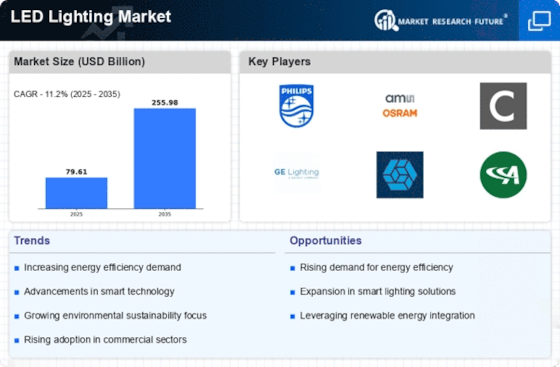
As per Market Research Future analysis, the LED Lighting Market Size was estimated at 79.61 USD Billion in 2024. The LED Lighting industry is projected to grow from 88.53 USD Billion in 2025 to 255.98 USD Billion by 2035, exhibiting a compound annual growth rate (CAGR) of 11.2% during the forecast period 2025 - 2035

Key Market Trends & Highlights

The LED Lighting Market is poised for robust growth driven by technological advancements and sustainability initiatives.

  • North America remains the largest market for LED lighting, driven by increasing energy efficiency demands. Asia-Pacific is the fastest-growing region, reflecting a surge in urbanization and infrastructure development. The New Installation segment dominates the market, while the Retrofit segment is experiencing rapid growth due to rising consumer awareness. Key market drivers include energy efficiency demand and environmental regulations, which are shaping consumer preferences.

Market Size & Forecast

2024 Market Size 79.61 (USD Billion)
2035 Market Size 255.98 (USD Billion)
CAGR (2025 - 2035) 11.2%
Largest Regional Market Share in 2024 North America

Major Players

Philips (NL), Osram (DE), Cree (US), GE Lighting (US), Signify (NL), Acuity Brands (US), Samsung (KR), LG Electronics (KR), Zumtobel Group (AT)

Market Trends

The LED Lighting Market is currently experiencing a transformative phase characterized by rapid technological advancements and increasing consumer awareness regarding energy efficiency. This transformation reflects rapid expansion of the global led lighting business ecosystem. Rising adoption of led light solutions across residential, commercial, and industrial sectors is accelerating demand. As sustainability becomes a focal point for both consumers and businesses, the demand for LED lighting solutions is on the rise. This shift is driven by the growing recognition of the environmental benefits associated with LED technology, which offers longer lifespans and reduced energy consumption compared to traditional lighting options. Growth opportunities are expanding for global led light producers and organized led lighting businesses focused on scale and efficiency. Furthermore, the integration of smart technologies into LED lighting systems is enhancing their appeal, allowing for greater control and customization in various applications. In addition to technological innovations, regulatory frameworks are evolving to support the adoption of energy-efficient lighting solutions. Governments worldwide are implementing policies that encourage the transition from incandescent and fluorescent lighting to LED alternatives. This regulatory push, combined with the increasing availability of LED products across diverse sectors, suggests a robust growth trajectory for the LED Lighting Market. As consumers continue to prioritize sustainability and energy savings, the market is likely to expand, presenting opportunities for manufacturers and suppliers to innovate and meet the changing demands of their customers. Vehicle electrification is boosting demand within the automotive led lighting market.

Technological Advancements

The LED Lighting Market is witnessing a surge in technological innovations, particularly in smart lighting solutions. Smart systems are increasing the value proposition of led light solutions. These advancements enable users to control lighting remotely, adjust brightness, and even change colors, enhancing user experience and energy efficiency.

Sustainability Focus

There is a growing emphasis on sustainability within the LED Lighting Market, as consumers and businesses alike seek environmentally friendly solutions. This trend is driving the demand for energy-efficient lighting options that reduce carbon footprints and promote eco-conscious practices. Energy efficiency benefits are driving widespread adoption of led light products across end users. This shift benefits the structured led lights business and long-term led lighting business models. Eco-friendly processes are gaining traction across the digital printing business ecosystem.

Regulatory Support

Government policies are increasingly favoring the adoption of LED lighting technologies. Such regulations create a favorable operating environment for led light producers and led lighting manufacturers. Regulations aimed at phasing out less efficient lighting options are creating a favorable environment for the growth of the LED Lighting Market, encouraging manufacturers to innovate and expand their product offerings. Government support continues to strengthen demand for led light producers and organized led lighting businesses.

LED Lighting Market Market Drivers

Cost-Effectiveness

Cost-effectiveness remains a crucial driver for the LED Lighting Market. The initial investment in LED technology may be higher than traditional lighting options; however, the long-term savings on energy bills and maintenance costs are substantial. LEDs have a lifespan of up to 25,000 hours, significantly reducing the frequency of replacements. In 2025, the total cost of ownership for LED lighting is expected to be 50% lower than that of conventional lighting solutions. This financial advantage is particularly appealing to commercial entities, where operational costs are closely monitored. As businesses seek to optimize their expenditures, the LED Lighting Market is likely to benefit from this trend, as more organizations recognize the value of investing in cost-effective lighting solutions.


Energy Efficiency Demand

The LED Lighting Market is experiencing a surge in demand for energy-efficient lighting solutions. As energy costs continue to rise, consumers and businesses alike are seeking alternatives that reduce electricity consumption. LEDs consume up to 75% less energy than traditional incandescent bulbs, which not only lowers utility bills but also contributes to a decrease in greenhouse gas emissions. This shift towards energy efficiency is further supported by various initiatives aimed at promoting sustainable practices. In 2023, the energy-efficient lighting segment accounted for approximately 60% of the overall lighting market, indicating a strong preference for LED technology. The growing awareness of energy conservation is likely to propel the LED Lighting Market forward, as more stakeholders recognize the long-term financial and environmental benefits of adopting LED solutions.

Environmental Regulations

The LED Lighting Market is significantly influenced by stringent environmental regulations aimed at reducing carbon footprints. Governments worldwide are implementing policies that encourage the adoption of energy-efficient lighting solutions, including LEDs. For instance, regulations that phase out incandescent bulbs and promote the use of energy-efficient alternatives are becoming more common. In 2025, it is projected that over 80% of new lighting installations will utilize LED technology, driven by these regulatory frameworks. Compliance with environmental standards not only fosters a sustainable approach but also enhances the market appeal of LED products. As regulations become more rigorous, manufacturers in the LED Lighting Market are likely to innovate and adapt, ensuring their products meet the evolving demands of both consumers and regulatory bodies.

Technological Innovations

Technological advancements play a pivotal role in shaping the LED Lighting Market. Innovations such as smart lighting systems, which integrate Internet of Things (IoT) capabilities, are becoming increasingly prevalent. These systems allow users to control lighting remotely, adjust brightness, and even change colors, enhancing user experience and energy management. The introduction of tunable white LEDs, which can adjust color temperature based on the time of day, is another notable development. In 2025, it is estimated that smart LED lighting will represent over 30% of the total LED market, reflecting a growing trend towards automation and connectivity. As technology continues to evolve, the LED Lighting Market is likely to witness further enhancements that improve efficiency and functionality, appealing to both residential and commercial sectors.

Consumer Awareness and Preferences

Consumer awareness regarding the benefits of LED lighting is rapidly increasing, driving growth in the LED Lighting Market. As individuals become more informed about energy efficiency, sustainability, and the advantages of LED technology, their preferences are shifting towards these solutions. Surveys indicate that over 70% of consumers now prefer LED lighting due to its longevity and reduced environmental impact. This heightened awareness is not only influencing residential purchases but also impacting commercial decisions, as businesses aim to align with consumer values. In 2025, it is anticipated that consumer-driven demand will account for a significant portion of the LED market, prompting manufacturers to focus on marketing strategies that highlight the benefits of LED products. The growing emphasis on sustainability and energy efficiency is likely to further solidify the position of LEDs in the lighting market.

Market Segment Insights

By Application: Residential Lighting (Largest) vs. Commercial Lighting (Fastest-Growing)

The LED lighting market is predominantly led by the Residential Lighting segment, which accounts for a significant portion of market share and showcases a high demand driven by the increasing adoption of energy-efficient solutions in households. This segment benefits from the transition towards smarter homes and sustainability trends, making it a cornerstone of the market's current landscape. Conversely, Commercial Lighting is emerging as the fastest-growing segment, propelled by the rising need for efficient lighting solutions in commercial spaces. Businesses are increasingly investing in LED technology to enhance energy efficiency, reduce operational costs, and contribute to environmentally-friendly practices, rapidly expanding this segment's market footprint.

Residential Lighting (Dominant) vs. Industrial Lighting (Emerging)

Residential Lighting continues to dominate the LED lighting market due to its established demand and significant consumer base focusing on energy efficiency and aesthetic appeal. This segment caters to a range of applications, including general lighting, task lighting, and accent lighting, providing diverse options to consumers. On the other hand, <a title="industrial lighting" href="https://www.marketresearchfuture.com/reports/industrial-lighting-market-4074" target="_blank" rel="noopener">Industrial Lighting</a> represents an emerging segment characterized by advancements in LED technology that enhances performance and reduces energy costs for manufacturers. As industries prioritize sustainability, the adoption of LED solutions in factory settings, warehouses, and large production facilities is growing. This transition supports a shift towards automated systems and smart lighting controls, positioning Industrial Lighting as a key player in the market's future growth.

By End Use: Retail (Largest) vs. Hospitality (Fastest-Growing)

The LED lighting market showcases a diverse range of end-use applications with Retail leading in market share, significantly driven by the increasing adoption of energy-efficient and aesthetically pleasing lighting solutions. In Retail, LED lighting enhances product visibility and creates engaging customer experiences, leading to sustained market dominance. On the other hand, the Hospitality sector is rapidly emerging as the fastest-growing segment in the LED lighting market. This growth is attributed to heightened consumer expectations for ambiance and energy efficiency in hotels, restaurants, and entertainment venues. The shift toward smart lighting solutions that can adapt to various moods and settings further accelerates this trend.

Retail (Dominant) vs. Hospitality (Emerging)

The Retail segment stands as a dominant force in the LED lighting market due to its focus on energy efficiency and design versatility. Retailers leverage LED technology to improve store aesthetics, enhance customer experiences, and reduce operational costs. In contrast, the Hospitality segment is characterized as an emerging player, where operators are increasingly adopting LED lighting for its longevity and cost effectiveness. Hospitality venues are incorporating smart lighting systems that adapt to guest preferences, creating personalized environments. Both segments are critical, but Retail continues to lead significantly while Hospitality shows promising growth potential driven by changing consumer demands.

By Technology: Smart Lighting (Largest) vs. LED Downlights (Fastest-Growing)

The LED lighting market showcases significant diversity in technology segments, with smart lighting holding the largest share due to its integration with IoT and user-friendly features. This segment benefits from robust consumer demand for automation and energy efficiency, outpacing others like incandescent replacements, which continue to decline. LED downlights, on the other hand, are gaining traction as a versatile lighting solution in residential and commercial applications, highlighting a shift towards modern lighting alternatives.

Technology: Smart Lighting (Dominant) vs. LED Downlights (Emerging)

Smart lighting dominates the LED lighting market due to its innovative technology and seamless connectivity, allowing users to control lighting remotely and customize their environment. This segment leverages advancements in wireless technology and smart home ecosystems, appealing to environmentally conscious consumers seeking energy efficiency without sacrificing style. In contrast, LED downlights are emerging rapidly as they provide a compact and aesthetically pleasing option for spaces requiring direct illumination. Their popularity is increasing among builders and interior designers, primarily driven by energy-saving attributes and the flexibility to fit various decor styles. Together, these segments reflect a progressive shift towards sustainable and intelligent lighting solutions.

By Form Factor: Bulbs (Largest) vs. Fixtures (Fastest-Growing)

The 'Form Factor' segment of the LED lighting market reveals significant diversity, with 'Bulbs' commanding the largest market share. Bulbs have become the go-to choice for consumers due to their ease of use and widespread availability across various retail platforms. Meanwhile, 'Fixtures' follow closely behind as the fastest-growing segment, thanks to the increasing trend toward energy-efficient installations in commercial and residential spaces. This shift is driven by the adoption of smart home technologies and sustainability concerns. In recent years, the market has observed a dynamic transition with 'Strips', 'Panels', and 'Lamps' also gaining traction. The growing preference for flexible lighting solutions, high customization options, and innovative design is fueling the surge in popularity of these segments. Additionally, as energy standards become stricter, more consumers are opting for LED lighting, pushing both 'Fixtures' and 'Panels' to expand in response to market demands for stylish yet functional lighting solutions.

Bulbs (Dominant) vs. Fixtures (Emerging)

In the LED lighting market, 'Bulbs' represent the dominant form factor, showcasing a diverse range of applications from residential to commercial use. They are particularly favored for their versatility, efficiency, and ease of installation, making them an ideal choice for a wide audience. Innovations in design and technology have enabled bulbs to provide enhanced aesthetics and functionality, supporting their continued leadership. On the other hand, 'Fixtures' are an emerging segment experiencing rapid growth, driven by new construction trends, renovations, and a consumer shift towards integrated lighting solutions. Fixtures are increasingly being designed to accommodate advanced features like smart technology and adaptability, allowing users to create energy-efficient and visually appealing environments.

Get more detailed insights about LED Lighting Market Research Report - Global Forecast till 2035

Regional Insights

North America : Innovation and Sustainability Leader

North America is witnessing robust growth in the LED lighting market, driven by increasing energy efficiency regulations and a shift towards sustainable lighting solutions. The region holds the largest market share at approximately 40%, with the U.S. leading the charge, followed by Canada at around 15%. Regulatory initiatives, such as the Energy Policy Act, are catalyzing this transition, promoting the adoption of energy-efficient technologies. The competitive landscape is dominated by key players like Philips, Cree, and GE Lighting, which are investing heavily in R&D to innovate and enhance product offerings. The U.S. market is characterized by a strong demand for smart lighting solutions, with significant contributions from commercial and residential sectors. As energy costs rise, the focus on LED technology is expected to intensify, further solidifying North America's position in the global market.

Europe : Regulatory-Driven Market Growth

Europe is emerging as a significant player in the LED lighting market, driven by stringent regulations aimed at reducing carbon emissions and promoting energy efficiency. The region holds the second-largest market share at approximately 30%, with Germany and the UK leading the way. The European Union's Ecodesign Directive mandates energy-efficient lighting solutions, fostering a favorable environment for LED adoption across various sectors. Leading countries like Germany, France, and the UK are witnessing a surge in demand for innovative lighting solutions, with key players such as Osram and Signify at the forefront. The competitive landscape is marked by a focus on sustainability and smart technologies, with companies investing in advanced LED systems that integrate IoT capabilities. This trend is expected to drive further growth in the European market, enhancing its global competitiveness. Regulatory alignment is strengthening the European led lighting market.

Asia-Pacific : Emerging Market Potential

The Asia-Pacific region is rapidly becoming a powerhouse in the LED lighting market, fueled by urbanization, industrial growth, and government initiatives promoting energy efficiency. This region holds a market share of approximately 25%, with China being the largest contributor, followed by Japan and India. Government policies, such as China's 13th Five-Year Plan, emphasize the transition to energy-efficient lighting solutions, driving significant demand for LEDs. This enhances competitiveness across the led lighting market. China's dominance is complemented by a growing presence of international players like Samsung and LG Electronics, which are expanding their operations in the region. The competitive landscape is characterized by a mix of local and global companies, focusing on innovation and cost-effective solutions. As the region continues to urbanize, the demand for LED lighting in commercial and residential sectors is expected to soar, further enhancing its market position. Cost-efficient production supports global led lighting manufacturers.

Middle East and Africa : Resource-Rich Market Opportunities

The Middle East and Africa (MEA) region is witnessing a gradual but steady growth in the LED lighting market, driven by increasing investments in infrastructure and energy efficiency initiatives. The region holds a market share of approximately 5%, with the UAE and South Africa leading the charge. Government programs aimed at reducing energy consumption are catalyzing the shift towards LED technology, particularly in urban development projects. Countries like the UAE are investing heavily in smart city initiatives, creating a favorable environment for LED adoption. The competitive landscape features both local and international players, with companies like Zumtobel Group making significant inroads. As the region continues to develop, the demand for energy-efficient lighting solutions is expected to rise, presenting ample opportunities for growth in the LED market.

Key Players and Competitive Insights

The LED Lighting Market is currently characterized by a dynamic competitive landscape, driven by technological advancements, sustainability initiatives, and increasing demand for energy-efficient solutions. Major players such as Philips (NL), Osram (DE), and Cree (US) are strategically positioned to leverage these trends. Philips (NL) focuses on innovation in smart lighting solutions, while Osram (DE) emphasizes its commitment to sustainability through eco-friendly products. Cree (US) is known for its cutting-edge LED technology, which enhances energy efficiency and performance. Collectively, these strategies not only enhance their market presence but also shape a competitive environment that prioritizes innovation and sustainability. Strategic expansion reflects a maturing led lighting business landscape. Innovation remains critical for every led light producer. Key business tactics within the LED Lighting Market include localizing manufacturing and optimizing supply chains to enhance efficiency and reduce costs. The market structure appears moderately fragmented, with several key players exerting influence over various segments. This fragmentation allows for niche players to thrive, while larger companies consolidate their positions through strategic partnerships and acquisitions, thereby enhancing their competitive edge.
In August Signify (NL) announced a partnership with a leading technology firm to develop advanced smart lighting systems that integrate seamlessly with IoT devices. This strategic move underscores Signify's commitment to innovation and positions it favorably in the growing smart home market. By enhancing its product offerings, Signify aims to capture a larger share of the market, particularly among tech-savvy consumers seeking integrated solutions.
In September Acuity Brands (US) launched a new line of energy-efficient LED fixtures designed specifically for commercial applications. This initiative reflects Acuity's focus on meeting the evolving needs of businesses aiming to reduce operational costs while enhancing lighting quality. The introduction of these fixtures is likely to strengthen Acuity's market position and appeal to environmentally conscious clients.
In July Samsung (KR) expanded its LED lighting portfolio by introducing a series of customizable lighting solutions aimed at the residential sector. This expansion not only diversifies Samsung's offerings but also aligns with the growing consumer demand for personalized lighting experiences. By tapping into this trend, Samsung is poised to enhance its competitive stance in the residential market.
As of October current competitive trends in the LED Lighting Market are increasingly defined by digitalization, sustainability, and the integration of artificial intelligence. Strategic alliances among key players are shaping the landscape, fostering innovation and enhancing product offerings. Looking ahead, competitive differentiation is likely to evolve from traditional price-based competition to a focus on technological innovation, supply chain reliability, and sustainability initiatives. Companies that can effectively navigate these trends will likely secure a competitive advantage in the rapidly changing market.

Key Companies in the LED Lighting Market include

Industry Developments

  • Q2 2025: Industrial and Commercial LED Lighting Market 2025-2029: Vendor Analysis Highlights Key Players in LED Lighting Industry A new vendor analysis was released in June 2025, highlighting key players and recent developments in the industrial and commercial LED lighting sector, including product launches and strategic moves by leading companies.

Future Outlook

LED Lighting Market Future Outlook

The LED Lighting Market is projected to grow at 11.2% CAGR from 2025 to 2035, driven by energy efficiency, technological advancements, and increasing environmental regulations.

New opportunities lie in:

  • <p>Expansion into smart lighting solutions for urban infrastructure.</p>
  • <p> </p>
  • <p>Development of energy-efficient LED products for industrial applications.</p>
  • <p>Partnerships with renewable energy firms for integrated lighting solutions.</p>

By 2035, the LED Lighting Market is expected to achieve substantial growth, solidifying its position as a leader in sustainable lighting solutions.

Market Segmentation

LED Lighting Market Product Type Outlook

  • Lamps
  • Luminaries

LED Lighting Market Installation Type Outlook

  • New Installation
  • Retrofit

LED Lighting Market End-Use Application Outlook

  • Indoor Lighting
  • Outdoor Lighting

LED Lighting Market Distribution Channel Outlook

  • Store Based
  • Non-Store Based

Report Scope

MARKET SIZE 2024 79.61(USD Billion)
MARKET SIZE 2025 88.53(USD Billion)
MARKET SIZE 2035 255.98(USD Billion)
COMPOUND ANNUAL GROWTH RATE (CAGR) 11.2% (2025 - 2035)
REPORT COVERAGE Revenue Forecast, Competitive Landscape, Growth Factors, and Trends
BASE YEAR 2024
Market Forecast Period 2025 - 2035
Historical Data 2019 - 2024
Market Forecast Units USD Billion
Key Companies Profiled Philips (NL), Osram (DE), Cree (US), GE Lighting (US), Signify (NL), Acuity Brands (US), Samsung (KR), LG Electronics (KR), Zumtobel Group (AT)
Segments Covered Installation Type, Product Type, Distribution Channel, End-Use Application, Regional
Key Market Opportunities Integration of smart technology in LED Lighting Market enhances energy efficiency and consumer engagement.
Key Market Dynamics Technological advancements drive energy efficiency and sustainability in the LED lighting market, reshaping consumer preferences and industry standards.
Countries Covered North America, Europe, APAC, South America, MEA

FAQs

What is the current valuation of the LED lighting market as of 2024?

<p>The LED lighting market was valued at 60.0 USD Billion in 2024.</p>

What is the projected market size for the LED lighting sector by 2035?

<p>The market is expected to reach 100.0 USD Billion by 2035.</p>

What is the expected CAGR for the LED lighting market during the forecast period 2025 - 2035?

<p>The expected CAGR for the LED lighting market during 2025 - 2035 is 4.75%.</p>

Which segments are included in the LED lighting market by application?

<p>The segments by application include Residential, Commercial, Industrial, Outdoor, and Architectural Lighting.</p>

What are the projected valuations for the Residential Lighting segment by 2035?

<p>The Residential Lighting segment is projected to reach between 15.0 and 25.0 USD Billion.</p>

Who are the key players in the LED lighting market?

<p>Key players include Signify, Osram, Cree, GE Lighting, Acuity Brands, Philips Lighting, Samsung Electronics, LG Electronics, Zumtobel Group, and Havells India.</p>

What is the expected valuation for the Commercial Lighting segment by 2035?

<p>The Commercial Lighting segment is anticipated to reach between 20.0 and 30.0 USD Billion.</p>

What technologies are driving the LED lighting market?

<p>Technologies driving the market include Incandescent Replacement, Smart Lighting, Solar Powered Lighting, LED Tubes, and LED Downlights.</p>

What is the projected valuation for the Healthcare end-use segment by 2035?

<p>The Healthcare end-use segment is projected to reach between 10.0 and 18.0 USD Billion.</p>

What form factors are included in the LED lighting market?

<p>The form factors include Bulbs, Fixtures, Strips, Panels, and Lamps.</p>

  1. SECTION I: EXECUTIVE SUMMARY AND KEY HIGHLIGHTS |
    1. EXECUTIVE SUMMARY | |
      1. Market Overview | |
      2. Key Findings | |
      3. Market Segmentation | |
      4. Competitive Landscape | |
      5. Challenges and Opportunities | |
      6. Future Outlook 2
  2. SECTION II: SCOPING, METHODOLOGY AND MARKET STRUCTURE |
    1. MARKET INTRODUCTION | |
      1. Definition | |
      2. Scope of the study | | |
    2. RESEARCH METHODOLOGY | |
      1. Overview | |
      2. Data Mining | |
      3. Secondary Research | |
      4. Primary Research | | |
      5. Forecasting Model | |
      6. Market Size Estimation | | |
      7. Data Triangulation | |
      8. Validation 3
  3. SECTION III: QUALITATIVE ANALYSIS |
    1. MARKET DYNAMICS | |
      1. Overview | |
      2. Drivers | |
      3. Restraints | |
      4. Opportunities |
    2. MARKET FACTOR ANALYSIS | |
      1. Value chain Analysis | |
      2. Porter's Five Forces Analysis | | |
      3. COVID-19 Impact Analysis | | |
  4. SECTION IV: QUANTITATIVE ANALYSIS |
    1. Semiconductor & Electronics, BY Application (USD Billion) | |
      1. Residential Lighting | |
      2. Commercial Lighting | |
      3. Industrial Lighting | |
      4. Outdoor Lighting | |
      5. Architectural Lighting |
    2. Semiconductor & Electronics, BY End Use (USD Billion) | |
      1. Retail | |
      2. Hospitality | |
      3. Healthcare | |
      4. Education | |
      5. Transportation |
    3. Semiconductor & Electronics, BY Technology (USD Billion) | |
      1. Incandescent Replacement | |
      2. Smart Lighting | |
      3. Solar Powered Lighting | |
      4. LED Tubes | |
      5. LED Downlights |
    4. Semiconductor & Electronics, BY Form Factor (USD Billion) | |
      1. Bulbs | |
      2. Fixtures | |
      3. Strips | |
      4. Panels | |
      5. Lamps |
    5. Semiconductor & Electronics, BY Region (USD Billion) | |
      1. North America | | |
      2. Europe | | |
      3. APAC | | |
      4. South America | | |
      5. MEA | | |
  5. SECTION V: COMPETITIVE ANALYSIS |
    1. Competitive Landscape | |
      1. Overview | |
      2. Competitive Analysis | |
      3. Market share Analysis | |
      4. Major Growth Strategy in the Semiconductor & Electronics | |
      5. Competitive Benchmarking | |
      6. Leading Players in Terms of Number of Developments in the Semiconductor & Electronics | |
      7. Key developments and growth strategies | | |
      8. Major Players Financial Matrix | | |
    2. Company Profiles | |
      1. Signify (NL) | | |
      2. Osram (DE) | | |
      3. Cree (US) | | |
      4. GE Lighting (US) | | |
      5. Acuity Brands (US) | | |
      6. Philips Lighting (NL) | | |
      7. Samsung Electronics (KR) | | |
      8. LG Electronics (KR) | | |
      9. Zumtobel Group (AT) | | |
      10. Havells India (IN) | | |
    3. Appendix | |
      1. References | |
      2. Related Reports 6 LIST OF FIGURES |
    4. MARKET SYNOPSIS |
    5. NORTH AMERICA MARKET ANALYSIS |
    6. US MARKET ANALYSIS BY APPLICATION |
    7. US MARKET ANALYSIS BY END USE |
    8. US MARKET ANALYSIS BY TECHNOLOGY |
    9. US MARKET ANALYSIS BY FORM FACTOR |
    10. CANADA MARKET ANALYSIS BY APPLICATION |
    11. CANADA MARKET ANALYSIS BY END USE |
    12. CANADA MARKET ANALYSIS BY TECHNOLOGY |
    13. CANADA MARKET ANALYSIS BY FORM FACTOR |
    14. EUROPE MARKET ANALYSIS |
    15. GERMANY MARKET ANALYSIS BY APPLICATION |
    16. GERMANY MARKET ANALYSIS BY END USE |
    17. GERMANY MARKET ANALYSIS BY TECHNOLOGY |
    18. GERMANY MARKET ANALYSIS BY FORM FACTOR |
    19. UK MARKET ANALYSIS BY APPLICATION |
    20. UK MARKET ANALYSIS BY END USE |
    21. UK MARKET ANALYSIS BY TECHNOLOGY |
    22. UK MARKET ANALYSIS BY FORM FACTOR |
    23. FRANCE MARKET ANALYSIS BY APPLICATION |
    24. FRANCE MARKET ANALYSIS BY END USE |
    25. FRANCE MARKET ANALYSIS BY TECHNOLOGY |
    26. FRANCE MARKET ANALYSIS BY FORM FACTOR |
    27. RUSSIA MARKET ANALYSIS BY APPLICATION |
    28. RUSSIA MARKET ANALYSIS BY END USE |
    29. RUSSIA MARKET ANALYSIS BY TECHNOLOGY |
    30. RUSSIA MARKET ANALYSIS BY FORM FACTOR |
    31. ITALY MARKET ANALYSIS BY APPLICATION |
    32. ITALY MARKET ANALYSIS BY END USE |
    33. ITALY MARKET ANALYSIS BY TECHNOLOGY |
    34. ITALY MARKET ANALYSIS BY FORM FACTOR |
    35. SPAIN MARKET ANALYSIS BY APPLICATION |
    36. SPAIN MARKET ANALYSIS BY END USE |
    37. SPAIN MARKET ANALYSIS BY TECHNOLOGY |
    38. SPAIN MARKET ANALYSIS BY FORM FACTOR |
    39. REST OF EUROPE MARKET ANALYSIS BY APPLICATION |
    40. REST OF EUROPE MARKET ANALYSIS BY END USE |
    41. REST OF EUROPE MARKET ANALYSIS BY TECHNOLOGY |
    42. REST OF EUROPE MARKET ANALYSIS BY FORM FACTOR |
    43. APAC MARKET ANALYSIS |
    44. CHINA MARKET ANALYSIS BY APPLICATION |
    45. CHINA MARKET ANALYSIS BY END USE |
    46. CHINA MARKET ANALYSIS BY TECHNOLOGY |
    47. CHINA MARKET ANALYSIS BY FORM FACTOR |
    48. INDIA MARKET ANALYSIS BY APPLICATION |
    49. INDIA MARKET ANALYSIS BY END USE |
    50. INDIA MARKET ANALYSIS BY TECHNOLOGY |
    51. INDIA MARKET ANALYSIS BY FORM FACTOR |
    52. JAPAN MARKET ANALYSIS BY APPLICATION |
    53. JAPAN MARKET ANALYSIS BY END USE |
    54. JAPAN MARKET ANALYSIS BY TECHNOLOGY |
    55. JAPAN MARKET ANALYSIS BY FORM FACTOR |
    56. SOUTH KOREA MARKET ANALYSIS BY APPLICATION |
    57. SOUTH KOREA MARKET ANALYSIS BY END USE |
    58. SOUTH KOREA MARKET ANALYSIS BY TECHNOLOGY |
    59. SOUTH KOREA MARKET ANALYSIS BY FORM FACTOR |
    60. MALAYSIA MARKET ANALYSIS BY APPLICATION |
    61. MALAYSIA MARKET ANALYSIS BY END USE |
    62. MALAYSIA MARKET ANALYSIS BY TECHNOLOGY |
    63. MALAYSIA MARKET ANALYSIS BY FORM FACTOR |
    64. THAILAND MARKET ANALYSIS BY APPLICATION |
    65. THAILAND MARKET ANALYSIS BY END USE |
    66. THAILAND MARKET ANALYSIS BY TECHNOLOGY |
    67. THAILAND MARKET ANALYSIS BY FORM FACTOR |
    68. INDONESIA MARKET ANALYSIS BY APPLICATION |
    69. INDONESIA MARKET ANALYSIS BY END USE |
    70. INDONESIA MARKET ANALYSIS BY TECHNOLOGY |
    71. INDONESIA MARKET ANALYSIS BY FORM FACTOR |
    72. REST OF APAC MARKET ANALYSIS BY APPLICATION |
    73. REST OF APAC MARKET ANALYSIS BY END USE |
    74. REST OF APAC MARKET ANALYSIS BY TECHNOLOGY |
    75. REST OF APAC MARKET ANALYSIS BY FORM FACTOR |
    76. SOUTH AMERICA MARKET ANALYSIS |
    77. BRAZIL MARKET ANALYSIS BY APPLICATION |
    78. BRAZIL MARKET ANALYSIS BY END USE |
    79. BRAZIL MARKET ANALYSIS BY TECHNOLOGY |
    80. BRAZIL MARKET ANALYSIS BY FORM FACTOR |
    81. MEXICO MARKET ANALYSIS BY APPLICATION |
    82. MEXICO MARKET ANALYSIS BY END USE |
    83. MEXICO MARKET ANALYSIS BY TECHNOLOGY |
    84. MEXICO MARKET ANALYSIS BY FORM FACTOR |
    85. ARGENTINA MARKET ANALYSIS BY APPLICATION |
    86. ARGENTINA MARKET ANALYSIS BY END USE |
    87. ARGENTINA MARKET ANALYSIS BY TECHNOLOGY |
    88. ARGENTINA MARKET ANALYSIS BY FORM FACTOR |
    89. REST OF SOUTH AMERICA MARKET ANALYSIS BY APPLICATION |
    90. REST OF SOUTH AMERICA MARKET ANALYSIS BY END USE |
    91. REST OF SOUTH AMERICA MARKET ANALYSIS BY TECHNOLOGY |
    92. REST OF SOUTH AMERICA MARKET ANALYSIS BY FORM FACTOR |
    93. MEA MARKET ANALYSIS |
    94. GCC COUNTRIES MARKET ANALYSIS BY APPLICATION |
    95. GCC COUNTRIES MARKET ANALYSIS BY END USE |
    96. GCC COUNTRIES MARKET ANALYSIS BY TECHNOLOGY |
    97. GCC COUNTRIES MARKET ANALYSIS BY FORM FACTOR |
    98. SOUTH AFRICA MARKET ANALYSIS BY APPLICATION |
    99. SOUTH AFRICA MARKET ANALYSIS BY END USE |
    100. SOUTH AFRICA MARKET ANALYSIS BY TECHNOLOGY |
    101. SOUTH AFRICA MARKET ANALYSIS BY FORM FACTOR |
    102. REST OF MEA MARKET ANALYSIS BY APPLICATION |
    103. REST OF MEA MARKET ANALYSIS BY END USE |
    104. REST OF MEA MARKET ANALYSIS BY TECHNOLOGY |
    105. REST OF MEA MARKET ANALYSIS BY FORM FACTOR |
    106. KEY BUYING CRITERIA OF SEMICONDUCTOR & ELECTRONICS |
    107. RESEARCH PROCESS OF MRFR |
    108. DRO ANALYSIS OF SEMICONDUCTOR & ELECTRONICS |
    109. DRIVERS IMPACT ANALYSIS: SEMICONDUCTOR & ELECTRONICS |
    110. RESTRAINTS IMPACT ANALYSIS: SEMICONDUCTOR & ELECTRONICS |
    111. SUPPLY / VALUE CHAIN: SEMICONDUCTOR & ELECTRONICS |
    112. SEMICONDUCTOR & ELECTRONICS, BY APPLICATION, 2024 (% SHARE) |
    113. SEMICONDUCTOR & ELECTRONICS, BY APPLICATION, 2024 TO 2035 (USD Billion) |
    114. SEMICONDUCTOR & ELECTRONICS, BY END USE, 2024 (% SHARE) |
    115. SEMICONDUCTOR & ELECTRONICS, BY END USE, 2024 TO 2035 (USD Billion) |
    116. SEMICONDUCTOR & ELECTRONICS, BY TECHNOLOGY, 2024 (% SHARE) |
    117. SEMICONDUCTOR & ELECTRONICS, BY TECHNOLOGY, 2024 TO 2035 (USD Billion) |
    118. SEMICONDUCTOR & ELECTRONICS, BY FORM FACTOR, 2024 (% SHARE) |
    119. SEMICONDUCTOR & ELECTRONICS, BY FORM FACTOR, 2024 TO 2035 (USD Billion) |
    120. BENCHMARKING OF MAJOR COMPETITORS 7 LIST OF TABLES |
    121. LIST OF ASSUMPTIONS | |
      1. |
    122. North America MARKET SIZE ESTIMATES; FORECAST | |
      1. BY APPLICATION, 2025-2035 (USD Billion) | |
      2. BY END USE, 2025-2035 (USD Billion) | |
      3. BY TECHNOLOGY, 2025-2035 (USD Billion) | |
      4. BY FORM FACTOR, 2025-2035 (USD Billion) |
    123. US MARKET SIZE ESTIMATES; FORECAST | |
      1. BY APPLICATION, 2025-2035 (USD Billion) | |
      2. BY END USE, 2025-2035 (USD Billion) | |
      3. BY TECHNOLOGY, 2025-2035 (USD Billion) | |
      4. BY FORM FACTOR, 2025-2035 (USD Billion) |
    124. Canada MARKET SIZE ESTIMATES; FORECAST | |
      1. BY APPLICATION, 2025-2035 (USD Billion) | |
      2. BY END USE, 2025-2035 (USD Billion) | |
      3. BY TECHNOLOGY, 2025-2035 (USD Billion) | |
      4. BY FORM FACTOR, 2025-2035 (USD Billion) |
    125. Europe MARKET SIZE ESTIMATES; FORECAST | |
      1. BY APPLICATION, 2025-2035 (USD Billion) | |
      2. BY END USE, 2025-2035 (USD Billion) | |
      3. BY TECHNOLOGY, 2025-2035 (USD Billion) | |
      4. BY FORM FACTOR, 2025-2035 (USD Billion) |
    126. Germany MARKET SIZE ESTIMATES; FORECAST | |
      1. BY APPLICATION, 2025-2035 (USD Billion) | |
      2. BY END USE, 2025-2035 (USD Billion) | |
      3. BY TECHNOLOGY, 2025-2035 (USD Billion) | |
      4. BY FORM FACTOR, 2025-2035 (USD Billion) |
    127. UK MARKET SIZE ESTIMATES; FORECAST | |
      1. BY APPLICATION, 2025-2035 (USD Billion) | |
      2. BY END USE, 2025-2035 (USD Billion) | |
      3. BY TECHNOLOGY, 2025-2035 (USD Billion) | |
      4. BY FORM FACTOR, 2025-2035 (USD Billion) |
    128. France MARKET SIZE ESTIMATES; FORECAST | |
      1. BY APPLICATION, 2025-2035 (USD Billion) | |
      2. BY END USE, 2025-2035 (USD Billion) | |
      3. BY TECHNOLOGY, 2025-2035 (USD Billion) | |
      4. BY FORM FACTOR, 2025-2035 (USD Billion) |
    129. Russia MARKET SIZE ESTIMATES; FORECAST | |
      1. BY APPLICATION, 2025-2035 (USD Billion) | |
      2. BY END USE, 2025-2035 (USD Billion) | |
      3. BY TECHNOLOGY, 2025-2035 (USD Billion) | |
      4. BY FORM FACTOR, 2025-2035 (USD Billion) |
    130. Italy MARKET SIZE ESTIMATES; FORECAST | |
      1. BY APPLICATION, 2025-2035 (USD Billion) | |
      2. BY END USE, 2025-2035 (USD Billion) | |
      3. BY TECHNOLOGY, 2025-2035 (USD Billion) | |
      4. BY FORM FACTOR, 2025-2035 (USD Billion) |
    131. Spain MARKET SIZE ESTIMATES; FORECAST | |
      1. BY APPLICATION, 2025-2035 (USD Billion) | |
      2. BY END USE, 2025-2035 (USD Billion) | |
      3. BY TECHNOLOGY, 2025-2035 (USD Billion) | |
      4. BY FORM FACTOR, 2025-2035 (USD Billion) |
    132. Rest of Europe MARKET SIZE ESTIMATES; FORECAST | |
      1. BY APPLICATION, 2025-2035 (USD Billion) | |
      2. BY END USE, 2025-2035 (USD Billion) | |
      3. BY TECHNOLOGY, 2025-2035 (USD Billion) | |
      4. BY FORM FACTOR, 2025-2035 (USD Billion) |
    133. APAC MARKET SIZE ESTIMATES; FORECAST | |
      1. BY APPLICATION, 2025-2035 (USD Billion) | |
      2. BY END USE, 2025-2035 (USD Billion) | |
      3. BY TECHNOLOGY, 2025-2035 (USD Billion) | |
      4. BY FORM FACTOR, 2025-2035 (USD Billion) |
    134. China MARKET SIZE ESTIMATES; FORECAST | |
      1. BY APPLICATION, 2025-2035 (USD Billion) | |
      2. BY END USE, 2025-2035 (USD Billion) | |
      3. BY TECHNOLOGY, 2025-2035 (USD Billion) | |
      4. BY FORM FACTOR, 2025-2035 (USD Billion) |
    135. India MARKET SIZE ESTIMATES; FORECAST | |
      1. BY APPLICATION, 2025-2035 (USD Billion) | |
      2. BY END USE, 2025-2035 (USD Billion) | |
      3. BY TECHNOLOGY, 2025-2035 (USD Billion) | |
      4. BY FORM FACTOR, 2025-2035 (USD Billion) |
    136. Japan MARKET SIZE ESTIMATES; FORECAST | |
      1. BY APPLICATION, 2025-2035 (USD Billion) | |
      2. BY END USE, 2025-2035 (USD Billion) | |
      3. BY TECHNOLOGY, 2025-2035 (USD Billion) | |
      4. BY FORM FACTOR, 2025-2035 (USD Billion) |
    137. South Korea MARKET SIZE ESTIMATES; FORECAST | |
      1. BY APPLICATION, 2025-2035 (USD Billion) | |
      2. BY END USE, 2025-2035 (USD Billion) | |
      3. BY TECHNOLOGY, 2025-2035 (USD Billion) | |
      4. BY FORM FACTOR, 2025-2035 (USD Billion) |
    138. Malaysia MARKET SIZE ESTIMATES; FORECAST | |
      1. BY APPLICATION, 2025-2035 (USD Billion) | |
      2. BY END USE, 2025-2035 (USD Billion) | |
      3. BY TECHNOLOGY, 2025-2035 (USD Billion) | |
      4. BY FORM FACTOR, 2025-2035 (USD Billion) |
    139. Thailand MARKET SIZE ESTIMATES; FORECAST | |
      1. BY APPLICATION, 2025-2035 (USD Billion) | |
      2. BY END USE, 2025-2035 (USD Billion) | |
      3. BY TECHNOLOGY, 2025-2035 (USD Billion) | |
      4. BY FORM FACTOR, 2025-2035 (USD Billion) |
    140. Indonesia MARKET SIZE ESTIMATES; FORECAST | |
      1. BY APPLICATION, 2025-2035 (USD Billion) | |
      2. BY END USE, 2025-2035 (USD Billion) | |
      3. BY TECHNOLOGY, 2025-2035 (USD Billion) | |
      4. BY FORM FACTOR, 2025-2035 (USD Billion) |
    141. Rest of APAC MARKET SIZE ESTIMATES; FORECAST | |
      1. BY APPLICATION, 2025-2035 (USD Billion) | |
      2. BY END USE, 2025-2035 (USD Billion) | |
      3. BY TECHNOLOGY, 2025-2035 (USD Billion) | |
      4. BY FORM FACTOR, 2025-2035 (USD Billion) |
    142. South America MARKET SIZE ESTIMATES; FORECAST | |
      1. BY APPLICATION, 2025-2035 (USD Billion) | |
      2. BY END USE, 2025-2035 (USD Billion) | |
      3. BY TECHNOLOGY, 2025-2035 (USD Billion) | |
      4. BY FORM FACTOR, 2025-2035 (USD Billion) |
    143. Brazil MARKET SIZE ESTIMATES; FORECAST | |
      1. BY APPLICATION, 2025-2035 (USD Billion) | |
      2. BY END USE, 2025-2035 (USD Billion) | |
      3. BY TECHNOLOGY, 2025-2035 (USD Billion) | |
      4. BY FORM FACTOR, 2025-2035 (USD Billion) |
    144. Mexico MARKET SIZE ESTIMATES; FORECAST | |
      1. BY APPLICATION, 2025-2035 (USD Billion) | |
      2. BY END USE, 2025-2035 (USD Billion) | |
      3. BY TECHNOLOGY, 2025-2035 (USD Billion) | |
      4. BY FORM FACTOR, 2025-2035 (USD Billion) |
    145. Argentina MARKET SIZE ESTIMATES; FORECAST | |
      1. BY APPLICATION, 2025-2035 (USD Billion) | |
      2. BY END USE, 2025-2035 (USD Billion) | |
      3. BY TECHNOLOGY, 2025-2035 (USD Billion) | |
      4. BY FORM FACTOR, 2025-2035 (USD Billion) |
    146. Rest of South America MARKET SIZE ESTIMATES; FORECAST | |
      1. BY APPLICATION, 2025-2035 (USD Billion) | |
      2. BY END USE, 2025-2035 (USD Billion) | |
      3. BY TECHNOLOGY, 2025-2035 (USD Billion) | |
      4. BY FORM FACTOR, 2025-2035 (USD Billion) |
    147. MEA MARKET SIZE ESTIMATES; FORECAST | |
      1. BY APPLICATION, 2025-2035 (USD Billion) | |
      2. BY END USE, 2025-2035 (USD Billion) | |
      3. BY TECHNOLOGY, 2025-2035 (USD Billion) | |
      4. BY FORM FACTOR, 2025-2035 (USD Billion) |
    148. GCC Countries MARKET SIZE ESTIMATES; FORECAST | |
      1. BY APPLICATION, 2025-2035 (USD Billion) | |
      2. BY END USE, 2025-2035 (USD Billion) | |
      3. BY TECHNOLOGY, 2025-2035 (USD Billion) | |
      4. BY FORM FACTOR, 2025-2035 (USD Billion) |
    149. South Africa MARKET SIZE ESTIMATES; FORECAST | |
      1. BY APPLICATION, 2025-2035 (USD Billion) | |
      2. BY END USE, 2025-2035 (USD Billion) | |
      3. BY TECHNOLOGY, 2025-2035 (USD Billion) | |
      4. BY FORM FACTOR, 2025-2035 (USD Billion) |
    150. Rest of MEA MARKET SIZE ESTIMATES; FORECAST | |
      1. BY APPLICATION, 2025-2035 (USD Billion) | |
      2. BY END USE, 2025-2035 (USD Billion) | |
      3. BY TECHNOLOGY, 2025-2035 (USD Billion) | |
      4. BY FORM FACTOR, 2025-2035 (USD Billion) |
    151. PRODUCT LAUNCH/PRODUCT DEVELOPMENT/APPROVAL | |
      1. |
    152. ACQUISITION/PARTNERSHIP | |

Semiconductor & Electronics Market Segmentation

Semiconductor & Electronics By Application (USD Billion, 2025-2035)

  • Residential Lighting
  • Commercial Lighting
  • Industrial Lighting
  • Outdoor Lighting
  • Architectural Lighting

Semiconductor & Electronics By End Use (USD Billion, 2025-2035)

  • Retail
  • Hospitality
  • Healthcare
  • Education
  • Transportation

Semiconductor & Electronics By Technology (USD Billion, 2025-2035)

  • Incandescent Replacement
  • Smart Lighting
  • Solar Powered Lighting
  • LED Tubes
  • LED Downlights

Semiconductor & Electronics By Form Factor (USD Billion, 2025-2035)

  • Bulbs
  • Fixtures
  • Strips
  • Panels
  • Lamps
Infographic

Free Sample Request

Kindly complete the form below to receive a free sample of this Report

Get Free Sample

Customer Strories

Compare Licence

×
Features License Type
Single User Multiuser License Enterprise User
Price $4,950 $5,950 $7,250
Maximum User Access Limit 1 User Upto 10 Users Unrestricted Access Throughout the Organization
Free Customization
Direct Access to Analyst
Deliverable Format
Platform Access
Discount on Next Purchase 10% 15% 15%
Printable Versions
%>