Request Free Sample ×

Kindly complete the form below to receive a free sample of this Report

* Please use a valid business email

Leading companies partner with us for data-driven Insights

clients tt-cursor
Hero Background
English
Chinese
French
Japanese
Korean
German
Spanish

LATAM Inflight Shopping Market Analysis

ID: MRFR/AD/16260-HCR
128 Pages
Triveni Bhoyar
March 2026

LATAM Inflight Shopping Market Size, Share, Industry Trend & Analysis Research Report Information By Type (Full Service and Low Cost), By Application (Adults and Children)– Forecast Till 2035

Share:
Download PDF ×

We do not share your information with anyone. However, we may send you emails based on your report interest from time to time. You may contact us at any time to opt-out.

LATAM Inflight Shopping Market Infographic
Purchase Options

Market Analysis

In-depth Analysis of LATAM Inflight Shopping Market Industry Landscape

The market dynamics of the LATAM inflight shopping sector present an intriguing landscape influenced by various factors such as passenger demographics, airline policies, economic conditions, and changing consumer preferences. Inflight shopping refers to the retail opportunities available to passengers while they are onboard an aircraft, offering a range of products from cosmetics and fragrances to electronics and souvenirs. One significant driver of this market is the growing number of air travelers in the Latin American region, spurred by increased tourism, business travel, and improved connectivity. As more passengers take to the skies, airlines and inflight retailers capitalize on this captive audience to generate additional revenue through inflight sales.

Airlines play a central role in shaping the dynamics of the LATAM inflight shopping market. They determine the onboard retail offerings, establish pricing strategies, and manage partnerships with inflight retail providers. Some airlines may opt for a traditional duty-free model, offering a selection of tax-free goods to passengers, while others may focus on curated product offerings tailored to their target demographics. Additionally, airlines may leverage inflight entertainment systems, seatback catalogs, and cabin crew promotions to promote inflight shopping and drive sales. The inflight shopping experience is closely tied to the overall passenger experience, with airlines striving to enhance onboard retail offerings to differentiate themselves and increase customer satisfaction.

Economic conditions and currency fluctuations also impact the LATAM inflight shopping market. As disposable incomes rise and fall, passenger spending habits may change, affecting the demand for inflight retail products. Currency devaluations or economic downturns in certain countries can impact purchasing power, influencing passenger willingness to make inflight purchases. Moreover, regional disparities in economic performance and consumer confidence levels may result in variations in inflight shopping trends across different Latin American markets. Airlines and inflight retailers must monitor these economic factors closely and adjust their strategies accordingly to optimize revenue generation from inflight sales.

Changing consumer preferences and shopping behaviors further contribute to the dynamic nature of the LATAM inflight shopping market. With the rise of e-commerce and digital retail platforms, passengers have become accustomed to convenient and personalized shopping experiences. In response, airlines and inflight retailers are exploring innovative ways to digitize the inflight shopping experience, such as offering pre-order options, mobile app integration, and personalized recommendations based on passenger profiles. Additionally, sustainability and ethical sourcing are increasingly important considerations for consumers, driving demand for eco-friendly and socially responsible products in the inflight retail space.

Competition within the LATAM inflight shopping market also influences market dynamics. Airlines and inflight retailers vie for passengers' attention and spending by offering compelling product selections, competitive pricing, and promotional incentives. Strategic partnerships with brands and suppliers enable airlines to access exclusive products and enhance their inflight retail offerings, while inflight retailers leverage their expertise in merchandising and marketing to maximize sales opportunities. Furthermore, the emergence of low-cost carriers and new entrants in the aviation industry introduces additional competition, challenging established players to innovate and adapt their inflight shopping strategies to remain competitive


Author
Author Profile
Triveni Bhoyar
Senior Research Analyst

Triveni Bhoyar has over 5 years of experience in the market research industry, specializing in the Automotive and Aerospace & Defense sectors. She has contributed to 200+ reports, including numerous custom projects for leading global companies, delivering solutions to complex business challenges. Renowned for her ability to generate valuable insights, Triveni excels in addressing unique market dynamics with precision and depth. Her expertise spans market sizing, competitive intelligence, and trend analysis, enabling clients to craft data-driven growth strategies. With strong analytical rigor and a client-centric approach, she plays a pivotal role in driving impactful, strategic decision-making.

Leave a Comment

FAQs

What is the current valuation of the LATAM inflight shopping market?

<p>The LATAM inflight shopping market was valued at 2.5 USD Billion in 2024.</p>

What is the projected market size for the LATAM inflight shopping market by 2035?

<p>The market is projected to reach 5.0 USD Billion by 2035.</p>

What is the expected CAGR for the LATAM inflight shopping market during the forecast period?

<p>The expected CAGR for the LATAM inflight shopping market from 2025 to 2035 is 6.5%.</p>

Who are the key players in the LATAM inflight shopping market?

<p>Key players include Dufry AG, Duty Free Americas, AeroMexico, and LATAM Airlines Group.</p>

What product categories are included in the LATAM inflight shopping market?

<p>Product categories include Electronics, Fashion, Cosmetics, Food and Beverages, and Travel Accessories.</p>

How did the sales of Food and Beverages perform in 2024?

<p>Sales of Food and Beverages reached 0.7 USD Billion in 2024, with projections of 1.4 USD Billion by 2035.</p>

What demographic factors influence purchasing behavior in the LATAM inflight shopping market?

<p>Demographic factors include Age Group, Income Level, Gender, Travel Frequency, and Travel Purpose.</p>

What is the significance of impulse buying in the LATAM inflight shopping market?

<p>Impulse buying accounted for 0.75 USD Billion in 2024, with expectations of reaching 1.5 USD Billion by 2035.</p>

How does brand preference affect consumer behavior in LATAM inflight shopping?

<p>Brand preference was valued at 0.4 USD Billion in 2024, with a potential increase to 0.8 USD Billion by 2035.</p>

What trends are emerging in the LATAM inflight shopping market regarding customer loyalty?

<p>Loyalty program participation was valued at 0.4 USD Billion in 2024, indicating a growing trend in customer retention strategies.</p>

Market Summary

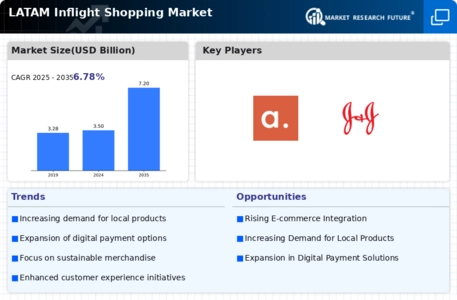
The Global LATAM Inflight Shopping Market is projected to grow from 3.5 USD Billion in 2024 to 7.2 USD Billion by 2035.

Key Market Trends & Highlights

LATAM Inflight Shopping Market Key Trends and Highlights

  • The market is expected to experience a compound annual growth rate (CAGR) of 6.78% from 2025 to 2035.
  • By 2035, the market valuation is anticipated to reach 7.2 USD Billion, indicating robust growth opportunities.
  • In 2024, the market is valued at 3.5 USD Billion, reflecting a strong foundation for future expansion.
  • Growing adoption of digital payment solutions due to increasing consumer preference for convenience is a major market driver.

Market Size & Forecast

2024 Market Size 3.5 (USD Billion)
2035 Market Size 7.2 (USD Billion)
CAGR (2025 - 2035) 6.78%
Largest Regional Market Share in 2024 -)

Major Players

Apple Inc (US), Microsoft Corp (US), Amazon.com Inc (US), Alphabet Inc (US), Berkshire Hathaway Inc (US), Tesla Inc (US), Meta Platforms Inc (US), Johnson & Johnson (US), Visa Inc (US), Samsung Electronics Co Ltd (KR)

Market Trends

Growing number of passengers flying through the airdriving the market growth The market's significant increase in the number of individuals opting to travel by plane both domestically and abroad is growing the in-flight shopping market. As automation and online in-flight purchasing grow in popularity in LATAM, more and more service providers and airlines are collaborating to offer passengers a top-notch, budget-friendly experience. Since this is adults, the market CAGR is likely to profit from the airline industry. As a result, it is anticipated that demand for in-flight shopping will increase throughout the projection period due to the rising facilities.

Furthermore, airline providers and customers can now collaborate because of automation and the broad availability of online in-flight shopping management, allowing for delivering high-quality goods at affordable prices. With more money going into the airline industry, LATAM online in-flight shopping companies should see a significant increase in investment and a growth in their market share. The growth of internet distribution channels and the increasing popularity of high-tech planes drive the in-flight retail industry to new heights.

Books and magazines, presents and crafts, clothing and accessories, food and drink, perfumes, and a host of other things are all available for purchase during flights, making it even more convenient to buy in the air. Moreover, rare items are simple to spot in the sky because many buyers are after them. Customers who like foreign brands can also buy the finest cosmetics, cigars, cigarettes, perfumes, and watches on this platform.

For example, Inmarsat, a leading provider of global mobile satellite communications services, and Viasat, a global communications company, are relieved that the Latin America Competition & Markets Authority has announced the conclusion of its Phase II review, confirming its provisional findings that the transaction does not raise competition concerns and allowing Viasat's proposed acquisition of Inmarsat to proceed without remedies. Therefore, the market is expanding due to a surge in the number of planes delivered and the increasing volume of people flying there.Thus,the driving the In-flight shopping market revenue.

LATAM Inflight Shopping Market Market Drivers

Sustainability Trends

Sustainability trends are increasingly influencing the Global LATAM Inflight Shopping Market Industry, as consumers become more environmentally conscious. Airlines are responding by offering eco-friendly products and sustainable packaging options, which resonate with the values of modern travelers. This shift towards sustainability not only attracts a growing segment of eco-conscious consumers but also enhances the overall brand reputation of airlines. As sustainability becomes a key consideration in purchasing decisions, the inflight shopping market is likely to evolve, with airlines integrating more sustainable practices into their offerings. This trend may further drive market growth as it aligns with broader global initiatives aimed at reducing environmental impact.

Diverse Product Offerings

The Global LATAM Inflight Shopping Market Industry benefits from a wide array of product offerings that appeal to various consumer segments. Airlines are increasingly curating their inflight catalogs to include luxury goods, local artisanal products, and exclusive items that cannot be found elsewhere. This strategy not only enhances the passenger experience but also drives sales, as travelers are often willing to spend on unique products during their flights. The diversification of product lines is expected to contribute to the market's growth, with projections indicating a potential increase to 7.2 USD Billion by 2035. This trend reflects a broader shift towards personalized and unique shopping experiences in the inflight environment.

Growing Passenger Traffic

The Global LATAM Inflight Shopping Market Industry is experiencing a notable increase in passenger traffic, which is a primary driver of market growth. In 2024, the industry anticipates reaching a valuation of 3.5 USD Billion, largely due to the rising number of travelers in Latin America. Airlines are capitalizing on this trend by enhancing their inflight shopping offerings, aiming to cater to the diverse preferences of passengers. This surge in passenger numbers not only boosts sales but also encourages airlines to innovate their product ranges, thereby expanding the overall market. As travel becomes more accessible, the inflight shopping segment is poised for significant expansion.

Market Growth Projections

The Global LATAM Inflight Shopping Market Industry is projected to experience substantial growth in the coming years, with a forecasted valuation of 7.2 USD Billion by 2035. This growth is underpinned by various factors, including increasing passenger traffic, technological advancements, and evolving consumer preferences. The market is expected to maintain a compound annual growth rate of 6.78% from 2025 to 2035, indicating a robust expansion trajectory. As airlines continue to innovate and adapt to changing market dynamics, the inflight shopping segment is likely to become an increasingly vital revenue stream for carriers operating in Latin America.

Technological Advancements

Technological advancements are playing a crucial role in shaping the Global LATAM Inflight Shopping Market Industry. Innovations such as mobile apps and digital payment systems are enhancing the shopping experience for passengers. These technologies facilitate seamless transactions and provide real-time updates on product availability, which can significantly increase impulse purchases. Furthermore, the integration of augmented reality features allows passengers to visualize products in a more engaging manner. As airlines adopt these technologies, the market is likely to see a compound annual growth rate of 6.78% from 2025 to 2035, indicating a robust future driven by enhanced consumer engagement and convenience.

Increased Focus on Customer Experience

The Global LATAM Inflight Shopping Market Industry is witnessing a heightened emphasis on customer experience, which is becoming a pivotal driver of market dynamics. Airlines are recognizing that enhancing the inflight shopping experience can lead to increased passenger satisfaction and loyalty. This focus manifests in personalized service, improved product selection, and user-friendly interfaces for shopping. By prioritizing customer experience, airlines not only boost their inflight sales but also foster a positive brand image. This strategic shift is likely to support the market's growth trajectory, as satisfied customers are more inclined to make purchases and recommend their experiences to others.

Market Segment Insights

By Product Category: Electronics (Largest) vs. Fashion (Fastest-Growing)

<p>In the LATAM inflight shopping market, the product category segment displays a diverse distribution of market shares among various categories like Electronics, Fashion, Cosmetics, Food and Beverages, and Travel Accessories. Electronics remains the largest segment, appealing predominantly to tech-savvy travelers looking for gadgets and accessories during their flights. Meanwhile, Fashion steadily gains traction as an emerging favorite among passengers, driven by a growing interest in unique and on-trend apparel.</p>

<p>Electronics: Dominant vs. Fashion: Emerging</p>

<p>The Electronics segment stands out as the dominant player in the LATAM inflight shopping market, offering travelers an array of high-demand products such as headphones, tablets, and portable chargers. This category's appeal is largely attributed to the increasing reliance on technology during travel, as passengers often seek entertainment and connectivity options. Conversely, the Fashion segment is emerging robustly, characterized by stylish apparel and accessories that resonate with passengers' desire for luxury and individuality. As brands focus on inflight exclusives and limited-edition collections, this category is expected to capture a growing share of the market.</p>

By Customer Demographics: Age Group (Largest) vs. Travel Purpose (Fastest-Growing)

<p>In the LATAM inflight shopping market, the customer demographics reveal a diverse profile. The largest share is comprised of younger travelers, specifically those aged 25-34, who dominate purchases due to their affinity for brands and products advertised during flights. Furthermore, older segments, particularly ages 45-54, hold considerable buying power as well, contributing significantly to the overall market. This age distribution highlights the varied purchasing motivations across different segments, with younger consumers eager to shop for trendy items while their elders focus on value and experience. Tackling growth trends, the inflight shopping experience is evolving, driven by the increasing frequency of travel amongst millennials and Gen Z travelers. This demographic is notably inclined towards unique product offerings that cater to their lifestyles and tastes, marking a shift towards personalized shopping experiences onboard. Simultaneously, an uptick in travel purpose related to leisure and adventure is witnessed, speeding up market growth as airlines adapt their offerings to meet these evolving consumer demands.</p>

<p>Age Group: 25-34 (Dominant) vs. Travel Purpose: Leisure (Emerging)</p>

<p>In the LATAM inflight shopping market, age group 25-34 stands out as the dominant segment, primarily due to their inclination towards online shopping and exposure to digital marketing. This demographic seeks trendy, tech-savvy products that resonate with their lifestyle preferences. On the other hand, the emerging travel purpose of leisure presents significant growth opportunities. More travelers are venturing out for leisure-related activities, impacting their purchasing behavior. This group prefers not only shopping for memories and souvenirs but also favors products that enhance their travel experience, such as unique local delicacies and culturally relevant souvenirs, thus shaping the inflight experience to be more than a transactional process.</p>

By Purchase Behavior: Impulse Buying (Largest) vs. Loyalty Program Participation (Fastest-Growing)

<p>In the LATAM inflight shopping market, impulse buying accounts for the largest share of consumer transactions. Passengers tend to make unplanned purchases during flights, driven by limited time offers and exclusive inflight promotions. This behavior is significantly influenced by the unique travel experiences and the curated product selections available during flights, creating a conducive environment for spontaneous buying decisions. On the other hand, loyalty program participation is emerging as the fastest-growing segment within this market. As airlines increasingly focus on providing personalized experiences and rewards, more travelers are enrolling in loyalty programs. These initiatives foster brand loyalty and enhance overall customer engagement, incentivizing repeat purchases and building long-term relationships between airlines and their passengers.</p>

<p>Impulse Buying (Dominant) vs. Loyalty Program Participation (Emerging)</p>

<p>Impulse buying remains a dominant force within the LATAM inflight shopping experience. This purchasing behavior thrives on the emotional triggers created during flights, such as boredom and the excitement of travel. Passengers are presented with limited-time deals on desirable products, which enhances the likelihood of unplanned purchases. Conversely, loyalty program participation is emerging as a crucial trend as airlines step up their customer loyalty strategies. By offering exclusive access to promotions and rewards, airlines strengthen their brand value and incentivize passengers to choose their services repeatedly. This dual dynamic of dominant impulse buying and the emerging loyalty trend is reshaping the landscape of inflight shopping in LATAM.</p>

Get more detailed insights about LATAM Inflight Shopping Market Research Report—Forecast till 2035

Regional Insights

North America : Market Leader in Inflight Shopping

North America is poised to maintain its leadership in the LATAM inflight shopping market, holding a significant market share of 1.25 in 2024. The region's growth is driven by increasing air travel demand, a robust tourism sector, and a growing preference for duty-free shopping. Regulatory support for inflight retail operations further enhances market dynamics, making it a lucrative space for investment and innovation. Key players such as Duty Free Americas and Dufry AG are strategically positioned to capitalize on this growth. The competitive landscape is characterized by a mix of established brands and emerging players, with a focus on enhancing customer experience through digital platforms and personalized offerings. The U.S. and Canada are leading markets, supported by favorable regulations and a high volume of international flights, ensuring a steady demand for inflight shopping options.

Europe : Emerging Market Opportunities

Europe's inflight shopping market is evolving, with a market size of 0.75 in 2025. The region benefits from a diverse range of airlines and a strong tourism sector, driving demand for duty-free products. Regulatory frameworks are adapting to enhance consumer experience, with initiatives aimed at simplifying the purchasing process for travelers. This regulatory support is crucial for fostering growth in the inflight retail sector. Leading countries such as the UK, Germany, and France are at the forefront of this market, with key players like Dufry AG and local airlines enhancing their offerings. The competitive landscape is marked by innovation, with airlines increasingly integrating technology to streamline shopping experiences. The presence of major airports facilitates a seamless transition from ground to inflight shopping, further boosting market potential.

Asia-Pacific : Growing Demand for Inflight Shopping

The Asia-Pacific region, with a market size of 0.4, is witnessing a growing interest in inflight shopping, driven by increasing air travel and a burgeoning middle class. The demand for luxury goods and unique products is on the rise, supported by favorable regulations that encourage duty-free shopping. Airlines are adapting their offerings to cater to this growing consumer base, enhancing the overall shopping experience for passengers. Countries like China, Japan, and Australia are leading the charge, with key players such as AeroMexico and LATAM Airlines Group expanding their inflight retail strategies. The competitive landscape is dynamic, with airlines focusing on partnerships with local brands to offer exclusive products. This approach not only enhances customer satisfaction but also drives revenue growth in the inflight shopping sector, positioning the region for future success.

Middle East and Africa : Untapped Market Potential

The Middle East and Africa region, with a market size of 0.1, presents untapped potential in the inflight shopping sector. The growth is driven by increasing air travel and a rising affluent population seeking luxury goods. Regulatory frameworks are gradually evolving to support duty-free shopping, which is essential for attracting international travelers and enhancing the inflight retail experience. Countries like the UAE and South Africa are emerging as key players in this market, with airlines focusing on enhancing their inflight offerings. The competitive landscape is characterized by a mix of local and international brands, with a focus on providing unique products that cater to diverse consumer preferences. As the region continues to develop its aviation infrastructure, the inflight shopping market is expected to grow significantly in the coming years.

Key Players and Competitive Insights

Leading market playersare investing heavily in research and development to expand their product lines, which will help the in-flight shopping market grow even more. Market participants are also undertaking various strategic activities to expand their footprint, with important market developments including new product launches, contractual agreements, mergers and acquisitions, higher investments, and collaboration with other organizations. To expand and survive in a more competitive and rising market climate, inflight shoppingindustry must offer cost-effective items.
Major players in theinflight shoppingmarketare attempting to increase market demand by investing in research and development operations, including Inmarsat plc, Lufthansa, AirAsia Group, The Emirates Group, Swiss International Air Lines AG, Thomas Cook Airlines Ltd., Singapore Airlines Limited, EasyJet Airline Company Limited.

Key Companies in the LATAM Inflight Shopping Market include

Industry Developments

March 2023: Dubai Future Foundation and the Emirates Group have signed a landmark cooperation to establish the Emirates Centre of Excellence for Aviation Robotics (ECEAR). ForsaTEK, the Group's innovation forum, was the setting for signing the agreement.

February 2023: The business partnership between Vietnam Airlines and Singapore Airlines (SIA) has been formalized by signing a Memorandum of Understanding (MoU). The carriers will initially explore opportunities for codeshare arrangements to facilitate better connectivity between Vietnam and Singapore.

Future Outlook

LATAM Inflight Shopping Market Future Outlook

The LATAM Inflight Shopping Market is poised for growth at 6.78% CAGR from 2025 to 2035, driven by enhanced digital platforms, evolving consumer preferences, and strategic partnerships.

New opportunities lie in:

  • Leverage AI-driven personalization to enhance customer experience and increase sales conversion rates.
  • Expand product offerings to include local artisan goods, catering to regional consumer preferences.
  • Develop exclusive inflight promotions in collaboration with luxury brands to attract high-spending travelers.

By 2035, the LATAM Inflight Shopping Market is expected to achieve robust growth, reflecting evolving consumer dynamics and innovative retail strategies.

Market Segmentation

Inflight Shopping TypeOutlook

  • Full Service
  • Low Cost

Inflight Shopping Application Outlook

  • Adults
  • Children

Report Scope

Report Attribute/Metric Details
Market Size2022 Significant Value
Market Size 2023 Significant Value
Market Size2032 Significant Value
Compound Annual Growth Rate (CAGR) 5.80%(2023-2032)
Base Year 2022
Market Forecast Period 2023-2032
Historical Data 2018- 2022
Market Forecast Units Value (USD Billion)
Report Coverage Revenue Forecast, Market Competitive Landscape, Growth Factors, and Trends
Segments Covered Type, Application,and Region
Region Covered Latin America
Countries Covered Brazil, Colombia, Argentina, and Rest of Latin America
Key Companies Profiled Inmarsat plc, Lufthansa, AirAsia Group, The Emirates Group, Swiss International Air Lines AG, Thomas Cook Airlines Ltd., Singapore Airlines Limited, and EasyJet Airline Company Limited
Key Market Opportunities Increasing In-Flight Ad revenue with programmatic marketing Rise in the number of new passengers
Key Market Dynamics Increasing passenger demand for in-flight media and internet access Increase in the use of reservation

FAQs

What is the current valuation of the LATAM inflight shopping market?

<p>The LATAM inflight shopping market was valued at 2.5 USD Billion in 2024.</p>

What is the projected market size for the LATAM inflight shopping market by 2035?

<p>The market is projected to reach 5.0 USD Billion by 2035.</p>

What is the expected CAGR for the LATAM inflight shopping market during the forecast period?

<p>The expected CAGR for the LATAM inflight shopping market from 2025 to 2035 is 6.5%.</p>

Who are the key players in the LATAM inflight shopping market?

<p>Key players include Dufry AG, Duty Free Americas, AeroMexico, and LATAM Airlines Group.</p>

What product categories are included in the LATAM inflight shopping market?

<p>Product categories include Electronics, Fashion, Cosmetics, Food and Beverages, and Travel Accessories.</p>

How did the sales of Food and Beverages perform in 2024?

<p>Sales of Food and Beverages reached 0.7 USD Billion in 2024, with projections of 1.4 USD Billion by 2035.</p>

What demographic factors influence purchasing behavior in the LATAM inflight shopping market?

<p>Demographic factors include Age Group, Income Level, Gender, Travel Frequency, and Travel Purpose.</p>

What is the significance of impulse buying in the LATAM inflight shopping market?

<p>Impulse buying accounted for 0.75 USD Billion in 2024, with expectations of reaching 1.5 USD Billion by 2035.</p>

How does brand preference affect consumer behavior in LATAM inflight shopping?

<p>Brand preference was valued at 0.4 USD Billion in 2024, with a potential increase to 0.8 USD Billion by 2035.</p>

What trends are emerging in the LATAM inflight shopping market regarding customer loyalty?

<p>Loyalty program participation was valued at 0.4 USD Billion in 2024, indicating a growing trend in customer retention strategies.</p>

  1. SECTION I: EXECUTIVE SUMMARY AND KEY HIGHLIGHTS
    1. | 1.1 EXECUTIVE SUMMARY
    2. | | 1.1.1 Market Overview
    3. | | 1.1.2 Key Findings
    4. | | 1.1.3 Market Segmentation
    5. | | 1.1.4 Competitive Landscape
    6. | | 1.1.5 Challenges and Opportunities
    7. | | 1.1.6 Future Outlook
  2. SECTION II: SCOPING, METHODOLOGY AND MARKET STRUCTURE
    1. | 2.1 MARKET INTRODUCTION
    2. | | 2.1.1 Definition
    3. | | 2.1.2 Scope of the study
    4. | | | 2.1.2.1 Research Objective
    5. | | | 2.1.2.2 Assumption
    6. | | | 2.1.2.3 Limitations
    7. | 2.2 RESEARCH METHODOLOGY
    8. | | 2.2.1 Overview
    9. | | 2.2.2 Data Mining
    10. | | 2.2.3 Secondary Research
    11. | | 2.2.4 Primary Research
    12. | | | 2.2.4.1 Primary Interviews and Information Gathering Process
    13. | | | 2.2.4.2 Breakdown of Primary Respondents
    14. | | 2.2.5 Forecasting Model
    15. | | 2.2.6 Market Size Estimation
    16. | | | 2.2.6.1 Bottom-Up Approach
    17. | | | 2.2.6.2 Top-Down Approach
    18. | | 2.2.7 Data Triangulation
    19. | | 2.2.8 Validation
  3. SECTION III: QUALITATIVE ANALYSIS
    1. | 3.1 MARKET DYNAMICS
    2. | | 3.1.1 Overview
    3. | | 3.1.2 Drivers
    4. | | 3.1.3 Restraints
    5. | | 3.1.4 Opportunities
    6. | 3.2 MARKET FACTOR ANALYSIS
    7. | | 3.2.1 Value chain Analysis
    8. | | 3.2.2 Porter's Five Forces Analysis
    9. | | | 3.2.2.1 Bargaining Power of Suppliers
    10. | | | 3.2.2.2 Bargaining Power of Buyers
    11. | | | 3.2.2.3 Threat of New Entrants
    12. | | | 3.2.2.4 Threat of Substitutes
    13. | | | 3.2.2.5 Intensity of Rivalry
    14. | | 3.2.3 COVID-19 Impact Analysis
    15. | | | 3.2.3.1 Market Impact Analysis
    16. | | | 3.2.3.2 Regional Impact
    17. | | | 3.2.3.3 Opportunity and Threat Analysis
  4. SECTION IV: QUANTITATIVE ANALYSIS
    1. | 4.1 Aerospace & Defense, BY Product Category (USD Billion)
    2. | | 4.1.1 Electronics
    3. | | 4.1.2 Fashion
    4. | | 4.1.3 Cosmetics
    5. | | 4.1.4 Food and Beverages
    6. | | 4.1.5 Travel Accessories
    7. | 4.2 Aerospace & Defense, BY Customer Demographics (USD Billion)
    8. | | 4.2.1 Age Group
    9. | | 4.2.2 Income Level
    10. | | 4.2.3 Gender
    11. | | 4.2.4 Travel Frequency
    12. | | 4.2.5 Travel Purpose
    13. | 4.3 Aerospace & Defense, BY Purchase Behavior (USD Billion)
    14. | | 4.3.1 Impulse Buying
    15. | | 4.3.2 Pre-Order
    16. | | 4.3.3 Loyalty Program Participation
    17. | | 4.3.4 Discount Sensitivity
    18. | | 4.3.5 Brand Preference
    19. | 4.4 Aerospace & Defense, BY Region (USD Billion)
    20. | | 4.4.1 North America
    21. | | | 4.4.1.1 US
    22. | | | 4.4.1.2 Canada
    23. | | 4.4.2 Europe
    24. | | | 4.4.2.1 Germany
    25. | | | 4.4.2.2 UK
    26. | | | 4.4.2.3 France
    27. | | | 4.4.2.4 Russia
    28. | | | 4.4.2.5 Italy
    29. | | | 4.4.2.6 Spain
    30. | | | 4.4.2.7 Rest of Europe
    31. | | 4.4.3 APAC
    32. | | | 4.4.3.1 China
    33. | | | 4.4.3.2 India
    34. | | | 4.4.3.3 Japan
    35. | | | 4.4.3.4 South Korea
    36. | | | 4.4.3.5 Malaysia
    37. | | | 4.4.3.6 Thailand
    38. | | | 4.4.3.7 Indonesia
    39. | | | 4.4.3.8 Rest of APAC
    40. | | 4.4.4 South America
    41. | | | 4.4.4.1 Brazil
    42. | | | 4.4.4.2 Mexico
    43. | | | 4.4.4.3 Argentina
    44. | | | 4.4.4.4 Rest of South America
    45. | | 4.4.5 MEA
    46. | | | 4.4.5.1 GCC Countries
    47. | | | 4.4.5.2 South Africa
    48. | | | 4.4.5.3 Rest of MEA
  5. SECTION V: COMPETITIVE ANALYSIS
    1. | 5.1 Competitive Landscape
    2. | | 5.1.1 Overview
    3. | | 5.1.2 Competitive Analysis
    4. | | 5.1.3 Market share Analysis
    5. | | 5.1.4 Major Growth Strategy in the Aerospace & Defense
    6. | | 5.1.5 Competitive Benchmarking
    7. | | 5.1.6 Leading Players in Terms of Number of Developments in the Aerospace & Defense
    8. | | 5.1.7 Key developments and growth strategies
    9. | | | 5.1.7.1 New Product Launch/Service Deployment
    10. | | | 5.1.7.2 Merger & Acquisitions
    11. | | | 5.1.7.3 Joint Ventures
    12. | | 5.1.8 Major Players Financial Matrix
    13. | | | 5.1.8.1 Sales and Operating Income
    14. | | | 5.1.8.2 Major Players R&D Expenditure. 2023
    15. | 5.2 Company Profiles
    16. | | 5.2.1 Dufry AG (CH)
    17. | | | 5.2.1.1 Financial Overview
    18. | | | 5.2.1.2 Products Offered
    19. | | | 5.2.1.3 Key Developments
    20. | | | 5.2.1.4 SWOT Analysis
    21. | | | 5.2.1.5 Key Strategies
    22. | | 5.2.2 Duty Free Americas (US)
    23. | | | 5.2.2.1 Financial Overview
    24. | | | 5.2.2.2 Products Offered
    25. | | | 5.2.2.3 Key Developments
    26. | | | 5.2.2.4 SWOT Analysis
    27. | | | 5.2.2.5 Key Strategies
    28. | | 5.2.3 AeroMexico (MX)
    29. | | | 5.2.3.1 Financial Overview
    30. | | | 5.2.3.2 Products Offered
    31. | | | 5.2.3.3 Key Developments
    32. | | | 5.2.3.4 SWOT Analysis
    33. | | | 5.2.3.5 Key Strategies
    34. | | 5.2.4 LATAM Airlines Group (CL)
    35. | | | 5.2.4.1 Financial Overview
    36. | | | 5.2.4.2 Products Offered
    37. | | | 5.2.4.3 Key Developments
    38. | | | 5.2.4.4 SWOT Analysis
    39. | | | 5.2.4.5 Key Strategies
    40. | | 5.2.5 Grupo Aeroportuario del Pacífico (MX)
    41. | | | 5.2.5.1 Financial Overview
    42. | | | 5.2.5.2 Products Offered
    43. | | | 5.2.5.3 Key Developments
    44. | | | 5.2.5.4 SWOT Analysis
    45. | | | 5.2.5.5 Key Strategies
    46. | | 5.2.6 Grupo Aeroportuario del Sureste (MX)
    47. | | | 5.2.6.1 Financial Overview
    48. | | | 5.2.6.2 Products Offered
    49. | | | 5.2.6.3 Key Developments
    50. | | | 5.2.6.4 SWOT Analysis
    51. | | | 5.2.6.5 Key Strategies
    52. | | 5.2.7 Aeroporto Internacional de São Paulo (BR)
    53. | | | 5.2.7.1 Financial Overview
    54. | | | 5.2.7.2 Products Offered
    55. | | | 5.2.7.3 Key Developments
    56. | | | 5.2.7.4 SWOT Analysis
    57. | | | 5.2.7.5 Key Strategies
    58. | | 5.2.8 Inflight Retail (BR)
    59. | | | 5.2.8.1 Financial Overview
    60. | | | 5.2.8.2 Products Offered
    61. | | | 5.2.8.3 Key Developments
    62. | | | 5.2.8.4 SWOT Analysis
    63. | | | 5.2.8.5 Key Strategies
    64. | | 5.2.9 Sky Retail (AR)
    65. | | | 5.2.9.1 Financial Overview
    66. | | | 5.2.9.2 Products Offered
    67. | | | 5.2.9.3 Key Developments
    68. | | | 5.2.9.4 SWOT Analysis
    69. | | | 5.2.9.5 Key Strategies
    70. | 5.3 Appendix
    71. | | 5.3.1 References
    72. | | 5.3.2 Related Reports
  6. LIST OF FIGURES
    1. | 6.1 MARKET SYNOPSIS
    2. | 6.2 NORTH AMERICA MARKET ANALYSIS
    3. | 6.3 US MARKET ANALYSIS BY PRODUCT CATEGORY
    4. | 6.4 US MARKET ANALYSIS BY CUSTOMER DEMOGRAPHICS
    5. | 6.5 US MARKET ANALYSIS BY PURCHASE BEHAVIOR
    6. | 6.6 CANADA MARKET ANALYSIS BY PRODUCT CATEGORY
    7. | 6.7 CANADA MARKET ANALYSIS BY CUSTOMER DEMOGRAPHICS
    8. | 6.8 CANADA MARKET ANALYSIS BY PURCHASE BEHAVIOR
    9. | 6.9 EUROPE MARKET ANALYSIS
    10. | 6.10 GERMANY MARKET ANALYSIS BY PRODUCT CATEGORY
    11. | 6.11 GERMANY MARKET ANALYSIS BY CUSTOMER DEMOGRAPHICS
    12. | 6.12 GERMANY MARKET ANALYSIS BY PURCHASE BEHAVIOR
    13. | 6.13 UK MARKET ANALYSIS BY PRODUCT CATEGORY
    14. | 6.14 UK MARKET ANALYSIS BY CUSTOMER DEMOGRAPHICS
    15. | 6.15 UK MARKET ANALYSIS BY PURCHASE BEHAVIOR
    16. | 6.16 FRANCE MARKET ANALYSIS BY PRODUCT CATEGORY
    17. | 6.17 FRANCE MARKET ANALYSIS BY CUSTOMER DEMOGRAPHICS
    18. | 6.18 FRANCE MARKET ANALYSIS BY PURCHASE BEHAVIOR
    19. | 6.19 RUSSIA MARKET ANALYSIS BY PRODUCT CATEGORY
    20. | 6.20 RUSSIA MARKET ANALYSIS BY CUSTOMER DEMOGRAPHICS
    21. | 6.21 RUSSIA MARKET ANALYSIS BY PURCHASE BEHAVIOR
    22. | 6.22 ITALY MARKET ANALYSIS BY PRODUCT CATEGORY
    23. | 6.23 ITALY MARKET ANALYSIS BY CUSTOMER DEMOGRAPHICS
    24. | 6.24 ITALY MARKET ANALYSIS BY PURCHASE BEHAVIOR
    25. | 6.25 SPAIN MARKET ANALYSIS BY PRODUCT CATEGORY
    26. | 6.26 SPAIN MARKET ANALYSIS BY CUSTOMER DEMOGRAPHICS
    27. | 6.27 SPAIN MARKET ANALYSIS BY PURCHASE BEHAVIOR
    28. | 6.28 REST OF EUROPE MARKET ANALYSIS BY PRODUCT CATEGORY
    29. | 6.29 REST OF EUROPE MARKET ANALYSIS BY CUSTOMER DEMOGRAPHICS
    30. | 6.30 REST OF EUROPE MARKET ANALYSIS BY PURCHASE BEHAVIOR
    31. | 6.31 APAC MARKET ANALYSIS
    32. | 6.32 CHINA MARKET ANALYSIS BY PRODUCT CATEGORY
    33. | 6.33 CHINA MARKET ANALYSIS BY CUSTOMER DEMOGRAPHICS
    34. | 6.34 CHINA MARKET ANALYSIS BY PURCHASE BEHAVIOR
    35. | 6.35 INDIA MARKET ANALYSIS BY PRODUCT CATEGORY
    36. | 6.36 INDIA MARKET ANALYSIS BY CUSTOMER DEMOGRAPHICS
    37. | 6.37 INDIA MARKET ANALYSIS BY PURCHASE BEHAVIOR
    38. | 6.38 JAPAN MARKET ANALYSIS BY PRODUCT CATEGORY
    39. | 6.39 JAPAN MARKET ANALYSIS BY CUSTOMER DEMOGRAPHICS
    40. | 6.40 JAPAN MARKET ANALYSIS BY PURCHASE BEHAVIOR
    41. | 6.41 SOUTH KOREA MARKET ANALYSIS BY PRODUCT CATEGORY
    42. | 6.42 SOUTH KOREA MARKET ANALYSIS BY CUSTOMER DEMOGRAPHICS
    43. | 6.43 SOUTH KOREA MARKET ANALYSIS BY PURCHASE BEHAVIOR
    44. | 6.44 MALAYSIA MARKET ANALYSIS BY PRODUCT CATEGORY
    45. | 6.45 MALAYSIA MARKET ANALYSIS BY CUSTOMER DEMOGRAPHICS
    46. | 6.46 MALAYSIA MARKET ANALYSIS BY PURCHASE BEHAVIOR
    47. | 6.47 THAILAND MARKET ANALYSIS BY PRODUCT CATEGORY
    48. | 6.48 THAILAND MARKET ANALYSIS BY CUSTOMER DEMOGRAPHICS
    49. | 6.49 THAILAND MARKET ANALYSIS BY PURCHASE BEHAVIOR
    50. | 6.50 INDONESIA MARKET ANALYSIS BY PRODUCT CATEGORY
    51. | 6.51 INDONESIA MARKET ANALYSIS BY CUSTOMER DEMOGRAPHICS
    52. | 6.52 INDONESIA MARKET ANALYSIS BY PURCHASE BEHAVIOR
    53. | 6.53 REST OF APAC MARKET ANALYSIS BY PRODUCT CATEGORY
    54. | 6.54 REST OF APAC MARKET ANALYSIS BY CUSTOMER DEMOGRAPHICS
    55. | 6.55 REST OF APAC MARKET ANALYSIS BY PURCHASE BEHAVIOR
    56. | 6.56 SOUTH AMERICA MARKET ANALYSIS
    57. | 6.57 BRAZIL MARKET ANALYSIS BY PRODUCT CATEGORY
    58. | 6.58 BRAZIL MARKET ANALYSIS BY CUSTOMER DEMOGRAPHICS
    59. | 6.59 BRAZIL MARKET ANALYSIS BY PURCHASE BEHAVIOR
    60. | 6.60 MEXICO MARKET ANALYSIS BY PRODUCT CATEGORY
    61. | 6.61 MEXICO MARKET ANALYSIS BY CUSTOMER DEMOGRAPHICS
    62. | 6.62 MEXICO MARKET ANALYSIS BY PURCHASE BEHAVIOR
    63. | 6.63 ARGENTINA MARKET ANALYSIS BY PRODUCT CATEGORY
    64. | 6.64 ARGENTINA MARKET ANALYSIS BY CUSTOMER DEMOGRAPHICS
    65. | 6.65 ARGENTINA MARKET ANALYSIS BY PURCHASE BEHAVIOR
    66. | 6.66 REST OF SOUTH AMERICA MARKET ANALYSIS BY PRODUCT CATEGORY
    67. | 6.67 REST OF SOUTH AMERICA MARKET ANALYSIS BY CUSTOMER DEMOGRAPHICS
    68. | 6.68 REST OF SOUTH AMERICA MARKET ANALYSIS BY PURCHASE BEHAVIOR
    69. | 6.69 MEA MARKET ANALYSIS
    70. | 6.70 GCC COUNTRIES MARKET ANALYSIS BY PRODUCT CATEGORY
    71. | 6.71 GCC COUNTRIES MARKET ANALYSIS BY CUSTOMER DEMOGRAPHICS
    72. | 6.72 GCC COUNTRIES MARKET ANALYSIS BY PURCHASE BEHAVIOR
    73. | 6.73 SOUTH AFRICA MARKET ANALYSIS BY PRODUCT CATEGORY
    74. | 6.74 SOUTH AFRICA MARKET ANALYSIS BY CUSTOMER DEMOGRAPHICS
    75. | 6.75 SOUTH AFRICA MARKET ANALYSIS BY PURCHASE BEHAVIOR
    76. | 6.76 REST OF MEA MARKET ANALYSIS BY PRODUCT CATEGORY
    77. | 6.77 REST OF MEA MARKET ANALYSIS BY CUSTOMER DEMOGRAPHICS
    78. | 6.78 REST OF MEA MARKET ANALYSIS BY PURCHASE BEHAVIOR
    79. | 6.79 KEY BUYING CRITERIA OF AEROSPACE & DEFENSE
    80. | 6.80 RESEARCH PROCESS OF MRFR
    81. | 6.81 DRO ANALYSIS OF AEROSPACE & DEFENSE
    82. | 6.82 DRIVERS IMPACT ANALYSIS: AEROSPACE & DEFENSE
    83. | 6.83 RESTRAINTS IMPACT ANALYSIS: AEROSPACE & DEFENSE
    84. | 6.84 SUPPLY / VALUE CHAIN: AEROSPACE & DEFENSE
    85. | 6.85 AEROSPACE & DEFENSE, BY PRODUCT CATEGORY, 2024 (% SHARE)
    86. | 6.86 AEROSPACE & DEFENSE, BY PRODUCT CATEGORY, 2024 TO 2035 (USD Billion)
    87. | 6.87 AEROSPACE & DEFENSE, BY CUSTOMER DEMOGRAPHICS, 2024 (% SHARE)
    88. | 6.88 AEROSPACE & DEFENSE, BY CUSTOMER DEMOGRAPHICS, 2024 TO 2035 (USD Billion)
    89. | 6.89 AEROSPACE & DEFENSE, BY PURCHASE BEHAVIOR, 2024 (% SHARE)
    90. | 6.90 AEROSPACE & DEFENSE, BY PURCHASE BEHAVIOR, 2024 TO 2035 (USD Billion)
    91. | 6.91 BENCHMARKING OF MAJOR COMPETITORS
  7. LIST OF TABLES
    1. | 7.1 LIST OF ASSUMPTIONS
    2. | | 7.1.1
    3. | 7.2 North America MARKET SIZE ESTIMATES; FORECAST
    4. | | 7.2.1 BY PRODUCT CATEGORY, 2025-2035 (USD Billion)
    5. | | 7.2.2 BY CUSTOMER DEMOGRAPHICS, 2025-2035 (USD Billion)
    6. | | 7.2.3 BY PURCHASE BEHAVIOR, 2025-2035 (USD Billion)
    7. | 7.3 US MARKET SIZE ESTIMATES; FORECAST
    8. | | 7.3.1 BY PRODUCT CATEGORY, 2025-2035 (USD Billion)
    9. | | 7.3.2 BY CUSTOMER DEMOGRAPHICS, 2025-2035 (USD Billion)
    10. | | 7.3.3 BY PURCHASE BEHAVIOR, 2025-2035 (USD Billion)
    11. | 7.4 Canada MARKET SIZE ESTIMATES; FORECAST
    12. | | 7.4.1 BY PRODUCT CATEGORY, 2025-2035 (USD Billion)
    13. | | 7.4.2 BY CUSTOMER DEMOGRAPHICS, 2025-2035 (USD Billion)
    14. | | 7.4.3 BY PURCHASE BEHAVIOR, 2025-2035 (USD Billion)
    15. | 7.5 Europe MARKET SIZE ESTIMATES; FORECAST
    16. | | 7.5.1 BY PRODUCT CATEGORY, 2025-2035 (USD Billion)
    17. | | 7.5.2 BY CUSTOMER DEMOGRAPHICS, 2025-2035 (USD Billion)
    18. | | 7.5.3 BY PURCHASE BEHAVIOR, 2025-2035 (USD Billion)
    19. | 7.6 Germany MARKET SIZE ESTIMATES; FORECAST
    20. | | 7.6.1 BY PRODUCT CATEGORY, 2025-2035 (USD Billion)
    21. | | 7.6.2 BY CUSTOMER DEMOGRAPHICS, 2025-2035 (USD Billion)
    22. | | 7.6.3 BY PURCHASE BEHAVIOR, 2025-2035 (USD Billion)
    23. | 7.7 UK MARKET SIZE ESTIMATES; FORECAST
    24. | | 7.7.1 BY PRODUCT CATEGORY, 2025-2035 (USD Billion)
    25. | | 7.7.2 BY CUSTOMER DEMOGRAPHICS, 2025-2035 (USD Billion)
    26. | | 7.7.3 BY PURCHASE BEHAVIOR, 2025-2035 (USD Billion)
    27. | 7.8 France MARKET SIZE ESTIMATES; FORECAST
    28. | | 7.8.1 BY PRODUCT CATEGORY, 2025-2035 (USD Billion)
    29. | | 7.8.2 BY CUSTOMER DEMOGRAPHICS, 2025-2035 (USD Billion)
    30. | | 7.8.3 BY PURCHASE BEHAVIOR, 2025-2035 (USD Billion)
    31. | 7.9 Russia MARKET SIZE ESTIMATES; FORECAST
    32. | | 7.9.1 BY PRODUCT CATEGORY, 2025-2035 (USD Billion)
    33. | | 7.9.2 BY CUSTOMER DEMOGRAPHICS, 2025-2035 (USD Billion)
    34. | | 7.9.3 BY PURCHASE BEHAVIOR, 2025-2035 (USD Billion)
    35. | 7.10 Italy MARKET SIZE ESTIMATES; FORECAST
    36. | | 7.10.1 BY PRODUCT CATEGORY, 2025-2035 (USD Billion)
    37. | | 7.10.2 BY CUSTOMER DEMOGRAPHICS, 2025-2035 (USD Billion)
    38. | | 7.10.3 BY PURCHASE BEHAVIOR, 2025-2035 (USD Billion)
    39. | 7.11 Spain MARKET SIZE ESTIMATES; FORECAST
    40. | | 7.11.1 BY PRODUCT CATEGORY, 2025-2035 (USD Billion)
    41. | | 7.11.2 BY CUSTOMER DEMOGRAPHICS, 2025-2035 (USD Billion)
    42. | | 7.11.3 BY PURCHASE BEHAVIOR, 2025-2035 (USD Billion)
    43. | 7.12 Rest of Europe MARKET SIZE ESTIMATES; FORECAST
    44. | | 7.12.1 BY PRODUCT CATEGORY, 2025-2035 (USD Billion)
    45. | | 7.12.2 BY CUSTOMER DEMOGRAPHICS, 2025-2035 (USD Billion)
    46. | | 7.12.3 BY PURCHASE BEHAVIOR, 2025-2035 (USD Billion)
    47. | 7.13 APAC MARKET SIZE ESTIMATES; FORECAST
    48. | | 7.13.1 BY PRODUCT CATEGORY, 2025-2035 (USD Billion)
    49. | | 7.13.2 BY CUSTOMER DEMOGRAPHICS, 2025-2035 (USD Billion)
    50. | | 7.13.3 BY PURCHASE BEHAVIOR, 2025-2035 (USD Billion)
    51. | 7.14 China MARKET SIZE ESTIMATES; FORECAST
    52. | | 7.14.1 BY PRODUCT CATEGORY, 2025-2035 (USD Billion)
    53. | | 7.14.2 BY CUSTOMER DEMOGRAPHICS, 2025-2035 (USD Billion)
    54. | | 7.14.3 BY PURCHASE BEHAVIOR, 2025-2035 (USD Billion)
    55. | 7.15 India MARKET SIZE ESTIMATES; FORECAST
    56. | | 7.15.1 BY PRODUCT CATEGORY, 2025-2035 (USD Billion)
    57. | | 7.15.2 BY CUSTOMER DEMOGRAPHICS, 2025-2035 (USD Billion)
    58. | | 7.15.3 BY PURCHASE BEHAVIOR, 2025-2035 (USD Billion)
    59. | 7.16 Japan MARKET SIZE ESTIMATES; FORECAST
    60. | | 7.16.1 BY PRODUCT CATEGORY, 2025-2035 (USD Billion)
    61. | | 7.16.2 BY CUSTOMER DEMOGRAPHICS, 2025-2035 (USD Billion)
    62. | | 7.16.3 BY PURCHASE BEHAVIOR, 2025-2035 (USD Billion)
    63. | 7.17 South Korea MARKET SIZE ESTIMATES; FORECAST
    64. | | 7.17.1 BY PRODUCT CATEGORY, 2025-2035 (USD Billion)
    65. | | 7.17.2 BY CUSTOMER DEMOGRAPHICS, 2025-2035 (USD Billion)
    66. | | 7.17.3 BY PURCHASE BEHAVIOR, 2025-2035 (USD Billion)
    67. | 7.18 Malaysia MARKET SIZE ESTIMATES; FORECAST
    68. | | 7.18.1 BY PRODUCT CATEGORY, 2025-2035 (USD Billion)
    69. | | 7.18.2 BY CUSTOMER DEMOGRAPHICS, 2025-2035 (USD Billion)
    70. | | 7.18.3 BY PURCHASE BEHAVIOR, 2025-2035 (USD Billion)
    71. | 7.19 Thailand MARKET SIZE ESTIMATES; FORECAST
    72. | | 7.19.1 BY PRODUCT CATEGORY, 2025-2035 (USD Billion)
    73. | | 7.19.2 BY CUSTOMER DEMOGRAPHICS, 2025-2035 (USD Billion)
    74. | | 7.19.3 BY PURCHASE BEHAVIOR, 2025-2035 (USD Billion)
    75. | 7.20 Indonesia MARKET SIZE ESTIMATES; FORECAST
    76. | | 7.20.1 BY PRODUCT CATEGORY, 2025-2035 (USD Billion)
    77. | | 7.20.2 BY CUSTOMER DEMOGRAPHICS, 2025-2035 (USD Billion)
    78. | | 7.20.3 BY PURCHASE BEHAVIOR, 2025-2035 (USD Billion)
    79. | 7.21 Rest of APAC MARKET SIZE ESTIMATES; FORECAST
    80. | | 7.21.1 BY PRODUCT CATEGORY, 2025-2035 (USD Billion)
    81. | | 7.21.2 BY CUSTOMER DEMOGRAPHICS, 2025-2035 (USD Billion)
    82. | | 7.21.3 BY PURCHASE BEHAVIOR, 2025-2035 (USD Billion)
    83. | 7.22 South America MARKET SIZE ESTIMATES; FORECAST
    84. | | 7.22.1 BY PRODUCT CATEGORY, 2025-2035 (USD Billion)
    85. | | 7.22.2 BY CUSTOMER DEMOGRAPHICS, 2025-2035 (USD Billion)
    86. | | 7.22.3 BY PURCHASE BEHAVIOR, 2025-2035 (USD Billion)
    87. | 7.23 Brazil MARKET SIZE ESTIMATES; FORECAST
    88. | | 7.23.1 BY PRODUCT CATEGORY, 2025-2035 (USD Billion)
    89. | | 7.23.2 BY CUSTOMER DEMOGRAPHICS, 2025-2035 (USD Billion)
    90. | | 7.23.3 BY PURCHASE BEHAVIOR, 2025-2035 (USD Billion)
    91. | 7.24 Mexico MARKET SIZE ESTIMATES; FORECAST
    92. | | 7.24.1 BY PRODUCT CATEGORY, 2025-2035 (USD Billion)
    93. | | 7.24.2 BY CUSTOMER DEMOGRAPHICS, 2025-2035 (USD Billion)
    94. | | 7.24.3 BY PURCHASE BEHAVIOR, 2025-2035 (USD Billion)
    95. | 7.25 Argentina MARKET SIZE ESTIMATES; FORECAST
    96. | | 7.25.1 BY PRODUCT CATEGORY, 2025-2035 (USD Billion)
    97. | | 7.25.2 BY CUSTOMER DEMOGRAPHICS, 2025-2035 (USD Billion)
    98. | | 7.25.3 BY PURCHASE BEHAVIOR, 2025-2035 (USD Billion)
    99. | 7.26 Rest of South America MARKET SIZE ESTIMATES; FORECAST
    100. | | 7.26.1 BY PRODUCT CATEGORY, 2025-2035 (USD Billion)
    101. | | 7.26.2 BY CUSTOMER DEMOGRAPHICS, 2025-2035 (USD Billion)
    102. | | 7.26.3 BY PURCHASE BEHAVIOR, 2025-2035 (USD Billion)
    103. | 7.27 MEA MARKET SIZE ESTIMATES; FORECAST
    104. | | 7.27.1 BY PRODUCT CATEGORY, 2025-2035 (USD Billion)
    105. | | 7.27.2 BY CUSTOMER DEMOGRAPHICS, 2025-2035 (USD Billion)
    106. | | 7.27.3 BY PURCHASE BEHAVIOR, 2025-2035 (USD Billion)
    107. | 7.28 GCC Countries MARKET SIZE ESTIMATES; FORECAST
    108. | | 7.28.1 BY PRODUCT CATEGORY, 2025-2035 (USD Billion)
    109. | | 7.28.2 BY CUSTOMER DEMOGRAPHICS, 2025-2035 (USD Billion)
    110. | | 7.28.3 BY PURCHASE BEHAVIOR, 2025-2035 (USD Billion)
    111. | 7.29 South Africa MARKET SIZE ESTIMATES; FORECAST
    112. | | 7.29.1 BY PRODUCT CATEGORY, 2025-2035 (USD Billion)
    113. | | 7.29.2 BY CUSTOMER DEMOGRAPHICS, 2025-2035 (USD Billion)
    114. | | 7.29.3 BY PURCHASE BEHAVIOR, 2025-2035 (USD Billion)
    115. | 7.30 Rest of MEA MARKET SIZE ESTIMATES; FORECAST
    116. | | 7.30.1 BY PRODUCT CATEGORY, 2025-2035 (USD Billion)
    117. | | 7.30.2 BY CUSTOMER DEMOGRAPHICS, 2025-2035 (USD Billion)
    118. | | 7.30.3 BY PURCHASE BEHAVIOR, 2025-2035 (USD Billion)
    119. | 7.31 PRODUCT LAUNCH/PRODUCT DEVELOPMENT/APPROVAL
    120. | | 7.31.1
    121. | 7.32 ACQUISITION/PARTNERSHIP
    122. | | 7.32.1

Aerospace & Defense Market Segmentation

Aerospace & Defense By Product Category (USD Billion, 2025-2035)

  • Electronics
  • Fashion
  • Cosmetics
  • Food and Beverages
  • Travel Accessories

Aerospace & Defense By Customer Demographics (USD Billion, 2025-2035)

  • Age Group
  • Income Level
  • Gender
  • Travel Frequency
  • Travel Purpose

Aerospace & Defense By Purchase Behavior (USD Billion, 2025-2035)

  • Impulse Buying
  • Pre-Order
  • Loyalty Program Participation
  • Discount Sensitivity
  • Brand Preference
Infographic

Free Sample Request

Kindly complete the form below to receive a free sample of this Report

Get Free Sample

Customer Strories

Compare Licence

×
Features License Type
Single User Multiuser License Enterprise User
Price $4,950 $5,950 $7,250
Maximum User Access Limit 1 User Upto 10 Users Unrestricted Access Throughout the Organization
Free Customization
Direct Access to Analyst
Deliverable Format
Platform Access
Discount on Next Purchase 10% 15% 15%
Printable Versions