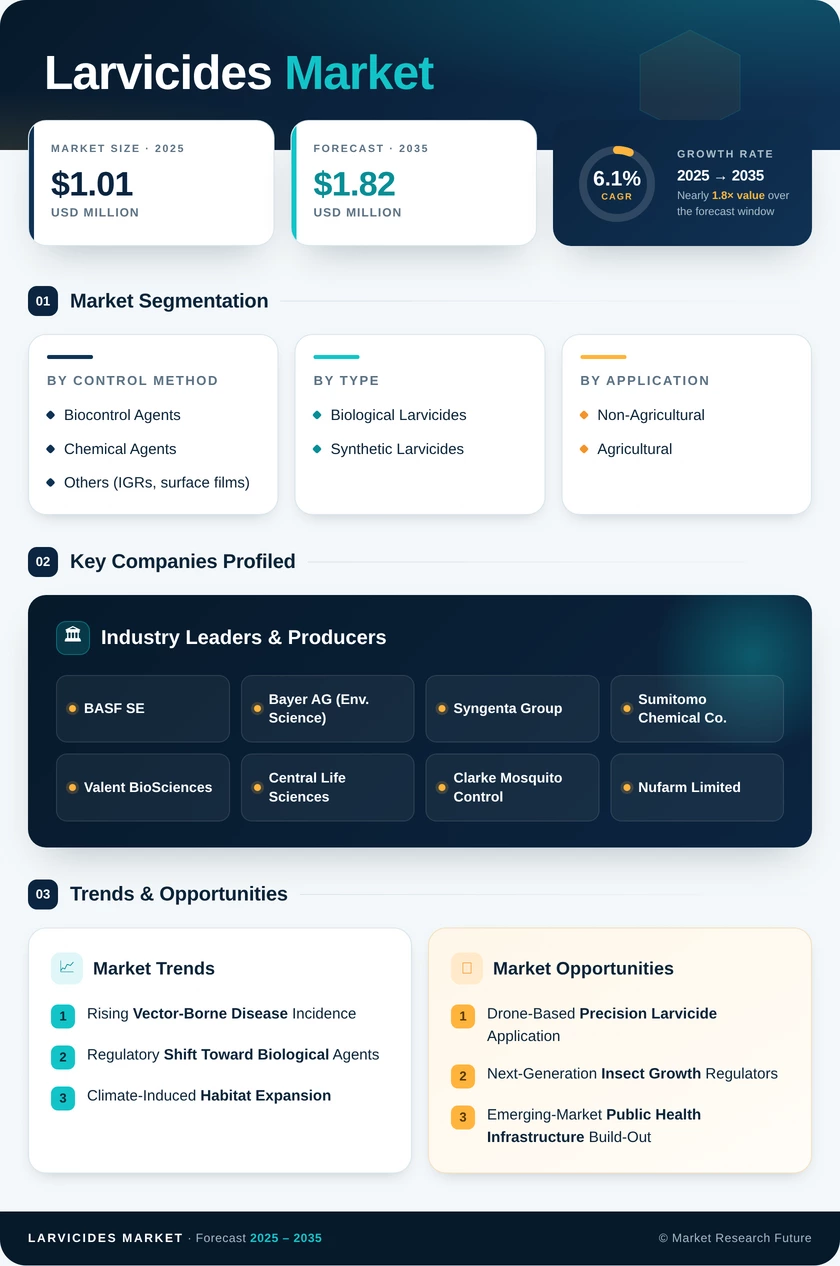
Segmentation Quick Reference
| Dimension | Sub-Segments | Dominant Segment | Fastest Growing Segment |
| Control Method | Biocontrol Agents, Chemical Agents, Others (IGRs, Surface Films) | Biocontrol Agents | Chemical Agents |
| Product Type | Biological Larvicides, Synthetic Larvicides | Synthetic Larvicides | Biological Larvicides |
| Application | Non-Agricultural, Agricultural | Non-Agricultural | Agricultural |
| Target Insects | Mosquitoes, Others (Midges, Black Flies, etc.) | Mosquitoes | Others |
| Formulation | Granules, Others (Briquettes, Liquids, Tablets) | Granules | Others |
Market Segmentation Overview
By Control Method
| Sub-Segment | Key Trend |
| Biocontrol Agents | Regulatory fast-tracking and IPM mandates accelerate adoption of Bti and Lysinibacillus formulations. |
| Chemical Agents | Retained for emergency outbreak response; reformulations address resistance and buffer-zone regulations. |
| Others (IGRs, Surface Films) | Insect growth regulators and monomolecular films fill niche roles in resistance-rotation strategies. |
Biocontrol agents remain the primary growth vector within the control-method dimension, supported by public health agency procurement policies that prioritize reduced-risk active ingredients. Chemical agents serve as a critical fallback during epidemic surge scenarios where speed of knockdown outweighs environmental considerations.
By Product Type
| Sub-Segment | Key Trend |
| Biological Larvicides | Encapsulated and slow-release Bti innovations extend residual efficacy and reduce reapplication costs. |
| Synthetic Larvicides | Legacy products face share erosion but benefit from price competitiveness in developing markets. |
Biological larvicides are closing the cost-per-treatment gap with synthetics as fermentation capacity scales globally. Synthetic products maintain relevance in cost-sensitive tenders across Africa and South Asia where cold-chain constraints limit biological product viability.
By Application
| Sub-Segment | Key Trend |
| Non-Agricultural | Municipal and public health agencies drive volume through structured abatement programs. |
| Agricultural | Rice-paddy and aquaculture operations increasingly adopt biological larvicides as part of integrated crop management. |
Non-agricultural applications anchor total market revenue through predictable government procurement cycles, while agricultural demand is diversifying into aquaculture biosecurity and specialty crop protection.
By Target Insects
| Sub-Segment | Key Trend |
| Mosquitoes | Dominant target driven by dengue, malaria, Zika, and chikungunya prevention mandates |
| Others (Midges, Black Flies, etc.) | Growing importance in aquaculture, livestock, and forestry pest management |
Mosquito-targeted larvicides constitute the vast majority of global demand, reflecting the outsized public health and economic burden of mosquito-borne diseases across tropical and subtropical regions.
By Formulation
| Sub-Segment | Key Trend |
| Granules | Preferred for aerial and mechanized ground application; compatible with drone dispensing systems |
| Others (Briquettes, Liquids, Tablets) | Sustained-release briquettes gain traction for catch basins and cryptic habitats; liquid concentrates suit ULV sprayers. |
Granular formulations dominate due to operational versatility across aerial, truck-mounted, and hand-application scenarios. Briquettes and tablet formulations are carving out specialized roles in urban storm-drain treatment and containerized water-storage larviciding.

 Noah Malgeri
Co-Founder
Noah Malgeri
Co-Founder

 Peter Groot koerkamp
Account and Business Manager
Peter Groot koerkamp
Account and Business Manager

 Younghwan Choi
Senior Retail Manager
Younghwan Choi
Senior Retail Manager

 Mark Irwin
Management Consultant
Mark Irwin
Management Consultant

 Akif Moroglu
Strategy & Business Development Director
Akif Moroglu
Strategy & Business Development Director

 Guilherme Gomes Martins
Product Management Director
Guilherme Gomes Martins
Product Management Director

 Joseph Aguayo
Sales Operations & Pricing Manager
Joseph Aguayo
Sales Operations & Pricing Manager

 La Terria Dodd
Program Support Specialist
La Terria Dodd
Program Support Specialist

 Rob Kooiker
Group Product Manager HVAC & Fire Protection GMA
Rob Kooiker
Group Product Manager HVAC & Fire Protection GMA