Request Free Sample ×

Kindly complete the form below to receive a free sample of this Report

* Please use a valid business email

Leading companies partner with us for data-driven Insights

clients tt-cursor
Hero Background
English
Chinese
French
Japanese
Korean
German
Spanish

Labeling Equipment Market Size

ID: MRFR/PCM/7342-HCR
110 Pages
Snehal Singh
Last Updated: April 06, 2026

Labeling Equipment Market Research Report Information By Product Type (Pressure Sensitive/Self-Adhesive Labelers, Glue-Based Labelers, Sleeve Labelers And others), By Technology (Automatic, Semi-Automatic, Manual), By End-Use (Food & Beverages, Healthcare & Pharmaceuticals, Cosmetics & Personal Care, Chemicals And others) And By Region (North America, Europe, Asia-Pacific, And Rest Of The World) –Market Forecast Till 2035

Share:
Download PDF ×

We do not share your information with anyone. However, we may send you emails based on your report interest from time to time. You may contact us at any time to opt-out.

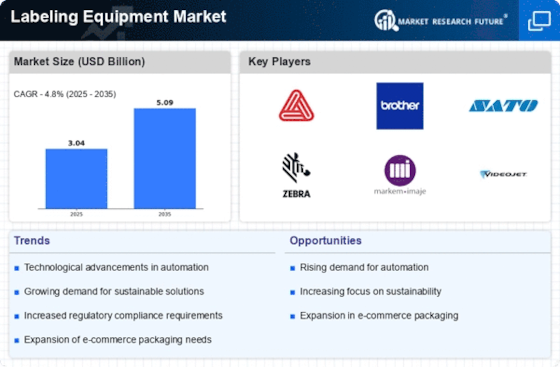
Labeling Equipment Market Infographic
Purchase Options

Labeling Equipment Size

Labeling Equipment Market Growth Projections and Opportunities

The Labeling Equipment Market is plagued by multiple market factors which synergistically contribute to the growing or declining of this industry. Among the many determining elements is that customer tastes constantly evolve and give rise to the need for customization. As consumers begin to become more discerning, board of the industries in general crazes with labeling equipment able to designate for adaptive pack and personalized. This turn has increased the demand for advanced labeling techniques requiring digital printing and smart labeling which are able to suit the changing types and complexities of packaging.

The Size of the Back Labeling Equipment Market is estimated to be valued at USD 2.8 Billion in 2022. The market for production and packaging equipment is likely to be going from USD 2.9 Billion in 2023 to USD 4.2 Billion by 2032 at a 4.80% compound annual growth rate (CAGR).

As for the FMCG industry, consumer preferences tend to change with the development of time. Besides this, regulatory compliance is the another significant factor that is shaping the labeling market. Since the requirements for labeling of products belonging to such industries as pharmaceuticals and food and beverage are the most rigid and exclusive ones, technical innovation has been employed to ensure the use of sophisticated labeling methods. Several industries engaged in the areas require the labeling machines that ensure the precision conformity and title-tracking to meet the strict legislative requirements. Consequently, this has brought manufacturers to theircreative mode to develop solutions that not only increases their efficiency but alsocompliance with regulations.

The globalized trade and commerce of the products have diversified have the largest influence on the mark labeling equipment production market. Companies, embracing the scope of their operation, come across the labeling requirements relating to each country and region that have unique labeling requirements. This has therefore created customers for the machine that can do multi-language labels, compliant with the respective regional standards, and versatile enough to match different packaging formats. Manufacturers within the labeling equipment are therefore involved in the process of the production of flexible solutions for labeling which can meet the complexities of the supply chains that spans a global environment.

Also, there is a growing tendency to pay more attention to sustainability and eco-friendliness and this can have a considerable impact on the labeling equipment market. Companies are increasingly opting for “green” labeling solutions to ensure chemical framework compliance, and also in line with the modern consumer culture that prioritizes sustainability practices. The demand for recycling processes has given rise to machinery that allows apparatus to work with recyclable materials, reduce energy and waste and is also energy saving. The sustainability issue that is becoming a major concern for companies worldwide is evidently leading to the changing development of the equipment for labeling market, which is now being presented in green, eco-conscious means of production.

.
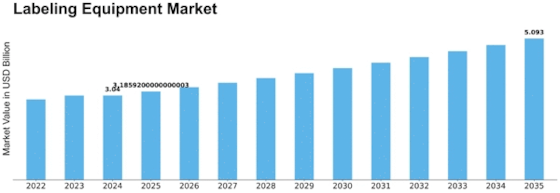
Labeling Equipment Market Size Graph
Author
Author Profile
Snehal Singh
Manager - Research

High acumen in analyzing complex macro & micro markets with more than 6 years of work experience in the field of market research. By implementing her analytical skills in forecasting and estimation into market research reports, she has expertise in Packaging, Construction, and Equipment domains. She handles a team size of 20-25 resources and ensures smooth running of the projects, associated marketing activities, and client servicing.

Leave a Comment

FAQs

What is the projected market valuation of the Labeling Equipment Market by 2035?

<p>The Labeling Equipment Market is projected to reach a valuation of 5.093 USD Billion by 2035.</p>

What was the market valuation of the Labeling Equipment Market in 2024?

<p>In 2024, the overall market valuation of the Labeling Equipment Market was 3.04 USD Billion.</p>

What is the expected CAGR for the Labeling Equipment Market during the forecast period 2025 - 2035?

<p>The expected CAGR for the Labeling Equipment Market during the forecast period 2025 - 2035 is 4.8%.</p>

Which product type segment is anticipated to have the highest growth in the Labeling Equipment Market?

<p>The Pressure Sensitive/Self-Adhesive Labelers segment is anticipated to grow from 1.52 USD Billion in 2024 to 2.54 USD Billion by 2035.</p>

How does the Glue-Based Labelers segment perform in terms of market valuation?

<p>The Glue-Based Labelers segment was valued at 0.76 USD Billion in 2024 and is projected to reach 1.25 USD Billion by 2035.</p>

What are the key end-user segments driving the Labeling Equipment Market?

<p>The Food & Beverages segment leads with a valuation of 1.2 USD Billion in 2024, expected to grow to 1.9 USD Billion by 2035.</p>

Which technology segment is expected to see significant growth in the Labeling Equipment Market?

<p>The Automatic technology segment is projected to increase from 1.52 USD Billion in 2024 to 2.54 USD Billion by 2035.</p>

Who are the leading players in the Labeling Equipment Market?

Key players in the Labeling Equipment Market include Avery Dennison, Brother Industries, SATO Holdings, and Zebra Technologies.

What is the market valuation for the Semi-Automatic technology segment?

The Semi-Automatic technology segment was valued at 1.02 USD Billion in 2024 and is expected to grow to 1.68 USD Billion by 2035.

How does the Chemicals end-user segment contribute to the Labeling Equipment Market?

The Chemicals end-user segment was valued at 0.3 USD Billion in 2024 and is projected to reach 0.5 USD Billion by 2035.

Market Summary

As per Market Research Future analysis, the Labeling Equipment Market Size was estimated at 3.04 USD Billion in 2024. The Labeling Equipment industry is projected to grow from 3.186 USD Billion in 2025 to 5.093 USD Billion by 2035, exhibiting a compound annual growth rate (CAGR) of 4.8% during the forecast period 2025 - 2035

Key Market Trends & Highlights

The Labeling Equipment Market is poised for substantial growth driven by automation and sustainability initiatives.

  • North America remains the largest market for labeling equipment, driven by advanced manufacturing capabilities.
  • Asia-Pacific is emerging as the fastest-growing region, fueled by increasing industrialization and e-commerce activities.
  • Pressure Sensitive/Self-Adhesive Labelers dominate the market, while Glue-Based Labelers are witnessing rapid growth.
  • The rising demand for e-commerce and regulatory compliance are key drivers propelling the labeling equipment market forward.

Market Size & Forecast

2024 Market Size 3.04 (USD Billion)
2035 Market Size 5.093 (USD Billion)
CAGR (2025 - 2035) 4.8%
Largest Regional Market Share in 2024 North America

Major Players

Avery Dennison (US), Brother Industries (JP), SATO Holdings (JP), Zebra Technologies (US), Markem-Imaje (FR), Videojet Technologies (US), Domino Printing Sciences (GB), Herma GmbH (DE), TSC Auto ID Technology (TW)

Market Trends

The Labeling Equipment Market is currently experiencing a dynamic evolution, driven by advancements in technology and increasing demand for automation across various industries. Manufacturers are focusing on enhancing the efficiency and accuracy of labeling processes, which is crucial for compliance and branding. The integration of smart technologies, such as the Internet of Things (IoT) and artificial intelligence, appears to be reshaping the landscape, enabling real-time monitoring and data collection. This shift not only streamlines operations but also enhances the overall user experience, suggesting a trend towards more intelligent labeling solutions. Moreover, sustainability concerns are influencing the Labeling Equipment Market, as companies seek eco-friendly materials and processes. The emphasis on reducing waste and improving recyclability is prompting manufacturers to innovate in their product offerings. As consumers become increasingly aware of environmental issues, businesses are likely to adapt their labeling strategies to align with these values. This dual focus on technological advancement and sustainability indicates a robust future for the Labeling Equipment Market, where adaptability and innovation will be key drivers of growth.

Automation and Smart Technologies

The Labeling Equipment Market is witnessing a notable shift towards automation and the incorporation of smart technologies. This trend is characterized by the integration of IoT and AI, which enhance operational efficiency and accuracy. Automated labeling systems are becoming essential for businesses aiming to streamline their processes and reduce human error, thereby improving productivity.

Sustainability Initiatives

Sustainability is emerging as a pivotal factor in the Labeling Equipment Market. Companies are increasingly prioritizing eco-friendly materials and practices in their labeling solutions. This trend reflects a broader commitment to environmental responsibility, as businesses seek to minimize their ecological footprint and appeal to environmentally conscious consumers.

Customization and Flexibility

Customization is gaining traction within the Labeling Equipment Market, as businesses seek solutions tailored to their specific needs. The demand for flexible labeling systems that can accommodate various product types and sizes is on the rise. This trend indicates a shift towards more versatile equipment that can adapt to changing market requirements.

Labeling Equipment Market Market Drivers

Rising Demand for E-commerce

The Labeling Equipment Market is experiencing a notable surge in demand due to the rapid expansion of e-commerce. As online shopping continues to grow, businesses require efficient labeling solutions to manage inventory and shipping processes. In 2025, the e-commerce sector is projected to account for a significant portion of retail sales, necessitating advanced labeling technologies. This trend compels manufacturers to innovate and enhance their labeling equipment to meet the specific needs of e-commerce businesses, such as high-speed printing and versatile label formats. Consequently, the Labeling Equipment Market is likely to witness increased investments in automation and technology to streamline operations and improve accuracy in product labeling.

Growth of the Food and Beverage Sector

The food and beverage sector is a key driver of the Labeling Equipment Market, as it requires precise and compliant labeling for a wide range of products. In 2025, the increasing consumer demand for packaged foods and beverages is expected to propel the need for efficient labeling solutions. This sector is particularly sensitive to labeling regulations, which necessitate clear and accurate information on packaging. As a result, manufacturers are likely to invest in advanced labeling technologies that can accommodate various packaging formats and sizes. The growth of this sector not only boosts the Labeling Equipment Market but also encourages innovation in labeling solutions to meet evolving consumer preferences.

Sustainability and Eco-friendly Practices

Sustainability is becoming a pivotal concern within the Labeling Equipment Market, as companies increasingly adopt eco-friendly practices. In 2025, the demand for sustainable labeling solutions, such as biodegradable labels and recyclable materials, is expected to rise. This shift is driven by consumer preferences for environmentally responsible products and the need for businesses to comply with sustainability regulations. Manufacturers are responding by developing labeling equipment that can produce eco-friendly labels without compromising quality or performance. As a result, the Labeling Equipment Market is likely to see a transformation towards more sustainable practices, which could enhance brand loyalty and attract environmentally conscious consumers.

Regulatory Compliance and Safety Standards

The Labeling Equipment Market is significantly influenced by stringent regulatory compliance and safety standards across various sectors. Industries such as food and beverage, pharmaceuticals, and chemicals are subject to rigorous labeling requirements to ensure consumer safety and product traceability. In 2025, the demand for labeling equipment that adheres to these regulations is expected to rise, as companies strive to avoid penalties and maintain brand integrity. This trend drives innovation in labeling technologies, prompting manufacturers to develop equipment that can accommodate complex labeling requirements, including barcodes and QR codes. As a result, the Labeling Equipment Market is likely to expand as businesses invest in compliant labeling solutions.

Technological Advancements in Labeling Solutions

Technological advancements are reshaping the Labeling Equipment Market, with innovations such as digital printing and smart labeling gaining traction. In 2025, the integration of IoT and AI technologies into labeling equipment is anticipated to enhance operational efficiency and reduce production costs. These advancements enable real-time monitoring and data collection, allowing businesses to optimize their labeling processes. Furthermore, the demand for high-quality, customizable labels is driving manufacturers to invest in cutting-edge technologies that can produce intricate designs and variable data printing. Consequently, the Labeling Equipment Market is poised for growth as companies seek to leverage these technologies to improve their competitive edge.

Market Segment Insights

By Product Type: Pressure Sensitive/Self-Adhesive Labelers (Largest) vs. Glue-Based Labelers (Fastest-Growing)

<p>The labeling equipment market is diversified with various product types, among which Pressure Sensitive/Self-Adhesive Labelers hold the largest share. These types dominate the market due to their versatility and ease of application across multiple industries, particularly in food and beverage packaging. Glue-Based Labelers, while currently smaller in share, are gaining traction in specific sectors such as cosmetics and pharmaceuticals for their strong adhesion properties, making them increasingly popular. Looking ahead, Pressure Sensitive/Self-Adhesive Labelers are expected to sustain their position due to continuous innovations in materials and adhesive technologies. Meanwhile, Glue-Based Labelers are anticipated to experience rapid growth driven by advancements in glue formulations that enhance efficiency and performance. These trends are fueled by rising consumer demand for more sustainable and reliable labeling solutions, ensuring robust competition in the market.</p>

<p>Pressure Sensitive/Self-Adhesive Labelers (Dominant) vs. Glue-Based Labelers (Emerging)</p>

<p>Pressure Sensitive/Self-Adhesive Labelers are recognized for their flexibility and user-friendly application, making them ideal for a wide array of products in various sectors. They are especially valued in the fast-paced food and beverage industry, where quick application and high-quality labeling are critical. On the other hand, Glue-Based Labelers are emerging as a strong contender due to their ability to provide durable and tamper-evident solutions for sensitive products like pharmaceuticals and cosmetics. Their growth is supported by evolving consumer preferences for reliable packaging that ensures product safety and compliance with regulations. The differentiation between these two segments highlights the dynamic nature of the labeling equipment market.</p>

By Technology: Automatic (Largest) vs. Semi-Automatic (Fastest-Growing)

<p>The labeling equipment market exhibits a diverse distribution among its technology segments, with automatic labeling equipment taking the lead as the largest contributor. Automatic systems dominate the landscape due to their efficiency and capability to handle high volumes, making them indispensable for businesses looking to enhance productivity. In contrast, semi-automatic labeling equipment holds a significant position as well, appealing to smaller operations or those seeking flexibility in their labeling processes, capturing a notable share of the market.</p>

<p>Technology: Automatic (Dominant) vs. Semi-Automatic (Emerging)</p>

<p>Automatic labeling equipment is recognized for its high-speed production capabilities and efficiency, making it a dominant force in the labeling equipment landscape. These systems are designed for large-scale operations, offering consistent application and reducing labor costs significantly. On the other hand, semi-automatic labeling equipment is emerging as a strong competitor, catering to businesses that require versatility and cost-effectiveness. While not as fast as their automatic counterparts, semi-automatic systems provide flexibility that is attractive to small to medium enterprises, allowing operators to maintain control while enhancing productivity.</p>

By End-User: Food & Beverages (Largest) vs. Healthcare & Pharmaceuticals (Fastest-Growing)

<p>The labeling equipment market is strongly influenced by its end-user segments, with the Food & Beverages sector holding the largest market share. This segment's demand is driven by the growing consumption of packaged foods and beverages, necessitating effective labeling solutions for product identification and compliance. Healthcare & Pharmaceuticals follows closely, showcasing its significance due to regulatory requirements and the need for precise labeling on medicines and health products. On the other hand, the Healthcare & Pharmaceuticals segment is noted as the fastest-growing, propelled by advancements in technology and increasing investments in healthcare. The rise of e-commerce in pharmaceuticals and the growing focus on packaging compliance are also contributing factors to this growth. Additionally, the Cosmetics & Personal Care segment is witnessing steady demand, while the Chemicals and Others segments are gradually expanding in alignment with their respective industries' needs for efficient labeling solutions.</p>

<p>Food & Beverages (Dominant) vs. Healthcare & Pharmaceuticals (Emerging)</p>

<p>The Food & Beverages segment remains dominant in the labeling equipment market, characterized by its extensive use of diverse labeling solutions across various food products and beverages. Consumers’ increasing preference for packaged goods drives the need for innovative labeling that ensures product information accuracy and compliance with health regulations. This segment typically utilizes high-speed labeling systems to meet production demands while maintaining quality and clarity in labels. Conversely, the Healthcare & Pharmaceuticals segment is emerging rapidly, reflecting increased regulatory scrutiny and a focus on safety and traceability in medical and pharmaceutical products. This segment's growth is marked by the demand for specialized labeling solutions that address the unique challenges of pharmaceuticals, such as complex regulatory requirements and the need for real-time tracking and identification in supply chains. As technology advances, this sector is likely to continue its upward trajectory, attracting investments and new innovations.</p>

Get more detailed insights about Labeling Equipment Market Research Report - Global Forecast 2035

Regional Insights

North America : Innovation and Demand Surge

North America is the largest market for labeling equipment, holding approximately 40% of the global share. The region's growth is driven by increasing demand for automation in manufacturing and stringent labeling regulations across various industries. The rise in e-commerce and retail sectors further fuels the need for efficient labeling solutions, making it a key player in the market. Regulatory catalysts, such as FDA guidelines for labeling in the food and pharmaceutical sectors, also contribute to market expansion. The competitive landscape in North America is robust, featuring key players like Avery Dennison, Zebra Technologies, and Videojet Technologies. These companies are at the forefront of innovation, offering advanced labeling solutions that cater to diverse industries. The presence of a well-established manufacturing base and a strong distribution network enhances market accessibility. As companies increasingly focus on sustainability, eco-friendly labeling solutions are gaining traction, further shaping the competitive dynamics.

Europe : Regulatory Compliance Drives Growth

Europe is the second-largest market for labeling equipment, accounting for approximately 30% of the global market share. The region's growth is significantly influenced by stringent regulatory requirements, particularly in the food and pharmaceutical sectors. The European Union's regulations on product labeling and traceability are key drivers, pushing companies to adopt advanced labeling technologies. Additionally, the rise in consumer awareness regarding product information and sustainability is propelling demand for innovative labeling solutions. Leading countries in Europe include Germany, France, and the UK, where major players like Markem-Imaje and Herma GmbH operate. The competitive landscape is characterized by a mix of established companies and emerging startups, focusing on technological advancements and customization. The presence of a skilled workforce and strong R&D capabilities further enhances the region's market potential. As companies adapt to changing consumer preferences, the demand for smart labeling solutions is expected to rise, shaping future market trends.

Asia-Pacific : Emerging Market with High Potential

Asia-Pacific is an emerging powerhouse in the labeling equipment market, holding approximately 25% of the global share. The region's rapid industrialization and urbanization are key growth drivers, leading to increased demand for labeling solutions across various sectors, including food and beverage, pharmaceuticals, and consumer goods. Additionally, the rise of e-commerce and retail in countries like China and India is significantly boosting the market. Government initiatives to enhance manufacturing capabilities also play a crucial role in market expansion. Key players in the Asia-Pacific region include Brother Industries and SATO Holdings, which are leveraging technological advancements to cater to the growing demand. The competitive landscape is evolving, with both local and international companies vying for market share. As the region continues to develop, the focus on automation and efficiency in labeling processes is expected to drive innovation and growth, positioning Asia-Pacific as a vital market in the global landscape.

Middle East and Africa : Untapped Potential and Growth

The Middle East and Africa represent a developing market for labeling equipment, holding approximately 5% of the global share. The region's growth is primarily driven by increasing investments in manufacturing and retail sectors, alongside a growing emphasis on compliance with international labeling standards. The rise in consumer goods and food production is also contributing to the demand for efficient labeling solutions. Government initiatives aimed at enhancing trade and manufacturing capabilities are further catalyzing market growth. Leading countries in this region include South Africa and the UAE, where companies are beginning to adopt advanced labeling technologies. The competitive landscape is characterized by a mix of local and international players, focusing on cost-effective solutions. As the region continues to evolve, the demand for innovative labeling solutions is expected to rise, driven by changing consumer preferences and regulatory requirements. The potential for growth in this market remains significant, making it an area of interest for investors and manufacturers alike.

Key Players and Competitive Insights

Leading market players are extensively investing in research and development in order to extend their product lines, which will help the Labelling Equipment Market grow even more. Market participants are also engaging in a number of strategic initiatives to grow their worldwide footprint, with significant market developments including new product launches, contractual agreements, mergers and acquisitions, increased investments, and collaboration with other organisations. To expand and survive in a more competitive and expanding market climate, the labelling equipment industry must provide cost-effective products.Manufacturing locally to minimize operational costs is one of the key business tactics used by manufacturers in the  labeling equipment industry to benefit clients and increase the market sector. In recent years, the labeling equipment industry has offered some of the most significant advantages to medicine. Major players in the Labeling Equipment Market, including Krones AG (Germany), FUJI Seal International Inc. (Japan). World Pack Automation Systems Private Limited (India), Langguth (Germany), Quadrel Labeling Systems (US) and others, are attempting to increase market demand by investing in research and development operations.Cosmo Films (formerly Cosmo First Limited) is a multinational Indian firm that produces bi-axially oriented polypropylene films (BOPP) for packaging, labelling, laminating, and industrial uses. The company is based in New Delhi, India. It has production plants in India and South Korea. In India, the company is traded on the Bombay Stock Exchange (BSE) and the National Stock Exchange (NSE). Mr. Ashok Jaipuria established Cosmo Films Limited in October 1976 and established the first production unit in Aurangabad, Maharashtra in 1981. Cosmo Films purchased a 76.51% stake in Gujarat Propack Limited in 2001.In July 2021, Cosmo Films Ltd. announced the release of a BOPP-based direct thermal printed top-coated film with patented coatings for thermal application applications.Bobst is a Swiss firm that provides packaging machines and services. Machines for the production of packaging and its derivatives (such as labels, bags, and adhesive strips) from solid board, corrugated board, or flexible materials (plastic films, etc.) are examples of products. The organization's headquarters are in Mex, near Lausanne, Switzerland. The company was founded to provide commercial printers in Lausanne. In 1917, the brand 'Bobst' was registered, and in 1918, a limited company called J. Bobst & Fils SA was formed. In June 2022, BOBST Group has announced the launch of the first BOBST Connect subscription package.This user-friendly platform connects converters and brand owners to an automated and digital workflow, giving them complete access to and control over the manufacturing process. BOBST Connect helps customers make the most of the data generated by their equipment by providing insights and various solutions to improve productivity, quality, and efficiency.

Key Companies in the Labeling Equipment Market include

Industry Developments

In September 2022, Markem-Imaje introduced the eTouch-S intelligent print and apply labelling technology. The eTouch-S was intended from the start to suit consumer desire for reduced environmental impact. The eTouch-S eliminates the need for plant air without interfering with supply chain traceability or increasing the likelihood of store fines for returned cases.

In May 2022, JUB Group, one of Europe's leading manufacturers of paints and renderings, ordered three Herma 500 applicators for its in-house manufacturing process to achieve labelling perfection despite the tough weight, intricate design, and large labels required for its products. Three HERMA 500 applicators on a labelling machine show how incredible accuracy can be achieved despite dynamic process changes when labelling. Elmed, a long-standing HERMA sales and service partner in South-east Europe, designed and implemented the solution.

Future Outlook

Labeling Equipment Market Future Outlook

The Labeling Equipment Market is projected to grow at a 4.8% CAGR from 2025 to 2035, driven by automation, e-commerce expansion, and regulatory compliance demands.

New opportunities lie in:

  • Integration of AI-driven labeling solutions for enhanced accuracy.
  • Development of eco-friendly labeling materials to meet sustainability goals.
  • Expansion into emerging markets with tailored labeling technologies.

By 2035, the market is expected to achieve robust growth, driven by innovation and strategic investments.

Market Segmentation

Labeling Equipment Market End-User Outlook

  • Food & Beverages
  • Healthcare & Pharmaceuticals
  • Cosmetics & Personal Care
  • Chemicals
  • Others

Labeling Equipment Market Technology Outlook

  • Automatic
  • Semi-Automatic
  • Manual

Labeling Equipment Market Product Type Outlook

  • Pressure Sensitive/Self-Adhesive Labelers
  • Glue-Based Labelers
  • Sleeve Labelers
  • Others

Report Scope

MARKET SIZE 2024 3.04(USD Billion)
MARKET SIZE 2025 3.186(USD Billion)
MARKET SIZE 2035 5.093(USD Billion)
COMPOUND ANNUAL GROWTH RATE (CAGR) 4.8% (2025 - 2035)
REPORT COVERAGE Revenue Forecast, Competitive Landscape, Growth Factors, and Trends
BASE YEAR 2024
Market Forecast Period 2025 - 2035
Historical Data 2019 - 2024
Market Forecast Units USD Billion
Key Companies Profiled Avery Dennison (US), Brother Industries (JP), SATO Holdings (JP), Zebra Technologies (US), Markem-Imaje (FR), Videojet Technologies (US), Domino Printing Sciences (GB), Herma GmbH (DE), TSC Auto ID Technology (TW)
Segments Covered Product Type, Technology, End-Use, Region
Key Market Opportunities Integration of automation and smart technologies enhances efficiency in the Labeling Equipment Market.
Key Market Dynamics Technological advancements and regulatory changes drive innovation and competition in the labeling equipment market.
Countries Covered North America, Europe, APAC, South America, MEA

FAQs

What is the projected market valuation of the Labeling Equipment Market by 2035?

<p>The Labeling Equipment Market is projected to reach a valuation of 5.093 USD Billion by 2035.</p>

What was the market valuation of the Labeling Equipment Market in 2024?

<p>In 2024, the overall market valuation of the Labeling Equipment Market was 3.04 USD Billion.</p>

What is the expected CAGR for the Labeling Equipment Market during the forecast period 2025 - 2035?

<p>The expected CAGR for the Labeling Equipment Market during the forecast period 2025 - 2035 is 4.8%.</p>

Which product type segment is anticipated to have the highest growth in the Labeling Equipment Market?

<p>The Pressure Sensitive/Self-Adhesive Labelers segment is anticipated to grow from 1.52 USD Billion in 2024 to 2.54 USD Billion by 2035.</p>

How does the Glue-Based Labelers segment perform in terms of market valuation?

<p>The Glue-Based Labelers segment was valued at 0.76 USD Billion in 2024 and is projected to reach 1.25 USD Billion by 2035.</p>

What are the key end-user segments driving the Labeling Equipment Market?

<p>The Food & Beverages segment leads with a valuation of 1.2 USD Billion in 2024, expected to grow to 1.9 USD Billion by 2035.</p>

Which technology segment is expected to see significant growth in the Labeling Equipment Market?

<p>The Automatic technology segment is projected to increase from 1.52 USD Billion in 2024 to 2.54 USD Billion by 2035.</p>

Who are the leading players in the Labeling Equipment Market?

Key players in the Labeling Equipment Market include Avery Dennison, Brother Industries, SATO Holdings, and Zebra Technologies.

What is the market valuation for the Semi-Automatic technology segment?

The Semi-Automatic technology segment was valued at 1.02 USD Billion in 2024 and is expected to grow to 1.68 USD Billion by 2035.

How does the Chemicals end-user segment contribute to the Labeling Equipment Market?

The Chemicals end-user segment was valued at 0.3 USD Billion in 2024 and is projected to reach 0.5 USD Billion by 2035.

  1. SECTION I: EXECUTIVE SUMMARY AND KEY HIGHLIGHTS
    1. | 1.1 EXECUTIVE SUMMARY
    2. | | 1.1.1 Market Overview
    3. | | 1.1.2 Key Findings
    4. | | 1.1.3 Market Segmentation
    5. | | 1.1.4 Competitive Landscape
    6. | | 1.1.5 Challenges and Opportunities
    7. | | 1.1.6 Future Outlook
  2. SECTION II: SCOPING, METHODOLOGY AND MARKET STRUCTURE
    1. | 2.1 MARKET INTRODUCTION
    2. | | 2.1.1 Definition
    3. | | 2.1.2 Scope of the study
    4. | | | 2.1.2.1 Research Objective
    5. | | | 2.1.2.2 Assumption
    6. | | | 2.1.2.3 Limitations
    7. | 2.2 RESEARCH METHODOLOGY
    8. | | 2.2.1 Overview
    9. | | 2.2.2 Data Mining
    10. | | 2.2.3 Secondary Research
    11. | | 2.2.4 Primary Research
    12. | | | 2.2.4.1 Primary Interviews and Information Gathering Process
    13. | | | 2.2.4.2 Breakdown of Primary Respondents
    14. | | 2.2.5 Forecasting Model
    15. | | 2.2.6 Market Size Estimation
    16. | | | 2.2.6.1 Bottom-Up Approach
    17. | | | 2.2.6.2 Top-Down Approach
    18. | | 2.2.7 Data Triangulation
    19. | | 2.2.8 Validation
  3. SECTION III: QUALITATIVE ANALYSIS
    1. | 3.1 MARKET DYNAMICS
    2. | | 3.1.1 Overview
    3. | | 3.1.2 Drivers
    4. | | 3.1.3 Restraints
    5. | | 3.1.4 Opportunities
    6. | 3.2 MARKET FACTOR ANALYSIS
    7. | | 3.2.1 Value chain Analysis
    8. | | 3.2.2 Porter's Five Forces Analysis
    9. | | | 3.2.2.1 Bargaining Power of Suppliers
    10. | | | 3.2.2.2 Bargaining Power of Buyers
    11. | | | 3.2.2.3 Threat of New Entrants
    12. | | | 3.2.2.4 Threat of Substitutes
    13. | | | 3.2.2.5 Intensity of Rivalry
    14. | | 3.2.3 COVID-19 Impact Analysis
    15. | | | 3.2.3.1 Market Impact Analysis
    16. | | | 3.2.3.2 Regional Impact
    17. | | | 3.2.3.3 Opportunity and Threat Analysis
  4. SECTION IV: QUANTITATIVE ANALYSIS
    1. | 4.1 Packaging & Transport, BY Product Type (USD Billion)
    2. | | 4.1.1 Pressure Sensitive/Self-Adhesive Labelers
    3. | | 4.1.2 Glue-Based Labelers
    4. | | 4.1.3 Sleeve Labelers
    5. | | 4.1.4 Others
    6. | 4.2 Packaging & Transport, BY Technology (USD Billion)
    7. | | 4.2.1 Automatic
    8. | | 4.2.2 Semi-Automatic
    9. | | 4.2.3 Manual
    10. | 4.3 Packaging & Transport, BY End-User (USD Billion)
    11. | | 4.3.1 Food & Beverages
    12. | | 4.3.2 Healthcare & Pharmaceuticals
    13. | | 4.3.3 Cosmetics & Personal Care
    14. | | 4.3.4 Chemicals
    15. | | 4.3.5 Others
    16. | 4.4 Packaging & Transport, BY Region (USD Billion)
    17. | | 4.4.1 North America
    18. | | | 4.4.1.1 US
    19. | | | 4.4.1.2 Canada
    20. | | 4.4.2 Europe
    21. | | | 4.4.2.1 Germany
    22. | | | 4.4.2.2 UK
    23. | | | 4.4.2.3 France
    24. | | | 4.4.2.4 Russia
    25. | | | 4.4.2.5 Italy
    26. | | | 4.4.2.6 Spain
    27. | | | 4.4.2.7 Rest of Europe
    28. | | 4.4.3 APAC
    29. | | | 4.4.3.1 China
    30. | | | 4.4.3.2 India
    31. | | | 4.4.3.3 Japan
    32. | | | 4.4.3.4 South Korea
    33. | | | 4.4.3.5 Malaysia
    34. | | | 4.4.3.6 Thailand
    35. | | | 4.4.3.7 Indonesia
    36. | | | 4.4.3.8 Rest of APAC
    37. | | 4.4.4 South America
    38. | | | 4.4.4.1 Brazil
    39. | | | 4.4.4.2 Mexico
    40. | | | 4.4.4.3 Argentina
    41. | | | 4.4.4.4 Rest of South America
    42. | | 4.4.5 MEA
    43. | | | 4.4.5.1 GCC Countries
    44. | | | 4.4.5.2 South Africa
    45. | | | 4.4.5.3 Rest of MEA
  5. SECTION V: COMPETITIVE ANALYSIS
    1. | 5.1 Competitive Landscape
    2. | | 5.1.1 Overview
    3. | | 5.1.2 Competitive Analysis
    4. | | 5.1.3 Market share Analysis
    5. | | 5.1.4 Major Growth Strategy in the Packaging & Transport
    6. | | 5.1.5 Competitive Benchmarking
    7. | | 5.1.6 Leading Players in Terms of Number of Developments in the Packaging & Transport
    8. | | 5.1.7 Key developments and growth strategies
    9. | | | 5.1.7.1 New Product Launch/Service Deployment
    10. | | | 5.1.7.2 Merger & Acquisitions
    11. | | | 5.1.7.3 Joint Ventures
    12. | | 5.1.8 Major Players Financial Matrix
    13. | | | 5.1.8.1 Sales and Operating Income
    14. | | | 5.1.8.2 Major Players R&D Expenditure. 2023
    15. | 5.2 Company Profiles
    16. | | 5.2.1 Avery Dennison (US)
    17. | | | 5.2.1.1 Financial Overview
    18. | | | 5.2.1.2 Products Offered
    19. | | | 5.2.1.3 Key Developments
    20. | | | 5.2.1.4 SWOT Analysis
    21. | | | 5.2.1.5 Key Strategies
    22. | | 5.2.2 Brother Industries (JP)
    23. | | | 5.2.2.1 Financial Overview
    24. | | | 5.2.2.2 Products Offered
    25. | | | 5.2.2.3 Key Developments
    26. | | | 5.2.2.4 SWOT Analysis
    27. | | | 5.2.2.5 Key Strategies
    28. | | 5.2.3 SATO Holdings (JP)
    29. | | | 5.2.3.1 Financial Overview
    30. | | | 5.2.3.2 Products Offered
    31. | | | 5.2.3.3 Key Developments
    32. | | | 5.2.3.4 SWOT Analysis
    33. | | | 5.2.3.5 Key Strategies
    34. | | 5.2.4 Zebra Technologies (US)
    35. | | | 5.2.4.1 Financial Overview
    36. | | | 5.2.4.2 Products Offered
    37. | | | 5.2.4.3 Key Developments
    38. | | | 5.2.4.4 SWOT Analysis
    39. | | | 5.2.4.5 Key Strategies
    40. | | 5.2.5 Markem-Imaje (FR)
    41. | | | 5.2.5.1 Financial Overview
    42. | | | 5.2.5.2 Products Offered
    43. | | | 5.2.5.3 Key Developments
    44. | | | 5.2.5.4 SWOT Analysis
    45. | | | 5.2.5.5 Key Strategies
    46. | | 5.2.6 Videojet Technologies (US)
    47. | | | 5.2.6.1 Financial Overview
    48. | | | 5.2.6.2 Products Offered
    49. | | | 5.2.6.3 Key Developments
    50. | | | 5.2.6.4 SWOT Analysis
    51. | | | 5.2.6.5 Key Strategies
    52. | | 5.2.7 Domino Printing Sciences (GB)
    53. | | | 5.2.7.1 Financial Overview
    54. | | | 5.2.7.2 Products Offered
    55. | | | 5.2.7.3 Key Developments
    56. | | | 5.2.7.4 SWOT Analysis
    57. | | | 5.2.7.5 Key Strategies
    58. | | 5.2.8 Herma GmbH (DE)
    59. | | | 5.2.8.1 Financial Overview
    60. | | | 5.2.8.2 Products Offered
    61. | | | 5.2.8.3 Key Developments
    62. | | | 5.2.8.4 SWOT Analysis
    63. | | | 5.2.8.5 Key Strategies
    64. | | 5.2.9 TSC Auto ID Technology (TW)
    65. | | | 5.2.9.1 Financial Overview
    66. | | | 5.2.9.2 Products Offered
    67. | | | 5.2.9.3 Key Developments
    68. | | | 5.2.9.4 SWOT Analysis
    69. | | | 5.2.9.5 Key Strategies
    70. | 5.3 Appendix
    71. | | 5.3.1 References
    72. | | 5.3.2 Related Reports
  6. LIST OF FIGURES
    1. | 6.1 MARKET SYNOPSIS
    2. | 6.2 NORTH AMERICA MARKET ANALYSIS
    3. | 6.3 US MARKET ANALYSIS BY PRODUCT TYPE
    4. | 6.4 US MARKET ANALYSIS BY TECHNOLOGY
    5. | 6.5 US MARKET ANALYSIS BY END-USER
    6. | 6.6 CANADA MARKET ANALYSIS BY PRODUCT TYPE
    7. | 6.7 CANADA MARKET ANALYSIS BY TECHNOLOGY
    8. | 6.8 CANADA MARKET ANALYSIS BY END-USER
    9. | 6.9 EUROPE MARKET ANALYSIS
    10. | 6.10 GERMANY MARKET ANALYSIS BY PRODUCT TYPE
    11. | 6.11 GERMANY MARKET ANALYSIS BY TECHNOLOGY
    12. | 6.12 GERMANY MARKET ANALYSIS BY END-USER
    13. | 6.13 UK MARKET ANALYSIS BY PRODUCT TYPE
    14. | 6.14 UK MARKET ANALYSIS BY TECHNOLOGY
    15. | 6.15 UK MARKET ANALYSIS BY END-USER
    16. | 6.16 FRANCE MARKET ANALYSIS BY PRODUCT TYPE
    17. | 6.17 FRANCE MARKET ANALYSIS BY TECHNOLOGY
    18. | 6.18 FRANCE MARKET ANALYSIS BY END-USER
    19. | 6.19 RUSSIA MARKET ANALYSIS BY PRODUCT TYPE
    20. | 6.20 RUSSIA MARKET ANALYSIS BY TECHNOLOGY
    21. | 6.21 RUSSIA MARKET ANALYSIS BY END-USER
    22. | 6.22 ITALY MARKET ANALYSIS BY PRODUCT TYPE
    23. | 6.23 ITALY MARKET ANALYSIS BY TECHNOLOGY
    24. | 6.24 ITALY MARKET ANALYSIS BY END-USER
    25. | 6.25 SPAIN MARKET ANALYSIS BY PRODUCT TYPE
    26. | 6.26 SPAIN MARKET ANALYSIS BY TECHNOLOGY
    27. | 6.27 SPAIN MARKET ANALYSIS BY END-USER
    28. | 6.28 REST OF EUROPE MARKET ANALYSIS BY PRODUCT TYPE
    29. | 6.29 REST OF EUROPE MARKET ANALYSIS BY TECHNOLOGY
    30. | 6.30 REST OF EUROPE MARKET ANALYSIS BY END-USER
    31. | 6.31 APAC MARKET ANALYSIS
    32. | 6.32 CHINA MARKET ANALYSIS BY PRODUCT TYPE
    33. | 6.33 CHINA MARKET ANALYSIS BY TECHNOLOGY
    34. | 6.34 CHINA MARKET ANALYSIS BY END-USER
    35. | 6.35 INDIA MARKET ANALYSIS BY PRODUCT TYPE
    36. | 6.36 INDIA MARKET ANALYSIS BY TECHNOLOGY
    37. | 6.37 INDIA MARKET ANALYSIS BY END-USER
    38. | 6.38 JAPAN MARKET ANALYSIS BY PRODUCT TYPE
    39. | 6.39 JAPAN MARKET ANALYSIS BY TECHNOLOGY
    40. | 6.40 JAPAN MARKET ANALYSIS BY END-USER
    41. | 6.41 SOUTH KOREA MARKET ANALYSIS BY PRODUCT TYPE
    42. | 6.42 SOUTH KOREA MARKET ANALYSIS BY TECHNOLOGY
    43. | 6.43 SOUTH KOREA MARKET ANALYSIS BY END-USER
    44. | 6.44 MALAYSIA MARKET ANALYSIS BY PRODUCT TYPE
    45. | 6.45 MALAYSIA MARKET ANALYSIS BY TECHNOLOGY
    46. | 6.46 MALAYSIA MARKET ANALYSIS BY END-USER
    47. | 6.47 THAILAND MARKET ANALYSIS BY PRODUCT TYPE
    48. | 6.48 THAILAND MARKET ANALYSIS BY TECHNOLOGY
    49. | 6.49 THAILAND MARKET ANALYSIS BY END-USER
    50. | 6.50 INDONESIA MARKET ANALYSIS BY PRODUCT TYPE
    51. | 6.51 INDONESIA MARKET ANALYSIS BY TECHNOLOGY
    52. | 6.52 INDONESIA MARKET ANALYSIS BY END-USER
    53. | 6.53 REST OF APAC MARKET ANALYSIS BY PRODUCT TYPE
    54. | 6.54 REST OF APAC MARKET ANALYSIS BY TECHNOLOGY
    55. | 6.55 REST OF APAC MARKET ANALYSIS BY END-USER
    56. | 6.56 SOUTH AMERICA MARKET ANALYSIS
    57. | 6.57 BRAZIL MARKET ANALYSIS BY PRODUCT TYPE
    58. | 6.58 BRAZIL MARKET ANALYSIS BY TECHNOLOGY
    59. | 6.59 BRAZIL MARKET ANALYSIS BY END-USER
    60. | 6.60 MEXICO MARKET ANALYSIS BY PRODUCT TYPE
    61. | 6.61 MEXICO MARKET ANALYSIS BY TECHNOLOGY
    62. | 6.62 MEXICO MARKET ANALYSIS BY END-USER
    63. | 6.63 ARGENTINA MARKET ANALYSIS BY PRODUCT TYPE
    64. | 6.64 ARGENTINA MARKET ANALYSIS BY TECHNOLOGY
    65. | 6.65 ARGENTINA MARKET ANALYSIS BY END-USER
    66. | 6.66 REST OF SOUTH AMERICA MARKET ANALYSIS BY PRODUCT TYPE
    67. | 6.67 REST OF SOUTH AMERICA MARKET ANALYSIS BY TECHNOLOGY
    68. | 6.68 REST OF SOUTH AMERICA MARKET ANALYSIS BY END-USER
    69. | 6.69 MEA MARKET ANALYSIS
    70. | 6.70 GCC COUNTRIES MARKET ANALYSIS BY PRODUCT TYPE
    71. | 6.71 GCC COUNTRIES MARKET ANALYSIS BY TECHNOLOGY
    72. | 6.72 GCC COUNTRIES MARKET ANALYSIS BY END-USER
    73. | 6.73 SOUTH AFRICA MARKET ANALYSIS BY PRODUCT TYPE
    74. | 6.74 SOUTH AFRICA MARKET ANALYSIS BY TECHNOLOGY
    75. | 6.75 SOUTH AFRICA MARKET ANALYSIS BY END-USER
    76. | 6.76 REST OF MEA MARKET ANALYSIS BY PRODUCT TYPE
    77. | 6.77 REST OF MEA MARKET ANALYSIS BY TECHNOLOGY
    78. | 6.78 REST OF MEA MARKET ANALYSIS BY END-USER
    79. | 6.79 KEY BUYING CRITERIA OF PACKAGING & TRANSPORT
    80. | 6.80 RESEARCH PROCESS OF MRFR
    81. | 6.81 DRO ANALYSIS OF PACKAGING & TRANSPORT
    82. | 6.82 DRIVERS IMPACT ANALYSIS: PACKAGING & TRANSPORT
    83. | 6.83 RESTRAINTS IMPACT ANALYSIS: PACKAGING & TRANSPORT
    84. | 6.84 SUPPLY / VALUE CHAIN: PACKAGING & TRANSPORT
    85. | 6.85 PACKAGING & TRANSPORT, BY PRODUCT TYPE, 2024 (% SHARE)
    86. | 6.86 PACKAGING & TRANSPORT, BY PRODUCT TYPE, 2024 TO 2035 (USD Billion)
    87. | 6.87 PACKAGING & TRANSPORT, BY TECHNOLOGY, 2024 (% SHARE)
    88. | 6.88 PACKAGING & TRANSPORT, BY TECHNOLOGY, 2024 TO 2035 (USD Billion)
    89. | 6.89 PACKAGING & TRANSPORT, BY END-USER, 2024 (% SHARE)
    90. | 6.90 PACKAGING & TRANSPORT, BY END-USER, 2024 TO 2035 (USD Billion)
    91. | 6.91 BENCHMARKING OF MAJOR COMPETITORS
  7. LIST OF TABLES
    1. | 7.1 LIST OF ASSUMPTIONS
    2. | | 7.1.1
    3. | 7.2 North America MARKET SIZE ESTIMATES; FORECAST
    4. | | 7.2.1 BY PRODUCT TYPE, 2025-2035 (USD Billion)
    5. | | 7.2.2 BY TECHNOLOGY, 2025-2035 (USD Billion)
    6. | | 7.2.3 BY END-USER, 2025-2035 (USD Billion)
    7. | 7.3 US MARKET SIZE ESTIMATES; FORECAST
    8. | | 7.3.1 BY PRODUCT TYPE, 2025-2035 (USD Billion)
    9. | | 7.3.2 BY TECHNOLOGY, 2025-2035 (USD Billion)
    10. | | 7.3.3 BY END-USER, 2025-2035 (USD Billion)
    11. | 7.4 Canada MARKET SIZE ESTIMATES; FORECAST
    12. | | 7.4.1 BY PRODUCT TYPE, 2025-2035 (USD Billion)
    13. | | 7.4.2 BY TECHNOLOGY, 2025-2035 (USD Billion)
    14. | | 7.4.3 BY END-USER, 2025-2035 (USD Billion)
    15. | 7.5 Europe MARKET SIZE ESTIMATES; FORECAST
    16. | | 7.5.1 BY PRODUCT TYPE, 2025-2035 (USD Billion)
    17. | | 7.5.2 BY TECHNOLOGY, 2025-2035 (USD Billion)
    18. | | 7.5.3 BY END-USER, 2025-2035 (USD Billion)
    19. | 7.6 Germany MARKET SIZE ESTIMATES; FORECAST
    20. | | 7.6.1 BY PRODUCT TYPE, 2025-2035 (USD Billion)
    21. | | 7.6.2 BY TECHNOLOGY, 2025-2035 (USD Billion)
    22. | | 7.6.3 BY END-USER, 2025-2035 (USD Billion)
    23. | 7.7 UK MARKET SIZE ESTIMATES; FORECAST
    24. | | 7.7.1 BY PRODUCT TYPE, 2025-2035 (USD Billion)
    25. | | 7.7.2 BY TECHNOLOGY, 2025-2035 (USD Billion)
    26. | | 7.7.3 BY END-USER, 2025-2035 (USD Billion)
    27. | 7.8 France MARKET SIZE ESTIMATES; FORECAST
    28. | | 7.8.1 BY PRODUCT TYPE, 2025-2035 (USD Billion)
    29. | | 7.8.2 BY TECHNOLOGY, 2025-2035 (USD Billion)
    30. | | 7.8.3 BY END-USER, 2025-2035 (USD Billion)
    31. | 7.9 Russia MARKET SIZE ESTIMATES; FORECAST
    32. | | 7.9.1 BY PRODUCT TYPE, 2025-2035 (USD Billion)
    33. | | 7.9.2 BY TECHNOLOGY, 2025-2035 (USD Billion)
    34. | | 7.9.3 BY END-USER, 2025-2035 (USD Billion)
    35. | 7.10 Italy MARKET SIZE ESTIMATES; FORECAST
    36. | | 7.10.1 BY PRODUCT TYPE, 2025-2035 (USD Billion)
    37. | | 7.10.2 BY TECHNOLOGY, 2025-2035 (USD Billion)
    38. | | 7.10.3 BY END-USER, 2025-2035 (USD Billion)
    39. | 7.11 Spain MARKET SIZE ESTIMATES; FORECAST
    40. | | 7.11.1 BY PRODUCT TYPE, 2025-2035 (USD Billion)
    41. | | 7.11.2 BY TECHNOLOGY, 2025-2035 (USD Billion)
    42. | | 7.11.3 BY END-USER, 2025-2035 (USD Billion)
    43. | 7.12 Rest of Europe MARKET SIZE ESTIMATES; FORECAST
    44. | | 7.12.1 BY PRODUCT TYPE, 2025-2035 (USD Billion)
    45. | | 7.12.2 BY TECHNOLOGY, 2025-2035 (USD Billion)
    46. | | 7.12.3 BY END-USER, 2025-2035 (USD Billion)
    47. | 7.13 APAC MARKET SIZE ESTIMATES; FORECAST
    48. | | 7.13.1 BY PRODUCT TYPE, 2025-2035 (USD Billion)
    49. | | 7.13.2 BY TECHNOLOGY, 2025-2035 (USD Billion)
    50. | | 7.13.3 BY END-USER, 2025-2035 (USD Billion)
    51. | 7.14 China MARKET SIZE ESTIMATES; FORECAST
    52. | | 7.14.1 BY PRODUCT TYPE, 2025-2035 (USD Billion)
    53. | | 7.14.2 BY TECHNOLOGY, 2025-2035 (USD Billion)
    54. | | 7.14.3 BY END-USER, 2025-2035 (USD Billion)
    55. | 7.15 India MARKET SIZE ESTIMATES; FORECAST
    56. | | 7.15.1 BY PRODUCT TYPE, 2025-2035 (USD Billion)
    57. | | 7.15.2 BY TECHNOLOGY, 2025-2035 (USD Billion)
    58. | | 7.15.3 BY END-USER, 2025-2035 (USD Billion)
    59. | 7.16 Japan MARKET SIZE ESTIMATES; FORECAST
    60. | | 7.16.1 BY PRODUCT TYPE, 2025-2035 (USD Billion)
    61. | | 7.16.2 BY TECHNOLOGY, 2025-2035 (USD Billion)
    62. | | 7.16.3 BY END-USER, 2025-2035 (USD Billion)
    63. | 7.17 South Korea MARKET SIZE ESTIMATES; FORECAST
    64. | | 7.17.1 BY PRODUCT TYPE, 2025-2035 (USD Billion)
    65. | | 7.17.2 BY TECHNOLOGY, 2025-2035 (USD Billion)
    66. | | 7.17.3 BY END-USER, 2025-2035 (USD Billion)
    67. | 7.18 Malaysia MARKET SIZE ESTIMATES; FORECAST
    68. | | 7.18.1 BY PRODUCT TYPE, 2025-2035 (USD Billion)
    69. | | 7.18.2 BY TECHNOLOGY, 2025-2035 (USD Billion)
    70. | | 7.18.3 BY END-USER, 2025-2035 (USD Billion)
    71. | 7.19 Thailand MARKET SIZE ESTIMATES; FORECAST
    72. | | 7.19.1 BY PRODUCT TYPE, 2025-2035 (USD Billion)
    73. | | 7.19.2 BY TECHNOLOGY, 2025-2035 (USD Billion)
    74. | | 7.19.3 BY END-USER, 2025-2035 (USD Billion)
    75. | 7.20 Indonesia MARKET SIZE ESTIMATES; FORECAST
    76. | | 7.20.1 BY PRODUCT TYPE, 2025-2035 (USD Billion)
    77. | | 7.20.2 BY TECHNOLOGY, 2025-2035 (USD Billion)
    78. | | 7.20.3 BY END-USER, 2025-2035 (USD Billion)
    79. | 7.21 Rest of APAC MARKET SIZE ESTIMATES; FORECAST
    80. | | 7.21.1 BY PRODUCT TYPE, 2025-2035 (USD Billion)
    81. | | 7.21.2 BY TECHNOLOGY, 2025-2035 (USD Billion)
    82. | | 7.21.3 BY END-USER, 2025-2035 (USD Billion)
    83. | 7.22 South America MARKET SIZE ESTIMATES; FORECAST
    84. | | 7.22.1 BY PRODUCT TYPE, 2025-2035 (USD Billion)
    85. | | 7.22.2 BY TECHNOLOGY, 2025-2035 (USD Billion)
    86. | | 7.22.3 BY END-USER, 2025-2035 (USD Billion)
    87. | 7.23 Brazil MARKET SIZE ESTIMATES; FORECAST
    88. | | 7.23.1 BY PRODUCT TYPE, 2025-2035 (USD Billion)
    89. | | 7.23.2 BY TECHNOLOGY, 2025-2035 (USD Billion)
    90. | | 7.23.3 BY END-USER, 2025-2035 (USD Billion)
    91. | 7.24 Mexico MARKET SIZE ESTIMATES; FORECAST
    92. | | 7.24.1 BY PRODUCT TYPE, 2025-2035 (USD Billion)
    93. | | 7.24.2 BY TECHNOLOGY, 2025-2035 (USD Billion)
    94. | | 7.24.3 BY END-USER, 2025-2035 (USD Billion)
    95. | 7.25 Argentina MARKET SIZE ESTIMATES; FORECAST
    96. | | 7.25.1 BY PRODUCT TYPE, 2025-2035 (USD Billion)
    97. | | 7.25.2 BY TECHNOLOGY, 2025-2035 (USD Billion)
    98. | | 7.25.3 BY END-USER, 2025-2035 (USD Billion)
    99. | 7.26 Rest of South America MARKET SIZE ESTIMATES; FORECAST
    100. | | 7.26.1 BY PRODUCT TYPE, 2025-2035 (USD Billion)
    101. | | 7.26.2 BY TECHNOLOGY, 2025-2035 (USD Billion)
    102. | | 7.26.3 BY END-USER, 2025-2035 (USD Billion)
    103. | 7.27 MEA MARKET SIZE ESTIMATES; FORECAST
    104. | | 7.27.1 BY PRODUCT TYPE, 2025-2035 (USD Billion)
    105. | | 7.27.2 BY TECHNOLOGY, 2025-2035 (USD Billion)
    106. | | 7.27.3 BY END-USER, 2025-2035 (USD Billion)
    107. | 7.28 GCC Countries MARKET SIZE ESTIMATES; FORECAST
    108. | | 7.28.1 BY PRODUCT TYPE, 2025-2035 (USD Billion)
    109. | | 7.28.2 BY TECHNOLOGY, 2025-2035 (USD Billion)
    110. | | 7.28.3 BY END-USER, 2025-2035 (USD Billion)
    111. | 7.29 South Africa MARKET SIZE ESTIMATES; FORECAST
    112. | | 7.29.1 BY PRODUCT TYPE, 2025-2035 (USD Billion)
    113. | | 7.29.2 BY TECHNOLOGY, 2025-2035 (USD Billion)
    114. | | 7.29.3 BY END-USER, 2025-2035 (USD Billion)
    115. | 7.30 Rest of MEA MARKET SIZE ESTIMATES; FORECAST
    116. | | 7.30.1 BY PRODUCT TYPE, 2025-2035 (USD Billion)
    117. | | 7.30.2 BY TECHNOLOGY, 2025-2035 (USD Billion)
    118. | | 7.30.3 BY END-USER, 2025-2035 (USD Billion)
    119. | 7.31 PRODUCT LAUNCH/PRODUCT DEVELOPMENT/APPROVAL
    120. | | 7.31.1
    121. | 7.32 ACQUISITION/PARTNERSHIP
    122. | | 7.32.1

Packaging & Transport Market Segmentation

Packaging & Transport By Product Type (USD Billion, 2025-2035)

  • Pressure Sensitive/Self-Adhesive Labelers
  • Glue-Based Labelers
  • Sleeve Labelers
  • Others

Packaging & Transport By Technology (USD Billion, 2025-2035)

  • Automatic
  • Semi-Automatic
  • Manual

Packaging & Transport By End-User (USD Billion, 2025-2035)

  • Food & Beverages
  • Healthcare & Pharmaceuticals
  • Cosmetics & Personal Care
  • Chemicals
  • Others
Infographic

Free Sample Request

Kindly complete the form below to receive a free sample of this Report

Get Free Sample

Customer Strories

Compare Licence

×
Features License Type
Single User Multiuser License Enterprise User
Price $4,950 $5,950 $7,250
Maximum User Access Limit 1 User Upto 10 Users Unrestricted Access Throughout the Organization
Free Customization
Direct Access to Analyst
Deliverable Format
Platform Access
Discount on Next Purchase 10% 15% 15%
Printable Versions