Request Free Sample ×

Kindly complete the form below to receive a free sample of this Report

* Please use a valid business email

Leading companies partner with us for data-driven Insights

clients tt-cursor
Hero Background
English
Chinese
French
Japanese
Korean
German
Spanish

IoT Based Asset Tracking Monitoring Market Share

ID: MRFR/SEM/10849-HCR
128 Pages
Ankit Gupta
December 2024

IoT-Based Asset Tracking and Monitoring Market Size, Share and Research Report By Connectivity Type (Wi-Fi, Bluetooth, Cellular, NB-IoT, LoRa, SigFox, UWB, GNSS, and Others), By Application (Livestock Monitoring, Automotive, Railways, Aviation, Manufacturing, Cold Chain Monitoring, and Others), And By Region (North America, Europe, Asia-Pacific, And Rest Of The World) – Industry Size, Share and Trebds Till 2035

Share:
Download PDF ×

We do not share your information with anyone. However, we may send you emails based on your report interest from time to time. You may contact us at any time to opt-out.

IoT Based Asset Tracking Monitoring Market Infographic
Purchase Options

Market Share

IoT Based Asset Tracking Monitoring Market Share Analysis

In the dynamic landscape of the IoT-based asset tracking and monitoring market, companies employ various market share positioning strategies to establish a competitive edge and capture a significant portion of the market. One prevalent strategy is differentiation through technological innovation. Companies invest heavily in research and development to create cutting-edge IoT solutions that offer unique features, improved performance, and enhanced functionalities. By staying at the forefront of technological advancements, companies can attract customers looking for state-of-the-art asset tracking and monitoring solutions, thereby securing a distinct market position.

Another key market positioning strategy revolves around strategic partnerships and collaborations. In the complex ecosystem of IoT, companies often form alliances with technology partners, system integrators, or other industry players to leverage complementary strengths. These partnerships can enhance product offerings, extend market reach, and facilitate the integration of diverse technologies. By strategically aligning with other entities in the value chain, companies can position themselves as comprehensive solution providers capable of addressing the multifaceted needs of customers in different industries.

Price competition is a significant factor influencing market share positioning. Some companies adopt a cost leadership strategy, aiming to provide IoT-based asset tracking and monitoring solutions at competitive prices. This approach is particularly effective in price-sensitive markets where customers prioritize cost efficiency. By optimizing production processes, minimizing operational costs, and offering budget-friendly solutions, companies can attract a broad customer base and secure a substantial market share.

Market segmentation is another strategic approach, where companies target specific industry verticals or niche markets with tailored solutions. By understanding the unique requirements of different sectors, companies can develop specialized offerings that resonate with the specific needs of customers in those segments. This strategy allows companies to position themselves as experts in particular industries, fostering customer trust and loyalty within those targeted markets.

Moreover, customer-centric strategies play a crucial role in market share positioning. Companies focus on understanding customer pain points and preferences to deliver solutions that align with their expectations. Providing excellent customer support, customization options, and seamless integration with existing systems are key elements of this strategy. By building strong relationships with customers and consistently meeting their evolving needs, companies can solidify their market position and benefit from positive word-of-mouth referrals, contributing to sustained growth.

Brand positioning and reputation management are integral aspects of market share strategies. Establishing a strong brand presence and cultivating a positive reputation within the industry can significantly impact customer perceptions. Companies invest in marketing initiatives, thought leadership, and building a compelling brand narrative to differentiate themselves from competitors. A positive brand image can not only attract new customers but also retain existing ones, contributing to long-term market share stability.


Author
Author Profile
Ankit Gupta
Team Lead - Research

Ankit Gupta is a seasoned market intelligence and strategic research professional with over six plus years of experience in the ICT and Semiconductor industries. With academic roots in Telecom, Marketing, and Electronics, he blends technical insight with business strategy. Ankit has led 200+ projects, including work for Fortune 500 clients like Microsoft and Rio Tinto, covering market sizing, tech forecasting, and go-to-market strategies. Known for bridging engineering and enterprise decision-making, his insights support growth, innovation, and investment planning across diverse technology markets.

Leave a Comment

FAQs

What is the projected market valuation for the IoT-Based Asset Tracking and Monitoring Market in 2035?

<p>The projected market valuation for the IoT-Based Asset Tracking and Monitoring Market in 2035 is 17.09 USD Billion.</p>

What was the market valuation for the IoT-Based Asset Tracking and Monitoring Market in 2024?

<p>The market valuation for the IoT-Based Asset Tracking and Monitoring Market in 2024 was 5.111 USD Billion.</p>

What is the expected CAGR for the IoT-Based Asset Tracking and Monitoring Market from 2025 to 2035?

<p>The expected CAGR for the IoT-Based Asset Tracking and Monitoring Market during the forecast period 2025 - 2035 is 11.6%.</p>

Which companies are considered key players in the IoT-Based Asset Tracking and Monitoring Market?

<p>Key players in the market include Zebra Technologies, Honeywell, Siemens, Cisco Systems, IBM, Oracle, SAP, GE Digital, and Tracki.</p>

What are the main types of technologies used in IoT-Based Asset Tracking and Monitoring?

<p>Main types of technologies include Wi-Fi, Bluetooth, Cellular, NB-IoT, LoRa, SigFox, UWB, and GNSS.</p>

How much is the Cellular segment projected to grow by 2035?

<p>The Cellular segment is projected to grow from 1.2 USD Billion in 2024 to 3.5 USD Billion by 2035.</p>

What applications are driving growth in the IoT-Based Asset Tracking and Monitoring Market?

Applications driving growth include Automotive, Livestock Monitoring, Railways, Aviation, Manufacturing, and Cold Chain Monitoring.

What is the projected growth for the Cold Chain Monitoring application by 2035?

The Cold Chain Monitoring application is projected to grow from 0.8 USD Billion in 2024 to 2.5 USD Billion by 2035.

Which technology segment is expected to see the highest growth by 2035?

The Cellular technology segment is expected to see the highest growth, increasing to 3.5 USD Billion by 2035.

What is the expected growth for the Livestock Monitoring application in the same period?

The Livestock Monitoring application is expected to grow from 0.5111 USD Billion in 2024 to 1.709 USD Billion by 2035.

Market Summary

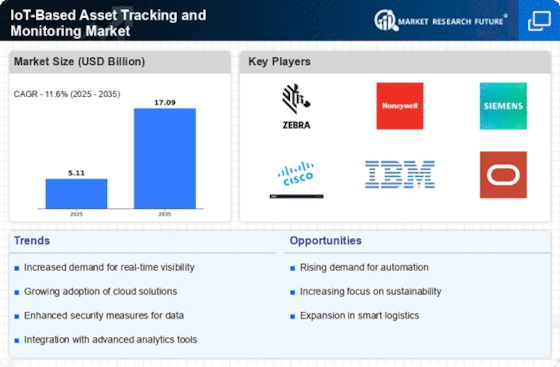
As per Market Research Future analysis, the IoT-Based Asset Tracking and Monitoring Market Size was estimated at 5.111 USD Billion in 2024. The IoT-Based Asset Tracking and Monitoring industry is projected to grow from 5.704 USD Billion in 2025 to 17.09 USD Billion by 2035, exhibiting a compound annual growth rate (CAGR) of 11.6% during the forecast period 2025 - 2035

Key Market Trends & Highlights

The IoT-Based Asset Tracking and Monitoring Market is experiencing robust growth driven by technological advancements and increasing demand for real-time data.

  • North America remains the largest market for IoT-based asset tracking solutions, reflecting a strong demand across various industries. The Asia-Pacific region is emerging as the fastest-growing market, fueled by rapid urbanization and industrialization. Cellular technology continues to dominate the market, while NB-IoT is gaining traction as a fast-growing segment due to its efficiency in low-power applications. Rising demand for real-time tracking and advancements in IoT technology are key drivers propelling market expansion.

Market Size & Forecast

2024 Market Size 5.111 (USD Billion)
2035 Market Size 17.09 (USD Billion)
CAGR (2025 - 2035) 11.6%
Largest Regional Market Share in 2024 North America

Major Players

Zebra Technologies (US), Honeywell (US), Siemens (DE), Cisco Systems (US), IBM (US), Oracle (US), SAP (DE), GE Digital (US), Tracki (US)

Market Trends

The IoT-Based Asset Tracking and Monitoring Market is currently experiencing a transformative phase, driven by advancements in technology and increasing demand for efficient asset management solutions. Organizations across various sectors are recognizing the value of real-time tracking and monitoring capabilities enabled by asset monitoring IoT solutions, which enhance operational efficiency and reduce costs. The integration of Internet of Things (IoT) devices enables businesses to gain insights into asset utilization, location, and condition through asset tracking using IoT, thereby facilitating informed decision-making. As a result, companies are increasingly adopting IoT-based solutions and asset tracking IoT platform technologies to streamline their operations and improve overall productivity. Moreover, the market landscape is evolving with the emergence of innovative technologies such as artificial intelligence and machine learning, which are being integrated into asset tracking systems. These technologies enhance predictive analytics, enabling organizations to anticipate maintenance needs and optimize resource allocation. Additionally, the growing emphasis on sustainability and regulatory compliance is prompting businesses to adopt IoT solutions that not only improve efficiency but also contribute to environmental goals. This convergence of technology and sustainability is likely to shape the future of the IoT-Based Asset Tracking and Monitoring Market, making iot tracking system adoption a focal point for investment and development in the coming years.

Increased Adoption of Cloud-Based Solutions

Organizations are increasingly shifting towards cloud-based platforms for asset tracking and monitoring. This trend allows for enhanced data accessibility, scalability, and collaboration among teams, facilitating real-time insights and decision-making through asset tracking IoT platform deployments.

Integration of Advanced Analytics

The incorporation of advanced analytics into asset tracking systems is becoming more prevalent. This trend enables businesses to leverage data from asset monitoring IoT networks for predictive maintenance, optimizing asset performance and reducing downtime.

Focus on Security and Data Privacy

As the IoT-Based Asset Tracking and Monitoring Market expands, there is a growing emphasis on security and data privacy within asset tracking using IoT frameworks. Companies are prioritizing robust security measures to protect sensitive information and ensure compliance with regulations.

IoT Based Asset Tracking Monitoring Market Market Drivers

Advancements in IoT Technology

Technological advancements in IoT are significantly influencing the IoT-Based Asset Tracking and Monitoring Market. Innovations such as improved sensor technologies, enhanced connectivity options, and the proliferation of low-power wide-area networks (LPWAN) are enabling more efficient asset tracking solutions. These advancements facilitate the deployment of cost-effective and scalable tracking systems, which are essential for businesses looking to monitor their assets in real-time. The integration of artificial intelligence and machine learning into IoT systems further enhances predictive analytics capabilities, allowing organizations to anticipate asset needs and mitigate risks. As a result, the market is expected to witness a robust growth trajectory, with an estimated increase in market size reaching several billion dollars by 2026.

Increased Focus on Sustainability

Sustainability is emerging as a key driver in the IoT-Based Asset Tracking and Monitoring Market. Organizations are increasingly prioritizing sustainable practices, which include efficient resource management and waste reduction. IoT-based asset tracking solutions enable companies to monitor their resource usage and optimize their operations, thereby minimizing their environmental impact. The ability to track assets in real-time allows businesses to identify areas where they can reduce waste and improve efficiency. As sustainability becomes a core component of corporate strategy, the demand for IoT solutions that support these initiatives is likely to grow. This shift not only enhances corporate responsibility but also positions companies favorably in the eyes of consumers who are increasingly concerned about environmental issues.

Regulatory Compliance and Standards

Regulatory compliance is becoming increasingly important within the IoT-Based Asset Tracking and Monitoring Market. Governments and regulatory bodies are establishing standards that require organizations to maintain accurate records of their assets, particularly in sectors such as healthcare, transportation, and logistics. Compliance with these regulations necessitates the adoption of IoT-based tracking solutions that can provide real-time data and reporting capabilities. As organizations strive to meet these regulatory requirements, the demand for sophisticated asset tracking systems is expected to rise. This trend not only supports market growth but also encourages innovation in IoT technologies, as companies seek to develop solutions that align with evolving compliance standards.

Rising Demand for Real-Time Tracking

The IoT-Based Asset Tracking and Monitoring Market is experiencing a notable surge in demand for real-time tracking solutions. Organizations across various sectors are increasingly recognizing the value of real-time visibility into their assets. This demand is driven by the need to enhance operational efficiency, reduce losses, and improve customer satisfaction. According to recent estimates, the market for real-time tracking solutions is projected to grow at a compound annual growth rate of approximately 25% over the next five years. This growth is indicative of a broader trend where businesses are leveraging IoT technologies to gain insights into asset utilization and location, thereby optimizing their supply chain processes.

Growing Need for Supply Chain Optimization

The IoT-Based Asset Tracking and Monitoring Market is being propelled by the increasing need for supply chain optimization. Companies are under constant pressure to streamline their operations and reduce costs, leading to a heightened focus on asset management. IoT solutions provide businesses with the tools necessary to monitor their assets throughout the supply chain, from production to delivery. This capability not only enhances visibility but also enables organizations to identify inefficiencies and implement corrective measures swiftly. Recent studies indicate that companies utilizing IoT-based tracking solutions can achieve up to a 30% reduction in operational costs. This trend underscores the critical role of IoT in transforming supply chain dynamics and driving market growth.

Market Segment Insights

By Type: Cellular (Largest) vs. NB-IoT (Fastest-Growing)

In the IoT-Based Asset Tracking and Monitoring Market, the distribution of market share among the various types highlights Cellular as the leading segment. Its widespread utilization across industries contributes significantly to its dominance in asset monitoring IoT applications. Following Cellular, NB-IoT is emerging with considerable momentum, driven by its efficiencies and suitability for a multitude of applications requiring low-power, wide-area connectivity. Growth trends in this segment reveal an increasing adoption of IoT technologies, with businesses pushing for enhanced connectivity and real-time data access to optimize operations. Key drivers include the surge in demand for efficient tracking solutions across logistics, transportation, and health sectors, coupled with advancements in network technologies such as 5G, enhancing overall performance and reliability of Cellular and NB-IoT technologies.

Technology: Cellular (Dominant) vs. NB-IoT (Emerging)

Cellular technology has firmly established itself as the dominant force in the IoT-Based Asset Tracking and Monitoring Market. With robust coverage and support for a vast number of devices, it provides reliable connectivity solutions capable of handling large data transfers. Cellular technology is particularly advantageous in urban environments where robust network infrastructure is available. In contrast, NB-IoT, an emerging player, is gaining traction due to its low-power consumption and superior battery life, ideal for devices requiring extended field operations. NB-IoT is being adopted across various sectors, facilitating enhanced data analytics and monitoring capabilities that align with the growing demand for efficiency and sustainability in asset management.

By Application: Cold Chain Monitoring (Largest) vs. Livestock Monitoring (Fastest-Growing)

The IoT-Based Asset Tracking and Monitoring Market is primarily driven by diverse applications supported by iot tracking system deployments. Cold Chain Monitoring emerges as the largest segment, fueled by its critical role in preserving product quality across the food, pharmaceuticals, and biotechnology industries. Livestock Monitoring, on the other hand, is gaining substantial traction, primarily due to increasing awareness regarding animal health and productivity enhancements, positioning it as a rapidly growing segment within the market.

Livestock Monitoring (Emerging) vs. Cold Chain Monitoring (Dominant)

Cold Chain Monitoring represents a dominant aspect of the IoT-Based Asset Tracking and Monitoring Market, characterized by its vital function in ensuring temperature-sensitive goods are stored and transported under optimal conditions. This segment relies heavily on advanced tracking technologies to provide real-time insights, thus minimizing spoilage and enhancing compliance with health regulations. Conversely, Livestock Monitoring is an emerging segment, focusing on the health and productivity of farm animals. Through IoT devices, farmers can manage herds more effectively, leveraging data analytics for improved decision-making, showcasing its transformative potential in boosting agricultural efficiency.

Get more detailed insights about IoT-Based Asset Tracking and Monitoring Market Research Report—Global Forecast till 2035

Regional Insights

By region, the study supplies market insights into North America, Europe, Asia-Pacific and the Rest of the World. The North American IoT Based Asset Tracking and Monitoring market area will dominate this market, owing to the early adoption of advanced technologies, a well-established IT infrastructure, and a high level of awareness regarding the benefits of IoT solutions. Industries like logistics, transportation, and healthcare have been early adopters of asset-tracking solutions.

Further, the major countries studied in the market report are The US, Canada, Germany, France, the UK, Italy, Spain, China, Japan, India, Australia, South Korea, and Brazil.

Figure: IOT-BASED ASSET TRACKING AND MONITORING MARKET SHARE BY REGION 2022 (USD Billion)

Europe's Asset Tracking and Monitoring market accounts for the second-largest market share due to the strong emphasis on sustainability and environmental regulations, driving the adoption of lot solutions for efficient resource management. Further, the German IoT Based Asset Tracking and Monitoring market held the largest market share, and the UK IoT Based Asset Tracking and Monitoring market was the fastest growing market in the European region.

The Asia-Pacific IoT-based Asset Tracking and Monitoring Market is expected to rise at the fastest CAGR from 2023 to 2032. It is due to the increased demand for asset-tracking technologies. Moreover, China’s IoT Based Asset Tracking and Monitoring market held the largest market share, and the Indian IoT Based Asset Tracking and Monitoring market was the fastest-rising market in the Asia-Pacific region.

Key Players and Competitive Insights

Leading market players are investing heavily in research and development in order to expand their product lines, which will help the IoT Based Asset Tracking and Monitoring market rise even more. Market participants are also undertaking a diversity of strategic activities to develop their global footprint, with vital market developments including new product launches,  agreements, mergers and acquisitions, higher investments, and collaboration with other organizations. To develop and survive in a more competitive and growing market climate, IoT Based Asset Tracking and monitoring industry must offer cost-effective items.Manufacturing locally to minimize operational costs is one of the key business tactics used by manufacturers in the global IoT Asset Tracking and Monitoring industry to benefit clients and increase the market sector. In recent years, the IoT Based Asset Tracking and Monitoring industry has offered some of the most significant advantages to medicine. Major players in the IoT Based Asset Tracking and Monitoring market, including Analog Devices, Inc., Fibocom Wireless Inc., Gosuncnwelink Corporation, Laird Connectivity, Mediatek Inc., Nordic Semiconductor, Quectel, Semtech, Sequans, Sierra Wireless, Sony Semiconductor Israel Ltd., Telit, Thales, and U-BloxNordic Semiconductor was founded as Nordic VLSI (NVLSI) in Trondheim, Norway, in 1983. The company is from the Norwegian University of Science and Technology. The company focuses on the design of mixed-signal application-specific circuits (ASICS) within the Nordic region. In 1996, the firm went public on the Norwegian stock exchange, where it still trades as of 2023. In 1998, NVLSI released its first wireless standard products in the 433 MHz ISM band. In 2003, NVLSI was named Nordic Semiconductor, frequently known as Nordic Semi, to consider the company's focus on ultra-low-power wireless devices. The release of Nordic Semiconductor's wireless devices at 2.4 GHz. Since 2003, Nordic Semiconductor has continued a focus on wireless products for the 2.4 GHz band and has seen its devices used in a broad range of branded consumer electronic products. Nordic Semiconductor keeps its dominant position in the wireless sports, fitness, and desktop peripheral markets.Nordic Semiconductor products support short-range low-power wireless through Bluetooth LE, Thread, Zigbee, and proprietary 2.4 GHz protocols and low-power cellular lot through LTE-M and NB-IoT.Founded in 1999, Fibocom is a leading global provider of IoT (Internet of Things) wireless solutions and wireless communication modules. We provide one-stop services, including wireless communication modules, IoT application solutions, and cloud platforms. They are committed to bringing reliable, accessible, secure and intelligent wireless solutions to every loT application scenario. The goals are to provide the perfect wireless experience for customers and enrich the smart life of the whole society. In 2017, Fibocom became the first stock-listed wireless module provider in China.

Key Companies in the IoT Based Asset Tracking Monitoring Market include

Industry Developments

Mar-2022: Sierra Wireless extended its concurrence with Mobile, the 5G leader, with the largest and fastest nationwide 5G network in the United States. This expansion aimed to boost the global Low Power Wide Area (LPWA) connectivity, offering its Smart Connectivity service. In addition, this agreement would strengthen Sierra Wireless' loT connectivity offering by integrating its purpose-built loT network and management tools with LPWA, 4G LTE, and 5G coverage from Mobile's powerful mobile network.

Feb-2022: Thales released the ELS62 series. This series would complement Thales' 360° approach1 and offer cost-effective solutions to streamline design, simplify development and boost time-to-market for loT solutions.

Dec-2021: Quectel Wireless Solutions, along with Point One Navigation, released the LG69T-AM, a new addition to the LG69T GNSS Module Series. Point One's positioning engine would empower the LG69T-AM and would allow centimeter-level global accuracy by combining augmented GNSS in an affordable yet simple-to-utilize module with open-source API.

Future Outlook

IoT Based Asset Tracking Monitoring Market Future Outlook

The IoT-Based Asset Tracking and Monitoring Market is projected to grow at 11.6% CAGR from 2025 to 2035, driven by advancements in IoT technology, increased demand for real-time data, and enhanced supply chain efficiency.

New opportunities lie in:

  • <p>Integration of AI-driven analytics for predictive maintenance solutions.</p>
  • <p> </p>
  • <p>Development of customized asset tracking solutions for specific industries.</p>
  • <p>Expansion of blockchain technology for secure asset management and tracking.</p>

By 2035, the market is expected to be robust, driven by innovation and increased adoption across various sectors.

Market Segmentation

IoT Based Asset Tracking Monitoring Market Type Outlook

  • Wi-Fi
  • Bluetooth
  • Cellular
  • NB-IoT
  • LoRa
  • SigFox
  • UWB
  • GNSS
  • Others

IoT Based Asset Tracking Monitoring Market Application Outlook

  • Livestock Monitoring
  • Automotive
  • Railways
  • Aviation
  • Manufacturing
  • Cold Chain Monitoring
  • Others

Report Scope

MARKET SIZE 2024 5.111(USD Billion)
MARKET SIZE 2025 5.704(USD Billion)
MARKET SIZE 2035 17.09(USD Billion)
COMPOUND ANNUAL GROWTH RATE (CAGR) 11.6% (2025 - 2035)
REPORT COVERAGE Revenue Forecast, Competitive Landscape, Growth Factors, and Trends
BASE YEAR 2024
Market Forecast Period 2025 - 2035
Historical Data 2019 - 2024
Market Forecast Units USD Billion
Key Companies Profiled Zebra Technologies (US), Honeywell (US), Siemens (DE), Cisco Systems (US), IBM (US), Oracle (US), SAP (DE), GE Digital (US), Tracki (US)
Segments Covered Connectivity Type, Application, Region
Key Market Opportunities Integration of advanced analytics and artificial intelligence enhances efficiency in the IoT-Based Asset Tracking and Monitoring Market.
Key Market Dynamics Rising demand for real-time visibility drives innovation in IoT-based asset tracking and monitoring solutions.
Countries Covered North America, Europe, APAC, South America, MEA

FAQs

What is the projected market valuation for the IoT-Based Asset Tracking and Monitoring Market in 2035?

<p>The projected market valuation for the IoT-Based Asset Tracking and Monitoring Market in 2035 is 17.09 USD Billion.</p>

What was the market valuation for the IoT-Based Asset Tracking and Monitoring Market in 2024?

<p>The market valuation for the IoT-Based Asset Tracking and Monitoring Market in 2024 was 5.111 USD Billion.</p>

What is the expected CAGR for the IoT-Based Asset Tracking and Monitoring Market from 2025 to 2035?

<p>The expected CAGR for the IoT-Based Asset Tracking and Monitoring Market during the forecast period 2025 - 2035 is 11.6%.</p>

Which companies are considered key players in the IoT-Based Asset Tracking and Monitoring Market?

<p>Key players in the market include Zebra Technologies, Honeywell, Siemens, Cisco Systems, IBM, Oracle, SAP, GE Digital, and Tracki.</p>

What are the main types of technologies used in IoT-Based Asset Tracking and Monitoring?

<p>Main types of technologies include Wi-Fi, Bluetooth, Cellular, NB-IoT, LoRa, SigFox, UWB, and GNSS.</p>

How much is the Cellular segment projected to grow by 2035?

<p>The Cellular segment is projected to grow from 1.2 USD Billion in 2024 to 3.5 USD Billion by 2035.</p>

What applications are driving growth in the IoT-Based Asset Tracking and Monitoring Market?

Applications driving growth include Automotive, Livestock Monitoring, Railways, Aviation, Manufacturing, and Cold Chain Monitoring.

What is the projected growth for the Cold Chain Monitoring application by 2035?

The Cold Chain Monitoring application is projected to grow from 0.8 USD Billion in 2024 to 2.5 USD Billion by 2035.

Which technology segment is expected to see the highest growth by 2035?

The Cellular technology segment is expected to see the highest growth, increasing to 3.5 USD Billion by 2035.

What is the expected growth for the Livestock Monitoring application in the same period?

The Livestock Monitoring application is expected to grow from 0.5111 USD Billion in 2024 to 1.709 USD Billion by 2035.

  1. SECTION I: EXECUTIVE SUMMARY AND KEY HIGHLIGHTS
    1. | 1.1 EXECUTIVE SUMMARY
    2. | | 1.1.1 Market Overview
    3. | | 1.1.2 Key Findings
    4. | | 1.1.3 Market Segmentation
    5. | | 1.1.4 Competitive Landscape
    6. | | 1.1.5 Challenges and Opportunities
    7. | | 1.1.6 Future Outlook
  2. SECTION II: SCOPING, METHODOLOGY AND MARKET STRUCTURE
    1. | 2.1 MARKET INTRODUCTION
    2. | | 2.1.1 Definition
    3. | | 2.1.2 Scope of the study
    4. | | | 2.1.2.1 Research Objective
    5. | | | 2.1.2.2 Assumption
    6. | | | 2.1.2.3 Limitations
    7. | 2.2 RESEARCH METHODOLOGY
    8. | | 2.2.1 Overview
    9. | | 2.2.2 Data Mining
    10. | | 2.2.3 Secondary Research
    11. | | 2.2.4 Primary Research
    12. | | | 2.2.4.1 Primary Interviews and Information Gathering Process
    13. | | | 2.2.4.2 Breakdown of Primary Respondents
    14. | | 2.2.5 Forecasting Model
    15. | | 2.2.6 Market Size Estimation
    16. | | | 2.2.6.1 Bottom-Up Approach
    17. | | | 2.2.6.2 Top-Down Approach
    18. | | 2.2.7 Data Triangulation
    19. | | 2.2.8 Validation
  3. SECTION III: QUALITATIVE ANALYSIS
    1. | 3.1 MARKET DYNAMICS
    2. | | 3.1.1 Overview
    3. | | 3.1.2 Drivers
    4. | | 3.1.3 Restraints
    5. | | 3.1.4 Opportunities
    6. | 3.2 MARKET FACTOR ANALYSIS
    7. | | 3.2.1 Value chain Analysis
    8. | | 3.2.2 Porter's Five Forces Analysis
    9. | | | 3.2.2.1 Bargaining Power of Suppliers
    10. | | | 3.2.2.2 Bargaining Power of Buyers
    11. | | | 3.2.2.3 Threat of New Entrants
    12. | | | 3.2.2.4 Threat of Substitutes
    13. | | | 3.2.2.5 Intensity of Rivalry
    14. | | 3.2.3 COVID-19 Impact Analysis
    15. | | | 3.2.3.1 Market Impact Analysis
    16. | | | 3.2.3.2 Regional Impact
    17. | | | 3.2.3.3 Opportunity and Threat Analysis
  4. SECTION IV: QUANTITATIVE ANALYSIS
    1. | 4.1 Semiconductor & Electronics, BY Type (USD Billion)
    2. | | 4.1.1 Wi-Fi
    3. | | 4.1.2 Bluetooth
    4. | | 4.1.3 Cellular
    5. | | 4.1.4 NB-IoT
    6. | | 4.1.5 LoRa
    7. | | 4.1.6 SigFox
    8. | | 4.1.7 UWB
    9. | | 4.1.8 GNSS
    10. | | 4.1.9 Others
    11. | 4.2 Semiconductor & Electronics, BY Application (USD Billion)
    12. | | 4.2.1 Livestock Monitoring
    13. | | 4.2.2 Automotive
    14. | | 4.2.3 Railways
    15. | | 4.2.4 Aviation
    16. | | 4.2.5 Manufacturing
    17. | | 4.2.6 Cold Chain Monitoring
    18. | | 4.2.7 Others
    19. | 4.3 Semiconductor & Electronics, BY Region (USD Billion)
    20. | | 4.3.1 North America
    21. | | | 4.3.1.1 US
    22. | | | 4.3.1.2 Canada
    23. | | 4.3.2 Europe
    24. | | | 4.3.2.1 Germany
    25. | | | 4.3.2.2 UK
    26. | | | 4.3.2.3 France
    27. | | | 4.3.2.4 Russia
    28. | | | 4.3.2.5 Italy
    29. | | | 4.3.2.6 Spain
    30. | | | 4.3.2.7 Rest of Europe
    31. | | 4.3.3 APAC
    32. | | | 4.3.3.1 China
    33. | | | 4.3.3.2 India
    34. | | | 4.3.3.3 Japan
    35. | | | 4.3.3.4 South Korea
    36. | | | 4.3.3.5 Malaysia
    37. | | | 4.3.3.6 Thailand
    38. | | | 4.3.3.7 Indonesia
    39. | | | 4.3.3.8 Rest of APAC
    40. | | 4.3.4 South America
    41. | | | 4.3.4.1 Brazil
    42. | | | 4.3.4.2 Mexico
    43. | | | 4.3.4.3 Argentina
    44. | | | 4.3.4.4 Rest of South America
    45. | | 4.3.5 MEA
    46. | | | 4.3.5.1 GCC Countries
    47. | | | 4.3.5.2 South Africa
    48. | | | 4.3.5.3 Rest of MEA
  5. SECTION V: COMPETITIVE ANALYSIS
    1. | 5.1 Competitive Landscape
    2. | | 5.1.1 Overview
    3. | | 5.1.2 Competitive Analysis
    4. | | 5.1.3 Market share Analysis
    5. | | 5.1.4 Major Growth Strategy in the Semiconductor & Electronics
    6. | | 5.1.5 Competitive Benchmarking
    7. | | 5.1.6 Leading Players in Terms of Number of Developments in the Semiconductor & Electronics
    8. | | 5.1.7 Key developments and growth strategies
    9. | | | 5.1.7.1 New Product Launch/Service Deployment
    10. | | | 5.1.7.2 Merger & Acquisitions
    11. | | | 5.1.7.3 Joint Ventures
    12. | | 5.1.8 Major Players Financial Matrix
    13. | | | 5.1.8.1 Sales and Operating Income
    14. | | | 5.1.8.2 Major Players R&D Expenditure. 2023
    15. | 5.2 Company Profiles
    16. | | 5.2.1 Zebra Technologies (US)
    17. | | | 5.2.1.1 Financial Overview
    18. | | | 5.2.1.2 Products Offered
    19. | | | 5.2.1.3 Key Developments
    20. | | | 5.2.1.4 SWOT Analysis
    21. | | | 5.2.1.5 Key Strategies
    22. | | 5.2.2 Honeywell (US)
    23. | | | 5.2.2.1 Financial Overview
    24. | | | 5.2.2.2 Products Offered
    25. | | | 5.2.2.3 Key Developments
    26. | | | 5.2.2.4 SWOT Analysis
    27. | | | 5.2.2.5 Key Strategies
    28. | | 5.2.3 Siemens (DE)
    29. | | | 5.2.3.1 Financial Overview
    30. | | | 5.2.3.2 Products Offered
    31. | | | 5.2.3.3 Key Developments
    32. | | | 5.2.3.4 SWOT Analysis
    33. | | | 5.2.3.5 Key Strategies
    34. | | 5.2.4 Cisco Systems (US)
    35. | | | 5.2.4.1 Financial Overview
    36. | | | 5.2.4.2 Products Offered
    37. | | | 5.2.4.3 Key Developments
    38. | | | 5.2.4.4 SWOT Analysis
    39. | | | 5.2.4.5 Key Strategies
    40. | | 5.2.5 IBM (US)
    41. | | | 5.2.5.1 Financial Overview
    42. | | | 5.2.5.2 Products Offered
    43. | | | 5.2.5.3 Key Developments
    44. | | | 5.2.5.4 SWOT Analysis
    45. | | | 5.2.5.5 Key Strategies
    46. | | 5.2.6 Oracle (US)
    47. | | | 5.2.6.1 Financial Overview
    48. | | | 5.2.6.2 Products Offered
    49. | | | 5.2.6.3 Key Developments
    50. | | | 5.2.6.4 SWOT Analysis
    51. | | | 5.2.6.5 Key Strategies
    52. | | 5.2.7 SAP (DE)
    53. | | | 5.2.7.1 Financial Overview
    54. | | | 5.2.7.2 Products Offered
    55. | | | 5.2.7.3 Key Developments
    56. | | | 5.2.7.4 SWOT Analysis
    57. | | | 5.2.7.5 Key Strategies
    58. | | 5.2.8 GE Digital (US)
    59. | | | 5.2.8.1 Financial Overview
    60. | | | 5.2.8.2 Products Offered
    61. | | | 5.2.8.3 Key Developments
    62. | | | 5.2.8.4 SWOT Analysis
    63. | | | 5.2.8.5 Key Strategies
    64. | | 5.2.9 Tracki (US)
    65. | | | 5.2.9.1 Financial Overview
    66. | | | 5.2.9.2 Products Offered
    67. | | | 5.2.9.3 Key Developments
    68. | | | 5.2.9.4 SWOT Analysis
    69. | | | 5.2.9.5 Key Strategies
    70. | 5.3 Appendix
    71. | | 5.3.1 References
    72. | | 5.3.2 Related Reports
  6. LIST OF FIGURES
    1. | 6.1 MARKET SYNOPSIS
    2. | 6.2 NORTH AMERICA MARKET ANALYSIS
    3. | 6.3 US MARKET ANALYSIS BY TYPE
    4. | 6.4 US MARKET ANALYSIS BY APPLICATION
    5. | 6.5 CANADA MARKET ANALYSIS BY TYPE
    6. | 6.6 CANADA MARKET ANALYSIS BY APPLICATION
    7. | 6.7 EUROPE MARKET ANALYSIS
    8. | 6.8 GERMANY MARKET ANALYSIS BY TYPE
    9. | 6.9 GERMANY MARKET ANALYSIS BY APPLICATION
    10. | 6.10 UK MARKET ANALYSIS BY TYPE
    11. | 6.11 UK MARKET ANALYSIS BY APPLICATION
    12. | 6.12 FRANCE MARKET ANALYSIS BY TYPE
    13. | 6.13 FRANCE MARKET ANALYSIS BY APPLICATION
    14. | 6.14 RUSSIA MARKET ANALYSIS BY TYPE
    15. | 6.15 RUSSIA MARKET ANALYSIS BY APPLICATION
    16. | 6.16 ITALY MARKET ANALYSIS BY TYPE
    17. | 6.17 ITALY MARKET ANALYSIS BY APPLICATION
    18. | 6.18 SPAIN MARKET ANALYSIS BY TYPE
    19. | 6.19 SPAIN MARKET ANALYSIS BY APPLICATION
    20. | 6.20 REST OF EUROPE MARKET ANALYSIS BY TYPE
    21. | 6.21 REST OF EUROPE MARKET ANALYSIS BY APPLICATION
    22. | 6.22 APAC MARKET ANALYSIS
    23. | 6.23 CHINA MARKET ANALYSIS BY TYPE
    24. | 6.24 CHINA MARKET ANALYSIS BY APPLICATION
    25. | 6.25 INDIA MARKET ANALYSIS BY TYPE
    26. | 6.26 INDIA MARKET ANALYSIS BY APPLICATION
    27. | 6.27 JAPAN MARKET ANALYSIS BY TYPE
    28. | 6.28 JAPAN MARKET ANALYSIS BY APPLICATION
    29. | 6.29 SOUTH KOREA MARKET ANALYSIS BY TYPE
    30. | 6.30 SOUTH KOREA MARKET ANALYSIS BY APPLICATION
    31. | 6.31 MALAYSIA MARKET ANALYSIS BY TYPE
    32. | 6.32 MALAYSIA MARKET ANALYSIS BY APPLICATION
    33. | 6.33 THAILAND MARKET ANALYSIS BY TYPE
    34. | 6.34 THAILAND MARKET ANALYSIS BY APPLICATION
    35. | 6.35 INDONESIA MARKET ANALYSIS BY TYPE
    36. | 6.36 INDONESIA MARKET ANALYSIS BY APPLICATION
    37. | 6.37 REST OF APAC MARKET ANALYSIS BY TYPE
    38. | 6.38 REST OF APAC MARKET ANALYSIS BY APPLICATION
    39. | 6.39 SOUTH AMERICA MARKET ANALYSIS
    40. | 6.40 BRAZIL MARKET ANALYSIS BY TYPE
    41. | 6.41 BRAZIL MARKET ANALYSIS BY APPLICATION
    42. | 6.42 MEXICO MARKET ANALYSIS BY TYPE
    43. | 6.43 MEXICO MARKET ANALYSIS BY APPLICATION
    44. | 6.44 ARGENTINA MARKET ANALYSIS BY TYPE
    45. | 6.45 ARGENTINA MARKET ANALYSIS BY APPLICATION
    46. | 6.46 REST OF SOUTH AMERICA MARKET ANALYSIS BY TYPE
    47. | 6.47 REST OF SOUTH AMERICA MARKET ANALYSIS BY APPLICATION
    48. | 6.48 MEA MARKET ANALYSIS
    49. | 6.49 GCC COUNTRIES MARKET ANALYSIS BY TYPE
    50. | 6.50 GCC COUNTRIES MARKET ANALYSIS BY APPLICATION
    51. | 6.51 SOUTH AFRICA MARKET ANALYSIS BY TYPE
    52. | 6.52 SOUTH AFRICA MARKET ANALYSIS BY APPLICATION
    53. | 6.53 REST OF MEA MARKET ANALYSIS BY TYPE
    54. | 6.54 REST OF MEA MARKET ANALYSIS BY APPLICATION
    55. | 6.55 KEY BUYING CRITERIA OF SEMICONDUCTOR & ELECTRONICS
    56. | 6.56 RESEARCH PROCESS OF MRFR
    57. | 6.57 DRO ANALYSIS OF SEMICONDUCTOR & ELECTRONICS
    58. | 6.58 DRIVERS IMPACT ANALYSIS: SEMICONDUCTOR & ELECTRONICS
    59. | 6.59 RESTRAINTS IMPACT ANALYSIS: SEMICONDUCTOR & ELECTRONICS
    60. | 6.60 SUPPLY / VALUE CHAIN: SEMICONDUCTOR & ELECTRONICS
    61. | 6.61 SEMICONDUCTOR & ELECTRONICS, BY TYPE, 2024 (% SHARE)
    62. | 6.62 SEMICONDUCTOR & ELECTRONICS, BY TYPE, 2024 TO 2035 (USD Billion)
    63. | 6.63 SEMICONDUCTOR & ELECTRONICS, BY APPLICATION, 2024 (% SHARE)
    64. | 6.64 SEMICONDUCTOR & ELECTRONICS, BY APPLICATION, 2024 TO 2035 (USD Billion)
    65. | 6.65 BENCHMARKING OF MAJOR COMPETITORS
  7. LIST OF TABLES
    1. | 7.1 LIST OF ASSUMPTIONS
    2. | | 7.1.1
    3. | 7.2 North America MARKET SIZE ESTIMATES; FORECAST
    4. | | 7.2.1 BY TYPE, 2025-2035 (USD Billion)
    5. | | 7.2.2 BY APPLICATION, 2025-2035 (USD Billion)
    6. | 7.3 US MARKET SIZE ESTIMATES; FORECAST
    7. | | 7.3.1 BY TYPE, 2025-2035 (USD Billion)
    8. | | 7.3.2 BY APPLICATION, 2025-2035 (USD Billion)
    9. | 7.4 Canada MARKET SIZE ESTIMATES; FORECAST
    10. | | 7.4.1 BY TYPE, 2025-2035 (USD Billion)
    11. | | 7.4.2 BY APPLICATION, 2025-2035 (USD Billion)
    12. | 7.5 Europe MARKET SIZE ESTIMATES; FORECAST
    13. | | 7.5.1 BY TYPE, 2025-2035 (USD Billion)
    14. | | 7.5.2 BY APPLICATION, 2025-2035 (USD Billion)
    15. | 7.6 Germany MARKET SIZE ESTIMATES; FORECAST
    16. | | 7.6.1 BY TYPE, 2025-2035 (USD Billion)
    17. | | 7.6.2 BY APPLICATION, 2025-2035 (USD Billion)
    18. | 7.7 UK MARKET SIZE ESTIMATES; FORECAST
    19. | | 7.7.1 BY TYPE, 2025-2035 (USD Billion)
    20. | | 7.7.2 BY APPLICATION, 2025-2035 (USD Billion)
    21. | 7.8 France MARKET SIZE ESTIMATES; FORECAST
    22. | | 7.8.1 BY TYPE, 2025-2035 (USD Billion)
    23. | | 7.8.2 BY APPLICATION, 2025-2035 (USD Billion)
    24. | 7.9 Russia MARKET SIZE ESTIMATES; FORECAST
    25. | | 7.9.1 BY TYPE, 2025-2035 (USD Billion)
    26. | | 7.9.2 BY APPLICATION, 2025-2035 (USD Billion)
    27. | 7.10 Italy MARKET SIZE ESTIMATES; FORECAST
    28. | | 7.10.1 BY TYPE, 2025-2035 (USD Billion)
    29. | | 7.10.2 BY APPLICATION, 2025-2035 (USD Billion)
    30. | 7.11 Spain MARKET SIZE ESTIMATES; FORECAST
    31. | | 7.11.1 BY TYPE, 2025-2035 (USD Billion)
    32. | | 7.11.2 BY APPLICATION, 2025-2035 (USD Billion)
    33. | 7.12 Rest of Europe MARKET SIZE ESTIMATES; FORECAST
    34. | | 7.12.1 BY TYPE, 2025-2035 (USD Billion)
    35. | | 7.12.2 BY APPLICATION, 2025-2035 (USD Billion)
    36. | 7.13 APAC MARKET SIZE ESTIMATES; FORECAST
    37. | | 7.13.1 BY TYPE, 2025-2035 (USD Billion)
    38. | | 7.13.2 BY APPLICATION, 2025-2035 (USD Billion)
    39. | 7.14 China MARKET SIZE ESTIMATES; FORECAST
    40. | | 7.14.1 BY TYPE, 2025-2035 (USD Billion)
    41. | | 7.14.2 BY APPLICATION, 2025-2035 (USD Billion)
    42. | 7.15 India MARKET SIZE ESTIMATES; FORECAST
    43. | | 7.15.1 BY TYPE, 2025-2035 (USD Billion)
    44. | | 7.15.2 BY APPLICATION, 2025-2035 (USD Billion)
    45. | 7.16 Japan MARKET SIZE ESTIMATES; FORECAST
    46. | | 7.16.1 BY TYPE, 2025-2035 (USD Billion)
    47. | | 7.16.2 BY APPLICATION, 2025-2035 (USD Billion)
    48. | 7.17 South Korea MARKET SIZE ESTIMATES; FORECAST
    49. | | 7.17.1 BY TYPE, 2025-2035 (USD Billion)
    50. | | 7.17.2 BY APPLICATION, 2025-2035 (USD Billion)
    51. | 7.18 Malaysia MARKET SIZE ESTIMATES; FORECAST
    52. | | 7.18.1 BY TYPE, 2025-2035 (USD Billion)
    53. | | 7.18.2 BY APPLICATION, 2025-2035 (USD Billion)
    54. | 7.19 Thailand MARKET SIZE ESTIMATES; FORECAST
    55. | | 7.19.1 BY TYPE, 2025-2035 (USD Billion)
    56. | | 7.19.2 BY APPLICATION, 2025-2035 (USD Billion)
    57. | 7.20 Indonesia MARKET SIZE ESTIMATES; FORECAST
    58. | | 7.20.1 BY TYPE, 2025-2035 (USD Billion)
    59. | | 7.20.2 BY APPLICATION, 2025-2035 (USD Billion)
    60. | 7.21 Rest of APAC MARKET SIZE ESTIMATES; FORECAST
    61. | | 7.21.1 BY TYPE, 2025-2035 (USD Billion)
    62. | | 7.21.2 BY APPLICATION, 2025-2035 (USD Billion)
    63. | 7.22 South America MARKET SIZE ESTIMATES; FORECAST
    64. | | 7.22.1 BY TYPE, 2025-2035 (USD Billion)
    65. | | 7.22.2 BY APPLICATION, 2025-2035 (USD Billion)
    66. | 7.23 Brazil MARKET SIZE ESTIMATES; FORECAST
    67. | | 7.23.1 BY TYPE, 2025-2035 (USD Billion)
    68. | | 7.23.2 BY APPLICATION, 2025-2035 (USD Billion)
    69. | 7.24 Mexico MARKET SIZE ESTIMATES; FORECAST
    70. | | 7.24.1 BY TYPE, 2025-2035 (USD Billion)
    71. | | 7.24.2 BY APPLICATION, 2025-2035 (USD Billion)
    72. | 7.25 Argentina MARKET SIZE ESTIMATES; FORECAST
    73. | | 7.25.1 BY TYPE, 2025-2035 (USD Billion)
    74. | | 7.25.2 BY APPLICATION, 2025-2035 (USD Billion)
    75. | 7.26 Rest of South America MARKET SIZE ESTIMATES; FORECAST
    76. | | 7.26.1 BY TYPE, 2025-2035 (USD Billion)
    77. | | 7.26.2 BY APPLICATION, 2025-2035 (USD Billion)
    78. | 7.27 MEA MARKET SIZE ESTIMATES; FORECAST
    79. | | 7.27.1 BY TYPE, 2025-2035 (USD Billion)
    80. | | 7.27.2 BY APPLICATION, 2025-2035 (USD Billion)
    81. | 7.28 GCC Countries MARKET SIZE ESTIMATES; FORECAST
    82. | | 7.28.1 BY TYPE, 2025-2035 (USD Billion)
    83. | | 7.28.2 BY APPLICATION, 2025-2035 (USD Billion)
    84. | 7.29 South Africa MARKET SIZE ESTIMATES; FORECAST
    85. | | 7.29.1 BY TYPE, 2025-2035 (USD Billion)
    86. | | 7.29.2 BY APPLICATION, 2025-2035 (USD Billion)
    87. | 7.30 Rest of MEA MARKET SIZE ESTIMATES; FORECAST
    88. | | 7.30.1 BY TYPE, 2025-2035 (USD Billion)
    89. | | 7.30.2 BY APPLICATION, 2025-2035 (USD Billion)
    90. | 7.31 PRODUCT LAUNCH/PRODUCT DEVELOPMENT/APPROVAL
    91. | | 7.31.1
    92. | 7.32 ACQUISITION/PARTNERSHIP
    93. | | 7.32.1

Semiconductor & Electronics Market Segmentation

Semiconductor & Electronics By Type (USD Billion, 2025-2035)

  • Wi-Fi
  • Bluetooth
  • Cellular
  • NB-IoT
  • LoRa
  • SigFox
  • UWB
  • GNSS
  • Others

Semiconductor & Electronics By Application (USD Billion, 2025-2035)

  • Livestock Monitoring
  • Automotive
  • Railways
  • Aviation
  • Manufacturing
  • Cold Chain Monitoring
  • Others
Infographic

Free Sample Request

Kindly complete the form below to receive a free sample of this Report

Get Free Sample

Customer Strories

Compare Licence

×
Features License Type
Single User Multiuser License Enterprise User
Price $4,950 $5,950 $7,250
Maximum User Access Limit 1 User Upto 10 Users Unrestricted Access Throughout the Organization
Free Customization
Direct Access to Analyst
Deliverable Format
Platform Access
Discount on Next Purchase 10% 15% 15%
Printable Versions