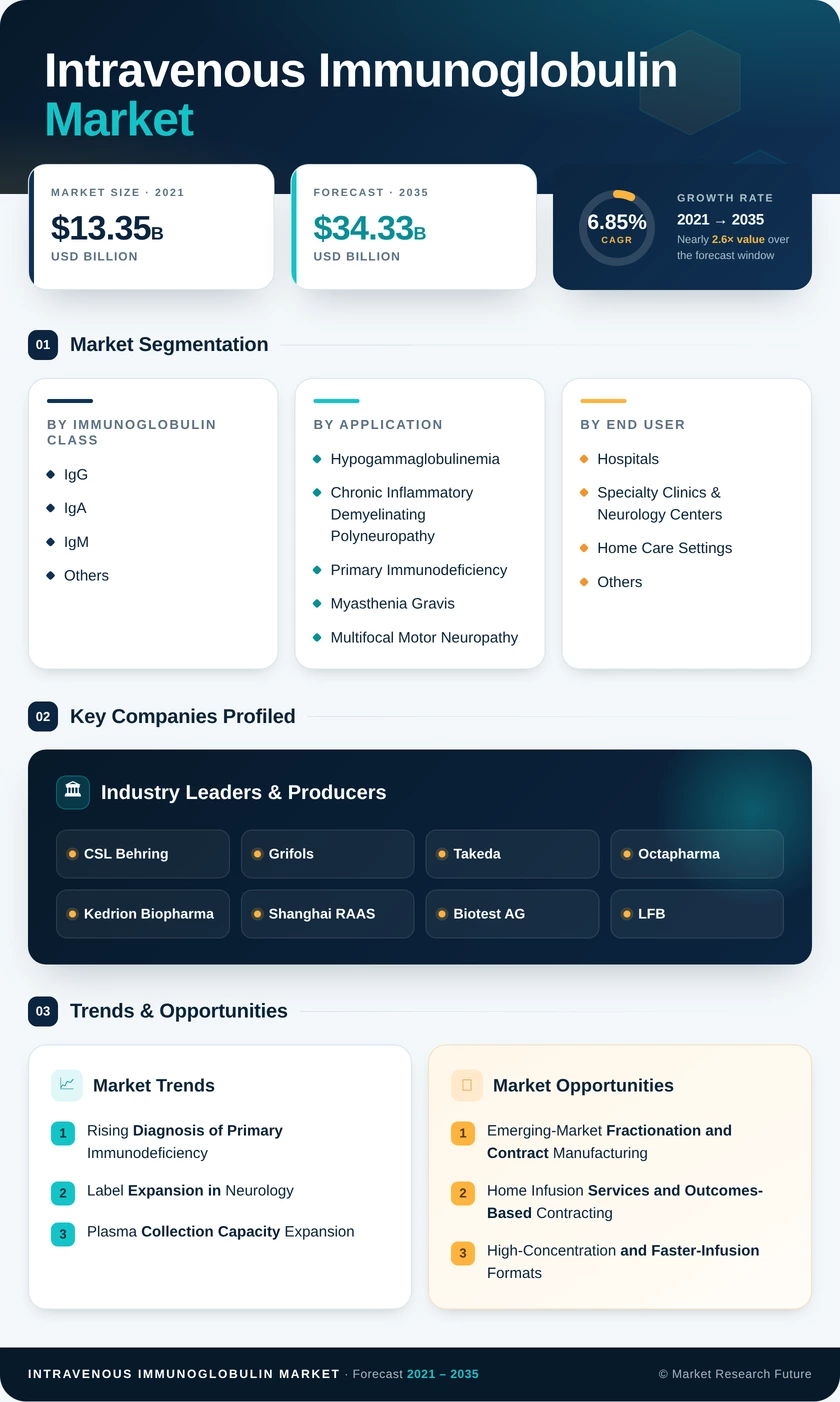
Intravenous Immunoglobulin Market (2026 - 2035)

ID: MRFR/HC/2259-HCR 200 Pages Satyendra Maurya Last Updated: October 07, 2026
Intravenous Immunoglobulin (IVIG) Market Research Report By Application (Immunodeficiency Disorders, Neurological Disorders, Autoimmune Disorders, Infectious Diseases), By End Use (Hospitals, Clinics, Homecare, Pharmaceutical Companies), By Product Type (Intravenous Immunoglobulin, Subcutaneous Immunoglobulin, Combination Therapies), By Source (Human Plasma, Recombinant Techniques) and By Region (North America, Europe, South America, Asia Pacific, Middle East and Africa) -Forecast to 2035
Intravenous Immunoglobulin Market
Market Size
Forecast Period2026-2035
CAGR (2026-2035)6.85%
2025 Market SizeUSD 17.67 Billion
2035 Market SizeUSD 34.33 Billion
Key Players
CSL Behring
Grifols
Takeda
Octapharma
Kedrion Biopharma
Shanghai RAAS
Opportunities
  • Emerging-Market Fractionation and Contract Manufacturing
  • Home Infusion Services and Outcomes-Based Contracting
  • High-Concentration and Faster-Infusion Formats
  1. 1 Market Summary | |
  2. 2 Key Report Takeaways | |
    1. 2.1 By Immunoglobulin Class | |
    2. 2.2 By Application | |
    3. 2.3 By End User | |
    4. 2.4 By Region | |
  3. 3 Market Size and Forecast (2021–2035) | |
  4. 4 Driver Impact Analysis | |
    1. 4.1 Rising Diagnosis of Primary Immunodeficiency | |
    2. 4.2 Label Expansion in Neurology | |
    3. 4.3 Plasma Collection Capacity Expansion | |
    4. 4.4 Secondary Immunodeficiency in Hematologic Cancer | |
    5. 4.5 Plasma Self-Sufficiency Programs in Emerging Economies | |
    6. 4.6 Home-Infusion Reimbursement Expansion | |
  5. 5 Restraints Impact Analysis | |
    1. 5.1 Plasma Supply Constraints and Rising Collection Cost | |
    2. 5.2 Competition from FcRn Inhibitors and Targeted Biologics | |
    3. 5.3 High Therapy Cost and Payer Utilization Controls | |
    4. 5.4 Donor Compensation Limits and Import Dependence in Europe | |
    5. 5.5 Thromboembolic and Renal Safety Risks | |
  6. 6 Opportunities | |
    1. 6.1 Emerging-Market Fractionation and Contract Manufacturing | |
    2. 6.2 Home Infusion Services and Outcomes-Based Contracting | |
    3. 6.3 High-Concentration and Faster-Infusion Formats | |
    4. 6.4 New Immunomodulatory Indications | |
    5. 6.5 Gulf and North African Capacity Partnerships | |
  7. 7 Regional Market Share and Country-Level Analysis | |
    1. 7.1 North America | | |
      1. 7.1.1 US | | |
      2. 7.1.2 Canada | | |
      3. 7.1.3 Mexico | |
    2. 7.2 Europe | | |
      1. 7.2.1 Germany | | |
      2. 7.2.2 UK | | |
      3. 7.2.3 France | | |
      4. 7.2.4 Italy | | |
      5. 7.2.5 Spain | | |
      6. 7.2.6 Nordic Countries | | |
      7. 7.2.7 Russia | | |
      8. 7.2.8 Rest of Europe | |
    3. 7.3 Asia-Pacific | | |
      1. 7.3.1 China | | |
      2. 7.3.2 India | | |
      3. 7.3.3 Japan | | |
      4. 7.3.4 South Korea | | |
      5. 7.3.5 ASEAN | | |
      6. 7.3.6 Rest of Asia-Pacific | |
    4. 7.4 South America | | |
      1. 7.4.1 Brazil | | |
      2. 7.4.2 Argentina | | |
      3. 7.4.3 Rest of South America | |
    5. 7.5 Middle East & Africa | | |
      1. 7.5.1 Saudi Arabia | | |
      2. 7.5.2 UAE | | |
      3. 7.5.3 South Africa | | |
      4. 7.5.4 Egypt | | |
      5. 7.5.5 Rest of MEA | |
  8. 8 Future Outlook (2026–2035) | |
    1. 8.1 Industrialized Plasma Collection and Donor Analytics | |
    2. 8.2 Competitive Reset from Targeted Immunology | |
    3. 8.3 Decentralized Care and Subcutaneous Crossover | |
    4. 8.4 Supply Security as Health Policy | |
  9. 9 Segmentation Analysis | |
    1. 9.1 By Immunoglobulin Class | | |
      1. 9.1.1 IgG | | |
      2. 9.1.2 IgA | | |
      3. 9.1.3 IgM | | |
      4. 9.1.4 Others | |
    2. 9.2 By Application | | |
      1. 9.2.1 Hypogammaglobulinemia | | |
      2. 9.2.2 Chronic Inflammatory Demyelinating Polyneuropathy | | |
      3. 9.2.3 Primary Immunodeficiency | | |
      4. 9.2.4 Myasthenia Gravis | | |
      5. 9.2.5 Multifocal Motor Neuropathy | | |
      6. 9.2.6 Others | |
    3. 9.3 By End User | | |
      1. 9.3.1 Hospitals | | |
      2. 9.3.2 Specialty Clinics & Neurology Centers | | |
      3. 9.3.3 Home Care Settings | | |
      4. 9.3.4 Others | |
  10. 10 Competitive Landscape | |
    1. 10.1 Market Concentration Analysis | |
    2. 10.2 Competitive Benchmarking Matrix | |
    3. 10.3 Company Profiles | | |
      1. 10.3.1 CSL Behring | | |
      2. 10.3.2 Grifols | | |
      3. 10.3.3 Takeda | | |
      4. 10.3.4 Octapharma | | |
      5. 10.3.5 Kedrion Biopharma | | |
      6. 10.3.6 Shanghai RAAS | | |
      7. 10.3.7 Biotest AG | | |
      8. 10.3.8 LFB | | |
      9. 10.3.9 GC Biopharma | | |
      10. 10.3.10 ADMA Biologics | |
  11. 11 Recent News & Developments | |
  12. 12 Report Scope and Methodology | |
  13. 13 Detailed Sources and Citations | |
  14. 14 Frequently Asked Questions (FAQs) | | LIST OF TABLES | |
  15. TABLE 1 Global IVIg Market Summary Snapshot, 2025–2035 | |
  16. TABLE 2 Global IVIg Market Size & Forecast, by Revenue (USD Billion), 2021–2035 | |
  17. TABLE 3 Driver Impact Analysis, 2026–2035 | |
  18. TABLE 4 Restraints Impact Analysis, 2026–2035 | |
  19. TABLE 5 Global IVIg Market, Regional Summary, 2025 | |
  20. TABLE 6 North America IVIg Market, by Country, 2025–2035 | |
  21. TABLE 7 Europe IVIg Market, by Country, 2025–2035 | |
  22. TABLE 8 Asia-Pacific IVIg Market, by Country, 2025–2035 | |
  23. TABLE 9 South America IVIg Market, by Country, 2025–2035 | |
  24. TABLE 10 Middle East & Africa IVIg Market, by Country, 2025–2035 | |
  25. TABLE 11 Global IVIg Market, by Immunoglobulin Class, 2021–2035 (USD Billion) | |
  26. TABLE 12 Global IVIg Market, by Application, 2021–2035 (USD Billion) | |
  27. TABLE 13 Global IVIg Market, by End User, 2021–2035 (USD Billion) | |
  28. TABLE 14 Competitive Benchmarking Matrix, 2025 | |
  29. TABLE 15 Report Scope and Methodology | |
  30. TABLE 16 Detailed Sources and Citations | | LIST OF FIGURES | |
  31. FIGURE 1 Global IVIg Market Dynamics Overview | |
  32. FIGURE 2 IVIg Industry Value Chain Analysis | |
  33. FIGURE 3 Porter's Five Forces Analysis | |
  34. FIGURE 4 Global IVIg Market Size Trend, 2021–2035 (USD Billion) | |
  35. FIGURE 5 Market Share by Immunoglobulin Class, 2025 | |
  36. FIGURE 6 Market Share by Application, 2025 | |
  37. FIGURE 7 Market Share by End User, 2025 | |
  38. FIGURE 8 Regional Market Share, 2025 | |
  39. FIGURE 9 Regional Growth Comparison, 2026–2035 | |
  40. FIGURE 10 Competitive Landscape Share Analysis, 2025

Segmentation Quick Reference

DimensionSub-SegmentsDominant SegmentFastest Growing Segment
By Immunoglobulin ClassIgG, IgA, IgM, OthersIgG (79.2% share)IgG (fastest-growing class)
By ApplicationHypogammaglobulinemia, Chronic Inflammatory Demyelinating Polyneuropathy, Primary Immunodeficiency, Myasthenia Gravis, Multifocal Motor Neuropathy, OthersHypogammaglobulinemia (34.4% share)Myasthenia Gravis (8.45% CAGR)
By End UserHospitals, Specialty Clinics & Neurology Centers, Home Care Settings, OthersHospitals (47.2% share)Specialty Clinics & Neurology Centers (8.70% CAGR)
By RegionNorth America, Europe, Asia-Pacific, South America, Middle East & AfricaNorth America (44.6% share)Asia-Pacific (8.9% CAGR)


Market Segmentation Overview

By Immunoglobulin Class

Sub-SegmentKey Trend
IgGHigh-strength 10% and 20% formulations shorten infusion time
IgALimited to research and specialty preparations
IgMIgM-enriched products used in severe infection protocols
OthersHyperimmune and specialty globulins


IgG leads and grows fastest because every licensed product for immunodeficiency and neurology is an IgG preparation, and new brands compete on purity and infusion speed. IgM keeps a defined niche in IgM-enriched sepsis protocols in parts of Europe. IgA remains marginal, with no major licensed intravenous indication.

By Application

Sub-SegmentKey Trend
HypogammaglobulinemiaStable demand from established replacement guidelines
Chronic Inflammatory Demyelinating PolyneuropathyHigh-dose maintenance under FcRn competition
Primary ImmunodeficiencyEarlier diagnosis via newborn screening
Myasthenia GravisEarlier use in exacerbations and crises
Multifocal Motor NeuropathyFirst-line labelled therapy with few alternatives
OthersKawasaki disease, ITP and emerging off-label uses


Hypogammaglobulinemia holds the largest share because replacement dosing is lifelong and guideline-backed. Myasthenia Gravis grows fastest as neurologists use IVIg earlier in crises, though FcRn inhibitors will contest maintenance use. Chronic Inflammatory Demyelinating Polyneuropathy remains the largest gram consumer per patient, which makes it the indication most exposed to targeted-biologic substitution.

By End User

Sub-SegmentKey Trend
HospitalsFirst infusions and acute neurology care
Specialty Clinics & Neurology CentersPayer steering to lower-cost sites
Home Care SettingsGrowth under the permanent CMS home benefit
OthersPhysician-office and ambulatory infusion


Hospitals lead because first doses and crisis treatment require monitored settings. Specialty Clinics & Neurology Centers grow fastest as payers shift stable maintenance patients away from hospital outpatient rates. Home Care Settings are gaining ground under the CMS benefit, but remain limited to stable patients with good infusion tolerance.


Download PDF ×

We do not share your information with anyone. However, we may send you emails based on your report interest from time to time. You may contact us at any time to opt-out.