
Request Free Sample ×

Kindly complete the form below to receive a free sample of this Report

* Please use a valid business email

Leading companies partner with us for data-driven Insights

clients tt-cursor
Hero Background
English
Chinese
French
Japanese
Korean
German
Spanish

Internet of Things Cloud Platform Market Share

ID: MRFR/ICT/5378-HCR
100 Pages
Kiran Jinkalwad
April 2026

IoT Cloud Platform Market Size, Share and Research Report: By Deployment (On-premise IoT cloud platform, Cloud-based IoT platform), By Application (Device management, Analytics management, Database management), By End-user (Automotive, Retail, Manufacturing, Healthcare), And By Region (North America, Europe, Asia-Pacific, And Rest Of The World) – Industry Size, Share and Forecast Till 2035

Share:
Download PDF ×

We do not share your information with anyone. However, we may send you emails based on your report interest from time to time. You may contact us at any time to opt-out.

Internet of Things Cloud Platform Market Infographic
Purchase Options

Market Share

Internet of Things Cloud Platform Market Share Analysis

The market for IoT cloud platforms has developed rapidly, and many organizations are battling for a sizable part of the market. Organizations utilize different situating systems in this consistently changing business sector to lay out their image and get an upper hand. Separation is a well-known methodology where IoT cloud platforms put themselves aside by giving unique highlights, administrations, or adaptability choices. This empowers organizations to zero in on specific specialty markets or areas, meeting the exceptional necessities of clients. A stage might have an upper hand in a specific market by spending significant time in the medical services IoT arrangements and offering administrations explicitly intended for the clinical area. Cost authority, in which IoT cloud platforms plan to offer their administrations at lower costs than rivals, is another significant strategy. The objective of this system is to attract cost cognizant clients and increment portion of the overall industry by being sensibly estimated. These stages diminish costs without forfeiting the type of their administrations by using economies of scale, viable tasks, and key coalitions. This strategy can be particularly valuable for acquiring a huge client base, especially in areas of the economy where estimating is a significant game changer. Also, organizations habitually focus on advancement to set up a good foundation for themselves as pioneers in the field. The IoT climate is dynamic, with new norms and creating advancements. Stages that keep up with their situation at the vanguard of mechanical progressions by constantly putting resources into Research and development are known for their advancement. These stages stay on the ball in a market that is changing rapidly by giving most recent elements, similarity with the freshest gadgets, and solid safety efforts. They likewise attract well-informed clients. An extra vital part of the portion of the overall industry situating methodologies is collaboration and organizations. IoT cloud platforms as often as possible team up with programming designers, equipment makers, and other environment members to construct a sweeping, arranged IoT arrangement. These organizations ensure the stage's impeccable joining with different gadgets and applications, in this way enlarging its offer. Interoperability transforms into a significant selling guide since it simplifies it for clients toward make broad IoT environments, which in the long run expands the stage's piece of the pie. Moreover, a client centered procedure is fundamental for viable market situations. Stages can make persevering through associations with their clients by putting a high need on the client experience, offering top notch client assistance, and forcefully searching out client criticism. Great client encounters produce positive informal exchange and brand steadfastness, which advances a natural portion of the overall industry development. Stages that coordinate their procedures with the necessities of their clients will have a more prominent possibility of long-haul progress in a climate where the client assumptions are continually evolving.


Author
Author Profile
Kiran Jinkalwad
Research Associate Level - II

Kiran Jinkalwad brings over four years of experience in market research, specializing in the ICT and Semiconductor sectors. She has worked on 50+ projects, including custom studies for companies like Microsoft and Huawei, addressing complex business challenges. With a background in Electronics and Telecommunication, Kiran excels in market estimation, forecasting, and strategic analysis. His sharp analytical skills and industry knowledge consistently deliver actionable insights for diverse clients.

Leave a Comment

FAQs

What is the projected market valuation of the IoT Cloud Platform Market by 2035?

<p>The IoT Cloud Platform Market is projected to reach a valuation of 39.86 USD Billion by 2035.</p>

What was the market valuation of the IoT Cloud Platform Market in 2024?

<p>In 2024, the IoT Cloud Platform Market had a valuation of 12.01 USD Billion.</p>

What is the expected CAGR for the IoT Cloud Platform Market from 2025 to 2035?

<p>The expected CAGR for the IoT Cloud Platform Market during the forecast period 2025 - 2035 is 11.52%.</p>

Which companies are considered key players in the IoT Cloud Platform Market?

<p>Key players in the IoT Cloud Platform Market include Amazon Web Services, Microsoft Azure, Google Cloud, and IBM Cloud.</p>

What are the two main deployment segments in the IoT Cloud Platform Market?

<p>The two main deployment segments are On-premise IoT cloud platforms and Cloud-based IoT platforms.</p>

How much is the Cloud-based IoT platform segment expected to grow by 2035?

<p>The Cloud-based IoT platform segment is expected to grow from 9.61 USD Billion to 31.86 USD Billion by 2035.</p>

What is the projected growth for the Device management application segment by 2035?

The Device management application segment is projected to grow from 3.6 USD Billion to 12.0 USD Billion by 2035.

Which end-user segment is expected to see the highest growth in the IoT Cloud Platform Market?

The Healthcare end-user segment is expected to grow from 4.11 USD Billion to 13.36 USD Billion by 2035.

What is the expected growth for the Analytics management application segment by 2035?

The Analytics management application segment is expected to grow from 4.2 USD Billion to 14.0 USD Billion by 2035.

How does the Manufacturing end-user segment compare to others in terms of growth?

The Manufacturing end-user segment is projected to grow from 3.0 USD Billion to 10.0 USD Billion by 2035, indicating robust growth.

Market Summary

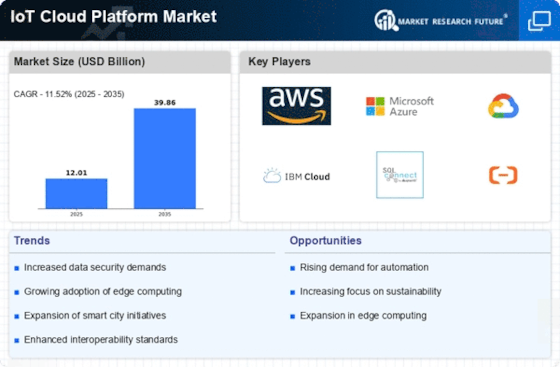
As per Market Research Future analysis, the IoT Cloud Platform Market Size was estimated at 12.01 USD Billion in 2024. The IoT Cloud Platform industry is projected to grow from 13.39 USD Billion in 2025 to 39.86 USD Billion by 2035, exhibiting a compound annual growth rate (CAGR) of 11.52% during the forecast period 2025 - 2035

Key Market Trends & Highlights

The IoT Cloud Platform Market is experiencing robust growth driven by technological advancements and increasing demand for smart solutions.

  • North America remains the largest market for IoT cloud platforms, showcasing a strong inclination towards cloud-based solutions. The Asia-Pacific region is emerging as the fastest-growing market, propelled by rapid urbanization and technological adoption. Cloud-based IoT platforms dominate the market, while on-premise solutions are witnessing the fastest growth due to specific enterprise needs. Key market drivers include the rising demand for smart devices and the expansion of 5G networks, which are facilitating enhanced connectivity and data management.

Market Size & Forecast

2024 Market Size 12.01 (USD Billion)
2035 Market Size 39.86 (USD Billion)
CAGR (2025 - 2035) 11.52%
Largest Regional Market Share in 2024 North America

Major Players

Amazon Web Services (US), Microsoft Azure (US), Google Cloud (US), IBM Cloud (US), Oracle Cloud (US), Alibaba Cloud (CN), Salesforce (US), SAP (DE), Cisco Systems (US), Siemens (DE)

Market Trends

The IoT Cloud Platform Market is currently experiencing a transformative phase, driven by the increasing integration of Internet of Things (IoT) technologies across various sectors. Organizations are increasingly recognizing the potential of cloud-based solutions to enhance operational efficiency, streamline processes, and facilitate real-time data analytics. This shift towards cloud platforms is not merely a trend but appears to be a fundamental change in how businesses approach connectivity and data management. As industries evolve, the demand for scalable, secure, and flexible IoT solutions continues to grow, suggesting a robust future for this market. Moreover, the IoT Cloud Platform Market is characterized by a diverse range of applications, spanning smart cities, healthcare, manufacturing, and agriculture. Each sector presents unique challenges and opportunities, which in turn influences the development of tailored solutions. The emphasis on interoperability and standardization is becoming increasingly pronounced, as stakeholders seek to ensure seamless communication between devices and platforms. This focus on collaboration and integration may lead to innovative partnerships and alliances, further propelling the market forward. Overall, the landscape of the IoT Cloud Platform Market is dynamic, with numerous factors shaping its trajectory and potential.

Increased Adoption of Edge Computing

The trend towards edge computing is gaining momentum within the IoT Cloud Platform Market. By processing data closer to the source, organizations can reduce latency and enhance the performance of their applications. This shift allows for more efficient data handling, particularly in environments where real-time decision-making is critical. As a result, businesses are likely to invest in edge solutions that complement their cloud strategies.

Focus on Enhanced Security Measures

Security remains a paramount concern in the IoT Cloud Platform Market. As the number of connected devices proliferates, the potential for cyber threats increases. Consequently, there is a growing emphasis on implementing robust security protocols and frameworks. Companies are likely to prioritize solutions that offer advanced encryption, authentication, and monitoring capabilities to safeguard their data and infrastructure.

Integration of Artificial Intelligence

The integration of artificial intelligence (AI) into IoT cloud platforms is emerging as a transformative trend. AI technologies can analyze vast amounts of data generated by IoT devices, enabling predictive analytics and automation. This capability not only enhances operational efficiency but also provides valuable insights for decision-making. As organizations seek to leverage data-driven strategies, the incorporation of AI into IoT solutions is expected to expand.

Internet of Things Cloud Platform Market Market Drivers

Expansion of 5G Networks

The rollout of 5G networks is poised to revolutionize the IoT Cloud Platform Market. With enhanced speed, lower latency, and greater connectivity, 5G technology facilitates the seamless operation of IoT devices. This advancement is expected to drive the adoption of IoT solutions across various sectors, including healthcare, transportation, and manufacturing. As 5G becomes more prevalent, the demand for cloud platforms that can support high-volume data transmission and processing will likely increase, positioning IoT Cloud Platforms as essential components in the evolving digital landscape.

Growth in Data Analytics

Data analytics has emerged as a crucial component of the IoT Cloud Platform Market. Organizations are recognizing the value of data-driven decision-making, leading to increased investments in analytics tools integrated with IoT platforms. By 2025, the analytics segment within the IoT market is projected to grow significantly, driven by the need for real-time insights and predictive analytics. This growth suggests that IoT Cloud Platforms must incorporate advanced analytics capabilities to remain competitive, enabling businesses to derive actionable insights from their data and optimize operations.

Emergence of Smart Cities

The development of smart cities is a significant driver for the IoT Cloud Platform Market. Urbanization and population growth are prompting cities to adopt IoT solutions to improve infrastructure, enhance public services, and promote sustainability. By 2025, investments in smart city initiatives are expected to reach substantial figures, creating a robust market for IoT cloud platforms that can support various applications, such as traffic management, waste management, and energy efficiency. This trend suggests that IoT Cloud Platforms will play a critical role in shaping the future of urban living, driving innovation and efficiency in city management.

Rising Demand for Smart Devices

The proliferation of smart devices is a primary driver for the IoT Cloud Platform Market. As consumers and businesses increasingly adopt smart technologies, the need for robust cloud platforms to manage and analyze data from these devices intensifies. In 2025, it is estimated that the number of connected devices will surpass 30 billion, creating a substantial demand for cloud solutions that can handle vast amounts of data. This trend indicates that IoT Cloud Platforms must evolve to support diverse applications, from smart homes to industrial automation, thereby enhancing their market presence and capabilities.

Increased Focus on Sustainability

Sustainability has become a pivotal concern for businesses, influencing the IoT Cloud Platform Market. Companies are increasingly seeking solutions that not only enhance operational efficiency but also reduce their environmental impact. IoT platforms that offer energy management, resource optimization, and waste reduction capabilities are gaining traction. This trend indicates a shift towards eco-friendly practices, with organizations leveraging IoT technologies to monitor and manage their carbon footprints. As sustainability becomes a priority, IoT Cloud Platforms that align with these values may experience heightened demand and market growth.

Market Segment Insights

By Deployment: Cloud-based IoT Platform (Largest) vs. On-premise IoT Cloud Platform (Fastest-Growing)

The IoT Cloud Platform Market exhibits a distinct distribution between cloud-based and on-premise deployments. Cloud-based IoT platforms capture the largest market share due to their scalability, flexibility, and ability to handle vast data volumes efficiently. Many businesses prefer these platforms for their cost-effectiveness and ease of integration with existing systems. Conversely, on-premise IoT cloud platforms are gaining traction among organizations that prioritize data security and control, contributing to their rapid growth in recent times. The growth trends in the deployment segment are largely driven by the increasing demand for cloud computing solutions and digital transformation among enterprises. Organizations are seeking more agile and adaptable solutions, leading to a surge in the adoption of cloud-based platforms. On the other hand, the heightened focus on data privacy regulations and the need for secure environments have propelled the on-premise solutions into the spotlight, making them the fastest-growing segment within the market. Companies are increasingly recognizing the importance of balancing operational efficiency with robust security measures, hence the dual preference for both deployment types.

Deployment: Cloud-based IoT Platform (Dominant) vs. On-premise IoT <a href="https://www.marketresearchfuture.com/reports/france-marketing-cloud-platform-market-57450">Cloud Platform</a> (Emerging)

In the IoT Cloud Platform Market, the cloud-based IoT platform is recognized as the dominant deployment option due to its extensive advantages, including reduced upfront costs, ease of scalability, and accessible maintenance. Organizations leverage cloud technology to obtain real-time data analytics and enhance their operational efficiency. The seamless integration with various IoT devices and platforms further solidifies its market position. In contrast, the on-premise IoT cloud platform is emerging as a viable alternative for enterprises with stringent data security concerns. This deployment type allows companies to maintain control over their data while also customizing their infrastructure to meet specific compliance requirements. As a result, an increasing number of businesses are investing in on-premise solutions, leading to notable growth within this segment.

By Application: Device Management (Largest) vs. Analytics Management (Fastest-Growing)

In the IoT Cloud Platform Market, the application segment is led by device management, which accounts for the largest market share. This dominance can be attributed to the increasing complexity and number of connected devices necessitating effective device management solutions. Close behind is analytics management, which is rapidly gaining traction as businesses seek to harness the data generated by IoT devices. As organizations prioritize data-driven decision-making, analytics management is swiftly establishing its presence in the market.

Device Management (Dominant) vs. Analytics Management (Emerging)

Device management is a dominant element in the IoT Cloud Platform, focusing on overseeing, controlling, and monitoring connected devices throughout their lifecycle. This application ensures devices are secure, updated, and functioning optimally, which is critical as the number of IoT devices continues to grow. Conversely, analytics management is emerging as a vital application in the market, enabling businesses to derive actionable insights from vast amounts of IoT-generated data. As companies increasingly realize the potential of big data for enhancing operational efficiency and driving innovative strategies, analytics management is poised to become a cornerstone of IoT cloud solutions.

By End-User: Healthcare (Largest) vs. Automotive (Fastest-Growing)

In the IoT Cloud Platform Market, the end-user segment is prominently led by healthcare, capturing a significant share of the market. Retail and manufacturing follow, but healthcare's robust adoption rates and increasing digital transformation initiatives grant it a substantial lead. Automotive is emerging rapidly, pushed by advancements in vehicle connectivity and the demand for smarter automotive solutions. The diverse usage of IoT applications across various sectors highlights the varying degrees of market participation. The distribution of market share illustrates a mature presence of established segments, while also indicating the transitions driven by innovative solutions.

Healthcare: IoT Applications (Dominant) vs. Automotive: Connected Vehicles (Emerging)

Healthcare as a dominant segment leverages IoT Cloud Platforms for real-time patient monitoring, remote health data management, and efficient healthcare service delivery. This sector relies on technology to enhance patient care and streamline operations, reflecting a high degree of innovation in health-related IoT solutions. In contrast, automotive is still emerging in the IoT landscape, characterized by its rapid adaptability to new technologies such as vehicle-to-everything (V2X) communication. This shift towards connectivity reflects increasing consumer demand for smarter, more automated vehicles, thus positioning automotive IoT solutions as vital for newer market entrants, yet to catch up with healthcare.

Get more detailed insights about Internet of Things (IoT) Cloud Platform Market Research Report - Forecast till 2035

Regional Insights

North America : Innovation and Leadership Hub

North America is the largest market for IoT Cloud Platforms, holding approximately 45% of the global market share. The region's growth is driven by rapid technological advancements, increasing adoption of IoT devices, and supportive government regulations promoting digital transformation. The demand for scalable and secure cloud solutions is further fueled by the rise of smart cities and industrial automation initiatives. The United States leads the market, with major players like Amazon Web Services, Microsoft Azure, and Google Cloud dominating the landscape. Canada also plays a significant role, contributing to the competitive environment. The presence of these key players fosters innovation and enhances service offerings, ensuring that North America remains at the forefront of IoT cloud technology.

Europe : Regulatory Framework and Growth

Europe is witnessing significant growth in the IoT Cloud Platform market, holding around 30% of the global share. The region benefits from stringent data protection regulations, such as GDPR, which drive demand for secure cloud solutions. Additionally, initiatives like the European Digital Strategy aim to enhance digital infrastructure, further propelling market growth. The increasing focus on sustainability and smart technologies also contributes to the rising demand for IoT solutions. Germany and the United Kingdom are the leading countries in this market, with strong investments in IoT technologies. Key players like SAP and Siemens are pivotal in shaping the competitive landscape. The presence of various startups and established firms fosters innovation, making Europe a dynamic player in The IoT Cloud Platform.

Asia-Pacific : Rapid Growth and Adoption

Asia-Pacific is rapidly emerging as a significant player in the IoT Cloud Platform market, accounting for approximately 20% of the global market share. The region's growth is driven by increasing urbanization, a surge in IoT device adoption, and government initiatives aimed at enhancing digital infrastructure. Countries like China and India are at the forefront, with substantial investments in smart city projects and industrial automation, further boosting demand for cloud solutions. China is the largest market in the region, with Alibaba Cloud leading the charge. India follows closely, with a growing number of startups and established companies entering the IoT space. The competitive landscape is characterized by a mix of local and international players, fostering innovation and driving advancements in IoT cloud technologies.

Middle East and Africa : Emerging Market with Potential

The Middle East and Africa region is gradually emerging in the IoT Cloud Platform market, holding about 5% of the global share. The growth is primarily driven by increasing investments in digital transformation and smart city initiatives across various countries. Governments are actively promoting IoT adoption to enhance operational efficiency and improve public services, creating a favorable regulatory environment for cloud solutions. Countries like the United Arab Emirates and South Africa are leading the charge, with significant investments in IoT infrastructure. The competitive landscape is evolving, with both local and international players entering the market. This region presents substantial growth opportunities as businesses increasingly recognize the value of IoT cloud technologies in driving innovation and efficiency.

Key Players and Competitive Insights

Leading market players are investing a lot of money in R&D to expand their product portfolios, which will spur further market growth for IoT Cloud Platform. With significant industry changes, including new product releases, contractual agreements, mergers and acquisitions, increased investments, and collaboration with other organizations, market developments are also undertaking various strategic activities to expand their global presence. To grow and remain in a market that is becoming increasingly competitive, IoT Cloud Platform industry competitors must provide affordable products.Manufacturing locally to cut operational costs is one of the IoT Cloud Platform industry's main business tactics to serve customers and increase the market sector. The IoT Cloud Platform industry has recently given medicine some of the most important advantages. The IoT Cloud Platform markets major players such as IBM Corporation, SAP SE, Amazon Web Services Inc., PTC Inc., Microsoft Corporation, Wipro Ltd., Google Inc., General Electric Co., Huawei Technologies Co. Ltd., Intel Corporation, Cisco Systems Inc., and others are working on expanding the market demand by investing in research and development activities.Microsoft Corporation is a worldwide technology company with its main office in Redmond, Washington. The Windows family of operating systems, the Microsoft Office package, and the Internet Explorer and Edge web browsers are among Microsoft's most well-known software offerings. In addition to Linux (Ubuntu, Debian) and Windows 10 IoT Core Operating Systems, Microsoft Azure Security Center for IoT has expanded support for Azure Real-Time Operating System (RTOS).An Amazon subsidiary called Amazon Web Services, Inc. (AWS) offers metered, pay-as-you-go, on-demand cloud computing platforms and APIs to people, businesses, and governments. To provide a safe, secure, and intelligent connected car software platform for in-vehicle apps, Amazon teamed up with BlackBerry in January 2020.

Key Companies in the Internet of Things Cloud Platform Market include

Industry Developments

January 2025: Microsoft committed to investing $80 billion in AI-enabled data centers in fiscal year 2025 in January 2025. This large investment will build modern data centers that can train AI models and deploy AI and cloud-based apps to meet rising demand for AI-driven services. Analysts expect Microsoft's fiscal 2025 capital expenditure to be $84.24 billion, with over half of the US$ 80 billion invested in the US.

This strategic decision is expected to improve Microsoft's Azure cloud infrastructure's scalability and performance, which supports many AI-driven applications, including OpenAI partner services. Microsoft is extending its data center capacity to satisfy AI workloads' computing demands and provide efficient and dependable service to its global customers.

June 2024: Oracle and Google Cloud partnered in June 2024 to streamline client upgrades and migration. The collaboration between Oracle Cloud Infrastructure (OCI) and Google Cloud technologies lets enterprises effortlessly use both platforms' strengths. This alliance addresses the growing demand for flexible, multi-cloud solutions, enabling organizations to optimize their IT environments while minimizing complexity and disruption during migration.

A highlight of this collaboration is cross-cloud interconnectivity in 11 global regions, eliminating data transfer fees. This functionality adds flexibility to deploy workloads across OCI and Google Cloud without high costs. The partnership helps organizations scale globally, access advanced cloud services, and innovate in a more connected digital landscape by reducing financial and operational barriers.

March 2022: T-Mobile, the industry leader in 5G and owner of the biggest and fastest countrywide 5G network in the United States, and Sierra Wireless, an MVNO and supplier of IoT solutions, have expanded their partnership. This will help Sierra Wireless' Smart Connectivity service, which offers worldwide Low Power Wide Area (LPWA) connectivity, become more competitive.

As a result of the partnership, consumers in the US now have access to 5G connection from T-multi-band Mobile as well as 4G LTE ultra-high data offerings for fixed applications such as commercial security/video surveillance, healthcare services, digital vending, signs, and others that need high throughput and low latency.

November 2021: To digitally transform and construct sustainable factories of the future, L&T Technology Services Ltd.'s (LTTS) Energy & Sustainability Manager solution will be accessible on Microsoft Azure. The most recent agreement is a part of LTTS' expanding partnership with Microsoft to make its advanced manufacturing solution suite accessible to companies across the globe via Azure's enterprise cloud-first, mobile-first architecture.

February 2021: NXP Semiconductors N.V., a leader in secure IoT embedded solutions, launched EdgeLock 2GO in February 2021. This platform simplifies and secures IoT device and service deployment and management across industries. In a quickly changing digital landscape, EdgeLock 2GO provides powerful end-to-end security for trusted IoT ecosystems. Businesses may streamline operations, manage device credentials, protect data connections, and comply with industry standards with this platform. EdgeLock 2GO's flexibility and scalability help enterprises maximize IoT breakthroughs, improving trust and functionality in connected environments.

Future Outlook

Internet of Things Cloud Platform Market Future Outlook

The IoT Cloud Platform Market is projected to grow at 11.52% CAGR from 2025 to 2035, driven by increased connectivity, data analytics, and demand for automation.

New opportunities lie in:

  • <p>Development of industry-specific IoT solutions for manufacturing sectors. Integration of AI-driven analytics for predictive maintenance services. Expansion of edge computing capabilities to enhance real-time data processing.</p>

By 2035, the IoT Cloud Platform Market is expected to be robust, driven by innovation and strategic partnerships.

Market Segmentation

Internet of Things Cloud Platform Market End-User Outlook

  • Automotive
  • Retail
  • Manufacturing
  • Healthcare

Internet of Things Cloud Platform Market Deployment Outlook

  • On-premise IoT cloud platform
  • Cloud-based IoT platform

Internet of Things Cloud Platform Market Application Outlook

  • Device management
  • Analytics management
  • Database management

Report Scope

MARKET SIZE 2024 12.01(USD Billion)
MARKET SIZE 2025 13.39(USD Billion)
MARKET SIZE 2035 39.86(USD Billion)
COMPOUND ANNUAL GROWTH RATE (CAGR) 11.52% (2025 - 2035)
REPORT COVERAGE Revenue Forecast, Competitive Landscape, Growth Factors, and Trends
BASE YEAR 2024
Market Forecast Period 2025 - 2035
Historical Data 2019 - 2024
Market Forecast Units USD Billion
Key Companies Profiled Amazon Web Services (US), Microsoft Azure (US), Google Cloud (US), IBM Cloud (US), Oracle Cloud (US), Alibaba Cloud (CN), Salesforce (US), SAP (DE), Cisco Systems (US), Siemens (DE)
Segments Covered Deployment, Application, End-user, Region
Key Market Opportunities Integration of artificial intelligence enhances data analytics capabilities in the IoT Cloud Platform Market.
Key Market Dynamics Rising demand for interoperability drives innovation and competition among IoT cloud platform providers.
Countries Covered North America, Europe, APAC, South America, MEA

FAQs

What is the projected market valuation of the IoT Cloud Platform Market by 2035?

<p>The IoT Cloud Platform Market is projected to reach a valuation of 39.86 USD Billion by 2035.</p>

What was the market valuation of the IoT Cloud Platform Market in 2024?

<p>In 2024, the IoT Cloud Platform Market had a valuation of 12.01 USD Billion.</p>

What is the expected CAGR for the IoT Cloud Platform Market from 2025 to 2035?

<p>The expected CAGR for the IoT Cloud Platform Market during the forecast period 2025 - 2035 is 11.52%.</p>

Which companies are considered key players in the IoT Cloud Platform Market?

<p>Key players in the IoT Cloud Platform Market include Amazon Web Services, Microsoft Azure, Google Cloud, and IBM Cloud.</p>

What are the two main deployment segments in the IoT Cloud Platform Market?

<p>The two main deployment segments are On-premise IoT cloud platforms and Cloud-based IoT platforms.</p>

How much is the Cloud-based IoT platform segment expected to grow by 2035?

<p>The Cloud-based IoT platform segment is expected to grow from 9.61 USD Billion to 31.86 USD Billion by 2035.</p>

What is the projected growth for the Device management application segment by 2035?

The Device management application segment is projected to grow from 3.6 USD Billion to 12.0 USD Billion by 2035.

Which end-user segment is expected to see the highest growth in the IoT Cloud Platform Market?

The Healthcare end-user segment is expected to grow from 4.11 USD Billion to 13.36 USD Billion by 2035.

What is the expected growth for the Analytics management application segment by 2035?

The Analytics management application segment is expected to grow from 4.2 USD Billion to 14.0 USD Billion by 2035.

How does the Manufacturing end-user segment compare to others in terms of growth?

The Manufacturing end-user segment is projected to grow from 3.0 USD Billion to 10.0 USD Billion by 2035, indicating robust growth.

  1. SECTION I: EXECUTIVE SUMMARY AND KEY HIGHLIGHTS
    1. | 1.1 EXECUTIVE SUMMARY
    2. | | 1.1.1 Market Overview
    3. | | 1.1.2 Key Findings
    4. | | 1.1.3 Market Segmentation
    5. | | 1.1.4 Competitive Landscape
    6. | | 1.1.5 Challenges and Opportunities
    7. | | 1.1.6 Future Outlook
  2. SECTION II: SCOPING, METHODOLOGY AND MARKET STRUCTURE
    1. | 2.1 MARKET INTRODUCTION
    2. | | 2.1.1 Definition
    3. | | 2.1.2 Scope of the study
    4. | | | 2.1.2.1 Research Objective
    5. | | | 2.1.2.2 Assumption
    6. | | | 2.1.2.3 Limitations
    7. | 2.2 RESEARCH METHODOLOGY
    8. | | 2.2.1 Overview
    9. | | 2.2.2 Data Mining
    10. | | 2.2.3 Secondary Research
    11. | | 2.2.4 Primary Research
    12. | | | 2.2.4.1 Primary Interviews and Information Gathering Process
    13. | | | 2.2.4.2 Breakdown of Primary Respondents
    14. | | 2.2.5 Forecasting Model
    15. | | 2.2.6 Market Size Estimation
    16. | | | 2.2.6.1 Bottom-Up Approach
    17. | | | 2.2.6.2 Top-Down Approach
    18. | | 2.2.7 Data Triangulation
    19. | | 2.2.8 Validation
  3. SECTION III: QUALITATIVE ANALYSIS
    1. | 3.1 MARKET DYNAMICS
    2. | | 3.1.1 Overview
    3. | | 3.1.2 Drivers
    4. | | 3.1.3 Restraints
    5. | | 3.1.4 Opportunities
    6. | 3.2 MARKET FACTOR ANALYSIS
    7. | | 3.2.1 Value chain Analysis
    8. | | 3.2.2 Porter's Five Forces Analysis
    9. | | | 3.2.2.1 Bargaining Power of Suppliers
    10. | | | 3.2.2.2 Bargaining Power of Buyers
    11. | | | 3.2.2.3 Threat of New Entrants
    12. | | | 3.2.2.4 Threat of Substitutes
    13. | | | 3.2.2.5 Intensity of Rivalry
    14. | | 3.2.3 COVID-19 Impact Analysis
    15. | | | 3.2.3.1 Market Impact Analysis
    16. | | | 3.2.3.2 Regional Impact
    17. | | | 3.2.3.3 Opportunity and Threat Analysis
  4. SECTION IV: QUANTITATIVE ANALYSIS
    1. | 4.1 Semiconductor & Electronics, BY Deployment (USD Billion)
    2. | | 4.1.1 On-premise IoT cloud platform
    3. | | 4.1.2 Cloud-based IoT platform
    4. | 4.2 Semiconductor & Electronics, BY Application (USD Billion)
    5. | | 4.2.1 Device management
    6. | | 4.2.2 Analytics management
    7. | | 4.2.3 Database management
    8. | 4.3 Semiconductor & Electronics, BY End-User (USD Billion)
    9. | | 4.3.1 Automotive
    10. | | 4.3.2 Retail
    11. | | 4.3.3 Manufacturing
    12. | | 4.3.4 Healthcare
    13. | 4.4 Semiconductor & Electronics, BY Region (USD Billion)
    14. | | 4.4.1 North America
    15. | | | 4.4.1.1 US
    16. | | | 4.4.1.2 Canada
    17. | | 4.4.2 Europe
    18. | | | 4.4.2.1 Germany
    19. | | | 4.4.2.2 UK
    20. | | | 4.4.2.3 France
    21. | | | 4.4.2.4 Russia
    22. | | | 4.4.2.5 Italy
    23. | | | 4.4.2.6 Spain
    24. | | | 4.4.2.7 Rest of Europe
    25. | | 4.4.3 APAC
    26. | | | 4.4.3.1 China
    27. | | | 4.4.3.2 India
    28. | | | 4.4.3.3 Japan
    29. | | | 4.4.3.4 South Korea
    30. | | | 4.4.3.5 Malaysia
    31. | | | 4.4.3.6 Thailand
    32. | | | 4.4.3.7 Indonesia
    33. | | | 4.4.3.8 Rest of APAC
    34. | | 4.4.4 South America
    35. | | | 4.4.4.1 Brazil
    36. | | | 4.4.4.2 Mexico
    37. | | | 4.4.4.3 Argentina
    38. | | | 4.4.4.4 Rest of South America
    39. | | 4.4.5 MEA
    40. | | | 4.4.5.1 GCC Countries
    41. | | | 4.4.5.2 South Africa
    42. | | | 4.4.5.3 Rest of MEA
  5. SECTION V: COMPETITIVE ANALYSIS
    1. | 5.1 Competitive Landscape
    2. | | 5.1.1 Overview
    3. | | 5.1.2 Competitive Analysis
    4. | | 5.1.3 Market share Analysis
    5. | | 5.1.4 Major Growth Strategy in the Semiconductor & Electronics
    6. | | 5.1.5 Competitive Benchmarking
    7. | | 5.1.6 Leading Players in Terms of Number of Developments in the Semiconductor & Electronics
    8. | | 5.1.7 Key developments and growth strategies
    9. | | | 5.1.7.1 New Product Launch/Service Deployment
    10. | | | 5.1.7.2 Merger & Acquisitions
    11. | | | 5.1.7.3 Joint Ventures
    12. | | 5.1.8 Major Players Financial Matrix
    13. | | | 5.1.8.1 Sales and Operating Income
    14. | | | 5.1.8.2 Major Players R&D Expenditure. 2023
    15. | 5.2 Company Profiles
    16. | | 5.2.1 Amazon Web Services (US)
    17. | | | 5.2.1.1 Financial Overview
    18. | | | 5.2.1.2 Products Offered
    19. | | | 5.2.1.3 Key Developments
    20. | | | 5.2.1.4 SWOT Analysis
    21. | | | 5.2.1.5 Key Strategies
    22. | | 5.2.2 Microsoft Azure (US)
    23. | | | 5.2.2.1 Financial Overview
    24. | | | 5.2.2.2 Products Offered
    25. | | | 5.2.2.3 Key Developments
    26. | | | 5.2.2.4 SWOT Analysis
    27. | | | 5.2.2.5 Key Strategies
    28. | | 5.2.3 Google Cloud (US)
    29. | | | 5.2.3.1 Financial Overview
    30. | | | 5.2.3.2 Products Offered
    31. | | | 5.2.3.3 Key Developments
    32. | | | 5.2.3.4 SWOT Analysis
    33. | | | 5.2.3.5 Key Strategies
    34. | | 5.2.4 IBM Cloud (US)
    35. | | | 5.2.4.1 Financial Overview
    36. | | | 5.2.4.2 Products Offered
    37. | | | 5.2.4.3 Key Developments
    38. | | | 5.2.4.4 SWOT Analysis
    39. | | | 5.2.4.5 Key Strategies
    40. | | 5.2.5 Oracle Cloud (US)
    41. | | | 5.2.5.1 Financial Overview
    42. | | | 5.2.5.2 Products Offered
    43. | | | 5.2.5.3 Key Developments
    44. | | | 5.2.5.4 SWOT Analysis
    45. | | | 5.2.5.5 Key Strategies
    46. | | 5.2.6 Alibaba Cloud (CN)
    47. | | | 5.2.6.1 Financial Overview
    48. | | | 5.2.6.2 Products Offered
    49. | | | 5.2.6.3 Key Developments
    50. | | | 5.2.6.4 SWOT Analysis
    51. | | | 5.2.6.5 Key Strategies
    52. | | 5.2.7 Salesforce (US)
    53. | | | 5.2.7.1 Financial Overview
    54. | | | 5.2.7.2 Products Offered
    55. | | | 5.2.7.3 Key Developments
    56. | | | 5.2.7.4 SWOT Analysis
    57. | | | 5.2.7.5 Key Strategies
    58. | | 5.2.8 SAP (DE)
    59. | | | 5.2.8.1 Financial Overview
    60. | | | 5.2.8.2 Products Offered
    61. | | | 5.2.8.3 Key Developments
    62. | | | 5.2.8.4 SWOT Analysis
    63. | | | 5.2.8.5 Key Strategies
    64. | | 5.2.9 Cisco Systems (US)
    65. | | | 5.2.9.1 Financial Overview
    66. | | | 5.2.9.2 Products Offered
    67. | | | 5.2.9.3 Key Developments
    68. | | | 5.2.9.4 SWOT Analysis
    69. | | | 5.2.9.5 Key Strategies
    70. | | 5.2.10 Siemens (DE)
    71. | | | 5.2.10.1 Financial Overview
    72. | | | 5.2.10.2 Products Offered
    73. | | | 5.2.10.3 Key Developments
    74. | | | 5.2.10.4 SWOT Analysis
    75. | | | 5.2.10.5 Key Strategies
    76. | 5.3 Appendix
    77. | | 5.3.1 References
    78. | | 5.3.2 Related Reports
  6. LIST OF FIGURES
    1. | 6.1 MARKET SYNOPSIS
    2. | 6.2 NORTH AMERICA MARKET ANALYSIS
    3. | 6.3 US MARKET ANALYSIS BY DEPLOYMENT
    4. | 6.4 US MARKET ANALYSIS BY APPLICATION
    5. | 6.5 US MARKET ANALYSIS BY END-USER
    6. | 6.6 CANADA MARKET ANALYSIS BY DEPLOYMENT
    7. | 6.7 CANADA MARKET ANALYSIS BY APPLICATION
    8. | 6.8 CANADA MARKET ANALYSIS BY END-USER
    9. | 6.9 EUROPE MARKET ANALYSIS
    10. | 6.10 GERMANY MARKET ANALYSIS BY DEPLOYMENT
    11. | 6.11 GERMANY MARKET ANALYSIS BY APPLICATION
    12. | 6.12 GERMANY MARKET ANALYSIS BY END-USER
    13. | 6.13 UK MARKET ANALYSIS BY DEPLOYMENT
    14. | 6.14 UK MARKET ANALYSIS BY APPLICATION
    15. | 6.15 UK MARKET ANALYSIS BY END-USER
    16. | 6.16 FRANCE MARKET ANALYSIS BY DEPLOYMENT
    17. | 6.17 FRANCE MARKET ANALYSIS BY APPLICATION
    18. | 6.18 FRANCE MARKET ANALYSIS BY END-USER
    19. | 6.19 RUSSIA MARKET ANALYSIS BY DEPLOYMENT
    20. | 6.20 RUSSIA MARKET ANALYSIS BY APPLICATION
    21. | 6.21 RUSSIA MARKET ANALYSIS BY END-USER
    22. | 6.22 ITALY MARKET ANALYSIS BY DEPLOYMENT
    23. | 6.23 ITALY MARKET ANALYSIS BY APPLICATION
    24. | 6.24 ITALY MARKET ANALYSIS BY END-USER
    25. | 6.25 SPAIN MARKET ANALYSIS BY DEPLOYMENT
    26. | 6.26 SPAIN MARKET ANALYSIS BY APPLICATION
    27. | 6.27 SPAIN MARKET ANALYSIS BY END-USER
    28. | 6.28 REST OF EUROPE MARKET ANALYSIS BY DEPLOYMENT
    29. | 6.29 REST OF EUROPE MARKET ANALYSIS BY APPLICATION
    30. | 6.30 REST OF EUROPE MARKET ANALYSIS BY END-USER
    31. | 6.31 APAC MARKET ANALYSIS
    32. | 6.32 CHINA MARKET ANALYSIS BY DEPLOYMENT
    33. | 6.33 CHINA MARKET ANALYSIS BY APPLICATION
    34. | 6.34 CHINA MARKET ANALYSIS BY END-USER
    35. | 6.35 INDIA MARKET ANALYSIS BY DEPLOYMENT
    36. | 6.36 INDIA MARKET ANALYSIS BY APPLICATION
    37. | 6.37 INDIA MARKET ANALYSIS BY END-USER
    38. | 6.38 JAPAN MARKET ANALYSIS BY DEPLOYMENT
    39. | 6.39 JAPAN MARKET ANALYSIS BY APPLICATION
    40. | 6.40 JAPAN MARKET ANALYSIS BY END-USER
    41. | 6.41 SOUTH KOREA MARKET ANALYSIS BY DEPLOYMENT
    42. | 6.42 SOUTH KOREA MARKET ANALYSIS BY APPLICATION
    43. | 6.43 SOUTH KOREA MARKET ANALYSIS BY END-USER
    44. | 6.44 MALAYSIA MARKET ANALYSIS BY DEPLOYMENT
    45. | 6.45 MALAYSIA MARKET ANALYSIS BY APPLICATION
    46. | 6.46 MALAYSIA MARKET ANALYSIS BY END-USER
    47. | 6.47 THAILAND MARKET ANALYSIS BY DEPLOYMENT
    48. | 6.48 THAILAND MARKET ANALYSIS BY APPLICATION
    49. | 6.49 THAILAND MARKET ANALYSIS BY END-USER
    50. | 6.50 INDONESIA MARKET ANALYSIS BY DEPLOYMENT
    51. | 6.51 INDONESIA MARKET ANALYSIS BY APPLICATION
    52. | 6.52 INDONESIA MARKET ANALYSIS BY END-USER
    53. | 6.53 REST OF APAC MARKET ANALYSIS BY DEPLOYMENT
    54. | 6.54 REST OF APAC MARKET ANALYSIS BY APPLICATION
    55. | 6.55 REST OF APAC MARKET ANALYSIS BY END-USER
    56. | 6.56 SOUTH AMERICA MARKET ANALYSIS
    57. | 6.57 BRAZIL MARKET ANALYSIS BY DEPLOYMENT
    58. | 6.58 BRAZIL MARKET ANALYSIS BY APPLICATION
    59. | 6.59 BRAZIL MARKET ANALYSIS BY END-USER
    60. | 6.60 MEXICO MARKET ANALYSIS BY DEPLOYMENT
    61. | 6.61 MEXICO MARKET ANALYSIS BY APPLICATION
    62. | 6.62 MEXICO MARKET ANALYSIS BY END-USER
    63. | 6.63 ARGENTINA MARKET ANALYSIS BY DEPLOYMENT
    64. | 6.64 ARGENTINA MARKET ANALYSIS BY APPLICATION
    65. | 6.65 ARGENTINA MARKET ANALYSIS BY END-USER
    66. | 6.66 REST OF SOUTH AMERICA MARKET ANALYSIS BY DEPLOYMENT
    67. | 6.67 REST OF SOUTH AMERICA MARKET ANALYSIS BY APPLICATION
    68. | 6.68 REST OF SOUTH AMERICA MARKET ANALYSIS BY END-USER
    69. | 6.69 MEA MARKET ANALYSIS
    70. | 6.70 GCC COUNTRIES MARKET ANALYSIS BY DEPLOYMENT
    71. | 6.71 GCC COUNTRIES MARKET ANALYSIS BY APPLICATION
    72. | 6.72 GCC COUNTRIES MARKET ANALYSIS BY END-USER
    73. | 6.73 SOUTH AFRICA MARKET ANALYSIS BY DEPLOYMENT
    74. | 6.74 SOUTH AFRICA MARKET ANALYSIS BY APPLICATION
    75. | 6.75 SOUTH AFRICA MARKET ANALYSIS BY END-USER
    76. | 6.76 REST OF MEA MARKET ANALYSIS BY DEPLOYMENT
    77. | 6.77 REST OF MEA MARKET ANALYSIS BY APPLICATION
    78. | 6.78 REST OF MEA MARKET ANALYSIS BY END-USER
    79. | 6.79 KEY BUYING CRITERIA OF SEMICONDUCTOR & ELECTRONICS
    80. | 6.80 RESEARCH PROCESS OF MRFR
    81. | 6.81 DRO ANALYSIS OF SEMICONDUCTOR & ELECTRONICS
    82. | 6.82 DRIVERS IMPACT ANALYSIS: SEMICONDUCTOR & ELECTRONICS
    83. | 6.83 RESTRAINTS IMPACT ANALYSIS: SEMICONDUCTOR & ELECTRONICS
    84. | 6.84 SUPPLY / VALUE CHAIN: SEMICONDUCTOR & ELECTRONICS
    85. | 6.85 SEMICONDUCTOR & ELECTRONICS, BY DEPLOYMENT, 2024 (% SHARE)
    86. | 6.86 SEMICONDUCTOR & ELECTRONICS, BY DEPLOYMENT, 2024 TO 2035 (USD Billion)
    87. | 6.87 SEMICONDUCTOR & ELECTRONICS, BY APPLICATION, 2024 (% SHARE)
    88. | 6.88 SEMICONDUCTOR & ELECTRONICS, BY APPLICATION, 2024 TO 2035 (USD Billion)
    89. | 6.89 SEMICONDUCTOR & ELECTRONICS, BY END-USER, 2024 (% SHARE)
    90. | 6.90 SEMICONDUCTOR & ELECTRONICS, BY END-USER, 2024 TO 2035 (USD Billion)
    91. | 6.91 BENCHMARKING OF MAJOR COMPETITORS
  7. LIST OF TABLES
    1. | 7.1 LIST OF ASSUMPTIONS
    2. | | 7.1.1
    3. | 7.2 North America MARKET SIZE ESTIMATES; FORECAST
    4. | | 7.2.1 BY DEPLOYMENT, 2025-2035 (USD Billion)
    5. | | 7.2.2 BY APPLICATION, 2025-2035 (USD Billion)
    6. | | 7.2.3 BY END-USER, 2025-2035 (USD Billion)
    7. | 7.3 US MARKET SIZE ESTIMATES; FORECAST
    8. | | 7.3.1 BY DEPLOYMENT, 2025-2035 (USD Billion)
    9. | | 7.3.2 BY APPLICATION, 2025-2035 (USD Billion)
    10. | | 7.3.3 BY END-USER, 2025-2035 (USD Billion)
    11. | 7.4 Canada MARKET SIZE ESTIMATES; FORECAST
    12. | | 7.4.1 BY DEPLOYMENT, 2025-2035 (USD Billion)
    13. | | 7.4.2 BY APPLICATION, 2025-2035 (USD Billion)
    14. | | 7.4.3 BY END-USER, 2025-2035 (USD Billion)
    15. | 7.5 Europe MARKET SIZE ESTIMATES; FORECAST
    16. | | 7.5.1 BY DEPLOYMENT, 2025-2035 (USD Billion)
    17. | | 7.5.2 BY APPLICATION, 2025-2035 (USD Billion)
    18. | | 7.5.3 BY END-USER, 2025-2035 (USD Billion)
    19. | 7.6 Germany MARKET SIZE ESTIMATES; FORECAST
    20. | | 7.6.1 BY DEPLOYMENT, 2025-2035 (USD Billion)
    21. | | 7.6.2 BY APPLICATION, 2025-2035 (USD Billion)
    22. | | 7.6.3 BY END-USER, 2025-2035 (USD Billion)
    23. | 7.7 UK MARKET SIZE ESTIMATES; FORECAST
    24. | | 7.7.1 BY DEPLOYMENT, 2025-2035 (USD Billion)
    25. | | 7.7.2 BY APPLICATION, 2025-2035 (USD Billion)
    26. | | 7.7.3 BY END-USER, 2025-2035 (USD Billion)
    27. | 7.8 France MARKET SIZE ESTIMATES; FORECAST
    28. | | 7.8.1 BY DEPLOYMENT, 2025-2035 (USD Billion)
    29. | | 7.8.2 BY APPLICATION, 2025-2035 (USD Billion)
    30. | | 7.8.3 BY END-USER, 2025-2035 (USD Billion)
    31. | 7.9 Russia MARKET SIZE ESTIMATES; FORECAST
    32. | | 7.9.1 BY DEPLOYMENT, 2025-2035 (USD Billion)
    33. | | 7.9.2 BY APPLICATION, 2025-2035 (USD Billion)
    34. | | 7.9.3 BY END-USER, 2025-2035 (USD Billion)
    35. | 7.10 Italy MARKET SIZE ESTIMATES; FORECAST
    36. | | 7.10.1 BY DEPLOYMENT, 2025-2035 (USD Billion)
    37. | | 7.10.2 BY APPLICATION, 2025-2035 (USD Billion)
    38. | | 7.10.3 BY END-USER, 2025-2035 (USD Billion)
    39. | 7.11 Spain MARKET SIZE ESTIMATES; FORECAST
    40. | | 7.11.1 BY DEPLOYMENT, 2025-2035 (USD Billion)
    41. | | 7.11.2 BY APPLICATION, 2025-2035 (USD Billion)
    42. | | 7.11.3 BY END-USER, 2025-2035 (USD Billion)
    43. | 7.12 Rest of Europe MARKET SIZE ESTIMATES; FORECAST
    44. | | 7.12.1 BY DEPLOYMENT, 2025-2035 (USD Billion)
    45. | | 7.12.2 BY APPLICATION, 2025-2035 (USD Billion)
    46. | | 7.12.3 BY END-USER, 2025-2035 (USD Billion)
    47. | 7.13 APAC MARKET SIZE ESTIMATES; FORECAST
    48. | | 7.13.1 BY DEPLOYMENT, 2025-2035 (USD Billion)
    49. | | 7.13.2 BY APPLICATION, 2025-2035 (USD Billion)
    50. | | 7.13.3 BY END-USER, 2025-2035 (USD Billion)
    51. | 7.14 China MARKET SIZE ESTIMATES; FORECAST
    52. | | 7.14.1 BY DEPLOYMENT, 2025-2035 (USD Billion)
    53. | | 7.14.2 BY APPLICATION, 2025-2035 (USD Billion)
    54. | | 7.14.3 BY END-USER, 2025-2035 (USD Billion)
    55. | 7.15 India MARKET SIZE ESTIMATES; FORECAST
    56. | | 7.15.1 BY DEPLOYMENT, 2025-2035 (USD Billion)
    57. | | 7.15.2 BY APPLICATION, 2025-2035 (USD Billion)
    58. | | 7.15.3 BY END-USER, 2025-2035 (USD Billion)
    59. | 7.16 Japan MARKET SIZE ESTIMATES; FORECAST
    60. | | 7.16.1 BY DEPLOYMENT, 2025-2035 (USD Billion)
    61. | | 7.16.2 BY APPLICATION, 2025-2035 (USD Billion)
    62. | | 7.16.3 BY END-USER, 2025-2035 (USD Billion)
    63. | 7.17 South Korea MARKET SIZE ESTIMATES; FORECAST
    64. | | 7.17.1 BY DEPLOYMENT, 2025-2035 (USD Billion)
    65. | | 7.17.2 BY APPLICATION, 2025-2035 (USD Billion)
    66. | | 7.17.3 BY END-USER, 2025-2035 (USD Billion)
    67. | 7.18 Malaysia MARKET SIZE ESTIMATES; FORECAST
    68. | | 7.18.1 BY DEPLOYMENT, 2025-2035 (USD Billion)
    69. | | 7.18.2 BY APPLICATION, 2025-2035 (USD Billion)
    70. | | 7.18.3 BY END-USER, 2025-2035 (USD Billion)
    71. | 7.19 Thailand MARKET SIZE ESTIMATES; FORECAST
    72. | | 7.19.1 BY DEPLOYMENT, 2025-2035 (USD Billion)
    73. | | 7.19.2 BY APPLICATION, 2025-2035 (USD Billion)
    74. | | 7.19.3 BY END-USER, 2025-2035 (USD Billion)
    75. | 7.20 Indonesia MARKET SIZE ESTIMATES; FORECAST
    76. | | 7.20.1 BY DEPLOYMENT, 2025-2035 (USD Billion)
    77. | | 7.20.2 BY APPLICATION, 2025-2035 (USD Billion)
    78. | | 7.20.3 BY END-USER, 2025-2035 (USD Billion)
    79. | 7.21 Rest of APAC MARKET SIZE ESTIMATES; FORECAST
    80. | | 7.21.1 BY DEPLOYMENT, 2025-2035 (USD Billion)
    81. | | 7.21.2 BY APPLICATION, 2025-2035 (USD Billion)
    82. | | 7.21.3 BY END-USER, 2025-2035 (USD Billion)
    83. | 7.22 South America MARKET SIZE ESTIMATES; FORECAST
    84. | | 7.22.1 BY DEPLOYMENT, 2025-2035 (USD Billion)
    85. | | 7.22.2 BY APPLICATION, 2025-2035 (USD Billion)
    86. | | 7.22.3 BY END-USER, 2025-2035 (USD Billion)
    87. | 7.23 Brazil MARKET SIZE ESTIMATES; FORECAST
    88. | | 7.23.1 BY DEPLOYMENT, 2025-2035 (USD Billion)
    89. | | 7.23.2 BY APPLICATION, 2025-2035 (USD Billion)
    90. | | 7.23.3 BY END-USER, 2025-2035 (USD Billion)
    91. | 7.24 Mexico MARKET SIZE ESTIMATES; FORECAST
    92. | | 7.24.1 BY DEPLOYMENT, 2025-2035 (USD Billion)
    93. | | 7.24.2 BY APPLICATION, 2025-2035 (USD Billion)
    94. | | 7.24.3 BY END-USER, 2025-2035 (USD Billion)
    95. | 7.25 Argentina MARKET SIZE ESTIMATES; FORECAST
    96. | | 7.25.1 BY DEPLOYMENT, 2025-2035 (USD Billion)
    97. | | 7.25.2 BY APPLICATION, 2025-2035 (USD Billion)
    98. | | 7.25.3 BY END-USER, 2025-2035 (USD Billion)
    99. | 7.26 Rest of South America MARKET SIZE ESTIMATES; FORECAST
    100. | | 7.26.1 BY DEPLOYMENT, 2025-2035 (USD Billion)
    101. | | 7.26.2 BY APPLICATION, 2025-2035 (USD Billion)
    102. | | 7.26.3 BY END-USER, 2025-2035 (USD Billion)
    103. | 7.27 MEA MARKET SIZE ESTIMATES; FORECAST
    104. | | 7.27.1 BY DEPLOYMENT, 2025-2035 (USD Billion)
    105. | | 7.27.2 BY APPLICATION, 2025-2035 (USD Billion)
    106. | | 7.27.3 BY END-USER, 2025-2035 (USD Billion)
    107. | 7.28 GCC Countries MARKET SIZE ESTIMATES; FORECAST
    108. | | 7.28.1 BY DEPLOYMENT, 2025-2035 (USD Billion)
    109. | | 7.28.2 BY APPLICATION, 2025-2035 (USD Billion)
    110. | | 7.28.3 BY END-USER, 2025-2035 (USD Billion)
    111. | 7.29 South Africa MARKET SIZE ESTIMATES; FORECAST
    112. | | 7.29.1 BY DEPLOYMENT, 2025-2035 (USD Billion)
    113. | | 7.29.2 BY APPLICATION, 2025-2035 (USD Billion)
    114. | | 7.29.3 BY END-USER, 2025-2035 (USD Billion)
    115. | 7.30 Rest of MEA MARKET SIZE ESTIMATES; FORECAST
    116. | | 7.30.1 BY DEPLOYMENT, 2025-2035 (USD Billion)
    117. | | 7.30.2 BY APPLICATION, 2025-2035 (USD Billion)
    118. | | 7.30.3 BY END-USER, 2025-2035 (USD Billion)
    119. | 7.31 PRODUCT LAUNCH/PRODUCT DEVELOPMENT/APPROVAL
    120. | | 7.31.1
    121. | 7.32 ACQUISITION/PARTNERSHIP
    122. | | 7.32.1

Semiconductor & Electronics Market Segmentation

Semiconductor & Electronics By Deployment (USD Billion, 2025-2035)

  • On-premise IoT cloud platform
  • Cloud-based IoT platform

Semiconductor & Electronics By Application (USD Billion, 2025-2035)

  • Device management
  • Analytics management
  • Database management

Semiconductor & Electronics By End-User (USD Billion, 2025-2035)

  • Automotive
  • Retail
  • Manufacturing
  • Healthcare
Infographic

Free Sample Request

Kindly complete the form below to receive a free sample of this Report

Get Free Sample

Customer Strories

Compare Licence

×
Features License Type
Single User Multiuser License Enterprise User
Price $4,950 $5,950 $7,250
Maximum User Access Limit 1 User Upto 10 Users Unrestricted Access Throughout the Organization
Free Customization
Direct Access to Analyst
Deliverable Format
Platform Access
Discount on Next Purchase 10% 15% 15%
Printable Versions