
×
Request Free Sample ×

Kindly complete the form below to receive a free sample of this Report

* Please use a valid business email

Leading companies partner with us for data-driven Insights

clients tt-cursor
Hero Background
English
Chinese
French
Japanese
Korean
German
Spanish

Intent Based Networking Market Size

ID: MRFR/SEM/5381-HCR
200 Pages
Ankit Gupta
February 2026

Intent-Based Networking Market Size, Share & Industry Analysis: By Component Type (Networking Hardware Components, Software, And Service), By Deployment Model (On-Premise And On Cloud), By Application (Healthcare, Government, Manufacturing, Telecom, Government, Defense, And BFSI), By Vertical (Construction, Building, Telecomm, And Healthcare), And By Region (North America, Europe, Asia-Pacific, And Rest Of The World) – Forecast Till 2035

Share:
Download PDF ×

We do not share your information with anyone. However, we may send you emails based on your report interest from time to time. You may contact us at any time to opt-out.

Intent Based Networking Market Infographic
Purchase Options

Intent Based Networking Size

Intent Based Networking Market Growth Projections and Opportunities

Intent-Based Networking (IBN) has transformed corporate network management and optimization. Many market drivers are driving intent-based networking's growth, a major participant in digital infrastructure's ever-changing environment. One reason for the need for intent-based networking solutions is the increasing complexity of today's networks. Traditional network management approaches are struggling to keep up with the complex structure of current information technology systems as firms increase their digital footprints. IBN automates network setup, management, and troubleshooting based on goals to solve this problem. This simplifies processes and minimizes IT workload. AI and ML are becoming increasingly crucial in network management, another industry-changing factor. These technologies allow Intent-Based Networking to understand and assess network data and make real-time decisions and changes based on correct information. This intelligence-driven strategy increases network security, performance, and reliability and follows the trend of organizations prioritizing advanced analytics for proactive network management. Agility and flexibility are key to intent-based networking's growth. IBN allows firms to quickly adapt to changing demands in today's fast-paced business environment. Automatically converting business regulations into network settings allows for more flexibility in meeting changing needs, which boosts innovation and competitiveness. Expanding cloud computing is another market driver for intent-based networking. More companies are moving their workloads and applications to the cloud, making a dynamic and responsive network essential. IBN seamlessly integrates on-premises and cloud networks. This link simplifies network management and ensures a uniform user experience across infrastructure. The technology's cost-effectiveness is also driving intent-based networking adoption. By automating network administration tasks, organizations may optimize resource utilization, save operating costs, and eliminate human error. IBN efficiency gains save money and free up IT staff to focus on critical initiatives, increasing corporate productivity. Security considerations are a major market factor in intent-based networking adoption. IBN automation and intelligence provide real-time threat detection and response, improving network security. Many firms use IBN to boost their network defenses and maintain a resilient infrastructure. Due to rising cybersecurity dangers.

Intent Based Networking Market Size Graph
Author
Ankit Gupta
Team Lead - Research

Ankit Gupta is a seasoned market intelligence and strategic research professional with over six plus years of experience in the ICT and Semiconductor industries. With academic roots in Telecom, Marketing, and Electronics, he blends technical insight with business strategy. Ankit has led 200+ projects, including work for Fortune 500 clients like Microsoft and Rio Tinto, covering market sizing, tech forecasting, and go-to-market strategies. Known for bridging engineering and enterprise decision-making, his insights support growth, innovation, and investment planning across diverse technology markets.

Leave a Comment

FAQs

What is the current valuation of the Intent-Based Networking Market as of 2024?

<p>The market valuation was 2.18 USD Billion in 2024.</p>

What is the projected market size for the Intent-Based Networking Market by 2035?

<p>The market is projected to reach 13.94 USD Billion by 2035.</p>

What is the expected CAGR for the Intent-Based Networking Market during the forecast period 2025 - 2035?

<p>The expected CAGR for the market during this period is 18.37%.</p>

Which companies are considered key players in the Intent-Based Networking Market?

<p>Key players include Cisco Systems, Juniper Networks, Arista Networks, VMware, Nokia, Hewlett Packard Enterprise, IBM, Extreme Networks, and Netgear.</p>

What are the main component types in the Intent-Based Networking Market?

<p>The main component types include Networking Hardware Components, Software, and Services.</p>

How does the market size for Networking Hardware Components compare to Software in 2025?

<p>In 2025, Networking Hardware Components and Software are both projected to be valued at 5.56 USD Billion.</p>

What is the market size for the Telecom application segment in 2025?

The Telecom application segment is expected to reach 3.2 USD Billion in 2025.

What are the projected valuations for the On-Premise and On-Cloud deployment models in 2025?

The On-Premise model is projected at 7.0 USD Billion, while the On-Cloud model is expected to be 6.94 USD Billion.

Which verticals are expected to drive growth in the Intent-Based Networking Market?

Key verticals include Telecom, Healthcare, Construction, and Building.

What is the anticipated market size for the Healthcare vertical by 2035?

The Healthcare vertical is projected to reach 3.14 USD Billion by 2035.

Market Summary

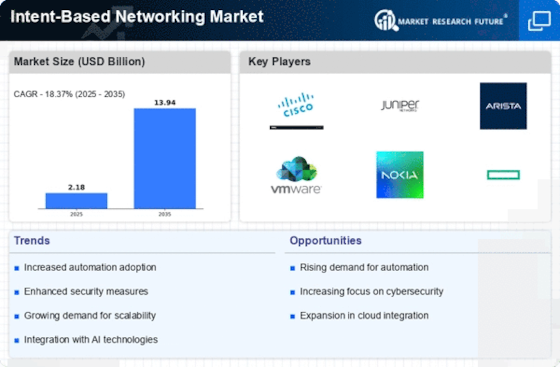
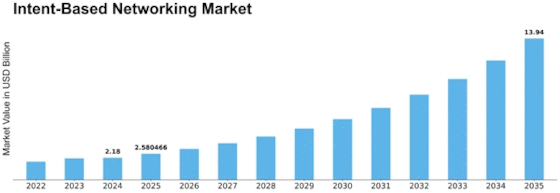
As per Market Research Future analysis, the Intent-Based Networking Market Size was estimated at 2.18 USD Billion in 2024. The Intent-Based Networking industry is projected to grow from 2.581 USD Billion in 2025 to 13.94 USD Billion by 2035, exhibiting a compound annual growth rate (CAGR) of 18.37% during the forecast period 2025 - 2035

Key Market Trends & Highlights

The Intent-Based Networking Market is poised for substantial growth driven by automation and advanced technologies.

  • North America remains the largest market for Intent-Based Networking, reflecting a strong demand for network automation. Asia-Pacific is emerging as the fastest-growing region, fueled by rapid digital transformation and IoT expansion. Networking Hardware Components dominate the market, while Software solutions are experiencing the fastest growth due to increasing automation needs. Rising demand for network automation and the integration of advanced security features are key drivers propelling market expansion.

Market Size & Forecast

2024 Market Size 2.18 (USD Billion)
2035 Market Size 13.94 (USD Billion)
CAGR (2025 - 2035) 18.37%
Largest Regional Market Share in 2024 North America

Major Players

Cisco Systems (US), Juniper Networks (US), Arista Networks (US), VMware (US), Nokia (FI), Hewlett Packard Enterprise (US), IBM (US), Extreme Networks (US), Netgear (US)

Market Trends

The Intent-Based Networking Market is currently experiencing a transformative phase, driven by the increasing demand for automation and enhanced network management capabilities. Organizations are recognizing the necessity for more agile and responsive networking solutions that can adapt to dynamic business environments. This shift is largely influenced by the growing complexity of network infrastructures and the need for real-time data analysis. As a result, intent-based networking is emerging as a viable solution, enabling businesses to define their desired outcomes and allowing the network to automatically adjust to meet those objectives. Furthermore, the integration of artificial intelligence and machine learning technologies is likely to play a pivotal role in optimizing network performance and security, thereby enhancing overall operational efficiency. In addition, the Intent-Based Networking Market appears to be expanding due to the increasing adoption of cloud-based services and the proliferation of Internet of Things (IoT) devices. These factors necessitate a more sophisticated approach to network management, as traditional methods may no longer suffice. Organizations are seeking solutions that not only streamline operations but also provide insights into network behavior and performance. Consequently, the market is poised for growth, with various stakeholders, including service providers and technology vendors, actively investing in research and development to innovate and refine their offerings. This evolving landscape suggests a promising future for intent-based networking solutions, as they align with the broader trends of digital transformation and operational efficiency.

Automation and Efficiency

The trend towards automation in network management is becoming increasingly pronounced. Organizations are seeking solutions that minimize manual intervention, thereby reducing the potential for human error and enhancing operational efficiency. Intent-based networking facilitates this by allowing networks to self-configure and self-heal, which streamlines processes and optimizes resource allocation.

Integration of AI and Machine Learning

The incorporation of artificial intelligence and machine learning technologies into intent-based networking is gaining traction. These advanced technologies enable networks to analyze vast amounts of data in real-time, facilitating proactive decision-making and improving security measures. This integration is likely to enhance the overall performance and reliability of network systems.

Cloud Adoption and IoT Expansion

The growing reliance on cloud services and the rapid expansion of IoT devices are driving the need for more sophisticated networking solutions. As organizations increasingly adopt cloud-based infrastructures, the demand for intent-based networking solutions that can seamlessly manage and secure these environments is expected to rise, reflecting a shift towards more dynamic and scalable network architectures.

Intent Based Networking Market Market Drivers

Growing Need for Real-Time Analytics

The Intent-Based Networking Market is increasingly driven by the growing need for real-time analytics in network management. Organizations are recognizing the importance of data-driven decision-making to enhance operational efficiency and improve user experiences. Intent-based networking solutions facilitate real-time monitoring and analytics, allowing businesses to gain insights into network performance and user behavior. Recent studies indicate that companies utilizing real-time analytics can achieve up to a 20% increase in operational efficiency. As the demand for actionable insights continues to rise, the integration of real-time analytics within intent-based networking solutions is likely to become a pivotal factor in shaping the future of network management.

Rising Demand for Network Automation

The Intent-Based Networking Market is experiencing a notable surge in demand for network automation solutions. Organizations are increasingly recognizing the need to streamline their network operations, reduce human error, and enhance overall efficiency. According to recent data, the market for network automation is projected to grow at a compound annual growth rate of approximately 25% over the next five years. This growth is driven by the necessity for businesses to adapt to rapidly changing technological landscapes and the increasing complexity of network environments. As companies seek to optimize their resources and improve service delivery, the adoption of intent-based networking solutions is likely to become a critical component of their strategic initiatives.

Integration of Advanced Security Features

In the current landscape, the Intent-Based Networking Market is witnessing a heightened focus on integrating advanced security features into networking solutions. With the rise in cyber threats and data breaches, organizations are prioritizing security as a fundamental aspect of their network infrastructure. Intent-based networking offers the potential to enhance security protocols by automating threat detection and response mechanisms. Recent statistics indicate that the cybersecurity market is expected to reach USD 300 billion by 2024, underscoring the urgency for businesses to adopt robust security measures. Consequently, the integration of security features within intent-based networking solutions is likely to drive market growth, as organizations seek to safeguard their digital assets while maintaining operational efficiency.

Shift Towards Software-Defined Networking

The Intent-Based Networking Market is experiencing a paradigm shift towards software-defined networking (SDN) as organizations seek to enhance flexibility and scalability in their network architectures. SDN allows for centralized control of network resources, enabling businesses to respond swiftly to changing demands. The intent-based networking approach complements SDN by translating business intentions into network policies, thereby automating network management. Recent market analysis indicates that the SDN market is projected to reach USD 100 billion by 2025, reflecting the growing recognition of its benefits. This shift towards SDN is likely to propel the adoption of intent-based networking solutions, as organizations aim to leverage the advantages of both technologies to optimize their network performance.

Increased Complexity of Network Environments

The Intent-Based Networking Market is significantly influenced by the increasing complexity of network environments. As organizations expand their digital footprints and adopt diverse technologies, managing these intricate networks becomes a daunting challenge. Intent-based networking solutions offer a promising approach to simplify network management by enabling automated configuration and policy enforcement. Data suggests that over 70% of IT professionals report difficulties in managing multi-cloud environments, highlighting the need for innovative solutions. This complexity drives the demand for intent-based networking, as organizations seek to enhance visibility, control, and adaptability within their networks. The ability to manage complex environments efficiently is likely to be a key driver for the growth of the intent-based networking market.

Market Segment Insights

By Component Type: Networking Hardware Components (Largest) vs. Software (Fastest-Growing)

The Intent-Based Networking Market is characterized by a diverse range of component types, with Networking Hardware Components leading the charge. This segment captures the largest share due to the increasingly critical role of physical infrastructure in supporting advanced network functions. As organizations invest heavily in upgrading their hardware to enable intent-based networking capabilities, this segment is set to dominate the market landscape for the foreseeable future. In contrast, the Software segment is rapidly emerging as the fastest-growing component in the Intent-Based Networking space. Driven by the demand for automation, enhanced security features, and improved network management solutions, software investments are accelerating. Enterprises are recognizing the value of integrating software-defined solutions, which respond more dynamically to network demands, thus propelling growth in this segment significantly.

Networking Hardware Components (Dominant) vs. Software (Emerging)

Networking Hardware Components are pivotal to the functionality of intent-based networking, serving as the backbone that supports various networking operations and optimizations. This segment includes routers, switches, and other hardware tools that facilitate efficient data flow and management in organizational networks. As businesses increasingly transition to more complex network environments that require sophisticated hardware to handle intent-driven strategies, the demand for these components continues to be robust. In contrast, the Software segment, while still lagging behind in terms of market share, is quickly becoming an essential part of the networking ecosystem. It encompasses advanced management platforms and analytics tools that offer critical insights and automation capabilities, enhancing overall network performance and security. With the growing emphasis on network agility and responsiveness, software solutions are escalating in adoption, driving innovation in the segment.

By Deployment Model: On-Premise (Largest) vs. On Cloud (Fastest-Growing)

In the Intent-Based Networking Market, the deployment model is primarily divided into On-Premise and On Cloud solutions. The On-Premise segment currently holds the largest share, adopted by enterprises looking for enhanced control and security over their networking infrastructure. In contrast, the On Cloud model is gaining traction rapidly, supported by businesses aiming for scalable solutions that facilitate agility and reduce capital expenditures. As organizations increasingly move towards digital transformation, the shift in preference is evident, with more enterprises leaning towards cloud-based solutions for their networking needs.

Deployment Model: On-Premise (Dominant) vs. On Cloud (Emerging)

The On-Premise deployment model remains the dominant choice within the Intent-Based Networking Market, favored by organizations that prioritize control, security, and compliance over their network operations. This model allows businesses to manage their systems internally, providing a sense of ownership and customization tailored to specific operational needs. On the other hand, the On Cloud deployment model is emerging as a popular alternative, particularly among startups and mid-sized companies seeking cost-effective, flexible solutions. This model offers advantages such as reduced infrastructure costs, scalable resources, and the ability to leverage advanced analytical tools without the need for significant upfront investments.

By Application: Healthcare (Largest) vs. Telecom (Fastest-Growing)

The Intent-Based Networking Market showcases a diverse application landscape with significant market share distribution among sectors such as Healthcare, Government, Manufacturing, Telecom, Defense, and BFSI. Healthcare continues to dominate this market due to its extensive infrastructure and critical requirements for reliable networking solutions. Conversely, Telecom has emerged as a rapidly growing segment, benefiting from the increasing demand for enhanced connectivity and innovative networking technologies that facilitate seamless communication networks.

Healthcare: Dominant vs. Telecom: Emerging

The Healthcare sector remains dominant in the Intent-Based Networking Market, characterized by its need for secure and efficient data handling, particularly during patient data management and healthcare operations. Advanced networking solutions enable healthcare institutions to streamline operations, improve patient care, and maintain regulatory compliance. On the other hand, Telecom is positioned as an emerging segment driven by technological advancements such as 5G and IoT integration, which are reshaping telecommunication infrastructures. Companies in the telecom sector are rapidly adopting intent-based networking to enhance network performance, manage increasing data traffic, and support innovative services, thus positioning themselves for significant growth.

By Vertical: Telecom (Largest) vs. Healthcare (Fastest-Growing)

The vertical segment of the Intent-Based Networking Market prominently features Telecom, which holds a significant market share given its critical role in communication systems. This substantial share is attributed to the enhanced network reliability and efficiency provided by intent-based solutions, facilitating seamless connectivity in an increasingly digital landscape. In contrast, the Healthcare vertical is rapidly increasing its presence due to the rising demand for digital transformation within the sector. The urgency for secure and efficient data handling plays a pivotal role in healthcare's growing adoption of these technologies.

Telecom: Dominant vs. Healthcare: Emerging

Telecom represents the dominant vertical in the Intent-Based Networking Market as it capitalizes on cutting-edge technologies that enhance network performance and scalability. The sector prioritizes efficient data flow and real-time analytics, which are essential for managing extensive user demands. On the other hand, the emerging healthcare segment is witnessing rapid adoption of intent-based networking as healthcare providers strive for operational efficiency and improved patient outcomes. This vertical focuses on secure and reliable networks that can handle sensitive information while ensuring compliance with regulations, thus driving the growth of innovative solutions tailored for healthcare applications.

Get more detailed insights about Intent-Based Networking Market Research Report - Forecast to 2035

Regional Insights

By region, the study provides market insights into North America, Europe, Asia-Pacific and Rest of the World. The North American Intent-Based Networking market will dominate this market, owing to increased investment in advanced technologies such as cloud-based services and intent-based networking solutions to improve businesses and the customer experience. In addition, the growing usage of intent will boost market growth in this region.

Further, the major countries studied in the market report are The US, Canada, German, France, the UK, Italy, Spain, China, Japan, India, Australia, South Korea, and Brazil.

Figure 2: Intent-Based Networking Market SHARE BY REGION 2022 (USD Billion)

Europe's Intent-Based Networking market accounts for the second-largest market share due to government initiatives toward advanced networking technologies. Further, the German Intent-Based Networking market held the largest market share, and the UK Intent-Based Networking market was the fastest-growing market in the European region.

The Asia-Pacific Intent-Based Networking Market is expected to grow at the fastest CAGR from 2023 to 2032 due to in penetration of digitalization and increasing adoption of advanced technology. Moreover, China’s Intent-Based Networking market held the largest market share, and the Indian Intent-Based Networking market was the fastest-growing market in the Asia-Pacific region.

  • March 2023, As part of a definitive agreement to acquire cloud security provider Axis Security, Hewlett Packard Enterprise increased its intent-based networking security capabilities by providing a solution to meet the growing demand for the integrated networking & security solutions delivered as-a-service.
  • March 2023, In order to improve industrial asset visibility, securely manage assets from anywhere, and give intent-based networking & industrial internet of things (IoT) customers a seamless path to automation for operational technology (OT) teams, Cisco Systems Inc has launched cloud services in IoT operations dashboard.
  • March 2023, As part of a definitive agreement to acquire cloud security provider Axis Security, Hewlett Packard Enterprise increased its intent-based networking security capabilities by providing a solution to meet the growing demand for the integrated networking & security solutions delivered as-a-service.
  • March 2023, In order to improve industrial asset visibility, securely manage assets from anywhere, and give intent-based networking & industrial internet of things (IoT) customers a seamless path to automation for operational technology (OT) teams, Cisco Systems Inc has launched cloud services in IoT operations dashboard.

Key Players and Competitive Insights

Leading market players are investing heavily in research and development to expand their product lines, which will help the Intent-Based Networking market, grow even more. Market participants are also undertaking several strategic activities to expand their global footprint, with important market developments including new product launches, contractual agreements, mergers and acquisitions, higher investments, and collaboration with other organizations. To expand and survive in a more competitive and rising market climate, the Intent-Based Networking industry must offer cost-effective items.Manufacturing locally to minimize operational costs is one of the key business tactics manufacturers use in the global Intent-Based Networking industry to benefit clients and increase the market sector. In recent years, the Intent-Based Networking industry has offered some of the most significant advantages to medicine. Major players in the Intent-Based Networking market, including Cisco Systems Inc. (US), Apstra Inc. (US), Veriflow Systems (US), Huawei Technologies Co.Ltd. (China), Juniper Networks Inc. (US), Cerium Networks (US), Pluribus Networks (US), Forward Networks Inc. (US), Anuta Networks (US), Indeni Ltd. (US), and others, are attempting to increase market demand by investing in research and development operations.Cisco Systems, Inc., known as Cisco, is an American global digital communication technology conglomerate firm with its corporate headquarters in San Jose, California. Cisco creates, produces, and markets networking tools, computer software, telecommunications gear, and other high-tech services and goods. Cisco is a leading provider of cutting-edge technologies such as Webex, OpenDNS, Jabber, Duo Security, and Jasper. It specializes in niche technological areas like the Internet of Things (IoT), domain security, videoconferencing, and energy management.For instance: In March 2023, Cisco Systems Inc. unveiled cloud services in the IoT operations dashboard to grow business asset visibility, firmly manage assets from anywhere and deliver intent-based networking and industrial Internet of Things (IoT) customers with a unified path to automation for operational technology (OT) teams.NetBrain, founded in 2004, offers operators and engineers a platform for network automation and visibility, making managing hybrid networks easier. The US Company NetBrain has headquartered in Massachusetts (US). Its top-down methodology sets and upholds corporate ambitions while converting each network component into a digital twin that comprehends component intentions. By regulating desired outcomes, engineers and operators can ensure network integrity. NetBrain is used by over 2,500 large businesses and managed service providers to streamline management processes, cut MTTRs, guarantee compliance, and comprehend network support for operational needs.For Instance: In March 2023, NetBrain Technologies unveiled the Problem Diagnosis Automation System (PDAS) powered by Network Intent technology that NetBrain Technology Inc. has patented. With the help of the new PDA System, operations can define network intent without writing a single line of code. The PDA System responds to service incidents by connecting ITSM systems with it, decreasing total MTTR and eliminating tedious diagnostic work.

Key Companies in the Intent Based Networking Market include

Industry Developments

  • Q2 2024: Cisco Announces Intent-Based Networking Innovations to Accelerate Enterprise Automation Cisco launched new intent-based networking features for its enterprise portfolio, including AI-driven automation and enhanced security capabilities, aiming to simplify network management for large organizations.
  • Q2 2024: Juniper Networks Expands Intent-Based Networking Portfolio with New Apstra Release Juniper Networks released an updated version of its Apstra intent-based networking software, introducing advanced analytics and multi-vendor support to improve data center automation.
  • Q2 2024: Forward Networks Raises $50 Million in Series D Funding to Advance Intent-Based Networking Solutions Forward Networks secured $50 million in Series D funding to accelerate development of its intent-based networking platform and expand its global market presence.
  • Q3 2024: IBM Launches AI-Powered Intent-Based Networking Platform for Hybrid Cloud Environments IBM introduced a new intent-based networking platform leveraging AI to automate network configuration and management across hybrid cloud infrastructures.
  • Q3 2024: Nokia Partners with HPE to Deliver Intent-Based Networking Solutions for Telecom Operators Nokia announced a strategic partnership with Hewlett Packard Enterprise (HPE) to co-develop intent-based networking solutions tailored for telecom operators, focusing on automation and scalability.
  • Q3 2024: Huawei Unveils Next-Generation Intent-Based Networking System for Enterprise Clients Huawei launched its latest intent-based networking system, featuring enhanced AI capabilities and real-time analytics for enterprise network optimization.
  • Q4 2024: Juniper Networks Wins Major Intent-Based Networking Contract with European Financial Institution Juniper Networks secured a significant contract to deploy its intent-based networking solutions for a leading European financial institution, supporting digital transformation and network automation.
  • Q4 2024: Gluware Secures $30 Million Series C Funding to Expand Intent-Based Networking Automation Gluware raised $30 million in Series C funding to enhance its intent-based networking automation platform and accelerate customer acquisition in the enterprise sector.
  • Q1 2025: Cisco Acquires Intent-Based Networking Startup to Bolster AI-Driven Network Automation Cisco announced the acquisition of a leading intent-based networking startup, aiming to integrate advanced AI-driven automation features into its existing network management solutions.
  • Q1 2025: IBM Appoints New Head of Intent-Based Networking Division IBM named a new executive to lead its intent-based networking division, signaling increased focus on AI-powered network automation and enterprise solutions.
  • Q2 2025: Nokia Opens New Intent-Based Networking R&D Facility in Finland Nokia inaugurated a new research and development facility in Finland dedicated to advancing intent-based networking technologies for global telecom and enterprise markets.
  • Q2 2025: Forward Networks Announces Strategic Partnership with IBM for Intent-Based Networking Integration Forward Networks entered a strategic partnership with IBM to integrate its intent-based networking platform with IBM's hybrid cloud solutions, targeting large enterprise customers.

Future Outlook

Intent Based Networking Market Future Outlook

The Intent-Based Networking Market is projected to grow at an 18.37% CAGR from 2025 to 2035, driven by automation, AI integration, and increasing demand for network efficiency.

New opportunities lie in:

  • Development of AI-driven network optimization tools</p><p>Expansion into edge computing solutions</p><p>Creation of subscription-based network management services

By 2035, the market is expected to be robust, driven by innovative solutions and strategic partnerships.

Market Segmentation

Intent Based Networking Market Vertical Outlook

  • Construction
  • Building
  • Telecom
  • Healthcare

Intent Based Networking Market Application Outlook

  • Healthcare
  • Government
  • Manufacturing
  • Telecom
  • Defense
  • BFSI

Intent Based Networking Market Component Type Outlook

  • Networking Hardware Components
  • Software
  • Service

Intent Based Networking Market Deployment Model Outlook

  • On-Premise
  • On Cloud

Report Scope

MARKET SIZE 2024 2.18(USD Billion)
MARKET SIZE 2025 2.581(USD Billion)
MARKET SIZE 2035 13.94(USD Billion)
COMPOUND ANNUAL GROWTH RATE (CAGR) 18.37% (2025 - 2035)
REPORT COVERAGE Revenue Forecast, Competitive Landscape, Growth Factors, and Trends
BASE YEAR 2024
Market Forecast Period 2025 - 2035
Historical Data 2019 - 2024
Market Forecast Units USD Billion
Key Companies Profiled Cisco Systems (US), Juniper Networks (US), Arista Networks (US), VMware (US), Nokia (FI), Hewlett Packard Enterprise (US), IBM (US), Extreme Networks (US), Netgear (US)
Segments Covered Component Type, Deployment Model, Application, Vertical, Region
Key Market Opportunities Integration of artificial intelligence enhances automation and efficiency in the Intent-Based Networking Market.
Key Market Dynamics Rising demand for automation and efficiency drives innovation in the Intent-Based Networking Market.
Countries Covered North America, Europe, APAC, South America, MEA

FAQs

What is the current valuation of the Intent-Based Networking Market as of 2024?

<p>The market valuation was 2.18 USD Billion in 2024.</p>

What is the projected market size for the Intent-Based Networking Market by 2035?

<p>The market is projected to reach 13.94 USD Billion by 2035.</p>

What is the expected CAGR for the Intent-Based Networking Market during the forecast period 2025 - 2035?

<p>The expected CAGR for the market during this period is 18.37%.</p>

Which companies are considered key players in the Intent-Based Networking Market?

<p>Key players include Cisco Systems, Juniper Networks, Arista Networks, VMware, Nokia, Hewlett Packard Enterprise, IBM, Extreme Networks, and Netgear.</p>

What are the main component types in the Intent-Based Networking Market?

<p>The main component types include Networking Hardware Components, Software, and Services.</p>

How does the market size for Networking Hardware Components compare to Software in 2025?

<p>In 2025, Networking Hardware Components and Software are both projected to be valued at 5.56 USD Billion.</p>

What is the market size for the Telecom application segment in 2025?

The Telecom application segment is expected to reach 3.2 USD Billion in 2025.

What are the projected valuations for the On-Premise and On-Cloud deployment models in 2025?

The On-Premise model is projected at 7.0 USD Billion, while the On-Cloud model is expected to be 6.94 USD Billion.

Which verticals are expected to drive growth in the Intent-Based Networking Market?

Key verticals include Telecom, Healthcare, Construction, and Building.

What is the anticipated market size for the Healthcare vertical by 2035?

The Healthcare vertical is projected to reach 3.14 USD Billion by 2035.

  1. SECTION I: EXECUTIVE SUMMARY AND KEY HIGHLIGHTS
    1. | 1.1 EXECUTIVE SUMMARY
    2. | | 1.1.1 Market Overview
    3. | | 1.1.2 Key Findings
    4. | | 1.1.3 Market Segmentation
    5. | | 1.1.4 Competitive Landscape
    6. | | 1.1.5 Challenges and Opportunities
    7. | | 1.1.6 Future Outlook
  2. SECTION II: SCOPING, METHODOLOGY AND MARKET STRUCTURE
    1. | 2.1 MARKET INTRODUCTION
    2. | | 2.1.1 Definition
    3. | | 2.1.2 Scope of the study
    4. | | | 2.1.2.1 Research Objective
    5. | | | 2.1.2.2 Assumption
    6. | | | 2.1.2.3 Limitations
    7. | 2.2 RESEARCH METHODOLOGY
    8. | | 2.2.1 Overview
    9. | | 2.2.2 Data Mining
    10. | | 2.2.3 Secondary Research
    11. | | 2.2.4 Primary Research
    12. | | | 2.2.4.1 Primary Interviews and Information Gathering Process
    13. | | | 2.2.4.2 Breakdown of Primary Respondents
    14. | | 2.2.5 Forecasting Model
    15. | | 2.2.6 Market Size Estimation
    16. | | | 2.2.6.1 Bottom-Up Approach
    17. | | | 2.2.6.2 Top-Down Approach
    18. | | 2.2.7 Data Triangulation
    19. | | 2.2.8 Validation
  3. SECTION III: QUALITATIVE ANALYSIS
    1. | 3.1 MARKET DYNAMICS
    2. | | 3.1.1 Overview
    3. | | 3.1.2 Drivers
    4. | | 3.1.3 Restraints
    5. | | 3.1.4 Opportunities
    6. | 3.2 MARKET FACTOR ANALYSIS
    7. | | 3.2.1 Value chain Analysis
    8. | | 3.2.2 Porter's Five Forces Analysis
    9. | | | 3.2.2.1 Bargaining Power of Suppliers
    10. | | | 3.2.2.2 Bargaining Power of Buyers
    11. | | | 3.2.2.3 Threat of New Entrants
    12. | | | 3.2.2.4 Threat of Substitutes
    13. | | | 3.2.2.5 Intensity of Rivalry
    14. | | 3.2.3 COVID-19 Impact Analysis
    15. | | | 3.2.3.1 Market Impact Analysis
    16. | | | 3.2.3.2 Regional Impact
    17. | | | 3.2.3.3 Opportunity and Threat Analysis
  4. SECTION IV: QUANTITATIVE ANALYSIS
    1. | 4.1 Semiconductor & Electronics, BY Component Type (USD Billion)
    2. | | 4.1.1 Networking Hardware Components
    3. | | 4.1.2 Software
    4. | | 4.1.3 Service
    5. | 4.2 Semiconductor & Electronics, BY Deployment Model (USD Billion)
    6. | | 4.2.1 On-Premise
    7. | | 4.2.2 On Cloud
    8. | 4.3 Semiconductor & Electronics, BY Application (USD Billion)
    9. | | 4.3.1 Healthcare
    10. | | 4.3.2 Government
    11. | | 4.3.3 Manufacturing
    12. | | 4.3.4 Telecom
    13. | | 4.3.5 Defense
    14. | | 4.3.6 BFSI
    15. | 4.4 Semiconductor & Electronics, BY Vertical (USD Billion)
    16. | | 4.4.1 Construction
    17. | | 4.4.2 Building
    18. | | 4.4.3 Telecom
    19. | | 4.4.4 Healthcare
    20. | 4.5 Semiconductor & Electronics, BY Region (USD Billion)
    21. | | 4.5.1 North America
    22. | | | 4.5.1.1 US
    23. | | | 4.5.1.2 Canada
    24. | | 4.5.2 Europe
    25. | | | 4.5.2.1 Germany
    26. | | | 4.5.2.2 UK
    27. | | | 4.5.2.3 France
    28. | | | 4.5.2.4 Russia
    29. | | | 4.5.2.5 Italy
    30. | | | 4.5.2.6 Spain
    31. | | | 4.5.2.7 Rest of Europe
    32. | | 4.5.3 APAC
    33. | | | 4.5.3.1 China
    34. | | | 4.5.3.2 India
    35. | | | 4.5.3.3 Japan
    36. | | | 4.5.3.4 South Korea
    37. | | | 4.5.3.5 Malaysia
    38. | | | 4.5.3.6 Thailand
    39. | | | 4.5.3.7 Indonesia
    40. | | | 4.5.3.8 Rest of APAC
    41. | | 4.5.4 South America
    42. | | | 4.5.4.1 Brazil
    43. | | | 4.5.4.2 Mexico
    44. | | | 4.5.4.3 Argentina
    45. | | | 4.5.4.4 Rest of South America
    46. | | 4.5.5 MEA
    47. | | | 4.5.5.1 GCC Countries
    48. | | | 4.5.5.2 South Africa
    49. | | | 4.5.5.3 Rest of MEA
  5. SECTION V: COMPETITIVE ANALYSIS
    1. | 5.1 Competitive Landscape
    2. | | 5.1.1 Overview
    3. | | 5.1.2 Competitive Analysis
    4. | | 5.1.3 Market share Analysis
    5. | | 5.1.4 Major Growth Strategy in the Semiconductor & Electronics
    6. | | 5.1.5 Competitive Benchmarking
    7. | | 5.1.6 Leading Players in Terms of Number of Developments in the Semiconductor & Electronics
    8. | | 5.1.7 Key developments and growth strategies
    9. | | | 5.1.7.1 New Product Launch/Service Deployment
    10. | | | 5.1.7.2 Merger & Acquisitions
    11. | | | 5.1.7.3 Joint Ventures
    12. | | 5.1.8 Major Players Financial Matrix
    13. | | | 5.1.8.1 Sales and Operating Income
    14. | | | 5.1.8.2 Major Players R&D Expenditure. 2023
    15. | 5.2 Company Profiles
    16. | | 5.2.1 Cisco Systems (US)
    17. | | | 5.2.1.1 Financial Overview
    18. | | | 5.2.1.2 Products Offered
    19. | | | 5.2.1.3 Key Developments
    20. | | | 5.2.1.4 SWOT Analysis
    21. | | | 5.2.1.5 Key Strategies
    22. | | 5.2.2 Juniper Networks (US)
    23. | | | 5.2.2.1 Financial Overview
    24. | | | 5.2.2.2 Products Offered
    25. | | | 5.2.2.3 Key Developments
    26. | | | 5.2.2.4 SWOT Analysis
    27. | | | 5.2.2.5 Key Strategies
    28. | | 5.2.3 Arista Networks (US)
    29. | | | 5.2.3.1 Financial Overview
    30. | | | 5.2.3.2 Products Offered
    31. | | | 5.2.3.3 Key Developments
    32. | | | 5.2.3.4 SWOT Analysis
    33. | | | 5.2.3.5 Key Strategies
    34. | | 5.2.4 VMware (US)
    35. | | | 5.2.4.1 Financial Overview
    36. | | | 5.2.4.2 Products Offered
    37. | | | 5.2.4.3 Key Developments
    38. | | | 5.2.4.4 SWOT Analysis
    39. | | | 5.2.4.5 Key Strategies
    40. | | 5.2.5 Nokia (FI)
    41. | | | 5.2.5.1 Financial Overview
    42. | | | 5.2.5.2 Products Offered
    43. | | | 5.2.5.3 Key Developments
    44. | | | 5.2.5.4 SWOT Analysis
    45. | | | 5.2.5.5 Key Strategies
    46. | | 5.2.6 Hewlett Packard Enterprise (US)
    47. | | | 5.2.6.1 Financial Overview
    48. | | | 5.2.6.2 Products Offered
    49. | | | 5.2.6.3 Key Developments
    50. | | | 5.2.6.4 SWOT Analysis
    51. | | | 5.2.6.5 Key Strategies
    52. | | 5.2.7 IBM (US)
    53. | | | 5.2.7.1 Financial Overview
    54. | | | 5.2.7.2 Products Offered
    55. | | | 5.2.7.3 Key Developments
    56. | | | 5.2.7.4 SWOT Analysis
    57. | | | 5.2.7.5 Key Strategies
    58. | | 5.2.8 Extreme Networks (US)
    59. | | | 5.2.8.1 Financial Overview
    60. | | | 5.2.8.2 Products Offered
    61. | | | 5.2.8.3 Key Developments
    62. | | | 5.2.8.4 SWOT Analysis
    63. | | | 5.2.8.5 Key Strategies
    64. | | 5.2.9 Netgear (US)
    65. | | | 5.2.9.1 Financial Overview
    66. | | | 5.2.9.2 Products Offered
    67. | | | 5.2.9.3 Key Developments
    68. | | | 5.2.9.4 SWOT Analysis
    69. | | | 5.2.9.5 Key Strategies
    70. | 5.3 Appendix
    71. | | 5.3.1 References
    72. | | 5.3.2 Related Reports
  6. LIST OF FIGURES
    1. | 6.1 MARKET SYNOPSIS
    2. | 6.2 NORTH AMERICA MARKET ANALYSIS
    3. | 6.3 US MARKET ANALYSIS BY COMPONENT TYPE
    4. | 6.4 US MARKET ANALYSIS BY DEPLOYMENT MODEL
    5. | 6.5 US MARKET ANALYSIS BY APPLICATION
    6. | 6.6 US MARKET ANALYSIS BY VERTICAL
    7. | 6.7 CANADA MARKET ANALYSIS BY COMPONENT TYPE
    8. | 6.8 CANADA MARKET ANALYSIS BY DEPLOYMENT MODEL
    9. | 6.9 CANADA MARKET ANALYSIS BY APPLICATION
    10. | 6.10 CANADA MARKET ANALYSIS BY VERTICAL
    11. | 6.11 EUROPE MARKET ANALYSIS
    12. | 6.12 GERMANY MARKET ANALYSIS BY COMPONENT TYPE
    13. | 6.13 GERMANY MARKET ANALYSIS BY DEPLOYMENT MODEL
    14. | 6.14 GERMANY MARKET ANALYSIS BY APPLICATION
    15. | 6.15 GERMANY MARKET ANALYSIS BY VERTICAL
    16. | 6.16 UK MARKET ANALYSIS BY COMPONENT TYPE
    17. | 6.17 UK MARKET ANALYSIS BY DEPLOYMENT MODEL
    18. | 6.18 UK MARKET ANALYSIS BY APPLICATION
    19. | 6.19 UK MARKET ANALYSIS BY VERTICAL
    20. | 6.20 FRANCE MARKET ANALYSIS BY COMPONENT TYPE
    21. | 6.21 FRANCE MARKET ANALYSIS BY DEPLOYMENT MODEL
    22. | 6.22 FRANCE MARKET ANALYSIS BY APPLICATION
    23. | 6.23 FRANCE MARKET ANALYSIS BY VERTICAL
    24. | 6.24 RUSSIA MARKET ANALYSIS BY COMPONENT TYPE
    25. | 6.25 RUSSIA MARKET ANALYSIS BY DEPLOYMENT MODEL
    26. | 6.26 RUSSIA MARKET ANALYSIS BY APPLICATION
    27. | 6.27 RUSSIA MARKET ANALYSIS BY VERTICAL
    28. | 6.28 ITALY MARKET ANALYSIS BY COMPONENT TYPE
    29. | 6.29 ITALY MARKET ANALYSIS BY DEPLOYMENT MODEL
    30. | 6.30 ITALY MARKET ANALYSIS BY APPLICATION
    31. | 6.31 ITALY MARKET ANALYSIS BY VERTICAL
    32. | 6.32 SPAIN MARKET ANALYSIS BY COMPONENT TYPE
    33. | 6.33 SPAIN MARKET ANALYSIS BY DEPLOYMENT MODEL
    34. | 6.34 SPAIN MARKET ANALYSIS BY APPLICATION
    35. | 6.35 SPAIN MARKET ANALYSIS BY VERTICAL
    36. | 6.36 REST OF EUROPE MARKET ANALYSIS BY COMPONENT TYPE
    37. | 6.37 REST OF EUROPE MARKET ANALYSIS BY DEPLOYMENT MODEL
    38. | 6.38 REST OF EUROPE MARKET ANALYSIS BY APPLICATION
    39. | 6.39 REST OF EUROPE MARKET ANALYSIS BY VERTICAL
    40. | 6.40 APAC MARKET ANALYSIS
    41. | 6.41 CHINA MARKET ANALYSIS BY COMPONENT TYPE
    42. | 6.42 CHINA MARKET ANALYSIS BY DEPLOYMENT MODEL
    43. | 6.43 CHINA MARKET ANALYSIS BY APPLICATION
    44. | 6.44 CHINA MARKET ANALYSIS BY VERTICAL
    45. | 6.45 INDIA MARKET ANALYSIS BY COMPONENT TYPE
    46. | 6.46 INDIA MARKET ANALYSIS BY DEPLOYMENT MODEL
    47. | 6.47 INDIA MARKET ANALYSIS BY APPLICATION
    48. | 6.48 INDIA MARKET ANALYSIS BY VERTICAL
    49. | 6.49 JAPAN MARKET ANALYSIS BY COMPONENT TYPE
    50. | 6.50 JAPAN MARKET ANALYSIS BY DEPLOYMENT MODEL
    51. | 6.51 JAPAN MARKET ANALYSIS BY APPLICATION
    52. | 6.52 JAPAN MARKET ANALYSIS BY VERTICAL
    53. | 6.53 SOUTH KOREA MARKET ANALYSIS BY COMPONENT TYPE
    54. | 6.54 SOUTH KOREA MARKET ANALYSIS BY DEPLOYMENT MODEL
    55. | 6.55 SOUTH KOREA MARKET ANALYSIS BY APPLICATION
    56. | 6.56 SOUTH KOREA MARKET ANALYSIS BY VERTICAL
    57. | 6.57 MALAYSIA MARKET ANALYSIS BY COMPONENT TYPE
    58. | 6.58 MALAYSIA MARKET ANALYSIS BY DEPLOYMENT MODEL
    59. | 6.59 MALAYSIA MARKET ANALYSIS BY APPLICATION
    60. | 6.60 MALAYSIA MARKET ANALYSIS BY VERTICAL
    61. | 6.61 THAILAND MARKET ANALYSIS BY COMPONENT TYPE
    62. | 6.62 THAILAND MARKET ANALYSIS BY DEPLOYMENT MODEL
    63. | 6.63 THAILAND MARKET ANALYSIS BY APPLICATION
    64. | 6.64 THAILAND MARKET ANALYSIS BY VERTICAL
    65. | 6.65 INDONESIA MARKET ANALYSIS BY COMPONENT TYPE
    66. | 6.66 INDONESIA MARKET ANALYSIS BY DEPLOYMENT MODEL
    67. | 6.67 INDONESIA MARKET ANALYSIS BY APPLICATION
    68. | 6.68 INDONESIA MARKET ANALYSIS BY VERTICAL
    69. | 6.69 REST OF APAC MARKET ANALYSIS BY COMPONENT TYPE
    70. | 6.70 REST OF APAC MARKET ANALYSIS BY DEPLOYMENT MODEL
    71. | 6.71 REST OF APAC MARKET ANALYSIS BY APPLICATION
    72. | 6.72 REST OF APAC MARKET ANALYSIS BY VERTICAL
    73. | 6.73 SOUTH AMERICA MARKET ANALYSIS
    74. | 6.74 BRAZIL MARKET ANALYSIS BY COMPONENT TYPE
    75. | 6.75 BRAZIL MARKET ANALYSIS BY DEPLOYMENT MODEL
    76. | 6.76 BRAZIL MARKET ANALYSIS BY APPLICATION
    77. | 6.77 BRAZIL MARKET ANALYSIS BY VERTICAL
    78. | 6.78 MEXICO MARKET ANALYSIS BY COMPONENT TYPE
    79. | 6.79 MEXICO MARKET ANALYSIS BY DEPLOYMENT MODEL
    80. | 6.80 MEXICO MARKET ANALYSIS BY APPLICATION
    81. | 6.81 MEXICO MARKET ANALYSIS BY VERTICAL
    82. | 6.82 ARGENTINA MARKET ANALYSIS BY COMPONENT TYPE
    83. | 6.83 ARGENTINA MARKET ANALYSIS BY DEPLOYMENT MODEL
    84. | 6.84 ARGENTINA MARKET ANALYSIS BY APPLICATION
    85. | 6.85 ARGENTINA MARKET ANALYSIS BY VERTICAL
    86. | 6.86 REST OF SOUTH AMERICA MARKET ANALYSIS BY COMPONENT TYPE
    87. | 6.87 REST OF SOUTH AMERICA MARKET ANALYSIS BY DEPLOYMENT MODEL
    88. | 6.88 REST OF SOUTH AMERICA MARKET ANALYSIS BY APPLICATION
    89. | 6.89 REST OF SOUTH AMERICA MARKET ANALYSIS BY VERTICAL
    90. | 6.90 MEA MARKET ANALYSIS
    91. | 6.91 GCC COUNTRIES MARKET ANALYSIS BY COMPONENT TYPE
    92. | 6.92 GCC COUNTRIES MARKET ANALYSIS BY DEPLOYMENT MODEL
    93. | 6.93 GCC COUNTRIES MARKET ANALYSIS BY APPLICATION
    94. | 6.94 GCC COUNTRIES MARKET ANALYSIS BY VERTICAL
    95. | 6.95 SOUTH AFRICA MARKET ANALYSIS BY COMPONENT TYPE
    96. | 6.96 SOUTH AFRICA MARKET ANALYSIS BY DEPLOYMENT MODEL
    97. | 6.97 SOUTH AFRICA MARKET ANALYSIS BY APPLICATION
    98. | 6.98 SOUTH AFRICA MARKET ANALYSIS BY VERTICAL
    99. | 6.99 REST OF MEA MARKET ANALYSIS BY COMPONENT TYPE
    100. | 6.100 REST OF MEA MARKET ANALYSIS BY DEPLOYMENT MODEL
    101. | 6.101 REST OF MEA MARKET ANALYSIS BY APPLICATION
    102. | 6.102 REST OF MEA MARKET ANALYSIS BY VERTICAL
    103. | 6.103 KEY BUYING CRITERIA OF SEMICONDUCTOR & ELECTRONICS
    104. | 6.104 RESEARCH PROCESS OF MRFR
    105. | 6.105 DRO ANALYSIS OF SEMICONDUCTOR & ELECTRONICS
    106. | 6.106 DRIVERS IMPACT ANALYSIS: SEMICONDUCTOR & ELECTRONICS
    107. | 6.107 RESTRAINTS IMPACT ANALYSIS: SEMICONDUCTOR & ELECTRONICS
    108. | 6.108 SUPPLY / VALUE CHAIN: SEMICONDUCTOR & ELECTRONICS
    109. | 6.109 SEMICONDUCTOR & ELECTRONICS, BY COMPONENT TYPE, 2024 (% SHARE)
    110. | 6.110 SEMICONDUCTOR & ELECTRONICS, BY COMPONENT TYPE, 2024 TO 2035 (USD Billion)
    111. | 6.111 SEMICONDUCTOR & ELECTRONICS, BY DEPLOYMENT MODEL, 2024 (% SHARE)
    112. | 6.112 SEMICONDUCTOR & ELECTRONICS, BY DEPLOYMENT MODEL, 2024 TO 2035 (USD Billion)
    113. | 6.113 SEMICONDUCTOR & ELECTRONICS, BY APPLICATION, 2024 (% SHARE)
    114. | 6.114 SEMICONDUCTOR & ELECTRONICS, BY APPLICATION, 2024 TO 2035 (USD Billion)
    115. | 6.115 SEMICONDUCTOR & ELECTRONICS, BY VERTICAL, 2024 (% SHARE)
    116. | 6.116 SEMICONDUCTOR & ELECTRONICS, BY VERTICAL, 2024 TO 2035 (USD Billion)
    117. | 6.117 BENCHMARKING OF MAJOR COMPETITORS
  7. LIST OF TABLES
    1. | 7.1 LIST OF ASSUMPTIONS
    2. | | 7.1.1
    3. | 7.2 North America MARKET SIZE ESTIMATES; FORECAST
    4. | | 7.2.1 BY COMPONENT TYPE, 2025-2035 (USD Billion)
    5. | | 7.2.2 BY DEPLOYMENT MODEL, 2025-2035 (USD Billion)
    6. | | 7.2.3 BY APPLICATION, 2025-2035 (USD Billion)
    7. | | 7.2.4 BY VERTICAL, 2025-2035 (USD Billion)
    8. | 7.3 US MARKET SIZE ESTIMATES; FORECAST
    9. | | 7.3.1 BY COMPONENT TYPE, 2025-2035 (USD Billion)
    10. | | 7.3.2 BY DEPLOYMENT MODEL, 2025-2035 (USD Billion)
    11. | | 7.3.3 BY APPLICATION, 2025-2035 (USD Billion)
    12. | | 7.3.4 BY VERTICAL, 2025-2035 (USD Billion)
    13. | 7.4 Canada MARKET SIZE ESTIMATES; FORECAST
    14. | | 7.4.1 BY COMPONENT TYPE, 2025-2035 (USD Billion)
    15. | | 7.4.2 BY DEPLOYMENT MODEL, 2025-2035 (USD Billion)
    16. | | 7.4.3 BY APPLICATION, 2025-2035 (USD Billion)
    17. | | 7.4.4 BY VERTICAL, 2025-2035 (USD Billion)
    18. | 7.5 Europe MARKET SIZE ESTIMATES; FORECAST
    19. | | 7.5.1 BY COMPONENT TYPE, 2025-2035 (USD Billion)
    20. | | 7.5.2 BY DEPLOYMENT MODEL, 2025-2035 (USD Billion)
    21. | | 7.5.3 BY APPLICATION, 2025-2035 (USD Billion)
    22. | | 7.5.4 BY VERTICAL, 2025-2035 (USD Billion)
    23. | 7.6 Germany MARKET SIZE ESTIMATES; FORECAST
    24. | | 7.6.1 BY COMPONENT TYPE, 2025-2035 (USD Billion)
    25. | | 7.6.2 BY DEPLOYMENT MODEL, 2025-2035 (USD Billion)
    26. | | 7.6.3 BY APPLICATION, 2025-2035 (USD Billion)
    27. | | 7.6.4 BY VERTICAL, 2025-2035 (USD Billion)
    28. | 7.7 UK MARKET SIZE ESTIMATES; FORECAST
    29. | | 7.7.1 BY COMPONENT TYPE, 2025-2035 (USD Billion)
    30. | | 7.7.2 BY DEPLOYMENT MODEL, 2025-2035 (USD Billion)
    31. | | 7.7.3 BY APPLICATION, 2025-2035 (USD Billion)
    32. | | 7.7.4 BY VERTICAL, 2025-2035 (USD Billion)
    33. | 7.8 France MARKET SIZE ESTIMATES; FORECAST
    34. | | 7.8.1 BY COMPONENT TYPE, 2025-2035 (USD Billion)
    35. | | 7.8.2 BY DEPLOYMENT MODEL, 2025-2035 (USD Billion)
    36. | | 7.8.3 BY APPLICATION, 2025-2035 (USD Billion)
    37. | | 7.8.4 BY VERTICAL, 2025-2035 (USD Billion)
    38. | 7.9 Russia MARKET SIZE ESTIMATES; FORECAST
    39. | | 7.9.1 BY COMPONENT TYPE, 2025-2035 (USD Billion)
    40. | | 7.9.2 BY DEPLOYMENT MODEL, 2025-2035 (USD Billion)
    41. | | 7.9.3 BY APPLICATION, 2025-2035 (USD Billion)
    42. | | 7.9.4 BY VERTICAL, 2025-2035 (USD Billion)
    43. | 7.10 Italy MARKET SIZE ESTIMATES; FORECAST
    44. | | 7.10.1 BY COMPONENT TYPE, 2025-2035 (USD Billion)
    45. | | 7.10.2 BY DEPLOYMENT MODEL, 2025-2035 (USD Billion)
    46. | | 7.10.3 BY APPLICATION, 2025-2035 (USD Billion)
    47. | | 7.10.4 BY VERTICAL, 2025-2035 (USD Billion)
    48. | 7.11 Spain MARKET SIZE ESTIMATES; FORECAST
    49. | | 7.11.1 BY COMPONENT TYPE, 2025-2035 (USD Billion)
    50. | | 7.11.2 BY DEPLOYMENT MODEL, 2025-2035 (USD Billion)
    51. | | 7.11.3 BY APPLICATION, 2025-2035 (USD Billion)
    52. | | 7.11.4 BY VERTICAL, 2025-2035 (USD Billion)
    53. | 7.12 Rest of Europe MARKET SIZE ESTIMATES; FORECAST
    54. | | 7.12.1 BY COMPONENT TYPE, 2025-2035 (USD Billion)
    55. | | 7.12.2 BY DEPLOYMENT MODEL, 2025-2035 (USD Billion)
    56. | | 7.12.3 BY APPLICATION, 2025-2035 (USD Billion)
    57. | | 7.12.4 BY VERTICAL, 2025-2035 (USD Billion)
    58. | 7.13 APAC MARKET SIZE ESTIMATES; FORECAST
    59. | | 7.13.1 BY COMPONENT TYPE, 2025-2035 (USD Billion)
    60. | | 7.13.2 BY DEPLOYMENT MODEL, 2025-2035 (USD Billion)
    61. | | 7.13.3 BY APPLICATION, 2025-2035 (USD Billion)
    62. | | 7.13.4 BY VERTICAL, 2025-2035 (USD Billion)
    63. | 7.14 China MARKET SIZE ESTIMATES; FORECAST
    64. | | 7.14.1 BY COMPONENT TYPE, 2025-2035 (USD Billion)
    65. | | 7.14.2 BY DEPLOYMENT MODEL, 2025-2035 (USD Billion)
    66. | | 7.14.3 BY APPLICATION, 2025-2035 (USD Billion)
    67. | | 7.14.4 BY VERTICAL, 2025-2035 (USD Billion)
    68. | 7.15 India MARKET SIZE ESTIMATES; FORECAST
    69. | | 7.15.1 BY COMPONENT TYPE, 2025-2035 (USD Billion)
    70. | | 7.15.2 BY DEPLOYMENT MODEL, 2025-2035 (USD Billion)
    71. | | 7.15.3 BY APPLICATION, 2025-2035 (USD Billion)
    72. | | 7.15.4 BY VERTICAL, 2025-2035 (USD Billion)
    73. | 7.16 Japan MARKET SIZE ESTIMATES; FORECAST
    74. | | 7.16.1 BY COMPONENT TYPE, 2025-2035 (USD Billion)
    75. | | 7.16.2 BY DEPLOYMENT MODEL, 2025-2035 (USD Billion)
    76. | | 7.16.3 BY APPLICATION, 2025-2035 (USD Billion)
    77. | | 7.16.4 BY VERTICAL, 2025-2035 (USD Billion)
    78. | 7.17 South Korea MARKET SIZE ESTIMATES; FORECAST
    79. | | 7.17.1 BY COMPONENT TYPE, 2025-2035 (USD Billion)
    80. | | 7.17.2 BY DEPLOYMENT MODEL, 2025-2035 (USD Billion)
    81. | | 7.17.3 BY APPLICATION, 2025-2035 (USD Billion)
    82. | | 7.17.4 BY VERTICAL, 2025-2035 (USD Billion)
    83. | 7.18 Malaysia MARKET SIZE ESTIMATES; FORECAST
    84. | | 7.18.1 BY COMPONENT TYPE, 2025-2035 (USD Billion)
    85. | | 7.18.2 BY DEPLOYMENT MODEL, 2025-2035 (USD Billion)
    86. | | 7.18.3 BY APPLICATION, 2025-2035 (USD Billion)
    87. | | 7.18.4 BY VERTICAL, 2025-2035 (USD Billion)
    88. | 7.19 Thailand MARKET SIZE ESTIMATES; FORECAST
    89. | | 7.19.1 BY COMPONENT TYPE, 2025-2035 (USD Billion)
    90. | | 7.19.2 BY DEPLOYMENT MODEL, 2025-2035 (USD Billion)
    91. | | 7.19.3 BY APPLICATION, 2025-2035 (USD Billion)
    92. | | 7.19.4 BY VERTICAL, 2025-2035 (USD Billion)
    93. | 7.20 Indonesia MARKET SIZE ESTIMATES; FORECAST
    94. | | 7.20.1 BY COMPONENT TYPE, 2025-2035 (USD Billion)
    95. | | 7.20.2 BY DEPLOYMENT MODEL, 2025-2035 (USD Billion)
    96. | | 7.20.3 BY APPLICATION, 2025-2035 (USD Billion)
    97. | | 7.20.4 BY VERTICAL, 2025-2035 (USD Billion)
    98. | 7.21 Rest of APAC MARKET SIZE ESTIMATES; FORECAST
    99. | | 7.21.1 BY COMPONENT TYPE, 2025-2035 (USD Billion)
    100. | | 7.21.2 BY DEPLOYMENT MODEL, 2025-2035 (USD Billion)
    101. | | 7.21.3 BY APPLICATION, 2025-2035 (USD Billion)
    102. | | 7.21.4 BY VERTICAL, 2025-2035 (USD Billion)
    103. | 7.22 South America MARKET SIZE ESTIMATES; FORECAST
    104. | | 7.22.1 BY COMPONENT TYPE, 2025-2035 (USD Billion)
    105. | | 7.22.2 BY DEPLOYMENT MODEL, 2025-2035 (USD Billion)
    106. | | 7.22.3 BY APPLICATION, 2025-2035 (USD Billion)
    107. | | 7.22.4 BY VERTICAL, 2025-2035 (USD Billion)
    108. | 7.23 Brazil MARKET SIZE ESTIMATES; FORECAST
    109. | | 7.23.1 BY COMPONENT TYPE, 2025-2035 (USD Billion)
    110. | | 7.23.2 BY DEPLOYMENT MODEL, 2025-2035 (USD Billion)
    111. | | 7.23.3 BY APPLICATION, 2025-2035 (USD Billion)
    112. | | 7.23.4 BY VERTICAL, 2025-2035 (USD Billion)
    113. | 7.24 Mexico MARKET SIZE ESTIMATES; FORECAST
    114. | | 7.24.1 BY COMPONENT TYPE, 2025-2035 (USD Billion)
    115. | | 7.24.2 BY DEPLOYMENT MODEL, 2025-2035 (USD Billion)
    116. | | 7.24.3 BY APPLICATION, 2025-2035 (USD Billion)
    117. | | 7.24.4 BY VERTICAL, 2025-2035 (USD Billion)
    118. | 7.25 Argentina MARKET SIZE ESTIMATES; FORECAST
    119. | | 7.25.1 BY COMPONENT TYPE, 2025-2035 (USD Billion)
    120. | | 7.25.2 BY DEPLOYMENT MODEL, 2025-2035 (USD Billion)
    121. | | 7.25.3 BY APPLICATION, 2025-2035 (USD Billion)
    122. | | 7.25.4 BY VERTICAL, 2025-2035 (USD Billion)
    123. | 7.26 Rest of South America MARKET SIZE ESTIMATES; FORECAST
    124. | | 7.26.1 BY COMPONENT TYPE, 2025-2035 (USD Billion)
    125. | | 7.26.2 BY DEPLOYMENT MODEL, 2025-2035 (USD Billion)
    126. | | 7.26.3 BY APPLICATION, 2025-2035 (USD Billion)
    127. | | 7.26.4 BY VERTICAL, 2025-2035 (USD Billion)
    128. | 7.27 MEA MARKET SIZE ESTIMATES; FORECAST
    129. | | 7.27.1 BY COMPONENT TYPE, 2025-2035 (USD Billion)
    130. | | 7.27.2 BY DEPLOYMENT MODEL, 2025-2035 (USD Billion)
    131. | | 7.27.3 BY APPLICATION, 2025-2035 (USD Billion)
    132. | | 7.27.4 BY VERTICAL, 2025-2035 (USD Billion)
    133. | 7.28 GCC Countries MARKET SIZE ESTIMATES; FORECAST
    134. | | 7.28.1 BY COMPONENT TYPE, 2025-2035 (USD Billion)
    135. | | 7.28.2 BY DEPLOYMENT MODEL, 2025-2035 (USD Billion)
    136. | | 7.28.3 BY APPLICATION, 2025-2035 (USD Billion)
    137. | | 7.28.4 BY VERTICAL, 2025-2035 (USD Billion)
    138. | 7.29 South Africa MARKET SIZE ESTIMATES; FORECAST
    139. | | 7.29.1 BY COMPONENT TYPE, 2025-2035 (USD Billion)
    140. | | 7.29.2 BY DEPLOYMENT MODEL, 2025-2035 (USD Billion)
    141. | | 7.29.3 BY APPLICATION, 2025-2035 (USD Billion)
    142. | | 7.29.4 BY VERTICAL, 2025-2035 (USD Billion)
    143. | 7.30 Rest of MEA MARKET SIZE ESTIMATES; FORECAST
    144. | | 7.30.1 BY COMPONENT TYPE, 2025-2035 (USD Billion)
    145. | | 7.30.2 BY DEPLOYMENT MODEL, 2025-2035 (USD Billion)
    146. | | 7.30.3 BY APPLICATION, 2025-2035 (USD Billion)
    147. | | 7.30.4 BY VERTICAL, 2025-2035 (USD Billion)
    148. | 7.31 PRODUCT LAUNCH/PRODUCT DEVELOPMENT/APPROVAL
    149. | | 7.31.1
    150. | 7.32 ACQUISITION/PARTNERSHIP
    151. | | 7.32.1

Semiconductor & Electronics Market Segmentation

Semiconductor & Electronics By Component Type (USD Billion, 2025-2035)

  • Networking Hardware Components
  • Software
  • Service

Semiconductor & Electronics By Deployment Model (USD Billion, 2025-2035)

  • On-Premise
  • On Cloud

Semiconductor & Electronics By Application (USD Billion, 2025-2035)

  • Healthcare
  • Government
  • Manufacturing
  • Telecom
  • Defense
  • BFSI

Semiconductor & Electronics By Vertical (USD Billion, 2025-2035)

  • Construction
  • Building
  • Telecom
  • Healthcare
Infographic

Free Sample Request

Kindly complete the form below to receive a free sample of this Report

Get Free Sample

Customer Strories

Compare Licence

×
Features License Type
Single User Multiuser License Enterprise User
Price $4,950 $5,950 $7,250
Maximum User Access Limit 1 User Upto 10 Users Unrestricted Access Throughout the Organization
Free Customization
Direct Access to Analyst
Deliverable Format
Platform Access
Discount on Next Purchase 10% 15% 15%
Printable Versions