Request Free Sample ×

Kindly complete the form below to receive a free sample of this Report

* Please use a valid business email

Leading companies partner with us for data-driven Insights

clients tt-cursor
Hero Background
English
Chinese
French
Japanese
Korean
German
Spanish

Injectable Drug Delivery Devices Market Analysis

ID: MRFR/MED/0704-CR
164 Pages
Nidhi Mandole
August 2019

Injectable drug delivery Market Research Report: Size, Share, Trend Analysis By Devices (Conventional Injection Devices, Self-Injection Devices), By Therapeutic Application (Autoimmune Diseases, Hormonal Disorders and Cancer) By Usage Pattern (Curative pattern, Immunization), By Site of Delivery (Intramuscular, Subcutaneous, Intra Dermal), and By Region (North America, Europe, Asia-Pacific, And Rest Of The World) - Growth Outlook & Industry Forecast 2025 To 2035

Share:
Download PDF ×

We do not share your information with anyone. However, we may send you emails based on your report interest from time to time. You may contact us at any time to opt-out.

Injectable Drug Delivery Devices Market Infographic
Purchase Options

Market Analysis

Injectable Drug Delivery Market (Global, 2024)

Introduction

The injectable drug delivery market is a fast-growing market, mainly driven by technological advancements and the growing demand for efficient therapeutic solutions. As patient-centricity continues to gain traction in the healthcare sector, injectable drug delivery systems are gaining traction because of their ability to provide fast onset of action, improved bioavailability, and greater patient compliance. The market is characterized by the presence of a wide range of products, including prefilled syringes, auto-injectors, and wearable injectors, which are designed to cater to specific therapeutic needs and patient preferences. The growing prevalence of chronic diseases and the advent of biological and biosimilar therapies are driving the development of new formulations and drug delivery devices. As companies in the pharmaceutical and biotechnology industries seek to optimize drug delivery mechanisms, the injectable drug delivery market is expected to witness significant transformations in the coming years, owing to the emergence of new collaborations and the increasing number of product launches.

PESTLE Analysis

Political
In 2024, the global injectable drug delivery systems market will be influenced by many political factors, such as government regulations and health care policies. As a part of its health care reforms, the United States government has allocated $ 1.5 billion to develop advanced drug delivery systems. The European Medicines Agency has also tightened the requirements for approval of injectable drugs. This has led to an increase in the regulatory costs for pharmaceutical companies of up to 20 percent over the past year.
Economic
The economic situation of the injection drug delivery market in 2024 is characterized by the growth in health expenditure. The expected value of the American health budget will be $4.315 billion, which will amount to 18.6 % of the national income. This increase in health spending will increase the demand for injection drug delivery systems, as medical institutions will be looking for more effective and less expensive treatment methods. Furthermore, the post-pandemic economic recovery will lead to an increase in investment in biotechnology companies focused on injection drug delivery systems of 15%.
Social
The social factors play a major role in the injectable drug market, especially in terms of patient preferences and the demographics of the population. In 2024, a survey was carried out among patients in the United States and Europe. The survey showed that 72% of the patients prefer injectable drugs to oral drugs because of the speed of onset. Moreover, the aging population, of which there are more than 1.5 billion people over 60 years old in the world, is also driving the demand for injectable drugs, because this population often requires long-term drug therapy, which is more convenient for injections.
Technological
The injection drug delivery market is rapidly changing. In 2024, the smart injection device is expected to account for about one-third of new products. The smart injection device can not only improve patient adherence, but also provide real-time information to medical staff. And in the syringe and needle, the biocompatible material has been developed, and more than half of the companies are investing in R & D to improve the safety and effectiveness of their products.
Legal
The injection drug market is influenced by legal factors such as regulations and patent laws. In 2024, the FDA issued more than 200 guidelines specifically for the production and distribution of injection drugs, which increased the regulatory burden on companies. The patent protection of some key injection drugs is also due to expire, and the generic competition is expected to increase, and it is estimated that by the end of the year, generic injection drugs will occupy more than 40% of the market, which will have an impact on the price of injection drugs and the market structure.
Environmental
Environmental concerns are increasingly influencing the injectable drug market. By 2024, it is expected that around one quarter of the pharmaceutical companies will have reduced their carbon footprint by introducing sustainable practices in their manufacturing processes. This will include the use of more sustainable materials for the packaging of the products and a reduction in the amount of waste produced during the production process. Also, the authorities are now requiring an assessment of the environmental impact of new injectable drug delivery systems, which has resulted in an increase in the operating costs of around 10 per cent to comply with these requirements.

Porter's Five Forces

Threat of New Entrants
The injectable drug delivery system market has a medium barrier to entry due to the significant investment required for research and development, regulatory approvals and manufacturing capabilities. The market is attractive because of its growth potential. However, established players with strong brand names and distribution networks represent a challenge to new entrants. The advancement of technology and the rising demand for new drug delivery systems may lead to new entrants.
Bargaining Power of Suppliers
The bargaining power of the suppliers in the injectable drug delivery system market is relatively low. There are many suppliers of the raw materials and components required for the manufacture of injectable drug delivery systems, which creates a competitive environment. Also, many companies can easily change suppliers without incurring high costs, which further reduces the bargaining power of suppliers. However, suppliers of special materials may have somewhat higher bargaining power because they offer unique products.
Bargaining Power of Buyers
High The buyers of injectables, such as hospitals, clinics, and pharmaceutical companies, have great bargaining power in the market. The existence of multiple suppliers and the availability of alternative products enables buyers to bargain for lower prices and terms. In addition, as the costs of health care rise, buyers are increasingly demanding cost-effective solutions, thereby strengthening their position against suppliers.
Threat of Substitutes
The threat of substitutes in the injectable drug delivery market is moderate. There are alternatives to injectables, such as oral, transdermal and inhalable drug delivery systems, but the unique advantages of injectables, such as fast onset of action and precise dosing, reduce the threat. However, developments in alternative drug delivery systems and the growing preference for non-invasive drug delivery systems could pose a threat to the injectables market in the future.
Competitive Rivalry
Competition in the injectable drug delivery market is high, driven by the presence of many established players and the continuous introduction of new products. To gain market share, companies are deploying aggressive marketing strategies, product differentiation, and technological advancements. The need to outstrip the competition in terms of innovation has further exacerbated the competition in the market.

SWOT Analysis

Strengths

  • High precision and targeted delivery of medications.
  • Growing demand for biologics and monoclonal antibodies.
  • Advancements in technology enhancing drug formulation and delivery systems.

Weaknesses

  • Higher production and development costs compared to oral delivery systems.
  • Need for trained healthcare professionals for administration.
  • Potential for patient discomfort and fear associated with injections.

Opportunities

  • Increasing prevalence of chronic diseases requiring long-term treatment.
  • Expansion of home healthcare and self-administration devices.
  • Rising investment in research and development for innovative drug delivery systems.

Threats

  • Regulatory challenges and stringent approval processes.
  • Competition from alternative drug delivery methods, such as oral and transdermal systems.
  • Market saturation and price pressures from generic injectable drugs.

Summary

In 2024, the injectable drug delivery market will be characterized by the precision and growing demand for biosimilars, but it will be faced with the high cost and the discomfort of patients. Opportunities include the increasing prevalence of chronic diseases and the development of self-injection technology, while threats include regulatory barriers and competition from other modes of administration. The main success factors for the players will be a strategic focus on innovation and addressing patient concerns.


Author
Author Profile
Nidhi Mandole
Senior Research Analyst

She is an extremely curious individual currently working in Healthcare and Medical Devices Domain. Nidhi is comfortably versed in data centric research backed by healthcare educational background. She leverages extensive data mining and analytics tools such as Primary and Secondary Research, Statistical Analysis, Machine Learning, Data Modelling. Her key role also involves Technical Sales Support, Client Interaction and Project management within the Healthcare team. Lastly, she showcases extensive affinity towards learning new skills and remain fascinated in implementing them.

Leave a Comment

FAQs

What is the projected market valuation of The Global Injectable Drug Delivery by 2035?

<p>The projected market valuation for The Global Injectable Drug Delivery by 2035 is 268.23 USD Billion.</p>

What was the market valuation of The Global Injectable Drug Delivery in 2024?

<p>The overall market valuation of The Global Injectable Drug Delivery was 124.69 USD Billion in 2024.</p>

What is the expected CAGR for The Global Injectable Drug Delivery during the forecast period 2025 - 2035?

<p>The expected CAGR for The Global Injectable Drug Delivery during the forecast period 2025 - 2035 is 7.21%.</p>

Which companies are considered key players in The Global Injectable Drug Delivery?

Key players in The Global Injectable Drug Delivery include AbbVie, Bristol-Myers Squibb, Pfizer, Roche, Sanofi, Merck &amp; Co., Amgen, Johnson &amp; Johnson, and Novartis.

What are the projected values for Conventional Injection Devices and Self-Injection Devices by 2035?

<p>By 2035, the projected value for Conventional Injection Devices is 158.23 USD Billion, while Self-Injection Devices is expected to reach 110.0 USD Billion.</p>

How do the therapeutic applications of Autoimmune Diseases and Hormonal Disorders and Cancer compare in market valuation by 2035?

<p>By 2035, the market valuation for Autoimmune Diseases is projected to be 81.12 USD Billion, whereas Hormonal Disorders and Cancer is expected to reach 187.11 USD Billion.</p>

What are the anticipated values for the usage patterns of Curative Pattern and Immunization by 2035?

The anticipated value for Curative Pattern by 2035 is 188.23 USD Billion, while Immunization is projected to be 80.0 USD Billion.

What are the projected market values for different sites of delivery by 2035?

By 2035, the projected market values for delivery sites are 81.0 USD Billion for Intramuscular, 106.0 USD Billion for Subcutaneous, and 81.23 USD Billion for Intradermal.

How does the market for Self-Injection Devices compare to Conventional Injection Devices in 2025?

In 2025, the market for Self-Injection Devices is expected to be 50.0 USD Billion, compared to 74.69 USD Billion for Conventional Injection Devices.

What trends are influencing the growth of The Global Injectable Drug Delivery?

Trends influencing the growth of The Global Injectable Drug Delivery include advancements in technology, increasing prevalence of chronic diseases, and a growing preference for self-administration.

Market Summary

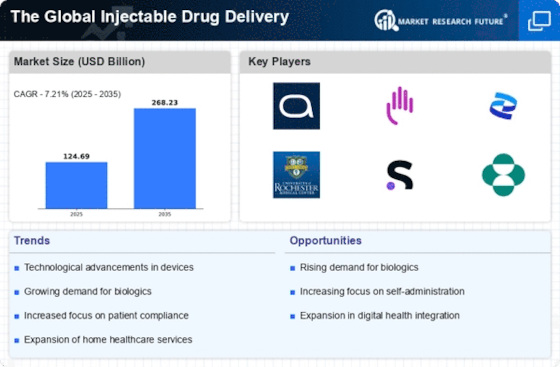
As per Market Research Future analysis, The Global Injectable Drug Delivery was estimated at 124.69 USD Billion in 2024. The market is projected to grow from 133.68 USD Billion in 2025 to 268.23 USD Billion by 2035, exhibiting a compound annual growth rate (CAGR) of 7.21% during the forecast period 2025 - 2035

Key Market Trends & Highlights

The Global Injectable Drug Delivery is poised for substantial growth driven by technological advancements and increasing demand for biologics.

  • North America remains the largest market for injectable drug delivery, driven by advanced healthcare infrastructure and high adoption rates. The Asia-Pacific region is emerging as the fastest-growing market, fueled by increasing investments in healthcare and rising patient populations. Conventional injection devices dominate the market, while self-injection devices are experiencing rapid growth due to their convenience and patient preference. Technological innovations in drug delivery systems and the rising prevalence of chronic diseases are key drivers propelling market expansion.

Market Size & Forecast

2024 Market Size 124.69 (USD Billion)
2035 Market Size 268.23 (USD Billion)
CAGR (2025 - 2035) 7.21%
Largest Regional Market Share in 2024 North America

Major Players

AbbVie (US), Bristol-Myers Squibb (US), Pfizer (US), Roche (CH), Sanofi (FR), Merck &amp; Co. (US), Amgen (US), Johnson &amp; Johnson (US), Novartis (CH)

Market Trends

The Global Injectable Drug Delivery is currently experiencing a transformative phase, characterized by advancements in technology and increasing demand for efficient drug administration methods. The  injectable drug delivery devices market  encompasses a wide array of products, including prefilled syringes, auto-injectors, and wearable injectors, which are gaining traction due to their convenience and ease of use. The rise in chronic diseases and the need for biologics are driving the adoption of injectable solutions, as they offer rapid absorption and targeted delivery. Furthermore, the integration of smart technologies into these devices is enhancing patient compliance and monitoring, thereby improving therapeutic outcomes.

In addition to technological innovations, The Global Injectable Drug Delivery is influenced by regulatory frameworks that are evolving to accommodate new delivery systems. Manufacturers are focusing on developing user-friendly devices that cater to the needs of patients and healthcare providers alike. The emphasis on personalized medicine is also shaping the landscape, as tailored therapies require precise delivery mechanisms. As the market continues to expand, collaboration between pharmaceutical companies and technology firms is likely to foster further innovations, ensuring that the sector remains dynamic and responsive to emerging healthcare challenges.

Technological Advancements

The Global Injectable Drug Delivery is witnessing rapid technological advancements, particularly in device design and functionality. Innovations such as smart injectors and connected devices are enhancing user experience and adherence to treatment regimens. These developments not only improve the efficiency of drug delivery but also facilitate real-time monitoring of patient health.

Rising Demand for Biologics

There is a growing demand for biologics within The Global Injectable Drug Delivery, driven by the increasing prevalence of chronic diseases. Biologics often require injectable delivery methods due to their complex structures and the need for precise dosing. This trend is likely to continue as more biologic therapies are developed and approved.

Focus on Patient-Centric Solutions

The emphasis on patient-centric solutions is reshaping The Global Injectable Drug Delivery. Manufacturers are prioritizing the development of devices that enhance comfort and ease of use for patients. This focus on user experience is expected to drive market growth, as healthcare providers seek to improve patient compliance and satisfaction.

Injectable Drug Delivery Devices Market Market Drivers

Focus on Patient-Centric Solutions

The Global Injectable Drug Delivery Industry is increasingly oriented towards patient-centric solutions, emphasizing the need for convenience and ease of use in drug administration. Patients are seeking more accessible and user-friendly delivery methods, which has led to the development of pre-filled syringes and wearable injectors. These innovations not only enhance patient compliance but also improve the overall treatment experience. Market Research Future indicates that patient-centric devices are expected to capture a significant share of the market, with a projected growth rate of 10% annually. This shift towards patient-centricity is likely to drive manufacturers to invest in research and development, further propelling the injectable drug delivery market.

Increasing Prevalence of Chronic Diseases

The Global Injectable Drug Delivery Industry is significantly influenced by the rising prevalence of chronic diseases, including diabetes, cancer, and autoimmune disorders. As these conditions become more widespread, the demand for effective treatment options is escalating. Injectable therapies, particularly biologics and monoclonal antibodies, are increasingly being utilized due to their targeted action and rapid onset of effects. For instance, the market for injectable diabetes medications is projected to grow at a CAGR of 8% through 2027, reflecting the urgent need for effective management solutions. This trend suggests that the market will continue to expand as healthcare providers seek innovative delivery methods to address the growing burden of chronic illnesses.

Regulatory Support and Favorable Policies

The Global Injectable Drug Delivery Industry benefits from supportive regulatory frameworks and favorable policies that encourage innovation and market entry. Regulatory agencies are increasingly streamlining approval processes for new injectable therapies, which facilitates quicker access to the market. For instance, the introduction of expedited pathways for biologics and novel drug delivery systems has been instrumental in fostering growth. Additionally, government initiatives aimed at promoting healthcare access and affordability are likely to bolster the injectable drug delivery market. As these policies evolve, they may create a conducive environment for the development and commercialization of advanced injectable solutions, thereby enhancing market dynamics.

Rising Demand for Biologics and Biosimilars

The Global Injectable Drug Delivery Industry is witnessing a notable increase in the demand for biologics and biosimilars, which are often administered via injection. Biologics, including therapeutic proteins and monoclonal antibodies, are gaining traction due to their effectiveness in treating complex diseases. The biosimilars market is also expanding, driven by the need for cost-effective alternatives to expensive biologic therapies. It is estimated that the biosimilars market could reach USD 30 billion by 2025, indicating a robust growth trajectory. This rising demand is likely to propel the injectable drug delivery market, as manufacturers focus on developing advanced delivery systems that ensure optimal therapeutic outcomes.

Technological Innovations in Drug Delivery Systems

The Global Injectable Drug Delivery Industry is experiencing a surge in technological innovations that enhance the efficacy and safety of drug administration. Advanced delivery systems, such as smart syringes and auto-injectors, are being developed to improve patient compliance and reduce the risk of needle-stick injuries. These innovations are projected to drive market growth, with the market for auto-injectors alone expected to reach USD 50 billion by 2026. Furthermore, the integration of digital health technologies, such as mobile applications for monitoring and managing drug delivery, is likely to transform patient experiences. As these technologies evolve, they may lead to more personalized treatment regimens, thereby increasing the overall demand for injectable drug delivery solutions.

Market Segment Insights

By Device: Conventional Injection Devices (Largest) vs. Self-Injection Devices (Fastest-Growing)

In The Global Injectable Drug Delivery, Conventional Injection Devices hold the largest market share, primarily due to their established use in healthcare settings. This segment includes traditional syringes and autoinjectors, which continue to be the go-to choice for administering medications. Their reliability and ease of use have enabled them to maintain dominance amidst evolving technologies. Conversely, Self-Injection Devices are rapidly emerging as a significant growth segment within this market. Driven by the increasing demand for patient autonomy and home healthcare solutions, these devices are becoming essential for chronic disease management. The rise in health consciousness and the preference for less invasive methods are further boosting their popularity, indicating a promising future for this segment.

Technology: Conventional Injection Devices (Dominant) vs. Self-Injection Devices (Emerging)

Conventional Injection Devices are the staple of injectable drug delivery, favored for their simplicity and effectiveness. They are predominantly used in hospitals and clinics for various applications, including vaccinations and chronic disease therapies. The segment is characterized by a high level of familiarity among healthcare professionals and patients alike, which solidifies its position as the dominant choice. On the other hand, Self-Injection Devices are on the rise, attracting attention from both patients and healthcare providers. They allow patients to administer their medications at home, fostering independence and compliance. The increasing prevalence of chronic illnesses such as diabetes is propelling this segment forward, as self-injection devices offer an innovative solution to enhance patient engagement and treatment adherence.

By Therapeutic Application: Autoimmune Diseases (Largest) vs. Hormonal Disorders and Cancer (Fastest-Growing)

In The Global Injectable Drug Delivery, the therapeutic application segment is primarily dominated by <a href="https://www.marketresearchfuture.com/reports/autoimmune-disease-treatment-market-5586">autoimmune diseases</a>, which account for a significant share of market demand. This is largely due to the increasing prevalence of autoimmune disorders and the growing awareness regarding advanced treatment options available in injectable formulations. On the other hand, hormonal disorders and cancer represent a rapidly expanding segment, reflecting a heightened focus on targeted therapies and personalized medicine in oncology as well as endocrine disorders.

Therapeutic Applications: Autoimmune Diseases (Dominant) vs. Hormonal Disorders and Cancer (Emerging)

Autoimmune diseases have emerged as the dominant therapeutic application within the injectable drug delivery market, primarily attributed to chronic conditions that require ongoing management. The expanding market for these therapies is driven by the rising incidence of autoimmune disorders and continual advancements in biologics and monoclonal antibodies. Conversely, hormonal disorders and cancer signify the emerging applications in the space, fueled by innovations in targeted delivery systems that enhance efficacy and patient compliance. This segment is characterized by the incorporation of advanced drug formulations and is expected to see substantial growth as therapies evolve towards more sophisticated approaches.

By Usage Pattern: Curative Pattern (Largest) vs. Immunization (Fastest-Growing)

In The Global Injectable Drug Delivery, the Usage Pattern segment is predominantly characterized by the Curative Pattern, holding the largest share due to its established application in treating various health conditions. The Curative Pattern encompasses a wide range of therapeutics, catering to chronic diseases, which significantly contributes to its robust market presence. On the other hand, the Immunization segment, though currently smaller, is rapidly expanding as vaccination programs become more prevalent worldwide, driving growth in preventive healthcare initiatives.

Usage Patterns: Curative Pattern (Dominant) vs. Immunization (Emerging)

The Curative Pattern represents the dominant force within the Usage Pattern segment, showcasing a wide range of injectable solutions aimed at treating existing health conditions. This pattern's stronghold in the market is attributed to the increasing prevalence of chronic diseases and the ongoing development of innovative therapies, ensuring its continual relevance. In contrast, the Immunization pattern is emerging as a significant segment, driven by the heightened emphasis on preventive healthcare and global vaccination efforts. This trend is fueled by technological advancements in drug delivery systems, making immunization more efficient and accessible, especially in regions with rising healthcare needs. Together, both segments illustrate the diverse applications of injectable drug delivery, catering to both curative and preventive approaches.

By Site of Delivery: Intramuscular (Largest) vs. Subcutaneous (Fastest-Growing)

The Global Injectable Drug Delivery showcases a diverse distribution across various sites of delivery, with intramuscular (IM) delivery dominating the landscape. This segment's leading position is attributed to its rapid onset of action and the ability to administer larger volumes of medication. Conversely, the subcutaneous (SC) route, although currently smaller in market share, is rapidly gaining traction among healthcare providers due to its convenience and patient compliance features.

Subcutaneous (Emerging) vs. Intradermal (Dominant)

The subcutaneous delivery method is emerging as a pivotal player in The Global Injectable Drug Delivery, primarily because of its ease of administration and the rising trend of self-administration by patients. This method allows medications to be infused into the fatty tissue just below the skin, making it suitable for biologics and other medications. On the other hand, the intradermal delivery method is well-established and regarded for its targeted delivery, particularly in vaccinations and allergy testing. However, this method is less common for larger volumes or systemic treatments, thus solidifying intradermal as a dominant method within specific applications.

Get more detailed insights about Injectable Drug Delivery Devices Market Research Report - Global Forecast To 2035

Regional Insights

By region, the study provides the market insights into North America, Europe, Asia-Pacific and Rest of the World. North America Injectable drug delivery market accounted for USD 8.01 billion in 2022 with a share of around 45.80% and is expected to exhibit a significant CAGR growth during the study period. The rise in biologics sales and the rise in demand for self-injection devices are factors in the prevalence of chronic diseases.

With the increasing cases of chronic diseases, the rise in disposable income, the rising concern for comfort and safety, and the rising number of partnerships in this market, this sector is expected to experience the largest growth. New product development, partnerships, partnerships, expansions, mergers, and acquisitions are the main strategies used by the organisations in the market.

Further, the major countries studied in the market report are: The U.S, Canada, Germany, France, UK, Italy, Spain, China, Japan, India, Australia, South Korea, and Brazil.

Europe Injectable drug delivery market accounts for the second-largest market share. This region now dominates the market for insulin pens in Europe as a result of increasing research and development in this area. The two German businesses, Emperra GmbH E-Health Technologies and Pendiq Intelligent Diabetes Care, respectively, developed and commercialized the insulin pens ESYSTA and Pendiq. Moreover, UK market of Injectable drug delivery held the largest market share, and the Germany market of Injectable drug delivery was the fastest-growing market in the region.

Asia Pacific Injectable drug delivery Market is expected to grow at the fastest CAGR from 2022 to 2030. It is Since more people are becoming aware of these delivery methods, there are more patients, and ready-to-use injectables are replacing traditional drug administration injectables. Further, the China market of Injectable drug delivery held the largest market share, and the India market of Injectable drug delivery was the fastest-growing market in the region.

Key Players and Competitive Insights

Major market players are spending a lot of money on R&D to increase their product lines, which will help the market of Injectable drug delivery grow even more. Market participants are also taking a range of strategic initiatives to grow their worldwide footprint, with key market developments such as new product launches, mergers and acquisitions, contractual agreements, increased investments, and collaboration with other organizations. Competitors in the Injectable drug delivery industry must offer cost-effective items to expand and survive in an increasingly competitive and rising market environment. One of the primary business strategies adopted by manufacturers in the Injectable drug delivery industry to benefit clients and expand the market sector is to manufacture locally to reduce operating costs. In recent years, Injectable drug delivery industry has provided medicine with some of the most significant benefits. The Injectable drug delivery market major player such as Eisai Co. Ltd, Antares Pharma, AstraZeneca, Becton, Dickinson and Company, Eli Lilly and Company. With its corporate headquarters in Düsseldorf, Gerresheimer AG is a German manufacturer of packaging materials for medication and drug delivery systems manufactured of special-purpose glass and plastics. The corporation operates production facilities in Asia, the Americas, and Europe. Gerresheimer increased the scope of its collaboration with Taisei Medical Co. Ltd. in 2016 to promote its ClearJect syringes and offer technical support to customers. Additionally, the business intends to expand its line of COP syringes in collaboration with Taisei Medical by producing Gx RTF ClearJect brand syringes that combine ClearJect and its glass RTF (ready-to-fill) idea. This partnership is intended to assist the company in expanding both its clientele and product line in the syringe needles sector. An American international healthcare corporation, Baxter International Inc., has its corporate headquarters in Deerfield, Illinois. The company's main areas of concentration include chronic and acute medical disorders, including kidney illness. The leading manufacturer of active pharmaceutical ingredients, ScinoPharm Taiwan, Ltd., and Baxter International Inc. partnered strategically in February 2017. (API). Five injectable medications will need to be developed, produced, and made available for sale as part of this collaboration. 

Key Companies in the Injectable Drug Delivery Devices Market include

Industry Developments

  • Q2 2024: Becton Dickinson launches new pre-filled syringe platform for biologics Becton Dickinson announced the launch of a new pre-filled syringe platform designed specifically for biologic drugs, aiming to improve drug stability and patient safety.
  • Q2 2024: West Pharmaceutical Services Announces Opening of New Manufacturing Facility in Singapore West Pharmaceutical Services opened a new manufacturing facility in Singapore to expand its production capacity for injectable drug delivery devices, targeting growth in the Asia-Pacific region.
  • Q3 2024: Ypsomed and Novo Nordisk enter partnership to develop next-generation autoinjectors Ypsomed and Novo Nordisk announced a partnership to co-develop next-generation autoinjectors for self-administration of biologic therapies.
  • Q3 2024: Stevanato Group receives FDA clearance for Alba® Connect smart injector Stevanato Group received FDA clearance for its Alba® Connect smart injector, a connected device designed to improve adherence and monitoring for injectable therapies.
  • Q4 2024: Phillips-Medisize secures contract to supply wearable injectors for major US pharma company Phillips-Medisize announced it has secured a contract to supply wearable injectors to a major US pharmaceutical company for a new biologic drug launch.
  • Q4 2024: SHL Medical raises $150 million in private funding round to expand autoinjector production SHL Medical completed a $150 million private funding round to expand its autoinjector manufacturing capacity and accelerate development of new delivery platforms.
  • Q1 2025: Gerresheimer acquires Sensile Medical to strengthen digital drug delivery portfolio Gerresheimer announced the acquisition of Sensile Medical, enhancing its portfolio with digital and connected drug delivery devices for injectable therapies.
  • Q1 2025: Bespak by Recipharm receives CE mark for new pen injector platform Bespak by Recipharm received CE mark approval for its new pen injector platform, enabling commercial launch in European markets.
  • Q2 2025: Owen Mumford appoints new CEO to drive global expansion of injectable device business Owen Mumford announced the appointment of a new CEO, tasked with accelerating global expansion and innovation in its injectable drug delivery device segment.
  • Q2 2025: Nemera opens new R&D center in France for advanced injectable device development Nemera opened a new research and development center in France focused on the design and development of advanced injectable drug delivery devices.
  • Q2 2025: Vetter Pharma secures multi-year contract with European biotech for fill-finish of injectable biologics Vetter Pharma announced a multi-year contract with a European biotech company to provide fill-finish services for injectable biologic products.
  • Q3 2025: Credence MedSystems closes $40 million Series C funding to accelerate commercialization of Companion® Syringe System Credence MedSystems closed a $40 million Series C funding round to support the commercialization and global rollout of its Companion® Syringe System for injectable drugs.

Future Outlook

Injectable Drug Delivery Devices Market Future Outlook

The Global Injectable Drug Delivery is projected to grow at a 7.21% CAGR from 2025 to 2035, driven by technological advancements, increasing chronic diseases, and rising demand for self-administration devices.

New opportunities lie in:

  • <p>Development of smart injectable devices with real-time monitoring capabilities. Expansion into emerging markets with tailored product offerings. Partnerships with telehealth platforms for integrated drug delivery solutions.</p>

By 2035, the injectable drug delivery devices market is expected to achieve substantial growth, driven by innovation and strategic partnerships.

Market Segmentation

Injectable Drug Delivery Devices Market Device Outlook

  • Conventional Injection Devices
  • Self-Injection Devices

Injectable Drug Delivery Devices Market Usage Pattern Outlook

  • Curative Pattern
  • Immunization

Injectable Drug Delivery Devices Market Site of Delivery Outlook

  • Intramuscular
  • Subcutaneous
  • Intradermal

Injectable Drug Delivery Devices Market Therapeutic Application Outlook

  • Autoimmune Diseases
  • Hormonal Disorders and Cancer

Report Scope

MARKET SIZE 2024 124.69(USD Billion)
MARKET SIZE 2025 133.68(USD Billion)
MARKET SIZE 2035 268.23(USD Billion)
COMPOUND ANNUAL GROWTH RATE (CAGR) 7.21% (2025 - 2035)
REPORT COVERAGE Revenue Forecast, Competitive Landscape, Growth Factors, and Trends
BASE YEAR 2024
Market Forecast Period 2025 - 2035
Historical Data 2019 - 2024
Market Forecast Units USD Billion
Key Companies Profiled AbbVie (US), Bristol-Myers Squibb (US), Pfizer (US), Roche (CH), Sanofi (FR), Merck & Co. (US), Amgen (US), Johnson & Johnson (US), Novartis (CH)
Segments Covered Devices, Therapeutic Application, Usage Pattern, Site of Delivery, Region
Key Market Opportunities Advancements in smart delivery systems enhance patient compliance in The Global Injectable Drug Delivery.
Key Market Dynamics Technological advancements and regulatory changes drive innovation and competition in the injectable drug delivery market.
Countries Covered North America, Europe, APAC, South America, MEA

FAQs

What is the projected market valuation of The Global Injectable Drug Delivery by 2035?

<p>The projected market valuation for The Global Injectable Drug Delivery by 2035 is 268.23 USD Billion.</p>

What was the market valuation of The Global Injectable Drug Delivery in 2024?

<p>The overall market valuation of The Global Injectable Drug Delivery was 124.69 USD Billion in 2024.</p>

What is the expected CAGR for The Global Injectable Drug Delivery during the forecast period 2025 - 2035?

<p>The expected CAGR for The Global Injectable Drug Delivery during the forecast period 2025 - 2035 is 7.21%.</p>

Which companies are considered key players in The Global Injectable Drug Delivery?

Key players in The Global Injectable Drug Delivery include AbbVie, Bristol-Myers Squibb, Pfizer, Roche, Sanofi, Merck &amp; Co., Amgen, Johnson &amp; Johnson, and Novartis.

What are the projected values for Conventional Injection Devices and Self-Injection Devices by 2035?

<p>By 2035, the projected value for Conventional Injection Devices is 158.23 USD Billion, while Self-Injection Devices is expected to reach 110.0 USD Billion.</p>

How do the therapeutic applications of Autoimmune Diseases and Hormonal Disorders and Cancer compare in market valuation by 2035?

<p>By 2035, the market valuation for Autoimmune Diseases is projected to be 81.12 USD Billion, whereas Hormonal Disorders and Cancer is expected to reach 187.11 USD Billion.</p>

What are the anticipated values for the usage patterns of Curative Pattern and Immunization by 2035?

The anticipated value for Curative Pattern by 2035 is 188.23 USD Billion, while Immunization is projected to be 80.0 USD Billion.

What are the projected market values for different sites of delivery by 2035?

By 2035, the projected market values for delivery sites are 81.0 USD Billion for Intramuscular, 106.0 USD Billion for Subcutaneous, and 81.23 USD Billion for Intradermal.

How does the market for Self-Injection Devices compare to Conventional Injection Devices in 2025?

In 2025, the market for Self-Injection Devices is expected to be 50.0 USD Billion, compared to 74.69 USD Billion for Conventional Injection Devices.

What trends are influencing the growth of The Global Injectable Drug Delivery?

Trends influencing the growth of The Global Injectable Drug Delivery include advancements in technology, increasing prevalence of chronic diseases, and a growing preference for self-administration.

  1. SECTION I: EXECUTIVE SUMMARY AND KEY HIGHLIGHTS |
    1. EXECUTIVE SUMMARY | |
      1. Market Overview | |
      2. Key Findings | |
      3. Market Segmentation | |
      4. Competitive Landscape | |
      5. Challenges and Opportunities | |
      6. Future Outlook 2
  2. SECTION II: SCOPING, METHODOLOGY AND MARKET STRUCTURE |
    1. MARKET INTRODUCTION | |
      1. Definition | |
      2. Scope of the study | | |
    2. RESEARCH METHODOLOGY | |
      1. Overview | |
      2. Data Mining | |
      3. Secondary Research | |
      4. Primary Research | | |
      5. Forecasting Model | |
      6. Market Size Estimation | | |
      7. Data Triangulation | |
      8. Validation 3
  3. SECTION III: QUALITATIVE ANALYSIS |
    1. MARKET DYNAMICS | |
      1. Overview | |
      2. Drivers | |
      3. Restraints | |
      4. Opportunities |
    2. MARKET FACTOR ANALYSIS | |
      1. Value chain Analysis | |
      2. Porter's Five Forces Analysis | | |
      3. COVID-19 Impact Analysis | | |
  4. SECTION IV: QUANTITATIVE ANALYSIS |
    1. Healthcare, BY Device (USD Billion) | |
      1. Conventional Injection Devices | |
      2. Self-Injection Devices |
    2. Healthcare, BY Therapeutic Application (USD Billion) | |
      1. Autoimmune Diseases | |
      2. Hormonal Disorders and Cancer |
    3. Healthcare, BY Usage Pattern (USD Billion) | |
      1. Curative Pattern | |
      2. Immunization |
    4. Healthcare, BY Site of Delivery (USD Billion) | |
      1. Intramuscular | |
      2. Subcutaneous | |
      3. Intradermal |
    5. Healthcare, BY Region (USD Billion) | |
      1. North America | | |
      2. Europe | | |
      3. APAC | | |
      4. South America | | |
      5. MEA | | |
  5. SECTION V: COMPETITIVE ANALYSIS |
    1. Competitive Landscape | |
      1. Overview | |
      2. Competitive Analysis | |
      3. Market share Analysis | |
      4. Major Growth Strategy in the Healthcare | |
      5. Competitive Benchmarking | |
      6. Leading Players in Terms of Number of Developments in the Healthcare | |
      7. Key developments and growth strategies | | |
      8. Major Players Financial Matrix | | |
    2. Company Profiles | |
      1. AbbVie (US) | | |
      2. Bristol-Myers Squibb (US) | | |
      3. Pfizer (US) | | |
      4. Roche (CH) | | |
      5. Sanofi (FR) | | |
      6. Merck & Co. (US) | | |
      7. Amgen (US) | | |
      8. Johnson & Johnson (US) | | |
      9. Novartis (CH) | | |
    3. Appendix | |
      1. References | |
      2. Related Reports 6 LIST OF FIGURES |
    4. MARKET SYNOPSIS |
    5. NORTH AMERICA MARKET ANALYSIS |
    6. US MARKET ANALYSIS BY DEVICE |
    7. US MARKET ANALYSIS BY THERAPEUTIC APPLICATION |
    8. US MARKET ANALYSIS BY USAGE PATTERN |
    9. US MARKET ANALYSIS BY SITE OF DELIVERY |
    10. CANADA MARKET ANALYSIS BY DEVICE |
    11. CANADA MARKET ANALYSIS BY THERAPEUTIC APPLICATION |
    12. CANADA MARKET ANALYSIS BY USAGE PATTERN |
    13. CANADA MARKET ANALYSIS BY SITE OF DELIVERY |
    14. EUROPE MARKET ANALYSIS |
    15. GERMANY MARKET ANALYSIS BY DEVICE |
    16. GERMANY MARKET ANALYSIS BY THERAPEUTIC APPLICATION |
    17. GERMANY MARKET ANALYSIS BY USAGE PATTERN |
    18. GERMANY MARKET ANALYSIS BY SITE OF DELIVERY |
    19. UK MARKET ANALYSIS BY DEVICE |
    20. UK MARKET ANALYSIS BY THERAPEUTIC APPLICATION |
    21. UK MARKET ANALYSIS BY USAGE PATTERN |
    22. UK MARKET ANALYSIS BY SITE OF DELIVERY |
    23. FRANCE MARKET ANALYSIS BY DEVICE |
    24. FRANCE MARKET ANALYSIS BY THERAPEUTIC APPLICATION |
    25. FRANCE MARKET ANALYSIS BY USAGE PATTERN |
    26. FRANCE MARKET ANALYSIS BY SITE OF DELIVERY |
    27. RUSSIA MARKET ANALYSIS BY DEVICE |
    28. RUSSIA MARKET ANALYSIS BY THERAPEUTIC APPLICATION |
    29. RUSSIA MARKET ANALYSIS BY USAGE PATTERN |
    30. RUSSIA MARKET ANALYSIS BY SITE OF DELIVERY |
    31. ITALY MARKET ANALYSIS BY DEVICE |
    32. ITALY MARKET ANALYSIS BY THERAPEUTIC APPLICATION |
    33. ITALY MARKET ANALYSIS BY USAGE PATTERN |
    34. ITALY MARKET ANALYSIS BY SITE OF DELIVERY |
    35. SPAIN MARKET ANALYSIS BY DEVICE |
    36. SPAIN MARKET ANALYSIS BY THERAPEUTIC APPLICATION |
    37. SPAIN MARKET ANALYSIS BY USAGE PATTERN |
    38. SPAIN MARKET ANALYSIS BY SITE OF DELIVERY |
    39. REST OF EUROPE MARKET ANALYSIS BY DEVICE |
    40. REST OF EUROPE MARKET ANALYSIS BY THERAPEUTIC APPLICATION |
    41. REST OF EUROPE MARKET ANALYSIS BY USAGE PATTERN |
    42. REST OF EUROPE MARKET ANALYSIS BY SITE OF DELIVERY |
    43. APAC MARKET ANALYSIS |
    44. CHINA MARKET ANALYSIS BY DEVICE |
    45. CHINA MARKET ANALYSIS BY THERAPEUTIC APPLICATION |
    46. CHINA MARKET ANALYSIS BY USAGE PATTERN |
    47. CHINA MARKET ANALYSIS BY SITE OF DELIVERY |
    48. INDIA MARKET ANALYSIS BY DEVICE |
    49. INDIA MARKET ANALYSIS BY THERAPEUTIC APPLICATION |
    50. INDIA MARKET ANALYSIS BY USAGE PATTERN |
    51. INDIA MARKET ANALYSIS BY SITE OF DELIVERY |
    52. JAPAN MARKET ANALYSIS BY DEVICE |
    53. JAPAN MARKET ANALYSIS BY THERAPEUTIC APPLICATION |
    54. JAPAN MARKET ANALYSIS BY USAGE PATTERN |
    55. JAPAN MARKET ANALYSIS BY SITE OF DELIVERY |
    56. SOUTH KOREA MARKET ANALYSIS BY DEVICE |
    57. SOUTH KOREA MARKET ANALYSIS BY THERAPEUTIC APPLICATION |
    58. SOUTH KOREA MARKET ANALYSIS BY USAGE PATTERN |
    59. SOUTH KOREA MARKET ANALYSIS BY SITE OF DELIVERY |
    60. MALAYSIA MARKET ANALYSIS BY DEVICE |
    61. MALAYSIA MARKET ANALYSIS BY THERAPEUTIC APPLICATION |
    62. MALAYSIA MARKET ANALYSIS BY USAGE PATTERN |
    63. MALAYSIA MARKET ANALYSIS BY SITE OF DELIVERY |
    64. THAILAND MARKET ANALYSIS BY DEVICE |
    65. THAILAND MARKET ANALYSIS BY THERAPEUTIC APPLICATION |
    66. THAILAND MARKET ANALYSIS BY USAGE PATTERN |
    67. THAILAND MARKET ANALYSIS BY SITE OF DELIVERY |
    68. INDONESIA MARKET ANALYSIS BY DEVICE |
    69. INDONESIA MARKET ANALYSIS BY THERAPEUTIC APPLICATION |
    70. INDONESIA MARKET ANALYSIS BY USAGE PATTERN |
    71. INDONESIA MARKET ANALYSIS BY SITE OF DELIVERY |
    72. REST OF APAC MARKET ANALYSIS BY DEVICE |
    73. REST OF APAC MARKET ANALYSIS BY THERAPEUTIC APPLICATION |
    74. REST OF APAC MARKET ANALYSIS BY USAGE PATTERN |
    75. REST OF APAC MARKET ANALYSIS BY SITE OF DELIVERY |
    76. SOUTH AMERICA MARKET ANALYSIS |
    77. BRAZIL MARKET ANALYSIS BY DEVICE |
    78. BRAZIL MARKET ANALYSIS BY THERAPEUTIC APPLICATION |
    79. BRAZIL MARKET ANALYSIS BY USAGE PATTERN |
    80. BRAZIL MARKET ANALYSIS BY SITE OF DELIVERY |
    81. MEXICO MARKET ANALYSIS BY DEVICE |
    82. MEXICO MARKET ANALYSIS BY THERAPEUTIC APPLICATION |
    83. MEXICO MARKET ANALYSIS BY USAGE PATTERN |
    84. MEXICO MARKET ANALYSIS BY SITE OF DELIVERY |
    85. ARGENTINA MARKET ANALYSIS BY DEVICE |
    86. ARGENTINA MARKET ANALYSIS BY THERAPEUTIC APPLICATION |
    87. ARGENTINA MARKET ANALYSIS BY USAGE PATTERN |
    88. ARGENTINA MARKET ANALYSIS BY SITE OF DELIVERY |
    89. REST OF SOUTH AMERICA MARKET ANALYSIS BY DEVICE |
    90. REST OF SOUTH AMERICA MARKET ANALYSIS BY THERAPEUTIC APPLICATION |
    91. REST OF SOUTH AMERICA MARKET ANALYSIS BY USAGE PATTERN |
    92. REST OF SOUTH AMERICA MARKET ANALYSIS BY SITE OF DELIVERY |
    93. MEA MARKET ANALYSIS |
    94. GCC COUNTRIES MARKET ANALYSIS BY DEVICE |
    95. GCC COUNTRIES MARKET ANALYSIS BY THERAPEUTIC APPLICATION |
    96. GCC COUNTRIES MARKET ANALYSIS BY USAGE PATTERN |
    97. GCC COUNTRIES MARKET ANALYSIS BY SITE OF DELIVERY |
    98. SOUTH AFRICA MARKET ANALYSIS BY DEVICE |
    99. SOUTH AFRICA MARKET ANALYSIS BY THERAPEUTIC APPLICATION |
    100. SOUTH AFRICA MARKET ANALYSIS BY USAGE PATTERN |
    101. SOUTH AFRICA MARKET ANALYSIS BY SITE OF DELIVERY |
    102. REST OF MEA MARKET ANALYSIS BY DEVICE |
    103. REST OF MEA MARKET ANALYSIS BY THERAPEUTIC APPLICATION |
    104. REST OF MEA MARKET ANALYSIS BY USAGE PATTERN |
    105. REST OF MEA MARKET ANALYSIS BY SITE OF DELIVERY |
    106. KEY BUYING CRITERIA OF HEALTHCARE |
    107. RESEARCH PROCESS OF MRFR |
    108. DRO ANALYSIS OF HEALTHCARE |
    109. DRIVERS IMPACT ANALYSIS: HEALTHCARE |
    110. RESTRAINTS IMPACT ANALYSIS: HEALTHCARE |
    111. SUPPLY / VALUE CHAIN: HEALTHCARE |
    112. HEALTHCARE, BY DEVICE, 2024 (% SHARE) |
    113. HEALTHCARE, BY DEVICE, 2024 TO 2035 (USD Billion) |
    114. HEALTHCARE, BY THERAPEUTIC APPLICATION, 2024 (% SHARE) |
    115. HEALTHCARE, BY THERAPEUTIC APPLICATION, 2024 TO 2035 (USD Billion) |
    116. HEALTHCARE, BY USAGE PATTERN, 2024 (% SHARE) |
    117. HEALTHCARE, BY USAGE PATTERN, 2024 TO 2035 (USD Billion) |
    118. HEALTHCARE, BY SITE OF DELIVERY, 2024 (% SHARE) |
    119. HEALTHCARE, BY SITE OF DELIVERY, 2024 TO 2035 (USD Billion) |
    120. BENCHMARKING OF MAJOR COMPETITORS 7 LIST OF TABLES |
    121. LIST OF ASSUMPTIONS | |
      1. |
    122. North America MARKET SIZE ESTIMATES; FORECAST | |
      1. BY DEVICE, 2025-2035 (USD Billion) | |
      2. BY THERAPEUTIC APPLICATION, 2025-2035 (USD Billion) | |
      3. BY USAGE PATTERN, 2025-2035 (USD Billion) | |
      4. BY SITE OF DELIVERY, 2025-2035 (USD Billion) |
    123. US MARKET SIZE ESTIMATES; FORECAST | |
      1. BY DEVICE, 2025-2035 (USD Billion) | |
      2. BY THERAPEUTIC APPLICATION, 2025-2035 (USD Billion) | |
      3. BY USAGE PATTERN, 2025-2035 (USD Billion) | |
      4. BY SITE OF DELIVERY, 2025-2035 (USD Billion) |
    124. Canada MARKET SIZE ESTIMATES; FORECAST | |
      1. BY DEVICE, 2025-2035 (USD Billion) | |
      2. BY THERAPEUTIC APPLICATION, 2025-2035 (USD Billion) | |
      3. BY USAGE PATTERN, 2025-2035 (USD Billion) | |
      4. BY SITE OF DELIVERY, 2025-2035 (USD Billion) |
    125. Europe MARKET SIZE ESTIMATES; FORECAST | |
      1. BY DEVICE, 2025-2035 (USD Billion) | |
      2. BY THERAPEUTIC APPLICATION, 2025-2035 (USD Billion) | |
      3. BY USAGE PATTERN, 2025-2035 (USD Billion) | |
      4. BY SITE OF DELIVERY, 2025-2035 (USD Billion) |
    126. Germany MARKET SIZE ESTIMATES; FORECAST | |
      1. BY DEVICE, 2025-2035 (USD Billion) | |
      2. BY THERAPEUTIC APPLICATION, 2025-2035 (USD Billion) | |
      3. BY USAGE PATTERN, 2025-2035 (USD Billion) | |
      4. BY SITE OF DELIVERY, 2025-2035 (USD Billion) |
    127. UK MARKET SIZE ESTIMATES; FORECAST | |
      1. BY DEVICE, 2025-2035 (USD Billion) | |
      2. BY THERAPEUTIC APPLICATION, 2025-2035 (USD Billion) | |
      3. BY USAGE PATTERN, 2025-2035 (USD Billion) | |
      4. BY SITE OF DELIVERY, 2025-2035 (USD Billion) |
    128. France MARKET SIZE ESTIMATES; FORECAST | |
      1. BY DEVICE, 2025-2035 (USD Billion) | |
      2. BY THERAPEUTIC APPLICATION, 2025-2035 (USD Billion) | |
      3. BY USAGE PATTERN, 2025-2035 (USD Billion) | |
      4. BY SITE OF DELIVERY, 2025-2035 (USD Billion) |
    129. Russia MARKET SIZE ESTIMATES; FORECAST | |
      1. BY DEVICE, 2025-2035 (USD Billion) | |
      2. BY THERAPEUTIC APPLICATION, 2025-2035 (USD Billion) | |
      3. BY USAGE PATTERN, 2025-2035 (USD Billion) | |
      4. BY SITE OF DELIVERY, 2025-2035 (USD Billion) |
    130. Italy MARKET SIZE ESTIMATES; FORECAST | |
      1. BY DEVICE, 2025-2035 (USD Billion) | |
      2. BY THERAPEUTIC APPLICATION, 2025-2035 (USD Billion) | |
      3. BY USAGE PATTERN, 2025-2035 (USD Billion) | |
      4. BY SITE OF DELIVERY, 2025-2035 (USD Billion) |
    131. Spain MARKET SIZE ESTIMATES; FORECAST | |
      1. BY DEVICE, 2025-2035 (USD Billion) | |
      2. BY THERAPEUTIC APPLICATION, 2025-2035 (USD Billion) | |
      3. BY USAGE PATTERN, 2025-2035 (USD Billion) | |
      4. BY SITE OF DELIVERY, 2025-2035 (USD Billion) |
    132. Rest of Europe MARKET SIZE ESTIMATES; FORECAST | |
      1. BY DEVICE, 2025-2035 (USD Billion) | |
      2. BY THERAPEUTIC APPLICATION, 2025-2035 (USD Billion) | |
      3. BY USAGE PATTERN, 2025-2035 (USD Billion) | |
      4. BY SITE OF DELIVERY, 2025-2035 (USD Billion) |
    133. APAC MARKET SIZE ESTIMATES; FORECAST | |
      1. BY DEVICE, 2025-2035 (USD Billion) | |
      2. BY THERAPEUTIC APPLICATION, 2025-2035 (USD Billion) | |
      3. BY USAGE PATTERN, 2025-2035 (USD Billion) | |
      4. BY SITE OF DELIVERY, 2025-2035 (USD Billion) |
    134. China MARKET SIZE ESTIMATES; FORECAST | |
      1. BY DEVICE, 2025-2035 (USD Billion) | |
      2. BY THERAPEUTIC APPLICATION, 2025-2035 (USD Billion) | |
      3. BY USAGE PATTERN, 2025-2035 (USD Billion) | |
      4. BY SITE OF DELIVERY, 2025-2035 (USD Billion) |
    135. India MARKET SIZE ESTIMATES; FORECAST | |
      1. BY DEVICE, 2025-2035 (USD Billion) | |
      2. BY THERAPEUTIC APPLICATION, 2025-2035 (USD Billion) | |
      3. BY USAGE PATTERN, 2025-2035 (USD Billion) | |
      4. BY SITE OF DELIVERY, 2025-2035 (USD Billion) |
    136. Japan MARKET SIZE ESTIMATES; FORECAST | |
      1. BY DEVICE, 2025-2035 (USD Billion) | |
      2. BY THERAPEUTIC APPLICATION, 2025-2035 (USD Billion) | |
      3. BY USAGE PATTERN, 2025-2035 (USD Billion) | |
      4. BY SITE OF DELIVERY, 2025-2035 (USD Billion) |
    137. South Korea MARKET SIZE ESTIMATES; FORECAST | |
      1. BY DEVICE, 2025-2035 (USD Billion) | |
      2. BY THERAPEUTIC APPLICATION, 2025-2035 (USD Billion) | |
      3. BY USAGE PATTERN, 2025-2035 (USD Billion) | |
      4. BY SITE OF DELIVERY, 2025-2035 (USD Billion) |
    138. Malaysia MARKET SIZE ESTIMATES; FORECAST | |
      1. BY DEVICE, 2025-2035 (USD Billion) | |
      2. BY THERAPEUTIC APPLICATION, 2025-2035 (USD Billion) | |
      3. BY USAGE PATTERN, 2025-2035 (USD Billion) | |
      4. BY SITE OF DELIVERY, 2025-2035 (USD Billion) |
    139. Thailand MARKET SIZE ESTIMATES; FORECAST | |
      1. BY DEVICE, 2025-2035 (USD Billion) | |
      2. BY THERAPEUTIC APPLICATION, 2025-2035 (USD Billion) | |
      3. BY USAGE PATTERN, 2025-2035 (USD Billion) | |
      4. BY SITE OF DELIVERY, 2025-2035 (USD Billion) |
    140. Indonesia MARKET SIZE ESTIMATES; FORECAST | |
      1. BY DEVICE, 2025-2035 (USD Billion) | |
      2. BY THERAPEUTIC APPLICATION, 2025-2035 (USD Billion) | |
      3. BY USAGE PATTERN, 2025-2035 (USD Billion) | |
      4. BY SITE OF DELIVERY, 2025-2035 (USD Billion) |
    141. Rest of APAC MARKET SIZE ESTIMATES; FORECAST | |
      1. BY DEVICE, 2025-2035 (USD Billion) | |
      2. BY THERAPEUTIC APPLICATION, 2025-2035 (USD Billion) | |
      3. BY USAGE PATTERN, 2025-2035 (USD Billion) | |
      4. BY SITE OF DELIVERY, 2025-2035 (USD Billion) |
    142. South America MARKET SIZE ESTIMATES; FORECAST | |
      1. BY DEVICE, 2025-2035 (USD Billion) | |
      2. BY THERAPEUTIC APPLICATION, 2025-2035 (USD Billion) | |
      3. BY USAGE PATTERN, 2025-2035 (USD Billion) | |
      4. BY SITE OF DELIVERY, 2025-2035 (USD Billion) |
    143. Brazil MARKET SIZE ESTIMATES; FORECAST | |
      1. BY DEVICE, 2025-2035 (USD Billion) | |
      2. BY THERAPEUTIC APPLICATION, 2025-2035 (USD Billion) | |
      3. BY USAGE PATTERN, 2025-2035 (USD Billion) | |
      4. BY SITE OF DELIVERY, 2025-2035 (USD Billion) |
    144. Mexico MARKET SIZE ESTIMATES; FORECAST | |
      1. BY DEVICE, 2025-2035 (USD Billion) | |
      2. BY THERAPEUTIC APPLICATION, 2025-2035 (USD Billion) | |
      3. BY USAGE PATTERN, 2025-2035 (USD Billion) | |
      4. BY SITE OF DELIVERY, 2025-2035 (USD Billion) |
    145. Argentina MARKET SIZE ESTIMATES; FORECAST | |
      1. BY DEVICE, 2025-2035 (USD Billion) | |
      2. BY THERAPEUTIC APPLICATION, 2025-2035 (USD Billion) | |
      3. BY USAGE PATTERN, 2025-2035 (USD Billion) | |
      4. BY SITE OF DELIVERY, 2025-2035 (USD Billion) |
    146. Rest of South America MARKET SIZE ESTIMATES; FORECAST | |
      1. BY DEVICE, 2025-2035 (USD Billion) | |
      2. BY THERAPEUTIC APPLICATION, 2025-2035 (USD Billion) | |
      3. BY USAGE PATTERN, 2025-2035 (USD Billion) | |
      4. BY SITE OF DELIVERY, 2025-2035 (USD Billion) |
    147. MEA MARKET SIZE ESTIMATES; FORECAST | |
      1. BY DEVICE, 2025-2035 (USD Billion) | |
      2. BY THERAPEUTIC APPLICATION, 2025-2035 (USD Billion) | |
      3. BY USAGE PATTERN, 2025-2035 (USD Billion) | |
      4. BY SITE OF DELIVERY, 2025-2035 (USD Billion) |
    148. GCC Countries MARKET SIZE ESTIMATES; FORECAST | |
      1. BY DEVICE, 2025-2035 (USD Billion) | |
      2. BY THERAPEUTIC APPLICATION, 2025-2035 (USD Billion) | |
      3. BY USAGE PATTERN, 2025-2035 (USD Billion) | |
      4. BY SITE OF DELIVERY, 2025-2035 (USD Billion) |
    149. South Africa MARKET SIZE ESTIMATES; FORECAST | |
      1. BY DEVICE, 2025-2035 (USD Billion) | |
      2. BY THERAPEUTIC APPLICATION, 2025-2035 (USD Billion) | |
      3. BY USAGE PATTERN, 2025-2035 (USD Billion) | |
      4. BY SITE OF DELIVERY, 2025-2035 (USD Billion) |
    150. Rest of MEA MARKET SIZE ESTIMATES; FORECAST | |
      1. BY DEVICE, 2025-2035 (USD Billion) | |
      2. BY THERAPEUTIC APPLICATION, 2025-2035 (USD Billion) | |
      3. BY USAGE PATTERN, 2025-2035 (USD Billion) | |
      4. BY SITE OF DELIVERY, 2025-2035 (USD Billion) |
    151. PRODUCT LAUNCH/PRODUCT DEVELOPMENT/APPROVAL | |
      1. |
    152. ACQUISITION/PARTNERSHIP | |

Healthcare Market Segmentation

Healthcare By Device (USD Billion, 2025-2035)

  • Conventional Injection Devices
  • Self-Injection Devices

Healthcare By Therapeutic Application (USD Billion, 2025-2035)

  • Autoimmune Diseases
  • Hormonal Disorders and Cancer

Healthcare By Usage Pattern (USD Billion, 2025-2035)

  • Curative Pattern
  • Immunization

Healthcare By Site of Delivery (USD Billion, 2025-2035)

  • Intramuscular
  • Subcutaneous
  • Intradermal
Infographic

Free Sample Request

Kindly complete the form below to receive a free sample of this Report

Get Free Sample

Customer Strories

Compare Licence

×
Features License Type
Single User Multiuser License Enterprise User
Price $4,950 $5,950 $7,250
Maximum User Access Limit 1 User Upto 10 Users Unrestricted Access Throughout the Organization
Free Customization
Direct Access to Analyst
Deliverable Format
Platform Access
Discount on Next Purchase 10% 15% 15%
Printable Versions