Infrared Detector Market (2026 - 2035)

ID: MRFR/ICT/9311-CR
178 Pages
Ankit Gupta
Last Updated: July 07, 2026
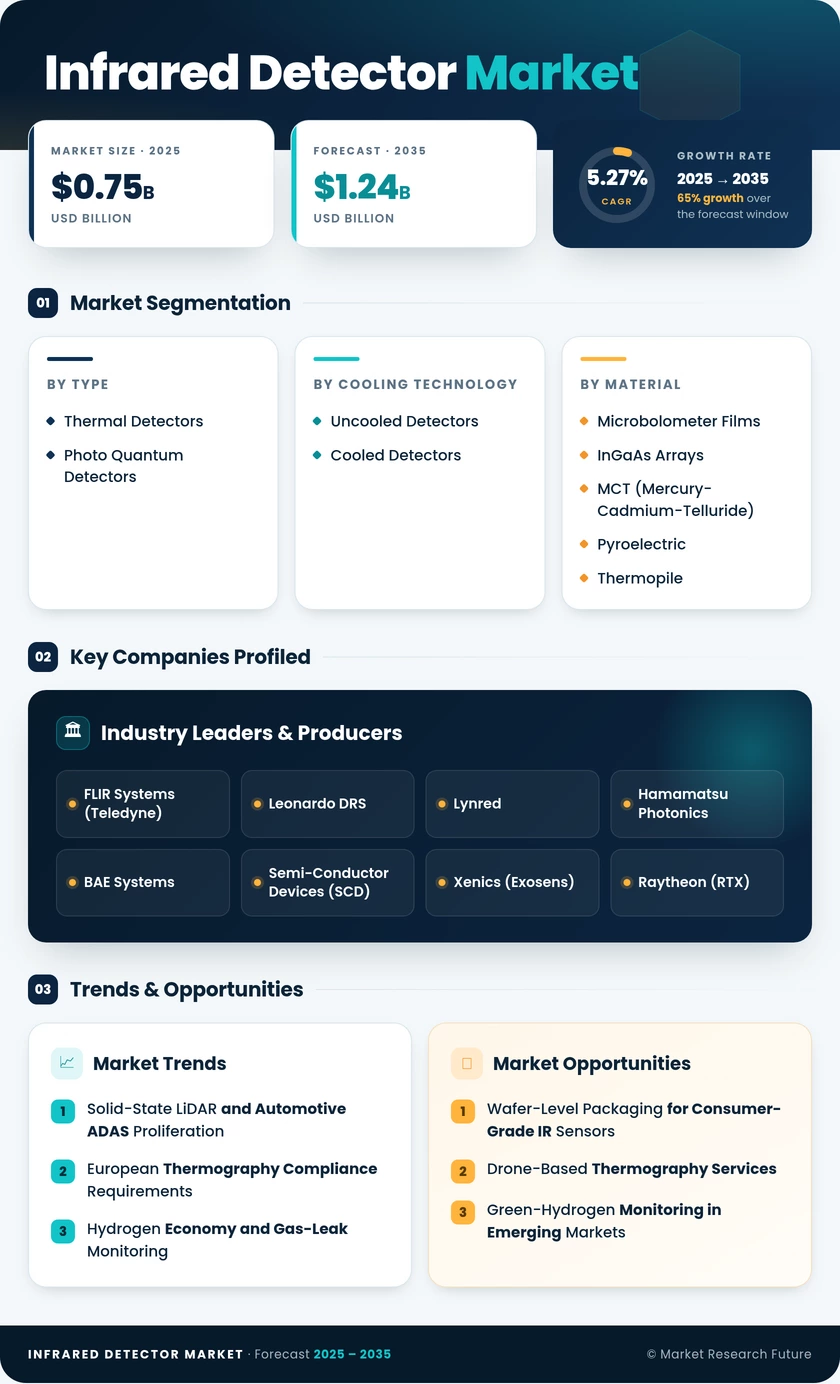
Infrared Detector Market Size, Share and Research Report By Detector Type (Thermal Detectors, Photo Quantum Detectors), By Cooling Technology (Uncooled Detectors, Cooled Detectors), By Material (Microbolometer Films, Indium-Gallium-Arsenide (InGaAs) Arrays, Mercury-Cadmium-Telluride (MCT), Pyroelectric, Thermopile), By Spectral Range (LWIR (Long-Wave Infrared), SWIR (Short-Wave Infrared), MWIR (Mid-Wave Infrared), NIR (Near Infrared), FIR (Far Infrared)), By Application (Temperature Measurement & Thermography, Automotive ADAS & LiDAR, People & Motion Sensing, Gas Detection & Spectroscopy, Military & Surveillance), By End-Use Industry (Industrial Manufacturing, Automotive, Aerospace & Defense, Building & Construction, Healthcare) and By Region (North America, Europe, South America, Asia Pacific, Middle East and Africa) - Industry Forecast to 2035.
Infrared Detector Market
Market Size
Forecast Period2026-2035
CAGR (2026-2035)5.27%
2025 Market SizeUSD 0.75 Billion
2035 Market SizeUSD 1.24 Billion
Key Players
FLIR Systems
Leonardo DRS
Lynred
Hamamatsu Photonics
BAE Systems
Semi-Conductor Devices
Opportunities
  • Wafer-Level Packaging for Consumer-Grade IR Sensors
  • Drone-Based Thermography Services
  • Green-Hydrogen Monitoring in Emerging Markets
  1. 1 Market Overview |
    1. 1.1 Study Assumptions & Market Definition |
    2. 1.2 Scope of the Study |
    3. 1.3 Research Methodology
  2. 2 Market Summary & Key Takeaways
  3. 3 Market Dynamics |
    1. 3.1 Market Drivers Analysis | |
      1. 3.1.1 Solid-State LiDAR Integration in EVs | |
      2. 3.1.2 EU Quarterly Thermography Audit Mandates | |
      3. 3.1.3 Hydrogen-Leak Monitoring Regulations | |
      4. 3.1.4 Defense Modernization & ISR Upgrades | |
      5. 3.1.5 Smart-Building Energy Efficiency Standards | |
      6. 3.1.6 Wafer-Level Packaging Cost Reductions | |
      7. 3.1.7 Autonomous Vehicle Sensor Fusion Requirements |
    2. 3.2 Market Restraints Analysis | |
      1. 3.2.1 High Cost of Cooled MCT Detector Systems | |
      2. 3.2.2 ITAR/EAR Export Restrictions on IR Sensors | |
      3. 3.2.3 Semiconductor Fab Capacity Constraints | |
      4. 3.2.4 Calibration Complexity for Multi-Spectral Arrays | |
      5. 3.2.5 Competition from Alternative Sensing Modalities |
    3. 3.3 Market Opportunity Analysis | |
      1. 3.3.1 Wafer-Level Packaging for Consumer-Grade IR Sensors | |
      2. 3.3.2 Drone-Based Thermography Services | |
      3. 3.3.3 Green-Hydrogen Monitoring in Emerging Markets | |
      4. 3.3.4 AI-Enabled Predictive Maintenance Platforms | |
      5. 3.3.5 Autonomous Vehicle Sensor Fusion |
    4. 3.4 Industry Value Chain Analysis |
    5. 3.5 Porter's Five Forces Analysis
  4. 4 Global Infrared Detector Market Size & Forecast (2021–2035) |
    1. 4.1 Historical Market Size (2021–2025) |
    2. 4.2 Current & Forecast Market Size (2026–2035) |
    3. 4.3 Market Size by Revenue (USD Billion) |
    4. 4.4 Year-over-Year Growth Analysis
  5. 5 Segmentation Analysis |
    1. 5.1 By Detector Type | |
      1. 5.1.1 Thermal Detectors | |
      2. 5.1.2 Photo Quantum Detectors |
    2. 5.2 By Cooling Technology | |
      1. 5.2.1 Uncooled Detectors | |
      2. 5.2.2 Cooled Detectors |
    3. 5.3 By Material | |
      1. 5.3.1 Microbolometer Films | |
      2. 5.3.2 Indium-Gallium-Arsenide (InGaAs) Arrays | |
      3. 5.3.3 Mercury-Cadmium-Telluride (MCT) | |
      4. 5.3.4 Pyroelectric | |
      5. 5.3.5 Thermopile |
    4. 5.4 By Spectral Range | |
      1. 5.4.1 LWIR (Long-Wave Infrared) | |
      2. 5.4.2 SWIR (Short-Wave Infrared) | |
      3. 5.4.3 MWIR (Mid-Wave Infrared) | |
      4. 5.4.4 NIR (Near Infrared) | |
      5. 5.4.5 FIR (Far Infrared) |
    5. 5.5 By Application | |
      1. 5.5.1 Temperature Measurement & Thermography | |
      2. 5.5.2 Automotive ADAS & LiDAR | |
      3. 5.5.3 People & Motion Sensing | |
      4. 5.5.4 Gas Detection & Spectroscopy | |
      5. 5.5.5 Military & Surveillance |
    6. 5.6 By End-Use Industry | |
      1. 5.6.1 Industrial Manufacturing | |
      2. 5.6.2 Automotive | |
      3. 5.6.3 Aerospace & Defense | |
      4. 5.6.4 Building & Construction | |
      5. 5.6.5 Healthcare
  6. 6 Regional Analysis |
    1. 6.1 North America | |
      1. 6.1.1 United States | |
      2. 6.1.2 Canada | |
      3. 6.1.3 Mexico |
    2. 6.2 Europe | |
      1. 6.2.1 Germany | |
      2. 6.2.2 United Kingdom | |
      3. 6.2.3 France | |
      4. 6.2.4 Italy | |
      5. 6.2.5 Spain | |
      6. 6.2.6 Nordic Countries | |
      7. 6.2.7 Russia | |
      8. 6.2.8 Rest of Europe |
    3. 6.3 Asia-Pacific | |
      1. 6.3.1 China | |
      2. 6.3.2 India | |
      3. 6.3.3 Japan | |
      4. 6.3.4 South Korea | |
      5. 6.3.5 ASEAN | |
      6. 6.3.6 Rest of Asia-Pacific |
    4. 6.4 South America | |
      1. 6.4.1 Brazil | |
      2. 6.4.2 Argentina | |
      3. 6.4.3 Rest of South America |
    5. 6.5 Middle East & Africa | |
      1. 6.5.1 Saudi Arabia | |
      2. 6.5.2 UAE | |
      3. 6.5.3 South Africa | |
      4. 6.5.4 Egypt | |
      5. 6.5.5 Rest of MEA
  7. 7 Competitive Landscape |
    1. 7.1 Market Share Analysis (2025) |
    2. 7.2 Competitive Benchmarking Matrix |
    3. 7.3 Company Profiles | |
      1. 7.3.1 Teledyne FLIR | |
      2. 7.3.2 Leonardo DRS | |
      3. 7.3.3 Lynred | |
      4. 7.3.4 Hamamatsu Photonics | |
      5. 7.3.5 BAE Systems | |
      6. 7.3.6 Semiconductor Devices (SCD) | |
      7. 7.3.7 Xenics (Exosens) | |
      8. 7.3.8 Raytheon (RTX) | |
      9. 7.3.9 Murata Manufacturing | |
      10. 7.3.10 Meridian Innovation
  8. 8 Future Outlook & Strategic Recommendations (2026–2035) |
    1. 8.1 AI-Driven Autonomous Thermal Analytics |
    2. 8.2 Electrification Supercycle and Battery Monitoring |
    3. 8.3 ESG Reporting and Mandatory Emissions Monitoring |
    4. 8.4 Space-Based and Hyperspectral Expansion
  9. 9 Recent Developments & News
  10. 10 Frequently Asked Questions (FAQs)
  11. 11 Report Scope & Methodology |
    1. 11.1 Study Period & Base Year |
    2. 11.2 Data Sources & Citations |
    3. 11.3 Abbreviations
  12. 12 LIST OF TABLES |
  13. TABLE 1 Global Infrared Detector Market Size & Forecast, by Revenue (USD Billion), 2021–2035 |
  14. TABLE 2 Global Infrared Detector Market — Year-over-Year Growth Analysis, 2021–2035 |
  15. TABLE 3 Driver Impact Analysis — Infrared Detector Market, 2026–2035 |
  16. TABLE 4 Restraint Impact Analysis — Infrared Detector Market, 2026–2035 |
  17. TABLE 5 Regional Market Share Summary — Infrared Detector Market, 2025 |
  18. TABLE 6 North America Infrared Detector Market Size, by Country, 2021–2035 (USD Billion) |
  19. TABLE 7 Europe Infrared Detector Market Size, by Country, 2021–2035 (USD Billion) |
  20. TABLE 8 Asia-Pacific Infrared Detector Market Size, by Country, 2021–2035 (USD Billion) |
  21. TABLE 9 South America Infrared Detector Market Size, by Country, 2021–2035 (USD Billion) |
  22. TABLE 10 Middle East & Africa Infrared Detector Market Size, by Country, 2021–2035 (USD Billion) |
  23. TABLE 11 Global Infrared Detector Market Size, by Detector Type, 2021–2035 (USD Billion) |
  24. TABLE 12 Global Infrared Detector Market Size, by Cooling Technology, 2021–2035 (USD Billion) |
  25. TABLE 13 Global Infrared Detector Market Size, by Material, 2021–2035 (USD Billion) |
  26. TABLE 14 Global Infrared Detector Market Size, by Spectral Range, 2021–2035 (USD Billion) |
  27. TABLE 15 Global Infrared Detector Market Size, by Application, 2021–2035 (USD Billion) |
  28. TABLE 16 Global Infrared Detector Market Size, by End-Use Industry, 2021–2035 (USD Billion) |
  29. TABLE 17 Competitive Benchmarking Matrix — Global Infrared Detector Market, 2025 |
  30. TABLE 18 Company Profiles — Key Players, Global Infrared Detector Market |
  31. TABLE 19 Recent Developments & Strategic Announcements, 2023–2025 |
  32. TABLE 20 Report Scope & Methodology Summary |
  33. TABLE 21 Detailed Sources and Citations
  34. 13 LIST OF FIGURES |
  35. FIGURE 1 Infrared Detector Market Dynamics — Drivers, Restraints, and Opportunities |
  36. FIGURE 2 Industry Value Chain Analysis — Infrared Detector Market |
  37. FIGURE 3 Porter's Five Forces Analysis — Infrared Detector Market |
  38. FIGURE 4 Global Infrared Detector Market Size Trend (USD Billion), 2021–2035 |
  39. FIGURE 5 Infrared Detector Market Share, by Detector Type, 2025 |
  40. FIGURE 6 Infrared Detector Market Share, by Cooling Technology, 2025 |
  41. FIGURE 7 Infrared Detector Market Share, by Material, 2025 |
  42. FIGURE 8 Infrared Detector Market Share, by Spectral Range, 2025 |
  43. FIGURE 9 Infrared Detector Market Share, by Application, 2025 |
  44. FIGURE 10 Infrared Detector Market Share, by End-Use Industry, 2025 |
  45. FIGURE 11 Infrared Detector Market Share, by Region, 2025 |
  46. FIGURE 12 North America Infrared Detector Market Share, by Country, 2025 |
  47. FIGURE 13 Europe Infrared Detector Market Share, by Country, 2025 |
  48. FIGURE 14 Asia-Pacific Infrared Detector Market Share, by Country, 2025 |
  49. FIGURE 15 South America Infrared Detector Market Share, by Country, 2025 |
  50. FIGURE 16 Middle East & Africa Infrared Detector Market Share, by Country, 2025 |
  51. FIGURE 17 Competitive Landscape — Market Share of Top 10 Players, 2025

Segmentation Quick Reference

DimensionSub-SegmentsDominant SegmentFastest Growing Segment
Detector TypeThermal, Photo QuantumThermal DetectorsPhoto Quantum Detectors
Cooling TechnologyUncooled, CooledUncooled DetectorsCooled Detectors
MaterialMicrobolometer, InGaAs, MCT, Pyroelectric, ThermopileMicrobolometer FilmsInGaAs Arrays
Spectral RangeNIR, SWIR, MWIR, LWIR, FIRLWIRSWIR
ApplicationTemperature Measurement & Thermography, Automotive ADAS & LiDAR, People & Motion Sensing, Gas Detection & Spectroscopy, Military & SurveillanceTemperature Measurement & ThermographyAutomotive ADAS & LiDAR
End-Use IndustryIndustrial Manufacturing, Automotive, Infrared Detector Market, Building & Construction, HealthcareIndustrial ManufacturingAutomotive


Market Segmentation Overview

By Detector Type

Sub-SegmentKey Trend
Thermal DetectorsWafer-level packaging driving cost reduction in uncooled microbolometers for volume deployments
Photo Quantum DetectorsInGaAs and MCT substrates are gaining automotive and defense traction with faster frame rates.


Thermal detectors continue to serve the broadest range of applications in the Infrared Detector Market, from building energy audits to industrial predictive maintenance. Photo quantum detectors are carving out high-growth niches where sensitivity and speed outweigh cost considerations.

By Cooling Technology

Sub-SegmentKey Trend
Uncooled DetectorsCMOS-compatible fabrication enabling sub-USD 15 modules for IoT and consumer integration
Cooled DetectorsMiniaturized Stirling cryocoolers reducing SWaP for portable defense and airborne platforms


Uncooled technology dominates unit shipments, while cooled systems command premium pricing in defense and scientific segments where noise-equivalent temperature differences below 20 mK are mandatory.

By Material

Sub-SegmentKey Trend
Microbolometer FilmsVanadium oxide and amorphous silicon thin films remain the standard for LWIR thermography.
InGaAs ArraysExpanding into SWIR machine vision, autonomous vehicles, and telecom fiber alignment
MCT (Mercury-Cadmium-Telluride)Sustained demand from cooled military FPAs; tunable across MWIR and LWIR bands
PyroelectricPrice erosion driving migration to microbolometers; niche retention in low-power motion sensing
ThermopileStable demand for non-contact temperature measurement in medical and consumer devices


Material selection in the Infrared Detector Market hinges on the trade-off between spectral range, sensitivity, and cost. Microbolometers dominate volume, InGaAs leads growth, and MCT holds value in defense.

By Spectral Range

Sub-SegmentKey Trend
LWIR (Long-Wave Infrared)Core band for thermography, building inspection, and uncooled detector applications
SWIR (Short-Wave Infrared)Fastest growth driven by LiDAR and active imaging with eye-safe 1,550 nm lasers
MWIR (Mid-Wave Infrared)Gas detection and military targeting remain the primary demand drivers
NIR (Near Infrared)Biomedical imaging and telecom fiber testing sustain steady demand
FIR (Far Infrared)Limited to niche scientific and astronomy applications


LWIR remains the revenue anchor, but SWIR is rapidly closing the gap as automotive LiDAR and machine vision applications scale.

By Application

Sub-SegmentKey Trend
Temperature Measurement & ThermographyEU mandates and industrial maintenance are driving steady replacement cycles.
Automotive ADAS & LiDAREV platform proliferation is creating high-volume demand for integrated IR sensor modules.
People & Motion SensingSmart-building and security deployments are shifting from pyroelectric to microbolometer sensors.
Gas Detection & SpectroscopyHydrogen economy and methane regulations are expanding addressable use cases.
Military & SurveillancePersistent ISR and border security sustaining premium-priced cooled detector procurement


Automotive ADAS is the stand-out growth application, while thermography remains the largest revenue contributor across the Infrared Detector Market.

By End-Use Industry

Sub-SegmentKey Trend
Industrial ManufacturingPredictive maintenance and quality inspection using thermal imaging is becoming standard practice.
AutomotiveADAS, night vision, and cabin monitoring, integrating multiple IR sensor modalities per vehicle
Infrared Detector MarketLong-cycle government contracts sustaining R&D investment in cooled focal-plane arrays.
Building & ConstructionEnergy performance regulations mandating thermal audits across the commercial building stock
HealthcareNon-contact fever screening and vascular imaging are expanding the clinical use of IR detectors.


Industrial manufacturing holds the largest share by end-use, but automotive is closing rapidly as each vehicle platform adds multiple infrared detector modules.


Download PDF ×

We do not share your information with anyone. However, we may send you emails based on your report interest from time to time. You may contact us at any time to opt-out.