Request Free Sample ×

Kindly complete the form below to receive a free sample of this Report

* Please use a valid business email

Leading companies partner with us for data-driven Insights

clients tt-cursor
Hero Background
English
Chinese
French
Japanese
Korean
German
Spanish

Implantable Cardioverter Defibrillator Market Size

ID: MRFR/MED/6771-HCR
111 Pages
Nidhi Mandole
Last Updated: April 06, 2026

Implantable Cardioverter Defibrillator (ICD) Market Research Report By Product Type (Single Chamber ICD, Dual Chamber ICD, Triple Chamber ICD, Subcutaneous ICD), By End User (Hospitals, Cardiology Clinics, Ambulatory Surgical Centers), By Patient Type (Adults, Pediatric, Geriatric), By Distribution Channel (Direct Sales, Distributors, Online Sales) and By Regional (North America, Europe, South America, Asia Pacific, Middle East and Africa) - Growth & Industry Forecast 2025 To 2035

Share:
Download PDF ×

We do not share your information with anyone. However, we may send you emails based on your report interest from time to time. You may contact us at any time to opt-out.

Implantable Cardioverter Defibrillator Market Infographic
Purchase Options

Implantable Cardioverter Defibrillator Size

Implantable Cardioverter Defibrillator Market Growth Projections and Opportunities

The prevalence of cardiovascular infections, like arrhythmias and heart failure, is a significant driver for the ICD market. As the worldwide population ages and lifestyles complement to heart-related issues, the interest for ICDs as life-saving gadgets increments. Developing awareness about heart conditions and the availability of cutting-edge indicative apparatuses lead to early identification of arrhythmias, inciting more popularity for ICDs. Training campaigns and effort programs by medical services associations add to expanded awareness among the two patients and medical care suppliers. Repayment arrangements and medical care supporting instruments significantly impact the reception of ICDs. Great repayment arrangements urge patients to select implantation techniques, while medical care suppliers are inspired to offer these life-saving gadgets. Financial conditions, including Gross domestic product development and medical care spending, impact the ICD market. Financial crashes can influence buying power and medical care spending plans, affecting the reception of costly clinical gadgets like ICDs. Patient association in medical services choices is developing, and inclinations for explicit ICD elements or brands can impact market patterns. Shared decision-production between medical services suppliers and patients assumes an urgent part in the determination of fitting ICD gadgets. The universality of cardiovascular illnesses shifts geologically. Factors like lifestyle, genetic qualities, and medical care framework add to local varieties in the interest for ICDs. Understanding these distinctions is fundamental for market extension procedures.

Implantable Cardioverter Defibrillator Market Size Graph
Author
Author Profile
Nidhi Mandole
Senior Research Analyst

She is an extremely curious individual currently working in Healthcare and Medical Devices Domain. Nidhi is comfortably versed in data centric research backed by healthcare educational background. She leverages extensive data mining and analytics tools such as Primary and Secondary Research, Statistical Analysis, Machine Learning, Data Modelling. Her key role also involves Technical Sales Support, Client Interaction and Project management within the Healthcare team. Lastly, she showcases extensive affinity towards learning new skills and remain fascinated in implementing them.

Leave a Comment

FAQs

What is the projected market valuation for the Implantable Cardioverter Defibrillator (ICD) Market in 2035?

<p>The projected market valuation for the ICD Market in 2035 is 12.14 USD Billion.</p>

What was the overall market valuation of the ICD Market in 2024?

<p>The overall market valuation of the ICD Market in 2024 was 6.867 USD Billion.</p>

What is the expected CAGR for the ICD Market during the forecast period 2025 - 2035?

<p>The expected CAGR for the ICD Market during the forecast period 2025 - 2035 is 5.32%.</p>

Which companies are considered key players in the ICD Market?

<p>Key players in the ICD Market include Medtronic, Boston Scientific, Abbott, Biotronik, and others.</p>

What are the projected revenues for Single Chamber ICDs by 2035?

<p>The projected revenues for Single Chamber ICDs are expected to range from 1.5 to 2.5 USD Billion by 2035.</p>

How do the revenues for Dual Chamber ICDs compare to those of Triple Chamber ICDs in 2035?

<p>In 2035, revenues for Dual Chamber ICDs are projected to be between 2.5 and 4.0 USD Billion, whereas Triple Chamber ICDs are expected to range from 1.5 to 2.5 USD Billion.</p>

What is the anticipated revenue range for hospitals as end users of ICDs by 2035?

<p>The anticipated revenue range for hospitals as end users of ICDs is projected to be between 2.74 and 4.8 USD Billion by 2035.</p>

What is the expected revenue for pediatric patients using ICDs by 2035?

<p>The expected revenue for pediatric patients using ICDs is projected to be between 1.0 and 1.5 USD Billion by 2035.</p>

What distribution channel is expected to generate the highest revenue for ICDs by 2035?

<p>Direct sales are expected to generate the highest revenue for ICDs, projected to range from 2.5 to 4.5 USD Billion by 2035.</p>

What is the projected revenue for ambulatory surgical centers as end users of ICDs by 2035?

<p>The projected revenue for ambulatory surgical centers as end users of ICDs is expected to range from 2.067 to 3.74 USD Billion by 2035.</p>

Market Summary

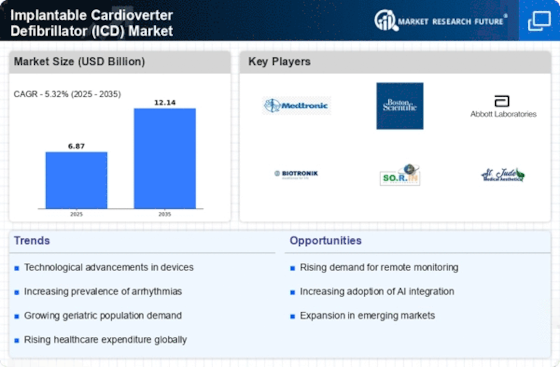
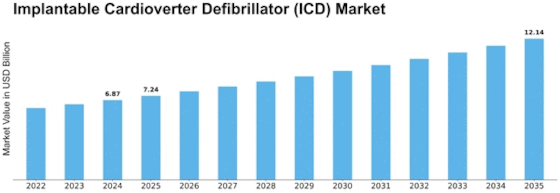
As per Market Research Future analysis, the Implantable Cardioverter Defibrillator Market (ICD) Market Size was estimated at 6.867 USD Billion in 2024. The ICD industry is projected to grow from 7.232 USD Billion in 2025 to 12.14 USD Billion by 2035, exhibiting a compound annual growth rate (CAGR) of 5.32% during the forecast period 2025 - 2035

Key Market Trends & Highlights

The Implantable Cardioverter Defibrillator Market (ICD) market is poised for substantial growth driven by technological advancements and increasing disease prevalence.

  • Technological advancements in ICDs are enhancing device efficacy and patient outcomes. North America remains the largest market, while Asia-Pacific is emerging as the fastest-growing region. The Dual Chamber ICD segment holds the largest market share, whereas the Subcutaneous ICD segment is witnessing rapid growth. Key market drivers include the rising incidence of cardiovascular diseases and regulatory support for innovation.

Market Size & Forecast

2024 Market Size 6.867 (USD Billion)
2035 Market Size 12.14 (USD Billion)
CAGR (2025 - 2035) 5.32%
Largest Regional Market Share in 2024 North America

Major Players

<a href="https://www.medtronic.com/en-us/healthcare-professionals/products/cardiac-rhythm/implantable-cardioverter-defibrillators.html#aq=%40pagetype%3D%22product-model%22&amp;cq=%40products_type%3D%22Implantable%20cardioverter%20defibrillators%22%20OR%20%40ontology_isa%3D%22Implantable%20cardioverter%20defibrillators%22">Medtronic </a>(US), Boston Scientific (US), Abbott (US), Biotronik (DE), Sorin Group (IT), St. Jude Medical (US), Cardiac Science (US), Philips (NL), LivaNova (GB)

Market Trends

The Implantable Cardioverter Defibrillator Market is currently experiencing notable advancements driven by technological innovations and an increasing prevalence of cardiovascular diseases. The integration of advanced features such as remote monitoring and enhanced battery life appears to be reshaping the landscape of ICD devices. Furthermore, the growing awareness regarding sudden cardiac arrest and the importance of timely intervention is likely to propel demand for these devices.

As healthcare systems evolve, the focus on patient-centric solutions may lead to a broader acceptance of ICDs among both healthcare providers and patients. In addition, regulatory bodies are seemingly becoming more supportive of innovations in the Implantable Cardioverter Defibrillator Market, which could facilitate faster approvals for new technologies. This trend may encourage implantable cardioverter defibrillator manufacturers to invest in research and development, potentially leading to the introduction of more sophisticated devices and reducing heart defibrillator implant costs.

Moreover, the increasing collaboration between technology firms and healthcare providers suggests a shift towards more integrated healthcare solutions, which may enhance the overall efficacy of ICDs in managing cardiac conditions. As the market continues to evolve, it is essential to monitor these trends closely to understand their implications for future growth and development.

Technological Advancements

The Implantable Cardioverter Defibrillator Market (ICD) Market is witnessing rapid technological advancements, particularly in device miniaturization and connectivity features. Innovations such as wireless communication and remote monitoring capabilities are enhancing patient management and follow-up care.

Rising Cardiovascular Disease Incidence

The increasing incidence of cardiovascular diseases globally is driving the demand for Implantable Cardioverter Defibrillators. As awareness of heart health grows, more patients are being diagnosed and treated with ICDs, indicating a shift towards proactive cardiac care.

Regulatory Support for Innovation

Regulatory bodies are showing a growing inclination to support innovations within the Implantable Cardioverter Defibrillator Market. This trend may lead to expedited approval processes for new technologies, encouraging implantable cardioverter defibrillator manufacturers to develop advanced solutions.

Implantable Cardioverter Defibrillator Market Market Drivers

Regulatory Support for Innovation

Regulatory bodies are increasingly supportive of innovations within the Implantable Cardioverter Defibrillator Market (ICD) Market, facilitating the introduction of new technologies. Streamlined approval processes and incentives for research and development are encouraging manufacturers to invest in advanced ICD solutions. For instance, the FDA has established programs to expedite the review of breakthrough devices, which can significantly shorten the time to market for novel ICDs. This regulatory environment not only fosters innovation but also enhances competition among manufacturers, leading to improved product offerings. As a result, the ICD market is likely to witness a proliferation of new devices that cater to diverse patient needs, ultimately benefiting healthcare systems.

Increasing Awareness and Education

There is a growing awareness regarding the importance of early detection and treatment of cardiac conditions, which is positively influencing the Implantable Cardioverter Defibrillator Market (ICD) Market. Educational initiatives aimed at both healthcare professionals and patients are crucial in promoting the understanding of ICDs and their benefits. As more individuals become informed about the risks associated with arrhythmias and sudden cardiac arrest, the demand for ICD implantation is expected to rise. Additionally, healthcare providers are increasingly advocating for the use of ICDs as a preventive measure, further driving market growth. This heightened awareness is likely to translate into increased sales and adoption rates of ICDs in various healthcare settings.

Technological Advancements in ICDs

The Implantable Cardioverter Defibrillator Market (ICD) Market is experiencing a surge in technological advancements that enhance device functionality and patient outcomes. Innovations such as leadless ICDs and subcutaneous devices are gaining traction, offering less invasive options for patients. These advancements not only improve the safety profile of ICDs but also reduce the risk of complications associated with traditional leads. Furthermore, the integration of remote monitoring capabilities allows for real-time data transmission, enabling healthcare providers to make timely interventions. According to recent data, the market for advanced ICDs is projected to grow at a compound annual growth rate of over 8% through the next few years, reflecting the increasing demand for sophisticated cardiac care solutions.

Rising Cardiovascular Disease Incidence

The prevalence of cardiovascular diseases continues to rise, significantly impacting the Implantable Cardioverter Defibrillator Market (ICD) Market. Factors such as aging populations, sedentary lifestyles, and increasing rates of obesity contribute to this trend. As cardiovascular diseases become more common, the demand for effective treatment options, including ICDs, is expected to escalate. Recent statistics indicate that nearly 17.9 million people die from cardiovascular diseases each year, underscoring the urgent need for preventive and therapeutic measures. This growing patient population is likely to drive the ICD market, as healthcare providers seek to implement life-saving technologies to manage arrhythmias and prevent sudden cardiac arrest.

Aging Population and Healthcare Expenditure

The aging population is a significant driver of the Implantable Cardioverter Defibrillator Market (ICD) Market, as older adults are at a higher risk for cardiovascular diseases. As life expectancy increases, the number of individuals requiring cardiac interventions, including ICDs, is also expected to rise. Moreover, healthcare expenditure on chronic diseases is projected to increase, with a substantial portion allocated to cardiac care. This trend suggests that healthcare systems will prioritize investments in advanced technologies like ICDs to improve patient outcomes. Consequently, the ICD market is likely to expand, driven by the need to address the growing burden of cardiovascular diseases among the elderly.


Market Segment Insights

By Type: Dual Chamber ICD (Largest) vs. Subcutaneous ICD (Fastest-Growing)

In the Implantable Cardioverter Defibrillator Market, the distribution of segments showcases the prominence of Dual Chamber ICDs, which dominate the market share due to their enhanced capabilities for patients with complex heart conditions. Following closely, Single Chamber ICDs occupy a significant portion of the implantable medical devices market, appreciated for their simplicity and efficacy in straightforward cases. Subcutaneous ICDs, meanwhile, are emerging rapidly, driven by clinical innovations that cater to patients who require an alternative to traditional lead placements. Growth trends indicate a notable shift towards Subcutaneous ICDs as healthcare providers increasingly recognize their advantages, such as reduced risk of infection and ease of implantation. This segment is expected to witness the fastest growth, fueled by technological advancements and rising awareness regarding their benefits among patients and healthcare professionals alike. Moreover, the aging population presents a growing base of patients needing ICDs, further accelerating the demand for various device types in this market.

Dual Chamber ICD (Dominant) vs. Subcutaneous ICD (Emerging)

The Dual Chamber ICD segment has established itself as a dominant choice among healthcare providers due to its sophisticated pacing capabilities and adaptability for patients with atrial and ventricular arrhythmias. This device utilizes two leads to monitor and treat irregular heart rhythms, offering more precise therapy than its Single Chamber counterpart. Its robust functionality makes it suitable for a wider range of patients, thus securing its market position. Conversely, Subcutaneous ICDs represent an emerging segment characterized by their innovative design, which eliminates the need for transvenous leads, significantly reducing the risk of complications. This technology is particularly appealing for patients who are at a higher risk of infections or vascular complications. Both segments highlight the ongoing evolution in the ICD market aimed at improving patient outcomes.

By End User: Hospitals (Largest) vs. Cardiology Clinics (Fastest-Growing)

The Implantable Cardioverter Defibrillator Market (ICD) Market shows a significant distribution of market share among its end users. Hospitals account for the largest share due to their comprehensive healthcare systems that can support complex cardiac procedures. They possess advanced medical technologies and a wide range of patient services, making them essential for ICD implantation and follow-up care. Cardiology clinics, while smaller in market share, are rapidly gaining importance as more patients seek specialized care in less intensive settings, particularly as awareness of cardiac health increases.

Cardiology Clinics (Emerging) vs. Ambulatory Surgical Centers (Dominant)

Cardiology clinics are emerging as key players in the ICD market due to their focused approach on cardiac health, providing specialized care and tailored treatment plans. They often offer advanced consultation and monitoring services, fostering strong patient relationships. In contrast, <a href="https://www.marketresearchfuture.com/reports/ambulatory-services-market-2491">ambulatory </a>surgical centers play a dominant role, favored for their efficiency and implanted cardioverter defibrillator cost-effectiveness in performing ICD implantations. These facilities offer a less invasive approach, attracting patients who prefer outpatient procedures, leading to a growing number of ICD placements in this setting. As healthcare dynamics evolve, both segments are reshaping their strategies to meet the increasing demand for personalized cardiac care.

By Patient Type: Adults (Largest) vs. Pediatric (Fastest-Growing)

In the Implantable Cardioverter Defibrillator Market, the 'Adults' segment constitutes a significant portion of the overall market share. This segment benefits from the higher prevalence of cardiovascular diseases in the adult population, making it the largest target for ICD manufacturers. The adult demographic often has a higher incidence of conditions such as arrhythmias, which necessitate the use of implantable devices, thus solidifying its dominant position in the implantable medical devices market.

Patient Type: Adults (Dominant) vs. Pediatric (Emerging)

The 'Adults' patient type holds a dominant position in the ICD market, characterized by a well-established prevalence of heart conditions that require medical intervention. Adults tend to have greater access to healthcare facilities and are more likely to receive ICD implants due to increased health awareness and diagnostic procedures. On the other hand, the 'Pediatric' segment is emerging rapidly as a vital area for innovation, driven by the need for age-appropriate devices and growing awareness among healthcare providers regarding congenital heart conditions. The demand for pediatric ICDs is being fueled by advancements in technology, leading to more successful outcomes in younger patients, positioning this segment as a focal point of growth in the market.

By Distribution Channel: Direct Sales (Largest) vs. Distributors (Fastest-Growing)

In the Implantable Cardioverter Defibrillator Market (ICD) market, distribution channels play a pivotal role in ensuring that these critical devices reach healthcare providers and patients effectively. Direct sales currently dominate the market share, allowing manufacturers to maintain control over their sales processes while fostering strong relationships with hospitals and clinics. Distributors, however, are catching up rapidly, leveraging their extensive networks and logistical expertise to penetrate new markets and enhance product accessibility.

Direct Sales (Dominant) vs. Distributors (Emerging)

Direct sales channels are characterized by direct interaction between manufacturers and end-users, offering personalized service and tailored solutions, which leads to strong customer loyalty. This channel allows for immediate feedback, adapting offerings based on healthcare provider needs. On the other hand, distributors are emerging as a significant force in the market, capitalizing on their established distribution networks and relationships with healthcare systems. This segment is rapidly growing as it offers flexibility and efficiency to healthcare providers, thus catering to the increasing demand for implantable cardioverter defibrillators in various regions.

Get more detailed insights about Implantable Cardioverter Defibrillator (ICD) Market Research Report - Global Forecast till 2035

Regional Insights

The Implantable Cardioverter Defibrillator Market (ICD) Market revenue showcases significant growth across various regional segments, with North America dominating the market, valued at 2.85 USD Billion in 2023, and projected to reach 4.5 USD Billion by 2032. This substantial presence can be attributed to advanced healthcare infrastructure and a high prevalence of cardiovascular diseases.

Europe ranks second, with a valuation of 1.8 USD Billion in 2023, expected to rise to 2.8 USD Billion in 2032, benefiting from increasing awareness and access to cardiac healthcare.The APAC region, valued at 1.5 USD Billion in 2023 and 2.4 USD Billion in 2032, is witnessing significant growth driven by rising healthcare expenditure and an aging population.

South America and MEA are smaller markets, valued at 0.7 USD Billion and 0.67 USD Billion in 2023, expected to reach 1.1 USD Billion and 0.9 USD Billion, respectively, by 2032; however, these regions offer substantial opportunities for growth, particularly as healthcare systems develop and access to cardiac devices expands.

The segmentation of the Implantable Cardioverter Defibrillator Market (ICD) Market data highlights varying growth drivers and challenges, with North America demonstrating significant dominance, while the emerging markets in APAC and South America present lucrative potential for market expansion.Market growth in these regions is further supported by technological advancements and the increasing adoption of preventive healthcare measures.

Key Players and Competitive Insights

The Implantable Cardioverter Defibrillator Market is characterized by significant competitive dynamics due to the increasing prevalence of cardiovascular diseases and a growing aging population worldwide. This market comprises a variety of ICD manufacturers including large multinational corporations, specialized businesses, and emerging ventures, all vying to capture market share through innovation and product differentiation.
As advancements in technology continue to evolve, ICD companies are focused not only on enhancing the efficacy and safety of their devices but also on improving patient comfort and lifestyle integration. Strategic partnerships, acquisitions, and extensive research and development activities are becoming crucial for gaining competitive advantage in this dynamic market landscape.
Additionally, the regulatory landscape and reimbursement frameworks across different regions can heavily influence market strategies and outcomes, making it essential for ICD brands to adapt swiftly to changing conditions.Cook Medical has established a notable presence in the Implantable Cardioverter Defibrillator Market by leveraging its strong brand reputation and extensive portfolio of cardiovascular devices. The company is known for its focus on innovation, allowing them to introduce advanced ICD systems that cater to the evolving needs of healthcare providers and patients.
A key strength lies in their robust research and development capabilities, enabling them to deliver technologically advanced solutions that improve device functionality.
Moreover, Cook Medical's commitment to quality and regulatory compliance ensures that their ICD products meet stringent safety standards, enhancing their market appeal. Additionally, their customer-centric approach allows them to maintain strong relationships with healthcare professionals, ultimately leading to repeat business and loyalty in an increasingly competitive environment.Cardiac Science stands out in the Implantable Cardioverter Defibrillator Market by emphasizing its dedication to high-quality products and exceptional customer service. The company focuses on creating devices that not only meet but often exceed medical standards, thereby reinforcing its reputation among healthcare professionals.
Cardiac Science's strengths are rooted in its commitment to research and development, which fuels continuous improvements in device technology and performance.
Furthermore, the company offers comprehensive support services that assist healthcare providers in the effective implementation and monitoring of their ICD products. This approach not only enhances user experience but also leads to better patient outcomes. Cardiac Science's adaptability to market changes and emphasis on innovation further solidify its position within the competitive landscape of the Implantable Cardioverter Defibrillator Market, making it a respected player.

Key Companies in the Implantable Cardioverter Defibrillator Market include

Industry Developments

The Implantable Cardioverter Defibrillator Market is experiencing significant developments, particularly with advancements in technology and increasing investments. ICD companies such as Medtronic and Abbott Laboratories are actively enhancing their product lines with innovative features that improve patient outcomes and ease of use. Recent acquisitions are shaping the market landscape; for instance, Boston Scientific acquired the cardiac device segment of Cameron Health to expand its portfolio and strengthen its position.

Additionally, LivaNova and Sorin Group are reportedly consolidating efforts to develop next-generation cardiovascular devices, which has attracted investment interest. Current affairs also highlight the growing demand for remote monitoring solutions, driven by the pandemic's emphasis on telehealth, significantly impacting ICD companies like Zoll Medical and Biotronik. Major growth is noted in the valuation of firms like Philips and Cook Medical, which are leveraging strategic partnerships and advancements in AI-driven diagnostics to capture a more significant market share. The ongoing trends reflect a heightened focus on holistic patient care through technology integration, making the Implantable Cardioverter Defibrillator Market an evolving landscape full of opportunities.

Future Outlook

Implantable Cardioverter Defibrillator Market Future Outlook

The Implantable Cardioverter Defibrillator Market (ICD) Market is projected to grow at a 5.32% CAGR from 2025 to 2035, driven by technological advancements, increasing cardiovascular diseases, and rising healthcare expenditure.

New opportunities lie in:

  • <p>Expansion of <a href="https://www.marketresearchfuture.com/reports/telehealth-market-900">telehealth </a>services for remote patient monitoring Development of next-generation ICDs with enhanced battery life Strategic partnerships with healthcare providers for integrated care solutions</p>

By 2035, the ICD market is expected to be robust, driven by innovation and strategic collaborations.

Market Segmentation

Implantable Cardioverter Defibrillator Market Type Outlook

  • Single Chamber ICD
  • Dual Chamber ICD
  • Triple Chamber ICD
  • Subcutaneous ICD

Implantable Cardioverter Defibrillator Market End User Outlook

  • Hospitals
  • Cardiology Clinics
  • Ambulatory Surgical Centers

Implantable Cardioverter Defibrillator Market Patient Type Outlook

  • Adults
  • Pediatric
  • Geriatric

Implantable Cardioverter Defibrillator Market Distribution Channel Outlook

  • Direct Sales
  • Distributors
  • Online Sales

Report Scope

MARKET SIZE 2024 6.867(USD Billion)
MARKET SIZE 2025 7.232(USD Billion)
MARKET SIZE 2035 12.14(USD Billion)
COMPOUND ANNUAL GROWTH RATE (CAGR) 5.32% (2025 - 2035)
REPORT COVERAGE Revenue Forecast, Competitive Landscape, Growth Factors, and Trends
BASE YEAR 2024
Market Forecast Period 2025 - 2035
Historical Data 2019 - 2024
Market Forecast Units USD Billion
Key Companies Profiled Medtronic (US), Boston Scientific (US), Abbott (US), Biotronik (DE), Sorin Group (IT), St. Jude Medical (US), Cardiac Science (US), Philips (NL), LivaNova (GB)
Segments Covered Product Type, End User, Patient Type, Distribution Channel, Regional
Key Market Opportunities Advancements in remote monitoring technologies enhance patient management in the Implantable Cardioverter Defibrillator (ICD) Market.
Key Market Dynamics Technological advancements and regulatory changes drive competitive dynamics in the Implantable Cardioverter Defibrillator market.
Countries Covered North America, Europe, APAC, South America, MEA

FAQs

What is the projected market valuation for the Implantable Cardioverter Defibrillator (ICD) Market in 2035?

<p>The projected market valuation for the ICD Market in 2035 is 12.14 USD Billion.</p>

What was the overall market valuation of the ICD Market in 2024?

<p>The overall market valuation of the ICD Market in 2024 was 6.867 USD Billion.</p>

What is the expected CAGR for the ICD Market during the forecast period 2025 - 2035?

<p>The expected CAGR for the ICD Market during the forecast period 2025 - 2035 is 5.32%.</p>

Which companies are considered key players in the ICD Market?

<p>Key players in the ICD Market include Medtronic, Boston Scientific, Abbott, Biotronik, and others.</p>

What are the projected revenues for Single Chamber ICDs by 2035?

<p>The projected revenues for Single Chamber ICDs are expected to range from 1.5 to 2.5 USD Billion by 2035.</p>

How do the revenues for Dual Chamber ICDs compare to those of Triple Chamber ICDs in 2035?

<p>In 2035, revenues for Dual Chamber ICDs are projected to be between 2.5 and 4.0 USD Billion, whereas Triple Chamber ICDs are expected to range from 1.5 to 2.5 USD Billion.</p>

What is the anticipated revenue range for hospitals as end users of ICDs by 2035?

<p>The anticipated revenue range for hospitals as end users of ICDs is projected to be between 2.74 and 4.8 USD Billion by 2035.</p>

What is the expected revenue for pediatric patients using ICDs by 2035?

<p>The expected revenue for pediatric patients using ICDs is projected to be between 1.0 and 1.5 USD Billion by 2035.</p>

What distribution channel is expected to generate the highest revenue for ICDs by 2035?

<p>Direct sales are expected to generate the highest revenue for ICDs, projected to range from 2.5 to 4.5 USD Billion by 2035.</p>

What is the projected revenue for ambulatory surgical centers as end users of ICDs by 2035?

<p>The projected revenue for ambulatory surgical centers as end users of ICDs is expected to range from 2.067 to 3.74 USD Billion by 2035.</p>

  1. SECTION I: EXECUTIVE SUMMARY AND KEY HIGHLIGHTS
    1. | 1.1 EXECUTIVE SUMMARY
    2. | | 1.1.1 Market Overview
    3. | | 1.1.2 Key Findings
    4. | | 1.1.3 Market Segmentation
    5. | | 1.1.4 Competitive Landscape
    6. | | 1.1.5 Challenges and Opportunities
    7. | | 1.1.6 Future Outlook
  2. SECTION II: SCOPING, METHODOLOGY AND MARKET STRUCTURE
    1. | 2.1 MARKET INTRODUCTION
    2. | | 2.1.1 Definition
    3. | | 2.1.2 Scope of the study
    4. | | | 2.1.2.1 Research Objective
    5. | | | 2.1.2.2 Assumption
    6. | | | 2.1.2.3 Limitations
    7. | 2.2 RESEARCH METHODOLOGY
    8. | | 2.2.1 Overview
    9. | | 2.2.2 Data Mining
    10. | | 2.2.3 Secondary Research
    11. | | 2.2.4 Primary Research
    12. | | | 2.2.4.1 Primary Interviews and Information Gathering Process
    13. | | | 2.2.4.2 Breakdown of Primary Respondents
    14. | | 2.2.5 Forecasting Model
    15. | | 2.2.6 Market Size Estimation
    16. | | | 2.2.6.1 Bottom-Up Approach
    17. | | | 2.2.6.2 Top-Down Approach
    18. | | 2.2.7 Data Triangulation
    19. | | 2.2.8 Validation
  3. SECTION III: QUALITATIVE ANALYSIS
    1. | 3.1 MARKET DYNAMICS
    2. | | 3.1.1 Overview
    3. | | 3.1.2 Drivers
    4. | | 3.1.3 Restraints
    5. | | 3.1.4 Opportunities
    6. | 3.2 MARKET FACTOR ANALYSIS
    7. | | 3.2.1 Value chain Analysis
    8. | | 3.2.2 Porter's Five Forces Analysis
    9. | | | 3.2.2.1 Bargaining Power of Suppliers
    10. | | | 3.2.2.2 Bargaining Power of Buyers
    11. | | | 3.2.2.3 Threat of New Entrants
    12. | | | 3.2.2.4 Threat of Substitutes
    13. | | | 3.2.2.5 Intensity of Rivalry
    14. | | 3.2.3 COVID-19 Impact Analysis
    15. | | | 3.2.3.1 Market Impact Analysis
    16. | | | 3.2.3.2 Regional Impact
    17. | | | 3.2.3.3 Opportunity and Threat Analysis
  4. SECTION IV: QUANTITATIVE ANALYSIS
    1. | 4.1 Healthcare, BY Type (USD Billion)
    2. | | 4.1.1 Single Chamber ICD
    3. | | 4.1.2 Dual Chamber ICD
    4. | | 4.1.3 Triple Chamber ICD
    5. | | 4.1.4 Subcutaneous ICD
    6. | 4.2 Healthcare, BY End User (USD Billion)
    7. | | 4.2.1 Hospitals
    8. | | 4.2.2 Cardiology Clinics
    9. | | 4.2.3 Ambulatory Surgical Centers
    10. | 4.3 Healthcare, BY Patient Type (USD Billion)
    11. | | 4.3.1 Adults
    12. | | 4.3.2 Pediatric
    13. | | 4.3.3 Geriatric
    14. | 4.4 Healthcare, BY Distribution Channel (USD Billion)
    15. | | 4.4.1 Direct Sales
    16. | | 4.4.2 Distributors
    17. | | 4.4.3 Online Sales
    18. | 4.5 Healthcare, BY Region (USD Billion)
    19. | | 4.5.1 North America
    20. | | | 4.5.1.1 US
    21. | | | 4.5.1.2 Canada
    22. | | 4.5.2 Europe
    23. | | | 4.5.2.1 Germany
    24. | | | 4.5.2.2 UK
    25. | | | 4.5.2.3 France
    26. | | | 4.5.2.4 Russia
    27. | | | 4.5.2.5 Italy
    28. | | | 4.5.2.6 Spain
    29. | | | 4.5.2.7 Rest of Europe
    30. | | 4.5.3 APAC
    31. | | | 4.5.3.1 China
    32. | | | 4.5.3.2 India
    33. | | | 4.5.3.3 Japan
    34. | | | 4.5.3.4 South Korea
    35. | | | 4.5.3.5 Malaysia
    36. | | | 4.5.3.6 Thailand
    37. | | | 4.5.3.7 Indonesia
    38. | | | 4.5.3.8 Rest of APAC
    39. | | 4.5.4 South America
    40. | | | 4.5.4.1 Brazil
    41. | | | 4.5.4.2 Mexico
    42. | | | 4.5.4.3 Argentina
    43. | | | 4.5.4.4 Rest of South America
    44. | | 4.5.5 MEA
    45. | | | 4.5.5.1 GCC Countries
    46. | | | 4.5.5.2 South Africa
    47. | | | 4.5.5.3 Rest of MEA
  5. SECTION V: COMPETITIVE ANALYSIS
    1. | 5.1 Competitive Landscape
    2. | | 5.1.1 Overview
    3. | | 5.1.2 Competitive Analysis
    4. | | 5.1.3 Market share Analysis
    5. | | 5.1.4 Major Growth Strategy in the Healthcare
    6. | | 5.1.5 Competitive Benchmarking
    7. | | 5.1.6 Leading Players in Terms of Number of Developments in the Healthcare
    8. | | 5.1.7 Key developments and growth strategies
    9. | | | 5.1.7.1 New Product Launch/Service Deployment
    10. | | | 5.1.7.2 Merger & Acquisitions
    11. | | | 5.1.7.3 Joint Ventures
    12. | | 5.1.8 Major Players Financial Matrix
    13. | | | 5.1.8.1 Sales and Operating Income
    14. | | | 5.1.8.2 Major Players R&D Expenditure. 2023
    15. | 5.2 Company Profiles
    16. | | 5.2.1 Medtronic (US)
    17. | | | 5.2.1.1 Financial Overview
    18. | | | 5.2.1.2 Products Offered
    19. | | | 5.2.1.3 Key Developments
    20. | | | 5.2.1.4 SWOT Analysis
    21. | | | 5.2.1.5 Key Strategies
    22. | | 5.2.2 Boston Scientific (US)
    23. | | | 5.2.2.1 Financial Overview
    24. | | | 5.2.2.2 Products Offered
    25. | | | 5.2.2.3 Key Developments
    26. | | | 5.2.2.4 SWOT Analysis
    27. | | | 5.2.2.5 Key Strategies
    28. | | 5.2.3 Abbott (US)
    29. | | | 5.2.3.1 Financial Overview
    30. | | | 5.2.3.2 Products Offered
    31. | | | 5.2.3.3 Key Developments
    32. | | | 5.2.3.4 SWOT Analysis
    33. | | | 5.2.3.5 Key Strategies
    34. | | 5.2.4 Biotronik (DE)
    35. | | | 5.2.4.1 Financial Overview
    36. | | | 5.2.4.2 Products Offered
    37. | | | 5.2.4.3 Key Developments
    38. | | | 5.2.4.4 SWOT Analysis
    39. | | | 5.2.4.5 Key Strategies
    40. | | 5.2.5 Sorin Group (IT)
    41. | | | 5.2.5.1 Financial Overview
    42. | | | 5.2.5.2 Products Offered
    43. | | | 5.2.5.3 Key Developments
    44. | | | 5.2.5.4 SWOT Analysis
    45. | | | 5.2.5.5 Key Strategies
    46. | | 5.2.6 St. Jude Medical (US)
    47. | | | 5.2.6.1 Financial Overview
    48. | | | 5.2.6.2 Products Offered
    49. | | | 5.2.6.3 Key Developments
    50. | | | 5.2.6.4 SWOT Analysis
    51. | | | 5.2.6.5 Key Strategies
    52. | | 5.2.7 Cardiac Science (US)
    53. | | | 5.2.7.1 Financial Overview
    54. | | | 5.2.7.2 Products Offered
    55. | | | 5.2.7.3 Key Developments
    56. | | | 5.2.7.4 SWOT Analysis
    57. | | | 5.2.7.5 Key Strategies
    58. | | 5.2.8 Philips (NL)
    59. | | | 5.2.8.1 Financial Overview
    60. | | | 5.2.8.2 Products Offered
    61. | | | 5.2.8.3 Key Developments
    62. | | | 5.2.8.4 SWOT Analysis
    63. | | | 5.2.8.5 Key Strategies
    64. | | 5.2.9 LivaNova (GB)
    65. | | | 5.2.9.1 Financial Overview
    66. | | | 5.2.9.2 Products Offered
    67. | | | 5.2.9.3 Key Developments
    68. | | | 5.2.9.4 SWOT Analysis
    69. | | | 5.2.9.5 Key Strategies
    70. | 5.3 Appendix
    71. | | 5.3.1 References
    72. | | 5.3.2 Related Reports
  6. LIST OF FIGURES
    1. | 6.1 MARKET SYNOPSIS
    2. | 6.2 NORTH AMERICA MARKET ANALYSIS
    3. | 6.3 US MARKET ANALYSIS BY TYPE
    4. | 6.4 US MARKET ANALYSIS BY END USER
    5. | 6.5 US MARKET ANALYSIS BY PATIENT TYPE
    6. | 6.6 US MARKET ANALYSIS BY DISTRIBUTION CHANNEL
    7. | 6.7 CANADA MARKET ANALYSIS BY TYPE
    8. | 6.8 CANADA MARKET ANALYSIS BY END USER
    9. | 6.9 CANADA MARKET ANALYSIS BY PATIENT TYPE
    10. | 6.10 CANADA MARKET ANALYSIS BY DISTRIBUTION CHANNEL
    11. | 6.11 EUROPE MARKET ANALYSIS
    12. | 6.12 GERMANY MARKET ANALYSIS BY TYPE
    13. | 6.13 GERMANY MARKET ANALYSIS BY END USER
    14. | 6.14 GERMANY MARKET ANALYSIS BY PATIENT TYPE
    15. | 6.15 GERMANY MARKET ANALYSIS BY DISTRIBUTION CHANNEL
    16. | 6.16 UK MARKET ANALYSIS BY TYPE
    17. | 6.17 UK MARKET ANALYSIS BY END USER
    18. | 6.18 UK MARKET ANALYSIS BY PATIENT TYPE
    19. | 6.19 UK MARKET ANALYSIS BY DISTRIBUTION CHANNEL
    20. | 6.20 FRANCE MARKET ANALYSIS BY TYPE
    21. | 6.21 FRANCE MARKET ANALYSIS BY END USER
    22. | 6.22 FRANCE MARKET ANALYSIS BY PATIENT TYPE
    23. | 6.23 FRANCE MARKET ANALYSIS BY DISTRIBUTION CHANNEL
    24. | 6.24 RUSSIA MARKET ANALYSIS BY TYPE
    25. | 6.25 RUSSIA MARKET ANALYSIS BY END USER
    26. | 6.26 RUSSIA MARKET ANALYSIS BY PATIENT TYPE
    27. | 6.27 RUSSIA MARKET ANALYSIS BY DISTRIBUTION CHANNEL
    28. | 6.28 ITALY MARKET ANALYSIS BY TYPE
    29. | 6.29 ITALY MARKET ANALYSIS BY END USER
    30. | 6.30 ITALY MARKET ANALYSIS BY PATIENT TYPE
    31. | 6.31 ITALY MARKET ANALYSIS BY DISTRIBUTION CHANNEL
    32. | 6.32 SPAIN MARKET ANALYSIS BY TYPE
    33. | 6.33 SPAIN MARKET ANALYSIS BY END USER
    34. | 6.34 SPAIN MARKET ANALYSIS BY PATIENT TYPE
    35. | 6.35 SPAIN MARKET ANALYSIS BY DISTRIBUTION CHANNEL
    36. | 6.36 REST OF EUROPE MARKET ANALYSIS BY TYPE
    37. | 6.37 REST OF EUROPE MARKET ANALYSIS BY END USER
    38. | 6.38 REST OF EUROPE MARKET ANALYSIS BY PATIENT TYPE
    39. | 6.39 REST OF EUROPE MARKET ANALYSIS BY DISTRIBUTION CHANNEL
    40. | 6.40 APAC MARKET ANALYSIS
    41. | 6.41 CHINA MARKET ANALYSIS BY TYPE
    42. | 6.42 CHINA MARKET ANALYSIS BY END USER
    43. | 6.43 CHINA MARKET ANALYSIS BY PATIENT TYPE
    44. | 6.44 CHINA MARKET ANALYSIS BY DISTRIBUTION CHANNEL
    45. | 6.45 INDIA MARKET ANALYSIS BY TYPE
    46. | 6.46 INDIA MARKET ANALYSIS BY END USER
    47. | 6.47 INDIA MARKET ANALYSIS BY PATIENT TYPE
    48. | 6.48 INDIA MARKET ANALYSIS BY DISTRIBUTION CHANNEL
    49. | 6.49 JAPAN MARKET ANALYSIS BY TYPE
    50. | 6.50 JAPAN MARKET ANALYSIS BY END USER
    51. | 6.51 JAPAN MARKET ANALYSIS BY PATIENT TYPE
    52. | 6.52 JAPAN MARKET ANALYSIS BY DISTRIBUTION CHANNEL
    53. | 6.53 SOUTH KOREA MARKET ANALYSIS BY TYPE
    54. | 6.54 SOUTH KOREA MARKET ANALYSIS BY END USER
    55. | 6.55 SOUTH KOREA MARKET ANALYSIS BY PATIENT TYPE
    56. | 6.56 SOUTH KOREA MARKET ANALYSIS BY DISTRIBUTION CHANNEL
    57. | 6.57 MALAYSIA MARKET ANALYSIS BY TYPE
    58. | 6.58 MALAYSIA MARKET ANALYSIS BY END USER
    59. | 6.59 MALAYSIA MARKET ANALYSIS BY PATIENT TYPE
    60. | 6.60 MALAYSIA MARKET ANALYSIS BY DISTRIBUTION CHANNEL
    61. | 6.61 THAILAND MARKET ANALYSIS BY TYPE
    62. | 6.62 THAILAND MARKET ANALYSIS BY END USER
    63. | 6.63 THAILAND MARKET ANALYSIS BY PATIENT TYPE
    64. | 6.64 THAILAND MARKET ANALYSIS BY DISTRIBUTION CHANNEL
    65. | 6.65 INDONESIA MARKET ANALYSIS BY TYPE
    66. | 6.66 INDONESIA MARKET ANALYSIS BY END USER
    67. | 6.67 INDONESIA MARKET ANALYSIS BY PATIENT TYPE
    68. | 6.68 INDONESIA MARKET ANALYSIS BY DISTRIBUTION CHANNEL
    69. | 6.69 REST OF APAC MARKET ANALYSIS BY TYPE
    70. | 6.70 REST OF APAC MARKET ANALYSIS BY END USER
    71. | 6.71 REST OF APAC MARKET ANALYSIS BY PATIENT TYPE
    72. | 6.72 REST OF APAC MARKET ANALYSIS BY DISTRIBUTION CHANNEL
    73. | 6.73 SOUTH AMERICA MARKET ANALYSIS
    74. | 6.74 BRAZIL MARKET ANALYSIS BY TYPE
    75. | 6.75 BRAZIL MARKET ANALYSIS BY END USER
    76. | 6.76 BRAZIL MARKET ANALYSIS BY PATIENT TYPE
    77. | 6.77 BRAZIL MARKET ANALYSIS BY DISTRIBUTION CHANNEL
    78. | 6.78 MEXICO MARKET ANALYSIS BY TYPE
    79. | 6.79 MEXICO MARKET ANALYSIS BY END USER
    80. | 6.80 MEXICO MARKET ANALYSIS BY PATIENT TYPE
    81. | 6.81 MEXICO MARKET ANALYSIS BY DISTRIBUTION CHANNEL
    82. | 6.82 ARGENTINA MARKET ANALYSIS BY TYPE
    83. | 6.83 ARGENTINA MARKET ANALYSIS BY END USER
    84. | 6.84 ARGENTINA MARKET ANALYSIS BY PATIENT TYPE
    85. | 6.85 ARGENTINA MARKET ANALYSIS BY DISTRIBUTION CHANNEL
    86. | 6.86 REST OF SOUTH AMERICA MARKET ANALYSIS BY TYPE
    87. | 6.87 REST OF SOUTH AMERICA MARKET ANALYSIS BY END USER
    88. | 6.88 REST OF SOUTH AMERICA MARKET ANALYSIS BY PATIENT TYPE
    89. | 6.89 REST OF SOUTH AMERICA MARKET ANALYSIS BY DISTRIBUTION CHANNEL
    90. | 6.90 MEA MARKET ANALYSIS
    91. | 6.91 GCC COUNTRIES MARKET ANALYSIS BY TYPE
    92. | 6.92 GCC COUNTRIES MARKET ANALYSIS BY END USER
    93. | 6.93 GCC COUNTRIES MARKET ANALYSIS BY PATIENT TYPE
    94. | 6.94 GCC COUNTRIES MARKET ANALYSIS BY DISTRIBUTION CHANNEL
    95. | 6.95 SOUTH AFRICA MARKET ANALYSIS BY TYPE
    96. | 6.96 SOUTH AFRICA MARKET ANALYSIS BY END USER
    97. | 6.97 SOUTH AFRICA MARKET ANALYSIS BY PATIENT TYPE
    98. | 6.98 SOUTH AFRICA MARKET ANALYSIS BY DISTRIBUTION CHANNEL
    99. | 6.99 REST OF MEA MARKET ANALYSIS BY TYPE
    100. | 6.100 REST OF MEA MARKET ANALYSIS BY END USER
    101. | 6.101 REST OF MEA MARKET ANALYSIS BY PATIENT TYPE
    102. | 6.102 REST OF MEA MARKET ANALYSIS BY DISTRIBUTION CHANNEL
    103. | 6.103 KEY BUYING CRITERIA OF HEALTHCARE
    104. | 6.104 RESEARCH PROCESS OF MRFR
    105. | 6.105 DRO ANALYSIS OF HEALTHCARE
    106. | 6.106 DRIVERS IMPACT ANALYSIS: HEALTHCARE
    107. | 6.107 RESTRAINTS IMPACT ANALYSIS: HEALTHCARE
    108. | 6.108 SUPPLY / VALUE CHAIN: HEALTHCARE
    109. | 6.109 HEALTHCARE, BY TYPE, 2024 (% SHARE)
    110. | 6.110 HEALTHCARE, BY TYPE, 2024 TO 2035 (USD Billion)
    111. | 6.111 HEALTHCARE, BY END USER, 2024 (% SHARE)
    112. | 6.112 HEALTHCARE, BY END USER, 2024 TO 2035 (USD Billion)
    113. | 6.113 HEALTHCARE, BY PATIENT TYPE, 2024 (% SHARE)
    114. | 6.114 HEALTHCARE, BY PATIENT TYPE, 2024 TO 2035 (USD Billion)
    115. | 6.115 HEALTHCARE, BY DISTRIBUTION CHANNEL, 2024 (% SHARE)
    116. | 6.116 HEALTHCARE, BY DISTRIBUTION CHANNEL, 2024 TO 2035 (USD Billion)
    117. | 6.117 BENCHMARKING OF MAJOR COMPETITORS
  7. LIST OF TABLES
    1. | 7.1 LIST OF ASSUMPTIONS
    2. | | 7.1.1
    3. | 7.2 North America MARKET SIZE ESTIMATES; FORECAST
    4. | | 7.2.1 BY TYPE, 2025-2035 (USD Billion)
    5. | | 7.2.2 BY END USER, 2025-2035 (USD Billion)
    6. | | 7.2.3 BY PATIENT TYPE, 2025-2035 (USD Billion)
    7. | | 7.2.4 BY DISTRIBUTION CHANNEL, 2025-2035 (USD Billion)
    8. | 7.3 US MARKET SIZE ESTIMATES; FORECAST
    9. | | 7.3.1 BY TYPE, 2025-2035 (USD Billion)
    10. | | 7.3.2 BY END USER, 2025-2035 (USD Billion)
    11. | | 7.3.3 BY PATIENT TYPE, 2025-2035 (USD Billion)
    12. | | 7.3.4 BY DISTRIBUTION CHANNEL, 2025-2035 (USD Billion)
    13. | 7.4 Canada MARKET SIZE ESTIMATES; FORECAST
    14. | | 7.4.1 BY TYPE, 2025-2035 (USD Billion)
    15. | | 7.4.2 BY END USER, 2025-2035 (USD Billion)
    16. | | 7.4.3 BY PATIENT TYPE, 2025-2035 (USD Billion)
    17. | | 7.4.4 BY DISTRIBUTION CHANNEL, 2025-2035 (USD Billion)
    18. | 7.5 Europe MARKET SIZE ESTIMATES; FORECAST
    19. | | 7.5.1 BY TYPE, 2025-2035 (USD Billion)
    20. | | 7.5.2 BY END USER, 2025-2035 (USD Billion)
    21. | | 7.5.3 BY PATIENT TYPE, 2025-2035 (USD Billion)
    22. | | 7.5.4 BY DISTRIBUTION CHANNEL, 2025-2035 (USD Billion)
    23. | 7.6 Germany MARKET SIZE ESTIMATES; FORECAST
    24. | | 7.6.1 BY TYPE, 2025-2035 (USD Billion)
    25. | | 7.6.2 BY END USER, 2025-2035 (USD Billion)
    26. | | 7.6.3 BY PATIENT TYPE, 2025-2035 (USD Billion)
    27. | | 7.6.4 BY DISTRIBUTION CHANNEL, 2025-2035 (USD Billion)
    28. | 7.7 UK MARKET SIZE ESTIMATES; FORECAST
    29. | | 7.7.1 BY TYPE, 2025-2035 (USD Billion)
    30. | | 7.7.2 BY END USER, 2025-2035 (USD Billion)
    31. | | 7.7.3 BY PATIENT TYPE, 2025-2035 (USD Billion)
    32. | | 7.7.4 BY DISTRIBUTION CHANNEL, 2025-2035 (USD Billion)
    33. | 7.8 France MARKET SIZE ESTIMATES; FORECAST
    34. | | 7.8.1 BY TYPE, 2025-2035 (USD Billion)
    35. | | 7.8.2 BY END USER, 2025-2035 (USD Billion)
    36. | | 7.8.3 BY PATIENT TYPE, 2025-2035 (USD Billion)
    37. | | 7.8.4 BY DISTRIBUTION CHANNEL, 2025-2035 (USD Billion)
    38. | 7.9 Russia MARKET SIZE ESTIMATES; FORECAST
    39. | | 7.9.1 BY TYPE, 2025-2035 (USD Billion)
    40. | | 7.9.2 BY END USER, 2025-2035 (USD Billion)
    41. | | 7.9.3 BY PATIENT TYPE, 2025-2035 (USD Billion)
    42. | | 7.9.4 BY DISTRIBUTION CHANNEL, 2025-2035 (USD Billion)
    43. | 7.10 Italy MARKET SIZE ESTIMATES; FORECAST
    44. | | 7.10.1 BY TYPE, 2025-2035 (USD Billion)
    45. | | 7.10.2 BY END USER, 2025-2035 (USD Billion)
    46. | | 7.10.3 BY PATIENT TYPE, 2025-2035 (USD Billion)
    47. | | 7.10.4 BY DISTRIBUTION CHANNEL, 2025-2035 (USD Billion)
    48. | 7.11 Spain MARKET SIZE ESTIMATES; FORECAST
    49. | | 7.11.1 BY TYPE, 2025-2035 (USD Billion)
    50. | | 7.11.2 BY END USER, 2025-2035 (USD Billion)
    51. | | 7.11.3 BY PATIENT TYPE, 2025-2035 (USD Billion)
    52. | | 7.11.4 BY DISTRIBUTION CHANNEL, 2025-2035 (USD Billion)
    53. | 7.12 Rest of Europe MARKET SIZE ESTIMATES; FORECAST
    54. | | 7.12.1 BY TYPE, 2025-2035 (USD Billion)
    55. | | 7.12.2 BY END USER, 2025-2035 (USD Billion)
    56. | | 7.12.3 BY PATIENT TYPE, 2025-2035 (USD Billion)
    57. | | 7.12.4 BY DISTRIBUTION CHANNEL, 2025-2035 (USD Billion)
    58. | 7.13 APAC MARKET SIZE ESTIMATES; FORECAST
    59. | | 7.13.1 BY TYPE, 2025-2035 (USD Billion)
    60. | | 7.13.2 BY END USER, 2025-2035 (USD Billion)
    61. | | 7.13.3 BY PATIENT TYPE, 2025-2035 (USD Billion)
    62. | | 7.13.4 BY DISTRIBUTION CHANNEL, 2025-2035 (USD Billion)
    63. | 7.14 China MARKET SIZE ESTIMATES; FORECAST
    64. | | 7.14.1 BY TYPE, 2025-2035 (USD Billion)
    65. | | 7.14.2 BY END USER, 2025-2035 (USD Billion)
    66. | | 7.14.3 BY PATIENT TYPE, 2025-2035 (USD Billion)
    67. | | 7.14.4 BY DISTRIBUTION CHANNEL, 2025-2035 (USD Billion)
    68. | 7.15 India MARKET SIZE ESTIMATES; FORECAST
    69. | | 7.15.1 BY TYPE, 2025-2035 (USD Billion)
    70. | | 7.15.2 BY END USER, 2025-2035 (USD Billion)
    71. | | 7.15.3 BY PATIENT TYPE, 2025-2035 (USD Billion)
    72. | | 7.15.4 BY DISTRIBUTION CHANNEL, 2025-2035 (USD Billion)
    73. | 7.16 Japan MARKET SIZE ESTIMATES; FORECAST
    74. | | 7.16.1 BY TYPE, 2025-2035 (USD Billion)
    75. | | 7.16.2 BY END USER, 2025-2035 (USD Billion)
    76. | | 7.16.3 BY PATIENT TYPE, 2025-2035 (USD Billion)
    77. | | 7.16.4 BY DISTRIBUTION CHANNEL, 2025-2035 (USD Billion)
    78. | 7.17 South Korea MARKET SIZE ESTIMATES; FORECAST
    79. | | 7.17.1 BY TYPE, 2025-2035 (USD Billion)
    80. | | 7.17.2 BY END USER, 2025-2035 (USD Billion)
    81. | | 7.17.3 BY PATIENT TYPE, 2025-2035 (USD Billion)
    82. | | 7.17.4 BY DISTRIBUTION CHANNEL, 2025-2035 (USD Billion)
    83. | 7.18 Malaysia MARKET SIZE ESTIMATES; FORECAST
    84. | | 7.18.1 BY TYPE, 2025-2035 (USD Billion)
    85. | | 7.18.2 BY END USER, 2025-2035 (USD Billion)
    86. | | 7.18.3 BY PATIENT TYPE, 2025-2035 (USD Billion)
    87. | | 7.18.4 BY DISTRIBUTION CHANNEL, 2025-2035 (USD Billion)
    88. | 7.19 Thailand MARKET SIZE ESTIMATES; FORECAST
    89. | | 7.19.1 BY TYPE, 2025-2035 (USD Billion)
    90. | | 7.19.2 BY END USER, 2025-2035 (USD Billion)
    91. | | 7.19.3 BY PATIENT TYPE, 2025-2035 (USD Billion)
    92. | | 7.19.4 BY DISTRIBUTION CHANNEL, 2025-2035 (USD Billion)
    93. | 7.20 Indonesia MARKET SIZE ESTIMATES; FORECAST
    94. | | 7.20.1 BY TYPE, 2025-2035 (USD Billion)
    95. | | 7.20.2 BY END USER, 2025-2035 (USD Billion)
    96. | | 7.20.3 BY PATIENT TYPE, 2025-2035 (USD Billion)
    97. | | 7.20.4 BY DISTRIBUTION CHANNEL, 2025-2035 (USD Billion)
    98. | 7.21 Rest of APAC MARKET SIZE ESTIMATES; FORECAST
    99. | | 7.21.1 BY TYPE, 2025-2035 (USD Billion)
    100. | | 7.21.2 BY END USER, 2025-2035 (USD Billion)
    101. | | 7.21.3 BY PATIENT TYPE, 2025-2035 (USD Billion)
    102. | | 7.21.4 BY DISTRIBUTION CHANNEL, 2025-2035 (USD Billion)
    103. | 7.22 South America MARKET SIZE ESTIMATES; FORECAST
    104. | | 7.22.1 BY TYPE, 2025-2035 (USD Billion)
    105. | | 7.22.2 BY END USER, 2025-2035 (USD Billion)
    106. | | 7.22.3 BY PATIENT TYPE, 2025-2035 (USD Billion)
    107. | | 7.22.4 BY DISTRIBUTION CHANNEL, 2025-2035 (USD Billion)
    108. | 7.23 Brazil MARKET SIZE ESTIMATES; FORECAST
    109. | | 7.23.1 BY TYPE, 2025-2035 (USD Billion)
    110. | | 7.23.2 BY END USER, 2025-2035 (USD Billion)
    111. | | 7.23.3 BY PATIENT TYPE, 2025-2035 (USD Billion)
    112. | | 7.23.4 BY DISTRIBUTION CHANNEL, 2025-2035 (USD Billion)
    113. | 7.24 Mexico MARKET SIZE ESTIMATES; FORECAST
    114. | | 7.24.1 BY TYPE, 2025-2035 (USD Billion)
    115. | | 7.24.2 BY END USER, 2025-2035 (USD Billion)
    116. | | 7.24.3 BY PATIENT TYPE, 2025-2035 (USD Billion)
    117. | | 7.24.4 BY DISTRIBUTION CHANNEL, 2025-2035 (USD Billion)
    118. | 7.25 Argentina MARKET SIZE ESTIMATES; FORECAST
    119. | | 7.25.1 BY TYPE, 2025-2035 (USD Billion)
    120. | | 7.25.2 BY END USER, 2025-2035 (USD Billion)
    121. | | 7.25.3 BY PATIENT TYPE, 2025-2035 (USD Billion)
    122. | | 7.25.4 BY DISTRIBUTION CHANNEL, 2025-2035 (USD Billion)
    123. | 7.26 Rest of South America MARKET SIZE ESTIMATES; FORECAST
    124. | | 7.26.1 BY TYPE, 2025-2035 (USD Billion)
    125. | | 7.26.2 BY END USER, 2025-2035 (USD Billion)
    126. | | 7.26.3 BY PATIENT TYPE, 2025-2035 (USD Billion)
    127. | | 7.26.4 BY DISTRIBUTION CHANNEL, 2025-2035 (USD Billion)
    128. | 7.27 MEA MARKET SIZE ESTIMATES; FORECAST
    129. | | 7.27.1 BY TYPE, 2025-2035 (USD Billion)
    130. | | 7.27.2 BY END USER, 2025-2035 (USD Billion)
    131. | | 7.27.3 BY PATIENT TYPE, 2025-2035 (USD Billion)
    132. | | 7.27.4 BY DISTRIBUTION CHANNEL, 2025-2035 (USD Billion)
    133. | 7.28 GCC Countries MARKET SIZE ESTIMATES; FORECAST
    134. | | 7.28.1 BY TYPE, 2025-2035 (USD Billion)
    135. | | 7.28.2 BY END USER, 2025-2035 (USD Billion)
    136. | | 7.28.3 BY PATIENT TYPE, 2025-2035 (USD Billion)
    137. | | 7.28.4 BY DISTRIBUTION CHANNEL, 2025-2035 (USD Billion)
    138. | 7.29 South Africa MARKET SIZE ESTIMATES; FORECAST
    139. | | 7.29.1 BY TYPE, 2025-2035 (USD Billion)
    140. | | 7.29.2 BY END USER, 2025-2035 (USD Billion)
    141. | | 7.29.3 BY PATIENT TYPE, 2025-2035 (USD Billion)
    142. | | 7.29.4 BY DISTRIBUTION CHANNEL, 2025-2035 (USD Billion)
    143. | 7.30 Rest of MEA MARKET SIZE ESTIMATES; FORECAST
    144. | | 7.30.1 BY TYPE, 2025-2035 (USD Billion)
    145. | | 7.30.2 BY END USER, 2025-2035 (USD Billion)
    146. | | 7.30.3 BY PATIENT TYPE, 2025-2035 (USD Billion)
    147. | | 7.30.4 BY DISTRIBUTION CHANNEL, 2025-2035 (USD Billion)
    148. | 7.31 PRODUCT LAUNCH/PRODUCT DEVELOPMENT/APPROVAL
    149. | | 7.31.1
    150. | 7.32 ACQUISITION/PARTNERSHIP
    151. | | 7.32.1

Healthcare Market Segmentation

Healthcare By Type (USD Billion, 2025-2035)

  • Single Chamber ICD
  • Dual Chamber ICD
  • Triple Chamber ICD
  • Subcutaneous ICD

Healthcare By End User (USD Billion, 2025-2035)

  • Hospitals
  • Cardiology Clinics
  • Ambulatory Surgical Centers

Healthcare By Patient Type (USD Billion, 2025-2035)

  • Adults
  • Pediatric
  • Geriatric

Healthcare By Distribution Channel (USD Billion, 2025-2035)

  • Direct Sales
  • Distributors
  • Online Sales
Infographic

Free Sample Request

Kindly complete the form below to receive a free sample of this Report

Get Free Sample

Customer Strories

Compare Licence

×
Features License Type
Single User Multiuser License Enterprise User
Price $4,950 $5,950 $7,250
Maximum User Access Limit 1 User Upto 10 Users Unrestricted Access Throughout the Organization
Free Customization
Direct Access to Analyst
Deliverable Format
Platform Access
Discount on Next Purchase 10% 15% 15%
Printable Versions